Introduction
Tonsillectomy is one of the most common surgical procedures undertaken in the UK, and post-operative haemorrhage is the most significant complication, with reported rates ranging between 3 to 20 per cent.Reference Myssiorek and Alvi1 The severity of bleeding can range from very minor to fatal haemorrhage so a thorough analysis of the risk factors is extremely useful. Consensus opinion suggests that the cause of secondary haemorrhage is infection in the tonsillar bed, and it has also been demonstrated that the use of hot techniques for tonsillectomy are associated with higher rates of secondary haemorrhage. The management of mild to moderate bleeds is usually conservative and includes hospital bed rest, fluid resuscitation, intravenous antibiotics and close monitoring.Reference Shah, Ghani and Ayub2 However, this practice has little evidence base, and there are no data to show any association between bacterial colonisation of the tonsillar bed and the rates of post-operative haemorrhage.
Several studies have examined tonsillar micro flora, both during episodes of acute tonsillitis and in periods without any clinical evidence of infection.Reference Gaffney, Freeman, Walshy and Cafferkey3–Reference Surow, Handler, Telian, Fleisher and Baranak5 It has been shown that even in the absence of inflammation, polymicrobial flora are present in tonsillar tissue and during the inflammatory process these increase significantly in number.Reference Brook and Foote4 The commonest bacteria isolated have been Haemophilus influenzae, Staphylococcus aureus, and mixed anaerobes.Reference Gaffney, Freeman, Walshy and Cafferkey3, Reference Surow, Handler, Telian, Fleisher and Baranak5
Post-tonsillectomy infection is a recognised complication, and can result in pyrexia, increased pain and analgesia requirements, nausea and vomiting, otalgia, halitosis and general malaise.Reference Telian, Handler, Fleisher, Baranak and Wetmore6, Reference O'Reilly, Black, Fernandes and Panesar7 Opinion over whether the routine use of antibiotics post-operatively is justified is divided and several studies have examined this. Results have varied, earlier trials showing a decrease in the symptoms of post-tonsillectomy infection with antibiotics,Reference Telian, Handler, Fleisher, Baranak and Wetmore6 but later studies finding no justification for the routine use of antimicrobials.Reference O'Reilly, Black, Fernandes and Panesar7, Reference Burkart and Steward8
The aim of this prospective study is to examine whether there is a relationship between bacterial colonisation and post-operative bleeding, and to identify the organisms involved.
Materials and methods
There were 105 consecutive patients included in the study. The median age was seven with a range from two to 38. There were 79 paediatric cases and 26 adults, 61 males and 44 females. All patients undergoing tonsillectomy were added to the database, excluding those with suspected or proven malignancy, or known bleeding tendency. All patients underwent tonsillectomy in the operating theatres at the West Middlesex University Hospital, Middlesex, under general anaesthesia. The surgical technique used for each patient was bipolar diathermy. This study predated the National Prospective Tonsillectomy Audit, and the interim guidance issued in March 2004, which found that the use of diathermy for tonsillectomy dissection and haemostasis is associated with higher rates of post-tonsillectomy haemorrhage and suggested that diathermy be used with caution.9 Seventy-seven per cent of procedures were carried out by registrars, 17 per cent by senior house officers and 6 per cent by consultants. None of the patients received pre- intra- or post-operative antibiotics or steroids. Demographic data were collected, including the age, gender, indication for surgery and any additional procedure performed, as well as the grade of surgeon and outcome in terms of post-operative bleeding. Patients were given standard advice sheets on post-operative care and dealing with most post-discharge questions.
Microbiological sampling was taken from the tonsillar surface pre-operatively immediately before removing the tonsils.
These swabs were placed in Stuart's transport medium and transported to the microbiology laboratory. The swabs were cultured directly onto four types of culture media plates to identify all bacterial organisms in the upper aerodigestive tract. The plates were incubated at 37°C in appropriate conditions and re-examined after 24 hours. They were re-incubated for a further 24 hours and re-examined before the plates were discarded. Any likely significant pathogens from the first and second readings were followed up for complete identification and sensitivity testing.
Patients with post-operative problems were advised to follow the instructions on the advice sheet – namely to return to hospital or the nearest emergency department or call the ENT ward. All patients requiring readmission to hospital with an episode of bleeding were also re-swabbed at the time of admission. Bleeding was defined as an episode of fresh (red) or altered (brown) blood expectoration of any volume in the post-operative phase, and bleeding episodes were identified by an interview with the patient which took place in the hospital at seven to 10 days post-operatively. All results were entered into an Excel data file, and subsequently transferred and analysed in SPSS 12.0. All comparisons in proportions were performed using 2-sided Pearson's chi-square and Fisher's exact test as appropriate. Continuous variables parametrically distributed were compared using two-sided t-tests.
Results and analysis
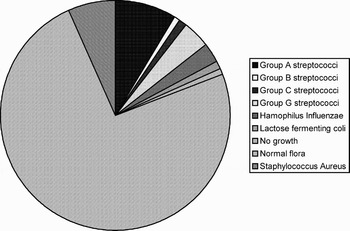
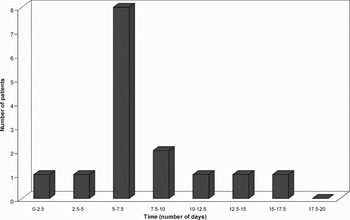
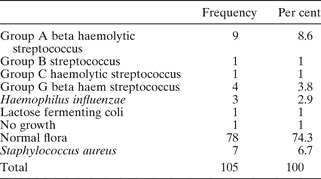
One hundred and five patients were included in the study. Twenty-four point eight per cent of patients had positive pre-operative cultures, with the organisms identified detailed in Figure 1. The full microbiology results are summarised in Table I. The total number of patients who experienced post-tonsillectomy haemorrhage (defined as any amount of fresh or altered blood from the tonsillar fossae) was 14 (13.3 per cent). The median time to bleeding episode was seven days, mean 8.1 days, range 0–16 days (95 per cent confidence intervals [CI] 5.3–9.4 days) (Figure 2). We found that males had a higher bleeding rate than females, 16.2 per cent of males versus 9.1 per cent of females, although this difference was not statistically significant. Operative procedures performed by senior house officers had the highest rates of bleeding at 23.5 per cent, followed by registrars with a bleeding rate of 9 per cent, while none of the five patients who were operated on by consultants bled again. Statistically this difference was significant (p = 0.009). Similarly, analysis of the patients' ages showed that those who bled tended to be older (median age 17 in the haemorrhage group versus six in the non-haemorrhage group), although the difference was not statistically significant.
Details of microbiology – percentage of microbials identified.

Time interval to post-tonsillectomy haemorrhage.

Pre-operative microbiology results

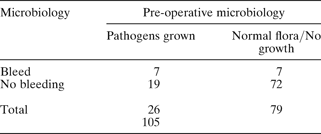
A comparison of all the patients with growth of pathogenic bacteria, versus those with normal flora or no bacteria, showed that there is a consistent pattern of increased bleeding associated with colonisation of the tonsillar fossae (Table II).
Correlation of pre-operative microbiology with bleeding

p = 0.04 Fisher's exact test
We found that a pre-operative swab which showed normal flora or no bacterial growth was associated with an 8.8 per cent chance of bleeding versus a 26.9 per cent chance of bleeding with pathogen growth, and this finding was statistically significant (odds ratio; 3.8, 1.1 to 12.1, 95 per cent CI, p = 0.04). The different bleeding rates varied depending on which bacteria had been cultured: four out of the nine patients with Group A streptococci returned with a post-tonsillectomy bleed, while one of the four patients with Group G streptococci bled, compared with only seven out of 72 patients with no growth or normal flora. The risk of bleeding was highest when the tonsillar fossa was colonised with haemolytic streptococci. The range of flora isolated from the oropharynx included Lancefield groups A, B, C and G streptococci, Staphylococcus aureus and Haemophilus influenzae.
Discussion
Many potential risk factors in post-tonsillectomy haemorrhage have been assessed including the use of local anaesthesia, pre-operative abnormalities in blood pressure or clotting,Reference Tami, Parker and Taylor10 the role of age, gender and indication for surgery,Reference Bhattacharyya11 and even whether redheads are more commonly affected, or higher rates seen on Friday the 13th.Reference Kumar, Kumar and Isaacson12 None of these associations were shown to be positive. It has been shown that the use of bipolar diathermy can increase the rate of post-tonsillectomy haemorrhage, with rates three times higher observed than when using traditional cold steel techniques. The observation of a dose-response relation suggests that the extent to which diathermy is used is linked with the amount of damage to surrounding tissues, and therefore to the rate of secondary haemorrhage.Reference Van der Muelen13 Although no clear link has been shown between positive tonsillar microbiology and post-operative tonsillectomy haemorrhage, infection is widely accepted to play a role in the pathogenesis. Patients presenting to hospital with post-tonsillectomy bleeds are usually admitted and treated with intravenous antibiotics and this combined with a period of observation is frequently adequate intervention. Previous studies have shown that tonsillar tissue contains pathogenic bacteria,Reference Stjernquist-Desatnik and Holst14 and that during tonsillectomy a transient bacteraemia occurs in as many as 27 per cent via the breach in oropharyngeal mucosa,Reference Gaffney, Freeman, Walshy and Cafferkey3, Reference Yuldririm, Okur, Ciragil, Aral, Kilic and Gul15 but as this bacteraemia is short lived the use of prophylactic antibiotics is unnecessary unless the risk of metastatic infection is high.Reference Gaffney, Freeman, Walshy and Cafferkey3, Reference Yuldririm, Okur, Ciragil, Aral, Kilic and Gul15
The results in this study showed that the rate of bleeding throughout the entire cohort appears to be high at 13.3 per cent. This is due to the fact that all bleeding episodes were reported, including those which were minor and did not require hospital admission. This result is in keeping with the published series using a similar definition of post-operative bleeding, where bleeding rates as high as 20 per cent have been reported.Reference Myssiorek and Alvi1 Our study identified an increased rate of bleeding in both males and with increasing age. Although neither of these findings were statistically significant, they reflect the findings of the National Prospective Tonsillectomy Audit, which showed a statistically significant difference in both categories.9 The increased rate of bleeding in tonsillectomies performed by trainees has been considered, and was thought to be due to increased use of diathermy during the procedure. Although the numbers were small, this has been useful in reassessing the training and supervision required during the performance of this common procedure.
The second point of interest is the diverse range of bacteria which were identified from the tonsils and tonsillar beds. Previous research has found the commonest bacteria isolated were Haemophilus influenzae, Staphylococcus aureus and mixed anaerobes. Our data isolated Lancefield groups A, B, C & G streptococci and lactose fermenting coliforms as well as those mentioned above. The organisms seen most frequently were streptococci, including the beta haemolytic streptococci which comprised 63 per cent of the total. This was helpful in guiding the choice of antibiotics in the treatment of post-tonsillectomy infection or bleeding.
Trials assessing the effect of antibiotics post-tonsillectomy have not demonstrated a significant reduction in complications. This may be due to the diverse range of bacteria present and resistance to the commonly prescribed antimicrobials, which in most studies tended to be amoxicillin or erythromycin. These data show the frequent presence of bacteria which are resistant to amoxicillin via the virulence factor beta lactamase, i.e. the beta haemolytic streptococci, and suggest it would be more appropriate to use an antibiotic which contains clavulanic acid such as co-amoxiclav (Augmentin).
• Treatment of post-tonsillectomy haemorrhage often involves hospital admission and intravenous antibiotics
• However, there are no published data to show that infection is related to post-tonsillectomy haemorrhage
• One hundred and five patients underwent tonsillectomy and had microbiological sampling of their tonsils pre-operatively
• Twenty-four per cent of these patients had positive cultures from their tonsils
• Bacterial colonisation of the tonsil pre-operatively increases the post-tonsillectomy bleeding rate by more than three times (p = 0.04)
However, the most important finding was that bacterial colonisation of the tonsil in the pre-operative period increases the bleeding rate by more than three times, an increase that was statistically significant despite our small sample. Although it would be tempting to assume that eradication of pathogens would be associated with reduced bleeding rates, it remains to be proven. However, our study could potentially explain the divergent results of studies which assessed the efficacy of prophylactic antibiotics in preventing post-tonsillectomy bleeding. If one assumed that antibiotics were effective prophylactically only in patients with positive cultures, then their overall effectiveness would be dependent on the incidence of colonisation. In studies containing only a small number of patients with colonised tonsillar fossae their effectiveness would be diluted and not demonstrable. Thus, we do not feel that one could suggest routinely sterilising the tonsillar fossae pre-operatively as the number needed to treat to avoid an episode of bleeding would be extremely large. However, it may be a viable solution to prescribe antibiotics for patients with positive microbiology pre-operatively, although this would require all patients to undergo microbiological sampling, and this is also a significant undertaking. Further trials may be useful in assessing the viability of this proposition as well as its cost effectiveness.
Potential limitations of the study
We were not able to control for potential sources of bias within the confines of this study, for example use of other prescribed medications, including medications which predispose to bleeding – although all patients with a bleeding tendency were excluded from the study. We were also unable to control for exercise regimes and activities post-operatively, and had we done so it may have strengthened our findings.
Conclusion
This prospective study has found a statistically significant relationship between bacterial colonisation of the tonsillar fossa and post-tonsillectomy haemorrhage. This suggests there may be an argument for the use of antibiotics in those cases with positive pre-operative cultures. In view of the types of pathogens isolated, we feel that the management of a post-tonsillectomy bleed should include a beta lactamase inhibiting antibiotic.