INTRODUCTION
The exceptionally high sea surface temperatures of 1998, the warmest year in the 20th Century and the strongest El Niño event ever recorded, caused severe coral bleaching and extensive coral mass mortality, especially in the Indian Ocean (Wilkinson et al., Reference Wilkinson, Linden, Cesar, Hodgson and Strong1999). The reefs of the Maldives, in particular, suffered one of the highest mortality rates ever recorded (McClanahan, Reference McClanahan2000).
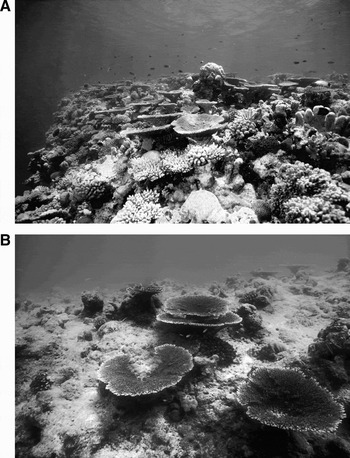
The coral communities of the Maldives have been investigated only irregularly after the pioneer studies made in 1958 during the ‘Xarifa’ expedition (Wallace & Zahir, Reference Wallace and Zahir2007); however, tabular Acropora, mainly represented by A. hyacinthus (Dana, 1846), were known to be abundant between 3 and 15 m depth in both lagoon and ocean reefs before the bleaching event (Ciarapica & Passeri, Reference Ciarapica and Passeri1993; Bianchi et al., Reference Bianchi, Colantoni, Geister, Morri, Lessios and Macintyre1997), determining a well developed reef 3D structure with their robust horizontal tables up to more than 1.5 m in diameter (Figure 1A). Being highly susceptible to bleaching (Marshall & Baird, Reference Marshall and Baird2000), they suffered mortality of whole colonies with rates of around 90% (Bianchi et al., Reference Bianchi, Morri, Pichon, Benzoni, Colantoni, Baldelli, Sandrini, Suzuki, Nakamori, Hidaka, Kayanne, Casareto, Nadaoka, Yamano and Tsuchiya2006a), leading to their virtual disappearance from Maldivian reefs (Schuhmacher et al., Reference Schuhmacher, Loch, Loch and See2005). Recovery started soon, however, and new colonies up to 14 cm tall were observed one year later (Bianchi et al., Reference Bianchi, Pichon, Morri, Colantoni, Benzoni, Baldelli and Sandrini2006b). Field observations from 1999 onward showed increasing presence of tabular Acropora through the years, leading to a cautious optimism about the possibility of a full recovery to the pre-1998 situation (Morri et al., Reference Morri, Bianchi, Colantoni and Sandrini2008; Bianchi et al., Reference Bianchi, Morri, Colantoni and Sandrini2009).
Examples of shallow reef coral communities with tabular Acropora in 1997 (A) and in 2004 (B).

This study aims at quantifying abundance and colony size of tabular Acropora in the Maldives 6 years after the coral mass mortality, analysing differences according to reef typology and depth zones.
MATERIALS AND METHODS
Field activity was carried out during the ‘Albatros Top Boat’ scientific cruise of April 2004 in the two central atolls of South Malé and Ari.
Data were collected by SCUBA diving in three depth zones, namely 4–6 m, 10–12 m and 16–18 m, in six randomly selected sites belonging to two reef typologies: ocean reefs and lagoon reefs. Three replicate 40 m2 (20 m × 2 m) belt transects (Bianchi et al., Reference Bianchi, Pronzato, Cattaneo-Vietti, Benedetti Cecchi, Morri, Pansini, Chemello, Milazzo, Fraschetti, Terlizzi, Peirano, Salvati, Benzoni, Calcinai, Cerrano and Bavestrello2004) were randomly laid in each depth zone, totalling 54 belt transects. The abundance and diameter of tabular Acropora colonies were recorded within each belt transect; diameters were measured to the nearest cm, and only colonies with diameter equal or greater than 16 cm were taken into account. According to Stimson (Reference Stimson1985) and Sheppard et al. (Reference Sheppard, Harris and Sheppard2008), colonies of tabular Acropora bigger than 15 cm stabilize their radial extension at a nearly constant rate of 10 cm · yr−1, irrespective of reef type and depth. We therefore arranged size data into 10 cm size-classes to draw size–frequency distribution diagrams.
A three-way ANOVA was used to explore the variability in the abundance of tabular Acropora between reef typologies (two level fixed factor), among sites (three level random factor, nested within typologies) and among depth zones (three level fixed and orthogonal factor). Prior to the analysis, Cochran's test was performed to verify the assumption of variance homogeneity. The Student–Newman–Keuls (SNK) test was applied a posteriori to significant differences.
A two-way unbalanced ANOVA with reef typologies and depth zones as fixed factors was used to compare Acropora colony sizes. Prior to the analysis, Levene's test was performed to verify the assumption of variance homogeneity, and log(x) transformation was applied. Tukey's test was applied a posteriori to significant differences.
RESULTS
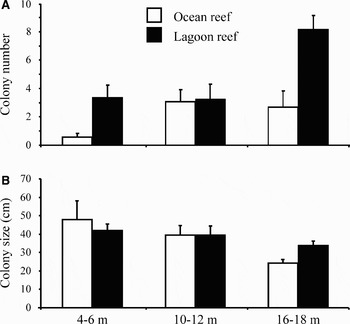
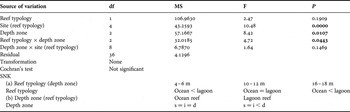
A total of 192 colonies of tabular Acropora was counted in 2160 m2 of belt transects: 58 colonies (30.2%) were found in ocean reef sites, 134 (69.8%) in lagoon reef sites. The smallest number of colonies was found in shallow ocean reefs, the greatest in deep lagoon reefs (Figure 2A). A significant interaction (P < 0.05) between reef typologies and depth zones was found (Table 1). A common pattern was evidenced between reef typologies at 4–6 m and 16–18 m, although values in ocean reefs were lower than in lagoon reefs; no significant difference between reef typologies was found at 10–12 m. No significant difference was found in ocean reefs among depth zones, whereas in lagoon reefs tabular Acropora abundance was significantly higher at 16–18 m than at 4–6 m and 10–12 m, the latter two depth zones being not significantly different.
Colony number (A) and size (B) of tabular Acropora in the three depth zones and the two reef typologies (ocean and lagoon reefs) (mean + SE).

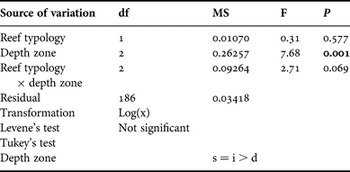
Three-way ANOVA on Acropora abundance in the two reef typologies (ocean and lagoon reefs) and the three depth zones (s = 4–6 m, i = 10–12 m, d = 16–18 m). Bold numbers indicate P < 0.05. SNK, Student–Newman–Keuls test.

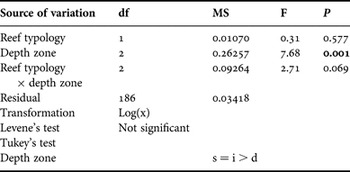
Diameter of tabular Acropora colonies varied from 25.0 ± 1.5 cm to 47.0 ± 11.2 cm, with the largest sizes in shallow ocean reefs, and the smallest in deep ocean reefs (Figure 2B). Significant differences (P < 0.001) were found among depth zones but not between reef typologies (Table 2). Acropora colonies at 16–18 m were significantly smaller than those at the two shallower depth zones.
Two-way ANOVA on Acropora colony size in the two reef typologies (ocean and lagoon reefs) and the three depth zones (s = 4–6 m, i = 10–12 m, d = 16–18 m). Bold number indicates P < 0.05.
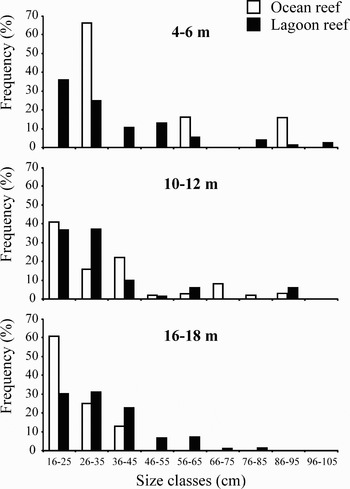
Size–frequency distributions showed a preponderance of colonies (about 60% in ocean reefs and 70% in lagoon reefs) in the two smallest size-classes (16 to 35 cm). Patterns in the two reef typologies were different, especially at 16–18 m where ocean reefs had no tabular Acropora colonies larger than 45 cm (Figure 3).
Size–frequency distribution of tabular Acropora in the three depth zones and the two reef typologies (ocean and lagoon reefs).

DISCUSSION
The 1998 bleaching event in the Maldives caused total mortality of branching coral colonies (primarily Acropora and Pocillopora), and partial mortality of massive coral colonies (e.g. Porites and Diploastrea). Millepora had completely disappeared, while Heliopora was not affected (Loch et al., Reference Loch, Loch, Schuhmacher and See2002; Bianchi et al., Reference Bianchi, Morri, Pichon, Benzoni, Colantoni, Baldelli, Sandrini, Suzuki, Nakamori, Hidaka, Kayanne, Casareto, Nadaoka, Yamano and Tsuchiya2006a, Reference Bianchi, Pichon, Morri, Colantoni, Benzoni, Baldelli and Sandrinib). The catastrophic coral mass mortality of 1998 led to the nearly complete disappearance of the tabular Acropora colonies from the Maldivian reefs (Loch et al., Reference Loch, Loch, Schuhmacher and See2002, Reference Loch, Loch, Schuhmacher and See2004). Their renewed occurrence was already observed in 2002 by Pichon & Benzoni (Reference Pichon and Benzoni2007). Tabular Acropora colonies are known to grow rapidly and to be able to outcompete neighbouring corals, two features that facilitate their recovery after a disturbance (Baird & Hughes, Reference Baird and Hughes2000 and references therein). The present study shows that tabular Acropora colonies were again conspicuous in 2004, although their numbers were still reduced with respect to the situation prior to 1998. Scarce in shallow ocean reefs, where physical disturbance by oceanic waves limits coral cover (Lasagna et al., Reference Lasagna, Albertelli, Giovannetti, Grondona, Milani, Morri and Bianchi2008), they were abundant in the quiet water of lagoon reefs (Figure 1B). As other corals recovered comparatively less, the original complexity of the coral community 3D structure was only partially reconstructed (Lasagna et al., Reference Lasagna, Albertelli, Colantoni, Morri and Bianchi2010).
Where did these tabular Acropora colonies come from? Newly settled colonies up to 14 cm tall were observed as early as 1999 (Bianchi et al., Reference Bianchi, Pichon, Morri, Colantoni, Benzoni, Baldelli and Sandrini2006b). Assuming a radial extension rate of 10 cm · yr−1 (Stimson, Reference Stimson1985; Sheppard et al., Reference Sheppard, Harris and Sheppard2008), they should have reached nearly 65 cm in 2004. A small number of colonies in 2004 were nevertheless larger, a few reaching 105 cm. This raises the possibility that the largest colonies in 2004 were the survivors of the mass mortality of 1998, which caused the death of around 90% of the branching corals (including tabular Acropora), especially in shallow waters (Bianchi et al., Reference Bianchi, Morri, Pichon, Benzoni, Colantoni, Baldelli, Sandrini, Suzuki, Nakamori, Hidaka, Kayanne, Casareto, Nadaoka, Yamano and Tsuchiya2006a) and in the lagoon (Longo et al., Reference Longo, De Mandato, Piscitelli and Corriero2000). However, the fact that none of these largest colonies showed significant signs of damage suggests another possibility, not necessarily alternative to the first: yearly growth rates in such uncrowded situations as those in the aftermath of the 1998 mass mortality may have exceeded 10 cm · yr−1, to reach 105 cm in only 6 years. From experiences with coral transplants, tabular Acropora are known to be able to grow to a rate greater than 20 cm · yr−1 (Yap et al., Reference Yap, Alino and Gomez1992). The underlying hypothesis that radial extension rates of tabular Acropora corals under conditions of recovery may be higher than in normally crowded situations may be important to predict coral reef resilience after major disturbances and deserves further investigations.
ACKNOWLEDGEMENTS
The ‘Albatros Top Boat’ (Verbania and Malé) organized our scientific cruise in the Maldives: we especially thank Donatella ‘Dodi’ Telli and Massimo Sandrini for their support. Our thanks also go to Elisa Giovannetti and Valeriano Parravicini (University of Genoa) for advice on the statistical analyses.