Introduction
Alzheimer's disease (AD) is associated with a central cholinergic deficit which is thought to be responsible for many of the clinical symptoms of the disease (Perry et al., Reference Perry, Perry, Blessed and Tomlinson1978). Cholinesterase inhibitors (ChEIs) act by inhibiting the enzymes (acetyl- and butyrylcholinesterase) which degrade acetylcholine, hence increasing its availability in the synaptic cleft. They represent the mainstay of symptomatic treatment in AD. Three medications belonging to this class are currently widely available and are approved for the symptomatic treatment of AD: donepezil, rivastigmine, and galantamine. Switching ChEIs represents a reasonable clinical option for individuals who do not tolerate or who do not seem to benefit from the initial agent. This paper reviews the most recent studies of ChEI switching and discusses their clinical implications. It reviews the recommendations of recent consensus guidelines on switching ChEIs. Finally, it proposes a practical approach to switching ChEIs, including indications and modalities.
Rationale for switching ChEIs
Even though the three available ChEIs belong to the same general class, they have individual pharmacological particularities as well as pharmacokinetic and pharmacodynamic properties that make them distinct. This is the main rationale for switching ChEIs. Typically, ChEIs show a dose-dependant clinical response on cognitive and functional measures of dementia, but to a lesser extent on behavioural manifestations of the disease. This is thought to be related to a differential nonlinear relationship between doses of the medications and cholinesterase inhibition (Jann et al., Reference Jann, Shirley and Small2002).
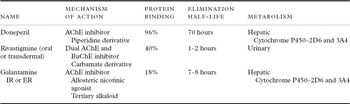
Donepezil is a piperidine derivative that reversibly inhibits acetylcholinesterase. It has the longest elimination half-life at 70 hours, strongly binds to proteins, and is metabolized by isoenzyme 2D6 and 3A4 of cytochrome P450 (Seltzer, Reference Seltzer2007).
Rivastigmine is a carbamate derivative that reversibly inhibits both acetyl- (AChE) and butyryl- (BuChE) cholinesterase (Onor et al., Reference Onor, Trevisiol and Aguglia2007). It is the only ChEI with a significant dual inhibition of cholinesterases. Studies show that BuChE is mainly found in regions of the brain significantly affected by AD pathology (Darvesh et al., Reference Darvesh, Hopkins and Geula2003). Pathological data show that concentrations of BuChE increase whereas those of AChE decrease with progression of dementia (Perry et al., Reference Perry, Perry, Blessed and Tomlinson1978). Long-term treatment with rivastigmine is associated with sustained inhibition of both AChE and BuChE, suggesting possible persistent clinical benefit overtime (Darreh-Shori et al., Reference Darreh-Shori2002). Similar studies with donepezil and galantamine reveal an increase of cholinesterases overtime which is thought to be due to enzymatic up-regulation and has been proposed as a potential explanation for eventual loss of clinical benefit with time (Davidsson et al., Reference Davidsson, Blennow, Andreasen, Eriksson, Minthon and Hesse2001). The exact clinical significance of these properties of rivastigmine is unclear. Rivastigmine is available both in oral and transdermal forms, the latter being associated with better gastrointestinal tolerability. It has a short elimination half-life of approximately 1 to 2 hours, and binds to proteins in a proportion of 40%. It is hydrolyzed by esterases (including cholinesterases), and is excreted in the urine. This minimizes the risks of drug-drug interactions with agents metabolized by cytochrome P450 isoenzymes.
Galantamine is a tertiary alkaloid agent that reversibly inhibits AChE (Robinson and Plosker, Reference Robinson and Plosker2006). It also enhances cholinergic function by allosterically binding to nicotinic receptors. Again, the exact clinical significance of this property remains unclear. Galantamine is available in immediate release (IR) or extended release (ER) forms, the latter allowing once-daily dosing. It has an elimination half-life of between 7 and 8 hours, and binds to plasma proteins in a proportion of 18%. It is metabolized by isoenzyme 2D6 and 3A4 of cytochrome P450. Table 1 summarizes the pharmacological properties of these three ChEIs.
Pharmacological properties of cholinesterase inhibitors

AChE = acetylcholinesterase; BuChE = butyrylcholinesterase; IR = immediate release; ER = extended release.
Indications for switching ChEIs
Switching ChEIs may be considered because of intolerance or lack (or loss) of benefit. In the EXTEND Study (EXelon Therapy to Enhance Normal Daily Living in Alzheimer Disease) (Gauthier et al., Reference Gauthier, Juby, Morelli, Rehel and Schecter2006), intolerance was divided into “early” and “late”. Early intolerance is characterized by the typical gastrointestinal cholinergic adverse events (anorexia, nausea, vomiting, and diarrhoea), and occurs at initiation of therapy and at dose escalation. Late intolerance included arrhythmia (especially bradycardia), insomnia, muscle cramps, weight loss, etc.
Unsatisfactory response to ChEIs can be divided into lack of efficacy and loss of efficacy. In clinical studies, this is determined by patients' response on clinical outcome measures that evaluate the different domains affected by dementia. For example, the cognitive domain is usually evaluated by the Alzheimer's Disease Assessment Scale – Cognitive portion (ADAS-Cog), and global clinical response by the Clinician's Interview-Based Impression of Change (CIBIC) or the Clinician Global Impression of Change (CGIC). In randomized and controlled clinical trials, clinical response (or lack of it) is determined by the difference in patients' performance on these scales in the treatment and placebo arms. Typically, clinical trials in mild to moderate AD show mild cognitive improvement or stabilization for 9 to 12 months, and for 3 to 6 months on measures of global impression. Measures of functional autonomy usually show stabilization for up to six months (Massoud and Gauthier, Reference Massoud and Gauthier2010).
In clinical practice, the judgment as to the response to treatment relies greatly on the expectations that patients, their families and their prescribing physician have with this class of medications. It should be kept in mind that ChEIs are symptomatic agents that are indicated for a degenerative and otherwise progressive condition. Hence, mild improvement or stabilization is considered an appropriate and realistic goal with these medications. Long-term clinical trials and open label extensions of some studies suggest slower deterioration in patients taking ChEIs versus the projected course on placebo (Rogers et al., Reference Rogers, Doody, Pratt and Ieni2000; Mohs et al., Reference Mohs2001). This is much more difficult to establish (and harder to convey to patients and their caregivers) in clinical practice, in a deteriorating patient, and in the absence of a placebo comparator. Most clinicians would agree that a trial of at least six months with a ChEI is necessary to establish if there is a clinical response. Significant deterioration during that period of time constitutes a reasonable justification for switching ChEIs for “lack of efficacy”. Beyond six months, deterioration constitutes “loss of efficacy” and may be considered by some clinicians as an indication for switching ChEIs (see section on practical recommendations). In the EXTEND study, “lack of efficacy” was established in patients after the initial six months. “Loss of efficacy” was considered in patients with an unsatisfactory response beyond six months, but no longer than 18 months of treatment.
Clinical studies of switching ChEIs
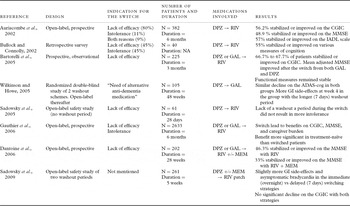
The eight studies that have specifically evaluated switching ChEIs are summarized in Table 2. All of these studies were open-label or retrospective. They all included patients in the mild to moderate stages of AD. The number of patients included varies between 40 and 2633. The indication for switching was unsatisfactory response in three studies (Bartorelli et al., Reference Bartorelli2005; Sadowsky et al., Reference Sadowsky2005; Dantoine et al., Reference Dantoine, Auriacombe, Sarazin, Becker, Pere and Bourdeix2006), unsatisfactory response or intolerance in three studies (Auriacombe et al., Reference Auriacombe, Pere, Loria-Kanza and Vellas2002; Bullock and Connolly, Reference Bullock and Connolly2002; Gauthier et al., Reference Gauthier, Juby, Morelli, Rehel and Schecter2006), and not mentioned in two studies (Wilkinson and Howe, Reference Wilkinson and Howe2005; Sadowsky et al., Reference Sadowsky, Dengiz, Olin, Koumaras, Meng and Brannan2009). Details of these criteria are only available from three studies, the others relying on “unsatisfactory response or intolerance” as judged by treating physicians. The study by Auriacombe et al. (Reference Auriacombe, Pere, Loria-Kanza and Vellas2002) considered lack of response as a decrease in Mini-mental State Examination (MMSE) scores of at least two points within the last 12 months of donepezil treatment as well as a significant deterioration in functional autonomy. Similar criteria were used in the study by Sadowsky et al. (Reference Sadowsky2005). In the study by Bartorelli et al. (Reference Bartorelli2005) similar clinical criteria were used to determine lack of response but within the last six months of ChEI treatment. Lack of tolerability is specifically defined in only one study as intolerance of donepezil at 5 mg or 10 mg daily (Auriacombe et al., Reference Auriacombe, Pere, Loria-Kanza and Vellas2002). We can probably assume that intolerance in most other studies required the presence of significant side effects with the medications making sustained treatment difficult or impossible. All but one study evaluated switching to rivastigmine. One study evaluated switching to galantamine. One study included both naïve and patients with previous ChEI treatment (Gauthier et al., Reference Gauthier, Juby, Morelli, Rehel and Schecter2006). Duration of initial ChEI use before the switch varied greatly from less than 12 weeks in one study, to a mean of 29 months with wide intervals in another. In terms of endpoints, six studies evaluated both the clinical benefit and tolerance of the switch, whereas two studies were specifically designed to assess safety and tolerability. These studies cannot be readily compared because of heterogeneity in design, number of patients, agents used, and endpoints. However, some observations emerge from their qualitative analysis. With the exception of the study by Wilkinson and Howe (Reference Wilkinson and Howe2005), which included patients on treatment for fewer than 12 weeks, and the study by Bullock and Connolly (Reference Bullock and Connolly2002) which does not mention duration of use, all other studies assessing efficacy included individuals initially treated for six months or longer. Therefore, switching in most of these studies was done for both “lack of benefit” or “loss of response” after up to 29 months of treatment. Nevertheless, the majority of these studies did not include individuals switched for lack of response after several years of treatment. In general, global evaluations, cognitive and functional measures show stabilization or improvement in more than 50% of switched patients for unsatisfactory response. In one study including both naïve and switched patients, the benefits were more significant in the former group (Gauthier et al., Reference Gauthier, Juby, Morelli, Rehel and Schecter2006). One study shows that switching led to a reduction or discontinuation of psychotropic agents (Bartorelli et al., Reference Bartorelli2005). More than 50% of individuals switched for intolerance were able to tolerate the second agent. Hence, lack of satisfactory response or intolerance with the initial agent was not predictive of similar results with the second agent. Nevertheless, the open design of all these studies could have significantly influenced clinical ratings.
Studies of switching cholinesterase inhibitors in Alzheimer's disease

DPZ = donepezil; GAL = galantamine; RIV = rivastigmine; MEM = memantine; MMSE = Mini-mental State Examination; CGIC = Clinician Global Impression of Change; IADL = Instrumental Activities of Daily Living; ADAS-cog = Alzheimer's Disease Assessment Scale-cognitive portion; GI = gastrointestinal.
The duration of time to initiation of the second agent varied between studies from overnight to several weeks. In all studies including patients switched because of intolerance, initiation of the second agent was delayed at least until side effects resolved. Two studies specifically evaluated different washout schemes before the switch. In the study by Sadowsky et al. (Reference Sadowsky, Dengiz, Olin, Koumaras, Meng and Brannan2009), an immediate (overnight) switch to rivastigmine patch led to slightly more asymptomatic bradycardia and gastrointestinal side-effects than a delayed (7 days) switch. In the study by Wilkinson and Howe (Reference Wilkinson and Howe2005), individuals with a longer washout period (7 days versus 4 days) before the switch had surprisingly more gastrointestinal side-effects four weeks later. The authors hypothesized that AChE levels may have decreased during the longer washout period in these individuals exposing them to a more significant subsequent rise and more side effects.
How common is switching ChEIs?
Several recently published drug utilization studies of ChEIs shed some light on the prevalence of switching agents in real-life settings. A study evaluating drug utilization of ChEIs between 2000 and 2002 in 28,961 Ontario residents (including 4601 nursing home patients) showed that switching ChEIs occurred in 6% of cases (Herrmann et al., Reference Herrmann2007). A similar study by the same group including 5622 Ontario ChEI users residing in the community in 2006 shows that switching occurred in 21.9% of donepezil users, 40.5% of rivastigmine users, and 32.3% of galantamine users (Herrmann et al., Reference Herrmann, Binder, Dalziel, Smyth and Camacho2009). A community-based drug utilization review of ChEIs in Quebec including 18,748 individuals between 2001 and 2003 shows that switching took place in 10% of donepezil users, 11.7% of rivastigmine users, and 5% of galantamine users (F. Massoud et al., unpublished data). A nationwide American study of nursing home residents including 2873 individuals between 2001 and 2003 shows that switching occurred in 3.3% of donepezil users, 4.7% of rivastigmine users, and 2% of galantamine users (Dybicz et al., Reference Dybicz, Keohane, Erwin, McRae and Shah2006). Another American study of 3177 Medicare beneficiaries between 2001 and 2003 showed that switching occurred in 14.5% of donepezil users, 21.5% of rivastigmine users, and 15% of galantamine users (Mucha et al., Reference Mucha, Shaohung, Cuffel, McRae, Mark and Del2008). Finally, in a recent French multicenter two-year cohort study of 686 ambulatory patients with mild-to-moderate Alzheimer's disease, the switch incidence rate was 9.2 per 100 person-years amongst the 611 subjects treated with a cholinesterase inhibitor at baseline (Gardette et al., Reference Gardette2010). In this study, ineffective cholinesterase inhibitor dose, rapid cognitive decline, hospitalization unrelated to Alzheimer's disease and anxiety score ≥4 on the Neuropsychiatric Inventory were independently associated with switching. In summary, even though several trials seem to support ChEI switching as a clinical option in some individuals with AD, this practice remains relatively marginal since it takes place in less than a third of patients in most studies.
Published guidelines on switching ChEIs
Few consensus guidelines have made specific recommendations about switching ChEIs. The Third Canadian Consensus Conference on the Diagnosis and Treatment of Dementia published in 2007 concludes that “a number of studies have shown that it is possible to switch from one ChEI to another . . . Unfortunately, these studies do not tell us when we should switch” (Hogan et al., Reference Hogan2007). A consensus statement from the British Association for Psychopharmacology states that there is “type 2b evidence to support the switching of one cholinesterase to another if the first is not tolerated or ineffective” (Burns et al., Reference Burns2006) without suggesting specific criteria for determination of intolerance or effectiveness. Hence, these sets of guidelines agree on switching ChEIs as a reasonable clinical option, but they do not make any specific recommendations as to whom and how to switch. This general lack of specifics is explained, at least in part, by the methodological weaknesses of all published studies on switching ChEIs (lack of randomization or blinding, limited numbers of patients, heterogeneity in indications and outcomes, etc.).
Practical recommendations on switching ChEIs
The following practical recommendations are based on the qualitative analysis of published trials, and on the authors' experience in switching ChEIs. Before switching is considered, clinicians should make sure that there are no problems with compliance and that dose adjustments have been tried. In the case of unsatisfactory response or deterioration, concomitant medical conditions, such as delirium or depression, and the initiation of inappropriate medications should be ruled out.
In the case of intolerance, switching to a second ChEI should not be tried before complete resolution of side-effects after discontinuation of the initial agent. The second ChEI can then be initiated at the usual starting dose and increased according to the recommended titration scheme, by periods of no less than four weeks. When considered for lack of benefit, switching ChEIs can be done overnight. We consider lack of benefit as an unsatisfactory response within the first year of treatment. In three clinical studies, this was established by a decline of at least 2 points on the MMSE, as well as a documented deterioration in functional autonomy, global impression or behavior within the previous 6–12 months of ChEI treatment. In our opinion, these criteria merely serve as a guide and cannot replace the clinical judgment of individual treating physicians which remains paramount in determining response to treatment. We usually initiate the second ChEI at the recommended starting dose, but titrate more rapidly (two-week intervals) until the minimal therapeutic dose is reached, to avoid clinical deterioration due to sub-optimal cholinesterase inhibition during the switch. We do not usually recommend switching for loss of benefit, especially if the patient has been taking the initial ChEI for several years. In our experience, “loss of benefit” in this case is due to the natural course of the disease which is most evident during the transition from mild to moderate, or moderate to severe stages. Switching to another ChEI in this context is most often disappointing. We believe that the best approach for these individuals would be adding memantine to the ChEI. This recommendation is both evidence-based (Tariot et al., Reference Tariot, Farlow, Grossberg, Graham, McDonald and Gergel2004) and “practice-based”, and seems to be most successful in patients who start to display behavioral symptoms of the disease such as agitation.
Conclusions
The individual pharmacological properties of ChEIs make switching a valid clinical option for patients with AD who do not tolerate or respond unsatisfactorily to the initial agent. We recommend switching for intolerance or lack of benefit from the first agent. We do not usually recommend switching for loss of response with the initial ChEI beyond one year of use as this is most often due to the natural course of the disease.
Conflict of interest declaration
Fadi Massoud and Serge Gauthier have received speaker's honoraria, consultant fees, and/or research support from Pfizer, Janssen Ortho Inc., Novartis and Lundbeck.
Description of authors' roles
Fadi Massoud and Serge Gauthier designed the review, analyzed the literature search, and participated in writing the preliminary and final drafts of the paper. Julie Desmarais designed the review, analyzed the literature search, and participated in writing the final draft of the paper.