Introduction
It is essential for the production of genetically engineered mutant mice to maintain the pluripotency of mouse embryonic stem (ES) cells. If pluripotency decreases or disappears completely, then the application of those ES cells will be greatly restricted. Despite the importance of maintaining ES pluripotency, the mechanisms governing it are poorly understood, although are recognized to be complex (Brown et al., Reference Brown, Willington, Findlay and Muggleton-Harris1992; Liu et al., Reference Liu, Wu, Loring, Hormuzdi, Disteche, Bornstein and Jaenischm1997). Rigorous procedures are currently undertaken to ensure the maintenance of ES cell pluripotency and germline transmission capability, including ES cell culture under optimal conditions, such as being grown on a fibroblast feeder layer or in suitable batch-tested serum (Elder et al., Reference Elder, Jansen, Weeks, Willington, Deans, Watson, Mynett, Bailey, Cooper, Rafferty, Heeran, Wijnhoven, van Zeeland and Margison1998; Akiyama et al., Reference Akiyama, Sakai, Lambert, Nicol, Matsusue, Pimprale, Lee, Ricote, Glass, Brewer and Gonzalez2002; Harris et al., Reference Harris, Bartley, Hacker, McDonald, Douglas, Greaser, Powers and Moss2002).
With regards to the latter point, the variable quality of serum between different batches of culture medium means that batch-testing is required; a time-consuming procedure complicated by the fact that well defined conditions for ES cell culture are lacking. The ideal solution to this problem is the culture of ES cells in synthetic serum, which can provide fully defined growth conditions, thereby greatly reducing the time required for ES cell culture, while maintaining efficient chimera production and germline transmission (Ward et al., Reference Ward, Stern, Willington and Flenniken2002). Recently, several groups have reported that the use of inhibitors of some signal transduction pathways could significantly improve both the derivation of new ES cell lines, including those from C57BL/6 mice, and their subsequent potential to contribute to chimeric mice and germline transmission (Chen et al., Reference Chen, Hilcove and Ding2006; Ying et al., Reference Ying, Wray, Nichols, Batlle-Morera, Doble, Woodgett, Cohen and Smith2008; Kiyonari et al., 2010). These studies established that KOSR + 2i media enabled highly efficient generation of germline transmitting chimeras from targeted C57BL/6-derived ES cells.
Previous studies have demonstrated that the efficiency of the establishment of ES cell lines is different among different mouse strains; however, no research has been conducted to systematically compare the pluripotency of ES cell lines that are derived from different strains of mice (Kawase et al., Reference Kawase, Suemori, Takahashi, Okazaki, Hashimoto and Nakatsuji1994). With this in mind, in the present study we have compared the differences in germline transmission between ES cells derived from 129 mice (E14) and ES cells derived from C57BL/6J-Tyrc-2J mice (C2J), cultured in KOSR + 2i medium. We successfully produced healthy mouse chimeras by using C2J and E14 ES cells with transmission to the germline; however, we believe that C2J cells are a superior model because they have the same genetic backgrounds as the C57BL/6J host embryos.
Materials and methods
Ethics statement
Mice were maintained and used for experiments according to the ethical permit issued by the Animal Care guidelines for Use of Animals of Department of Laboratory Animal Sciences, Shanghai Jiao Tong University School of Medicine.
Animals
C57BL/6J mice were used as embryo hosts for ES cell injection, and CD-1 females were used as pseudopregnant recipients. Animals were maintained on a 12 h light/dark cycle and provided with food and water ad libitum, in individually ventilated units in the specific-pathogen-free facility of the Laboratory Animal Sciences, Shanghai Jiao Tong University School of Medicine, China.
ES cell culture
E14 (Thompson et al., Reference Thompson, Clarke, Pow, Hooper and Melton1989) and C2J (Millipore, Billerica, MA, USA) ES cells were routinely grown at 37°C in 95% air and 5% CO2 on mouse embryonic fibroblast feeder layers treated with mitomycin-C (Sigma-Aldrich Co., St Louis, MO, USA). For KOSR + 2i culture, we used Knockout-DMEM (KO-DMEM, Invitrogen, Life Technologies Co., Grand Island, NY, USA) supplemented with 0.1 mM non-essential amino acids, 0.1 mM 2-mercaptoethanol, 4 mM l-glutamine, 100 U/ml penicillin, 100 μg/ml streptomycin, 500 U/ml leukemia inhibitory factor (all from Millipore), 15% KnockOut™ Serum Replacement (Invitrogen), 1 μM of the mitogen-activated protein kinase inhibitor PD 98059 (Cayman Chemical, Ann Arbor, MI, USA) and 3 μM of the glycogen synthase kinase-3 inhibitor BIO (Cayman Chemical).
Chimera generation and evaluation
Blastocyst injection was performed according to Papaioannou's protocol (Papaioannou & Johnson, Reference Papaioannou, Johnson and Joyner2000). Briefly, embryos were collected at embryonic day 3.5 from pregnant C57BL/6J mice which had been superovulated. After ES cell injection, blastocysts were transferred into the uteri of 2.5-days post-coitum pseudopregnant CD-1 females who had been previously mated with vasectomized males. Evaluation of chimera grades were judged by the coat colour of pups aged up to 2 weeks old. For both E14 and C2J ES cell lines, the percentage of chinchilla or white fur on the black coat background was 50% (grade A), 15–50% (grade B), 1–15% (grade C) or <1% (grade D).
Backcross of E14 and C2J chimeras
All chimeras were weaned at 3 weeks of age and used for natural breeding at 4 to 8 weeks. Chimeras were tested for the ability of germline transmission to the next generation by backcrossing with C57BL/6 mice of the opposite gender. For E14 and C2J chimeras, their positive F1 offspring owned chinchilla and white coat colour respectively, allowing easy identification of chimeras with successful germline transmission.
Results
Effects of ES cell difference on chimera production
In order to evaluate the pluripotency of E14 and C2J ES cell lines, both of them were injected into blastocysts of C57BL/6J mice. Two hundred and forty-one blastocysts were injected with E14 ES cells yielding 56 chimeras, and 268 blastocysts were injected with C2J ES cells, yielding 21 chimeras. The phenotype of chimeric mice from the two ES cell lines examined were visually distinct, examples of which are shown in Fig. 1. The grade of chimerism was determined for each ES cell line and the data are summarized in Table 1. Blastocyst injection of E14 ES cells resulted in a 92.8% rate of chimerism, of which 46.4% were grade A, 19.6% were grade B, and 26.8% were grade C. In contrast, blastocyst injection of C2J ES cells resulted in only a 61.9% rate of chimerism, of which 23.8% were grade A, 14.3% were grade B, and 23.8% were grade C. Thus, these data indicate that E14 ES cells have a greater capability to form chimeric mice than C2J ES cells.).
Grading of chimeras generated from E14 and C2J ES cells

Result of backcrossing E14 and C2J chimeric mice
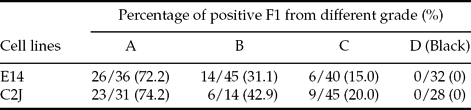
All of the chimeric mice generated from E14 and C2J ES cells were mated with C57BL/6J mice to check the rate of germline transmission, and to compare this rate between the two ES cell lines. As summarized in Table 2, the result of this backcrossing experiment revealed that the percentage of positive F1 mice from grade A C2J chimeras was almost identical to that from grade A E14 chimeras (74.2 versus 72.2%, respectively). However, only 31.1% of positive F1 mice were produced from grade B E14 chimeras, whereas 42.9% positive F1 mice were generated from grade B C2J chimeras. With regard to grade C chimeras, the results were comparable, with E14 and C2J grade C chimeras producing 15.9% and 20.0% of positive F1 offspring, respectively. Taken together, our results suggest that when comparing the highest grade of chimeras (grade A), C2J and E14 ES cells are comparable in their rate of germline transmission; however, E14 cells retain a higher capability for forming chimeras.).
Results from backcross of E14 and C2J ES cells derived from chimeric mice
Representative photographs of chimeras obtained from E14-derived ES cells (A, B) and C2J-derived ES cell lines (C, D). Panel A shows an example of a grade A chimera obtained from E14 ES cells, showing an animal with a 100% chinchilla colored coat. Panel B shows a mix of grade A and grade B chimeras derived from E14 ES cells. Panel C shows an example of a grade A chimera obtained from C2J ES cells, with a coat that is >50% white. Panel D shows a comparison image of a grade A chimera (left) and grade C chimera (right) derived from C2J ES cells. (See online for colour version of this figure.)
Discussion
The aim of this study was to compare the ability of two different mouse ES cells lines (E14 and C2J) in their chimera forming and germline transmission capability. Chimeric mice were generated by injecting both E14 and C2J ES cell clumps into host blastocysts; the resultant chimeric embryos were transferred into the uterus of recipient females leading to live born chimeric offspring which were assessed for their chimeric grade and successful germline transmission.
Previous research has suggested that growth of ES cells in synthetic serum could provide a more efficient method for the production of chimeric mice, and that fully defined culture conditions would allow the investigation of factors involved in ES cell self-renewal, differentiation, and germline transmission (Ward et al., Reference Ward, Stern, Willington and Flenniken2002). More recently, Gertsenstein et al. confirmed that KOSR + 2i medium enabled highly efficient generation of germline transmitting chimeras from targeted C57BL/6-derived ES cells (Gertsenstein et al., Reference Gertsenstein, Nutter, Reid, Pereira, Stanford, Rossant and Nagy2010). Consistent with this report, our data show that the efficiency of germline transmission of ES cells in KOSR + 2i medium was high, and that the KOSR + 2i medium could support both C2J and E14 ES cells to keep their pluripotent capability.
Previous studies have indicated that B6-derived ES cells appear to be less efficient than other strains in generating germline transmitting chimeras; for example, in a recent large study only about 43% of B6-derived chimeras had successful germline transmission, versus 81% of 129S5 ES cells (Ware et al., Reference Ware, Siverts, Nelson, Morton and Ladiges2003; Ward et al., Reference Ward, Barrow and Stern2004; Hansen et al., Reference Hansen, Markesich, Burnett, Zhu, Dionne, Richter, Finnell, Sands, Zambrowicz and Abuin2008). In our work, we have examined the chimera forming capability of E14 and C2J mouse ES cell lines, finding that E14 ES cells had a higher capability to form chimeras than C2J ES cells. We assume that as C57BL/6-Tyrc-2J/J (B6-albino) is a substrain of C57BL/6J mice that carry a mutation in the tyrosinase gene, thus the same genetic background between C57BL/6J and B6-albino is probably the main reason for the lower capability for forming chimeras in the C2J ES cells. Despite the lower rate of chimera formation in the C2J ES cells, our backcrossing experiment revealed that grade A C2J chimeras and grade A E14 chimeras were comparable in their rates of germline transmission. This result suggested that C2J cells have same germline transmission capability as E14 ES cells, despite their lower ability to form chimeras.
The genome of C57BL/6J mice has been sequenced and well characterized, making this strain the preferred choice for generating mutant mice. However, the combination of using 129 ES cells and a C57BL/6J host leads to the production of mixed-background chimeras, which may not be suitable for all experimental applications. As such, using ES cell lines of the same genetic background as the host mouse model simplifies analyses and reduces the time and cost involved in producing appropriate mouse models. For this reason, some laboratories are trying to use C57BL/6J original ES cell instead of 129 original ES cell for gene targeting (Keskintepe et al., Reference Keskintepe, Norris, Pacholczyk, Dederscheck and Eroglu2007; Gertsenstein et al., Reference Gertsenstein, Nutter, Reid, Pereira, Stanford, Rossant and Nagy2010). However, B6-derived ES cells have been shown to be more difficult to maintain in culture and have a greater tendency to lose their pluripotency when cultured in standard 15% FBS and LIF-supplemented ES cell medium, compared with 129-dervied ES cells (Brook & Gardner, Reference Brook and Gardner1997; Auerbach et al., Reference Auerbach, Dunmore, Fairchild-Huntress, Fang, Auerbach, Huszar and Joyner2000; Sharova et al., Reference Sharova, Sharov, Piao, Shaik, Sullivan, Stewart, Hogan and Ko2007). We have shown that despite a reduced rate of chimerism, B6-derived ES cells retain a high capacity for germline transmission.
In summary, we found that KOSR + 2i medium could support both E14 and C2J ES cells to keep their pluripotency. Moreover, C2J cells have a poor capability for forming chimeras compared with E14 ES cells, though they seem to possess a similar ability for germline transmission. As such, we believe it will be possible for C2J-derived ES cells to be used as replacements for E14-derived ES cells, and promote the widespread use of this ES cell line as a superior choice for gene targeting in mice.
Acknowledgement
The study was supported by the grants from the Natural Science Foundation of Shanghai (11ZR418800) and National Natural Science Foundation of China (81170756/H0713). This manuscript was proofread by an English speaking professional with a science background at Elixigen Corporation