



Ambel (ISO 639-3: wgo) is an Austronesian language spoken by approximately 1600 people on the island of Waigeo in the Raja Ampat archipelago (West Papua province, Indonesia). Within Austronesian, Ambel belongs to the South Halmahera-West New Guinea (SHWNG) subbranch (see Blust Reference Blust1978); within SHWNG, Ambel is classified as a Raja Ampat–South Halmahera language (RASH; Remijsen Reference Remijsen2001:32–37; Kamholz Reference Kamholz2014). Other languages spoken in Raja Ampat include Maˈya, Matbat, Biga, Batta, and several closely-related varieties on Salawati island (all RASH); Biak (a non-RASH SHWNG language); and varieties of Malay, in particular Papuan Malay. While historically Maˈya and Biak were used as lingua francas throughout the archipelago, these days Malay is the dominant language.Footnote 1 The spread of Malay in recent decades has been facilitated by improvements in telecommunications and infrastructure in the region; the government-backed immigration of Indonesians from the overcrowded western islands of the nation to the more sparsely populated Papua; and a rapidly growing tourist industry throughout Raja Ampat.
A map of the area where Ambel is spoken is given below (Figure 1). There are two dialects of Ambel: Metsam Ambel, spoken in the villages of Kalitoko and Warsamdin, to the south of the Ambel area; and Metnyo Ambel, spoken in the remaining nine villages. The differences between the two dialects are minimal: the only segmental difference is that Metsam /f/ corresponds to Metnyo /h/. In addition, while both dialects have lexical tone, the underlying systems are different: while Metsam has two tones (/H/ and /LH/), Metnyo only has one (/H/; see below, and Arnold Reference Arnold2020). The dialect described in this Illustration is Metnyo Ambel, as spoken in the village of Kapadiri, on the north coast of Waigeo.
Both dialects are endangered, as speakers shift to Papuan Malay as their primary language of communication. In the Metnyo speech community, those born before approximately 1990 are fluent in both Ambel and Papuan Malay, and favour Ambel for daily conversation with their peers. However, Papuan Malay is the dominant language for those born after 1990; and those born after approximately 2000 are monolingual in Papuan Malay. The Metsam dialect is even more endangered: it is only spoken by those born before approximately 1960. Those born between 1960 and 2000 in traditionally Metsam-speaking villages acquired the Metnyo dialect instead.
The Ambel language area; unlabelled dots mark villages where languages other than Ambel (either Biak or Maˈya) are spoken.

The audio recordings in this paper come from three speakers. The first is Mesak Kein (MK), who was in his mid-forties at the time of recording. Mr Kein was born, raised, and still lives in Kapadiri village, and is fluent in both Ambel and the local variety of Malay; he additionally knows some words and phrases of English. His wife is a native speaker of Biak. However, she has learnt Ambel since moving to Kapadiri, and the two communicate with each other, and occasionally their children, in Ambel (although the children respond in Malay). The recordings of Mr Kein illustrate the consonantal, vocalic, and tonal contrasts; he also provided the recording for the transcribed passage, and some of the in-text examples. The second speaker is Martinus Wakaf (MW), who was in his mid-seventies at the time of recording. Mr Wakaf speaks Ambel and the local Malay fluently; he also has a good command of Biak, and speaks some of the Kawe dialect of Maˈya. Mr Wakaf has also spent his life in Kapadiri; his wife is a native speaker of Ambel, and they use Ambel to communicate with their children (although Malay is used with their grandchildren). Unless otherwise noted, the recordings of Mr Wakaf illustrate the examples discussed in the text. The third speaker is Alfred Gaman (AG), who was aged 22 at the time of recording. Mr Gaman was born and raised in Kapadiri, and speaks Ambel, the local Malay, and a more standard variety of Indonesian fluently; he has recently completed a degree in economics at the local university in Manokwari. The recordings of Mr Gaman were used in the quantitative analyses of prosodic phenomena in the ‘Prosody’ section, and illustrate Ambel word- and phrase-level prosody in Figures 6–12, 14 and 15.
Consonants
Ambel has fourteen native consonant phonemes. The consonant inventory of Mentyo Ambel is given below.


Syllable-initially, there is a phonemic contrast between voiceless and voiced plosives: voiceless plosives are unaspirated, and voiced plosives are prevoiced. This is shown in Table 1, which gives the mean voice onset times for voiceless and voiced plosives in syllable-initial position. These measurements are based on data from a single speaker (MK) across 105 tokens, and have been rounded to the nearest millisecond. The standard deviations in milliseconds, rounded to one decimal point, are also provided.
Mean voice onset times for voiceless and voiced plosives from a single speaker (MK), rounded to the nearest millisecond.

In syllable-final contexts, the contrast between voiceless and voiced plosives is neutralised, and only voiceless plosives occur.
There is an asymmetry in the place of articulation of the coronal plosives /t/ and /d/: whereas /d/ is produced as the apico-alveolar [d], /t/ is almost always produced as the apico-dental or denti-alveolar [t̪].Footnote 2 In fast speech, intervocalic /k/ may be lenited and realised as voiceless [x] or voiced [ɣ] – see for example the range of realisations of /k/ in the root /kɐ́ton/ ‘sit’ in the transcribed passage, where it is realised [k] (line 8 in the ‘Transcription’ section below), [kx] (line 3), [x] (line 6) and [ɣ] (line 4). Intervocalic /b/ is also occasionally lenited to [β] in fast speech.
There is a morphophonological alternation whereby the realisation of /t/ preceding a sonorant consonant across a morphological break within a phonological word varies according to the place and manner of the following sonorant.Footnote 3 Conditions for this alternation are created either by the prefixation of the 1pl.incl possessive or verbal subject marker /t-/, which only attaches to sonorant-initial roots, or through nominal compounding. If the consonant is a nasal, /t/ assimilates to the place and manner of articulation of the sonorant, while remaining voiceless; hence, /t/ is realised as the voiceless bilabial nasal [m̥] before /m/, and as the voiceless alveolar nasal [n̥] before /n/ (or [ɲ̥] if /n/ is realised [ɲ] preceding /j/; see below). When /t/ precedes /w/, it is debuccalised (i.e. loses its oral articulation) and fricativised, and is realised as glottal [h]. Preceeding /l/, /t/ may either assimilate to the place and manner of articulation, realised as the voiceless lateral [l̥]; or it may debuccalise to [h]. There are no examples in the corpus of /t/ preceding the sonorant /r/ in this context. This alternation occurs both in syllable onsets, and across syllable boundaries. Spectrograms showing the realisation of /t/ before /m/ and /l/, as produced by MW, are given in Figures 2 and 3.
Spectrogram showing the realisation of /t/ as [m̥] before /m/.

Spectrogram showing the realisation of /t/ as [h] before /l/.

For older speakers of Metnyo Ambel (those born before approximately 1965), most instances of underlying /h/ may be realised as [h], [ɸ], or [f] in all contexts (for details, see Arnold Reference Arnold2018a: 46–47). For those speakers with this variation, the realisation depends on the speed and care of speech: in slow, careful speech, speakers tend to use [f], whereas in faster, less careful speech, speakers tend to use [ɸ] or [h]. As mentioned above, in the Metsam dialect of Ambel, /f/ corresponds to Metnyo /h/.
In all but the most careful speech, the alveolar nasal /n/ assimilates to the place of articulation of a following bilabial, palatal, or velar consonant: thus, /n/ is realised as bilabial [m] before /p/, /b/, and /m/; as palatal [ɲ] before /j/; and as velar [Ŋ] before /k/ or /ɡ/. This process occurs across word boundaries, as shown in (1), where /tún/ ‘moon’ is realised [t̪úm].Footnote 4

Prenasalised consonants resulting from morphophonological processes are found in the system of verbal subject marking. There are four lexically-specified verb classes in Ambel, defined by the shape of prefixes and infixes marking the subject of the clause. For one of these classes, a 2sg or 3sg.an subject is marked on the root with homorganic prenasalisation, if: (i) the verb root is /t/, /d/, /b/, /l/, /m/, /w/, or /s/-initial; and (ii) the inflected verb occurs either at the beginning of an intonation phrase, or is preceded by a closed syllable.Footnote 5 This prenasalisation is analysed as the realisation of an underlying archiphonemic prefix /N-/, which is unspecified for place and assimilates to the place of the following consonant.Footnote 6 A spectrogram showing the realisation of /N-/ as prenasalisation on the first segment of the root /dɐ́l/ ‘crow’, produced by MW, is given in Figure 4.
The realisation of /一-/ as [ⁿ] before /d/.

Also in the verbal subject-marking morphology, there is a proclitic /ɐN=/, which marks a 3sg.inan subject. For two of the verb classes, this proclitic attaches directly to the root; when it does, the /N/ segment of the proclitic assimilates, generally to the place of articulation of the following consonant. Thus, /ɐN=/ is realised as [ɐm] before the bilabial segments /p, b, m/ and the labial realisations of /h/ (i.e. [f] and [ɸ]); [ɐn] before the alveolar segments /t, d, n, s, r/ (as in example (5) below); and [ɐŊ] before the velar segments /k, g/. When /ɐN=/ precedes the lateral /l/ or the glottal realisation of /h/ (i.e. [h]), the proclitic is either realised as [ɐŊ] (as in lines 5 and 13 of the transcribed passage), or as the nasalised vowel [ɐ˜]. The proclitic /ɐN=/ is not attested preceding the glides /j/, /w/, or vowels.Footnote 7
Intonation phrase-medially, intervocalic /r/ is optionally realised as an alveolar tap [ɾ]; otherwise, it is realised as a trill [r]. Examples are given in (2) (speaker MK).Footnote 8

There are no native affricates in the Ambel consonant inventory. Phonetic [tʃ], however, is one of the realisations of the sequence /tj/, as shown in (3); and [dʒ] is one of the realisations of /dj/. Justification for the analyses of phonetic affricates as underlyingly coronal–glide sequences will be provided in the ‘Phonotactics’ section.

There is optional root-initial elision of the palatal glide /j/ before the close front vowel /i/, and of the labial-velar glide /w/ before the back vowels /u/ and /o/.
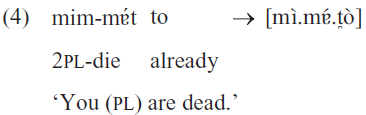
When two identical consonants come together within a single intonation phrase, the sequence is realised as a single consonant in all but the most careful speech. This is shown in (4), which shows this consonant hiatus resolution applies both within the word (in the case of /m/), and across word boundaries (in the case of /t/).
Vowels

Ambel has a straightforward five-vowel system: /i e ɐ o u/. There is no phonemic vowel length in Ambel, and there is no variation in the vowel systems of the two dialects. Ambel does not have phonemic diphthongs: phonetic diphthongs, which are all of the shape [Vi] or [Vu], are analysed as realisations of vowel–glide sequences. Underlying sequences of /ij/ also lead to phonetic sequences of [ii] within a syllable nucleus. Justification for the analysis of [Vi] and [Vu] nuclei as underlyingly vowel-glide will be provided in the ‘Phonotactics’ section.
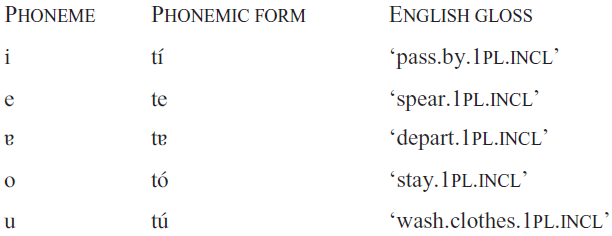
An instrumental analysis of 178 vowel tokens produced by four speakers (two male, two female) was carried out.Footnote 9 These vowels come from open toneless syllables, elicited in the following medial contexts: /ine b<j>Ì́ne ___ be lɐ́wrɐ/ ‘I say ___ to Laura’ and /ine b<j>Ì́ne ___ po/ ‘I don’t say ___’. Word-final syllables in both contexts therefore precede plosives; for comparability of results, word-medial syllables in polysyllabic words were selected that also precede plosives (or in one case a phonetic affricate). For each vowel token, F1 and F2 were measured at the mid-point of each vowel. The values were then normalised with the Nearey 1 formula (Nearey Reference Nearey1977), and scaled to Hz. A representation of the vowel qualities given in the vowel trapezoid above is visualised in an F1 versus F2 plot using NORM (Thomas & Kendall Reference Thomas and Kendall2007) in Figure 5. The ellipses plot the F1 and F2 values to 1.5 standard deviations.
Plot of average F1 and F2 values of 178 elicited vowel tokens in open toneless syllables preceding plosives or affricates, produced by two males and two females. Values were normalised using the Nearey 1 formula and scaled to Hz; ellipses show the F1 and F2 values to 1.5 standard deviations.

Figure 5 shows that on average there is no overlap in the realisation of /ɐ/, /o/, and /u/ with any other vowel; additionally, there is very little variation in the realisation of /o/, and, to a lesser extent, /e/, /ɐ/, and /u/. The vowel with the widest range of realisations is /i/. The realisations of /i/ and /e/ overlap to some extent, in that both can be realised [ɪ], particularly in fast speech.
The realisations of each vowel occur unconditioned in most environments. One exception is /u/, which in connected speech is regularly realised as [y] when preceding /j/.
In fast speech, intonation phrase-final vowels are sometimes realised with breathy phonation (e.g. the final vowels of lines 5 and 10 in the transcribed passage) or without voice (e.g. the final vowel of line 13 in the passage).
When two identical vowels come together across a syllable or word boundary within a single intonation phrase, the sequence is realised as a single short vowel, even in careful speech. An example of this vowel hiatus resolution is given in (5), where the underlying syllables /pɐ/ and /ɐN=/ are realised as a single syllable [pɐ̀n].

Phonotactics
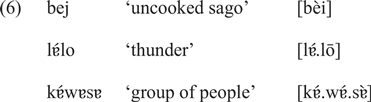
The majority of Ambel words are monosyllables or disyllables; trisyllabic words are also common. Examples of each are given in (6). Monomorphemic words up to five syllables are also attested.
The syllable structure of Ambel is (C)(C)(C)V(C)(C), where brackets indicate that a segment is optional. At the surface level, all complex onsets and codas adhere to the Sonority Sequencing Principle (Clements Reference Clements1990).Footnote 10
Any consonant may appear in a single-C onset. Attested CC onsets are given in Table 2. Both root-internal clusters and clusters arising from inflectional prefixation are shown; inter-morpheme clusters are in italics, and the prefix is separated from the root by a hyphen. The number of unique lexical items attested with each of the onset clusters (out of a total of 1834
Attested CC onsets: morpheme-internal CC onsets in normal text (number of individual lexical items out of 1834 in parentheses); CC onsets arising from inflection in italics.

items) is given in brackets. Examples of monomorphemic words with CC onsets are given in (7).Footnote 11

The onset sequence /tj/ is variably realised as [c] or [tʃ], and onset /dj/ as [ɟ] or [dʒ]. There are three reasons to support the analysis of [c ~ tʃ] and [ɟ ~ dʒ] as underlying coronal–glide sequences, rather than /c/ and /ɟ/ or /tʃ/ and /dʒ/. First, neither [c ~ tʃ] nor [ɟ ~ dʒ] occur in syllable codas. While [ɟ ~ dʒ] is prevented by the neutralisation of the voicing contrast in coda plosives, an analysis of [c ~ tʃ] as /tj/ explains why it does not occur in the coda: it would violate the Sonority Sequencing Principle. Second, the plosive/affricate analysis would leave a conspicuous gap in the permitted /Cj/ onsets given in Table 2: while the plosive/affricate analysis cannot account for the remaining permitted Cj clusters /pj kj bj sj hj mj nj/ with reference to natural classes, the coronal–glide analysis allows us to state that the /C/ in /Cj/ onsets are non-approximants, i.e. plosives (except /ɡ/),Footnote 12 fricatives, and nasals. Finally, in the verbal morphology, the infixation of /<j>/ following a /t/- or /d/-initial root gives the realisation [c ~ tʃ] or [ɟ ~ dʒ], as shown in (8).

Only two words are attested with CCC onsets: one monomorphemic, the other morphologically complex. Both are given in (9).

Any consonant, with the exception of the voiced plosives /b d ɡ/, the voiceless fricative /h/, and the loan phonemes /tʃ/, /dʒ/, and /ɲ/, can occur in a single-C coda. Nucleus-internal phonetic sequences of [Vi] and [Vu] are analysed as syllables with /j/ and /w/ codas, respectively. The attested /Vj/ and /Vw/ sequences in the corpus, along with the number of unique lexical items (out of 1834), are given in Table 3. Examples are given in (10).Footnote 13

Attested /Vj/ and /Vw/ sequences (number of attestations out of 1834 in brackets).

There are three reasons for analysing the sequences in Table 3 as underlyingly vowel–glide sequences. First, both [Vi] and [Vu] sequences behave like /Vj/ and /Vw/ with regards to the resolution of identical consonants in hiatus, described in the section ‘Consonants’. When [Vi] and [Vu] precede /j/- and /w/-initial words, respectively, the V2 [i] and [u] segments are treated as /j/ and /w/, in that they are deleted. This is shown in (11): here /kɐjɐ́w/ ‘pig’, which in other contexts is realised [kɐ̀jɐ́u], is realised [kɐ̀.jɐ́] before the /w/-initial article /wɐnɐ/.

Second, if the [ii] sequences were derived from underlying /ii/, this would violate the rule of vowel hiatus resolution, in which two underlying adjacent vowels are realised as a single short vowel. An analysis of [ii] as /ij/ does not violate this rule. Finally, this analysis neatly explains why all nucleus-internal [VV] sequences have [i] and [u] as V2: they are realisations of /j/ and /w/, respectively.Footnote 14
CC clusters in codas are more restricted than in onsets: only the glides /j/ and /w/ are attested as C1, and only the voiceless plosives /t k/ and the nasals /m n/ are attested as C2. Attested CC codas are given in Table 4, again with the number of unique lexical items out of 1834. Examples of monomorphemic words with CC codas are given in (12).
Attested coda consonant clusters (number of attestations out of 1834 in brackets).


Prosody
Word-level prosody
Both dialects of Ambel have systems of lexical tone.Footnote 15 In the Metnyo dialect, there is a single tonal specification /H/, in a system which is culminative, i.e. there is no more than one /H/ syllable per morpheme, but not obligatory, i.e. there are morphemes without a tonal specification.Footnote 16 The system is privative, in that /H/ syllables contrast with toneless syllables / /. Minimal and near-minimal pairs demonstrating the tone contrasts in monosyllabic and disyllabic words in Metnyo Ambel are given below. As will be described in the ‘Phrase-level Prosody’ section below, the realisation of /H/ and // syllables in the final position of an intonation phrase (IP), including the recordings in isolation context given here, depends on syllable weight.
Monosyllables

Disyllables

IP-medially, /H/ syllables are generally realised with high level pitch [H], and toneless syllables with low level pitch [L].Footnote 17 If an IP-medial toneless syllable immediately follows a [H] syllable (derived from /H/), the toneless syllable is predictably realised [H], a process that crosses word boundaries.Footnote 18 The realisation of tone IP-medially does not depend on the moraic weight of the syllable (unlike the IP-final realisation; see below). This is evidence that the tone-bearing unit in Ambel is the first mora of the syllable (see further Arnold Reference Arnold2018b).
Pitch contours showing the IP-medial realisation of /H/ as [H] on the monosyllabic word /tún/ ‘moon’, of the toneless monosyllabic word /tun/ ‘thorn’ as [L], and of the second toneless syllable of /pɐ́nje/ ‘morning’ as [H] following a H syllable are given in Figures 6, 7, and 8, respectively.Footnote 19
Intonation phrase-medial realisation of /H/ in a monosyllabic word, /tún/ ‘moon’ (speaker: AG).

Intonation phrase-medial realisation of a toneless monosyllabic word, /tun/ ‘thorn’ (speaker: AG).

Intonation phrase-medial realisation of a toneless syllable (the second syllable of /p─́nje/ ‘morning’) as
 $[ $
H
 $] $
when immediately following a
$[ $
H
$] $
syllable within a word (speaker: AG).

Figures showing the average F0 of IP-medial syllables with different tonal specifications are given in Table 5. These data are based on measurements of 133 IP-medial rhyme tokens in the context /ine b<j>Ì́ne ____ po/ ‘I don’t say ____’, produced in a single session by speaker AG. Measurements were taken at 10
 $\% $
, 50
$\% $
, and 90
$\% $
into the F0 trace; the average across the rhyme, measured at 10
$\% $
intervals, is also given. The average difference between /H/ syllables and toneless syllables realised as [H] is not statistically significant (t(87) = 0.6654, p = .5076); the difference between /H/ syllables and toneless syllables realised as [L], however, is (t(106) = 9.6930, p<.0001).
Average F0 measurements of IP-medial rhymes of syllables with different tonal specifications at 10
$\% $
, 50
$\% $
, and 90
$\% $
of the F0 trace, and the average across the rhyme (measured at 10
$\% $
intervals; figures rounded to the nearest Hertz).

Work on the tone system of Metsam Ambel is still preliminary. However, there appear to be two underlying tones in this dialect. Syllables can be sorted into one of three groups, depending on IP-medial realisation: those with high, rising, and low pitch. In Arnold (Reference Arnold2018b, Reference Arnold2020), high and rising pitch are analysed as realisations of underlying High and Rise tone, respectively, and low pitch is analysed as the realisation of toneless syllables.
Phrase-level prosody
In this section, I discuss the interaction of lexical tone and IP-final intonation contours for declarative/imperative and polar interrogative utterances.Footnote 20
Declarative and imperative utterances are marked with a high-falling IP-final boundary tone (henceforth: HL
$\% $
). If an IP-final word in a declarative or imperative utterance is lexical, then HL
$\% $
attaches to the final syllable of the word, and the realisation of the boundary tone depends on a combination of the moraic weight and tonal specification of the final syllable.Footnote 21 Segments that contribute to the moraic weight of a syllable in Ambel are vowels /i e ɐ o u/ and sonorant consonants /w j r l m n/. Segments that can occur in a syllable coda but which do not contribute to moraic weight are voiceless plosives /p t k/ and the fricative /s/. If a syllable rhyme consists of only a vowel, or of a vowel plus a non-sonorant consonant, then it is monomoraic and thus light; if a syllable has a vowel plus at least one sonorant consonant in the coda, then it is bimoraic and thus heavy. The
 $[{\text{H}}] $
component of the HL
$\% $
boundary tone docks to the first mora of a syllable, and the [L] component docks to the second mora; thus on light syllables, HL
$\% $
is realised [H], whereas on heavy syllables, it is realised [HL].
F0 contours showing the IP-final realisation of HL
$\% $
on syllables with each of the possible combinations of tonal specification and syllable weight are given in Figures 9–12; these realisations are summarised in Table 6. As shown in this table and Figure 9, IP-final heavy syllables with /H/ are realised [HL]: the [H] component of HL
$\% $
docks to the first mora (which applies vacuously, as the mora already has [H] from underlying /H/); and the [L] component docks to the second. If a /H/ syllable is light, the [L] component of HL
$\% $
cannot dock; again, the [H] component of HL
$\% $
is vacuous due to the realisation of [H] from underlying /H/, and the syllable is realised [H] (Figure 10). If an IP-final toneless syllable is heavy, then it is realised [LHL] (Figure 11): the first [L] is the realisation of lexical tonelessness on the first mora, as described in the ‘Word-level Prosody’ section above; the [H] component of HL
$\% $
also docks to the first mora; and the [L] component of HL
$\% $
docks to the second mora. If an IP-final toneless syllable is light, it is realised [LH] (Figure 12): the [L] of tonelessness and the [H] of HL
$\% $
both dock to the first mora, but the [L] of HL
$\% $
cannot dock.
Realisation of IP-final syllables of lexical words, by tonal specification and moraic weight.

Realisation of HL
$\% $
on a heavy intonation phrase-final /H/ syllable /dún/ ‘fish’ as
$[ $
HL
$] $
(speaker: AG).

Realisation of HL
$\% $
on a light intonation phrase-final /H/ syllable /lɐ́p/ ‘fire’ as
$[ $
H
$] $
(speaker: AG).

Realisation of HL
$\% $
on a heavy intonation phrase-final toneless syllable /tun/ ‘thorn’ as
$[ $
LHL
$] $
(speaker: AG).

Realisation of HL
$\% $
on a light intonation phrase-final toneless syllable /we/ ‘water’ as
$[ $
LH
$] $
(speaker: AG).

Measurements showing the average F0 of IP-final syllables 10
$\% $
, 50
$\% $
, and 90
$\% $
into the rhyme are given in Table 7. These data are based on measurements of 68 tokens of IP-final rhymes in the context /ine b<j>Ì́ne ____ / ‘I say X’, produced in a single session by speaker AG. The smoothed F0 contours of IP-final syllables in this context are visualised in Figure 13 (drawn using Ring Reference Ring2017).
Average F0 measurements of IP-final rhymes with different tonal specifications and moraic weights at 10
$\% $
, 50
$\% $
, and 90
$\% $
of the F0 trace (rounded to the nearest Hertz).

Comparison of the average smoothed F0 traces of 68 tokens of intonation phrase-final rhymes with different tonal specifications and syllable weights produced by AG. Red = /H/ syllables, blue = toneless syllables; solid line = light syllable, dashed line = heavy syllable.

Realisation of E
$\% $
on intonation phrase-final /H/ syllable:
$[ $
E
$] $
(speaker: AG).

Polar interrogative sentences are marked by an extra-high boundary tone (henceforth: E
$\% $
), which attaches to the final syllable of the IP.Footnote 22 As with the HL
$\% $
boundary tone, E
$\% $
interacts with the lexical tone of the final syllable. If the final syllable already has high pitch [H] deriving from lexical /H/ (as opposed to [H] from assimilation of toneless syllables), it is realised with extra-high level pitch [E], as shown in Figure 14. If the final syllable is toneless, it is realised with low pitch rising to extra-high pitch [LE], as shown in Figure 15.
Transcription of recorded passage
In this transcription, the first line is phonetic, the second line is orthographic, and the third line gives the English translation. The Ambel orthography is based on the orthography of Standard Indonesian, which is very close to the IPA. The following orthographic symbols deviate from the IPA: <y> is used for /j/; <c> and <j> are used for [c ~ tʃ] and [ɟ ~ dʒ] (realisations of /tj/ and /dj/; see‘Phonotactics’); and <a> is used for /ɐ/. The archiphonemic prefix /N-/ (described in section ‘Consonants’) is transcribed as a homorganic nasal, e.g. <n> on /t/ or /d/-initial roots, and <m> on /b/-initial roots.
Realisation of E
$\% $
on intonation phrase-final toneless syllable:
$[ $
LE
$] $
(speaker: AG).


Acknowledgements
Data for this study were collected during a four-year documentation project of Ambel, funded by the British Academy, the University of Edinburgh, the Hans Rausing Endangered Languages Documentation Programme, the Foundation for Endangered Languages, and the Firebird Foundation. My sincere thanks to all of the Ambel community for their hospitality and co-operation during this project – especially my language teachers Martinus Wakaf and Alfred Gaman, and Wolter Gaman, Yubel Kein, and Konstantina Wakaf, for providing transportation and accommodation. I am also grateful to my local sponsors, the Center for Endangered Languages Documentation at Universitas Papua in Manokwari. Finally, I would like to thank James Kirby, two anonymous reviewers, and Marija Tabain, whose feedback on earlier drafts greatly improved the quality of this paper. All errors remain my own.
Supplementary materials
To view supplementary material for this article (including audio files to accompany the language examples), please visit https://doi.org/10.1017/S0025100320000237.



