Introduction
The new mineral, gysinite-(La), with the ideal formula PbLa(CO3)2(OH)⋅H2O, has been discovered in lujavrite from the Saima alkaline complex, Liaoning Province, northeast China. For the past few decades, the Saima complex has been mined, initially for its uranium resource. Since 2015 it has also been explored for Nb and rare earth element (REE) resources by the China Geological Survey (CGS) and No. 241 Group Co., Ltd., Liaoning Geological Exploration and Mining Group. This alkaline complex is also the type locality for gugiaite, hezuolinite, fengchengite and newly approved fluorsigaiite (Peng et al., Reference Peng, Cao, Zou, Zhang, Yin and Ding1962; Yang et al., Reference Yang, Giester, Ding and Tillmanns2012; Shen et al., Reference Shen, Xu, Yao and Li2017; Wu et al., Reference Wu, Gu, Rao, Wang, Zhong and Wan2022a).
This new mineral is the La-dominant analogue of the approved mineral gysinite-(Nd), PbNd(CO3)2(OH)⋅H2O, therefore the naming of gysinite-(La) is in consistency with rules of the International Mineralogical Association, Commission on New Minerals, Nomenclature and Classification (IMA–CNMNC) for rare earth minerals and dominant constituents (Levinson, Reference Levinson1966; Bayliss and Levinson, Reference Bayliss and Levinson1988; Hatert and Burke, Reference Hatert and Burke2008). Gysinite-(La) is the ninth member of the ancylite-group minerals with the general formula (REExM 2+2–x)(CO3)2(OH)x⋅(2–x)H2O, where REE = La, Ce and Nd, and M = Ca, Sr and Pb (Table 1). The species and the name gysinite-(La) with symbol Gys-La have been approved by the Commission on New Minerals, Nomenclature and Classification of the International Mineralogical Association (IMA2022-008, Wu et al., Reference Wu, Gu, Rao, Wang, Xing, Wan and Zhong2022b). The type material is deposited at the Geological Museum of China, No. 15 Yangrouhutong, Xisi, Beijing 100031, PR China, with catalogue number M16133.
Characteristics of the ancylite-group minerals with the general formula (REExM 2+2–x)(CO3)2(OH)x⋅(2–x)H2O.

n.a. = not available; S.g. = space group.
References: aPetersen et al. (Reference Petersen, Niedermayr, Gault, Brandsttter and Giester2001); bDal Negro et al. (Reference Dal Negro, Rossi and Tazzoli1975); cWang et al. (Reference Wang, Gu, Dong, Hou, Yang, Fan, Wang, Tang, Cheng and Qu2022); dBelovitskaya et al. (Reference Belovitskaya, Pekov, Gobechiya and Kabalov2013); eOrlandi et al. (Reference Orlandi, Pasero and Vezzalini1990); fChabot and Sarp (Reference Chabot and Sarp1985); gMiyawaki et al. (Reference Miyawaki, Matsubara, Yokoyama, Iwano, Hamasaki and Yukinori2003); hMiyawaki et al. (Reference Miyawaki, Matsubara, Yokoyama, Takeuchi, Nakai and Terada2000); *this study.
Occurrence and paragenesis
The Saima alkaline complex (longitude E120°16', latitude N40°58') is located in the eastern Liaodong Peninsula within the north-eastern segment of the North China Craton. This complex is primarily composed of phonolite, nepheline syenite, lujavrite and alkaline pegmatite, with a coeval emplacement age ranging from 224 to 230 Ma (Wu et al., Reference Wu, Yang, Marks, Liu, Zhou, Ge, Yang, Zhao, Mitchell and Markl2010; Zhu et al., Reference Zhu, Yang, Sun, Zhang and Wu2016). Nepheline syenite and lujavrite intruded the Cambrian–Ordovician limestone and Precambrian marble. These Saima alkaline rocks were derived from the low-degree partial melting of subcontinental lithospheric mantle, which was metasomatised by melts or fluids from recycled ancient continental crust (Zhu et al., Reference Zhu, Yang, Sun and Wang2017). The various suits of rocks composing the Saima batholith were then emplaced as a result of crustal assimilation and fractional crystallisation processes (Zhu et al., Reference Zhu, Yang, Sun, Zhang and Wu2016). Post-magmatic metasomatism such as albitisation, skarnification and carbonation were widespread. The petrography and mineralogy of the Saima complex have been described in detail in previous studies (Wu et al., Reference Wu, Wang, Yang, Wu, Zhang, Gu and Zhang2015, Reference Wu, Wang, Yang, Wu, Zhang, Gu and Zhang2016; Zhu et al., Reference Zhu, Yang, Sun, Zhang and Wu2016).
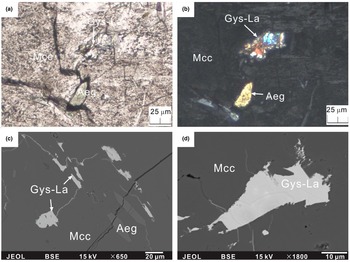
In lujavrite, gysinite-(La) occurs as either single subhedral to anhedral, granular and platy crystals from 5 to 50 μm in size in a matrix of nepheline and microcline (Fig. 1a,b), or as aggregates consisting of a few crystals individually <20 μm in fractures or interstices of nepheline, aegirine and microcline (Fig. 1c). In a few cases, compositionally heterogeneous zoning, probably caused by variable Pb and REE contents, can be observed in crystals under back-scattered electron imaging (Fig. 1d). Associated minerals include nepheline, aegirine, microcline, natrolite, eudialyte, lamprophyllite, bastnäsite-(Ce), parasite-(Ce), ancylite-(La), ancylite-(Ce), bobtraillite, britholite-(Ce), thorite, calcite and galena. In the same lujavrite sample, most of eudialyte grains are partly to completely replaced by an unidentified Pb-bearing zirconosilicate (potentially PbZrSi3O9⋅2H2O based on our unpublished data). The occurrence of gysinite-(La) associated with Ca-rich wall rocks (limestone and marble) allows us to propose that crystallisation of gysinite-(La) may be related to a post-magmatic carbonation event within the Saima complex.
Photomicrographs (a,b) and back-scattered electron images (c,d) showing the occurrence of gysinite-(La). (a,b) Gysinite-(La) and aegirine crystals in microcline under parallel nicols (a) and crossed nicols (b) in transmitted light. (c) Aggregate of gysinite-(La) crystals in interstices of microcline (including holotype crystal selected for Raman spectroscopy). (d) Single gysinite-(La) crystal showing weak heterogeneous zoning. Mineral abbreviations: Aeg – aegirine, Gys-La – gysinite-(La), Mcc – microcline. Specimen #SM01.

Physical and optical properties
Individual granular or platy crystals of gysinite-(La) are transparent, colourless or pale yellow in transmitted light with a white coloured streak and vitreous lustre. It shows no fluorescence under either longwave or shortwave ultraviolet light. Optically, gysinite-(La) is biaxial (–), α= 1.832(2), β= 1.849(4), γ = 1.862(5) (white light) and 2Vmeas = 81.6°. Pleochroism was not observed. Some of its physical properties could not be determined due to its small grain size. Gysinite-(La) is brittle, with an uneven fracture, and has a Mohs hardness value of ~ 3½ to 4. No cleavage twinning or parting was observed. The calculated density is 5.007 g/cm3 based on the empirical formula and refined single-crystal unit-cell parameters (see below). Gysinite-(La) is non-magnetic with respect to a neodymium magnet, and soluble in 30% HCl (aq) at room temperature. According to the calculated density and the measured indices of refraction, the compatibility index [1 – (K P/K C)] is –0.011, and corresponds to the ‘superior’ category (Mandarino, Reference Mandarino1981).
Raman spectroscopy
A Raman spectrum was obtained from a randomly oriented gysinite-(La) grain, by a Renishaw inVia RM2000 spectrometer equipped with a 50× Leica objective lens at the State Key Laboratory of Nuclear Resources and Environment, East China University of Technology. The excitation wavelength was 532 nm, and the laser output power was set at 20 mW. The spatial resolution was estimated to be 1 μm, and the spectral resolution was 1 cm–1. High-pure silicon with a 520 cm–1 Raman shift was chosen for calibration. The spectrum was collected from 100 to 4000 cm–1 and the accumulation time for each spectrum was ~30 s with 2–3 accumulations.
The Raman characteristics for the carbonate unit are clearly observed in Fig. 2. The strongest Raman band at 1077 cm–1 is assigned to the intense symmetric C–O stretching mode (ν1) and relatively weak bands at 700 and 726 cm–1 correspond to the C–O asymmetric in-plane bending modes (ν4) (Bühn et al., Reference Bühn, Rankin, Radtke, Haller and Knöchel1999; Buzgar and Apopei, Reference Buzgar and Apopei2009; Chakhmouradian and Dahlgren, Reference Chakhmouradian and Dahlgren2021). The C–O out-of-plane bending signals (ν2) at 870–880 cm–1, which occur in some anhydrous carbonates, are not observed in gysinite-(La). In addition, a weak line at 1443 cm–1 is probably assigned to the C–O ν3 asymmetric stretching mode, which is also observed in bastnäsite and aragonite-group minerals (Frost and Dickfos, Reference Frost and Dickfos2007; Buzgar and Apopei, Reference Buzgar and Apopei2009), and lines around 1738 cm–1 may be regarded as the combination bands of ν1 + ν4 modes (Gunasekaran et al., Reference Gunasekaran, Anbalagan and Pandi2006). The bands of H2O present at 3249 and 3549 cm–1 correspond to the O–H asymmetric and symmetric ν1 stretching modes, respectively, and the band at 1612 cm–1 is assigned to the O–H ν2 bending mode (Carey and Korenowski, Reference Carey and Korenowski1998). The Raman bands at the lowest region of the spectrum including 167, 379 and 567 cm–1 can be attributed to the lattice modes.
Raman spectrum for gysinite-(La).

Chemical composition
Quantitative elemental microanalysis of gysinite-(La) was conducted with a JEOL-JXA 8530F Plus electron microprobe in wavelength dispersive spectroscopy mode at 15 kV and 50 nA, with a defocused beam diameter of 5 μm to minimise diffusion of elements mobile under the electron beam, at the State Key Laboratory of Nuclear Resources and Environment, East China University of Technology. Measurement time for each element on peaks and background was 20 and 10 s, respectively. Standards for calibration were fluorapatite (CaKα and FKα), celestine (SrLα), crocoite (PbLα), monazite (LaLα, CeLα, PrLβ and NdLα), and synthetic REE-phosphates (SmLα, EuLα and GdLα). The F content in gysinite-(La) was below detection limits of the EPMA (i.e. ≤ 500 ppm), hence it is not listed in Table 2. According to the general formula (REExM 2+2–x)(CO3)2(OH)x⋅(2–x)H2O of ancylite-group minerals, the empirical formula of gysinite-(La) is:
Composition from electron microprobe data (in wt.%) for gysinite-(La).

S.D. = standard deviation; bdl = below detection limits.
*CO2 was assumed as 2 apfu according to the general formula of the ancylite group, and #(OH+H2O) was assumed as 2 apfu and each of them was calculated based on the charge balance.
(La0.93Pb0.61Nd0.23Pr0.14Sr0.04Gd0.02Sm0.01Eu0.01Ca0.01)Σ2(CO3)2(OH)1.34⋅0.66H2O. The OH group was calculated from the stoichiometry, and the number of water molecules was calculated based on the sum of (OH+H2O) = 2 atoms per formula unit (apfu). The ideal formula, in line with gysinite-(Nd), becomes PbLa(CO3)2(OH)⋅H2O, which requires PbO 44.51, La2O3 32.53, CO2calc 17.56, H2Ocalc 5.40, total 100 (all in wt.%).
Powder X-ray diffraction determination
The powder X-ray diffraction pattern (XRD) of gysinite-(La) was collected on a Rigaku XtaLAB Synergy diffractometer (CuKa, λ = 1.54184 Å) in powder Gandolfi mode at 50 kV and 1 mA, at the School of Earth Sciences and Info-physics, Central South University, China. The structural model of a single crystal (see below) was used to index the powder XRD pattern of gysinite-(La) (Table 3). The strongest eight lines of the powder XRD pattern [d in Å (I) (hkl), Fig. 3] were: 5.596 (21) (011), 4.349 (100) (110), 3.732 (68) (111), 2.984 (61) (121), 2.667 (21) (031), 2.363 (48) (131), 2.090 (29) (221) and 2.028 (21) (212). The unit cell parameters were refined in an orthorhombic crystal system using the program UnitCell (Holland and Redfern, Reference Holland and Redfern1997) and are: a = 5.0591(2) Å, b = 8.5899(3) Å, c = 7.3987(4) Å, V = 321.52(2) Å3 and Z = 2.
Powder X-ray diffraction pattern for gysinite-(La).

Experimental and calculated* powder X-ray diffraction data (d in Å, I in %) for gysinite-(La).

* The calculated values were obtained using VESTA 3 (Momma and Izumi, Reference Momma and Izumi2011).
The strongest values are given in bold.
Crystal structure refinement
Single-crystal X-ray diffraction data were collected at room temperature on a 10 × 10 × 10 μm crystal fragment dug from a polished thin section, using a Rigaku XtaLAB Synergy diffractometer, at the School of Earth Sciences and Info-physics, Central South University, China, which was equipped with CuKα radiation (λ = 1.54184 Å) at working conditions of 50 kV and 1mA, respectively. The diffraction data were treated with the program CrysAlisPro (Rigaku Oxford Diffraction, UK) and the structure of gysinite-(La) was refined using the software SHELX (Sheldrick, Reference Sheldrick2015a, Reference Sheldrick2015b). Once all atoms were located, they were refined anisotropically and the occupancies of La, Pb, Nd, Pr and Sr at the metal cation site were manually adjusted according to the chemical composition, yielding:
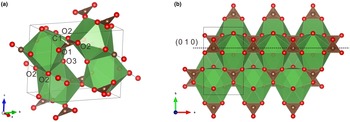
(La0.90Pb0.66Nd0.24Pr0.16Sr0.04)Σ2(CO3)2(OH)2, without further consideration for H2O. The crystal structure refinement finally converged to R 1 = 3.21% for 360 unique reflections (I>2σ(I)) and 34 parameters. Unit cell parameters refined from these reflections are a = 5.0655(2) Å, b = 8.5990(3) Å, c = 7.3901(4) Å, V = 321.90(2) Å3 and Z = 2, in the space group Pmcn. See Table 4 for details of data collection and refinement. Atom coordinates, anisotropic atomic displacement parameters and site population are given in Tables 5–6, and selected bond distances and angles in Table 7. The bond-valence sums of atoms, calculated using the parameters given by Brese and O'Keeffe (Reference Brese and O'Keeffe1991) are presented in Table 8. The structure is illustrated in Fig. 4. The crystallographic information file has been deposited with the Principal Editor of Mineralogical Magazine and is available as Supplementary material (see below).
Crystal structure of gysinite-(La) (unit cell outlined in black lines) plotted with VESTA 3 (Momma and Izumi, Reference Momma and Izumi2011). (a) M–O polyhedron (green) connected with each other by face (O2–O2–O3 triangle) and corner (O2) sharing modes. (b) The C–O triangle (brown) and M–O polyhedron form layer-like units parallel to (0 1 0).

Data collection and structure refinement details for gysinite-(La).

*wR 2 = {∑[w(F o2–F c2)2]/∑[w(F o2)2]}½; w = 1/[σ2(F o)2 + (aP)2 + bP] where a is 0.036, b is 6.13 and P is [2F c2 + Max(F o2, 0)]/3.
Wyckoff positions, inferred site populations, fractional coordinates of atoms, and equivalent isotropic displacement parameters in gysinite-(La) structure.

Anisotropic atomic displacements (Å2) for gysinite-(La).

Selected bond distances (Å) and angles (°) for gysinite-(La).

Calculated bond valence sums (in vu) of atoms for gysinite-(La), using the parameters of Brese and O'Keeffe (Reference Brese and O'Keeffe1991).*

* Bond valence sums were calculated with the site population factors given in Table 5. The theoretical number of vu of M and O3 is calculated based on ⅔REE3++⅓M 2+ and ⅔OH+⅓H2O, respectively, according to its empirical formula for charge balance.
Gysinite-(La) is a new Pb-analogue of the ancylite-group minerals and it is isostructural with gysinite-(Nd), but with the dominance of La over Nd in the REE occupancy (Dal Negro et al., Reference Dal Negro, Rossi and Tazzoli1975; Sarp and Bertrand, Reference Sarp and Bertrand1985). In the ancylite structure, the cations REE (i.e. La, Ce and Nd) and M (i.e. Ca, Sr and Pb) occupy the same coordinated site, which is bonded to eight oxygen atoms belonging to the CO3 group and two hydroxyls and water molecules (Dal Negro et al., Reference Dal Negro, Rossi and Tazzoli1975). According to the chemical composition and occupancy at the metal cation site (i.e. REE and M), the ancylite group minerals can be further divided into ancylite–calcioancylite–gysinite–kozoite solid solutions (Miyawaki et al., Reference Miyawaki, Matsubara, Yokoyama, Takeuchi, Nakai and Terada2000, Reference Miyawaki, Matsubara, Yokoyama, Iwano, Hamasaki and Yukinori2003). In the gysinite-(La) structure, the ten-fold coordinated M cation is mainly dominated by La and Pb over other REE and alkaline-earth elements. The basic framework of gysinite-(La) is composed mainly of M–O polyhedra connected with each other by face (O2–O2–O3 triangle) and corner (O2) sharing modes (Fig. 4a). The M–O distances vary from 2.599 to 2.773 Å for the eight oxygen atoms (O1×2 and O2×6) belonging to CO3 group, whereas the M–O3 distances connected to the hydroxyls are shorter (2.449 and 2.511 Å). The mean M–O bond distance of 2.635 Å is slightly longer than that in gysinite-(Nd) (2.595 Å, Chabot and Sarp, Reference Chabot and Sarp1985). The carbon atom at the C1 site in gysinite-(La) structure is bonded to 3 O atoms (O1×1 and O2×2) to form isolated isosceles triangles with an average C–O bond distance of 1.286 Å. The C–O triangle and M–O polyhedron form layer-like units parallel to (0 1 0) with OH and H2O located between layers (Fig. 4b). Comparative data from ancylite-(La) to gysinite-(La) in Table 1 illustrate that the progressive substitution of Ca and Sr (effective ionic radius 1.23 and 1.36 Å, respectively, Shannon, Reference Shannon1976) by Pb (effective ionic radius 1.40 Å) in the crystal structure leads to an increase in average M–O bond distance from 2.622 to 2.635 Å, as well as increases in the unit-cell parameters and density.
The bond-valence sums of 2.747 valence units (vu) for the M-site in gysinite-(La) is close to its theoretical value of 2.667 vu, which was calculated on the basis of ⅔REE3+ and ⅓M 2+ in accordance with its empirical formula. The bond valence sums for the O1, O2 and O3 sites are 1.995, 1.955 and 0.816 vu, respectively. Similarly, the 0.816 vu for O3 is close to its theoretical value of 0.667 vu, calculated on the basis of ⅔OH and ⅓H2O at the O3 site for charge balance. In comparison with O1 and O2, the lower bond-valence for O3 suggests a mixed occupancy by hydroxyl and water molecules, which is also demonstrated by its actual composition and Raman spectroscopy.
Implications
Gysinite-(La) is the second Pb-analogue of the ancylite group ever discovered after gysinite-(Nd) (Chabot and Sarp, Reference Chabot and Sarp1985; Sarp and Bertrand, Reference Sarp and Bertrand1985). Regardless of being from different rock types, both gysinite-(La) and gysinite-(Nd) were crystallised in hydrothermal conditions. Gysinite-(Nd) was discovered as a secondary mineral after uraninite alteration in the Shinkolobwe sediment-hosted uranium-polymetallic deposit of Congo, and in hydrothermal lead-zinc deposits of Italy and Germany (Sarp and Bertrand, Reference Sarp and Bertrand1985; Olmi and Sabelli, Reference Olmi and Sabelli1991), whereas gysinite-(La) was discovered in altered lujavrite from the Saima alkaline complex of China. Rare earth elements in gysinite-(La) were most likely to have been derived from the alteration and decomposition of eudialyte, which was ultimately replaced by another unidentified Pb-bearing zirconosilicate during a post-magmatic carbonation event associated with Sr–Pb-rich hydrothermal fluids. The altered lujavrite is also the co-type sample for recently approved fluorsigaiite with the ideal formula of Ca2Sr3(PO4)3F (Wu et al., Reference Wu, Gu, Rao, Wang, Zhong and Wan2022a), which similarly occurs in interstices of aegirine, microcline and nepheline, and was most probably also crystallised from late hydrothermal events. This Sr–Pb-rich carbonation event affecting the Saima alkaline system has been documented in our previous work – it induced the intense replacement of primary wadeite and rinkite-(Ce) by a series of secondary hydrothermal minerals including Sr-bearing calcite and strontianite (Wu et al., Reference Wu, Wang, Yang, Wu, Zhang, Gu and Zhang2015, Reference Wu, Wen, Bonnetti, Wang, Yang and Wu2019). However, although country rocks such as limestone and marble could be a candidate for such Sr–Pb-rich carbonation fluids, the true source of Sr and Pb in the hydrothermal fluids, responsible for the crystallisation of gysinite-(La) and other Sr–Pb-rich minerals, remains to be determined.
The discoveries of gysinite-(La) and gysinite-(Nd) suggest that in addition to Sr and Ca, Pb could occur as another conventional bivalent cation in the M site of the ancylite-group structure. Lead and Ba are actually common constituents in carbonate minerals, as exampled by the Ca, Sr, Pb and Ba analogue of aragonite-group minerals with general formula M 2+(CO3) (De Villiers, Reference De Villiers1971; Negro and Ungaretti, Reference Negro and Ungaretti1971). Therefore, it may be considered that the discovery of gysinite-(La) draws attention to a certain expectation that the Ba analogue of the ancylite group, as well as the Ce analogue of gysinite will be discovered in the future.
Acknowledgements
The authors thank Principal Editor Stuart Mills for handling the manuscript as well as Professor Peter Leverett and another anonymous reviewer for their valuable comments. This study was financially supported by the National Natural Science Foundation of China (Grant No. 42272087, 42063006, 42072054 and 41702033), and the Natural Science Foundation of Jiangxi Province, China (Grant No. 20212BAB203003 and 20224ACB213012).
Competing interests
The authors declare none.
Supplementary material
To view supplementary material for this article, please visit https://doi.org/10.1180/mgm.2022.126