Introduction
Family relationships play a major role in individuals' lives and can be a source of comfort, support and protection during the whole lifecourse. Particularly in the context of life events, such as ageing, health crises or widowhood, family relationships may be particularly salient in helping (older) adults to cope with feelings of grief, loss and loneliness. The family of origin is an important environment within which individuals form close and affective relationships that endure over the lifecourse (Merz, Schuengel and Schulze Reference Merz, Schuengel and Schulze2007), including those with siblings and progeny. Relationship experiences with parents during childhood may be the seedbed for support exchanges between family members throughout life. Crosnoe and Elder (Reference Crosnoe and Elder2004), for example, examined adjustment and functioning in later life in association with childhood experiences (although in men only). Whether childhood experiences also play an adaptive role in reducing loneliness in ever-widowed older adults has yet to be examined.
Earlier work (Pai and Ha Reference Pai and Ha2012; Utz et al. Reference Utz, Reidy, Carr, Kessler, Nesse and Wortman2004) has shown that widowed adults often rely on their adult children for support in the period following widowhood. Relationships with and support from siblings may also be important: from a lifetime perspective, siblings have a central position in individuals' networks and are thought to again become important towards the end of the lifecourse as long-lived relationships (White Reference White2001). Siblings' common history of upbringing in the same parental home and a similar socialisation regarding norms and values leads to shared opinions that might be important especially in crisis situations and in times of need (De Jong Gierveld and Peeters Reference De Jong Gierveld and Peeters2003). Pinquart (Reference Pinquart2003) showed that divorced and widowed adults reported a higher quality of sibling relationships than adults in first marriage, and Cicirelli (Reference Cicirelli1995) mentioned the relevance of siblings for emotional outcomes. Sibling support has been found to buffer against loneliness (De Jong Gierveld and Dykstra Reference De Jong Gierveld and Dykstra2008), however, very little work has examined the role of sibling support in later life and in association with negative life events such as widowhood.
The current paper examines whether childhood experiences of parental relationships, current support from siblings and the evaluation of family ties are associated with reduced loneliness in older ever-widowed men and women. We used survey data from the second wave of the Netherlands Kinship Panel Study (Dykstra et al. Reference Dykstra, Kalmijn, Knijn, Komter, Liefbroer and Mulder2012), and an additional in-depth study of a sub-sample of 18 men and women who experienced widowhood to shed light on lifecourse family ties and loneliness in widowed older adults.
Family ties in childhood and adulthood
Previous work has shown the general effect of positive relationships on various outcomes throughout life (Merz and Consedine Reference Merz and Consedine2009; Merz, Schuengel and Schulze Reference Merz, Schuengel and Schulze2007). Experiences, memories and expectations about the availability and responsiveness of trusted figures during childhood are incorporated into a mental representation of the self, of others and of relationships, which guides perceptions and behaviour in later relationships (Feeney Reference Feeney, Cassidy and Shaver2008). Children who have developed good relationships and attachment security, based on experiences with parents, typically show positive views of the self and others and desire closeness within relationships across the lifecourse (Kachadourian, Fincham and Davila Reference Kachadourian, Fincham and Davila2004). They manage to maintain a balance between being autonomous and having satisfying relationships with others. Such children are expected to establish and maintain supportive relationships with family members during the adult lifecourse until old age (Davila, Burge and Hammen Reference Davila, Burge and Hammen1997; Repetti, Taylor and Seeman Reference Repetti, Taylor and Seeman2002).
Early experiences characterised by stressful childhood environments and unavailability of trusted figures leads to the development of less positive representations of relationships in which either the self and/or relationship partners are negatively viewed. Persons who have developed such negative representations generally have pessimistic views regarding interactions with other people (Mikulincer, Shaver and Pereg Reference Mikulincer, Shaver and Pereg2003), associated with less social support exchange (Kobak and Sceery Reference Kobak and Sceery1988). They have difficulties with intimacy accompanied by difficulties with balancing care-giving and care-seeking behaviour within significant relationships. Based on these considerations, such adults are expected to have less satisfying and more distanced relationships with family members, resulting in fewer support exchanges and higher loneliness during adulthood.
From a lifecourse view, siblings occupy a unique position in individuals' networks. They are often the most long-lived relationships people have, starting with the shared parental home and similar socialisations. In early adulthood, sibling ties often become weaker and partners and own children become central in adult's networks. Later on, when confronted with the death of or divorce from a partner, contact with siblings intensifies again (White Reference White2001).
Family support and wellbeing
A large body of research has demonstrated a positive association between aspects of social support and wellbeing in later life (Reinhardt, Boerner and Horowitz Reference Reinhardt, Boerner and Horowitz2006; Russell and Cutrona Reference Russell and Cutrona1991; Seeman Reference Seeman1996). Of particular relevance to the current work are data indicating that support stemming from within the family may be of particular importance to wellbeing in older adults (e.g. Attias-Donfut Reference Attias-Donfut2001; Grundy and Henretta Reference Grundy and Henretta2006 for intergenerational support; Thomas Reference Thomas2010 for sibling support). Family support, however, is a complex construct (Uchino, Cacioppo and Kiecolt-Glaser Reference Uchino, Cacioppo and Kiecolt-Glaser1996). Indeed, emotional and instrumental support may have differing associations with wellbeing (Zunzunegui, Béland and Otero Reference Zunzunegui, Béland and Otero2001) and loneliness (Sánchez, De Jong Gierveld and Buz Reference Sánchez, De Jong Gierveld and Buz2014). Research by Voorpostel and Van der Lippe (Reference Voorpostel and Van der Lippe2007), comparing support exchange between siblings (and friends), found that relationship quality between siblings was important in explaining the effective exchange of both practical and emotional support between siblings. Voorpostel, Van der Lippe and Flap (Reference Voorpostel, Van der Lippe and Flap2012) have shown that those with supportive and less strained sibling relationships experienced fewer negative life events such as divorce or physical and psychological illnesses, suggesting a protecting role in exposure to negative life events. Siblings may function as important sources of support to their widowed brother or sister. How this relates to loneliness, however, is yet to be examined. Distinguishing between types of support, that is, emotional and practical support, may help to disentangle the complex associations between sibling support and loneliness.
In general, family relationships have been identified as important resources for adults in maintaining or regaining health, life satisfaction and wellbeing (e.g. Merz and Consedine Reference Merz and Consedine2009; Tesch-Römer, Motel-Klingebiel and Von Kondratowitz Reference Tesch-Römer, Motel-Klingebiel and Von Kondratowitz2002). As suggested by Bengtson (Reference Bengtson2004), it is necessary to look beyond the nuclear family when examining the influential power of family ties. Therefore, not only the parental home but also adult family relationships, including the extended family network, may be important factors in predicting loneliness in widowed adults.
Loneliness, widowhood and family network
Perlman and Peplau (Reference Perlman, Peplau, Gilmour and Duck1981: 31) defined loneliness as ‘the unpleasant experience that occurs when a person's network of social relations is deficient in some important way, either quantitatively or qualitatively’. Central to this definition is that loneliness is a subjective and negative experience, and is the outcome of a cognitive evaluation of the match between the quantity and quality of existing relationships and relationship standards.
Living as a couple is the living arrangement that provides older men and women with the greatest possibilities for alleviating loneliness. The benefits individuals experience from romantic relationships are distinct from those of other social bonds: the romantic relationship has a unique position in the social networks of adults. Partner relationships are associated with various outcomes such as protection and care (Zeifman and Hazan Reference Zeifman, Hazan, Cassidy and Shaver2008), wellbeing (Soons and Liefbroer Reference Soons and Liefbroer2008; Soons, Liefbroer and Kalmijn Reference Soons, Liefbroer and Kalmijn2009), health (Musick and Bumpass Reference Musick and Bumpass2012) and mortality (Drefahl Reference Drefahl2012). Fulfilling and satisfying partnerships protect individuals from loneliness (De Jong Gierveld et al. Reference De Jong Gierveld, Broese van Groenou, Hoogendoorn and Smit2009). Briefly, adults without a partner tend to be less insulated from loneliness (Dannenbeck Reference Dannenbeck and Bertram1995; Wenger et al. Reference Wenger, Davies, Shahtahmasebi and Scott1996). Several mechanisms can explain why the absence of a partner makes people more vulnerable to loneliness. First, a key structuring influence in the social network is missing: size and broader composition of the network are strongly linked to the presence of a partner (Musick and Bumpass Reference Musick and Bumpass2012; Pinquart and Sörensen Reference Pinquart and Sörensen2001). Persons living alone have smaller networks than those living with a partner. Second, when help is needed, persons living alone lack in-house support and must seek assistance with others outside the household. Third, living alone is in many cases the result of the dissolution of a partner relationship. Those who remain alone after the death of a partner are specifically at risk of loneliness, and the effects on the intensity of loneliness are recognisable over a long period of time (Lopata Reference Lopata1996; Stevens Reference Stevens1995).
Involvement in relationships other than a romantic bond can also help to prevent or alleviate loneliness. Hagestad (Reference Hagestad1998) described the socially integrative role of the family, arguing that communication and historical conversations across generations help maintain continuity across life phases and strengthen a sense of belonging. The centrality of the parent–child bond in people's lives is undisputed (Rossi and Rossi Reference Rossi and Rossi1990), particularly for those who live alone. Dykstra (Reference Dykstra1993) and Pinquart (Reference Pinquart2003) have shown, for example, that contact with children is more likely to reduce loneliness among formerly married than among married older adults. Siblings too are special in many ways (Bedford Reference Bedford1998; Cicirelli Reference Cicirelli1995; Connidis Reference Connidis1989); there is the common blood tie, the shared history of growing up together in the same parental home and having the same background. Many widows and widowers consequently rely on the long-standing network of siblings, an already-extant network (Scott et al. Reference Scott, Bergeman, Verney, Longenbaker, Markey and Bisconti2007). The loss of a sibling has been found to contribute to loneliness among older persons (Gold Reference Gold1987). Particularly at later ages, individuals tend to maintain emotionally close and rewarding contacts and increase interactions with siblings (Carstensen, Isaacowitz and Charles Reference Carstensen, Isaacowitz and Charles1999). Taken together, the above-mentioned evidence suggests that bonds formed in the parental home, as well as current ties from the close family network, are key in predicting loneliness in widowed older adults.
The current study and hypotheses
Ample evidence has shown the general salient effect of positive and supportive family bonds. The current work intended to examine the role of lifetime family ties, i.e. childhood bonds, and sibling support for loneliness in ever-widowed older adults. In order to examine whether sibling support has additional predictive power in explaining loneliness, we simultaneously examine support from both siblings and children.
We expected memories of positive relationships with fathers and mothers during childhood to be related to positive adult family ties (hypothesis H1). Stronger family ties in adulthood, that is, involvement in an extended family network in which family members are experienced as reliable and available, is then expected to reduce loneliness in older adults (hypothesis H2). Similarly, support from the sibling network characterised by affectiveness, mutual interest and advice (i.e. emotional support) is hypothesised to predict reduced loneliness (hypothesis H3a). Conversely, practical support from siblings was hypothesised to have no relationship with loneliness because it may elicit unwanted feelings of dependency and might be characterised more by obligation than affective care (hypothesis H3b).
To shed more light on the role of family relationships in loneliness in ever-widowed older adults and underlying processes, we combined quantitative and qualitative data from the Netherlands Kinship Panel Study (NKPS). The use of multiple methods, for example a combination of qualitative and quantitative approaches, is an approach which was first advocated for in the early 1970s (Denzin, Reference Denzin1970). Miles and Huberman (Reference Miles and Huberman1984: 234) stated: ‘It is important having different kinds of measurement, which provide repeated verification of outcomes’. The use of large-scale quantitative data and analyses provides knowledge about structures and processes that can be generalised to various populations. In addition, there is a growing recognition that qualitative studies may be critically important for in-depth knowledge about the mechanisms behind these structures and processes (Manning and Smock Reference Manning and Smock2005). For that reason, we combined the quantitative analyses with qualitative in-depth data. By drawing on the quantitative data, we examined the association between loneliness and childhood experiences of parental relationships, family ties, and support from siblings and adult children among ever-widowed women and men aged 50 and over. Using qualitative data from 18 semi-structured interviews, we further investigated how older adults recall their earlier relations with parents and siblings in the parental home and how they experience current relations with siblings and other family members.
Method
Participants and measures: quantitative analyses
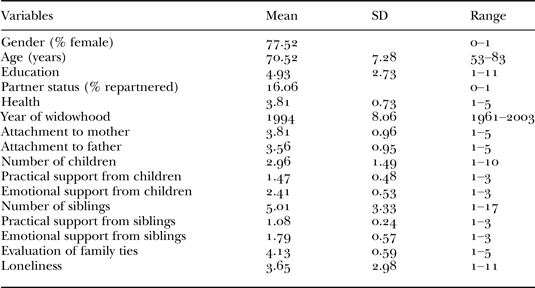
The data for the present work stem from the second wave of the NKPS (Dykstra et al. Reference Dykstra, Kalmijn, Knijn, Komter, Liefbroer and Mulder2012), a study intended to examine family and kinship relationships in the Netherlands. The NKPS is a representative panel survey among individuals aged 18–79 living in private households in the Netherlands. First-wave data were collected among 8,161 main respondents during 2002–2004. Second-wave data were collected in 2006–07 with 6,026 of the former 8,161 NKPS main respondents being re-interviewed. The questionnaires in Wave 2 focused on the changes that had taken place in the lives of the respondents and their families since the first wave but also included new variables to shed more light on experiences within the parental home; these variables were central to the present study. All 218 older adults who met the study criteria, that is, those who experienced the death of a partner and were aged 50 or over, were selected for the quantitative analyses. Mean age was 70.52 years (standard deviation = 7.29, range 53–83) and 78 per cent were female. Of these respondents, 35 (16.1%) were repartnered after the death of their former partner (Table 1).
Descriptive statistics of the study variables

Notes: N = 218. SD: standard deviation.
The scales measuring childhood experiences, support from adult children and siblings, and current family ties were designed for the NKPS by the scientific team. They all show high validity, good reliabilities and have been widely used in family research (Merz and Jak Reference Merz and Jak2013; Merz, Schuengel and Schulze Reference Merz, Schuengel and Schulze2008; Merz et al. Reference Merz, Consedine, Schulze and Schuengel2009).
Childhood experiences
Two scales were used as indicators of intergenerational relationship quality during childhood: ‘attachment to mother’ and ‘attachment to father’. The two scales each consisted of four indicators measuring closeness with, availability of the mother and/or father, and support and understanding within the relationship with the mother and/or father during childhood. An example for measuring availability in the relationship with mother is ‘I could always turn to my mother if I had problems’. Items on both sub-scales were answered on a five-point scale ranging from 1 = strongly disagree to 5 = strongly agree. An average score of the four single items was calculated. Higher values on the scales indicated stronger attachment to mother and father, respectively. Cronbach's alpha was 0.94 for both scales.
Family ties
The quality of family ties and embedding in the family was measured on a scale including four indicators covering closeness, strength, information exchange and cohesion within relationships with members from the extended family, including siblings, aunts, uncles and cousins. Note that no items about ties with individual members from the nuclear family were included in the present analysis. One example item is ‘The ties between members of my extended family are tightly knit’. Respondents evaluated their family ties on a five-point scale ranging from 1 = strongly disagree to 5 = strongly agree. Higher values on this scale represented stronger family ties. Cronbach's alpha for this scale was 0.85.
Support from siblings and adult children
Emotional support was measured using two items referring to how much interest and advice (ranging between 1 = not at all, 2 = once or twice, and 3 = several times) siblings and/or adult children provided to their widowed brother/sister or father/mother. Information on these aspects of support was available for a maximum of two siblings and two children. Cronbach's alpha for the emotional support variable, based on four items (i.e. interest and advice from two siblings/two children), was 0.72 for the siblings and 0.70 for child support. Instrumental support consisted of two items measuring how much support with household chores and odd jobs (ranging between 1 = not at all, 2 = once or twice, and 3 = several times) siblings/adult children provided. Cronbach's alpha for the instrumental support variable, based on four items, was 0.64 for sibling support and 0.66 for child support.
Loneliness
Loneliness was measured using the De Jong Gierveld 11-item loneliness scale (De Jong Gierveld and Kamphuis Reference De Jong Gierveld and Kamphuis1985), a widely used, psychometrically sound scale (Pinquart and Sörensen Reference Pinquart and Sörensen2001; Van Tilburg and De Leeuw Reference Van Tilburg and De Leeuw1991). The word loneliness is not used in any of the items in order to avoid triggering feelings of embarrassment and social stigma among lonely men and women. The scale consists of items covering the availability of enough people to talk to, sources of support, people to trust, people to feel close to and friends to call on whenever needed. An example item is ‘There is always someone I can talk to about my day-to-day problems’. Possible answers to the items were 0 = no, 1 = more or less, and 2 = yes. Scale scores are based on dichotomous item scores; the answer ‘more or less’ always indicates loneliness. The scale score 0 refers to the absence of loneliness, the score 11 to ultimate loneliness (De Jong Gierveld and Van Tilburg Reference De Jong Gierveld and Van Tilburg1999). Cronbach's alpha for this scale was 0.83.
Control variables
Previous research has shown that loneliness varies across demographic characteristics (Hawkley et al. Reference Hawkley, Hughes, Waite, Masi, Thisted and Cacioppo2008). Therefore, we included age (in years), gender, education (ranging from 1 = incomplete elementary to 11 = post-graduate), number of siblings and number of children, and a general measure of subjective health (ranging from 1 = very poor to 5 = excellent) as control variables in the quantitative analyses.
Quantitative analyses
Pearson correlations were used to calculate bivariate associations among the study variables. Multivariately, first a hierarchical regression was performed to determine the best linear combination of demographic and childhood attachment variables predicting the evaluation of current family ties. Second, demographic and childhood attachment variables, as well as the evaluation of current family ties and variables identifying current network characteristics (partner status, the number of children and siblings, and support received from children and siblings) were taken into account to predict loneliness.
Participants and procedure: qualitative analyses
In order to elicit in-depth knowledge about the mechanisms behind the role of family relationships for loneliness in older adults, a total of 52 semi-structured interviews were conducted with NKPS respondents in the years 2008/9. Only respondents who at the end of the NKPS Wave 2 agreed to be re-interviewed were contacted. A professionally educated interviewer and the second author with extensive expertise in qualitative research conducted the interviewing. The sub-sample of 52 interviewees encompassed ever-widowed and ever-divorced adults. The criteria for inclusion in this specific study encompassed: NKPS respondents aged 50 or over (in Wave 2), ever-widowed, and having two or more children and two or more siblings. In total, 18 out of the 52 older adults in the sub-sample were eligible for this study. All interviews took place in respondents' homes. Ten respondents were female and eight were male. The moment of widowhood dated back 4–36 years, with a mean of 19.7 years. In total, nine of the 18 respondents had started a new romantic partner relationship and shared living arrangements; the other nine were living alone.
Given the availability of basic information about the respondents, based on the quantitative data gathered in Waves 1 and 2 of the survey, the semi-structured interview guide included only a specialised series of topics covering quality and support exchange within the relationships with children, siblings and other family members. The focus was on positive, negative and ambivalent aspects of the sibling relationships to investigate the mechanisms behind the comforting or discomforting function of sibling relationships (Bengtson Reference Bengtson2004; Hogerbrugge and Komter Reference Hogerbrugge and Komter2012; Lowenstein Reference Lowenstein2007). The opening question was ‘How would you describe the relations with your family members, more specifically with your children, sisters and brothers?’ Answers to these questions helped to elicit perceptions, experiences and evaluations of past and current relationships. Additional questions were formulated to clarify answers, in order to obtain a broad and detailed overview of the relationships between respondents and their siblings and children. The interview strategy also allowed flexibility to capture unexpected findings. Duration of the interviews varied between 60 and 90 minutes.
The information gathered was tape-recorded and consequently transcribed in order to prepare the data for entry into the qualitative data management system. The second author, who has extensive expertise in qualitative research, took the lead in analysing the data. Both authors have been intensively involved in exploring the coding categories and themes that emerged from the data. The analysis procedure started with open coding of the interview texts (LaRossa Reference LaRossa2005). Next the coding categories were examined and compared for similarities and differences and brought together in several schemes of related categories. As expected, sibling bonds are not stable over time, but are formed and re-formed, improving and deteriorating, depending on important life events with which adults are confronted. Introducing additional elements of the lifecourse offered the opportunity to reassemble meaningful pieces of information (Elder Reference Elder and Bandura1995). Coding schemes have been revised and expanded as our interpretations and explanations progressed. The analysis was completed by formulating theoretical propositions around the interactional processes elicited, while data saturation was discussed between researchers.
Results
Descriptive quantitative results and correlations
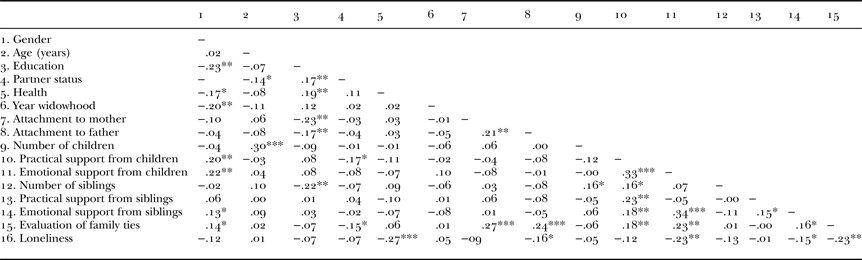
Tables 1 and 2 display the descriptives of the main variables and their correlations. As can be seen from Table 2, loneliness was not correlated with our control variables, except for health. Neither age, gender nor education was associated with loneliness, whereas poor health was related to increased loneliness. Attachment to father but not attachment to mother reduced loneliness. Regarding family support, emotional support received from children and siblings correlated with lower levels of loneliness in our widowed older respondents whereas practical support was not associated with loneliness. Stronger family ties also correlated with lower levels of loneliness.
Correlations among demographic control variables, childhood memories, sibling support, family ties and loneliness
Notes: N = 218. Gender and partner status are dummy coded, such that 1 is female and having a partner.
Significance levels: * p < 0.05, ** p < 0.01, *** p < 0.001.
Multivariate results
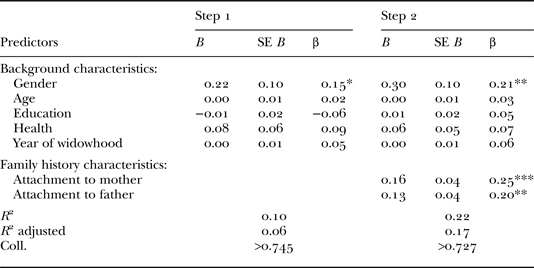
Table 3 displays the results of the hierarchical regression analysis of current family ties on demographic control variables and childhood attachment. Of the control variables, only gender was significantly associated with family ties, in that women reported higher quality. Memories of relationships with parents during childhood, or attachment to mother and father, positively predicted the current evaluation of family ties. Entering these family history characteristics into the regression more than doubled the explained variance in current family ties (cf. Table 3).
Family history predicting current family ties
Notes: N = 218. Gender and partner status are dummy coded, such that 1 is female and having a partner. SE: standard error. Coll: Collinearity Statistics: Tolerance value.
Significance levels: * p < 0.05, ** p < 0.01, *** p < 0.001.
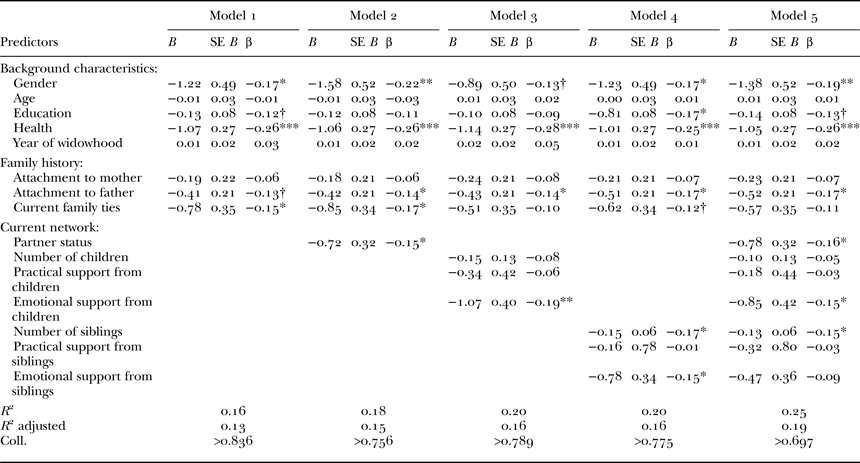
In a second regression (cf. Table 4), family history characteristics (i.e. childhood attachment) as well as current family network characteristics (i.e. partner status, number of children and siblings, adult child and sibling support) stepwise were used to predict loneliness in our ever-widowed older adults. Among the control variables, gender and health related with loneliness, such that being male and in poor health was associated with higher feelings of loneliness. Attachment to father and evaluation of family ties reduced loneliness (cf. Model 1). In the next steps, current network characteristics were entered. Having a new partner reduced loneliness. Model 3 investigated the role support from adult children may play in association with loneliness among older adults. Emotional support did reduce loneliness whereas number of children and practical support was not predictive. Model 4 took support from the sibling network into account. Both number of siblings and emotional support from siblings were negatively related with loneliness. In both models, the child and sibling support model increased the explained variance in loneliness from 18 to 20 per cent, indicating that support from siblings mattered in a similar way for positive outcome in older adults as adult child support. In our final model, all predictors were included simultaneously, explaining 25 per cent of the variance in loneliness. In this model, father attachment, partner status and emotional support from children, as well as number of siblings, remained significant predictors of loneliness.
Family history, current family ties and the functioning of the family network predicting loneliness
Notes: N = 218. Gender and partner status are dummy coded, such that 1 is female and having a partner. SE: standard error. Coll: Collinearity Statistics: Tolerance value.
Significance levels: † p < 0.10, * p < 0.05, ** p < 0.01, *** p < 0.001.
Outcomes: qualitative analyses
In order to understand better the possible mechanisms behind the associations among childhood relationships, current family bonds and sibling support, we examined how older ever-widowed women and men described and evaluated the bonds with family and siblings in particular. Based on these descriptions, several theoretical lines of thinking could be elicited. The most distinctive differentiation was between older adults who evaluate current sibling relationships as either positive or negative. Among both groups of respondents, for those who evaluated their sibling bonds as positive or negative, the parental home was explicitly mentioned as one of the factors determining the quality of current relationships. Furthermore, many of the interviewees spontaneously mentioned the exchange of support, especially emotional support particularly in relation to widowhood, as one of the key characteristics of optimal sibling relationships in later life. Additionally, this study showed that for the nine respondents who mentioned having good relationships with brothers and sisters, this was associated with lower scores on the loneliness scale for almost all of them. These respondents underlined the blessings of warm relationships with brothers and sisters, being well aware of the vulnerability of these sibling bonds given the advanced age of the interviewed older adults. Non-optimal sibling bonds proved to be associated with feelings of more intense loneliness. Those respondents mentioned the discomfort of weakened bonds with siblings.
In the next sections, we describe the comments of our respondents in detail. Firstly, we address the comments of those evaluating their sibling bonds as positive. Secondly, we address the comments of those who are dissatisfied and talking about weakened bonds with brothers and sisters.
The benefits of warm relationships with siblings
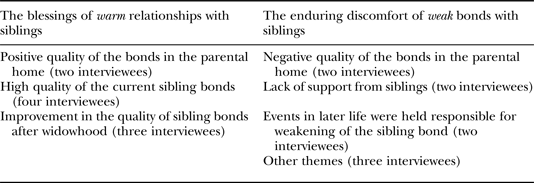
Of the nine respondents who were positive about the quality of their sibling bonds, two referred spontaneously to the positive quality of the bonds in the parental home, and four of them spontaneously mentioned the high quality of current sibling support. Three out of these nine respondents discussed broadly the improvement in the quality of sibling relationships starting in later life, more specifically after the onset of widowhood (see also Table 5).
Comparing warm and weak sibling relationships: main themes
Note: N = 18.
Older adults who evaluated their sibling relationships as positive talked extensively about these bonds. Moreover, all but one of these adults had low scores on the loneliness scale as measured in Wave 2 of the NKPS. The beneficial facets of good sibling relationships were, for example, carefully described by a woman, widowed for nine years, living as a single mother with her children (#6):
My brother is very important to me, because we only have each other now. I mean … there are no other brothers and sisters alive anymore. Yes, if something happens, we can always count on each other, … yes, we share the problems, the joy, we share everything, really. If something happens, we are always there for each other, always. So, really very important for me, yes. My brother and I, we are … er, our father was a problem drinker, you see, … so we did not grow up in a balanced family.
Apparently, the bond with her brother was helpful in alleviating loneliness; although having to cope with the daily chores of running a household with dependent children, she did not feel lonely (score on the loneliness scale 0). The time perspective (including both childhood and ageing experiences) played an important role in her description of the warm sibling bond. Their problematic childhood experiences have welded the siblings together. This widow referred to the bond with her brother in the context of other brothers and sisters who had died already and are sorrowly missed.
Similarly, a widow, aged 73 years, living alone (#19), describing her sibling relations positively, framed her answer explicitly in the perspective of ageing and the confrontation with the death of her partner and of siblings (who had migrated from the Netherlands to Canada):
A mid-week family reunion was organised last year, and all sisters and brothers (-in-law) they came over from Canada, especially for this … It was a great success … I organised everything. My brother died soon after the reunion and looking back I would say that made the reunion even more important. And then, especially when you find out that your brother falls ill and you call each other, … you keep in touch and my sister and I, we said, now it's just the two of us here and we have to be really nice to each other, that's what we said.
This widow also had a low score on the loneliness scale (score 1) and realised the importance of lasting sibling bonds in the light of ageing and death. As mentioned by both respondents, the death of brothers and sisters affected the bonds with siblings who were still alive. Older adults mentioned their honest wish to be in contact with surviving brothers and sisters, but sometimes valuable bonds are hardly replaceable, as aptly put forward by a widower of 77 years, widowed for 36 years, living alone (#7):
…and my youngest sister, she was really my closest confidante, and she died two years ago. And that [contact] always went by telephone, because she lived in America. But it is a lot cheaper nowadays to phone to America, so I would chat on the phone for at least an hour. But I was able to discuss things with her, look, … with my oldest sister, we are on good terms, but I can't have those conversations that I used to have with my youngest sister. And my oldest brother died too.
The vulnerability of valuable bonds was by most interviewees explicitly recognised and especially well understood by the oldest interviewees. Several touched upon the beneficial functions of good sibling bonds, especially if one of the siblings was very recently confronted with the death of a partner. The bereaved sibling was comforted, and more frequently than before the bereaved person was emotionally supported. Those ‘in the same boat’, that is those who experienced widowhood already in the past, were willing and prepared to comfort the newly bereaved. Their partly shared lifecourse eased an optimal tuning of the interrelationship. The following quote shows how a long-term widow, aged 73 years (#19), followed her heart in comforting her sister-in-law:
I kept in close contact with my sister-in-law, who was now also alone, because I understood how she felt…
For this widow too, the positive bond with her sister-in-law was among the factors affecting her low intensity of loneliness (a score of 1 on the loneliness scale). More than one respondent consequently mentioned the recognition of how others felt in the particular situation of becoming a widower or widow as a valuable aspect of sibling bonds in later life:
In situations when it was needed, yes, then we were really there for each other, yes. But that was also because he lost his wife three years ago due to cancer and eh, then people often really change. From, eh, being an optimistic and easy-going person and now, having to face it yourself then all over sudden it was different. And then, you understand a lot more of what others have to face. (widow for 32 years, 62 years of age; #41)
This widow scored much higher on the loneliness scale (score 7). This score probably indicated that sibling contacts are important elements of the total social network, but the shortage of other supporting relationships in her network might have had a more decisive effect on the experienced intensity of loneliness.
In the citations shown until now, the most precious sibling bonds were characterised by emotional support, formulated as: ‘understanding’, ‘being one's best confidante’ and ‘we are there, if something happens’. Interviewees accentuated that this emotional support became more and more important while ageing. In contrast, instrumental support between siblings tended to fade away. Several interviewees were filled with regret or nostalgia for times gone by. One of them, a widower for 32 years, now 81 years of age (#78), formulated these feelings as follows:
It's like this, if something needed to be moved, then we [as siblings] always helped out, that goes without saying. Then everyone helped. But it has become less and less … But, we have children and grandchildren now, who can also do the job. The job has been taken over.
In conclusion, exchange of emotional support, being one's best confidante, were central categories of quotations of older adults involved in warm and positively evaluated sibling bonds. Moreover, most of the widows and widowers cited in this context were characterised by low levels of loneliness. Apparently, they had a social network distinguished – among others – by good sibling contacts that contributed to the experience of low levels of loneliness. One of the respondents, however, scored high on the loneliness scale. Hence, there was no exclusive relationship between one aspect of the social network – in this case the sibling bonds – and the overall evaluation of one's social environment as lonely.
The enduring discomfort of weakened sibling relationships and the wish for restoration
Nine of the respondents were involved in sibling relationships characterised as ambiguous or even full of conflicts. Such non-optimal sibling bonds proved to be associated with feelings of discomfort. Sometimes the less optimal bonds with siblings dated back to the period in the parental home, as was explicitly and spontaneously mentioned by two of our respondents. For two of the respondents other events later in life were held responsible for the weakening of sibling ties. The lack of support from siblings was mentioned as an important facet of current life (see also Table 5). Most of the interviewees continued too long to discuss restoration of the bonds or reconciliation.
The comments of older adults who evaluated their current sibling bonds as ‘reasonable’, ‘not good’ or ‘not good at all’ were characterised by sorrowful descriptions of bonds with brothers and sisters. Interviewees explicitly referred to relational conflicts or even broken-off sibling relationships during interviews. Several examples illustrate the sadness of those involved; one such example is the story of a widow for ten years, 55 years of age (#94; loneliness score 2):
The sibling relationships have been difficult for quite a while. Totally driven apart, actually. Especially with my sister. We, my sister and I were very close sisters … And then, she had marriage problems and during that time, I had just met Huub [an intimate friend of hers], and Huub said something about her husband … and that's why everything went wrong. My sister blamed Huub for this and indirectly me too … And then we did not see one another for a long period of time … In the past we, as brothers and sisters, always supported each other. That was necessary. Yes, we supported each other through thick and thin… (her eyes fill with tears).
There were older adults who were more than incidentally involved in sibling conflicts. This is the story of a widow, now aged 75 years, who cared for her first husband until he died after a long period of illness and hospitalisation. She became a widow at age 57. There are a selection of events out of her life story which illustrate multiple frictions with siblings:
The sibling relationships are poor. For a long time there was disagreement between my youngest sister and my oldest sister and I was the one in the middle … Now, my youngest sister also had an argument with my brother … My sister has broken with the whole family, and now also with me. This has given me a lot of grief … No, there is no support giving or receiving in this family, never listening to one another. (75 years, #52)
This widow scored very high (9) on the loneliness scale. Multiple conflicts can in the end lead to the loss of hope for restoration of the bonds and to intense loneliness. Faced with this situation, older adults were more or less forced to accept the emptiness of missing relationships, feeling rejected and losing their trust and confidence in close relationships. The negatively experienced sibling relationships and the related intense loneliness could become so overwhelming that older adults did not see any light at the end of the tunnel. This reality of a widow aged 80 years (#44) was expressed as follows:
I have nobody.
She scored 11, the highest score on the loneliness scale. She was confronted with the death of her first and recently with the death of her second husband. In answering the question: ‘Has someone supported you and your husband during the period of his terminal illness’?, she said:
No, no, because I have nobody. I have really no person…
The moderate feelings of loneliness of a long-term widow, now 51 years of age (#35; score of 4 on the loneliness scale) proved to be related to the breaking up of a group of four sisters. Three out of the four were still in close contact. Our interviewee apparently envied the bonds between the three sisters and was deeply unhappy with her ‘staying aside’. She formulated the situation as follows:
Er …, reasonable. Well, how shall I say it … We did not quarrel or anything, we could always rely on each other if needed. But we were not very close. I believe that those three together, they have more contact with each other.
In conclusion, our data showed the effects of missing the exchange of emotional support with brothers and sisters. Several of the interviewees were stricken by grief, as became clear from the comments elicited, but also from their behaviour: some of the respondents started crying while describing their broken-off relationships with siblings. In addition, our data illustrated the relationship between the evaluation of bonds with social network members as deficient, and the intensity of loneliness.
Discussion
Our results provide a thorough approach to shedding light on the role of siblings in older adults' social networks – both in terms of size and composition and in terms of the evaluative and supportive aspects of these networks – by combining qualitative and quantitative data. Below, we discuss these results more fully, considering the unique role of childhood memories and current family relations for loneliness after widowhood.
Family ties – the role of attachment to mother and father
Experiences and memories of parents as a reliable resource in problem solving, as supportive, as (a) close figure(s) and as understanding have been found to predict positively current evaluation of the family network (H1 confirmed) which in turn associated with loneliness such that positive family ties were related to reduced loneliness (H2 confirmed). Although previous research has always acknowledged the central role of primary care-givers, usually the mother, for the development of children, only a few studies have extended this work to covering the whole lifecourse well into old age (Van IJzendoorn and Bakermans-Kranenburg Reference Van IJzendoorn and Bakermans-Kranenburg2010). As shown by Grossmann, Grossmann and Kindler (Reference Grossmann, Grossmann, Kindler, Grossmann, Grossmann and Waters2005), childhood experiences with primary care-givers influenced young adults' thoughts and feelings about close relationships. Generally, the current work, based on a combination of quantitative and qualitative data, gives some insight into the even farther-reaching influences that positive relationships in childhood can have on adult relations and the evaluation of family ties in older age. In addition, experiences and memories of the father as a reliable resource in problem solving, as supportive, a close figure and as understanding have been found to reduce loneliness in our widowed respondents. Why attachment to mothers did not associate with loneliness in our analyses while attachment to father did is not easy to explain. Recent work, however, has shown that fathers play a special and sometimes unique role in the upbringing of children and contribute specific features to their social and emotional development (Mallers et al. Reference Mallers, Charles, Neupert and Almeida2010) well into adulthood (Gilligan et al. Reference Gilligan, Suitor, Kim and Pillemer2013). Particularly in stimulating exploration, fathers have been shown to be important figures in children's development (Grossmann et al. Reference Grossmann, Grossmann, Kindler, Zimmermann, Cassidy and Shaver2008). It may well be that fathers are important in stimulating contact beyond the parental home, whereas mothers have been shown to play important roles in comforting and soothing (Baumrind Reference Baumrind1980; Grossmann et al. Reference Grossmann, Grossmann, Kindler, Zimmermann, Cassidy and Shaver2008) and in shaping emotional experiences (Mallers et al. Reference Mallers, Charles, Neupert and Almeida2010). The current association between positive memories of childhood relations with a father may have provided our respondents with social skills and capacities leading to more supportive networks in adulthood upon which they can rely after widowhood. Our qualitative results also referred to the importance of the family of origin for adult functioning and the maintenance and quality of sibling bonds in particular. Interestingly, a problematic family home may have led to better sibling bonds as protection. Although not explicitly asked, several of our qualitative respondents mentioned their parental home and childhood situation when describing the current bonds with family, again confirming the importance of childhood experiences for adult outcome.
Sibling support and loneliness in older adults
Due to ageing and life events such as widowhood, older adults have to rely on other close and emotionally rewarding figures (Carstensen, Isaacowitz and Charles Reference Carstensen, Isaacowitz and Charles1999; Doherty and Feeney Reference Doherty and Feeney2004). Our quantitative results indicated that relationships with brothers and sisters can play a role in reducing loneliness in older ever-widowed adults. Siblings can contribute to the wellbeing of their brothers and sisters. Both sibling structure and relationship quality have been shown to associate with wellbeing in adolescents (Vogt Yuan Reference Vogt Yuan2009). Similarly, number of siblings, and especially the emotional support received from siblings, proved to be associated with lower levels of loneliness in older adults (confirming H3a). These quantitative results were paralleled by information from the in-depth interviews. Those who described their relationships with siblings as characterised by emotional support tended to report low levels of loneliness. They used warm and sympathetic words to refer to the meaning of close sibling relationships. Bonds with siblings were based on regular visits to one another, but also on phoning each other. Lifecourse events and related moves to other places require maintaining bonds over long distances. This is especially true for siblings confronted with the out-migration of brothers and sisters. Several of the interviewees mentioned that brothers or sisters had migrated from the Netherlands to Canada or the United States of America. In these cases, emotionally supporting the widowed sibling is realised via long-distance calls, and occasionally via visits and family reunions.
Our interviewees explicitly mentioned that they were well aware of the ageing process and the risks of losing their loved ones, now that they as brothers and sisters were ageing. Several of them described in detail the bonds with a sister or brother who had passed away, and how intensely this person is missed. The need to be in close contact with brothers and sisters, who still are among them, was expressed. Additionally, those siblings who were in the same boat after the death of their partners stated explicitly that they tried to comfort one another, because they could empathise and shared the feeling of their loss. In the interviews, respondents also referred to practical help exchange, which was formerly a sibling task but was taken over by the younger generation. As expected (H3b), our quantitative results showed that indeed practical sibling support did not predict loneliness.
In research until now, frequently ignored is the situation of adults who, confronted with negative life events such as widowhood, evaluated their contacts with siblings as not good. Our study showed the overall sad and miserable situations of older widows and widowers when sibling relationships did not meet expected quality. The comments of older adults who evaluated their current sibling bonds as ‘not good’ or ‘not good at all’ were characterised by sometimes heartbreaking descriptions of ties that had deteriorated or even broken down. Many of them envied those siblings that were still in contact; others yearned for restoration of the bonds. Our data showed an association between sibling relationships evaluated as warm or emotionally supportive and lower levels of loneliness. On the other hand, those interviewees who identified sibling relationships as not good at all were more frequently characterised by moderate or strong feelings of loneliness. Many recently widowed older adults received increased social support from the family network that protected against loneliness to a certain extent. Later on, however, such contact and support started to decrease (Guiaux, Van Tilburg and Broese van Groenou Reference Guiaux, Van Tilburg and Broese van Groenou2007), leading to higher risks of loneliness. For that reason, it may be important to know more about the functioning of the sibling part of the social network. Siblings, as part of the social relationships ‘given by birth’, are supposed to be less prone to network instability and to continue to function as a safety network in fighting the onset and continuation of loneliness.
Limitations
Although it contributes to our understanding of the role of family relationships on loneliness after widowhood by paying particular attention to sibling support based on both quantitative and qualitative data, the current study is not without limitations. First, we had to rely on retrospective measuring of childhood experiences. Adult respondents were asked to recall their experiences with parents before age 15. Evidence in childhood abuse and neglect studies (for an overview, see Hardt and Rutter Reference Hardt and Rutter2004) showed that adverse life events in childhood tend to be correctly recalled or underestimated when retrospectively recalled in adulthood. Less is known, however, about the correct recalling of positive relationship aspects in their childhood experiences by adults. McCormick and Kennedy (Reference McCormick and Kennedy1994) did find continuity between retrospective childhood attachment and current adolescent attachment measures. However, whether this continuity holds until late adulthood remains uncertain.
Second, no valid quantitative measures of sibling conflict were available from the survey. Although respondents were asked about negativity and conflict in their relationships with family members, the items referring to sibling relationships were very skewed and showed no to little variance. Therefore, they could not be used in the quantitative analyses. In addition, the interview data were collected after the survey data. For better compatibility between the quantitative and qualitative reports, it would have been valuable to use more parallel measures and timing.
In analysing the qualitative data, it was shown that experiencing warm sibling bonds was associated with lower loneliness, and deteriorated or broken sibling relationships were associated with higher levels of loneliness. The latter group used a varied set of words to indicate feelings of sadness and grief. However, none of them explicitly used the word loneliness to describe their feelings. We interpret this to be associated with the social stigma and taboo surrounding the phenomenon of loneliness. It was only by using their scores on the quantitative loneliness scale that we were able to connect the evaluation of relationship quality with siblings and loneliness. On the other hand, this procedure illustrates the rich potential of a research design that encompasses both quantitative and qualitative data.
Concluding remarks and implications for policy making
In sum, the current study was a first step in elucidating some of the complex associations family relations might have with loneliness in widowed older adults. Both the quantitative and qualitative results showed that family bonds, in particular sibling relationships and emotional support, may be major resources in reducing loneliness. In addition, childhood memories of relationships with a father have been found to predict loneliness. Attachment concepts may help link personal childhood experiences to social circumstances (Merz, Schuengel and Schulze Reference Merz, Schuengel and Schulze2008) as attachment ties can be considered the first social ties through which children develop and experience future relationships. This process may be key to elucidating the complex interplay among family relations throughout the whole lifecourse, from childhood well into old age.
Family relationships often stir strong emotions, positive and negative, and play an important role in social health, especially during negative life events. It should be taken into account that meaningful and long-lasting relations between family members in all phases of the lifespan cannot be taken for granted (Kaufmann et al. Reference Kaufmann, Kuijsten, Schulze and Strohmeier2002), although they are crucial for our wellbeing and the very meaning of life. Based on findings such as these, awareness may be raised that maintaining high-quality relationships with one's siblings, children or parents requires active commitment. Letting relationships deteriorate might, in the long run, lead to lower wellbeing. Although there is a well-developed practice for supporting parent–child relationships when children are young, the current findings suggest that such practice, for example family counselling, may become relevant again as individuals are ageing and experience the death of a spouse.
Acknowledgements
The Netherlands Kinship Panel Study (NKPS) is funded by the ‘Major Investments Fund’ (grant number 480-10-009) and the ‘Longitudinal Survey and Panel Fund’ (grant number 481-08-008) of the Netherlands Organization for Scientific Research (NWO). Financial and institutional support for the NKPS also comes from The Netherlands Interdisciplinary Demographic Institute (NIDI), the Royal Netherlands Academy of Arts and Sciences (KNAW), the Faculty of Social Sciences (Utrecht University), the Faculty of Spatial Sciences (University of Amsterdam), the Faculty of Social Sciences (Tilburg University) and the Faculty of Social Sciences (Erasmus University Rotterdam). No ethical approval was necessary for this study. Note, however, that only respondents who agreed to be re-contacted in the survey were approached for the qualitative interviews.