Introduction
Soil-transmitted helminths (STH) cause around 2 billion infections worldwide; these include hookworms which, as of 2010, accounted for an estimated 438.9 million infections worldwide with 70% of these occurring in Asia (Pullan et al., Reference Pullan, Bethony, Geiger, Correa-Oliveira, Brooker and Quinnell2010). There are a number of zoonotic hookworm species parasitic in dogs and cats, including Ancylostoma caninum, A. braziliensis and A. ceylanicum which cause a range of symptoms in humans. Historically, it was believed that N. americanus and A. duodenale were responsible for all human hookworm infections (de Silva et al., Reference de Silva, Brooker, Hotez, Montresor, Engels and Savioli2003; Bethony et al., Reference Bethony, Brooker, Alboico, Geirger, Loukas, Diemart and Hotez2006); however, it is now known that A. ceylanicum is also an important hookworm of humans, particularly in South East Asia (SEA) (Traub et al., Reference Traub, Inpankaew, Sutthikornchai, Sukthana and Thompson2008; Bradbury and Traub, Reference Bradbury, Traub and Loukas2016). Morphologically these species are similar but there are molecular assays available that distinguish A. duodenale from A. ceylanicum (Palmer et al., Reference Palmer, Traub, Robertson, Hobbs, Elliot, While, Rees and Thompson2007; Traub et al., Reference Traub, Inpankaew, Sutthikornchai, Sukthana and Thompson2008; Jiraanankul et al., Reference Jiraanankul, Aphijirawat, Mungthin, Khositnithikul, Rangsin, Traub, Piyaraj, Naaglor, Taamasri and Leelayoova2011; Inpankaew et al., Reference Inpankaew, Schar, Dalsgaard, Khieu, Chimnoi, Chhoun, Sok, Marti, Muth, Odermatt and Traub2014). Precise determination of the species of hookworm causing the human infection is important for control as A. ceylanicum can be transmitted by cats and dogs as well as by infected humans (Yoshida et al., Reference Yoshida, Okamoto and Chiu1968; Setasuban et al., Reference Setasuban, Vajrasthira and Muennoo1976; Traub, Reference Traub2013).
The only previous report identifying A. ceylanicum in the Philippines is from 1968 and utilized microscopy-based diagnosis (Velasquez and Cabrera, Reference Velasquez and Cabrera1968). More recently, molecular-based copro-diagnostics have determined a relatively high prevalence of A. ceylanicum in SEA in both humans and dogs. In Cambodia, 52% of human hookworm infections and >90% of infected dogs were shown due to A. ceylanicum (Inpankaew et al., Reference Inpankaew, Schar, Dalsgaard, Khieu, Chimnoi, Chhoun, Sok, Marti, Muth, Odermatt and Traub2014). Molecular studies have identified A. ceylanicum in humans in Thailand (Traub et al., Reference Traub, Inpankaew, Sutthikornchai, Sukthana and Thompson2008; Jiraanankul et al., Reference Jiraanankul, Aphijirawat, Mungthin, Khositnithikul, Rangsin, Traub, Piyaraj, Naaglor, Taamasri and Leelayoova2011), Laos (Conlan et al., Reference Conlan, Khamlome, Vongxay, Elliot, Pallant, Sripa, Blacksell, Fenwick and Thompson2012), Malaysia (Ngui et al., Reference Ngui, Lim, Traub, Mahmud and Mistam2012b), and the Solomon Islands (Bradbury et al., Reference Bradbury, Hii, Harrington, Speare and Traub2017) and in Australian dogs (Palmer et al., Reference Palmer, Traub, Robertson, Hobbs, Elliot, While, Rees and Thompson2007).
To date, there had been no molecular identification of A. ceylanicum in the Philippines. Here we report on the prevalence of A. ceylanicum in humans and dogs resident in the municipalities of Palapag and Laoang in Northern Samar of that country utilizing a real-time PCR (qPCR) assay on previously collected stool samples.
Methods
Ethics statement
This study was approved by the QIMR Berghofer Medical Research Institute (QIMRB) Human Ethics Committee and the Institutional Review Board of the Research Institute for Tropical Medicine (RITM), Manila. Informed written consent was received for all study participants; consent from minors was signed for by a legal parent or guardian before the commencement of the study. Individual identification numbers (IDN) were assigned to each participant. Participants were aged 4–72 years. Informed written consent was received from all animal owners in the study area and ethical approval for the animal work was provided by the Ethics Committee of the RITM and the QIMRB Animal Research Ethics Committee. This study was performed in accordance with the recommendations of the Australian code of practice for the care and use of animals for scientific purposes, 2004.
Study design
Human stool DNA samples used in this study were originally collected as part of a previously undertaken cross-sectional survey on Schistosoma japonicum in humans and bovines in the Philippines (Weerakoon et al., Reference Weerakoon, Gordon, Williams, Cai, Gobert, Olveda, Ross, Olveda and McManus2017). Briefly, the survey was performed in 18 barangays (villages) in the municipalities of Palapag and Laoang in Northern Samar in 2015 (Weerakoon et al., Reference Weerakoon, Gordon, Williams, Cai, Gobert, Olveda, Ross, Olveda and McManus2017). Stool samples, collected from 452 individuals, with age and gender data collected at the same time, were stored in 80% (v/v) ethanol before being transported to the QIMRB for DNA extraction and a ddPCR assay for S. japonicum identification (Weerakoon et al., Reference Weerakoon, Gordon, Williams, Cai, Gobert, Olveda, Ross, Olveda and McManus2017).
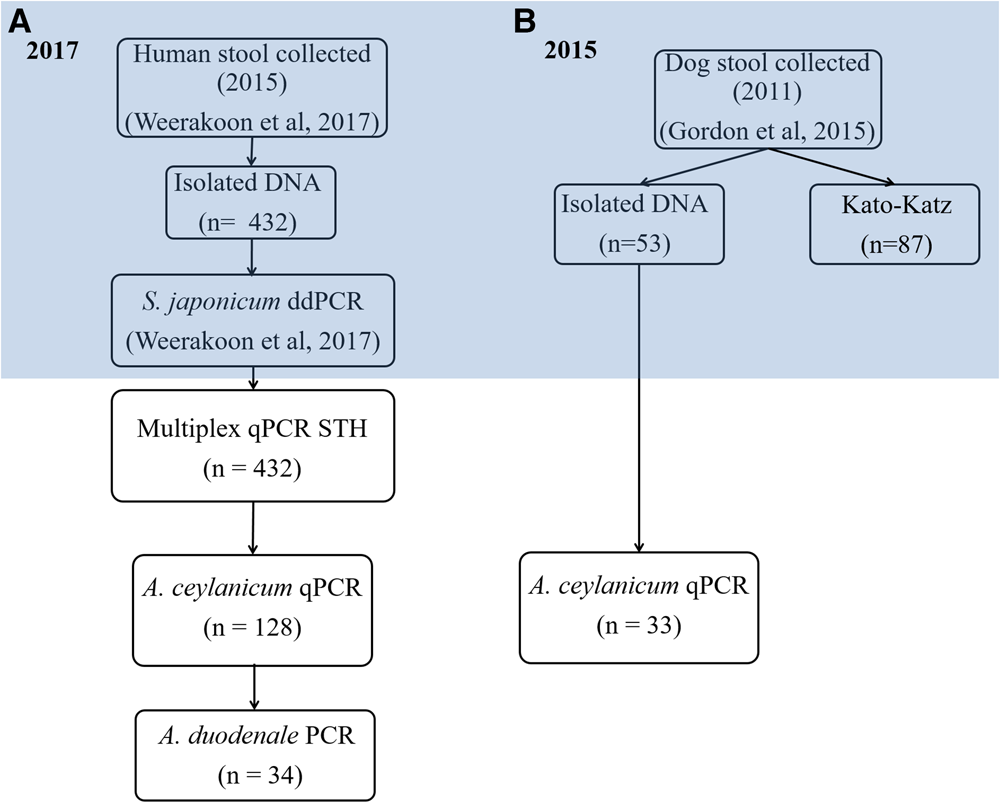
Dog DNA samples used here were originally collected in 2011 for an earlier study on S. japonicum, although the samples were not used in that particular study (Gordon et al., Reference Gordon, Acosta, Gobert, Jiz, Olveda, Ross, Gray, Williams, Harn, Yuesheng and McManus2015a, Reference Gordon, Acosta, Gobert, Olveda, Ross, Williams, Gray, Harn, Li and McManus2015b). Briefly, a cross-sectional survey involving animals was undertaken in six barangays in the Palapag municipality. Stool samples were sought from all dog owners in the study area with age and gender data collected from owners and stored in 80% ethanol before being transported to the QIMRB for DNA extraction in 2011. A total of 87 dog stool samples were collected and subjected to the Kato-Katz (KK) method as part of the original study. Of these, 53 had sufficient stool for DNA extraction, completed in 2011; one sample was discarded as the DNA quality and quantity were low. DNA quality and quantity were re-checked in 2018 using a NanoDrop 1000 prior to qPCR analysis; 33 dog stool samples had sufficient DNA quality and quantity to proceed with the A. ceylanicum qPCR assay.
The workflow for the qPCR analysis is shown in Fig. 1.
Workflow for qPCR analysis for Ancylostoma ceylanicum in this study. A. Stool samples were collected initially for the detection of S. japonicum by ddPCR and qPCR (shaded blue) (Weerakoon et al., Reference Weerakoon, Gordon, Williams, Cai, Gobert, Olveda, Ross, Olveda and McManus2017). Extracted DNA was stored at −20°C until utilized in the current study for a multiplex STH and A. ceylanicum qPCR. B. Dog stool samples were collected and DNA extracted as reported in a previous study in 2011 (Gordon et al., Reference Gordon, Acosta, Gobert, Jiz, Olveda, Ross, Gray, Williams, Harn, Yuesheng and McManus2015a, Reference Gordon, Acosta, Gobert, Olveda, Ross, Williams, Gray, Harn, Li and McManus2015b); the DNA was stored at −20°C until analysed in the current study using the A. ceylanicum qPCR. Of the dog stool DNA samples available, 33 had sufficient DNA quality and quantity to proceed with the A. ceylanicum qPCR assay.

Study area
The Palapag and Laoang barangay area, where stool samples were collected, has been described in detail elsewhere (Olveda et al., Reference Olveda, Olveda, Lam, Chau, Li, Gisparil and Ross2014; Papier et al., Reference Papier, Williams, Luceres-Catubig, Ahmed, Olveda, McManus, Chy, Chau, Gray and Ross2014; Gordon et al., Reference Gordon, Acosta, Gobert, Jiz, Olveda, Ross, Gray, Williams, Harn, Yuesheng and McManus2015a, Reference Gordon, Acosta, Gobert, Olveda, Ross, Williams, Gray, Harn, Li and McManus2015b, Reference Gordon, McManus, Acosta, Olveda, Williams, Ross, Gray and Gobert2015c; Olveda et al., Reference Olveda, Inobaya, McManus, Olveda, Vinluan, Ng, Harn, Li, Guevarra, Lam and Ross2016; Ross et al., Reference Ross, Papier, Luceres-Catubig, Chau, Inobaya and Ng2017; Weerakoon et al., Reference Weerakoon, Gordon, Williams, Cai, Gobert, Olveda, Ross, Olveda and McManus2017; Weerakoon et al., Reference Weerakoon, Gordon, Williams, Cai, Gobert, Olveda, Ross, Olveda and McManus2018). Briefly, the area is of low socio-economic status and many households in the study barangays (villages) lacked toilets or sewerage systems and running water (Ross et al., Reference Ross, Papier, Luceres-Catubig, Chau, Inobaya and Ng2017). The barangays had been subjected to annual mass drug administration (MDA) for schistosomiasis with praziquantel (PZQ), and albendazole for STH amongst school-aged children (Ross et al., Reference Ross, Olveda, Olveda, Harn, Gray, McManus, Tallo, Chau and Williams2015; DepED, 2015a, 2015b; Inobaya et al., Reference Inobaya, Chau, Ng, MacDougall, Olveda, Tallo, Landicho, Malacad, Aligato, Guevarra and Ross2018). Human stool samples were obtained by handing out labelled stool cups which were collected over 1 week in each barangay. Stool samples were stored in 80% (v/v) ethanol for subsequent DNA isolation and molecular analysis. Ages of participants ranged from 4 to 72 years; the mean age in the study population was 33. Gender was evenly distributed; 53% of study participants were male.
Dog ages were collected from questionnaires given to all human participants (Gordon et al., Reference Gordon, Acosta, Gobert, Jiz, Olveda, Ross, Gray, Williams, Harn, Yuesheng and McManus2015a; Gordon et al., Reference Gordon, Acosta, Gobert, Olveda, Ross, Williams, Gray, Harn, Li and McManus2015b). Apart from two animals of unknown age, the ages of the dogs ranged from 1 to 14 years, with the mean age being 3 years; 48% of the dogs were male.
Multiplex qPCR for STH
A multiplex qPCR to amplify hookworm (Ancylostoma spp., N. americanus), and A. lumbricoides DNA, utilizing previously described primers and probes (Gordon et al., Reference Gordon, McManus, Acosta, Olveda, Williams, Ross, Gray and Gobert2015c), was carried out on the collected stool samples.
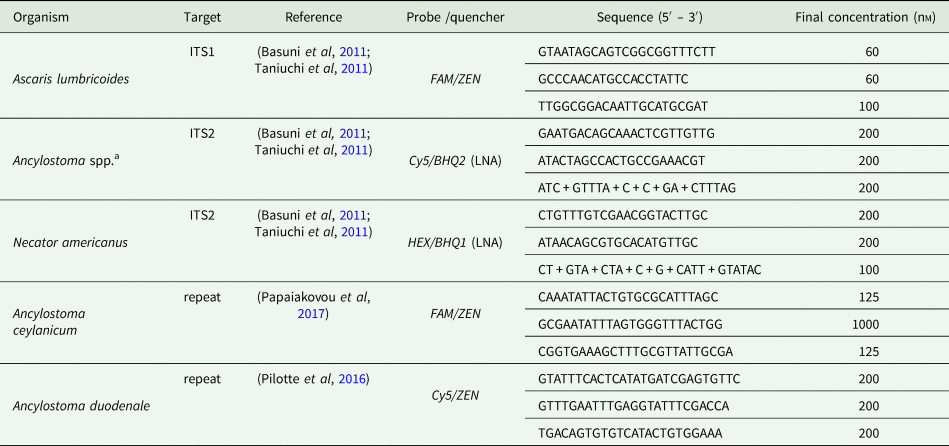
Reaction mixes with a final volume of 13 μL were prepared to contain 8 μL of GoTaq® qPCR Master Mix (Promega, Madison, USA), 0.8 μL of H2O, appropriate amounts of forward and reverse primers and probes for A. lumbricoides, N. americanus and Ancylostoma spp. (Table 1), and 2 μL of template DNA. The qPCR was run on a 5-plex Corbett RotorGene 6000 (Qiagen, Hilden, Germany) with the following cycling conditions; 98°C for 2 minutes which was followed by 40 cycles at 98°C for 20 seconds, 74°C for 20 seconds, 58°C for 30 seconds and a final extension at 72°C for 5 minutes.
Primers and probes used in multiplex qPCR for STH and for A. ceylanicum qPCR

a Amplifies A. duodenale and A. ceylanicum
Genomic DNA of each of the STH analysed was used as positive controls in the qPCR assays, with nuclease-free water used as a negative control. A 1:10 DNA dilution series for each positive control was used to prepare the standard curve [35].
Ancylostoma ceylanicum qPCR
Human and dog DNA samples shown positive for Ancylostoma spp. were subjected to a singleplex qPCR with specific primers and probe to identify A. ceylanicum as previously described [43]. Reaction mixes with a final volume of 7 μL were prepared to contain 3.5 μL of GoTaq® qPCR Master Mix (Promega, Madison, USA), 0.71 μL of H2O, appropriate amounts of primer and probe for A. ceylanicum (Table 1), and 2 μL of template DNA. The qPCR was run on a 5-plex Corbett RotorGene 6000 (Qiagen) with the following cycling conditions: 50°C for 2 minutes followed by 95°C for 10 minutes followed by 40 cycles at 95°C for 15 seconds, and 59°C for 60 seconds.
A positive control, comprising cloned copies of A. ceylanicum G-block gene fragments (Integrated DNA Technologies, Melbourne, Australia), and nuclease-free water as a negative control, were run in tandem for each qPCR assay. A 1:10 dilution series of the positive control was used to prepare the standard curve.
Ancylostoma duodenale qPCR
Human DNA samples, positive for A. ceylanicum, were subject to a singleplex qPCR with specific primers and probe to identify A. duodenale as previously described [43]. Reaction mixes with a final volume of 8 μL were prepared to contain 3.5 μL of GoTaq® qPCR Master Mix (Promega), 0.71 μL of H2O, appropriate amounts of primer and probe for A. ceylanicum (Table 1), and 3 μL of template DNA. The qPCR was run on a 5-plex Corbett RotorGene 6000 (Qiagen) with the following cycling conditions; 95°C for 15 minutes followed by 40 cycles at 95°C for 30 seconds, 55°C for 60 seconds, and 72°C for 30 seconds.
Clones of A. duodenale G-block gene fragments (Integrated DNA Technologies), used as a positive control, and nuclease-free water as negative control were run for each qPCR assay. A 1:10 dilution series of the positive control was used to prepare the standard curve.
Statistical analysis
Data analysis was carried out using Microsoft Excel (Microsoft; LA, USA, 2010) and SAS (version 9.4). A sample was considered positive if it had a cycle threshold (Ct) value less than 35 for the multiplex analysis and less than 32 for the singleplex A. ceylanicum qPCR. Prevalence and 95% confidence intervals (95%CI), and levels of significance were calculated in SAS. 95% CI was calculated using a standard formula based on the binomial and lognormal distribution (prevalence). Significance was calculated using general estimating equations.
Results
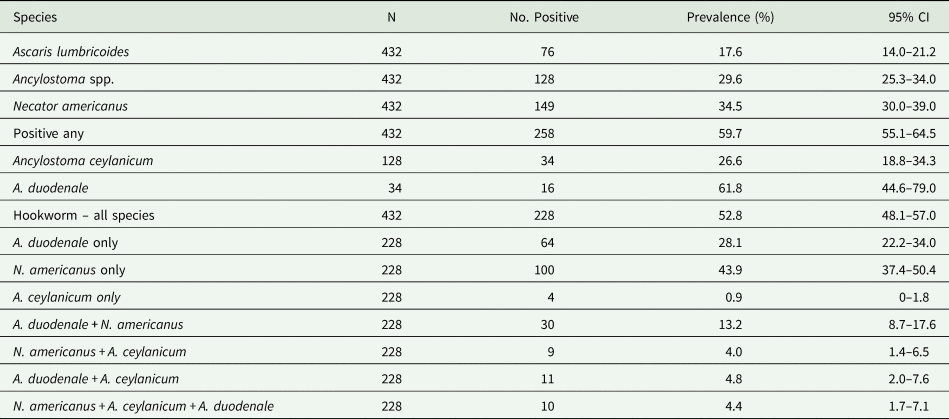
Hookworm accounted for the highest STH prevalence in the human subjects with 52.8% (228/432; 95% CI 48.05–57.50) of individuals infected with either Ancylostoma spp. or N. americanus (Table 2). Of these, 34.5% (149/432; 95% CI 30.00–38.99) were infected with N. americanus and 29.6% (128/432; 95% CI 25.31–33.95) with Ancylostoma spp. Of those positive for Ancylostoma spp., 26.6% (34/128; 95% CI 18.81–34.32) were positive for A. ceylanicum, (Table 2). Of those positive for A. ceylanicum 9 were also positive for N. americanus, 11 were positive for A. duodenale, and 10 were positive for all three hookworm species (Table 2).
Prevalence of Ascaris and hookworm in human subjects from Palapag and Laoang determined by qPCR

The prevalence of hookworm in dogs determined by the KK was 33.3% (29/87; 95% CI 23.23–43.44). Of the dog stool samples subjected to the A. ceylanicum qPCR assay, 36.4% (12/33; 95% CI 19.04–3.69) were positive.
Discussion
The prevalence of human hookworm in the Palapag and Laoang study area in the Philippines was lower (52.8%) than previously reported (82.3%) in 2013 (Gordon et al., Reference Gordon, McManus, Acosta, Olveda, Williams, Ross, Gray and Gobert2015c), likely due to implementation (in 2015) of the national school deworming program (DepED, 2015b; Peñas et al., Reference Peñas, de Los Reyes, Sucaldito, Ballera, Hizon, Magpantay, Belizario and Hartigan-Go2018). Mass drug administration (MDA) with albendazole of school-aged children for STH has been carried out bi-annually in the Philippines since 2016; community MDA is not provided (DepED, 2015b; DepED, 2016). In our 2013 survey from the same area, we did not identify any infections due to N. americanus but in the current study, it accounted for the majority (34.5%) of the hookworms present. This may be due to the smaller number of villages surveyed in the earlier study.
The Palapag/Laoang study area is predominantly rural, it is isolated, and it is of low socioeconomic status; there is little in the way of septic or water treatment and roughly 40% of people do not have access to a water-sealed toilet while the remainder use pit latrines which can become flooded during the rainy season (Ross et al., Reference Ross, Olveda, Olveda, Harn, Gray, McManus, Tallo, Chau and Williams2015). In most cases drinking water is collected from wells a few feet deep, or from natural springs; occasionally, river water is used for bathing and washing. Poor hygiene, food safety and sanitation are significant risk factors for infection with STH, including hookworm, which makes the study site a prime transmission area for these intestinal worms. This is the first molecular study reporting on the prevalence of A. ceylanicum in the Philippines although this hookworm species was identified morphology in 1968 (Velasquez and Cabrera, Reference Velasquez and Cabrera1968).
Similar to other reports from SEA, the current study showed a higher human infection prevalence of N. americanus than A. ceylanicum (Ngui et al., Reference Ngui, Ching, Kai, Roslan and Lim2012a; Inpankaew et al., Reference Inpankaew, Schar, Dalsgaard, Khieu, Chimnoi, Chhoun, Sok, Marti, Muth, Odermatt and Traub2014). The prevalence of A. ceylanicum in Palapag and Laoang adds to growing concerns that this hookworm is widespread in SEA and is likely to be present in other areas of the Philippines (Velasquez and Cabrera, Reference Velasquez and Cabrera1968; Ngui et al., Reference Ngui, Lim, Ismail, Lim and Mahmud2014).
Dog stool samples, collected in the study area in 2011, were here subjected to qPCR for hookworm presence. Although not reported, the study undertaken in Palapag in 2015 (Gordon et al., Reference Gordon, Acosta, Gobert, Jiz, Olveda, Ross, Gray, Williams, Harn, Yuesheng and McManus2015a, Reference Gordon, Acosta, Gobert, Olveda, Ross, Williams, Gray, Harn, Li and McManus2015b) identified 29 of 87 dogs from six barangays as being KK-positive for hookworm. Only a small number (33) of these dog stool DNA samples were available for analysis in the current study but we successfully identified 12 animals infected with A. ceylanicum. Increased knowledge of the zoonotic transmission of A. ceylanicum is important in terms of the epidemiology of the parasite and in hookworm control generally; the provision of hookworm treatment to humans only will not prevent infection from dogs which freely roam the barangays. The significant health problem of zoonotic diseases caused by domestic animals – in this case, dogs – cannot be over-emphasized. Infected dogs contaminate the external environment with hookworm eggs giving rise to larvae that can readily infect humans. Elimination of zoonotic diseases is impossible without interventions that also target animal hosts which act as reservoirs of infection.
The sequencing and identification of A. ceylanicum haplotypes will be important to determine the extent of cross-infection between humans and dogs in the Philippines and elsewhere (Ngui et al., Reference Ngui, Mahdy, Chua, Traub and Lim2013; Inpankaew et al., Reference Inpankaew, Schar, Dalsgaard, Khieu, Chimnoi, Chhoun, Sok, Marti, Muth, Odermatt and Traub2014). In addition, the identification of other canine hookworm spp., with zoonotic potentials, such as A. brazilliensis, will also be important in any future STH-focused surveys.
Concluding remarks
We have successfully employed a molecular approach to unambiguously identify infections of A. ceylanicum in humans and dogs in the Philippines. Hookworm control programs that adopt a One Health approach will more likely succeed by targeting this zoonotic hookworm both in humans and in dogs. However, this One Health approach will only be effective if residents are appropriately educated about the importance of using correct hygiene practice and undertaking responsible pet ownership. As well, local authorities need to increase health infrastructure that promotes improved sanitation, safe water supply, and enhanced hygiene practices in endemic areas prevalent with hookworm infection.
Supplementary material
To view supplementary material for this article, please visit https://dx.doi.org/10.1017/S0031182020001547.
Funding
DPM receives Program Grant funding (APP1132975) for his research on neglected tropical and zoonotic diseases from the National Health and Medical Research Council of Australia