Introduction
A number of health systems in Europe, which traditionally limited choice for patients have since the 1990s been extending the ability of patients to exercise choice over where and when they are treated. These policies have been introduced for a number of different reasons including reducing waiting times, introducing competition between providers and improving convenience for patients (Thomson and Dixon, Reference Thomson and Dixon2006).
The implementation of patient choice has been supported in different countries through the provision of new information systems (e.g. giving real time waiting time information), new payment systems (activity-based payments to allow money to follow the patient) and new IT systems to allow continuity of information (including electronic medical records). The implementation of choice for patients over where and when they are seen by specialists in hospital outpatient clinics has been supported by electronic referral systems in the Netherlands and in England. The aim of this article is to understand the impact of electronic referral systems on the process of referral and patient choice of provider by comparing experiences of implementation in England and one region of the Netherlands.
Both countries have a strong system of primary care gate keeping, which means that general practitioners (GPs) play an important role in mediating referral and choice of provider. Both countries experienced problems with waiting times for access to specialists and elective procedures in the 1990s and saw choice as a means of utilising capacity and increasing responsiveness. In England, ‘Choose and Book’ like other aspects of the National Programme for IT has been implemented as a top–down policy led by the Department of Health. In contrast, in the Netherlands the use of a booking system is a local corporate decisionFootnote 1: ZorgDomein, the subject of this paper, is now used or is being implemented in nine regions in 13 hospitals (of a total of 100 hospitals in the country); some other hospitals have implemented (other) booking or referral systems.
We firstly describe the policy context and objectives of patient choice in each country, including the developing information infrastructures to support patient choice (e.g. national websites). We then present a comparison of the key dimensions of how the electronic referral systems operate with a particular focus on how the choices are presented, how many choices are offered, what information is available to the patient/GP, who makes the choice (patient or GP), and how the booking is made. This analysis of how patient choice is mediated through electronic referral systems is followed by an assessment of their implementation, focusing in particular on the impact on patient experience, the referral process, hospital scheduling, GP referral behaviour and consultations. Finally, we discuss the extent to which the implementation of these systems in England and the Netherlands has supported the achievement of policy objectives for choice at point of referral.
Background
There is a considerable literature on choice in health care. Some is theoretical discussing the value of choice and competition within health care (e.g. Le Grand, Reference Le Grand2007). The concept of ‘exit’ (Hirschman, Reference Hirschman1970) has been used in recent years to support arguments that voice is not a sufficiently effective mechanism for ensuring quality in health care and that the power of exit is necessary (even if not exercised by many) to ensure that providers raise their game (Le Grand, Reference Le Grand2007). Choice of provider is predominantly viewed as a mechanism for driving quality improvement but efficiency gains are expected as well. Schlesinger (2010) also argues that although health policy discourse typically portrays exit and voice as substitutes, choice with the potential for exit can encourage ‘voice’.
For ‘exit’ to operate in this way a number of assumptions must hold true. There must be alternatives available, there must be information on the relative quality of these options, and consumers must exercise choice. The theoretical assumptions about how choice will impact on the attainment of policy objectives in health care depend on the implementation of choice, and the way choice is mediated by social and technical agents who should support implementation of the policy. As is well known within the policy literature, ‘street level bureaucrats’ (in this context GPs) can fundamentally change policy during its implementation (Lipsky, Reference Lipsky1980), as can information systems, which act as ‘mediators of choice’ (van der Ploeg et al., Reference van der Ploeg, Winthereik and Bal2006; Adams and De Bont, Reference Adams and De Bont2007). Therefore, the way in which choice is framed by information systems embedded within the interaction between GPs and patients is likely to influence the process of implementation and the impact of the policy.
Previous studies
There have been a number of empirical studies, which evaluate the impact of patient choice. In England, these studies have mainly focused on evaluation of a series of pilots including choice for cardiac patients (le Maistre et al., Reference Le Maistre, Reeves and Coulter2003), choice for patients waiting for elective surgery in London (Dawson et al., Reference Dawson, Jacobs, Martin and Smith2004; Burge et al., Reference Burge, Devlin, Appleby, Rohr and Grant2005; Coulter et al., Reference Coulter, le Maistre and Henderson2005; Ferlie et al., Reference Ferlie, Freeman, McDonnell, Petsoulas and Rundle-Smith2005), and choice at point of referral pilots (Taylor et al., Reference Taylor, Pringle and Coupland2004). These have generally focused on the level of uptake by different groups of patients and the impact on waiting times.
Studies in the Netherlands have focused on the effect of national websites that provide information on hospital performance on choice (Stoop et al., Reference Stoop, Vrangbaek and Berg2005), the role of insurers in furthering choice for hospital admissions (Knippers et al., Reference Knippers, Breedveld, Andela and Lambeck2001) and the extent to which patients are seeking cross-border care (Brouwer et al., Reference Brouwer, van Exel, Hermans and Stoop2003). Similar studies have been published that focus on the impact of choice in Sweden and Denmark. Vrangbaek and Bech focus on the financial incentives that were introduced to facilitate patients choosing providers outside of their county council of residence and the (limited) extent to which these created incentives for providers to attract patients in Denmark (Vrangbaek and Bech, Reference Vrangbaek and Bech2004).
There have also been a number of papers, which have compared the policies and the extent to which patients are exercising choice (Fotaki, Reference Fotaki1999, Reference Fotaki2007; Vrangbaek et al., Reference Vrangbaek, Ostergren, Okkels Birk and Winbald2007).
These empirical papers have mostly focused on the desired objectives of the policies and their impacts. They have focused much less on how the impact has been mediated during implementation.
Method
This paper is based on analysis of secondary literature and data in the public domain as well as primary data collected during the course of research projects undertaken by the authors. For England, data includes information from the Audit Commission, Healthcare Commission, National Audit Office, British Medical Association and Connecting for Health on the implementation of ‘Choose and Book’, and from national patient surveys. It also draws on the findings of previous studies and qualitative data gathered as part of research into the views of GPs (Rosen et al., Reference Rosen, Florin and Hutt2007). We have supplemented this with informal discussions with one London-based Primary Care Trust. In the Netherlands, data draw on a study on the implementation at regional level of a computer-based referral system. Data are derived from both qualitative (interviews, observations and document analysis) and quantitative (questionnaires) methods. In all some 60 interviews were conducted. Questionnaires were sent to GPs (N = 47, response 51%), medical specialists (N = 79, 51%) and patients (N = 176, response unknown).Footnote 2
Choice policies in the Netherlands and England
The Netherlands
In principle, patients have always been free to choose a hospital (and physician within the hospital) after referral in the Netherlands. In practice, however, choice was not on the policy agenda, nor was it actively supported. Comparative knowledge on secondary care providers was scarce and GPs – who act as gatekeepers to hospital care – tended to have close connections to specific hospitals. Choice of hospitals has emerged as a policy issue for two reasons. First, the growth of waiting lists from the early 1990s onwards as a result of the budgets set for hospital care. Stimulating choice of hospital at that time was seen as a way of reducing waiting times.Footnote 3 Second, choice on the basis of quality of care criteria is high on the current policy agenda, to further the regulated competition in hospital care that was introduced in 2006.Footnote 4
Several instruments have been developed to stimulate choice. First, national websites (both public and private) have been set up to provide information about the quality of hospital care. Initially these focussed exclusively on waiting times and their impact on choice was minimal, although they stimulated public discussion (Stoop et al., Reference Stoop, Vrangbaek and Berg2005). More recently developed websites, such as kiesBeter.nl (‘choose better’) and Independer.nl offer more information; including the Dutch healthcare inspectorate’s set of performance indicators for hospital care (a set of 29 indicators including e.g. decubitus ulcer prevalence and infection rates in hospitals). These websites are primarily designed for use by patients and the public outside the GP consultation. Evaluation of these websites is still underway. As research elsewhere has suggested, however, impact on choice of such websites generally remains low and restricted to specific subsets of the population (Henwood et al., Reference Henwood, Wyatt, Hart and Smith2003).
Second, more direct forms of stimulating patient choice are being explored. One example is the ‘waiting time mediation’ service set up by health insurers from the mid 1990s onwards. Patients with a referral to hospital can contact their health insurer who will try to find a shorter waiting time. In 2000, some 6000 patients accessed this service. On average between 70% and 80% of patients were able to find a hospital with a shorter waiting time (Knippers et al., Reference Knippers, Breedveld, Andela and Lambeck2001). As gatekeepers, GPs also engage in these mediating activities. They have direct contact with medical specialists in the case of urgent referrals (i.e. patients who need to be seen in a few days). In the case of ‘semi urgent’ referrals (i.e. need to be seen in a week) GP assistants will contact assistants at the outpatient ward to arrange quick referrals. Even with normal referrals, GPs frequently discuss choice options with patients. However, patients are able to ‘shop around’ between hospitals if they so wish.Footnote 5 In the region examined in this article, shopping around was not uncommon, with patients living in the border region also accessing care in Belgium to prevent excessive waits (Bal and Mastboom, Reference Bal and Mastboom2004).
England
In England patients have traditionally had little choice over where their GP refers them for hospital treatment. GPs have usually made this decision on behalf of their patients. During the 2000s policies have been introduced that give patients more choice over where they get referred for treatment.
The National Health Service (NHS) Plan (Department of Health, 2000) committed the government to giving patients a choice over the time and date of their hospital appointment. Choice over where patients were referred for treatment was only announced later (Department of Health, 2002). Coronary heart disease (CHD) patients nationally and all elective surgery patients in London who had been waiting over six months (CHD) or eight months (London) for treatment were offered quicker care from an alternative provider. Patient choice was intended to make efficient use of capacity in the NHS and reduce waiting times.
The NHS improvement plan (Department of Health and HM Government, 2004) announced plans to give all patients a choice of hospital at the time they were referred for treatment. The aims of the patient choice policy were broadened from an initiative to get patients seen more quickly to a tool for improving the responsiveness of health services to patients’ needs, promoting quality improvement and cost effectiveness. In order to promote competition a new reimbursement system that paid health care providers a fixed tariff price per case was also introduced and hence was intended to promote competition on quality and timeliness of care.
Since January 2006 patients should have been offered a choice of four or five local providers for their hospital treatment. Since April 2008 patients should have been able to choose any provider nationally that meets standards set by the independent regulator of quality, the Care Quality Commission, and will provide care at the national tariff rate (Department of Health, 2007a). The NHS constitution made this a legal ‘right’ to choice in 2009 (Department of Health, 2009a).
Information to support choice has been slow to develop. To help patients choose a hospital they are supposed to be offered a ‘choosing hospital’ booklet but only 7% of those who recall being offered choice say they were offered the booklet (Department of Health, 2009b). The NHS choices website (http://www.nhs.uk), launched in June 2007, has been developed to provide information on providers and allow patients to compare different options. The site was used by 6% of patients only who were offered a choice (Department of Health, 2009b). The information currently available on the site comes mainly from the Care Quality Commission Annual Health Check ratings, along with some patient comments posted on the site. There is a small but increasing amount of information available about the quality of care provided by particular clinics/specialties within hospitals; and, for cardiac patients only, consultant level risk adjusted survival rates are published, although there is a little variation between these (see http://www.heartsurgery.healthcarecommission.org.uk). The recent Next Stage Review suggests that there will be much more quality information, including clinical measures and patient reported outcomes, collected and published in future (Department of Health, 2008a). When asked, GPs say they use a combination of soft knowledge about providers and published data in order to advise patients. They are sometimes sceptical about official information sources and therefore less tangible reputation factors are likely to impact on choice (Rosen et al., Reference Rosen, Florin and Hutt2007).
In summary, there is a stronger tradition of patient choice of hospital in the Netherlands than in England yet both health systems, faced with long waiting times, sought to strengthen patient choice at point of referral to enable patients to secure appointments with providers whose waits are shorter. Encouraging patient choice has been supported as a means of driving competition between providers of health care with the expectation that providers will be more efficient, improve their quality and be more responsive to patients. Increasingly comparative information is available to patients on quality in both countries although this mainly reports on the performance of organisations rather than particular specialties, clinics or clinicians.
The implementation of choice
The introduction of an electronic referral system is just one of a series of measures designed to support patient choice in each country, but an important one as it mediates the decision-making process of patients and GPs. In this section, we compare the key dimensions of how the electronic referral systems operate in each country.
The Netherlands
The ZorgDomein project (in literal translation: care domain) in the Dutch Eindhoven region was initiated by the Regional consultation body on curative care, in which the four regional hospitals, the District GP Association and the two main health insurers in the region participated.Footnote 6 In the first instance, only three of the hospitals participated in the project (with a total of four sites); the fourth hospital joined when the project was in its second year. The insurers were not directly involved in the project. Financially, the implementation of ZorgDomein was supported by the hospitals. The basic idea and design of the project was to implement an electronic referral system (ZorgDomein) to enable a smoother communication process between GPs and hospitals, improve the quality of referrals and improve efficiency in the hospitals. Patient choice was implemented as part of this wider agenda.
The (commercial) ZorgDomein application supports structured choice options on the basis of regional care provision and waiting times, medical and logistic information for patients, and communication between the GP and medical specialist. It consists of referral protocols (based on existing national guidelines as well as local working practices), up-to-date and/or guaranteed waiting times for specialist consultations, and patient information. ZorgDomein also adds new referral types to the pre-existing ‘normal’, ‘urgent’ and ‘semi-urgent’ referral: the ‘combination referral’ in which patients are referred for diagnostic tests and specialist consultation at the same time, and the ‘shortened access time referral’ for which there is no need for a telephone consultation between GP and specialist. GP’s can send an electronic referral letter to the hospital of their choice (being limited to the participating hospitals).Footnote 7 The format for the referral letter is standardised for specified patient groups, for example, heart failure patients, agreed on in GP-medical specialist consensus meetings and based on existing national and regional standards. Ideally, the letter automatically extracts all relevant information from the GP’s information system (but see Bal et al. (Reference Bal, Mastboom, Spiers and Rutten2007)). The ‘return letters’ from medical specialists to GPs also have standardised formats. A separate but parallel development has been the introduction of standardised care trajectories within hospitals, especially for the combination referrals.
How does a ZorgDomein referral come about? When, during a GP consultation, a decision is made about a referral, the GP can open the ZorgDomein application from his GP Information System. ZorgDomein will then show a list of medical specialties for which referrals can be made in the region. Scrolling down the list, the referral options for each of the specialties are shown. Choosing one will then show a second screen in which the referral options in the region are shown. This screen lists the kinds of referrals that can be made to each of the participating hospitals, the trajectory that will be followed in the hospital, the waiting time for this specific referral, and the diagnostic criteria that have to be met in order to make the referral (which may mean that there is additional diagnostic work to be done by the GP in order to make the referral). Waiting time information in ZorgDomein is added by the system administrators on a weekly basis. A standard definition of waiting time – the third available time slot for the clinic – has been agreed upon between project members. Hospitals at first tried to set up automated systems to generate waiting times using this definition, but these sometimes generated inaccurate waiting times as, for example, clinics could have appointment slots that appeared available when in fact consultants had agreed not to add new patients to that clinic list. Because of this, waiting times in the system are mostly generated by administrators phoning participating wards individually to ask them to report waiting times.
After choosing one of the referrals, a third screen is opened with a data sheet that needs to be completed in order to make a referral. At this time, the ZorgDomein application will extract name and address as well as medical data from the GP information system. If the GP wants the patient to be seen by a specific specialist at the ward, this can be made explicit in the screen in an open text field. Once the screen is filled, the letter can be generated by clicking on the relevant button and can be sent electronically to the hospital (where it will be automatically transferred to the ward for this specific referral). The GP can also print a copy of the referral letter for the patient as well as a separate sheet with the contact details of the ward. Both letter and sheet contain a unique patient number. The patient is then expected to call the ward to make an appointment, stating the unique number that can be used for identification of the referral letter.
Choice of hospital in ZorgDomein is a GP-assisted process and is limited to: participating hospitals, which in this case were all public hospitals in the Eindhoven region; and the specific referral types that are defined in the GP-medical specialist consensus meetings. ZorgDomein, like other GP information systems (van der Ploeg et al., Reference van der Ploeg, Winthereik and Bal2006), structures the conversation between the patient and the GP regarding the issue of choice for, respectively, medical specialty, referral type and hospital. Patients can, however, always opt-out of the choice made during the consultation, and in fact this happens regularly (Bal and Mastboom, Reference Bal and Mastboom2004), creating a new category of patients for the wards: that is, those that were referred but never made an appointment. It was not initially clear who was responsible for following up these patients and it took some time (and legal advice) to resolve the issue.
In the hospitals, referrals are received at the wards as attachments to Emails. When patients call for appointments they are in principle treated as any other patient and assigned a time slot for consultation; in the case of combination referrals, this time slot includes both diagnostics and specialist consultation. At the time of our study (2004–2005), there was no electronic connection between ZorgDomein and the hospital information systems and referral letters were just printed and added to the patient paper file. Due to the fact that the ZorgDomein referral letters are sent by e-mail they are present in the hospital before the patient is seen allowing the specialist to prepare for the consultation (which is not the case for patients referred without systems like ZorgDomein).
England
The introduction of choice at point of referral in England has been supported by the development and implementation of an electronic booking system called ‘Choose and Book’. This system provides a computer interface that links GP IT systems with hospital patient administration systems (PAS) and allows appointments to be booked online in the GP surgery or by patients over the internet or telephone using a secure password. The system was developed by Atos Origin who won a contract for its development in October 2003 following a Europe wide tendering process. The contract was worth £64.5million over five years (National Audit Office, 2006).
In addition to the improvements in efficiency and quality expected from giving patients a choice of provider, the electronic booking system hoped to create greater convenience and reduce the stress and uncertainty of the referral process for patients, reduce the number of enquiries GPs have to deal with about appointments, and lessen the bureaucracy associated with the referral process. It was also expected to reduce the number of patients who do not attend (DNAs) their hospital appointments and reduce cancellations as well as provide more consistency in the format and standard of referrals (Department of Health, 2004).
The implementation of ‘Choose and Book’ has been led by the National Implementation Director for ‘Choose and Book’ at the Department of Health. Primary Care Trusts (PCTs) are responsible for ensuring patients can choose to be treated at any clinically appropriate hospital (Department of Health, 2009c) and that the ‘Choose and Book’ system is implemented at a local level (Department of Health, 2004).
GPs across England have various different IT systems for monitoring patient activity in their practices. When GPs make a decision to refer a patient for treatment, their own IT system, in most cases, links to ‘Choose and Book’. The ‘Choose and Book’ system then picks up the patient’s identity from their NHS number and the GP chooses the priority of the referral to outpatients (urgent, routine or two week wait). They then select the specialty and clinic type the patient needs from preset menus. Although the system is designed to allow choice of named consultants, so that GPs can refer directly to a particular specialist, this is not available in most cases. Once these clinical options have been selected, the GP can search for possible providers either by using a patient’s postcode to search by distance, by inputting a key word (such as the name of a provider) or a search by waiting time (an indicative waiting time is given for each provider based on the last 20 appointments in the system). Information is then displayed showing name of provider, clinic and the distance from the postcode used in the search, as well as indicative waiting time. From this list GPs can click on any of the providers and get information about them from a directory of services, which lists the services available at the hospital and the type of patients that should be referred to each clinic. This information is supplied by the providers.
There are a number of ways in which patients can make their choice and book an appointment. The GP can confirm the booking during the consultation, other practice staff can process the booking (e.g. receptionist), or alternatively patients may wish to make the booking themselves, in which case an appointment request is generated by the system and given to the patient. They can then either call a telephone appointments line or access ‘Choose and Book’ on the internet through their own personal ‘health space’ page where they can also access the NHS choices website, which provides information on providers and allows comparisons to be made on performance against published indicators, patient views and distance from home.
Once a provider has been chosen, if they have ‘directly bookable’ appointments (i.e. the hospital booking system is electronically linked with ‘Choose and Book’), a time and date can be selected on the system and a booking form printed. If the provider’s booking system is not yet integrated with ‘Choose and Book’ then the patient is given the hospital’s telephone number along with a generic booking form with a reference number for the referral but no time or date on it. They must then phone the hospital to book their appointment. The booking request is received by the hospital who decides whether it is appropriate and either confirms, or rejects the referral. In some cases they may also contact the patient to change the appointment time.
Within three days of the booking, GPs are required to attach a referral letter to the ‘Choose and Book’ system to pass on clinical information to the hospital at which an appointment has been made.
Similarities and differences in systems design
There are some similarities and differences in the design of the systems.
Although ZorgDomein creates an electronic referral including clinical information, in England the primary purpose of the system is to generate an electronic booking to which referral information can be attached. However, the choice of clinic within ‘Choose and Book’ does require clinical judgement to determine the appropriate clinic type and therefore this decision must be made with the GP before a booking request is generated. In the Netherlands, it is up to the patient to contact the hospital to make an appointment. In England it is possible for the booking to be made directly by the GP, though this may also be delegated to other practice staff, or to the patients themselves. Where the chosen hospital does not have appointment slots available on the system, the patient has to ring up to make the booking in much the same way as a patient in the Netherlands would.
Both systems rely on GPs for their implementation. In both countries GPs have had to be given financial incentives to use the system. In the Netherlands, ZorgDomein allows for direct referral for diagnostics, which reduces the number of consultant visits. The additional work by GPs reduces the work required of hospitals and so they demanded a shift in financial reimbursement (see below for more detail). In England, where the majority of GPs are paid through a national contract, a special additional payment was introduced in the GMS contract from 1 April 2006 of 96p per registered patient (Department of Health, 2007b) which has now been replaced by locally agreed incentive schemes.
Evaluation
The Netherlands
Implementation
After an initial period of implementation problems, the ZorgDomein project in the Eindhoven region has generally been seen as a success. For one thing, there has been an increasing number of care providers interested in joining the project. Apart from the fourth hospital in the region, these include the rehabilitation clinic and the mental healthcare centres. Also, the (private, not-for-profit) centre for primary care diagnostics has been allowed to participate, after initial resistance by some of the hospitals.Footnote 8 Second, the number of referrals made through the ZorgDomein application has shown a sharp increase. At first, this increase was largely attributable to the increasing number of GPs connected to the system, but as of the first quarter of 2005 (three quarters after implementation) the increase in referrals was at a greater rate than the increase in the number of GPs. In the first quarter of 2007, some 2000 referrals were made every week through the system by a total of 300 GPs (out of almost 350 in the region), some 6–7 referrals per GP per week, which is somewhat higher than the average number of referrals made by GPs in the Netherlands.Footnote 9
The main problems to be dealt with during the early stages of implementation were the connections of the ZorgDomein application with the GP Information systems, which were not only related to technical issues, but also arose from the sometimes idiosyncratic use of information systems by GPs who had previously had few ‘third parties’ looking into their data. Technically, the main challenge was connecting the ZorgDomein system to the five different GP information systems in use in the region meaning that five different connections between ZorgDomein and the GP information system had to be built. GPs were offered new hardware if needed as part of the project. Also, some pressure was put on GPs to purchase the most up to date versions of their information systems. Further problems related to the use of ZorgDomein by GPs included the often-incomplete data drawn by ZorgDomein from the GP information systems, forcing GPs to cut and paste missing data.
GPs’ expectations had to be carefully managed to prevent them from withdrawing. GPs demanded payment for the extra work they did in referring patients – with efficiency gains allegedly made in the hospitals as GPs referred patients directly for diagnostic tests avoiding unnecessary pre-test consultations at the hospital – and these took some time to negotiate (Bal and Mastroom, Reference Bal and Mastboom2005, Reference Bal and Mastboom2007).Footnote 10 One reason for this demand was the general claim by GPs that referrals through ZorgDomein were much more time consuming than traditional referrals (78% of GPs in our survey said that they spent more time on ZorgDomein referrals, which was corroborated by anecdotal evidence; a systematic time study has, however, not been done). Medical specialists at first were dissatisfied with referral letters (even though these objectively matched the national GP guideline for referrals better than letters not made through ZorgDomein) and complained that patients were not better prepared for consultation. Also, medical specialists argued that ZorgDomein in their view led to duplication of diagnostic tests, a point also made by GPs concerning combination referrals. Patients, however, were satisfied with the system, especially with the combination referrals, as these lead to much quicker diagnosis and treatment.
Choice
Patients generally are also positive about the choices offered to them through the ZorgDomein system. The extent to which patients actually do get a choice, however, also depends on the strategy of the GP. Although some GPs discuss all referral types and waiting times in the system with their patients, some GPs only tell patients the referral options and waiting times for the hospital in the immediate locality. Only when patients ask, mostly because of long waiting times, do the GPs go into other options. Some others argued that they would not tell their patients anything about waiting times as the GPs did not see this as their responsibility. Waiting times in the ZorgDomein system, these GPs argued, were ‘promises’ made by the hospital and if these promises could not be met, the hospital should be the one to be held accountable, not the GP.Footnote 11 These differences are reflected in the finding that some 43% of patients stated in the questionnaire that they had not been informed about waiting times by their GP (with 34% of respondents stating that waiting times in the system were met, and 16% that they were seen earlier than stated in the system; only 4% had to wait longer and 3% did not recall).
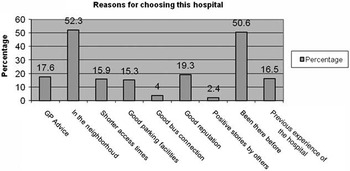
Interestingly, waiting times were not the principal criterion for patients choosing between hospitals, only 16% of patients indicated that it was one of the reasons for their choice (respondents could list more than one reason); the reasons most often referred to were that the hospital was ‘in the neighbourhood’ (52%) or that the patient had ‘been there before’ (50%). GP advice was listed by 17.6% of patients as one of the reasons for their choice (see Figure 1).
Reasons for choosing a hospital, data from a patient questionnaire on ZorgDomein, N = 176

Although patients in general reacted somewhat conservatively to the choices offered, hospital management and medical specialists in general saw ZorgDomein as an ‘infrastructure for competition’. Almost all medical specialists in our survey preferred knowing waiting times for their speciality as shown in ZorgDomein (to which they had no access at the time of the survey). Hospital managers argued that the visibility of differences would lead them to focus on waiting times more than they had done in the past. As one Chief Executive expressed it:
We are patient centred. It is not just the GP; it is also the patient who has a right to know and a right to make choices. If that leads to shifts in patient flow, because we have longer waiting times, then we just have to make sure that waiting times are reduced (interview hospital CEO, 11 November 2004).
In general, hospital managers saw this as a positive driving force for change within the hospital, adding to a culture of transparency and competition, which they favoured.
England
There has been little published academic evaluation of the ‘Choose and Book’ system. Most published reports either relate to pilots where choice was offered to patients already on waiting lists rather than at the point of referral (Dawson et al., Reference Dawson, Jacobs, Martin and Smith2004; Taylor et al., Reference Taylor, Pringle and Coupland2004; Burge et al., Reference Burge, Devlin, Appleby, Rohr and Grant2005; Coulter et al., Reference Coulter, le Maistre and Henderson2005; Ferlie et al., Reference Ferlie, Freeman, McDonnell, Petsoulas and Rundle-Smith2005) or early stages of ‘Choose and Book’ implementation when usage by GPs was still very low (National Audit Office 2005; Rosen et al., Reference Rosen, Florin and Hutt2007). Two smaller scale studies have looked in depth at use of the system by GPs and consultants in one PCT (British Medical Association, 2009) and at patients’ experience in one London hospital (Green et al., Reference Green, McDowall and Potts2008).
Take up of the system has been slow. Although ‘Choose and Book’ was installed in nearly every GP practice during 2005, when the system went live in January 2006 only 8% of GPs were making full use of the system (Rosen et al., Reference Rosen, Florin and Hutt2007). The NHS Improvement Plan target that all referrals would be booked electronically by 2005 was not met and the 2006–2007 operating framework set a new target that 90% of referrals should be booked through the system by March 2007 (Department of Health, 2006). The NHS is still well short of this target, with ‘Choose and Book’ used for less than half of GP referrals to first outpatient appointment in 2007–2008 (Healthcare Commission, 2008).
There are a number of reasons why take up of the system has been so slow. A survey of GPs conducted by the National Audit Office before the system went live found 93% of them felt that there had been inadequate consultation with GPs about the implementation of ‘Choose and Book’, and 78% were either negative or very negative about the idea of ‘Choose and Book’ (National Audit Office, 2005). Technical difficulties have caused frustration. A postal survey of GPs found time constraints and inflexibility of the system as the reasons for disengagement (Pothier et al., Reference Pothier, Awad and Tierney2006). Disengagement has been evident in focus groups carried out with GPs (Rosen et al., Reference Rosen, Florin and Hutt2007) as well as interviews with consultants working in acute trusts (Hendy et al., Reference Hendy, Fulop, Reeves, Hutchings and Collin2007). GPs report that the system is difficult to use as it often ‘crashes’ making it impossible to process an appointment request (Rosen, Reference Rosen2007, personal communication). The British Medical Association found that even some enthusiasts who felt the system had the potential to improve patient experience had become frustrated with its lack of reliability and felt it was not worth using (BMA, 2009).
A major problem has been linking the GP system to hospital PAS. Planned upgrades to PAS systems fell behind schedule with only seven of the planned 22 upgrades in 2004 taking place (National Audit Office, 2006). GP focus groups identified a lack of training as a barrier to ‘Choose and Book’ use (Rosen et al., Reference Rosen, Florin and Hutt2007). The system was regularly updated and GPs reported difficulty finding time to update their training (BMA, 2009). GPs have been frustrated about not being able to refer to a named consultant; they often do not know in which clinic a particular clinician works so find it difficult to refer patients to a recommended consultant (Rosen, Reference Rosen2007, personal communication; Rosen et al., Reference Rosen, Florin and Hutt2007; BMA, 2009). GPs have also been frustrated that some good providers to whom patients would like to be referred are not available on the options list (Rosen et al., Reference Rosen, Florin and Hutt2007), although since free choice was introduced in April 2008 patients’ options are no longer limited to hospitals with which their trust has a contract, and patients should be able to book an appointment at any eligible provider nationally.
A survey in 2005 for the National Audit Office found that over 90% of GPs thought ‘Choose and Book’ would lengthen consultation times and that it would increase workload (National Audit Office, 2005). More recently, the Audit Commission found GPs were concerned about the extra time taken in their consultations to use the ‘Choose and Book’ system (Audit Commission, 2008).
Some of the expected gains from more efficient administrative processes have not been realised: low take up of the system means hospitals have to administer both paper based and electronic referral systems simultaneously and, rather than using the system themselves, some consultants prefer to annotate printed referral letters from which administrators (often in a centralised booking office within the hospital) input information into the system (BMA, 2009).
In contrast to GPs, patients seem fairly enthusiastic about choice. In September 2007, 79% of patients surveyed by the Department of Health were satisfied with the process of being offered a choice (Department of Health, 2008b). Another survey found 75% of respondents said choice was either important or very important to them (Robertson and Dixon, Reference Robertson and Dixon2009). Some patients have complained about problems getting through to the telephone appointments line (Department of Health, 2008b) and in one month, in 2008, 27,000 (8%) of the 338,000 calls to the appointments line were not answered (Hansard, 2008).
Use of ‘Choose and Book’ is not a perfect predictor of whether patients have been offered a choice of provider for their treatment. A GP can book an appointment through the system without offering the patient a choice, or a patient may be offered a choice and booked into hospital via a paper based, rather than electronic, referral. In one hospital in London a study of just over 100 patients found 32% of those whose appointments were booked through ‘Choose and Book’ were not given a choice of hospital and 66% were not given a choice of appointment date (Green et al., Reference Green, McDowall and Potts2008). In general, recall of choice is still fairly low, with 47% of patients surveyed by the Department of Health for their bi-monthly monitoring survey recalled being offered a choice by their GP, and this varied substantially between PCTs, from 27% in Newcastle to 80% in Solihull (Department of Health, 2009b).
Impacts
It was expected that ‘Choose and Book’ would reduce the number of patients not attending their hospital appointments (DNAs). There is no published academic evidence to support this, although the 2006–2007 benefits statement from Connecting for Health says that ‘Choose and Book’ has reduced DNAs by up to 23% and bought about ‘huge reductions’ of ‘up to 88%’ in the time taken to process a GP referral. It also states that the time it takes for patients to receive an appointment has reduced by ‘up to 93%’ (Connecting for Health, 2008). In written evidence submitted to the Public Accounts Committee in 2006–2007, the Department of Health quotes research among a significant sample of patients in three primary care trusts that showed a 50% reduction in DNAs from use of ‘Choose and Book’ (House of Commons Committee of Public Accounts, 2007). It also states that DNA rates for appointments booked through ‘Choose and Book’ are 5% compared to 9% for those not booked using the system. No further details of the research that underpins these figures are given.
Some consultants have raised concerns about the impact of ‘Choose and Book’ on the quality of GP referrals. In some GP practices much of the process of booking an appointment has been delegated to administrative staff, whose lack of clinical knowledge was blamed for referrals to the wrong clinics, which took time for hospitals to redirect (BMA, 2009). Some consultants felt referral letters were of lower quality in ‘Choose and Book’ and hospitals complained of having to chase up GP practices who did not attach referral information to their bookings (BMA, 2009).
Research has shown patients want information on health outcomes, waiting times and GPs’ opinions when making a choice (Burge et al., Reference Burge, Devlin, Appleby, Rohr and Grant2005) but patients do not seem to be consulting comparative information on quality to help them choose (Robertson and Dixon, Reference Robertson and Dixon2009). The Department of Health’s choice survey shows cleanliness and infection rates to be the most important factors impacting on choice (74% of patients cited this as important). Media stories have focused attention on this issue in England. Quality of care was the second most important factor (64%), followed by waiting times (62%) the friendliness of staff (56%), the reputation of the hospital (54%) and location or transport considerations (53%) (Department of Health, 2009b).
There have been some concerns from policy commentators (Appleby et al., Reference Appleby, Harrison and Devlin2003) about the impact of choice on equity and whether members of disadvantaged groups will be able to exercise choice. A survey of GPs on doctors.net conducted in September 2005 found that 46% thought the introduction of ‘Choose and Book’ would increase healthcare inequalities by socioeconomic class (National Audit Office, 2005). The Department of Health’s patient choice survey showed that in the first half of 2007 the proportion of patients who recalled being offered a choice by their GP was higher for white patients than black and minority ethnic groups. The percentage of patients from Asian or Asian British, Black or Black British and other ethnic groups who recalled being offered a choice was between 16% and 19% below the average (Department of Health, 2007c). But results from the London Patient Choice Pilot where patients were supported by care advisers showed no difference in the numbers taking up an offer of choice by different socioeconomic groups (Dawson et al., Reference Dawson, Jacobs, Martin and Smith2004). However, a survey of PCTs shows few have put support measures in place for patients at point of referral (Thorlby and Turner, Reference Thorlby and Turner2007). Schlesinger (this issue) has emphasised the value of advisers to help patients in making choices in health care.
Discussion
As we have shown, choice policies in the Netherlands and England have a number of common objectives, despite their different historical evolution. Choice has been actively promoted, in the Netherlands since the early 1990s and England since the early 2000s, as a means of addressing waiting times and to try and promote quality competition between hospitals. The implementation of choice at point of referral is supported by a number of different measures including public websites with comparative information about hospital performance and electronic referral systems. As we have shown, the design of these referral systems mediates the process of choice and influences the way GPs, patients and hospitals interact. This in turn affects the impact of patient choice policies in practice. Recognising the limitations of comparing a national top–down initiative in England and a voluntary system in one region of the Netherlands, the focus here on the micro-level has provided insights into how the design of information systems has shaped the implementation of choice policy.
Returning to the assumptions, set out at the beginning of this article, that are necessary for choice to impact on quality, we find that they mostly hold true. Alternative providers are available. Although the system in the Netherlands restricts the options to participating hospitals within the region, the number of providers participating is increasing and patients are still free to go to a provider outside the system. In England, in theory patients have choice of any provider accredited by the Care Quality Commission. In both countries there are public websites that provide information on waiting times and other aspects of quality of care. In both countries some patients are exercising choice of hospital, and the systems in general appear to be well received by the patients who have experienced them and they appear satisfied with the choices on offer. However, we find that issues with micro-level implementation can lead to the objectives of the policy not being achieved.
In both countries, the implementation of choice in practice and the mediating effects of electronic referral systems and GPs, means that patients are often not aware of the alternative providers available. In practice, many are not offered choice, and comparative information about the relative quality is not presented at the point at which the referral to hospital is made. We now discuss each of these issues in turn.
First, in England not all hospitals have linked their PAS systems to ‘Choose and Book’, so patients are not able to see bookable slots from some providers. In many cases, patients do not make the booking directly but a booking letter is generated by the GP practice. This may set out a limited set of options. The long standing tradition of open choice at point of referral in the Netherlands means that patients are aware of their right to choose. If choice is to operate effectively there needs to be greater awareness among patients in England of their right to choose and the availability of electronically bookable slots through ‘Choose and Book’ needs to be improved (something the Department of Health has set out recently in the Operating Framework 2009–2010 (Department of Health, 2008c)).
Second, in the Netherlands, we found some evidence that GPs are referring patients to the local hospital without discussing the alternatives. Some patients are opting out of the choice made during the consultation suggesting that alternative providers are not always discussed and appraised with the GP. There is similar evidence that many patients in England do not recall being offered a choice of hospital by their GP.
In both countries whether a patient is offered a choice is largely dependent on their GP. Little is known about whether certain types of patients are more likely to be offered a choice, and how many GPs do not offer choice unless the patient asks. It is still possible for GPs to bypass the electronic referral systems, or to use them, but not involve the patients in the choice.
GPs appear to be the most important agent in the process of offering and are ‘mediating’ choice. But there are obstacles to be overcome for them to be effective in this role: the reliability of the software, they are reluctant to give information on waiting times and concerned about the impact of these new tasks on consultation length. The need to provide additional payments in both countries suggests that GPs are not motivated to use the system. Although the use of the system is increasing in both countries, the use of ‘Choose and Book’ in England has fallen well short of the targets set by the government. A number of hospitals in England have been engaged in outreach to local GPs to engage them in patient choice and support them in implementing ‘Choose and Book’, including giving them information about specific clinics. Similar workshops for GPs have taken place in the Netherlands. If choice is to be more effective, GPs need to not only understand but also accept and perform their role in offering choice to patients.
Third, the information in the public domain is not integrated into the electronic referral systems. The information contained in the electronic referral systems is limited to information about waiting times and in the case of England, some other background information about the services on offer. This is despite the fact that waiting times have dramatically fallen in both countries, and, when asked, patients in both countries cite other factors being important to their choice such as cleanliness, quality of care, location and transport considerations. Although evidence to date suggests patients make little use of publicly available hospital performance information, integrating comparative quality information into referral systems may increase its use.
The systems analysed here have had various impacts on the process of referral, and on the experience of patients, GPs and the behaviour of hospitals. It is not clear from our analysis whether the top down implementation of the system in England has made a significant difference. In both countries there have been common challenges: for example, GP resistance to the systems, and technological challenges to integrate with different GP computer systems. In the Netherlands, implementation at the local level means that the system has been more flexible to respond to the concerns of professionals and local providers and more easily adaptable than the national programme in England.
The systems have made more transparent the process of referral and the required standardisation of processes. This has impacted on clinical behaviour in primary care, the administrative processes, and hospital scheduling. In England, in the past, most referrals were made to named consultants. Now GPs have to choose clinics by type. This may be a major reason as to why GPs continue to make paper referrals and are reluctant to use the system. ZorgDomein on the other hand allows GPs to refer to named consultants, although there is some pressure to make referrals to clinics.
The impact of the systems on hospital outpatient appointment systems in the two countries is also different. The main change for hospitals participating in ZorgDomein is that they now receive a referral notification directly from the GP before they get the call from the patient to make the booking. In England, hospitals had always received a referral from the GP, but whereas previously they were free to allocate an appointment date and time to patients, overbooking clinics if necessary to allow for patients not turning up, they now have to make concrete appointment slots available in advance into which patients can book themselves. This has required some changes to the organisation of outpatient clinics.
It has also ‘exposed’ patients who have been given a referral but then do not book in for an appointment, whereas previously these non-attendances were not known to the GP, they are now explicit within the system. This rises ethical issues about whose responsibility is it to follow this up. Judicial advice in the Netherlands said it was the patient’s responsibility, but there is no general policy on this, implying that hospitals (and clinics) can set their own policies. This is similar in the NHS, where PCTs can and do have different policies for dealing with the problem. It is not known whether particular groups of patients are less likely to follow through their referral and consequently whether this represents systematic inequities in utilisation. Further research into this question would be useful.
In addition to facilitating patient choice, the systems implemented in both countries have generated some efficiencies. In the Netherlands, the efficiency gains from ZorgDomein have arisen from the reduction in the number of hospital appointments due to fewer dual diagnostics. In England, the main efficiency gains are expected to come from a reduction in DNAs although there is as yet little firm published evidence on this. However, there is also some evidence that GP consultations were longer in the Netherlands, and since ‘Choose and Book’ has gone live in England there are reports of significant problems with the system crashing, which may have added to the length of consultations. In the past hospitals used to over-book clinics in order to ensure maximum throughput, but ‘Choose and Book’ does not allow this. If DNA rates do not fall as predicted this might reduce the productivity of hospital outpatient clinics.
Overall, it appears that the introduction of these systems and the strengthening of patient choice (as a possibility even if not exercised by many patients) are provoking a reaction from providers. Although this has not yet been systematically analysed in either country, there appears to be some evidence that choice stimulates a focus on organisational reputation.
It is likely that some of the initial problems encountered in the implementation can be resolved by improving the electronic referral system itself, in particular its functionality and integration with other information sources. But other aspects of implementation will rely on changes in the behaviours of GPs, hospital outpatient departments and ultimately patients.