Introduction
The search for business survival has always been a central concern – live or latent – to executives and managers of companies around the world. The high levels of complexity and uncertainty that underlie the competitive environment, decreases in business performance (Nohria & Green, Reference Nohria and Green1996) or the pressure that is exerted by stakeholder expectations (Freeman, Reference Freeman1984), among others, are factors that have traditionally driven firms to pursue novel formal structures and rational practices that are aimed at adapting to changes and assuring firm survival, reputation, and success (Freeman, Harrison, & Wicks, Reference Freeman, Harrison and Wicks2007). In this vein, following Johansen, Olsen, Solstad, and Torsteinsen (Reference Johansen, Olsen, Solstad and Torsteinsen2015), when diverse institutional logics encounter, organizations may have to face challenges related to the different dimensions and conceptualizations of efficiency, legitimacy, and meaning.
In this line, whether the reputation is considered positive by external actors, then companies may be endorsed to develop toward further growth and, ultimately, superior performance. However, not every business change is produced solely as a response to market pressures. From the institutional theory perspective, it is argued that many of these behaviors are mainly due to the institutional pressures (IP) that are exerted by the organization's environment (DiMaggio & Powell, Reference DiMaggio and Powell1983; Zucker, Reference Zucker1987). This framework assumes the preponderance of legitimacy over efficiency as the isomorphism's desired effect to increase survival opportunities.
A seminal definition of ‘organizational legitimacy' is the one that was proposed by Dowling and Pfeffer (Reference Dowling and Pfeffer1975, p. 122), who label it as ‘congruence between the social values associated with (the organization) or implied by their activities and the norms of acceptable behavior in the larger social system of which they are a part.’ Thus, organizations attain legitimacy by adjusting to more generally accepted forms of doing business, whether it is by copying best practices from other successful organizations – benchmarking – or by the mere adaptation of other practices that have been legitimized by the environment and that have been disseminated (Pfeffer, Reference Pfeffer1981). However, the concept of ‘organizational efficiency’ might be considered to be a measure of value creation through a firm's internal mechanisms, while it transforms inputs into tangible products and services that increase the firm's competitiveness and ensures its survival (Horne, Reference Horne2016). According to Meyer and Rowan (Reference Meyer and Rowan1977), isomorphic changes in organizations, for instance, the firm's implementation of the total quality management (TQM) philosophy, often occur as a response to the existing pressures in institutionalized environments. This normally brings among other relevant consequences, the incorporation of externally legitimized elements rather than those that have been legitimized in terms of efficiency.
To remain competitive in a changing market and being able to gain legitimacy before its stakeholders, firms must adopt a strategy conducive to quality improvement (Fuentes, Llorens, & Molina, Reference Fuentes, Llorens and Molina2006; Llorens & Verdú, Reference Llorens and Verdú2004). TQM is a systematic approach for quality management improvement that seeks to improve organizational performance in terms of quality, productivity, customer satisfaction, and profitability (Fuentes, Llorens, & Molina, Reference Fuentes, Llorens and Molina2006). Many companies around the world have embraced TQM practices over the last decades, often leading to a mimetic effect. While there have been numerous success stories related to TQM implementation, others have failed. Several studies have assessed the reasons underlying TQM implementation failure (Sadikoglu & Zehir, Reference Sadikoglu and Zehir2010; Taylor & Wright, Reference Taylor and Wright2003) and plenty of authors report inconclusive outcomes: in some cases the impact of TQM adoption upon performance has found to be positive, while in other cases it has proven to be negative (Llorens & Verdú, Reference Llorens and Verdú2004).
Thus, it is worthy to re-examine this relationship periodically. Replication research contributes to the development of knowledge and allows generalizing research outcomes (Sadikoglu & Zehir, Reference Sadikoglu and Zehir2010). Some scholars (Prajogo & Sohal, Reference Prajogo and Sohal2003) argue that the effects of TQM practices upon distinct measures of firm performance significantly differ. Furthermore, we failed to find in the literature enough empirical evidence regarding the effect of TQM practices on the firm's levels of legitimacy and the efficiency of the quality management system.
Accordingly, two research questions remain scarcely addressed and demand the attention of practitioners and academics:
-
RQ1: Does the implementation of the TQM philosophy really constitute a successful strategy when it comes to channeling IP, so that the company achieves its objective of legitimacy without sacrificing efficiency?
-
RQ2: To what extent does the simultaneous attainment of the legitimacy and efficiency targets contribute to the achievement of superior organizational performance?
Hence, this paper aims to contribute to the existing debate by addressing aspects that have not yet been conclusively studied and therefore still constitute a gap in the academic literature. This is the case of business decisions that are adopted due to IP that are exerted by an organization's environment and the consequences of such decisions. Thereby, the concept of isomorphism – the process through which institutions embrace similar practices, structural patterns, routines, behaviors or even strategies (Díez-Martín, Díez-de-Castro, & Vázquez-Sánchez, Reference Díez-Martín, Díez-de-Castro, Vázquez-Sánchez, Díez-De-Castro and Peris-Ortiz2018) – should be noted. In this vein, the literature suggests that the isomorphic adoption of certain practices emphasizes legitimacy over efficiency. For instance, in a recent study entitled ‘TQM and performance: Is the relationship so obvious?', Corredor and Goñi (Reference Corredor and Goñi2011, p. 831) point out that isomorphism involves ‘the tendency of organizations to try to become like those they perceive to be more successful’. In this way, the desire to attain superior performance often drives several companies (early adopters) to implement management philosophies such as TQM, but as its implementation spreads, it reaches a brink beyond which implementation leads to legitimacy rather than efficiency (Meyer & Rowan, Reference Meyer and Rowan1977). However, companies embrace TQM willing to improve their levels of efficiency, reliability, and quality as well as in an attempt to attain superior performance and productivity (Dubey, Gunasekaran, Childe, Papadopoulos, Hazen, & Roubaud, Reference Dubey, Gunasekaran, Childe, Papadopoulos, Hazen and Roubaud2018; Lee, Ooi, Sohal, & Chong, Reference Lee, Ooi, Sohal and Chong2012).
As such, the concrete benefits derived of firms' isomorphic TQM adoption remain unclear. Hence, this paper aims to explore whether a concrete isomorphic practice such as the implementation of TQM has a direct effect not only on legitimacy (LEG) but also on efficiency (EFF). In addition, the existence of a mediating effect that is exerted by TQM implementation on IP-legitimacy and IP-efficiency links has not yet been explored, which is the second important gap that we attempt to cover with this work. In addition, the prior-related models in the literature analyze the legitimacy-performance and efficiency-performance relationships separately, and they have failed to integrate them into the same model, which is the third gap that we aim to fill in this study. Thus, our work contributes to the literature by joining both links within the same research meta-model. In this way, the paper suggests that by isomorph TQM implementation firms may simultaneously attain legitimacy and efficiency, which can, in turn, lead to overall firm performance enhancement. We believe that this is a more accurate framework because we interpret reality through a more complete and all-encompassing meta-model compared to other studies that regard these relationships as independent realities. Another source of originality in this paper is rooted in the multi-sector sample that was selected. Hence, we differ from the other studies that have been conducted on TQM implementation, which have traditionally focused on the same sector.
Thus, our aim is to contribute to the exploration and discussion of new routes and to propose useful managerial applications. To frame our research, we focus on the EFQM Excellence model, proposed by the European Foundation for Quality Management. The EFQM model aims to assist companies in their willingness to improving their performance by means of the adoption of TQM postulates and the use of the EFQM model. This model shapes a comprehensive managerial framework applied globally by over 50,000 organizations. Our research model and hypotheses are tested using a sample that is composed of 102 Spanish companies enrolled at the ‘Club for Management Excellence’ (Club de Excelencia en la Gestión) and other regional excellence promotion centers, encompassing distinct sectors and a different degree of seniority with regard to the implementation of TQM. All of these firms possess the ISO 9001/2000, which entail a broader and more complete incorporation of TQM philosophy and practices in their requirements than prior versions of this norm (Gotzamani & Tsiotras, Reference Gotzamani and Tsiotras2002).
This paper presents a proposal of the isomorphic change for those firms in which legitimacy and efficiency constitute two considered aspirations, which leads us to establish four objectives, which are as follows: (i) to elucidate the existence of a highly institutionalized context of pressure upon companies that have implemented TQM philosophy; (ii) to explore whether a conflict truly exists between legitimacy and efficiency, given that both currents can coexist with regard to desired effects in business changes and the result of IP; (iii) to assess the impact that can be asserted by both effects (legitimacy and efficiency) upon overall company performance and its contribution, whether isolated or interactive, to firm survival meta-objectives; and (iv) to study the double mediating role that is exerted by TQM implementation on IP-legitimacy and IP-efficiency links.
This paper is structured as follows: Theoretical Foundations, Research Model and Hypotheses provide an assessment of the theoretical foundations that underlie the proposed research model and hypotheses; section 3 describes the methodology that is jointly employed with the sample features; section 4 presents the empirical results; and section 5 encompasses the discussion of the findings, implications, limitations and further lines of research.
Theoretical Foundations, Research Model and Hypotheses
Institutional pressures and TQM implementation by isomorphism
An interesting approach to the framework of the relationships between organizations and their environment is synthesized by Mizruchi and Fein (Reference Mizruchi and Fein1999), who highlight the works of Meyer and Rowan (Reference Meyer and Rowan1977) and DiMaggio and Powell (Reference DiMaggio and Powell1983) as the two first and principal studies of the new institutional theory. In this framework, the environment is perceived to be a set of rules, beliefs, structures, and institutionalized practices that may be adopted by organizations to respond to the environmental pressures from which they suffer, and hence can enhance their legitimacy (Meyer & Rowan, Reference Meyer and Rowan1977). Therefore, in the eyes of their internal and external stakeholders, a company may attain legitimacy when it conforms and responds to the institutional scheme of rules, values, and reasonings (Déniz-Déniz & García-Cabrera, Reference Déniz-Déniz and García-Cabrera2014). Companies seek legitimacy because those whose actions are seen in the context of their environment to be legitimate increase their probability of survival by gaining access to scarce resources and thereby improving their business performance (Deephouse, Reference Deephouse1999; Deephouse & Suchman, Reference Deephouse, Suchman, Greenwood, Oliver, Sahlin and Suddaby2008; Dowling & Pfeffer, Reference Dowling and Pfeffer1975). Along these lines, DiMaggio and Powell (Reference DiMaggio and Powell1983) sustain that in a business domain organizations are distinct at the beginning, but with the passage of time, they tend to become similar due to their need to respond to the environment's ‘institutional pressures’ although as a consequence they might modify their practices or goals. Such a homogenization process is known as isomorphism. Dowling and Pfeffer (Reference Dowling and Pfeffer1975) identified two types of isomorphism – competitive isomorphism and institutional isomorphism. In the first type, firms start this process as a consequence of the market's competitive pressures, while in the second type, the isomorphism assigns the same importance to political legitimacy and market position. These authors consider the second type of isomorphism to be the consequence of three mechanisms or pressures that are typified as coercive, normative, and mimetic, which have a determinant impact on a firm's decision-making process and practices (Oliver, Reference Oliver1991). Following Dowling and Pfeffer (Reference Dowling and Pfeffer1975) coercive pressures are those that lead organizations to adopt structures that are aligned with the demands that are posited by more the powerful organizations upon which they depend. Normative pressures were addressed as a consequence of professionalization, developing the isomorphism by means of the training that is received by similar professionals who socially interact, as well as through professional organizations. Lastly, mimetic pressures derive from uncertainty contexts, where firms attempt to mitigate such effects by imitating others' successfully perceived structures and practices.
The academic literature has broadly studied how IP, individually considered, have affected firm decision-making and, more concretely, isomorphic change processes, yielding dissimilar and often inconclusive results. For instance, Bada, Aniebonam, and Owei (Reference Bada, Aniebonam and Owei2004) separately label each of the previous pressures as sources of crisis and opportunities within processes of implementing organizational change programs. Along these lines, de Abreu, Albuquerque, and Oliveira (Reference de Abreu, Albuquerque and Oliveira2016) empirically test the relationship between the three types of pressures in the process of disclosure of controls among petrol and gas companies. Following Riquel-Ligero (Reference Riquel-Ligero2010) and Vargas-Sánchez and Riquel-Ligero (Reference Vargas-Sánchez and Riquel-Ligero2015), there is a positive relationship between each of the IP and the isomorphic adoption of the environmental practices of golf courses in the Andalusian region of Southern Spain. However, other studies have not been as conclusive and have presented mixed results. The same authors show in a similar previous study that normative pressures are the only ones that are not positively related to the adoption of good environmental practices (Riquel-Ligero & Vargas-Sánchez, Reference Riquel-Ligero and Vargas-Sánchez2013). According to Honig and Karlsson (Reference Honig and Karlsson2004), normative pressures do not exert any influence on the isomorphic adoption of business plans among recently launched firms, while Shipilov and Danis (Reference Shipilov and Danis2003) argue that there are differences between Hungarian and American firms with regard to the influence that is exerted by mimetic pressures on business management. Following Huo, Han, Zhao, Zhou, Wood, and Zhai (Reference Huo, Han, Zhao, Zhou, Wood and Zhai2013), the adoption of supplier integration systems and processes is related to normative and mimetic pressures, while coercive pressures show a non-significant relationship. Liu, Ke, Wei, Gu, and Chen (Reference Liu, Ke, Wei, Gu and Chen2010) conclude that, in the adoption of supply chain management systems with an internet connection, mimetic pressures also do not present a direct relationship.
According to Mizruchi and Fein (Reference Mizruchi and Fein1999), the three mechanisms that lead to institutional isomorphism have been identified, and yet they are diffuse and difficult to demonstrate. Further, there are certain simultaneous effects between them that are ignored. Both DiMaggio and Powell (Reference DiMaggio and Powell1983) and Mizruchi and Fein (Reference Mizruchi and Fein1999), note that it is often impossible to distinguish between the three types of isomorphism. Thus, the appropriateness of conducting a study of IP as an antecedent variable in the process of isomorphic institutionalism by taking each pressure type independently might be questioned, or, as we propose, considered in a comprehensive manner. This may save the difficulty of having to detail all of the possible interactions between them, as well as the possible concomitant effect. Thus, in an attempt to shed light on the debate, this paper treats the environment's IP in general terms.
In this vein, and with the purpose of covering the first objective that is posited in this study, it is fair to reflect upon whether one of the most widely extended isomorphic changes between firms, such as TQM implementation (Jaeger & Adair, Reference Jaeger and Adair2016), might be due to the existence of a highly institutionalized context for adopting firms. TQM is considered to be a managerial philosophy and a set of practices that attempt to satisfy customer needs, improve their expectations, and pursue continuous improvement; such philosophy and practices are rooted in teamwork and attempt to establish narrow links with suppliers and other stakeholders. This approach can be applied to any type of organization, enabling them to become more creative, competitive, and successful; and ultimately attain improvements in the implementation of firm financial performance (Hafeez, Malak, & Abdelmeguid, Reference Hafeez, Malak and Abdelmeguid2006; Powell, Reference Powell1995).
Delmas and Toffel (Reference Delmas and Toffel2008) rely on institutional theory when they posit that stakeholders (including governments, customers, partners, competitors, and other interest groups) exert IP upon firms. Along these lines, abundant studies have tried to identify the impact of each IP on TQM implementation. Zhang, Jiang, Shabbir, and Duan (Reference Zhang, Jiang, Shabbir and Duan2015) explored the impact that is exerted by IP upon firm market orientation and empirically showed, in a sample of manufacturing Chinese companies, that normative and mimetic pressures are the antecedents or drivers of this characteristic, which is inherent to TQM philosophy. Hoque and Alam (Reference Hoque and Alam1999) suggest that some organizations adopt new management systems (such as TQM) by imitating others and increasing their external legitimacy. These authors also analyze the impact of TQM implementation on the use of quality control measurement practices among Australian companies. Similarly, Zsidisin, Melnyk, and Ragatz (Reference Zsidisin, Melnyk and Ragatz2005) recognize the link between the environment's normative pressures and the adoption of managerial practices such as lean systems, TQM, time-based competition, and other chain improvement initiatives. Yang (Reference Yang2007) tested the positive link between IP and the diffusion of self-managed teams within municipal governmental firms. Moreover, Zhu and Sarkis (Reference Zhu and Sarkis2007) verified how IP influence the adoption of environmental management practices while they exert a moderating role between such practices and organizational performance. A similar study was developed by Huang and Yang (Reference Huang and Yang2014), who highlighted the moderating role that is exerted by IP, as a whole, between an innovative practice such as reverse logistics and performance.
In sum, companies embracing TQM philosophy are expected to emulate early adopters in their attempt to improve the quality of their products, services, and processes, as a response to institutional and competitive pressures (Dubey et al., Reference Dubey, Gunasekaran, Childe, Papadopoulos, Hazen and Roubaud2018; Sila, Reference Sila2007). In this vein, Kostova and Roth (Reference Kostova and Roth2002) indicate that organizations are regularly willing to implement TQM in response to external pressures from its diverse stakeholders (i.e., customers, shareholders, partners, etc.). Therefore, it seems reasonable that IP could somehow drive or stimulate the dissemination of TQM philosophy (Dubey et al., Reference Dubey, Gunasekaran, Childe, Papadopoulos, Hazen and Roubaud2018).
Based on all the arguments above, we posit the following hypothesis:
Hypothesis 1 The institutional pressures of the environment are positively related to TQM implementation.
Legitimacy and efficiency: two sides of the same coin?
A very influential historical perspective on the organizational change is the one that was exposed by Weber (Reference Weber1968), who considered that a primary motivation toward action in the business context lies in the need to improve efficiency and consequently to be more competitive in the market. However, different neo-institutionalist authors have suggested that the motivation that ultimately determines these actions lies more in its recognition and credibility in the institutional context than in its efficiency (DiMaggio & Powell, Reference DiMaggio and Powell1983; Meyer & Rowan, Reference Meyer and Rowan1977).
This dual motivation of change, in apparent opposition, has been an issue of debate within the academic literature, and one can distinguish among the authors who support this assertion and those who consider it to be more a matter of the moment in which the firm has access to rational structures and practices, depending on the extent to which they are more or less institutionalized, and one may be the consequence of the other. Meyer and Rowan (Reference Meyer and Rowan1977) identified and modeled this situation. These authors sustained that a firm's survival depends not only on its efficiency level but also on its capacity to adjust to the rules that exist within its institutional context, which may, therefore, lead it to obtain legitimacy. In this sense, legitimacy and efficiency shape the two extremes of a continuum in which companies take a position, assigning a greater or inferior weight to each of them based on the institutional context in which they relate, thus generating a permanent conflict between them. In this way, firms that coexist within the context of high institutionalization may stress legitimacy attainment over efficiency, given that the isomorphic adaptation of rational institutional structures would reduce uncertainty and risks, and the firms' trust in the functioning ‘per se’ of the adoption. Nevertheless, firms within low institutionalization contexts shall be innovative and base their technical activities upon coordination and control patterns to reduce risk, with the maintenance of efficiency as the primary goal. Along these lines, efficiency has been considered as an objective to reach typical of those firms that, at initial stages of their development and lacking from institutionalized referents, need to provide an answer to the market and achieve differentiation. In addition, once these structures are acknowledged and the risk of adoption is reduced, as it is the case of late adopters, environmental acceptation and recognition (legitimacy) primes over efficiency as the main goal to attain, suggesting that adopting certain novel practices might be inefficient and yet improve the firm's survival perspectives (DiMaggio & Powell, Reference DiMaggio and Powell1983; Meyer & Rowan, Reference Meyer and Rowan1977; Tolbert & Zucker, Reference Tolbert and Zucker1983; Westphal, Gulati, & Shortell, Reference Westphal, Gulati and Shortell1997). Along these lines, Meyer and Rowan (Reference Meyer and Rowan1977) tie this battle between legitimacy and efficiency to the natural existence of decoupling between both perspectives. Thus, organizations may attempt to acquire legitimacy without necessarily altering their business practices. This could be achieved by implementing the formal structures that satisfy institutional demands, although this may not comport with the real daily practices (MacLean & Behnam, Reference MacLean and Behnam2010; Oliver, Reference Oliver1991; Scott, Reference Scott1995).
With this study, we aim to contribute to the debate by questioning whether the decoupling that is assumed by the academic literature should be taken for granted, or on the contrary, there might be highly institutionalized contexts in which such decoupling is defeated and is hence able to harmonize the search for legitimacy with efficiency. To illustrate our proposal, we suggest that the isomorphic implementation of TQM could be an example of the aspiration for the coexistence of legitimacy and efficiency, given that the nature of this variable makes it a partner of both orientations. Ideally, both ends will coincide and attempt to reconcile and align the interests of the company with those of its stakeholders.
Several studies (Westphal, Gulati, & Shortell, Reference Westphal, Gulati, Shortell, Keys and Dosier1996, Reference Westphal, Gulati and Shortell1997) have maintained the mainly accepted current, highlighting that TQM implementation, by normative isomorphism, enhances legitimacy despite sacrificing efficiency, hence positioning themselves on the side of late adopters. Zbaracki (Reference Zbaracki1998) yields on institutional theory to describe the process by which the ‘rhetorical value’ of something such as TQM finally supplants its technical value. Consequently, managers will use ‘rhetorical TQM’ to gain legitimacy without affecting the firm's technical-operative core. Similar to Kennedy and Fiss (Reference Kennedy and Fiss2009), this double motivation in the implementation of TQM practices in American hospitals was dependent on the extent to which the hospitals were initial or later adopters.
Against this position, other authors have attempted to demonstrate that no such decoupling exists in the case of TQM implementation, which is compatible, to a greater or lower extent, with both pretensions. Thus, they are dialectically related and jointly constitute the process of diffusion while they reinforce each other (Nohria & Green, Reference Nohria and Green1996). Following Hoque and Alam (Reference Hoque and Alam1999), commitment with quality management will seek to provide an answer to both institutional forces and the internal need to remain competitive and to be successful in the market.
Therefore, we might be attending to a strategic diatribe about managerial positioning and the decision to implement TQM by questioning whether its implementation contributes more to the achievement of legitimacy or the improvement of efficiency, or whether both pretensions are feasible at the same time. This leads us to posit the following hypotheses:
Hypothesis 2 TQM implementation is positively related to legitimacy acquisition.
Hypothesis 3 TQM implementation is positively related to the efficiency of such implementation.
Legitimacy and efficiency in the path towards superior performance
Legitimacy and efficiency, as aspirations in the framework of business management, are a consequence of the managerial structures and practices that are adopted based on the firm's relationship with its context and whose institution may help a firm to survive (Horne, Reference Horne2016; Meyer & Rowan, Reference Meyer and Rowan1977). To visualize such pretensions and to be able to communicate them to stakeholders, organizational performance results from the adjustment between context, structure, and managerial practices and stands as a good measurement that can represent both efficiency in a firm's operations and a good answer to the legitimacy that is established by stakeholders' continuous support (Luke, Barraket, & Eversole, Reference Luke, Barraket and Eversole2013). According to some authors, the impact that is exerted by both orientations upon overall performance (OP) is considerably different. On the one hand, it has been found that companies that apply standardized and quality-related managerial practices exert a positive influence on short-term financial performance (Gil, Jiménez, & Lorente, Reference Gil, Jiménez and Lorente2001). On the other hand, firms that perform activities that satisfy their stakeholders obtain long-term support and resources to survive (Freeman, Reference Freeman1984). Our work attempts to elucidate the greater impact that each orientation may possess in the attainment of superior business performance, as well as the possible joint impact, so that we can help to further the debate around its reasoning and suggest new investigation routes.
Thus, companies with high legitimacy might have better access to external resources, which are essential to improve business performance, in that this is a resource that can attract other resources that are scarce in its environment (Suchman, Reference Suchman1995). The academic literature has extensively linked legitimacy and OP in that it is a critical factor that contributes to organizational success or failure, as it is either present or not. In this vein, organizations with a high level of legitimacy obtain better results and hence establish a positive relationship between legitimacy and organizational success (Díez-Martín, Blanco-González, & Prado-Román, Reference Díez-Martín, Blanco-González and Prado-Román2010). Other authors have analyzed the impact that is exerted by perceived TQM performance on OP (Prajogo & Sohal, Reference Prajogo and Sohal2006).
Following this study's rationale, we observe how for Guo, Tang, and Su (Reference Guo, Tang and Su2014) firms might suffer from a certain strain between legitimacy adoption and market orientation, to be similar to or different from others, which generates the dilemma of pursuing legitimacy and efficiency at the same time. This author empirically shows that each of the two orientations contributes to global performance, nevertheless failing to do so in an interactive way. We aim to follow this debate and hence posit that a managerial philosophy such as TQM might suggest both objectives to increase OP and consequently contribute to increasing its survival options. Thus, we hypothesize as follows:
Hypothesis 4 Legitimacy – attained by TQM implementation – is positively related to overall performance.
Hypothesis 5 Efficiency – attained by TQM implementation – is positively related to overall performance.
The double mediating role of TQM implementation in the institutional pressures-legitimacy and institutional pressures-efficiency links
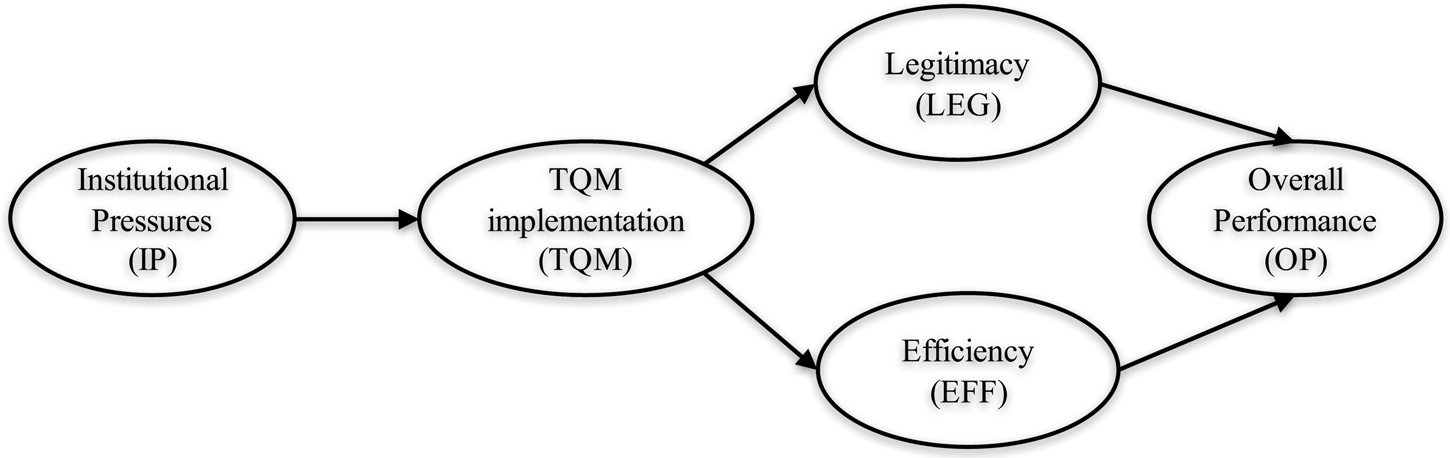
Our research has sufficient support to suggest a two-way approach: on the one hand, IP lead an organization toward the implementation of TQM, which in turn allows it to achieve legitimacy (LEG). On the other hand, TQM derives an improvement of the firm's efficiency (Carmona-Márquez, Leal-Millán, Vázquez-Sánchez, Leal-Rodríguez, & Eldridge, Reference Carmona-Márquez, Leal-Millán, Vázquez-Sánchez, Leal-Rodríguez and Eldridge2016). In this model, we approach efficiency by means of a measure of TQM performance. In the first scenario, we consider that by adding the two direct paths (IP → TQM and TQM → LEG) we conclude the existence of an indirect link between IP and LEG through TQM implementation. Analogously, in the second scenario, we find an indirect link between IP and EFF through TQM implementation. This idea is consistent with the proposals of Westphal, Gulati, and Shortell (Reference Westphal, Gulati, Shortell, Keys and Dosier1996, Reference Westphal, Gulati and Shortell1997) and Zbaracki (Reference Zbaracki1998). Our proposal tries to reinforce the hypotheses that are formulated above by introducing a double mediation relationship that allows for the addition of a new perspective on the effects of isomorphism, proposed by Meyer and Rowan (Reference Meyer and Rowan1977), where the prominence resides in the organization's TQM implementation, whose mediating role improves and reconciles the achievement of legitimacy and efficiency at the same time. Thus, we hypothesize (see Figure 1) as follows:
Hypothesis 6 TQM implementation positively mediates the link between institutional pressures and legitimacy.
Hypothesis 7 TQM implementation positively mediates the link between institutional pressures and efficiency.
Research model and hypotheses.

Methodology and Sample Description
Data collection and sample
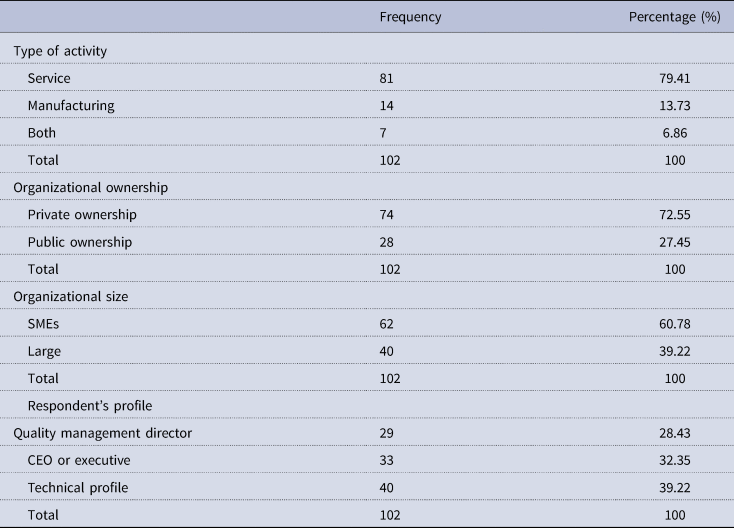
The database that is used in this study is grounded in a set of medium and large Spanish companies that belong to distinct sectors and are of different sizes, with different degrees of TQM implementation. To this end, from November 2015–July 2016, a questionnaire was developed and submitted by e-mail to the quality management director or responsible within each firm. The survey was directed to a total of 518 firms, of whom 220 firms belong to the ‘Club for Management Excellence’ (Club de Excelencia en la Gestión) and 298 firms belong to other regional excellence promotion centers in Spain. The two e-mailing efforts yielded 102 valid responses, which constitutes a 19.7% response rate and is consistent with comparable studies that use a key informant methodology (Felipe, Roldán, & Leal-Rodríguez, Reference Felipe, Roldán and Leal-Rodríguez2016). The questionnaire consists of eight information blocks and is composed of 62 questions that we used as items for the measurement model. The questionnaire was designed on the basis of previously used and validated measurement scales that can be found in the academic literature. Prior to the questionnaire, a pre-test was conducted with personal interviews from a pool of five academics and 10 executives, which allowed us to check the validity of the items, as well as to ensure that the informants would be able to understand it. Table 1 presents a summary of the main demographic statistics, including the type of activity, ownership, size, and respondent's profile.
Descriptive statistics

To encourage participation in this study, the participants were promised a personalized comparative report of each of the areas that were addressed in relation to the average data obtained as per Sax, Gilmartin, and Bryant (Reference Sax, Gilmartin and Bryant2003). Once the data collection was completed and to confirm that no bias existed, the early answers were compared with the late ones to ensure that the respondents did not differ significantly in their responses. To this end, a group was formed with responses from those who responded in the first month and another group with responses from the last month. t-Test comparisons were performed between the means of the two groups, and no significant differences were found between them.
Variable definition and measurement
To measure the constructs and variables shaping the research model and the dimensions that integrate them, this paper relies on survey methodology, encompassing the following steps: (i) questionnaire instrument construction; (ii) sampling of individual units from a population, and (iii) survey data collection. To this aim, a set of 62 items was employed, using a seven point Likert type scale, ranging from 1 to 7 (1 = totally disagree, 7 = totally agree). Questionnaires often seem an accurate means for quantitative data collection in social sciences, although they also entail difficulties regarding its design and response rate (Easterby-Smith, Thorpe, & Jackson, Reference Easterby-Smith, Thorpe and Jackson2012).
IP are a second order construct that is composed of three dimensions: CP (coercive pressures, four items), NP (normative pressures, three items) and MP (mimetic pressures, four items), and they are measured according to the scale employed by Riquel-Ligero and Vargas-Sánchez (Reference Riquel-Ligero and Vargas-Sánchez2013). The legitimacy construct (LEG) was also measured through the 12 items scale used by Riquel-Ligero and Vargas-Sánchez (Reference Riquel-Ligero and Vargas-Sánchez2013).
Concerning the TQM implementation degree (TQM) as isomorph adoption, it is modeled as a second order construct shaped by four dimensions: customer focus and continuous improvement (CFCI, 15 items), management commitment to quality (MCQ, six items), training and empowerment (TE, four items), and benchmarking (B, four items). To measure this construct we rely on a 29 items scale proposed by Jabnoun and Sedrani (Reference Jabnoun and Sedrani2005).
The efficiency (EFF) construct was measured on the basis of the five items scale proposed by Powell (Reference Powell1995). We rely on the use of this scale that Powell (Reference Powell1995) used to measure TQM performance because TQM performance is essentially assumed by this author to be an unbiased measure of efficiency. Finally, OP was measured through the five items scale that was proposed by Powell and Dent-Micallef (Reference Powell and Dent-Micallef1997).
Data analysis
In the first place, since the online survey was programmed in terms that all the questions had to be compulsorily answered, we had not to deal with missing values. However, an exhaustive assessment of the descriptive statistics was carried out, specially focusing on the range of response values, asymmetry and kurtosis (Hair, Hult, Ringle, & Sarstedt, Reference Hair, Hult, Ringle and Sarstedt2016). Most of the items present an average in the high part of the Likert scale (i.e., between 4 and 7) and all of the items reach values as low as 1 and as high as 7. Only one of the indicators (Q23) presents kurtosis and skewness statistics surpassing the range of ±2, which is considered acceptable for a normal distribution (George & Mallery, Reference George and Mallery2010).
Secondly, this paper empirically tests our research model and hypotheses through the application of partial least squares (PLS) path modeling, which is a variance-based structural equation modeling (SEM) technique (Roldán & Sánchez-Franco, Reference Roldán, Sánchez-Franco, Mora, Gelman, Steenkamp and Raisinghani2012). PLS permits the assessment of the reliability and validity of the measures of theoretical constructs and jointly with the estimation of the relationships that are hypothesized between constructs (Barroso, Cepeda-Carrión, & Roldán, Reference Barroso, Cepeda-Carrión, Roldán, Esposito Vinzi, Chin, Henseler and Wang2010).
PLS is an adequate methodology for developing research in the social sciences field for the following reasons: (i) data sets tend to be small. Our data set, which comprises n = 102 cases, is rather small; (ii) measurement scales are often scarcely developed; (iii) data are frequently non-normally distributed; (iv) there is a high presence of ordinal and categorical data; and (v) the focus tends to be more on the prediction of the dependent constructs than on the confirmation and goodness of fit of the models (Roldán & Sánchez-Franco, Reference Roldán, Sánchez-Franco, Mora, Gelman, Steenkamp and Raisinghani2012). We rely on the use of the SmartPLS 3.0.7 software to assess the measurement and structural models, respectively (Ringle, Wende, & Becker, Reference Ringle, Wende and Becker2015).
Results
The PLS models are evaluated through two steps, which are as follows: (i) verifying the reliability/validity of the measurement model and (ii) assessing the significance of the paths (inter-construct relationships) within the structural model.
Measurement model
The evaluation of the measurement model shows satisfactory results. First, the indicators comply with the requirement of individual item reliability because their outer loadings are, in general, greater than .707 (Table 2), and only some of the outer loadings are slightly under this critical level. Nevertheless, we decided to retain them to support the content validity of the scale.
Individual item reliability

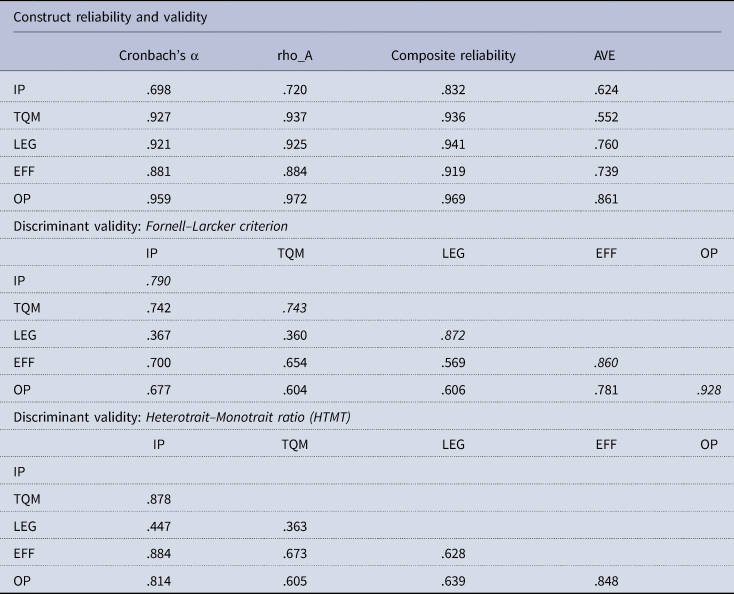
Second, all of the reflective constructs meet the requirements of construct reliability because their Cronbach's α, Dijkstra–Henseler's indicator (Rho_A) and composite reliabilities are greater than .7. Third, these latent variables also reach convergent validity because their average variance extracted (AVE) surpasses the .5 threshold (Table 3). Lastly, Table 3 reveals that all of the variables achieve discriminant validity following both the Fornell–Larcker and the HTMT (Henseler, Ringle, & Sarstedt, Reference Henseler, Ringle and Sarstedt2015).
Construct reliability, convergent validity, and discriminant validity

Rho_A = Dijkstra–Henseler's indicator; AVE = average variance extracted.
Notes: Fornell–Larcker criterion: Diagonal elements (italic) are the square root of the variance shared between the constructs and their measures (AVE). For discriminant validity, diagonal elements should be larger than off-diagonal elements. Off-diagonal elements are the correlations among constructs. The Heterotrait–Monotrait ratio (HTMT) criterion should be under the threshold of .85 (Kline, Reference Kline2015).
Structural model
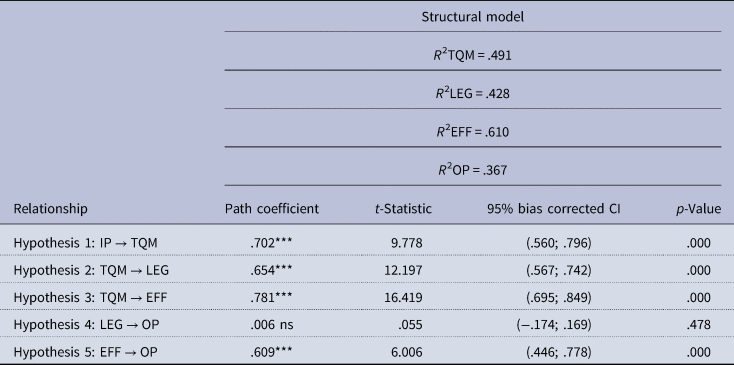
Following Hair, Sarstedt, Hopkins, and Kuppelwieser (Reference Hair, Sarstedt, Hopkins and Kuppelwieser2014), a bootstrapping technique (5,000 re-samples) is employed to generate standard errors and t-statistics, which permits the assessment of the statistical significance of the links that are considered within the two research models. Table 4 includes the main parameters that are obtained for the structural model under study in the structural assessment. The coefficient of determination (R 2) is assumed to be the main criterion for the explained variance, which is shown in the dependent construct, as the path coefficients are depicted in the distinctly considered models. These results confirm that the structural models have acceptable predictive relevance for the endogenous constructs – TQM, LEG, EFF, and OP.
Structural model results

Note: Bootstrapping 95% confidence intervals bias corrected in square brackets (based on n = 5,000 subsamples).
***p .001; **p .01; *p .05 (based on t(4,999), one-tailed test). t(.05, 4,999) = 1.645; t(.01, 4,999) = 2.327; t(.001, 4,999) = 3.092; ns = not significant.
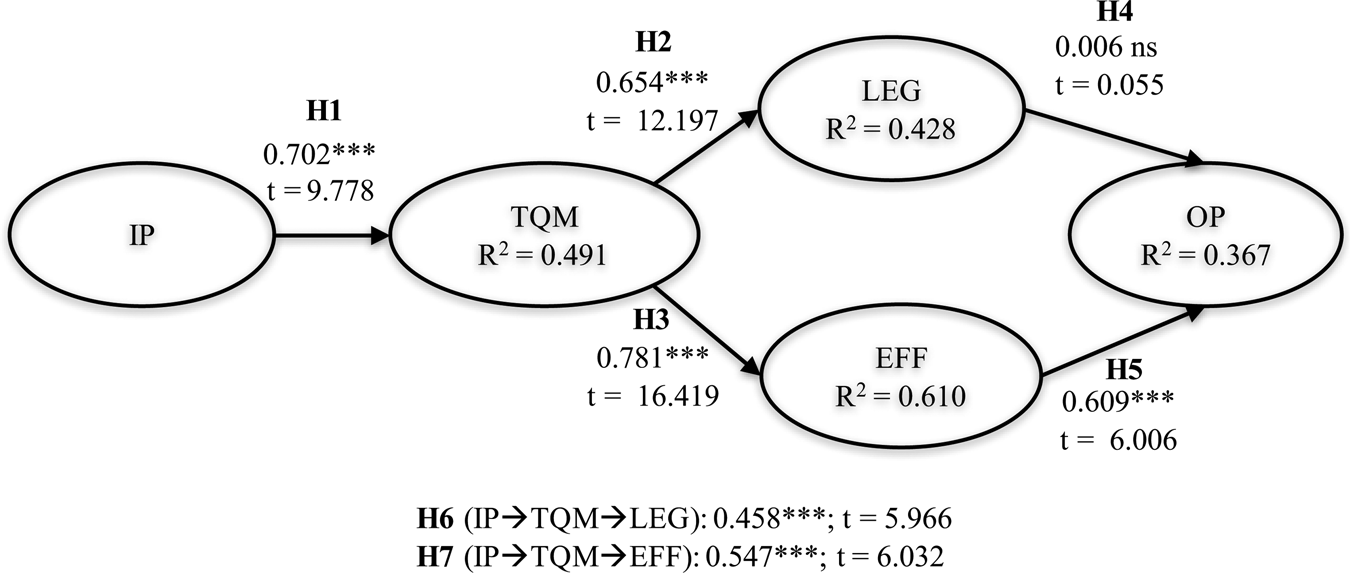
The results from the PLS analysis reveal that support is found for four of the five hypothesized relationships. Thus, the structural model results, as shown by Table 4, provide evidence to support hypotheses Hypothesis 1 (.702***; t = 9.778), Hypothesis 2 (.654***; t = 12.197), Hypothesis 3 (.781***; t = 16.419), and Hypothesis 5 (.609***; t = 6.006). However, we found no statistical evidence to support Hypothesis 4 (.006 ns; t = .055) (Figure 2).
Structural model.

The IP-TQM, TQM-LEG, and TQM-EFF direct paths are positive and significant. However, this is a necessary but not sufficient condition for an indirect effect of IP on LEG and EFF through TQM (i.e., the mediating role of TQM: Hypothesis 6 and Hypothesis 7) (Preacher & Hayes, Reference Preacher and Hayes2008). Consequently, this research tests whether the indirect effect is also significant (see Table 5). This paper uses PLS analysis to obtain bias-corrected 95% bootstrap confidence intervals for the indirect effects. The absence of zero from the interval for an indirect effect means that this mediated relationship is significantly different from zero with a 95% confidence level. Thus, in principle, there is support for Hypothesis 6 and Hypothesis 7 due to the significant indirect effects (Table 5; Figure 2).
Summary of indirect effects results

Note: Bootstrapping 95% confidence intervals bias corrected in square brackets (based on n = 5,000 subsamples).
***p .001; **p .01; *p .05 (based on t(4,999) one-tailed test). t(.05, 4,999) = 1.645; t(.01, 4,999) = 2.327; t(.001, 4,999) = 3.092; ns = not significant.
Importance-performance map analysis
This section intends to present additional findings that may provide more insight out from PLS results. Thus, this section enlightens PLS results by means of the importance-performance map analysis (IPMA), also known as the importance-performance matrix, impact-performance map, or priority map analysis (Ringle & Sarstedt, Reference Ringle and Sarstedt2016). IPMA stands as a valuable analysis in PLS-SEM that extends the standard outcomes reporting of path coefficient estimates through the addition of a dimension that considers the average values of latent variable scores. Concretely, the IPMA contrasts the total effects, representing the antecedent constructs' relevance in determining a certain target construct, with their average latent variable scores indicating their performance (Ringle & Sarstedt, Reference Ringle and Sarstedt2016). The goal is to identify antecedents that are relatively important for the target construct (i.e. those with a strong total effect), but also reveal a low performance (i.e. low average latent variable scores).
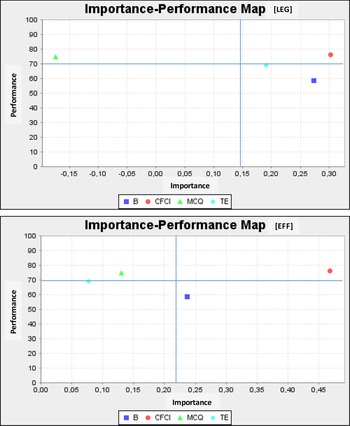
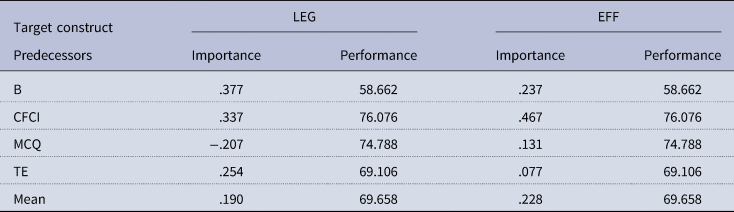
The importance and performance values of LEG AND EFF antecedent constructs (i.e. B; CFCI; MCQ, and TE) enable the building of the importance-performance maps for LEG and EFF. Table 6 contains the values of these maps' importance and performance dimensions. Subsequently, this data can be translated into scatter plots, which allows the generation of the two importance-performance maps as exhibited in Figure 3. The x-axis embodies the importance of the antecedent constructs or predecessors while explaining the target constructs, while the y-axis depicts the performance of B; CFCI; MCQ, and TE in terms of their average rescaled latent variable scores. To attain an enhanced orientation, it is advisable to draw two supplementary lines within the importance-performance maps: the mean value for the importance dimension (i.e. a vertical line) and the mean value for the performance dimension (i.e. a horizontal line) (Figure 3).
Importance-performance maps for LEG and EFF.

Data of the importance-performance maps for LEG and EFF

In our model, our results reveal a mean importance of .190 for LEG and .228 for EFF and a mean performance of 69.658 (Table 6). These two supplementary lines divide each importance-performance map into four quadrants that depict importance and performance values above and below the average. Usually, while conducting IPMA, constructs placed within the lower right quadrant (i.e. scoring above average in terms of importance and below average in terms of performance) are of utmost interest and its assessment should be emphasized, followed by those constructs placed at the higher right, lower left, and finally, the higher left quadrants. Thus, IPMA may offer advice regarding what constructs should be prioritized (Ringle & Sarstedt, Reference Ringle and Sarstedt2016). This way, as it can be observed, B is placed in the lower right quadrant, indicating hence that it scores above average in terms of importance and below average in terms of performance. On the contrary, CFCI appears at the higher right quadrant, suggesting that it shapes an antecedent of utmost importance while predicting LEG and EFF and scores above the average in terms of performance. With regard to MCQ, it is placed on the higher left quadrant, revealing that it is scoring above in terms of performance, but its importance is rather scarce. Finally, TE appears on the lower right quadrant for LEG and on the lower left quadrant for EFF, hence indicating that although its performance is under the average, it is important for predicting LEG.
Discussion and Practical Implications
This research is framed between two theoretical paradigms – organizational institutionalism and the resources and capabilities based view of the firm. Since Weber (Reference Weber1968) seminal work associating organizational change with the search for efficiency and competitiveness in the market, a great deal of research has emerged that has been framed in the context of both of the above-mentioned theories (Deephouse, Reference Deephouse1996; DiMaggio & Powell, Reference DiMaggio and Powell1983; Dowling & Pfeffer, Reference Dowling and Pfeffer1975; Mahoney & Pandian, Reference Mahoney and Pandian1992; Meyer & Rowan, Reference Meyer and Rowan1977). This diverse corpus of the literature is not conclusive about whether organizations change their formal structures and management practices on the basis of IP to seek legitimacy or if such actions are the result of the pursuit of efficiency (Meyer & Rowan, Reference Meyer and Rowan1977; Tolbert & Zucker, Reference Tolbert and Zucker1983; Westphal, Gulati, & Shortell, Reference Westphal, Gulati and Shortell1997). This struggle between legitimacy and efficiency has been widely studied and even concretized in managerial practice and philosophy such as TQM. However, it remains unclear as to how these two objectives could be simultaneously addressed.
Besides, despite the impact that TQM implementation might have on an organization's OP has been widely studied (Guo, Tang, & Su, Reference Guo, Tang and Su2014), the existence of mixed findings regarding the success of quality practices (Roldán, Leal-Rodríguez, & Leal, Reference Roldán, Leal-Rodríguez and Leal2012) pose the enquiry as to whether or not TQM implementation might lead to superior performance or not. Still, we have not found any study that jointly evaluates the relationships among these three variables: LEG, EFF, and OP. Therefore, we propose a meta-model with the aim of contributing to the closing of this gap by providing empirical evidence from a multi-sectorial sample. To this end, the paper addresses these shortcomings by empirically explaining the direct relationships between the variables that shape the proposed model. Subsequently, we examine the mediating role of TQM implementation on IP-legitimacy and IP-efficiency links.
Our empirical results reveal that all of the direct relationships that are hypothesized among the constructs (Hypothesis 1 to Hypothesis 5) are positive and significant with the exception of Hypothesis 4. These positive empirical findings are consistent with other prior studies that have found a positive relationship between IP and TQM – Hypothesis 1 – (Delmas & Toffel, Reference Delmas and Toffel2008; Hoque & Alam, Reference Hoque and Alam1999; Zhang et al., Reference Zhang, Jiang, Shabbir and Duan2015), as well as between TQM and LEG – Hypothesis 2 – (Kennedy & Fiss, Reference Kennedy and Fiss2009; Westphal, Gulati, & Shortell, Reference Westphal, Gulati, Shortell, Keys and Dosier1996; Reference Westphal, Gulati and Shortell1997) and between TQM and EFF – Hypothesis 3 – (Dirsmith, Fogarty, & Gupta, Reference Dirsmith, Fogarty and Gupta2000; Nohria & Green, Reference Nohria and Green1996). The two latter hypotheses are directed in the line that was addressed by Hoque and Alam (Reference Hoque and Alam1999), which suggests that commitment with quality management will seek to provide an answer to both institutional forces and the internal need to remain competitive and to be successful in the market. In addition, we find support for the indirect relationships that are hypothesized in the model – Hypothesis 6, Hypothesis 7 –, in that this is a novel approach that has not been previously addressed. These results reinforce the dual mediating effect that is exerted by TQM implementation on the links between IP and the achievement of both legitimacy and efficiency. The relationships that are derived from both mediation effects and the shaping of the firm's OP have also been explored with the aim of finding theoretical and managerial implications. Although we find support for the efficiency-OP link – Hypothesis 5 –, in line with Prajogo and Sohal (Reference Prajogo and Sohal2006), the relationship between legitimacy and OP is not significant – Hypothesis 4. Thus, this study fails to conclude the debate concerning whether legitimacy is a clear driver of OP. This result is in line with previous studies that have shown inconclusive results regarding this link. Concretely, such studies have treated the link between legitimacy and financial performance (as one of the variables of OP) as both an antecedent variable and an output variable – a recursive relationship – (Fombrun & Shanley, Reference Fombrun and Shanley1990; Oliver, Reference Oliver1990; Suchman, Reference Suchman1995), in that their results have been inconclusive. These ideas are in line with the lack of a clear theoretical framework as Sabaté and Puente (Reference Sabaté and Puente2003) point out.
The rejection of Hypothesis 4 deserves to be analyzed in depth. In the first place, there is unanimity among institutionalism theorists about the fact that isomorphism benefits companies in some particular respects, since it ‘avoids confusion, makes them intelligible, makes them legitimate, gives them funding and avoids coercive state sanctions’ (Donaldson, Reference Donaldson1995, p. 125). Concretely, it is often argued that isomorphism impacts positively on what is called organizations' symbolic performance, namely the extent to which it leads to positive perceived evaluations by society (Heugens & Lander, Reference Heugens and Lander2009). Such type of performance usually fits with the notion of organizational legitimacy. However, it remains unclear whether isomorphism exerts a positive impact on organizations' substantive performance, namely its ability to produce accounting-based profits or market share increases (Heugens & Lander, Reference Heugens and Lander2009). This reflection is in line with several scholars who perceive a manifest mismatch between legitimacy and substantive performance (Heugens & Lander, Reference Heugens and Lander2009; Meyer & Rowan, Reference Meyer and Rowan1977). A second reason that might explain the rejection of Hypothesis 4 could be linked to the fact that internal stakeholders may hold higher expectations about their firm's level of legitimacy than external stakeholders like customers, which might not be leading to superior performance. This is in line with expectancy theory of motivation, which argues that employees might be emphasizing personal evaluations of the environment, actions, and behaviors as a consequence of their own expectations (Purvis, Zagenczyk, & McCray, Reference Purvis, Zagenczyk and McCray2015). Finally, another possible reason underlying the non-compliance of Hypothesis 4 could be the fact that a firm's corporate image and the subsequent legitimacy that this image provides tend to have a delayed (in the long term) effect due to the existence of time lags with regard to performance. Precisely, some critics of TQM outline the lack of immediate benefits (Reed, Lemak, & Montgomery, Reference Reed, Lemak and Montgomery1996). Consequently, the influence that legitimacy may exert over OP might not be observed in a cross-sectional research study such as the one that is used in this paper. Accordingly, we understand that the debate is still ongoing. This indicates that we must move forward with new research models that introduce the effect of a greater number of control variables or different research design (i.e., longitudinal analysis).
The main novelty of this paper is rooted in the proposing of the coexistence of legitimacy and efficiency as a result of the isomorphic implementation of TQM, and the highlighting of the mediating role that is exerted by TQM implementation on both relationships (IP-LEG and IP-EFF). Similarly, we observe the prominence of efficiency over legitimacy as the driver of OP. Several studies (i.e., Du, Yin, and Zhang, Reference Du, Yin and Zhang2016; Mariotti, Kadasah, and Abdulghaffar, Reference Mariotti, Kadasah and Abdulghaffar2014) point that those firms that have implemented a quality assurance system through ISO norms (i.e., ISO 9000, ISO 14000, etc.) automatically attain external legitimacy. This is due to the fact that such firms receive third-party issued certificates that endorse against external stakeholders that the firm complies with international quality standards and that its key processes are under control. Nevertheless, the mere implementation of a TQM system does not grant the firm the obtaining of a quality management certificate that could be displayed against customers and other external stakeholders. Despite this, our findings show that TQM implementation boosts firms' legitimacy, especially for their internal stakeholders. The higher perceived legitimacy the more likely may employees and managers appeal to engage in their own practice, leading to superior levels of efficiency and global performance.
This study has certain implications for management. Given the importance of TQM implementation as a management philosophy, we could work on certain fundamental aspects in which the success of TQM implementation is based. For instance, CFCI, the top managers' commitment to quality and firm investments in TE are powerful drivers of TQM implementation success and hence of the achievement of both efficiency and legitimacy. Although the level of efficiency tends to be a short-term and pressing objective for most firms, organizations should not underestimate the importance of corporate image as perceived by the different stakeholders because legitimacy enhancement may also lead to the subsequent improvement of OP.
In addition, the outcomes derived from the Importance Performance Matrix Analysis technique reveal interesting implications for practitioners. These findings may enlight practitioners while attempting to increase their level of knowledge on how to manage TQM implementation factors with regard to their relative levels of importance and performance on both legitimacy and efficiency. Firstly, IPMA results show that benchmarking (B), as a dimension shaping TQM implementation, entails high importance while predicting both efficiency and legitimacy, yet its performance is under the average. This finding suggests that the companies shaping our sample should focus their efforts on the enhancement of benchmarking practices, since they have not sufficiently emphasized this implementation factor. Hence, this seems to be an urgent aspect to improve. Why is benchmarking so critical? By promoting and intensifying their benchmarking activities, firms develop a comparative learning process that makes them able to better detect their internal critical factors as well as external (i.e. competitors') success drivers. To enable the benchmarking process, firms are driven to rely on the mapping and measurement of their key processes and its further contrast with their main competitors' ones. This leads to the generation of critical knowledge that permits firms to gain efficiency and legitimacy. Therefore, managers should concretely be committed to developing a systematic comparative assessment of competitors' operative processes, quality procedures, and customer service practices.
In addition, IPMA results reveal that the CFCI factor is of utmost importance while determining both legitimacy and efficiency target constructs. However, in this case, the efforts regarding this issue developed by the firms shaping our sample are rather sufficient, given that they score over the average in terms of performance. Thus, our advice is for managers to keep an eye on this critical factor to intensify or at least maintain such a level, given that it is still far from maximum performance.
Regarding the TE factor, despite according to IPMA results it also entails high importance while predicting legitimacy, yet it scores slightly under the average in terms of performance, it is the least important factor while determining the efficiency target construct. Consequently, it is unclear whether managers should devote such a significant effort and resources in TE activities, since its contribution to efficiency seems to be rather overestimated. Although, companies must not overlook TE practices, given that it may exert an important contribution to the firm's legitimacy.
Likewise, managers tend to emphasize MCQ, while according to the IPMA outcomes, its impact on both legitimacy and efficiency targets seem rather weak in terms of importance. Therefore, practitioners could consider to relocate some of their endeavors towards other areas of TQM implementation – especially CFCI and benchmarking – that seem to be of superior importance while driving both organizational goals and superior OP.
Finally, we did not find empirical evidence to support Hypothesis 4 – legitimacy is positively related with OP – which would contribute to concluding the existing debate in the literature regarding this topic. Therefore, we may conclude that further research is needed to close this gap. The first area of research is the time of adoption that is necessary to achieve the double objective of legitimacy and efficiency. Second, an analysis in other countries may lead to conclusions to reinforce our study or perhaps to maintain the debate. Third, a longitudinal analysis is needed that would allow for a contrast in the evolution that is followed by the organizations in our sample after a few years. Finally, a comparative study using multigroup analysis may bring interesting insights regarding sectorial, geographical or size differences.
Appendix 1
Questionnaire Items
Institutional pressures (IP)
• The implementation of TQM practices in the management of my organization is guided by the knowledge of the laws
• In the management of my organization the laws and rules are strictly enforced
• There are a large number of regulatory authorities (international and/or national) that promote and enforce the TQM practices and principles that are implemented in my organization
• There are laws and/or agreements of international or state that impel the implementation of TQM practices in the organizations
• Ensuring the implementation of TQM practices is a moral obligation in my organization
• In the management of my organization we try to achieve coherence between the values that predominate in the environment and those that are pursued when implementing TQM management systems
• The management of my organization tries to achieve consistency between the social norms that reflect the media, educational institutions, and professional associations, and those pursued by implementing TQM practices
• Before implementing a new TQM management practice, we try to obtain information about other organizations in which it has been implemented to serve as a guide
• The actions in TQM management carried out by other organizations are usually taken as a model to follow
• My organization has once imitated other organizations in the implementation of TQM management practices
• In my organization, successful experiences are known about TQM actions carried out by other organizations
Legitimacy (LEG)
• In my organization, we try to obtain support and social recognition in the implementation of TQM management programs
• The values of my organization are congruent with the predominant values in their social environment
• The different public administrations grant legitimacy and social recognition to our organization
• Our employees public administrations grant legitimacy and social recognition to our organization
• The citizens of our environment grant legitimacy and social recognition to our organization
• The communication media grant legitimacy and social recognition to our organization
• Our customers grant legitimacy and social recognition to our organization
• Our suppliers grant legitimacy and social recognition to our organization
• The associations of ecologists grant legitimacy and social recognition to our organization
• Professional associations grant legitimacy and social recognition to our organization
• The professional sector in which we develop our activity grant legitimacy and social recognition to our organization
• It is important for my organization to maintain stable relationships with its stakeholders
Customer focus and continuous improvement (CFCI)
• We work closely with our supplier to improve each other's processes
• Leadership is encouraged throughout the organization
• Employees are informed of issues important to them
• This organization is customer focused
• Customer needs are continuously identified
• Customer requirements are communicated throughout the business
• We continuously measure customer satisfaction
• Customer complaints and problems are solved promptly and effectively
• Customer relationship are evaluated and improved
• Future expectations and requirements of customers are planned
• Our processes are continuously improved
• We set improvement targets for our defect rate
• We set improvement targets for customer satisfaction
• We set improvement targets for employees' satisfaction
• Customer feedback is used as a method to initiate improvements in our current processes
Management commitment to quality (MCQ)
• We have a more active employee suggestion system
• Operators train regularly in quality
• Quality is part of the way we do things here
• Management promotes quality improvement efforts
• Management ensures employees are well supported through times of change
• Quality objectives are tied to business objectives
Training and empowerment (TW)
• Employees are empowered to correct defects
• We have an organization-wide training and development process for all employees
• Management trains in quality principles
• Employees train in problem solving skills
Benchmarking (B)
• We are engaged in extensive benchmarking of competitor's quality procedures
• We are engaged in extensive benchmarking of competitor's key operating processes
• We are engaged in extensive benchmarking of competitor's customer service
• We have a database system with our suppliers
Efficiency (EFF)
• Our quality program (TQM) has dramatically increased our organization's productivity
• Our quality program (TQM) has improved our competitive position
• Our quality program (TQM) has dramatically increased our revenues
• Our quality program (TQM) has dramatically increased our profitability
• Our quality program (TQM) has improved our OP
Overall performance (OP)
• Our financial performance has been outstanding
• Our financial performance has exceeded our competitors'
• Our revenue (sales) growth has been outstanding
• We have been more profitable than our competitors
• Our revenue growth rate has exceeded our competitors'
Prof. Francisco J. Carmona Márquez is Ph.D. student at the Department of Business Administration and Marketing, Universidad de Sevilla, Seville, Spain. He works as executive advisor of multiple companies both belonging to the private and public spheres and holds a broad experience in post-graduate education lecturing in several leading business schools. His research interest is mainly focused on total quality management and business excellence. His research has already been published in leading scientific journals such as the International Journal of Quality and Reliability Management.
Dr. Antonio L. Leal-Rodríguez is Assistant Professor at the Department of Business Administration and Marketing, Universidad de Sevilla, Seville, Spain. He has developed several research visits in prestigious international academic institutions such as Lancaster University Management School, University of Surrey and University of Twente. His research interests include knowledge management, innovation, quality management, and organizational culture. His research has been published in a variety of leading scientific journals including the International Journal of Project Management, International Journal of Quality and Reliability Management, Journal of Knowledge Management, Journal of Business Research, or Technological Forecasting and Social Change among others.
Dr. Antonio Leal-Millán is Full Professor and Head of the Department of Business Administration and Marketing, Universidad de Sevilla, Seville, Spain. He has been visiting professor of prestigious international academic institutions such as the University of Nottingham and the University of Leicester. His research interests include organizational culture, total quality management, knowledge management and innovation. His research has been published in a variety of leading scientific journals including Total quality management & business excellence, British Journal of Management, International Journal of Project Management, International Journal of Quality and Reliability Management, Quality Assurance in Education, Journal of Knowledge Management, or Journal of Business Research, among others.
Dr. Adolfo E. Vázquez Sánchez is Professor at the Department of Business Administration and Marketing, Universidad de Sevilla, Seville, Spain. He is currently Head of the Chair of Family Business at Universidad de Sevilla and works as executive advisor of multiple companies both belonging to the private and public spheres. His research interest is mainly focused on total quality management and business excellence. His research has been published in several leading scientific journals such as the International Journal of Quality and Reliability Management or European Research on Management and Business Economics, among others.