INTRODUCTION
In fragmented environments, selective pressures acting on both hosts and parasites can differ from one site to another (Thompson, 1994). This can result in the implementation of local adaptation: the fitness of parasites (or hosts) is higher when they are placed in their sympatric environment rather than in allopatric conditions (Gandon et al. 1996). It has long been conventional to consider that parasites should have greater evolutionary potential than their hosts (Leonard, 1977) and should therefore be locally adapted to their host. However, although many empirical studies demonstrated parasite local adaptation (Ballabeni and Ward, 1993; Hangelbroek et al. 2003; Mutikainen et al. 2000; Thrall et al. 2002), many others failed to demonstrate it or even show parasite local maladaptation (i.e. host local adaptation) (Jarosz and Burdon, 1991; Kaltz et al. 1999), suggesting that other aspects of parasite and host natural life-history traits could be important determinants of local adaptation.
Recent theoretical studies in this area demonstrated that the co-evolutionary outcome of host-parasite interactions in terms of local adaptation was dependent on multiple factors. If the evolution of local adaptation depends on the strength of selective pressures acting on each interacting species (Lively, 1999), it also depends on their evolutionary potential, that is their ability to regularly incorporate new genotypes within the population. As a consequence, mutation and migration rates are key factors in the evolution of local adaptation. For instance, considering a matching allele model of infectivity, some studies showed that the ratio of host to parasite migration rate strongly affects the pattern of local adaptation (Gandon et al. 1996, 1998; Gandon and Michalakis, 2002). Thus, for intermediate or low migration rates, if parasites (or hosts) migrate more than hosts (parasites), parasites (hosts) are locally adapted. This seems counterintuitive because gene flow is generally expected to disturb the implementation of local adaptation (Lenormand, 2002). However, in an environment changing through time, as under a cyclical co-evolution model, factors that increase the evolutionary potential of a species by incorporating novel alleles within subpopulations also increase its ability to respond to these changes (Gandon and Michalakis, 1996). The rate of extinction and the pattern of recolonization are, in this respect, also key factors (Thrall and Antonovics, 1995; Thrall and Burdon, 1997; Thrall et al. 2002).
Parasite local adaptation is usually tested by transplanting parasite populations on both sympatric and allopatric host populations and comparing the infection success among them (measured as the prevalence of infection of a population or a set of individuals) (Dybdahl and Storfer, 2003). However, in natural systems, host and pathogen populations may vary in their global levels of susceptibility or infectivity respectively and these variations among populations may complicate interpretation of results from studies of local adaptation. Such variations can occur for different reasons. Obviously, host and pathogen populations may vary in the identity and diversity of the genotypes of susceptibility and infectivity present because local drift, extinction, recolonization, migration and the intensity, the duration and the direction of selection may vary among populations (Thompson, 1994; Thrall et al. 2001). Nonetheless, the genetics of susceptibility/infectivity can explain only a part of infection prevalence. Ecological conditions (environment, physiology, population composition) may also play a large role in explaining levels of infections. For instance, susceptibility of hosts to parasitic infection may depend on their age (Théron et al. 1998), their size (Coltman et al. 2001), their sex (Poulin, 1996) as well as the quality of the environment (resource levels) where they live (Krist et al. 2004; Dybdahl and Krist, 2004) or develop (e.g. maternal effects) (Moller et al. 2004). The infection status can also be a determinant because of the potential immunosuppressive effects of some pathogens (Cox, 2001). In the same way, parasite infectivity could also potentially depend on multiple factors, but analyses relating variations of infectivity due to ecological differences between parasite habitats are, to our knowledge, rather scarce (e.g. Anderson et al. 1982).
In this study, we tested for local adaptation in the host-parasite system involving the trematode Schistosoma mansoni and its freshwater snail intermediate host Biomphalaria glabrata in Guadeloupe. In this focus, both species evolve in a metapopulation context (Théron and Pointier, 1995). Eight transmission sites separated by about 2–10 kilometers have been reported (Théron and Pointier, 1995). Investigations on schistosome and snail population genetic structure demonstrated that subpopulations of both species are genetically highly differentiated between transmissions sites (Langand et al. 1999; Sire et al. 2001). To evaluate local adaptation, we used cross-inoculations involving 5 host and parasite populations. We tested for local adaptation by comparing the performance of subpopulations of parasites on sympatric versus allopatric host subpopulations after taking into account geographical variations in susceptibility and infectivity of both mollusk and parasite populations. A total of about 2000 snails and 20,000 miracidia were used for the experiment. This is the first cross-transplantation experiment concerning this host-parasite system of which both hosts and parasites came directly from the wild, excluding laboratory generations and experimental host passages, sources of potential genetic drift.
MATERIALS AND METHODS
Sampling sites
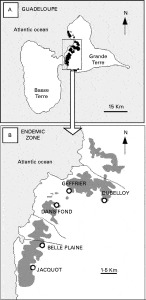
B. glabrata and S. mansoni were sampled in 5 sites of the marshy forest focus of Grande Terre Island in Guadeloupe (Fig. 1). The sites sampled included from south to north Jacquot (JAC; N: 16 °16·241′, W: 061 °31·999′), Belle Plaine (BLP; N: 16 °17·405′, W: 061 °31·444′), Dans Fond (DFO; N: 16 °18·500′, W: 061 °30·720′), Geffrier (GEF; N: 16 °19·907′, W: 061 °29·952′) and Dubelloy (DUB; N: 16 °19·660′, W: 061 °28·524′). These sites are located along the border of the marshy forest and are separated from each other by about 2–10 kilometers (Fig. 1).

Fig. 1. Location of the five transmission sites in the marshy forest focus of Guadeloupe where sampling of Schistosoma mansoni, Rattus rattus and Biomphalaria glabrata was performed. (A) Location of the marshy forest in Guadeloupe. (B) Location of the transmission sites: Jacquot, Belle Plaine, Dans Fond, Geffrier, Dubelloy (modified from Prugnolle et al. 2005).
Snail collection
Five hundred B. glabrata were randomly collected within each transmission site in December 2002. Snails were transported to a laboratory (INRA-Duclos) in Basse Terre island of Guadeloupe and individually tested for cercarial shedding to eliminate those patently infected by digenean larvae (e.g. Ribeiroia marini and Clinostomum golvani). Tests were performed twice during the day following collection, at the end of the afternoon, and in the early morning to detect cercariae with diurnal or nocturnal shedding patterns. After the test, the shell size of 30 randomly chosen non-shedding snails from each site was measured with a slide caliper. The non-shedding mollusks were placed in plastic basins by group of 100 randomly chosen individuals with 5 litres of water (5 groups for each locality). To avoid potential problems of chemical contamination the water came from a spring and was changed every 2 days. Snails were maintained at ambient temperature, and subjected to the natural photo-period occurring at this period in Guadeloupe. Snails were fed ad libitum with dried leaves of Colocasia esculenta, their main food in the marshy forest.
Recovery of S. mansoni eggs and miracidia
Rattus rattus is the natural definitive host of S. mansoni in this focus of Guadeloupe. S. mansoni eggs were collected from R. rattus liver. In each site, rats were captured during a single night (December 2002) using traps baited with coconut. Rats were anesthetized following international principles regarding the care and use of vertebrates. The liver of each rat was then recovered, crushed in a saline solution and the homogenea was passed on different filters to finally retrieve only schistosome eggs. In each site, schistosome eggs from 5 heavily infected rats were melted and placed in fresh water to hatch into miracidia. The number of eggs recovered from Geffrier (GEF) was insufficient to permit the cross-infection experimental design. The egg extraction protocol we used allowed us to recover most of non-encapsulated eggs (i.e. recently trapped in the liver tissue). All miracidia individually collected under the microscope for the infections were particularly active.
Cross-transplantation experimental design
Cross-infection experiments were then conducted whereby snails of each geographical location were exposed to parasites of each geographical location (except parasites from GEF). For each of the 20 host/parasite combinations performed, 96 snails were exposed individually to 10 miracidia, in approximately 10 ml of water for 8 h. Following exposure to miracidia, snails were replaced in their original container. A total of about 2000 snails and 20000 miracidia were used for the experiment.
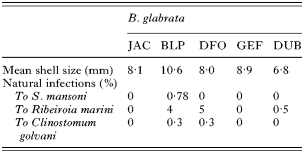
After 30 days, snails were screened individually for infection status by the presence of daugther sporocysts. Such dissection allowed us to distinguish a posteriori between snails infected during the experiment from those naturally infected but undetectable because of being in the pre-patent period during sampling. Distinction between experimental and natural infections was easily made by comparison of the degree of colonization of the hepatopancreas by daughter sporocysts, a process that increases with age of infection (see Gérard et al. 1993). Natural infection by S. mansoni, R. marini and C. golvani were recorded (see Table 1).
Table 1. Biomphalaria glabrata population characteristics (The mean shell size (in mm) and the prevalence (in %) of natural pre-patent infections by Schistosoma mansoni and 2 other trematodes (Ribeiroia marini and Clinostomum golvani) are given. JAC, Jacquot; BLP, Belle Plaine; DFO, Dans Fond; GEF, Geffrier; DUB, Dubelloy.)

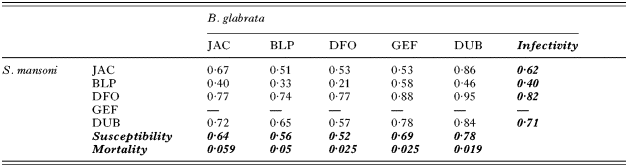
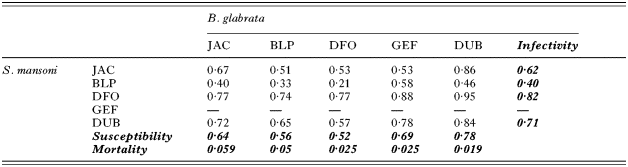
Mollusk mortality rates were also estimated as the proportion of mollusks dead in each population (Table 2).
Table 2. Rate of infection observed in different populations of Biomphalaria glabrata experimentally infected by different populations of Schistosoma mansoni (JAC, Jacquot; BLP, Belle Plaine; DFO, Dans Fond; GEF, Geffrier; DUB, Dubelloy. No parasite was available for Geffrier. Mollusk mortality rates after 30 days are also given for each population.)
Statistical analyses
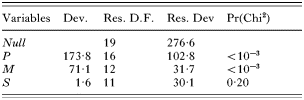
Because of potential variations in the infectivity of parasites and the susceptibility of mollusk populations, the test for local adaptation was performed using the following generalized linear model: I~P+M+S+constant, where I represents the infection rate, P describes the geographical location parasites come from, M the geographical location mollusk populations come from and S the type of cross-infection, sympatric or allopatric. Because the significance of I depends on the number N of mollusks used for each cross-infection, we weighted each observation by N. As the response data corresponded to proportions, a classical binomial model was fitted. The significance of the different variables was tested using a Chi-test. Similar results were obtained using gaussian and quasi-likelihood models (not shown).
To test for the effect of mollusk size on the observed levels of infection, the same model was used but replacing the variable M (geographical location of mollusk) by MS (Mollusk Size). All tests were performed using S-PLUS 2000 (MathSoft Inc).
RESULTS
Mollusk shell size
The mean shell size of mollusks significantly varied from one site to another as shown in Table 1 (P-value <10−3).
Infectivity and susceptibility variations
The rates of infection of each mollusk population as well as the infectivity of each schistosome population are presented in Table 2. Infection rates ranged between 21% and 95% for the DFO/BLP and DUB/DFO host-parasite combination respectively. The mollusk population from Dubelloy (DUB) appeared to be the most susceptible considering all parasite populations used (on average, 78% of mollusks infected) whereas the schistosome population from Dans Fond (DFO) was the most infective considering all mollusk populations used (on average, 95% of mollusks infected). Infectivity and susceptibility were significantly different from one population to another. Differences in infectivity between schistosome populations explain 63% of the observed variation in infection rate (P-value <10−3) whereas differences in mollusk susceptibility explain only 26% of the variance (P-value <10−3) (Table 3). Shell size significantly explained some of the variations in mollusk susceptibility (percentage of explained variation: r2=7%; P-value <10−3). Larger mollusks were on average less infected than mollusks of lower size.
Table 3. Results of the generalized linear model for the infection rate I explained by mollusk localities (M), schistosome localities (P) and the type of cross-infection (S: sympatric or allopatric) (Dev., deviance; D.F., degrees of freedom. Res.: residuals. Null: null model. Pr(Chi2): P-value of the Chi-test.)

After taking into account the variability of parasite infectivity and mollusk susceptibility, the generalized linear model showed no pattern of local adaptation (P-value=0·20) (Table 3).
DISCUSSION
Variation of infectivity/susceptibility
We used cross-transplantation experiments to test for local adaptation in the host-parasite system S. mansoni/B. glabrata in the marshy forest focus of Guadeloupe. While no local adaptation was demonstrated (neither for the parasite nor for the host), our analysis clearly demonstrated strong differences in the infectivity of schistosome populations as well as in the susceptibility of mollusk populations. These differences were highly significant for both hosts (B. glabrata) and parasites (S. mansoni), which lead us to question the factors that could explain them. Two non-exclusive sets of explanations will be discussed. Those related to genetic factors and those related to the environment.
First, host (or pathogen) populations may vary in the nature and the frequency of susceptible (infective) genotypes present within each population because they were submitted to variable levels of genetic drift and/or selection during their micro-evolutionary history (Thompson, 1994; Thrall et al. 2001). This explanation is valuable as long as the susceptibility (infectivity) is, at least partly, genetically determined and the allelic frequencies for those genes different from one population to another in the endemic focus of Guadeloupe. B. glabrata susceptibility and schistosome infectivity have both been demonstrated to have a genetic basis (see Richards and Shade, 1987 for B. glabrata and Davies et al. 2001 for S. mansoni) and we recently demonstrated that both parasite and snail populations were highly genetically differentiated in Guadeloupe (see Prugnolle et al. 2005). It is therefore likely that both the variations in infectivity and susceptibility observed in this study could be, at least in part, linked to differences in the frequency of susceptible/infective genotypes in the different populations.
In addition to genetics, factors linked to ecological conditions or physiological state could also explain some of the observed variations in both hosts and parasites. For the host, there are a large number of studies showing that susceptibility to parasites, especially schistosomes, can be linked to environmental or physiological conditions (e.g. Krist et al. 2004). Mollusk size is, for instance, one of these potential factors. For various reasons, bigger mollusks were recurrently demonstrated to be less susceptible to infection by schistosomes or other trematodes (Anderson et al. 1982; Niemann and Lewis, 1990; Théron et al. 1998). In our study, mollusks from different sites displayed different sizes and, as expected, mollusks of larger shell size were, on average, less infected than mollusks of lower size. Nevertheless, mollusk size does not entirely explain the observed variations in host susceptibility (only 7%). Therefore, other environmental factors could have influenced the levels of infection observed in each host population (e.g. the level of resource available for mollusks in each site, the age structure), but without any other information, it is difficult to give precise details on those potential factors.
For schistosomes, variations in environmental conditions or in physiological state could also account for some of the variations in infectivity. It was demonstrated that water quality and composition could strongly affect the infectivity of miracidia (see Pietrock and Marcogliese, 2003 for review of helminths). In our experiment, this cannot account for the variations in infectivity among parasite populations as the same water was used for all infections. If variations in physiological or environmental conditions explain some of the observed differences in parasite infectivity, these have therefore to be investigated in the adult parasites present within the definitive host or in the environment defined by the definitive host itself. Variations in the average age of the adult worms present in the definitive hosts of the different populations might have, for example, influenced the infectivity of miracidia as demonstrated for other trematodes (see Toledo et al. 2004 for Echinostoma friedi). Again, as for mollusks, it is unfortunately difficult to determine which environmental factors could have affected the level of parasite infectivity. Further experiments in fixed environmental conditions/using inbred lines will be needed to distinguish both the effects of the ecological conditions and genetics on the susceptibility of the host populations and the infectivity of the parasites.
Why we did not detect any pattern of local adaptation in this host-parasite system
The implementation of local adaptation occurs under a particular co-evolutionary process: the time-lagged oscillation of allele frequencies caused by time-lagged frequency-dependent selection (Morand et al. 1996; Kaltz and Shykoff, 1998; Webster and Davies, 2001; Webster et al. 2004). Conditions that govern the existence and the patterns of co-evolutionary cycles and their independence among populations determine the opportunity for local adaptation (Dybdahl and Storfer, 2003). Several factors, related to metapopulation dynamics and species life-histories, can be important (e.g. migration, extinction-recolonization patterns, (e.g. see Kaltz and Shykoff, 1998)). Therefore, there are several possible explanations for why we observed local adaptation neither for the parasite nor for the host in the S. mansoni/B. glabrata system. Here, we will only discuss 2 of them. The first hypothesis deals with host and parasite population dynamics within transmission sites and the second deals with host and parasite relative dispersal rates at the geographical scale under scrutiny.
In a metapopulation context, if host (or parasite) populations experience high rates of local extinction or bottlenecks (e.g. because the suitable habitat is ephemeral), subpopulations may be recolonized by a pool of genotypes that is different from the previous one. In such a system, driven mainly by migration-drift dynamics, there are limited possibilities for co-evolutionary interactions generating local adaptation, especially if the selection pressure acting on hosts (or parasites) are low in comparison to the strength of genetic drift (Kaltz and Shykoff, 1998). In the marshy forest of Guadeloupe, B. glabrata is submitted to a drastic reduction of its populations during the dry season (occurring from March to June): population size generally becomes very small and mollusks only persist in residual puddles located around the transmission sites (Sire et al. 1999). For example, in the site of Dans Fond, more than 3000 mollusks per hectare have been found during the rainy season (December 1995), whereas during the dry season (June 1997), the snail population was strongly reduced and mollusks were patchily distributed among 7 residual puddles in the site (Sire et al. 1999). Moreover, parasite prevalence is always very low in the intermediate host since, on average, only 0·2% of the mollusks are infected during the rainy season and less than 4% during the dry season. Therefore, as the intensity of the parasite-mediated selection is very low and the intensity of the genetic drift is high in the host, we think that there are limited possibilities for co-evolutionary interactions generating local adaptation in such a host-parasite system.
Now, considering that coevolutionary cycles occur within each site, some theoretical models predict that the ratio of host and parasite migration rates strongly affects local adaptation: if parasites (hosts) migrate much more than hosts (parasites), parasites (hosts) are locally adapted, whereas if both species have similar or high migration rates, equal performances are expected in sympatry and allopatry (Gandon et al. 1996). Prugnolle et al. (2005) analysed the population genetic structure of both S. mansoni and B. glabrata using microsatellite markers among the same transmission sites in 2001 and found levels of genetic differentiation values of the same order of magnitude (Fst schistosomes=0·27, Fst mollusks=0·23) after correcting for the genetic diversity observed in each species (Hedrick, 2005). The effective number of migrants is therefore similar among host and parasite populations, which might preclude the evolution of local adaptation in this host-parasite system.
Our results are somewhat at variance with other studies relating tests of local adaptation performed with schistosomes and their intermediate hosts (reviewed by Morand et al. 1996). Some of them demonstrated that parasites where more infective on sympatric hosts than on allopatric hosts. Although opposite to our results, the existence of local adaptation in some schistosome/host systems is, however, not surprising given that co-evolutionary processes and particularly the implementation of local adaptation are greatly dependent on the metapopulation dynamics, which can greatly vary from one place to another. Genetic drift, extinction-recolonization processes, host and parasite dispersal abilities and selection in different directions or selection intensity are all factors susceptible to affect co-evolutionary dynamics. Moreover, the quality, the nature and the heterogeneity of the environment (abiotic and biotic), through their effects on host susceptibility and parasite infectivity and virulence, can also be important in influencing the co-evolutionary process.
This work received financial support from the CNRS (PNDBE), the MENRT (PRFMMIP n ° 95) and the French Ministry of Ecology and Sustainable Development (Contract no. CV2000071, MEDD, programme “Ecosystèmes Tropicaux”). T. de M. and A. T. are also supported by the CNRS. We thank H. Mauléon and V. Rolles for their technical support. We thank M. Charpentier for her help with statistics.