The last fifteen years or so have been remarkably busy ones in the development of British drug policy. Starting with the 1995 white paper, Tackling Drugs Together (HM Government, 1995), which was hailed as the ‘first genuinely strategic response in England to the complexities of the drugs problem’, unprecedented efforts have been made to deliver a coherent national strategy (Central Drugs Coordination Unit, 1998: 9; see also Drugs Strategy Directorate, 2002; HM Government, 2008, 2010). This more strategic approach has been accompanied by an apparent shift in focus, whereby criminal justice has displaced health as the dominant policy paradigm, prompting claims that Britain has abandoned its famously pragmatic approach to such matters. Although British drug policy has become more punitive and coercive in certain respects, it is my contention that such claims are misconceived because they underestimate the degree of continuity that is at work and misrepresent the key dynamics of change. An alternative interpretation is offered below based on the observation that British drug policy has been shaped and reshaped by the broader workings of the modern state.
Following an initial summary of the criminalisation thesis, this alternative interpretation is developed in three sections. The first section shows how formal drug control emerged as a function of the modern state, noting how early medicalised controls reflected broader conceptions of state interventionism and tracing the criminalisation of drug control back to the early part of the twentieth century. As a counterpoint to the static conception of criminal justice that is implied by the criminalisation thesis, the second section develops the argument that British drug policy has been reconfigured by a broader transformative process that has its origins in the ‘crisis of penal modernism’. Set in this context, it is evident that drug policy has changed not because criminal justice imperatives have become more prominent, but because the dominant mode of their expression has been reworked and redirected. Put simply, drug policy has become more punitive and coercive, in part at least, because criminal justice has become more punitive and coercive. The third, and final, section considers developments that do not seem to fit the criminalisation thesis, drawing attention to ‘adaptive’ strategies, including treatment and harm reduction.
The criminalisation thesis
The identification of ‘anti-social behaviour’ as a target for what are frequently punitive and coercive interventions has stimulated renewed interest in the relationship between social policy and criminal justice. While prompting talk of ‘the criminalisation of the social’ (Cook, Reference Cook2006: 178) or the ‘criminalisation of nuisance’ (Squires, Reference Squires2008), such developments are also said to have redrawn the boundaries between social policy and criminal justice. According to Rodger (Reference Roger2008) the worlds of welfare and criminal justice – which had previously retained some measure of detachment – are moving increasingly together. The result, he argues, is a tendency to criminalise social policy, which is evident in ‘the subordination of social policy objectives designed to address social injustice . . . to those of the criminal justice system’ and in the blurring of ‘professional boundaries and paradigms between the criminal justice system and the world of welfare’ (2008: xii).
Drug policy has featured intermittently in this work. Measham and Moore (Reference Measham, Moore and Squires2008) point to the ‘criminalisation of intoxication’, while Roger concludes by suggesting ‘we should look at the history and changing patterns of drug policy as an exemplar of what is happening more broadly in social and criminal justice policy’ (2008: 203). As well as providing a template for the tension between criminal justice and social policy, drug policy is said to be valuable because it is searching for a point of equilibrium between punitive criminalising tendencies on the one hand and health and social intervention strategies on the other. Grover (Reference Grover2010) supports the contention that social policy has become more closely aligned with criminal justice, arguing that we are entering ‘a new period’ of social security policy, where access to benefits is increasingly defined by individuals’ general behaviour rather than their financial needs. To illustrate this point, he considers the potential withdrawal of housing benefit from people evicted for ‘anti-social’ behaviour and the proposed introduction of a treatment allowance for ‘problem drug users’, both of which are attributed to the growing vindictiveness of late modern society. While noting that the concept of vindictiveness has been applied to criminal justice policy, Grover insists that it is useful in understanding what ‘might be termed the criminalisation of social security policy’ (2010: 1.5).
There is a substantial yet largely separate body of work in the drug field that can be drawn upon to support the contention that social policy is undergoing a process of criminalisation. When applied to drug policy, criminalisation is often described in terms of a shift from health to criminal justice. According to Stimson (Reference Stimson2000: 259–60) Britain's once ‘healthy’ policy, which aimed ‘to help problem drug users to lead healthier lives, and to limit the damage they might cause to themselves or others’, has given way to an ‘unhealthy’ ‘war’, which has ‘focused down on the link between drugs and crime’ leading to ‘the introduction of a punitive and coercive ethos’.This shift was said to date back to the election of the first New Labour government in 1997 and to be initially evident in moves to link the criminal justice and drug treatment, with subsequent proposals for compulsory drug testing of offenders making for ‘the worse piece of drug legislation’ in British history (2000: 262). Similar claims have been made elsewhere. Harman and Paylor (Reference Harman and Paylor2002) point to ‘a strategic shift in the focus of national drug policy’, arguing that the health-oriented harm reduction efforts of the 1980s and 1990s have been displaced by a preoccupation with crime. Sampson (Reference Sampson2002: 6) suggests addiction has gone from being primarily seen as a health to a law-and-order issue, insisting ‘we are in the middle of a significant take-over of the drugs issue by the criminal justice system’. Duke (Reference Duke2006: 413) maintains that drugs work is ‘increasingly . . . being usurped under the heading of crime prevention’ as ‘the drug problem’ has ‘become increasingly framed and managed’ as a ‘crime problem’, while Seddon et al. (Reference Seddon, Ralphs and Williams2008: 818) point to a ‘“criminalizing” turn’:
It is sometimes difficult to convey fully to those outside the field the enormity of the transformation that appears to have taken place in British drug policy in recent times. After a long period throughout most of the twentieth century in which British drug policy was lauded as exemplary in its liberal pragmatism – from the old ‘British System’ in which heroin was prescribed to ‘addicts’ right through to the needle exchanges established in the late 1980s to prevent the spread of HIV – the last few years has seen the emergence of a new approach. Policy makers now increasingly see much of the drug problem as a crime issue . . . some of the latest initiatives – for example, the establishment of drug testing of arrestees in police custody suites and the introduction of coerced drug treatment – would probably be profoundly shocking to an historical observer.
Such claims demand careful historical scrutiny as it is ‘only by understanding the past that we can hope to discover what is genuinely new about the present’ (Garland, Reference Garland2001: 29).
Medicine, morality and the origins of drug control
The history of drug control is, in many ways, the history of the modern state. For much of the nineteenth century, the market in what are now prohibited substances was governed by the spirit of free enterprise that defined the age. Opium was readily available from village stores and corner shops, being variously used to alleviate medicinal ailments, as a tonic and, in certain circles, as a means of inducing euphoria or oblivion (Parssinen, Reference Parssinen1983; Berridge and Edwards, Reference Berridge and Edwards1981). As the century progressed, a series of restrictions and prohibitions began to be put in place, forming part of the broader disciplinary apparatus of the modern state.
While early drug controls were heavily influenced by medical perspectives, they also formed part of a broader moral project. As documented by Elias (Reference Elias2000), appeals to health and medicine often served to mask other interests, providing post-hoc rationalisations for what were essentially moral injunctions. Focusing on the development of European societies from late medieval times, Elias charted the way people in such societies had become increasingly distanced from their basic animalistic instincts – something he referred to as the civilising process. Whether it was table manners, attitudes to ‘natural’ bodily functions, blowing one's nose or spitting, the curve of development was said to be similar: standards of behaviour tightened and became increasingly differentiated, conduct was refined and levels of inhibition increased. Elias specifically rejected suggestions that health and hygiene must have played an important role in these developments, showing repeatedly that standards of restraint came first and matters of hygiene featured later as retrospective justifications for the new standards. Spitting was only declared to be unhealthy, for example, after it had become socially unacceptable, prior to which it was considered unhealthy to retain sputum. References to health and medicine, Elias notes, particularly during the nineteenth century, were almost always used to justify the restraint of natural urges, overlapping with, and serving a similar function to, moral injunctions. Increases in self-restraint were also said to be bound up with broader processes of state formation and associated changes in the nature of social relations. As the central authority achieved a high degree of monopolisation over the means of violence and taxation, courtly elites were able to ‘colonise’ the bourgeoisie, who, in turn, sought to inculcate their own civilised standards in the masses (see Mennell, Reference Mennell1992).
Medicine and morality were central to the development of early British drug controls. Having previously been marketed as an aid to health and well-being, opiates were recast as a threat, shrouded in the ‘disease’ of addiction, and ‘were literally taken away from the people and became in large measure the property of the doctors’ (Berridge and Edwards, Reference Berridge and Edwards1981: 212). Initial restrictions were placed on supply, with the 1868 Pharmacy Act granting pharmacists a monopoly on the sale of ‘poisons’ such as morphine and opium. Tighter controls were then placed on possession, providing the basis for what came to be known as the ‘British system’. Under Regulation 40B of the 1914 Defence of the Realm Act and the 1920 Dangerous Drugs Act, it became an offence for anybody, other than a licensed medical practitioner or pharmacist, to buy, sell or possess substances such as heroin, morphine and cocaine without a valid prescription (Mold, Reference Mold2008). Such arrangements were confirmed by the 1924–26 Rolleston Committee, which famously concluded that ‘the administration of morphine and heroin may be regarded as legitimate medical treatment’ for those who are ‘undergoing treatment for cure of addiction by the gradual withdrawal method’ and those ‘for whom, after every effort has been made for the cure of addiction, the drug cannot be completely withdrawn’ (see Spear, Reference Spear2002: 31).
The advent of formal drug control owed something to the changing nature of drugs and their availability. Over the course of the nineteenth century, the synthesis of cocaine from the coca plant and heroin from morphine, as well as the development of hypodermic injection, increased the potential potency of available forms of drug use (Elvins, Reference Elvins2003), while the advent of new techniques of industrial production and distribution meant ‘the possibility of addiction was obviously much greater’ (Courtwright, Reference Courtwright2001: 173). Nonetheless, as Elias might have noted, responses to psychoactive substances ‘are not and never have been, direct reactions to unambiguously medical or pharmacological problems’ (Berridge and Hickman, Reference Berridge, Hickman, Nutt, Robbins, Stimson, Ince and Jackson2007: 469). The development of more potent forms of drug use helped to create a ‘breech of uncertainty’ that was filled by morality as the state took responsibility for ‘protecting’ its citizens’ (Elvins, Reference Elvins2003: 38) – a paternalistic stance that was symptomatic of a growing emphasis on state interventionism. Although the prevailing ethos remained one of rugged individualism, greater intervention was deemed a necessary response to the problems of an industrialising society and was facilitated by the creation of a comprehensive administrative infrastructure (Evans, Reference Evans1983). Important steps were taken towards the creation of a modern criminal justice system, including the birth of ‘modern professional policing’ (Reiner, Reference Reiner2010: 39) and the formation of a centralised prison system (Coyle, Reference Coyle2005), but it was in the fields of medicine and public health that state intervention was pursued most vigorously (Evans, Reference Evans1983).
The ‘disease’ model of addiction appealed to contemporary concerns about public health, while simultaneously serving the self-interests of the medical profession (Berridge, Reference Berridge1999). What passed for medicine was ‘often inseparable’ from morality, moreover, and the dominant ‘moral–pathological’ view of the time held that addicts were suffering from a ‘pathologically impaired moral faculty’ (Mold, Reference Mold2008: 7). This fusion of medicine and morality also served the broader interests of the industrial classes, illustrating a core tension within the emerging welfare state, which simultaneously embodied ‘tendencies to enhance social welfare’ alongside ‘tendencies to repress and control people, to adapt them to the requirements of the capitalist economy’ (Gough, Reference Gough1984: 12). At a time when threats of urban unrest and the need for a disciplined work force accentuated the subversive qualities of many traditional pursuits, concerns about social order featured prominently in the efforts of ‘moral crusaders’ to bring about the ‘reformation of manners’ among the lower orders (Evans, Reference Evans1983). Hence, the inclusion of opium in the 1868 Pharmacy Act reflected a ‘combination of entwined professional and public health moves’ as well as ‘class tensions which had emphasized lower-class use of the drug’ (Berridge, Reference Berridge1999: 117).
Moral imperatives arguably became more explicit with the introduction of legal controls on possession. Amid mounting international pressure for a global system of drug control and specific concerns about cocaine use among soldiers during the First World War, the Home Office acquired ‘a position of central power over drug policy’, committing those involved ‘to an essentially “criminal” view of the situation’ (Berridge, Reference Berridge1999: 257). Regulation 40B of the Defence of the Realm Act ‘established the fundamental principle of prohibition’ (Kohn, Reference Kohn1992: 44) and was followed by a concerted effort to ‘impose a policy completely penal in direction’ (Berridge, Reference Berridge1999: 264). Although such efforts were ultimately frustrated by the medical profession, which was more powerful than in the US, they did create ‘something of a rupture’ in the emerging system of control (Berridge, Reference Berridge1999: xv). Crucially, the British system was ‘less medical than it seemed’ and rested on ‘a mixed criminal justice and medical system of control in which the balance of power could alter in response to changing patterns of addiction’ (Berridge and Hickman, Reference Berridge, Hickman, Nutt, Robbins, Stimson, Ince and Jackson2007: 479). Unauthorised possession remained illegal and subject to criminal penalties, while prescriptions were not to be made for the ‘gratification of addiction’ and maintenance was to be used as a last resort (Spear, Reference Spear2002). This, according to Young, was a ‘near perfect example of an absolutist model of deviancy’ (1971: 206), illustrating the ‘insidious’ forms of ‘coercion and punishment’ that treatment often entails (1971: 77). Far from being an experiment in liberal drug control, as some, mainly American, commentators have claimed, the British system was conceived as a pragmatic solution to a declining problem (Spear, Reference Spear2002). This arrangement was accepted ‘because the addict population was small, elderly and dying off’ (Parssinen, Reference Parssinen1983: 220) and was maintained for as long as the drug problem seemed to be contained. When society's defences against drugs use were ‘decisively breached’ during the 1960s (Marwick, Reference Marwick1998: 4) the established medico-penal balance began to be reconfigured.
Drug policy and the culture of control
The proliferation of drug use and associated policy responses formed part of a broader dynamic that reshaped crime and criminal justice across much of the late-modern world. While the hardening of crime control policies has been widely discussed, David Garland's analysis stands out as ‘a tour de force’ that ‘has deservedly become exceptionally influential’ (Reiner, Reference Reiner2007: 117). As a starting point, Garland (Reference Garland2001) notes that, for most of the last century, criminal justice policy in Britain and the US was based on a firm commitment to correctionalism and rehabilitation, which provided the basis of an approach he describes as ‘penal-welfarism’ or ‘penal modernism’. Having been sustained by low crime rates, penal-welfarism was ‘shaken to its roots’ during the ‘crisis decades’ of the 1970s and 1980s by the emergence of a new criminological predicament that ‘has its origins in two major social facts of the last third of the twentieth century: the normality of high crime rates and the acknowledged limitations of the criminal justice state’ (2001: 3 and 106, original emphasis). Just as the limited capacity of the nation state was being exposed in other areas of policy, so the criminal justice system came to be viewed primarily in terms of its deficiencies rather than its prospects for success, eroding ‘one of the foundational myths of modern society’; namely, ‘that the sovereign state is capable of delivering “law and order” and controlling crime within its territorial boundaries’ (2001: 109). The response, like the predicament itself, forms part of a broader shift, whereby ‘neoliberalism, individualism and the “risk society”’ have eclipsed ‘the Keynesian, mixed economy, welfare state consensus that prevailed for the first three postwar decades’ (Reiner, Reference Reiner2007: 129).
The new criminological predicament has given rise to a process of accommodation and adjustment, creating ‘a series of policies that appear deeply conflicted, even schizoid, in their relation to one another’ (Garland, Reference Garland2001: 110). This conflicted quality is illustrative of the ‘structured ambivalence’ of state responses, which draw on two major strategies: one that seeks to face up to the predicament by developing pragmatic approaches characterised by a high degree of administrative rationality and creativity (the adaptive strategy), and another that is primarily expressive and seeks to reassure the public, often by denying the problem, reasserting the power of the state and ‘acting out’ through impulsive, almost knee-jerk, reactions (the sovereign state strategy). Adaptive measures usually develop incrementally away from the spotlight of public political debate and tend to be endorsed by administrative actors, while the sovereign state strategy appeals more to political actors who place a premium on popular and effective measures that will not be viewed as a sign of weakness. Adaptive solutions have increasingly been eclipsed by more politicised alternatives as ‘the state's political machine has repeatedly indulged in a form of evasion and denial that is almost hysterical in the clinical sense of that term’ (Garland, Reference Garland2001: 131).
What Garland (Reference Garland2001: 147) describes as ‘the culture of control’ reveals ‘a sharp discontinuity’, reversing long-term modernising trends towards ‘rationalisation’ that confound standard theories of punishment based on readings of various authors including Elias. This is no ‘epochal transformation’ involving the wholesale replacement of one system by another, however, but a ‘reconfigured complex of interlocking structures and strategies that are themselves composed of old and new elements, the old revised and reoriented by a new operational context’ (2001: 23). Both the ‘institutional architecture’ of penal modernity and the state apparatus of criminal justice remain ‘firmly in place’, though their ‘deployment’, ‘strategic functioning’ and ‘social significance’ have been ‘transformed’ (2001: 168). While the penal mode has become more prominent, punitive and security-minded, the welfare mode has become more muted and contingent. As a result, public protection has replaced rehabilitation as the overarching aim of the system; incapacitation and deterrence have returned as the main basis for sentencing; prison has been reinvented as an institution that ‘works’ and is used much less sparingly; and probation has been repositioned as punishment in the community.
Although drug policy does not feature heavily in Garland's analysis, it is clearly implicated. In the US, for example, President Reagan's declaration of a ‘War on Drugs’ is identified as the point at which adaptive solutions were eclipsed by non-adaptive solutions and is said to have ‘all the hallmarks of a sovereign state dealing with its limitations by denying they exist’ (2001: 132).
The punitive turn
The development of British drug policy conforms to the main contours of Garland's analysis. By providing individualised medical treatment within a broader correctionalist framework, the British system was consistent with the tradition of penal-welfarism, while the reconfiguration of this system mirrors the general trend towards more punitive and coercive forms of control. Amid growing anxieties about newly emerging patterns of drug use, the British government ratified the 1961 United Nations Single Convention on Narcotic Drugs and introduced a raft of legislation to ensure compliance with its obligations, culminating in the 1971 Misuse of Drugs Act, which continues to provide the basis for one of the harshest drug regimes in Europe (Bennett and Holloway, Reference Bennett and Holloway2005; Police Foundation, 2000). While ‘most of the work towards criminalizing drug use had been completed by the early 1980s’ (Bennett and Holloway, Reference Bennett and Holloway2005: 24), drugs were also beginning to become ‘a political and politicized issue attracting a political consensus that largely persists’ (South, Reference South, Maguire, Morgan and Reiner2007: 823). The rise of ‘law and order’ politics, reinforced by Prime Minister Thatcher's ‘special relationship’ with President Reagan while he was intensifying US anti-drug efforts, paved the way for a more overtly ideological approach. When Britain was hit by a heroin epidemic in the early 1980s, official responses began to resemble a ‘war on drugs’: central government became more actively involved in drug policy, debates were politicised in ways they had not been previously and a new emphasis on law enforcement displaced medicine from its former central role (Stimson, Reference Stimson, Dorn and South1987).
Welfarism in retreat
Just as the penal mode has become more prominent, so the welfare mode has receded. According to Young (Reference Young1971), the British system broke down during the 1960s because of the emergence of lifestyle addicts who refused to conform to the ‘sick role’ that was reserved for them. Amid growing concerns about the ‘excessive’ prescribing practices of a handful of doctors, the Interdepartmental Committee on Drug Addiction recommended that the prescribing powers of general practitioners be restricted (Spear, Reference Spear2002). Under the 1967 Dangerous Drugs Act, only doctors who were licensed by the home secretary were permitted to prescribe heroin and cocaine, which, in practice, meant responsibility for prescribing passed to specialist drug dependency units where the use of ‘substitute’ drugs, such as methadone, quickly became the preferred treatment and heroin was rarely prescribed (South, Reference South, Maguire, Morgan and Reiner2007). Claims that this was the moment Britain abandoned its distinctive system of medicalised drug control and adopted a US-style penal policy overstate the case, not least because the Rolleston principles were retained, albeit in a restricted form, and because most doctors were unwilling to treat addicts anyway (Yates, Reference Yates2002). Nonetheless, the apparently ‘small step’ of limiting doctors’ prescribing powers ‘marked a turning point and the beginning of a gradual decline in the influence of the medical profession in defining and controlling addiction and drug use’ (Bennett and Holloway, Reference Bennett and Holloway2005: 20).
Even allowing for the impact of HIV and AIDS, it is implausible to suppose that Britain retained a straightforwardly ‘healthy’ drug policy into the 1980s. The identification of HIV as ‘a greater threat to public and individual health than drug misuse’ (ACMD, 1988: 1) was a significant milestone, provoking a ‘political emergency reaction’ that softened the strong penal approach publicly advocated by the then Conservative government (Berridge, Reference Berridge, Berridge and Strong1993: 136). Such was the urgency of the situation that hard-line political and media opposition could be ‘quietly overcome’ and prescribing was recast as a legitimate option supported by considerable investment in innovative harm reduction initiatives, including needle exchange schemes. Essential continuities remained, however, and, though such changes were ‘real enough’, they exemplified and expanded ‘on long-standing themes and tensions within British drug policy’ (Berridge, Reference Berridge, Berridge and Strong1993: 146). Crucially, the twin-track focus established in the 1920s persisted and medical controls continued to operate within a framework of penal national and international policy. The public health imperative was to prevent the spread of the virus into the general population, which meant ‘that the safety of the community could be prioritised over the treatment of the individual’ (Mold, Reference Mold2008: 136). While prescribing was endorsed as a means of attracting drug users into services (Berridge, Reference Berridge, Berridge and Strong1993), moreover, the ultimate goal of treatment remained one of abstinence as the Rolleston principles ‘were restated for a modern era’ (Yates, Reference Yates2002: 119).
What maintenance prescribing there was during this era tended to be concentrated in private practice, and doctors whose prescribing practises were deemed irresponsible continued to face charges of professional misconduct (Mold, Reference Mold2008). A state-funded heroin maintenance programme was provided by several clinics in the North West of England, but it closed in 1995 when the supervising psychiatrist, Dr John Marks, was removed from his post amid claims of pressure from US authorities and a lack of moral clarity on the part of his employers (Dean, Reference Dean1995; Runcorn and Widness Weekly News, 19 August 2010). The constraints on maintenance prescribing were reaffirmed a decade or so later when seven doctors from the Stapleford Centre were charged with serious professional misconduct arising out of their ‘irresponsible’ prescribing practices. In a case that was ‘strongly reminiscent’ of that brought against Dr Ann Dally twenty years earlier, the criticisms levelled at the Stapleford doctors formed part of a broader debate about the treatment of addiction (Mold, Reference Mold2008: 144). Like Dr Dally before them, three of the Stapleford doctors were found guilty of serious professional misconduct, including Dr Colin Brewer, the Centre's founder, who was struck off the medical register. While accepting mistakes had been made, Dr Brewer insisted the clinic had been trying to provide a service that was not available on the National Health Service (BBC, 9 November 2006).
Welfarism suffered another blow in December 1999 when Ruth Wyner and John Brock, co-workers in a day centre for homeless people in Cambridge, were convicted of ‘knowingly’ allowing the distribution of a class A drug following an undercover police operation (The Guardian, 6 July 2005). The trial judge made it clear there was no suspicion that either had been involved in, or profited from, the deals in any way, only that they could have done more to make them less likely, including sharing what they believed to be confidential information with the police. Wyner and Brock were sentenced to a combined total of nine years imprisonment, before being released on appeal.
The reinvented prison
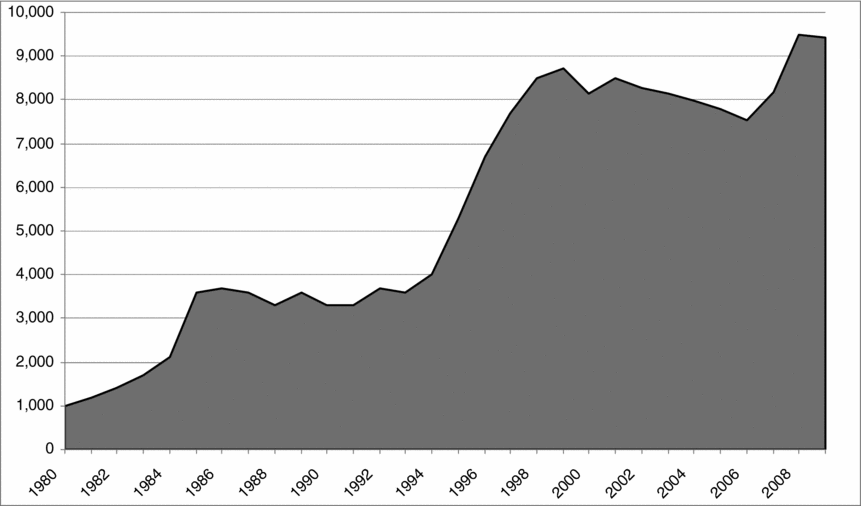
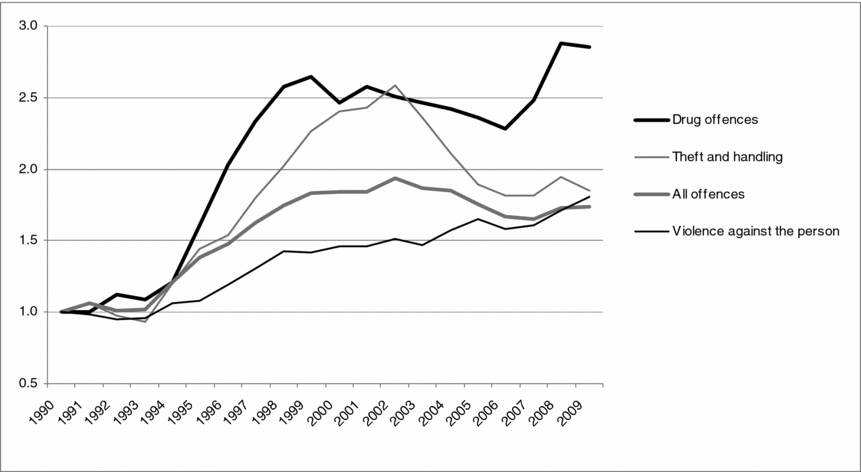
The transformation of penal-welfarism reshaped the drug field by changing sentencing practices and reorienting treatment. Court disposals for drug offences have become increasingly severe as they have for other offences (Newburn, Reference Newburn and Tonry2007). Since 1980, the proportion of drug offenders fined by the courts has almost halved to around a third, while the proportion given immediate custodial sentences has trebled to around one-in-five (Home Office, 1989; Ministry of Justice, 2010a). The greater use of custody developed in two distinct phases, with the number of drug offenders being sent to prison more than trebling between 1980 and 1985, then doubling again between 1993 and 1998 (see Figure 1). The initial increase occurred at a time when the overall use of custodial sentences remained fairly stable, but as drug policy was beginning to be reshaped into a ‘war’ (Stimson, Reference Stimson, Dorn and South1987). Although it leveled off, this greater use of imprisonment for drug offences was maintained throughout the second half of the 1980s, even as the public health response to HIV was being implemented. The later upsurge in imprisonment for drug offences occurred in a very different context, forming part of a broader trend (see Figure 2) that had its origins within penal policy as a whole. According to Garland (Reference Garland2001), the adoption of tough populist policies in 1993 by the then Conservative government, following the murder of four-year-old James Bulger, signalled the most pronounced shift from adaptive to non-adaptive strategies in British criminal justice. With both major parties seeking to out-tough one another on crime, a new political consensus was forged, prompting ‘a step change’ involving ‘a rather sharp accentuation of a trend towards harder crime control’ (Reiner, Reference Reiner2007: 118). In little over a decade, the prison population increased by more than two-thirds, due largely to the introduction of more severe sentencing practices, with drug offences accounting for the largest proportionate increase in new receptions (Newburn, Reference Newburn and Tonry2007; Ministry of Justice, 2009).Footnote 1 The importance of broader penal policy is made clear when we consider that drug offences account for 14 per cent of the increase in custodial sentences since 1993, while violence against the person and theft and handling account for 16 per cent and 24 per cent respectively (Ministry of Justice, 2010a).
Offenders sentenced to immediate custody, 1990–2009 (proportionate change)
Source: Home Office (2000) and Ministry of Justice (2010a).

The greater severity of the courts also made for longer sentences, with various initiatives pushing in this direction, including the introduction of ‘three strikes’ mandatory minimum sentences for serious sexual or violent offences, ‘trafficking’ in class A drugs and domestic burglary (Newburn, Reference Newburn and Tonry2007). Between 1993 and 2003, the average length of custodial sentences for drugs offences increased by a quarter, while that for burglary increased by more than half (Home Office, 2005). As more people were sent to prison for longer, drug offences attracted nearly three times as much prison time in 2004 than they had ten years earlier (Reuter and Stevens, Reference Reuter and Stevens2008).
The repositioning of treatment
Community sentences have increased at a greater rate than custodial sentences, quadrupling since 1993, and are now given to a quarter of drug offenders coming before the courts (Home Office 2005; Ministry of Justice, 2010a). This trend has helped reposition treatment so as to serve the goals of crime control more explicitly. A plethora of initiatives, including ‘coerced’ treatment and compulsory drug testing of arrestees, have been introduced to ensure the criminal justice system exploits ‘every opportunity from arrest, to court, to sentence to get drug-misusing offenders into treatment’ (Drugs Strategy Directorate, 2002: 4). Starting with the Drug Treatment and Testing Order (DTTO), which was fully implemented in 2000, the criminal justice system has been increasingly used to channel drug users into treatment and incentivise compliance (Reuter and Stevens, Reference Reuter and Stevens2008). The number of people entering treatment under a court order in England and Wales increased from less than 2,000 in 1995 to more than 12,000 in 2009 (RDS NOMS, 2005; Ministry of Justice, 2010b). While some positive outcomes have been noted (McSweeney et al., Reference McSweeney, Stevens, Hunt and Turnbull2007), these orders have been subject to relatively high rates of non-compliance, with approximately half the DTTOs issued in 2003 and 2004 being ‘breached’, leading to the imprisonment of more than 3,000 drug users (Home Office, 2005; RDS NOMS, 2005).Footnote 2
Such developments are, again, symptomatic of broader criminal justice trends. Not only has there been a general increase in community sentences, but doubts about their efficacy and perceived lack of toughness have prompted concerted efforts to improve compliance, primarily through the threat of punishment (Newburn, Reference Newburn and Tonry2007). The repositioning of treatment is also illustrative of the broader preoccupation with public protection. Under consecutive New Labour administrations, treatment was geared towards enabling ‘people with drug problems to overcome them and live healthy and crime-free lives’, serving the overall goal of ‘protecting families and communities’ (Central Drugs Coordination Unit, 1998: 3; HM Government, 2008). By recasting harm from harm to users to harm by users (Hunt and Stevens, Reference Hunt and Stevens2004), this reformulation is consistent with one of the key cognitive shifts associated with the transformation of penal-welfarism, whereby offenders are less likely to be viewed as ‘socially deprived citizens in need of support’ and are ‘depicted instead as culpable, undeserving and somewhat dangerous individuals who must be carefully controlled’ (Garland, Reference Garland2001: 175). Where rehabilitative interventions are undertaken, they are increasingly geared towards risk reduction as offenders ‘can only be “treated” (in drug-abuse programmes, anger-management groups, offence-reduction programmes etc.) to the extent that such treatment is deemed to be capable of protecting the public, reducing risk, and being more cost-effective than simple, unadorned punishment’ (Garland, Reference Garland2001: 176).
Adapting to the limitations of the sovereign state
Denial is not limited to the US drugs war, but is a common feature of contemporary drug policy. Consider, for example, the United Nations’ call for ‘A Drug Free World – We Can Do It’ (Arlacchi, Reference Arlacchi1998) or the promise, contained in the latest British drugs strategy, to ‘consistently enforce effective criminal sanctions to deter drug use’ (HM Government, 2010: 9):
The Government is clear that it is not sufficient to simply treat the symptoms of drug misuse. To tackle crime and reduce the harm and costs to society, we need to reduce the demand for drugs. People should not start taking drugs and those who do should stop.
While fulfilling a clear political function, such assertions of sovereign state control are difficult to sustain in light of the available evidence (Elvins, Reference Elvins2003). Interdiction efforts may be able to disrupt or reshape drug markets, but four decades of global prohibition have confirmed that they cannot direct or stamp out consumer demand (Young, Reference Young1971; Shiner, Reference Shiner2009). Illegal drugs account for an estimated 3 per cent of all world trade, making it the third largest sector behind oil and arms (Klein, Reference Klein2008), while international comparisons show no clear link between the severity of drug control regimes and levels of consumption (Degenhardt et al., Reference Degenhardt2008). As well as having one of Europe's harshest drug regimes (Police Foundation, 2000; EMCDDA, 2008), Britain has some of the region's highest rates of drug use, with almost three million adults having used illicit drugs in the last year and around a million having used class A drugs (Hoare and Moon, Reference Hoare and Moon2010).
Such widespread use highlights the limitations of sovereign state control and demands adaptive strategies, creating deeply bifurcated policies. The trend across Europe has been towards ‘harmonization and toughening of enforcement measures alongside acceptance of alternative approaches to the issue of harm reduction’ (Elvins, Reference Elvins2003: 182; see Hakkarinen et al., Reference Hakkarainen, Tigerstedt and Tammi2007). In Britain, tough talk, net-widening and the intensification of imprisonment for those involved in supply-side activities have been accompanied by the de-escalation of punishment for the majority of drug users caught up in the criminal justice system and investment in treatment (Stevens, Reference Stevens2011). Such an approach enables the criminal justice state to adjust to the realities of widespread drug use while maintaining the myth of sovereign state control. Adaptive responses serve a dual function in this context, ensuring that the criminal justice system does not become overwhelmed, whilst also helping to maintain a sense of effectiveness.
What Garland (Reference Garland2001: 113) refers to as the ‘rationing of justice’ and ‘defining deviance down’ have limited the demands on the system by promoting a more selective approach to prosecution. The number of drug offenders processed by the criminal justice system has increased by approximately seven fold since 1980 to around 100,000 a year (Home Office, 1989, 1994 and 2000; Ministry of Justice, 2010a and 2010c). This heavier caseload has been accompanied by much greater reliance on police cautions, which were given to fewer than 2 per cent of drug offenders in 1980 but are now given to almost half. Just as the police divert large numbers of drug offenders away from the courts, so the courts divert large numbers away from prison. Some 56,620 drug offenders were convicted by the courts in 2009, fewer than 10,000 of whom were given immediate custodial sentences (Ministry of Justice, 2010a). Such sentences were generally reserved for supply-side activities, moreover, with possession offences accounting for fewer than 1,300 or 14 per cent of those imprisoned for drug offences (Ministry of Justice, 2010c). Only 3 per cent of convictions for possession resulted in immediate custody, with fines (49 per cent), community sentences (25 per cent) and conditional discharge (17 per cent) being much more common. By contrast, immediate imprisonment was the most common sentence for convictions of production, supply or intent to supply, being given in slightly more than half of such cases.
Cannabis possession is by far the most common drugs offence that the criminal justice system has to deal with (Chaplin et al., Reference Chaplin, Flatley and Smith2011) and it is here that the most tangible efforts have been made towards defining deviance down. The legal classification of cannabis was downgraded from B to C with effect from January 2004, prompting the Association of Chief Police Officers (ACPO) to release guidance advising officers to issue street warnings for most possession offences and only arrest when there are aggravating circumstances (May et al., Reference May, Duffy, Warburton and Hough2007). Although cannabis was subsequently returned to class B, this was a largely symbolic gesture. ACPO (2009) reiterated its previous guidance that warnings should ordinarily be issued for possession offences unless there are aggravating factors and, with the introduction of a new Penalty Notice for Disorder (PND) or on-the-spot fine for cannabis possession in 2009, it remains the case that almost half of all drug offences are dealt with out of court (Ministry of Justice, 2010c).
As well as limiting the demands on the criminal justice system, adaptive solutions serve to maintain an image of effectiveness by relocating responsibilities, scaling down expectations and redefining the criteria by which success is assessed (Garland, Reference Garland2001). All these strategies have been mobilised as part of the ‘community damage limitation’ approach to drugs policing (Dorn and Lee, Reference Dorn, Lee and South1999; Lee and South, Reference Lee, South and Newburn2008). As part of a process of responsibilisation, the police have sought to broaden ownership of the drug problem by activating partnerships with statutory and non-statutory agencies as well as the public. Behind the ‘rhetorical smokescreens’ of talk about a ‘fight’ or ‘war’ against drugs, moreover, the police are increasingly ‘scaling down expectations, redefining their aims, and modifying the criteria by which success is judged’ (Dorn and Lee, Reference Dorn, Lee and South1999: 92). Rather than seeking to eliminate the drugs trade, the ‘community damage limitation approach’ settles for more modest improvements at the margins, aiming to alleviate fears of drug-related crime, disrupt supply and reduce threats to public health. The risk of ‘policy failure’ has, in other words, been averted by changing the terms of engagement, with the ‘manageability’ of crime and drug problems replacing ‘the more heroic but politically risky “war” stance’ (Dorn and Lee Reference Dorn, Lee and South1999: 97; see also Lister et al., Reference Lister, Wincup and Seddon2007).
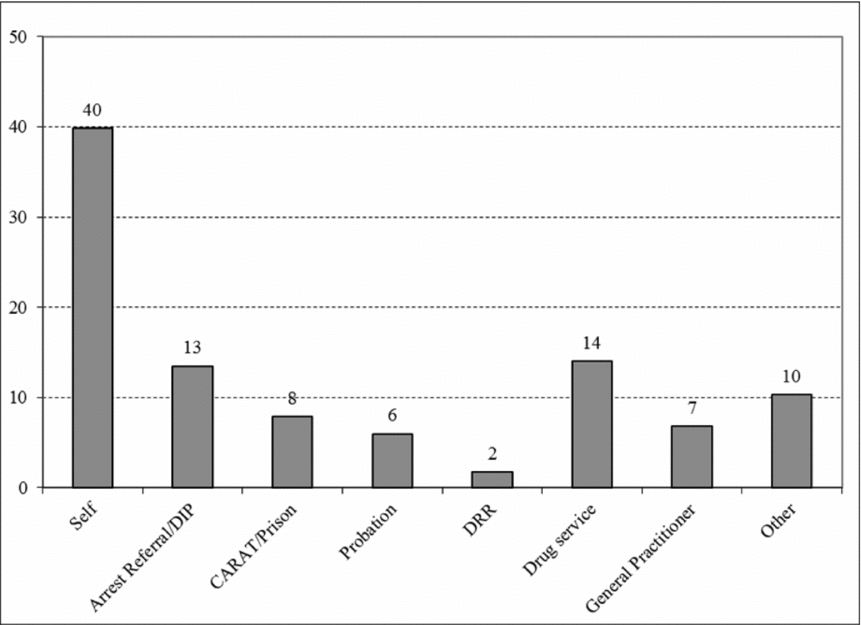
Treatment and harm reduction remain key adaptive strategies. The British system has not been entirely abandoned and the ‘basic principle, that a person addicted to drugs should voluntarily be able to seek medical help which, at the discretion of the doctor, may or may not include the regular prescribing of drugs including heroin, remains intact’ (Spear, Reference Spear2002: 310). Harm reduction was officially endorsed during the 1980s on the basis of what was effectively a restatement of the Rolleston principles (Berridge, Reference Berridge1999; Yates, Reference Yates2002) and, though rarely discussed in political debates, ‘the focus on harm reduction . . . carried on and expanded in actual practice’ under New Labour (Stevens, Reference Stevens2011: 83). The first Labour drug strategy identified several public health objectives, which included improving the capacity and accessibility of treatment, reducing the prevalence of risky injecting practices and bringing down the number of drug related deaths (Central Drugs Coordination Unit, 1998). These commitments were augmented by The National Treatment Agency for Substance Misuse (NTA), which was established in 2001 with the aim of improving effectiveness, efficiency and access to treatment (Lart, Reference Lart, Hughes, Lart and Higate2006). The target of doubling the numbers in drug treatment within ten years was comfortably met (Reuter and Stevens, Reference Reuter and Stevens2008) and the principle of voluntary access was maintained alongside more coercive measures.While the criminal justice system has become an important route into drug treatment, self-referral remains the most common pathway (Figure 3). The vast majority of those in treatment receive some kind of prescribing intervention (NTA, 2010b), moreover, and the announcement that ‘heroin should be available on prescription to all those who have a clinical need for it’ (Drugs Strategy Directorate, 2002: 56) prompted claims that the government ‘is moving addiction from a criminal offence to a medical need, an old and sensible approach’ (The Guardian, July 11 2002). In practice, clear limits were placed on the expansion of heroin prescribing with initial guidance from the NTA advising that such treatment should be an option of last resort (Mold, Reference Mold2008). This guidance was followed by a part-NTA-funded controlled trial that demonstrated the effectiveness of heroin prescribing and recommended that proposals to provide injectable heroin to previously unresponsive chronic users should be rolled-out nation-wide (Strang et al., Reference Strang2010).
Source of referral into treatment, new journeys 2009/10 (percentage)
Key:
DIP – Drug Interventions Programme.
DRR – Drug Rehabilitation Requirement.
Source: NTA (2010b).
Conclusion
The claims that have been made about the criminalisation of drug policy are problematic for several reasons, some or all of which may apply equally to other policy areas. Although some formulations of the criminalisation thesis give careful consideration to what exactly it is that has changed (see Roger, Reference Roger2008), others are less circumspect. Theories of change often rest on simplistic versions of a past that never was (Shiner, Reference Shiner2009 and Reference Shiner, Botterill and Jones2010) and rely on ‘false dichotomies’, resulting in partial, exaggerated or mythical accounts (Matthews, Reference Matthews2005). When considering recent claims about the criminalisation of drug policy, we would do well to remember Berridge's (Reference Berridge, Berridge and Strong1993: 152) earlier warning that ‘the overall balance of power within policy is too complex and historically specific to be adequately subsumed under rhetorical barriers such as the “public health” approach’. Careful historical analysis shows that official responses to drugs were never as straightforwardly benign as much recent commentary implies and were never wholly committed to protecting the well-being of individual users. Early controls carried strong moral commitments that were harnessed by the emerging medical professions and paved the way for the medico-penal arrangement that was formalised by the Rolleston Committee. By glossing over these nuances, the criminalisation thesis may be said to rest on a useful fiction that draws attention to what has changed while obscuring important continuities.
To suggest that criminal justice has displaced health as the main policy paradigm is to misrepresent the key dynamics of change. As a function of the modern state, drug policy has been shaped and reshaped by broader conceptions of how things should be done. The medical orientation of early controls reflected contemporary concerns about public health, while the medico-penal arrangement that followed was consistent with the tradition of penal-welfarism that dominated criminal justice. More recent developments have, in turn, been shaped by the transformation of this tradition as part of a broader realignment of the nation state. With the fragmentation of the welfare state consensus, security has become an increasingly prominent means of legitimating state intervention, and the identification of large-scale threats, such as crime and drugs, has been pivotal to this process, providing rationalisations for actions aimed at bolstering the authority and control of the state (Elvins, Reference Elvins2003; Simon, Reference Simon2007; Crick, Reference Crick2012). To claim, under these circumstances, that drug policy has become more punitive and coercive because criminal justice has displaced health from its formerly dominant position is to miss the point. The main driver of change is not that criminal justice has expanded or colonised other areas of policy, but that the nature of criminal justice itself has changed, becoming, more punitive and coercive.
Although welfarism has become more muted, both within drug policy and across criminal justice as a whole, it has not been entirely eclipsed. While recent developments, such as the greater use of imprisonment and the rise of ‘coerced’ treatment, illustrate the prominence of the penal mode they form part of a more complex, bifurcated, set of policies. Various adaptive strategies attest to the structured ambivalence of state responses, creating on-going tensions within criminal justice as well as between criminal justice and health. There is, as a result, evidence of both continuity and discontinuity (Garland, Reference Garland2001) or of ‘continuity within change’ (Shiner, Reference Shiner2009). Casting a long shadow, the British system provides an example of ‘the historical conditions of existence upon which contemporary practices depend’ (Garland, Reference Garland2001: 2). It may be ‘impossible to say if history will repeat itself’, but it ‘is clear is that the same debates, conflicts and tensions that have beset drug addiction treatment since the beginning of twentieth century endure’ (Mold, Reference Mold2008: 170).
In short, the transformation of penal-welfarism has given rise to a more punitive and coercive approach to drug control, but has not entailed the wholesale replacement of one system by another. The medico-penal alliance that was forged a century or so ago remains firmly in place and it is this hybrid arrangement, with all its attendant tensions and contradictions, that is, perhaps, the most distinctive and enduring feature of British drug policy.
Acknowledgements
I am grateful to Rebekah Delsol, Eric Dunning, Jane Lewis and Alex Stevens for their helpful comments on an earlier draft of this paper. I am also indebted to the anonymous referees and journal editors for their insights and guidance.