Introduction
Mushroom compost is an intensely managed, organic-based substrate on which several varieties of mushroom are spawned, grown, and harvested. The mushroom compost is used for one generation of mushrooms and then removed from the mushroom house. Growers often sell the used mushroom compost as spent mushroom compost (SMC) to many farms, nurseries, and homes throughout the United States. In Pennsylvania, SMC can be used at rates of up to 44,834 kg ha–1 in wheat (Triticum aestivum L.) and 179,336 kg ha–1 in grass hay (PDEP 2012). Compost ingredients may come from fields contaminated with weed seed after harvest, and given the amount of SMC that can be applied to crop land, there is concern that it may spread unwanted and potentially herbicide-resistant weed seed.
Composting is an aerobic process in which an organic substrate is degraded into humus-like material, the end product of which should not contain viable weed seed (Nether et al. Reference Nether, Weicht and Dunseith2015). Previous research has shown that temperatures over 55 C are needed to kill a majority of weed species in traditional composting systems (Dahlquist et al. Reference Dahlquist, Prather and Stapleton2007; Daugovish et al. Reference Daugovish, Downer, Faber and McGiffen2007; Grundy et al. Reference Grundy, Green and Lennartsson1998; Larney and Blackshaw Reference Larney and Blackshaw2003; Norsworthy et al. Reference Norsworthy, Smith, Steckel and Koger2009; Tompkins et al. Reference Tompkins, Chaw and Abiola1998). However, the time necessary for lethal exposure can vary by species. For example, Dahlquist et al. (Reference Dahlquist, Prather and Stapleton2007) reported that barnyardgrass (Echinochloa crus-galli [L.] Beauv.) mortality was 100% when exposed to a temperature of 60 C for <1 h, whereas common purslane (Portulaca oleracea L.) required 3 h of exposure to reach 100% mortality.
The process of making SMC is similar to traditional composting; however, SMC is exposed to multiple phases of heating and cooling. Four major stages are involved in commercial mushroom compost production and mushroom production: (1) preconditioning and Phase I; (2) Phase II, pasteurization; (3) mushroom production (spawning, growth, and harvest); and (4) post-crop sterilization. During preconditioning, compost ingredients are mixed, watered, piled, and allowed to stand for several days outside. The main compost ingredients consist of corncobs, hay, horse manure, poultry litter, and straw (PDEP 2012). Other organic and non-organic ingredients may also be added depending on the mushroom operation. Once the ingredients are softened, compost is piled to begin Phase I composting. Phase I compost may be placed in open-air concrete bunkers or in rectangular piles called ricks, which are approximately 1.5 to 2 m wide, up to 2.4 m high, and as long as 30 to 50 m. During Phase I the internal temperature of the compost reaches 63 to 77 C. The compost is turned and watered at 2-d intervals for 7 to 16 d, so as to ensure optimal temperatures and mix ingredients.
During Phase II, the compost is pasteurized to kill competing fungi and other pests that may be present. This step can be conducted using the single-zone or tunnel system. A single-zone system consists of placing compost in individual beds in an environmentally controlled growing room. This system involves rapidly heating the compost with steam to approximately 60 C for 3 d, then gradually lowering the temperature over a 10-d period to approximately 38 C. Mushrooms are then grown on the same beds. In the tunnel system, compost is placed in large “tractor-trailer”-like bins with perforated floors so pasteurization can be completed on bulk. In tunnels, steam is used to heat the compost to approximately 57 C for 1 d, and temperature is lowered over a 4-d period to 47 C; afterwards, the compost is moved to growing rooms and placed in beds. In the growing beds, mushrooms are spawned, grown, and harvested on the compost over a period of approximately 5 wk (referred to as cropping phase). During the cropping phase, mushrooms are grown in the dark and the compost temperature is maintained at a range of 16 to 27 C with high relative humidity.
Post-crop sterilization occurs after the final mushroom harvest. The compost is steam-pasteurized so as to destroy any pest or diseases that may have accumulated during the mushroom growth cycle. Sterilization occurs before the mushroom compost is removed from the beds; over a 3-d period the compost is heated to at least 60 C. Removal of the compost follows completion of this stage, and the compost is now available for use as SMC.
The objective of this study was to determine the potential for the commercial mushroom compost production cycle to eliminate weed seed viability. As the length of time the mushroom compost remains in Phase II differs for single-zone versus tunnel systems, we compared both. Rather than designing the study to test the effects of different compost mixtures or variations in growing conditions, we evaluated the commercial mushroom composting process and mushroom cropping cycle as a whole.
Materials and Methods
Two studies were conducted to test the viability of five weed species following specific stages in the mushroom production process. The first study examined the change in weed seed viability during the period from Phase II through the period following post-crop sterilization of the mushroom production process, whereas the second study evaluated viability during the preconditioning period through post-crop sterilization. We hypothesized that the period from Phase II through post-crop sterilization would be enough to completely eliminate weed seed. Therefore, two studies were conducted: one exclusively indoors and the other outdoors followed by an indoor study. Commercial mushroom production facilities near Hockessin, DE (39.8°N, 75.7°W) were used for all studies. All stages of the mushroom composting process were performed according to industry standards (PDEP 2012).
Weed Seed Preparation
Fifty seeds of each species were placed in individual 3-cm by 3-cm mesh bags. Afterwards, one bag of each species was placed in an onion bag, constituting one replication. Onion bags were then inserted into separate compost piles at 30-cm depths. Five species were used: Italian ryegrass, hairy vetch, ivyleaf morningglory, Palmer amaranth, and velvetleaf. Italian ryegrass and Palmer amaranth are small-seeded species suspected of being found in plant material commonly used for mushroom compost. Hairy vetch, ivyleaf morningglory, and velvetleaf have larger seeds with thicker seed coats and have shown resistance to seed decay in other studies (Eghball and Lesoing Reference Eghball and Lesoing2000; Egley Reference Egley1990; Mirsky et al. Reference Mirsky, Wallace, Curran and Crockett2015; Schutte et al. Reference Schutte, Haromato and Davis2010).
Study 1: Phase II through Post-Crop
The study was a randomized complete block design in a two-factor factorial arrangement consisting of Phase II method, species, and removal timing with five replications per treatment. The study was repeated three times, referred to as runs. Phase II method utilized either the single-zone or tunnel system. Seeds were placed in compost piles prior to Phase II. Seeds placed in the tunnel system were removed after Phase II and immediately placed in growing beds. Seeds placed in the single-zone system remained in the growing beds. Weed species evaluated were Italian ryegrass, ivyleaf morningglory, hairy vetch, Palmer amaranth, and velvetleaf. Removal timings were at end of Phase II (referred to as pre-spawn), 2 wk after Phase II (referred to as cropping), and following the post-crop sterilization phase (referred to as post-crop).
Study 2: Preconditioning Through Post-Crop
The study was a randomized block design in a two-factor factorial arrangement of Phase II method, species, and removal timing with five replications per treatment. The study was repeated twice. Seeds were placed in compost piles prior to preconditioning, removed after Phase I, and then immediately placed in compost at one of the two Phase II methods (i.e., either the single-zone or tunnel system). Weed species evaluated were Italian ryegrass, ivyleaf morningglory, and Palmer amaranth. Removal timings were at the end of Phase I compost preparation (referred to as Phase I), cropping, and post-crop.
Data Collection and Analysis
Five onion bags were recovered at the prescribed removal time and shipped overnight to University of Delaware’s Carvel Research and Education Center near Georgetown, DE (38.64°N, 75.5°W) in insulated boxes filled with mushroom compost to maintain moisture levels and a constant temperature. Within 24 h of arrival, seeds were pressure tested using forceps, with those unable to withstand slight pressure (mushy) considered dead. Seeds that resisted slight pressure were placed in Petri dishes lined with germination paper. Petri dishes with ivyleaf morningglory, Palmer amaranth, and velvetleaf seeds were placed in a Seedburo Table Top Germinator (Seedburo Equipment Co., 2293 S. Mount Prospect Road, Des Plaines, IL 60018) set at 23 C. Hairy vetch and Italian ryegrass seeds were placed on a lab bench where ambient temperatures ranged from (10 to 20 C). All seeds were placed in the dark, and neither germination location received more than ambient room light. The differences in germination location were due to differences in requirement for summer and winter annual weed germination as reported by Buhler and Hoffman (Reference Buhler and Hoffman1999). Seed from the initial seed source were included in the germination test and served as our control. Petri dishes were watered as needed with a 1% solution of captan (Bonide Captan Fruit and Ornamental Concentrate; Bonide Products, Inc., 6301 Sutliff Road, Oriskany, NY 13424) to prevent mold growth. Petri dishes were monitored for seed decay or radicle emergence every 2 to 3 d over a 4-wk period. Seeds that did not decay but failed to germinate were dried, and a crush test was performed by lightly striking each individual seed with a hammer (Sawma and Mohler Reference Sawma and Mohler2002). Seeds that remained intact after striking were given an additional 2-wk germination period followed by a second crush test. Seeds were classified as recoverable (withstood the initial pressure test), germinable (if they produced a radicle), and persistent (if they remained intact after the second crush test).
Data were subjected to ANOVA with the mixed procedure run by removal timing in JMP Pro 14 (SAS Institute Inc., SAS Campus Drive, Building T, Cary, NC 27513), with Phase II method, species, and run as fixed effects. Replications and replications nested within run were treated as random effects. If interactions between species and Phase II method were significant, data were grouped by Phase II method and analyzed using the same procedure, with removal timing and species run as fixed effects. Fixed effects and interactions were tested using Fisher’s LSD test at P = 0.05. If no interactions were observed, data were combined over fixed effects.
Results and Discussion
Our results show SMC to be free of viable weed seed of many species upon removal from the mushroom houses. Although some seed was recovered at each removal timing, the composting process itself affected the seed sufficiently that the majority tested were nonviable upon removal from the compost. In the control samples, germination of hairy vetch, Italian ryegrass, ivyleaf morningglory, Palmer amaranth, and velvetleaf seeds averaged 92%, 87%, 74%, 53%, and 23%, respectively, across all studies. Furthermore, 0.1%, 0.3%, 0.8%, 14%, and 5%, of the control samples of hairy vetch, Italian ryegrass, ivyleaf morningglory, Palmer amaranth, and velvetleaf, respectively, persisted. Whereas ivyleaf morningglory seeds were the only seeds to germinate or persist at the post-crop timing in the first study, no seed of any species germinated or persisted at the post-crop timing in the second study.
Study 1: Phase II through Post-Crop
No hairy vetch, Italian ryegrass, Palmer amaranth, or velvetleaf persisted following completion of the trial. Overall, there was a significant species-by-Phase II method interaction for recoverable seed (P = 0.0001); therefore, data were analyzed separately by Phase II method.
In the tunnel system, only the main effect of species was significant for recoverable seed. No recoverable seeds were recorded for hairy vetch, Italian ryegrass, or Palmer amaranth. Two velvetleaf seeds were recovered at both the pre-spawn and cropping sampling times (totaled over three runs). The recovered seeds did not germinate and did not persist at the end of the study. Five ivyleaf morningglory seeds were recovered across all three sampling times (totaled over three runs). None of the ivyleaf morningglory seeds germinated, and two seeds (0.27%) from post-crop samples persisted.
In the single-zone system, weed species decline varied by removal timing. In the third run, the interaction of species and removal timing was significant (P = 0.0238). No recoverable seeds were recorded for hairy vetch, Italian ryegrass, Palmer amaranth, or velvetleaf for any of the removal timings. Recoverable ivyleaf morningglory from pre-spawn (1.2%) and cropping (0.8%) was higher than post-crop (0%). Although, no ivyleaf morningglory seed germinated, two seeds (0.4%) from both pre-spawn and cropping were classified as persistent.
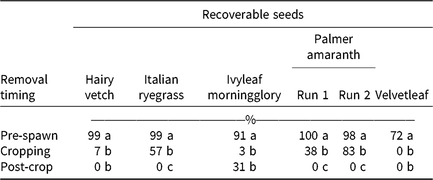
Seed decline data in the single-zone system for the other two runs were combined for analysis of hairy vetch, Italian ryegrass, ivyleaf morningglory, and velvetleaf. However, there was a significant run-by-removal timing interaction for Palmer amaranth (P = 0.0096). The percentage of recoverable seed from hairy vetch, velvetleaf, and ivyleaf morningglory was higher following pre-spawn removal compared to cropping and post-crop timings. Ninety-nine percent of hairy vetch seeds were recoverable when sampled at the pre-spawn timing, whereas seeds from cropping and post-crop declined to 7% and 0%, respectively (Table 1). No hairy vetch seeds germinated, but one seed (0.2%) from pre-spawn persisted. Likewise, recoverable velvetleaf seeds from pre-spawn were 72%, whereas no seeds were recoverable from cropping and at post-crop timings. No velvetleaf seeds germinated, and none persisted. Recoverable ivyleaf morningglory seeds were 91% from pre-spawn (Table 1). Although not significant, the final two removal timings had variable results, with 3% recoverable seeds from cropping and 31% of seeds recoverable from post-crop. Ivyleaf morningglory seeds removed at cropping timing did not germinate, but 0.2% at both pre-spawn and post-crop germinated. At the end of the study only 2.8% of ivyleaf morningglory seeds from pre-spawn and 0.6% from cropping persisted.

a Means in the same column followed by the same letter do not differ according to Fisher’s LSD (P = 0.05).
b Only data from the first and second runs are presented. Data were averaged over run for hairy vetch, Italian ryegrass, ivyleaf morningglory, and velvetleaf.
Recoverable Italian ryegrass and Palmer amaranth seeds declined with each removal timing. Recoverable Italian ryegrass seeds from pre-spawn, cropping, and post-crop were 99%, 57%, and 0%, respectively (Table 1). No Italian ryegrass seed germinated, and three seeds (0.6%) from pre-spawn persisted. Likewise, recoverable Palmer amaranth seeds from pre-spawn, cropping, and post-crop in the first run were 100%, 38%, and 0%, respectively; and 98%, 83%, and 0%, respectively, in the second run. Two Palmer amaranth seeds from cropping (0.4%) germinated, and six seeds (1.2%) from pre-spawn persisted.
Study 2. Preconditioning to Post-Crop
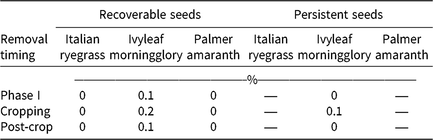
The main effect of species and Phase II method were not significant at any removal timing. No recoverable Italian ryegrass or Palmer amaranth seeds were recorded, but four ivyleaf morningglory seeds (0.13%) were recoverable over the course of the study (Table 2). No ivyleaf morningglory seed germinated, and one seed (0.03%) persisted over the course of the study.

There were no recoverable seeds following post-crop sterilization, except for hairy vetch (Study 1) and ivyleaf morningglory (Studies 1 and 2). The level of seed decline was dependent on the amount of time spent in the compost and/or the Phase II method used. When seeds underwent the entire mushroom composting process (Study 2), no species were recoverable following Phase I, and only ivyleaf morningglory seeds were recoverable at a subsequent removal timing. When seeds underwent Phase II through post-crop only (Study 2), certain species required longer exposure times. In the tunnel system, Italian ryegrass, Palmer amaranth, and velvetleaf seeds were not recoverable after pre-spawn. However, hairy vetch seeds required at least one additional removal timing before no recoverable seeds were detected. In the single-zone system, hairy vetch, Italian ryegrass, and Palmer amaranth seeds underwent three removal timings before no recoverable seeds were detected, whereas no velvetleaf seeds were detected after cropping. Although recoverable ivyleaf morningglory seed was detected at all three removal timings, the amount of recoverable seed decreased at cropping and post-crop sterilization.
Regardless of Phase II method, ivyleaf morningglory was the only species to have persistent seeds following removal from the compost at post-crop timing in either study. Morningglory species are characterized as having a hard seed coat, and scarification is often required for germination (Buhler and Hoffman Reference Buhler and Hoffman1999; Chauhan and Abugho Reference Chauhan and Abugho2012, Schutte et al. Reference Schutte, Haromato and Davis2010). However, as no ivyleaf morningglory seeds persisted following post-crop sterilization in the second study, this is probably not an issue in commercial mushroom compost. Likewise, Eghball and Lesoing (Reference Eghball and Lesoing2000) reported that 1% of morningglory seeds were viable after turning wet cattle manure compost once, but no seeds were viable at the end of composting.
Although this study did not evaluate the mechanism of seed destruction, previous research has indicated that the high temperatures over an extended time period are needed to kill many weed seeds (Nether et al. Reference Nether, Weicht and Dunseith2015). The National Organic Standards Board Program recommends that compost piles maintain temperatures between 55 and 77 C for a minimum of 15 d and be turned a minimum of five times (Nether et al. Reference Nether, Weicht and Dunseith2015; USDA 2011) to eliminate both weed seed and pathogens. This process is similar to Phase I mushroom composting (Study 1), which destroyed two out of three species tested.
However, when Phase I was not included, seed mortality increased with subsequent removal timings. Although the optimal temperatures for seed mortality are achieved in Phase II, these temperatures are not maintained long enough for seed mortality in traditional composting practices. Therefore, heat is probably not the only factor contributing to seed mortality in the mushroom composting process. Prior to Phase II, the moisture content of the compost is between 68% and 74%, and humidity levels are maintained at >90% during mushroom growth. These variations in temperature, along with high moisture and humidity, can break seed dormancy and stimulate germination of weed seed (Dillon and Forcella Reference Dillon and Forcella1985, Nishimoto and McCarty Reference Nishimoto and McCarty1997).
A separate study conducted at the University of Delaware showed that 10% of velvetleaf seeds and 19% of hairy vetch seeds germinated in unfinished mushroom compost incubated at 23 C over a 2-wk period (data not presented). Therefore, germination can occur during mushroom growth, but plants never fully develop as a result of the extremely low light levels required for mushroom production. Although the length of time in Phase II in tunnels is shorter compared to the single-zone system, temperature fluctuations occur more rapidly in the tunnel system. This abrupt change in environment is probably contributing to faster seed mortality in tunnels compared to the single-zone system.
The commercial mushroom composting process was sufficient to eliminate weed seeds that may have been introduced with composting materials. Species such as hairy vetch, Italian ryegrass, Palmer amaranth, and velvetleaf were eliminated at earlier stages in the composting process, but the entire process was required for 100% of ivyleaf morningglory seeds to be destroyed. Therefore, growers should not be concerned about the spread of unwanted weed seed when obtaining SMC immediately after removal from the mushroom houses. However, given the amount of SMC that is applied, growers should be wary of using SMC that has been left in areas where the introduction of new weed seed may occur.
Acknowledgments
The authors would like to thank the American Mushroom Institute for partial funding of this research, as well as Joe Poppiti and Tom Brosius for their consultation. Thanks to the University of Delaware Weed Science crew for processing seed samples. We appreciate John R. Stinson and Sons, Inc., John C Leo and Son, LLC, Hy-Tech Mushroom Compost, Inc., Laurel Valley Farms, LLC, Marlboro Mushrooms, and Needham Mushroom Farms, Inc., for allowing these studies to take place at their mushroom farms. No conflicts of interest have been declared.