Attempts to understand Vietnam as a unique entity rather than a lesser version of China have been made since the early twentieth century by the Ecole Française d'Extrême Orient, and a series of studies since the 1970s that have aimed to understand the Lý and Trần dynasties as mandala states can be positioned along these lines.Footnote 1 Such studies emphasise the Southeast Asian nature of pre-modern Vietnamese history, and it can be said that tracing Southeast Asian elements as the substratum for Vietnam's cultural identity has been recognised in the study of Vietnamese history since the latter half of the twentieth century. However, it is not always appropriate to search for the nature of Vietnamese society by looking to Southeast Asia. In some cases it may be more appropriate to consider the similarities with East Asian societies. For example, Alexander Woodside described patrilineal kinship groups called dòng họ and village communities called làng as obstacles to the Chinese model of statecraft characterised by a centralised bureaucracy, and argued that the Nguyễn dynasty's push for centralisation suppressed the existing Southeast Asian culture.Footnote 2 However, were dòng họ and làng really of Southeast Asian descent? Anthropological studies of Southeast Asian family structures, looking at multi-household compounds since the 1980s, suggest that social groups with closed and fixed membership (such as dòng họ and làng) are not of Southeast Asian origin.Footnote 3 In order to consider the Southeast Asian nature of Vietnamese history, it is first necessary to consider the sociocultural characteristics of Southeast Asia as a premise for discussion.
Generally, Southeast Asia has been characterised as having a ‘loosely structured society’. In 1950 John F. Embree explained this to mean a fluid society in which exclusive and stable social groups are underdeveloped.Footnote 4 Since his study of Thai society, with the progress of field research on rural multi-household compounds, ‘loosely structured society’ was established as a description of the social structures across Southeast Asia.Footnote 5 This was explained by the low population density of pre-modern society. While the region had a relatively low population to land ratio, it played a major part in the East–West maritime trade, with the export of valuable tropical products necessitating the early development of water transportation. This brought about high population mobility, and made it difficult for social groups with fixed and closed membership to develop in Southeast Asia, which in turn resulted in a weakly organised social structure, according to Yoshihiro Tsubouchi.Footnote 6 Polities were organised on a mandala model by multi-layered individual relationships based on client-patronage in a loosely structured society; hence the task of statecraft during the Lý–Trần period was how to build a state on the Chinese model and stabilise royal power in such a sociopolitical context.Footnote 7
On the other hand, Vietnamese social groups, as represented by dòng họ and làng, have a distinct membership that distinguishes those ‘inside’ (nội) and those ‘outside’ (ngoài).Footnote 8 The fact that hundreds of years of archives are stored at village communal halls (đình) and ancestral halls (nhà thờ họ) indicates that these social groups have been persistent and stable for at least several hundred years. We can easily find many traces of Southeast Asian cultures, such as the incorporation of Cham culture and the persistence of various Southeast Asian customs. However, that is not seeing the wood for the trees. For example, in the nineteenth century, the Red River Delta had many groups which were not centred around charismatic leaders, and were autonomous, exclusive and sustainable, based on Confucian patrilineal and age order, unlike Southeast Asia's loosely structured society. This is a reason why Japanese scholarship on Vietnamese history has utilised the theory of East Asia's ‘early modern peasant society’.Footnote 9 In other words, Japanese researchers have been attempting to grasp the social transformations from the Lý–Trần period to the Nguyễn dynasty as a transition from Southeast Asia's loosely structured society to East Asia's more tightly organised ‘small peasant society’. The present article also follows this viewpoint.
How were social groups with exclusive membership which persisted for hundreds of years, such as làng and dòng họ, formed from the earlier loosely structured society, and how did they come to prevail in Vietnam? According to current studies, the oligarchy of landed gentry and local officials in Red River Delta villages was established in the seventeenth and eighteenth centuries.Footnote 10 Vietnamese historiography is strongly influenced by the Marxist-Leninist emphasis on class struggle, so it is not always possible to mesh these studies with the analytical perspective mentioned above. However, materials in the Institute of Han-Nom Studies library also show us that the compilation of family genealogies and the building of Confucian facilities, such as village communal halls and ancestral halls, began and spread rapidly in the seventeenth and eighteenth centuries.Footnote 11 At the very least, it is certain that local groups managing these historical materials were formed or transformed to some degree in this period. However, no concrete analysis has yet been done that links phenomena such as the establishment of social groups with fixed and closed membership and the popularisation of Confucianism. That is to say, the historical process of how these social phenomena led to the transition from a Southeast Asian loosely structured society to an East Asian small peasant society has not been examined.
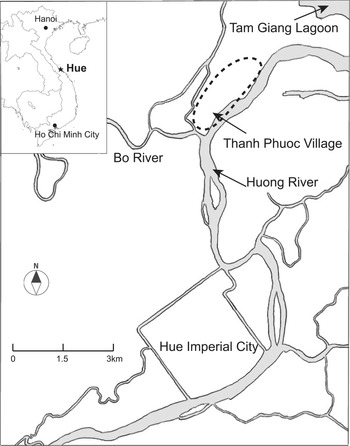
This article examines the formation and transformation of làng and dòng họ in Thanh Phước village near Huế in Central Vietnam (see map 1).Footnote 12 There are several reasons for selecting this village. First, Thanh Phước village has a very rich collection of Hán-Nôm (Chinese character and chữ Nôm) documents that are essential for examining the development of local social groups.Footnote 13 Most of the historical materials on Thanh Phước were collected from the village communal hall (đình) and ancestral halls (nhà thờ họ). The communal hall had about 120 documents consisting mainly of administrative documents, such as land cadastres, population registers, court decisions and village regulations, dating from the late seventeenth century; the Buddhist temple (Hồng Phúc temple) had about 40 documents consisting mainly of sắc phong (Imperial edicts on deities), dating from the early nineteenth century; and the major lineages, which are called thất tộc (the seven families) or họ khai canh (the first settled lineages), in the village had about 150 documents consisting of family genealogies dating from the early eighteenth century.Footnote 14 In addition, each of the document groups includes the land contracts of common fields and their associated financial accounts. The abundance and diversity of these historical documents in the village is a rich source for various analyses of micro social phenomena. Second, the Huế area is a region where the population and cultivated area increased rapidly since the Lê Thánh Tông era (in the mid-fifteenth century), and especially during the seventeenth and eighteenth centuries during the reign of the Nguyễn lords,Footnote 15 and in the nineteenth century during the Nguyễn dynasty, when the expansion of cultivated land and the establishment of new settlements reached their limits.Footnote 16 Thus, in the case of the Huế area, we can observe the transition of social structures from a society with a land surplus to an overpopulated society; this process occurred much more rapidly and in a more compact area than in the Red River Delta, the cradle of the Kinh people. Based on the above, this article seeks to clarify the formation and transformation of the village community and paternal kinship lineage in Thanh Phước village, focusing on the progress of agricultural development and the spread of Confucianism, from the perspective of transformation from a loosely structured society to a small peasant society.
Thanh Phước Village: Location and surrounding areas

Thanh Phước lies at the confluence of the Hương and Bồ rivers. A shipbuilding industry once flourished, but today the village has no prominent industry other than rice cultivation. Thanh Phước is presently administered as a village (thôn) within the commune (xã) of Hương Phong, but has held many different administrative statuses over time. Thanh Phước was established in 1473 as Hoằng Phúc xã (弘福社). However, sometime before the second half of the seventeenth century, the village name was changed to Hồng Phúc xã (洪福社). Later, in the Tây Sơn period, it became Hồng Ân xã (洪恩社), but with the unification under the Nguyễn dynasty in the early nineteenth century, its name reverted to Hồng Phúc xã. In the mid-nineteenth century, it was changed again to Thanh Phước xã (淸福社). In 1977, the village was merged with a village to its north as the Phước Hòa Cooperative. After further consolidation and separation, it became the hamlet of Thanh Phước in the commune of Hương Phong.Footnote 17 However, in this article the village is referred to as Thanh Phước regardless of the period under discussion in order to avoid confusing readers.
Establishment of Thanh Phước village
This section traces land use development in Thanh Phước based on its historical records. The establishment of Thanh Phước is described in document TP Phan Hữu 2: according to the document, Phan Niêm, founder of Thanh Phước, joined Lê Thánh Tông's Champa expedition in 1471. After that, he was awarded the lands in the present-day Hải Lăng district, Quảng Trị province in the second lunar-month of 1472, and his settlement was incorporated into the local administration as Diên Cát xã (延葛社) in the following month. In addition, Phan Niêm and his second son Phan Lăng settled in Ô Thủy (烏水) of Kim Trà district (present-day Hương Trà district). After the cadastral survey, their new settlement was admitted as a new commune named Hoằng Phúc xã in the fourth leap lunar-month of 1473. Although TP Phan Hữu 2 was written about 300 years later in 1775, this document is a fairly detailed record. It is likely that the documents which awarded land to Phan Niêm still existed in the late eighteenth century, and TP Phan Hữu 2 summarised their contents. Also according to this document, after the Champa expedition, Lê Thánh Tông gave military men uncultivated lands around Quảng Trị and Huế as a reward and to encourage the migration of Kinh people to the area. The cadastral survey incorporated the new settlements into the local administrative organisation as xã (社, commune).Footnote 18 It is probable that Huế and its surrounding areas still had a shortage of labour, and there was plenty of land available for cultivation at the end of the fifteenth century.
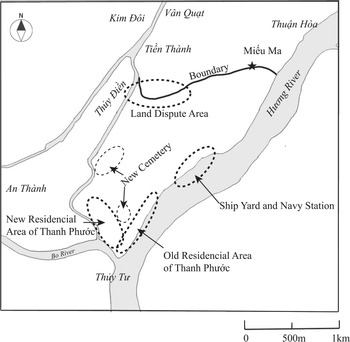
Details of agricultural development in Thanh Phước in the sixteenth and early seventeenth centuries are unknown due to a lack of historical documents.Footnote 19 However, there are some details about the mid-seventeenth century and beyond, because the village documents from Thanh Phước, particularly those deposited in the communal hall, include some related to land cadastres under the Nguyễn lords and the Nguyễn dynasty. The land cadastre edited in 1669 (DTP12), which is the oldest document in the village, is examined first. Regarding the village's agricultural development, the beginning of this cadastre has an important sentence: ‘In the former land cadastre, 260 mẫu 9 sào 6 thước. From this year, an additional registration of 111 mẫu 7 sào 9 thước [of public rice fields] and 58 mẫu 5 sào 3 thước of public land’. This document shows that about 170 mẫuFootnote 20 of rice fields and land had been developed since the compilation of the previous land cadastre, and these newly cultivated fields were first registered in 1669. Around the same time, according to lawsuit documents filed in 1703 and 1718 (DTP107) in a land dispute with the village of Tiền Thành to the northwest, Thanh Phước struggled to claim the small land units (xứ đồng) called Hào Cung, Thành Hào and Cồn Gia Lâm around its present northwest boundary (see map 2). Furthermore, the land cadastre in 1669 (DTP12) registered a small land unit called Miếu Bàn Ma, probably near Miếu Ma (Ma Temple) on the northern border with the village of Thuận Hòa. These facts show that at least by the 1660s, the expansion of cultivated land around Thanh Phước had already reached its limits.Footnote 21
Land Reclamation in Thanh Phước Village

Furthermore, according to a lawsuit document (DTP107), officials under the Nguyễn lords investigating documentary evidence referred to Tiền Thành's land cadastre of the Thịnh Đức era (1653–58) and the Cảnh Trị era (1663–71). ‘The former land cadastre’ referenced in the Thanh Phước's land cadastre (DTP12) likely was a cadastre revised in the Thịnh Đức era.Footnote 22 These facts indicate that Thanh Phước rapidly expanded its cultivated land by reclaiming vacant land between settlements during the 1650s and 1660s, bringing its cultivated areas into contact with the land of surrounding villages.Footnote 23 Such a rapid expansion of cultivated areas caused frequent land disputes between settlements, and a crucial need for new boundaries and boundary control.
No historical documents from Thanh Phước suggest further expansion of cultivated areas after the 1650s and 1660s. The land cadastre of 1732 (DTP100) and the land cadastres of the Tây Sơn period (DTP56; DTP58) were only transcribed from the land cadastre of 1669 (DTP12). The Nguyễn dynasty conducted the first land survey in about 150 years. In the land cadastre of 1814 (DTP72), the cultivated land was more fragmented and generally upgraded, but there was no significant change in the total area under cultivation.Footnote 24
However, documents from the Nguyễn dynasty indicate significant changes in the village space. In a document submitted to Hương Trà district in 1850 (DTP18), Thanh Phước reported conversions of land use in the 1814 land cadastre:
Our village checked the land cadastre of the Gia Long era [the land cadastre of 1814] and found that some parts of public rice fields were diverted to a residential area and cemetery. Currently, we are dealing with a note on the land cadastre that these lands were diverted to house sites, a village communal hall, a market and a cemetery, but these land taxes are collected as rice field [taxes].
After this report, about 24 mẫu of the converted lands were enumerated,Footnote 25 and the village's land taxes were slightly reduced. The report of 1850 (DTP18) indicates that after the 1814 land cadastre, the village's increasing population prompted expansion of the residential area.
This rapid population growth was due to the construction of a naval base and the related development of a shipbuilding industry in the village. According to a study by Trần Đức Anh Sơn, Thanh Phước was one of three naval bases serving the defence of the capital Huế and hosted a huge shipbuilding yard during the Nguyễn dynasty, but this shipbuilding industry declined from the late nineteenth century with the rise of Western-style steamships.Footnote 26 His study is also supported by an 1888 petition document (DTP7), according to which, about 8 mẫu of the shipbuilding yard and naval base constructed on the Hương River in the village in 1832 were abandoned around 1885. For three years, the villagers tried to reclaim these sites but could not restore them to good quality rice fields. As a result of the petition, the Nguyễn administration reduced the land taxes for the site of the former military installations. Considering these documents, it seems that the expansion of the residential area and the cemetery after the 1814 land cadastre was primarily due to the construction of Nguyễn dynasty military installations.Footnote 27 Thus, although the expansion of the cultivated lands of Thanh Phước had reached its limits by the second half of the seventeenth century, there was another population inflow in the nineteenth century.
Furthermore, the document on the revision of the land cadastre in 1850 (DTP18) mentioned that in Thượng Mũi Cồn, the ‘current state is an area of gardens, houses, a village communal hall and a market, where land taxes are collected as rice field [taxes]’. It means that this area had recently become a residential area with a village communal hall. Today, the communal hall is on the banks of the Hương River (in the old residential area of map 2). However, according to villagers, this communal hall was once beside the village temple (Hồng Phúc Tự, in the new residential area), which accords with this document. Given that this area was transformed from rice fields into a residential area between 1814 and 1850, it is highly possible that this was when the village communal hall was constructed in the new area.
The Thanh Phước documents include a type of accounting book called mãi hành bộ (買行簿), which recorded the expenditures of common funds in joint investments by the village and kinship groups. The oldest accounting book related to the village communal hall refers to repairs in 1873 (DTP111), but no accounting books related to its construction have been found. However, the DTP documents include documents on the establishment of common rice fields supporting the village communal hall in 1836 (DTP64) and village regulations called hương ước edited in 1837 (DTP67).Footnote 28 These facts indicate that Thượng Mũi Cồn was converted from rice fields to a residential area in the 1830s, and the communal hall was constructed in the new residential area at the same time. If the village communal hall in Thanh Phước was constructed in the 1830s, its repairs in 1873 (DTP111) are appropriate.Footnote 29
Some speculations can be drawn from the generalisation of this transformation of Thanh Phước. The village was established by Kinh migrants following Lê Thánh Tông's Champa expedition in the 1490s. It is highly possible that the village was established as part of a postwar resettlement and migration policy. The situation later in the sixteenth century is unclear due to the lack of data, but the expansion of rice fields might have been resumed after Nguyễn Hoàng's transfer to Central Vietnam, and by the end of the seventeenth century, the expansion of the cultivated area had almost reached its limit. Consequently, boundary disputes with neighbouring villages arose in the early eighteenth century. In the nineteenth century, Thanh Phước became a military base under the Nguyễn dynasty, which spurred a fresh population inflow and the construction of the village communal hall around the 1830s. The next section explores how these changes were reflected in the composition of the village community and kinship groups.
Formation of branches of the first settled lineages
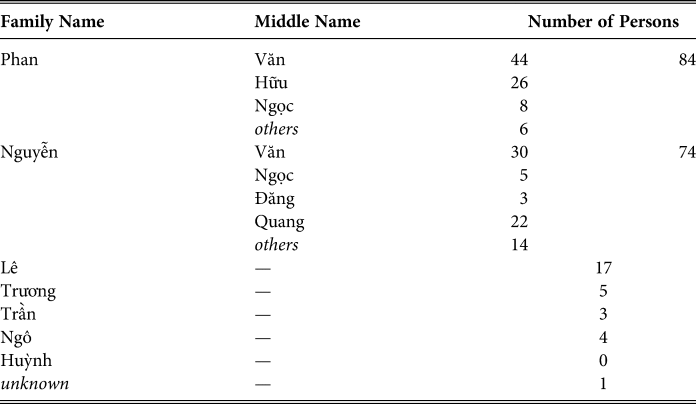
The previous section examined agricultural development and population inflows from the establishment of Thanh Phước through to the nineteenth century. This section explores the transformation of the village community and kinship groups against this social background. Thanh Phước was settled by Phan Niêm in 1473 (TP Phan Hữu 2), and the first settlers belonged to seven kinship groups: Phan (潘), Nguyễn (阮), Lê (黎), Trương (張), Trần (陳), Ngô (呉) and Huỳnh (黃). These seven kinship groups are called the họ khai canh (first settled lineages) or thất tộc (seven families) in Thanh Phước today. However, excluding Phan Niêm, there is no information about the first settlers of the other six lineages. The population composition of the village before the eighteenth century is also unclear, but it is recorded in the population registers of the Tây Sơn and the Nguyễn dynasty from the late eighteenth century. For example, the population register in 1786 (DTP45) showed the male population composition (table 1). It is immediately clear that the population of Thanh Phước was primarily composed of the Phan, Nguyễn and Lê lineages, as persons with those three family names accounted for 93 per cent of the male population.
Population composition and family names in 1786

Source: The population register in 1786 (DTP45), Thanh Phước village.
In village legend, the Huỳnh were also among the first settlers, but this lineage had already disappeared by the end of the eighteenth century. This accelerating trend of the dominance of the three lineages is shown in the 1890 population register (DTP14). Outside the Phan, Nguyễn and Lê lineages, there was only one person of Trần lineage, and the Trương and Ngô lineages had also disappeared from the population register. Neither population register in 1786 (DTP45) and in 1890 (DTP14) had any person with a family name other than the first settled lineages. These facts show that the membership of the village community was substantially monopolised by the descendants of the first settlers, primarily the Phan, Nguyễn and Lê, and this tendency became stronger over time.Footnote 30 Even today, these three lineages make up the majority of the population in Thanh Phước, and the two larger lineages of Phan and Nguyễn are divided into branches. The Phan lineage has three branches (chi 枝): Phan Hữu, Phan Văn and Phan Ngọc. The Nguyễn lineage has four branches: Nguyễn Ngọc, Nguyễn Đăng, Nguyễn Văn and Nguyễn Quang. In addition, each branch is usually divided into sects (phái 派) such as the first sect and the second sect. Thus, the Phan and Nguyên lineages have three layers, for instance, Phan lineage — Phan Hữu branch — the first sect.
Although the membership of the village community was dominated by the first settled lineages, particularly the Phan, Nguyên and Lê, Thanh Phước experienced a population inflow during and after the nineteenth century, as mentioned. How the village community and the kinship groups of Thanh Phước dealt with the new migrants, therefore, should be considered. However, in the family genealogies (or genealogical documents) of Thanh Phước, villagers generally wrote their ancestors’ names, but paid less attention to sorting their ancestors by generation and recording genealogical relationships.Footnote 31 This article, therefore, adds missing information about the treatment of immigrants obtained from the author interviews.
First, the Phan and Nguyễn lineages exhibit many unclear points in their divisions and ages. For example, for the Nguyễn Ngọc branch, considered to be the oldest and most senior, the first family genealogy (TP Nguyễn Ngọc 24) was edited in 1719. This branch repeatedly compiled its genealogy, from the second edition in 1765 (TP Nguyễn Ngọc 2) to the sixth edition in 1954 (TP Nguyễn Ngọc 6). However, the date of the division of the Nguyễn lineage into this branch is obscure as the counting of the generations in each successive genealogy has been artificially manipulated. It can only be established that the Phan and Nguyễn lineages had already divided into branches by the second half of the eighteenth century.
The process and reasons for the division of these two lineages are also obscure. However, Miyazawa Chihiro reported the practice of changing middle names, tên đệm, in a kinship group in the Red River Delta.Footnote 32 According to his report, part of the kinship group changed their middle names to facilitate marriages in the same village without violating the Confucian taboo on marriage within the same lineage. In the case of Thanh Phước, members of the Phan and Nguyễn branches were strongly aware that they were part of the same lineage, but marriages between members of branches were permissible as the division of the branches occurred a long time ago. In other words, middle names were changed to allow for the convenience of marriages between persons in the same lineage in the village.Footnote 33 The genealogy of the Nguyễn Văn branch in 1901 (TP Ngyuễn Văn 1) included wives’ birthplaces. According to this register, the 54 females who married the Nguyễn Văn branch's males from the second half of the eighteenth century to the last half of the nineteenth century included 22 females with the family name Nguyễn.Footnote 34 Of those 22 Nguyễn females, only 2 came from outside Thanh Phước. This fact indicates that marriages between males of the Nguyễn Văn branch and females of other Nguyễn branches were very common in the village, and distinguishing tên đệm served to facilitate marriages between villagers.
It can be said that the membership of Thanh Phước was monopolised by the first settled lineages, which acted as a kind of territorial connection group through intermarriage within the village. However, this tendency does not mean that the villagers never married outsiders. The expansion of Thanh Phước's cultivated lands in the seventeenth century was accompanied by a population inflow, and during the nineteenth century, the population increased again due to the setting up of military facilities. In fact, some documents on the first settled kinship groups contain some traces of migrant inflow. The outline of the treatment of newcomers in these documents was complemented with information obtained from interviews with present-day lineage sect chiefs.
Case 1: Sect 5, Phan Hữu Branch
The chief of sect 5 has a family genealogy in the Vũ Văn lineage (武文族) edited in 1985 (TP Phái thứ 5, Phan Hữu). According to the sect chief, its founder was from Quảng Ngãi province, served in the navy during the Nguyễn dynasty and married a female of the Phan Hữu branch. He was later adopted into the Phan Hữu branch and founded his sect in it. In the family genealogy, the sect founder named Vũ Văn Chi from An Phú village in Quảng Ngãi province married Phan Thị Đạo. The sect chief's testimony and the family genealogy thus correspond. According to the sect chief, sect 5 has its own anniversary on the founder's death anniversary on 30 June (lunar calendar), separate from the Phan Hữu branch's founder's day. Vũ Văn Chi died in Thanh Phước, but his tomb is in his home village, while his wife Phan Thị Đạo's tomb is in Thanh Phước.
Case 2: Sects 3 and 4, Nguyễn Đăng Branch
According to the chiefs of sect 1 and sect 2, the present Nguyễn Đăng branch has four sects but the founders of two (sect 3 and sect 4) were female. The founder of sect 3 was Nguyễn Thị Lịch, whose husband was Lê Văn Lục from Thanh Hóa province. The founder of sect 4 was Nguyễn Thị Yên, whose husband is unknown. The chiefs speculated that she was the concubine of a military man, but there is no evidence for this.
Case 3: Huỳnh Lineage (attempted adoption)
Huỳnh was one of the first settled lineages, but it disappeared before the nineteenth century, as mentioned. The Huỳnh lineage in this case is not part of the original seven, but founded by a migrant in the late nineteenth century. According to its chief who was born in 1935, his grandfather Huỳnh Huế came from Nam Định province as a marine in the navy and married Phan Thị Thanh, who was of the Phan Văn branch. His son Huỳnh Vui married Phan Thị Cháu, who was of the Phan Văn branch. The lineage chief applied for adoption into the Phan Văn branch based on their blood ties over two generations, but this did not take place due to the confusion of war. After the reunification of North and South Vietnam, he did not try again because the privileges of those from the first settled lineages had disappeared.
These three cases show some features of migration and its impact on Thanh Phước society. First, the migration recorded in the field survey occurred after the nineteenth century, and most migrants were ex-navy men from Quảng Ngãi and Quang Nam provinces attached to the military base built in the nineteenth century. Second, the kinship group did not adhere to the strict Confucian principles regarding the social status of women, as evident in case 2 where the sect founder was a woman. This probably was closely related to the fact that most newcomers in the nineteenth century were men from the navy, and it can be assumed that in some situations, those who had married Thanh Phước women were transferred to other military bases or returned to their home villages after retirement, leaving behind their wives and children in Thanh Phước. On the contrary, in case 3, the ex-seaman did not return to his home village but settled in Thanh Phước. Third, community membership in Thanh Phước was limited to those belonging to the first settled lineages, so newcomers who wanted to obtain membership had to marry females from these lineages. However, such marriages did not guarantee adoption into the wives̀ lineages. Newcomers and their descendants usually needed to marry into a particular kinship group over several generations to be adopted into the maternal kinship group.
Insights from these interviews enable us to better understand how migration affected village composition as recorded in the Thanh Phước documents. For example, the Nguyễn Đăng branch has an adoption application document (TP Nguyễn Đăng 1) from 1887 in which Nguyễn Văn Gà and two other men sought adoption into the Nguyễn Đăng branch. According to this document, their grandfather Trần Hạng had married a female of the Nguyễn Đăng branch. Given case 1, it is probable that Trần Hạng and his sons had also married females in this branch over two generations. The grandsons then applied for adoption into their maternal kinship group. If this adoption was approved, they would found a new sect in the Nguyễn Đăng branch, as in case 1.Footnote 35
In addition, the present Nguyễn Ngọc branch has six family genealogies, the earliest dating from 1719. In the Thanh Phước genealogies, branch members were commonly listed in male and female name sections. However, in the genealogy edited in 1798 (TP Nguyễn Ngọc 25), two female names, Nguyễn Thị Mả (阮氏 ) and Nguyễn Thị Lội (阮氏
 ), were listed in the male section. The preceding family genealogy edited in 1765 (TP Nguyễn Ngọc 2) did not include these two female names, so the women must have died sometime between 1765 to 1798, and their names were recorded in the new family genealogy in 1798. Given case 2, it may be proposed that these two females had married newcomers, and for the sake of convenience, the family genealogy in 1798 recorded the wives’ names in the male section as sect founders. However, in the later genealogy edited in 1860 (TP Nguyễn Ngọc 5), the two female names disappeared. This disappearance is obviously not a transcription error, but an intentional deletion as the preceding and subsequent male names are perfectly transcribed from the preceding genealogy. This change indicates that a kind of strict Confucian distinction between male and female was adopted in the nineteenth century.
In the genealogies of the Nguyễn Đăng branch, a male name from another family — adopted person Lê Văn Lục (附族黎文綠) — was added to the male section in the genealogies from 1856 (TP Nguyễn Đăng 5) and 1887 (TP Nguyễn Đăng 6). This male, Lê Văn Lục, is definitely the husband of sect founder Nguyễn Thị Lịch noted in case 2. Thus, when part of the Nguyễn Đăng branch was subdivided into a sect through one woman's marriage with a newcomer in the nineteenth century, his name was recorded in the male section with the label of ‘adopted person’. The Nguyễn Đăng branch's family genealogies in the nineteenth century also show a tendency toward strict Confucian distinctions between men and women as in the Nguyễn Ngọc branch's nineteenth-century genealogies. Overall, genealogies edited in and after the nineteenth century display stronger gender distinctions than the earlier ones.
To sum up, examination of the population registers and family genealogies in Thanh Phước village documents show that male newcomers often formed new sects in the first settled lineages through marriage. However, members of the first settled lineages retained their dominance of the village community. Thus, a newcomer who wanted to obtain village membership had to marry a female in a first settled lineage and become a member through adoption into the wifès kinship group.Footnote 36 This process usually took several generations, so acquiring village membership demanded overcoming great difficulties. In the nineteenth century, Thanh Phước thus substantially limited its membership by strictly applying patrilineal kinship requirements. In contrast, during the eighteenth century, the first settled lineages were also essentially paternal kinship groups but the principle was applied quite flexibly. This difference indicates a transformation of kinship groups from the eighteenth century to the nineteenth century, which is examined in the next section.
Transformation of ancestral rituals in the first settled lineages
The previous section showed the gradual strengthening of the Confucian patrilineal kinship principle during the nineteenth century. This section examines the ancestral ritual, which is essential in Confucianism. In the village documents, the practice of ancestral worship by the first settled lineages can be traced to at least the early eighteenth century. For example, the oldest family genealogy of the Nguyễn Ngọc branch (TP Nguyễn Ngọc 24), the most senior branch of the Nguyễn lineage, was edited in 1719 and recorded the practice of the ancestral ritual. For the Phan Hữu branch, the most senior branch of the Phan lineage, the oldest existing family genealogy was edited in 1777, but a mortuary tablet of the lineage founder Phan Niêm seems to have been made in the first half of the eighteenth century. These facts indicate that Confucian ancestral rites were already being practised from at least the early eighteenth century.
However, according to the village genealogies, the ancestral ritual of the first settled lineages was mixed with many un-Confucian elements in the eighteenth century. For example, the first part of the oldest genealogy of the Nguyễn Ngọc branch (TP Nguyễn Ngọc 24) described their ancestor worship rites. First, the villagers set up an open-air altar called the ‘Altar to Express Gratitude for Lôi Công (God of Thunder), Lift Mourning and Pray for the Peace of the Gods’ (雷公 謝兼解除重喪神熬
 安
 壇). Next, the villagers invited a Daoist priest to conduct the ritual and recite a Daoist sutra for the souls of their ancestors to ascend to Xian (Tiên 僊). Furthermore, the date of the ancestral ritual was not on the lineage founder's death day, but decided by divination. Based on the family genealogies in this village, the Phan and Nguyễn lineages both seem to have practised the ancestral ritual in mid-June of the lunar calendar.Footnote 37 The ritual thus did not strictly mark the anniversary of the lineage's founder, but derived from the Daoist and Buddhist Hungry Ghost Festival.
Considering these facts, the subjects of the ritual undoubtedly were the founder and ancestors of the kinship group, but the style of prayer was Daoist and Buddhist. According to Onishi Kazuhiko, in eighteenth-century Vietnam, Daoism had a strong social influence on the common people, so Buddhist priests often called themselves Daoist and practised Daoist rituals, and the Confucian school entrance ritual also adopted Daoism.Footnote 38 Onishi also examined Thanh Phước and found that the village's Buddhist temple featured a statue of a Daoist god from the eighteenth century.Footnote 39 The practice of the ancestral ritual in Thanh Phước during the eighteenth century reflected this religious mixture of Confucianism, Buddhism and Daoism. The later family genealogies edited in 1765 (TP Nguyễn Ngọc 2) and 1798 (TP Nguyễn Ngọc 25) contained the same ancestral rites as described in the preceding family genealogy in 1719. The ritual consisting of an open-air altar, the Daoist priest's participation and the Daoist sutra recitation seems to have continued throughout the eighteenth century. These genealogies show that during the eighteenth century, the religious practices of the common people around Huế mixed these three religions, and the influence of Daoism was especially strong.Footnote 40
In contrast, the practices recorded in nineteenth-century genealogies seem more Confucian. For example, the 1860 family genealogy of the Nguyễn Ngọc branch (TP Nguyễn Ngọc 2) included a typical Confucian statement stressing the bloodline between ancestors and descendants: ‘Just as trees have roots and rivers have sources, it is the ancestral grave that is around us. We, therefore, cherish our ancestors here.’ The latter part of the family genealogy remained similar to the Hungry Ghost Festival, while the descriptions of the construction of the open-air altar and the Daoist priest's participation had disappeared. Overall, the nineteenth century ancestor rituals retained some traces of Daoism, but the descriptions were transformed into a Confucian style.
The Phan Hữu branch, the senior Phan lineage, is considered next. The oldest genealogy of this branch, edited in 1777 (TP Phan Hữu 1), had features falling between those of the genealogies of the eighteenth and the nineteenth centuries. The introduction of the Phan Hữu genealogy edited in 1777 (TP Phan Hữu 1) was almost the same as the 1869 genealogy of the Nguyễn Ngọc branch (TP Nguyễn Ngọc 2). The later family genealogy (TP Nguyễn Ngọc 2) probably was transcribed from the earlier family genealogy or used the same manual. However, the latter part of the Phan Hữu genealogy edited in 1777 (TP Phan Hữu 1) described the ancestral ritual as consisting of the open-air altar to Lôi Công (God of Thunder), the Daoist priest's participation and the Daoist sutra recitation. It seems that the Phan Hữu ancestral ritual was almost the same as that of the Nguyễn Ngọc branch in the eighteenth century. The 1869 family genealogy of the Nguyễn Ngọc branch (TP Nguyễn Ngọc 2) obviously imitated the beginning of the 1777 family genealogy of the Phan Hữu branch (TP Phan Hữu 1), without the Daoist-influenced latter half.
What do these transformations in the rituals described in the genealogies from the eighteenth century to the nineteenth century mean? Consider the grave worship in present-day Thanh Phước observed by Suenari Michio.Footnote 41 According to his report, grave visiting is practised in the twelfth month of the lunar calendar. The day before the grave visit, the kinship groups gather and bow to the altar with their chief in the ancestral hall. The next day, they go to the cemetery, clean their ancestors’ tombs and cut the surrounding grass, and then one elder bows in front of the founder's tomb. At this point, only bowing is necessary, offerings are not required, and an altar is not constructed. Later, members of the kinship group return to the ancestral hall, offer food at the ancestral altar and bow to the founder and their ancestors. In the afternoon, they gather at the ancestral hall again and hold a banquet with the food offerings for the souls of their ancestors. In Suenari's report, the worshipping of ancestors at the tomb and the cemetery are simple, probably because most kinship groups in Thanh Phước have their own ancestral halls. They formally offer food and bow in their ancestral hall, so the offerings and ceremonies in the cemetery may be simple. The ceremony at the ancestral hall thus is the main venue for offerings to ancestors.
Suenari reported grave visiting in the twelfth lunar-month, but the ceremony for the founder was in the sixth lunar-month. However, the family genealogies also described holding banquets of offered foods for the souls of ancestors, so it can be supposed that the pre-modern order of the ancestral ritual was similar. This assumption can help explain the difference between the eighteenth and nineteenth century genealogies. The disappearance of the open-air altar probably was due to the construction of ancestral halls. In fact, the Nguyễn Ngọc branch bought land for their ancestral hall in 1826 (TP Nguyễn Ngọc 20), so it would have been built by around 1830.Footnote 42 The construction date of the Phan Hữu ancestral hall is unknown from the documents, but in this branch's present ancestral hall, a tablet with the name ‘Hiển Thừa Từ (顕承祠)’ hanging on the altar, was made in 1850. The Phan Hữu branch seems to have also constructed its ancestral hall in the first half of the nineteenth century.
The construction of ancestral halls likely brought about significant changes in the religious practices of kinship groups. Before the construction of ancestral halls with their permanent altars, villagers had to set up temporary, open-air altars each time they wanted to perform ancestral rites. Subsequently, the open-air ceremony was gradually simplified, and the centre of the ritual transferred to the ancestral hall. The ancestral hall thus not only entailed a shift in the location of the ceremony, but also greatly influenced the earlier religious mixing of Confucianism, Buddhism and Daoism. Confucianism's superiority as reflected in the nineteenth-century family genealogies seems to have resulted from the construction of the Confucian-style ancestral halls.
Overall, parallel to the strengthening of the Confucian patrilineal principle in the recognition of bloodlines and relatives in Thanh Phước, the first settled lineages built ancestral halls as places for performing ancestral rituals, which changed religious practices. Next, we look at how the first settled lineages managed the village land and obtained their own funds.
Common property in the first settled lineages
This section examines the formation of common property among the first settled lineages. In addition to the ancestral hall, common rice fields represented the shared property of a kinship group. As the ancestral hall hosted meetings and various rituals as the centre for management of the kinship group, the earnings from some common rice fields financially supported the ancestral hall. Today, Thanh Phước has no common rice fields belonging to kinship groups, but before the unification of North and South Vietnam, various common rice fields could be classified according to criteria such as their owners, purposes and origins. Kinship groups owned at least 30 mẫu of common rice fields. According to the chief of the Nguyễn Ngọc branch, these common rice fields were classified into three types by their origin. The first were rice fields of kinship groups purchased by a joint fund with contributions from all group members. The second were rice fields donated by specific persons to fund religious services in the ancestral hall after their death. These two types were not unusual, and the Red River Delta has many inscriptions for such donations after the seventeenth century.Footnote 43 The third were common rice fields called bán công bán tư (半公半私, half-public, half-private).Footnote 44 According to the elder chief of the Nguyễn Ngọc branch, these rice fields were purchased from the village of Thanh Phước during the reign of Gia Long (1802–19), and only the Phan, Nguyễn and Lê lineages and their branches and sects held them. This type of common rice field emerges in a group of contracts for land sales dated the 26th day of the tenth lunar-month, 1813.
A contract document in the village communal hall (DTP27) provides the most detail about the sale process and contract contents for bán công bán tư. According to this contract, the land sales process was as follows. In 1812, Thanh Phước sold cultivation rights to a 15 mẫu public rice field, with a repurchase rider, to a person named Tích (積; unknown family name).Footnote 45 In the third lunar-month of 1813, Thanh Phước requested to repurchase the field based on the rider, but Tích did not accept the request. In the ninth lunar-month, the village made another repurchase offer that Tích accepted.Footnote 46 However, Thanh Phước could not raise the money for the repurchase itself, so each kinship group collected money from its members and gave the funds to the village. After repurchasing the cultivation rights to the public rice field, Thanh Phước re-sold them to the kinship groups as compensation for their funds and allowed the groups to manage it as common rice fields under a land sales contract (DTP27) dated the 26th day of the tenth lunar-month 1813. At the same time, Thanh Phước village officials and the purchasers established some management regulations such as prohibiting the alienation of cultivation rights to maternal relatives. This regulation would prevent the purchasers from losing their common rice field through the transfer of cultivation rights to maternal relatives, and indicated that those who drew up this regulation recognised the purchasers as a paternal kinship group.
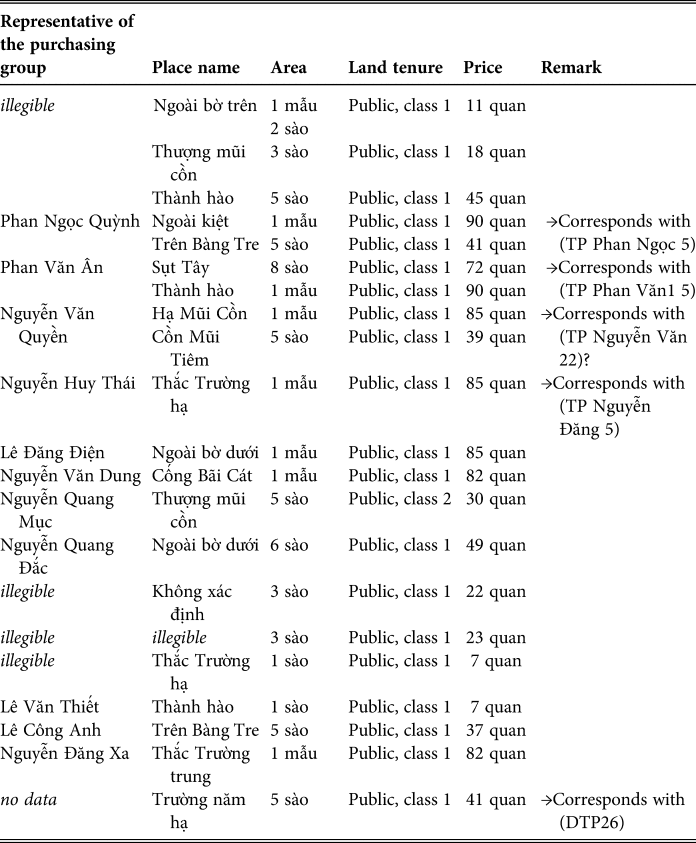
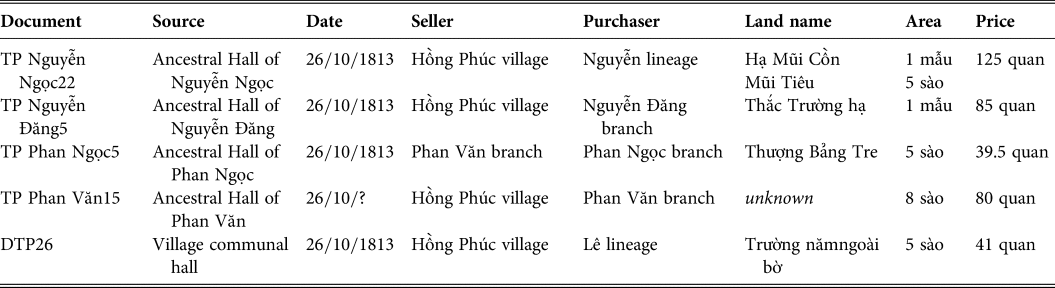
Against the background of this contractual process and land regulations, table 2 presents a list of rice field purchases with the names of about 90 signed purchasers. As shown in table 2, the total area of land purchased in 26th day of the tenth lunar-month 1813 as common rice fields were about 15 mẫu. As mentioned, the total area of common rice fields before the unification was around 30 mẫu, so common rice fields set up under contracts in 1813 accounted for about half of this total area. Furthermore, the average price per mẫu in the contract (DTP27) was around 100 quan, considerably less expensive than other land contracts in the village.Footnote 47 The documents of kinship groups also include many contracts for land sales dated the 26th day of the tenth lunar-month 1813 that correspond to this contract (DTP27) (see table 3). When comparing tables 2 and 3, for example, the contracts of land purchases by the Nguyễn Ngọc branch (TP Nguyễn Ngọc 22) and Nguyễn Văn Quyền and his kin (in DTP27) are similar. In addition, Phan Ngọc Quýnh and his kin purchased two pieces of land under a contract (DTP27) and then resold one piece of land to the Phan Ngọc branch under another contract (TP Phan Ngọc 5). It is assumed that after purchasing the cultivation rights to two pieces of land, the Phan lineage resold a part of them to its own branches. Through such resales, the major branches and sects of the first settled lineages owned these common rice fields.
Land sales in contract DTP27

Contracts for land sales, 26 Oct. 1813

One sentence at the end of a contract (DTP27) is important for understanding the characteristics of the common rice fields called bán công bán tư (half public, half private): ‘and made an agreement that each kinship group will follow the regulations of the village concerning taxes’ (又交如租税, 各族本社例). Understanding the meaning of this sentence requires considering the social background. According to the land cadastres, all the rice fields in Thanh Phước initially were public rice fields, with no private rice fields. As noted in earlier studies, the Lê and Nguyễn dynasties laid down national regulations requiring that public rice fields be distributed to villagers according to individual status and age.Footnote 48 However, it was impossible to update the land cadastre and population register every year in the pre-modern period, so a census was only carried out when there was a change of government, and the distribution of public rice fields was substantially entrusted to individual villages.Footnote 49
Political instability in the late eighteenth century accelerated this trend. From the rise of the Tây Sơn to the unification of Vietnam under the Nguyễn dynasty, the governance of Huế repeatedly shifted among the Nguyễn lords, Trịnh lords, Tây Sơn and Nguyễn dynasty over 20 years. When the Trịnh lords seized Huế from the Nguyễn lords by taking advantage of the rise of the Tây Sơn, Lê Quý Đôn, the vice-commandant in the Trịnh lords’ expeditionary force, wrote about the social situation in 1776. According to him, the Huế area did not have sufficient cultivated land for its population and imported rice from the south in the second half of the eighteenth century. However, rice and rice field prices in Huế soared due to stagnant rice imports when the Tây Sơn were in power in the south. Land became an excessively traded item, and people were forced to buy back land they had sold years or decades earlier.Footnote 50
In 1776, to calm this situation, the Trịnh government issued legislation on public rice fields involved in the revitalisation of the land trade.Footnote 51 According to this, despite a prohibition on commercial transactions, public rice fields could be traded in two ways. The first method was falsification of land cadastres by classifying public rice fields as private rice fields. In addition to this illegal method, another trading method occupied a grey area: rental of cultivation rights. From the legal viewpoint, public rice fields were state-owned, and villages were only entrusted with their management. Therefore, villages could not sell public rice field to others without state permission. That is, the transfer of ownership of public rice fields was prohibited. However, in fact, the villagers who received public rice fields did not cultivate it themselves, but could rent out their cultivation rights to others. The rental periods were often too long, and renting cultivators often continued to grow crops without being evicted even when the lender required return of the rights. This caused a shortage of public rice fields so that villages could not distribute them to villagers. The Trịnh lords ordered that lenders return half of the rental fee to confirmed renting cultivators when evicting them. At the same time, the government also prohibited long-term rental of cultivation rights from them on.Footnote 52
In the late eighteenth century, the land trade around Huế was revitalised, and public rice fields became involved in a form of rental of cultivation rights or land sales with repossession riders that became widespread due to the prohibition on trading public rice fields. The case of Thanh Phước, Tích and the first settled lineages reflected this situation. However, the Nguyễn dynasty's national regulations did not allow rice field distribution to kinship groups as cultivation rights to public rice fields were supposed to be distributed according to individuals’ social status and age, and returned to the state (substantially, the village) after death. The distribution of public rice field cultivation rights by a village to kinship groups would mean to allow semi-permanent cultivation until the entire lineage had died out. Thus, while from the perspective of national land tenure, the common rice fields called bán công bán tư were public rice fields, but in practice, kinship groups privately owned the cultivation rights. Thus, the kinship groups with common rice fields had to pay land taxes on the public rice fields.Footnote 53
Overall, the economic foundations of Thanh Phước's first settled lineages were formed through the privatisation of public rice fields in the context of the commercialisation of cultivation rights to public rice fields around Huế. Considering the first settled lineages’ monopoly on village membership, it can be said that these lineages arbitrarily operated the public rice fields in Thanh Phước. The construction of ancestral halls and the Confucianisation of religious practices by the first settled lineages were based on these economic foundations in the early nineteenth century.
Conclusion
This article has traced the transformation of Thanh Phước from the seventeenth to the nineteenth centuries, focusing on the first settled lineages and their relationships with newcomers. Thanh Phước was settled by migrants after Lê Tánh Tông's expedition and rapidly developed under the Nguyễn lords in the seventeenth century. Agricultural development in the village reached its limits by the early eighteenth century, spurring several land disputes with surrounding villages. That Thanh Phước's oldest documents are mainly related to land disputes in this period suggests that the shared benefits of the villagers enabled the establishment of a strong community. At the same time, reaching the limits of agricultural development in the village space transformed it from a loosely structured, open, migrant society into a closed and exclusive community. This shift is most clearly seen in the practice of patrilineal kinship by the first settled lineages. Although they were already a kind of patrilineal kinship group in the eighteenth century, the application of this principle was quite flexible depending on the situation. Probably this is because, in the pioneering society with a scarcity of labour, matrilocal residence enabled the addition and adoption of newcomers. However, after the nineteenth century, the first settled lineages strictly applied the patrilineal kinship principle, making it difficult for newcomers to become members of the village community. These same first settled lineages also formed their common rice fields through occupying and renting out the village's public rice fields, proceeds from which supported the construction of ancestral halls during the nineteenth century. This, in turn, affected the first lineages’ religious practices and led to the expansion of Confucianism in the village.
Thus, after reaching the limits of land development, Thanh Phước tended to protect the vested interests of the first settled lineages by increasing the entry barriers for migrants, gradually closing the village space. These facts suggest that the establishment of various social groups with closed and fixed membership and the spread of Confucianism among the common people in early modern Vietnam were complementary social phenomena. Notably, the village community, which was a kind of territorial group, restricted its membership based on the Confucian patrilineal kinship principle, which was a kind of blood relationship. This complex of village community and kinship group could explain the aspect of territorially-connected group of the present paternal kinship group called dòng họ. Newcomers had to be adopted by one the first settled lineages to obtain village membership, requiring that they formally sever their relationships with their native places and kinship groups. Assuming that the first residents required similar steps for newcomers to protect their vested interests in each other's villages, kinship groups naturally tended to become village units even if there was migration among the villages. Consequently, village communities called làng, which mixed territorial and blood bonds, were widely established. These social transformations established ‘traditional society’ in early modern Vietnam.
Finally, the historical positioning of early modern Vietnam is considered from a broad perspective. From a macro point of view, we can grasp the transformation of the village space in Thanh Phước as a transition from a loose social structure with land surplus and a population shortage to a small peasant society with a land shortage and overpopulation. In this process, Confucianism played an important role in the establishment of local social groups. This long-term social change around the Huế area had much in common with early modern small peasant societies in East Asia, where the stagnation of agriculture and the popularisation of Confucianism progressed in a complementary manner from the seventeenth century.Footnote 54 However, this article has mainly focused on kinship groups and the village community, so the family structure in early modern Vietnam could not be fully considered. Moreover, the present paternal kinship group called dòng họ among the Kinh people appears to have emerged after the multi-household compound once widely distributed throughout Southeast Asia declined, and Confucian patrilocal residence spread, but this topic will be addressed in another article.