





Background
The global epidemic of type 2 diabetes mellitus (T2DM) has reached alarming proportions, with the International Diabetes Federation estimating that 589 million adults (20–79 years) worldwide are affected as of 2025, a figure projected to increase further in the coming decades (International Diabetes Federation, 2025). Concurrently, cancer remains a leading cause of death globally, accounting for approximately 10 million deaths annually, with certain malignancies showing a notable association with T2DM (Bray et al., Reference Bray, Laversanne, Sung, Ferlay, Siegel, Soerjomataram and Jemal2024).
Accumulating epidemiological data suggest that individuals with T2DM face an increased risk of developing specific cancers, including pancreatic, liver, colorectal, breast, and prostate cancers (Giovannucci et al., Reference Giovannucci, Harlan, Archer, Bergenstal, Gapstur, Habel, Pollak, Regensteiner and Yee2010; Tomic et al., Reference Tomic, Shaw and Magliano2022). The pathophysiological links are complex and multifactorial, involving hyperinsulinemia, insulin-like growth factors (IGFs), chronic low-grade inflammation, oxidative stress, and shared lifestyle risk factors such as obesity and physical inactivity (Cignarelli et al., Reference Cignarelli, Genchi, Caruso, Natalicchio, Perrini, Laviola and Giorgino2018; Kotwal et al., Reference Kotwal, Cheung, Cromwell, Drincic, Leblebjian, Quandt, Rushakoff and McDonnell2021; Zhu and Qu, Reference Zhu and Qu2022). These mechanisms contribute to increased cellular proliferation and reduced apoptosis, fostering oncogenesis.
In Türkiye, the national prevalence of T2DM among adults has reached approximately 13.7%, posing a major public health challenge (Satman et al., Reference Satman, Omer, Tutuncu, Kalaca, Gedik, Dinccag, Karsidag, Genc, Telci, Canbaz, Turker, Yilmaz, Cakir and Tuomilehto2013). Simultaneously, national cancer registry data indicate high incidence rates of breast cancer in women and prostate and lung cancers in men within the middle-aged and elderly Turkish population (Arslan et al., Reference Arslan, Kiliçkap, Dede, Hayran, Erman, Çelik and Kutluk2011; Eser et al., Reference Eser, Örün, Hamavioğlu and Lofti2022). In primary care settings, where the majority of T2DM patients are managed, understanding the prevalence of concurrent cancer diagnoses and the associated risk factors is vital for early detection and improving patient outcomes. Among T2DM patients in Dutch primary care, it was shown that pre-diagnosis poor glycemic control may be associated with increased mortality in breast and colorectal cancer (de Haan-Du et al., Reference de Haan-Du, Groenier, Wauben-Spaetgens, Jalving, Kleefstra, Landman and de Bock2023). Several regional studies have reported varying rates of cancer prevalence among diabetic populations; for instance, in some European cohorts, the prevalence ranges from 10% to 20% (Gurney et al., Reference Gurney, Stanley, Teng, Krebs, Koea, Lao, Lawrenson, Meredith, Sika-Paotonu and Sarfati2022; Safadi et al., Reference Safadi, Balogh, Lám, Nagy and Belicza2024). However, data specific to Türkiye remain limited.
Furthermore, diabetes duration, glycemic control, and comorbidities such as obesity and hypertension influence cancer risk (Hendriks et al., Reference Hendriks, Schrijnders, van Hateren, Groenier, Siesling, Maas, Landman, Bilo and Kleefstra2018). Yet, the extent of these associations in primary care populations in Türkiye has not been fully elucidated. Clarifying these relationships can aid in developing targeted screening programmes, thereby potentially reducing cancer-related morbidity and mortality among diabetic patients.
Given these considerations, this study aims to evaluate the prevalence and types of diagnosed cancers in adult T2DM patients within a primary care setting in Türkiye, and to explore associated clinical and demographic factors, and specifically to examine cancer patterns in relation to T2DM duration. This evidence can subsequently inform public health strategies, screening guidelines, and personalized patient management approaches.
Methods
We used a descriptive, cross-sectional study design that is appropriate to reveal the prevalence of cancer diagnoses in adult patients with T2DM in an education-family health centre (EFHC).
The study was carried out at Marmara University School of Medicine, Department of Family Medicine Tuzla EFHC between 01.11.2022 and 30.04.2023, and data collection took place from 01.11.2022 to 31.12.2022. The study evaluated active registered electronic medical records spanning the preceding five years (2018–2022) to capture complete patient medical histories.
In the beginning of data collection, we identified patients with a principal diagnosis of T2DM, which corresponds to the diagnosis codes E11 (‘type 2 diabetes mellitus’) and E13 (‘other specified diabetes mellitus’) with their sub-categories according to International Statistical Classification of Diseases and Related Health Problems 10th Revision (ICD-10) in registered patient lists of Tuzla EFHC. To be eligible, patients with T2DM had to be over 18 years of age and had to have a cancer diagnosis, which corresponds to the diagnosis codes C (C00–C97; malignant neoplasms) according to ICD-10. The participants in the research were individuals with T2DM who had received a cancer diagnosis.
We collected
-
• the sociodemographic data of the participants, which are sex, age, height (in cms), weight (in kgs), body mass index (BMI) (was calculated), and smoking information;
-
• T2DM relevant data, which are date of T2DM diagnosis, duration of T2DM (was calculated according to relevant data collection date), and T2DM treatment (oral antidiabetics, insulin, or both);
-
• other health information, which are comorbidities and chronically used medicines other than T2DM treatment;
-
• and finally, cancer data, which are the type of cancer, date of cancer diagnosis, and duration of cancer (calculated as the time elapsed from initial diagnosis to the date of data collection).
BMI classification was performed as is:
-
• 18.5–24.9: normal range (group 1).
-
• 25.0–29.9: overweight (group 2).
-
• 30–39.9: obese (group 3).
-
• ≥40: morbid obese (group 4).
Data collection, missing data, and addressing potential bias
All 152 eligible patients with T2DM and cancer were contacted via telephone interviews to verify sociodemographic characteristics and clinical histories. Height and weight values were extracted from objective physical examination records documented during routine primary care consultations within the preceding six months. To minimize information and selection bias, self-reported data were cross-verified using the family medicine information system (computer recordkeeping system) and the national electronic health record repository. Variables with missing or unverified details (e.g., specific clinical staging and oncological treatment details) were excluded from secondary sub-analyses to maintain data integrity.
Rationale for diabetes duration analysis
Patients were classified according to the duration of T2DM to evaluate cumulative metabolic exposure. Long-standing T2DM is associated with prolonged exposure to hyperinsulinemia, chronic systemic inflammation, and advanced glycation end-products, which are hypothesized to accelerate carcinogenic pathways differently than early-stage T2DM.
The number of patients with T2DM and cancer diagnosis during the study period determined the sample size. Therefore, a sample size calculation was not performed.
We used IBM SPSS 21 software for statistical analyses. The distribution of data (normal or non-normal) was assessed with the One-Sample Kolmogorov–Smirnov test. For measures of central tendency and dispersion, the mean and standard deviation were used for continuous variables, while the median and min–max values were used for non-normal or non-parametric variables. Comparative analyses were performed using the chi-square test for categorical variables; student’s t-test for continuous variables, or the Mann–Whitney U test for non-normal continuous variables. The results were evaluated and reported within this data framework. The level of p, which denoted a statistically significant result, was <0.05.
Results
There were 442 patients registered to Tuzla EFHC who had T2DM at the beginning of data collection. The number of patients with T2DM and cancer was 152, which means that the prevalence of cancer in T2DM was 34.4% in Tuzla EFHC. Of the 152 patients with both T2DM and cancer, all of the patients were included in the study.
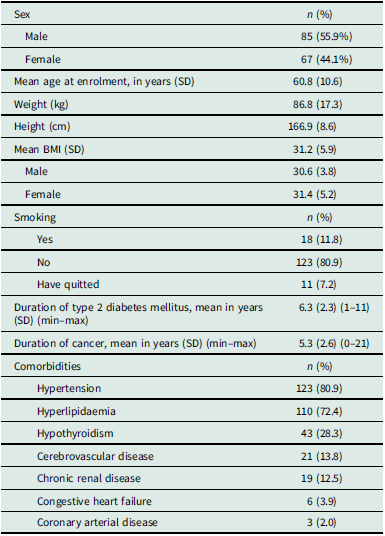
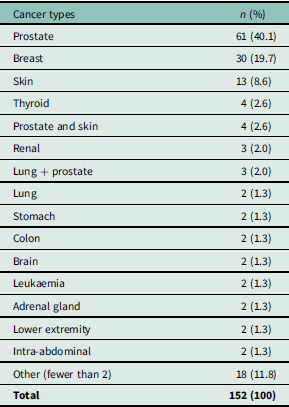
Of the 152 patients, 55.9% were male, and 44.1% were female. The mean age of the patients was 60 years. It was found that 11.8% of these patients were smokers and 53% were obese based on BMI data (Figure 1). The most common cancer types observed alongside T2DM were prostate (40.1%), breast (19.7%), and skin (8.6%). The three most common comorbidities were hypertension (68.4%), hyperlipidaemia (42.1%), and hyperthyroidism (15.8%) (Table 1).
Body mass index (BMI) distribution of patients with type 2 diabetes mellitus (T2DM).

Characteristics of the study base at enrolment

Table 1. Long description
A table summarizing characteristics of study participants at enrollment. The table has 15 rows and 2 columns. The columns are labeled ‘Sex’ and ‘n (%)’. Row 1: Male, 85 (55.9 percent). Row 2: Female, 67 (44.1 percent). Row 3: Mean age at enrolment, in years (SD), 60.8 (10.6). Row 4: Weight (kg), 86.8 (17.3). Row 5: Height (cm), 166.9 (8.6). Row 6: Mean BMI (SD), 31.2 (5.9). Row 7: Male, 30.6 (3.8). Row 8: Female, 31.4 (5.2). Row 9: Smoking, n (percent). Row 10: Yes, 18 (11.8 percent). Row 11: No, 123 (80.9 percent). Row 12: Have quit, 11 (7.2 percent). Row 13: Duration of type 2 diabetes mellitus, mean in years (SD) (min-max), 6.3 (2.3) (1-11). Row 14: Duration of cancer, mean in years (SD) (min-max), 5.3 (2.6) (0-21). Row 15: Comorbidities, n (percent). Row 16: Hypertension, 123 (80.9 percent). Row 17: Hyperlipidaemia, 110 (72.4 percent). Row 18: Hypothyroidism, 43 (28.3 percent). Row 19: Cerebrovascular disease, 21 (13.8 percent). Row 20: Chronic renal disease, 19 (12.5 percent). Row 21: Congestive heart failure, 6 (3.9 percent). Row 22: Coronary arterial disease, 3 (2.0 percent).
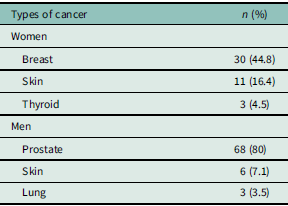
Distribution of cancer types among patients and between women and men can be seen in Tables 2 and 3, respectively.
Distribution of cancer types among patients with type 2 diabetes mellitus (T2DM)

Table 2. Long description
A table showing the distribution of various cancer types among patients. The table has 18 rows and 2 columns. The columns are labeled ‘Cancer types’ and ‘n (%)’. The rows list different types of cancers and their corresponding counts and percentages. Row 1: Prostate, 61 (40.1 percent). Row 2: Breast, 30 (19.7 percent). Row 3: Skin, 13 (8.6 percent). Row 4: Thyroid, 4 (2.6 percent). Row 5: Prostate and skin, 4 (2.6 percent). Row 6: Renal, 3 (2.0 percent). Row 7: Lung + prostate, 3 (2.0 percent). Row 8: Lung, 2 (1.3 percent). Row 9: Stomach, 2 (1.3 percent). Row 10: Colon, 2 (1.3 percent). Row 11: Brain, 2 (1.3 percent). Row 12: Leukaemia, 2 (1.3 percent). Row 13: Adrenal gland, 2 (1.3 percent). Row 14: Lower extremity, 2 (1.3 percent). Row 15: Intra-abdominal, 2 (1.3 percent). Row 16: Other (fewer than 2), 18 (11.8 percent). Row 17: Total, 152 (100 percent).
The three most common types of cancer in men and women with type 2 diabetes mellitus (T2DM)

Table 3. Long description
A table comparing the most common types of cancer in men and women with type 2 diabetes mellitus. The table has two rows for women and three rows for men, with columns for types of cancer and their respective percentages. For women, the types of cancer are breast (44.8 percent), skin (16.4 percent), and thyroid (4.5 percent). For men, the types of cancer are prostate (80 percent), skin (7.1 percent), and lung (3.5 percent).
Correlation between duration of T2DM and duration of cancer (defined as the elapsed time from initial diagnosis to study inclusion, representing cancer survivors in active follow-up) was analysed using Pearson’s correlation, but no statistically significant correlation was observed between these parameters.
Comparative analyses
When we considered the BMI groups as normal weight and overweight as one group, and obese and morbidly obese as another group, there was no statistically significant difference between these groups in terms of the incidence of prostate cancer in men and breast cancer in women. Similarly, when we took the BMI groups as normal weight as one group and overweight, obese, and morbidly obese as another group, the result was the same.
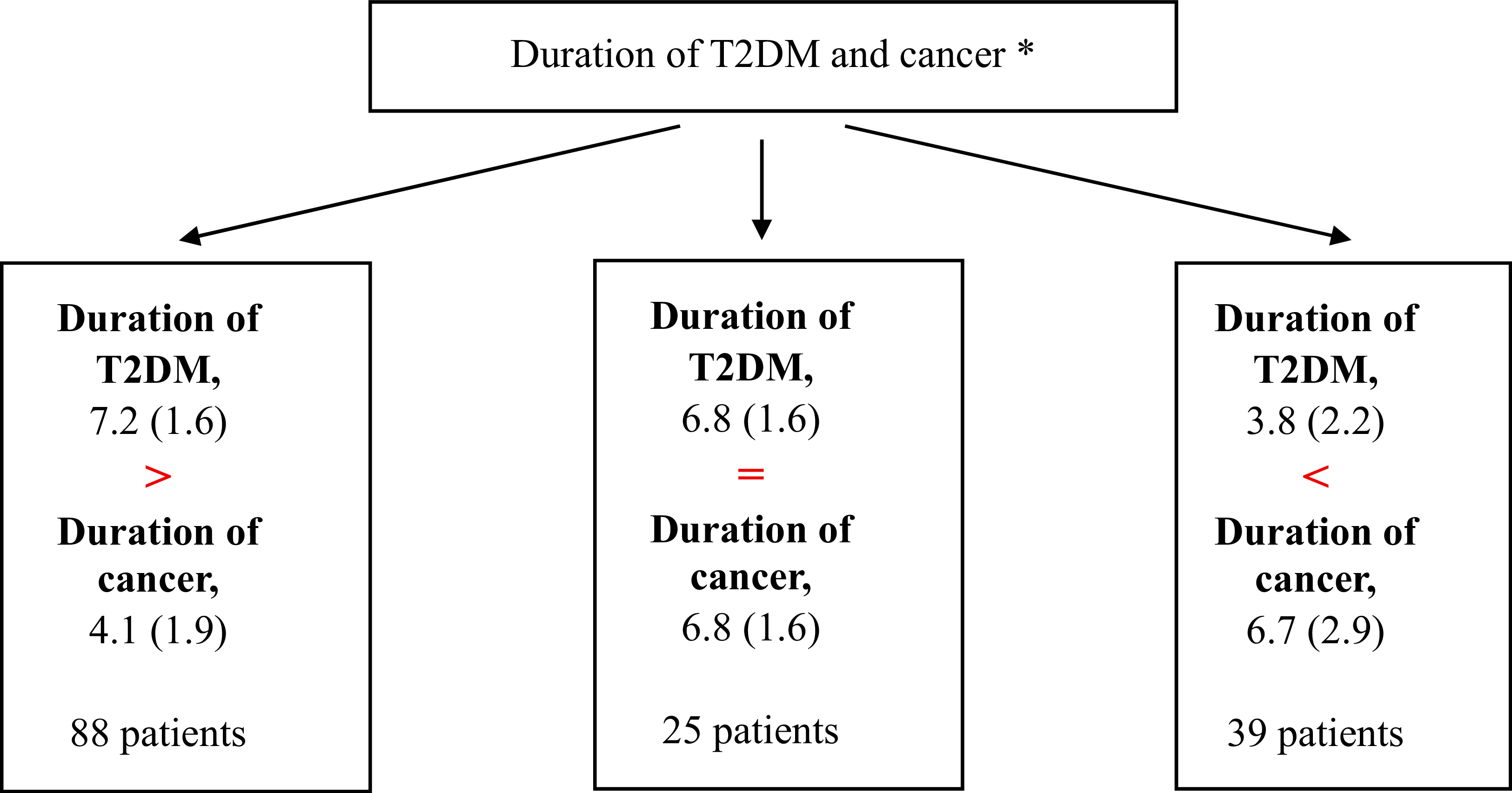
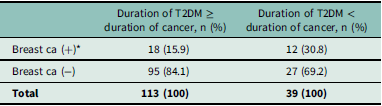
We classified the duration of T2DM and cancer in three groups (Figure 2). There was no statistically significant difference in BMI groups, gender, smoking status, presence of comorbidities, or the frequency of prostate cancer in men between patients with a longer duration of T2DM (those diagnosed with T2DM at the time of cancer diagnosis) and those with a shorter duration of T2DM than cancer. On the other hand, among women with a longer duration of T2DM than the duration of cancer, breast cancer was less frequently observed (p < 0.05) (Table 4).
Distribution of duration of type 2 diabetes mellitus (T2DM) and cancer of study population.
*in years, mean (SD)

Association between duration of type 2 diabetes mellitus (T2DM) and cancer and breast cancer prevalence

Table 4. Long description
The table compares breast cancer prevalence based on the duration of type 2 diabetes mellitus (T2DM) and cancer. It has two rows and three columns. The columns are labeled ‘Duration of T2DM ≥ duration of cancer, n (%)’, ‘Duration of T2DM < duration of cancer, n (%)’, and ‘Total’. The rows are labeled ‘Breast ca (+)’ and ‘Breast ca (-)’. Row 1: Duration of T2DM ≥ duration of cancer, n (%), 18 (15.9); Duration of T2DM < duration of cancer, n (%), 12 (30.8). Row 2: Duration of T2DM ≥ duration of cancer, n (%), 95 (84.1); Duration of T2DM < duration of cancer, n (%), 27 (69.2). The total row shows 113 (100) for ‘Duration of T2DM ≥ duration of cancer, n (%)’ and 39 (100) for ‘Duration of T2DM < duration of cancer, n (%)’.
* x 2 = 4.03; p < 0.05.
Discussion
This study demonstrated that 34.4% of adults with T2DM in a primary care setting in Türkiye had a diagnosed cancer. The most common cancers observed were prostate in men and breast in women. Skin cancer also appeared at a notable rate. The cohort’s average BMI was 31.2, indicating a population predominantly overweight or obese. These findings highlight a significant health burden, underscoring the importance of routine cancer screening and risk factor management integrated into primary care services for diabetic patients.
In the broader context of the literature, the prevalence of cancer in diabetic populations is reported to range broadly from 10% to 20% in many regions and studies, varying on the age groups (Gurney et al., Reference Gurney, Stanley, Teng, Krebs, Koea, Lao, Lawrenson, Meredith, Sika-Paotonu and Sarfati2022; Safadi et al., Reference Safadi, Balogh, Lám, Nagy and Belicza2024). In a primary care study of 2025, which was held in the USA, the prevalence of cancer in 712 diabetic patients was 6.5% (Booker et al., Reference Booker, Eary, Gonzalez, Muquith, Dev, Lee and Balasubramanian2025). Our observed rate exceeds these ranges. This discrepancy can be largely attributed to demographic differences between study populations; for instance, while international cohorts often include younger adult age groups (>40 years), our primary care diabetic cohort had a higher mean age (60 years), aligning with national age-adjusted cancer peak incidence in Türkiye (Arslan et al., Reference Arslan, Kiliçkap, Dede, Hayran, Erman, Çelik and Kutluk2011; Eser et al., Reference Eser, Örün, Hamavioğlu and Lofti2022). Furthermore, lifestyle factors, including diet and physical activity levels, regional environmental factors (such as high UV exposure contributing to skin cancers), genetic predispositions, and local primary care screening practices may also influence these findings (Gülle et al., Reference Gülle, Tozduman and Ören Çelik2025).
The mechanisms linking T2DM to increased cancer risk are multifaceted. Hyperinsulinemia, common in insulin-resistant states, stimulates cellular proliferation via activation of insulin and IGF-1 receptors, promoting tumour growth and inhibiting apoptosis. Systemic low-grade inflammation, a hallmark of obesity and metabolic syndrome, creates a pro-oncogenic environment through cytokine production and oxidative stress, facilitating genetic mutations and tumour progression. Hormonal alterations – particularly increased oestrogen levels in obese individuals – further enhance risks for hormone-sensitive cancers, notably breast and prostate (Lega and Lipscombe, Reference Lega and Lipscombe2020; Rakib et al., Reference Rakib, Mamun, Mandal, Sinha and Singh2025). While pancreatic cancer is the most common cancer type that develops later in life in people diagnosed with diabetes mellitus (DM), many other types of cancer can also develop because the many risk factors in a person with DM predispose them to cancer development. Chief among these risk factors is the association of DM and obesity. The high BMI observed in our cohort (mean around 31) aligns with these pathways, supporting the well-established link between obesity and the increased risk of multiple malignancies.
There have been a lot of studies on the relationship between prostate and breast cancer and T2DM. On the other hand, there is no consensus regarding whether prostate cancer is associated with T2DM. While many studies have demonstrated an inverse relationship between T2DM and prostate cancer incidence (Kasper and Giovannucci, Reference Kasper and Giovannucci2006; Gurney et al., Reference Gurney, Stanley, Teng, Krebs, Koea, Lao, Lawrenson, Meredith, Sika-Paotonu and Sarfati2022; Lavalette et al., Reference Lavalette, Cordina-Duverger, Rébillard, Lamy, Trétarre, Cénée and Menegaux2022; Drab et al., Reference Drab, Wdowiak, Kanadys, Zajączkowski, Koczkodaj, Religioni, Borowska, Loś and Lozano-Lorca2024; Lee et al., Reference Lee, Han and Lee2024; Ye et al., Reference Ye, Yang, Luo, Wang and Xia2024; Pagano et al., Reference Pagano, da Silva, Vieira, Meira Filho, Purcell, Lewis, Mackenzie, Robson, Vena, Silva and Prado2025), there are also publications that suggest the opposite (Yuan et al., Reference Yuan, Jiang and Yu2023; Safadi et al., Reference Safadi, Balogh, Lám, Nagy and Belicza2024). In our small sample size study, prostate cancer is the most common cancer among men, consistent with its position in the overall cancer ranking. The situation is similar for breast cancer as well. Some studies indicate that T2DM increases the risk of breast cancer (Gurney et al., Reference Gurney, Stanley, Teng, Krebs, Koea, Lao, Lawrenson, Meredith, Sika-Paotonu and Sarfati2022; Sun et al., Reference Sun, Zhang, Kadier, Hu, Liu, Liu, Yan, Sun, Yau, Lowe, Meng, Liu and Zhou2023), while others have shown no such association (Zhang et al., Reference Zhang, Liu, Yue, Niu, Hu, Zheng and Tang2024). There are also studies suggesting that metformin prevents cancer development in patients with T2DM (Baur et al., Reference Baur, Klotsche, Hamnvik, Sievers, Pieper, Wittchen, Stalla, Schmid, Kales and Mantzoros2011; Aydın et al., Reference Aydın, Turkyılmaz, Gul, Bulan and Yanardag2023), as well as studies indicating that tamoxifen use, prescribed for breast cancer, may increase the incidence of T2DM (Jordt et al., Reference Jordt, Kjærgaard, Thomsen, Borgquist and Cronin-Fenton2023). In our study, we found that breast cancer was less frequently observed among those with a longer duration of T2DM compared to the duration of cancer. In other words, in the group with a shorter duration of T2DM than cancer, the incidence of breast cancer was higher. These findings are consistent with cited literature suggesting complex interactions between oncological agents, antidiabetic regimens, and endocrine pathways.
Although causality cannot be confirmed in a cross-sectional design, our findings reinforce the critical importance of addressing obesity and metabolic control as part of comprehensive diabetic management. Lifestyle interventions including weight management, physical activity promotion, smoking cessation, and glycemic optimization are proven strategies to reduce the carcinogenic potential associated with obesity and insulin resistance (Bray et al., Reference Bray, Heisel, Afshin, Jensen, Dietz, Long, Kushner, Daniels, Wadden, Tsai, Hu, Jakicic, Ryan, Wolfe and Inge2018; American Diabetes Association, Reference American Diabetes Association2019). Tailoring patient education and public health programmes toward these goals is essential, especially considering cultural and regional factors affecting lifestyle in Türkiye.
Finally, the study adds valuable regional data to the existing literature, underscoring the high burden of cancer in diabetic populations managed within primary care. Recognizing this, healthcare systems should prioritize screening and preventive care to reduce morbidity and mortality, integrating it into national diabetes management programmes. Future research should focus on longitudinal studies to establish causal relationships, evaluate the impact of metabolic and lifestyle modifications, and explore molecular pathways further.
Limitations
This study has several limitations that should be considered when interpreting the results. First, its cross-sectional design inherently precludes establishing causal or temporal relationships. Second, because data were derived from active primary care medical records, the study cohort consists exclusively of cancer survivors; individuals with fatal cancer outcomes or those receiving inpatient palliative care were not captured, introducing potential survival bias. Third, cancer duration was calculated based on initial diagnosis records and may not reflect continuous active disease status. Fourth, detailed molecular subtypes, precise cancer staging, and comprehensive treatment regimens were incomplete in primary care records and could not be analysed. Finally, the single-centre scope in an EFHC may restrict the generalizability of the findings across Türkiye’s diverse health regions.
In conclusion, this study highlights the significant burden of cancer among Turkish diabetic patients in primary care settings. The high prevalence of cancer even in a primary care environment emphasizes the need for targeted screening programmes, risk stratification, and early intervention to improve patient outcomes. To mitigate this burden, integrated screening programmes, lifestyle interventions, and risk factor management are necessary. Well-designed prospective studies are needed to clarify causal pathways, evaluate intervention effectiveness, and develop tailored regional guidelines to reduce cancer-related morbidity and mortality in this vulnerable group.
Data availability statement
All data are available from the corresponding author upon request.
Acknowledgements
The authors thank Tuzla EFHC health professionals for their logistic help to gather study data.
Author contributions
ÜSÜ: Conceptualization, Methodology, Formal analysis, Writing – original draft, Writing – review and editing, Supervision, Project administration. YDA: Formal analysis, Review and editing, Supervision. MED, MK, AK, ÖDÖ, BÖ: Investigation, Data curation, Review and editing. All authors have read and approved the final version of the manuscript.
Funding statement
This research received no specific grant from any funding agency, commercial, or not-for-profit sectors.
Competing interests
None.
Ethical standards
The authors assert that all procedures contributing to this work comply with the ethical standards of the relevant national and institutional guidelines on human experimentation (the Marmara University School of Medicine Clinical Research Ethics Committee on December 2022, with the protocol number 014.11.2022.1466) and with the Helsinki Declaration of 1975, as revised in 2008. Written (or Verbal) informed consent was obtained from all subjects/patients.
Use of AI and AI-assisted technologies
The authors used Google Gemini solely for the purpose of English language editing and proofreading to improve readability. After using this tool, the authors reviewed and edited the content as needed and take full responsibility for the final context and scientific validity of the publication.


 Open access

