




No CrossRef data available.
Article contents
The acquisition of face and person identity information following anterior temporal lobectomy
Published online by Cambridge University Press: 04 May 2005
Abstract
Thirty unilateral anterior temporal lobectomy (ATL) subjects (15 right and 15 left) and 15 controls were presented a multitrial learning task in which unfamiliar faces were paired with biographical information (occupation, city location, and a person's name). Face recognition hits were similar between groups, but the right ATL group committed more false-positive errors to face foils. Both left and right ATL groups were impaired relative to controls in acquiring biographical information, but the deficit was more pronounced for the left ATL group. Recall levels also varied for the different types of biographical information; occupation was most commonly recalled followed by city name and person name. In addition, city and person name recall was more likely when occupation was also recalled. Overall, recall of biographical information was positively correlated with clinical measures of anterograde episodic memory. Findings are discussed in terms of the role of the temporal lobe and associative learning ability in the successful acquisition of new face semantic (biographical) representations. (JINS, 2005, 11, 237–248.)
Information
- Type
- Research Article
- Information
- Journal of the International Neuropsychological Society , Volume 11 , Issue 3 , May 2005 , pp. 237 - 248
- Copyright
- © 2005 The International Neuropsychological Society
INTRODUCTION
Typically, the recognition and identification of a familiar face unfolds in a smooth, automatic, and rapid fashion. The sense of “familiarity” is commonly accompanied by the retrieval of biographical information that specifically identifies the individual. However, it is now well established that there are distinct and separable component processes involved in face recognition and identification (Bruce & Young, 1986). In the Bruce and Young model, familiar face processing is composed of four distinct, sequential, and interactive stages which provide for access and retrieval of information about a face: (1) structural encoding, creates a description of the basic physical features of the face; (2) face recognition, matching of the structural encoding stage is matched to a face recognition unit (FRU) in memory; (3) semantic identification, a representation of the identity specific semantic codes that allow for unique identification of a particular face, and (4) name retrieval, retrieval of the lexical name code associated with the particular face.
Impairment in face recognition and identification is presumed to occur as a result of a breakdown at different stages and as a result of lesions in different neuroanatomical regions. Studies of both nonneurological and people with focal brain damage have provided support for the decomposition of the face recognition process into these stages. For example, diaries maintained by participants describing their day-to-day difficulties and errors in encounters with familiar people confirmed the occurrence of “face slips” that were consistent with the Bruce and Young model. Name retrieval was the most common error, and a name was typically not provided unless semantic identification occurred (Young et al., 1985).
Evidence concerning the neural substrates of these distinct components primarily comes from studies of patients with focal brain damage. For example, differential patterns of familiar face recognition and identification occur in patients with left or right temporal lobe damage. Patients with focal left temporal lobe damage have a specific impairment at the stage of name retrieval with intact face recognition and retrieval of (semantic) biographical knowledge, whereas right temporal lobe damage is associated with impairment in all three component stages; recognition, identification, and naming (Ellis et al., 1991; Seidenberg et al., 2002; Viskontas et al., 2002).
The process of learning or acquiring face identity information represents an important link in understanding the operation of the face processing system. That is, all faces initially start out as unknown or unfamiliar. A sense of familiarity and unique identification requires the formation of a representation in long-term memory that associates specific biographical information to a particular face. To date, the neuropsychological investigation of face recognition and identification has primarily focused on the retrieval of previously familiar or well-known faces. In contrast, there has been limited investigation of the effects of focal brain damage on the ability to mediate the transformation of a face from unfamiliar to unique identification. The purpose of the current study is to provide data relevant to this latter issue by examining the acquisition of face-biographical vignettes in patients who have undergone a unilateral temporal lobe resection for treatment of intractable seizures.
The Bruce and Young model (1986) was originally developed and articulated to characterize the process of recognizing and identifying already known faces; however, researchers have also adopted it for examining the acquisition of unfamiliar faces. To date, much of this research has focused on the perceptual processes involved in matching and discrimination of unfamiliar faces and recognition memory for unfamiliar faces. Furthermore, most studies have used a single trial probe, and have not included the examination of unfamiliar face learning ability combined with biographical information.
The study of unfamiliar faces also provides an opportunity to eliminate several methodological confounds inherent in the investigation of already known and familiar faces. For example, when faces of well-known public figures are studied, it is difficult to determine or control the participant's previous exposure history to the set of faces. Thus, there is likely to be considerable variability in the time frame of initial acquisition, frequency and recency of exposure, and the amount and type of knowledge associated with these well-known faces. Pairing unfamiliar faces with a defined set of biographical information provides a means to systematically control and potentially study these stimulus factors and their implications for face recognition and identity processes.
The acquisition of face-biographical vignette information places considerable demands on associative learning processes which are critically dependent on the integrity of the hippocampus and adjacent neocortical temporal lobe region (Eichenbaum et al., 1994; Squire, 1992). Given the critical role of right temporal lobe regions for unfamiliar face learning (Dade & Jones-Gotman, 2001; Milner, 1968; Warrington & James, 1967), we expected that patients undergoing right anterior temporal lobe resection (R-ATL) would show greater impairment than left anterior temporal lobe resection (L-ATL) patients in learning new unfamiliar faces (i.e., establishing a new face recognition unit). In contrast, the potential impact of left versus right-sided temporal lobe lesions for associating vignette (biographical) information to the newly acquired faces has not been extensively studied. A limited number of case study reports of patients preselected for the presence of proper name anomia (Fukatsu et al., 1999; Lucchelli & De Renzi, 1992; Reinkemeier et al., 1997) have implicated left temporal lobe lesions in difficulties in the acquisition of biographical information, and particularly for acquiring proper names. A recent study reported that right temporal lobe lesions also impacted the acquisition of proper names, but did not impair the acquisition of other biographical information (e.g., occupation) (Tsukiura et al., 2002). However, this study did not provide data on the acquisition of face semantic vignettes over trials, and also did not decompose performance for face and biographical information
In the current study, we contrasted the performance of temporal lobe epilepsy (TLE) patients, who have undergone either a L-ATL or R-ATL resection, to acquire and retain biographical information (occupation, city name, and person name) associated with a set of previously unfamiliar faces. Data is provided for the acquisition of the face-biographical vignettes over multiple trial presentations, and performance for face recognition and face identification processes are examined. Although, different patterns of deficits following right or left temporal lobe lesions are evident in the recognition and identification of previously familiar faces (Ellis et al., 1991; Seidenberg et al., 2002), there has been limited direct examination of the contrasting effect of lateralized temporal lobe lesions on the acquisition and retention of new face-biographical vignette pairings. Specific questions to be addressed in this study include examination of the effect of lateralized temporal lobe damage on (1) learning of a face-biographical vignette, (2) the acquisition of distinct elements (face, person name, occupation, and city name) of a face-biographical vignette, and (3) the relationship between face-biographical vignette learning and performance on standard clinical measures of face matching, object naming, and anterograde verbal and visual memory.
METHODS
Participants
A total of 45 participants, 15 healthy controls and 30 patients who had undergone anterior temporal lobectomy (ATL), 15 R-ATL and 15 L-ATL for relief of intractable seizures, were studied. All ATL patients underwent Wada testing and showed left hemisphere language dominance. A tailored ATL resection was conducted with electrocorticography, and for those undergoing a dominant ATL, intraoperative or extraoperative stimulation mapping was conducted. All surgical procedures were conducted by the same neurosurgeon who specializes in epilepsy surgery. ATL resection included the temporal pole and a portion (typically 30–50 mm) of the lateral and ventral temporal cortex, and more extensive resection of medial temporal lobe structures including amygdala and hippocampus. The posterior margin of the lateral cortical resection is guided by electrocorticography and intraoperative stimulation mapping. The anterior 1–2 cm of hippocampus is resected en bloc for examination of hippocampal sclerosis.
ATL participants were excluded if they (1) had a history of psychiatric disturbance, substance abuse, or neurological illness other than epilepsy; (2) had a magnetic resonance image (MRI)-identified structural lesion other than mesial temporal sclerosis (based on visual examination); (3) were younger than 18 years or older than 55 years; (4) were nonnative English speakers; (5) had less than 8 years of education; (6) had atypical language dominance as demonstrated by intracarotid sodium amobarbital testing; or (7) had less than a 90% reduction in seizure frequency (Engel outcome classification III or IV) from presurgical status. MRI and/or histopathological data were available for 27 ATL participants. Of these, 22 participants had available MRI scans and 5 participants had histopthological data available. Fifteen of the participants showed evidence of hippocampal sclerosis on either or both MRI and histopathology.
Fifteen healthy, right-handed normal control participants were recruited from relatives and friends of the ATL participants or as part of an NIH-funded project investigating the neurodevelopmental course of TLE. Control participants were excluded if they were younger than 18 or older than 55, had less than 8 years of education, or had a history of neurological disease, major psychiatric disturbance, substance abuse, or were taking psychoactive medications. Control participants did not have an MRI done for this study.
Stimuli
Stimuli consisted of ten black-and-white photographs of unfamiliar adult faces (five male and five female) paired with ten biographical vignettes. All vignettes were comprised of a three-syllable full name, an occupation, and a city (e.g., Debbie York is a teacher from Boston; see Appendix for a complete listing). Ninety additional unfamiliar faces were used as foils.
Procedure
Learning trials
Participants were presented with faces one at a time in a booklet as the accompanying vignette was presented on audiotape. Participants were instructed to try to remember the face and the vignette, as they would be asked to recall them later. A 5-s study time exposure was provided for each face, during which time the accompanying vignette was presented twice. This procedure was repeated for seven learning trials, with face recognition and vignette recall tested after each trial. For each learning trial, a different presentation order of the face-biographical vignette pairings was used. Each vignette was scored for accuracy of four pieces of information; face recognition, occupation, city, and name. Credit was given for a naming response if both the first and last names were provided.
Immediate recall
Following presentation of the ten face-vignette pairs, participants were presented the ten faces (“targets”) one at a time intermixed with ten new faces (“foils”). For each face, participants first determined if the face had been presented on the learning trial. Participants were asked to recall biographical information for each face they identified as being presented during the learning trial irrespective of whether it actually had been previously presented (i.e., “Hit”) or not (i.e., “false alarm”). Unrecognized faces were not probed for biographical information. This procedure was repeated for a total of seven presentation trials.
Immediate recognition
Following presentation of the seventh learning and recall trial, the ten “target” faces were presented one at a time. Participants were read three names, occupations, and cities and asked to choose the one associated with that face during the learning trials (e.g., “Was she a teacher, a police officer, or a flight attendant?”). All foils for the semantic biographical information were taken from the other face-vignette pairings.
Clinical neuropsychological measures
A short battery of standardized paper-and-pencil neuropsychological measures was also administered to all participants. Measures were chosen to parallel the stages of the Bruce and Young model; face structural encoding, anterograde memory, and naming ability and included the Recognition Memory Test (Warrington, 1984), for words and faces, Wechsler Memory Scale–III Logical Memory and Visual Reproduction subtests (Wechsler, 1997b), a 30-item short form of the Boston Naming Test (Williams et al., 1989), and the short-form of Test of Facial Recognition (Benton et al., 1983). A four subtest short form of the Wechsler Adult Intelligence Scale–Revised and Third Edition (Wechsler, 1981, 1997a) was also administered to provide an estimate of general intellectual ability (Reynolds et al., 1983).
Statistical Analyses
Immediate face recognition, biographical recall, and recognition
Immediate face recognition performance was examined for hits (correct recognition of target faces) and false alarms (incorrectly identifying a foil as a target face). Multivariate analysis of variance (MANOVA) was conducted to examine group differences (controls, R-ATL, and L-ATL) in the recall of the three different types of biographical information (occupation, city name, and person name) across the seven learning trials. Analyses for biographical recall (and all other additional analyses) included only trials in which the participant correctly recognized the target face to avoid any confound associated with face recognition performance. All interaction effects were decomposed with one-way univariate analysis of variance (ANOVA) and subsequent post-hoc comparisons were conducted with Bonferroni correction for multiple comparisons. A family-wise alpha level was set at .017 (.05/3) to adjust for the multiple comparisons conducted. The p-values reported for these post-hoc comparisons represent exact Bonferroni-corrected p-values. In examining learning of the face-biographical vignettes, a group × trial (3 × 2) MANOVA was conducted to contrast recall performance on trial 1 versus trial 7 to minimize the number of pairwise trial contrasts being examined. As described above, Bonferroni correction with a family-wise alpha correction value (p = .017) was conducted for these post-hoc comparisons.
RESULTS
Demographic and Clinical Information
Table 1 provides a summary of the demographic and clinical seizure characteristics of the study groups. The three groups did not significantly differ on age, F(2,42) = 3.03, p > .05, education, F(2,42) = .58, p > .10, or estimated Full Scale IQ, F(2,42) = .54, p > .10. There was a similar proportion of males and females in the three groups, chi- square = 1.41, p > .10. The R-ATL and L-ATL groups also did not differ on age at onset of recurrent seizures, F(1,28) = 2.14, p > .10, time since surgery, F(1,28) = 1.41, p > .10, and seizure outcome.
Demographic and seizure variables

Group Performance on Neuropsychological Measures
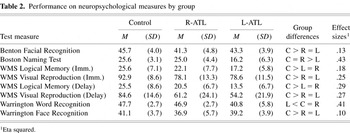
Table 2 displays the mean performance of the groups on the standard neuropsychological measures examined as part of the study protocol. Significant group differences were observed on all measures (Face Recognition Test: F(2,38) = 3.95, p < .05; Boston Naming Test: F(2,42) = 18.02, p < .001; Recognition Memory Words: F(2,28) = 9.63, p < .001; Recognition Memory Faces: F(2,39) = 3.14, p =.05), Logical Memory Immediate: F(2,42) = 5.66, p < .001; Logical Memory Delayed: F(2,42) = 9.77, p < .001; Visual Reproduction Immediate: F(2,40) = 7.70, p < .001; Visual Reproduction Delay (2, 40) = 8.40, p < .001). Post-hoc group comparisons using Bonferroni adjustment for multiple comparisons indicated a pattern generally consistent with a material-specific memory effect. The R-ATL participants were significantly impaired relative to controls on face recognition and discrimination ability, and measures of unfamiliar face memory, as well as more general visual memory indices (all p < .01). The L-ATL group was impaired relative to controls on confrontation naming ability, and anterograde memory of both verbal and visual information (all p < .005). In addition, the L-ATL group demonstrated a significantly lower performance than the R-ATL group on confrontation naming (p < .001) and recognition memory for words (p = .008).
Performance on neuropsychological measures by group

Face Recognition
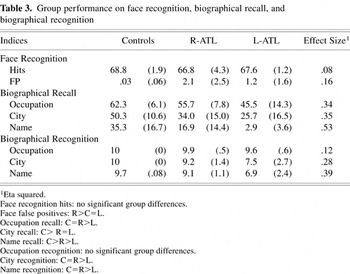
Group face recognition performance in terms of overall hits and false alarms is shown in Table 3. A one-way MANOVA (Group) indicated that the groups did not significantly differ in recognizing target faces (Hits), F(2,42) = 1.30, p > .05, but there was a significant group difference in the number of false positives, F(2,42) = 4.11, p < .05. As expected, the R-ATL group committed significantly more total false alarms across trials than the control group (p = .006).
Group performance on face recognition, biographical recall, and biographical recognition

Acquisition of Biographical Information
Figure 1 illustrates the proportion recall (based on correct face recognition trials) for biographical information (occupation, city, and person name) collapsed across the seven learning trials. A 3 × 3 MANOVA (Group × Biographical Type) yielded a significant main effect of group, F(2,42) = 21.86, p < .001, and a significant main effect of biographical information type, F(2,41) = 169.9, p < .001. Post-hoc comparisons using Bonferroni correction indicated that the control group recalled significantly more biographical information than both the R-ATL group (p < .003) and the L-ATL group (p < .001), and the R-ATL group recalled more information than the L-ATL group (p = .01). Across the three groups, occupation information was recalled significantly more often than city information, which was recalled more often than person name (all p < .001). The interaction of group × biographical type was also significant, F(4,82) = 3.55, p < .01. Decomposition of the interaction effect indicated a different pattern of group differences across the three types of biographical information. For occupation information, F(2,42) = 10.29, p < .001; the L-ATL group produced significantly less recall than both the controls (p < .001) and the R-ATL group (p < .01), whereas the R-ATL group and controls did not differ (p > .10). For city information, F(2,42) = 11.18, p < .001; the control group showed better recall than both the L-ATL and R-ATL groups (p < .01), and the ATL groups did not differ from each other (p > .10). For person name, F(2,42) = 23.94, p < .001; the control group again showed superior recall to the L-ATL and R-ATL groups (p < .001), but the R-ATL group also showed better recall than the L-ATL group (p < .01).

Percent recall of biographical information.
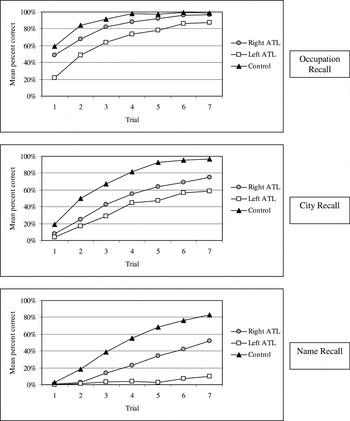
Figure 2 illustrates the performance of the three groups in the recall of different types of biographical information over the course of the seven learning trials. To minimize the number of pairwise trial contrasts being conducted, we examined biographical recall performance of the three groups on trial 7 compared to trial 1. Consistent with the analyses reported above, a 3 × 2 (Group × Trial) MANOVA produced a significant main effect for group on all three biographical indices (all p < .01). In addition, a significant main effect of trial was obtained for occupation recall and city name recall (p < .001) reflecting improved recall over the course of the learning trials (see Figure 2). Thus, trial 7 recall was significantly better than trial 1 recall for all three groups for both occupation recall and city recall. In addition, a significant group × trial interaction effect was observed for person name information, F(2,42) = 29.48, p < .001. On trial 1, the group effect was not significant, F(2,42) = .89, p > .05. On trial 7, a significant main effect of group was observed, F(2,42) = 29.87, p < .001; the control group recalled significantly more proper person names than both the L-ATL group (p < .001) and the R-ATL group (p < .001), while the R-ATL group also showed better recall than the L-ATL group, (p < .009).

Recall of biographical information over trials: (a) Occupation recall, (b) City recall, and (c) Proper name recall.
Recall of Biographical Information Type
To examine if there was preferential recall for the different types of vignette information, we compared the recall of the different possible combinations of biographical information. For vignettes in which only one piece of biographical information was recalled, there are three possibilities (occupation alone, city alone, or proper name alone). Similarly, when two pieces of biographical information are recalled, there are also three possible information type combinations (occupation with city, occupation with proper name, and city with proper name). A series of pairwise t-tests (Bonferroni corrected) comparing recall level for the different information combinations was conducted for each of the three groups using only correct face recognition trials. As illustrated in Table 4, there was consistent recall superiority for occupation information evident across the three groups at both the one- and two-unit recall levels. For vignettes in which one biographical piece of information was recalled, occupation alone was recalled significantly more frequently than either name alone or city alone in all three groups (all p < .001). Recall level for city alone versus name alone did not differ for any of the groups (once corrected for multiple comparisons). Similarly, the combination of occupation and city information was recalled together significantly more often than either the occupation and name combination or the city and person name combination (all p < .001). Thus, these results point to the primacy of occupation information in the acquisition and recall of person identity information, and the considerable difficulty in acquiring proper names, and people's names in particular.
Percent recall of biographical information

Recognition of Biographical Information
Table 3 displays the mean performance of the three groups across the recognition indices of biographical information. A series of oneway (Group) ANOVA produced a nonsignificant group difference for occupation, F(2,42) = 2.80, p = .07, but significant group differences for both the recognition of city information, F(2,42) = 8.00, p < .001, and name information, F(2,42) = 13.54, p < .001. For both city and name recognition indices, the L-ATL group recognized significantly less information than both the R-ATL group and the controls (all p < .01), while the R-ATL group and controls were not significantly different from each other (all p > .05).
Correlation between Unfamiliar Face Learning and Neuropsychological Measures
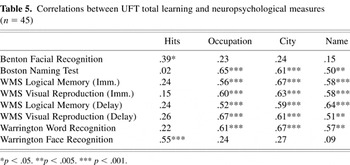
Table 5 displays the correlations between the neuropsychological measures and the indices from the person-identity acquisition task. Some measures (e.g., Warrington Words) were not completed by all participants; however, there was no difference in performance on the other indices between those who did and those who did not complete all the measures. A distinct pattern of relationships is evident; face recognition hits were significantly correlated with measures specific to face discrimination (FRT) and face memory (RMF). In contrast, the learning of biographical information (occupation, city, and name) was significantly correlated to episodic verbal and visual memory measures and confrontation naming.
Correlations between UFT total learning and neuropsychological measures (n = 45)

DISCUSSION
There are three sets of findings from this study relevant to the effects of lateralized temporal lobe lesions on the acquisition and representation of face-person identity information. First, the L-ATL and R-ATL groups demonstrated different patterns and degree of impairment in the acquisition of a de novo face-person identity representation. Second, there were distinct differences in the acquisition of the different types of biographical information (i.e., occupation, city, and person name) within these person-identity representations. Third, different patterns of association were observed between components of the face-person identity representation (i.e., face recognition and semantic information) and measures of cognitive processing (face matching/discrimination, face memory, and associative learning ability). These findings are discussed in detail below.
Face Recognition
Although the R-ATL group had a similar number of face recognition hits as controls and the L-ATL group, they did commit an increased number of false-positive recognition errors. This finding is consistent with previous reports of an increased rate of false recognition and misidentification of unfamiliar faces (Rapcsak et al., 1994, 1996) and difficulties in discriminating famous faces from foils (Ellis et al., 1991; Seidenberg et al., 2002) following right hemisphere damage. False alarms were evident particularly in the initial learning trials but were no longer observed after trial 4. Overall, the R-ATL group demonstrated a moderate impairment in face recognition characterized by a difficulty in establishing a reliable face recognition unit. However, they overcame this difficulty with multiple exposures. In contrast, two other studies have shown that right TLE participants are impaired in unfamiliar face recognition after multiple trial presentations (Beardsworth & Zaidel, 1994; Dade & Jones-Gotman, 2001).
The current study findings may reflect the beneficial contribution of the accompanying biographical vignettes on face recognition performance. Polster and Rapcsak (1996) described a prosopagnosic patient with a right hemisphere lesion (RJ) who showed different levels of unfamiliar face learning across four encoding conditions. RJ was more successful in acquiring unfamiliar faces when he rated them for personality traits or listened to an accompanying biographical vignette than when he rated them on physical features or identified the most distinctive feature. Similarly, the vignettes used in this study may serve to elicit “deep” encoding operations that help to create identity-specific semantic codes that in turn assist in the creation of structural face codes. Furthermore, RJ was unable to generalize the ability to acquire unfamiliar faces when alternate views were tested. In the current study, the same face photograph was repeatedly used over the seven learning trials and it is quite possible that the use of alternate views of the target unfamiliar faces would prove more challenging for the right ATL participants.
Acquisition of Biographical Information
Although both the R-ATL and L-ATL groups showed poorer face-biographical vignette acquisition than controls, the extent of impairment was considerably more severe for the L-ATL group. The impairment in recall of biographical information was evident for trials in which accurate face recognition occurred, and face recognition hits did not differ between the three groups (see Table 3). The L-ATL group demonstrated a global impairment relative to controls in the acquisition of all three biographical components of the presented vignettes—occupation, city, and person name—despite normal levels of face recognition. In addition, the L-ATL group recalled significantly less occupation and person name information than the R-ATL group. In contrast, the R-ATL group performed similar to controls (across trials) in the recall of occupation information, but was impaired for the recall of both city and person name information.
The global impairment in the recall of biographical information observed for the L-ATL group differs from previous findings regarding recognition and identification of famous faces. Several investigators have shown that left hemisphere lesions result in a specific impairment in the retrieval of proper names, with normal levels of retrieval of other semantic identification information, such as occupation or reason for fame (Flude et al., 1989; Fukatsu et al., 1999; Hanley, 1995; Harris & Kay, 1995; Hittmair-Delazer et al., 1994; Reinkemeier et al., 1997; Seidenberg et al., 2002; Semenza & Zettin, 1989; Shallice & Kartsounis, 1993).
A possible explanation for the contrasting findings observed here is that the current study employed a new learning (episodic memory) paradigm, rather than examination of retrieval from a previously acquired knowledge base (semantic memory). Consistent with this hypothesis, a subset of L-ATL subjects (n = 7) who had previously served as participants in a protocol examining famous face recognition and identification demonstrated accurate knowledge of biographical information (i.e., occupation or reason for fame), but not the person's name for famous faces (Seidenberg et al., 2002). Thus, retrieval of occupation information for already known familiar faces was relatively preserved in the L-ATL group compared to the ability to form new associative face-occupation relationships.
In the context of a global impairment in the acquisition of biographical information, the L-ATL group demonstrated a very marked difficulty in associating a person's name to a new face. Indeed, they exhibited an essentially flat learning curve for person name recall over the seven trials (see Figure 2c). Their performance also remained significantly below both the controls and the R-ATL group during the recognition memory probe for person's name. Thus, the left temporal lobe appears to play a critical role both in the acquisition and association of a person's name to a face, as well as in the retrieval of previously acquired names of familiar people (Damasio et al., 1996).
The R-ATL group was also impaired relative to controls in learning names and city information associated with unfamiliar faces. A deficit in person identity knowledge has been previously reported for famous faces in patients with right temporal lobe damage (Ellis et al., 1989; Evans et al., 1995; Hanley et al., 1990; Seidenberg et al., 2002). A role for the right temporal lobe in person identity has also been suggested in recent functional neuroimaging studies for recognition of famous faces (Leveroni et al., 2000), and for the acquisition of biographical information (names and occupation) to unfamiliar faces (Tsukiura et al., 2002). Although the R-ATL group was impaired in the acquisition of biographical information compared to the controls, their impairment was not as severe as the L-ATL group (see Table 3). The L-ATL group was impaired relative to both controls and the R-ATL group on the recognition memory probe for both city and person name information. In contrast, the R-ATL group performed similar to controls on the recognition memory probe for biographical information. However, recognition performance for the control group was at ceiling, which may have obscured possible group differences. Nevertheless, it is evident that the difficulty in the acquisition of person identity information is more pronounced following L-ATL than R-ATL.
The TLE participants examined in the current study underwent a tailored resection based on findings from intracranial electrocorticography. Thus, the resection estimates provided in the Methods section provide a general reference point for the typical surgery procedure conducted. More detailed information concerning the extent of resection in the lateral and mesial regions is not available. Nevertheless, it should be noted that that the typical resection was larger for participants undergoing R-ATL as compared to L-ATL, and the current study findings implicate a greater impairment in acquiring biographical information for the L-ATL group. In addition, the findings point to a dissociation in the nature of impairment evident between L-ATL and R-ATL groups for unfamiliar face acquisition and acquisition of biographical information, and a dissociation in the extent of impairment in learning different types of biographical information (names, occupation, city). Thus, the pattern of results is difficult to reconcile with a simple extent of resection explanation.
Recall of Biographical Information
The present study points to the considerable difficulty in learning to associate names to unfamiliar faces, and is consistent with previous reports in neurologically normal (Cohen, 1990; Craigie & Hanley, 1997; McCluney & Krauter, 1997; McWeeny et al., 1987) and brain-damaged participants (Fukatsu et al., 1999; Lucchelli & De Renzi, 1992; Milders, 1998). For all three groups, recall of name information was significantly lower than recall of city information, which was in turn poorer than recall of occupation information. This was also evident even when credit was given for correct recall of just the first or last name rather than the full name. A serial order learning effect (i.e., primacy or recency) cannot account for the pattern of observed recall findings as each vignette used a standard presentation order for the biographical information in which person name was presented first, followed by occupation and city name (see Appendix). Other factors which could affect recall levels for the different types of biographical information such as category set size and frequency of occurrence were not controlled in this study, and warrant investigation in subsequent studies.
The ubiquitous nature of name learning difficulty has been the subject of considerable interest within the context of current models of face processing ability (Bruce et al., 1994; Burton & Bruce, 1992; Cohen, 1990; Stanhope & Cohen, 1993). In the present study, recall of city names was intermediate between occupation and name recall for all three groups. City names are also proper names and the question arises as to why city names are more easily acquired than person names. City names do have characteristics that are similar to person names. They are both arbitrary verbal labels that uniquely describe a place/person. However, city names may not truly be meaningless in the sense that they may have “borrowed semanticity” (Cohen & Faulkner, 1986) that links them into the semantic network. For example, the city Seattle may produce conceptual associations (e.g., rain, coffee, Space Needle) that allow for integration into a semantic network. Additionally, city names are not truly unique in that they are also a property that describes many other individuals in the person identity system, (i.e., several person identity nodes may share them). That is, while there is only one geographical area named Seattle, there are many individuals who share Seattle as a biographical property. It is also possible to adjectivize a city in reference to a set of characteristics. In this sense, a city name can serve as an associative cue to a more general set of semantic features.
In addition, name recall (person or city) rarely occurred without the accompanying recall of occupation information. Indeed, person name recall occurred most frequently (for all three groups) when both occupation and city name were also recalled. These findings are consistent with serial/hierarchical proposals of person identification processes described for retrieval of familiar faces (Bruce & Young, 1986; Hay et al., 1991). The current study results extend this perspective to the process of acquiring new face person identity representations.
Face-Semantic Network Acquisition and Cognitive Functioning
The performance of the ATL groups on the standard clinical neuropsychological measures showed a pattern of material-specific effects following unilateral temporal lobectomy (Bell & Davies, 1998; Hermann et al., 1995, 1999; Milner, 1968; Seidenberg et al., 1998). The R-ATL group was impaired relative to controls on face discrimination, recognition memory for faces, and visual memory. Conversely, the L-ATL group was impaired on measures of confrontation naming, recognition memory for words, and verbal episodic memory. The L-ATL group was also impaired on visual memory, a finding frequently observed and hypothesized to be related to the verbalizability of the stimuli (Bell & Davies, 1998; Hermann et al., 1992). The performance of the ATL groups on the unfamiliar face/biographical vignette-learning task was also generally consistent with material specific effects. The R-ATL group was impaired on face learning and discrimination ability and the L-ATL group was more impaired on learning the biographical verbal information. Furthermore, unfamiliar face recognition performance was significantly correlated with indices of face discrimination ability and face recognition memory, suggesting that both perceptual and mnemonic abilities are related to the formation of a face recognition unit. In contrast, learning of biographical information was strongly related to indices of associative verbal and nonverbal memory. Thus, it appears that general associative learning ability is critically linked to the acquisition of new face-semantic identity representations.
Anterograde associative learning ability is strongly linked to the functional integrity of the mesial temporal lobe region (Eichenbaum et al., 1994; Squire, 1992), and previous findings of pre-post ATL have confirmed that associative learning ability is more negatively affected following left-sided resections compared to right-sided resections (Seidenberg et al., 1998). However, one cannot rule out the potential contribution of regions adjacent to the medial temporal lobe as the typical resection also removes a portion of the anterior temporal lobe as well. Recent findings from both human lesion studies and functional neuroimaging investigations have implicated the anterior temporal lobe in familiar face identification processes including naming famous faces (Gorno-Tempini et al., 1998; Leveroni et al., 2000; Tranel et al., 1997). Particular attention has focused on the possible role of the left temporal pole and left middle temporal gyrus in the recognition and naming of familiar faces. Furthermore, the left temporal polar region has been linked to retrieval of names for both unique familiar persons and unique familiar landmarks (Grabowski et al., 2001). These studies address the retrieval of already known concepts (faces and places). Of interest, a recent fMRI study examining activation patterns for newly learned faces and biographical information implicated the involvement of the left temporal lobe in the retrieval of people's names irrespective of whether they were famous or newly learned. In addition, the right anterior temporal lobe showed increased activity during retrieval of people's names from newly learned faces compared to well known famous faces (Tsukiura et al., 2002). These findings correspond with the current study findings showing impairment of both the L-ATL and R-ATL groups (compared to controls) in the acquisition of names for newly acquired faces.
Taken together, the current findings are consistent with the viewpoint that the acquisition of new face semantic networks is related to two distinct cognitive operations—face processing and associative learning. Laterality of temporal lobe lesion (as reflected by ATL) appears to produce a dissociation, which parallels this distinction. The R-ATL group was more impaired for unfamiliar face learning while the L-ATL group was more impaired for the acquisition of biographical information. Furthermore, the acquisition of person-identity information appears to be strongly linked to both verbal and nonverbal associative learning ability (Hittmair-Delazer et al., 1994; Shallice & Kartsounis, 1993). Accordingly, the pronounced impairment evident for the L-ATL group in acquiring new face-related biographical representations may be viewed as a consequence of their substantial impairment in both verbal and nonverbal associative learning capabilities. These findings also serve to highlight important similarities and differences between the effect of lateralized temporal lobe lesions on retrieval of (already known) information concerning famous faces and the acquisition of new face biographical associations.
ACKNOWLEDGMENTS
This work was supported by NIH RO1-37738 and MO1 RR03186. We would like to acknowledge Christian Dow, Brian Bell, and Jana Jones for their assistance with data collection, and Joy Parrish for her assistance in manuscript preparation.
APPENDIX
List of Vignettes
Debbie York is a teacher from Boston.
Alice Dunn is a police officer from Philadelphia.
Sue Bailey is a chef from New York.
Kate Walker is a florist from Washington, DC.
Liz Hardy is a flight attendant from Los Angeles.
Kevin Grant is a minister from Chicago.
Bill Perry is an architect from Miami.
Jeff Dixon is a butcher from Seattle.
Matt Reilly is a reporter from Dallas.
Ray Wilson is a locksmith from Detroit.
References
REFERENCES
Beardsworth, E.D. &
Zaidel, D.W.
(1994).
Memory for faces in epileptic children before and after brain
surgery.
Journal of Clinical and Experimental Neuropsychology,
16,
589–596.Google Scholar
Bell, B. &
Davies, K.G.
(1998).
Anterior temporal lobectomy, hippocampal sclerosis, and memory:
Recent neuropsychological findings.
Neuropsychology Review,
8,
25–41.CrossRefGoogle Scholar
Benton, A.L.,
Hamsher, K.DeS.,
Varney, N.R., &
Spreen, O.
(1983).
Contributions to neuropsychological assessment.
New York:
Oxford University Press.
Bruce, V.,
Burton, A.M., &
Walker, S.
(1994).
Testing the models? New data and commentary on Stanhope & Cohen
(1993).
British Journal of Psychology,
85,
335–349.Google Scholar
Bruce, V. &
Young, A.
(1986).
Understanding face recognition.
British Journal of Psychology,
77,
305–327.CrossRefGoogle Scholar
Burton, A.M. &
Bruce, V.
(1992).
I recognize your face but I can't remember your name: A simple
explanation?
British Journal of Psychology,
83,
45–60.Google Scholar
Cohen, G.
(1990).
Why is it difficult to put names to faces?
British Journal of Psychology,
81,
287–297.Google Scholar
Cohen, G. &
Faulkner, D.
(1986).
Memory for proper names: Age differences in retrieval.
British Journal of Developmental Psychology,
4,
187–197.Google Scholar
Craigie, M. &
Hanley, J.R.
(1997).
Putting faces to names.
British Journal of Psychology,
88,
157–171.CrossRefGoogle Scholar
Dade, L.A. &
Jones-Gotman, M.
(2001).
Face learning and memory: The twins test.
Neuropsychology,
15,
525–534.CrossRefGoogle Scholar
Damasio, H.,
Grabowski, T.J.,
Tranel, D.,
Hichwa, R.D., &
Damasio, A.R.
(1996).
A neural basis for lexical retrieval.
Nature,
380,
499–505.CrossRefGoogle Scholar
Eichenbaum, H.,
Otto, T., &
Cohen, N.J.
(1994).
Two functional components of the hippocampal memory system.
Behavioral and Brain Sciences,
17,
449–517.Google Scholar
Ellis, A.W.,
Hillam, J.C.,
Cardno, A., &
Kay, J.
(1991).
Processing of words and faces by patients with left and right
temporal lobe epilepsy.
Behavioural Neurology,
4,
121–128.CrossRefGoogle Scholar
Ellis, A.W.,
Young, A.W., &
Critchley, E.M.R.
(1989).
Loss of memory for people following temporal lobe damage.
Brain,
112,
1469–1483.CrossRefGoogle Scholar
Evans, J.J.,
Heggs, A.J.,
Antoun, N., &
Hodges, J.R.
(1995).
Progressive prosopagnosia associated with selective right temporal
lobe atrophy: A new syndrome?
Brain,
118,
1–13.Google Scholar
Flude, B.M.,
Ellis, A.W., &
Kay, J.
(1989).
Face processing and name retrieval in an anomic aphasic: Names are
stored separately from semantic information about familiar people.
Brain and Cognition,
11,
60–72.CrossRefGoogle Scholar
Fukatsu, R.,
Fujii, T.,
Tsukiura, T.,
Yamadori, A., &
Otsuki, T.
(1999).
Proper name anomia after left temporal lobectomy: A patient
study.
Neurology,
52,
1096–1099.Google Scholar
Gorno-Tempini, M.L.,
Price, C.J.,
Josephs, O.,
Vandenberghe, R.,
Cappa, S.F.,
Kapur, N., &
Frackowiak, R.S.J.
(1998).
The neural systems sustaining face and proper-name
processing.
Brain,
121,
2103–2118.CrossRefGoogle Scholar
Grabowski, T.J.,
Damasio, H.,
Tranel, D.,
Ponto, L.L.,
Hichwa, R.D., &
Damasio, A.R.
(2001).
A role for left temporal pole in the retrieval of words for unique
entities. Human Brain Mapping,
13,
4,
199–212.Google Scholar
Hanley, J.R.
(1995).
Are names difficult to recall because they are unique? A case study
of a patient with anomia.
Quarterly Journal of Experimental Psychology,
48A,
487–506.CrossRefGoogle Scholar
Hanley, J.R.,
Pearson, N.A., &
Young, A.W.
(1990).
Impaired memory for new visual forms.
Brain,
113,
1131–1148.Google Scholar
Harris, D.M. &
Kay, J.
(1995).
I recognize your face but I can't remember your name: Is it
because names are unique?
British Journal of Psychology,
86,
345–358.Google Scholar
Hay, D.C.,
Young, A.W., &
Ellis, A.W.
(1991).
Routes through the face recognition system.
Quarterly Journal of Experimental Psychology,
43A,
761–791.Google Scholar
Hermann, B.P.,
Connell, B.,
Barr, W.B., &
Wyler, A.R.
(1995).
The utility of the Warrington Recognition Memory Test for temporal
lobe epilepsy: Pre- and postoperative results.
Journal of Epilepsy,
8,
139–145.Google Scholar
Hermann, B.P.,
Perrine, K.,
Chelune, G.J.,
Barr, W.,
Loring, D.W.,
Strauss, E.,
Trenerry, M.R., &
Westerveld, M.
(1999).
Visual confrontation naming following left anterior temporal
lobectomy: A comparison of surgical approaches.
Neuropsychology,
13,
3–9.Google Scholar
Hermann, B.P.,
Wyler, A.R.,
Somes, G.,
Berry, A.D., &
Dohan, F.C.
(1992).
Pathological status of the mesial temporal lobe predicts memory
outcome from left anterior temporal lobectomy.
Neurosurgery,
31,
652–657.Google Scholar
Hittmair-Delazer, M.,
Denes, G.,
Semenza, C., &
Mantovan, M.C.
(1994).
Anomia for people's names.
Neuropsychologia,
32,
465–476.CrossRefGoogle Scholar
Leveroni, C.L.,
Seidenberg, M.,
Mayer, A.R.,
Mead, L.A., &
Rao, S.M.
(2000).
Neural systems underlying the recognition of familiar and newly
learned faces.
Journal of Neuroscience,
20,
878–886.Google Scholar
McCluney, M.M. &
Krauter, E.E.
(1997).
Mr. Barber or a barber: Remembering names and occupations.
Psychological Reports,
81,
847–863.Google Scholar
McWeeny, K.H.,
Young, A.W.,
Hay, D.C., &
Ellis, A.W.
(1987).
Putting names to faces.
British Journal of Psychology,
78,
143–149.Google Scholar
Milders, M.
(1998).
Learning people's names following severe closed-head
injury.
Journal of Clinical and Experimental Neuropsychology,
20,
237–244.Google Scholar
Milner, B.
(1968).
Visual recognition and recall after right temporal-lobe excision in
man.
Neuropsychologia,
6,
191–209.CrossRefGoogle Scholar
Polster, M.R. &
Rapcsak, S.Z.
(1996).
Representations in learning new faces: Evidence from
prosopagnosia.
Journal of the International Neuropsychological Society,
2,
240–248.Google Scholar
Rapcsak, S.Z.,
Polster, M.R.,
Comer, J.F., &
Rubens, A.B.
(1994).
False recognition and misidentification of faces following right
hemisphere damage.
Cortex,
30,
565–583.CrossRefGoogle Scholar
Rapcsak, S.Z.,
Polster, M.R.,
Glisky, M.L., &
Comer, J.F.
(1996).
False recognition of unfamiliar faces following right hemisphere
damage: Neuropsychological and anatomical observations.
Cortex,
32,
677–684.Google Scholar
Reinkemeier, M.,
Markowitsch, H.J.,
Rauch, M., &
Kessler, J.
(1997).
Differential impairments in recalling people's names: A case
study in search of neuroanatomical correlates.
Neuropsychologia,
35,
677–684.Google Scholar
Reynolds, C.R.,
Willson, V.L., &
Clark, P.L.
(1983).
A four-test short form of the WAIS–R for clinical
screening.
Journal of Clinical Neuropsychology,
5,
111–116.Google Scholar
Seidenberg, M.,
Hermann, B.,
Wyler, A.R.,
Davies, K.,
Dohan, F.C., Jr., &
Leveroni, C.
(1998).
Neuropsychological outcome following anterior temporal lobectomy
patients with and without the syndrome of mesial temporal lobe
epilepsy.
Neuropsychology,
12,
303–316.Google Scholar
Seidenberg, M.,
Griffith, R.,
Sabsevitz, D.,
Moran, M.,
Haltiner, A.,
Bell, B.,
Swanson, S.,
Hammeke, T., &
Hermann, B.
(2002).
Recognition and identification of famous faces in patients with
unilateral temporal lobe epilepsy.
Neuropsychologia,
40,
446–456.Google Scholar
Semenza, C. &
Zettin, M.
(1989).
Evidence from aphasia for the role of proper names as pure referring
expressions.
Nature,
342,
678–679.Google Scholar
Shallice, T. &
Kartsounis, L.D.
(1993).
Selective impairment of retrieving people's names: A category
specific disorder?
Cortex,
29,
281–291.Google Scholar
Squire, L.R.
(1992).
Memory and the hippocampus: A synthesis from findings with rats,
monkeys, and humans:
Psychological Review,
99,
582.Google Scholar
Stanhope, N. &
Cohen, G.
(1993).
Retrieval of proper names: Testing the models.
British Journal of Psychology,
84,
51–65.Google Scholar
Tranel, D.,
Damasio, H., &
Damasio, A.R.
(1997).
A neural basis for the retrieval of conceptual knowledge.
Neuropsychologia,
35,
1319–1327.Google Scholar
Tsukiura, T.,
Fujii, T.,
Fukatsu, R.,
Otsuki, T.,
Okuda, J.,
Umetsu, A.,
Suzuki, K.,
Tabuchi, M.,
Yanagawa, I.,
Nagasaka, T.,
Kawashima, R.,
Fukuda, H.,
Takahashi, S., &
Yamadori, A.
(2002).
Neural basis of the retrieval of people's names: Evidence from
brain-damaged patients and fMRI. Journal of Cognitive
Neuroscience,
14,
6,
922–937.Google Scholar
Viskontas, I.V.,
McAndrews, M.P., &
Moscovitch, M.
(2002).
Memory for famous people in patients with unilateral temporal lobe
epilepsy and excisions.
Neuropsychology,
16,
472–480.CrossRefGoogle Scholar
Warrington, E.K.
(1984).
Recognition Memory Test.
Los Angeles, California:
Western Psychological Services.
Warrington, E.K. &
James, M.
(1967).
An experimental investigation of facial recognition in patients with
unilateral cerebral lesions.
Cortex,
3,
317–326.Google Scholar
Wechsler, D.
(1981).
Manual for the Wechsler Adult Intelligence
Scale–Revised.
San Antonio, TX:
The Psychological Corporation.
Wechsler, D.
(1997a).
Wechsler Adult Intelligence Scale—Third Edition.
San Antonio, TX:
The Psychological Corporation.
Wechsler, D.
(1997b).
Wechsler Memory Scale–Third Edition.
San Antonio, TX:
The Psychological Corporation.
Williams, B.W.,
Mack, W., &
Henderson, V.W.
(1989).
Boston Naming Test in Alzheimer's disease.
Neuropsychologia,
27,
1073–1079.Google Scholar
Young, A.W.,
Hay, D.C., &
Ellis, A.W.
(1985).
The faces that launched a thousand slips: Everyday difficulties and
errors in recognizing people.
British Journal of Psychology,
76,
495–523.Google Scholar

Demographic and seizure variables
Performance on neuropsychological measures by group
Group performance on face recognition, biographical recall, and biographical recognition

Percent recall of biographical information.
Recall of biographical information over trials: (a) Occupation recall, (b) City recall, and (c) Proper name recall.

Percent recall of biographical information
Correlations between UFT total learning and neuropsychological measures (n = 45)
 You have
Access
- 16
- Cited by