Introduction
The continuous indiscriminate use of anthelmintics has caused a growing problem of parasite resistance to conventional treatments (Jackson & Coop, Reference Jackson and Coop2000). Adverse reactions and high costs are some problems associated with currently available anthelmintics. Consequently, there is an urgent need to develop newer, selective and ecofriendly plant-based anthelmintics to overcome some problems encountered in helminth infections. The common pharmacological basis of treatment of helminths generally involves either disruption of the energy generation process and subsequent starvation of the parasite; or a break in neuromuscular coordination, causing paralysis of helminths and subsequent expulsion; or an adverse effect on reproductive processes (Robertson, Reference Robertson, Booth and McDonald1982).
Neurotransmitters are endogenous substances in mammals and helminths which are released selectively from nerve terminals at synapses and neuromuscular junctions. These neurotransmitters regulate muscle contraction and help in attachment, feeding and reproduction of helminth parasites (Prichard, Reference Prichard2005). Apart from their effects on energy generation and reproduction, many selective anthelmintics affect the functioning of the neuromuscular system of helminths (Geary et al., Reference Geary, Klein, Vanover, Bowman and Tompson1992). Anthelmintics such as levamisol, piperazine and ivermectin induce paralysis of nematodes by their action on nicotinic receptors (Harrow & Gration, Reference Harrow and Gration1985), γ-aminobutyric acid (GABA) receptors (Martin & Humphrey, Reference Martin and Humphrey1994) and glutamate-gated chloride ion channels (Cully et al., Reference Cully, Chen, Miller, Wing, Bennet and Pax1996). Various studies have revealed the functional presence of adrenergic and dopaminergic systems in trematodes. Neurotransmitters such as epinephrine, norepinephrine and dopamine have also been demonstrated in flatworms (Maule et al., Reference Maule, Halton, Johnston, Show and Fairweather1990). In both the central and peripheral nervous system of trematodes, neurotransmitters play an important role (Bennett & Gianutsos, Reference Bennett and Gianutsos1977; Maule et al., Reference Maule, Halton, Johnston, Show and Fairweather1990) in regulating spontaneous muscular contractions by interacting with either adrenergic or dopaminergic receptors in the nerve fibres of mammals (Bylund, Reference Bylund1994). The presence of adrenergic and dopaminergic receptors have also been observed in the muscle of Gastrothylax crumenifer (Verma et al., Reference Verma, Kumar and Tandon2010). Dopamine has been reported to elicit an excitatory effect, whereas epinephrine and norepinephrine produce an inhibitory effect, on the frequency and amplitude of rhythmic activity of isometrically mounted Schistosoma mansoni (Mellin et al., Reference Mellin, Busch, Wang and Kath1983), Fasciola hepatica (Holmes & Fairweather, Reference Holmes and Fairweather1984) and F. gigantica (Kumar & Tripathi, Reference Kumar and Tripathi1996). However, dopamine (100 μM) had no observable effect on rhythmic contractions of isolated muscle fibres of Bdelloura candida (Blair & Anderson, Reference Blair and Anderson1994). Haloperidol, a dopaminergic antagonist, completely blocked the excitatory effect of dopamine on the spontaneous muscular activity of S. mansoni (Mellin et al., Reference Mellin, Busch, Wang and Kath1983). However, a literature review revealed that no such study has been carried out so far to investigate the type of neurohumoral transmission of Paramphistomum cervi. Therefore, the present study was undertaken to investigate the role of adrenergic neurotransmitters and their antagonists on the spontaneous muscular activity of P. cervi.
Materials and methods
Parasitological and experimental procedures
Mature amphistomes identified as P. cervi were collected from the rumen of freshly slaughtered cattle at a local abattoir in warm (37 ± 1°C) Hank's Balanced Salt Solution (HBSS) in an insulated container and brought to the laboratory. The amphistomes were maintained in a Biological Oxygen Demand (BOD) incubator at 37 ± 1°C, until further use.
Epinephrine (molecular weight (Mwt) 183.2), norepinephrine (Mwt 169.2), dopamine (Mwt 189.6) and l-dopa (Mwt 107.19) were obtained from Sigma-Aldrich (St Louis, Missouri, USA), haloperidol (Mwt 425.91) from RPG Life Sciences (Mumbai, India) and propranolol (Mwt 295.81) from Merck India Ltd (Mumbai, India). Other chemicals used in the study were of analytical grade.
Mature worms of P. cervi were mounted isometrically in HBSS solution at 37 ± 1°C (Ahmed & Nizami, Reference Ahmed and Nizami1990). Each worm was mounted with the help of two fine hooks. One hook was inserted 1–2 mm below the anterior sucker and fixed to the tip of an aeration tube and another hook was pierced through the surface of the acetabulum and connected to an isometric force transducer (Powerlab, 4/35, 4-Channel Data Acquisition System, Model: ML866/P, AD Instruments, Delhi, India) and a tension of 200 mg was applied to the parasite. After setting up, the preparations were allowed to equilibrate in bath fluid for 30 min and standard time intervals of 20 min were allowed between drug exposures. After equilibration, adrenergic neurotransmitters, epinephrine, norepinephrine, dopamine, l-dopa, and their antagonists propranolol and haloperidol, were added in a molar concentration of 1 log unit in ascending order (10− 7 to 10− 3 M) in the tissue bath to study their effects on the spontaneous muscular activity of P. cervi. Three parameters – amplitude (average of all peaks per 5 min or average tension), baseline tension (average of all minimum levels of contractions used for measuring amplitude) and frequency (total number of contractions in 5 min) – of the isometrically mounted P. cervi were measured for a period of 10 min, and these measurements were recorded using the software Omega Chart Windows 7 (url=http://www.windows7download.com/win7-omegaChart/pkaunqyx.html). Control recordings were made for 15 min before the addition of neuropharmacological agents.
Data analysis
Three parameters – frequency, amplitude of rhythmic contractions and baseline tension of the isometrically mounted P. cervi – were measured and compared with controls to elucidate the effects of various neuropharmacological agents. The results are presented as standard error, and the levels of significance were measured by paired t-test (Snedecor & Cochran, Reference Snedecor and Cochran1989).
Results
Isometrically mounted worms of P. cervi exhibited spontaneous muscular activity (SMA) for several hours without any significant change in amplitude, baseline tension and frequency of the rhythmicity. The control amplitude, baseline tension and frequency of SMA were 0.52 ± 0.03 g, 0.19 ± 0.01 g and 55.00 ± 5.00 Hz, respectively. The amplitude (0.48 ± 0.02 g), baseline tension (0.19 ± 0.03 g) and frequency (51.00 ± 4.71 Hz) of spontaneous contractions recorded after a period of 2 h, were not significantly different from those recorded 15 min after applying the tension to P. cervi (table 1).
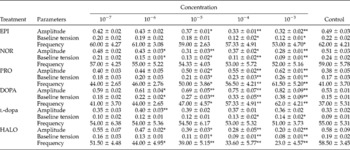
The effect of 10−3 M to 10−7 M epinephrine (EPI), norepinephrine (NOR), propranolol (PRO), dopamine (DOPA), l-dopa and haloperidol (HALO) on amplitude (g), baseline tension (g) and frequency (Hz) of spontaneous muscular activity of six worms of Paramphistomum cervi; mean±standard error (n=6) with P values significant at<0.05* and<0.01**.

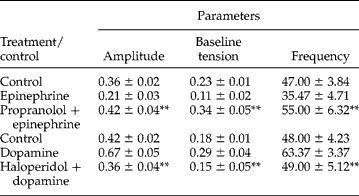
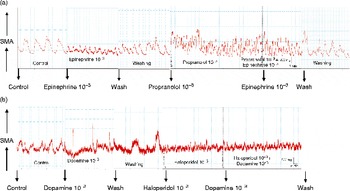
Following the cumulative administration of 1 log unit in ascending order (10− 7 to 10− 3 M), epinephrine elicited a concentration-dependent reduction of amplitude at 10− 5 to 10− 3 M, of baseline tension at 10− 4 to 10− 3 M and of frequency at 10− 3 M concentration as compared to control SMA. Similarly, with the administration of graded (10− 7 to 10− 3 M) molar concentration of 1 log unit in ascending order, norepinephrine produced a significant reduction in amplitude and baseline tension at 10− 6 to 10− 3 M concentrations, compared with controls. Subsequently, propranolol (10− 7 to 10− 3 M), an adrenergic antagonist, exhibited a significant increase in amplitude and baseline tension at 10− 5 to 10− 3 M concentrations and frequency at 10− 5 to 10− 3 M as compared with controls (table 1). On the other hand, epinephrine induced an inhibitory effect which was completely blocked by propranolol (10− 3 M) and followed by an excitation of SMA of P. cervi (table 2, fig. 1a).
The effect of 10−3 M concentration of propranolol, epinephrine, haloperidol and dopamine on amplitude (g), baseline tension (g) and frequency (Hz) of spontaneous muscular activity of six worms of Paramphistomum cervi; mean±standard error (n=6) with P values significant at<0.01**.

(colour online) The effect of 10− 3 M concentrations of (a) propranolol and epinephrine (b) haloperidol and dopamine on spontaneous muscular activity (SMA) of Paramphistomum cervi.

The addition of dopamine (10− 7 to 10− 3 M) to the bath fluid containing isometrically mounted mature P. cervi caused an excitation of SMA in a dose-dependent manner. Significant excitatory activities of dopamine on amplitude and baseline tension were observed at 10− 6 to 10− 3 M concentrations and on frequency at 10− 5 to 10− 3 M, as compared to the control values. Likewise, following the cumulative administration of 1 log unit in ascending order (10− 7 to 10− 3 M), l-dopa produced a significant increase in the amplitude of spontaneous muscular contractions at 10− 6 and 10− 5 M. Furthermore, there was a dose-dependent (10− 7 to 10− 3 M) increase in baseline tension at 10− 4 and 10− 3 M concentration. l-Dopa did not evoke any significant alteration in the frequency of the contractile activity of P. cervi when compared with controls. Haloperidol (10− 7 to 10− 3 M), an antagonist of dopamine, produced a significant increase in amplitude at the concentrations of 10− 6 to 10− 3 M, baseline tension at 10− 5 to 10− 3 M and frequency at 10− 6 to 10− 3 M, as compared to control observations (table 1). Dopamine-induced (10− 3 M) excitatory activity on the amplitude, baseline tension and frequency of the contractile activity of P. cervi was found to be completely blocked by haloperidol, showing inhibition of SMA (table 2, fig. 1b).
Discussion
Adrenergic neurotransmitters are important in the functioning of the central and peripheral nervous systems of trematodes and their animal hosts (Maule et al., Reference Maule, Halton, Johnston, Show and Fairweather1990). In vitro isometrically mounted P. cervi exhibited a uniform pattern of SMA, which is apparently similar to that of S. mansoni (Mellin et al., Reference Mellin, Busch, Wang and Kath1983), F. hepatica (Fairweather et al., Reference Fairweather, Holmes and Threadgold1983), Gigantocotyle explanatum (Ahmed & Nizami, Reference Ahmed and Nizami1990), F. gigantica (Tripathi et al., Reference Tripathi, Kumar, Chandra and Prasad2000) and G. crumenifer (Verma et al., Reference Verma, Kumar and Tandon2010). In the present study, both epinephrine and norepinephrine elicited inhibitory responses on the SMA of P. cervi. Similar inhibitory effects have been reported in F. hepatica (Holmes & Fairweather, Reference Holmes and Fairweather1984), F. gigantica (Kumar & Tripathi, Reference Kumar and Tripathi1996) and G. crumenifer (Verma et al., Reference Verma, Kumar and Tandon2010) with epinephrine and norepinephrine, but the latter did not elicit the motor activity of S. mansoni (Mellin et al., Reference Mellin, Busch, Wang and Kath1983). In the present experiment, the β-adrenergic blocker, propranolol, was found to antagonize the epinephrine-induced inhibitory response and increased the amplitude, baseline tension and frequency of the contractile activity of P. cervi.
The gross visual motility of G. crumenifer was also inhibited by pargyline and other monoamine oxidase inhibitors, thereby influencing the metabolism of norepinephrine and epinephrine (Abidi & Nizami, Reference Abidi and Nizami2000). Dopamine is another adrenergic agent used as an important classical neurotransmitter. Previous investigators have shown that dopamine produces an excitatory effect on rhythmic contractions in F. hepatica (Holmes & Fairweather, Reference Holmes and Fairweather1984) and F. gigantica (Kumar & Tripathi, Reference Kumar and Tripathi1996). In the present study dopamine also produced significant excitatory effects on the amplitude, baseline tension and frequency of SMA of P. cervi. In contrast, dopamine (0.1 mM) produced a slight decrease in motor activity of S. mansoni and the effect was blocked by haloperidol (Mellin et al., Reference Mellin, Busch, Wang and Kath1983). Yet again, l-dopa, a precursor molecule of dopamine, produced excitatory effects on amplitude and baseline tension, without significant changes in the frequency of contractions of P. cervi, which is in agreement with the earlier reports on G. crumenifer (Verma et al., Reference Verma, Kumar and Tandon2010). In the present study, haloperidol (10− 3 M concentration) completely blocked the excitatory activity of dopamine (10− 3 M concentration) and thereby confirms the antagonistic role of haloperidol on dopaminergic receptors of the SMA of P. cervi. These observations suggest that two types of receptors – adrenergic and dopaminergic – in P. cervi, and their activities, were antagonized by their classical blockers. Similarly, the presence of serotonergic, cholinergic and peptidergic neurons have been demonstrated immunocytochemically in S. mansoni (Pax et al., Reference Pax, Siefker and Bennett1984; Gustafsson, Reference Gustafsson1987), and serotonergic, cholinergic and adrenergic receptors have been shown functionally in G. crumenifer (Verma et al., Reference Verma, Katoch, Srivastava and Pankaj2007, Reference Verma, Kumar and Tandan2009, Reference Verma, Kumar and Tandon2010). The present investigation also suggests the involvement of adrenergic and dopaminergic receptors in the muscle of P. cervi.
Furthermore, both epinephrine and norepinephrine produced inhibitory effects, whereas dopamine and l-dopa produced excitatory effects on the spontaneous muscular contraction of P. cervi. Antagonistic reactions to the inhibitory effect of epinephrine and norepinephrine and excitatory effect of dopamine and l-dopa by their respective blockers propranolol and haloperidol have also corroborated their role on the spontaneous motility of P. cervi.
Acknowledgements
The authors are grateful to the Indian Council of Agricultural Research (ICAR), Government of India, New Delhi, for providing financial assistance, and Director of Research (Vety), CVSc, Khanapara for providing necessary facilities to carry out the research work. The authors also confirmed that there is no conflict of interest in the study.