Despite growing recognition of the significance of mental health issues in Africa, Africa is greatly underrepresented in mental health research. One review found that <1% of mental health studies in published research have been conducted in Africa,Reference Patel and Sumathipala 1 despite the fact that Africa’s population of an estimated 1.1 billion represents a substantial proportion of the world’s 7.2 billion living members. Africa is specifically underrepresented in the research literature on disaster mental health,Reference Norris, Friedman and Watson 2 even though disasters, including terrorist incidents, commonly occur on this continent.Reference Krueger and Maleckova 3 , Reference Kim 4
Previous disaster research focusing on differences among ethnocultural groups has suggested that membership in specific ethnic and cultural groups may be associated with differences in the prevalence of post-traumatic stress disorder (PTSD).Reference Alcántara, Casement and Lewis-Fernandez 5 Similarly, focus groups with Spanish and Mandarin-speaking individuals conducted after the September 11, 2001, attacks encountered broader ethnocultural differences in disaster-related community concerns over time.Reference Johnson, North and Pollio 6 These ethnocultural differences may have important effects on disaster mental health responses. Little is known, however, about relationships between mental health and the traditional culture of African people, and even less is known about how different ethnic groups may be affected by large terrorist attacks.
Kenya is an ethnically diverse country in East Africa, with a long history of strong tribal affiliations that have shaped the social identity, culture, and politics of the local communities.Reference Collier and Sambanis 7 Altogether, Kenya has at least 42 distinct tribal groups. The Kikuyu tribe currently constitutes the largest ethnic group in Kenya, most heavily concentrated in the eastern and central provinces of Kenya, representing 22% of the country’s population, and this group is closely related to the Meru tribe in the same geographic areas.Reference Chege 8 The largest of the other tribal groups are the Luhya (14%) and Luo (13%) in far western Kenya, Kalenjin (12%) in the Rift Valley of western Kenya, Kamba (11%) in the eastern province, and Meru (5%) in eastern and central Kenya.Reference Chege 8 - Reference Juma 10
At 10:30 AM on August 7, 1998, a terrorist truck bomb severely damaged the US Embassy building in Nairobi, Kenya. The blast killed 213 persons, including 12 Americans and 32 locally engaged staff (LES) of the American Embassy, and wounded nearly 5000 people in the vicinity of the explosion. 11 Thirty-one surrounding buildings were seriously damaged and >100 structures sustained damage, resulting in a total of approximately $40 million in damages. 11 The high concentration of Kikuyu in provinces that include the city of NairobiReference Chege 8 put high numbers of this ethnic group at risk for exposure to the bomb blast in the 1998 terrorist attack on the US Embassy in Nairobi.
A study of the mental health effects of the bombing on civilian survivorsReference Zhang, Pfefferbaum and Narayanan 12 provided a consequential contribution to the literature on disaster mental health in Africa. Data on ethnic affiliations of the research participants in this study provide a unique opportunity to examine potential differences in mental health outcomes among members of different ethnic groups exposed to this disaster. These differences may be useful in determining the focus of disaster mental health interventions and guiding their implementation.
METHODS
Sample and Procedures
Approximately 8 to 10 months after the disaster, this study investigating the mental health effects of the bombing sampled 3 groups of Nairobi citizens: employees of businesses in the path of the bomb blast, rescue and recovery workers responding to the disaster, and African personnel of the US State Department at the US Embassy and US Agency for International Development (USAID) in Nairobi. Employee rosters of 6 businesses in the immediate vicinity of the US Embassy that were in the direct path of the bomb blast were used to randomly select 1 of 5 employees, with participation of 244 of 271 (90%) of the selected civilian employees. A list provided by the Kenyan Red Cross Society of the International Federation of the Red Cross and Red Crescent Societies including approximately 1500 rescue and recovery workers who responded to the bombing was used to randomly select 1 of 15 from the list, with 69 of 100 (69%) of these workers participating. US government LES of the US State Department (N=56) and USAID (N=74) were encouraged to participate in the study, providing a combined participation rate of 42% from a total of about 319 estimated African employees of the US government in these 2 agencies at the time of the bombing.
Information on ethnic affiliation was provided by 392 participants (88% of 446), constituting the sample for ethnic analyses. The total sample of 392 participants with ethnic affiliation data for this study included 229 civilian employees, 64 Red Cross workers, and 99 US government employees. A list of 7 main ethnic affiliation groups was established for groups with at least 10 members in the sample. An “other” ethnic affiliation category was created to include 27 other ethnic affiliations mentioned, with no group representing more than 5 study participants. Missing ethnic affiliation information was associated with greater age (mean [SD] years=37.9 [10.2] vs. 34.6 [8.6] years; t=2.30, df=414, P=0.022) and lower disaster injury rates (33% vs. 65%; χ2=20.48, df=1, P<0.001), but unavailability of ethnic affiliation information was not associated with demographic or disaster exposure variables or with pre-disaster or post-disaster disorders. Ethnic affiliation data were missing for significantly more of the US government employees (26% vs. 6%; χ2=32.25, df=1, P<0.001) and fewer of the employees of nearby businesses (6% vs. 19%; χ2=17.98, df=1, P<0.001) than for other participants.
This study was approved in advance by the institutional review boards of Washington University School of Medicine and the University of Oklahoma Health Sciences Center. Participants provided written informed consent upon study entry. Additional details about the sampling, interview procedures, and previous findings are provided in a previous publication.Reference Zhang, Pfefferbaum and Narayanan 12
Assessments
Participants were administered the Diagnostic Interview Schedule for the Diagnostic and Statistical Manual of Mental Disorders (Fourth Edition) (DIS-IV)Reference Robins, Cottler, Compton, Bucholz, North and Roarke 13 and the Disaster Supplement to the DIS.Reference North, Pfefferbaum, Robins and Smith 14 Selected sections of the DIS administered in this study were PTSD, major depression, panic disorder, generalized anxiety disorder, and alcohol use disorder. Diagnoses assessed by the DIS-IV included specification of current, pre-disaster, and post-disaster diagnosis, through separate questioning about symptoms in time frames before and after the date of the disaster. The Disaster Supplement obtained information on the participants’ ethnic affiliations.
Data Analysis
The data were entered into an Excel spreadsheet (Microsoft Corp, Redmond, WA) and imported into SAS 9.4 (SAS Institute Inc, Cary, NC) for analysis. Descriptive data were summarized as numerical counts, proportions, and means with standard deviations (SDs). Categorical variables were compared by using two-tailed chi-square analyses (substituting Fisher’s exact tests when expected cell numbers were <5). Numerical and categorical variables were compared by using Student’s t-tests, substituting the Satterthwaite method for instances of unequal variance. Multiple logistic regression models were developed to predict post-disaster diagnosis (dependent variable, separate model for each diagnosis variable) from independent covariates entered into the model simultaneously, including sample subgroup and ethnic affiliation groups (using separate models for each ethnic affiliation group). Variance inflation testing in the final models was within acceptable limits (≤1.5 for all variables). Statistical significance was set at α=0.05.
RESULTS
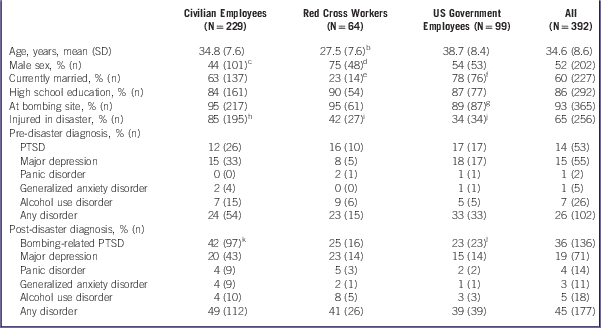
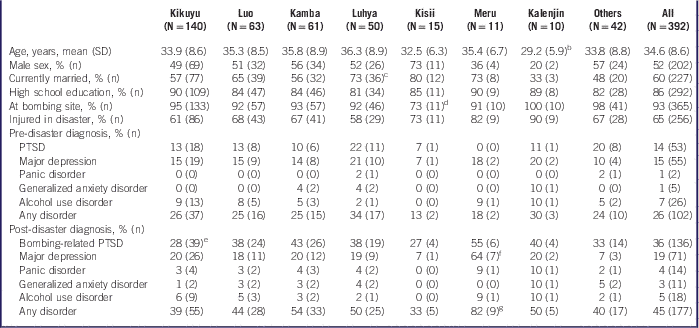
Demographic characteristics and psychiatric disorders in the sample (N=392) are provided for the 3 study samples (Table 1) and for the ethnic affiliation groups (Table 2; ethnic affiliation groups presented in order of group size, followed by the “other” category and a column representing the entire sample). Overall, the sample was about equally represented by males and females, with a mean age of 35 years (median=34 years). More than one-half of sample was currently married, and most had completed high school. The vast majority of the sample had been present at the bombing site during the explosion or in the immediate aftermath. Nearly two-thirds of the sample had been injured in the disaster. Approximately one-fourth had a pre-disaster psychiatric disorder, most commonly major depression or PTSD.
Sample Demographic Characteristics Across Ethnic Affiliation GroupsFootnote a

a Abbreviation: PTSD, post-traumatic stress disorder. Note: denominators vary slightly based on occasional missing data on some variables.
b P<0.001 vs mean (SD)=36.0 (8.0); t=7.79, df=375.
c P<0.001 vs 62%; χ2=12.16, df=1.
d P<0.001 vs 47%; χ2=16.87, df=1.
e P<0.001 vs 67%; χ2=43.41, df=1.
f P<0.001 vs 54%; χ2=16.89, df=1.
g P=0.036 vs 95%; χ2=4.41, df=1.
h P<0.001 vs 35%; χ2=111.78, df=1.
i P<0.001 vs 70%; χ2=18.04, df=1.
j P<0.001 vs 76%; χ2=56.04, df=1.
k P<0.001 vs 24%; χ2=14.28, df=1.
l P<0.001 vs 39%; χ2=14.28, df=1.
Sample Demographic Characteristics Across Ethnic Affiliation GroupsFootnote a

a Abbreviation: PTSD, post-traumatic stress disorder. Note: denominators vary slightly based on occasional missing data on some variables.
b P=0.045 vs mean (SD)=34.7 (8.6); t=2.01, df=375.
c P=0.040 vs 58%; χ2=4.22, df=1.
d P=0.002 vs 94%; Fisher’s exact test.
e P=0.034 vs 38%; χ2=4.49, df=1.
f P=0.001 vs 18%; Fisher’s exact test.
g P=0.027 vs 44%; Fisher’s exact test.
As shown in Table 1, compared to all others in the sample, the civilian employee group had a lower proportion of males and a higher proportion injured in the disaster. The Red Cross group was younger and had a higher representation of males and married individuals, fewer at the site during or in the immediate aftermath of the bombing, and fewer injured in the bombing. The US government employees had a higher proportion who were married and fewer who were at the bombing site or injured. The Red Cross group had a significantly greater representation of Luo (27% vs. 14% [16% of civilian employees and 10% of US government employees]; χ2=6.24, df=1, P=0.013) and less of Kamba (3% vs. 19% [18% of civilian employees and 18% of US government employees]; χ2=9.00, df=1, P=0.003) than did the other study groups (not shown in tables).
As shown in Table 2, the study sample’s most prevalent affiliation was Kikuyu (36%), reflecting the overall ethnic composition of Kenya nationally. Luo and Kamba (16% each) were the second and third most prevalent ethnic groups, respectively. Members of the Kalenjin group were significantly younger than the remainder of the sample. More members of the Luhya group were married compared to all others. Fewer members of the Kisii group were at the bombing site during the explosion or in the immediate aftermath. Ethnic affiliation groups did not differ by prevalence of sex, educational attainment, any pre-disaster diagnosis, or injury in the bombing.
There were no significant differences in pre-disaster psychiatric disorders among sample subgroups (Table 1). The civilian employee subgroup had a significantly higher prevalence and the US government employees had a significantly lower prevalence of bombing-related PTSD compared with others in the sample. No other subgroup differences in post-disaster diagnosis prevalence were detected among these sample subgroups.
There were no differences in pre-disaster psychiatric disorders among sample subgroups (Table 2). Members of the Kikuyu group had a significantly lower prevalence of bombing-related PTSD compared to all other groups. Members of the Meru group had the absolute highest percentage of bombing-related PTSD of all the groups, but the difference compared to all others was not statistically significant. The Meru group did, however, have a significantly higher post-disaster prevalence of major depression and any post-disaster diagnosis compared to all others. No other ethnic group affiliation was significantly associated with post-disaster diagnoses.
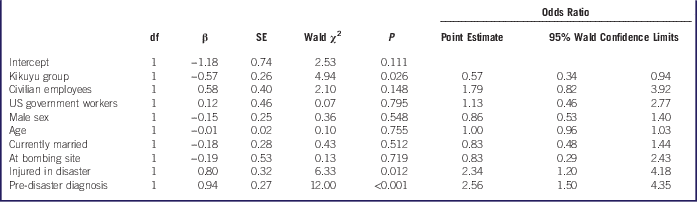
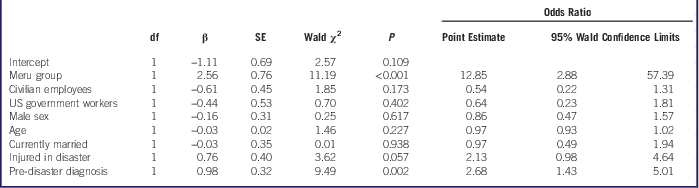
Two multiple logistic regression models were constructed to predict post-disaster psychiatric disorders from a collection of independent covariates based on results of the bivariate analyses. The findings of these models are presented in Table 3 (predicting PTSD from Kikuyu ethnic affiliation) and Table 4 (predicting post-disaster major depression from Meru ethnic affiliation). Independent variables included in both of these models included sample subgroup (specifying the Red Cross worker group as a dummy value because it was not associated with post-disaster disorders in bivariate analyses), specific ethnic affiliation group, demographic variables (age, sex, and current married status), disaster-related injury, and any pre-disaster diagnosis entered simultaneously into the model. Direct exposure to disaster trauma was excluded from the model in Table 2 because incomplete separation of data points prohibited estimation of maximum likelihood, and elimination of this variable solved this analytic dilemma.
Results of Multiple Logistic Regression Model Predicting Disaster-Related Post-traumatic Stress Disorder (N=333)

Results of Multiple Logistic Regression Model Predicting Post-disaster Major Depression (N=315)

As in the bivariate analyses, Kikuyu ethnic affiliation was significantly associated with lower disaster-related PTSD prevalence, and Meru ethnic affiliation was significantly associated with higher post-disaster major depression prevalence. In these models, disaster injury was significantly associated with disaster-related PTSD and fell just short of significance in association with post-disaster major depression. Presence of any pre-disaster psychiatric disorder was significantly associated with both disorders in the multivariate models. Sample subgroup, sex, age, and currently married status added no further significance to these models controlling for the presence of all other independent variables.
DISCUSSION
This study examined the association of African ethnic affiliations with psychopathology after a terrorist bombing in Nairobi, Kenya. Kikuyu ethnic affiliation was protective against bombing-related PTSD and the Meru ethnic affiliation was a risk factor for post-disaster major depression, even after controlling for demographic and trauma exposure variables and pre-disaster psychopathology. The study did not, however, shed further light on the reasons for differing post-disaster psychopathology in these ethnic groups, especially given that they share a similar worldview, cultural practices, and geography. Prior research has established that pre-disaster psychopathology is a robust and consistent predictor approximately doubling the prevalence of PTSD,Reference Norris, Friedman and Watson 2 , Reference North, Oliver and Pandya 15 and this study again confirmed this relationship. Female gender is another strong predictor of PTSD from prior studies,Reference Norris, Friedman and Watson 2 , Reference North, Oliver and Pandya 15 but gender did not play a significant role in the models examining effects of ethnic associations with PTSD in this study.
A main strength of this study was its large sample size. Some of the ethnic groups, however, were small based on their representation in the data, yet significant main findings were evident even with such small group sizes. Additional strengths of this study were the systematic recruitment method and the 90% participation rate of the civilian employee subgroup. However, the lower participation rates of the other 2 study subsamples represented a sampling limitation. The use of a full diagnostic interview is an important strength, providing reliable and valid diagnostic assessment. The use of multivariate models permitted examination of ethnic groups in association with psychiatric disorders independent of the effects of the additional independent covariates entered into the models. Study limitations included the 12% missing ethnic affiliation data and potential bias based on the significant association of missing ethnic affiliation data with age and disaster-related injuries, as well as the potential for other variables not included in this study to explain the negative association of PTSD with the Kikuyu ethnic group and post-disaster major depression with the Meru ethnic group. Findings from the ethnic groups living in Nairobi who were sampled in this study may not be generalizable to members of these groups living in other places. It is unknown how strong ethnic affiliations are in modern urban Nairobi. In the years since the collection of this dataset, history has continued to evolve across time, although sources of information in this time period suggest continuing importance of ethnic affiliations in Kenya.Reference Chege 8 , Reference Gettleman 9 , 16
Given the limitations described above, it is impossible to derive data-driven discussion about the inter-group differences found in this study. Similar to the authors’ approach in previous work on ethnocultural responses to disaster,Reference Johnson, North and Pollio 6 understanding these differences requires inductive approaches to illuminating the meaning of the experience of disaster trauma exposure. The findings of this study suggest that further investigation of ethnic affiliations in association with disaster-related psychopathology is warranted. A logical approach to further explore these relationships would be to conduct qualitative or community-based participatory research.
CONCLUSIONS
This study examined associations between disaster-related psychopathology and ethnic affiliations after a terrorist bombing in Nairobi, Kenya. In this study, disaster-related PTSD was less prevalent among members of the Kikuyu group, and post-disaster major depression was more prevalent among members of the Meru group, compared with all others in the sample. Further study of disaster-related psychopathology in relation to African ethnic affiliations is needed to assist in planning resources and interventions for African disaster survivors.
Acknowledgments
This research was supported by National Institute of Mental Health grant MH40025 to Dr. North. The authors thank Jacinta Ondeng for her thoughtful comments and recommendations on drafts of this article.