INTRODUCTION
In recent years, a growing body of literature has assessed the relationship between spirituality and health. Although there is not a consensus on the exact definition of spirituality (Lazenby, Reference Lazenby2010), it is associated with a sense of purpose, peace, meaning in life, and relationship (Edwards et al., Reference Edwards, Pang and Shiu2010). Several studies have shown that spirituality has a positive impact on physical (Nelson, Reference Nelson2009; Campbell et al., Reference Campbell, Yoon and Johnstone2010; Park et al., Reference Park, Lee and Sun2011) and mental health (Baetz & Toews, Reference Baetz and Toews2009; Koenig, Reference Koenig2009; Dein et al., Reference Dein, Cook and Powell2010) as well as health-related quality of life (HRQOL), especially in chronic or life-threatening disease (Krupski et al., Reference Krupski, Kwan and Fink2006; Finkelstein et al., Reference Finkelstein, West and Gobin2007; Vallurupalli et al., Reference Vallurupalli, Lauderdale and Balboni2011). Spirituality has been shown to be associated with coping with illness and with less anxiety, depression, and social isolation in patients with chronic disease, as well as cancer (Mueller et al., Reference Mueller, Plevak and Rummans2001; Wachholtz et al., Reference Wachholtz, Pearce and Koenig2007). Therefore, assessment of spiritual well-being to screen for spiritual suffering and to identify patients who need spiritual care is an essential component of the multidimensional care of patients.(Sulmasy, Reference Sulmasy2002; Selman et al., Reference Selman, Harding and Gysels2011)
The Functional Assessment of Chronic Illness Therapy–Spiritual Well-Being (FACIT-Sp) scale is a valid and reliable instrument that was developed in the 1990s to provide an inclusive measure of spirituality in research and clinical practice (Brady et al., Reference Brady, Peterman and Fitchett1999; Bredle et al., Reference Bredle, Salsman and Debb2011). This questionnaire assesses spirituality well-being as well as HRQOL, regardless of religious or spiritual tradition (Bredle et al., Reference Bredle, Salsman and Debb2011). It consists of a core general questionnaire for measuring HRQOL and an additional scale for measuring spirituality. The core general questionnaire that measures HRQOL is commonly called the Functional Assessment of Cancer Therapy—General (FACT-G). The FACT-G is composed of four subscales: Physical Well-being (seven items), Social/Family Well-being (seven items), Emotional Well-being (six items), and Functional Well-being (seven items) (Cella et al., Reference Cella, Tulsky and Gray1993). The additional scale for measuring spirituality contains 12 items and 3 subdomains (Peace, Meaning, and Faith) (Bredle et al., Reference Bredle, Salsman and Debb2011) When the 12-item Spiritual Well-being scale is added to the FACT-G, the entire scale is called the FACIT-Sp. The FACIT-Sp is self-administered and uses a five-point Likert-type scale (0 = Not at all; 4 = Very much) (Bredle et al., Reference Bredle, Salsman and Debb2011). Hereafter, when we refer to the FACIT-Sp we refer to all five subscales (Physical, Social/Family, Emotional, Function, and Spiritual Well-being), and when we refer to the FACT-G we refer to the four subscales that measure HRQOL (Physical, Social/Family, Emotional, and Functional Well-being).
Because of its widespread use in research and clinical practice, the FACIT-Sp has been translated into Arabic, Chinese (simplified and traditional), Danish, Dutch, French, German, Italian, Japanese, Korean, Norwegian, Portuguese, Spanish, and Swedish (Bredle et al., Reference Bredle, Salsman and Debb2011). It has not been translated into Farsi, the language of Farsi-speaking people (who reside in Iran, Afghanistan, and Tajikistan, among other countries, and in diaspora). The FACT-G questionnaire was previously translated into Farsi (http://www.facit.org), but the 12 item Spiritual Well-being subscale was not. Hence, the entire FACIT-Sp is not available to study spiritual well-being and its contribution to HRQOL among Farsi-speaking patients in treatment for cancer. The first aim of this study was to translate the 12-item Spiritual Well-being scale into Farsi, thus creating the complete Persian version of the FACIT-Sp. The second aim was to investigate the validity and reliability of the entire Persian version of the FACIT-Sp scale, thus making it available for future research on, and clinical assessment of, spiritual well-being among Farsi-speaking people.
METHOD
Development of the Farsi Version of FACIT-Sp
With the permission of the developer, the 12 item Spiritual Well-being subscale of the FACIT-Sp Version 4 was translated into Farsi by employing the FACIT translation methodology (Eremenco et al., Reference Eremenco, Cella and Arnold2005). Two native Farsi-speaking medical doctors translated the English version into Farsi. Another native Farsi speaker with adequate knowledge of medical and psychological concepts reconciled the two forward translations. This reconciled version was back-translated into English and compared with the source document. This version was reviewed by three bilingual (Farsi and English) experts. After review, the final Persian version of FACIT-Sp Version 4 was pilot tested, which consisted of interviewing 10 patients in treatment for cancer according to the cognitive debriefing protocol of the FACIT organization (Eremenco et al., Reference Eremenco, Cella and Arnold2005). Patients were asked to comment on the comprehensiveness and clarity of the items in the questionnaire and mention any difficulties encountered when answering the questions.
Participants and Data Collection
Participants were recruited using a convenience method of sampling from the referral cancer hospital St. S. Al-Shohada Hospital, Isfahan, Iran. Inclusion criteria were: histologically confirmed malignancy, at least 18 years old, ability to understand Farsi, and willingness to give written informed consent. Patients with primary brain tumors, brain metastasis, intellectual disability, psychosis, and dementia were not eligible to participate. Demographic information (age, marital status, education, and occupation) was collected through a self-administered questionnaire. Clinical data including pathological disease stage and concurrent chronic disease were extracted from medical records. Participants were instructed to read the brief directions at the top of the questionnaire. After participants’ correct understanding was confirmed, they were encouraged to complete every item in private. A total of 153 participants completed the FACIT-Sp and demographic information questionnaire.
Statistical Analysis
The sample was described using frequencies and measures of central tendency and dispersion, depending upon the level of the variable. The internal consistency of each subscale was evaluated using Cronbach's α coefficient. An α ≥ 0.70 was considered satisfactory. Confirmatory factor analysis (CFA) was used to confirm the measurement properties of the previously translated FACT-G and the newly translated 12 item Spiritual Well-being scale. Indices of goodness of fit were examined through: 1) chi-square/degrees of freedom (χ2/df), with values of <3 indicating a good fit; 2) root mean square error of approximation (RMSEA), with values of <0.08 representing an acceptable fit and values <0.05 representing a good fit; 3) comparative fit index (CFI) and Tucker-Lewis Index (TLI), for which values >0.9 were acceptable fits (Wood, Reference Wood2008) In addition, inter-subscale correlation coefficients of the FACT-Sp were estimated.
Multiple regression analysis was used to assess the predictor role of the 12 item Spiritual Well-being subscale of the FACIT-Sp and each of its subdomains (Peace, Meaning, and Faith) on general HRQOL. The item “I am content with my quality of life right now” (from the Functional Well-being subscale of the FACT-G question GF7) was considered as the dependent variable (Whitford & Olver, Reference Whitford and Olver2011) and the Peace, Meaning, and Faith subdomains of the Spiritual Well-being subscale of the FACIT-Sp were entered as independent variables. Collinearity diagnostics were performed by means of the variance inflation factors (VIF) for each independent variable entered in the regression equations; a VIF >10 was considered as positive multicollinearity (Kleinbaum et al., Reference Kleinbaum, Kupper and Muller2007). Relationships between identified subdomains of the 12 item Spiritual Well-being subscale and demographic and clinical characteristics of participants were assessed using multiple analysis of variance (MANOVA).
All reported analyses were based on two-sided tests, whereas statistical significance was noted as p < 0.05. Data of participants were analyzed by the Statistical Package for Social Sciences (SPSS, Version 19) for MicroSoft Windows. CFA procedures were conducted using analysis of moment structures (AMOS) (Arbuckle, 2009) version 18.
Ethics
The design of the study was approved by the Ethics Committee of the Vice Chancellor for Research, Isfahan University of Medical Sciences (project no.389319). All participants received trial information and provided written informed consent. The confidentiality of all information was managed by researchers in accordance with the approved Ethics Committee protocol.
RESULTS
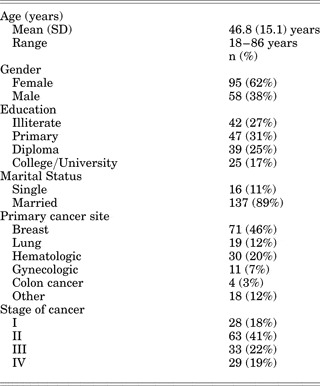
The demographic and clinical characteristics of the participants are shown in Table 1. The mean age of participants was 46.8 (SD = 15.1) years. Most were married (89%), and were educated below the level of a high school diploma (58%). All patients identified themselves as Muslim.
Participant demographic and clinical characteristics (N = 153)

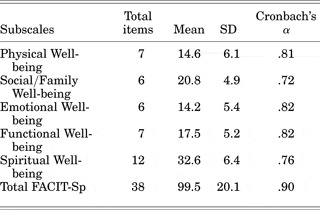
The mean FACT-G score was 67.1 (SD = 16.1). The mean for 12 item Spiritual Well-being subscale was 32.6 (SD = 6.4). The internal consistency as measured by the Cronbach's α coefficient was been found to be 0.76 for the Spiritual Well-being subscale alone and 0.90 for the entire FACIT-Sp (all five subscales together), indicating satisfactory reliability. Descriptive statistics for each subscale of the FACIT-Sp and the results of internal consistency evaluation based on Cronbach's α reliability coefficients are shown in Table 2.
FACIT–Sp descriptive statistics

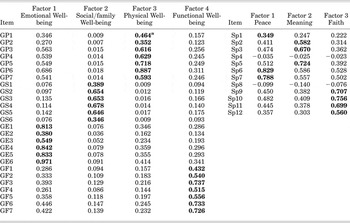
Table 3 shows the results of factor analysis on the FACIT-Sp. Item GS7 of the Social/Family Well-being subscale (“I am satisfied with my sex life”) was not included in the analysis, because <50% of the participants answered it. CFA generally replicated the original conceptualization of the five domains of the FACIT-Sp and three subdomains of the 12-item Spiritual Well-being subscale. The χ2/df was 1.65, and the CFI and TLI were both found to be 0.94. These indices point toward a good model fit. In this model, the RMSEA was 0.06, which showed an acceptable level of model fitness. The factor loadings for the items were found to be adequate (Table 4).
FACIT–Sp factor analysis

GP, Physical Well-being subscale; GS, Social/Family Well-being subscale; GE, Emotional Well-being subscale; GF, Functional Well-being subscale; Sp, Spiritual Well-being subscale.
a Significant items (p < 0.05) are in bold.
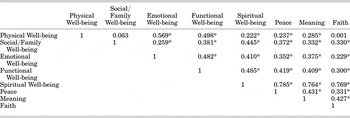
Pearson's correlation coefficients between FACIT–Sp subscales

* Correlation is significant at the 0.01 level (two-tailed).
Correlations among the four FACT-G subscales and three subdomains of the Spiritual Well-being subscale are shown in Table 4. Correlation coefficients of ≥0.7 between scales indicate a strong relationship (Aaronson et al., Reference Aaronson, Ahmedzai and Bergman1993). In this study, all correlation coefficients between subscales were ≤0.7, which indicated that each subscale was distinct.
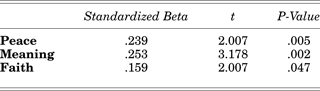
In multiple regression analyses, after evaluating the correlations among the independent variables, no multicollinearity problem was detected. All three subdomains of Spiritual Well-being subscale (Meaning, Peace and Faith) were significant predictors (p < 0.05) of HRQOL. The final model explained 26% of the variance of the HRQOL (Table 5). No statistically significant relationships between the subdomains of the Spiritual Well-being subscale and demographic characteristics and clinical status were found on MANOVA.
Predictors of the Subdomains (Peace, Meaning, Faith) of the 12-item Spiritual Well-being Subscale of Contentment with Quality of Life.
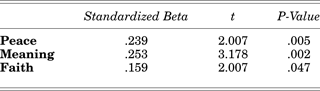
R square: 0.26
Method: Enter
Dependent variable: GF7: “I am content with the quality of my life right now.”
DISCUSSION
The results of this study indicate that the Persian version of FACIT-Sp is a valid and reliable tool to assess spirituality well-being as well as HRQOL. Cronbach's α coefficients of the subscales of the Persian FACIT-Sp ranged from 0.72 to 0.90, which is within the range of the original scale (Peterman et al., Reference Peterman, Fitchett and Brady2002), and those reported for other languages ( Noguchi et al., Reference Noguchi, Ohno and Morita2004; Lazenby et al., Reference Lazenby, Khatib and Al-Khair2011) The α for the entire FACIT-Sp is 0.90. However, α coefficients tend to increase as the number of items increases in the presence of positively correlated items (Rosenthal & Rosnow, Reference Rosenthal and Rosnow1991).
The results of the factors analysis of the 12-item Spirituality Well-being subscale suggest that the three factor model (Peace, Meaning, Faith) persists in the Persian version with acceptable internal consistencies for each factor. The original factor analysis of the 12 item Spiritual Well-being subscale supported two factors: Meaning/Peace as one, and Faith as the other (Peterman et al., Reference Peterman, Fitchett and Brady2002). Consequently, an alternative three-factor model was proposed and confirmed by instrument developers (Bredle et al., Reference Bredle, Salsman and Debb2011; Lazenby et al., Reference Lazenby, Khatib and Al-Khair2011). Our findings suggest that the three-factor model is compatible for Farsi-speaking population. However, the factor structure of 12 item Spiritual Well-being subscale showed low factor loading for items Sp4 “I have trouble feeling peace of mind” and Sp8 “My life lacks meaning and purpose.” This indicates the difficulty for Iranian patients in answering negatively worded questions. Other researchers have suggested that the Spiritual Well-being subscale could be improved by removing the negatively worded questions (4 and 8) and replacing them with positively worded items (Murphy et al., Reference Murphy, Fitchett and Stein2010; Lazenby et al., Reference Lazenby, Khatib and Al-Khair2011).
The item on the Social/Family Well-being subscale regarding sexual satisfaction was >50% unanswered, suggesting that Iranian participant were not willing to respond to such a question that, in the culture, is considered private. This finding was also observed in another validation study among an Iranian population (Ghaem et al., Reference Ghaem, Haghighi and Jafari2007), a Jordanian population (Lazenby et al., Reference Lazenby, Khatib and Al-Khair2011), and also among Japanese patients (Noguchi et al., Reference Noguchi, Ohno and Morita2004). This indicates that cultural issues should be considered when applying a standard questionnaire in a different context.
Previous studies (Fehring et al., Reference Fehring, Miller and Shaw1997) suggested that there may be a problem of overlap between the Emotional and Spiritual Well-being subscales. In the present study, the Emotional Well-being subscale of the FACIT-Sp was moderately correlated with the Spiritual Well-being subscale (r = 0.41), indicating that these two scales, although related, are sufficiently distinctive. This result was confirmed by another study (Noguchi et al., Reference Noguchi, Ohno and Morita2004).
We found that spiritual well-being is uniquely predictive of HRQOL (i.e., “I am content with the quality of my life right now”). Brady et al. (Reference Brady, Peterman and Fitchett1999) also examined the best predictors of contentment with quality of life among the Physical, Emotional, Social/Family, and Spiritual Well-being subscales of FACIT-Sp. In a stepwise regression equation, they found that the Meaning/Peace subdomain of the Spiritual Well-being subscale was the best predictor of contentment with quality of life. This result is in line with a large sample of an Australian cancer population (Whitford et al., Reference Whitford, Olver and Peterson2008) and a Jordanian (predominantly Muslim) population (Lazenby et al., Reference Lazenby, Khatib and Al-Khair2011), further demonstrating the importance of the spiritual domain.
Implications for Practice
Several studies have indicated the important role of spirituality well-being on HRQOL. And spiritual care provided during the trajectory of cancer care may increase patients’ sense of meaning (Breitbart et al., Reference Breitbart, Rosenfeld and Gibson2010). Our study introduced the Persian version of FACIT-Sp as a valid and reliable tool for clinicians to use to assess the spiritual well-being of patients in treatment for cancer and for evaluating the effectiveness of spiritual care interventions.
Implications for Research
The FACIT-Sp was designed to be used in different settings of health-related research, not just in cancer-related research (Peterman et al., Reference Peterman, Fitchett and Brady2002). Further assessment of the reliability and validity of this questionnaire should be undertaken among patients with chronic or life-threatening conditions other than cancer. As we did not find a relationship between the FACIT-Sp subscales and demographic and clinical data, the contribution of demographic and clinical factors to spiritual well-being among the Iranian population should be investigated in future studies.
Limitations and Strengths of Study
Our study was limited by its culturally homogeneous sample of patients with cancer who were in treatment in a single city of Iran, and the generalizability of the findings to a more racially and ethnically diverse Iranian population is uncertain. Replication of this study in other diverse and larger samples would help us to confirm the validity and reliability of the Persian translation of the FACIT-Sp Version 4. Additionally, we do not have measures to explore the divergent validity of the tool. Despite these limitations, the current study is unique in providing a validated tool for assessing spiritual well-being in Muslim Iranian and Farsi-speaking patients in other regions of the world who are in treatment for cancer.
CONCLUSION
Our study provides evidence that the Persian version of FACIT-Sp Version 4 is a valid and reliable measure to use with Farsi-speaking persons with cancer. Further research is necessary to replicate the findings in culturally diverse populations and among populations with other chronic diseases.
ACKNOWLEDGMENTS
This manuscript is the first report of the dissertation project numbered 389319 founded by the research chancellor of Isfahan University of Medical Sciences. Our heartfelt thanks are extended to patients who so graciously agreed to participate. The authors also thank the FACIT organization for their permission to translate the FACIT-Sp12 and for the time spent to approve the translated questionnaire.