Introduction
One important debate that drives second/foreign language (L2) processing research is whether or not non-native speakers who have begun learning the L2 after the so-called critical period for language acquisition (e.g., Abrahamsson & Hyltenstam, Reference Abrahamsson and Hyltenstam2009; Bialystok & Miller, Reference Bialystok and Miller1999; Birdsong, Reference Birdsong2006; Birdsong & Mollis, Reference Birdsong and Molis2001; DeKeyser, Reference DeKeyser2000; DeKeyser, Alfi-Shabtay & Ravid, Reference DeKeyser, Alfi-Shabtay and Ravid2010; Hakuta, Bialystok & Wiley, Reference Hakuta, Bialystok and Wiley2003; Johnson & Newport, Reference Johnson and Newport1989), also referred to as “late” L2 learners, rely on mechanisms similar to those of native speakers in L2 processing. One linguistic domain where this debate has received considerable attention is that of morphology. Recent L2 morphological processing studies have investigated whether late L2 learners show sensitivity to the morphological structure of words when accessing them (e.g., Babcock, Stowe, Maloof, Brovetto & Ullman, Reference Babcock, Stowe, Maloof, Brovetto and Ullman2012; Basnight-Brown, Chen, Hua, Kostic & Feldman, Reference Basnight-Brown, Chen, Hua, Kostic and Feldman2007; Bowden, Gelfand, Sanz & Ullman, Reference Bowden, Gelfand, Sanz and Ullman2010; Clahsen, Balkhair, Shutter & Cunnings, Reference Clahsen, Balkhair, Shutter and Cunnings2013; Clahsen, Felser, Neubauer, Sato & Silva, Reference Clahsen, Felser, Neubauer, Sato and Silva2010; Diependaele, Duñabeita, Morris & Keuleers, Reference Diependaele, Duñabeitia, Morris and Keuleers2011; Feldman, Kostic, Basnight-Brown, Durdevic & Patizzo, Reference Feldman, Kostic, Basnight-Brown, Durdevic and Pastizzo2010; Gor & Cook, Reference Gor and Cook2010; Gor & Jackson, Reference Gor and Jackson2013; Jacob, Fleischhauer & Clahsen, Reference Jacob, Fleischhauer and Clahsen2013; Lehtonen Niska, Wande, Niemi & Laine, Reference Lehtonen, Niska, Wande, Niemi and Laine2006; Neubauer & Clahsen, Reference Neubauer and Clahsen2009; Portin, Lehtonen, Herrer, Wande, Niemi & Laine, Reference Portin, Lehtonen, Herrer, Wande, Niemi and Laine2008; Portin, Lehtonen & Laine, Reference Portin, Lehtonen and Laine2007; Silva & Clahsen, Reference Silva and Clahsen2008). These studies suggest that many factors mitigate whether or not L2 learners show sensitivity to the morphological structure of words, including the similarity between the native and target languages (e.g., Basnight-Brown et al., Reference Basnight-Brown, Chen, Hua, Kostic and Feldman2007; Feldman et al., Reference Feldman, Kostic, Basnight-Brown, Durdevic and Pastizzo2010; Portin et al., Reference Portin, Lehtonen, Herrer, Wande, Niemi and Laine2008), the surface frequency of morphologically complex words (e.g., Bowden et al., Reference Bowden, Gelfand, Sanz and Ullman2010; Gor & Cook, Reference Gor and Cook2010; Gor & Jackson, Reference Gor and Jackson2013; Lehtonen et al., Reference Lehtonen, Niska, Wande, Niemi and Laine2006; Portin et al., Reference Portin, Lehtonen and Laine2007, Reference Portin, Lehtonen, Herrer, Wande, Niemi and Laine2008), the nature of the affix (derivational vs. inflectional; e.g., Silva & Clahsen, Reference Silva and Clahsen2008), and L2 learners’ proficiency and age of acquisition (e.g., Babcock et al., Reference Babcock, Stowe, Maloof, Brovetto and Ullman2012; Feldman et al., Reference Feldman, Kostic, Basnight-Brown, Durdevic and Pastizzo2010; Gor & Cook, Reference Gor and Cook2010; Gor & Jackson, Reference Gor and Jackson2013).
Two general positions have been adopted with regards to the L2 processing of morphology. The first position is that highly proficient late L2 learners use mechanisms similar to those used by native speakers for processing morphologically complex words (e.g., Diependaele et al., Reference Diependaele, Duñabeitia, Morris and Keuleers2011; Feldman et al., Reference Feldman, Kostic, Basnight-Brown, Durdevic and Pastizzo2010; Gor & Cook, Reference Gor and Cook2010; Gor & Jackson, Reference Gor and Jackson2013; Lehtonen et al., Reference Lehtonen, Niska, Wande, Niemi and Laine2006; Portin et al., Reference Portin, Lehtonen and Laine2007, Reference Portin, Lehtonen, Herrer, Wande, Niemi and Laine2008). Researchers who argue for this position differ in whether or not they assume that L2 learners store all morphologically complex words in their whole form or decompose some or all of them into stem and affix (see below). However, they converge in suggesting that late L2 learners can rely on mechanisms similar to those used by native speakers for processing morphologically complex words, and that although morphological processing may change with increasing proficiency, these changes are quantitative rather than qualitative. The second position is that late L2 learners tend to rely more on whole-word storage than on decomposition when processing morphologically complex words (e.g., Babcock et al., Reference Babcock, Stowe, Maloof, Brovetto and Ullman2012; Basnight-Brown et al., Reference Basnight-Brown, Chen, Hua, Kostic and Feldman2007; Bowden et al., Reference Bowden, Gelfand, Sanz and Ullman2010; Clahsen et al., Reference Clahsen, Balkhair, Shutter and Cunnings2013; Jacob et al., Reference Jacob, Fleischhauer and Clahsen2013; Neubauer & Clahsen, Reference Neubauer and Clahsen2009; Silva & Clahsen, Reference Silva and Clahsen2008). Some of the researchers adopting this position argue that L2 learners show a shift from whole-word storage to decomposition as they become more proficient in the target language (e.g., Babcock et al., Reference Babcock, Stowe, Maloof, Brovetto and Ullman2012; Basnight-Brown et al., Reference Basnight-Brown, Chen, Hua, Kostic and Feldman2007; Bowden et al., Reference Bowden, Gelfand, Sanz and Ullman2010), thus suggesting a qualitative change in the mechanisms that underlie L2 morphological processing with increasing proficiency; others, by contrast, suggest that late L2 learners and native speakers rely on qualitatively different mechanisms for processing morphologically complex words, irrespective of proficiency (e.g., Clahsen et al., Reference Clahsen, Felser, Neubauer, Sato and Silva2010, Reference Clahsen, Balkhair, Shutter and Cunnings2013; Jacob et al., Reference Jacob, Fleischhauer and Clahsen2013; Neubauer & Clahsen, Reference Neubauer and Clahsen2009; Silva & Clahsen, Reference Silva and Clahsen2008).
The present study further contributes to this debate by examining whether L2 learners at varying levels of proficiency can decompose morphologically complex verbs. We use a masked-priming word-naming task to investigate whether native English-speaking late L2 learners of French decompose morphologically complex French verbs into stem and affix, and whether French proficiency modulates their ability to do so. Unlike some of the previous masked-priming L2 studies (e.g., Clahsen et al., Reference Clahsen, Balkhair, Shutter and Cunnings2013; Neubauer & Clahsen, Reference Neubauer and Clahsen2009; Silva & Clahsen, Reference Silva and Clahsen2008), we show that late L2 learners can indeed decompose morphologically complex words, and their ability to do so further increases with French proficiency, thus falsifying theories that suggest that qualitatively different mechanisms underlie L2 learners’ and native speakers’ morphological processing.
The paper is organized as follows: first, we review the different types of mechanisms that have been proposed for native speakers’ processing of morphologically complex words; second, we review L2 morphological processing theories and experimental studies; next, we present the method and results of a masked-priming word-naming task; finally, we discuss these results and their implications for understanding the mechanisms that underlie morphological processing in late L2 learners.
Morphological processing models
In the psycholinguistic literature, morphological processing models can be divided into two approaches: single-mechanism and dual-mechanism approaches.
Within the single-mechanism approach, two specific models that differ quite markedly have been put forward. The first type of single-mechanism model is that of connectionist models, where all words (morphologically simple or complex) are processed and represented in a distributed network of semantic, phonological, and orthographic information (e.g., McClelland & Patterson, Reference McClelland and Patterson2002; Rumelhart & McClelland, Reference Rumelhart, McClelland, McClelland, Rumelhart and Group1986). Such models posit that all words are stored in whole form and no representational distinction exists between regular and irregular words, with stems not being stored separately from affixes. The second type of single-mechanism model also stipulates that regular and irregular words are processed similarly, but unlike the first type of model, morpho-phonological rules are used to decompose regular and irregular words into their morphological constituents (e.g., Embick & Marantz, Reference Embick and Marantz2005; Halle & Marantz, Reference Halle and Marantz1993).
The dual-mechanism approach is perhaps the most widely accepted one in the morphological processing literature (e.g., Baayen, Dijkstra & Schreuder, Reference Baayen, Dijkstra and Schreuder1997; Clahsen, Reference Clahsen1999; Marslen-Wilson & Tyler, Reference Marslen-Wilson and Tyler1998; Pinker, Reference Pinker1999; Pinker & Ullman, Reference Pinker and Ullman2002; Ullman, Reference Ullman2001). Models from this approach, such as Pinker's (Reference Pinker1999) Words-and-Rules model, posit that storage and composition are both involved in the processing of morphologically complex words: irregulars are argued not to be decomposable into morphological constituents, and thus stored and accessed in whole form, whereas regularly inflected words are claimed to be composed of stems and affixes, which are stored separately and computed to form morphologically complex words. Work by Ullman and colleagues has built upon the Words-and-Rules model to claim that these two distinct components of word processing draw on separate domain-general memory systems in the brain: the declarative memory system rooted in the medial temporal lobe, and the procedural memory system rooted in the frontal lobe and basal ganglia. The declarative memory system is associated with learning arbitrary information, such as facts about specific events or about the world; in the morphological processing domain, it is involved in memorizing irregular words (went). By contrast, the procedural memory system is associated with learning behavioural sequences, such as motor and cognitive skills; in the morphological processing domain, it is responsible for computing regularly inflected forms from stems and affixes (e.g., walk+ing).
Recent research that has lent support to dual-mechanism approaches to native morphological processing comes from masked-priming tasks, which often include a lexical decision component. Typically, masked-priming lexical decisions tasks have participants see a mask (########), followed by a 30–60-millisecond (ms) prime, followed by the target word. When the target word appears on the screen, the participant quickly decides whether or not the letter string they see is a real word. Importantly, the prime is presented too quickly for participants to be aware of it. The rationale behind using such a task is that only some types of primes should facilitate lexical decisions about target words, given the brief stimulus-onset asynchrony (SOA). These tasks typically include three prime conditions: (i) an identity condition, where the prime and the target are the same word (e.g., walk–WALK); (ii) a morphologically related condition, where the prime is the morphologically inflected word and the target is the stem form or vice versa (e.g., walking–WALK); and (iii) an unrelated condition, where the prime is an unrelated word that has the same lexical frequency and length as the target word but no semantic or orthographic relationship with it (e.g., read–WALK). The identity condition should show the maximum amount of priming possible for the target word since it is identical to it, whereas the unrelated prime will provide the minimal amount of priming possible for that same target. The reaction times to the morphological conditions are then compared to the reaction times to the identity and the unrelated conditions. Semantic and orthographic primes (e.g., respectively, hike–WALK and talk–WALK) are typically included as control conditions to ensure that morphological priming is not due to semantic or orthographic overlap. Note, however, that semantic priming should not occur in masked-priming paradigms given the short SOA of the prime (Rastle, Davis, Marslen-Wilson & Tyler, Reference Rastle, Davis, Marslen-Wilson and Tyler2000).
Behavioural work on morphological processing in English suggests that morphological decomposition is an early and automatic process that occurs based on the orthographic appearance of morphological structure. For example, in a masked-priming lexical decision task, Rastle, Davis and New (Reference Rastle, Davis and New2004) showed that native English speakers attempted to decompose target words that had a genuine or apparent morphological relationship with the prime (e.g., respectively, cleaner–CLEAN, and corner–CORN), but not targets that overlapped orthographically with the prime but did not contain an apparent morpheme (e.g., brothel–BROTH). These results were interpreted as evidence that the orthographic appearance of morphological structure (e.g., -er in corner) is enough to initiate morpheme stripping, even in the absence of semantic transparency. The authors refer to this as morpho-orthographic segmentation (but see Crepaldi, Rastle, Coltheart & Nickels, Reference Crepaldi, Rastle, Coltheart and Nickels2010 for evidence that priming can also occur with morphologically related words that cannot be decomposed).
Another method used for investigating morphological decomposition relies on surface-form and lemma frequency effects. Words that are stored in the lexicon have resting activation levels that reflect their frequency in the input. If a morphologically complex word is stored in its whole form, it should be its surface-form frequency, not its lemma frequency, that determines how rapidly it is recognized; by contrast, if a morphologically complex word is decomposed into stem and affix, it should be its lemma frequency, not its surface-form frequency, that determines how rapidly it is recognized. By controlling lemma frequency and examining the effect of surface-form frequency (or vice versa), researchers examined whether regular and irregular word forms are processed differently, as would be predicted by the dual-route mechanism.
For example, in visual lexical decision tasks, Clahsen, Eisenbeiss and Sonnenstuhl-Henning (Reference Clahsen, Eisenbeiss and Sonnenstuhl1997) found that native German speakers recognized irregular plural nouns and past participles more rapidly if they had a high surface-form frequency (e.g., Rinder “cattle”, gelaufen “run”) than if they had a low surface-form frequency (e.g., Würmer “worms”, geschlafen “slept”). This effect was not found for regular plural nouns (e.g., Kartons “cardboards” vs. Details “details”) or past participles (e.g., gepackt “packed” vs. gespielt “played”) (for a broader discussion of morphological decomposition in German, see Clahsen, Reference Clahsen1999). These findings were interpreted as evidence that irregular words are stored in their whole form, and thus show effects of surface-form frequency, whereas regular word forms are decomposed into stem and affix, and therefore do not show effects of surface-form frequency (see Ullman, Reference Ullman1999, for similar results with a visual acceptability rating task).
Other research, however, suggests that regularly inflected words can also show effects of surface-form frequency if they reach a particular surface-form frequency threshold. For example, using visual lexical decision tasks, Baayen et al. (Reference Baayen, Dijkstra and Schreuder1997) showed that regularly inflected plural Dutch nouns were recognized faster if they had a high surface-form frequency than if they had a low surface-form frequency, with high- and low-frequency words having respective means of 86 vs. 13 words per million words (Experiment 1). For English, however, Alegre and Gordon (Reference Alegre and Gordon1999) identified a much lower surface-form frequency threshold for the processing of regularly inflected English verbs, with frequency effects emerging at six (or more) words per million words (see Baayen, Wurm & Aycock, Reference Baayen, Wurm and Aycock2007). In a lexical decision task, Lehtonen et al. (Reference Lehtonen, Niska, Wande, Niemi and Laine2006) similarly report that native speakers of Swedish, a language with limited inflectional morphology, decompose words with low surface-form frequency (one word per million words), but not words with mid or high surface-form frequency (respectively, 20 and 100 words per million words).
These (and other) researchers have taken these effects of surface-form frequency as evidence that regularly inflected words can be processed via one of two routes: a whole-word storage route or a decomposition route (but see Baayen et al., Reference Baayen, Wurm and Aycock2007, for an alternative account of surface-form frequency effects in high- and low-frequency words). For the sake of processing efficiency, the route that yields the fastest word recognition is selected. For inflected words that have a sufficiently high surface-form frequency, the whole-word storage route would be more rapid than the decomposition route, whereas the opposite would be true for regularly inflected words that have a low surface-form frequency. If two routes are available for processing morphologically complex words within a certain frequency range, then we might expect to find both evidence of morphological decomposition and evidence of whole-word storage for the same words. That is, finding evidence of whole-word storage in frequency-based paradigms does not necessarily preclude that the morpho-segmentation route is available for the same words.
Given that the dual-mechanism approach is the most widely accepted model of lexical processing in the native-speaker literature, it is not surprising that it is also the approach that is the most often assumed to represent native-like processing in the L2-processing literature. However, it is still rather unclear whether L2 learners differ from native speakers in the extent to which they decompose morphologically complex words.
L2 Morphological processing
In the L2 literature, there are currently two dominant views regarding the capacity of L2 morphological processing and its predicted trajectory with increased proficiency. One view is that highly proficient late L2 learners use similar mechanisms to those used by native speakers for processing morphologically complex words (e.g., Diependaele et al., Reference Diependaele, Duñabeitia, Morris and Keuleers2011; Feldman et al., Reference Feldman, Kostic, Basnight-Brown, Durdevic and Pastizzo2010; Gor & Cook, Reference Gor and Cook2010; Gor & Jackson, Reference Gor and Jackson2013; Lehtonen et al., Reference Lehtonen, Niska, Wande, Niemi and Laine2006; Portin et al., Reference Portin, Lehtonen and Laine2007, Reference Portin, Lehtonen, Herrer, Wande, Niemi and Laine2008). The second view is that late L2 learners tend to rely more on whole-word storage than on decomposition for processing morphologically complex words (e.g., Babcock et al., Reference Babcock, Stowe, Maloof, Brovetto and Ullman2012; Basnight-Brown et al., Reference Basnight-Brown, Chen, Hua, Kostic and Feldman2007; Bowden et al., Reference Bowden, Gelfand, Sanz and Ullman2010; Clahsen et al., Reference Clahsen, Balkhair, Shutter and Cunnings2013; Jacob et al., Reference Jacob, Fleischhauer and Clahsen2013; Neubauer & Clahsen, Reference Neubauer and Clahsen2009; Silva & Clahsen, Reference Silva and Clahsen2008). These two views are in line with two different types of accounts that have been proposed for the L2 learning and processing of grammatical information: that of McDonald (Reference McDonald2006) vs. those of Ullman (Reference Ullman2001, Reference Ullman and Sanz2005), Paradis (Reference Paradis and Ellis1994, Reference Paradis2004, Reference Paradis2009), and DeKeyser (Reference DeKeyser1997, Reference DeKeyser, VanPatten and Williams2007).
In her cognitive processing account, McDonald (Reference McDonald2006) proposed that late L2 learners typically do not reach native-like attainment in the processing of grammatical information due to limitations in basic cognitive processes that depend in part on grammatical knowledge but that are not grammar specific: low working memory capacity in the L2, difficult decoding of the L2, and slow processing speed in the L2. In an auditory grammaticality judgement task, she showed that working memory capacity and decoding ability (assessed with independent tasks) were indeed significant predictors of L2 learners’ accurate detection of grammatical errors in speech. Furthermore, she showed that when native speakers were placed under stress related to these factors (e.g., increased memory load, speech masked with noise, time pressure and compressed speech), they patterned similarly to unstressed L2 learners in the same grammaticality judgment task. McDonald thus claimed that the mechanisms that underlie language processing are similar in L2 learners and native speakers, and that any changes in L2 learners’ performance with increasing proficiency should be the direct result of L2 learners’ improved working memory capacity, decoding ability, and processing speed, suggesting that these changes are quantitative rather than qualitative.
By contrast, in his declarative/procedural (D/P) model, Ullman (Reference Ullman2001, Reference Ullman and Sanz2005) proposed that, akin to Pinker's Words-and-Rules model (Reference Pinker1999), language processing is broken up into accessing stored words (in the lexicon) in the declarative-memory system and computing grammatical rules (including morphological rules) in the procedural-memory system. Ullman's D/P model posits that native speakers utilize both systems during lexical processing, accessing stored irregular word forms (e.g., went) and highly frequent regular word forms (e.g., walked), and decomposing less frequent regular word forms into separately stored morphological constituents (e.g., coughed). This latter process is claimed to be inaccessible to late L2 learners at low proficiency levels, and even at higher proficiencies, late L2 learners are argued to be generally more dependent on declarative memory than on procedural memory. However, Ullman predicts that with increased experience, and thus proficiency, L2 learners should be able to gain access to procedural memory and begin to decompose regular word forms in a qualitatively similar way to native speakers, though it is unclear from the model whether native-like attainment should eventually be possible. Thus, the changes that L2 learners show with increasing proficiency should be qualitative, insofar as their reliance on declarative memory should decrease and their reliance on procedural memory should increase.
Paradis's (Reference Paradis and Ellis1994, Reference Paradis2004, Reference Paradis2009) neurolinguistic theory of bilingualism and DeKeyser's (Reference DeKeyser1997, Reference DeKeyser, VanPatten and Williams2007) skill-acquisition theory differ from Ullman's model in a number of respects. For example, Paradis and DeKeyser propose that the knowledge stored in declarative memory is explicit in nature and the knowledge underlain by procedural memory is implicit, whereas for Ullman, the knowledge stored in declarative memory does not have to be explicit (e.g., L2 learners can compute implicit rules from regularities in their lexicon). However, like Ullman, both Paradis and DeKeyser predict that as L2 learners have further opportunities to practise the target language, they should gradually proceduralize their explicit grammatical knowledge, with this knowledge becoming implicit and with L2 learners eventually showing automatic use of it. DeKeyser (Reference DeKeyser1997, Reference DeKeyser, VanPatten and Williams2007), in particular, assumes that the proceduralization of grammatical knowledge is like the learning of any other cognitive skill, and thus should show the same power-function learning curve as other cognitive skills, with improvements in performance (i.e., higher accuracy, faster reaction times) decreasing as practice increases (see also Anderson, Reference Anderson1993; Anderson & Fincham, Reference Anderson and Fincham1994). According to DeKeyser, changes in performance should first be qualitative, as L2 learners’ explicit grammatical knowledge becomes implicit via proceduralization, and it should be quantitative thereafter as the use of this implicit grammatical knowledge becomes increasingly more automatic.
Recent auditory priming studies investigating L2 morphological processing suggest that L2 learners can rely on mechanisms similar to those used by native speakers when processing morphologically complex words. For instance, in a cross-modal-priming lexical decision task, Basnight-Brown et al. (Reference Basnight-Brown, Chen, Hua, Kostic and Feldman2007) found that like native English speakers, Serbian and Chinese late L2 learners of English who had similar English proficiency showed significant priming effects in the processing of regularly inflected English verbs (e.g., guided–GUIDE, pushed–PUSH) (for similar cross-modal priming results with Serbian L2 learners of English, see Feldman et al, Reference Feldman, Kostic, Basnight-Brown, Durdevic and Pastizzo2010, Experiment 2). Likewise, in an auditory-priming study with lexical decision, Gor and Cook (Reference Gor and Cook2010) found that, like native Russian speakers, advanced English L2 learners of Russian showed significant priming effects not only for regularly inflected Russian verbs (e.g., rabotaju–RABOTAT “I work–work”), but also for semi-regular (e.g., xozhu–XODIT “I go–go”) and irregular (e.g., zvat–ZOVU “I call–call”) verbs, and that the effect of priming increased with higher proficiency in Russian. More recently, using a similar task, Gor and Jackson (Reference Gor and Jackson2013) showed that as English-speaking L2 learners become more proficient in Russian, they go from decomposing Russian verbs with less complex and more productive stem allomorphy to decomposing Russian verbs with more complex and less productive stem allomorphy. Based on these results, Gor and Jackson suggest that both native speakers and L2 learners automatically decompose regular Russian verbs into stem and affix, but L2 learners show development in being able to decompose less regular Russian verbs.
Not all priming studies show morphological priming effects in L2 learners, however. For example, Silva and Clahsen (Reference Silva and Clahsen2008) used masked-priming lexical decision tasks to investigate the processing of inflectional and derivational morphology (e.g., prayed–PRAY, neatness–NEAT) in advanced late L2 learners of English who spoke German, Japanese, or Chinese as native languages. For both word types, native speakers showed a full morphological priming effect. By contrast, the L2 groups did not show morphological priming for inflectional morphology, and they showed a partial priming effect for derivational morphology. The authors concluded that L2 learners do not decompose morphologically complex words, irrespective of their native language, and instead store morphologically complex words in their whole form (for similar results with advanced Arabic-speaking L2 learners of English, see Clahsen et al., Reference Clahsen, Balkhair, Shutter and Cunnings2013). These results differ from those reported by Diependaele et al. (Reference Diependaele, Duñabeitia, Morris and Keuleers2011). Using masked-priming experiment to investigate L2 learners’ processing of derivational morphology, Diependaele et al. found that both high-proficiency Spanish L2 learners of English and Dutch L2 learners of English behaved identically to native English speakers, showing the greatest priming effects for prime and target words with a semantically transparent morphological relationship (e.g., viewer–VIEW), followed by prime and target words that had a semantically opaque morphological relationship (e.g., corner–CORN), followed by prime and target words that only had a form relationship (e.g., freeze–FREE). Diependaele et al. attribute the difference between their findings and those of Silva and Clahsen (Reference Silva and Clahsen2008) to methodological shortcomings in Silva and Clahsen, including too few items per condition, too few affixes in the test items, and replacement of missing values with means rather than with predicted values from multiple regressions when item difficulty and participant proficiency are predictors of the reaction times.
Neubauer and Clahsen (Reference Neubauer and Clahsen2009) also failed to find morphological priming effects in their masked-priming study (Experiment 3) on the processing of inflectional morphology by native Polish speakers who were advanced late L2 learners of German and had begun learning German after the age of 10. The inflected stimuli were regular (e.g., geöffnet–ÖFFNE “opened–(I) open”) and irregular (e.g., gefahren–FAHRE “driven–(I) drive”) past participles. Neubauer and Clahsen found that, unlike native speakers, L2 learners did not show a priming effect for either verb type. The authors concluded that late L2 learners do not decompose morphologically complex words. These results again differ from those reported by Feldman et al. (Reference Feldman, Kostic, Basnight-Brown, Durdevic and Pastizzo2010). Using a masked-priming lexical decision task (Experiment 1), Feldman et al. found that both native English speakers and high-proficiency Serbian L2 learners of English show priming effects for regularly inflected prime and stem target verbs (e.g., billed–BILL) and, importantly, not for orthographically related prime and target verbs (e.g., billion–BILL); low-proficiency L2 learners, on the other hand, show priming effects for both the morphological and orthographic conditions. The authors concluded that as L2 learners become more proficient, their reliance on form alone decreases and their reliance on semantics increases. The different findings between Feldman et al. (Reference Feldman, Kostic, Basnight-Brown, Durdevic and Pastizzo2010) and Neubauer and Clahsen (Reference Neubauer and Clahsen2009) may be due in part to methodological differences between the two studies, as well as to the formation of past participles in German vs. past-tense verbs in English.
More recently, using a cross-modal priming experiment, Jacob et al. (Reference Jacob, Fleischhauer and Clahsen2013) found that advanced Russian late L2 learners of German show partial morphological priming effects when processing both regular and irregular German past participles with a stem change (e.g., gesunken–SINKE “sunk–(I) sink”), but no priming effect when processing irregular German past participles without a stem change (e.g., gefahren–FAHRE “driven–(I) drive”). Because native German speakers showed partial morphological priming only when processing irregular past participles and full morphological priming when processing regular past participles, the authors concluded that L2 learners must be storing and accessing both regular past participles and irregular past participles with a stem change as subentries of the lexical forms rather than as stems and affixes. In other words, the authors’ interpretation of the results is contingent on their assuming a dual-route mechanism for native speakers’ processing of irregular past participles in German, even if these irregular past participles in fact show some regularity in their affixation patterns despite exhibiting stem changes (e.g., ge + sunke + n). Jacob et al. (Reference Jacob, Fleischhauer and Clahsen2013) point out that no study to date has reported full priming effects for L2 learners, in that the studies that did report morphological priming effects (e.g., Basnight-Brown et al., Reference Basnight-Brown, Chen, Hua, Kostic and Feldman2007; Diependaele et al., Reference Diependaele, Duñabeitia, Morris and Keuleers2011; Feldman et al., Reference Feldman, Kostic, Basnight-Brown, Durdevic and Pastizzo2010; Gor & Cook, Reference Gor and Cook2010; Gor & Jackson, Reference Gor and Jackson2013) did not use an identity control condition, thus making it impossible to determine whether priming was partial or full (note, however, that these identity conditions are typically not used in the native morphological processing literature).
Studies investigating L2 morphological processing have also done so by examining the effect of surface-form frequency on the processing of regular and irregular words. In a partial replication of Lehtonen et al.'s (Reference Lehtonen, Niska, Wande, Niemi and Laine2006) visual lexical decision task (described in the previous section), Portin et al. (Reference Portin, Lehtonen and Laine2007) found that highly proficient Finnish late L2 learners of Swedish showed significant effects of surface-form frequency for mid- and high-frequency words, but not for low-frequency words, mirroring native speakers’ results. Portin et al. (Reference Portin, Lehtonen, Herrer, Wande, Niemi and Laine2008) later found that Hungarian late L2 learners of Swedish showed a significant effect of surface-form frequency for high-frequency words but not for mid- or low-frequency words, whereas proficiency-matched Chinese late L2 learners of Swedish show effects of surface-form frequency for all words. From these results, Portin et al. (Reference Portin, Lehtonen, Herrer, Wande, Niemi and Laine2008) concluded that whereas Finnish and Hungarian speakers appear to decompose Swedish words, Chinese speakers may store Swedish words in their whole form, suggesting that the native language may modulate whether or not L2 learners automatically decompose morphologically complex written words (see Silva & Clahsen, Reference Silva and Clahsen2008).
Yet, some studies that examine the effects of surface-form frequency have argued that L2 learners store all regularly-inflected words. Neubauer and Clahsen (Reference Neubauer and Clahsen2009) reported the results of a visual lexical decision task (Experiment 2) where the effect of surface-form frequency was examined for regular and irregular German past participles. Their high-frequency words had a mean frequency of 3945 words per million words, and their low-frequency words had a mean frequency of 62.5 words per million words. The authors found significant frequency effects for both regular and irregular verbs in their data from advanced Polish L2 learners of German, but only for irregular verbs in native German speakers’ data. They concluded that unlike native German speakers, Polish late L2 learners of German store all German past participles in their whole form. Instead using a production paradigm, Babcock et al. (Reference Babcock, Stowe, Maloof, Brovetto and Ullman2012) examined whether proficiency-matched Chinese and Spanish L2 learners of English stored regular and irregular English past-tense verbs. Regular and irregular past-tense verbs had a mean surface-form frequency of six words per million words. Their results revealed similar effects of surface-form frequency for both regular and irregular words in both L2 groups, whereas native English speakers showed a significant effect of surface-form frequency only for irregular words. Furthermore, L2 learners who had arrived to the United States at a later age were more likely to show surface-form frequency effects for regular verbs. The authors concluded that late L2 learners store morphologically complex words irrespective of the native language (for similar results in Spanish, see Bowden et al., Reference Bowden, Gelfand, Sanz and Ullman2010).
The obvious question that arises from the previous studies is why they yielded inconsistent findings. Some cross-modal and auditory priming studies revealed significant effects of morphological priming in late L2 learners (e.g., Basnight-Brown et al., Reference Basnight-Brown, Chen, Hua, Kostic and Feldman2007; Feldman et al., Reference Feldman, Kostic, Basnight-Brown, Durdevic and Pastizzo2010; Gor & Cook, Reference Gor and Cook2010; Gor & Jackson, Reference Gor and Jackson2013; Jacob et al., Reference Jacob, Fleischhauer and Clahsen2013). By contrast, only a few masked-priming studies revealed such effects (e.g., Diependaele et al., Reference Diependaele, Duñabeitia, Morris and Keuleers2011; Feldman et al., Reference Feldman, Kostic, Basnight-Brown, Durdevic and Pastizzo2010). Although one might conclude that the amount of time during which the masked prime is presented may not be sufficient for L2 learners show sensitivity to morphological relatedness, the masked-priming studies that did report effects of morphological priming in late L2 learners in fact displayed the prime for a smaller amount of time (48 ms in Feldman et al., Reference Feldman, Kostic, Basnight-Brown, Durdevic and Pastizzo2010, and 53 ms in Diependaele et al., Reference Diependaele, Duñabeitia, Morris and Keuleers2011) than those that did not reports such effects (60 ms in Silva & Clahsen, Reference Silva and Clahsen2008, and Neubauer & Clahsen, Reference Neubauer and Clahsen2009). Thus, it cannot be the case that the length of the prime is, on its own, responsible for the absence of morphological priming effects in some of these L2 studies (see Clahsen et al., Reference Clahsen, Balkhair, Shutter and Cunnings2013, for evidence that adding a 200-ms time delay after the presentation of the 60-ms prime does not result in Arabic L2 learners of English showing greater evidence of morphological decomposition).
The lexical decisions that L2 learners make in masked-priming paradigms may be one contributing factor that potentially obscures any evidence of morphological priming taking place. The process of deciding whether or not a given string of letters constitutes a real word may be more difficult in a second language – for example, due to L2 learners’ smaller and less easily accessible lexicon, their competing native lexicon, and possible uncertainties about word spellings. Additionally, since lexical decision tasks encourage participants to rely on memory, these tasks may potentially overestimate the extent to which speakers (including L2 learners) rely on the whole-word storage route (for discussion, see Clahsen, Reference Clahsen and Brown2006). However, again, lexical decisions alone cannot explain why some masked-priming studies did not find evidence of morphological priming in late L2 learners (i.e., Neubauer & Clahsen, Reference Neubauer and Clahsen2009; Silva & Clahsen, Reference Silva and Clahsen2008), in that the studies that did (i.e., Diependaele et al., Reference Diependaele, Duñabeitia, Morris and Keuleers2011; Feldman et al., Reference Feldman, Kostic, Basnight-Brown, Durdevic and Pastizzo2010) also used lexical decision tasks.
Of the studies that investigate L2 morphological processing by examining frequency effects, again, only two show similar results in native speakers and L2 learners: Portin et al. (Reference Portin, Lehtonen and Laine2007, Reference Portin, Lehtonen, Herrer, Wande, Niemi and Laine2008). One possibility is that the surface-form frequency of the low-frequency words examined in Portin et al. (Reference Portin, Lehtonen and Laine2007, Reference Portin, Lehtonen, Herrer, Wande, Niemi and Laine2008) was lower than that of some of the other frequency-based studies (e.g., Babcock et al., Reference Babcock, Stowe, Maloof, Brovetto and Ullman2012; Neubauer & Clahsen, Reference Neubauer and Clahsen2009, Experiment 2) and thus resulted in decomposition of these words. Furthermore, if two routes are available for processing morphologically complex words within a certain frequency range, then one might argue that finding evidence of whole-word storage in frequency-based paradigms does not necessarily preclude the morpho-segmentation route from being available for the same words.
The present study further contributes to the debate on morphological processing in L2 learners. It examines whether mid-to-high-proficiency English-speaking late L2 learners of French can decompose inflected French verbs into stem and affix, and whether their ability to do so increases with French proficiency. The inflectional system of French is richer than that of English, and the particular inflection that is examined in this study (first-person-plural affix -ons; donnons “(we) give”) does not have an existing counterpart in English. Hence, English L2 learners of French must learn that first-person-plural verbs are marked with this inflection in order to process them in a target-like fashion. Previous behavioural and event-related-potentials (ERP) research suggests that native French speakers decompose regularly inflected French verbs (e.g., Meunier & Marslen-Wilson, Reference Meunier and Marslen-Wilson2004; Royle, Drury, Bourguignon & Steinahauer, Reference Royle, Drury, Bourguignon and Steinhauer2012). Since we focus mostly on regular verbs in this study, we also expect native French speakers to show evidence of morphological decomposition.
We use a masked-priming paradigm to investigate whether English-speaking L2 learners can decompose French verbs into stem and affix. However, unlike previous L2 masked-priming studies, we elicit word naming rather than lexical decisions, with word-naming latencies being the dependent variable of interest. We hypothesize that word naming may be more sensitive to morphological decomposition than lexical decision, in that it does not require L2 learners to make an explicit binary decision about the status of words (see the above discussion of lexical decisions tasks). In addition to the identity and unrelated conditions, which serve as baselines for examining the effect of the morphologically related condition, this study uses two control conditions: an orthographically related condition and a semantically related condition. These two control conditions are used to ensure that morphological priming in L2 learners is not due to orthographic or semantic overlap between the prime and target. Note that in any case, semantic priming should not be found due to the short SOA (Rastle et al., Reference Rastle, Davis, Marslen-Wilson and Tyler2000).
If English L2 learners of French show significant morphological priming effects but not orthographic or semantic priming effects, we can conclude that the morpho-segmentation route is available to them. This, however, would not preclude that L2 learners also have a whole-word storage route available to them for the same words. If the morphological priming effect does not interact with language group, we may be able to conclude that late L2 learners show qualitatively similar processing of morphologically complex words to that of native speakers. If the morphological priming effect increases with French proficiency, then we can conclude that L2 learners show greater use of this morpho-segmentation route as they become more proficient in the target language, suggesting increasing sensitivity to morphological structure. Since we do not examine whether L2 learners also store morphologically complex words in their whole form, our results cannot shed light on whether L2 learners undergo a qualitative change in processing as their proficiency increases, but they can indicate whether greater proceduralization of morphological information takes place with increasing proficiency.
Methodology
Participants
Thirty native English speakers (24 females; mean age = 21.8 years, range = 19–29 years) and 30 native French speakers (24 females; mean age = 21.4 years, range = 18–32 years) participated in the study. Most participants in the English and French groups did not speak a language other than, respectively, English or French, until the age of 10.Footnote 1 The English speakers were tested in the US. They were recruited from fourth-year French classes and graduate classes, and had completed at least six semesters of French at the time of the study. The native French speakers were tested in France.
Participants filled out a short language-background questionnaire in which they provided relevant biographical information. Additionally, L2 learners completed a cloze test that assessed their French proficiency (for discussion of the use of cloze test as proficiency assessment method, see Tremblay, Reference Tremblay2011). L2 learners’ background information and cloze test scores are presented in Table 1. The mean cloze score reflects an intermediate level of proficiency that is typical of fourth-year French classes in American universities (Tremblay, Reference Tremblay2011).
L2 learners’ language background information.

If L2 learners’ language background information and their cloze test scores co-vary with the same underlying construct, that of proficiency, then we might expect a significant relationship between the two. We therefore ran a stepwise linear-regression model on L2 learners’ cloze test scores, with years of French instruction, months of residence in a French-speaking environment, percent weekly use of French, and age of first exposure to French as predictors. The best model accounted for 30.9% of the variance, with months of residence in a French-speaking environment being the strongest predictor (β = .591) of cloze test scores, followed by age of first exposure to French (β = .427) and years of French instruction (β = .298). Note, however, that the relationship between L2 learners’ age of first exposure to French and their cloze test scores in French was in the opposite direction to what many studies on age of acquisition have shown (e.g., Abrahamsson & Hyltenstam, Reference Abrahamsson and Hyltenstam2009; Bialystok & Miller, Reference Bialystok and Miller1999; Birdsong, Reference Birdsong2006; Birdsong & Mollis, Reference Birdsong and Molis2001; DeKeyser, Reference DeKeyser2000; DeKeyser, Alfi-Shabtay & Ravid, Reference DeKeyser, Alfi-Shabtay and Ravid2010; Hakuta, Bialystok & Wiley, Reference Hakuta, Bialystok and Wiley2003; Johnson & Newport, Reference Johnson and Newport1989), with L2 learners who were exposed to French later outperforming those who were exposed to French earlier (but see Muñoz, Reference Muñoz2008, for a discussion of how instructed learners, such as those in the present study, differ from naturalistic learners, such as those in many age-of-acquisition studies).
Materials
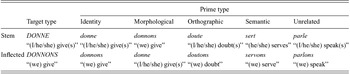
Participants completed a masked-priming word-naming task. The experimental items included 80 French -er verbs. The experiment included two target types: first/third person-singular verbs, which, for convenience, we will call “stem” targets (for discussion, see below), and first-person-plural verbs, which we will call “inflected” targets. The experiment also included five prime types for each target type: identity, morphologically related, orthographically related, semantically related, and unrelated primes. Crossing target type and prime type yielded a total of 10 conditions. The rationale behind using both stem and inflected targets was to provide two locations where decomposition could potentially occur in the morphological conditions: if L2 learners decompose morphologically complex words into stem and affix, recognition of the stem target should be facilitated by the stem part of the inflected prime, and recognition of the stem part of the inflected target (and thus recognition of the inflected target) should be facilitated by the stem prime. The identity and unrelated conditions served as baseline for establishing, respectively, the maximal and minimal amounts of priming. The morphologically related condition served as experimental condition, and the orthographic and semantic conditions served as control conditions to ensure that the effect of priming in the morphological condition, if significant, cannot be attributed to orthographic or semantic overlap between the prime and the target. Ten lists were created so that all items were used in each condition, but no participant saw any verb in more than one condition. An example test item is shown in Table 2. The stem targets and the morphological and orthographic primes are provided in the Appendix.
Example stimuli.

The stem form was always the first/third-person-singular form, and the inflected form was always the first-person-plural form, which has a phonologically realized inflection. One might argue that the first/third-person-singular form is not the true stem of regular -er verbs given that it has the orthographic ending -e, which, in the writing system of French, is considered an inflection. However, the written form donn is not a French word, and donn and donne are homophonous (thus, /dᴐn/ is indeed the phonological stem form). The first/third-person-singular form is the closest approximation to a true stem form in French, and it is closer to a stem form than the infinitive form, which has the affix -er /e/ (see Meunier & Marslen-Wilson, Reference Meunier and Marslen-Wilson2004). In their ERP research on morphological processing in French, Royle et al. (Reference Royle, Drury, Bourguignon and Steinhauer2012) used first/third-person-singular forms as stem forms. Recent research in English also suggests that a single letter added to the stem does not disrupt priming effects from the inflected form to the stem form (adorable–ADORE; McCormick, Rastle & Davis, Reference McCormick, Rastle and Davis2009). For these reasons, the first/third-person-singular form was chosen to function as the stem form. At best, our first/third-person-singular primes and targets will function as stem primes and targets; at worse, they will function as inflected primes and targets, but notice that their possible decomposition does not undermine the logic of the design: if a word like donnons primes a word like donne, it must be that at least donnons, but possibly also donne, were decomposed.
Of the verbs that were included in the experiment, 64 were regular -er verbs (e.g., aimer “to like/love”), eight were semi-regular -er verbs in which the stem had small phonological and orthographic changes between the singular and plural forms (e.g., paie “(I/he/she) pay(s)” vs. payons “(we) pay”, répète “(I/he/she) repeat(s)” vs. répétons “(we) repeat”), and eight were semi-regular -er verbs in which the stem had small orthographic changes between the singular and plural forms (e.g., commence “(I/he/she) begin(s)” vs. commençons “(we) begin”, bouge “(I/he/she) move(s)” vs. bougeons “(we) move”). The semi-regular verbs, which were included in order to have enough words with which L2 learners would be familiar, all had the same first-person-plural inflection as the regular verbs (i.e., -ons).Footnote 2 All test items could be found in the beginner-level French textbook used at their home university (Amon, Muyskens & Omaggio Hadley, Reference Amon, Muyskens and Omaggio Hadley2010).
The primes and targets were analyzed for written surface (i.e., token) form frequency using the database Lexique, which contains 14.8 million word occurrences (New, Pallier, Ferrand & Matos, Reference New, Pallier, Ferrand and Matos2001). The stem primes and targets (e.g., donne) have an average frequency of 27.9 words per million words, whereas the inflected primes and targets (e.g., donnons) have an average frequency of 0.8 word per million words, a difference that is statistically significant in the log-transformed frequency values, t(79) = –25.58, p < .001. These log-transformed frequency values will therefore be included in the statistical analyses.
The orthographically related primes were chosen such that they would have similar lengths as the targets and would be identical to the targets in the first two letters and final inflection (when present). The mean percent orthographic overlap between primes and targets in the orthographic condition (58.6%) did not differ from the mean percent orthographic overlap between primes and targets in the morphological condition (60.7%), t(159) = 1.643, p > .1. The semantically related primes were words that had similar lengths and meanings as the targets. The unrelated primes had similar lengths as the targets, but they were not orthographically or semantically related to the targets. Two native French speakers who did not participate in the experiment rated the semantic proximity of the prime and target words in the semantically related and unrelated conditions on a scale from 1 to 6 (1 = completely different meaning, 6 = same meaning). Only primes that were rated as 4 or above by both speakers were used as semantically related primes, and only primes that were rated as 1 by both speakers were used as unrelated primes.
The experimental items were interspersed with 80 filler items, all of which were French nouns. Half of the nouns had identity primes and the other half had unrelated primes.
Procedures
The experiment was run using E-Prime software (Schneider, Eschman & Zuccolotto, Reference Schneider, Eschman and Zuccolotto2002). Participants sat in front of a computer screen wearing a head-mounted microphone connected to a digital recorder, which audiorecorded them during the entirety of the experiment. Participants were told that they would first see a row of hash signs (########), followed by a French word. They were instructed to read the French word aloud as soon as they saw it on the screen and as rapidly as possible. They were told not to correct themselves if they made a mistake.
The hash signs remained on the screen for 750 ms, followed by the prime, which was presented for 50 ms, followed by the target word, which remained on the screen for 2000 ms. To minimize the likelihood that priming would be strictly visual, the primes were all presented in lowercase (14 pt font size), whereas the targets were presented in uppercase (18 pt font size). When the target word appeared on the screen, the computer made a 100-ms beep to mark the onset of the target word on the digital recorder, which would later be used to measure the latencies of the participants’ productions. Throughout the experiment, a PLUS VITE! “faster!” reminder periodically appeared on the screen to keep participants under time pressure, which was deemed necessary to ensure that L2 learners would not take too much time in an effort to pronounce the target word accurately.
The experiment was divided into four short blocks, with participants having the option of taking a brief break at the end of each block. The test items from all conditions were fully randomized across the entire experiment and across participants. The entire experiment took about 10 minutes. After completing the experiment, participants were asked if they saw the prime or anything visually strange during the experiment. No participant reported seeing anything between the mask and the target word.
Data analysis
The latencies from the onset of the target words (as identified by the beep) to the onset of the participants’ productions were measured manually in Praat (Boersma & Weenink, Reference Boersma and Weenink2007). For each of the 80 target words, text grids were created, and the onset of the beep and the onset of the production were identified in an interval tier. Target words were excluded if they were produced with the wrong inflection, if they began with a false start, or if they were simply the wrong word. This resulted in the exclusion of 2.6% of the L2 learner data and 2.3% of the native-speaker data. The duration of all segmented latencies was then extracted using an automated script. Items with latencies greater than 1000 ms or 2.5 standard deviations above the participant's mean latency were removed from the analysis. This resulted in the removal of another 2% of the learner data and 3.1% of the native speaker data. It was not the case that any one target elicited significantly more errors than other targets.
Latencies were then log-transformed and analyzed with linear mixed-effects models using the lme4 package in R (Baayen, Reference Baayen2008). The results of the morphologically, orthographically, and semantically related conditions were analyzed in separate models. All models had the log-transformed latencies as dependent variable. The models included prime type (identity, test, unrelated), target type (stem, inflected), group (native speakers, L2 learners), and all two- and three-way interactions as fixed variables. All the models had the same identity and unrelated conditions in them, but the test condition (morphological, orthographic, semantic) varied as a function of the model. Native speakers’ latencies with stem targets in the test conditions were used as baselines. Using the test conditions as baselines made it possible to test for: (i) full priming, where the test conditions would be significantly different from the unrelated condition but not from the identity condition; (ii) partial priming, where the test conditions would be significantly different from both the identity and the unrelated conditions; and (iii) no priming, where the test conditions would be significantly different from the identity condition but not from the unrelated condition. Lest prime and target frequencies affect the results, the models also included (log-transformed) prime frequency and (log-transformed) target frequency as fixed variables. In order to determine whether L2 learners’ sensitivity to morphological structure is modulated by their French proficiency, we ran similar models on L2 learners’ results only, but with proficiency (centered cloze-test scores) instead of group as a fixed variable.
All our models had participant and item as random intercepts. We compared these models without random slopes to models in which prime type, target type, and their interaction were added as random slopes for participant. Adding these random slopes did not improve any of the models. We therefore present the models without random slopes.
In the results section, we report only those effects that were significant or marginal; the complete models can be found in the Supplementary Materials.
Results
Morphological condition
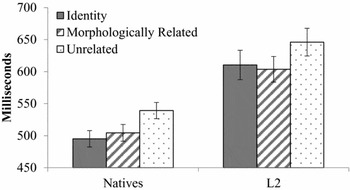
Figure 1 shows the mean latencies for native speakers and L2 learners in the morphological condition. Since target type did not interact with prime type (see below), the results for stem and inflected targets are collapsed in Figure 1.
All participants’ naming latencies: Identity, morphological, and unrelated conditions.

A linear mixed-effects model conducted on all participants’ log-transformed latencies in the identity, morphological, and control conditions revealed significantly longer latencies for the unrelated condition when compared to the morphological condition, t(2748) = 10.579, p < .001, and for L2 learners when compared to native speakers, t(2748) = 4.476, p < .001. No other effect reached significance (p > .1; see Table SM 1 in the Supplementary Materials). These results suggest full morphological priming for both L2 learners and native speakers.
A similar linear mixed-effects model conducted only on L2 learners’ log-transformed latencies, with French proficiency rather than group as fixed variable, revealed the following effects: significantly longer latencies for the unrelated condition when compared to the morphological condition, t(1370) = 6.499, p < .001; significantly shorter latencies with increasing proficiency, t(1370) = –2.845, p < .005; a significantly larger latency difference between the unrelated and morphological conditions as proficiency increases, t(1370) = 2.394, p < .017; and marginally shorter latencies for more frequent targets, t(1370) = –1.679, p < .094. No other effect reached significance (p > .1; see Table SM 2 in the Supplementary Materials). These results suggest full morphological priming in L2 learners, with the size of this priming effect increasing with French proficiency. Recall that full priming is defined as the morphological condition being significantly different from the unrelated condition but not significantly different from the identity condition. Because we find a significant priming effect in addition to the interaction between proficiency and priming in L2 learners’ morphological-unrelated comparison, and given that we do not find such an interaction in L2 learners’ morphological-identity comparison, we may conclude that our L2 learners, as a group, show evidence of full priming, with the size of this priming being larger for learners who are more proficient in French.
Orthographic condition
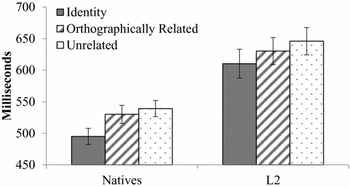
Figure 2 shows the mean latencies for the two groups in the orthographic condition. The means for the identity and unrelated conditions are the same as those reported for the morphological condition. Since target type did not interact with prime type (see below), the results for stem and inflected targets are collapsed in Figure 2.
All participants’ naming latencies: Identity, orthographic, and unrelated conditions.

A linear mixed-effects model conducted on all participants’ log-transformed latencies in the identity, orthographic, and control conditions revealed the following effects: significantly shorter latencies for the identity condition when compared to the orthographic condition, t(2740) = –8.733, p <. 001; significantly longer latencies for the unrelated condition when compared to the orthographic condition, t(2740) = 3.533, p < .001; significantly longer latencies for L2 learners when compared to native speakers, t(2740) = 4.063, p < .001; a significantly smaller latency difference between the identity condition and the orthographic condition for L2 learners than for native speakers, t(2740) = 2.268, p < .023; and marginally shorter latencies for more frequent targets, t(2740) = –1.651, p < .097. No other effect reached significance (p > .1; see Table SM 3 in the Supplementary Materials). These results suggest partial orthographic priming for both native speakers and L2 learners, but with the size of this priming differing for the two groups.
Hence, a subsequent model was run separately on native speakers’ log-transformed latencies. This model revealed significantly shorter latencies for the identity condition when compared to the orthographic condition, t(1365) = –8.082, p < .001, significantly longer latencies for the unrelated condition when compared with the orthographic condition, t(1365) = 2.268, p < .024, and a marginally larger latency difference between the identity condition and the orthographic condition for inflected targets when compared to stem targets, t(1365) = –1.688, p < .092. No other effect reached significance (p > .1; see Table SM 4 in the Supplementary Materials). These results confirm that native speakers show partial orthographic priming.
A similar model was run on only L2 learners’ log-transformed latencies, with French proficiency as fixed variable. This model revealed significantly shorter latencies for the identity condition when compared to the orthographic condition, t(1368) = –4.483, p < .001, significantly longer latencies for the unrelated condition when compared to the orthographic condition, t(1368) = 2.261, p < .024, and significantly shorter latencies with increasing proficiency, t(1368) = –2.144, p < .032. No other effect reached significance (p > .1; see Table SM 5 in the Supplementary Materials). These results confirm that L2 learners also show partial orthographic priming, with this effect not being modulated by French proficiency.
Morphological vs. orthographic conditions
Our results show full morphological priming effects for both native French speakers and English L2 learners of French, but they also show partial orthographic priming for both groups. One might then wonder whether the full morphological priming effect can be partially attributed to orthographic overlap between the prime and the target. In order to answer this question, we ran an additional model that directly compared the morphological and orthographic conditions, with the morphological condition as baseline. Since target type did not interact with prime type in either the morphological or the orthographic models, we did not enter target type as a fixed variable in this additional model. However, since group did interact with prime type in the orthographic model, we kept group in this additional model, together with the variables that we included in our previous models (frequency of the prime and frequency of the target as fixed variables, and subject and item as random variables).
The model comparing the morphological and orthographic conditions revealed significantly longer latencies for the orthographic condition than for the morphological condition, t(1819) = 6.900, p < .001, significantly longer latencies for L2 learners than for native speakers, t(1819) = 4.410, p < .001, and significantly shorter latencies for more frequent targets, t(1819) = –4.000, p < .001. No other effect reached significance (p > .1; see Table SM 6 in the Supplementary Materials). These results confirm that word naming was more facilitated in the morphological condition than in the orthographic condition for both groups. Since the morphological and orthographic conditions did not differ in their percentage overlap between primes and targets, we can conclude from these results that morphological structure, not orthographic overlap, is responsible for the greater facilitation in the morphological condition as compared to the orthographic condition.
Semantic condition
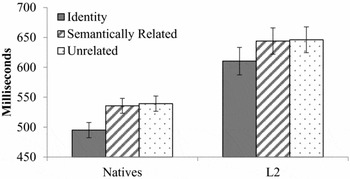
Figure 3 shows the mean latencies for the two groups in the semantic condition. The means for the identity and unrelated conditions are the same as those reported for the morphological and orthographic conditions. Target type interacted with prime type for native speakers, but since the priming effect was the same for both target types (see below), the results for stem and inflected targets are also collapsed in Figure 3.
All participants’ naming latencies: Identity, semantic, and unrelated conditions.

A linear mixed-effects model conducted on all participants’ log-transformed latencies in the identity, semantic, and control conditions revealed the following effects: significantly shorter latencies for the identity condition when compared to the semantic condition, t(2722) = –11.119, p < .001; significantly longer latencies for L2 learners when compared to native speakers, t(2722) = 4.466, p < .001; a marginally smaller latency difference between the identity and the semantic conditions for stem targets as compared to inflected targets in native speakers’ data, t(2722) = 1.949, p < .051; significantly shorter latencies for targets preceded by more frequent primes, t(2722) = –1.965, p < .049; and significantly shorter latencies for more frequent targets, t(2722) = –2.186, p < .028. No other effect reached significance (p > .1; see Table SM 7 in the Supplementary Materials). These results suggest no semantic priming for either native speakers or L2 learners, but the two groups differ in the difference they show between the identity and semantic conditions for inflected targets as compared to stem targets.
Thus, another mixed-effects model was run separately on native speakers’ data. This model revealed significantly shorter latencies for the identity condition when compared to the semantic condition, t(1354) = –9.483, p < .001, and a significantly smaller latency difference between the identity and semantic conditions for stem targets than for inflected targets, t(1354) = –2.478, p < .013. No other effect reached significance (see Table SM 8 in the Supplementary Materials). However, subsequent mixed-effects models run separately on native speakers’ latencies for stem and inflected targets revealed significantly shorter latencies for the identity conditions than for the semantic condition in both target conditions (stem targets: t(674) = –4.817, p < .001; inflected targets: t(679) = –8.358, p < .002; see Table SM 9 in the Supplementary Materials). These results indicate no semantic priming for either stem or inflected targets.
A linear mixed-effects model run on only L2 learners’ log-transformed latencies, with French proficiency rather than group as fixed variable, revealed the following effects: significantly shorter latencies for the identity condition than for the semantic condition, t(1361) = –6.494, p < .001; significantly shorter latencies with increased proficiency, t(1361) = 2.211, p < .027; marginally shorter latencies for targets preceded by more frequent primes, t(1361) = –1.922, p < .053; and marginally shorter latencies for more frequent targets, t(1361) = –1.779, p < .076. No other effect reached significance (p > .1; see Table SM 10 in the Supplementary Materials). These results suggest that L2 learners show no semantic priming, irrespective of their French proficiency.
Discussion
The results of this study showed full morphological priming effects for both native French speakers and English L2 learners of French. These results indicate that both native and non-native speakers rely on similar mechanisms when processing inflectional morphology in French, at least in the present masked-priming word-naming task with regular French verbs. We interpret these results as suggesting that both native and non-native French speakers decompose morphologically complex French verbs. Our findings are in line with those of previous studies on morphological processing in native French (e.g., Meunier & Marslen-Wilson, Reference Meunier and Marslen-Wilson2004; Royle et al., Reference Royle, Drury, Bourguignon and Steinhauer2012), and they add to the small number of masked-priming studies that have shown morphological priming in L2 learners (e.g., Diependaele et al., Reference Diependaele, Duñabeitia, Morris and Keuleers2011; Feldman et al., Reference Feldman, Kostic, Basnight-Brown, Durdevic and Pastizzo2010). Our findings are also consistent with those of Basnight-Brown et al. (Reference Basnight-Brown, Chen, Hua, Kostic and Feldman2007), Gor and Cook (Reference Gor and Cook2010), and Gor and Jackson (Reference Gor and Jackson2013), who found morphological priming in late L2 learners using cross-modal and auditory priming paradigms. Importantly, if Jacob et al. (Reference Jacob, Fleischhauer and Clahsen2013) are correct, our study is the first to provide evidence of full morphological priming in both native speakers and late L2 learners, in that the present experimental paradigm used both identity and unrelated conditions, and the results showed significant facilitation in the morphologically related condition compared to the unrelated condition, but no significant difference between the morphologically related condition and the identity condition. Crucially, these effects did not interact with language group, suggesting that native speakers and L2 learners relied on similar mechanisms to process morphologically complex words. The interaction between the effect of priming in the morphological-unrelated comparison and proficiency in the analysis of L2 learners’ data does not undermine this conclusion, in that we find a full effect of morphological priming in addition to this interaction, and we do not find a significant interaction between the effect of priming in the morphological-identity comparison and proficiency. This suggests that L2 learners, as a group, showed evidence of full morphological priming.
The present results also revealed that the size of L2 learners’ morphological priming increased with their French proficiency. These results suggest a quantitative change in L2 learners’ ability to process morphologically complex words, with L2 learners becoming more adept at using the morpho-segmentation route as their experience with and proficiency in French increased. On the one hand, these results are in line with theories that suggest only quantitative changes in L2 learners’ ability to process the target language (e.g., McDonald, Reference McDonald2006). On the other hand, these results do not falsify theories that propose a qualitative change in L2 processing (e.g., DeKeyser, Reference DeKeyser1997, Reference DeKeyser, VanPatten and Williams2007; Paradis, Reference Paradis and Ellis1994, Reference Paradis2004, Reference Paradis2009; Ullman, Reference Ullman2001, Reference Ullman and Sanz2005), in that the L2 learners in this study may have been too advanced to show qualitative changes; since these theories also postulate quantitative changes in L2 processing at the higher end of the proficiency spectrum, our results are compatible with their predictions, with L2 learners’ eventually showing more rapid and automatic use of procedural knowledge as their experience with and proficiency in the target language increases. Importantly, our results falsify theories that posit fundamental differences between native speakers’ and L2 learners’ morphological processing (e.g., Clahsen et al., Reference Clahsen, Felser, Neubauer, Sato and Silva2010; Jacob et al., Reference Jacob, Fleischhauer and Clahsen2013; Neubauer & Clahsen, Reference Neubauer and Clahsen2009; Silva & Clahsen, Reference Silva and Clahsen2008), and as such they add to the body of evidence that suggests that native and non-native speakers rely on similar mechanisms in morphological processing (e.g., Diependaele et al., Reference Diependaele, Duñabeitia, Morris and Keuleers2011; Feldman et al., Reference Feldman, Kostic, Basnight-Brown, Durdevic and Pastizzo2010; Gor & Cook, Reference Gor and Cook2010; Gor & Jackson, Reference Gor and Jackson2013; Lehtonen et al., Reference Lehtonen, Niska, Wande, Niemi and Laine2006; Portin et al., Reference Portin, Lehtonen and Laine2007, Reference Portin, Lehtonen, Herrer, Wande, Niemi and Laine2008).
These results also showed partial orthographic priming effects for both native French speakers and English L2 learners of French. In a masked-priming study in French that compared lexical decisions and word naming (with an SOA of 43 ms), Grainger and Ferrand (Reference Grainger and Ferrand1996) found that primes that differed from targets by only one letter or one phoneme facilitated both lexical decision on, and naming of, these targets, whereas primes that shared similar onsets with targets facilitated only the naming of these targets. In our experiment, the primes and targets in the orthographic condition shared on average 58.6% of their letters and always had the same onsets. Hence, it is not completely surprising that both native speakers and L2 learners showed a partial orthographic priming effect. Importantly, however, both groups had shorter latencies in the morphological condition than in the orthographic condition, even if these two conditions did not differ in their respective orthographic overlap between primes and targets. This suggests that the facilitation observed in the morphological condition cannot be attributed strictly to orthographic priming. Furthermore, unlike the results in the morphological condition, the partial orthographic priming that L2 learners displayed was not modulated by French proficiency. This further strengthens our conclusion that orthographic overlap cannot, on its own, have driven the priming effects that we found in the morphological condition.
Finally, our results showed no semantic priming effect for either native French speakers or L2 learners. These results were expected, as the SOA in our experiment was too short for semantic priming effects to occur (Rastle et al., Reference Rastle, Davis, Marslen-Wilson and Tyler2000). This means that the morphological priming effect observed in this study cannot be explained by the semantic overlap between primes and targets in the morphological condition. It is unclear how single-mechanism models where morphologically simple and complex words are processed in a distributed network of semantic, phonological, and orthographic information (e.g., McClelland & Patterson, Reference McClelland and Patterson2002; Rumelhart & McClelland, Reference Rumelhart, McClelland, McClelland, Rumelhart and Group1986) would explain these results.
The obvious question that arises from the present research is why L2 learners showed evidence of morphological priming in our masked-priming study (and in Diependaele et al., Reference Diependaele, Duñabeitia, Morris and Keuleers2011 and Feldman et al., Reference Feldman, Kostic, Basnight-Brown, Durdevic and Pastizzo2010) but not in other masked-priming studies (e.g., Clahsen et al., Reference Clahsen, Balkhair, Shutter and Cunnings2013; Neubauer & Clahsen, Reference Neubauer and Clahsen2009; Silva & Clahsen, Reference Silva and Clahsen2008). Given that our L2 learners were tested in an environment where the L2 was spoken only in institutional settings (and so were the participants in Diependaele et al., Reference Diependaele, Duñabeitia, Morris and Keuleers2011 and Feldman et al., Reference Feldman, Kostic, Basnight-Brown, Durdevic and Pastizzo2010), we do not think that our participants (or theirs) were more proficient than those in Clahsen et al. (Reference Clahsen, Balkhair, Shutter and Cunnings2013), Neubauer and Clahsen (Reference Neubauer and Clahsen2009), or Silva and Clahsen (Reference Silva and Clahsen2008), who were tested in environments where the L2 was spoken (though, of course, direct comparisons between these three studies and ours are difficult, because they investigated different languages and assessed proficiency differently).
One might hypothesize that our L2 learners showed sensitivity to morphological structure because of the phonological instantiations of inflectional morphology in French. The inflection selected for this study, the first-person-plural -ons, adds a complete syllable to the stem, one that is also accented in isolated words. As such, this inflection may have been more salient and therefore more readily processed, even if L2 learners were not aware of it in trials where the prime was inflected and the target was not. In Clahsen et al. (Reference Clahsen, Balkhair, Shutter and Cunnings2013) and Silva and Clahsen (Reference Silva and Clahsen2008), the past-tense morpheme did not add an additional syllable to the majority of the English verbs tested, and even when it did, this additional syllable would not be stressed in English. Hence, the English past tense may be more difficult to detect and process, perhaps even in written language. Note, however, Feldman et al. (Reference Feldman, Kostic, Basnight-Brown, Durdevic and Pastizzo2010) did use similar stimuli as those in Clahsen et al. (Reference Clahsen, Balkhair, Shutter and Cunnings2013) and Silva and Clahsen (Reference Silva and Clahsen2008) and did find significant morphological priming in L2 learners. Hence, this salience hypothesis may not be adequate in explaining why we found significant morphological priming effects in our L2 learners. Furthermore, it would not explain the asymmetry between our findings and those of Neubauer and Clahsen (Reference Neubauer and Clahsen2009) and Jacob et al. (Reference Jacob, Fleischhauer and Clahsen2013), given that German past participles have the prefix ge- in addition to the inflectional ending -t or -n (gespielt “played”, gelaufen “run”). That prefix is unstressed, but it ought to be salient given its word-initial position.
Another explanation for why the L2 learners in this study showed morphological priming could be methodological: our masked-priming word-naming paradigm may have been more sensitive to morphological priming than masked-priming lexical decision tasks. The process of deciding whether or not a given string of letters constitutes a real word is difficult in a second language – for example, due to L2 learners’ smaller and less easily accessible lexicon, their competing native lexicon, and possible uncertainties about word spellings. Moreover, since lexical decision tasks encourage participants to rely on memory, these tasks may potentially overestimate the extent to which speakers (including L2 learners) rely on the whole-word storage route in morphological processing (Clahsen, Reference Clahsen and Brown2006). Hence, masked-priming word-naming tasks may be more sensitive than masked-priming lexical decision tasks for capturing L2 learners’ sensitivity to morphological structure. Note, however, that this again cannot be the only reason why we found significant morphological priming effects in our L2 data, in that Diependaele et al. (Reference Diependaele, Duñabeitia, Morris and Keuleers2011) and Feldman et al. (Reference Feldman, Kostic, Basnight-Brown, Durdevic and Pastizzo2010) did find significant morphological priming effects in their L2 lexical decision data. Since, like Diependaele et al. (Reference Diependaele, Duñabeitia, Morris and Keuleers2011) and Feldman et al. (Reference Feldman, Kostic, Basnight-Brown, Durdevic and Pastizzo2010), we used a shorter SOA than in the L2 studies conducted by Clahsen and colleagues (50 ms instead of 60 ms), SOA is also unlikely to be responsible for the lack of morphological priming in Clahsen et al. (Reference Clahsen, Balkhair, Shutter and Cunnings2013), Neubauer and Clahsen (Reference Neubauer and Clahsen2009) and Silva and Clahsen (Reference Silva and Clahsen2008).
An alternative explanation for why we find morphological decomposition in L2 learners may have to do with the frequency of the inflected forms we used. First-person-plural verb forms in French are relatively infrequent because of the common use of the third-person-singular pronoun on ‘we’ with a similar, though more informal, inclusive meaning. The inflected word forms in this study had an average frequency of 0.8 word per million words, similarly to the inflected words in Diependaele et al. (Reference Diependaele, Duñabeitia, Morris and Keuleers2011). By contrast, those in Clahsen et al. (Reference Clahsen, Balkhair, Shutter and Cunnings2013) and Silva and Clahsen (Reference Silva and Clahsen2008) hovered around 42 words per million wordsFootnote 3 and those in Neubauer and Clahsen's (Reference Neubauer and Clahsen2009) masked-priming experiment had an averaged frequency of 11 words per million words. The threshold for morphological decomposition identified by Alegre and Gordon (Reference Alegre and Gordon1999) is six words per million words (but see Baayen et al., Reference Baayen, Wurm and Aycock2007 for an even lower threshold). Previous frequency-based studies that did not show surface-form frequency effects for L2 learners’ processing of regular words had fewer than six words per million words (e.g., Portin et al., Reference Portin, Lehtonen and Laine2007, Reference Portin, Lehtonen, Herrer, Wande, Niemi and Laine2008). Hence, it could be the case that the low frequency of the inflected forms in our study encouraged L2 learners to use a decomposition route rather than the whole-word route (though Feldman et al., Reference Feldman, Kostic, Basnight-Brown, Durdevic and Pastizzo2010 used regular English verbs with an averaged surface-form frequency of 24 words per million words and did find morphological priming effects in L2 learners). For this reason, it is unclear whether our results would generalize to more frequent verb forms (e.g., second-person plural donnez “you (pl.) give”, infinitive donner “to give”).
A final possible explanation for why the L2 learners in the present study showed morphological priming has to do with the formal instruction they received in French. Since our non-native speakers learned French in the classroom in the United States, they are likely to have received explicit grammatical instruction on verb conjugations. Typically, this instruction takes the form of telling L2 learners replace the infinitive ‘termination’ of regular -er verbs with the first, second, or third person singular or plural “termination” of the present tense (i.e., singular: -e, -es, -e; plural: -ons, -ez, -ent; only -ons [

These findings suggest that L2 learners have a morphological decomposition route available to them and use it when it leads to more efficient lexical processing. Furthermore, the use of this morpho-segmentation route increases as L2 proficiency increases, suggesting quantitative changes in L2 learners’ ability to decompose morphologically complex words with more experience in the target language. Our findings add to the body of evidence that suggests L2 learners have access to the same mechanisms as native speakers for processing complex morphological word forms (e.g., Diependaele et al., Reference Diependaele, Duñabeitia, Morris and Keuleers2011; Feldman et al., Reference Feldman, Kostic, Basnight-Brown, Durdevic and Pastizzo2010; Gor & Cook, Reference Gor and Cook2010; Gor & Jackson, Reference Gor and Jackson2013; Lehtonen et al., Reference Lehtonen, Niska, Wande, Niemi and Laine2006; Portin et al., Reference Portin, Lehtonen and Laine2007, Reference Portin, Lehtonen, Herrer, Wande, Niemi and Laine2008). This body of evidence also includes studies that examine electrophysiological brain responses. For example, Hahne, Muhler and Clahsen (Reference Hahne, Muller and Clahsen2006) found that Russian L2 learners of German showed qualitatively native-like ERP effects to some morphosyntactic German violations: like native speakers, L2 learners showed an anterior negative-going waveform from 250 ms to 600 ms and a parietal positive-going waveform at approximately 600 ms to irregular past participles that were inflected with the regular -t affix (*gelauft instead of gelaufen “run”). The anterior negativity and the P600 component are associated with the analysis of morphosyntactic information, whereas the N400 component is associated with the semantic likelihood of a word appearing in a given context. If these L2 learners had been processing complex word forms as whole forms and not analyzing the morphological structure of the words, they would have shown an N400 rather than a P600. Note, however, that these same learners did not show native-like responses to plural-noun violations, which the authors attributed to the irregularity of the nominal plurality system in German. Based on these findings, and in contrast with their later position (Clahsen et al., Reference Clahsen, Felser, Neubauer, Sato and Silva2010), Hahne et al. (Reference Hahne, Muller and Clahsen2006) concluded that L2 learners may be able to process certain features (e.g., participle formation) in a native-like way, at least at sufficiently high proficiencies.
Many other ERP studies have similarly shown that native-like attainment in the domain of inflectional morphology is indeed possible, with this attainment being modulated not only by proficiency, but also by the native language of L2 learners and the phonological instantiation of the morphological system in the target language (e.g., Frenck-Mestre, Osterhout, McLaughlin & Foucart, Reference Frenck-Mestre, Osterhout, McLaughlin and Foucart2008; Gabriele, Fiorentino & Aleman-Bañón, Reference Gabriele, Fiorentino and Aleman-Bañón2013; Gillon-Dowens, Vergara, Barber & Carreiras, Reference Gillon-Dowens, Vergara, Barber and Carreiras2010; Tanner, Inoue & Osterhout, published online August 12, 2013). These studies, however, all examine L2 learners’ sensitivity to morphosyntactic violations in the context of sentences. Further ERP research investigating morphological decomposition (e.g., Royle et al., Reference Royle, Drury, Bourguignon and Steinhauer2012) should determine whether L2 learners show brain responses qualitatively similar to those of native speakers when parsing morphologically complex words.
Conclusion
The present study investigated whether late L2 learners can rely on the same mechanisms as native speakers when processing morphologically complex words. It did so by examining whether native English speakers who have begun learning French around the onset of puberty can decompose French -er verbs. The results of a masked-priming word-naming task showed full morphological priming for both native and non-native speakers, with this effect increasing with French proficiency for L2 learners; partial orthographic priming was also found for both groups, but priming was greater for morphologically related primes and targets than for orthographically related primes and targets. These results suggest that L2 learners have access to mechanisms similar to those of native speakers when processing morphologically complex words. Based on these results, we suggest that both native and non-native speakers decompose morphologically complex word forms into stem and affix. Further research should try to disentangle the effects of proficiency, native-target language pairings, and surface-form frequency on L2 learners’ morphological processing.
Appendix. Experimental items (stem target condition)