


Introduction
Political leaders are increasingly engaging in identity entrepreneurship, foregrounding social identities as a central component of their political strategy (Thau Reference Thau2019; Huber Reference Huber2022). Existing scholarship explains identity entrepreneurship primarily through structural conditions: the territorial concentration of identity-led populations, voter demand for the representation of those identities, the impossibility of establishing clientelistic linkages, and subnational rent-seeking that invokes identity to win autonomy from the center (Chandra Reference Chandra2004; Posner Reference Posner2005; Roeder Reference Roeder1991; Koter Reference Koter2013). Although important, these accounts cannot explain the behavioral variation that motivates this article: why similar structural environments produce different responses across leaders, and why the same leader intensifies identity entrepreneurship at some moments but not others.
Building on an instrumentalist approach to social identities (Brass Reference Brass1991; Brubaker Reference Brubaker2004), this article theorizes a new source of such variation: anti-corruption pressure. Leaders facing anti-corruption pressure from the media, other political actors, and the judiciary intensify identity entrepreneurship because oversight action against them and their inner circle can be recast as persecution of the social group to which the leader belongs, not merely as an attack on one individual. This translation is most effective when the content of this pressure directly names the leader, targets close associates, and attributes wrongdoing to the individual rather than presenting it in procedural or impersonal terms. When this framing gains credibility among the bounded constituencies of which the leader is a part, it activates an in-group solidarity mechanism expressed through two outputs that emerge at different rates: a loyal citizen base from identity-led constituencies that evaluates the leader more leniently, supplying a floor of public support, and grassroots organizations from identity-linked groups that supply mobilization capacity. These outputs diverge temporally because the costs of public commitment vary across arenas (Olson Reference Olson1965; Tarrow Reference Tarrow1994): citizens can express attitudinal solidarity at low cost, whereas organizational leaders require accumulated credibility before endorsement is perceived as solidarity rather than reputational risk. Together, these dynamics sustain the political relevance of embattled leaders even as accountability pressure mounts.
What makes identity entrepreneurship distinctive among the survival strategies available to an embattled leader is that its credibility can appreciate rather than depreciate under legal exposure. Corruption allegations and indictments ordinarily damage the linkages between politicians and citizens, including citizens who share the leader’s social group (Dickson and Scheve Reference Dickson and Scheve2006; Sambanis and Shayo Reference Sambanis and Shayo2013). Here, however, the opposite can occur. This is because the strategy draws on pre-political biographical investments the scandal cannot contaminate, but only for leaders whose prior biographical anchor makes the persecution translation credible. Two further scope conditions govern who can: prior polarization, which removes cross-cleavage constituencies whose defection would otherwise make boundary-sharpening prohibitively costly; and declining macroeconomic conditions, which remove the investor-reassurance constraint that would otherwise discipline the strategy. The anchor condition is the most decisive: its absence prevents the mechanism from operating regardless of pressure intensity.
The argument is illustrated through the presidency of Pedro Castillo in Peru (2021–22), a case that sits at the intersection of two well-documented features of contemporary politics, particularly salient in Latin America: the persistence of identity-based cleavages as vehicles for political mobilization (Madrid Reference Madrid2012), and the progressive judicialization of politics (Pérez-Liñán Reference Pérez-Liñán2007). Peru is an extreme case of the latter, a condition that holds anti-corruption pressure roughly constant across administrations and makes variation in presidential response observable. In Peru, moreover, the most mobilizing cleavage is not strictly ethnic but center–periphery (Vergara Reference Vergara2018), a divide that bundles ethnic, territorial, and class distinctions (De la Cadena Reference De la Cadena2000). Existing scholarship has examined this cleavage in institutional and historical terms (Vergara Reference Vergara2018; Eaton Reference Eaton2017; Barrenechea and Encinas Reference Barrenechea and Encinas2025); what remains neglected is how sitting leaders strategically manipulate it. Castillo is the only post-Fujimori president to have responded to this shared pressure by systematically intensifying identity entrepreneurship, and the only one whose tenure produced the organizational outputs the solidarity mechanism predicts. His presidency is therefore the most informative site for tracing the mechanism’s operation. In Peru, identity entrepreneurship takes the form of peripheral identity entrepreneurship (PIE): the strategic foregrounding of the center–periphery boundary in peripheral regions (outside Lima and Callao) and toward peripheral social organizations whose members share the boundary’s territorial, racial, or class dimensions: provincianos, Indigenous and racialized groups, and the rural and urban poor.
Anti-corruption pressure, this article shows, does not merely threaten incumbents; it can reshape how they build power even in adverse contexts. The article also closes a gap at the intersection of three literatures that have rarely spoken to each other: the instrumentalist study of identity construction, the study of democratic accountability under prosecutorial pressure, and the emerging literature on corruption and political survival. When legal, investigative, and political action threatens incumbents, identity entrepreneurship does not only provide rhetorical cover; it builds durable electoral and organizational infrastructure that raises the political costs of accountability during the crisis, persists even where removal ultimately succeeds, and, under more favorable institutional balances, can translate into impunity. The answer to why some embattled leaders consolidate organizational support while others collapse lies not in the pressure itself, but in whether the scope conditions are met, above all whether the leader can perform the persecution translation credibly, which depends on investments made before the crisis began.
The article proceeds as follows. “Anti-Corruption Pressure and Identity Entrepreneurship” develops the theoretical argument, specifying the solidarity mechanism, its two outputs, the three scope conditions that govern activation, and why identity entrepreneurship comes to dominate alternative survival strategies when those conditions hold. “Case Selection, Research Design, and Data” presents the case selection, research design, and data. “Anti-Corruption Pressure and Identity Entrepreneurship Intensity” traces the mechanism through the Castillo presidency. The article concludes with implications for accountability research.
Anti-Corruption Pressure and Identity Entrepreneurship
Identity Entrepreneurship and the Persecution Frame
Working within the instrumentalist tradition of social identities, I treat identity not as a primordially fixed attribute but as a boundary that individuals, especially political leaders, strategically foreground, time, and target toward specific constituencies (Brass Reference Brass1991; Brubaker Reference Brubaker2004). Identity entrepreneurship refers to the deliberate activation of a social cleavage (territorial, ethnic, class-based, or some combination of these) so that it becomes the primary interpretive frame for political conflict and a focal point for political support and collective action (Brubaker Reference Brubaker2004; Wimmer Reference Wimmer2013). What distinguishes it from generic rhetorical adaptation is strategic selection: the identity entrepreneur chooses which boundary to foreground, deploys it in venues where it is spatially and organizationally dense, and times its intensification to moments when it will be most legible to targeted audiences. Identity entrepreneurship is therefore not a binary attribute but a behavior that varies in intensity—in how frequently, where, and before whom the boundary is foregrounded—and it is this variation in intensity that the argument developed here explains.
Anti-corruption pressure creates substantial constraints for incumbents: the loss of allies (from political counterparts to fundraisers) who fear that the allegations against the indicted leader will extend to them; the erosion of popular support where corruption is read as betrayal or incompetence (Bauhr and Charron Reference Bauhr and Charron2018); the loss of office through impeachment or political disqualification when opponents command sufficient votes in Congress (Pérez-Liñán Reference Pérez-Liñán2007); and even the loss of liberty when the ousted leader, stripped of immunity, becomes available to courts that may order preventive detention to foreclose flight rather than await further investigation. This pressure is not exclusively judicial: it emerges from prosecutors and courts, but also from investigative media and from legislatures wielding oversight and removal powers—three arenas whose interaction is most consequential in weakly institutionalized party systems, where presidents lack the partisan shields that would otherwise contain scandal (Pérez-Liñán Reference Pérez-Liñán2007).
Yet anti-corruption pressure is not uniformly threatening, because its content varies in biographical intensity across all three arenas. At one end, procedural findings target institutional processes or third parties without attributing conduct to the leader personally; at the other, investigative journalism revelations, leaks, police raids, preventive detention orders, formal accusations, and congressional investigative proceedings name the leader directly, target the family and inner circle, and attribute wrongdoing to the individual rather than to the office or the organization. Biographical content is, moreover, graded rather than binary: it peaks at discontinuous escalations (a first revelation reaching the inner circle, a first enforcement act against the family) rather than accumulating linearly with each additional allegation, because it is the novel, publicly dramatized attribution of wrongdoing to the person, not its repetition, that gives the persecution translation fresh purchase with targeted audiences. It is this biographical content—not oversight intensity in the aggregate—that supplies the raw material for a persecution frame: a reframing of legal exposure as an attack not on the individual alone but on the social group to which the leader belongs, which leaders with the right biographical profile can convert into solidarity rather than absorb as accountability.
Why should biographical content shift evaluation from the individual to the group? The translation runs through the prototypicality logic of social identity. Oversight that is biographical in form attributes wrongdoing not to the office but to the leader as a particular kind of person, defined by occupational origin, associational history, ethnicity, region, or class. Where that characteristic is one an audience shares, the leader stands as a prototypical member of their category, and an attack on a prototypical member is read as diagnostic of how the category itself is treated rather than as an isolated individual failing (Tajfel and Turner Reference Tajfel, Turner, Worchel and William1986; Hogg Reference Hogg2001). This is what category salience denotes: the point at which group membership, not individual conduct, becomes the operative frame through which an event is interpreted (Brubaker et al. Reference Brubaker, Loveman and Stamatov2004). Once that frame is operative, the same prosecutorial act that reads as accountability to outside observers reads as persecution to the in-group, not because its members condone wrongdoing, but because they evaluate the act through the boundary the prosecution has made salient. The leader does not create the category; the biographical content of the prosecution makes it salient, and a leader with prior standing in that category is positioned to perform the translation credibly rather than opportunistically.
Not every leader can deploy this frame credibly. It requires a prior biographical anchor (associational ties, occupational identity, geographic origin, organizational history) that makes the claim that prosecution targets what the leader represents, rather than what he did, credible to the organized constituencies sharing those attributes. Without this anchor, the frame is dismissed as opportunistic posturing regardless of how forcefully it is deployed. Scholars of political legitimation under duress have shown that embattled leaders reframe crises strategically—deploying excuses to diffuse blame and justifications to recast wrongdoing as defensible on moral or collective grounds—and that victimization framing is a well-documented instrument in this repertoire across regime types and regions (McGraw Reference McGraw1991; Boin et al. Reference Boin, ‘t Hart and McConnell2009). Identity entrepreneurship is analytically distinct from this broader blame-management literature: it requires prior biographical investment in the relevant organizational networks that generic victimization posturing does not, and its credibility depends on that investment having predated the scandal rather than having been constructed in response to it. The specific dimensions of the anchor (territorial, ethnic, class-based, or some combination) will vary with the cleavage structure of the case.
Solidarity or Punishment: The Conditional Logic of In-Group Response
When the persecution frame achieves credibility among the identity-led constituencies it targets, it produces in-group solidarity through a single interpretive shift: members of the targeted group apply solidarity logic rather than accountability logic in evaluating the leader (Tajfel and Turner Reference Tajfel, Turner, Worchel and William1986; Solaz et al. Reference Solaz, De Vries and de Geus2019). In their survey study of a real-world scandal, Solaz, De Vries, and de Geus find that in-group loyalty weakens voters’ withdrawal of support from a corrupt incumbent without eliminating it, a pattern consistent with the solidarity mechanism proposed here, which predicts attenuation of accountability logic rather than its elimination. This solidarity operates through shared interpretive categories rather than shared preferences: members need not hold identical views on policy or corruption, only the identity frame through which oversight content is evaluated (Habyarimana et al. Reference Habyarimana, Humphreys, Posner and Weinstein2007; Brubaker et al. Reference Brubaker, Loveman and Stamatov2004).
Solidarity is not guaranteed by the persecution frame alone. Where corruption is perceived as extraction from the in-group (theft of shared resources, betrayal of group norms), in-group members may exact harsher rather than milder punishment (Dickson and Scheve Reference Dickson and Scheve2006; Sambanis and Shayo Reference Sambanis and Shayo2013; Habyarimana et al. Reference Habyarimana, Humphreys, Posner and Weinstein2007). What determines which logic prevails is the interpretive frame applied to oversight content, not the identity of the accused: the persecution frame makes solidarity logic more likely to displace accountability logic; the extraction frame blocks that displacement and may intensify punishment.
The persecution frame’s credibility is also partly endogenous to how adversaries behave. When opposition actors escalate in ways that are themselves biographical and aggressive (naming the leader, pursuing his family, moving to remove him), they corroborate the frame’s central claim, so that hostile action intended to discipline the leader can instead authenticate his persecution narrative and deepen in-group solidarity (Gamboa Reference Gamboa2022; Selçuk Reference Selçuk2016). The same behavior that raises the leader’s costs can therefore lower them by making the frame harder to dismiss as opportunism.
When these conditions are met, solidarity finds expression through two outputs. The first is attitudinal favorability among bounded publics. Citizens who share the targeted identity evaluate the leader more leniently, attenuating disapproval independently of programmatic performance and consolidating a loyal base that becomes available at election time (Solaz et al. Reference Solaz, De Vries and de Geus2019), an electoral conversion this article’s case, truncated by removal, cannot observe. This resource is critical for incumbents facing corruption allegations for two reasons. It allows them to demonstrate that, despite the indictments against them, they remain popular; and it helps the entrepreneur retain allied congressional seats that can block the impeachment attempts, formal accusations, and political disqualifications that constitute the political cost of exposure—or, at the extreme, assemble coalitions to retaliate institutionally against oversight actors by removing them from their agencies and prosecuting them.
The second output is endorsement from identity-led populations and the social organizations that represent them. Populations that share a salient characteristic frequently organize around it (to preserve it, to defend themselves when it is attacked, or both) and in doing so accumulate the capacity for sustained collective action (McAdam et al. Reference McAdam, Tarrow and Tilly2001). Organizations whose members share the targeted identity cross their endorsement threshold, publicly backing the leader at reputational cost. The grassroots infrastructure they provide serves two functions. It stages demonstrations of support that signal to challengers that the embattled leader is not isolated and retains political value. And it can harass oversight actors (investigative journalists, opposition politicians, prosecutors, and judges) through actions ranging from street confrontation to, at the extreme, kidnapping and collective physical violence (Tilly Reference Tilly2003), raising the political costs of accountability.
This endorsement is analytically distinct from organizational brokerage under stable party linkages (Samuels and Zucco Reference Samuels and Zucco2015; Anria Reference Anria2018; Poertner Reference Poertner2021). Established brokerage operates through partisan infrastructure whose activation does not depend on prosecutorial content or credibility accumulation. What identity entrepreneurship under pressure produces instead is a solidarity-based threshold shift: organizations that previously maintained distance cross into public endorsement because the persecution frame, combined with prior biographical investment, lets endorsement be read as an act of solidarity rather than a reputational liability. The organizations most likely to do so are those with cohesion grounded in shared material conditions and organizational history (community patrols, ethnic federations, labor confederations, veterans’ associations) rather than organizations bound only by shared identity labels (Putnam Reference Putnam1993; McAdam et al. Reference McAdam, Tarrow and Tilly2001).
Endorsement persists while the persecution frame retains credibility and new biographical escalations continue to arrive; it attenuates once prosecution routinizes into static legal process (once no new escalations supply occasions for solidarity display) or once the costs of public mobilization rise sharply, even where the underlying prosecution continues. Because attitudinal solidarity is far cheaper to sustain than organizational mobilization, the two outputs are predicted to diverge under routinization: attitudes persist while mobilization decays, a temporal prediction that distinguishes the argument from purely structural accounts of organizational loyalty. Organizational endorsement also emerges later than attitudinal solidarity because its cost of public commitment is substantially higher (Olson Reference Olson1965; Tarrow Reference Tarrow1994): organizational leaders bear reputational exposure by endorsing a criminally investigated executive, and their constituencies can observe that endorsement. This asymmetry in commitment costs generates a predictable gap between the two outputs, and the timing of that gap has no analogue in the stable partisan brokerage account. Once crossed, organizational endorsement also feeds back into the attitudinal output: public backing by respected identity-led organizations makes individual expressions of solidarity socially acceptable and less costly, so attitudinal favorability among the targeted public is predicted to recover once endorsement is visible. The same cost asymmetry implies a difference in triggers: attitudinal solidarity can respond to revelations and accusations alone, but organizational endorsement—public, observable, and reputationally costly—requires an enforcement act unambiguous enough that endorsement reads as solidarity rather than complicity.
Costs, Scope Conditions, and the Dominance of Identity Entrepreneurship
For all its returns under pressure, identity entrepreneurship carries three costs that explain why it is not universally employed. The first is political. Foregrounding a social boundary forecloses coalitions with constituencies located across it: actors aligned with neither pole of the cleavage, in the legislature or the wider social arena, whose support boundary-sharpening places permanently out of reach. The second is economic. The capital at stake here is the external financing a government seeks: sovereign borrowing, multilateral and bilateral lending, and the foreign and domestic investment whose terms governments actively court. Boundary-sharpening raises the cost of that financing because creditors and investors read it as a signal of social conflict, political instability, and policy unpredictability that threaten their investments (Mosley Reference Mosley2003; Jensen Reference Jensen2008).Footnote 1 The third is credibility. A persecution claim advanced without prior standing in the targeted networks is read as opportunism, leaving the strategy unavailable to leaders who cannot make it read as solidarity rather than self-interest. Under stable political and economic conditions, and absent that prior standing, identity entrepreneurship is a losing strategy: its organizational returns do not compensate for the coalitions it forecloses and the capital it repels, and the claim is dismissed before it can mobilize anyone.
Three structural conditions can relax these costs simultaneously, creating the zone within which identity entrepreneurship’s returns become dominant. Prior polarization relaxes the political cost. It is met when disagreement has hardened into organized negative partisanship: an antagonistic bloc whose shared identity is constituted by opposition to the leader or his project (McCoy et al. Reference McCoy, Rahman and Somer2018; Lupu Reference Lupu2016), observable in sustained extreme values on standard polarization measures. Below this threshold—where cross-cleavage constituencies remain live coalition partners rather than a consolidated antagonistic bloc—polarization is absent for the theory’s purposes, whatever the ambient level of disagreement. When a country’s main political attachments are structured around negative identifications (anti-communism, anti-conservatism, or opposition to a specific leader), the constituencies on the far side of the boundary have already exited the coalition before the crisis begins, so there is no support to lose from boundary-sharpening. Where polarization is absent, boundary-sharpening risks alienating constituencies whose support remains valuable, and the organizational returns cannot compensate for the coalition loss (Lupu Reference Lupu2016).
Macroeconomic deterioration relaxes the economic cost. It is met when three features hold jointly: decline precedes the turn to identity entrepreneurship; it is attributable to inherited or exogenous conditions rather than to the incumbent’s choices; and it is visible in the aggregate indicators creditors and publics track (debt trajectories, inflation, currency pressure) rather than in a single adverse quarter. Deterioration of this kind relaxes the cost through two channels. First, investor confidence is already impaired, so the additional signal that boundary-sharpening sends carries little marginal penalty; the penalty has already been paid by circumstances outside the identity entrepreneur’s control (Mosley Reference Mosley2003; Jensen Reference Jensen2008). Second, and more consequentially, prior and externally caused deterioration supplies a blame-externalization frame: the economic situation can be cast as a crisis the leader inherited rather than created, which both blunts the competence penalty for ongoing decline and feeds the same grievance narrative the persecution frame draws on (McGraw Reference McGraw1991). Deterioration does not remove the need for capital (it may even intensify it), but refraining from boundary-sharpening no longer purchases the reassurance it would under stable conditions.
The biographical anchor addresses the credibility cost. It is met when the leader’s pre-political trajectory (occupational, associational, territorial) is embedded in and verifiable by identity-led audiences, rather than resting on symbolic affinity alone. The anchor establishes a baseline of recognition; above it, iterative engagement compounds credibility: each boundary-relevant event lowers future coordination costs and embeds the persecution frame as the interpretive lens through which targeted publics process subsequent political events (Yashar Reference Yashar1998; Eifert et al. Reference Eifert, Miguel and Posner2010; Hill Reference Hill2022). Engagement during an anti-corruption crisis can deepen an anchor that already exists, but it cannot manufacture one where pre-political standing was absent. Credibility therefore appreciates through sustained engagement rather than depreciating under pressure.
These three conditions are not co-equal. Prior polarization and macroeconomic deterioration are permissive: their absence raises the cost of a strategy that remains available. The biographical anchor is necessary: its absence makes the persecution claim dismissible regardless of how far the political and economic costs have been relaxed. The mechanism can therefore fail for want of the anchor alone, but not for want of either permissive condition alone.
When all three costs are relaxed, identity entrepreneurship becomes dominant not because it is costless but because competing strategies depreciate faster under exactly the conditions that make the persecution frame most effective. Patronage disbursements confirm the charge under investigation (Artés et al. Reference Artés, Jiménez and Perdiguero2023). Technocratic repair depends on institutional endorsers who are simultaneously the source of threat (Dargent Reference Dargent2014). Charisma erodes when personal integrity is persistently questioned (Bauhr and Charron Reference Bauhr and Charron2018). Each alternative decays through the very channel the scandal attacks, while identity entrepreneurship draws on pre-political investments the scandal cannot reach. The relative return to identity entrepreneurship therefore rises not because it becomes more productive in absolute terms but because competing strategies become less productive faster. This relative shift is observable in itinerary allocation and organizational reception sequences, behavioral patterns that alternative survival logics cannot account for.
The Joint Prediction
Figure 1 summarizes the argument. Not all leaders facing anti-corruption pressure can activate the solidarity mechanism, and those who can do not do so at all moments of pressure. The three conditions map onto the three costs established above (polarization onto the political cost, deterioration onto the economic, the anchor onto credibility), with one asymmetry: the anchor is necessary, the other two permissive. Together they create the zone within which the mechanism can operate; the biographical content of anti-corruption allegations then governs when, within that zone, it activates.
The Solidarity Mechanism: From Biographical Anti-corruption Pressure to Attitudinal and Organizational Solidarity.

A leader with all three conditions satisfied still requires biographical content to activate the persecution frame at any given moment. High pressure without biographical content does not trigger the mechanism. Biographical content without previously accumulated credibility does not produce organizational endorsement. Both are required simultaneously, which generates the argument’s central observable prediction: organizational endorsement concentrates at moments when prior investment has compounded sufficiently and content is biographical enough for the crossing to appear publicly as solidarity rather than opportunism.
This joint prediction yields three observable implications that structure the empirical analysis. OI1 (timing): identity entrepreneurship concentrates at discontinuous escalations in the biographical content of anti-corruption pressure rather than tracking aggregate pressure levels. OI2 (targeting): its deployment varies across venues and audiences under equivalent pressure, concentrating where the targeted identity is organizationally dense, rather than appearing uniformly across events. OI3 (threshold): organizational endorsement shifts upward discretely once prior investment has accumulated sufficiently and a biographical enforcement trigger arrives, and attenuates once biographical escalation ceases and prosecution routinizes, while lower-cost attitudinal solidarity persists. The sections headed “The Timing and Targeting of PIE” and ”The Solidarity Mechanism’s Dual Expression” evaluate each implication against the evidence; “Alternative Explanations” assesses whether rival explanations can reproduce the same patterns.
The joint prediction also distinguishes the argument from purely structural accounts, which predict constant availability wherever cleavages are salient (e.g., Chandra Reference Chandra2004; Posner Reference Posner2005) and so cannot explain why equivalent pressure produces different responses across leaders or moments, and from purely biographical accounts, which predict uniform deployment wherever leaders hold the relevant profile and so cannot explain why organizational endorsement crosses its threshold at specific moments rather than from inauguration.
Case Selection, Research Design, and Data
Case and Scope
I examine the presidency of Pedro Castillo (July 2021–December 2022) as a most-likely case for the mechanism theorized above—that is, a case where all three scope conditions are satisfied and anti-corruption pressure took a biographical form, making it the setting where the solidarity mechanism should operate if it operates anywhere. Peru’s post-Fujimori political order is characterized by fragmented parties, weak partisan institutionalization, and highly autonomous oversight institutions (Levitsky and Cameron Reference Levitsky and Cameron2003; Vergara and Encinas Reference Vergara and Encinas2016)—a combination that increases executive vulnerability and makes prosecutorial pressure a recurring feature of presidential politics.
Peru is marked by deep and historically entrenched cleavages between Lima’s political center—comprising the Lima and Callao regions—and the rest of the country (Eaton Reference Eaton2017; Vergara Reference Vergara2018), which mirrors the center–periphery cleavage theorized by Lipset and Rokkan (Reference Lipset, Rokkan, Lipset and Rokkan1967). Peruvian ethnographic and historical scholarship shows that labels such as provinciano, serrano, and campesino encode enduring hierarchies of geography, race, and class, with the interior persistently racialized as rural, Indigenous, and poor (De la Cadena Reference De la Cadena2000; Poole Reference Poole1997; Portocarrero Reference Portocarrero1993).Footnote 2 In this context, these dimensions are not analytically separable at the level of lived experience: the center–periphery cleavage bundles racialized, class, and territorial hierarchies into a single composite identity that actors experience as unified rather than decomposed. The general dependent variable—identity entrepreneurship intensity—is operationalized here as PIE: the strategic foregrounding of this composite boundary, deployed in peripheral regions and social organizations whose members identify—or are identified—with its peripheral side: as provincianos, as serranos (or serrano descendants), or as poor, whether campesinos, blue-collar workers, or informal workers. Table A7 in the Supplementary Material lists the organizations through which this composite identity is mobilized, demonstrating that organizational infrastructure exists for the periphery as a superordinate identity and not only for its component dimensions separately.
Castillo’s trajectory as a rural, unionized schoolteacher and self-identified campesino, serrano, and rondero from the Cajamarca highlands gave him pre-political biographical weight in the organizational networks—peasant patrols, provincial teachers’ and workers’ unions, highland community organizations, Indigenous organizations—that the persecution translation requires.Footnote 3 Two additional cases serve as consistency checks on the scope conditions rather than as a systematic comparative analysis: former Peruvian presidents Alejandro Toledo (2001–6) and Ollanta Humala (2011–16), both of whom deployed peripheral rhetoric during their campaigns and faced anti-corruption pressure during their tenures, but differed from Castillo on the biographical anchor condition—and, in Humala’s case, on polarization as well. Neither produced comparable organizational activation under prosecutorial pressure, which is what the absent scope conditions predict. The comparison is developed on p. 22.
Research Design
I trace three interlocking processes during Castillo’s presidency: the escalation and timing of anti-corruption oversight, which creates the conditions under which the persecution translation is most likely to resonate; the timing, venue, and content of Castillo’s identity entrepreneurship, which constitutes the selective intensification the argument predicts; and the differentiated reactions of strategically targeted constituencies, which constitute the solidarity mechanism’s outputs.
Process tracing is the appropriate method for detecting a compounding threshold mechanism of the kind theorized here. The theory does not predict a linear relationship between anti-corruption pressure and identity entrepreneurship intensity—it predicts a step change once prior investment has accumulated sufficiently and oversight content is biographical enough to make the threshold crossable. A correlation-based research design would structurally obscure this pattern, pooling pre- and post-threshold observations and producing null average effects that could be mistaken for disconfirmation. Within-case timing evidence—the sequence of itinerary choices, organizational receptions, and approval trajectories relative to documented prosecutorial escalation—is therefore the primary form of evidence. The analysis treats each process as part of a sequence in which credibility accumulates through costly engagement until organizational endorsement becomes a solidarity act (George and Bennett Reference George and Bennett2005). Where within-case timing evidence is insufficient alone, variation across event types within the same day—itinerary choices and organizational receptions occurring under equivalent monthly pressure—is particularly informative for distinguishing deliberate selection from automatic response to prosecutorial context.
The goal is theory-building rather than theory-testing: process tracing establishes that the solidarity mechanism operates under the specified scope conditions in the Peruvian case; it does not test generalizability across contexts. Claims in what follows are calibrated accordingly: the evidence is consistent with the mechanism, not causally sufficient to establish it across cases.
Data and Evidentiary Base
One measurement challenge deserves acknowledgment at the outset: in Peru’s institutional context, prosecutorial pressure and impeachment risk were not fully separable, as legislative removal efforts consistently tracked investigative escalations rather than preceding them independently. What the data can establish is that identity entrepreneurship intensity tracked the biographical content of anti-corruption pressure rather than the legislative calendar; “Alternative Explanations” develops this limitation and its implications. Potential threats to validity—selective media coverage and discretion in coding—are mitigated by triangulation across distinct types of sources. Appendix A in Supplementary Material provides full coding rules and the monthly data series. The study draws on three contemporaneous sources.
Anti-corruption Pressure
Oversight episodes come from a systematic reading of Perú21, a daily newspaper highly critical of Castillo that provided the most complete coverage of corruption allegations and related oversight actions involving the president and his entourage. To mitigate this outlet’s anti-Castillo bias and check the accuracy of its coverage, each episode is cross-checked against outlets spanning the editorial spectrum: the conservative El Comercio, the center-left La República, and the internationally recognized investigative outlet IDL-Reporteros. Drawing on these sources, I construct a monthly anti-corruption pressure series based on event-level oversight actions—corroborated media revelations attributing new allegations to the president or his entourage, prosecutorial investigations and expansions, police raids and arrests, Comptroller audit findings, and congressional investigative proceedings. To avoid conflating pressure with media attention, revelations are counted only when they introduce new allegations; continued coverage of already-reported events is not counted. The pressure series thus captures event counts as the observable proxy for oversight intensity; the biographical content of those actions—whether they name the leader personally, target the family, or remain procedural—is established through process tracing at the junctures the theory identifies as most consequential, rather than coded as a continuous variable.
Presidential Events and Discourse
To trace Castillo’s identity entrepreneurship in his public appearances, I rely primarily on audiovisual records from the presidency of Peru’s official YouTube channel and, secondarily, on the archive of TV Perú, the public broadcast network. For each public event, I code the date, location (center vs. periphery), type of audience (identity-led social organization or not), and whether the speech contains PIE—understood as boundary-making content invoking the territorial, racial, or class dimensions of the center–periphery divide, or any combination of these. The center–periphery coding follows the administrative boundary between the Lima and Callao metropolitan area—Peru’s undisputed political and economic center—and all other regions, which captures the territorial hierarchy that structures the cleavage rather than imposing an arbitrary geographic cut. The PIE coding is designed to capture the persecution frame specifically—boundary-making content that attributes political conflict to the center–periphery divide and frames prosecution as an attack on the group—rather than generic anti-elite or populist discourse. Appendix A.1 in the Supplementary Material provides full coding rules and examples.
Constituency Response
To observe how targeted identity-led constituencies reacted, I draw on two external sources. Ipsos’s monthly presidential approval data—disaggregated by region, urban–rural residence, and socioeconomic strata—allow for a descriptive assessment of whether peripheral approval reflects the consolidation of a loyal base consistent with the solidarity mechanism’s predicted first output. The Armed Conflict Location and Event Data Project (ACLED) protest dataset (Raleigh et al. Reference Raleigh, Linke, Hegre and Karlsen2010; data accessed in March 2025) is filtered for events explicitly supporting Castillo and disaggregated by geography—center versus periphery—and by phase: during the presidency, the three weeks following the December 7 removal, and the post-tenure period through July 2024; Table 2 summarizes the resulting counts, providing evidence on whether grassroots mobilization persisted in peripheral rather than central regions in ways consistent with the solidarity mechanism’s predicted organizational output.
Anti-corruption Pressure and Identity Entrepreneurship Intensity: The Case of Pedro Castillo in Peru (2021–22)
Castillo’s presidency compresses into 16 months the full sequence the theory identifies, from biographical pressure across the media, political, and judicial arenas to solidarity output. “Anti-Corruption Pressure and Its Escalation” reconstructs the escalation of anti-corruption pressure and identifies its most biographical episodes; “The Timing and Targeting of PIE” and “The Solidarity Mechanism’s Dual Expression” then trace Castillo’s response and the mechanism’s two outputs against those episodes (OI1–OI3); “Alternative Explanations” considers rival explanations.
The case sits squarely inside the theory’s zone of operation. All three scope conditions are present. V-Dem’s political polarization index registers 1.92 in 2021 and 2.52 in 2022 under Castillo, well above Toledo (−0.65) and Humala (−0.25/−0.19), in keeping with cross-cleavage constituencies having structurally exited the coalition before Castillo took office. Macroeconomic deterioration was already underway: public debt rose from 26.8 to 36.1 percent of GDP between 2019 and 2021, and inflation jumped from 1.8 to 6.8 percent by March 2022 (US Department of State 2022), removing the investor-reassurance constraint that would otherwise discipline boundary-sharpening. Castillo’s trajectory, rooted in the Cajamarca highlands and forged as a campesino schoolteacher, union organizer, and rondero, combined the territorial, racial, and class dimensions of Peru’s center–periphery boundary, establishing pre-political standing among exactly the constituencies and organizational networks the mechanism targets.
Anti-Corruption Pressure and Its Escalation
Anti-corruption pressure on Castillo emerged in the presidency’s first months, escalated sharply from November 2021, and ran without interruption through the three arenas “Identity Entrepreneurship and the Persecution Frame” identifies: investigative media, Congress, and the judicial–prosecutorial apparatus (the Comptroller; the Fiscalía, Peru’s autonomous public prosecution; and the police executing its orders). Early press reports of unregistered meetings at the Government Palace prompted a Comptroller warning that the practice violated lobbying transparency laws; in late November 2021, Cuarto Poder, one of Peru’s leading investigative news programs, escalated the story by revealing that Castillo was holding late-night, off-the-record meetings at a private residence with developers and lobbyists.Footnote 4
From there, pressure escalated in three documented phases. In the first (August–December 2021), oversight actions focused on Castillo’s informal meeting networks and his first cabinet’s ties to criminal organizations, producing eight oversight events in November 2021 alone; oversight content was biographical from the outset, naming Castillo directly and attributing conduct to him personally. Congressional pressure ran in parallel: the first presidential vacancy motion (vacancia, Peru’s congressional removal procedure) was filed in this phase and rejected at the admission stage on December 7, 2021. In the second (January–July 2022), prosecutors expanded investigations to Castillo’s family and inner circle, with raids, arrests, and new investigations accumulating across seven consecutive months, and a second vacancy motion debated and defeated in Congress on March 28, 2022. In the third (August–December 2022), Attorney General Patricia Benavides’s constitutional complaint framed Castillo explicitly as the leader of a criminal organization. Congressional pressure again ran in parallel: the complaint passed to Congress for constitutional processing, and a third vacancy motion, filed in late November, was scheduled for debate on December 7, 2022.
The moments at which pressure peaked in biographical content are the ones that matter for the analysis that follows. The first such peak came on November 23, 2021, when the press revealed that a prosecutorial search, inside the Government Palace, of the office of presidential secretary Bruno Pacheco (a schoolteacher who had joined Castillo in the teachers’ union movement) had found $20,000 in cash hidden in the bathroom. The August 2022 palace raid to arrest Yenifer Paredes, Castillo’s sister-in-law, was the most biographical prosecutorial action to that point, reaching inside both the Palace and the family. The October 2022 constitutional complaint was the culmination—three peaks, each carried by a different arena: a press revelation of a prosecutorial find, a police enforcement act, and a formal accusation by the Attorney General. March 2022, by contrast, combined high oversight intensity with no new escalation: the March events extended accusatory lines opened in January and February rather than reaching new circles, a within-case contrast the theory’s timing prediction requires.Footnote 5 “The Timing and Targeting of PIE” and “The Solidarity Mechanism’s Dual Expression” trace PIE against exactly these three episodes.
The Timing and Targeting of PIE
The timing of PIE intensification tracks the biographical content of anti-corruption pressure (whether carried by media revelations, congressional initiatives, or prosecutorial action) rather than uniform pressure escalation or the sequential exhaustion of conventional strategies. This subsection evaluates two of the observable implications from “The Joint Prediction”: that PIE concentrates at first-time escalations in the biographical content of anti-corruption pressure rather than at pressure peaks as such (OI1), and that its deployment varies across event types within the same day under equivalent pressure, reflecting deliberate venue selection rather than automatic response (OI2). The discrete organizational step after August 2022 (OI3) appears in Figure 3 as targeting evidence; its threshold dynamics are developed in “The Solidarity Mechanism’s Dual Expression”.
The first dateable behavioral evidence (November 27, 2021, four days after the Pacheco cash revelation) preceded the exhaustion of the most credible conventional alternative by over two months. Technocratic repair remained structurally available: progressive prime minister Mirtha Vásquez’s resignation, the last credible attempt at a left-technocratic cabinet, did not occur until January 31, 2022. Patronage-based congressional bargaining (the alternative the theory expects to decay first, since disbursements confirm the charge under investigation) was already compromised by allegations linking rent-seeking legislators to Castillo, and charisma was unavailable given his hesitant public demeanor and brief tenure. The timing is consistent with early perceived returns from identity entrepreneurship rather than last-resort substitution, though the available evidence cannot distinguish deliberate calculation from structural availability.
On November 27, Castillo allocated presidential air travel to Loreto (Peru’s most remote region, reachable only by air, one of its poorest, and home to numerous Amazonian Indigenous communities) to meet with CUNARC-P, the national peasant patrol confederation. This was a credibility-construction episode whose opportunity cost is observable even where its precise organizational return cannot be measured: the peripheral trip preceded the November 29 national address by two days, establishing that investment in peripheral networks took precedence over communicative damage control in the capital. Before CUNARC-P he framed the pressure as an attack on what he represented rather than on what he had done, aiming at an unnamed “they” his audience could place in the capital: “they can cut our electricity, they can take away the microphone, but they cannot silence our voice—and that is why we are here.” Two days later, the national address carried the same frame to a national audience: a minority of parties and economic groups—implicitly, those anchored in the capital—he declared, “never accepted that a campesino, a rondero, a schoolteacher could lead the nation.”Footnote 6
The dataset reveals within-day variation inconsistent with automatic deployment. On February 18, 2022, a meeting with local authorities in Amazonas and an inauguration ceremony in Lambayeque contained no PIE; a rally in Amazonas (another poor, densely Indigenous region on the border with Ecuador) the same day did, with Castillo telling the crowd that “the provinces are those that hold the country.” Nor is the pattern unique to one day: on August 15, 2022, a rally in Piura, a meeting with border communities in Tumbes, and a Palace reception for the Casapalca miners’ union carried the persecution frame while two inaugurations, a ceremony, and a press appearance the same day did not. The recurrence of within-day selectivity under different pressure environments is the article’s clearest evidence of venue-selective rather than pressure-driven deployment. Figure 2 makes the decoupling visible: of the three pressure peaks in the series (November 2021, March 2022, and August 2022), only the two carrying new biographical content coincide with PIE spikes, while the March peak, dense in events but supplying no fresh escalation, leaves the PIE line essentially flat. Given the short time series and modest number of events, I read these quantitative patterns as observable implications of the investment argument rather than stand-alone causal estimates.
PIE and Anti-Corruption Pressure During the Castillo Presidency, 2021–22.


The pre-pressure months establish the baseline: PIE at roughly 30 percent of events from August through October 2021, reflecting the authentic anchor rather than strategic deployment, the resting level from which escalation-driven deviations are measured. PIE concentration does not track pressure level mechanically. The sharpest increases came in November 2021 and August 2022, the two months in which a media revelation and a judicial enforcement action, respectively, carried the presidency’s most biographical content: August 2022 marks the series maximum, and November 2021 a jump of over 30 points from October’s level. July 2022, by contrast, records six oversight events alongside a PIE share of 25 percent, the lowest of any month under sustained pressure and below even the pre-pressure baseline. July’s pressure was biographical in content but confined to allegations: collaborator testimony, prosecutorial citations of the president’s wife and sister-in-law, a fourth penal investigation. Accusatory accumulation of this kind supplied nothing comparable to the first inner-circle revelation of November 2021 or the first enforcement act against the family in August 2022. November 2022 provides a second informative case. Prosecutorial pressure was low, yet PIE reached 55.6 percent, the series’ second-highest value. The elevation followed the October constitutional complaint, a fresh escalation, so sustained deployment at this point is consistent with the timing logic. The null aggregate correlation between pressure and PIE is therefore not disconfirmatory: it is structurally expected when pre- and post-threshold observations are pooled, as the monthly correlations (Table A1), the event-level models (Tables A2–A3), and the pooled high/low-pressure comparison (Table A4) jointly document.
Figure 3 disaggregates PIE by venue. Throughout, peripheral social organizations (the Peru-specific form of the identity-led organizations the theory targets) are rooted variously in the boundary’s territorial dimension (pro-district and regional committees), its racial dimension (Indigenous confederations), and its class dimension (organizations of peasants, workers, informal workers, and the urban poor). The periphery panel shows the periphery line above the center line for most of the pre-threshold period; the exceptions (November–December 2021 and May 2022) are months in which PIE concentrated in Lima venues, most visibly the November 29 national address and receptions for peripheral social organizations—events central in venue but peripheral in audience—rather than reversals of the peripheral targeting pattern. From August 2022 onward the gap closes as center PIE rises to, and at times above, the peripheral level, driven by those same receptions: audience targeting persisting even as the venue shifts to the capital, the pattern OI2 anticipates. The second panel shows the threshold crossing most clearly: meetings with peripheral social organizations remain in low single digits from inauguration through July 2022, never exceeding five in any month and falling to zero in July, then step upward sharply to 13 in August 2022, followed by 3 in September, 5 in October, and 10 in November. The September count reflects a thin event calendar rather than retreat: of only 11 public events that month, meetings with peripheral social organizations constituted 27.3 percent of activity (the series’ second-highest share), and the September–November average runs roughly triple the pre-threshold mean (Appendix A.2.5, Supplementary Material).
These receptions sit at the junction of the two concepts: the president’s decision to host them is targeting behavior (PIE), while each organization’s decision to attend (publicly, amid an active criminal investigation) carries the reputational cost that defines endorsement; “The Solidarity Mechanism’s Dual Expression” analyzes them from the organizational side. This pattern is inconsistent with stable partisan brokerage, which depends on neither prosecutorial triggers nor accumulated credibility and would predict organizational engagement distributed across the presidency rather than concentrated after August 2022. Critically, non-identity-led engagement peaked in March 2022 at 42 events—a high-pressure month in which meetings with peripheral organizations remained at zero—in line with the theoretical prediction that pressure without sufficient prior investment produces organizational activity but not identity-targeted endorsement.
August 2022 is the clearest demonstration of the joint compounding-and-trigger logic. Police raided the Government Palace on August 9 to arrest Yenifer Paredes, Castillo’s sister-in-law, naming her in the search warrant—the episode “Anti-Corruption Pressure and Its Escalation” identified as the most biographical of the presidency to that point. Prior investment had accumulated across nine months to the point where the endorsement threshold was crossable; the Paredes raid supplied the biographical trigger that made the crossing publicly defensible as an act of solidarity: adversary escalation corroborating the frame’s central claim, as “Solidarity or Punishment” anticipates. The densest sequence of meetings with peripheral social organizations in the dataset followed: ten delegations in 19 days between August 13 and 31, spanning women’s Indigenous confederations, veterans’ associations, pro-district territorial committees, a miners’ union, labor confederations, public-sector unions, and peasant community leaders from Ica, Huancavelica, and Tacna. These delegations were rooted variously in the boundary’s territorial, racial, and class dimensions, a breadth beyond what any single network’s activation could produce, and exactly what a crossed solidarity threshold predicts. He also held seven rallies across Junín, Arequipa, San Martín, Huánuco, Piura, La Libertad, and Apurímac: the public-facing counterpart of the Palace receptions, both arms of the strategy running at maximum intensity within the same three weeks. Neither condition alone is sufficient: March 2022 combined high pressure with insufficient accumulated investment, and July 2022 combined fully biographical allegations with the absence of an enforcement trigger. In August 2022 both conditions held simultaneously, even as conventional alternatives remained technically available.
Table 1 pairs the three most biographical escalations with the boundary-making claims that followed each within days. Read in sequence, the quotations show the persecution translation itself intensifying. In Piura the attack is attributed to who the president is (“because I come from the countryside … because I do not speak [Spanish] the way they do”); by late August, to what his presence in the Palace represents (“for the first time in history a rural president”); by the October national address the transfer from person to group is explicit: the accusation is “not against me but against the majorities.” None of the three reads the allegations as extraction from the group, the frame that would convert prosecution into in-group punishment rather than solidarity (“Solidarity or Punishment”).
Anti-Corruption Escalation and PIE during the Castillo Presidency

Table 1. Long description
The table has four rows and three columns. The columns are labeled Date, Corruption Escalation, Place / Organization addressed, and Boundary-Making Claim (Direct Quotation). The rows detail specific events and claims. Row 1: Date, Aug. 15, 2022; Corruption Escalation, Police raid on Government Palace seeking Yenifer Paredes in an influence-peddling investigation (Aug. 9); Place / Organization addressed, Public rally, Piura; Boundary-Making Claim (Direct Quotation), They have gone after this government because I come from the countryside, in a thoroughly racist era, because I do not speak the way they do. Row 2: Date, Aug. 31, 2022; Corruption Escalation, Preventive detention ordered for Yenifer Paredes in corruption investigation; Place / Organization addressed, Meeting with peasant community leaders from Ica and Huancavelica, Lima; Boundary-Making Claim (Direct Quotation), We have the moral authority to say we will fight corruption, but they do not accept that a campesino ... that for the first time in history a rural president has set foot in Government Palace. Row 3: Date, Oct. 19, 2022; Corruption Escalation, Attorney General Patricia Benavides files a constitutional complaint accusing Castillo of leading a criminal organization (Oct. 11); Place / Organization addressed, National address, Lima; Boundary-Making Claim (Direct Quotation), I was accused of being a communist ... with hatred and contempt ... not against me but against the majorities of our indigenous populations, the provincials, the poor, the humble.
The Solidarity Mechanism’s Dual Expression
The solidarity mechanism’s two outputs became observable at different moments because the costs of public commitment differ across arenas: citizens could express solidarity attitudinally in response to biographical revelations and accusations alone, whereas the leaders of peripheral social organizations required both sufficient accumulated prior investment and a biographical enforcement trigger before their public endorsement would read as loyalty rather than complicity. The nine-month gap between the two outputs is the theory’s predicted pattern, not a sequential causal relationship in which one arena must shift before the other can follow.
Approval as One Expression
The solidarity mechanism’s first output is attitudinal: the consolidation of a loyal base of peripheral supporters whose evaluation of the president attenuates accountability logic under prosecutorial pressure. The approval evidence is documented as consistent with this output, not causally attributed to identity entrepreneurship alone. Pre-existing center–periphery cleavage salience remains a rival explanation the single-case design cannot fully rule out. What the data establish is that Castillo’s approval trajectory is categorically anomalous relative to every predecessor for whom disaggregated data exist—an anomaly and a purely structural baseline cannot explain.
Figure 4 plots the center–periphery approval gap across Peruvian presidencies from 2006 to 2022. The structural rival predicts a positive gap at inauguration that subsequently decays toward the predecessor baseline as corruption pressure mounts. The solidarity mechanism predicts the opposite: asymmetric rates of decline (peripheral approval declining proportionally more slowly than central approval) and, once organizational endorsement crosses its threshold, asymmetric recovery. The figure shows the latter unambiguously, and rules out a general-trend or measurement-artifact explanation: no prior president maintained a persistently positive gap. Alan García’s gap was negative for virtually his entire term, reaching −23; Humala’s oscillated around zero, and even its positive stretch late in his term never exceeded +9, a third of Castillo’s floor; Pedro Pablo Kuczynski’s traced the structural rival’s predicted pattern in miniature—briefly positive at inauguration, then decaying below zero within months and remaining negative through a presidency that ended under fully biographical prosecutorial pressure without a peripheral anchor; and Martín Vizcarra’s was negative throughout the observable portion of his term, reaching −16, with disaggregated data unavailable for his removal crisis. Castillo’s gap is positive from inauguration and never crosses zero (ranging from approximately +14 to +27), a magnitude and persistence with no precedent in the series.
Center—Periphery Approval Gap Across Peruvian Presidencies (2006–22).
Notes: Ipsos did not publish disaggregated center–periphery approval data for January 2019 through July 2021—covering the latter part of the Vizcarra presidency, the Merino interregnum, and the Sagasti caretaker government—with the exception of a single July 2020 observation, omitted from the compressed break region. The axis break marks this discontinuity. Shaded bands span each presidency’s actual dates in office; the axis terminates at Castillo’s removal on December 7, 2022. All data points are drawn from Ipsos monthly national surveys.

The trajectory has three phases that track the threshold logic. In the pre-threshold phase (August 2021–April 2022), the Ipsos series shows Lima and peripheral approval both declining, but at asymmetric rates matching the citizen-level expression the solidarity mechanism predicts: Lima fell from 24 percent to 9 percent, a proportional loss of 63 percent, while peripheral approval fell from 46 percent to 24 percent, a loss of 48 percent. A second national polling series, from the Instituto de Estudios Peruanos (IEP), shows the same asymmetry: from their August 2021 baselines to their common trough in June 2022, approval in Metropolitan Lima lost 69 percent of its starting value (26 percent to 8 percent) while rural approval, the most identity-relevant segment, lost 39 percent (49 percent to 30 percent).Footnote 7 The IEP’s March 2022 survey also captures the interpretive frame directly: among rural respondents who expected Castillo not to complete his term, 40 percent attributed this to obstruction rather than incapacity, against 26 percent in Metropolitan LimaFootnote 8 —persecution-frame reception among peripheral publics of exactly the form the theory expects, before organizational endorsement had crossed its threshold. In the consolidation phase (May–July 2022), both Ipsos segments hold near their troughs (Lima between 9 and 14 percent, the periphery between 26 and 29 percent), establishing the pre-threshold baseline.
The post-threshold phase begins in August 2022, precisely when peripheral social organizational meetings step upward from near zero to 13 in a single month. The recovery pattern from August onward matches what the solidarity mechanism predicts: in the Ipsos series, peripheral approval recovers 10 points from its April trough to 34 percent by November 2022 against a 6-point recovery in Lima, re-widening the gap from its June minimum of 14 points to 19; in the IEP series, rural approval recovers 15 points from its June trough to 45 percent by November (the largest recovery among the survey’s territorial segments), and the south, a region densely networked with peripheral social organizations, recovers 13 points to 40 percent. This re-widening is a trend reversal concentrated at the point of threshold crossing; a constant, such as structural cleavage salience, has no way to produce it. The two defeated vacancy motions of December 2021 and March 2022 accord with the protective function “Solidarity or Punishment” assigns this base—demonstrable peripheral support raising the cost of removal votes—though vote-level analysis is beyond this article’s scope. What the three phases jointly document is the loyal base the theory’s first output describes: a bounded peripheral public whose favorability eroded more slowly than any other segment’s under sustained biographical prosecution, declined to a floor rather than collapsing, and recovered fastest in absolute terms once organizational endorsement gave individual expressions of solidarity public cover.
An October 2022 Ipsos poll provides a further observable implication at the moment of the constitutional complaint against the president. Asked whether Congress should vote to suspend Castillo while the Attorney General’s investigation proceeded, 75 percent of Lima respondents favored the vote against 57 percent in the interior—interior respondents were thus roughly twice as likely to oppose the president’s suspensionFootnote 9 —the observational counterpart to the partisan bias in corruption attitudes that experimental work has documented (Anduiza et al. Reference Anduiza, Gallego and Muñoz2013). This attributional pattern is consistent with persecution-frame reception: category salience, rather than shared preferences, appears to activate solidarity logic. A structural account anchored in pre-existing cleavage salience alone predicts a constant attributional gap, not one that shifts with prosecutorial episodes.
Mobilization as One Expression
Another expression of the solidarity mechanism was the activation of grassroots capacity cultivated through iterative costly engagement: the peripheral social organizations documented in Table A7 (Supplementary Material) (Indigenous federations, peasant patrols, labor confederations, veterans’ associations), whose collective identity is grounded in the periphery’s composite territorial, racial, and class dimensions rather than in programmatic or partisan alignment. What makes this organizational endorsement valuable to a leader under prosecution (and worth the years of investment it requires) is that the same grassroots infrastructure serves two ends at once: it stages the demonstrations that signal the leader is not isolated, and it supplies the coercive capacity to intimidate the oversight actors “Solidarity or Punishment” identifies (journalists, opposition politicians, and judicial actors).
The intimidation capacity appeared first, and at its theorized extreme, in the network where prior investment ran deepest. On July 6, 2022, rondero patrols in Chadín district, Chota (the Cajamarca heartland of Castillo’s own pre-political organization) held a Cuarto Poder reporter and cameraman for roughly five hours while they investigated Paredes, releasing them only after América Televisión interrupted its national broadcast so that the reporter could read a statement dictated by his captors.Footnote 10 The episode’s location is as informative as its form: it originated not from the broad organizational field, which had not yet crossed the endorsement threshold, but from the anchor network itself, where accumulated credibility was already sufficient and where the triggering content was maximally biographical—a press investigation of the president’s family on the network’s own territory.
Lourdes Huanca, president of the National Federation of Peasant, Artisan, Indigenous, Native, and Wage-Earning Women of Peru (FENMUCARINAP), publicly denounced Castillo’s imprisonment as political persecution in domestic and international forums and accompanied Paredes during judicial proceedings, a commitment costly enough to count as endorsement rather than opportunistic alignment.Footnote 11 Peasant patrols, regional peasant and Indigenous federations, and newer platforms such as the National People’s Assembly (NPA)—bringing together CUNARC-P, the Amazonian Indigenous confederation Interethnic Association for the Development of the Peruvian Rainforest (AIDESEP), and other organizations cultivated through Castillo’s iterative PIE investment in meetings and rallies—provided the mobilization capacity the solidarity mechanism predicts as its organizational output.Footnote 12 The NPA’s flagship protest, the Toma de Lima (Takeover of Lima) of November 10, 2022, symbolically inverted the country’s territorial hierarchy: peripheral constituencies converged on the capital, the police sealed the approaches to Congress with metal fencing, and Congress’s governing board (Mesa Directiva) suspended that day’s plenary session,Footnote 13 a direct, observable increment in the cost of legislating against the president.
Table 2 tracks the organizational output across the mechanism’s full temporal arc. During the presidency, mobilization concentrated in peripheral regions (23 of 30 events), matching the targeting logic of “The Timing and Targeting of PIE.” The removal itself (Castillo’s failed autogolpe of December 7, an attempt to dissolve Congress, answered within hours by a congressional vacancy vote and within days by preventive detention) constituted the largest single biographical escalation of the entire sequence, and the mechanism responded accordingly: 64 mobilizations in the three weeks after December 7, 59 of them peripheral, the densest stretch of the series. This mobilization brackets the presidency at both ends. Before Castillo held office, during the disputed second-round count of June 2021, ronderos from Chota traveled to Lima and marched on the National Elections Board (JNE) while it resolved challenges to the vote tally, sharpening their machetes against the pavement as they advancedFootnote 14 —the anchor network already mobilized, and already willing to intimidate a judicial-electoral body, before any prosecutorial pressure existed and before Castillo controlled any state resource.
Pro–Castillo Mobilizations by Phase and Geography (Count)

Table 2. Long description
A table with three rows and four columns. The columns are labeled ‘Phase’, ‘Total’, ‘Center (n)’, and ‘Periphery (n)’. The rows are labeled with different phases: ‘During the government (Aug. 2021–Dec. 6, 2022)’, ‘Immediately after removal (Dec. 7–31, 2022)’, and ‘Post-tenure (Jan. 2023–Jul. 2024)’. Row 1: During the government (Aug. 2021–Dec. 6, 2022), Total 30, Center (n) 7, Periphery (n) 23. Row 2: Immediately after removal (Dec. 7–31, 2022), Total 64, Center (n) 5, Periphery (n) 59. Row 3: Post-tenure (Jan. 2023–Jul. 2024), Total 19, Center (n) 15, Periphery (n) 4.
Notes: “Center” = Regions of Lima and Callao; “Periphery” = all other regions. Events are coded by venue; post-tenure center events are predominantly mobilizations convened by peripheral organizations relocated to the capital (the Tomas de Lima).
This bracketing isolates solidarity from exchange in a way the stable-brokerage account cannot reproduce: what the presidency added in between was not the network’s willingness to act, which predated it, but the persecution frame that converted standing capacity into targeted deployment against the specific oversight actors prosecuting the president. From 2023 onward, the two outputs diverged exactly as the commitment-cost asymmetry predicts. With Castillo detained, prosecution routinized into static legal process (no new raids, revelations, or escalations) while the state’s lethal response to the December–January protests raised the cost of street mobilization sharply. Organizational mobilization decayed accordingly, from 94 events in 17 months to 19 in the following 19; the residual events relocated to the capital as periodic Tomas de Lima. This decay is consistent with the mechanism’s routinization prediction, though the post-January repression environment means the decline cannot be attributed to routinization alone.
The cheaper output, meanwhile, did not decay: the other half of the predicted divergence. A national survey fielded one month after the removal shows attitudinal loyalty persisting independently of Castillo’s presence in office: 60 percent of Peruvians held that Castillo should not remain in prison, and while 66 percent disapproved of the coup attempt itself, the three in ten who approved it were concentrated outside Metropolitan Lima: in urban and rural Peru and in the center, south, and east.Footnote 15 The same survey captures persecution-frame reception directly: asked who the protagonists of the post-removal protests were, Lima respondents most often pointed to groups linked to terrorism (38 percent) or illegal economies, while in the rest of the country half identified them as spontaneous or organized citizens—the same mobilization read as subversion from the center and as citizenship from the periphery, which is the interpretive boundary the persecution frame draws. This fits the solidarity mechanism’s prediction of a loyal base that outlasts the crisis rather than dissolving with the leader’s removal.
Alternative Explanations
Four alternative explanations merit consideration. Each is evaluated against the same evidentiary standard: consistency with the timing, targeting, and comparative patterns documented in “The Timing and Targeting of PIE” and “The Solidarity Mechanism’s Dual Expression.”
A first alternative explanation emphasizes institutional learning: each successive Peruvian president, having observed predecessors, deploys more sophisticated survival responses. Three observations distinguish the solidarity mechanism from this explanation. First, the learning argument predicts cumulative sophistication regardless of pressure type; the theory explains specifically why PIE concentrated at prosecutorial rather than legislative shocks—because prosecutorial narratives are biographical by construction and lend the persecution frame its greatest plausibility. Second, the learning interpretation predicts a widening repertoire; Castillo’s response was notably narrower than his predecessors’, consistent with structural dominance of identity entrepreneurship over depleted alternatives rather than sequential foreclosure. Third, if learning were operative, behavioral convergence should appear regardless of polarization levels; the cross-presidential variation is more consistent with the credible-anchor scope condition varying across leaders than with cumulative sophistication. The single-case design cannot definitively rule out a learning explanation; it can only establish that the pattern it predicts is not what the evidence shows.
A second interpretation shifts agency to subnational elites and the structural weakness of political intermediation. Governors, mayors, and other regional bosses may deploy anti-Lima or ethnonational frames to defend rents, and scarce patronage under weak-party systems can push leaders toward symbolic appeals. These features are structurally constant across Castillo’s term and therefore cannot account for the variation in peripheral travel and organizational outreach across moments of equivalent pressure.
A third possibility is personalist and biographical. Castillo’s rural and unionist trajectory furnished the vocabulary and credibility for peripheral identity claims independently of any pressure event. This interpretation is not wrong: it explains availability. What it cannot explain is timing and targeting. If PIE were fully explained by static biographical resources, intensity and venue should track the center–periphery cleavage’s salience uniformly. They do not: July 2022, under pressure comparable to November 2021, produced the lowest PIE share of any month under sustained pressure (“The Timing and Targeting of PIE”). Castillo’s electoral success based on Peru’s deep center–periphery grievances explains why PIE was available to Castillo and not to Toledo or Humala, but not why it concentrated in November 2021 and August 2022 rather than distributing uniformly, nor why organizational endorsement crossed its threshold only in August 2022.
Toledo and Humala serve as consistency checks on the anchor condition. Toledo’s indigenista symbolism (self-styled Pachacútec branding, highland ceremonies) drew on physical and cultural markers without the biographical depth the anchor condition requires: he left the Andes as a teenager, built his career through US academic and Lima professional networks, and held a Stanford doctorate. His persecution frame therefore lacked organizational credibility among peripheral networks, not because he deployed it in the wrong venues, but because his pre-political biographical investments were anchored in the center-aligned professional world his persecution frame would have had to indict. His urban-concentrated support base (Perú Posible winning only two congressional seats, both from Metropolitan Lima, in 2006) accords with this absence. Humala’s approval collapsed from roughly 60 percent to around 20 percent under V-Dem polarization scores (−0.25 in 2011, −0.19 in 2015) that left cross-cleavage constituencies as live constraints on boundary-sharpening—unlike the +1.92/+2.52 environment Castillo navigated. His pre-political biographical ties were in the military and party structure rather than in rondas, peasant federations, or peripheral unions, making the persecution frame unavailable regardless of pressure intensity. His response followed the elite bargaining and technocratic repair path: pivoting toward centrist coalition partners and cycling through cabinet adjustments rather than peripheral mobilization. Both comparisons serve as plausibility probes; the absent anchor is individually sufficient to explain the divergence in each case.
Finally, a fourth interpretation treats impeachment risk rather than corruption pressure as the primary trigger. As noted in “The Timing and Targeting of PIE,” impeachment risk in Peru was not an analytically separable cause but an institutional expression of the same underlying process. The clearest evidence is August 2022 (when organizational endorsement crossed its threshold), which followed a police raid in a month with no scheduled impeachment vote. A genuine complication deserves acknowledgment: Castillo may have perceived impeachment risk as chronic and diffuse rather than episodic, making subjective vulnerability a constant rather than a variable that tracks the legislative calendar. This article cannot fully disentangle the two with the available evidence. What the data establish is that PIE intensity tracked the biographical content of prosecutorial actions (raids, arrests, and constitutional complaints naming the leader and targeting the family) rather than the legislative calendar, which is the observable implication the theory predicts and an impeachment-centered framework cannot replicate. Vacancy motions are procedural and constitutional in content; unlike congressional investigative proceedings, which can carry biographical content, removal votes as such supply none for boundary activation.
Future comparative research could test whether the solidarity mechanism operates under corruption pressure alone in presidential systems where impeachment risk is structurally decoupled from investigative exposure. More broadly, the Castillo case observes the solidarity branch of the conditional logic under scope conditions that are jointly satisfied; the punishment branch (where an extraction frame prevails) and the cells where one or both permissive conditions are absent remain for comparative work to populate.
Conclusion
This article has theorized anti-corruption pressure as an overlooked cause of identity entrepreneurship intensity, working within the instrumentalist tradition of social identities that treats identity salience as politically constructed and variable rather than primordially fixed. The argument is not that prosecution creates identity entrepreneurship where none existed. It is, rather, that biographical content governs when and where the persecution translation works best, and that the strategy becomes dominant precisely when its alternatives depreciate fastest. When that translation achieves credibility among bounded constituencies, it produces two expressions of the same solidarity response at different rates: an attitudinal floor among identity-linked publics, whose disapproval attenuates regardless of programmatic performance, and public endorsement from mobilized identity-led organizations that raises the price oversight actors pay for pursuing accountability.
The Peruvian case illustrates the mechanism through the presidency of Pedro Castillo (2021–22). PIE concentrated at the moments when the content of anti-corruption pressure escalated in biographical terms rather than tracking pressure levels mechanically; it varied across event types within the same day under equivalent pressure; and meetings with peripheral organizations stepped upward discretely after August 2022. Peripheral approval declined proportionally more slowly than central approval before the threshold was crossed, then recovered fastest once organizational endorsement activated: a pattern with no precedent across five predecessors and inconsistent with structural cleavage salience as the driver. The organizational infrastructure outlasted Castillo’s removal, with 59 peripheral mobilizations against five in Lima in December 2022, before attenuating as prosecution routinized and mobilization costs rose, while attitudinal loyalty persisted: the divergence the commitment-cost asymmetry predicts and a patron-client account cannot reproduce. The evidence is thus consistent with all three observable implications specified in “The Joint Prediction,” while the rival explanations examined in “Alternative Explanations” reproduce none of them.
For the comparative study of identity entrepreneurship, these findings identify a situational trigger, anti-corruption pressure, that existing structural accounts cannot explain and that operates independently of the cleavage salience conditions those accounts emphasize. For the study of democratic accountability, the findings carry a less comfortable implication. Identity entrepreneurship under anti-corruption pressure goes beyond rhetorical cover: it lowers the endorsement threshold of pre-existing organizational networks until solidarity logic displaces accountability logic, producing mobilization capacity that outlasts the crisis. How leaders use anti-corruption pressure to construct identity boundaries, and how those boundaries constrain the actors designed to hold them accountable, remains comparatively underexplored, but the Peruvian case suggests the dynamic is worth pursuing across contexts where anti-corruption pressure is biographical, identities are organizationally dense, and leaders hold pre-political biographical weight in the relevant networks.
The more tractable intervention point is the scope conditions: reducing polarization and addressing macroeconomic deterioration before crises emerge limits the zone within which identity entrepreneurship’s organizational returns are dominant. Under the right conditions, anti-corruption pressure can end up activating the very strategy that shields leaders from accountability. This is particularly relevant in the current Latin American and global context, where the conjunction of structural conditions (polarization, economic deterioration, and corruption) is no longer confined to historically crisis-prone countries such as Peru.
Supplementary material
To view supplementary material for this article, please visit https://doi.org/10.1017/lap.2026.10072.
Acknowledgments
I am grateful to Roselyn Hsueh, Adam Ziegfeld, and Julio Carrión, as well as the anonymous reviewers at *Latin American Politics and Society*, for their helpful and constructive comments. I also thank participants in the LASA 2026 panel “Identities, Values, and Political Instability in Peru” and Temple University’s Department of Political Science Graduate Research Day 2024 for their valuable feedback on earlier versions of this article. All remaining errors are my own.
Competing interests
The author declares that there are no conflicts of interest.


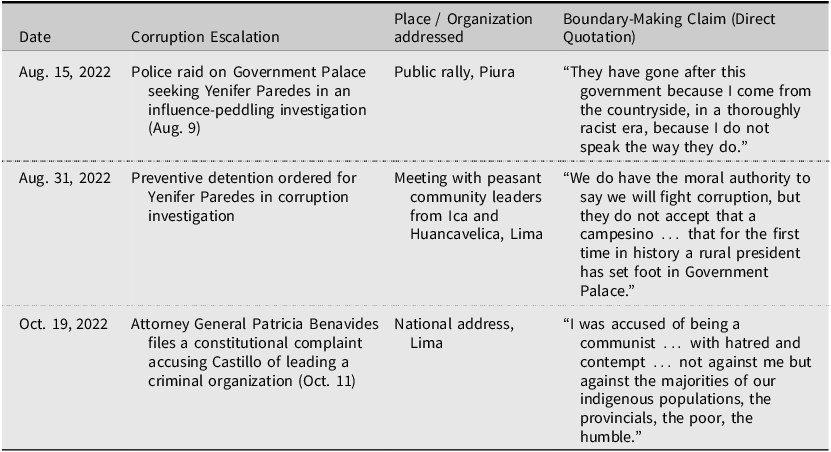




 Open access

