Attention deficit hyperactivity disorder (ADHD) is a childhood-onset neurodevelopmental disorder characterized by symptoms of hyperactivity-impulsiveness and inattention (American Psychological Association, 1994). Early markers of behavioral and emotional dysregulation (e.g. impulsivity, reactivity, and regulation difficulties) in infancy and childhood have been associated with increased risk for ADHD (Frick, Forslund, & Brocki, Reference Frick, Forslund and Brocki2018; Harold et al., Reference Harold, Leve, Barrett, Elam, Neiderhiser, Natsuaki and Thapar2013). ADHD is highly heritable, with twin studies estimating the heritability of ADHD to be around 70% (Thapar, Reference Thapar2018). Recent molecular genetics studies have also evidenced the genetic underpinnings of ADHD (Demontis et al., Reference Demontis, Walters, Martin, Mattheisen, Als, Agerbo and Cerrato2019). However, the rearing environment, including parenting and parent–child relationship quality, is also recognized as important with respect to modifying the course of ADHD symptoms in children (Deault, Reference Deault2010; Johnston & Mash, Reference Johnston and Mash2001), even when genetic factors are considered (Thapar, Langley, O'Donovan, & Owen, Reference Thapar, Langley, O'Donovan and Owen2006).
A number of studies have found associations between symptoms and diagnosis of ADHD and lower academic attainment in childhood, adolescence, and adulthood (Daley & Birchwood, Reference Daley and Birchwood2010; Greven, Harlaar, Dale, & Plomin, Reference Greven, Harlaar, Dale and Plomin2011; Greven, Kovas, Willcutt, Petrill, & Plomin, Reference Greven, Kovas, Willcutt, Petrill and Plomin2014; Plourde et al., Reference Plourde, Boivin, Forget-Dubois, Brendgen, Vitaro, Marino and Dionne2015; Snowling & Hulme, Reference Snowling and Hulme2012; Tosto, Momi, Asherson, & Malki, Reference Tosto, Momi, Asherson and Malki2015). Specifically, ADHD symptoms have been associated with reduced reading, writing, and math attainment in both clinical and community samples (Daley & Birchwood, Reference Daley and Birchwood2010). Associated comorbid specific learning problems (e.g. dyslexia, developmental coordination disorder) and poorer cognitive ability that are known to be strongly associated with ADHD may be one route via which ADHD impacts on educational attainment. The pathways and processes through which ADHD symptomology may influence academic achievement are not clear. Genetic and environmental pathways are both hypothesized to play a role in these associations (Hart et al., Reference Hart, Petrill, Willcutt, Thompson, Schatschneider, Deater-Deckard and Cutting2010; Kuntsi et al., Reference Kuntsi, Eley, Taylor, Hughes, Asherson, Caspi and Moffitt2004; Paloyelis, Rijsdijk, Wood, Asherson, & Kuntsi, Reference Paloyelis, Rijsdijk, Wood, Asherson and Kuntsi2010; Willcutt, Pennington, Olson, & DeFries, Reference Willcutt, Pennington, Olson and DeFries2007).
Parenting behaviors have been associated with child ADHD symptoms (Johnston & Mash, Reference Johnston and Mash2001); the most consistent finding is an association with hostile parenting (Harold et al., Reference Harold, Leve, Barrett, Elam, Neiderhiser, Natsuaki and Thapar2013; Ullsperger, Nigg, & Nikolas, Reference Ullsperger, Nigg and Nikolas2016). Recent twin and adoption studies also suggest that behaviors consistent with ADHD symptoms in the early years of life (e.g. child impulsivity/activation) may evoke hostile parenting (Harold et al., Reference Harold, Leve, Barrett, Elam, Neiderhiser, Natsuaki and Thapar2013; Lifford, Harold, & Thapar, Reference Lifford, Harold and Thapar2009). Parenting processes, specifically hostile caregiving, have also been associated with reduced academic attainment, including reading and math performance in middle childhood and adolescence (Benner & Kim, Reference Benner and Kim2010; Dotterer, Hoffman, Crouter, & McHale, Reference Dotterer, Hoffman, Crouter and McHale2008; Eamon, Reference Eamon2005; Flouri & Buchanan, Reference Flouri and Buchanan2004; McCoy, George, Cummings, & Davies, Reference McCoy, George, Cummings and Davies2013; Melby & Conger, Reference Melby and Conger1996; Weymouth, Buehler, Zhou, & Henson, Reference Weymouth, Buehler, Zhou and Henson2016), with initial evidence suggesting that youth adjustment may play a mediating role (e.g. Wentzel, Reference Wentzel1994). However, there is a relatively limited examination of the parenting processes that may impact on ADHD outcomes (Deault, Reference Deault2010). Furthermore, when examining the role of the parent–child relationship on child adjustment, research has primarily focused on the mother-child relationship. The role of fathers is increasingly recognized as an important influence on risk for child psychopathology and academic attainment (e.g. Cabrera, Volling, & Barr, Reference Cabrera, Volling and Barr2018). Although evidence suggests that associations between parenting and child outcomes may vary across the mother-child and father-child relationship (Harold et al., Reference Harold, Leve, Barrett, Elam, Neiderhiser, Natsuaki and Thapar2013; Lifford et al., Reference Lifford, Harold and Thapar2009), this is rarely considered in the context of child ADHD symptoms. Where studies examine maternal and paternal parenting processes in relation to child ADHD symptoms, they have not usually considered the relative role of maternal and paternal parenting processes (Kaiser, McBurnett, & Pfiffner, Reference Kaiser, McBurnett and Pfiffner2011; Lifford, Harold, & Thapar, Reference Lifford, Harold and Thapar2008).
A key challenge to establishing family processes as a salient environmental factor for child outcomes is that most family studies rely on genetically related parents and children and therefore it is difficult to disentangle environmental from genetic effects, also known as gene–environment correlations (rGE; Harold, Leve, & Sellers, Reference Harold, Leve and Sellers2017; Plomin, DeFries, & Loehlin, Reference Plomin, DeFries and Loehlin1977). The two most frequently examined forms of rGE are passive and evocative rGE. Passive rGE occurs when parents' and children's genes (which are shared) confound the association between family and child level variables (Plomin et al., Reference Plomin, DeFries and Loehlin1977; Scarr & McCartney, Reference Scarr and McCartney1983). Evocative rGE occurs when genetically influenced characteristics in the child evoke particular responses from their environment (Plomin et al., Reference Plomin, DeFries and Loehlin1977). Environmental main effects are those that cannot be attributed to rGE. To disentangle such effects, genetically informative designs, among others (Thapar & Rutter, Reference Thapar and Rutter2019) are helpful for attempting to identify likely causal processes to target intervention and prevention strategies appropriately. To address this limitation, we utilized a longitudinal parent-offspring adoption design to examine the interplay between genetic susceptibility to child attention problems (birth mother ADHD symptoms) and adoptive parent (mother and father) hostility on child academic outcomes. This design examines the association between adopted child symptoms and characteristics of biologically related parents (the birth parents) and unrelated parents (the adoptive parents). Associations between adopted children and their adoptive parents are assumed to be due to rearing environmental influences, unconfounded by shared genes (i.e. removing the confound of passive rGE). In contrast, associations between adopted children and their biological parents are assumed to be attributable to shared genes (in addition to prenatal environmental effects for biological mothers). Employing this research design, we examined associations between adoptive mother and father hostile parenting (at a child age of 4.5 years), child ADHD symptoms (child age 6 years), and academic attainment (reading and math scores at age 7 years). We also examined associations between genetically influenced (via birth mother symptoms of ADHD) early child behaviors (impulsivity/activation, behavior consonant with early ADHD-type behaviors: Harold et al., Reference Harold, Leve, Barrett, Elam, Neiderhiser, Natsuaki and Thapar2013) on both maternal and paternal hostility (i.e. evocative rGE) as pathways associated with child ADHD symptom continuity, reading, and math achievement. It was hypothesized that biological mother ADHD symptoms would be associated with adopted child impulsivity/activation (at 4.5 years), which in turn would predict maternal and paternal hostility, indicative of evocative rGE, replicating prior findings for mothers. Additionally, it was hypothesized that maternal and paternal hostile parenting (at 4.5 years) would predict children's ADHD symptom continuity age of 6 years and that child ADHD symptoms would predict poorer academic achievement.
Methods
Participants and study design
The current sample comprised 361 linked sets of adopted children, adoptive parents, and biological mothers from the Early Growth and Development Study, a longitudinal, multisite US parent-offspring adoption study (Leve et al., Reference Leve, Neiderhiser, Ganiban, Natsuaki, Shaw and Reiss2019). The median lag-time to placement was child age of 2 days (M = 6.2; s.d. = 12.45; range = 0–91 days). Participants were representative of the adoptive parent and birth parent populations that completed adoption plans at the participating agencies during the same period. Mean age of birth mothers and birth fathers at the time of placement was 23.84 and 25.61 respectively. The majority of birth parents were Caucasian (birth mother = 75%; birth father = 79%). Birth parents typically had high school education, and household incomes of <$ 25 000. The majority of adoptive parents were Caucasian (91%). Mean age of adoptive mothers and adoptive fathers was 36.98 and 37.82 at the time of placement, respectively. Adoptive parents were typically college educated with a median household income of $ 100 000. Adoptive parents had been married at an average of 12 years. Additional details about the study design and sample description are described elsewhere (Leve et al., Reference Leve, Neiderhiser, Ge, Scaramella, Conger, Reid and Reiss2007, Reference Leve, Neiderhiser, Ganiban, Natsuaki, Shaw and Reiss2019). Ethical approval was provided by the University of Oregon Institutional Review Board (protocol number: 04262013.036). Given our focus on maternal relative to paternal parenting processes, we excluded same-sex couples from analyses, therefore 345 families were available for the current analysis.
Measures
Birth mother ADHD symptoms
Birth mother ADHD symptoms were assessed using maternal reports of both the Adult Temperament Questionnaire (α = 0.73) at 18 months of child age (Rothbart, Ahadi, & Evans, Reference Rothbart, Ahadi and Evans2000) and the Barkley Adult ADHD scale (α = 0.90) at a child age of 4.5 years (Murphy & Adler, Reference Murphy and Adler2004). The scales were standardized and then summed into a single measure of mother ADHD symptoms, with good internal consistency (α = 0.88). See Harold et al. (Reference Harold, Leve, Barrett, Elam, Neiderhiser, Natsuaki and Thapar2013) for further details of the measure (M = 0.08, s.d. = 1.75).
Adoptive parent-to-child hostility
Adoptive parent-to-child hostility was assessed using parent self-reports on the Iowa Family Interaction Rating Scales (Melby et al., Reference Melby, Conger, Book, Rueter, Lucy, Repinski and Rogers1993) at a child age of 4.5 years. Adoptive mothers and fathers reported on their own hostile behaviors towards their child (maternal reports M = 11.04, s.d. = 3.08; paternal reports M = 10.29; s.d. = 2.89). Higher scores were indicative of higher hostility (maternal reports α = 0.91; paternal reports: α = 0.94).
Child impulsivity/activation
Child impulsivity/activation was assessed using adoptive mother report on the Children's Behavior Questionnaire (Rothbart, Ahadi, Hershey, & Fisher, Reference Rothbart, Ahadi, Hershey and Fisher2001) and adoptive mother reports on the Behavioral Inhibition Scale/Behavioral Activation Scale (Blair, Peters, & Granger, Reference Blair, Peters and Granger2004) at an age of 4.5 years, as used in Harold et al. (Reference Harold, Leve, Barrett, Elam, Neiderhiser, Natsuaki and Thapar2013). Each of these subscales were standardized and then summed to create a single indicator of early child impulsivity/activation (M = 0.02, s.d. = 3.19).
Child ADHD symptoms
Child ADHD symptoms were assessed using adoptive mother and father reports on the Conner's Abbreviated Parent Questionnaire, a 10-item scale regarding hyperactivity and inattentive behaviors (Conners, Reference Conners1997) at a child age of 6 years. A composite score of mother and father reports was created (r = 0.71, p < 0.001), using a mean score of mother and father reports (M = 8.09; s.d. = 4.93).
Child academic achievement
Child academic achievement was measured at an age of 7 years using z-scores of reading (M = 0.53, s.d. = 1.00) and math fluency (M = −0.02; s.d. = 1.04) subscales from the Woodcock–Johnson III achievement test (Woodcock, McGrew, & Mather, Reference Woodcock, McGrew and Mather2001), which assessed reading and math skills. Previous research suggests that the reliability for both reading and math fluency shows strong reliabilities of 0.90 (Schrank & McGrew, Reference Schrank and McGrew2001). Scales were reverse scored so that higher scores indicated greater levels of difficulty in attaining competence (i.e. poorer academic attainment).
Covariates
Earlier levels of academic achievement were assessed using the Test of Preschool Early Literacy test (TOPEL) at an age of 4.5 years (Lonigan, Wagner, Torgesen, & Rashotte, Reference Lonigan, Wagner, Torgesen and Rashotte2007). The present study combined two subscales (Print Knowledge and Definitional Vocabulary) to create a composite score of children's emergent literacy skills. Previous research suggests internal consistency for the TOPEL index is 0.96 (Lonigan et al., Reference Lonigan, Wagner, Torgesen and Rashotte2007).
To control for similarities between birth and adoptive families resulting from contact and knowledge between birth parents and children, secondary analyses considered the association with the level of openness in the adoption (Ge et al., Reference Ge, Natsuaki, Martin, Leve, Neiderhiser, Shaw and Reiss2008). We also examined associations with prenatal complications to attempt to disentangle genetic influences from the prenatal environment (Marceau et al., Reference Marceau, De Araujo-Greecher, Miller, Massey, Mayes, Ganiban and Neiderhiser2016). However, neither of these covariates was significantly associated with any variables in the model and therefore neither was considered further in analyses.
Analyses
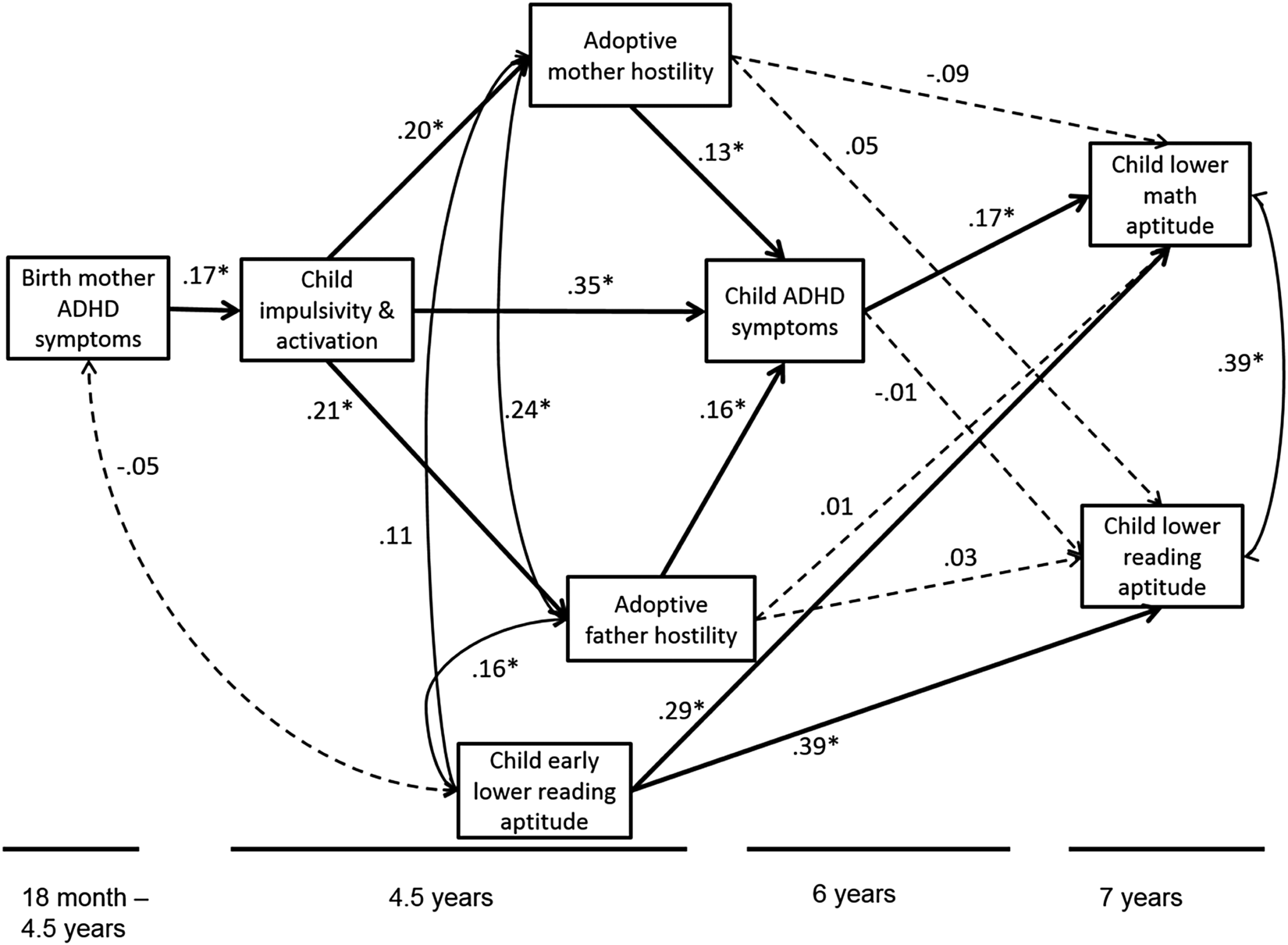
Path analysis was used to examine the role of biological mother ADHD as a predictor of adopted children's early impulsivity/activation behaviors, and to examine associations between child impulsivity/activation and both adoptive mother and father hostility, thereby allowing examination of evocative rGE processes. It simultaneously allowed the examination of processes through which parental hostility and child ADHD symptoms may be associated with later child academic outcomes (reading and math). The full theoretical model is shown in Fig. 1. Analyses were conducted using LISREL (Jöreskog, Reference Jöreskog and Sörbom2006). Fit statistics were used to examine model fit using the χ2, confirmatory fit index (CFI), and the root mean square error of approximation (RMSEA). Good model fit is indicated by a non-significant χ2 test, CFI ⩾ 0.98, TLI ⩾ 0.80, and RMSEA ⩽ 0.05 (Kline, Reference Kline2011).
Path model with results showing standardized coefficients. Path diagram shows standardized coefficients; * p = <0.05; solid lines represent significant coefficients; dashed lines represent non-significant coefficients. Fit indices (Kline, Reference Kline2011) indicated a satisfactory fit to the data: χ2 (9) = 26.66, p = 0.002; CFI = 0.96; TLI = 0.87; RMSEA = 0.07 (0.04, 0.10), SRMR = 0.05.

Missing data ranged from 21% (72/345 for math achievement at an age of 7) to 34% (117/345 father hostility at an age of 4.5 years). The Little's test indicated that data were missing completely at random (χ2 (253) = 281.54, p = 0.105). Analyses were conducted using Full Information Maximum Likelihood estimation, which makes use of all available data, therefore 345 cases were included in the current analyses.
Results
Correlational analyses
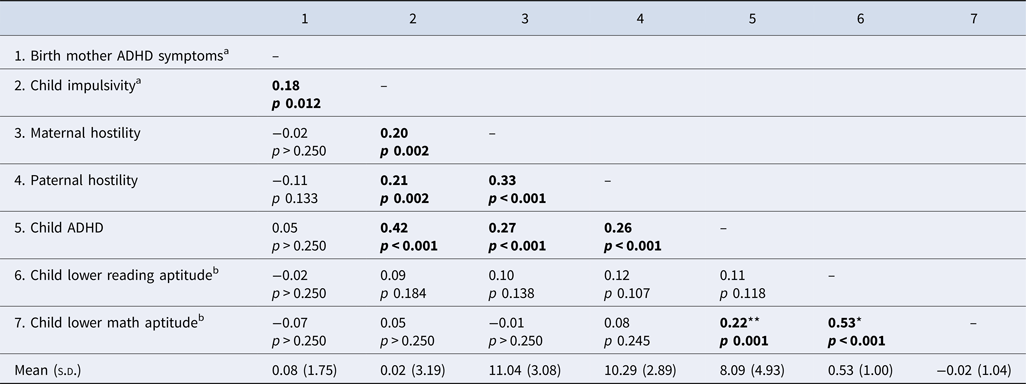
As previously demonstrated (Harold et al., Reference Harold, Leve, Barrett, Elam, Neiderhiser, Natsuaki and Thapar2013), birth mother ADHD symptoms were correlated with early child impulsivity/activation (r = 0.18, p < 0.001); see Table 1. In addition, early child impulsivity was correlated with maternal and paternal hostility toward the child (r = 0.20, p < 0.001; r = 0.21, p < 0.001 respectively), as well as later child ADHD symptoms (r = 0.42, p < 0.001), but not with later reading (r = .09, p = .184) or math scores (r = 0.05, p > 0.250). Maternal and paternal hostility toward the child were correlated with each other (r = 0.33, p < 0.001), and with later levels of child ADHD symptoms (r = 0.27, p < 0.001; r = 0.26, p < 0.001 respectively). Parent hostility was not correlated with child reading (maternal hostility: r = 0.10, p = 0.138; paternal hostility: r = 0.12, p = 0.107) or math scores (maternal hostility: r = −0.01, p > 0.250; paternal hostility: r = 0.08, p = 0.245). Child ADHD symptoms were correlated with lower math (r = 0.22, p < 0.001) but not reading achievement (r = 0.11, p = 0.118).
Correlations, means, and standard deviations among study variables

a Summed standardized subscales.
b Standardized z score.
Path analysis
Figure 1 shows the full model. Fit indices indicated a satisfactory fit to the data (χ2 (9) = 26.66, p = 0.002; CFI = 0.96; TLI = 0.87; RMSEA = 0.07 (0.04, 0.10), SRMR = 0.05).
Birth mother ADHD symptoms predicted child early impulsivity/activation (β = 0.17, p = 0.005). Child impulsivity/activation (at an age of 4.5 years) in turn predicted both adoptive mother and father hostility (β = .20, p = 0.002; β = 0.21, p = 0.001 respectively), as well as child ADHD symptoms at an age of 6 years (β = 0.35, p < 0.001). Adoptive mother hostility predicted later child ADHD symptoms (β = 0.13, p = 0.015), as did adoptive father hostility (β = 0.16, p = 0.006). Neither maternal hostility nor father hostility directly predicted later poorer child math (β = −0.10, p = 0.093; β = −0.03, p > 0.250) or reading (β = 0.03, p > 0.250; β = 0.04, p > 0.250) achievement. However, there was a significant indirect effect of maternal and paternal hostility on later math aptitude via the continuity in child ADHD symptoms (both β = 0.03, p < 0.05). Early levels of poorer reading in the child predicted later poorer math (β = 0.29, p < 0.001) and reading (β = 0.39, p < 0.001) achievement. Child symptoms of ADHD predicted later poorer child math achievement (β = 0.17, p = 0.007), but not reading (β = −0.01, p > 0.250). There was a significant indirect effect of early child impulsivity/activation on later child poorer math ability via child ADHD symptoms (β = 0.05, p < 0.05). Additional analyses compared this full model to a model which set non-significant associations to zero. A non-significant χ2 difference test (Δdf = 5; Δχ2 = 6.16, p = 0.292) suggested that these non-significant associations did not substantially contribute to the model indicating that a more parsimonious model can be accepted.
Stacked modeling procedures examined whether pathways from child impulsivity to maternal and paternal hostility differed in magnitude. Constraining the path from child impulsivity to adoptive mother hostility and to adoptive father hostility to be equal did not result in a significantly worse model fit (Δdf = 1; Δχ2 = 0.98, p > 0.05), suggesting that the association between early child impulsivity on father hostility was not significantly different than its association with mother hostility. We also examined whether pathways differed in magnitude between maternal and paternal hostility to child ADHD symptoms. Constraining the path from adoptive mother hostility and father hostility to child ADHD symptoms to be equal did not result in a significantly worse model fit (Δdf = 1; Δχ2 = 0.78, p > 0.05), suggesting that the associations between maternal and paternal hostility on child ADHD symptoms were not significantly different.
Discussion
The current study examined the interplay between genetic susceptibility and both maternal and paternal hostility in the persistence of ADHD symptoms and academic achievement in childhood with child impulsivity/activation as an early marker of risk for ADHD symptoms (Frick et al., Reference Frick, Forslund and Brocki2018). We examined associations between early child attributes (impulsivity/activation), parent hostility, and academic attainment (specifically math) via child ADHD symptoms in a research design that removes the confound of passive rGE (adoptive parents and their adopted children do not share genes). Our findings first replicate previous findings in this sample suggesting that genetically influenced (measured by birth mother ADHD symptoms) early child impulsivity/activation evokes adoptive mother hostility (Harold et al., Reference Harold, Leve, Barrett, Elam, Neiderhiser, Natsuaki and Thapar2013). We also extended findings, demonstrating evocative effects on adoptive father hostility. Second, child ADHD symptoms were associated with later academic attainment. We found that child ADHD symptoms were specifically associated with lower math but not reading attainment. This is surprising given that ADHD and reading ability are known to be strongly associated (e.g. Adams & Snowling, Reference Adams and Snowling2001; Snowling & Hulme, Reference Snowling and Hulme2012; Willcutt et al., Reference Willcutt, Pennington, Olson and DeFries2007), with evidence suggesting shared genetic liability (Barry, Lyman, & Klinger, Reference Barry, Lyman and Klinger2002; Daley & Birchwood, Reference Daley and Birchwood2010; Plourde et al., Reference Plourde, Boivin, Forget-Dubois, Brendgen, Vitaro, Marino and Dionne2015; Stergiakouli et al., Reference Stergiakouli, Martin, Hamshere, Langley, Evans, St Pourcain and Smith2015). The null finding on ADHD symptoms and reading is in contrast to previous research that finds associations between ADHD and reading/literacy (Frazier, Youngstrom, Glutting, & Watkins, Reference Frazier, Youngstrom, Glutting and Watkins2007; Rabiner & Coie, Reference Rabiner and Coie2000). There are several explanations for why the current study found no association between child ADHD symptoms and reading. First, the current sample consists of primarily middle-class, college-educated adoptive parents and evidence suggests that parents with higher educational qualifications read to their children more frequently (Kuo, Franke, Regalado, & Halfon, Reference Kuo, Franke, Regalado and Halfon2004). Second, parents place an increased importance on literacy learning and spend more time supporting children's reading compared to math (Cannon & Ginsburg, Reference Cannon and Ginsburg2008). This results in math being a relatively novel subject at school entry. Third, we were able to control for prior reading abilities using the TOPEL, but we did not have an earlier measure of children's math abilities. This methodological artefact may have resulted in more available variance to predict in math as compared to reading achievement. Together, these three factors could have contributed to reading being less influenced by ADHD symptoms in the current study. Nevertheless, these findings have implications for the understanding of child development and long-term math attainment where there are indicators of signs of early ADHD.
We were able to examine pathways implicated in the development of ADHD symptomatology and subsequent academic attainment in a study that removed the confound of passive rGE. Any associations between adoptive parent characteristics and adopted children cannot be explained by common genes, and likely reflect environmental associations, providing evidence of the importance of environmental factors, specifically parent hostility for child ADHD symptom continuity, and later math attainment. In line with previous research, we found evidence of an association between child ADHD symptoms and maternal hostility (e.g. Harold et al., Reference Harold, Leve, Barrett, Elam, Neiderhiser, Natsuaki and Thapar2013); however, we extend current understanding, demonstrating the importance of the relative role of father hostility for child ADHD symptom persistence. The current study suggests that the associations between parental hostility and later child ADHD symptoms do not differ in magnitude for mothers or fathers. This has implications for recognizing the potential of father involvement in interventions. In addition, we were also able to examine evocative rGE, specifically examining genetically informed attributes of the child (impulsivity/activation) on both maternal and paternal parenting processes. Consistent with previous research examining evocative rGE, early impulsivity/activation evoked hostile parenting in mothers with maternal hostility in turn predicting later ADHD symptoms (Harold et al., Reference Harold, Leve, Barrett, Elam, Neiderhiser, Natsuaki and Thapar2013). We found similar processes for paternal parenting, with child impulsivity/activation evoking hostile paternal parenting, which in turn predicted later child ADHD symptoms. These findings have implications for the understanding of child development, with both genetic (measured by birth mother ADHD symptoms) and environmental processes (adoptive mother and father hostile parenting) predicting child outcomes (child ADHD symptoms and later math attainment).
Limitations and future directions
It is important to interpret these findings in the light of limitations. First, potential bidirectional effects between early impulsivity/activation and parent hostility may be present, however, in the current study, early child impulsivity/activation was measured in the same period as adoptive parent hostility. However, findings from the current study are consistent with a number of studies that have found evidence of evocative rGE for parenting behaviors using molecular genetic (Elam et al., Reference Elam, Wang, Bountress, Chassin, Pandika and Lemery-Chalfant2016) and family-based genetic research designs (Elam et al., Reference Elam, Harold, Neiderhiser, Reiss, Shaw, Natsuaki and Leve2014; Harold et al., Reference Harold, Leve, Barrett, Elam, Neiderhiser, Natsuaki and Thapar2013). Further research is needed to examine the direction of effects between early impulsivity and parenting processes. Second, birth father ADHD symptoms were not included in the measure of the child's inherited risk because of limited data available from birth fathers. ADHD diagnoses are more common in males than females (Polanczyk, De Lima, Horta, Biederman, & Rohde, Reference Polanczyk, De Lima, Horta, Biederman and Rohde2007). We also relied on adult self-reports of ADHD symptoms rather than diagnoses of ADHD in birth mothers as an index of genetic risk for impulsivity in childhood. Together, these factors may have underestimated (or overestimated) the magnitude of the association between birth parent ADHD symptoms and child impulsivity. Third, although the findings in the current study are consistent with Harold et al. (Reference Harold, Leve, Barrett, Elam, Neiderhiser, Natsuaki and Thapar2013) which examined associations between adoptive mother hostility and child ADHD symptoms using a cross-rater approach, it is important to note that, for some measures there was a reliance on a single reporter (adoptive mother). Where available, we utilized multiple informants to reduce the potential risk for shared method variance, for example, both mother and father reports of child ADHD symptoms were used. We also used standardized assessments of child reading and math achievement. However, future research should consider alternative approaches to assessing child achievement, symptoms, and parenting (e.g. teacher reports or clinical assessments of child ADHD symptoms; observational parenting assessments). Fourth, in the current study, child ADHD symptom levels were relatively low and therefore do not necessarily constitute mental health ‘difficulties.’ However, ADHD can be conceptualized as a continuum: both in terms of associated outcomes, and because heritability estimates have been shown to be similar across the continuum as well as in ‘high scores’ (Stergiakouli et al., Reference Stergiakouli, Martin, Hamshere, Langley, Evans, St Pourcain and Smith2015). Therefore, non-clinical samples can be useful to examine the etiology of ADHD and related outcomes. Fifth, whilst both inattentive and hyperactive-impulsive symptoms of ADHD have been evidenced to contribute to the prediction of reading and math, evidence suggests that inattentiveness may be a significantly stronger predictor of reading and math than hyperactive-impulsive symptoms of ADHD (e.g. Greven et al., Reference Greven, Harlaar, Dale and Plomin2011, Reference Greven, Kovas, Willcutt, Petrill and Plomin2014). Therefore, it is possible that different domains of ADHD may differentially impact on child reading and math outcomes. However, in the current study, child ADHD symptoms were assessed using the Conners' Parent Rating Scale – Revised, a unidimensional measure of ADHD symptoms. Therefore it was not possible to examine these domains separately.
Finally, ADHD commonly co-occurs with other neurodevelopmental problems (e.g. language, motor co-ordination difficulties; DuPaul, Gormley, & Laracy, Reference DuPaul, Gormley and Laracy2013; Martin, Hamshere, Stergiakouli, O'Donovan, & Thapar, Reference Martin, Hamshere, Stergiakouli, O'Donovan and Thapar2015) as well as mental health problems (e.g. conduct disorder, anxiety; Jensen, Martin, & Cantwell, Reference Jensen, Martin and Cantwell1997; Schatz & Rostain, Reference Schatz and Rostain2006; Thapar & vanGoozen, Reference Thapar and vanGoozen2018) so we cannot rule out that the link between ADHD and parent hostility and its links with math attainment is explained by these factors.
To further understand the pathways and processes influencing the developmental course of ADHD symptomatology and academic outcomes, future research should consider additional mediators and moderators of the pathways to child ADHD symptoms and academic outcomes. For example, additional aspects of parenting that were included in the current study but not in the current report (e.g. monitoring, engagement) could also be important for the development of child mental health difficulties (including symptoms of ADHD) and later academic functioning (Daley & Birchwood, Reference Daley and Birchwood2010; Rogers, Wiener, Marton, & Tannock, Reference Rogers, Wiener, Marton and Tannock2009a, Reference Rogers, Wiener, Marton and Tannock2009b). In addition, parent academic ability is associated with child academic ability, with the association due to both genetic and environmental influences (Friend et al., Reference Friend, DeFries, Olson, Pennington, Harlaar, Byrne and Keenan2009). Future research should examine how adoptive and birth parent measures of academic ability impact on these processes. In addition, adoptive parent mental health may be important to consider: parental symptoms of ADHD have been associated with aspects of parenting (Harvey, Danforth, McKee, Ulaszek, & Friedman, Reference Harvey, Danforth, McKee, Ulaszek and Friedman2003), as have symptoms of antisocial behavior (Harold et al., Reference Harold, Rice, Hay, Boivin, Van Den Bree and Thapar2011; Harold, Elam, Lewis, Rice, & Thapar, Reference Harold, Elam, Lewis, Rice and Thapar2012). Therefore, it will be important for future research to examine how other aspects of parental mental health affect the processes through which children develop psychopathology, and difficulties in reading and math achievement.
Notwithstanding these caveats, results provide evidence of an environmental effect of adoptive father-to-child and mother-to-child effects on child ADHD symptom continuity, and later math ability in children to whom they were not genetically related (i.e. removing passive rGE). In addition, adoptive mother-to-child and father-to-child hostility was evoked by genetically informed child impulsivity/activation which also predicted child ADHD symptoms. The current data help advance understanding of the interplay between genetic susceptibility and environmental risk in the development of ADHD symptoms and academic achievement in childhood. Genetic risk for ADHD symptoms served as a risk factor for disrupted mother-to-child and father-to-child relationships. These findings suggest a cascade of risk through which genetic risk for ADHD symptoms influence later math achievement, with indirect effects via both mother and father hostility contributing to the developmental course of ADHD. Early interventions targeting hostility in both parents may be important, especially where children have high levels of impulsivity, not for treating ADHD per se (as per NICE guidance) but for influencing its developmental course and associated outcomes and attainment. There is evidence that parenting programs can be an effective intervention for those with ADHD who have comorbid conduct disorder (NICE, 2018), which is known to also be associated with learning problems (Erskine et al., Reference Erskine, Norman, Ferrari, Chan, Copeland, Whiteford and Scott2016). Recent review evidence suggests that parenting interventions targeting ADHD alone (without comorbid presence of conduct disorder) do not appear efficacious (Daley et al., Reference Daley, Van Der Oord, Ferrin, Cortese, Danckaerts, Doepfner and Banaschewski2018; Lange et al., Reference Lange, Daley, Frydenberg, Houmann, Kristensen, Rask and Thomsen2018; see meta-analysis Sonuga-Barke et al., Reference Sonuga-Barke, Brandeis, Cortese, Daley, Ferrin, Holtmann and Dittmann2013) but may help other outcomes. Notwithstanding these observations, the present results are among the very first in this area to highlight the role of maternal and paternal parenting as significant in relation to ADHD symptoms – a potential consideration for future intervention program design and development. In addition, child ADHD symptoms were associated with later academic ability, specifically math ability. Interventions that assist with the development of math skills, particularly those with high levels of early manifestations of ADHD symptoms, may also be particularly beneficial.
Acknowledgements
This project was supported by grant R01 HD042608 from the National Institute of Child Health and Human Development and the National Institute on Drug Abuse, NIH, U.S. PHS (PI Years 1–5: Reiss; PI Years 6–10: Leve); UH3 OD023389 from the Office of the Director, NIH, U.S. PHS (PIs: Leve, Neiderhiser, Ganiban); and MH092118 from the National Institute of Mental Health (PIs: Neiderhiser, Leve). Sellers and Harold were supported by Economic and Social Research Council project grant awards (ES/N003098/1 and ES/L014718/1 respectively). The content is solely the responsibility of the authors and does not necessarily represent the official views of the Eunice Kennedy Shriver National Institute of Child Health and Human Development or the National Institutes of Health.
Author contributions
Harold, Leve, and Sellers developed the study research question. Sellers performed the data analysis under the supervision of Harold and Leve. Sellers and Harold contributed to the interpretation of the study findings. Sellers drafted the manuscript. Reiss, Leve, Neiderhiser, Shaw, and Natsuaki designed and carried out the original study and data collection activities
All authors provided critical revisions, and all authors approved the final version of the manuscript for submission.
Conflict of interests
None.