1. Introduction
The received wisdom is that economic downturns prompt countries to raise trade barriers (Conybeare, Reference Conybeare1983; Cassing et al., Reference Cassing, McKeown and Ochs1986; Bohara and Kaempfer, Reference Bohara and Kaempfer1991; Bagwell and Staiger, Reference Bagwell and Staiger2003; Davis and Pelc, Reference Davis and Pelc2017). Recently, various studies have challenged this claim by pointing out that the financial crisis and recession of 2008–2009 generated little protectionism. Crucial to averting protectionism during this episode was that the G20 leaders pledged to resist the temptation to raise trade barriers (Organisation for Co-operation and Development, 2010; Vandenbussche and Viegelahn, Reference Vandenbussche, Viegelahn and P. Bown2011; Kee et al., Reference Kee, Neagu and Nicita2013; Gawande et al., Reference Gawande, Hoekman and Cui2015).Footnote 1 Not only did G20 countries forestall a rise in protectionism, but the bulk of these states formed international trade agreements during this period.Footnote 2
The latter development reflects a tendency for leaders of democratic countries to establish trade agreements during hard economic times. We argue that some democratic leaders enter trade agreements because they yield political as well as economic benefits. Such agreements can help heads of state in countries with competitive political systems retain office during economic downturns. In democracies, leaders are concerned that the public will hold them responsible for the downturn and vote them out of office. Policies designed to liberalize and promote the flow of trade can signal to voters that the downturn was not the product of rent-seeking or incompetence, but instead was due to circumstances beyond the leader's control. Since trade agreements bind the hands of political leaders, they have a harder time acquiescing to protectionist pressures. Such agreements create credible commitments by the leader to avoid rent-seeking behavior.
We test this argument by analyzing the formation of preferential trade agreements (PTAs), which are a broad class of international institutions that include common markets, customs unions (CUs), free trade areas (FTAs), and economic unions. These agreements have marked the global landscape for centuries, but have proliferated rapidly over the past half-century. PTAs are designed to foster economic integration among member-states by improving and stabilizing the access that each member has to the other participants’ markets (Freund and Ornelas, Reference Freund and Ornelas2010). Consistent with our argument, we find that democracies experiencing hard times are particularly likely to form PTAs. Since World War II, democratic countries have a greater tendency to establish these agreements than non-democratic countries, and have been most likely to enter PTAs during downturns in the business cycle. We also find that, as our argument suggests, leaders in democracies who sign PTAs during hard times tend to enjoy a longer tenure in office than those who eschew PTAs. Our results challenge the conventional wisdom that economic downturns necessarily lead to greater protectionism. Instead, hard times prompt democratic leaders to reassure society about their competence, and forming agreements that oppose protectionism is one way of achieving this end.
2. A theory of PTAs in hard times
PTAs influence the flow of trade and investment, but previous research has shown that national leaders often conclude these agreements for political as well as economic reasons (Mansfield and Milner, Reference Mansfield and Milner2012; Baccini and Urpelainen, Reference Baccini and Urpelainen2015). Leaders entering a PTA realize domestic political benefits that are difficult to obtain through unilateral trade policy measures alone. PTAs are a form of international cooperation since the participating countries mutually adjust their trade barriers. These adjustments require agreement both among countries and among actors within them. Thus, PTAs are costly to sign and signal the government's preferences more clearly than unilateral measures. And since PTAs often include institutional mechanisms to monitor the actions of members, entering these agreements creates especially credible commitments that are more costly to renege on than unilateral policies.
A rational government will only form an agreement with other countries if the expected benefits – both domestic and international – of doing so exceed the costs of negotiating and ratifying the agreement. Trade agreements may generate important economic and political benefits for both governments and the public. It is widely recognized that PTAs can have important economic effects and that leaders may be motivated to form these agreements by a desire to achieve economic gains. However, trade agreements also have important domestic political effects that have received less scholarly attention to date. They convey information to the public and interest groups opposing heightened protectionism about the nature and activities of leaders. They signal the public about leaders and bolster the credibility of commitments by leaders to avoid rent seeking. Such information can contribute to political support for leaders, helping them retain office.
Leaders may prefer different degrees of protection based on the weights that they assign to the benefits of accruing rents compared to the benefits of improving social welfare (Gawande et al., Reference Gawande, Krishna and Olarreaga2009). Promoting social welfare can yield political support on the part of the public and free trade interest groups that lengthen a leader's tenure in office. The public and these groups, however, generally cannot be certain of what balance between rents and social welfare a government truly desires. They need reassurance about the motives and actions of the government. The public also have heterogeneous preferences about trade policy: some individuals prefer extensive protection, whereas others prefer freer trade. We assume that the median member of society, who commands the attention of leaders, prefers some positive level of trade barriers; that is, s/he is not committed to a purely free trade policy. However, since trade barriers create rents for certain interest groups, office-holders may seek to raise barriers beyond the level preferred by the median individual to extract these rents. The public, who do not gain and probably suffer welfare losses as a result of these rents, are unaware of the extent of government rent-seeking since they do not know their leaders’ exact trade preferences or policies. Governments would like to limit the amount of protection they furnish since it harms the economy in the long run and potentially damages their reelection prospects.
But governments may be tempted to provide protection to certain domestic groups. Government rents from special interests rise with the level of protection. Although leaders may not desire as much protection as key interest groups demand, they may be tempted by the rents that accrue from furnishing protection. Faced with special interests that demand protection, particularly when the economy sours, leaders need to find ways to reassure the public that they are not being captured by protectionist interests and that they are making sound foreign economic policy. Increasing trade barriers may win leaders support from some import-competing interests, but doing so can also antagonize pro-trade interest groups as well as the public, which will be harmed if protectionism contributes to a slump in economic growth. PTAs provide a mechanism for leaders to manage such societal pressures by creating a visible commitment mechanism to avoid rent seeking.
Other studies have advanced similar arguments about the role of trade agreements in domestic politics (Maggi and Rodriguez-Clare, Reference Maggi and Rodriguez-Clare1998, Reference Maggi and Rodriguez-Clare2007; Staiger and Tabellini, Reference Staiger and Tabellini1999; Mitra, Reference Mitra2002). Maggi and Rodriguez-Clare (Reference Maggi and Rodriguez-Clare1998), for example, argue that governments may form trade agreements to provide credible commitments vis-á-vis the public and interest groups. They show that governments face a time inconsistency problem. Many interest groups demand protectionist trade policy, especially during economic downturns. Although governments find it difficult to resist these demands, protection causes investment distortions, which harm them politically in the longer run by reducing efficiency and growth. Governments then use trade agreements to make policy commitments that are credible and prevent interest groups from pressing for heightened trade barriers in the future.
For leaders, concluding a trade agreement can help reassure the public that they are making sound foreign economic policy and resisting protectionism. Leaders, however, also worry about the domestic costs involved in ratifying agreements since not everyone supports trade. Balancing these two forces is a central part of a decision maker's calculation about whether to sign a PTA. A country's regime type is crucial in this regard.
Democracies have greater political incentives to enter PTAs than other countries. The free, fair, and regular elections that are the hallmark of democracies motivate leaders to sign such agreements. Leaders in democracies are caught between the pressures of special interest groups and the need for political support from voters. Some special interests press for policies – such as protectionist trade policies – that benefit them but adversely affect the domestic economy. Heads of state may want to satisfy these interests in exchange for campaign contributions or other sources of political support. But complying with all interest group demands could have highly deleterious economic consequences and could imperil their hold on office.
Democratic leaders also have a hard time convincing the public that they will not accede to special interest demands. As Maggi and Rodriguez-Clare (Reference Maggi and Rodriguez-Clare1998) point out, governments would like to be able to resist some protectionist demands; but when such demands arise, governments are usually better off acquiescing to each group. Many voters and free trade interest groups understand this and are harmed by government rent-seeking (Maggi and Rodriguez-Clare, Reference Maggi and Rodriguez-Clare1998, Reference Maggi and Rodriguez-Clare2007). Leaders may realize that these groups could take actions that would reduce their probability of retaining office. But voters and interest groups face an informational problem. The public may not know the preferences of – or the exact trade policy chosen by – the government, and thus cannot easily distinguish between adverse exogenous economic shocks and the extractive policies of leaders. An economic downturn could be caused by either highly protectionist policies or an exogenous shock, such as a global recession or an international crisis. Both events, for example, might increase the price that the public pay for goods and services, thereby dampening public support for the government. For leaders facing competitive elections, this threatens their ability to retain office.
Democratic leaders have particular reason to demonstrate to the public that poor economic performance is not the result of their extractive policies. While they could choose to unilaterally lower trade barriers, doing so is time inconsistent. Leaders can reduce barriers, but they and the public recognize that future special interest demands for protection may be met. Consequently, heads of government must find other ways to reassure the public that they will not engage in excessive protectionism.
One way of achieving this end is by entering into an international trade agreement, which is both a visible commitment to restrict protectionism and an institutional reassurance to the public and free trade interest groups that excessive protectionism has been resisted. The agreement commits participating countries to trade barriers that fall below each government's ideal unilateral level and serves as a monitoring mechanism. Other member-states can use features of the trade institution (such as the dispute settlement mechanism included in various trade agreements) to convey information to each participating government's public if its trade barriers rise above the agreed upon level. The agreement is public and therefore provides information that domestic groups can use to monitor leaders. The monitoring that an international trade agreement facilitates can help political leaders overcome their reassurance problem.
Indeed, the institutions set up by trade agreements can help transmit information to domestic groups regarding governments’ behavior about which they would otherwise remain ignorant. The legalized dispute processes included in many PTAs play an important role in spreading information about the policies of member governments to previously uninformed subnational actors, such as the voting public. In order to properly attribute blame for poor economic conditions, voters need to be able to identify and distinguish between the result of bad policy choices and adverse macroeconomic circumstances that are beyond the government's control (Mansfield et al., Reference Mansfield, Milner and Rosendorff2002). Dispute settlement procedures (DSPs) in PTAs provide credible information to the public about the government's trade policy choices that advantage certain industries (Davis, Reference Davis2012; Jo and Namgung, Reference Jo and Namgung2012), which can help insulate political leaders during economic downturns (Hollyer and Rosendorff, Reference Hollyer and Rosendorff2012). More than 80% of PTAs formed from 1947 to 2009 contain some type of dispute settlement provision, with about 6% having a standing legal body (Dür et al., Reference Dür, Baccini and Elsig2014). Although there is substantial variation in the types of DSPs contained in PTAs – from informal negotiations to third-party adjudication – such procedures are frequently used (Rosendorff, Reference Rosendorff and Martin2015; Allee and Elsig, Reference Allee and Elsig2016). A recent study places the number of PTA-related disputes in the Western Hemisphere in the thousands since 1995 (Laks-Hutnick, Reference Laks-Hutnick2013, as cited in Allee and Elsig, Reference Allee and Elsig2016: 100). The North American Free Trade Agreement (NAFTA) alone has at least seven forms of dispute settlement for topics ranging from anti-dumping and countervailing duties to environmental and labor cooperation (de Mestral, Reference de Mestral, Bartels and Ortino2006: 4). This institution has experienced 210 formal disputes through 2016 (Allee and Elsig, Reference Allee and Elsig2016: 100).Footnote 3 Furthermore, in the case of the United States, recent studies have found that the public are increasingly informed and interested in gaining more information about trade policy once a dispute is initiated (Pelc, Reference Pelc2013; Chaudoin, Reference Chaudoin2014).
Thus, entering into a trade agreement can bolster support for a government, even when the economy falters. When elections take place in the face of adverse economic circumstances, citizens may blame incumbents and vote them out of office.Footnote 4 Absent the agreement, the government faces greater difficulty retaining office since it cannot credibly reassure voters and free trade interest groups that the downturn was beyond its control. These political benefits help motivate leaders to sign trade agreements.
PTAs provide such a political reassurance mechanism, which is most useful for democratic leaders. These agreements allow leaders to commit to lower trade barriers and signal voters that leaders’ trade policies did not directly cause hard economic times. In turn, these leaders are more likely to remain in office since at least some voters have greater reason to view them as competent economic stewards, even during recessions. The more electoral competition that exists, the more that leaders have to worry about being ejected from office and the greater their need to reassure the public. Hence, democratic governments should be more likely to sign trade agreements than other governments.
In countries marked by genuine electoral competition, the opposition usually wants to discredit the government and the incumbent party. One way to do so is by charging that the government has been captured by special interests and has neglected the national interest. In hard economic times, this charge is likely to carry added weight since the government will have difficulty demonstrating that the downturn was not due to its rent seeking. If, however, the government has signed and abided by a PTA, the opposition's argument will be harder to establish. As a result, the opposition may not advance this claim in the first place. If it does so, the government can respond that its hands were tied through a trade agreement that restricted its ability to protect special interests. Hence, it is not responsible for the adverse economic circumstances and should be reelected. Moreover, publicly exposed cheating on trade agreements can generate domestic ‘audience costs’ for political leaders, increasing the penalties they face for violating the accord (Fearon, Reference Fearon1994; Lohmann, Reference Lohmann2003; Tomz, Reference Tomz2007). These costs help create a credible commitment. To voters, this argument by the government should be more convincing than if the government had not signed a PTA or if it signed and then violated a PTA.
The extent of the domestic political costs generated by a leader's excessive rent seeking varies according to a country's regime type. While autocracies have difficulty reassuring the public about their intentions, there is less need for them to do so since they are not regularly confronted by voters and interest groups that can easily remove them from office. Democratic leaders, by contrast, are confronted with more substantial reassurance problems. Domestic political competition can generate political costs that leaders seek to mitigate through credible commitments like PTAs.
For autocracies, the calculations differ. Rent seeking through protectionism may be very appealing for autocrats; providing protection may be an important means of maintaining support from key groups. Interest group pressures for protectionism in autocracies create incentives for leaders to resist entering PTAs since these agreements reduce the rents they can provide to supporters. Equally, autocrats have less need to reassure members of the public that they are competent economic decision makers since their votes do not determine leaders’ fates. In addition, the public cannot sanction autocrats in the same way that they can punish democratic leaders. The mass public in an autocracy is less likely to understand whether the government has signed and is abiding by an agreement, since autocracies lack many of the institutions – such as a free press and robust opposition parties – that provide information to the public in democracies. Because autocrats have less reason to worry about reelection, there is less need for them to solve this informational problem by concluding commercial agreements. Moreover, creating a credible commitment to forgo rent seeking may not be in their political interests. With little electoral competition, autocrats are less likely to be removed from office than democratic leaders and do not have to worry as much about how economic conditions are going to affect their survival. They thus have fewer incentives to commit their country to a lower level of trade barriers in exchange for the informational advantages that an agreement could bring them.
Furthermore, our argument suggests that autocracies may sign these agreements but are generally less likely to do so for domestic political reasons than democracies. Instead, autocrats may be driven more by factors such as the economic benefits of PTA membership or international political advantages.
We focus on political leaders because they initiate and sign PTAs. But interest groups may also play an important role. Indeed, many domestic theories of trade policy focus on interest groups since they have the resources and coherence necessary to exert influence on politicians (Grossman and Helpman, Reference Grossman and Helpman1994; Gawande et al., Reference Gawande, Krishna and Olarreaga2009; Manger, Reference Manger2009). Some interest groups prefer freer trade; others are more protectionist. From our standpoint, opponents of trade openness are most important when they are able to exert influence as veto players in the negotiation and ratification of PTAs. We therefore account for such veto players in our empirical analysis. However, while interest groups help to shape the demand for PTAs, they do not control the political process through which these agreements are initiated and signed. Ultimately, political leaders must conclude these agreements, and their incentives to do so are our primary focus.
Our argument assumes that the median member of the public is not strongly protectionist. We do not assume that she is committed to open trade, but rather that she is sufficiently supportive of trade that leaders have an incentive to pursue trade agreements. PTAs rarely eliminate all barriers to trade; more typically, they lower some barriers and liberalize the economy in other ways. They help limit the amount of protectionism – but do the public desire such exposure to the international economy? The Pew Research Center Global Attitudes Survey examined attitudes toward trade in a large number of countries in 2002, 2007, 2008, 2009, 2010, 2011, and 2014. In all of these surveys, an overwhelming majority of respondents in a large number of nations felt that trade was good for their country. Other surveys, such as the Latinobarometro and Afrobarometer, also show majority support for free trade across Latin America and Africa (Mansfield and Milner, Reference Mansfield and Milner2012: 54). More recent surveys show similar support for trade. A majority of respondents in Latin America express consistent and increasing support for Mercosur, with average evaluations of the agreement across 16 Latin and Central American states rising from 6.1 out of 10 in 2001 to 6.4 in 2015 (Latinobarómetro, 2001, 2015).Footnote 5 The 2014 Pew survey asking about views on trade found that 80% of people in 44 countries (including 35 developing countries and nine advanced industrial states) said that trade was ‘somewhat good’ or ‘very good’ for their country.Footnote 6 Even in the US, support for trade has remained high. A 2002 Pew survey showed that 78% of American respondents expressed a ‘very good’ or ‘somewhat good’ opinion of trade. This dropped to a low of 53% in 2008 during the financial crisis but climbed to 68% by 2014 (Pew Research Center, 2014). In sum, public opinion polls in various regions are consistent with the claim that the median member of the public views trade favorably, providing some justification for our assumption that the public tend to be more supportive of trade than of extensive protectionism.
We also assume that some members of the public and certain interest groups are aware of the trade agreements their government has signed and generally view such accords favorably. Public opinion data are consistent with this assumption. In many countries, there is widespread awareness of, and a favorable attitude toward, international trade accords. Many of the same surveys noted above – as well as the International Social Survey Programme, which has been conducted in numerous countries – yield evidence that a large majority of respondents had heard quite a bit about the major PTAs in which their country participates and feel that membership in these agreements benefits their country (Mansfield and Milner, Reference Mansfield and Milner2012). Recent Eurobarometer evidence confirms this tendency: the majority of Europeans support a trade and investment accord between the European Union (EU) and the US (European Commission, 2016). Furthermore, the institutions established by trade agreements can help transmit information to domestic groups about governments’ behavior. Many PTAs report signatories’ actions and policies at regular intervals (Martin, Reference Martin2000). Legalized dispute processes that exist in some PTAs also play an important role in transmitting information about the policies of member governments to the public.
Our argument also emphasizes how international agreements can help leaders reduce the odds of losing political support by reassuring the public about their intentions. But does society care about whether the government has signed and abided by PTAs? Recent public opinion research indicates that it does. Herrmann et al. (Reference Herrmann, Tetlock and Diascro2001), for example, suggest that voters value trade agreements and believe they are needed to support an open trading system, implying that leaders may pay a political price for violating the rules of such institutions.
2.1 Regime type, the business cycle, and PTAs
We have argued that voters in a democracy consider the state of the economy when going to the polls. Governments are likely to be penalized when the economy performs badly. Many voters may assume that such downturns are at least partly attributable to the policies enacted in response to interest group pressures. As such, governments face a credibility problem. Voters are more likely to remove them from office in the face of deteriorating economic conditions, even if they did not acquiesce to special interest demands and over-protect overseas commerce. Leaders therefore seek ways to demonstrate to the public that they are not overly solicitous to protectionist interests. One way to accomplish this is to sign a trade agreement.
In political systems where the public cannot vote leaders out of office, this problem is less severe. In systems with competitive elections, by contrast, the problem is acute. The more leaders’ fortunes depend on the voting public, the more incentive they will have to find mechanisms to reassure the public that they have not capitulated to special interest demands and damaged the economy. Consequently, the more democratic a country is, the greater the incentive for leaders to make a credible commitment to an open trade policy and hence the more likely they are to sign international trade agreements.
This dynamic is especially pronounced during hard economic times, when leaders are often suspected of having chosen policies that favored special interests and contributed to a recession. Leaders therefore will seek membership in PTAs during downturns in the business cycle to demonstrate that they are not overly influenced by protectionist interests. For the chief executive of countries marked by competitive political systems, these pressures are especially pronounced. Thus, we expect democracies to respond to economic downturns by initiating and ratifying PTAs even more frequently than they do when the economy flourishes.
Our data, which are described in greater detail below, reveal numerous cases where a democracy joined trade agreements during hard times. Japan, for instance, ratified a PTA with Singapore in 2002 in the face of an economic decline. Israel signed agreements with Bulgaria and Romania in 2001, during an economic slump. Zambia, a new democracy that had just held its first multi-party elections in decades, joined the Southern African Development Community (SADC) and the African Economic Community during an economic downturn in 1992. From 1991 to 1993, Switzerland experienced poor economic performance and concluded a large number of PTAs with East and Central European countries, as well as one with Israel under the European Free Trade Association umbrella. More recently, as we mentioned earlier, many democratic G20 countries formed trade agreements during the Great Recession.
Our argument emphasizes the effects of the business cycle in democracies, but that is hardly the only factor guiding the establishment of PTAs. Domestic interest groups, international politics, and economic factors have also been linked to PTA formation, and we therefore try to account for these influences in our empirical analysis.
3. An empirical model of PTA formation
Our analysis centers on estimating the following model:
 $$\eqalign{PTA \; Sign_{ij} & = \beta_0 + \beta _1 \; Democracy_i + \beta_2 \Delta GDP_i + \beta_3 (Democracy_i \times \Delta GDP_i) \cr & \quad + \beta _4 Veto \; Players_i + \beta_5 \; Existing \; PTA_{ij} + \beta_6 \; Trade_{ij} + \beta_7 \; GDP_i \cr & \quad + \beta_8 Dispute_{ij} + \beta_9 \; Ally_{ij} + \beta_{10} \; Former \; Colony_{ij} + \beta_{11} \; Contiguity_{ij} \cr & \quad + \beta_{12} \; Distance_{ij} + \beta_{13} \; Hegemony + \beta_{14} \; Post - Cold \; War\cr & \quad + \beta_{15} \; GDP \; Ratio_{ij} + \beta_{16}\% Dyads \; Signing \; PTA\cr & \quad + \beta_{17} \; Global \; Business \; Cycle + \beta_{18} \; GATT_{ij} + \varepsilon_{ij} } $$
3.1 The dependent variable
Our dependent variable, PTA Sign ij, is the log of the odds that state i signs a PTA with state j in year t, where we observe 1 if this occurs and 0 otherwise. Based on our data, signing a PTA almost always leads to its ratification by the participating countries (roughly 90% of the time). We focus on the date when a PTA is signed by the governments rather than the start of PTA negotiations or the date a PTA is formally ratified. Signing the agreement is a more public and visible act than starting negotiations, and state leaders have greater control over when agreements are signed than when they are ratified (which often involves the consent of a country's legislature).Footnote 7 Although analyzing PTA signing provides the best test of our argument, it is important to note that our results are very similar if we instead examine the ratification of PTAs.
Our analysis covers the period from 1962 to 2011 (years t). We address reciprocal agreements, which involve policy adjustment on the part of all members, and exclude arrangements where one state unilaterally grants another country preferential access to its market. Since we are interested in the formation of preferential agreements, the observed value of PTA Sign ij is 1 in years when states sign a new PTA or when i or j joins a PTA to which the other state is already a party, but not in subsequent years when the agreement is in force.
3.2 The independent variables
Our primary independent variables are the regime type of each nation-state and fluctuations in the business cycle. First, Democracy i indicates whether state i is democratic in year t–1. To measure regime type, we rely on a widely used index constructed by Gurr, Jaggers, and Moore that ranges from 1 for the most autocratic countries to 21 for the most democratic states, as well as data drawn from the Polity Project (Gurr et al., Reference Gurr, Jaggers and Moore1989; Gurr and Jaggers, Reference Gurr and Jaggers1995; Marshall and Jaggers, Reference Marshall and Jaggers2009).Footnote 8
In the following analysis, we use two different thresholds for democracy: (1) a score of 20–21 on the aforementioned index, and (2) a score of 16–21. Almost all OECD countries are coded as democratic based on the first threshold (the exceptions are the Czech Republic, Estonia, Mexico, South Korea, and in certain years Belgium and France). So too are a number of smaller countries. In 2010, for example, Costa Rica, Estonia, Lithuania, Mauritius, Mongolia, Taiwan, Trinidad, and Uruguay were democratic based on the most restrictive definition. Using the second threshold adds various countries to the democratic ranks. Depending on the year in question, these countries include Argentina, Brazil, Burundi, Georgia, India, Liberia, Nepal, Pakistan, South Africa, Turkey, Ukraine, and all of the OECD countries that did not cross the first threshold. Our argument implies that the tendency for democracies to enter PTAs during hard times should be most pronounced if countries have the most fully formed and coherent democratic institutions. By comparing results across these two thresholds, we can assess this implication.
Second, to measure the business cycle, we include ΔGDP i, the percentage change in the gross domestic product (GDP) of state i from year t–2 to year t–1.Footnote 9 We also include the interaction between Democracy i and ΔGDP i to test our argument that democracies are especially likely to establish PTAs during economic downturns.Footnote 10
In addition, we include a set of variables that have been linked to PTA formation in prior research, many of which might be associated with a country's regime type, its business cycle, or both. To begin, there is ample reason to expect that interest groups influence the formation of trade agreements. We account for their effect by examining the number of veto players in a country. These actors have the capacity to exert influence on a country's leadership and affect whether an executive signs international agreements. The number of veto players affects the transaction costs that the government bears when ratifying a PTA. These costs are greater in countries marked by a large number of veto players, which in turn reduces the incentives for leaders to sign PTAs. Consequently, the odds of a state entering a preferential arrangement are likely to decline as the number of veto players rises.Footnote 11
We therefore include Veto Players i, which indicates the extent of constitutionally mandated institutions that can exercise veto power over decisions in state i as well as the alignment of actors’ preferences between those institutions within the state (Henisz, Reference Henisz2000, Reference Henisz2002).Footnote 12 This measure is continuous and ranges from 0 to 1. When Veto Players i equals 0, there is a complete absence of veto players in state i. Higher values indicate the presence of effective political institutions that can balance the power of the executive. Like all of the remaining independent variables, Veto Players i is measured in year t–1.
Existing PTA ij indicates whether states i and j are already members of the same PTA(s). Participating in a trade agreement is likely to affect a state's proclivity to create or join another arrangement with the same partner. Trade ij is the logarithm of the total value of trade (in constant 2005 US dollars) between states i and j.Footnote 13 Various observers argue that increasing economic exchange creates incentives for domestic groups that benefit as a result to press governments to enter PTAs, since these arrangements help to avert the possibility that trade relations will degrade in the future (e.g., Nye, Reference Nye1988). Moreover, heightened overseas commerce can increase the susceptibility of firms to predatory behavior by foreign governments, prompting firms to press for the establishment of PTAs that limit the ability of governments to behave opportunistically (Yarbrough and Yarbrough, Reference Yarbrough and Yarbrough1992).Footnote 14
Besides economic relations between countries, the size of their economies is likely to influence PTA formation. Large states may have less incentive to seek the expanded market access afforded by PTA membership than their smaller counterparts. We therefore analyze GDP i, the logarithm of state i’s gross domestic product (in constant 2000 US dollars).
Political relations between states are also likely to influence whether they join the same PTA, independent of their respective domestic political structures. Military hostilities between states reflect differences in preferences between them and may discourage economic cooperation and thus their propensity to sign PTAs. Similarly, political–military cooperation may promote economic cooperation and open trade relations (Gowa and Mansfield, Reference Gowa and Mansfield1993). To address the effects of hostilities, we include Dispute ij, which is coded 1 if states i and j are involved in a dispute, 0 otherwise. Though many studies rely on the militarized interstate disputes (MIDs) dataset (Jones et al., Reference Jones, Bremer and Singer1996; Ghosn and Palmer, Reference Ghosn and Palmer2003), it does not extend beyond 2000 for dyads. To analyze the longest possible time frame, we therefore use the Uppsala Conflict Data Program's data on interstate armed conflict, which covers the period from 1951 to 2011.Footnote 15 Ally ij equals 1 if states i and j are members of a political–military alliance, 0 otherwise. We code this variable using the ATOP data (Leeds et al., Reference Leeds, Ritter, Mitchell and Long2002).Footnote 16 Further, since previous research has found that a former colonial relationship between i and j increases the likelihood that they will enter the same PTA, we include Former Colony ij, which equals 1 if states i and j had a colonial relationship that ended after World War II, 0 otherwise (Mansfield et al., Reference Mansfield, Milner and Rosendorff2002; Mansfield and Reinhardt, Reference Mansfield and Reinhardt2003).Footnote 17
Geographic proximity is another important influence on PTA formation. States often enter PTAs to obtain preferential access to the markets of their key trade partners. These partners tend to be located nearby, since closer proximity reduces transportation costs and other impediments to trade. We introduce two variables to capture distance. Contiguity ij is a dummy variable that is coded 1 if states i and j share a common border or are separated by 150 miles of water or less. Distance ij is the logarithm of the capital-to-capital distance between i and j. It is useful to include both variables since some states have distant capitals (for example, Russia and China) yet share borders, while other states do not share borders but are in relatively close proximity (for example, Benin and Ghana).Footnote 18
Equally, systemic conditions are likely to affect the prospects of PTA formation. Since there is evidence that declining hegemony contributes to the proliferation of preferential arrangements, we include Hegemony, which is the proportion of global GDP produced by the state with the largest GDP (in our sample, the US for each year) (Gilpin, Reference Gilpin1987). This variable therefore takes on the same value for each country in year t–1. We further include Post-Cold War, which equals 0 from 1950 to 1988 and 1 thereafter, to account for the spike in PTAs after the Berlin Wall's collapse. We also examine whether power disparities influence the establishment of preferential arrangements by including GDP Ratio ij, which is the natural logarithm of the ratio of the country GDPs for each dyad. In computing this variable, the larger GDP is always in the numerator. Hence, a negative sign on the coefficient of this variable would indicate that a greater disparity between the countries decreases the likelihood of signing a PTA.
Because various observers have argued that the spread of trade agreements has been marked by diffusion, we include the percentage of all dyads in the system that signed a PTA in year t–1, % Dyads Signing PTA. Since a given country's business cycle is likely to be affected by the global business cycle, we include Global Business Cycle, a measure drawn from the OECD's Composite Leading Indicators data. This variable is created by assessing trends in various aspects of economic output to identify upturns or downturns in the international economy. We rely on the OECD composite measure that identifies annual change (from January to January) in the business cycle. Because the General Agreement on Tariffs and Trade (GATT) and the World Trade Organization (WTO) recognize and attempt to govern the establishment of PTAs, members of these global institutions may also be disproportionately likely to enter preferential arrangements (Mansfield and Reinhardt, Reference Mansfield and Reinhardt2003). To account for this possibility, we introduce GATT ij, which equals 1 if states i and j are both members of the GATT in each year prior to 1995 or if they are both members of the WTO in years from 1995 on, and 0 otherwise.Footnote 19
Initially, we estimate the model with regional fixed effects, using eight regional categories identified by the World Bank, since it is widely argued that the prevalence of PTAs varies across regions. We then estimate the model with country fixed effects for state i and state j to account for any unobserved heterogeneity across countries in PTA formation.Footnote 20 Finally, εij is a stochastic error term.
To conduct this analysis, we generate two sets of estimates. In the first set, our unit of analysis is the annual ‘directed dyad’, Consequently, for each dyad in each year, there is one observation corresponding to state i and a second observation corresponding to state j. For example, in the case of the United States–Mexican dyad in 1985, we include one observation where the US is i and Mexico is j, and a second observation where Mexico is i and the US is j. Each monadic variable is included in this model only once, for the country listed as i in each particular observation. Because focusing on directed dyads doubles the number of observations in the sample, thereby producing standard errors that are too small, we cluster the standard errors over the ‘undirected dyad’. In the second set of estimates, our unit of analysis is the undirected dyad. Each annual observation includes country-level information for both i and j. Since there is no theoretical reason to expect the coefficients of a given variable to vary between i and j, and since estimates of them may vary due to sampling error, we constrain the coefficients for each pair of country-level variables (for i and j) to be identical. We continue to conduct tests of statistical significance based on robust standard errors clustered on the undirected dyad.
Descriptive statistics for all of these variables are presented in the online appendix to this article. The sample in the following analyses is comprised of all pairs of states during the period from 1962 to 2011 (years t). Because the observed value of the dependent variable is dichotomous, we use logistic regression to estimate the model. To account for temporal dependence in the formation of PTAs, we include a spline function of the number of years that have elapsed (as of t) since each dyad last formed a PTA with knots at years 1, 4, and 7, as suggested by Beck et al. (Reference Beck, Katz and Tucker1998).Footnote 21
4. Results
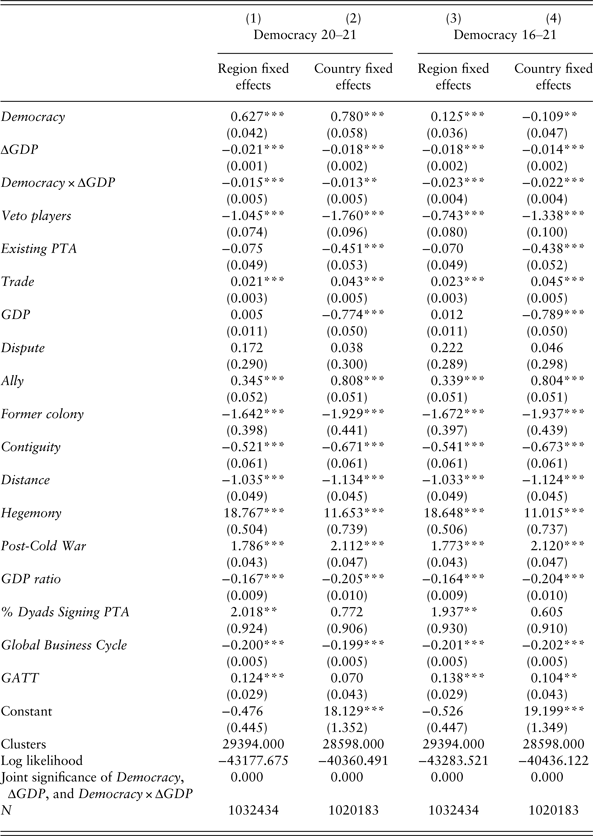
In Table 1, we report the initial estimates of our model. The first two columns show our results when we analyze directed dyads, and Democracy i is coded 1 for states that score 20–21 on the Polity index. The third and fourth columns shows the results when it is coded 1 for states that score 16–21. These results indicate that, regardless of how stringent a definition of democracy that we use, democracies are much more likely to agree to form PTAs during downturns in the business cycle than during periods of economic growth. The likelihood of a non-democracy signing a trade agreement, in contrast, is much less sensitive to the business cycle.
Estimated effects of regime type and the business cycle on PTA signing

Note: Entries are logistic regression estimates with robust standard errors clustered by dyad in parentheses. Statistical significance is indicated as follows: *** p < 0.01; ** p < 0.05; * p < 0.10. All tests of significance are two-tailed.
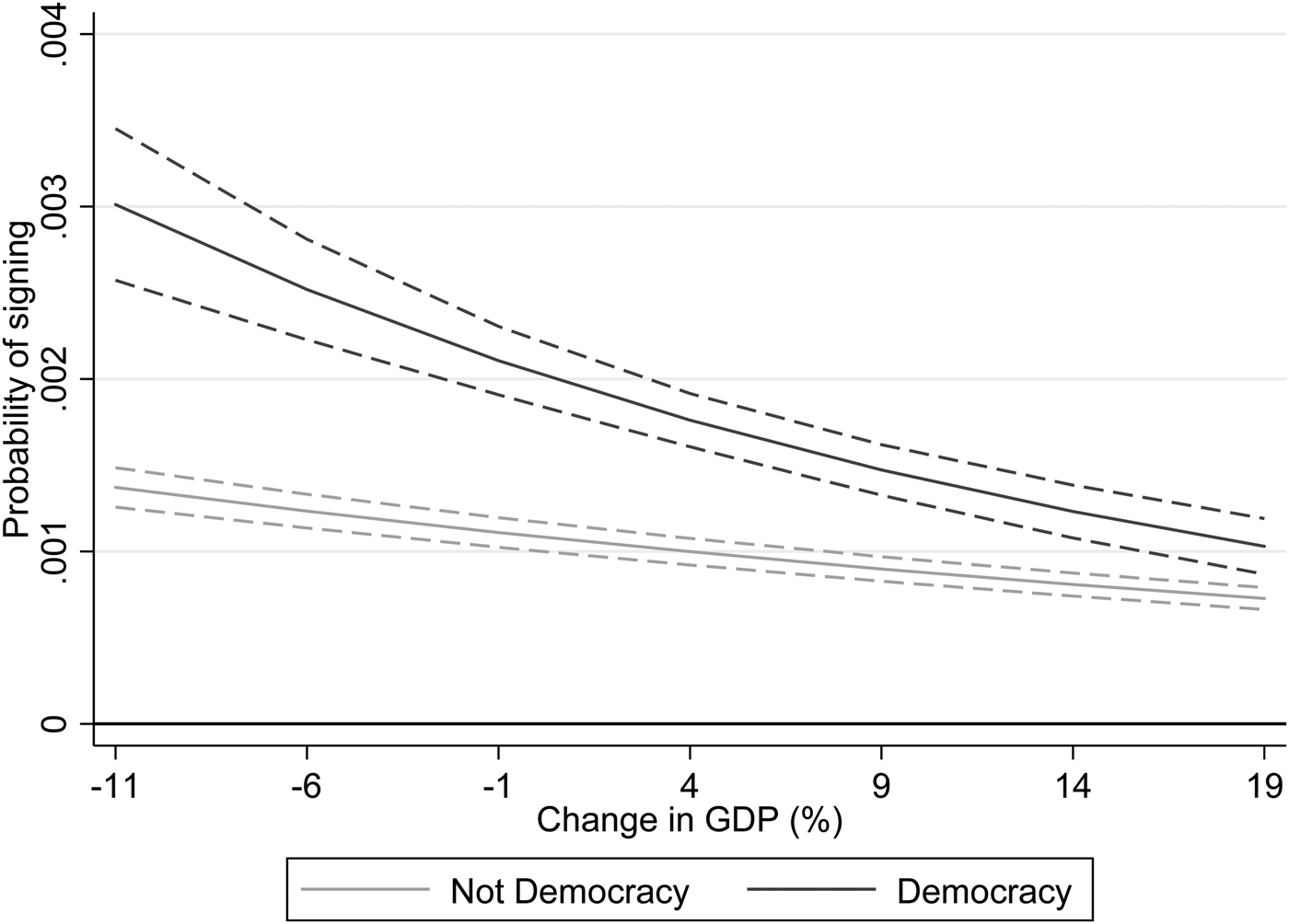
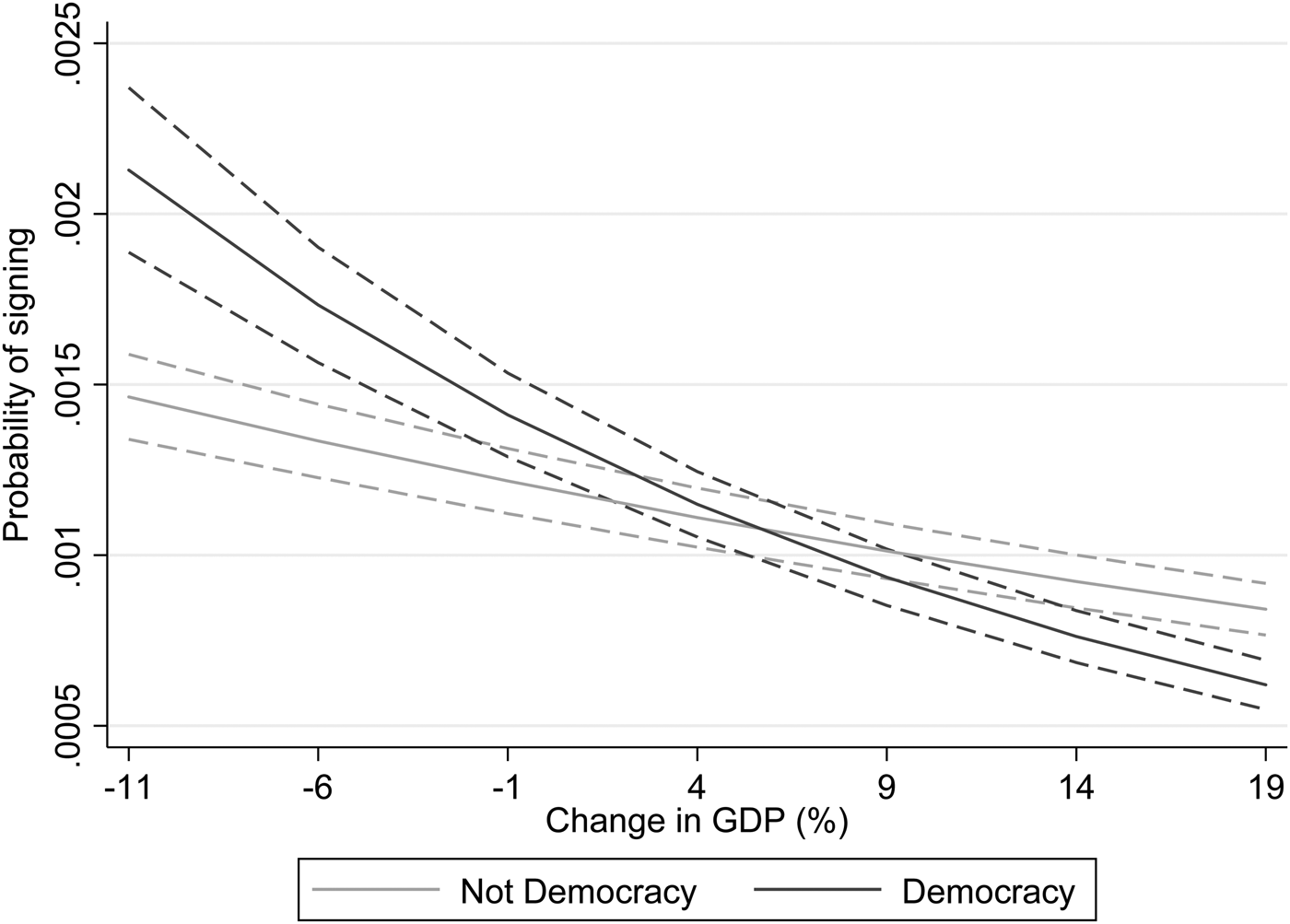
Figures 1 and 2 show the predicted probabilities of signing a PTA for democracies and for non-democracies under various macroeconomic conditions drawn from our data. To generate these probabilities, we rely on the region fixed effects specification, holding constant the dichotomous variables at their modal values and the remaining continuous variables at their median values (Ai and Norton, Reference Ai and Norton2003). The range of values of ΔGDP i along the x-axis of Figures 1 and 2 is the mean of this variable (4%) plus and minus two standard deviations. These figures reveal that democracies are more likely than other states to sign PTAs during the hardest times. Among states suffering a 3% reduction in GDP – which is one standard deviation below the mean of ΔGDP i – democracies are roughly twice as likely to accede to a PTA as non-democracies, if we define democracies as states that score 20–21 on the Polity index, and over 20% more likely if we define democracies as states that score 16–21. Hence, as expected, the tendency for recessions to prompt democracies to sign trade agreements and the difference between democracies and non-democracies in this regard grow stronger and larger as the definition of democracy becomes more stringent.
Predicted probability of signing a PTA for democracies and non-democracies, under various economic conditions, where democracy is defined as a Polity score of 20–21

Predicted probability of signing a PTA for democracies and non-democracies, under various economic conditions, where democracy is defined as a Polity score of 16–21

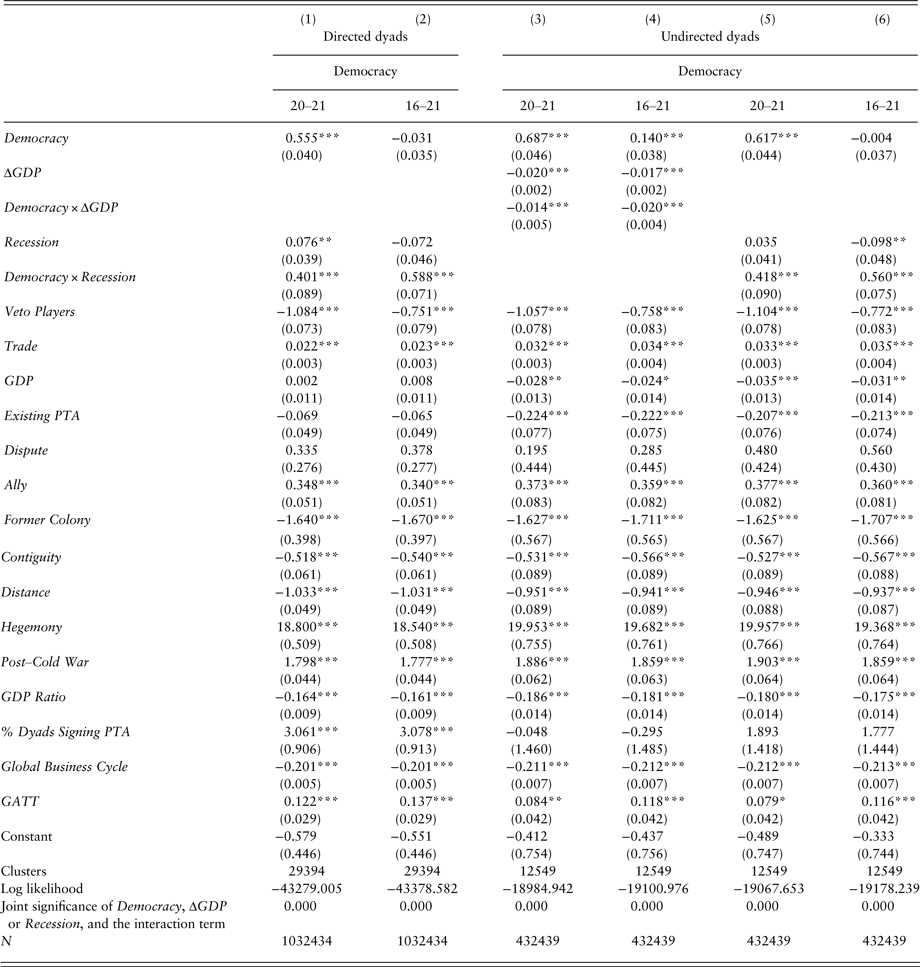
The annual change in GDP is a widely used measure of the business cycle, but it captures both upswings and downswings in a country's economy. To more specifically address the effects of recessions, we replace ΔGDP i with Recession i, which is a dummy variable that equals 1 if the GDP of state i falls by 2% or more from year t–2 to year t–1, 0 otherwise.Footnote 22 The results shown in the first two columns of Table 2 provide additional evidence that democracies are particularly likely to sign PTAs during recessions.Footnote 23 Based on these estimates and holding constant the remaining variables in our model, democracies are about 2.6 times more likely to enter a PTA than other states in the face of a recession when Democracy i is defined as a score of 20–21 on the Polity index and 75% more likely when Democracy i is defined as 16–21.
Estimated effects of regime type and the business cycle on PTA signing, based on two measures of economic fluctuations and both directed and undirected dyads

Note: Entries are region fixed effects logistic regression estimates, with robust standard errors clustered by dyad in parentheses. Statistical significance is indicated as follows: *** p < 0.01; ** p < 0.05; * p < 0.10. All tests of significance are two-tailed. In Models (3) through (6) – which are estimated using undirected dyads – the coefficients and standard errors of Democracy, ΔGDP, Democracy × ΔGDP, Recession, Democracy × Recession, Veto Players, and GDP are constrained to be equal for country i and country j. Consequently, only one coefficient estimate and standard error is presented for each of these variables.
Furthermore, the results in the final four columns of Table 2, which are based on undirected dyads, reveal that the influences of regime type and the business cycle do not depend on whether we organize the data as directed or undirected dyads. Note that, in these columns, the coefficient estimate for each country-level variable is shown only once since the estimates for i and j are constrained to be identical. The results are very similar to those based on directed dyads.
Like regime type and recessions, the effects of the remaining variables in the model are quite robust regardless of whether we analyze directed or undirected dyads and irrespective of which measure of the business cycle we employ. As expected, the odds of signing a PTA rise as the number of veto players falls. In each model, the estimated coefficient of Veto Players i is negative and statistically significant. To further analyze the effects of this variable, we compare the predicted probability of state i forming a PTA when it has few veto players – which we define as the 10th percentile in the data – to the predicted probability when it has many such players – which we define as the 90th percentile in the data – holding constant the remaining variables in the model. Based on the results in the second column of Table 1, a state with few veto players is about 75% more likely to sign a PTA than one with many players. This figure varies depending on how democracy is defined, how recessions are measured, and whether the model is estimated with region or country fixed effects; but these results nonetheless reinforce the point that domestic politics play an important role in shaping the decision to enter trade agreements.
Not surprisingly, however, various economic and international factors are also important in this regard. States that trade extensively tend to form PTAs. In each case, the estimated coefficient of Trade ij is positive and statistically significant. Increasing the mean of Trade ij by one standard deviation increases the predicted probability of signing a PTA by between 12% and 25%, depending on how democracy and recessions are coded and holding constant the remaining variables in the model. Further, larger countries are less likely to enter PTAs than their smaller counterparts since the estimated coefficients of GDP i are negative, and they are statistically significant except when the data are organized as directed dyads and the model includes region fixed effects.
Turning to the systemic variables, there is evidence of the diffusion of PTAs, and that the odds of ratifying such an arrangement rose in the Cold War's aftermath. The estimated coefficient of Post-Cold War is positive and statistically significant in each instance. So too is the coefficient of % Dyads Signing PTA, which indicates that PTA formation tends to cluster over time. States may be either strategically conditioning their behavior on what their counterparts do or simply following the herd.
PTAs are also especially likely to form as a hegemonic power rises. The estimated coefficients of Hegemony are positive and statistically significant, indicating that the odds of signing a preferential arrangement grow larger as the portion of the world's output accounted for by the leading economy increases. Increasing the mean value of Hegemony by one standard deviation yields a 35% to 85% rise in the predicted probability of PTA formation, depending on how democracy is coded, how recessions are measured, and whether region or country fixed effects are included.
In addition, alliances and existing PTA membership promote the establishment of preferential arrangements. As expected, allies are more likely to form preferential agreements than other states. However, political–military disputes have little effect on PTAs; the estimated coefficients of Dispute ij are positive, but are not statistically significant. It also might seem surprising that countries that already participate in the same PTA are more likely to form another one than states that are not PTA partners.Footnote 24 However, in 2005, 1,927 country-pairs were parties to two preferential agreements; 357 pairs to three PTAs; 85 pairs to four PTAs; 29 dyads to five PTAs; and two pairs to six PTAs. In 1976, Papua New Guinea and Australia inked a bilateral agreement, followed by both countries joining the South Pacific Regional Trade and Economic Cooperation Agreement (SPARTECA) in 1980. Singapore and New Zealand signed a bilateral agreement in 2000, after which both countries entered the Trans-Pacific Strategic Economic Partnership Agreement in 2005. In 1997, the Greater Arab Free Trade Agreement (GAFTA) was signed. Among the members were three countries (Morocco, Tunisia, and Libya) that also participated in the Arab Maghreb Union, as well as six members (Iraq, Egypt, Syria, Yemen, Kuwait, and the United Arab Emirates) that already belonged to the Council of Arab Economic Unity (CAEU).
The results also show that contiguous states are unlikely to form PTAs. In combination with the observed effects of Distance ij, this suggests that PTAs are most likely to be established by states that are nearby but do not share a border.Footnote 25 Further, while many observers assume that PTAs are formed between a large, rich country and a small, poor one, our results indicate otherwise. The coefficient estimate of GDP Ratio ij is negative and statistically significant, implying that greater imbalances in national income discourage PTAs. Since countries that are equally sized may be better able to negotiate agreements that involve reciprocal concessions and may derive larger net welfare gains from PTAs than countries that are unequally sized, this result may not be that surprising (Baier and Bergstrand, Reference Baier and Bergstrand2004). But the view that small countries are frequently forced into PTAs with larger ones against their will does not seem to be borne out (Gruber, Reference Gruber2000). Finally, the estimated coefficient of Global Business Cycle is negative and statistically significant, indicating that PTAs are more likely to arise during economic downturns than during upswings in the international economy.Footnote 26
A number of robustness checks provide further support for our claims. First, we want to ensure that our results do not simply reflect the European Community/EU, which is comprised of democracies that have signed many trade agreements since World War II. We therefore dropped all EU member countries. Then we dropped all pairs in which either country is an EU member. Neither adjustment yields any changes to our core results. Second, our results are virtually unchanged when we estimate the model using a rare events logit specification, which accounts for the fact that the establishment of a PTA is an uncommon occurrence (King and Zeng, Reference King and Zeng2001). Third, we analyze the first PTA that a given pair of countries formed and drop any subsequent agreement that they join from the sample. None of these tests yields any substantive changes to our results.
Fourth, although we think that measuring the business cycle over a one-year period is most appropriate, we also measured this cycle over a two-year interval and our results are unchanged. Fifth, although the Polity data are very widely used, it is useful to address whether our results are robust to alternative data and measures of regime type. We therefore measured regime type using another well-known data set compiled by Cheibub et al. (Reference Cheibub, Gandhi and Vreeland2010). Neither measurement change yielded any substantive differences in our results.
Finally, we account for several domestic variables that might affect the observed influence of regime type and the business cycle on PTA formation. We include various measures of the timing of national elections, but find no evidence that they influence either trade agreements or the effects of regime type and the business cycle on such agreements (Hyde and Marinov, Reference Hyde and Marinov2012; Cruz et al., Reference Cruz, Keefer and Scartascini2016). Equally, introducing the partisan orientation of government in our model does not alter the effects of regime type and the business cycle (Cruz et al., Reference Cruz, Keefer and Scartascini2016). In sum, our results seem to be very robust.
5. PTAs and the longevity of democratic leaders
One implication of our argument is that democratic leaders who sign PTAs during economic downturns should enjoy a longer tenure than their counterparts who eschew trade agreements. Entering a PTA signals to the public that their leader is neither a rent-seeker nor incompetent, and that the downturn did not stem from economic mismanagement, but rather was due to conditions that were largely beyond his or her control. If our argument is correct, then the public should reward leaders who sign trade agreements under such circumstances by voting for incumbents instead of turning them out of office, as economic theories of voting often predict (Duch and Stevenson, Reference Duch and Stevenson2008; Lewis-Beck and Nadeau, Reference Lewis-Beck and Nadeau2011).
A number of studies have found that democratic leaders experience longer tenure if they sign PTAs (Hollyer and Rosendorff, Reference Hollyer and Rosendorff2012; Mansfield and Milner, Reference Mansfield and Milner2012: chapter 5). To address the issue of whether this effect becomes more pronounced in the face of recessions, we follow Hollyer and Rosendorff (Reference Hollyer and Rosendorff2012) and estimate a Cox frailty proportional hazard model of leader duration, which takes the following form:
 $$h_i\left( t \right){\rm} = h_0\left( t \right){\rm exp}(\beta {\bi X} + {\rm} \theta _i + \varepsilon _i)$$
In this model, h 0(t) is the baseline hazard function, which is assumed to be proportional across units, βX is a vector of covariates and parameters, θi is a country-specific frailty parameter akin to a random effect, and εi is an error term (Box-Steffensmeier and Jones, Reference Box-Steffensmeier and Jones2004). Our unit of analysis is the leader-year and we rely on The Archigos Data on Political Leaders to measure a given leader's duration in office, as of year t, which is the dependent variable (Goemans et al., Reference Goemans, Gleditsch and Chiozza2009).
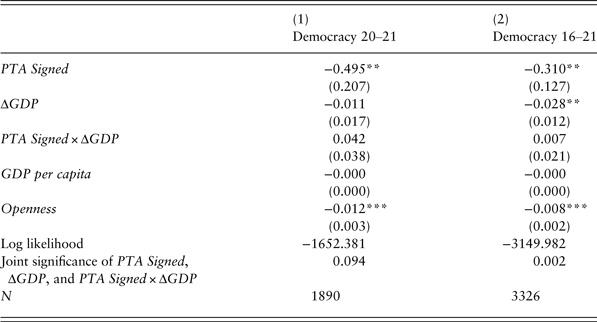
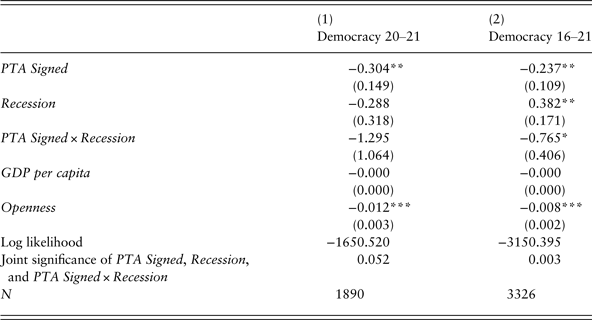
Consistent with our earlier analysis of PTA signing, we measure the business cycle using both the annual percentage change in GDP and a dummy variable indicating whether a recession occurred. As such, we analyze two sets of models. In the first set, our key independent variables are: (1) PTA Signed – which equals 1 if a given leader has signed a PTA in the current year or previously in his or her term in office, 0 otherwise; (2) ΔGDP, which is the percentage change in GDP from year t–1 to year t; and (3) PTA Signed × ΔGDP.Footnote 27 In the second set, our key independent variables are: (1) PTA Signed; (2) Recession, which equals 1 if GDP dropped by 2% or more from year t–1 to year t, 0 otherwise; and (3) PTA Signed × Recession. Like Hollyer and Rosendorff (Reference Hollyer and Rosendorff2012), we also include the real Per Capita GDP of each country and Openness, which is defined as (imports + exports)/GDP for each country. Both of these variables are measured in year t–1. In interpreting the following results, note that a positive (negative) coefficient indicates that an increase in the relevant variable increases (decreases) the hazard function and thereby increases (decreases) the risk of the leader being turned out of office.
This model is estimated for the period from 1960 to 2011. We restrict our sample to democracies, based on the same two thresholds (scores of 20–21 and 16–21 on the Polity index) that were used earlier. Consequently, Tables 3 and 4 each present two sets of results, all of which support our argument.
The effects of PTAs and the business cycle on democratic leader duration, based on the percentage change in GDP

Note: Entries are derived from a Cox frailty proportional hazard model, with standard errors in parentheses. Statistical significance is indicated as follows: *** p < 0.01; ** p < 0.05; * p < 0.10. All tests of significance are two-tailed.
The effects of PTAs and the business cycle on democratic leader duration, based on recession

Note: Entries are derived from a Cox frailty proportional hazard model, with standard errors in parentheses. Statistical significance is indicated as follows: *** p < 0.01; ** p < 0.05; * p < 0.10. All tests of significance are two-tailed.
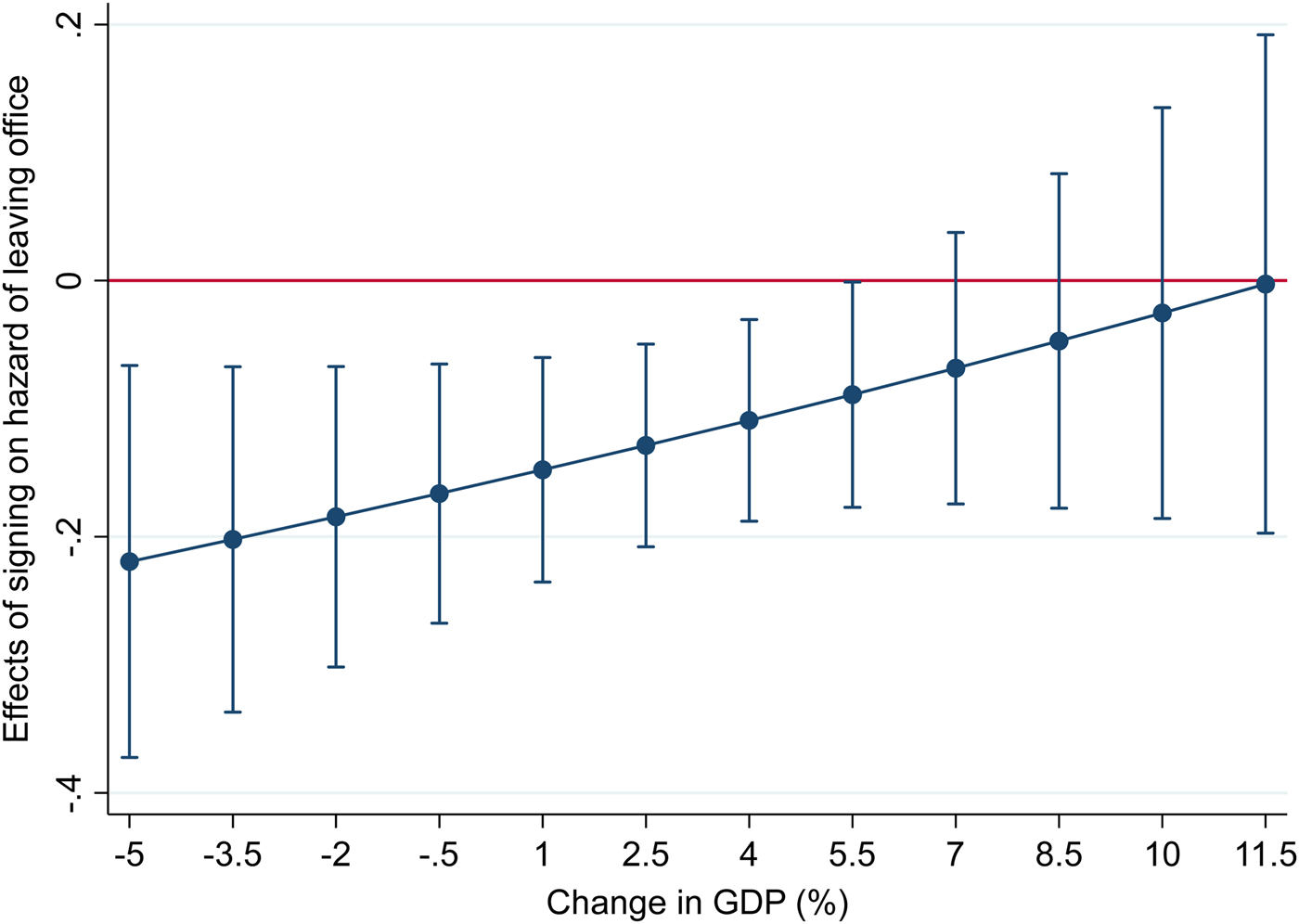
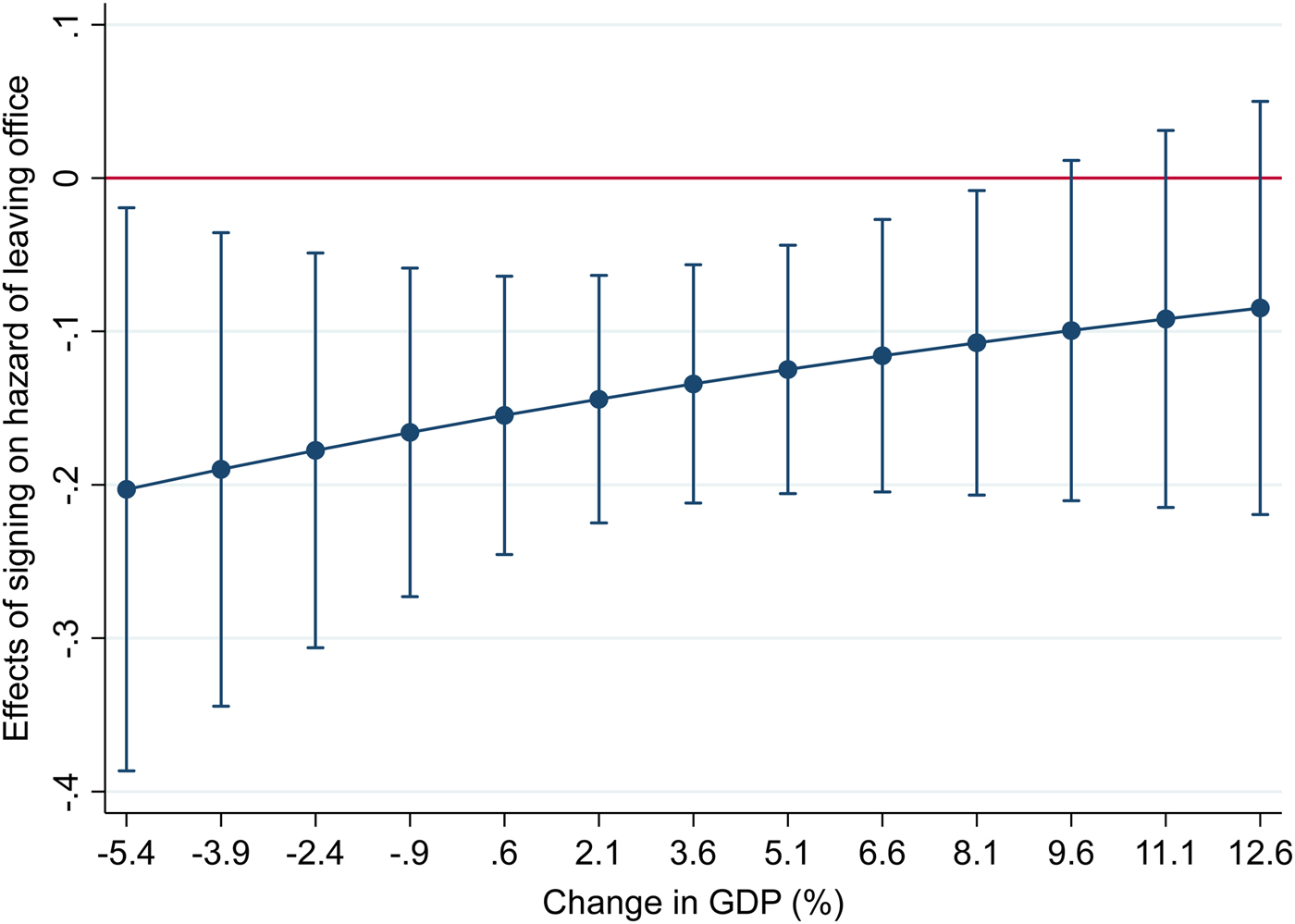
In each case, the estimated coefficients of PTA Signed, ΔGDP or Recession, and PTA Signed × ΔGDP or PTA Signed × Recession are jointly significant (Brambor et al., Reference Brambor, Clark and Golder2006). In non-linear models such as ours, political methodologists frequently counsel that the best way to assess interaction effects is through graphical presentation (Ai and Norton, Reference Ai and Norton2003; Berry et al., Reference Berry, DeMeritt and Esarey2010). Figures 3 and 4 present the difference in the predicted probability of being removed from office for democratic leaders who do and do not sign PTAs, when the annual percentage change in GDP is used to measure the business cycle.Footnote 28 Consistent with previous studies, we find that signing a PTA reduces the likelihood of a democratic leader losing office (Hollyer and Rosendorff, Reference Hollyer and Rosendorff2012; Mansfield and Milner, Reference Mansfield and Milner2012: chapter 5). Particularly important for our purposes, however, is that these results also indicate that signing a PTA does the most to reduce the odds of a leader being removed during economic downturns.
Effects of PTA signing on the hazard of democratic leader duration, based on the annual change in GDP, where democracy is defined as a Polity score of 20–21

Effects of PTA signing on the hazard of democratic leader duration, based on the annual change in GDP, where democracy is defined as a Polity score of 16–21

We recognize the potential limitations of our analysis, which stem from a number of practical constraints. For one thing, many factors that might also affect longevity are not accounted for in our model, in part because many of them are not readily measureable. In particular, leaders’ competence might contribute to both their political achievements (i.e., signing PTAs) and their longevity in office. For another, leaders that remain in office longer may be more likely to sign PTAs, perhaps simply because they have more time to negotiate and conclude an agreement, suggesting that PTA Signed may be endogenous. Unfortunately, in non-linear models such as the ones we have estimated in this section, the use of instrumental variables is inappropriate and other means to address endogeneity are very difficult to identify (Box-Steffensmeier and Jones, Reference Box-Steffensmeier and Jones2004: 112; Angrist and Pischke, Reference Angrist and Pischke2009: 190–92). Further, we do not have data on term limits, a factor that might affect our results. Our findings should therefore be considered preliminary and interpreted cautiously. Nonetheless, they accord with the hypothesis that trade agreements are associated with heightened leadership longevity in democracies experiencing economic downturns.
6. Conclusions
The received wisdom is that economic downturns promote protectionism. It is therefore surprising that economic hard times sometimes lead political leaders to negotiate agreements that reduce trade barriers and resist protectionism among members. We have argued that domestic political incentives exist for democratic leaders to establish trade agreements during hard times. Of course, domestic politics is not the sole factor shaping PTAs; we have found that a wide variety of economic and international political variables also exert a strong influence of the establishment of these agreements. But the domestic political logic of PTAs and its relationship to the state of the economy has been understudied and underappreciated to date, a gap that we helped to fill in this study.
PTAs signal to the public that a country's leader may not be captured by protectionist special interests. Hence, when economic troubles arise, some voters and pro-trade interest groups may be less likely to blame the leader. Establishing agreements that liberalize overseas commerce indicates to the public that its leader is less likely to be exploitative or incompetent and that hard times should be attributed to sources beyond his or her control. Public opinion data from around the world show that a strong majority in many countries like trade and think it is good for their country. Under these circumstances, leaders appear to have a better chance of retaining office during economic downturns when they make agreements. Leaders realize political gains as a result and the general public also benefit from freer trade. We find that, since World War II, various leaders have chosen this strategy and have been rewarded for it.
Where leaders face greater political competition, these considerations are particularly important. In more democratic settings, leaders are more concerned with how the public react to hard economic times and thus leaders are more likely to enact policies that reassure the public. Trade agreements help to provide such reassurance when the public support trade; the international visibility and monitoring mechanisms in trade agreements create more credible commitment by leaders. We therefore expect that on average leaders in more democratic political environments will be more likely to negotiate PTAs in bad times than otherwise.
Autocrats are often less susceptible to the political consequences of economic downturns (Bueno de Mesquita et al., Reference Bueno de Mesquita, Smith, Siverson and Morrow2003). Hence, they have less reason to pursue trade agreements in general and during bad times. Indeed, during dips in the business cycle, they may avoid making agreements because the distributional effects of doing so may harm their supporters. Autocrats often depend on the support of the major sectors of the economy and may, in turn, protect these sectors to generate political support. Reducing trade barriers during downturns may undermine this support and thus jeopardize their hold on power. Consistent with this observation, we find that the business cycle has relative little bearing on whether non-democracies enter trade agreements.
Our research suggests some good news. PTAs do less to promote welfare than unilateral or multilateral trade liberalization; but with the WTO struggling to advance multilateral liberalization and the difficulties that many countries face unilaterally liberalizing foreign commerce, PTAs may be the best and only politically viable way to keep the global trading system open. In the recent past when public support for trade has been strong, such trade agreements seem to be associated with longer duration in office for leaders, especially those who sign them in bad times. Political incentives may thus animate PTAs. Moreover, democratic leaders may have some political reasons to resist protectionism in the face of downturns. The past 20 years have been marked by extreme economic turbulence and yet the global trading system has not collapsed. Many political leaders confronting dips in the business cycle have not turned to protectionism, but have rather sought out strategies like PTAs that enable a more calibrated response to hard times. With resistance to trade developing in some advanced industrial countries, although majorities remain favorable to trade in surveys, this strategy may face less acceptance in the future.