Introduction
Posttraumatic stress disorder (PTSD) is a psychiatric condition that develops in response to a traumatic event and affects approximately 8% of the general population and between 10% and 25% of veterans (Hoge, Auchterlonie, & Milliken, Reference Hoge, Auchterlonie and Milliken2006; Kessler, Sonnega, Bromet, Hughes, & Nelson, Reference Kessler, Sonnega, Bromet, Hughes and Nelson1995). In recent years, much research has been devoted to the intersection of emotional and cognitive symptoms in PTSD to further understanding of the nature of this disorder and guide the development of novel treatments. A large body of research shows that individuals with PTSD exhibit poorer neurocognitive functioning compared to individuals without PTSD, including those exposed to similar traumas and those without trauma exposure (Scott et al., Reference Scott, Matt, Wrocklage, Crnich, Jordan, Southwick and Schweinsburg2015). Neurocognitive domains most commonly affected include episodic memory, attention, executive functions, and information processing speed (e.g., Aupperle, Allard, et al., Reference Aupperle, Allard, Grimes, Simmons, Flagan, Behrooznia and Stein2012; Koenen et al., Reference Koenen, Driver, Oscar-Berman, Wolfe, Folsom, Huang and Schlesinger2001; Vasterling et al., Reference Vasterling, Duke, Brailey, Constans, Allain and Sutker2002). These deficits are generally moderate in magnitude (Brewin, Kleiner, Vasterling, & Field, Reference Brewin, Kleiner, Vasterling and Field2007; Scott et al., Reference Scott, Matt, Wrocklage, Crnich, Jordan, Southwick and Schweinsburg2015) and associated with social, occupational, and treatment difficulties (Geuze, Vermetten, de Kloet, Hijman, & Westenberg, Reference Geuze, Vermetten, de Kloet, Hijman and Westenberg2009; Nijdam, de Vries, Gersons, & Olff, Reference Nijdam, de Vries, Gersons and Olff2015; Wrocklage et al., Reference Wrocklage, Schweinsburg, Krystal, Trejo, Roy, Weisser and Scott2016).
Studies to date have focused primarily on retrospective memory (e.g., learning and prompted delayed recall of a word list, passage, or design), and little is known about prospective memory (PM) in PTSD, despite its potential clinical and functional relevance (see Zogg, Woods, Sauceda, Wiebe, & Simoni, Reference Zogg, Woods, Sauceda, Wiebe and Simoni2012). PM refers to memory for an intention that might be recalled at an appropriate time in the future without explicit prompting. PM is involved in several everyday tasks and health behaviors, such as remembering to mail a letter on the way home from work, take a medication at a particular time of day, go to an appointment, or return an email to a colleague. Of particular clinical importance, several studies in other psychiatric and neurological disorders have shown that dysfunction in PM is strongly and uniquely associated with important functional outcomes, including medication non-adherence (Woods et al., Reference Woods, Dawson, Weber, Gibson, Grant and Atkinson2009), engagement in risky behaviors (Weinborn et al., Reference Weinborn, Moyle, Bucks, Stritzke, Leighton and Woods2013), unemployment (Woods et al., Reference Woods, Weber, Weisz, Twamley and Grant2011), poorer treatment outcomes (Withall, Harris, & Cumming, Reference Withall, Harris and Cumming2009), and declines in instrumental activities of daily living (Pirogovsky, Woods, Filoteo, & Gilbert, Reference Pirogovsky, Woods, Filoteo and Gilbert2012).
Recall of a PM intention usually occurs in the context of other ongoing activities and necessitates interruption of these activities with either external or internal cues, which are most commonly classified as event- or time-based PM cues, respectively. In event-based PM, recall of an intention or action is cued by an external reminder, such as seeing a pharmacy and then recalling one’s intention to fill a prescription. Time-based PM involves recalling an intention at a particular point in time (e.g., go to the pharmacy in 1 hr) and, as such, relies more heavily on internal self-monitoring abilities (McDaniel & Einstein, Reference McDaniel and Einstein2000). Successful PM functioning requires the effective interaction of multiple cognitive processes over a period of time, including the formation and encoding of an intention, maintenance for that intention (or intention-cue pairing) during intervening tasks and demands, selective attention to ignore distracting information during intervening tasks, self-initiated retrieval after an appropriate cue, inhibition of incorrect intentions, and execution of a correct intention (Kliegel, Martin, McDaniel, & Einstein, Reference Kliegel, Martin, McDaniel and Einstein2001). Unsurprisingly then, PM performance is dependent on the integrity of prefrontal and (to a lesser degree) mediotemporal memory systems (Burgess, Gonen-Yaacovi, & Volle, Reference Burgess, Gonen-Yaacovi and Volle2011; Gordon, Shelton, Bugg, McDaniel, & Head, Reference Gordon, Shelton, Bugg, McDaniel and Head2011).
Cognitive and neuroanatomical models of brain-behavior associations in PTSD support the hypothesis that PM functioning might be affected in individuals with PTSD. Current cognitive models of PTSD suggest that hyperarousal and noradrenergic dysfunction may divert attentional resources to extraneous stimuli, which may disrupt prefrontally mediated goal-based attention and encoding of information (Etkin, Gyurak, & O’Hara, Reference Etkin, Gyurak and O’Hara2013; Eysenck, Derakshan, Santos, & Calvo, Reference Eysenck, Derakshan, Santos and Calvo2007). This disruption may affect multiple aspects of PM, such as monitoring behavior or inhibition of inappropriate responses.
In fact, attention, inhibition, and retrospective memory, cognitive domains essential for effective PM, appear to be particularly affected in a proportion of individuals with PTSD (Aupperle, Melrose, Stein, & Paulus, Reference Aupperle, Melrose, Stein and Paulus2012; Brewin et al., Reference Brewin, Kleiner, Vasterling and Field2007; Scott et al., Reference Scott, Matt, Wrocklage, Crnich, Jordan, Southwick and Schweinsburg2015) and have been proposed to play a role in both the establishment (e.g., vivid, trauma-related memories) and maintenance (e.g., attentional control of trauma-related thoughts) of the disorder (Brewin, Gregory, Lipton, & Burgess, Reference Brewin, Gregory, Lipton and Burgess2010; McNally, Reference McNally2006). Furthermore, the profile of retrospective memory dysfunction in PTSD is most consistent with difficulties in “executive” aspects of encoding and retrieval (Samuelson et al., Reference Samuelson, Neylan, Metzler, Lenoci, Rothlind, Henn-Haase and Marmar2006; Scott et al., Reference Scott, Matt, Wrocklage, Crnich, Jordan, Southwick and Schweinsburg2015; Twamley et al., Reference Twamley, Allard, Thorp, Norman, Hami Cissell, Hughes Berardi and Stein2009), implicating dysfunction in prefrontal memory systems in PTSD. Specifically, individuals with PTSD have difficulty with initial encoding of information, although minimal forgetting occurs over time, and recognition discrimination is most often unaffected (Cohen et al., Reference Cohen, Neylan, Yaffe, Samuelson, Li and Barnes2013; Yehuda, Golier, Halligan, & Harvey, Reference Yehuda, Golier, Halligan and Harvey2004).
Paralleling these findings, functional neuroanatomical models of PTSD have highlighted frontolimbic pathophysiology in PTSD, characterized by reductions in hippocampal volumes and prefrontal cortical thickness, as well as altered patterns of neural activation in medial and dorosolateral prefrontal cortex, and hippocampal and parahippocampal regions (Aupperle, Allard, et al., Reference Aupperle, Allard, Grimes, Simmons, Flagan, Behrooznia and Stein2012; Hayes, Hayes, & Mikedis, Reference Hayes, Hayes and Mikedis2012; Woodward et al., Reference Woodward, Kaloupek, Grande, Stegman, Kutter, Leskin and Eliez2009).
PM might also be implicated in PTSD through its negative association with symptoms of depression and anxiety. Higher depressive symptoms are reliably related to worse time-based PM in both clinical and nonclinical samples (Altgassen, Kliegel, & Martin, Reference Altgassen, Kliegel and Martin2009; Li, Weinborn, Loft, & Maybery, Reference Li, Weinborn, Loft and Maybery2013; Rude, Hertel, Jarrold, Covich, & Hedlund, Reference Rude, Hertel, Jarrold, Covich and Hedlund1999), while findings regarding depression and event-based PM tasks are equivocal (Altgassen et al., Reference Altgassen, Kliegel and Martin2009; Arnold, Bayen, & Böhm, Reference Arnold, Bayen and Böhm2015). Thus, difficulties in PM are primarily observed on tasks that require greater cognitive resources or self-initiation (e.g., time-based tasks), which supports the interpretation that PM deficits are driven by diminished attentional allocation in depression (Li, Weinborn, Loft, & Maybery, Reference Li, Weinborn, Loft and Maybery2014). Relatively fewer studies have examined effects of anxiety on PM. In nonclinical samples, state anxiety, or one’s current experience of anxiety symptoms, has been negatively related to performance on event-based PM tasks, while event-based PM results for trait anxiety, referring to one’s baseline level of anxiety, have been less consistent (Arnold et al., Reference Arnold, Bayen and Böhm2015; Harris & Cumming, Reference Harris and Cumming2003; Harris & Menzies, Reference Harris and Menzies1999). No studies appear to have examined the relationship between time-based PM and anxiety.
One recent study examined associations between PM and PTSD. Using a single-group design with 40 veterans, McFarland and colleagues (Reference McFarland, Clark, Lee, Grande, Marx and Vasterling2016) reported that PTSD symptom severity was negatively associated with performance on a focal, event-based PM task, even after accounting for contributions from retrospective memory. Moreover, PTSD symptom severity was more associated with PM performance than depression severity. Although this study provides intriguing data on associations between PTSD and PM, several critical questions remain about the pattern and extent of potential PM dysfunction in PTSD. For example, no prior study has been conducted examining PM performance in PTSD against a comparison sample, limiting conclusions that can be drawn about the profile of PM performance in patients with PTSD. Moreover, time-based PM has not been examined in PTSD, despite its additional reliance on executive functions and potentially greater theoretical relevance to PTSD. Lastly, McFarland et al. (Reference McFarland, Clark, Lee, Grande, Marx and Vasterling2016) restricted analyses of cognitive mechanisms contributing to PM (e.g., executive functioning) by only examining retrospective memory.
The aims of the present study were to examine the nature and extent of PM deficits in PTSD. We hypothesized that PTSD would be associated with worse PM performance, especially on time-based tasks in which higher self-directed cognitive resources would be required. We also examined the profile of PM (i.e., errors, performance on the ongoing task, PM recognition) to examine the pattern of PM dysfunction in PTSD. Secondary aims included examining whether: (1) PM was associated with particular PTSD symptom dimensions; and (2) PM functioning correlated with performance on standard clinical tests of executive function, episodic memory, and processing speed in the PTSD sample.
Methods
Participants
Forty veterans with current PTSD and 38 trauma comparison (TC) participants who were exposed to combat but never met criteria for PTSD were recruited between August 2009 and December 2014. Participants were recruited from the Veterans Affairs (VA) Connecticut Healthcare System through referrals from other National Center for PTSD (NCPTSD) studies; via flyers placed within public spaces within the hospital and primary care, mental health, and polytrauma clinics; and outreach in veteran communities. No participants were inpatients at the time of enrollment. Participants were part of a larger psychological and neuroimaging study at the Clinical Neurosciences Division of the NCPTSD.
We excluded participants with histories of severe psychiatric illness (e.g., psychotic disorders), neurological disease, head injuries with a loss of consciousness of greater than 30 min or post-traumatic amnesia of greater than 24 hr, attention deficit/hyperactivity disorder, learning disorders, or had verbal IQ estimates of <70 based on the Wechsler Test of Adult Reading (WTAR; Wechsler, Reference Wechsler2001). Participants with current benzodiazepine use were excluded due to their significant cognitive effects (Barker, Greenwood, Jackson, & Crowe, Reference Barker, Greenwood, Jackson and Crowe2004). Participants in the PTSD group with substance use disorders were not excluded to recruit a representative sample of veterans with PTSD. We allowed participants in the TC group with current or lifetime diagnoses of substance abuse, although substance dependence was excluded from this group. All participants underwent urine toxicology screens before the neurocognitive evaluation to ensure abstinence.
Participants who were visibly intoxicated or positive for any drug except cannabis were rescheduled to a later date and asked to maintain abstinence. Because of the difficulty distinguishing recent from residual cannabis use in urine (Goodwin et al., Reference Goodwin, Darwin, Chiang, Shih, Li and Huestis2008), participants who tested positive for cannabis were allowed to continue if: (1) they denied cannabis use the day of the evaluation; and (2) if the assessor made behavioral observations that the participant was not intoxicated. Six participants had positive screens for cannabis, including three PTSD and three TC.
All participants provided written, informed consent, and the study received Institutional Review Board approval from both VA Connecticut and Yale University. Participants were financially compensated for participating.
Measures
Prospective Memory
The proprietary version of the Memory for Intentions Test (MIST; Raskin, Buckheit, & Sherrod, Reference Raskin, Buckheit and Sherrod2010), was administered as a measure of PM abilities. This standardized, performance-based test consists of eight PM tasks over 30 min that are balanced by type of cue (i.e., time-based vs. event-based), mode of response (i.e., physical vs. verbal), and delay (i.e., 2 min vs. 15 min). During the entire task, participants are asked to complete word search puzzles unrelated to the PM tasks, which minimizes continuous active rehearsal of the prescribed intentions. Participants are given a digital clock with which they can monitor the time. Each PM trial is scored from 0 to 2 points, with one point awarded for a correct response and one point awarded for responding (in some manner) at the appropriate time (±15% of the target) or to the appropriate cue. Each trial contributes to three of the MIST’s six subscales (range=0–8), which are summed to create a summary score ranging from 0 to 48. In addition, an eight-item, three-choice recognition trial is administered at the end of the test for each PM task. Prior studies demonstrate that the MIST displays adequate psychometric characteristics and reliability, as well as evidence of construct validity (Kamat et al., Reference Kamat, Weinborn, Kellogg, Bucks, Velnoweth and Woods2014; Raskin, Reference Raskin2009; Raskin et al., Reference Raskin, Buckheit and Sherrod2010; Woods, Moran, Dawson, Carey, & Grant, Reference Woods, Moran, Dawson, Carey and Grant2008).
We examined the following primary variables: (1) summary score; (2) time-based trials; and (3) event-based trials. In addition, we generated separate error type totals for the time-based and event-based scales (range, 0–4). Consistent with prior studies (Woods et al., Reference Woods, Moran, Dawson, Carey and Grant2008), errors were coded as PM failure (i.e., no response omission errors), loss of time (i.e., executing an intention ≥15% target time), task substitution (e.g., responding verbally instead of with an action or vice versa), or loss of content (i.e., awareness that a response is required but failure to recall the content) errors.
Neuropsychological Assessment
Participants were also administered a comprehensive neuropsychological assessment designed to be sensitive to potential neurocognitive effects associated with PTSD. The measures chosen for correlational analyses were drawn from the domains of attention/working memory [Digit Span and Letter-Number Sequencing Total Scores from the Wechsler Adult Intelligence Scale-Fourth Edition (WAIS-IV; Wechsler, Reference Wechsler2008), d-prime from the Conners’ Continuous Performance Test II (Conners, Reference Conners2000)], executive functions [Trailmaking Number-Letter Switching, Color-Word Interference Condition, and Verbal Fluency Switching from the Delis Kaplan Executive Functioning System (DKEFS; Delis, Kaplan, & Kramer, Reference Delis, Kaplan and Kramer2001)], retrospective memory [California Verbal Learning Test-Second Edition Trials 1–5 (CVLT-II; Delis, Kramer, Kaplan, & Ober, Reference Delis, Kramer, Kaplan and Ober2000), Rey-O Complex Figure Test Delayed Recall (Meyers & Meyers, Reference Meyers and Meyers1995)], and speed of information processing [Coding and Symbol Search subtests from the WAIS-IV (Wechsler, Reference Wechsler2008), DKEFS Trail Making Number Sequencing (Delis et al., Reference Delis, Kaplan and Kramer2001). All participants performed above published cutoffs on all indices of performance validity [e.g., Test of Memory Malingering (Tombaugh & Tombaugh, Reference Tombaugh and Tombaugh1996) Trial 1 or 2> or =45, Digit Memory Test (Hiscock & Hiscock, Reference Hiscock and Hiscock1989) > or =90% accuracy, CVLT Forced Choice ≥14].
Psychiatric Assessment
All participants were administered the Clinician Administered PTSD Scale (CAPS; Blake et al., Reference Blake, Weathers, Nagy, Kaloupek, Gusman, Charney and Keane1995), widely considered the gold standard PTSD assessment, by extensively trained clinicians. PTSD was diagnosed according to DSM-IV criteria. TC participants never met criteria for a PTSD diagnosis, and none qualified for partial PTSD according to criteria from Pietrzak and colleagues (Reference Pietrzak, Goldstein, Southwick and Grant2012). Participants also completed the Structured Clinical Interview for DSM-IV (SCID-IV; First, Spitzer, Gibbon, & Williams, Reference First, Spitzer, Gibbon and Williams2002) to assess for comorbid and exclusionary disorders.
Behavioral and Functional Assessments
The Combat Exposure Scale (Keane et al., Reference Keane, Fairbank, Caddell, Zimering, Taylor and Mora1989) provided a measure of combat severity. The Beck Depression Inventory-2 (BDI-2; Beck, Steer, & Brown, Reference Beck, Steer and Brown1996) was used as a measure of depressive symptomatology. Military-related concussions were evaluated by postdoctoral fellows or neuropsychologists with a modified version of the Military Acute Concussion Evaluation (French, McCrea, & Baggett, Reference French, McCrea and Baggett2008), a structured interview querying blast exposures, details of head injuries with loss or alteration of consciousness, and post-concussive symptoms. A neuropsychologist independently assessed traumatic brain injury (TBI) severity using American Congress of Rehabilitation Medicine (1993) criteria.
Statistical Analyses
Independent samples t tests and χ2 tests (where appropriate) were performed to examine between-group differences in demographic and psychiatric variables. All variables from the MIST were non-normally distributed (Kolmogrov-Smirnov p<.05), and thus Wilcoxon rank-sum tests (complemented with Cohen’s d measure of effect size) were used to assess between-group differences on MIST primary variables. We further examined the specificity of between-group differences by conducting correlational analyses between MIST variables and both depression and combat exposure and performing multiple regressions predicting PM while including relevant covariates (e.g., TBI, substance use disorders).
To examine associations between MIST variables and neuropsychological measures, Z scores were created from raw scores across the whole sample, which were then averaged to generate putative composite measures of neurocognitive functioning within that domain. Neuropsychological measures in which higher scores reflected worse performance were multiplied by −1 so that lower scores always reflected worse performance. Spearman’s rho correlation coefficients were conducted to examine associations among MIST variables, neuropsychological Z scores, and PTSD symptoms. We examined associations with specific PTSD symptom clusters using a well-validated, four-factor emotional numbing symptom model that separates PTSD symptoms into re-experiencing, avoidance, numbing, and hyperarousal symptoms (Asmundson, Stapleton, & Taylor, Reference Asmundson, Stapleton and Taylor2004). The critical alpha level was set at .05.
Results
Demographics and Mental Health
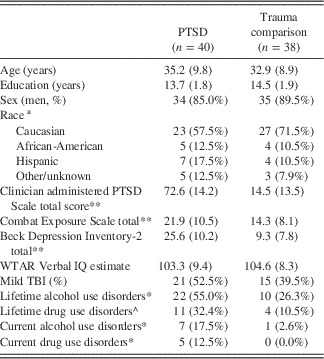
As shown in Table 1, PTSD and TC groups were well matched on demographics, including age, education, race/ethnicity, and gender. Participants were generally equivalent on WTAR IQ estimates. As would be expected, groups differed in BDI-2 scores and alcohol and substance use disorders.
Demographic, military, and mental health characteristics of the samples

Note. PTSD=posttraumatic stress disorder; TBI=traumatic brain injury; WTAR=Wechsler Test of Adult Reading.
a The χ2 test compares Caucasian to all other groups.
^ p<.10.
*p<.05.
**p<.01.
Prospective Memory Performance
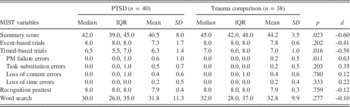
Descriptive data for the MIST subscales and errors are displayed in Table 2. As shown in the table, the PTSD group performed significantly worse than the TC group on the MIST summary score (Cohen’s d=−0.60). Individuals with PTSD performed significantly worse on time-based trials (d=−0.58) but did not display significantly worse performance on event-based trials (d=−0.41). Moreover, performance on the multiple choice recognition trial and ongoing word search task did not differ between the groups (ps>.10). To examine specific errors contributing to time-based PM dysfunction, follow-up analyses of error types on time-based trials were conducted. As shown in Table 2, individuals in the PTSD group showed greater time-based PM failure errors (i.e., omissions; d=0.63), but no significant differences for other time-based PM errors.
Memory for Intentions Test (MIST) performance by group

Note. p-Values represent Wilcoxon rank-sum tests for between group differences. MIST=Memory for Intentions Test; PM=prospective memory; PTSD=posttraumatic stress disorder.
Association with Comorbidities, Symptom Dimensions, and Neuropsychological Performance
Follow-up analyses examined whether depression, combat exposure, or substance use disorders could account for the above findings. Considering that the confidence interval for the event-based PM effect size, although null, overlapped with that observed time-based PM, we conducted our follow-up correlational analyses using both MIST summary score to capture overall PM performance and the time-based scale to capture the specific PM deficit evidenced in this cohort. Depression symptoms were not significantly associated with MIST summary score or performance on time-based trials in either the whole sample or the PTSD group (all ps>.10). Depression symptoms were significantly associated with performance on event-based trials in the whole sample (rho=−.25; p=.035) but not in the PTSD sample alone (rho=−.13; p=.445). Combat exposure was not significantly associated with any MIST variable of interest in either the whole sample or PTSD group (all ps>.10).
We examined the influence of TBI and lifetime and current substance use disorders (including alcohol) by including each variable in separate regressions predicting MIST summary score. TBI (β=−0.006; p=.957), current substance use disorders (β=0.16; p=.166), and lifetime substance use disorders (β=−0.10; p=.377) were not significant explanatory variables in these models, and PTSD remained a significant predictor of MIST summary scores even after their inclusion (p<.05). We also conducted supplementary analyses by excluding the seven PTSD individuals with current alcohol/substance use disorders and re-running Wilcoxon rank-sum tests for prior significant results. Results remained significant for MIST summary score (p=.026; d=−0.69), time-based trials (p=.014; d=−0.65), and time-based PM failure errors (p=.037; d=0.61) even after excluding these individuals.
Correlational analyses revealed that PTSD hyperarousal symptoms were negatively associated with performance on time-based trials (rho=−.25; p=.025) across the whole sample, such that those with higher symptoms showed worse performance. PTSD numbing symptoms were associated at a trend level with performance on time-based trials (rho=−.22; p=.057) across the whole sample. All other associations between PTSD symptom clusters and MIST time-based scores were non-significant (p>.10).
As shown in Table 3, within the PTSD group, MIST summary score and performance on time-based trials were both significantly correlated with measures of executive functioning (ps<.05) and retrospective memory (ps<.05). Speed of information processing and attention domains were not significantly associated with any MIST variables of interest in the PTSD group (ps>.10). In the TC group, performances on time-based trials were significantly associated with measures of executive functioning and speed of information processing but not with other domains (ps>.10; Table 4).
Associations between prospective memory performance and neuropsychological functioning in the PTSD group

Note. Data presented are Spearman’s correlations. MIST=Memory for Intentions Screening Test; PTSD=posttraumatic stress disorder.
*p<.05.
**p<.01.
Associations between prospective memory performance and neuropsychological functioning in the TC group

Note. Data presented are Spearman’s correlations. MIST=Memory for Intentions Screening Test; TC=trauma comparison.
*p<.05.
Independent Contribution of PTSD to Time-Based PM
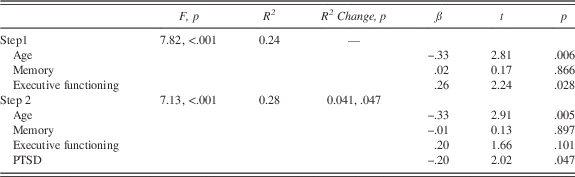
To examine the independent contribution of PTSD to MIST time-based scores above and beyond age and relevant neuropsychological factors, we conducted hierarchical regressions in the whole sample, with age and retrospective memory and executive functioning Z scores entered in the first step, followed by PTSD diagnosis. Even though age was not significantly different in the two groups, aging is associated with declines in performance on laboratory-based PM tasks (Henry, MacLeod, Phillips, & Crawford, Reference Henry, MacLeod, Phillips and Crawford2004). In our sample, age was significantly associated with MIST time-based score across the whole sample (rho=−.34; p=.003) and within the PTSD group (rho=−.32; p=.013). As shown in Table 5, in the first step of a hierarchical regression analysis predicting MIST time-based score, age and executive functioning were significant in the model but the memory Z score was not; the model accounted for significant variance (R2=0.24). When PTSD diagnosis was entered in the second step, it was a significant explanatory variable in the model and accounted for significant change in variance (R2 change=0.04), and a significant overall R2 (0.28).
Hierarchical regression predicting MIST summary score

Note. MIST=Memory for Intentions Test; PTSD=posttraumatic stress disorder.
Discussion
The current study examined the nature and extent of PM dysfunction in PTSD. Prior studies have shown that PTSD is associated with dysfunction in inhibition, working memory, and retrospective memory (Aupperle, Melrose, et al., Reference Aupperle, Melrose, Stein and Paulus2012; Polak, Witteveen, Reitsma, & Olff, Reference Polak, Witteveen, Reitsma and Olff2012; Scott et al., Reference Scott, Matt, Wrocklage, Crnich, Jordan, Southwick and Schweinsburg2015), and a recent study showed that PTSD symptom severity was associated with performance on a focal, event-based PM task. Here, we extend this literature and show that during an ecologically relevant, performance-based test of PM, veterans with PTSD displayed more time-based PM omission failures than a trauma-exposed comparison group.
Importantly, associations between PTSD and PM were not better explained by deficits in other relevant neurocognitive abilities, such as executive functions and retrospective memory, nor were they explained by age. These results are not likely due to between-group demographic differences, as groups were relatively well matched on these variables. Group differences also persisted after adjusting for relevant confounds and comorbidities. Moreover, groups were equivalent in performance on the ongoing word search task completed during PM cue-intention encoding and recall, suggesting that differences were unlikely to be due to limited overall task engagement. Taken together, these data suggest that PTSD may be associated with a specific deficit in PM.
In the context of McDaniel and Einstein’s (Reference McDaniel and Einstein2000) multiprocess theory, the observed pattern of PM performance suggests that individuals with PTSD have difficulties with PM tasks when strategic monitoring cognitive loads are increased. More specifically, while individuals with PTSD displayed numerically lower performance in both time-based (e.g., “In 15 minutes, use that paper to write the number of medications you are currently taking”) and event-based tasks (e.g., “When I hand you a postcard, self-address it”), they only evidenced significantly worse performance on time-based tasks compared to TC participants. Of interest, these results contrast somewhat with those of McFarland et al. (Reference McFarland, Clark, Lee, Grande, Marx and Vasterling2016), who reported that PTSD symptom severity was associated with reduced performance on an focal event-based PM task with a single prospective memory cue.
Theoretical models of PM have proposed that time-based PM is more heavily dependent on self-generated monitoring and retrieval processes associated with cognitive control (McDaniel & Einstein, Reference McDaniel and Einstein2000), which is associated with the integrity of prefrontal circuitry and associated executive functions (Einstein, McDaniel, Richardson, Guynn, & Cunfer, Reference Einstein, McDaniel, Richardson, Guynn and Cunfer1995) implicated in PTSD (Aupperle, Melrose, et al., Reference Aupperle, Melrose, Stein and Paulus2012). In contrast, event-based PM typically relies on externally prompted, less effortful, and more automatic retrieval (Einstein et al., Reference Einstein, McDaniel, Richardson, Guynn and Cunfer1995). In the context of these models, it may be that individuals with PTSD have greater difficulty accurately completing future intentions when tasks require greater internally guided allocation of cognitive resources.
Analyses of error types on time-based trials suggested that the PTSD group made more PM failure errors (i.e., omissions) than the TC group but did not differ in other time-based errors (e.g., loss of content, task substitutions). In the setting of intact recognition and ongoing task performance, these data suggest that individuals with PTSD may have had difficulty with the process of strategically monitoring time to detect the proper moment at which to enact their planned intention (McDaniel & Einstein, Reference McDaniel and Einstein2000). Adaptive time-based PM monitoring typically exhibits a J-shaped curve in which a brief initial monitoring spike occurs, followed by less frequent monitoring until the target time approaches, when monitoring greatly increases in frequency until the intention is executed.
Such adaptive clock-checking behavior has been shown to be strongly related to time-based PM (Doyle et al., Reference Doyle, Loft, Morgan, Weber, Cushman and Johnston2013), can be disrupted in neuropsychiatric populations (e.g., schizophrenia; Shum, Ungvari, Tang, & Leung, Reference Shum, Ungvari, Tang and Leung2004), and is associated with deficits in executive functions and retrospective memory (Doyle et al., Reference Doyle, Loft, Morgan, Weber, Cushman and Johnston2013). Analyses of the cognitive correlates of PM provided further evidence to support this interpretation, as they revealed moderate correlations with executive functions and retrospective memory in the PTSD group. However, since we did not specifically measure time monitoring, the possible contribution of retrospective memory failures cannot be dismissed. Future studies are needed to examine the role of strategic clock-checking behaviors in PTSD and determine if efforts to support such processes (e.g., increasing task importance, introducing intermittent salient monitoring reminders) can enhance or normalize PM (Woods et al., Reference Woods, Doyle, Morgan, Naar-King, Outlaw, Nichols and Loft2014).
Of note, the PTSD group did not differ from TC in event-based PM, which is a relatively more automatic process (McDaniel & Einstein, Reference McDaniel and Einstein2000). This is particularly true in the case of the proprietary version of the MIST in which the cues are overtly displayed to the examinee (cf., the research version of the MIST, which uses more subtle cues; Woods et al., Reference Woods, Moran, Dawson, Carey and Grant2008), thus greatly reducing cue monitoring and detection demands. Even so, the effect size confidence intervals for time-based and event-based PM did not differ in the present study, although null hypothesis significance testing revealed a deficit in the former but not the latter.
Thus, we cannot confidently state that PTSD is not associated with deficits in event-based PM, which is a complex and multifaceted construct. In fact, McFarland and colleagues (Reference McFarland, Clark, Lee, Grande, Marx and Vasterling2016) found that PTSD symptom severity was associated with performance on a focal event-based PM task, although no comparison with a non-PTSD group was conducted. Future studies may, therefore, wish to exploit the relative strategic and automatic monitoring demands of event-based PM to determine under what conditions such deficits emerge (and are abated) in PTSD. For example, manipulations of cue focality (Kliegel, Jäger, & Phillips, Reference Kliegel, Jäger and Phillips2008), cue salience, ongoing task demands, and the semantic relatedness of cue-intention pairings (Woods, Dawson, Weber, & Grant, Reference Woods, Dawson, Weber and Grant2010) may prove interesting in PTSD.
The discrepancy between time-based and event-based PM in the current study is consistent with prior results from major depression, which have shown worse time-based PM but relatively intact event-based PM (Li et al., Reference Li, Weinborn, Loft and Maybery2013). Unexpectedly, in the current study, depression symptoms were associated with event-based PM across the whole sample, although this correlation was not significant in the PTSD group. It was noteworthy, however, that depressive symptoms were not associated with overall or time-based PM in the current study, although PTSD numbing symptoms (which are theoretically related to dimensions of depression) did exhibit trend-level associations with PM performance.
Taken together with previous results, individuals with depression and those with PTSD may show similar difficulties with self-initiated monitoring and retrieval during PM, although these difficulties may arise from divergent mechanisms that result in similar cognitive control dysfunction. Future studies may benefit from large-scale psychiatric samples to delineate the dimensional symptoms of PTSD, depression, and anxiety that are associated with specific patterns of PM dysfunction.
Analyses of dimensional PTSD symptoms found specific associations between a cluster of hyperarousal symptoms and both the MIST summary score and time-based score, with a marginally significant association with PTSD numbing symptoms. In contrast, McFarland et al. (Reference McFarland, Clark, Lee, Grande, Marx and Vasterling2016) reported correlations between all symptom clusters and event-related PM performance. Discrepancies between our results may reflect differences in PM task parameters.
Relevant to the current study, hyperarousal symptoms of PTSD include sleep disturbance, difficulty concentrating, irritability, hypervigilance, and an exaggerated startle response. These symptoms have been associated with dysfunction in noradrenergic systems (Arnsten, Raskind, Taylor, & Connor, Reference Arnsten, Raskind, Taylor and Connor2015; Pietrzak et al., Reference Pietrzak, Gallezot, Ding, Henry, Potenza, Southwick and Neumeister2013), which modulate the response of cortical regions to allocate resources according to task demands by enhancing interactions within top-down prefrontal cortical systems involved in attention and executive control (Aston-Jones & Cohen, Reference Aston-Jones and Cohen2005). Given convincing evidence of prefrontal cortical dysfunction in PTSD (e.g., Liberzon & Sripada, Reference Liberzon and Sripada2008), one possibility is that PM difficulties are driven by noradrenergic system dysfunction and associated inefficiencies in resource allocation (e.g., hypervigilance to extraneous stimuli); this speculation awaits future study.
Limitations of this study should be acknowledged and include the exclusive focus on veterans with PTSD and a limited sample of women. An additional limitation is the substance exclusion criteria that resulted in significant substance use comorbidity in the PTSD group, with less comorbidity in the TC group. We recruited the PTSD sample to extend generalizability and be generally representative of the veteran PTSD population. Although our supplementary analyses showed that these comorbid conditions, including substance use disorders, were not associated with PM in the PTSD sample, we cannot positively assert that PTSD is associated with PM in the absence of such comorbidities nor that these comorbidities will not have additive or synergistic effects on PM performance in prospective studies that are properly powered to answer such complex questions. We also did not directly assess monitoring behavior (e.g., clock-checking), although this is strongly related to time-based PM performance (Doyle et al., Reference Doyle, Loft, Morgan, Weber, Cushman and Johnston2013).
In addition, performance was close to ceiling on event-based trials, reflecting a common challenge in event-based PM tasks, which involve more automatic retrieval. Use of subtle or non-focal event-based cues in future studies may reduce ceiling effects. Moreover, this cross-sectional study cannot determine whether group differences reported here represent acquired dysfunction or pre-existing vulnerabilities. Previous longitudinal and twin studies have suggested that neurocognitive performance discrepancies in some domains may represent both vulnerability factors for and consequences of PTSD (Gilbertson et al., Reference Gilbertson, Paulus, Williston, Gurvits, Lasko, Pitman and Orr2006; Marx, Doron-Lamarca, Proctor, & Vasterling, Reference Marx, Doron-Lamarca, Proctor and Vasterling2009; Parslow & Jorm, Reference Parslow and Jorm2007), although measures of executive control have typically been omitted from such studies.
Despite these limitations, the current study provides initial evidence of time-based PM dysfunction in PTSD. Future studies should seek to replicate these findings and examine whether such deficits are found in civilians with PTSD. To further examine mechanisms of PM dysfunction in PTSD, future studies could manipulate the ongoing PM task (e.g., word search puzzle) by adding trauma-related stimuli, which could theoretically exacerbate PM deficits and provide insights into the underlying architecture of observed performance differences. Given prior findings in depression and other relevant disorders (Li et al., Reference Li, Weinborn, Loft and Maybery2013; Poquette et al., Reference Poquette, Moore, Gouaux, Morgan, Grant and Woods2013), future work could also examine the effects of delay interval on PM dysfunction in PTSD. Furthermore, although prior studies have shown that PM dysfunction is associated with important functional outcomes, such as medication adherence (Poquette et al., Reference Poquette, Moore, Gouaux, Morgan, Grant and Woods2013), the contribution of PM dysfunction to functional outcomes in PTSD (e.g., treatment outcomes; Withall et al., Reference Withall, Harris and Cumming2009) remains unexplored. If time-based PM dysfunction is driven by problems in strategic monitoring and retrieval, interventions that target these aspects of PM (e.g., self-regulatory strategies) might prove valuable, especially since time-based PM robustly predicts everyday functioning outcomes in other populations (Weinborn et al., Reference Weinborn, Moyle, Bucks, Stritzke, Leighton and Woods2013; Woods et al., Reference Woods, Dawson, Weber, Gibson, Grant and Atkinson2009).
Acknowledgments
This study is dedicated to the memory of Henry Krystal, M.D., pioneer of the impact of massive psychic trauma, who died on October 8, 2015. This work was supported by a Department of Veterans Affairs Career Development Award (IK2CX000772) to Dr. Scott, as well as the National Center for PTSD (NCPTSD). Dr. Krystal’s participation was supported by the National Center for Advancing Translational Science (1UH2TR000960-01), the Department of Veterans Affairs (NCPTSD), the Neuroimaging Core for the VA/DOD Consortium to Alleviate PTSD, the National Institute on Alcohol Abuse and Alcoholism (P50AA12870, M01RR00125), and the Yale Center for Clinical Investigation (UL1 RR024139). Dr. Woods is supported by R01MH073419 and R01DA034497. The views expressed in this article are those of the authors and do not necessarily reflect the position or policy of the Department of Veterans Affairs. The authors declare no conflicts of interest.