I am not sure which performance of 100% City, by now a decade-old series by acclaimed group Rimini Protokoll, I saw first. I recall watching it at my desk, in the middle of a sunny California day, and I remember that it was in English: so, 100% Melbourne, 100% Darwin, 100% Cork, or 100% Philadelphia. But it was not long before I had seen them all, barrelling ahead to subtitled locales such as 100% Gwangju, 100% São Paulo, and 100% Kopenhagen. International travel can be expensive. Rimini's archive-turned-atlas, generously uploaded to the streaming platform Vimeo, is free.
Even within the prolific output of Rimini Protokoll, a trio of Berlin-based writer-directors (Helgard Haug, Stefan Kaegi and Daniel Wetzel), no piece can have reached as wide an audience as has 100% City.Footnote 2 Since 100% Berlin (2008), 100% has been performed at thirty-four sites at the time of writing, with its next performance scheduled for Voronezh in Russia (twenty-four of these have been posted online). Each 100% performance stages a statistically representative sample of a hundred of each city's citizens, speaking about their identities, lives and opinions. Thus far, scholarship on the series has focused exclusively on single City instances, considered within each location's specific politics.Footnote 3 Writing at the height of the Greek crisis, Margherita Laera concludes that Athens ‘playfully performed contemporary Athens as a continuation of the half-mystical, half-historical city where theatre and “democracy” were “invented”’, without noting the potential irony of the piece's German origins.Footnote 4 With a more critical take, Marissia Fragkou and Philip Hager argue that ‘100% London reiterated consensual dramaturgies of participation that dominated discourses around the [2012] Olympics’, contrasting its cosmopolitanism with the agonism of another import, Occupy LSX (the London Stock Exchange).Footnote 5 In this journal, Karen Zaiontz acknowledges the ‘seeming paradox’ of 100% City – ‘how a show that feels so local can be a part of a global project and a transposable dramaturgy that is designed to be tented anywhere’ – but resolves this paradox in favour of locality. For a Vancouverite like herself, this ‘citizen-led performance … was Vancouver … a direct channel to the city and not a Rimini Protokoll export’.Footnote 6 As these essays show, even for a festival-circuit mainstay, spectatorial position is everything.
What, then, to make of my own position, zipping around the globe from my apartment, watching the twenty editions posted online as a serial? I use the last word pointedly, as the format and technology with which I watched them were not too distant from a Netflix binge, in which that streaming platform will propel you from one movie to another unless you manage to click in protest. When you finish one City, Vimeo will quickly recommend watching the next.Footnote 7 And so this particular performance documentation wormed its way into my life like no other, set on my counter while I did dishes, on my bed while I did laundry, even bookmarked (in the case of 100% Paris) for convenient language practice. While I have lived in cities my whole life, none of them has received the 100% treatment (only two in America have); consequently, my spectatorship of the series has been oddly flat. Each city appears equally foreign, so none of them seems foreign at all. Like Zaiontz, I am well aware of the paradox at the heart of 100% City, but just as her seat in the Vancouver audience produced Rimini's series as local, my seat at my laptop produced twenty localities as serial. As so much performance documentation shifts onto video-streaming platforms, the repetitions, structures and abstractions that this type of spectatorship brings forward deserve consideration as such.
Indeed, Rimini Protokoll themselves are beginning to present 100% City as series – at the Museum of Contemporary Art Santa Barbara, their City as Stage (2017) showed clips from each episode in a multimedia surround installation. It is through many series, then, that this essay will discuss a full decade of 100% City. The performance crafts each citizen's serial identities at two levels: as a member of populations, and as a member of a single transnational urbanity. After introducing the performance through a chorus of streamable episodes of 100% City, I will consider the work's political implications through the motif of ‘seriality’, as articulated first by Jean-Paul Sartre, developed by Benedict Anderson, and revived by contemporary scholars of popular media. Like some previous analyses of Rimini Protokoll, this discussion critiques the cosmopolitan aesthetic of their work, arguing that the layers of seriality operating through 100% efface temporality in favour of geography.Footnote 8 I therefore counter this tendency by historicizing the work, a move which can help explain why audiences the world over – myself included – have become so enchanted by 100%.
While it may well be true, as Eddie Paterson argues, that 100% City ‘validates the State apparatus’, this historicization of the work's serialities will suggest that Rimini's politics validate the liberal, statistical state of the nineteenth and twentieth centuries rather than the data-driven order in which we now live.Footnote 9 Our current century can be accurately characterized as undergoing a data revolution, as our actions both digital and biological are increasingly tracked, analysed and sold at dizzying rates. This transformation has been noted by many theatre scholars, some of whom have argued that the technology-intensive, numbers-obsessed work of Rimini Protokoll ‘could hardly be timelier’ in this age of data.Footnote 10 In contrast, considering the same historical shift, I argue that 100% City could hardly be more nostalgic. The numerical logic seen across 100% City is not a new, digital paranoia; it is a turn back to nineteenth-century concerns about statistics, probability and the laws of society. By reflecting on the series of 100%, or at least on my unusual spectatorship of peering across years and oceans thanks to video streaming, I hope to describe a serial nostalgia for statistical reason amidst our era of data. Such nostalgia is not at all limited to Rimini Protokoll. Ironically for a project that began on a laptop, I will conclude that such serial nostalgia quells our data anxieties with the comforts of the theatre itself.
Census as spectacle
Let us start along my unusual streaming path, cutting from city to city through the series’ consistent structure.Footnote 11 Each performance begins with a lone performer speaking into a stand microphone, centre, downstage. 100% Cork: ‘Hello everybody. My name is Mary Malone and I've always been interested in numbers … What I particularly love about statistics are the stories behind them’.Footnote 12 Malone's passion, she explains, led her to the Cork city bureau of statistics. 100% Amsterdam introduces city worker Esther Jakobs, who claims to ‘translate Amsterdam and the Amsterdammers into figures, shapes, charts, graphs and lists … I find these figures interesting, but these figures are about people. I thought it was a great idea to bring 100 people together who could represent all the Amsterdammers’.Footnote 13 Martin Pesl, census worker of 100% Wien: ‘What you have in front of you right now is 1.7 millionth of all residents of Vienna. I am 0.00006% of all residents of Vienna. We have taken a random sample of 100 people. This sample represents Vienna. Each of these 100 people represents 17,000 other people from Vienna, so 17,000 people are just like me’.Footnote 14 Martin lets out a slight grin, and gets a big laugh.
That ‘just like me’, we learn, refers to five master categories that Rimini Protokoll have used in nearly every city – in Berlin, ‘age, nationality, residential district, marital status and gender’.Footnote 15 A few cities replace ‘nationality’ with ‘race’ (Philadelphia) or ‘skin colour’ (São Paulo), while three of the surveyed cities add a sixth category (Wien and Yogyakarta include religion, while Kopenhagen includes socio-economic status).Footnote 16 The one hundred people gathered in each 100% together sample their city through these categories. As Bec Reid in Darwin puts it, ‘But where to begin? I chose one of the youngest Darwin citizens I could find for the starting point for a chain reaction’.Footnote 17 Jordan, an infant with his mother Thelma, enter, and that chain reaction begins to spool itself out on the stage.
This ‘chain reaction’ is more a game than a casting process. Each recruited performer has twenty-four hours to recruit the next, working with the bureaucrat to determine whom they know who might slot into the unfilled categories – and who might be willing to participate. In theory, the performance thus produces not just a representative sample of an urban population, but a thread of social connection which weaves the ‘urban fabric’ together. In interviews, the company has offered more details on this process. There is a ‘hidden filter’, for example, that ‘theatre enthusiasts or actors should not be a part of the cast’. The statistician keeps up ‘a backlist’ to start the chain off in different communities when the chain inevitably breaks; the group had to restart the 100% London chain by advertising in Pakistani-community newspapers, and often must cold-call homes for the elderly to meet their age quotas.Footnote 18 The company also admits that their requests meet friction in some groups, and that they miss some populations altogether. ‘[We must] convince the more conservative people, hardliners, to balance a demographic that is always easy to find: culturally interested, liberal people’, they write.Footnote 19 The group claims that such frictions are precisely what make the project interesting, but those breakages and efforts are not performed onstage. Instead, a community is produced, through a script and mise en scène which stage divisions as a dialectic to be overcome through synthesis.
The stage then revolves each citizen of the chain in front of a microphone in a tight spotlight. Each performer holds an object: a possession of theirs which they introduce as a sort of token of themselves. These introductions – typically just seconds long – have become the most affecting in the piece for me, encapsulating its core tensions between representation, identity, performance and amateurism. A couple of thousand introductions later, one can make some generalizations, especially by age. Children are highlights: ‘I'm Nicolai. I like to laugh and make people laugh. I also like insects, I keep insects as pets. I've brought one of my stick insects with me’ (Amsterdam).Footnote 20 Young adults often proclaim more particular identities: ‘My name is Mikhail. For five years I've been practising Krishna consciousness. I'm holding a japamala, a bag of praying beads that help me pray and talk to God. God loves you!’ (Rīga).Footnote 21 And older performers can be terse: ‘I'm a retired professor, but I'm an optimist’ (São Paulo).Footnote 22 Perhaps one expects to learn something about Yogyakarta from 100% Yogyakarta, and, to be sure, some of its citizens’ occupations (fruit seller, tobacco farmer, forest ranger) are not found in 100% Montréal. But these, like most of the comparisons that serial consumption of 100% sets forth (posture varies culturally, football is global, São Paulo is young while Gwangju is old), feel banal next to the transfixing anticipation felt as each new person steps before the microphone.
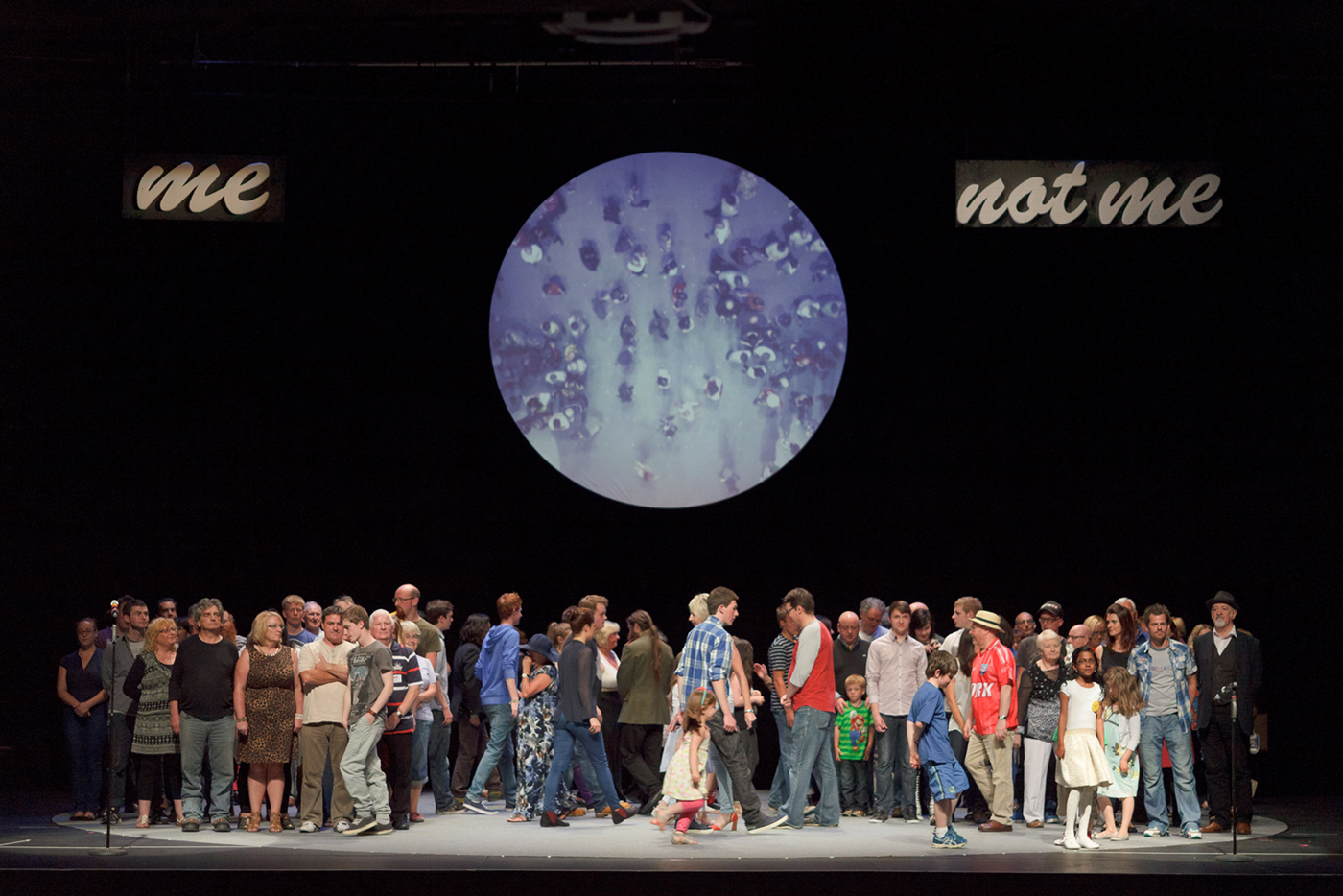
Once the introductions are complete, we hear the sound of a roulette ball whirring in its wheel, as the group circles around until the ball clack-clacks into place. A performer steps forward to announce, ‘We are Yogyakarta! We represent Yogyakarta’. (In Yogyakarta, the hundred citizens then bow). Another, always, follows: ‘We are the statistical cross-section of the population. We are 100 of 4,077,336 people who make up Melbourne’. The performers then begin to sort themselves, walking in choreographed spirals and patterns on the circular floor, made visible through a live-streamed overhead video projected, as a circle, on the upper upstage wall (see Fig. 1).
(Colour online) Performers sort themselves in Rimini Protokoll's 100% Cork. Photograph by Mike Hannon.

They arrange themselves in concentric circles to show age distribution. They sort themselves into a floor-projected map of the city's neighbourhoods. They divide into rough halves by gender (in Philadelphia, a gender-queer performer clarifies that the category refers to legal gender). As the stage rotates, a recorded voice walks them through a twenty-four-hour day, as they show themselves sleeping, walking, reading, working or clubbing at each hour.
The performance then moves into polling. The group sort themselves on each side of the stage, under the banners ‘ME’ and ‘NOT ME’, in response to questions posed by Rimini Protokoll and tailored to the location: ‘Who believes in the afterlife?’ (Gwangju).Footnote 23 ‘Who came here to escape violence from somewhere else?’ (Melbourne).Footnote 24 ‘Who would like kissing in public to be legalized?’ (Penang).Footnote 25 None of the performances survey political party membership or electoral choices – identities are established in the first segment of the performance, while politics are staged as divisions in opinion. Economic status is polled by labour status: the performers split up to indicate who works for a wage, who lives off assets, and who is in debt. A live local band joins in, charging the last third of the performance with energy, as the polling continues (alt-rock in Montréal, polka in Karlsruhe, and salsa/ska in Paris).Footnote 26 Finally, the house lights come up, and the audience join in by their raising hands in response to similar questions, and often asking questions back. The piece closes with the band leading an upbeat song as the performers bob along, smiling in rows on the stage. Audiences usually dance along. But the Vimeo audience, allowing another City to automatically cue up, might instead find themselves following a new statistical chain reaction across the globe. There are always more people eager to introduce themselves, always more numbers to count.
The serialities of 100%
The performers become categories, and categories become numbers. They define themselves with serial identities (male, twenty–thirty years old, nineteenth arrondissement, single, from the EU), all while the performance defines itself as a member of the larger series of 100% City. In concert, these two layers of seriality – of each individual as statistical, and of each ‘episode’ of 100% in its series – suggest the political limits of Rimini Protokoll's approach. The company claims that the performances attempt to show ‘the faces behind the numbers’, a phrase repeated in each show. But how were faces attached to numbers in the first place? Which faces have received such a privilege? Yet statistics tend to lead one away from these questions: a census has no time for the past. To represent populations through seriality effaces the history and politics which have produced them.Footnote 27
The emerging field of ‘seriality studies’ examines serial media as a fundamental genre of modernity, with particular interest in how serialities of identity and of media reinforce each other. Observing that narrative serials encourage their consumers to feel as if they are contributing to the series themselves, media scholar Frank Kelleter describes a seriality that can well inform our non-narrative example: ‘Popular seriality serves to shape, mobilize, and adaptively readjust modern practices of belonging and identity articulation in fast-changing market societies, not least by encouraging these societies to describe themselves as participatory cultures of engagement, debate, and choice.’Footnote 28 In this light, seriality seems linked to the fundamental imperatives of capitalist culture: reproduction, proliferation and assimilation. The genius of 100% lies in its presentation of demographic categories gathering people into ‘social series’, a type of collective described by Jean-Paul Sartre as ‘united but not integrated’, as he accounted for the collapse of revolutionary politics in Europe.Footnote 29 Members of what Sartre called the ‘group’ are ‘united by the action that they undertake together’ – he has labour unions in mind, but we might add that a typical theatrical cast exemplifies the ‘group’, cooperating with great effort to produce a single work.Footnote 30 Sartre's ‘social series’ are instead like people queuing up for the bus: ‘interchangeable’, with different interests, brought together only through a ‘prefabricated’ situation.Footnote 31 100% does not produce groups, but bus queues, from its circle of performers who make up ‘the city’ to its ‘ME/NOT ME’ clumps in its polling section. Its performers are brought together because of their shared memberships in collectives they may have little attachment to; they neither have shared goals nor competing objectives to fight over. It is this loose serial gathering, so typical of modernity while so unusual in the theatre, that produces the compulsively watchable truth of 100%.
The piece's political virtue, then, lies in its affirmation of belonging to many who might not look like a city's iconic population. 100% Brussels, Penang, and Montréal are pointedly multilingual, while 100% Amsterdam surprised this foreign viewer with its number of Surinamese performers. In some instances, however, the same normalizing logic can produce strain. The census worker of Gwangju confesses in her opening statement that the city only has a 1 per cent foreign-born population (she adds, defensively, that Seoul's rate is only 2 per cent). As the performers parade out, that 1 per cent becomes visible: a black man. Yombi, we learn, is a professor of political theory who came to Korea as an adolescent refugee from Congo. He jokes about his love of kimchi, and speaks of how he misses the music of his childhood. To this spectator, at least, Yombi's story is astonishing. As sociologist Gil-Soo Han observes, ‘members of minority groups may be residents or citizens of Korea, but are excluded and marginalized in their everyday life’.Footnote 32 Yet in 100% Gwangju, Yombi does not perform the improbability of his own success, but serves to attach that success to the label of ‘foreigner’. Even that category becomes confused in the South Korean context, where what Hyunjung Lee calls an ‘internal diaspora’ of foreign-born ethnic Koreans are considered ‘minority populations’.Footnote 33 Yombi thus seems doubly atypical amongst the 1 per cent he stands in for, given his social achievements and too-stable marking of ‘foreign-ness’, but through the interchangeable logic of seriality, he performs Gwangju as tolerant. Indeed, the piece ensures that he is one of the three performers who says ‘I am Gwangju’, insisting on his ability to produce the city's identity. As an actual foreigner to Gwangju, Yombi's normalization cannot help but fall flat; my American eyes widen at the apparent homogeneity of the ninety-nine people behind him, and I find myself questioning what such affirmations of identity efface.
The inclusion of national origin as one of its five demographic markers supplies every 100% with tales of migration. The performative ‘we are Melbourne’, spoken by immigrants from China, Indonesia and the United States, ensures the openness of the term ‘Melbourne’. The city appears as an Andersonian ‘imagined community’, a collective whose ‘unbound seriality’ he praised as a unique capacity by which diverse people can speak as one.Footnote 34 For Anderson, the power of ‘unbound’ serial identities like nationality is that anyone can claim them, in contrast to the body-bound violences of crafting race and gender. But as Partha Chatterjee points out in his critique of Anderson's work, citizenship and even inhabitance are highly policed, ‘bound’ communities themselves. Anderson's communities stand as ahistorical concepts to which anyone might belong.Footnote 35 Yet the fact that ‘Melbourne’ can also always be counted, as is evidenced by 100% itself, shows that ‘Melbourne’ is always undergoing fundamental change; further, such idealization denies that this change is a site of political struggle. Australia's indefinite internment of asylum seekers at camps in Nauru and Papua New Guinea can grimly illustrate how hard that government works to define – to bind – ‘Melbourne’ to a certain population, and restrict others from ever being counted as ‘Australian’ at all.Footnote 36 This historical condition of what is performed onstage, and the futures to which these onstage statistics might tend, are effaced by a performance that tries to spatialize politics, to affirm identity, and to refuse what Chatterjee calls ‘the complicated business of the politics of governmentality’.Footnote 37
Chatterjee's spin on ‘governmentality’ reminds us that the doing of government happens in multiple interlinked spheres: bureaucratization of laws, negotiations between industry groups, intellectual debate and loud mass street protest. For 100%, the scene of politics is shown instead as electoral: the survey, the ballot box, the counting of opinions, while the ‘face behind’ such measures would be the local conversation within the community gathered in the theatre. The governmental powers which create and manage the city, and which fund the performance, are absent. So are the powers that might change it – organization, persuasion and demonstration – in face of an imagined democracy in which tallying stable identities and binary values produces a civic commons. This statistical absence of governmentality, of history as a struggle, is then doubled by the second serial layer of 100% City: its own seriality between cities, performing a globalized unification.
This layer can be found on the last pages of every programme for 100% City. These are usually handsome, hefty booklets that supply profiles of every performer. In the back, that particular city's position can be found within a complete list of the show's stops, showing the history and booked future of 100% City. These one hundred are not only identified as citizens, but as City-zens, instantiated into a new kind of series. The series is thus an atlas, a project of cartography. The meta-identity of 100%, that list on the back of the booklet, maps each performance within a global, homogeneous network. From Paris to Tokyo, Oslo to Montréal, these cities comprise a specific layer of cosmopolitan modernity, their locations producing a web which crosses the planet, but through already well-trafficked circuits of capital and intercultural discourse. The city series of 100% testifies to what D. J. Hopkins and Kim Solga call ‘the uneven flow of the global’, the booklets testifying to cities’ desire to show what side of that flow they are on.Footnote 38 Collectively, these cities perform a corporate model of ‘diversity’, an arts-festival cliché that, according to George Yúdice, markets cities as producers and products of a homogeneous futurity.Footnote 39
Here, the layers of 100% work in concert. Any concepts of deviancy or inequalities of futures are denied to the one hundred performers on the stage, while certain distinctions among the group are enumerated: a diversity without difference. Then, those performers construct an identity of the metropolis itself, while denying the work that constitutes the limits of that identity. Finally, each city (now unified as a body) can inscribe itself not into a planetary totality, but into a slice of cities which also performs a certain diversity (they span the globe) while ignoring other differences (wealth, political structures). 100% valorizes the differences of geography, the chief element which both distinguishes the cities on its list and blocks each performer on its stage (the show's mise en scène is careful, its pace loose), in order to efface temporality, the axis of contest and transformation from which these cities wish to depart.
From statistics to data
This serial cartography has, however, its own historicity. The bureaucrat of 100% Darwin, who tells us he is ‘able to use the language of numbers to see how the [Northern Territory] is growing and changing’, not only occupies a job invented in early nineteenth-century Europe, but echoes a conceptual logic founded in that period's invention of the numbers called ‘statistics’.Footnote 40 This logic is well known from Michel Foucault's discussion of the ‘inversion’ of the sciences, through which categories previously thought inviolable were found to be effects of things themselves:
The classification of living beings is no longer to be found in the great expanse of order; the possibility of classification now arises from the depths of life … Before, the living being was a locality of natural classification; now, the fact of being classifiable is a property of the living being.Footnote 41
Classification thus became understood as a scientific action that produces accuracy, though only through effort – through mathematical operations, sampling and political negotiation around the categories in question. The chain-reaction, classification-creating casting that produces 100% thus indeed resembles what Paterson, in his critique of 100% Melbourne, calls ‘the grid-logic of the State’.Footnote 42 But Foucault's story of grids, classifications, identities and surveillance was not an abstract political complaint. It was a description of a historical specificity – broadly, nineteenth-century Europe – that Foucault believed had passed. Zaiontz's essay on 100% Vancouver points out that in 2010, the Harper government eliminated the mandatory Canadian census as part of its neo-liberal reforms.Footnote 43 She proceeds to read 100% as resistant to this dismantling of the social, but we can instead consider the piece as a more passive gaze back across a historical shift. Statistical ordering – serial identification – is now a practice of the past, so we should look to the past to understand it.
This is the shift I wish to underline by writing of the ‘nostalgia’ of 100% City. 100% calls forth the long history of serial identification with a warmth and hope perhaps only possible now that these practices have waned. Contemporary anxiety about what to do with ‘big data’, though well founded, can overlook the degree to which previous societies confronted similar challenges. Over the nineteenth century, as Ian Hacking points out, the US census grew from four questions to 13,010.Footnote 44 In fact, such an expansion likely underestimates the ‘avalanche of printed numbers’ of the era, which Hacking pegs at a 300,000-factor increase.Footnote 45 Many of these numbers made their way into newspapers, which turned with enthusiastic attention to statistics and their possible meanings. National rates of suicide, for example, were set into competition with those of other nations as a point of national pride.Footnote 46 In this way, statistics began to secure the very categories used to create them – numbers were given sense through identities, generalization, and the flattening of differences. This alignment of persons into series was at work in early statistical journalism, as a mode of understanding an abundance of numbers, just as it is at work in 100%. Most importantly, these numbers were then taken into aggregates: Scotland, England, France. Statistics answered new kinds of questions about nations and reproduced them as one general ‘social body’; indeed, as the historian Theodore Porter puts it, ‘society was itself in part a statistical construct’.Footnote 47
In the nineteenth century, such serialities would take more aggressive forms than that of 100%. Where Rimini abstract the ‘social body’ into a hundred bodies, many early sociologists attempted to abstract down to one. Statistician Adolphe Quetelet wondered in 1844 ‘if there exists, in a people, un homme type, a man who represents this people by height, and in relation to which all the other men of the same nation must be considered as offering deviations that are more or less large’.Footnote 48 If one could cut the mass of humanity into the right set of ‘peoples’, following lines of race, gender, age and nationality, the logic went, one could statistically produce ‘average men’, whose right to represent others was secured by sheer arithmetic. As Allan Sekula writes, ‘Quetelet sought to move from the mathematicization of individual bodies to that of society in general’.Footnote 49 This logic has been associated with the naturalism of Emile Zola, but was perhaps better captured through Francis Galton's invention of composite photography. Galton's ghostly blurred portraits, which purported to show readers ‘the face’ of various ‘types’ of people, expand the logic of serialization to absurd ends, forced to invent average faces where no such thing could exist. Rimini Protokoll are far more forgiving: if you inhabit the category, you can represent it. But the same thesis, articulated in governmental practices and social division, appears in all representations of hommes types, in which ‘the individual only existed as an individual by being identified’.Footnote 50
Rimini's return to the nineteenth-century sport of hommes types is forgiving again through its elimination of probability. 100% stages the first two steps of a census: it finds a sample of people, and it asks them questions. But it does not proceed to the final step of drawing the probabilistic conclusions – where are these people, where is society, going? – which defined early statistical approaches. For the likes of Comte or Durkheim, probabilistic predictions held the promise of divining, and if need be changing, a society's impending disease, criminality, income or mortality. 100% never uses its statistics for such purposes. To be sure, such fatalist conclusions could seem as absurd today as they did in their original era. Parodies of statistics can be read in Balzac and Dickens; regarding the theatre, an 1885 French sociologist complained that ‘as soon as a statistician comes on the stage, everyone prepares to laugh’ (the average ‘one-and-a-half-child’ family produced many music-hall sight gags).Footnote 51 Predictions have gone hollow, and we now understand how flexible categories of identity can be. Statistical reason, plainly, has waned. We must call 100% nostalgic for such reason not because it resembles those laughable music-hall sociologists, but because it only partially brings their era back to life. In particular, the reformist impulses driving early social sciences towards increasing averages of identities and aggregates of probabilities are now left aside. 100% does not want the ‘society’ it stages to consider transforming itself. It is instead nostalgic for the existence of society at all.
If statistics produced ‘society’, we might well be discovering that ‘big data’ produce no such thing. The ‘avalanche’ of nineteenth-century numbers pales when compared to the computer-driven ‘dataclysm’ of the past twenty years.Footnote 52 A 2010 Economist study concluded that this ‘information explosion’ – roughly a compound annual increase of 60 percent – has made data ‘the new raw material of business: an economic input almost on par with capital and labour’.Footnote 53 Entirely apart from the typical exploitation of our labour power, businesses are now racing to acquire our ‘data exhaust’, the formerly valueless by-products of our actions. Gilles Deleuze's concise description of the shift remains prescient: if statistics of the ‘disciplinary society’ gave the ‘individual … his or her position within a mass’ (what better description of the choreography of 100% City?), the ‘data’ of the ‘control’ society produce merely ‘dividuals’ who can perform in hundreds of categories without being at home in any of them.Footnote 54 We are no longer polled; we are tracked. Statistics must compile reams of information about each single interviewee, while data can just list one bit of information (one post, one click) into such a vast database that it can produce modes of control still difficult to foresee. In this era, 100% City makes us into the serialized individuals we no longer are.
The ‘data-subjects of postdigital culture’ we have instead become, to borrow Matthew Causey's term, can only be characterized as lacking character: diffused across bits of information that hardly line up with each other, let alone ourselves.Footnote 55 A major website might track your eyes through your webcam to see where you look, with no effort to line ‘you’ up with the simultaneous tracking of your clicks. As Paul Rae puts it, ‘seeing and being seen, knowing and being known: none of these coincide online’.Footnote 56 On a stage, the performer's actions, gender, age, race and ability are all inextricably present; in data there is little need for such categories to intersect. Algorithms (the new statisticians, who cannot stand downstage centre and introduce a performance) have no need for content, meaning, hermeneutics, bodies and their categories. Legal scholar Antoinette Rouvroy writes that statistical logics, whatever their long-documented flaws, ‘create epistemic communities … whereas algorithmic reason simply exempts from the burden of creating any type of community, of organizing interpretation … or even, simply, [from] the idea of appearance’.Footnote 57 We are being surveilled to an unparalleled degree, but we are not being interpellated, disciplined, exploited, identified or even seen. Interpreting the appearance and speech of persons: such was the regime of statistics, and such has been the practice of Western drama. As data make so little effort to identify any of us, we surely long to be seen by numbers once again. The excesses of identification in 100% City are thus precisely the source of its appeal.
Censuses are still administered, surveys still conducted, and statistical categories continue to perform their force unabated. But while these technologies were formerly subject to parody or critique, in 100% City they appear comforting. The old complaint about statistics: two choices cannot represent the complexity of my opinion. In an age in which my political allegiances can be calculated by an algorithm that spots my car on Google Street View, my complaint becomes, ‘can you at least just ask me my opinion?’Footnote 58 100% City does not present its populations to themselves so that they might be improved upon or governed (in this respect, it is not biopolitical). It instead presents its population as an accomplishment. In the theatre, it shows, numbers can still be inscribed on bodies, and societies can still be understood through representation. On the stage, people can still perform as if they were individuals. Serialization, in this light, does not appear as some insidious form of domination, but as a look back to a democratic era in which it seemed to matter who lived in a city. As an Irish Times review of 100% Cork begins, ‘Imagine this. There has been a revolution. The People's Republic of Cork … has become a reality’.Footnote 59 As it has so often, the theatre has staged a revolution to spark the imaginations of its audience – but now the survey has replaced the barricades.
Not that this is such a shift; theatre has long allegorized statistical identification. 100% City thus invokes centuries of theatre history, from Enlightenment debates about the chorus-as-city, to the social politics of naturalism, to the tension between absent populations and present fleshy performers. The ambivalences of statistics are, in many respects, those of the theatre. But what of data? The arbitrary, disassociated patterns of ‘information about information’, Rae observes, ‘would seem to be profoundly at odds with what we understand the localized and particular event of theatrical performance to be’.Footnote 60 Whether or not theatre could represent, advance or counter our data society has become a live question amongst theatre scholars. Causey, for example, advances an ‘accelerationist’ argument, urging his readers towards ‘becoming machine and thinking digitally’, as if embracing their data-subjectivity will give artists the ability to dismantle the world those data support.Footnote 61 But as I have argued, 100% City has moved in precisely the opposite direction. Sarah Bay-Cheng locates a different Rimini piece ‘at the nexus of performance, the algorithm, and … digital technologies’, but 100% City suggests that while Rimini might use digital tools and algorithmic procedures as processes, the kind of theatre they aim to produce is devoted to much older technologies of the self.Footnote 62
To read 100% City as a project of serial nostalgia better resembles the concept of ‘deceleration’, as used by Johannes Birringer to describe the work of Rimini and other artists who work from testimonial material.Footnote 63 A term sometimes used to counter the ‘accelerationism’ that intrigues Causey, deceleration implies an embodied slowing of pace, a ritualization and materialization of processes that too often bend toward the casual and ephemeral.Footnote 64 I doubt, however, that 100% City can be described as a deceleration of our becoming-data. Instead, 100% ignores the phenomenon on which its affective appeal is based. The performance never mentions ‘data’, even though that context pervades its choices and successes. This disavowal turns us to the term ‘nostalgia’, a mood that is so often vague about why, exactly, its hazily desired past has passed away. Likewise, I prefer to retain the ambivalent politics of ‘nostalgia’, recognizing the strength of its appeal during these anxious data-controlled times, while sceptical of its efficacy at countering that control. Nostalgia allows 100%’s cheerful interpellation of its performers into identity categories. Nostalgia proposes that gazing upon some group of citizens will tell a truth about others. Nostalgia neglects the histories that produced this group of citizens instead of another. Nostalgia even turns opinion surveys into revolutionary acts. As concerns about this data regime continue to permeate public discourse, this serial nostalgia – the nostalgia for being serial, expressed in a series – turns us back to the familiar, ever-statistical stage. Whether the ‘data body’ could ever appear on a stage or not, it seems safe to say that the serial nostalgia charted by 100% will be an increasingly attractive path for theatre in the years to come.
Conclusion
Perhaps the most unique individual in the surveyed episodes of 100% City is a grey-haired portly man in plain black attire, the 100th performer of 100% Braunschweig. ‘The chain reaction lost momentum towards the end’, apologizes Onno, the ninety-ninth Braunschweiger, as he passes the microphone along to the man. He says,
My name is Gunter Krense. I am not the person who I am here to represent. He should be divorced. I'm married. He should be between twenty-five and forty-four. If you don't look too closely that could almost be true. He lives in the North East. I've spent the last thirty-two years in the North West. I can represent this man, though, because I'm a professional extra.Footnote 65
Gunter's ‘object’ is, appropriately, a vial of fake blood. As noted above, actors are the only category of people deliberately excluded from 100% City. Yet somehow, despite recruiting babies, Pakistani Londoners, Surinamese Amsterdammers, and a Congolese refugee-turned-academic in Gwangju, the machine of 100% ran aground attempting to find a young divorcee in north-east Braunschweig. An actor was required.
Whatever their anti-theatrical prohibitions, Rimini Protokoll are artists of the theatre. When Gunter claims that he can ‘represent’ the absent citizen because he is an actor, he is entirely correct. The basic articulations of difference Gunter sets out – of family status, of neighbourhood, of age – adhere to the scheme of 100% just as they resemble the beginnings of building a character. The statistical order employed by the show, the system of serial identification erected in the nineteenth century, collapses comfortably into the claims actors have long made on the stage to have the authority to represent some, but not all, other people as outlined by demographic categories. (Though given Rimini's exclusion of actors, apparently collapsing acting with the ‘truth’ of statistics does not go over so comfortably – or not so nostalgically – with them.) How stage acting could manage to collapse into the disembodied, fractured categories of data remains an open question.
The nostalgia of 100% City for the statistical order, for serial identification, opens the series to several political critiques. The work atomizes social flows into individuals, reifies discursive categories, presents ‘diversity’ without difference, and presents cities as harbingers of a uniform ahistorical modernity while hiding those on the losing side of global capital accumulation. It serializes people, and serializes cities; these serialities make people and cities interchangeable, while concealing the people and cities that will never make it onto 100% City’s globetrotting tour. Series are open-ended, presenting themselves as forever inclusive, never having to admit what exclusions they (like any aesthetic project) perform. In this way, the serial structure of these performances – most obvious when viewing dozens of them through video streaming – redoubles the same logics of censuses and surveys staged by each individual edition.
But perhaps, as Bruno Latour would say, this anti-statistical critique ‘might not be aiming at the right target’.Footnote 66 While states continue to use statistics to understand and control populations, these practices hardly seem as concerning as the data-driven, algorithmic governmentality that international businesses are beginning to construct. Whatever its flaws, whatever will be missed when people are described in these ways, at least statistical bodies must still be gathered, considered and surveyed. I myself can still not resist the charms of each City’s inhabitants, their questions for each other, their joy in being present for an audience; I cannot help but imagine I am learning something profound about Montréal from watching a hundred of its citizens sort themselves ceaselessly.
Whatever the problems of statistical representations, at least they can be considered through the medium of theatre, their long-standing kin. The new controls of data and algorithms are opaque, and with their distance from flesh, individuals, and even labour, seem by contrast distant from the stage. Next to them, 100% City is a comfort. See for yourself: the videos, warm and fascinating, are online. Be advised, however, that Vimeo's data analytics will track all of your online activity. As you surf around the globe and gaze back at the numbers we no longer are, your clicks and views will construct the new numbers we are becoming.