Organised crime can cause as many deaths as traditional armed conflicts, particularly in Latin America.Footnote 1 The notion that criminal violence thrives where the state is absent often collides with the recognition that criminal actors and illegal markets require state corruption to operate. Institutional weakness and corruption undoubtedly empower criminal groups, but state–criminal interactions vary greatly. Recent literature (see note 3) acknowledges this variation, but it focuses on situations when the state enforces the law with overwhelming repression or relinquishes enforcement due to corruption. This article focuses instead on explaining government support for an uncommon policy used at different points since the 1990s: public negotiations with criminal groups, which appear in such diverse contexts as Belize, Colombia, El Salvador, the United States and South Africa. I argue that objective conditions (the relative power of criminal groups and politicians’ electoral incentives) interact with ideas and discourses to determine when governments support negotiations. Specifically, I argue that three conditions explain support for public negotiations. First, executive authorities support negotiations when the relative power of criminal groups makes it easier for them to portray negotiations as superior to repression (repression failure frame) or as means to support disaffected youth (marginalisation frame). Second, dialogue brokers – that is, key individuals within government and civil society with know-how about criminal groups – shape government support by inserting concrete negotiation proposals into these frames. Third, when elected executive authorities with power to implement security policies enjoy electoral security after election, they are more likely to support negotiations.
Drawing on fieldwork, interviews and archival analysis, I substantiate the theory in Belize City and Medellín, two cities that have experienced variation in the outcome analysed by this article: an executive authority’s decision to support negotiations. In Belize City, since 1995 the national government has supported truces with local gangs on five occasions, the most recent in 2023. In Medellín, the local government has supported negotiations both with local gangs (combos) and powerful criminal structures since the 1990s and as recently as 2022 (and still ongoing at the time of publication). I compare cases where executive authorities supported negotiation with cases where the possibility of negotiation appeared but was not supported, and periods when negotiations did not appear at all, and assess variation in the extent of support a negotiation received. This comparison over time in each location allows me to hold constant factors that are less likely to vary within a city. Comparing cities similarly afflicted by violence but with differing levels of criminal sophistication and state capacity allows me to assess the argument across contrasting contexts. This variation is important to build theory and evidence about a topic where conceptual work is scarce.Footnote 2
The article proceeds as follows. The first section defines criminal negotiations. The second and third review relevant literature and develop a theory about why elected authorities support public negotiations. The fourth explains the methods. The fifth analyses Belize City and Medellín, focusing on support for, rather than the outcomes of, negotiation because, as the cases show, different factors explain emergence and success. The conclusion reflects on the peacebuilding potential of negotiations and suggests future research.
Defining State–Criminal Negotiations
Recent scholarship shows that states can selectively enforce the law against criminal actors, and that state–criminal relationships range from confrontation to collaboration, with implications for violence, social order and governance.Footnote 3 The literature often focuses on two extremes: states enforcing the law through unconditional repression, or states colluding with criminal organisations, not enforcing the law, or enforcing it selectively against enemies.Footnote 4 Between these possibilities states enforce the law in multiple ways, following policies ranging from repressive to preventive.Footnote 5 One uncommon response to crime is when state actors selectively enforce the law not because of corruption or weakness, but because of a policy decision to negotiate.
This article conceptualises public negotiations as a state response to crime entailing collaboration between states and criminal actors that differs from private corrupt exchanges. Although both exemplify forms of state–criminal collaboration, public negotiations explicitly seek a common good – most frequently violence (homicide) reduction but also the reduction of other crimes like robberies and extortion – and are acknowledged as a public policy to mitigate conflict and reduce crime. State agents may also obtain individual economic and political benefits in public negotiations, but those benefits are more constrained by the public goal of reducing violence. Corrupt arrangements, rather, are private deals that facilitate criminal activities and illicit markets and provide individual profits for state agents and criminals, generating collective benefits as a byproduct or in tandem with particularistic benefits. This does not mean that negotiations are altruistic or free from moral hazards. In fact, public negotiations and private deals overlap, and private deals often seek, and sometimes achieve, homicide reductions. There are also private arrangements that are not necessarily corrupt. Yet such arrangements stay private and thus are less costly for politicians, who do not acknowledge the collaboration if media, judicial authorities or civilians publicise it. By contrast, state officials eventually recognise public negotiations even if they start in private, as occurred in the 2012 gang truce in El Salvador.Footnote 6 Thus, although different forms of state–criminal collaboration overlap, I focus on a government’s decision to support public negotiations because, although relatively rare, it is substantially important. Negotiations reveal clues about how to reduce violence in complex governance settings, and about how governments gain incentives to move away from repressive policies. Additionally, understanding negotiations can help theorise if and how states shift between private and public forms of collaboration.
I thus define a public negotiation as an active public interaction between government and criminal groups where the primary goal is to bargain over a collective community benefit (most frequently, but not exclusively, homicide reduction), in exchange for enforcement, judicial or economic benefits for criminal groups. Negotiations may entail intentionally not enforcing aspects of criminal law (for example, by reducing prison sentences or policing). Public negotiations take various forms such as government-brokered truces, no-harm pacts and informal dialogues, and they occur at national and local scales;Footnote 7 the definition encompasses forms that use direct communication with armed groups, and that government actors acknowledge publicly, although not always from the onset. Negotiations lie in the intersection between peace processes/conflict-mitigation policies and forms of state–criminal collaboration and collusion that reduce violence. The promise and risk of negotiations derive precisely from their potential to be both forms of state–criminal collusion and conflict-mitigation policies.Footnote 8
Negotiations are risky, because it is difficult to eliminate the economic and social incentives that explain engagement in illicit activities. Public negotiations are difficult to sustain and can appear as, or evolve into, corruption if there are no oversight, clear commitments or rules about how illegal groups and the state will reduce violence. Politicians prefer corruption, repression or politically cheaper violence-prevention programmes. Public negotiations may not appear risky when homicide reductions seem plausible and there is public support, because governments benefit electorally from lower homicides. Politicians may also gain other electoral benefits in acknowledging criminal power, for example leveraging it to mobilise clientelist networks. Yet governments often start negotiations before being certain that violence will decrease and, even when homicides decline, backlash can translate into legal prosecution for government officials. Appearing soft on criminals is risky when corruption is widespread; hidden corrupt arrangements are more attractive because elected authorities do not have to assume public responsibility but still receive political and electoral benefits from tolerating criminals.Footnote 9 Public negotiation is thus puzzling.
Existing Literature on Negotiations
Although rare, public negotiations with criminal groups are more common than often thought. Existing literature on this topic is largely policy oriented,Footnote 10 or focuses on the government-sponsored truce between the MS-13 and Barrio 18 gangs in El Salvador in 2012.Footnote 11 Some analyses of criminal negotiations theorise their consequences;Footnote 12 other works assume that the diversity of negotiations makes it difficult to theorise common trends.Footnote 13 There is thus little understanding about why elected executive authorities support negotiations with criminal groups. To explain this decision, I connect research on peace processes and on security policy-making, focusing on executive authorities because once they endorse a negotiation it becomes more formal and puzzling. Other state actors (police and judiciary) can undermine or sustain a negotiation, but it is unlikely that they can, on their own, launch it publicly.
The literature on peace processes explains negotiations focusing on the balance of power between warring parties. Many authors theorise stalemates as the motivation to negotiate in armed conflicts. The literature on terrorism goes beyond stalemates, highlighting how states avoid negotiations that carry reputational costs and empower challengers, and negotiate only when terrorist groups become a territorial threat.Footnote 14 Analyses of El Salvador’s truce, the most widely analysed case of state–criminal negotiation, similarly argue that states negotiate when criminal groups become a territorial threat.Footnote 15 This focus on balance of power is crucial for my argument, but it cannot explain negotiations with groups which inflict violence but have not become a territorial threat. Furthermore, there are debates on what defines a stalemate,Footnote 16 and on whether what matters are military capabilities, or the warring parties’ perceptions of each other’s power. An explanation based solely on balance-of power-considerations would lead us to expect negotiations to occur more often, yet states frequently respond to criminal groups with repression rather than negotiation.
Literature on punitivism and security policy-making provides other explanations overlooked in the peace processes literature, such as electoral and political incentives. The reputational cost of negotiating with criminal groups is high, and governments see criminals, like terrorists, as unreliable.Footnote 17 Politicians perceived as soft on crime may be judged more harshly than right-wing politicians for similar policy failures.Footnote 18 Studies thus suggest that electoral incentives and party competition shape security policy decisions. Alisha Holland argues that iron-fist policies emerge when right-leaning political parties face internal ideological divisions and challenges from the left and use tough-on-crime discourses to garner voter support.Footnote 19 Similarly, Eduardo Moncada argues that politicians’ reliance on clientelism determines whether they resort to reactionary policies or preventive policing.Footnote 20 These studies focus on policies that are easier to support, like repression or prevention; instead, my theory considers the electoral incentives to support negotiation.
Next, I develop the argument bringing together and expanding these insights.
A Theory on Elected Authorities’ Support for Negotiations
This article’s theory considers interactions between objective conditions (state and criminal power, electoral incentives) and policy frames and ideas, and I generated it inductively by analysing negotiation cases identified before developing the theory. I then validated the theory empirically in cases identified after theory development.
Negotiations can be politically costly, so governments are more likely to support them when executive authorities can reduce potential electoral costs, and when they can portray them as the best available option. This is likely to occur when three factors exist. First, when authorities can use policy frames that justify negotiations as a necessary policy alternative. I argue that two frames make this possible: a repression failure frame that portrays a clear failure of policing based on repression and thus legitimises non-repression alternatives, and a marginalisation frame that portrays members of criminal groups as disaffected youth who might be persuaded to leave criminal groups or to behave less violently. Second, when there are dialogue brokers, that is, key individuals within government and civil society, who socialise and insert concrete negotiation ideas into these policy frames. Third, elected authorities are more likely to support negotiation when they enjoy electoral security after election.
Policy Frames
As the peace processes literature highlights, states negotiate depending on how costly potential concessions are relative to the cost of continued fighting.Footnote 21 In principle, criminal group demands are easier to implement than those of politically motivated groups because they do not hinge on changing state power. Yet they are less legitimate.Footnote 22 Criminal actors forge complex relations with civilians and often need their support,Footnote 23 yet they lack explicit political agendas that the public may deem legitimate,Footnote 24 and the international community may see negotiations as encouraging illicit transnational activities, like drug trafficking. Policy frames are thus essential to reduce the reputational cost of dialoguing with criminal actors by increasing the legitimacy of negotiations or highlighting easy concessions.
Policy frames are sets of ideas or theories about a situation deployed by different actors to highlight some features of a problem, while hiding others, in order to mobilise public support and institutional resources.Footnote 25 They organise knowledge of an issue – in this case violence and security policies – and guide action.Footnote 26 I argue that the evolution of criminal power and state responses to crime constrain the policy frames executive authorities can use at a given time and thus transcend the politicians’ individual ideology, even though ideology or public opinion also shape how politicians frame violence and security policies. Two frames can make negotiations feasible by reducing the reputational cost of dialoguing: a repression failure frame that highlights the failure of repression to reduce violence, and a marginalisation frame that defines criminality as a result of marginalisation and thus portrays members of criminal groups as disaffected youth who might be persuaded through dialogue to leave crime. These two frames are not mutually exclusive, but it is easier for politicians to use them at extremes of criminal power, contingent on criminal groups’ evolution, state capacity and the effect of prior anti-crime policies (including the outcome of prior negotiations, if they have existed). On one hand, high levels of criminal sophistication that increase criminals’ territorial challenge can activate and facilitate executive authorities’ use of a repression failure frame when states have implemented large-scale repression repeatedly without reducing violence. This can increase the legitimacy of negotiating. When states have not experienced resounding repression failures, when prior negotiations are viewed negatively, or when states perceive to be in a better position to fight, executive authorities are less likely to use a repression failure frame. On the other hand, when groups have low levels of sophistication and do not threaten the state territorially, executive authorities can use a marginalisation frame more easily, thus reducing the perceived cost of concessions. Politicians may also use a marginalisation frame when criminal sophistication is high to refer to lower ranks of the criminal groups or to the root causes of violence; however, in the absence of repression failures, such framing may not be enough to legitimise negotiations because providing concessions to sophisticated criminal actors could be interpreted as legitimising crime.
In short, incentives to negotiate with criminal organisations increase when violence is high and criminals challenge the state territorially, that is, when they are highly sophisticated. States may also have incentives to negotiate when violence is high but groups are not sophisticated and controlling them seems easier because they do not aim to access state power (concessions are necessary but less politically costly with less sophisticated groups). Yet, the level of power and threat of a criminal group is relative. Therefore, the evolution of criminal power relative to state capacity and policies constrains or activates the policy frames that governments use to determine and justify strategies to confront criminal power.
Dialogue Brokers
The marginalisation frame and the repression failure frame reduce the reputational cost of dialoguing but also justify other security policies. I argue that dialogue brokers introduce public negotiation ideas into politicians’ policy repertoires. Dialogue brokers resemble what Oliver Richmond calls ‘insider partials’, networked and trusted individuals within communities with bargaining skills and legitimacy to communicate with politicians and criminals.Footnote 27 Brokers bridge social gaps through which information and knowledge flow.Footnote 28 They can be community leaders, bureaucrats or experienced police officers with strong community ties. Any negotiation, even an unsuccessful one, involves brokers. Brokers who compel elected executive authorities to endorse negotiations can connect simultaneously with criminal actors and state bureaucracies, and socialise negotiation ideas in policy circles. These brokers are generally part of, or connected to, a bureaucracy, before a negotiation starts. A politician interested in negotiation may seek out these individuals, yet the evidence I collected suggests that brokers have bureaucratic and community presence independent from politicians. Their professional reputation introduces or legitimises ideas about negotiations and facilitates communication between state and criminal representatives. The political opportunity structure created by politicians’ secure electoral position increases brokers’ ability to influence policy, but without brokers politicians may not consider a negotiation, or may not be able to bargain effectively. This understanding of dialogue brokers resonates with literature emphasising bureaucrats’ capacity to advance policy reforms, and bridge state and society.Footnote 29
Electoral Incentives
Tough-on-crime policies are popular and politicians prefer to advocate for them to create an appearance of immediate action.Footnote 30 Support for negotiations is thus unlikely to result from ex-ante calculations that elections can be won by proposing them. Rather, I argue, elected officials support negotiations when they expect fewer challenges by opponents and party allies, and when future electoral prospects are more secure. Unlike tough-on-crime policies that tend to be more appealing during electoral campaigns when politicians need to mobilise voters,Footnote 31 incentives to negotiate may emerge when politicians feel less forced to compete for votes. This is more likely to occur when politicians enjoy electoral security after election, which, in turn, depends on win margins and on whether elected authorities face internal party or coalitional divisions. The highest electoral security occurs with both high win margins and strong coalitions, although each condition alone provides electoral security. When executive authorities are elected with a wider margin (compared to prior elections) and when winning coalitions are strong and do not face factional disputes, political experimentation is plausible, and although opposition can emerge, especially from outside the coalition, governments are less vulnerable to it.
The support of elected authorities for negotiation thus emerges when policy frames, the existence of dialogue brokers who introduce negotiation ideas in policy circles, and electoral security reduce the reputational cost of dialoguing. These variables are jointly necessary, but individually insufficient, to explain negotiations. These are not dichotomous but continuous variables; therefore the extent to which they exist combines to shape the level of support for negotiation, as I explain in the case studies.
An alternative explanation to my argument is that ideological preferences determine whether elected authorities support negotiation. While ideology matters (leftist politicians may be more amenable to support negotiations), in practice politicians from different ideologies support negotiations, or change their positions, over time. Another alternative explanation is that support depends on who proposes the negotiation: states may reject negotiations initiated by criminals, or involving powerful groups, which may be seen as capitulation or collusion. However, early negotiation stages are confusing and therefore it is often unclear who starts the process. Criminal groups seem to seek negotiations more frequently than states endorse them, in a more ad-hoc basis generally connected to (1) ageing leaders seeking judicial benefits or a safe way out of criminal groups or (2) leaders and organisations facing extreme violence from rivals or the state.Footnote 32 Negotiations with sophisticated groups or initiated by them do occur, and therefore not only the balance of power, but also its relational nature, are important: when states appear weaker than criminals and have not succeeded in repression, negotiations are likely with sophisticated groups.
Methods and Case Selection
I compare negotiations in Belize City, Belize and Medellín, Colombia, where concerns over violence have been constant and homicide rates surpass the range the World Health Organization considers epidemic. As Figure 1 shows, although homicides vary over time, this variation does not coincide with the timing of negotiations. Belize is a small country of 390,000 people, and violence concentrates in Belize City, a city of 63,000 people. By contrast, Medellín is a city of 2.5 million people, with higher state capacity, and sophisticated criminal structures.Footnote 33 The unit of analysis is a local negotiation case; in each city negotiations involved different executive authorities given specific political dynamics. In Belize, national authorities define security policies, and therefore they authorised and implemented the truces discussed in this article because local authorities have little control over security policies and limited budgetary autonomy.Footnote 34 In Colombia, municipal authorities have greater influence in security policy-making; given complex political and conflict dynamics, I focus on negotiations specifically designed for Medellín, where municipal authorities had a greater role. I identify negotiations through secondary sources, newspapers and fieldwork. I focus on negotiations with groups lacking explicit political agendas; one case (Medellín’s militia demobilisation in 1994) has hybrid elements given the militias’ partial origin in left-leaning guerrillas (ELN, EPL and M-19),Footnote 35 but I include it because authorities acknowledged the militias’ criminal ethos. Since my outcome of interest is support for negotiations by executive authorities, in order to avoid selection bias (focusing on cases where support emerged) I explore variation in the outcome, assessing differences in the extent of support. I thus also include cases where the possibility of negotiating appeared but was not supported, and periods when negotiations did not emerge at all. Since this is a complex theory, I leverage variation within cities rather than across them, comparing key variables while holding others constant. Comparisons within Belize City hold constant low sophistication among gangs, while comparing the electoral security of the relevant authority (the Prime Minister), and subtle variation in marginalisation frames and the presence of dialogue brokers. Comparisons within Medellín hold constant high levels of sophistication, although there is more variation given armed groups’ complexity.
Homicides and negotiations in Belize and Medellín

Table 1 locates cases along two variables: the top left corner represents cases that received the strongest support whereas the bottom right corner represents cases with little or no support. The top right corner shows a more intermediate combination when electoral security was high, but executive authorities did not use marginalisation frames and dialogue brokers were inactive, and thus negotiations did not materialise.
Summary of cases

Note: Italic text indicates presence of brokers.
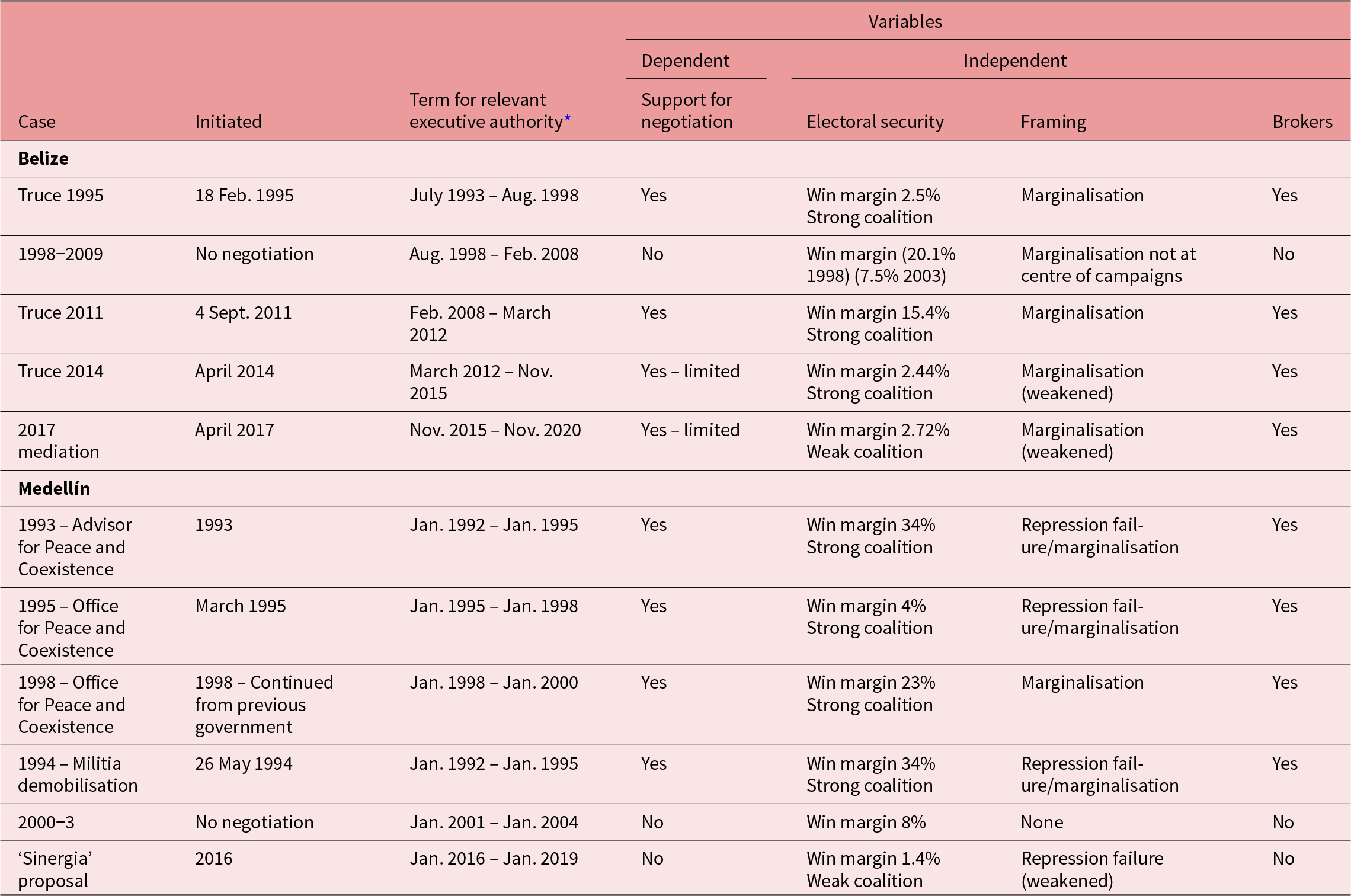
Evidence derives from fieldwork and 71 in-person and remote interviews I conducted in 2019 (May, June, August), 2020 (July, August virtually), 2022 (March, June), and 2023 (June, July) with former members of criminal groups, bureaucrats, politicians, police officials and NGOs. I identified informants through networks established through my prior fieldwork and preliminary research of media reports and secondary sources, focusing on people involved in negotiations or with detailed knowledge of the security situation. Then I used snowball sampling to identify and reach out to other informants. The Appendix lists the interviews with an alphanumeric code (e.g. ME-1) and lays out the interview protocol. I analysed campaign platforms, official security and development plans, and policy documents (programme evaluations, declarations or correspondence by negotiation participants where available) to characterise frames and to trace each process. I compiled documents through online searches and research in the Belize Archives and Records Service (Belmopan) and the Biblioteca del Concejo de Medellín (Medellín City Council Library). In Medellín two interviewees who worked with national and local programmes in the 1990s shared personal archives. I used election results (from official government sources), secondary sources (books), and newspaper articles to determine win margins and coalitions’ strength. Weak coalitions are those where party factions supported different candidates, or where candidates garnered limited support among key political sectors.Footnote 36 Evidence for the existence of dialogue brokers emerged from interviews, showing the importance of fieldwork for understanding complex processes and unveiling unseen details. I characterised support for negotiation (the dependent variable) as cases where governments explicitly (via public statements or written documents) supported any element of a negotiation. I determined the extent of support using interviews, press reports and policy documents assessing whether the government (a) institutionally supported negotiations and (b) provided material resources to deliver benefits to criminals or communities; in cases of limited support the government supported the process but provided little to no material resources or judicial benefits. Negative cases are those where negotiations did not emerge at all, or where the possibility emerged but the government did not support it.
Table 2 provides additional details of cases. The highest support for negotiations emerged when the three explanatory variables were present in Belize 2011 and in 1995 (although win margins were low in 1995), and in Medellín 1993 and 1998. Table 2 also includes information on an observable implication of the argument. If public negotiations depend on governments having electoral latitude for experimentation, they are more likely to receive support shortly after election or early in the term of an electorally strong authority (because political coalitions change quickly). The table shows that, indeed, negotiations tend to receive official support in the first half of the executive authority’s term.
Determinants of support for negotiations

Note:
* = relevant executive authority: Prime Minister for Belize and Mayor for Medellín.
Negotiations in Belize City and Medellín
Belize’s Gang Truces
Belize is a small country on the eastern Central American coast, marked by its recent colonial history, geography and linguistic status both as a Central American and Caribbean nation. The country has long experienced illicit drug and contraband flows,Footnote 37 but organised criminal groups have not taken hold. Gangs emerged in Belize City the 1980s, and though they have become more violent and engaged in illicit markets, they remain small, with limited territorial control and internal organisation. State and gangs are not very powerful, yet violence is high. I analyse four gang truces in 1995, 2011, 2014 and the mediation processes in 2017, which constitute all the cases I identified initially. In 2023, as I conducted field research, the government initiated another relevant programme (Leadership Intervention Unit, LIU) not officially labelled a truce, but similar to the other cases, that I do not discuss due to space restrictions. All these truces were supported by the United Democratic Party (UDP) except the 2023 LIU, which occurred under a PUP (People’s United Party) government. The cases I discuss varied in government endorsement, as the government supported the first two efforts more strongly than the last two.
I explain how executive authorities can use marginalisation frames because gangs are not sophisticated, and this legitimises truces as a response to marginalised youth; prominent dialogue brokers insert mediation ideas into these frames. In terms of electoral incentives, government support was stronger when the Prime Minister had a comfortable electoral majority and overcame internal party divisions (1995 and 2011 truces). The 1995 truce reduced homicides, even if temporarily, and thus a learning process unfolded helping the policy reoccur because dialogue brokers remained prominent in civil society, government and the police. The learning process created the expectation that violence reduction is possible when programmes consider young people’s socio-economic marginalisation. This does not mean that this perspective is unchallenged. As a faith leader told me, rehabilitation-oriented policies evolve ‘like Sisyphus’ in the Greek myth: the government implements youth programmes temporarily (as the rock Sisyphus carries to the top of the hill), abandons them due to political or financial pressures, and replaces them with similar initiatives named differently (BE-6).
The 1995 Truce (Bird’s Isle Agreement): Shortly after independence in 1981, youth gangs started to form, as deportees who belonged to the Crips and Bloods gangs in Los Angeles returned.Footnote 38 Gang identities resonated with poor, unemployed youth.Footnote 39 As the gangs strengthened, and fought more, some members started to think that violence was out of control, as a gang leader involved in the first truce told me: ‘Colours were the problem, because if you wore something blue, I chopped you up. [19]85, 86 started to get worse, we started get guns. Belize just got out of hand, ma’am’ (BE-5). A gang leader known as Junie Balls contacted Police Superintendent Edward Broaster with the truce idea and the government strongly supported it, as reflected in the involvement of the Prime Minister, the Minister of Security and the Police Superintendent.Footnote 40 Such support is consistent with my argument’s conditions: electoral security for the governing political party UDP, the possibility of using a marginalisation frame, and the presence of dialogue brokers mobilising negotiation ideas.
Competition between the centre-right UDP and the centre-left PUP has determined Belizean politics, yet the UDP had won only one national election before 1993, partially because it was fragmented, combining different opposition groups, while the PUP successfully represented anti-colonial goals. In 1993 the UDP won narrowly but addressed internal fragmentation re-uniting breakaway factions such as the National Alliance for Belizean Rights under Prime Minister Manuel Esquivel’s leadership.Footnote 41 This solidified bipartisan alternation and likely provided the UDP with the electoral security to implement its agenda.
The use of the marginalisation frame was possible because ‘gangsters’ were disaffected youth (BE-6). Government sectors recognised this, and Prime Minister Esquivel campaigned on economic issues rather than crime.Footnote 42 This does not mean that the government did not entertain repressive policing (BE-7) and indeed it deployed the defence forces in 1991 to fight gangs. Yet repression was not as widespread as it became, for example, in neighbouring Central American countries.Footnote 43 The use of the marginalisation frame enabled support for negotiations. Dialogue brokers with high-level government access inserted negotiation ideas in this context. One prominent dialogue broker was Nuri Muhammad, a religious leader who worked in prisons in the United States and returned to Belize to work with the government in prevention and rehabilitation programmes. When the gangs sought a truce, he leveraged knowledge of California’s truces, and of Belizean prisons, to advocate for the truce, proposing employment, education and rehabilitation to accompany it (BE-6). Muhammad was indispensable when the government convened the meeting that led to signing the truce, known as the Bird’s Isle declaration. The truce declaration reflected the marginalisation frame as the gangs committed to reduce violence, while the government agreed to create lasting opportunities for gang members (see Figure 2). The government created the Conscious Youth Development Programme (CYDP), which included representatives from NGOs, churches and the public and private sectors.Footnote 44 The programme provided jobs and education for gang members and engaged them as coordinators and council members. Gang members sometimes struggled with the discipline of attending routine weekly meetings, but they felt included, and this promoted the CYDP’s success.Footnote 45
Bird’s Isle Declaration

Analysing the truces’ impact goes beyond this article’s focus but it is worth noting that homicides declined countrywide from 16 per 100,000 in 1995 to ten in 1996 and 1997. The involvement of all gangs, cohesive, high-level, government support, and funding from business sectors (BE-7) likely account for this outcome. The truce crumbled as government and private funding for the CYDP, particularly the employment programmes, declined one year after the Bird’s Isle agreement. According to my interviewees, corrupt police officers used gang members to conduct illicit business, and this also undermined the truce:
A: [the] government just got involved and messed it up, everything they put their hands in, they mess it up … after a while started getting cops involved, dirty cops …
Q: What did they do?
A: Giving the guys dope to sell, giving them money to kill, dirty cops, you know, they really and truly blew it out of proportion, and people lost their trust in them. (BE-5)
Other interviewees suggested that police and politicians used gangs for garnering votes and participating in electoral rallies (BE-1, BE-2). Afterwards, some gang members returned to the streets, others remained in licit activities, but few leaders survived. In the 2000s, homicides increased due to economic decline, growing domestic drug markets and drug transit towards Mexico. Authorities oscillated between repression – avoiding full-scale iron-fist policies (BE-3) – and prevention, but did not implement new truces.Footnote 46 One may argue that this is because the PUP won the next two elections (1998 and 2003), and ideas about negotiation were less popular with the PUP. However, because ideology has been less consequential than clientelism for electoral success in Belize, parties have campaigned at the centre; it is therefore unlikely that ideology alone explains the absence of truces in the early 2000s.Footnote 47 A more plausible explanation is that external debt, unemployment, migration and territorial disputes with Guatemala were more central for campaigns than security.Footnote 48 Parties did not use crime to gain electoral support and thus politicians did not prioritise crime control between 2000 and 2008. Crime reemerged as a campaign issue between 2009 and 2010, as homicides increased by 30 per cent (homicides increased steadily between 1997 and 2008 but with a lower average yearly growth rate of 7 per cent).
Truces in the 2010s: As violence increased, the emergence of three truces in 2011, 2014 and 2017 is consistent with the argument’s variables: the UDP government had electoral security; gangs, though changing, still had low sophistication, which facilitated the use of the marginalisation frame; and dialogue brokers remained active. However, support in 2014 and 2017 was weaker than in 1995 and 2011, and the government did not fund gang employment programmes. This lower support is consistent with the government’s dwindling electoral security and the weakening of the marginalisation frame, which became more contested as crime worsened. This is illustrated in the UDP’s party manifestos. The 2008 manifesto highlighted the root causes of crime, the prevention and mitigation of gang violence, and CYDP’s role in providing alternatives to gangs and violence.Footnote 49 By contrast, the 2015 manifesto advocated for increasing security personnel and infrastructure and preserving territorial integrity vis-à-vis Guatemala.Footnote 50 The 2010s truces also reveal the argument’s path dependence: the 1995 truce was relatively successful, and the marginalisation frame remained active through support from government and NGOs. The CYDP inspired private and public anti-violence programmes that emphasised employment, education and socialisation for young people. Dialogue brokers in 1995, such as Muhammad, remained involved in these programmes, and government protagonists such as Police Superintendent Broaster also remained politically active.
The 2011 truce emerged in this context. After the UDP lost elections in 1998 and 2003 it regained power in 2008, winning 25 out of 31 seats in the House of Representatives. The security minister during the 1995 truce, Dean Barrow, became Prime Minister and a party unity figure, opening the political space for the government to implement truces again. On New Year’s Eve in 2010, Prime Minister Barrow, the Ministers of Education and National Security, and Broaster (now Director of the CYDP) met with gang leaders.Footnote 51 On 4 September 2011, Barrow requested another meeting with high-ranking Police and Defence Force officers, aimed at guaranteeing violence-free national holidays. The gangs agreed to reduce violence, and the government offered subsidies and employment to 200 gang members. The truce involved 13 gangs; the CYDP administered the truce, and the NGO Restore Belize mediated conflicts that could undo it.Footnote 52 The employment plan was controversial, as the population saw it as paying gangs not to kill each other;Footnote 53 the truce waned when the government ended the employment programme in December 2012.
In April 2014, Police Superintendent Broaster (formerly of the CYDP), who had participated in prior truces, brokered another ceasefire that lasted two months.Footnote 54 Prime Minister Barrow knew of, and supported, this truce – but not another job programme – and recognised that this effort was more limited than that of 2011, aiming only to ‘tamp down that situation’.Footnote 55 The UDP lost 8 seats in the House of Representatives, but narrowly maintained control over the legislature. This likely increased the electoral costs of supporting controversial concessions. Gangs also became better armed and more engaged in local drug dealing than in the 1990s, reducing support for the notion that dialogue could effectively reduce violence (BE-1). Still, the marginalisation frame and ideas about negotiations endured because dialogue brokers existed, and because gangs remained small and fragmented, with diffuse leaderships around territorially based identities.Footnote 56 Additionally, although homicides analyses are rare, most interviewees expressed the view that violence results from low-level turf disputes rather than fights over major drug trafficking proceeds which gangs do not control. This facilitates the use of the marginalisation frame.
In April 2017 the Police Commander in Belize City’s Southside, Chester Williams, facilitated another truce involving 20 gangs in talks to establish a ceasefire, which culminated with a joint police–gang March for Peace on 12 April 2017.Footnote 57 Williams had worked for two decades with the police and, after studying law abroad, he was appointed to the Southside; then, as he told me in an interview (BE-7), he changed his approach from ‘aggressive policing’ to a ‘carrots and stick approach’. Williams found sounding boards in brokers from previous truces involved with youth rehabilitation, but the truce’s scope was limited to community mediation to deescalate conflicts (BE-7). Prime Minister Barrow knew of Williams’ plan and did not challenge it, but his support was limited, likely due to the electoral context. Barrow won a third re-election in 2015, regaining two seats in Parliament, but with a lower margin (2.7 per cent) than in 2008 (15.4 per cent). After his third re-election Barrow probably feared losing political capital amid corruption scandals and he focused on the economy and the territorial dispute with Guatemala.Footnote 58 Williams was transferred to the Belmopan police department, and homicides in Belize City spiked shortly afterwards.Footnote 59
In sum, the lack of internal party conflicts, the viability of the marginalisation frame, and the prominence of dialogue brokers who socialised ideas about conflict mitigation through civil society and government programmes explain government support for the 1995 and 2011 truces. The political conditions during Barrow’s second and third re-election are consistent with his more limited support for the 2014 and 2017 truces.
Cohesion among government actors, participation of all gangs and civilian support characterised the successful 1995 and 2011 truces, which crumbled under financial and political pressures and the use of gangs for political ends. Negotiations entail moral hazards; many interviewees state that dialoguing with gangs legitimises their power. Yet this legitimisation can be positive if it shows gang members that power can derive from non-violent actions. More importantly, corruption and clientelism also politicise gangs as they are instrumentalised for political and electoral goals, and undermine formal truces. It is plausible that, although crime problems have become more complex, early truces and the use of marginalisation frames helped Belize emphasise rehabilitation, slowing down gang evolution. This marginalisation frame, however, is full of contradictions and often justifies paternalistic ideas that also marginalise. In 2023 a new effort to implement mediation-inspired strategies emerged, as repression failure started emerging as a stronger frame in response to the escalation of repression at the end of Barrow’s tenure.Footnote 60
Medellín’s Complicated Negotiation Path
Medellín’s violence results from intertwined drug trafficking and armed conflict dynamics, and has inspired policies ranging from repressive policing to socially oriented interventions.Footnote 61 Among these policies, state–criminal negotiations emerged early in the city’s modern history, in the 1990s. I focus on negotiations specifically designed for Medellín and implemented by the local (city) government, excluding cases with national scope where city authorities had limited influence, such as a negotiation with the Medellín Drug Cartel through ‘surrender to justice’ agreements that provided sentencing benefits in exchange for drug traffickers surrendering to authorities. I analyse the demobilisation of three militia groups in 1994 (MIVA, MPPP and the Milicias Metropolitanas),Footnote 62 and three stages in the consolidation of municipal programmes supporting non-aggression pacts where local gangs agreed to de-escalate lethal neighbourhood-level disputes. I contrast these cases with a failed negotiation attempt in 2016.
I focus on local actors lacking clear political agendas and primarily involved in crime, rather than on national groups in the armed conflict such as the Fuerzas Armadas Revolucionarias de Colombia (Revolutionary Armed Forces of Colombia, FARC) or the Autodefensas Unidas de Colombia (United Self-Defence Forces of Colombia, AUC) paramilitary group. Armed groups in Medellín combine political and criminal influences in complex ways, making it difficult to separate negotiations with criminal and political actors. I focus on cases that clearly were not traditional peace processes. The non-aggression pacts aimed at stopping homicides through direct communication and de-escalation efforts with neighbourhood gangs and hinged on recognising gangs’ territorial control, using it to reduce violence, rather than targeting it for prosecution. The militia negotiations resembled traditional demobilisations in exchange for judicial benefits and were possible because of the militias’ political origins. Yet, they lay in a grey area, as militias were heavily involved in crime; these negotiations have been overlooked in analyses of Colombia’s peace processes.Footnote 63
Medellín represents sophisticated criminality, given the multiple armed groups existing since the 1980s and their capacity to recruit, organise and connect to society and politics. These groups include drug trafficking organisations such as the Medellín Cartel, militias, paramilitaries and gangs connected to powerful groups.Footnote 64 Medellín displays comparatively higher state capacity than Belize City since it is Colombia’s second largest city and was an early centre of industrialisation.Footnote 65 Yet state capacity was lower in the 1990s than in the 2010s: in the second half of the 1990s local governments faced extreme security challenges even after deploying the military in public security, thus activating repression failure and marginalisation frames that facilitated negotiations. By contrast, in the 2010s official negotiations became less feasible because the power balance changed as the local state became stronger: government investment capacity increased tenfold between 1990 and 2000, and tripled between 2000 and 2010, alongside an increasingly complex bureaucratic apparatus.Footnote 66 In this context, using repression failure frames and negotiation ideas became difficult or unnecessary for executive authorities: national and international observers increasingly saw Medellín as a model in dealing with criminality. Dialogue brokers lost prominence.
Non-Aggression Pacts and Local Negotiation Infrastructure: In the 1980s, a worsening armed conflict and drug trafficker Pablo Escobar’s fight against the state fuelled violence. Homicides reached a staggering rate of 381 per 100,000 people by 1991. After a long fight combining repression with negotiation, the government killed Escobar through an alliance including US law enforcement officers and Escobar’s enemies.Footnote 67 Escobar’s death reduced violence, but homicides in the city remained higher than in the nation as a whole. Many actors generated violence, including gangs that had become more complex through interactions with organised crime. The first three negotiation cases relate to a city office (see below) created to address gang violence through non-aggression pacts. I analyse three stages in this office’s evolution as individual cases, because every new mayor had to renew their commitment to the programme.
The variables I advance in the argument are consistent with the institutionalisation of this mediation infrastructure: at the national and local level, it was feasible for executive authorities to use marginalisation and repression failure frames as explanations for persistently high violence; the mayors supporting the programme had electoral security; and dialogue brokers within local bureaucracies mobilised negotiation ideas. In an illustration of how path dependence shapes policy frames for negotiation, the mayor’s support for the programme increased while the public and governments perceived non-aggression pacts as relatively successful. Then, conflict transformations in the early 2000s enabled renewed support for repression as the armed conflict in Colombia intensified, a peace process with the FARC failed, and a positive perception of non-aggression programmes changed, reducing support for formal negotiations with local groups.
In 1993 Mayor Luis Alfredo Ramos (1993–5) created a position within the Mayor’s Office, the Advisor for Peace and Coexistence (Asesor de Paz y Convivencia), which coordinated non-aggression pacts between gangs. Ramos’ campaign emphasised order, and negotiations emerged after he took office, not as a campaign promise. He obtained 60 per cent of the vote and faced an opposition with declining power on the city council, likely gaining more room for manoeuvre to implement policies. His support for pacts seemed not to reflect ideological convictions, but rather his interest in strengthening clientelist networks;Footnote 68 yet it is likely that he would have avoided risky negotiations in the context of more precarious electoral results. These electoral incentives are however insufficient to explain why non-aggression pacts became possible and why Ramos supported them: frames and dialogue brokers were also necessary.
In the 1990s, high violence, widespread repression and a new Constitution issued in 1991 that emphasised individual rights made it possible for executive authorities to combine repression failure and marginalisation ideas in explaining and addressing local security issues.Footnote 69 The national government created the Consejería Presidencial para Medellín (Presidential Council for Medellín) in 1991; the Council explained violence as resulting from socioeconomic marginalisation (marginalisation frame), as can be noted in this policy document:
Despite the initial impact of drug trafficking in the economy, 15 years later the same structural problems persist in Medellín and the Metropolitan area, related to the quality of life of its poorest inhabitants and the lack of educational and economic opportunities.Footnote 70
The Council advanced an ambitious agenda promoting local pacts and cultural, educational and economic opportunities in poor neighbourhoods.Footnote 71 In the Council’s first years, socio-economic goals conflicted with the urgency of capturing Pablo Escobar but, after his death, persistent violence enabled the use of a repression failure frame that strengthened mediation ideas. All Medellín mayors have framed violence as resulting from multiple factors, including social marginalisation. This mix of ideas often included repression and militarisation, but in the 1990s pragmatism to remedy a situation that was out of control prevailed,Footnote 72 and this opened the space for mayors to entertain non-traditional policies like negotiation. Critically, dialogue brokers advocated for non-aggression pacts, inserting them into the policy repertoire.
Local dialogue brokers active in policy circles, like Medellín’s first Advisor for Peace and Coexistence, Juan Sepúlveda, inserted detailed negotiation ideas into the marginalisation and repression failure frames. Sepúlveda mobilised ideas about reconciliation that he had developed as ombudsman for human rights. According to his own recollection (ME-13), shortly after the elections Mayor Ramos asked him – a previous mayoral candidate – what was necessary to connect to the ‘other city’ he claimed to represent, referring to the poor and the marginalised. Sepúlveda stated that dialogue was necessary. He was trained, and as a university professor trained others, in critical criminology and restorative justice, advocating for ‘coexistence pacts’ as an alternative to incarceration and as a way in to addressing root causes of violence. Sepúlveda proposed the creation of the local office of Advisor for Peace and Coexistence and of local pacts as ‘an escape valve that [would allow] youth to learn the benefits of communication’ to peacefully transform conflicts.Footnote 73 Pacts were not new; since the early 1990s community organisations had promoted them to reduce violence (ME-14 and ME-22). For example, the Catholic Church’s programme ‘No Matarás’ (‘Do Not Kill’) aimed at stopping killings by talking to gang members, emphasising the sanctity of human life (ME-27). Sepúlveda recruited staff from similar community programmes, leveraging their experience; one of these mediators described Sepúlveda as very successful in connecting NGOs, government and ‘people he met in prison’ as ombudsman (ME-14).
Initially, pacts were public but informal ‘and the first thing that was agreed was to respect the life of armed actors and neighbouring communities, [and] freedom of movement’.Footnote 74 Mayor Ramos’ successor, Sergio Naranjo, who campaigned on an iron-fist approach, formalised this policy by creating an Office for Peace and Coexistence in March 1995. The next mayor, Juan Gómez, included the Office in his security policy, and mentioned negotiations during the campaign, because at that point the local government saw them as a relative success (homicides declined by 42 per cent between 1994 and 1997). Though Naranjo and Gómez won elections in a context of transformation of traditional political parties, they started their terms in relatively safe electoral positions, with Gómez in a stronger position due to his high win margin (23 per cent more votes than his opponent). Both mayors benefitted from their (Conservative) party’s ability to forge alliances, that helped them retain control of the local council, and better face a fractured opposition.Footnote 75 In the Marco estratégico de construcción de la paz (Strategic Framework for Peace-Building) Mayor Gómez welcomed dialogue ‘with those who in real good faith aspire to serve the city’; the document framed negotiations as necessary to create a culture of peace and ‘aggression-free spaces’.Footnote 76 The local government estimated that, by 2000, mediation processes involved approximately 173 armed groups and 7,000 people.Footnote 77
Demobilisation of Urban Militias: One could argue that non-aggression pacts in the 1990s received support because they engaged lower-level gangs and governments could defend them more easily. Yet the local government simultaneously promoted militia negotiations that involved complex groups, provided judicial benefits and created a cooperative for demobilised members, whose goal was to provide security and community surveillance services.Footnote 78
On 26 May 1994, the national government signed demobilisation agreements with three urban militias. Mayors were not legally authorised to negotiate, yet Mayor Ramos was key in brokering the agreement (ME-22). The national government’s engagement in peace negotiations with insurgent groups like the FARC activated frames that strengthened negotiation ideas advanced by local brokers. Earlier, in 1994, the national government had signed a demobilisation agreement with the Corriente de Renovación Socialista (Socialist Renovation Current, CRS), a faction of the insurgent ELN, which included a local militia from Medellín, the Milicias Populares del Valle de Aburrá (MPVA). The CRS and MPVA demobilisation led the local and national governments to entertain another negotiation – the one I describe in detail – with three additional local militias that the government did not recognise as insurgents, that operated locally, and whose political nature was blurrier. Two of these groups, the MIVA and the MPPP, had clearer political agendas given their insurgent origin and the presence of guerrilla combatants. The third group, the Milicias Metropolitanas, did not (ME-22). These three groups operated in grey areas between criminal and political violence, well known to the local government. Mayor Ramos’ electoral position and the conditions that activated a repression failure frame facilitated negotiations with these complex groups: after the long fight that culminated with Escobar’s killing, the sense that repression was not enough increased as many groups, including militias, were still responsible for extensive violence.
The negotiation led to the demobilisation of 843 milicianos (members of militias);Footnote 79 many scholars see it as a failure for various reasons. First, 187 demobilised members were assassinated (by peace spoilers, old enemies and in the context of ongoing criminal activities by demobilised members). Second, some milicianos did not participate, or remobilised.Footnote 80 Third, according to some analysts, negotiation facilitated paramilitaries’ expansion and co-optation of demobilised young men. Fourth, the state’s inability (or unwillingness) to implement social reforms, to contain paramilitary groups which were in collusion with the military and politicians, and to engage the community, undermined the potential of the negotiation (ME-22). The assessment of the local non-aggression pacts is similar. They reduced violence and brought temporary relief to neighbourhoods, and empowered community efforts, but legitimised criminal behaviour.Footnote 81 Notably, some politicians who supported negotiations were placed under investigation: the Corte Suprema de Justicia (Supreme Court of Justice) arrested and investigated Mayor Ramos in 2013 for links to paramilitaries, and the Fiscalía (Public Prosecutor) investigated Mayor Naranjo in cases related to drug trafficking.Footnote 82 Even if they were successful temporarily, local pacts did not address connections between gangs and organised crime and were not part of comprehensive strategies.Footnote 83 All the interviewees who participated in non-aggression pacts recognised that the need to ‘dampen down the flames’ drove their implementation, but their long-term potential remained unrealised.
Theorising about the outcome of the negotiations exceeds the article’s objective but, as occurred in Belize City’s less successful truces, criminal fragmentation and lack of coordination between national and local governments likely explain their failure to last.Footnote 84 According to a worker in the Peace and Coexistence Office, ‘the coexistence pacts were a negative peace … the positive peace of social inclusion was lacking … there was no support or institutional political will, and now, one starts to discover that there were many overlapping interests in the middle of it all’ (ME-14). Furthermore, there were multiple policy contradictions. According to a member of the staff of the Medellín Presidential Council: ‘On one hand we were trying to … take kids out of the Medellín Cartel, and trying to undermine the Cartel’s justification (estábamos tratando de quitarle la justificación al Cartel), but on the other hand, there was a [repressive] security policy’ (ME-16). The local negotiations stopped when Mayor Luis Pérez (2001–3) closed the Office for Peace and Coexistence, publicly refusing to negotiate with illegal groups. Paradoxically, he later promoted dialogue with the Bloque Cacique Nutibara (Chief Nutibara Bloc, BCN), an affiliate of the AUC. Militarisation during Pérez’s tenure contributed to consolidating paramilitary groups by weakening their insurgent counterparts.Footnote 85 Pérez’s initial distancing from negotiation resulted from multiple factors: he won narrowly (by only 8 per cent of the votes), and in a fragmented political landscape he likely benefitted from campaigning on an iron-fist approach: he referred to the city as ‘being hostage to criminal groups’ and to the need to re-establish authority.Footnote 86 Additionally, by 1998 paramilitary groups had expanded and many politicians supported them, thus undermining support for peacebuilding. Finally, negotiation (and dialogue brokers) fell out of favour, as did the repression failure frame.Footnote 87
In 2000, national discourses about negotiation lost legitimacy after a failed negotiation with the FARC embarrassed President Andrés Pastrana. In 2002, new President Álvaro Uribe advanced a popular right-wing security agenda that reduced the space for negotiations.Footnote 88 Uribe, paradoxically, brokered the demobilisation of paramilitary groups, but this process occurred in private without local participation. Public negotiations with criminal groups became less feasible within a city that gained bureaucratic and law enforcement capacity in the early 2000s.Footnote 89 It was hard for mainstream politicians to use a repression failure frame because there was a growing sense that the state finally had the resources and capacity to fight and defeat armed groups.
The 2016 Negotiation Proposal: Homicides declined sharply in the mid 2000s, increased in 2009, and steadily declined after 2013. In the 2010s it became evident that among positive factors like service provision for poor neighbourhoods, hidden collusion arrangements between, and started by, rival criminal factions – known as pactos de fusil (rifle pacts) – also facilitated homicide reduction. These pacts resulted from arrangements between rival groups to maintain territorial control and facilitate illicit activities by regulating violence; the collective benefit of violence reduction was a byproduct, while armed control and illicit markets remained intact (ME-15, ME-16, ME-21, ME-24). These pacts differed from official negotiations because, although some civilian organisations and criminal groups attempted to publicise them, the local government never endorsed them officially, and civilians eventually distanced themselves from them (ME-38, ME-34). Many politicians knew about – and benefitted from – unofficial pacts but governments did not implement them; nor did they publicly acknowledge them when media and politicians denounced them. This made public negotiations unlikely. In 2016, Mayor Federico Gutiérrez advanced a tough-on-crime discourse, stating during the campaign that the ‘internal dynamics of criminal groups which control neighbourhoods’, and not just policing strategies, explained declining homicide trends. He vowed to dismantle this control.Footnote 90
In 2016, criminal leaders presented a proposal to the government offering to reduce violence, stop child recruitment and surrender arms and rents in exchange for judicial benefits (ME-8). Lawyers for the criminals, civilians and academics held public forums and presented the proposal under an initiative called ‘Sinergia’ (synergy). Interviewees suggest that social leaders started the proposal; some of them were former members of armed groups and others remained partially active, and this made it difficult for them to gain the trust of NGOs and the government (ME-38). My interviewees suggest that Mayor Gutiérrez entertained the idea early in his term but then refused to engage in discussion around it. According to a high-level official of his team, ‘We never had interest in engaging in negotiations with organised crime for various reasons. One is that negotiating is a responsibility beyond the local level … also there was no scenario at the national level allowing the discussion of this topic’ (ME-15). The Public Prosecutor investigated and sentenced Gutiérrez’s first-appointed Secretary of Security, Gustavo Villegas, for abuse of authority and failure to report a crime regarding his communication with members of the Oficina de Envigado (Envigado Office) criminal group.Footnote 91 Mayor Gutiérrez declared having no knowledge of these communications; interviewees suggested that the local government had started to explore dialogue, but the efforts crumbled as Villegas used private communication channels to prevent extortion of his own company’s milk trucks. Villegas’ indictment made it impossible for the Mayor to publicly consider dialogue and made other people afraid of communicating with criminal actors, weakening the role of dialogue brokers. This illustrates a negative case, when the government started to explore a negotiation in private but never endorsed it publicly.
In sum, in the 2010s changes in state–criminal relations and the evolution of state policies made it hard for executive authorities to use the repression failure frame, as politicians highlighted successes in reducing crime. This delegitimised, or reduced the need for, negotiation and the incentives to endorse a proposal like Sinergia. Mayor Gutiérrez lacked electoral security as he won narrowly (1.4 percentage points over the runner-up) in the 2015 context of changing electoral alliances and weak coalitions.Footnote 92 Younger bureaucrats replaced older dialogue brokers with state access. Other potential dialogue brokers (the lawyers and social leaders spearheading Sinergia) lacked legitimacy and bureaucratic access to mobilise ideas effectively because local bureaucrats perceived them as representing criminals. The charges against Villegas undermined his reputation and role as dialogue broker as he allegedly used his position to extract private benefits. A government that had few electoral incentives to negotiate did not do anything to continue the process. In 2022, President Gustavo Petro’s ‘Total Peace’ strategy spearheaded a new cycle of local negotiations;Footnote 93 these are still ongoing at the time of finishing this article in 2025, but I do not discuss them for space reasons.
Conclusion
Why do governments support public negotiations with criminals in contexts of high levels of violence? I argue that objective conditions (the relative power of criminal groups and politicians’ electoral incentives) and framing possibilities are necessary for state actors to support negotiations. Governments are more likely to support negotiations when they are electorally secure, and when the relative balance of power makes it easier to legitimise negotiations by using frames that portray criminals as products of marginalisation (Marginalisation frame) or that highlight the failure of repression to eliminate violence (Repression failure frame). Dialogue brokers insert concrete negotiation ideas in these frames. By focusing on the origin of government support for negotiations I add systematic knowledge on negotiations with armed actors outside civil wars. This knowledge is crucial to understanding the complex incentives that lead governments to consider, and sustain, non-punitive policies, and to move from private to public negotiation. My findings highlight that, to understand enforcement decisions, and to broaden scholarship of peace processes, we should consider interactions between objective factors and discourses and ideas.
The cases show that the conditions that motivate governments to publicly negotiate are very dynamic. Criminals and state agents often collude in private, without explicit collective goals. Public negotiations are more accountable than private corrupt arrangements, but they are politically riskier and therefore vulnerable to political and electoral dynamics. Politicians hoping to benefit electorally from reductions in violence derived from collaborating with criminals may therefore prefer hidden, corrupt, arrangements or less costly prevention or repression. Additionally, negotiations strengthen some actors such as criminal leaders or politicians, to the detriment of others, with positive and negative effects. Criminal groups can learn that reducing violence benefits their businesses, and that they can extract concessions from governments; politicians can realise that they can exploit armed power to mobilise votes, and thus prefer to maintain, rather than eliminate, armed actors.
Yet negotiations also open the door to reducing violence, as Belize City’s most successful cases and even Medellín’s non-aggression pacts suggest, especially when marginalisation frames promote deeper understandings of the social, cultural and economic factors that perpetuate violence, and when criminal actors and state can make credible commitments. Gang members, criminals, community organisers and state actors can learn that negotiations open up opportunities for addressing root causes of violence and bringing relief to communities. Participants in these processes can transform their lives, becoming peace brokers themselves. This positive potential is not guaranteed and requires careful planning and implementation, community benefits beyond homicide reduction and long-term support and political will. Explaining the origin of support for negotiations, as I do in this article, can illuminate ways in which this long-term support may emerge. Future research can analyse criminal incentives to negotiate, the role of other state actors and civil society, and public opinion, explaining the evolution and impact of negotiations.
Supplementary material
The supplementary material for this article can be found at https://doi.org/10.1017/S0022216X25101247.
Acknowledgements
I have presented and received feedback on the larger research project related to this article at the University of Notre Dame, University of California San Diego, Northwestern University, Boston University, Tulane University, the University of Illinois-Chicago, University of Chicago, the International Catalan Institute for Peace (ICIP), the Friedrich Ebert Stiftung in Colombia (Fescol) and Ideas para la Paz, Centro de Investigación y Educación Popular (CINEP), Universidad del Rosario, Pontificia Universidad Católica del Perú (PUCP), Universidad de Chile, University at Albany – State University of New York (SUNY), and meetings of the American Political Science Association (APSA) and the Latin American Studies Association (LASA). The project received funding from the Harry Frank Guggenheim Foundation. I thank Roland Joseph, Iván Ramírez, Justine Novello and Luisa Mejia for their research assistance. Three anonymous reviewers, the editors, Eduardo Moncada, Matías Dewey, Benjamin Lessing, Hernán Flom, Lucía Tiscornia, Gema Santamaría, Sandra Ley, Abby Córdova, Janice Gallagher and Ana Arjona provided invaluable feedback on this article or the larger project of which it is part.