INTRODUCTION
Changes in concentration and attention are commonly reported following brain damage (Lezak, Howieson, & Loring, Reference Lezak, Howieson and Loring2004). Posner and Petersen (Reference Posner and Petersen1990), proposed the existence of an attention network with three inter-related sub-systems: an orienting system that relies upon the posterior brain areas and is involved in the selection of sensory information; an executive system involving the anterior cingulate, lateral prefrontal cortex, and the basal ganglia responsible for detecting signals for focal (conscious) processing; and an alerting or sustained attention system centered on right fronto-parietal regions, responsible for the internally generated functions required to remain vigilant to select high priority visual information for further processing.
Sustained Attention After Traumatic Brain Injury
The prefrontal cortex associated with sustained attention is particularly vulnerable post-traumatic brain injury (TBI). However, studies using traditional vigilance tests have often failed to find disproportionate deficits (see Manly et al., Reference Manly, Owen, McAvinue, Datta, Lewis and Scott2003).
Robertson, Manly, Andrade, Baddeley, and Yiend (Reference Robertson, Manly, Andrade, Baddeley and Yiend1997) developed a new computerized measure designed to be more sensitive to transient lapses in attention than traditional vigilance and continuous performance tests; the Sustained Attention to Response Test (SART). It measures a person’s ability to withhold responses to infrequent and unpredictable stimuli (targets), during a period of rapid and rhythmic responding to frequent stimuli (nontargets). The task encourages participants to lapse into automatic, attentionally undemanding, responding to nontarget trials. However, effective sustained attention is required to counter these effects so that the response to infrequent target trials can be suspended. The error of commission score (responding to targets) was found to be a sensitive measure of endogenously maintained sustained attention. Participants with decreased sustained attention ability also responded more quickly to correct nontarget items before errors of commission because their response was triggered by the anticipation of the stimuli rather than as a result of an evaluation of its relevance (Robertson et al., Reference Robertson, Manly, Andrade, Baddeley and Yiend1997).
There is a growing body of evidence to suggest that the SART is a useful and sensitive measure of sustained attention (Dockree, Kelly, Roche, Hogan, Reilly, & Robertson, Reference Dockree, Kelly, Roche, Hogan, Reilly and Robertson2004; Manly, Robertson, Galloway, & Hawkins, Reference Manly, Robertson, Galloway and Hawkins1999, Manly et al., Reference Manly, Owen, McAvinue, Datta, Lewis and Scott2003; Robertson et al., Reference Robertson, Manly, Andrade, Baddeley and Yiend1997). However, the results have not been unequivocal (see Whyte, Grieb-Neff, Gantz, & Polansky, Reference Whyte, Grieb-Neff, Gantz and Polansky2006).
Attention Deficits Associated With Sleep in Healthy Adults
Sleep deprivation has been cited as a cause of impaired cognitive performance in otherwise healthy adults (Pilcher & Huffcutt, Reference Pilcher and Huffcutt1996). There are indications that functioning of the frontal lobes is disproportionately affected by sleep deprivation and circadian modulation (May & Hasher, Reference May and Hasher1998).
Studies using Continuous Performance (CPT), and Psychomotor Vigilance Tests (PVT) under sleep-deprived conditions have shown increased reaction time variability, errors of omission (i.e., lapses), and errors of commission (Dinges & Kribbs, Reference Dinges, Kribbs and Monk1991). In healthy adults, 10 consecutive days of sleep restriction (less than 8 hr) were shown to produce progressive performance deficits in sustained attention, working memory, and processing speed, that were equivalent to those found after one-to-two nights of total sleep loss (Van Dongen, Maislin, Mullington, & Dinges, Reference Van Dongen, Maislin, Mullington and Dinges2003). Inversely, Kamdar, Kaplan, Kezirian, and Dement (Reference Kamdar, Kaplan, Kezirian and Dement2004) showed that extended sleep led to substantial improvements on a sustained attention task. A progressive “state instability hypothesis” has been proposed to explain the relationship between sleep deprivation and deficits; when sleep propensity is high enough, subtle and frequent shifts between sleep and wake occur that interrupt cognitive functioning but that are outside of conscious awareness (Durmer & Dinges, Reference Durmer and Dinges2005).
A recent study by Manly, Lewis, Robertson, Watson, and Datta (Reference Manly, Lewis, Robertson, Watson and Datta2002) examined the effects of circadian modulation on the SART in students. They found significantly higher errors of commission at 1 a.m. and 7 a.m. compared with 1 p.m. and 7 p.m. No circadian modulation of the more routine aspects of the task were observed. This highlights that sustained attention is particularly sensitive to changes in sleep-wake patterns. It also highlights that errors of commission on the SART are able to pick up fairly subtle changes in sustained attention.
Sleep Disorders, Attention, and Vigilance
Kamdar et al. (Reference Kamdar, Kaplan, Kezirian and Dement2004) reported that sleep disorders represented the largest number of cases of reversible cerebral dysfunction. People with insomnia commonly report cognitive problems such as poor concentration, attention, and memory, which they perceive as significantly impacting on their daytime functioning and quality of life (Hauri, Reference Hauri1997). However, objective evidence corroborating deficits in this group has been mixed (Bastien, Fortier-Brochu, Rioux, LeBlanc, Daley, & Morin, Reference Bastien, Fortier-Brochu, Rioux, LeBlanc, Daley and Morin2003; Roth, Costa e Silva, & Chase, Reference Roth, Costa e Silva and Chase2001; Schneider, Fulda, & Schultz, 2004; Spiegel, Herzog, & Koberle, Reference Spiegel, Herzog and Koberle1999). Methodological variations and different definitions of insomnia are likely to have contributed to inconsistencies. Furthermore, studies have tended to use global measures of cognitive domains rather than measures sensitive to the components of domains most affected by sleep disruption (Versace, Cavallero, De Min Tona, & Stegagno, Reference Versace, Cavallero, De Min Tona and Stegagno2006).
Coterminous Sleep Difficulties Following TBI
There is growing evidence for the manifestation and persistence of a range of sleep disorders after brain trauma (Castriotta & Lai, Reference Castriotta and Lai2001; Fichtenberg, Zafonte, Putnam, Mann, & Millard, Reference Fichtenberg, Zafonte, Putnam, Mann and Millard2002). However, there is only limited evidence on the relationship between sleep disturbance and cognitive functioning post-TBI.
In their review, Ouellet, Savard, and Morin (Reference Ouellet, Savard and Morin2004) commented on the indirect evidence to suggest that insomnia may exacerbate cognitive difficulties post-TBI, and on the lack of studies that have assessed the impact of insomnia on daytime cognitive functioning in TBI patients. In the studies that have assessed the impact of sleep disturbance on cognitive functioning post-TBI, specific tests of sustained attention have not been used (e.g., Mahmood, Rapport, Hanks, & Fichtenberg, Reference Mahmood, Rapport, Hanks and Fichtenberg2004). Furthermore, studies have often only used subjective measures of sleep disturbance; these are related to an individual’s perceptions and so are important. However, patients after moderate and severe TBIs may find it difficult to give accurate retrospective reports. In these cases, objective measures could be used to corroborate self-reports.
The Present Study
Frontal lobe functions such as sustained attention are known to be particularly vulnerable post-TBI. There is also evidence that sleep disturbance can increase the probability of deficits in sustained attention. Thus, it seems possible that increased levels of sleep disturbance post-TBI could further exacerbate neuropsychological deficits. The primary aim of this study was to examine whether, poor sleepers (PS) post-TBI had poorer sustained attention ability than good sleepers (GS) post-TBI. The SART random was chosen as the primary measure of sustained attention. Additionally, differences in general attentional functioning between good and poor sleepers who had all sustained a TBI were investigated; The Paced Auditory Serial Attention Test (PASAT), the letter number sequencing (LNS), and digit symbol substitution (DSS) tasks provided additional standardized measures of attention. A self-report measure of everyday cognitive failures was also used (CFQ). Retrospective subjective, prospective subjective, and objective measures were used to assess participants’ sleep.
HYPOTHESES
Primary Hypothesis
The PS group will make more errors of commission and have faster average reaction times (RT) than the GS group on the SART random.
Secondary Hypotheses
The PS will have poorer performance than the GS group on the additional attentional measures (PASAT, LNS, DSS). The PS group will report more attentional lapses on the CFQ than the GS group.
METHODOLOGY
Ethics and Consent
Ethical and Research and Development approval were granted by Greater Glasgow Community and Primary Care Trust, and South Glasgow University Hospitals, NHS Committees. Written informed consent was obtained from all participants.
Participants
Potential participants were identified from a community brain injury service, a vocational rehabilitation center, and via Headway, a charitable organization for people with head injuries. Letters of invitation to participate and participant information sheets emphasized that both good and poor sleepers were needed.
To meet inclusion criteria participants had to be 18 years or older and had to have sustained a TBI at least 3 months previously. Exclusion criteria included any impairment of language, perception, or general intellect that, in the judgment of the clinical team or researcher, was likely to make it impossible to participate. Individuals with active psychiatric symptoms or those who were identified in the interview to fit criteria for a primary sleep disorder such as sleep apnea or narcolepsy were also excluded. If the sleep disorder was suspected to be the result of ongoing substance misuse, if individuals were undergoing active psychological or pharmacological interventions for sleep problems, or if they had a neurological history (excluding a previous TBI) then they were also excluded.
Sample size estimation was conducted before commencement of the study to determine how many participants would be required in each of the groups to detect statistically significant differences at a power of 0.8 (one-tailed) with an alpha level set at 0.5.
No prior study that looked at the effects of good and poor sleep on the SART after TBI was identified. However, previous studies showed that the SART could reliably differentiate between control and TBI participants, and a large effect size was reported for differences in errors of commission; d = 1.03 (Robertson et al., Reference Robertson, Manly, Andrade, Baddeley and Yiend1997). Furthermore, a recent study showed that the SART was sensitive to circadian modulation in non–brain-injured participants. Medium effect sizes were found for the difference between the proportion of commission errors at 1 p.m. and 1 a.m. (0.66) and at 7 a.m. and 7 p.m. (0.5) (Manly et al., Reference Manly, Lewis, Robertson, Watson and Datta2002). For the present study, hypothesizing an effect size of at least d of 0.7, it was estimated that 21 participants per group would be required to detect significant differences between groups if they existed.
Materials and Apparatus
Background measures of mood and cognition
1) The Hospital Anxiety and Depression Scale (HADS; Zigmond & Snaith, Reference Zigmond and Snaith1983) was used to assess depression and anxiety symptomatology.
2) The Weschler Test of Adult Reading (WTAR; Wechsler, Reference Wechsler2001) was used to assess premorbid intellectual functioning.
3) The Wechsler Abbreviated Scale of Intelligence (WASI; Wechsler, Reference Wechsler1999) was used as a brief measure of current intellectual functioning.
Sleep measures
4) The Pittsburgh Sleep Quality Index (PSQI; Buysse, Reynolds, Monk, Berman, & Kupfer, Reference Buysse, Reynolds, Monk, Berman and Kupfer1989) was used as a self-report measure of global sleep quality. Although, it is a continuous measure, a cutoff score of 6 has been validated to differentiate between those with and without sleep disturbances (Mahmood et al., Reference Mahmood, Rapport, Hanks and Fichtenberg2004).
5) The Insomnia Severity Index (ISI; Morin, Reference Morin1993) provided a self-report measure of subjective symptoms of insomnia and also quantified scores into four categories to reflect insomnia severity.
6) Sleep diaries were used to provide a prospective measure of subjective sleep parameters.
7) Actigraphy was used as an objective measure of sleep. The Cambridge Neurotechnology “Actiwatch” system 2000, wrist Actiwatches (Model AW-2) and sleep analysis software (Actiwatch Sleep Analysis v 1.06) were used. Actigraphy has been shown to be a satisfactory objective estimate of sleep particularly in terms of global sleep parameters such as total sleep time (TST), sleep onset latency (SOL) and sleep efficiency (SE; Sadeh & Acebo, Reference Sadeh and Acebo2002).
Measures of attention
8) The Sustained Attention to Response Test-random version (Robertson et al., Reference Robertson, Manly, Andrade, Baddeley and Yiend1997) was used because it has been proven to be a specific measure of sustained attention ability. Alternative explanations, for example, that performance is mediated by response inhibition capacity have not been upheld (see Manly et al., Reference Manly, Robertson, Galloway and Hawkins1999). The SART-random version involves single digits (1–9) presented in a quasi-random sequence on a computer screen. Participants are required to respond to the digits with a key press with the exception of the number 3, to which they must withhold a response. The SART was programmed in E-prime software for the PC and run on a Toshiba lap top computer.
9) The Paced Auditory Serial Attention Test, 2-s inter-stimulus interval version (Gronwall & Wrightson, Reference Gronwall and Wrightson1974). The PASAT is reported to be sensitive to divided attention, sustained attention, working memory and information processing capacity (Strauss, Sherman, & Spreen, Reference Strauss, Sherman and Spreen2006).
10) The Digit Symbol Substitution (DSS) and Letter Number Sequencing (LNS) tasks from WAIS-III (Wechsler, Reference Wechsler1997). The DSS test is reported to be a measure of focused, selective attention and working memory and the LNS test is reported to be a measure of working memory and processing speed (Strauss et al., 2006).
11) The Cognitive Failures Questionnaire (Broadbent, Cooper, FitzGerald, & Parkes, Reference Broadbent, Cooper, FitzGerald and Parkes1982) is a 25-item checklist of self-reported attentional failures that was used to assess participants’ perceptions of their sustained attention ability.
Design and Procedure
A between-group design was used with participants allocated to GS or PS groups.
Following recruitment and screening by telephone, an initial meeting was held. Demographic and sleep data were gathered via standardized questionnaires (PSQI, MEQ-R, ISI, HADS) and a brief clinical interview was conducted. Head injury severity was determined on the basis of available information about: duration of altered consciousness (mild, up to 30 min; moderate, between 30 min and 24 hr; severe, 24 hr+); Glasgow Coma Scale score (mild, 13+; moderate, 9–12; severe; 8 or less); duration of post traumatic amnesia (mild, less than 24 hr; moderate, 24 hr–14 days; severe, several weeks), and injury details from patient notes/discharge letters (mild, no objective evidence of head injury and/or recorded in notes/discharge letter as “mild head injury”; moderate, positive scan/MRI and/or recorded in the notes or discharge letter as “moderate head injury”; severe, positive scan/MRI, and or recorded in the notes/discharge letter as “severe head injury”).
Participants were allocated an Actiwatch to wear continuously for 1 week. They were also asked to complete a sleep diary following each night of sleep. Written instructions were provided to support the retention of this information.
One week later, participants returned their Actiwatch and completed the cognitive measures (SART, PASAT, LNS, DSST, and CFQ). All tests were administered according to standard instructions.
Allocation of participants to PS or GS groups
Participants were categorized as GS, PS, or neither on the basis of the following criteria, which we developed with reference to RDC criteria (Edinger et al., Reference Edinger, Bonnet, Bootzin, Doghramji, Dorsey and Espie2004). PS participants were required to have a global score of six or above on the PSQI, in addition to a score of greater than 14 (clinical range insomnia) on the ISI and to have reported that their sleep complaint had been present for longer than a month, even though they had had adequate opportunity to sleep. They were also required to meet one or more of the following Actigraphy parameters at least three times a week: TST of less than 6.5 hr, a SE score of less than 85%, or a SOL of greater than 30 min. The GS group were required to have a score of less than six on the PSQI, in addition to a score of less than seven (sub-clinical range) on the ISI and not to meet any of the Actigraphy criteria outlined. A proportion of participants who did not meet either of these groups of criteria were classified as neither good nor poor sleepers.
Participants were then fully debriefed as to the purpose of the study and those who complained of poor sleep were offered a copy of the Good Sleep Guide (National Medical Advisory Press Committee, 1994).
RESULTS
Data Analysis
Analysis was conducted using the Statistics Package for the Social Sciences for Windows (SPSS for Windows version 14.0; 2005). Normal distribution was assessed for key parameters; Shapiro-Wilk tests were applied to statistically test normality. Some of the variables were not normally distributed so Mann-Whitney U and χ2 tests were used to compare the groups. Spearman’s rho was used to look at correlations. Effect sizes were represented by r for key measures to illustrate the magnitude of differences between groups; .1 representing low effect, .3 representing medium effect, and .5 representing a strong effect (Field & Hole, Reference Field and Hole2003).
Participant Characteristics
Fifty-five participants indicated that they would be willing to participate. Of these, five were excluded because they did not meet the inclusion/exclusion criteria and six did not attend. Thus, 44 participants were included in total. On the basis of the PSQI cutoff score of 6, 21 (48%) were categorized as good sleepers and 23 (52%) were categorized as poor sleepers. These rates are much higher than rates of insomnia commonly reported in the general population that suggest that around 10% of the general population suffer from insomnia syndrome (Ouellet & Morin, Reference Ouellet and Morin2006). When groups were categorized on the basis of both subjective and objective criteria as detailed above, 15 participants met criteria for the conservative good sleep group (CGS) and 11 participants (25%) met the criteria for the conservative poor sleep group (CPS), rates that are still significantly higher than those in the general population. Eighteen participants were classified as neither good nor poor sleepers.
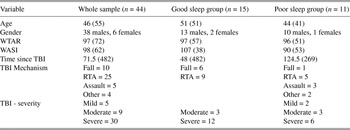
There were no significant differences between the groups on any of the demographic factors measured (see Table 1).
Characteristics of whole sample, and good and poor sleep groups

Note
Median and range are reported where appropriate.
n = number; WTAR = The Wechsler Test of Adult Reading; WASI = The Wechsler Abbreviated Scale of Intelligence; RTA = Road Traffic Accident; TBI = traumatic brain injury.
Self-report Measures of Sleep and Mood
Scores on the HADS were compared to investigate any emotional disorders. In line with previous findings of a significant relationship between depression and insomnia ratings (Ouellet et al., Reference Ouellet, Savard and Morin2004), the PS group presented with significantly more symptoms of depression than the GS group (p = .003, two-tailed). Data for self-report measures of sleep and mood are detailed in Table 2.
Scores for self-report mood and sleep measures for the whole sample, and good and poor sleep groups

Note
Median and range reported.
N = number; GS = Good sleep group; PS = Poor sleep group; p = p value; PSQI = Pittsburgh Sleep Quality Index; ISI = Insomnia Severity Index; HADS = Hospital Anxiety and Depression Scale.
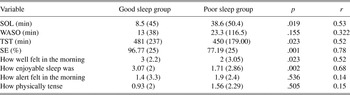
The majority of the sleep diary data supported the discrimination of the PS and GS groups (see Table 3).
Sleep diary data for good and poor sleep groups

Note
Median and range, Mann-Whitney p value, two-tailed (p) and effect size r.
SOL = sleep onset latency; WASO = wake after sleep onset; TST = total sleep time; SE = sleep efficiency.
Results of Cognitive Assessments
Primary hypothesis
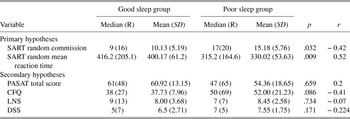
The results of the assessments of attention are detailed in Table 4. Consistent with predictions, the PS group made significantly more errors of commission on the SART random than the GS group (p = .032, two tailed). The effect size (r = 0.42) was approaching the large range. Furthermore, the PS group had significantly faster mean RTs (median: 315.2), than the GS group (median: 4.16.2). A large effect size was seen for this difference (r = 0.52).
Scores on cognitive measures for the good and poor sleep groups

Note
Median and range (R), mean, standard deviation (SD), Mann-Whitney two-tailed (p), and effect size (r) are reported.
p = p value; SART = Sustained Attention to Response Test; PASAT = Paced Auditory Serial Attention Test; CFQ = Cognitive Failures Questionnaire; LNS = letter number sequencing; DSS = digit symbol substitution.
As well as the significant difference between PS and GS groups on the SART variables, a significant positive relationship was found between HADS-depression score and SART-random errors of commission (rs = 0.0518; n = 26; p = .007, two-tailed). Thus, the possibility that differences between groups could be accounted for by depression was considered. However, further examination of the data revealed there was a correlation between HADS-depression and SART-random errors of commission for the GS group but not for the PS group (rs = 0.589; n = 15; p = .021; two- tailed and rs = 0.035; n = 11; p = .919, two-tailed). Small and uneven sample sizes, the nature of the relationship between the HADS-depression scores and SART random errors of commission and the violation of the assumption of homogeneity of variance meant that analysis of covariance would not be appropriate in this instance.
Secondary hypotheses
No significant differences were seen on any of the additional attention measures. The results for the PASAT were in the predicted direction; the effect size was small (r = 0.06). The PS group reported making more everyday slips of attention on the CFQ than the GS group, this difference was not significant but a medium effect size was seen (r = 0.406).
DISCUSSION
The present study was the first prospective study to examine the consequences of sleep disturbance on attentional functioning following TBI using specific measures of sustained attention.
Sleep groups were defined on the basis of subjective and objective criteria that aimed to reflect the multidimensional nature of sleep difficulties and clearly differentiate between participants who were suffering from clinically significant levels of insomnia and good sleepers.
Sustained Attention
It was predicted, a priori, that participants who had sustained a TBI and were poor sleepers would make more errors of commission and have faster average correct reaction times than the good sleepers on the SART random, reflecting poorer sustained attention. The results from the SART supported this prediction. Despite reduced sample sizes, the effect sizes suggested a medium to large difference between the groups. A post hoc power analysis suggested that the power was 0.6 (two-tailed) with an alpha level of 0.5.
However, the PS group also had more depression symptoms (HADS) than the GS group. So the relationship between depression and SART errors of commission was examined. The results suggested that there was a positive relationship between SART errors of commission and depression for the GS group but not for the PS. This suggests that it was sleep rather than depression that accounted for the differences between the groups in terms of SART errors of commission. Furthermore, it was noted that while separating the contribution of depression and sleep disturbance was meaningful from a research perspective, high rates of psychiatric co-morbidity have commonly been reported with insomnia (Kessler et al., Reference Kessler, McGonagle, Zhao, Nelson, Hughes and Eshleman1994) so this differentiation might not reflect the common complex clinical interaction of these conditions. The disorders may occur concurrently but independently, or they may interact, either one precipitating or perpetuating the other. Furthermore, the course may differ between individuals and/or fluctuate over time within individuals (Buysse, Ancoli-Israel, Edinger, Lichstein, & Morin, Reference Buysse, Ancoli-Israel, Edinger, Lichstein and Morin2006).
Sleep Classifications
Buysse et al. (Reference Buysse, Ancoli-Israel, Edinger, Lichstein and Morin2006) emphasized the importance of differentiating between insomnia as a disorder with various sleep/wake symptoms and insomnia as a syndrome, where symptoms meet specific diagnostic criteria. Edinger et al. (Reference Edinger, Bonnet, Bootzin, Doghramji, Dorsey and Espie2004) emphasized the importance of using good sleepers rather than just sleepers who were not poor as a control group. Both these points were considered in the design of this study, and both subjective and objective measures were used to allow for better discrimination of the independent variable (sleep) so that its impact on the dependent variable (sustained attention) could best be tested.
The use of multi-modal sleep assessment methods post-TBI may be particularly important because there are several methodological issues that must be minimized. For example, there has been debate in the TBI sleep literature about the utility of self-report measures in participants who have sustained severe TBIs due to the increased prevalence of awareness and memory difficulties, which might make it difficult for them to accurately report any sleep difficulties. Sixty-eight percent of the aggregate sample in this study had incurred a severe TBI. On the other hand, although Actiwatches provide useful collateral measures of sleep patterns especially when the patient’s report is in question (Ancoli-Israel, Cole, Alessi, Chambers, Moorcroft, & Pollak, Reference Ancoli-Israel, Cole, Alessi, Chambers, Moorcroft and Pollak2003), they have been criticized for being less reliable when distinguishing between still wakefulness and sleep (Sadeh & Acebo, Reference Sadeh and Acebo2002). Thus, it may be that GS and PS groups were only adequately differentiated in this study when both subjective and objective methods were combined and methodological limitations were minimized.
Despite the benefits of using both subjective and objective criteria; a lack of correspondence was seen between these measures for a proportion of participants. This finding has been reported previously in other studies conducted with both noninjured adults and TBI participants (Erman, Reference Erman2001; Ouellet & Morin, Reference Ouellet and Morin2006). Buysse et al. (Reference Buysse, Ancoli-Israel, Edinger, Lichstein and Morin2006) emphasized that, despite inevitable discrepancies among subjective and quantitative assessment modalities, they should be seen as complementary because insomnia symptoms are heterogeneous, and, therefore, a multi-measurement system may be necessary to adequately capture the different components of insomnia.
The lack of correspondence between sleep complaints and Actigraphy parameters may also have been influenced by inter-individual differences in the propensity to be affected by sleep reduction and disturbance. The ability of people to cope with sleep deprivation and to compensate for deficits is thought to reflect inter-individual differences in their basal sleep needs (Durmer & Dinges, Reference Durmer and Dinges2005).
A further point of interest is that, even in this study where both subjective and objective sleep measures were used to categorize sleep groups, observationally there were still more mild head injuries incurred by the poor sleep than the good sleep group. This finding is in line with previous studies that only used subjective measures. It does not support the hypothesis that this finding can be explained solely by under reporting of sleep difficulties on self-report measures by those who have sustained a severe TBI. Rather it supports the hypothesis that patients after mild head injuries are more vulnerable to insomnia perhaps because of increased insight resulting in them being more vulnerable to psychological stressors, rumination, and increased emotional arousal which are all common factors which may disrupt sleep.
General Attentional Functioning
The second prediction made was that the PS would show poorer performance on other attentional measures (PASAT, LNS, DSS) than the GS group. These predictions were not supported. Similarly, when the relationships between objective parameters and attention measures were investigated, the predictions were not supported. This supports the use of measures sensitive to the sub-systems of attention that are vulnerable to sleep.
Everyday Slips of Attention
The third prediction was that the PS group would report more everyday lapses of attention on the CFQ than the GS group. Although higher scores (indicative of increased attention lapses) were seen in the PS compared with the GS group, the difference between the groups was not statistically significant. Robertson et al. (Reference Robertson, Manly, Andrade, Baddeley and Yiend1997) found that significant others’ reports on the CFQ correlated with SART errors but that individuals’ own reports did not. Reduced insight and memory difficulties in severe TBI participants may have reduced the utility of this retrospective self-report measure and future studies would be improved by including the rating of a significant other.
Limitations
Approximately 300 invitations to participate were sent out; of these, 55 potential participants replied but only 44 attended and were suitable for inclusion in the study. Thus, the relatively low response rate may limit the ability to generalize from the findings of this study. Responders may have been more likely to have either sleep or attention difficulties or both.
The clinician who conducted the assessments also collected the sleep data, so potentially this was a threat to study validity. However, this threat was minimized because the subjective sleep measures were not scored, and the Actiwatches and sleep diaries were not collected from participants, until the end of the second session, by which time all of the psychometric measures had already been completed. Thus, none of the sleep data was analyzed until the participant had completed all other aspects of the research protocol.
Additionally, although significant differences were found between the groups on the primary measure; the SART random, power was not met. Thus, a larger sample size may have been necessary to detect a significant effect on all attention measures in this condition.
The use of sleep diaries as a prospective record of sleep over the assessment week was a strength of this study. However, low return rates of diaries and the fact that the version used did not include a validity check (to ascertain that data had been filled in on the correct day) were limitations of this tool. It might be better to phone participants for daily ratings or ask them to text or e-mail ratings to increase the validity of data. In the present study, participants whose diary data did not confirm them to be a GS or PS could have been excluded from the analysis to further increase the strength of the independent variable. This could be considered in future studies with larger sample sizes. Future studies might also consider including PSG as an alternative/ additional objective sleep measure post-TBI. Including the report of a significant other would also provide good collateral information on both sleep measures and the CFQ.
A further limitation of this study was that time of testing was not controlled for between groups. Sustained attention performance has been shown to be affected by circadian modulation. Thus, it may have been useful to test all participants at a similar stage in their circadian cycle. Further research is needed to investigate the differential impact of circadian factors on cognitive functioning.
Further Research
Before this study, no studies had used the SART to measure the impact of insomnia on cognition in uninjured participants. Results from studies using traditional vigilance, continuous performance, attention, and memory measures have been inconsistent. The results of this study have suggested that the SART may be a sensitive measure able to substantiate subjective complaints in uninjured individuals with primary insomnia. The identification of performance measures sensitive to the effects of insomnia has been emphasized as a high research priority (Buysse et al., Reference Buysse, Ancoli-Israel, Edinger, Lichstein and Morin2006).
Further research considering the utility and correspondence of subjective measures with participants with severe TBIs is also necessary, as is research differentiating between different types of insomnia disorders seen after TBI (specifically primary or comorbid insomnia and circadian rhythm disorders) as these may have different impacts on neuropsychological performance.
CONCLUSIONS AND CLINICAL IMPLICATIONS
The results of this exploratory study suggest that clinically significant levels of sleep disturbance post-TBI can negatively impact on sustained attention functioning. The findings supported the use of specific rather than general attentional measures in research into this area. A medium strength trend was seen for PS group to report more daytime lapses of attention than GS group. However, gathering collateral information from significant others may have improved the strength of information for this measure. Future research is needed to replicate these results with a larger sample size and to confirm whether or not these results can be generalized to the wider TBI population. In association with evidence of increased prevalence rates of insomnia post-TBI and evidence that insomnia can be successfully treated post-TBI (Zafonte, Mann, & Fichtenberg, Reference Zafonte, Mann and Fichtenberg1996), these findings suggest that clinicians working with TBI survivors should be vigilant to the occurrence, assessment, and treatment of these difficulties.
ACKNOWLEDGMENTS
We thank all our participants, Headway, Momentum, and the Community Treatment Centre for Brain Injury, Glasgow for their time and contribution. In addition, we thank two anonymous reviewers and Professor Haaland for their constructive and encouraging comments, and NHS Education for Scotland and The Dr. Mortimer and Theresa Sackler Foundation for supporting the project. The information in this manuscript has never been published either electronically or in print. The authors are not aware of any financial, or other, conflicts of interest.