INTRODUCTION
Members of the Family Ampharetidae (Annelida: Polychaeta) are widely distributed from intertidal to abyssal depths and are common in deep-sea environments like plains, hot vents or cold seeps (Böggemann, Reference Böggemann2009; Reuscher et al., Reference Reuscher, Fiege and Wehe2009; Aguirrezabalaga & Parapar, Reference Aguirrezabalaga and Parapar2014). According to Jirkov (Reference Jirkov2011), this family includes more than 200 valid species distributed in two subfamilies: Ampharetinae Malmgren, Reference Malmgren1866 and Melinnae Chamberlin, Reference Chamberlin1919. The taxonomy of ampharetids is complex and recently the number of genera was proposed to be strongly reduced from 90 to 24 (Jirkov, Reference Jirkov2011). The genus Anobothrus is one of the most speciose with 18 species currently considered valid, 10 of them described between 2008 and 2014 (Jirkov, Reference Jirkov2008; Schüller, Reference Schüller2008; Reuscher et al., Reference Reuscher, Fiege and Wehe2009; Imajima et al., Reference Imajima, Reuscher and Fiege2013; Schüller & Jirkov, Reference Schüller and Jirkov2013).
The first studies concerning the deep-sea macrofauna of the Bay of Biscay started in the 19th century and several expeditions were conducted in the 1970s (Laubier, Reference Laubier, Laubier and Monniot1985). Since the 1990s, several new species of Polychaeta have been described in the Capbreton Canyon following new oceanographic cruises from 1987 to 1990 (San Martín et al., Reference San Martín, Ceberio and Aguirrezabalaga1996; Nuñez et al., Reference Nuñez, Aguirrezabalaga and Ceberio2000; Aguirrezabalaga et al., Reference Aguirrezabalaga, Ceberio and Fiege2001, Reference Aguirrezabalaga, Ceberio and Paxton2002; Aguirrezabalaga & Ceberio, Reference Aguirrezabalaga and Ceberio2003, Reference Aguirrezabalaga and Ceberio2005a, Reference Aguirrezabalaga and Ceberiob, Reference Aguirrezabalaga and Ceberio2006; Aguirrezabalaga & Carrera-Parra, Reference Aguirrezabalaga and Carrera-parra2006; Aguirrezabalaga & Gil, Reference Aguirrezabalaga and Gil2009; Aguirrezabalaga & Parapar, Reference Aguirrezabalaga and Parapar2014). The Capbreton Canyon is situated in the south-east of the Bay of Biscay, beginning at 250 m from the coastline, in front of Hossegor city. It extends through 300 km before ending on the abyssal plain at 3500 m depth (Gaudin et al., Reference Gaudin, Mulder, Cirac, Berné and Imbert2006; Mazières et al., Reference Maziéres, Gillet, Castelle, Mulder, Guyot, Garlan and Mallet2014). Currently disconnected from the Adour River, the canyon continues to be affected by its plume during 20% of the year (Petus et al., Reference Petus, Marieu, Novoa, Chust, Bruneau and Froidefond2014). The Capbreton Canyon separates the northern Aquitanian shelf from the narrower southern Cantabrian platform (Pascual et al., Reference Pascual, Cearreta, Rodríguez-lázaro, Uriarte, Borja and Collins2004).
The main purpose of the BIOMIN project was to study the in situ impact of the biological diversity on the mineralization of the organic matter at the water-sediment interface. This study took place close to three river mouths: Rhône River (Gulf of Lions, Mediterranean Sea; Bonifácio et al., Reference Bonifácio, Solveig, Labrune, Amouroux, Escoubeyrou, Buscail, Romero-Ramirez, Lantoine, Vétion, Bichon, Desmalades, Rivière, Deflandre and Grémare2014), Gironde Estuary and Adour River (Bay of Biscay, Atlantic Ocean). During this project a new species of Anobothrus was discovered in the Capbreton Canyon. The present paper provides the description of this species as well as a key for worldwide hitherto described species of this genus.
MATERIALS AND METHODS
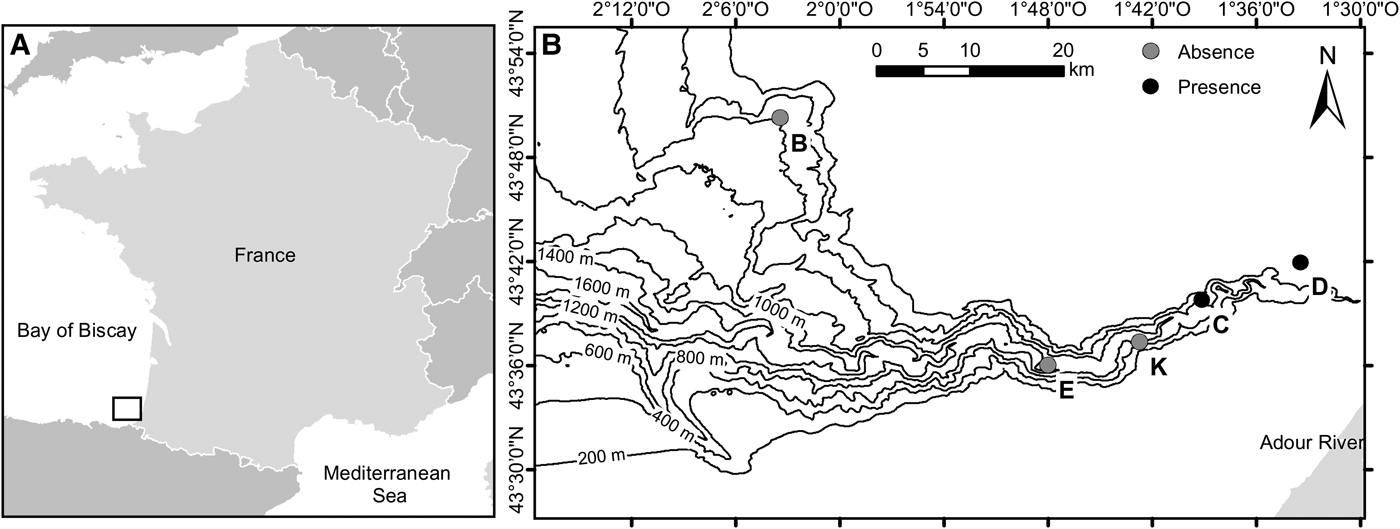
The third cruise of the BIOMIN project (BIOMIN-3) took place on board the RV ‘Côtes de la Manche’ in July 2012 in the Capbreton Canyon. Macrofauna was sampled at five stations situated between 108–735 m depth and between 18 and 52 km off the Adour River (Figure 1). At each station, samples were collected using a Hamon grab (three replicates of 0.25 m2) and an Oktopus® GmbH MC 6 multicorer (nine replicates of 0.007 m2).
BIOMIN-3 cruise sampling stations in the Capbreton Canyon showing those with presence (black circles) and absence (grey circles) of Anobothrus amourouxi sp. nov.

Samples were sieved through a 1 mm mesh and the remaining fraction was immediately fixed in 5% buffered formalin. When back at the laboratory, organisms were sorted, identified to the lowest taxonomic level (in most cases to the species level) and counted.
Specimens of the new Anobothrus species were examined under a Nikon SMZ 1500 stereomicroscope and a Nikon Eclipse E400 microscope, and photographed with a Nikon DS-Fi 2 camera. Some specimens were figured with a Wacom Intuos 5 tablet and Adobe Illustrator software. Length and width were measured with the NIS Elements Analysis software. Specimen used for examination with scanning electron microscopy (SEM) was prepared by critical point drying, covered with gold and examined and photographed at the Servicios de Apoio á Investigación-SAI (Universidade da Coruña-UDC, Spain).
Type specimens were deposited in the Muséum National d'Histoire Naturelle (MNHN) (Paris, France) and Museo Nacional de Ciencias Naturales (MNCN) (Madrid, Spain). Additional non-type specimens were deposited in the Arcachon Marine Station.
Abbreviations used in the text: S = segment; TS = thoracic segment; TC = thoracic chaetiger; TU = thoracic unciniger; AU = abdominal unciniger.
RESULTS
SYSTEMATICS
Family ampharetidae Malmgren, Reference Malmgren1866
Subfamily ampharetinae Malmgren, Reference Malmgren1866
Genus Anobothrus Levinsen, Reference Levinsen1884
Type species: Ampharete gracilis Malmgren, Reference Malmgren1866
Synonyms: Anobothrella Hartman, Reference Hartman1967: 155–156;
Melythasides Desbruyères, Reference Desbruyéres1978: 232–235; Sosanides
Hartmann-Schröder, Reference Hartmann-schröder1965: 243–246.
GENERIC DIAGNOSIS (EMENDED)
Prostomium trilobed, Ampharete-type, without glandular ridges. Buccal tentacles papillated or smooth. SII and SIII fused. Three to four pairs of branchiae (smooth or with transversal ciliated ridges or papillated), three pairs forming transversal row with or without gap arising from fused SII + III to SIV and the fourth pair, if present, situated behind this row, arising from SV. Notochaetae in fused SII + III originating from SII or SIII, or both. If present, notochaetae originating from SII varying in size from regular size to strongly enlarged (paleae). If present, notochaetae originating from SIII varying from reduced to regular size. If present, a pair of nephridrial papillae is situated in SIV behind innermost pair of branchiae or behind some anterior notopodia. Sixteen to seventeen TS. Thirteen to fifteen TC starting at SIII-IV. Eleven or twelve TU starting at SVI. Notopodial cirri absent. Circular whitish band in TU1, TU2 or TU3. Fourth-, fifth- or sixth-to-last thoracic unciniger with one or combined modifications: elevated notopodia and/or modified notochaeta and/or dorsal ridge. First two AU of thoracic type. Number of AU generally constant for each species. Abdominal rudimentary notopodia absent.
REMARKS
This emended generic diagnosis combines the emended diagnosis proposed by Schüller & Jirkov (Reference Schüller and Jirkov2013) and Imajima et al. (Reference Imajima, Reuscher and Fiege2013) which in turn combine previous proposals by Jirkov (Reference Jirkov2008) and Reuscher et al. (Reference Reuscher, Fiege and Wehe2009). Here we add the presence of transversal ciliated ridges on branchiae as an additional morphological character in the genus which should be taken into account in species descriptions.
Anobothrus amourouxi sp. nov.
(Figures 2–4)
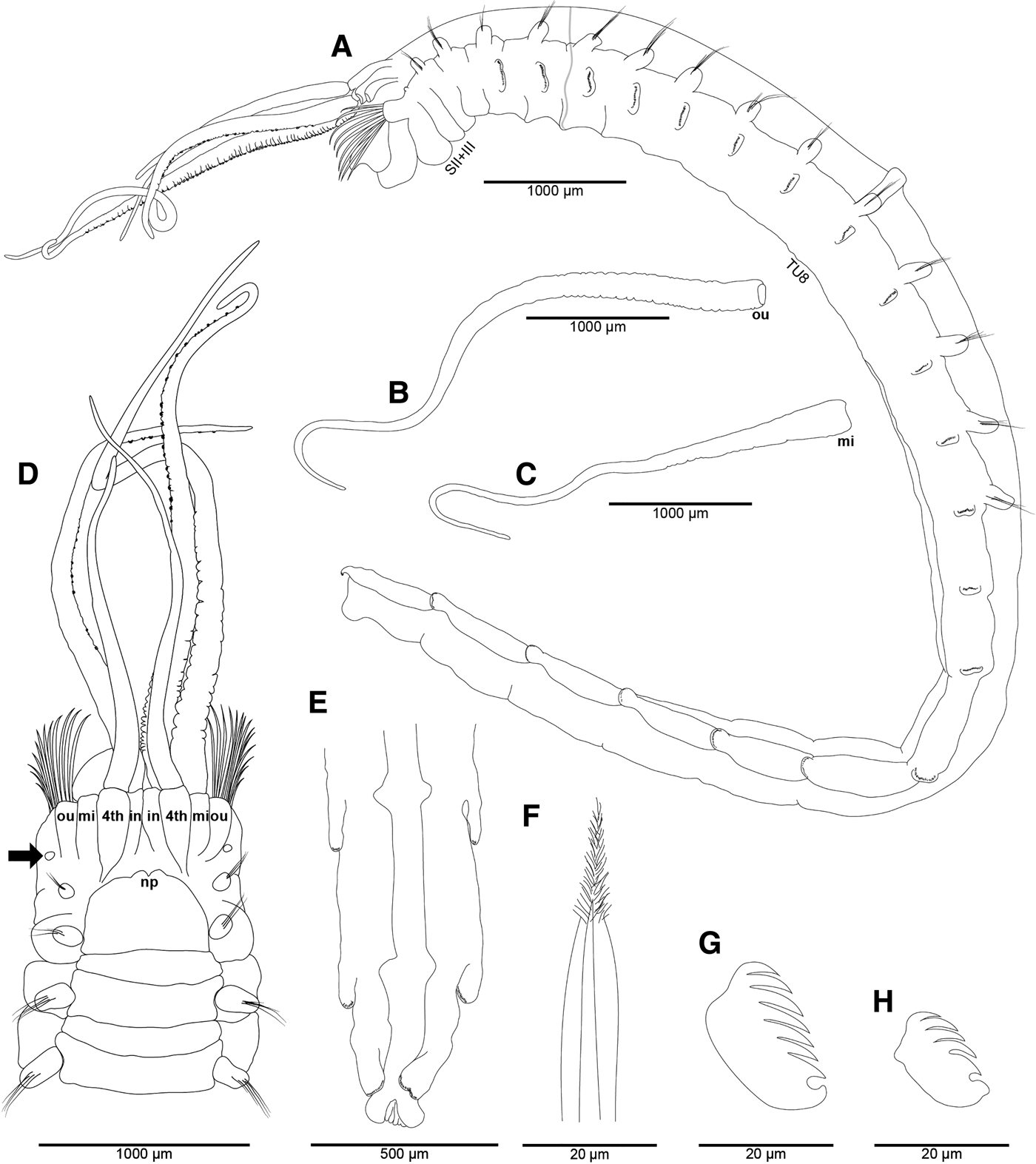
Anobothrus amourouxi sp. nov., holotype (MNHN-1561): (A) lateral view, specimen incomplete, showing fused SII+III; (B) deciduous branchia from outer (ou) pair; (C) deciduous branchia from middle (mi) pair; (D) anterior region, dorsal view, indicating reduced notopodia at fused segments II+III (arrow), nephridial papillae (np) and pairs of branchiae: (in) inner, (mi) middle, (ou) outer and (4th) fourth pair. Paratype (MNHN-1562): (E) pygidium, ventral view; (F) hirsute tips of notochaeta from modified eighth thoracic chaetiger (TU8). Paratype (MNHN-1563): (G) uncinus from first thoracic uncinigers (TU1), lateral view; (H) uncinus from third abdominal unciniger (AU3), lateral view.
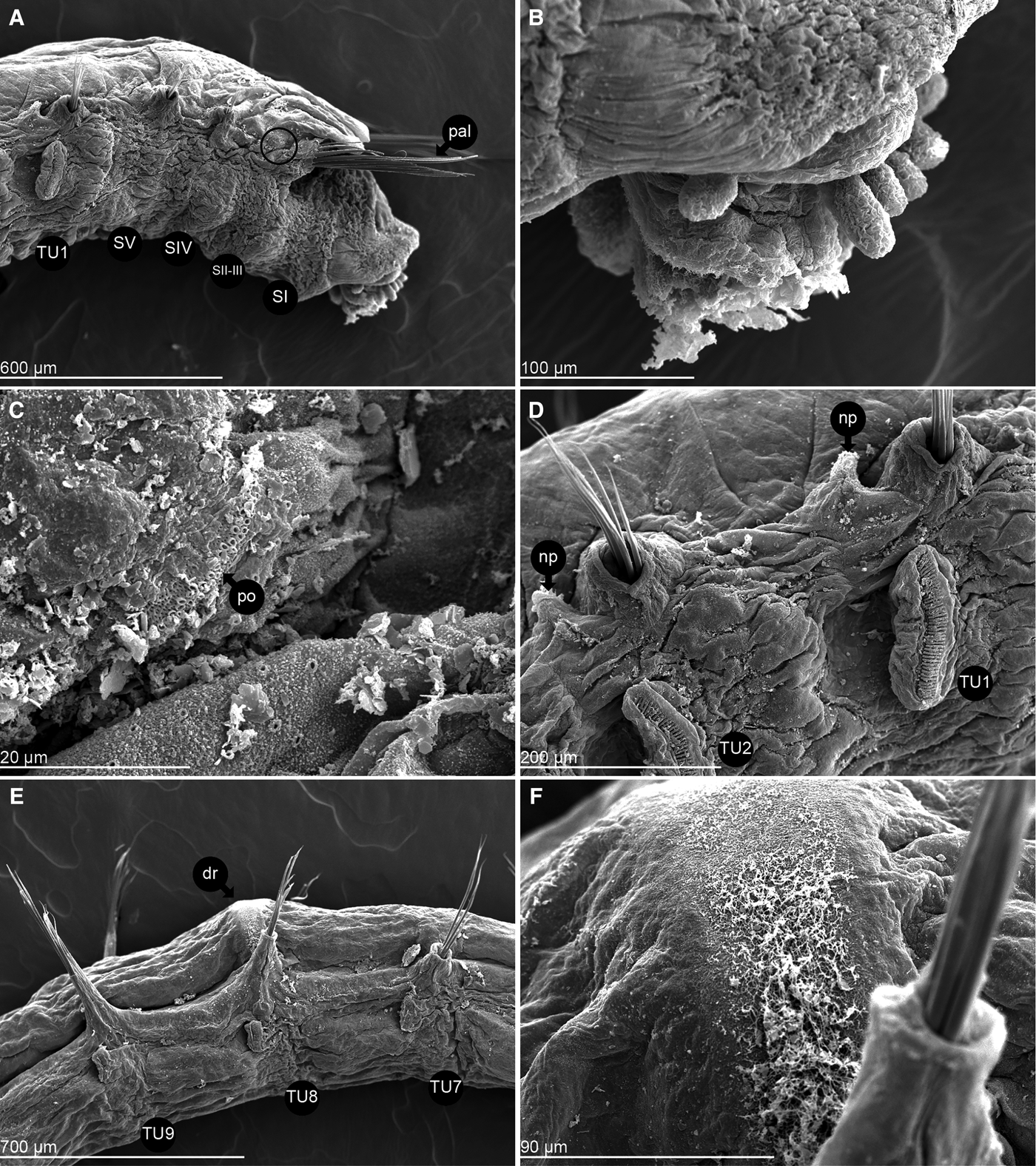
Anobothrus amourouxi sp. nov., paratype (MNCN-16.01/16071): (A) anterior end, right lateral view, showing first five thoracic segments (SI-SV), and first thoracic unciniger (TU1); reduced notopodia (encircled) at fused segments II+III behind the paleae (pal); (B) detail of prostomium and buccal tentacles, lateral view; (C) notopodia of fused segments II+III showing a row of pores (po); (D) TU1 and TU2 showing position of nephridial pores (np); (E) TU8 showing a transversal dorsal ridge (dr); (F) detail of dorsal ridge at TU8.
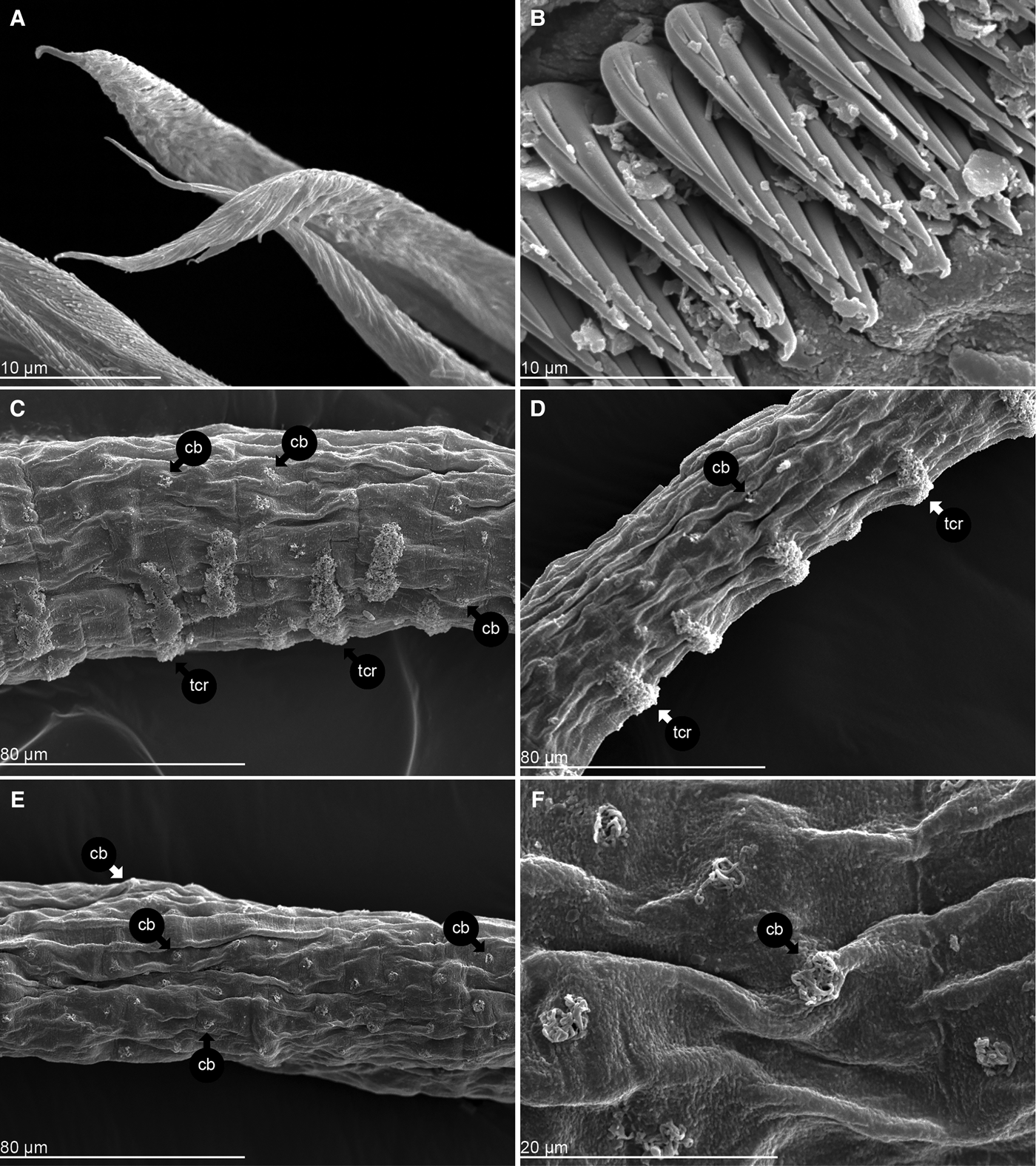
Anobothrus amourouxi sp. nov., paratype (MNCN-16.01/16071): (A) hirsute tips of T8 modified notochaetae; (B) thoracic uncini, upper-frontal view. Paratype (MNCN-16.01/16070): (C-D) basal and median zones of inner ciliated branchia showing the transversal ciliated ridges (tcr) and ciliated buttons (cb); (E-F) median and distal zones of smooth branchiae showing the ciliated buttons (cb).
TYPE MATERIAL
Holotype: MNHN-1561, incomplete specimen (broken at 9th AU), one branchial filament lacking and two filaments deciduous, 2.57 mm long and 1.02 mm wide, station C1-INCUB (multicorer) (43°39′48″N 01°39′09″W), 364 m depth, 7 July 2012.
Paratypes: MNHN-1562, complete specimen, all branchiae missing, 12.5 mm long and 1.5 mm wide, station C4-MFC (multicorer) (43°39′48″N 01°39′09″W), 364 m depth, 16 July 2012; MNHN-1563, four specimens (two complete), 10.3–13.9 mm long and 1.1–1.3 mm wide, all without branchiae, two specimens with oocytes in body cavity, station D (one specimen collected with Hamon grab, three specimens with multicorer) (43°42′00″N 01°33′27″W), 108 m depth, 7 and 12 July 2012; MNCN-16.01/16069, complete specimen, three branchial filaments lacking, 6.63 mm long and 0.63 mm wide, station C1-INCUB (multicorer) (43°39′48″N 01°39′09″W), 364 m depth, 7 July 2012; MNCN-16.01/16070, two branchiae in a STUB for SEM of the paratype MNCN-16.01/16069; MNCN-16.01/16071, complete specimen in SEM stub (broken at 2nd AU), all branchiae missing, 8.6 mm long and 1.0 mm wide, station C1-BIOIR (multicorer) (43°39′48″N 01°39′09″W), 364 m depth, 7 July 2012.
ADDITIONAL MATERIAL
One incomplete specimen (broken at 4th AU), all branchiae missing, 8.8 mm long and 1.0 mm wide, station C-BIOIR (multicorer) (43°39′48″N 01°39′09″W), 364 m depth, 7 July 2012. It was deposited in the Arcachon Marine Station.
DIAGNOSIS
Inner branchiae with transversal ciliated ridges, other ones smooth. Only modified TU8 provided notochaetae with hirsute tips. Uncini from TU1 with 6–7 teeth in lateral view arranged in two vertical rows in frontal view. Uncini from AU3 with 4–5 teeth in lateral view arranged in three vertical rows in frontal view. SII + III fused with paleae from SII but with reduced notopodia without chaetae from SIII. 15 TC, 12 TU and 12 AU.
DESCRIPTION (BASED ON HOLOTYPE AND PARATYPES)
Prostomium trilobed and anteriorly rounded, Ampharete-type, without eye-spots. Buccal tentacles apparently smooth (Figure 3B).
Four pairs of long, gradually tapering, cirriform branchiae (Figure 2A, D). No gap between groups of branchiae. First three pairs of branchiophores arranged in a transversal line (inner, middle and outer pairs), forming a high fold, originating from fused SII + III. Fourth pair situated behind between inner and middle pairs, originating from SV (Figure 2D). Diameter of all branchiophores approximately equal. Middle and outer pairs of branchiae with branchiostyles longer and thicker than inner and posterior pairs (Figure 2C). Outer pair longer than remaining ones (Figure 2B). Middle, outer and fourth pairs of branchiae with smooth branchiostyles. Branchiostyles of inner pair of branchiae with tufts of cilia arranged in rows forming transversal ciliated ridges (visible in stereomicroscope) along the whole ventral side of the branchiostyle (Figure 4C, D). All branchiostyles presenting minuscule ciliated buttons (visible only under SEM) along their entire surface (Figure 4E, F). Right branchiostyle of inner pair thicker and longer than the left one. Fourth (posterior) pair of branchiae with thinnest and shortest branchiostyle.
One pair of nephridial papillae, not separated by gap, situated behind the base of innermost pair of branchiae (Figure 2D). Additional pairs of nephridial papillae present behind notopodia of TU1 and TU2 (visible under SEM, Figure 3D).
Fused SII + III with 12 − 16 gradually tapering paleae, longer and larger than the best-developed notochaetae (Figures 2A, D & 3A) from SII. The longest paleae surpassing the prostomium in lateral view. Fused SII + III (Figures 2A & 3A) with reduced notopodia, rounded in shape, hardly visible under the stereomicroscope, located behind the paleae, without chaetae, presenting a row of pores (Figure 3C) from SIII. From SIV (TC2) notopodia well developed with rounded to elongate lobes and well-developed notochaetae. Seventeen TS and 15 TC. Twelve TU. TU3 with an anterior whitish band (Figure 2A). Fifth-to-last TU (TC11, TU8) with slightly elevated notopodia connected by a pronounced dorsal ridge (Figures 2A & 3E, F), sometimes as high as notopodial lobe (Anobothrus-type).
Abdomen with 12 AU. Neuropodia of first two abdominal uncinigers (AU1 − 2) of thoracic type (tori instead of pinnules; Figure 2A). Neuropodial lobe forming pinnules from AU3 to posterior end. Rudimentary notopodia and neuropodial cirri absent.
Notochaetae bilimbate. First two thoracic chaetigers (SIV−V; TC1 − 2) with 3–4 short notochaetae; subsequent chaetigers with 5 long and 4 short notochaetae. Notochaeta longer than notopodial lobe in TU. Notochaetae from modified TU8 with hirsute tips (Figures 2F & 4A). TU1 with 38–48 uncini, pectinate, with 6–7 teeth in lateral view, arranged in two vertical rows in frontal view (Figures 2G & 4B). AU3 with 25–35 uncini, situated in marginal position of neuropodial pinnule, pectinate, with 4–5 teeth in lateral view (Figure 2H), arranged in three vertical rows in frontal view.
Pygidium with terminal anus, without lateral papillae but with 3–5 dorsal minute folds (Figure 2E).
REMARKS
Anobothrus amourouxi sp. nov. is similar to A. antarctica Monro, Reference Monro1939, A. glandularis (Hartmann-Schröder, Reference Hartmann-schröder1965), A. mironovi Jirkov, Reference Jirkov2008, A. paleaodiscus Schüller & Jirkov, Reference Schüller and Jirkov2013 and A. patersoni Jirkov, Reference Jirkov2008 because they share the following characters: presence of paleae in fused SII + III from SII, four pairs of branchiae, circular band at TU3, 12 TU, modified fifth-to-last TU (TU8) and 12 AU. These species can be separated into two groups based on the presence or absence of notochaetae with hirsute tips at TU8: Group 1: A. paleaodiscus, A. patersoni and A. mironovi with smooth tips, and Group 2: A. amourouxi sp. nov., A. antarctica and A. glandularis with notochaetae with hirsute tips (but only in TU8). However, A. amourouxi sp. nov. and A. antarctica differ from A. glandularis for having both 15 TC and ciliated or papillated branchiae instead of 14 TC and smooth branchiae. Moreover, A. antarctica differs from A. amourouxi sp. nov. by presenting all branchiostyles papillated, from sparse to densely papillated (shaggy), while A. amourouxi sp. nov. presents only the inner pair provided with transversal ciliated ridges. Furthermore, A. antarctica has uncini from TU1 with 4–5 teeth, a large pair of nephridial papillae, and fused SII + III provided with notochaetae from SIII, while A. amourouxi sp. nov. has uncini from TU1 with 6–7 teeth, two groups of nephridial papillae, fused SII + III with reduced notopodia and without notochaetae from SIII. Indeed, in A. amourouxi sp. nov. the reduced notopodia from SIII at fused SII–III presents a row of pores instead of chaetae, a character also observed by Aguirrezabalaga & Parapar (Reference Aguirrezabalaga and Parapar2014: their figure 7E). These pores might be related to chaetae formation.
Although Imajima et al. (Reference Imajima, Reuscher and Fiege2013) suggested that the presence of transversal ciliated ridges on branchiae were related to the size of specimens, this could not be verified in A. amourouxi sp. nov. because the two biggest specimens (mature) lost their branchiae. However, no variation linked to age was observed for the other characters described here.
The Anobothrus species reported in NE Atlantic waters are A. gracilis (Malmgren, Reference Malmgren1866) and A. patersoni Jirkov, Reference Jirkov2008. Anobothrus gracilis is a species described from Swedish coasts and has a wide distribution in the Arctic Ocean, North Atlantic Ocean (Iceland to Swedish West coast), and NW Pacific Ocean (Jirkov, Reference Jirkov2008, Reference Jirkov2011; Parapar et al., Reference Parapar, Helgason, Jirkov and Moreira2014). Anobothrus patersoni is an exclusively abyssal species (3260–8292 m depth) described from North Pacific (Japan) but recorded also in the North Atlantic (Jirkov, Reference Jirkov2008). In the Capbreton Canyon, Rallo et al. (Reference Rallo, García-Arberas and Isasi1993) found a single specimen of A. gracilis between 358–410 m, and two incomplete specimens of Anobothrus aff. gracilis were also reported by Aguirrezabalaga & Parapar (Reference Aguirrezabalaga and Parapar2014), between 624–652 m depth. These records should be taken with caution as incomplete specimens may induce wrong identifications. These specimens might belong to A. amourouxi sp. nov. because A. gracilis share with the new species the possession of 15 TC, fused SII + III with reduced TC without notochaetae from SIII, 12 TU and circular band in TU3.
ETYMOLOGY
This species is dedicated to Dr Jean-Michel Amouroux (Laboratoire Arago, Observatoire Océanologique de Banyuls-sur-Mer, France) for his friendship and many contributions to French benthic research.
DISTRIBUTION
Specimens of the new species were collected in the Capbreton Canyon muddy bottoms, between 108 and 364 m depth. In the same area Rallo et al. (Reference Rallo, García-Arberas and Isasi1993) and Aguirrezabalaga & Parapar (Reference Aguirrezabalaga and Parapar2014) reported Anobothrus gracilis at 358–410 m depth and Anobothrus aff. gracilis at 624–652 m depth, respectively.
KEY FOR IDENTIFICATION OF THE SPECIES OF THE GENUS ANOBOTHRUS IN THE WORLD
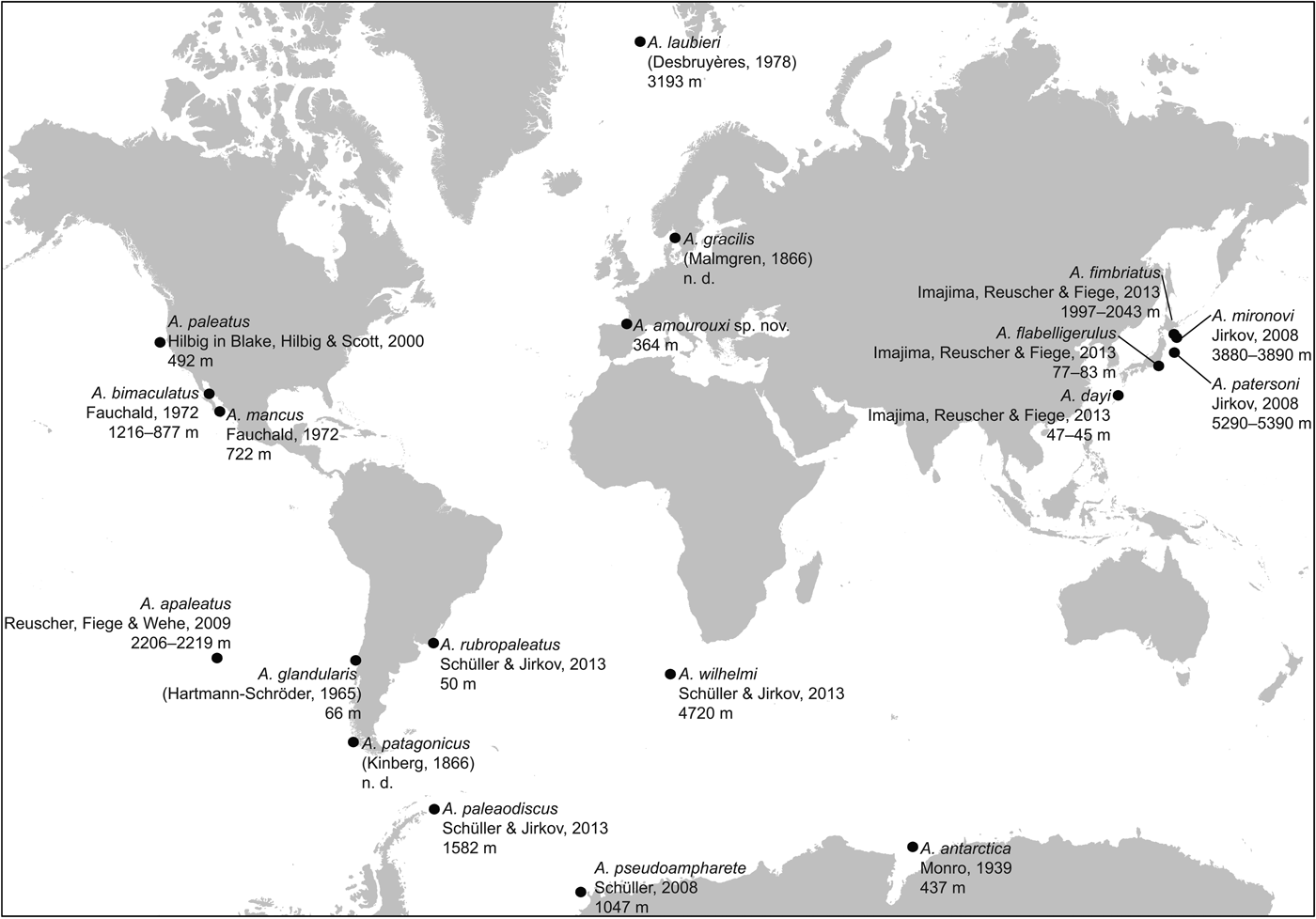
The following key accounts for the 18 species currently considered valid (Read, Reference Read, Read and Fauchald2014) plus the new species here proposed. Described species are well distributed in the world ocean, but mainly concentrated in the southern hemisphere, NE Atlantic, Pacific coasts of North America and Japan. Nevertheless gaps still persist in the NW Atlantic, Indo-Malay Philippines archipelago and the coasts of Africa and Australia (Figure 5).
World map showing location and depth of type locality of each currently considered valid species of Anobothrus.
Five species were previously included in the genus Anobothrus but are currently considered invalid or excluded from this genus and thus excluded from the following key. Anobothrus nasuta (Ehlers, Reference Ehlers1887), originally described in the genus Amphicteis, is supposed to belong to another genus (Jirkov, Reference Jirkov2008; Schüller & Jirkov, Reference Schüller and Jirkov2013). Anobothrus occidentalis Hartman, Reference Hartman1969 and Anobothrus trilobatus Hartman, Reference Hartman1969 were re-examined by Hilbig (Reference Hilbig, Blake, Hilbig and Scott2000) and are presently considered as belonging to the genera Sosanne and Eclysippe, respectively. Finally, Anobothrus nataliae Jirkov, Reference Jirkov2008 and Anobothrus wakatakamaruae Imajima, Reference Imajima2009 are considered junior synonyms of Anobothrus paleatus (Imajima et al., Reference Imajima, Reuscher and Fiege2013).
1. No paleae 2.
- Paleae present 3.
2. Modified notopodia with hirsute tips notochaetae A. fimbriatus.
- All notopodia without hirsute tips notochaetae A. apaleatus.
3. 3 pairs of branchiae 4.
- 4 pairs of branchiae 6.
4. Modified notopodia on TU8 5.
- Modified notopodia on TU9 A. flabelligerulus.
5. Notochaetae present on fused segments II–III, prostomium Ampharete-type, branchiae forming transversal line A. laubieri.
- Notochaetae absent on fused segments II–III, prostomium conical, wide gap between groups of branchiae A. dayi.
6. Modified notopodia on TU6 A. bimaculatus.
- Modified notopodia on TU7 A. mancus.
- Modified notopodia on TU8 7.
- Modified notopodia on TU9 A. paleatus.
7. Circular band on TU1 A. patagonicus.
- Circular band on TU2 (modified notochaetae without hirsute tips) 8.
- Circular band on TU3 9.
8. Paleae colourless, fine, with base slimmer than (or equal to) most developed notochaetae, outer pairs of branchiae distinctly narrower than inner, 12–13 AU A. wilhelmi.
- Paleae reddish, stout, with base stouter than most developed notochaetae, branchiae with almost the same diameter, 13 AU A. rubropaleatus.
9. Modified notopodia without notochaetae with hirsute tips 10.
- Only the modified notopodia with notochaetae with hirsute tips 11.
- All notopodia with notochaetae with hirsute tips A. gracilis.
10. 3 teeth on uncini from TU1 (lateral view), paleae abruptly tapering to delicate tip A. pseudoampharete.
- 8–9 teeth on uncini from TU1 (lateral view), diameter of all branchiophores more or less equal, less than 10 paleae, very conspicuous stout and long paleae A. paleaodiscus.
- 5 teeth on uncini from TU1 (lateral view), fourth pair of branchiophores two times slimmer and shorter than others reduced and their branchiostyles many times shorter than others, paleae longer than best-developed notochaeta, gradually tapering A. patersoni.
- 5 teeth on uncini from TU1 (lateral view), inner and middle pairs of branchiophores shorter and slimmer than others A. mironovi.
11. 6 teeth on uncini from TU1 (lateral view), surface of branchiostyle smooth, thoracic arrangement (fused SII–III with paleae from SII and without notochaetae from SIII) A. glandularis.
- 4–5 teeth on uncini from TU1 (lateral view), surface of all branchiostyles papillated, thoracic arrangement (fused SII–III with paleae from SII and notochaetae from SIII) A. antarctica.
- 6–7 teeth on uncini from TU1 (lateral view), surface of inner pair of branchiostyle with transversal ciliated ridges, thoracic arrangement (fused SII–III with paleae from SII and with reduced notopodia without notochaetae from SIII) A. amourouxi sp. nov.
ACKNOWLEDGEMENTS
The authors would like to thank the crew members of the RV ‘Côtes de la Manche’ (CNRS-INSU) and all people involved in the field sampling and sample processing, especially A. Roméro-Ramirez, O. Maire and M. Richard. We are very grateful to A. Grémare and B. Deflandre, coordinators of the BIOMIN Project. Thanks are also due to A. Castro and C. Sueiro (SAIN, UDC) who assisted with the preparation of specimens and the use of the SEM. Finally, we would like to thank the anonymous referees for their critical review of the first version of the manuscript and for their useful comments.
FINANCIAL SUPPORT
This work was partly funded by the French EC2CO-PNEC and LEFECYBER programmes through the BIOMIN project. The samples were identified through the Biodiversity Platform of EPOC laboratory. It is part of the PhD thesis of P. Bonifácio who was funded by the Agence de l'Eau Corse-Méditerranée (convention no. 2010 0871).