Nomenclature
- ACC
-
area control centres
- APP
-
approach control
- AS
-
alert services
- ATC
-
air traffic control
- ATCO
-
air traffic control officers
- ATM
-
air traffic management
- ATS
-
air traffic services
- CTA
-
control area
- CTR
-
control zone
- e-VTOL
-
electric vertical take-off and landing
- FIR
-
flight information region
- ICAO
-
international civil aviation organization
- IFR
-
instrument flight rules
- RPA
-
remotely piloted aircraft
- RPAS
-
remotely piloted aircraft systems
- RPS
-
remote pilot station
- SRM
-
safety risk management
- TWR
-
control towers
- UAM
-
urban air mobility
- UAS
-
unmanned aircraft systems
- UAV
-
unmanned aerial vehicles
- UTM
-
unmanned traffic management
- VFR
-
visual flight rules
1.0 INTRODUCTION
Activities related to unmanned aircraft systems (UAS) have rapidly grown across various commercial sectors, including services, agriculture, inspections, parcel deliveries and entertainment, expanding opportunities in the industry. However, this growth raises significant concerns regarding citizens’ privacy, public safety, and mainly, operational safety, especially in areas near airports. Frequent reports of unmanned aerial vehicles (UAV), such as drones, operating close to airports reinforce the urgent need to protect these critical areas, requiring effective risk management, advanced technologies and robust planning [Reference Lykou, Moustakas and Gritzalis1]. Beyond these public safety challenges, UAV operation poses as considerable risk to aviation, with the potential for airborne or ground collisions due to piloting errors or communication failures between the base and UAV. To mitigate these risks, specific mitigation methods based on studies and indicators are required [Reference Zaréa, Pognonec, Schmidt, Schnur, Lana, Boehm and Rigaud2].
With expected growth in both civil and military operations, UAV will soon share airspace with civil service operations and public safety activities, conducted day and night [Reference Jahanpour, Berberian, Imbert and Roy3]. However, the easy access to these devices and the lack of knowledge about aviation regulations have increased airspace intrusions, particularly in areas close to airports, causing disruptions, compromising safety and resulting in significant damage to the air traffic system and operators [Reference Wang, Tan and Low4]. Facing this emerging scenario, the concept of urban air mobility (UAM) has arisen, aiming to transform the mobility of passengers and cargo, creating new business opportunities. However, this innovation brings new safety challenges, both for aerial and ground operations [Reference Reiche, Cohen and Fernando5].
The integration of unmanned traffic management (UTM) with the existing air traffic management (ATM) system is a major challenge, with full implementation expected by 2035 [Reference Besada, Campaña, Bergesio, Bernardos and Miguel6]. To ensure this integration is safe and efficient, it is essential to have detailed planning and risk management that includes preparing air traffic control officers (ATCO), adapting legislation, structuring airspace and updating needed equipment to maintain operational safety.
Studies in the literature have addressed the risks of drone operations suggesting that risk assessment for new concepts should consider the population density of the overflown airspace and be incorporated into the risk matrices of the International Civil Aviation Organization (ICAO) [Reference Clothier, Palmer, Walker and Fulton7], including risk assessment by considering probability and severity, defending the maintenance of an acceptable safety level [Reference Speijker, Lee and Leijgraaf8]. The risk management for remotely piloted aircraft (RPA) should follow ISO 31000 [9] guidelines, focusing on hazard identification, risk classification and implementation of mitigation actions [Reference Sanz, Valente, Del Cerro, Colorado and Barrientos10]. Besides that, the importance of risk assessment considering the location of operation with mitigation adapted to regional particularities should be considered [Reference Maciejewska, Kardach, Galant and Fuć11].
Other studies suggest that UAV routes should be planned for areas with lower financial impact, considering the density of manned aircraft and airspace characteristics [Reference Hu, Pang, Dai and Low12] associated to airspace complexity with risks generated by UAV [Reference Bu, Zhang, Hu and Liu13]. Some scholars argue that risk management, based on four pillars – safety policy, risk management, safety assurance and safety promotion – is essential to integrate UAV into daily air activities with operational safety [Reference Zhang, Guo and Liao14] and add that drone operator’s attitudes and knowledge play a crucial role in risk mitigation [Reference Henderson15].
Although the literature addresses the hazards of drones in airspace, specific studies on the integration of UTM into ATM focusing on air traffic control have not been conducted yet. This focus is essential, as operational safety depends on the services provided by ATCO, who are responsible for maintaining air traffic control safety. Thus, this research seeks to fill this gap by exploring the research question: what are the hazards related to air traffic control activities resulting from the introduction of drones into air circulation?
To address this question, the general objective of this research is to propose a hazard framework for air traffic control, considering the impact of drone introduction. Specific objectives include identifying and assessing hazards for air traffic control, grouping them into failures related to human factors, the environment, and technology, as well as validating the proposed framework.
The relevance of the study is justified by the increasing popularisation of drone use and the need to understand the hazards they pose to air operations and to people and structures on the ground. This study aims to contribute to the development of more effective regulations and improved safety measures, promoting the safe and responsible use of this emerging technology.
While there are studies on drone operation in urban environments, the literature lacks research that addresses the specific impacts of drone integration into the air traffic control management system, especially from the perspective of the air traffic control and their interactions with manned and unmanned aircraft. This focus is relevant not only for operational safety but also for public safety and scientific development, benefiting society by anticipating and mitigating future challenges [Reference Lykou, Moustakas and Gritzalis1].
Critical questions remain unanswered, such as the limitations of drone detection systems, needed training for both UAV pilots and air traffic controllers, and the risks associated with non-collaborative drone use, which may be employed in illegal activities, such as drug trafficking or unauthorised surveillance [Reference Kopardekar, Rios, Prevot, Johnson, Jung and Robinson16].
From a scientific perspective, research on drones in air traffic control can broaden the understanding of how this technology can be safely used in a complex environment like airspace. Topics covered include early risk detection, mitigation of hazards associated with introducing drones into air traffic control operations and the development of new control technologies and methods [Reference Grote, Pilko, Scanlan, Cherrett, Dickinson, Smith and Marsden17].
Frameworks are essential tools for organising and guiding research, structuring data collection and analysis and facilitating adjustments as new information emerges [Reference Rowley and Slack18]. In this context, the proposed framework for identifying hazards related to drone introduction into the air traffic control system holds scientific, academic and social importance. By contributing to knowledge about the safe integration of this technology, it minimises risks and maximises benefits for all stakeholders.
This study is limited to identifying operational safety hazards, particularly considering aerodrome traffic zones, managed by control towers and terminal control areas, managed by approach control. This delimitation is justified because the airspace most used by UAV will initially be in these areas, where impacts will be concentrated due to the characteristics of the future airspace configuration [Reference Wang, Tan and Low4].
This paper has six sections: the first presents the introduction; the second reviews the literature on the state of the art and theoretical foundations. The third details the method and procedures for identifying the gap and achieving the objectives. The fourth section presents the risk management framework for air traffic control, focusing on UTM integration into ATM. The fifth section discusses the results. Finally, the sixth section provides conclusions, theoretical and practical contributions, limitations and suggestions for future research.
2.0 LITERATURE REVIEW
2.1 Air traffic control system
Air traffic management consists of air traffic control and airspace structures, where air traffic controllers communicate via radio with aircraft that have pre-planned their flights, adhering to regulations to ensure regulatory separation and airspace safety [Reference Brooker19].
The concept of UTM is a system like ATM, but dedicated to unmanned aircraft, creating a specific ecosystem for their operations [Reference Lykou, Moustakas and Gritzalis1]. Urban air mobility aims at transporting passengers, cargo and emergency services in urban areas, using vertical take-off and landing aircraft with a focus on safety and sustainability [Reference Reiche, Cohen and Fernando5].
Figure 1 shows the division of airspace proposed, in which small drones used for deliveries, filming and recreational activities are operated below 400 feet, with a transition area between 400 and 500 feet, and manned aircraft operating above 500 feet.
Future airspace structure. Source: [Reference Lykou, Moustakas and Gritzalis1].

The organisation and operation of the air traffic control system in Brazil are essential to ensure the safety and efficiency of operations. ICAO has established guidelines that help in understanding the main elements involved in delivering these services. The primary control units include area control centres (ACC), which manage aircraft within specific regions under their authority; approach control (APP) units, responsible for monitoring traffic during departure and arrival phases; and aerodrome control towers (TWR), which manage traffic at aerodromes, both on the ground and in flight [20]. Effective interaction between these units is crucial to ensure safety throughout the various phases of flight.
In addition to control units, the services provided by these institutions are equally critical. Air traffic services (ATS) comprise different functions, such as flight information services (FIS), air traffic control (ATC) services, and alert services (AS), which collectively allow for the continuous and safe management of airspace. These services are executed through the integration of ACC, APP and TWR with all parties needing to work in synchrony to ensure operational safety [20].
The proper functioning of air traffic control services also depends on the organisation of airspace, which is divided into specific volumes with clearly defined functions. Airspace can be a control zone (CTR), extending from the ground to an upper limit, or a control area (CTA), starting above a specified limit. In both cases, the provision of air traffic control services depends on the classification of the airspace and the applicable flight rules. Additionally, the flight information region (FIR) comprises areas where flight information and alert services are provided, ensuring that both manned and unmanned aircraft can operate safely [20].
Finally, flight operations follow a set of specific flight rules that vary depending on visibility conditions and the equipment onboard the aircraft. visual flight rules (VFR) specify that the pilot must maintain safety and separation by visual means, whereas instrument flight rules (IFR) require operations to be conducted based on instruments that provide precise navigation and separation information. These different modes of operation enable both pilots and air traffic controllers to manage airspace safely and efficiently, even in adverse conditions [20]. Airspace division is illustrated in Fig. 2.
Airspace structure. Source: Elaborated by the authors.

2.2 Drone, RPA, RPS, UAV, UAS and e-VTOL
Drones, also known as UAV, have become increasingly prevalent across various sectors, with a wide range of applications from recreational use to military and commercial missions. They can be equipped with multiple motors and may have either fixed or non-fixed wings, operated remotely by a pilot or autonomously. These devices vary in type, shape, size and weight and are classified according to criteria such as weight, speed or operational altitude making drones highly versatile, allowing them to adapt to different operational needs [Reference Lykou, Moustakas and Gritzalis1].
The terminology associated with these aircraft is also varied. According to the Manual of Remotely Piloted Aircraft Systems (RPAS), an RPA is an aircraft remotely controlled by a pilot operating from a remote pilot station (RPS). This station includes all the needed systems for controlling the RPA, including control interfaces and communication systems [21]. This concept highlights the importance of ground-based infrastructure that enables the efficient control of remotely piloted aircraft, facilitating their integration into shared airspace.
UAV are unmanned aircrafts and are part of a larger system known as a UAS that includes, in addition to the UAV, launch, recovery, transport and navigation stations, as well as the communication system that allows the autonomous operation of the aircraft through satellite positioning systems, using coordinates and altitude control. The concept of UAS reinforces that when considering drone operations, one must consider not only the aircraft but also the entire technological ecosystem that supports it [Reference Ermacora, Rosa and Toma22].
Another significant innovation in this field is e-VTOL (electric vertical take-off and landing) aircrafts, which can take off and land vertically using electric propulsion. These aircrafts offer significant advantages in terms of energy efficiency, reduced emissions and noise, making them particularly suitable for operations in urban areas with high air traffic density. Moreover, the lack of need for conventional runways broadens their use possibilities in congested or hard-to-reach areas [Reference Doo, Pavel, Didey, Hange, Diller, Tsairides and Mooberry23].
2.3 Risk management
Risk management is a central component of operational safety in airspace control, as defined by the International Civil Aviation Organisation. It comprises hazard identification, risk assessment and classification, determination of mitigation measures and risk acceptance, and it is a cyclical, dynamic process. Continuous reassessment is essential, as operational changes can introduce new hazards and risks. Furthermore, constant monitoring of implemented actions ensures the effectiveness of mitigation measures, allowing for revisions and new implementations if necessary [24].
Risk management is also described as a formal process within the safety risk management (SRM), comprising system description, hazard identification, risk assessment and risk control. Assessment is based on the combination of the probability and consequences of an undesired event, enabling the implementation of preventive actions, both individually and collectively, through the elimination or mitigation of risks [Reference Speijker, Lee and Leijgraaf8].
Another important factor in risk management is the damage potential associated with the operation, which varies according to the population density of the area being overflown. For instance, a large UAV operating in a remote area presents significantly less risk than in a densely populated area. This aspect is essential when considering the safety of operations in urban and rural environments [Reference Clothier, Palmer, Walker and Fulton7].
The risk management approach is structured in three steps. The first step is the identification of all hazards, considering the characteristics of the system and operation. Then, these hazards are assessed in terms of their damage potential, either individually or in conjunction with other events. Finally, the best response and solution methods for the identified issues are analysed, according to their origin and threat level [Reference Sanz, Valente, Del Cerro, Colorado and Barrientos10].
The probability of an undesired event occurring, combined with the potential for damage, defines risk. To manage these risks, an analysis of the UAV operational site is conducted, considering environmental assessment and hazard source identification. After this analysis, risks are estimated and measures are proposed to reduce risk levels to an acceptable range [Reference Maciejewska, Kardach, Galant and Fuć11].
In urban environments, risk management for UAV operations is crucial for operational planning and route management, particularly in the context of urban air mobility. This includes cost analysis and support for operational decision-making [Reference Hu, Pang, Dai and Low12]. Risk management for UAV operating at low altitudes can be divided into three main aspects that determine the complexity of risk management in these operations: air traffic characteristics, such as the number of aircrafts, volume, speed, flow complexity, mission and UAV model [Reference Bu, Zhang, Hu and Liu13].
Hazard identification, assessment and classification play an essential role in risk management, crucial for ensuring safety in any drone operation [Reference Zhang, Guo and Liao14]. User reliability in drone operations is another factor that can reduce risks, as an analysis of user skills and knowledge, such as navigation chart usage and support tool contribute to hazard mitigation [Reference Henderson15].
To address the risks involved in drone operations, the only effective strategy is to control, reduce or mitigate them to the lowest possible level. This can be achieved using the methodology proposed by ISO 31000 [9], which provides a framework for risk management in various areas, including drone operations.
2.4 Identified hazards related to UAV
The use of UAV involves various hazards that need to be appropriately identified and managed to ensure operational safety. According to ISO 31000, hazards are inherent in all activities and organisational processes, requiring identification, analysis, evaluation and treatment through a structured risk analysis process [9]. ICAO defines a hazard as any condition or object with the potential to cause harm, whether through injury, death, equipment or infrastructure damage, or even operational capacity loss, making the application of risk management practices essential [24].
In specific terms related to UAV, several potential threats, such as operational errors that can lead to exceeding the designated flight level or deviations from programmed routes. These errors are often caused by operator’s lack of situational awareness, which can result in incursions into hazardous or restricted areas, creating collision risks and interference with air traffic, compromising the safety of both people and critical electronic systems [Reference Speijker, Lee and Leijgraaf8].
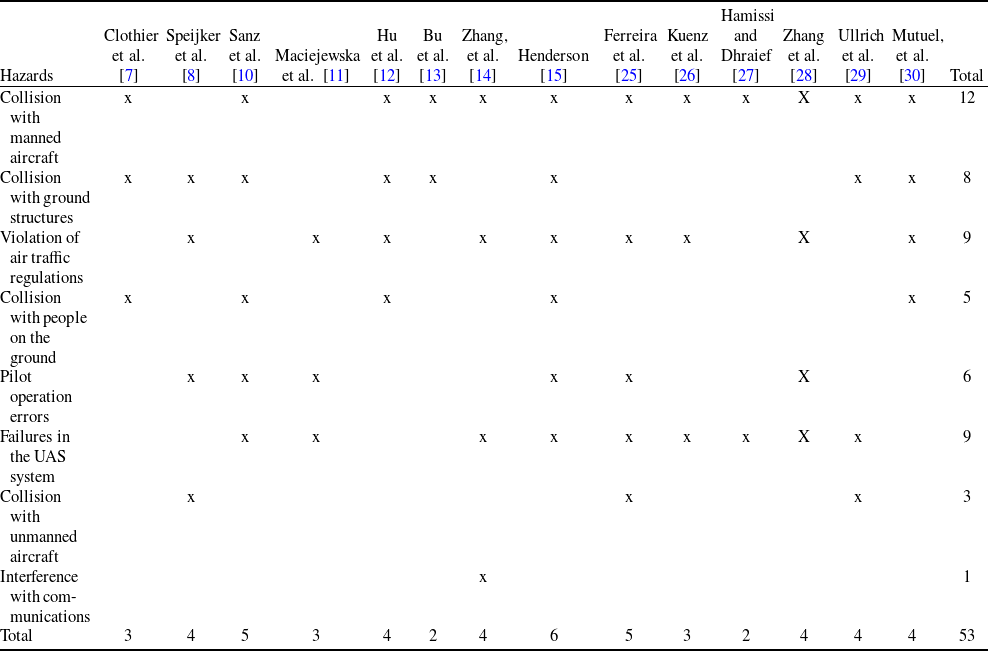
Clothier et al. [Reference Clothier, Palmer, Walker and Fulton7] identified collision risk as one of the main hazards associated with UAV use, especially when operated in areas shared with manned aircraft or over densely populated areas. Collisions with ground structures or other airspace users can cause severe disruptions in operations and endanger public safety. This risk is heightened in urban areas, where population density and airspace complexity significantly increase the damage potential.
Another set of hazards was identified by Sanz et al. [Reference Sanz, Valente, Del Cerro, Colorado and Barrientos10], who noted that both external sources (such as environmental conditions) and internal sources (such as mechanical, electrical or communication failures) could pose considerable risks to UAV operations. These failures may result in aircraft damage, injury to people or animals, and interference with other equipment, particularly when UAV operate close to critical infrastructure.
Maciejewska et al. [Reference Maciejewska, Kardach, Galant and Fuć11] presented a detailed analysis of hazards for UAV operation, using the SHELL model. These hazards were divided into five categories: operational environment, operator-related factors, RPA equipment, air traffic procedures and regulations. The consequences range from harm to people and structures to potential collisions with other aircraft or breaches of controlled airspace, making it crucial to adopt appropriate mitigation measures.
In urban operations, Hu et al. [Reference Hu, Pang, Dai and Low12] identified the possibility of collisions with people, vehicles and ground properties, as well as interferences with airport areas, as some of the most significant hazards. These risks are amplified in high air traffic areas, where the use of UAV near airports can create conflicts with manned aircraft during take-offs and landings.
Bu et al. [Reference Bu, Zhang, Hu and Liu13] analysed hazards from the perspective of air activities and highlighted the risk of conflicts between UAV and other aircraft, especially in areas with a high convergence of routes. The proximity to landing sites and the density of ground occupation are also critical factors that increase the risk of collisions and other incidents. Zhang et al. [Reference Zhang, Guo and Liao14] reinforced the importance of managing the collision risk between UAV and manned aircraft, particularly in congested airspace. Moreover, the authors noted that UAV could interfere with communications between air traffic controllers and pilots, leading to misinterpretations and potential invasions of restricted areas, such as airports or military zones.
Henderson [Reference Henderson15] complements this analysis by highlighting that aerial and ground hazard related to UAV use can be significantly reduced through operator awareness. Pilots’ lack of situational awareness, combined with communication and control system failures, increases the risk of accidents and incursions into critical areas. Operating in adverse weather conditions can also exacerbate these hazards, and non-compliance with safety regulations further increases risks.
Among the main hazards to the safety and efficiency of air traffic control services, Ferreira et al. [Reference Ferreira, Baum, Neto, Martins, Almeida, Cugnasca and Camargo25] identified the loss of communication with UAV, which can lead to route deviations and increase the risk of collisions. The difficulty in monitoring these operations, especially in urban areas, creates additional challenges for traffic controllers. Kuenz et al. [Reference Kuenz, Lieb, Rudolph, Volkert, Geister, Ammann and Walther26] had the same point of view by highlighting that traffic conflicts generated by UAV operations can lead to collisions and incursions into restricted areas. These problems are exacerbated by communication and navigation failures, which impact the provision of air traffic services and raise the risk of accidents.
Hamissi and Dhraief [Reference Hamissi and Dhraief27] also point out that vulnerabilities in the air traffic control system associated with UAV operations increase the probability of conflicts. The loss of control and communication with UAV can lead to unexpected and potentially hazardous situations, especially in operations close to manned aircraft.
Zhang et al. [Reference Zhang, Zou, Wu, Xie and Liu28] and Ullrich et al. [Reference Ullrich, Pothana, Thornby, Snyder and Vidhyadharan29] identify the risks of mid-air collisions as one of the main hazards related to UAV operations, particularly when there are communication or navigation failures. These risks are intensified in congested airspace, where the presence of critical infrastructure, such as antennas and airport structure, heightens the potential for physical collisions.
Mutuel et al. [Reference Mutuel, Wargo and Difelici30] add to this discussion by emphasising the risks of collision with fixed structures, aircraft and even people, especially in high-traffic areas. These hazards can result from unplanned route deviations or failures to comply with air traffic control regulations, representing a significant challenge to system safety and efficiency. The hazards related to drone operations found in the literature are shown in Table 1, prepared by the author.
Hazards related to drone operations identified in the literature

2.5 Framework
The theoretical framework developed in this study is based on the air traffic accident investigation model proposed by Wells and Rodrigues [Reference Wells and Rodrigues31], which identifies three main factors: human, material and operational. The human factor involves physiological and psychological aspects of the air traffic controller, such as behaviour, training, fatigue, stress and decision-making. The material factor refers to the physical components of control systems, such as radars, radios, and computers. The operational factor covers procedures, regulations, and coordination between crews and control agencies.
Aeronautics accidents generally result from the complex interaction between human errors, technical failures, environmental influences and management factors. Analysing these elements is crucial for improving the safety and effectiveness of air traffic control, especially in the context of UTM integration with ATM, one of aviation’s main contemporary challenges. The integration of these systems requires a multidisciplinary and specialised approach. Thus, the proposed framework organises SRM by considering three hazard groups: ATCO operational failure; service equipment failure; and pilot failure [Reference Speijker, Lee and Leijgraaf8].
ATCO operational failure involves human factors that can lead to operational errors. The lack of familiarity with new processes and the new airspace configuration, both internally within the work environment and externally due to new routes and procedures, can impact in ATCO effectiveness [Reference Lykou, Moustakas and Gritzalis1, Reference Bu, Zhang, Hu and Liu13, Reference Wells and Rodrigues31]. The absence of clear standards also contributes to inconsistencies, and psychological aspects resulting from change can impact performance, particularly in high-reliability environments such as air traffic control [Reference Wells and Rodrigues31]. The introduction of new technologies, procedures and responsibilities may lead to stress, cognitive overload, resistance to change or decision-making hesitation, especially when training or institutional support is insufficient.
Service equipment failure involves human errors in technical systems used for air traffic control. Problems with radio equipment can compromise communication between controllers and aircraft [Reference Brooker19], while radar failures hinder aircraft detection [Reference Wang, Tan and Low4]. Additionally, failures in fixed-line telephony and databases can impact communication between control services providers, the exchange of essential information [20] and power supply issues can also disrupt the functioning of control systems [20].
The category labeled as ‘Pilot Failure’ refers to human-related hazards associated with the operation of unmanned aircraft. To enhance clarity and specificity from the outset, this category was theoretically subdivided into three dimensions: (i) failure of UAS systems, such as technical or control issues attributable to the operator; (ii) failure in information and communication, including misunderstandings or lack of coordination between actors; and (iii) lack of knowledge of the new rules, particularly regarding regulatory or procedural updates related to UAS integration into controlled airspace. A lack of proper dissemination and awareness of changes in airspace can lead to operational errors [Reference Speijker, Lee and Leijgraaf8, Reference Sanz, Valente, Del Cerro, Colorado and Barrientos10, Reference Henderson15]. Additionally, technical failures in UAV systems can compromise the safety and effectiveness of operations [Reference Sanz, Valente, Del Cerro, Colorado and Barrientos10, Reference Zhang, Guo and Liao14]. The theoretical framework for risk managing change in UTM and ATM integration is shown in Fig. 3, prepared by the author.
Theoretical change management framework for UTM and ATM Integration. Source: Elaborated by the authors.

The proposed framework provides a structure for identifying, analysing and mitigating risks associated with the integration of UAV into controlled airspace. Implementing this framework can facilitate a safe transition to new operations, maintaining acceptable levels of operational safety and ensuring the effectiveness of the air traffic control system.
Previous studies have proposed risk assessment models for UAS integration into the airspace, such as the comprehensive safety risk management framework by Speijker et al. [Reference Speijker, Lee and Leijgraaf8], which considers multiple operational layers (design, operation and environment), and the empirical testing of dynamic geo-fencing strategies by Kuenz et al. [Reference Kuenz, Lieb, Rudolph, Volkert, Geister, Ammann and Walther26], focused on tactical mitigation in real flight trials. However, unlike these approaches, our framework specifically addresses hazards arising from the perspective of air traffic control operations, identifying critical failure points within the ATC workflow. Additionally, our study incorporates expert validation from operational safety specialists, aiming to support decision-making and enhance the applicability of the model to ATC procedures.
3.0 METHODOLOGY
This study began with a bibliometric survey to assess the state of the art in risk analysis for the integration of UTM airspace into ATM from the perspective of air traffic control. The literature search considered combinations of ‘Risk Management’, ‘Drone’, and related terms referencing this type of equipment. Using these terms, the following search sets were constructed: ‘risk management’ and ‘drone’, ‘risk management’ and ‘remotely piloted aircraft’, ‘risk management’ and ‘RPA’, ‘risk management’ and ‘unmanned aircraft system’, ‘risk management’ and ‘UAS’, ‘risk management’ and ‘unmanned aircraft system traffic management’, ‘risk management’ and ‘UTM’, ‘risk management’ and ‘air traffic management’, ‘risk management’ and ‘ATM’, ‘risk management’ and ‘unmanned aerial vehicle’, ‘risk management’ and ‘UAV’.
These terms were combined for searches in the Science Direct, Emerald, Scopus, Taylor & Francis and Wiley Online databases. Broadening the spectrum, searches were also conducted using combinations of keywords related to drone hazards for air traffic control. Thus, terms such as UAS and Hazard and Air Traffic Control, UAV and Hazard and Air Traffic Control, Drone and Hazard and Air Traffic Control, and RPA and Hazard and Air Traffic Control were used.
The PRISMA method (Preferred Reporting Items for Systematic Reviews and Meta-Analyses) was adopted for selecting documents due to its benefits for systematic reviews. Advantages include improved presentation of results, increased transparency and reproducibility of studies, as well as facilitating the identification of research gaps and enabling future investigations [Reference Moher, Liberati, Tetzlaff and Altman32].
Initially, 387 articles were identified. After review, 200 of them were eliminated as duplicates, leaving 187 for further evaluation, which involved reading and analysing abstracts. In this stage, 128 articles were excluded for not fitting the research topic.
These 59 articles left selected for full reading and detailed content analysis, with the aim of constructing the theoretical foundation of this study. During this phase, the focus was on verifying whether the articles addressed hazard identification associated with drone operation and conducted risk management analysis. The results indicated that 45 studies did not address hazards associated with drone operation and risk management, leading to their exclusion. Thus, 14 relevant articles were selected, forming the basis for constructing the theoretical framework of this research. The stages of the PRISMA method are shown in Fig. 4, adapted from Moher [Reference Moher, Liberati, Tetzlaff and Altman32].
Article selection flowchart based on the PRISMA protocol [Reference Moher, Liberati, Tetzlaff and Altman32].

The empirical phase of the research consisted of an expert evaluation on the theoretical framework on hazards related to drone operations. A Google form was developed and distributed to professionals from the aerospace sector. The instrument comprised 43 items: the first 3 focused on the respondent’s profile, and 32 were rated using a five-point Likert scale to assess the level of agreement with specific aspects of the framework. For each hazard and contributing factor, the most frequently assigned score (mode) was considered for analysis, as it better reflects the consensus perception among experts. Additionally, eight open-ended questions were included to capture the experts’ qualitative insights.
The participating experts work in air traffic operational safety across various organisational levels, contributing to both the integrity and efficiency of operations. In this study, they are identified as E1–E7.
-
• E1: With 30 years in air traffic control, including 12 years in administration, he currently coordinates service stations and supports operational safety training.
-
• E2: With 25 years in air traffic control and 14 in operational safety, he currently serves as the national head of operational safety.
-
• E3: With over 35 years in air traffic control and 15 in safety, he manages regulatory updates and has experience as a controller, instructor and supervisor.
-
• E4: With 24 years in aviation and 6 in air traffic control, he heads an agency that oversees 25% of national airspace and has experience in accident investigation.
-
• E5: With 22 years in aviation and 5 in control, he heads a local agency and is recognised for accident prevention and the integration of drone operations in Brazil.
-
• E6: With 23 years in safety management (SMS/SGSO), he is a Human Factors specialist involved in accident investigation and regulatory development.
-
• E7: Also with 23 years in safety management, she is a Human Factors specialist and psychological consultant focused on the well-being of air traffic controllers.
The broad experience of these professionals in regulation, operations, management and human factors, combined with their strategic roles at local, regional and national levels, provided a robust foundation for evaluating the proposed framework on drone-related hazards.
To validate the framework, a single-round Delphi approach was adopted, involving seven experts with extensive experience in air traffic control and operational safety. The structured questionnaire combined closed-ended Likert-scale items with open-ended questions to capture both quantitative agreement and qualitative insights. While no formal statistical reliability analysis was conducted, the high degree of convergence in expert responses supported the validation of the framework. Disagreements were minimal and addressed through qualitative interpretation of comments. Although the small sample size aligns with recommendations for Delphi studies in specialised technical fields, it is recognised as a limitation that may affect the generalisability of the results. This limitation is discussed further in the conclusion section.
4.0 RESULTS OF THE EXPERT ANALYSIS
Experts in air traffic operational safety were consulted to assess the hazards identified in the literature and the mitigating measures. The severity of each hazard and the effectiveness of the mitigating actions were rated using the five-point Likert scale, where 1 means “very low” and 5 means “very high”.
The first question addressed the possibility of a collision between unmanned aircraft and manned aircraft during air traffic control services. This issue was considered extremely important, reflecting the primary function of air traffic control: ensuring the safety of manned aircraft. All experts rated the issue highly, with most fully agreeing (rating 5). Only Expert E1, with operational experience, rated it 4, arguing that the use of early detection technologies could help ensure safe separation between UAV and manned aircraft.
Next, the experts assessed the effectiveness of three mitigation strategies: updating regulations, using technology to alert UAV in critical areas and training ATCO for the new operational scenario. Updating regulations were widely regarded as effective, with Experts E2, E3, E4 and E7 giving it a rating of 5, while E1 disagreed, considering it insufficient without additional complementary measures. The use of technology was unanimously viewed as essential (rating 5), and training was considered crucial by most, although E1 and E5 suggested that training alone lacked practical specificity.
The experts were also asked to propose additional actions to mitigate the possibility of collisions between UAV and manned aircraft. Suggestions included the segregation of airspace for UAV, as proposed by E1, and applying the same airworthiness requirements for UAV as for manned aircraft, as proposed by E3. E5 emphasised the importance of raising awareness among UAV operators about airspace operational rules.
The second statement explored the possibility of UAV collisions with ground structures during service provision. The experts had differing opinions, with E3 and E6 assigning the highest degree of importance (5), while E1 considered the hazard irrelevant (rating 1). Most of them recognised that ATCO do not have direct responsibility for separation between UAV and obstacles, but that technological and planning measures could minimise these risks.
The experts were also asked to assess the effectiveness of mitigating measures for this hazard, including updating regulations and using technology. The update of regulations received mixed evaluations, with E3, E6 and E7 giving it high importance (rating 5), while E1 and E2 questioned its practical applicability (rating 1). The use of technology was highly rated by most, although E1 and E2 highlighted the need for automation of these resources to increase their effectiveness. In addition to the measures analysed, the experts suggested improvements, such as updating obstacle databases near aerodromes (E3) and implementing technological barriers to prevent UAV from entering restricted areas (E4).
The third statement addressed non-compliance with air traffic regulations by UAV pilots. All experts agreed that this is a highly relevant issue (rating 5), emphasising that regulatory violations increase risks and compromise safety. Most experts agreed that updating regulations could mitigate these risks, but E2 highlighted that the greatest effectiveness would come from imposing severe penalties on UAV operators who violate regulations.
Regarding the use of technology, experts were broadly supportive, with E1, E3, E4 and E5 agreeing that electronic systems could facilitate the identification of violations and ensure greater safety. However, opinions on ATCO training were divided: while E3 and E7 considered it essential, others, such as E1, believed that it would not be sufficient to prevent violations, as controllers’ actions could not predict all UAV pilot errors. Finally, the experts also suggested additional actions, such as requiring UAV pilot training like that required for manned aircraft pilots (E3) and imposing strict penalties for air traffic violations (E5).
The consultation with the experts revealed consensus on the importance of mitigating the identified hazards, although there were differing opinions on the most effective measures. Combination of regulation, technology and training was widely considered the most efficient approach to ensuring operational safety in shared airspace between UAV and manned aircraft.
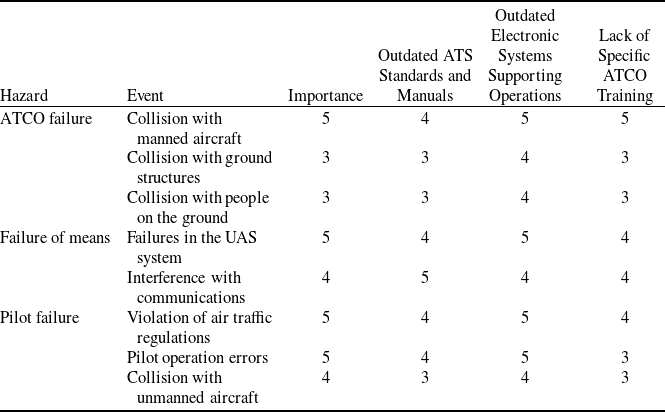
Table 2 presents the distribution of the most frequent scores (mode) assigned by the experts to each identified hazard. These values, obtained from a 5-point Likert scale, reflect the predominant perception regarding the relevance of each hazard within the proposed framework. Additionally, the table includes expert assessments of three contributing factors that may influence risk perception: outdated ATS standards and manuals, outdated electronic systems supporting operations, and lack of specific ATCO training. This structure allows for a comparative analysis of how these contextual factors may affect the prominence of each hazard.
Principal hazards, events and contributing factors based on expert judgement

In the construction of the proposed framework, each point of systemic interaction was classified by similar groups, creating a practical structure to guide the multidisciplinary team in risk analysis and the proposal of mitigating measures to maintain or enhance operational safety levels. The experts evaluated the framework, considering three main hazards identified in the literature: operational failure of the air traffic controller (ATCO); failures in technical means for service provision; and pilot failure.
Regarding the operational failure of the ATCO, the experts suggested adaptations to the framework to reflect the complexity of the environment. E1 emphasised the importance of ATCO fully understanding the new rules and suggested additional training. E2 proposed simulations to prepare ATCO for mixed traffic. E3 and E4 recommended replacing ‘ignorance’ with ‘failure’ in procedures, expanding the scope to include deficiencies in regulation and the risk of insufficient training. E5 and E6 reinforced the need for a multidisciplinary team and clear procedures, while E7 recommended greater attention to psychological and human factors. In summary, the experts suggest adjusted terminology, continuous training, and the inclusion of regulations in the framework.
Concerning technical failures, E1 highlighted the importance of UAV equipment to facilitate the detection of unmanned aircraft, while E2 emphasised the need to identify both UAV and manned aircraft. E3 suggested replacing ‘radar failure’ with ‘failures in surveillance systems’, including technologies such as multilateration and automatic dependent surveillance, and proposed adding failures in the aeronautical information service. E4 pointed out that the framework should reflect adjustments for the new UTM concept. In general, the suggestions included improvements in UAV detection, adjustments to surveillance systems, and specific regulations for new equipment.
As for the possibility of pilot failure, E1 highlighted the importance of raising awareness among pilots about the new configurations and processes. E2 suggested specifying that the hazard applies to UAV pilots, and E3 included failures in pilot training. E4 proposed improving communication, suggesting class representatives in training sessions, while E5, E6 and E7 agreed with the framework, with E6 emphasising the inclusion of pilots in ATCO guidance. The suggestions centred on clear communication, distinguishing between types of pilots and considering training failures.
The proposed framework, refined with expert input, offers a structured approach to risk analysis and hazard mitigation for the integration of UAV into air traffic control operations, as shown in Fig. 5.
Framework for risk analysis and hazard mitigation in the integration of UAV into air traffic control.

The suggestions from the operational safety experts were incorporated into the framework, representing a significant advancement for multidisciplinary risk management and operational safety team meetings. The framework was recognised as a promising proposal, as it offers a clear and objective organisation to facilitate the execution of complex tasks, providing a practical and functional model for the involved team.
E1 highlighted the potential of the framework to be replicated in other contexts, praising its comprehensiveness in evaluating the essential elements of the air traffic system. E2 also considered the proposal promising but suggested more detailed discussions about gaps, especially during the transition period, emphasising the need for specific adaptations for different contexts. E3 approved the robustness of the framework, with its division into three main sources of hazard, which facilitates the analysis and implementation of corrective measures, only suggesting adjustments for broader application.
E4 considered the framework a solid tool for guiding teamwork in the early phases of risk analysis, recommending flexibility to adapt it as necessary. E5 reinforced the adaptability of the framework as a strong point for dealing with varied challenges, provided specific adjustments are made. E6 cautioned that, in scenarios of significant change, the framework could limit hazard analysis, reinforcing the importance of considering this point in less experienced teams. Furthermore, E7 emphasised the importance of a collaborative approach, suggesting the replacement of the term ‘group’ with ‘team’ and agreeing with the replicability of the framework, if it is adapted during multidisciplinary meetings.
In summary, the framework was widely accepted by the experts as a valid guide for risk management, with a particular emphasis on its applicability in various projects. Aspects such as training and the analysis of human factors were highlighted as essential for the success of the implementation.
5.0 DISCUSSION
The operation of UAV presents significant risks to aviation, including mid-air collisions and ground accidents due to communication failures and piloting errors [Reference Zaréa, Pognonec, Schmidt, Schnur, Lana, Boehm and Rigaud2]. The risk management framework developed in this study addresses these hazards and provides specific mitigation methods, focusing on the integration of UTM with ATM from the perspective of air traffic control. This responds to the urgent need to prepare the ATM system to incorporate UAV management (UTM), as emphasised by Besada et al. [Reference Besada, Campaña, Bergesio, Bernardos and Miguel6], facilitating the safe and efficient integration of systems and ensuring smooth operations in controlled airspace.
Safety in the integration of drones into airspace is a key concern. Challenges such as UAV detection, pilot and controller training and the unauthorised use of drones are issues that require a systematic approach to risk mitigation [Reference Kopardekar, Rios, Prevot, Johnson, Jung and Robinson16]. The proposed framework addresses these concerns by providing a clear structure for identifying and mitigating risks, supporting the risk management team in establishing measures that ensure a safe and organised transition.
While the literature discusses the hazards of UAV in airspace, no studies have specifically addressed UTM-ATM integration from the air traffic control perspective, which is crucial for operational safety [Reference Wang, Tan and Low4, Reference Zhang, Guo and Liao14]. This work fills that gap, aligning with ICAO [24] guidelines to identify, assess and mitigate risks in air traffic control.
From a scientific perspective, this research contributes to the understanding of the challenges in introducing UAV into ATM, addressing issues of hazard detection and the development of new technologies and traffic control methods [Reference Grote, Pilko, Scanlan, Cherrett, Dickinson, Smith and Marsden17]. The global analysis of hazards resulting from UTM-ATM integration and expert validation indicates that the framework can maintain or enhance operational safety levels, meeting ICAO [24] objectives for change management.
The framework provides solutions for integration issues, such as improving technical systems and training pilots and controllers, aligning with the three risk axes (human, environment, and technology) proposed by Wells and Rodrigues [Reference Wells and Rodrigues31] and strengthening barriers to causal factors [Reference Speijker, Lee and Leijgraaf8]. The study not only identifies a knowledge gap but also advances by incorporating insights from experts directly involved in the research challenges. Expert validation ensures the legitimacy and robustness of the framework, guaranteeing that its guidelines are rigorous, applicable, and aligned with practice, thus reinforcing its reliability and practical and scientific relevance, while also highlighting areas for continuous improvement.
While previous studies such as Speijker et al. [Reference Speijker, Lee and Leijgraaf8] have proposed system-level frameworks for UAS safety risk management, and Kuenz et al. [Reference Kuenz, Lieb, Rudolph, Volkert, Geister, Ammann and Walther26] examined tactical mitigation tools like dynamic geo-fencing, these works do not focus specifically on the hazards introduced into air traffic control procedures. The framework proposed in this study addresses this gap by classifying operational hazards from the ATCO perspective and supporting risk-based decision-making in air traffic environments. This specificity reinforces the originality and applicability of the framework for managing the transition to integrated airspace operations.
Although this study addresses known hazard categories and mitigation strategies, it is important to acknowledge that many scenarios involving UAS operations remain uncertain or only partially understood. Situations involving partial system failures, such as intermittent loss of communication or degraded navigation capabilities, may not fit neatly into predefined risk categories but can significantly affect operational safety. Moreover, the dynamic nature of UAS missions demands that ATM procedures be flexible and adaptive to in-flight changes. These aspects underscore the need for ongoing updates to risk frameworks and training protocols to better prepare stakeholders for emerging and evolving threats.
6.0 CONCLUSION
The research objectives were achieved, as the developed framework provides unprecedented guidance for the organisation and analysis of risks related to the integration of UTM into ATM, enabling the multidisciplinary risk management and operational safety team to propose specific mitigation measures for the introduction of drones into air traffic. This framework provides a practical guide for risk analysis in the context of air traffic control, focusing on operational safety.
This study contributes to theory by filling a gap identified in the literature, as no articles were found on UAV integration into the ATM system. The creation and validation of the framework is a knowledge advancement, adding new insights into risk management in air traffic control and strengthening the theoretical foundation for future studies in the field.
In practice, the framework provides valuable initial guidance for managers and operational safety professionals. It allows for the identification and discussion of key hazards in advance, enabling preventive decisions that minimise risks and ensure a safer implementation of UAV in airspace, both during the transition and in daily operations.
By promoting the safe integration of drones into airspace, this work contributes to the confidence and acceptance of this technology in society, maximising its benefits and strengthening the air traffic management system. Thus, the framework helps in developing a safe and efficient infrastructure, positively impacting both public safety and economic development opportunities.
This study has limitations, as it was based on the opinions of a specific group of operational safety experts whose technical training originates from the same national technical school. This homogeneity may limit the diversity of perspectives. Furthermore, the analyses focused specifically on the integration of UTM into ATM, although the proposed framework has potential for adaptation to other future changes.
To expand the applicability of the results, it is suggested that future research test the framework in other areas or changes in the aviation sector to confirm its validity in different contexts. Additional studies could also explore the social and economic implications of using drones in air traffic control, including potential reductions in operational costs and increased efficiency at airports, as well as new business and employment opportunities in drone technology, while always ensuring operational safety and risk mitigation.
Furthermore, although the proposed framework is qualitative in nature, future research could incorporate quantitative risk assessment tools, such as probability versus severity matrices, weighted scoring models or alignment with ICAO Safety Management System standards, to enhance the practical applicability of the model for regulatory bodies and air traffic control authorities.