Introduction
Niche breadth is a central topic in ecology (Devictor et al. Reference Devictor, Clavel, Julliard, Lavergne, Mouillot, Thuiller, Venail, Villéger and Mouquet2010; Slatyer et al. Reference Slatyer, Hirst and Sexton2013; Sexton et al. Reference Sexton, Montiel, Shay, Stephens and Slatyer2017) and characterizes where species might sit on the spectrum between niche specialist and generalist. Thus, in classic ecological models a species’ niche breadth was expected to correspond to its relative commonness or rarity and the consequent structure of communities, translated into rank-abundance plots (Hutchinson Reference Hutchinson1957; Whittaker Reference Whittaker1972). However, comparison of niche breadth among different species can be challenging when considering multiple individual species-specific niche models. Factors selected into niche models (those with the greatest explanatory power) may be contrasting, that is, because species are constrained in their distribution or abundance by different limiting effects. This has led to methods for inferring specialization-generalization without reference to ecological details, such as those based on patterns of spatial co-occurrence (Fridley et al. Reference Fridley, Vandermast, Kuppinger, Manthey and Peet2007; Boulangeat et al. Reference Boulangeat, Lavergne, Van, Gaurraud and Thuiller2012). Alternatively, the aim of this study was to compare niche breadth among different lichen species by constructing a model that encapsulates key constraints to lichens in general terms, being relevant to individual species though also broadly defensible when comparing all species in a habitat. The approach focuses on woodland epiphytes, using ordination to collapse gradients relating to moisture and temperature, light, and trophic status into a hypervolume (cf. Hutchinson Reference Hutchinson1957; Whittaker Reference Whittaker1972; Carnes & Slade Reference Carnes and Slade1982; Devictor et al. Reference Devictor, Clavel, Julliard, Lavergne, Mouillot, Thuiller, Venail, Villéger and Mouquet2010; Blonder Reference Blonder2018), and with the proportion/percent of the hypervolume that is occupied by a given species (niche breadth) used to estimate a niche specialism score. It is tried here for an ecological guild (calicioid species) that has been repeatedly flagged as an indicator of old-growth forest structure and asks whether this status is consistent with high niche specialism.
Many studies have reported the spatial association of certain lichen species with old-growth forest stands (Tibell Reference Tibell1992; Goward Reference Goward1994; Selva Reference Selva1994), including ancient but cultural wooded landscapes (Rose Reference Rose, Morris and Perrring1974, Reference Rose, Brown, Hawksworth and Bailey1976). These lichen species are expected to be sensitive to two processes that can explain their association with old-growth and their referral under the rubric of ‘ecological continuity’ (Coppins & Coppins Reference Coppins and Coppins2002). First, niche specialism, with some lichens requiring structures (e.g. canopy gaps) or microhabitats skewed towards old-growth stands, such as on veteran and senescent trees (Nascimbene et al. Reference Nascimbene, Marini, Motta and Nimis2009; Fritz & Heilmann-Clausen Reference Fritz and Heilmann-Clausen2010). Second, dispersal limitation, with some lichens restricted to old-growth stands because low probabilities of colonization (Dettki et al. Reference Dettki, Klintberg and Esseen2000; Sillett et al. Reference Sillett, McCune, Peck, Rambo and Ruchty2000) are relaxed over time. Lichen epiphytes dependent on ecological continuity, and thus associated with old-growth, have been developed as regional indices (e.g. Nitare Reference Nitare2000; Coppins & Coppins Reference Coppins and Coppins2002) which, for the highly deforested temperate biome (Hannah et al. Reference Hannah, Lohse, Hutchinson, Carr and Lankerani1994, Reference Hannah, Carr and Lankerani1995), provide a strong proxy for habitat conservation value. Although early work scoping ecological continuity or old-growth lichen indicators was based on qualitative or semi-quantitative field interpretation, recent statistical tests appear to confirm their significance (Whittet & Ellis Reference Whittet and Ellis2013; Dymytrova et al. Reference Dymytrova, Brändli, Ginzler and Scheidegger2018; Miller et al. Reference Miller, Villella, Stone and Hardman2020). In particular, longitudinal monitoring (Öckinger et al. Reference Öckinger, Niklasson and Nilsson2005; Belinchón et al. Reference Belinchón, Harrison, Mair, Várkonyi and Snäll2017), spatial pattern analysis (Gu et al. Reference Gu, Kuusinen, Konttinen and Hanski2001; Williams & Ellis Reference Williams and Ellis2018) and population genetics (Walser Reference Walser2004; Jüriado et al. Reference Jüriado, Liira, Csencsics, Widmer, Adolf, Kohv and Scheidegger2011) support a limited dispersal of these indicators over ecological timescales.
Lichens and some non-lichenized fungi predominantly with mazaedia and often stalked apothecia (‘stubble’ or ‘pin-head’ lichens), while being polyphyletic (Wedin & Tibell Reference Wedin and Tibell1996; Prieto et al. Reference Prieto, Baloch, Tehler and Wedin2013), are recognized by lichen ecologists as being convergent in a ‘calicioid’ trait group, including genera such as Calicium and Chaenotheca (lichenized) or Microcalicium (non-lichenized). Calicioid species have been documented as having among the strongest spatial association with old-growth forest stands (Holien Reference Holien1996; Selva Reference Selva2003; Nascimbene et al. Reference Nascimbene, Marini and Nimis2010; Goward & Arsenault Reference Goward and Arsenault2018; Malíček et al. Reference Malíček, Palice, Vondrák, Kostovčík, Lenzová and Hofmeister2019). Nevertheless, calicioid species have relatively small spores, typically ≤ 20 μm (fig. 11 in Tibell (Reference Tibell1994)), which appear to be comparatively widely dispersed at biogeographical and ecological scales (Tibell Reference Tibell1994; Kruys & Jonsson Reference Kruys and Jonsson1997). Consequently, calicioids would be expected to demonstrate a comparatively high niche specialism, since this would be the primary mechanism explaining their status as old-growth indicators. Calicioid species should therefore be more niche specialist than lichen epiphytes in general, and also more specialist than other lichen indicators of ecological continuity, a group which, overall, will include a proportion of species more constrained by dispersal-limitation relative to their niche specialism.
This study explored the use of the hypervolume approach, described above, to test the hypothesis that epiphytic and corticolous calicioid species are more niche specialist relative to other epiphytes. If this turns out not to be the case, it will be necessary to revisit assumptions about the dispersal capacity of these small-spored species, and/or invoke establishment constraints that might be explained through high specificity or selectivity towards lichen photobionts (cf. Tibell Reference Tibell2001; Tibell & Beck Reference Tibell and Beck2001; Yahr et al. Reference Yahr, Vilgalys and DePriest2004).
Methods
Field and environmental sampling
Field sampling is described in detail by Ellis et al. (Reference Ellis, Eaton, Theodoropoulos and Elliott2015) and summarized here. Twenty ancient woodland sites were selected (cf. Roberts et al. Reference Roberts, Russel, Walker and Kirby1992; Whittet et al. Reference Whittet, Hope and Ellis2015), positioned across a longitudinal climate gradient from oceanic western to relatively continental north-eastern Scotland, and 10 equidistant points were positioned within the boundary of each site. Points were visited in random order, to accumulate a list of contrasting tree species in contrasting size categories that were sampled for their epiphytes in a way that captured site heterogeneity (maximizing tree species and tree size differences). Sampling used quadrats of 4 × 6 cm, 6 × 9 cm or 9 × 12 cm (depending on tree size), split into sub-units to record species frequency of occurrence per quadrat, with a minimum of four quadrats per tree at random heights between 30 and 200 cm for each cardinal aspect (north, south, east and west), and adding intermediate aspects as tree size increased (> 75 cm dbh). Accordingly, a total of 1013 quadrats was sampled from 250 individual trees across the 20 sites.
Field sampled quadrats were each accompanied by 20 environmental variables, the selection of which was based on a literature review that had examined the constraints explaining lichen epiphyte distribution and community structure (Ellis Reference Ellis2012), as follows:
Macroclimate. The growth of lichens is sensitive to regional gradients in the availability of moisture and temperature (Boucher & Nash Reference Boucher and Nash1990; Gauslaa et al. Reference Gauslaa, Palmqvist, Solhaug, Holien, Hilmo, Nybakken, Myhre and Ohlson2007; Ellis et al. Reference Ellis, Geddes, McCheyne and Stansfield2017), including their susceptibility to, and recovery from, cold temperatures (Solhaug et al. Reference Solhaug, Chowdhury and Gauslaa2018). Consequently, lichen distributions are often aggregated into different bioclimatic regimes (Coppins Reference Coppins, Brown, Hawksworth and Bailey1976; Ellis et al. Reference Ellis, Coppins, Dawson and Seaward2007), which correlate with an underlying growth response to climate (Braidwood & Ellis Reference Braidwood and Ellis2012). Macroclimatic variables were therefore mean relative humidity, totals for annual precipitation and precipitation during the driest quarter, mean annual and minimum temperatures, all for the 30-year period 1981–2010, interpolated from instrumental measurements at a 1 km grid-scale (Hollis et al. Reference Hollis, McCarthy, Kendon, Legg and Simpson2019).
Stand-scale microclimate. The macroclimate is modified by the topographic position of a stand, including features that can control lichen water balance, considering that lichens are both poikilohydric and only physiologically active when hydrated, enabling daytime photosynthesis (Palmqvist & Sundberg Reference Palmqvist and Sundberg2000; Palmqvist et al. Reference Palmqvist, Dahlman, Jonsson, Nash and Nash2010) and nocturnal stress recovery and tissue growth (Bidussi et al. Reference Bidussi, Gauslaa and Solhaug2013; Alam et al. Reference Alam, Gauslaa and Solhaug2015). Stand-scale variables were therefore a measure of physical exposure related to the drying effect of wind (detailed aspect method of scoring, DAMS: Quine & White Reference Quine and White1994; Suárez et al. Reference Suárez, Gardiner and Quine1999), distance to the nearest watercourse, which has been shown to control and explain lichen occurrence/abundance (Belinchón et al. Reference Belinchón, Martínez, Otálora, Aragón, Dimas and Escudero2009; Rambo Reference Rambo2010; Stehn et al. Reference Stehn, Nelson, Roland and Jones2013) and growth (Rambo Reference Rambo2010; Ellis Reference Ellis2020), and a heat load index based on latitude, slope and aspect (McCune & Keon Reference McCune and Keon2002; McCune Reference McCune2007).
Tree-scale microclimate. Again, in relation to thallus hydrology, the macroclimate and stand-scale effects will be modified by tree-scale microclimates, and variables were therefore the height on the tree bole, which affects the growth of individual species (Antoine & McCune Reference Antoine and McCune2004; Merinero et al. Reference Merinero, Martínez, Rubio-Salcedo and Gauslaa2015) and the structure of epiphyte communities (Kenkel & Bradfield Reference Kenkel and Bradfield1986; Bates Reference Bates1992; McCune et al. Reference McCune, Rosentreter, Ponzetti and Shaw2000), likewise the angle of bole lean (Kenkel & Bradfield Reference Kenkel and Bradfield1986; Bates Reference Bates1992; McCune et al. Reference McCune, Rosentreter, Ponzetti and Shaw2000; Doering & Coxson Reference Doering and Coxson2010), as well as bark furrow depth and cover of bryophytes which are both important in regulating lichen establishment and growth (Sillett & McCune Reference Sillett and McCune1998; Colesie et al. Reference Colesie, Scheu, Green, Weber, Wirth and Büdel2012; Rubio-Salcedo et al. Reference Rubio-Salcedo, Merinero and Martínez2015).
Light availability. The growth of lichens is physiologically constrained by light availability (Palmqvist & Sundberg Reference Palmqvist and Sundberg2000; Palmqvist et al. Reference Palmqvist, Dahlman, Jonsson, Nash and Nash2010), though species are differently adapted to light and shade (Demmig-Adams et al. Reference Demmig-Adams, Máguas, Adams, Meyer, Kilian and Lange1990; Manrique et al. Reference Manrique, Balaguer, Barnes and Davison1993; Gauslaa & Solhaug Reference Gauslaa and Solhaug1996). Variables were therefore a measure of direct radiation based on latitude, slope and aspect (McCune & Keon Reference McCune and Keon2002; McCune Reference McCune2007), indicative of below canopy light transmission (Lieffers et al. Reference Lieffers, Messier, Stadt, Gendron and Comeau1999; Angelini et al. Reference Angelini, Corona, Chianucci and Portoghesi2015) the basal area of the five nearest surrounding trees to approximate structural density, canopy openness measured around a sampled tree using a densiometer (Lemmon Reference Lemmon1956; Englund et al. Reference Englund, O'Brien and Clark2000; Paletto & Tosi Reference Paletto and Tosi2009), and the aspect of a quadrat on the tree bole, folded around a north-south axis (cf. McCune & Keon Reference McCune and Keon2002; McCune Reference McCune2007).
Physical-chemical conditions. The physical and chemical bark microhabitat has been shown to control occurrence and abundance of lichen species and patterns of community composition (Gauslaa Reference Gauslaa1985; Bates Reference Bates1992), and variables were therefore bark pH and conductivity (Kuusinen Reference Kuusinen1996; Jüriado et al. Reference Jüriado, Liira, Paal and Suija2009; Mežaka et al. Reference Mežaka, Brūmelis and Piterāns2012), as well as bark density and water holding capacity (Loppi & Frati Reference Loppi and Frati2004; Mistry & Beradi Reference Mistry and Beradi2005; Kubiak & Osyczka Reference Kubiak and Osyczka2020).
For detailed methods regarding measurement of environmental variables, see Ellis et al. (Reference Ellis, Eaton, Theodoropoulos and Elliott2015).
Statistical analysis
Analysis was based on the Hutchinsonian niche model (cf. Hutchinson Reference Hutchinson1957; Blonder Reference Blonder2018), which imagines a circumscribed environmental space or ‘hypervolume’ within which a species can complete its life cycle (establishment, growth and survival, reproduction). This volume is bounded by the species position along multiple axes, with the axes being environmental variables that limit the consequent occurrence or abundance of a species, and scaling to community composition.
To quantify the hypervolume concept, two ordination approaches were tested. First, a principal components analysis (PCA) was used to summarize covariance among the 20 selected environmental variables. PCA was performed using the prcomp package in R v. 4 (R Development Core Team 2020) with variables centred and scaled to unit variance. PCA assumes linearity among the environmental covariables. Second, non-metric multidimensional scaling (NMDS) was used to summarize difference among the samples with respect to environmental variables that were first standardized to avoid negatives (e.g. for minimum temperatures, or angle of bole lean). NMDS better handles non-linearity among environmental covariables (McCune & Grace Reference McCune and Grace2002). NMDS was performed using PC-Ord v. 6 (McCune & Mefford Reference McCune and Mefford2011), based on a Bray-Curtis distance matrix; search for an optimized solution was for a maximum of six ordination axes based on 500 runs with the observed data (step length = 0.2, stability criterion = 0.00001 with 100 runs to estimate stability), and with the significance of the optimum solution estimated against 1000 runs with randomized data.
Selecting the ordination (PCA or NMDS) that yielded the greatest variation explained for the lowest number of axes, the convex hull for all samples in ordination space was calculated using the geometry package in R v. 4 (R Development Core Team 2020), approximating the hypervolume of sampled environmental space available for species occurrence. Convex hulls relating particularly to each species niche were then calculated using the ordination scores for the samples within which a species occurred. Mathematically, this could be achieved for all epiphyte species with occurrences ≥ the number of relevant ordination axes plus one, that is the minimum number of points required to calculate a simplex; in practice, the method was applied only to species with ≥ 5 occurrences. The environmental space circumscribed by the samples within which a species occurred defined its niche breadth. Niche specialism was subsequently estimated by considering niche breadth relative to the hypervolume of sampled environmental space, that is, dividing the convex hull of the occupied samples by the convex hull for all samples, and multiplying by 100 to create a niche specialism score. Note that the lower the niche specialism score, the narrower the niche breadth with respect to sampled environmental space, and the higher the niche specialism.
Given this approach, it was important to test whether a species niche specialism was consistent with a deterministic niche model. In contrast, a neutral model (Hubbell Reference Hubbell2001; Etienne & Alonso Reference Etienne and Alonso2007) would predict that the number of occurrences, and therefore the extent to which a species is calculated to be a niche specialist or generalist, would scale with a process of random selection given the species abundance in a regional species pool. Niche specialists could therefore be identified as those with a niche specialism exceeding that of a null taxon with equivalent occurrence. Accordingly, null taxa were constructed at different occurrence levels, being randomly assigned to the samples in environmental space. Niche specialism scores were calculated for null taxa, repeated 10 000 times for each different occurrence level. Species with deterministic niches were identified in a one-tailed test as those with a niche specialism score exceeding the 5th percentile of their null taxa with equivalent occurrence (P < 0.05).
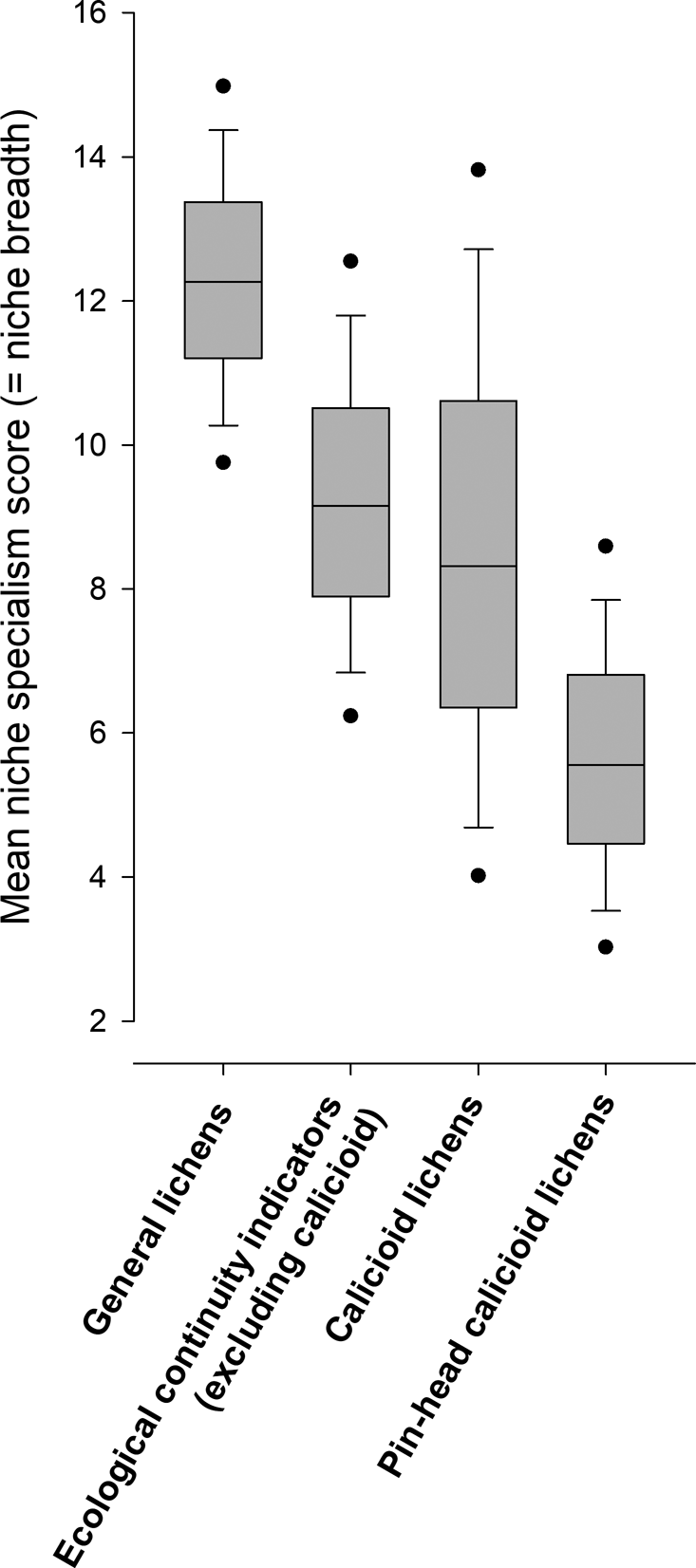
Species passing the null model test were grouped as follows: i) all lichens excluding ecological continuity indicator species relevant to the study area (Coppins & Coppins Reference Coppins and Coppins2002) and by default excluding calicioid species, ii) ecological continuity indicator species, excluding calicioid species, iii) broadly defined calicioid species including fruticose lichens such as Sphaerophorus globosus (Huds.) Vain., and iv) calicioids including only the pin-head morphology. The niche specialism scores were compared among groups by resampling their component species with replacements (10 000 times) to calculate their bootstrapped means, plotted as boxplots.
Furthermore, to aid interpretation of niche constraints, the mean (weighted average) position of calicioid species was calculated along individual ordination axes for the samples in which they occurred, and plotted into the sampled environmental space, while ordination axes were interpreted through Spearman's rank correlation with the 20 environmental variables.
Results
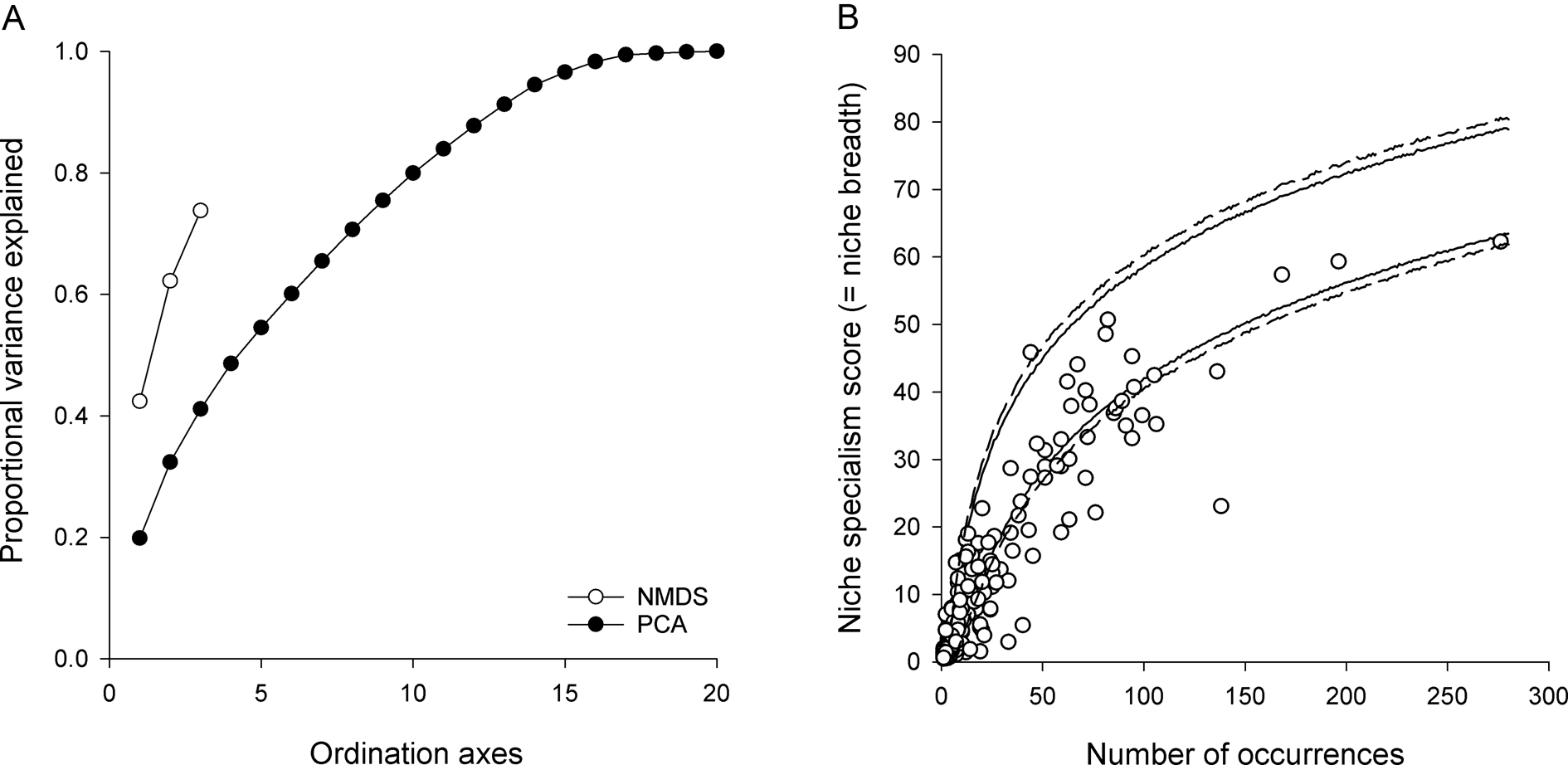
Analysis of the 20 environmental variables by PCA suggested that a large number of axes would be required to adequately represent environmental variation (15 axes to explain ≥ 95%), while NMDS identified a statistically significant (P < 0.001) optimum solution with three axes (stress = 18.96, instability < 0.00001). The three NMDS axes explained 73.8% of environmental variation, while nine PCA axes would be required for a comparable result (Fig. 1A). NMDS was therefore adopted as a parsimonious method that summarized non-linear relationships among the environmental variables.
A, comparison of environmental variance explained with the number of ordination axes for alternative methods of PCA and NMDS. B, comparison of a species calculated niche specialism (circles), with thresholds for niche specialism based on randomization for a given number of occurrences, at the 5th to 95th (solid lines) and 2.5th to 97.5th percentiles (dashed lines). Circles below the 95th percentile show species with niche specialism exceeding null expectation for a one-tailed test (P < 0.05).

Of an initial 294 fully identified species sampled as epiphytes (Ellis et al. Reference Ellis, Eaton, Theodoropoulos and Elliott2015), there were 183 with ≥ 5 occurrences. Of these, 113 (62%) passed the null model test for niche specialism (Fig. 1B), including 30 lichens assumed to be indicators of ecological continuity (Coppins & Coppins Reference Coppins and Coppins2002), plus an additional six calicioid species: Calicium salicinum Pers., C. viride Pers., Chaenotheca ferruginea (Turner ex Sm.) Mig., Ch. trichialis (Ach.) Th. Fr., Microcalicium disseminatum (Ach.) Vain. and Sphaerophorus globosus. When the mean scores for niche specialism were bootstrapped, it was clear that indicators of ecological continuity are more niche specialist than lichen epiphytes in general (Fig. 2). When including the fruticose Sphaerophorus globosus, the calicioid species had similar niche specialism to other ecological continuity indicators, but when restricting to pin-head calicioids there was a further shift towards higher levels of niche specialism than other ecological continuity indicators.
Bootstrapped mean of niche specialism scores for four different lichen groups. Boxplots show the median (line), 25th to 75th percentiles (box), 10th to 90th percentiles (whiskers), and 5th and 95th outliers (symbols). Note that the lower the niche specialism score, the narrower the niche breadth with respect to sampled environmental space, and the higher the niche specialism.

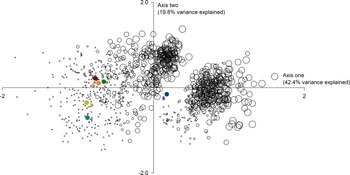
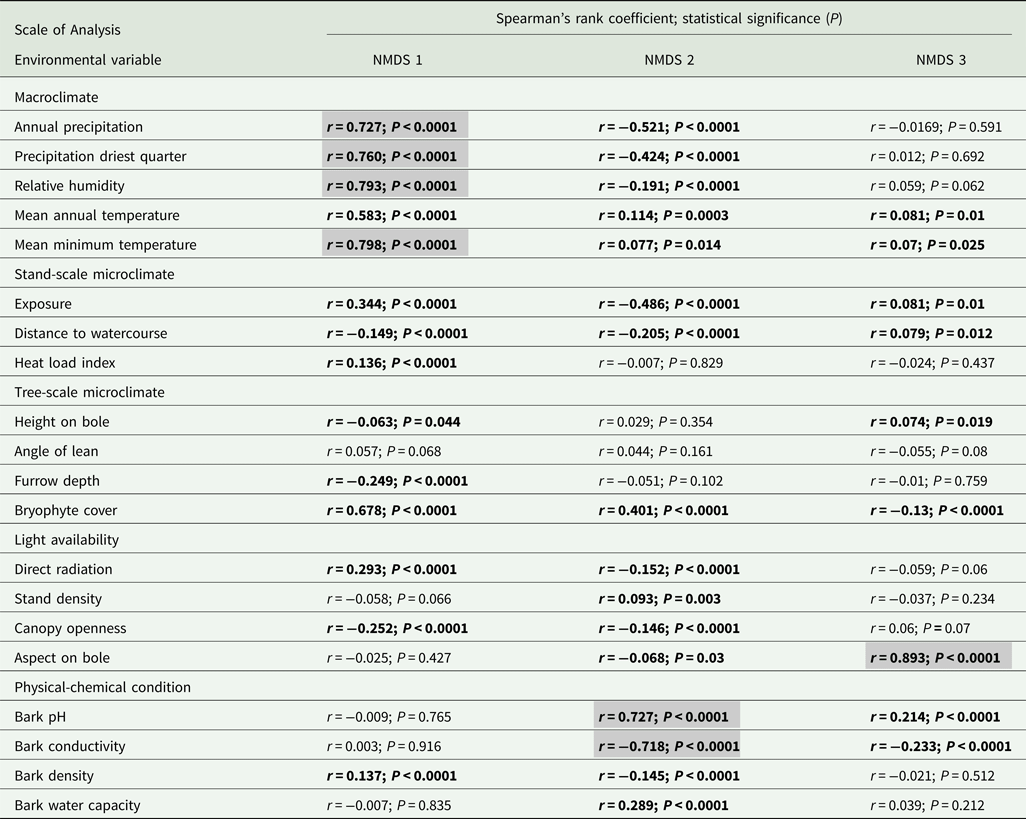
Niche position could be interpreted alongside niche specialism by considering how calicioid species plot into environmental ordination space (Fig. 3), and the relationship of ordination axes with environmental variables (Table 1). Thus, Sphaerophorus globosus appeared to occur under higher moisture conditions than the pin-head calicioids, which were closely grouped towards negative axis one scores representing drier and cooler climates, well-lit stand positions, and sheltered microhabitats (e.g. deeper bark furrows), being conditions that strongly contrasted with bryophyte-dominated communities, for example. However, there was wider spread in niche position encompassing positive and negative scores for axis two, representing differences between species tending to occur on a relatively more acidic (Chaenotheca ferruginea, Microcalicium disseminatum) or a less acidic (Calicium viride, C. salicinum, Chaenotheca trichialis) bark substratum. Axis three was most strongly related to tree bole aspect, though without a clear pattern in niche position among the different calicioids (data not shown).
Plot for two NMDS ordination axes (points = samples), with the mean niche point of calicioid species positioned into the sampled environmental space (cf. Table 1). 1 = Microcalicium disseminatum, 2 = Chaenotheca ferruginea, 3 = Calicium salicinum, 4 = Calicium viride, 5 = Chaenotheca trichialis, 6 = Sphaeorophorus globosus. Symbol size shows the frequency of bryophytes as a proxy for microhabitat conditions linked to community structure. In colour online.

Interpretation of NMDS ordination by correlating axis scores for samples against respective environmental variables; axis scores were used to define the convex hull for the sampled environmental space (hypervolume), and for epiphyte niche breadth (samples within which a species occurred). Statistically significant correlations are shown in bold, with the strongest relationships (r ≥ 0.7) shaded.

Discussion
Comparison of niche breadth, to establish whether species have specialist or generalist niches, poses a series of conceptual and methodological challenges. This study attempted a hypervolume approach to estimate the niche specialism of lichens, with calicioid species as a test case, since these are putative old-growth indicators (Holien Reference Holien1996; Selva Reference Selva2003; Nascimbene et al. Reference Nascimbene, Marini and Nimis2010; Goward & Arsenault Reference Goward and Arsenault2018; Malíček et al. Reference Malíček, Palice, Vondrák, Kostovčík, Lenzová and Hofmeister2019). It used ordination to construct a hypervolume (Carnes & Slade Reference Carnes and Slade1982; Devictor et al. Reference Devictor, Clavel, Julliard, Lavergne, Mouillot, Thuiller, Venail, Villéger and Mouquet2010) that aimed to represent the environmental space available for lichen epiphytes within the study area. Niche specialism was subsequently estimated as the proportion/percent of environmental space that is occupied by different species, including calicioids. The validity of the approach depends on a series of caveats outlined below, and which form targets for methodological improvement.
First, there may be unsampled environmental space (the hypervolume may be too small), and/or species occupancy may be under sampled (niche breadth may be truncated). The extent of these problems depends on the sampling design. Here, the sampling sought to capture environmental heterogeneity for ancient mixed temperate woodlands (between and within sites, between and within trees), positioned across a steep climatic gradient, while aiming for sufficient effort to recover an adequate representation of each species’ niche based on a structured random sampling. The focus on the calicioid test case is therefore context specific (cf. Sætersdal et al. Reference Sætersdal, Gjerde and Blom2005), relevant only to the limits of the sampling regime. Second, the use of convex hulls to quantify niche breadth makes a set of simplifying assumptions, principally that the outer limits of a species occurrence circumscribe the breadth of its deterministic realized niche; thus i) it reconstructs niche topography without bimodal or more complex responses (Austin & Smith Reference Austin and Smith1989; Smart et al. Reference Smart, Scott, Whitaker, Hill, Roy, Critchley, Marini, Evans, Emmett and Rowe2010), and ii) it considers empty samples (missing occurrences) within the boundaries of the niche as unoccupied niche space, for example because of dispersal limitation (Pulliam Reference Pulliam2000; Wild & Gagnon Reference Wild and Gagnon2005), though not accounting for other stochastic processes that could extend niche breadth, such as mass effects (Pulliam Reference Pulliam2000; Warren et al. Reference Warren, Bahn and Bradford2012). Third, the choice of relevant environmental variables is critically important, ensuring a link to ecological performance (establishment, growth and survival, reproduction) which will ultimately determine the sampled patterns of epiphyte occurrence. The choice for each of the environmental variables is outlined in detail as part of the Methods (see cited literature in ‘Field and environmental sampling’, above); they captured the key constraints of moisture availability at contrasting scales, temperature, light availability, and trophic status with respect to bark chemistry. Fourth, because niche breadth measured with a convex hull will scale to the number of occurrences, evidence for deterministic niche specialism needed to be tested against null expectation and c. 38% of species failed to meet a significance threshold of 0.05 (including two calicioid species: Calicium parvum Tibell and Chaenotheca chrysocephala (Ach.) Th. Fr.). This could be for various reasons, including weak initial specification of environmental variables that determine the lichen epiphyte niche (see cited literature in ‘Field and environmental sampling’, above), if irrelevant or redundant variables are included, and with possible improvement by considering a weighting for variable importance, or variable interactions. A further reason may be redundancy among the lichen species. That is, if the niche position of lichen epiphytes is broadly overlapping so that different species can replace one another stochastically in an epiphyte community, consequently a measured volume could be large relative to the number of occurrences. These caveats notwithstanding, sufficient species appeared to pass the null model test to cautiously estimate the comparative niche specialism of calicioid epiphytes.
The niche specialism of calicioid epiphytes depended on whether the guild included the fruticose Sphaeorophorus globosus, appearing more highly specialized than other ecological continuity indicators when restricted to pin-head calicioids only (excluding Sphaerophorus). This is despite the morphological differences that exist among the pin-heads themselves, being lichenized or non-lichenized, or contrasting in the form of their stalk, capitulum and mazaedium etc. (Van Dort & Horvers Reference Van Dort and Horvers2021). The results are therefore consistent with previous studies that have highlighted the specialist niche requirements of calicioid species, which when lichenized will require uptake of ambient moisture for photosynthetic activation (Palmqvist & Sundberg Reference Palmqvist and Sundberg2000; Palmqvist et al. Reference Palmqvist, Dahlman, Jonsson, Nash and Nash2010) except for pin-heads with an avoidance of direct wetting so that their occurrence is often skewed to drier climates and microhabitats comprising dry bark surfaces in furrows, crevices and overhangs (Van Dort & Horvers Reference Van Dort and Horvers2021). Thus, niche specialism combines with niche position (cf. Vela Díaz et al. Reference Vela Díaz, Blundo, Cayola, Fuentes, Malizia and Myers2020), which has an association with older trees, for example where these are characterized by deeply fissured bark (cf. Ellis Reference Ellis2012; Ellis et al. Reference Ellis, Eaton, Theodoropoulos and Elliott2015; Van Dort & Horvers Reference Van Dort and Horvers2021). Extending this consideration, there is also evidence of community succession among lichen epiphytes as trees age (Lewis & Ellis Reference Lewis and Ellis2010; Ellis & Ellis Reference Ellis and Ellis2013) that possibly includes a mid-age peak in species richness, while pin-heads appear to occupy a later stage in epiphyte community succession as species richness, density and inter-thalline competition decline.
The results here add support to the role of pin-head calicioids in particular as indicators of ecological continuity and old-growth status owing to their dependency on a limited set of realized niche conditions (specific climate or microclimate, bark condition, low competition) being associated with microhabitats found especially on veteran or senescent trees. Consequently, there is no reason to invoke alternative explanations for the role of calicioids as old-growth indicators. There is currently a lack of strong evidence to suggest that calicioid species are dispersal-limited (Wiersma & McMullin Reference Wiersma and McMullin2022). Furthermore, it has been proposed that production of mazaedia and loose spore mass facilitates dispersal by animals, including birds (Johansson et al. Reference Johansson, Kaasalainen and Rikkinen2021), providing effective long-distance dispersal at ecological scales (Tibell Reference Tibell1994; Rikkinen Reference Rikkinen2003; Prieto et al. Reference Prieto, Baloch, Tehler and Wedin2013). Instead, calicioid diversity has been associated with microhabitat heterogeneity of old-growth stands, rather than its temporal continuity per se (Kruys & Jonsson Reference Kruys and Jonsson1997; Lõhmus & Lõhmus Reference Lõhmus and Lõhmus2011), with this diversity extending beyond the few corticolous species examined here when considering epixylic species accumulated onto old-growth deadwood volume and structure (Kuusinen & Siitonen Reference Kuusinen and Siitonen1998; Lõhmus & Lõhmus Reference Lõhmus and Lõhmus2011; Goward & Arsenault Reference Goward and Arsenault2018). Nevertheless, because the niche position of calicioid species is centred on old-growth microhabitats that are now rare in nature, arguably population sizes and consequent spore densities may also be low, thus acting through meta-population processes (cf. Hanski Reference Hanski1999, Reference Hanski2002) to restrict their wider dispersal (and abundance) in the landscape. However, this meta-population constraint is potentially weakened by the high fecundity (spore production) of calicioid species (Tibell Reference Tibell1994). With respect to the potential effect of photobiont specificity and selectivity, although photobiont selectivity has been suggested as a constraint to the establishment of certain cyanolichens (Rikkinen et al. Reference Rikkinen, Oksanen and Lohtander2002; Fedrowitz et al. Reference Fedrowitz, Kaasalainen and Rikkinen2011; Belinchón et al. Reference Belinchón, Yahr and Ellis2015), experiments on niche specialist chlorolichens do not convincingly report the same pattern (Svensson et al. Reference Svensson, Caruso, Yahr, Ellis, Thor and Snäll2016).
In summary, calicioid species have been widely documented as ecological continuity old-growth indicators and they appear to provide an example of a trait group that has high niche specialism relative to other lichen epiphytes, and a niche position towards specific microhabitats associated with veteran and senescent trees. The hypervolume approach tried here is consistent with and strengthens evidence that calicioid epiphytes provide examples of old-growth indicators strongly determined by niche specialism rather than dispersal limitation. The hypervolume approach needs further testing and method development, though in principle it could also be used to estimate the degree to which species are dispersal-limited, by comparing the proportion of samples falling within the boundary of a species niche that is occupied compared to unoccupied, giving potential for widely dispersed species to occupy a greater proportion of suitable and available niche space.
Acknowledgements
I thank the Esmée Fairbairn Foundation for funding the field sampling of lichen epiphytes. Data analysis was funded from within Theme 1 of the Scottish Government's Rural and Environment Science and Analytical Services Division Strategic Research Programme. I thank Dr Piret Lõhmus, Dr Robert Smith and Prof. Bruce McCune for their constructive criticism of an initial manuscript and their helpful comments to improve the study analysis and interpretation.
Author ORCID
Christopher J. Ellis, 0000-0003-1916-8746.