Dynastic politicians, defined as politicians who are related by blood to other individuals formerly holding political office (Dal Bó, Dal Bó, and Snyder Reference Dal Bó, Dal Bó and Snyder2009; Geys and Smith Reference Geys and Smith2017), have long been suspected of undermining the representative nature of democracies (Pareto Reference Pareto1901; Michels Reference Michels1911). On average, they implement poorer policies (Braganca, Ferraz, and Rios Reference Braganca, Ferraz and Rios2015), substitute dynastic ties for experience (Thomas Bohlken Reference Bohlken and Chandra2016), put less effort into politics (Rossi Reference Rossi2017; Geys and Smith Reference Geys and Smith2017), and have in some contexts been found to be less educated (Daniele and Geys Reference Daniele and Geys2014; Geys Reference Geys2017). Additionally, family ties may be used to coordinate during coups (Naidu, Robinson, and Young Reference Naidu, Robinson and Young2017). Positive effects are much less often evoked, with the exception of the possibility that political dynasties may help women enter parliament and protect them from political violence (Chandra 2016; Basu Reference Basu and Chandra2016; Smith Reference Smith2018).
Political dynasties may, however, not be entirely beyond redemption. We argue that, while the literature in general pools all dynastic politicians together, they ought to be distinguished according to their ideological origins, which have a likely influence on their political behavior. Specifically, dynasties whose founders opposed authoritarian regimes or belonged to a party defending democratic ideals should be distinguished from other dynasties because they are more likely to stand up for democracy, should the necessity arise. For simplicity, we refer to these dynasties as “pro-democratic” for the rest of the paper. We define pro-democratic dynastic politicians by two criteria. First, they must belong to a dynasty and should therefore be related to other individuals formerly holding political office. Second, the dynasty must be pro-democratic. We consider a dynasty as pro-democratic if its founder showed explicit support for democracy. Accordingly, the founders of pro-democratic dynasties must have opposed former autocratic regimes, supported the democratic regime in which they started their political career, or both.
The conjecture that politicians belonging to a pro-democratic dynasty are more likely to stand up for democracy rests on either self-interest or socialization. Pro-democratic political dynasts may have a vested interest in democracy because it grants them an electoral advantage (Camp Reference Camp1982; Dal Bó, Dal Bó, and Snyder Reference Dal Bó, Dal Bó and Snyder2009; Fiva and Smith Reference Fiva and Smith2018; Querubin Reference Querubin2016) or certain economic advantages (Amore, Bennedsen, and Meisner Nielsen Reference Amore, Bennedsen and Meisner Nielsen2015; Gagliarducci and Manacorda Reference Gagliarducci and Manacorda2020; Fafchamps and Labonne Reference Fafchamps and Labonne2017; Folke, Persson, and Rickne Reference Folke, Persson and Rickne2017). After an autocratic reversal, these advantages may be lost, while other dynasts may still enjoy parts of them. Pro-democratic dynasties may also nurture a democratic culture in line with the literature on the transmission of values within families (Jennings and Niemi 1968; Bisin and Verdier Reference Bisin and Verdier2001; Jennings, Stoker, and Bowers 2009; Besley and Persson Reference Besley and Persson2019). Parents’ party identification is a strong predictor of their children’s (Aidt and Rauh Reference Aidt and Rauh2018), and pro-democratic culture may be reinforced as dynasts are monitored by family (Olson Reference Olson1993; Smith Reference Smith2018; Besley and Reynal-Querol Reference Besley and Reynal-Querol2017). This argument is in line with the model of Besley and Persson (Reference Besley and Persson2019), where values that are more adapted to a given regime, be it democratic or autocratic, have a higher probability of spreading, either because parents socialize their children or because members of younger generations imitate successful types in previous generations.
Testing the conjecture that pro-democratic dynastic politicians should more strongly support democracy is difficult. Indeed, pro-democratic dynasties take time to emerge and may therefore not be observed when democracies are still in their infancy. More generally, clearly identified threats to democracy are rare. The vote that took place following the French defeat against Germany in 1940 allows us to overcome these limitations. On 10 July 1940, a majority of the French parliament voted to surrender their powers to a dictator by passing an enabling act giving full powers to Marshal Philippe Pétain. In addition to being an instance of a decision by a democratic parliament to end democracy, the vote has three key desirable features for our purposes.
First, we know the vote of each parliamentarian, which was reported in the Journal officiel de la République Française.
Second, the Third Republic was fertile ground for political dynasties (Cirone and Velasco Rivera 2017). As the Third Republic was 70 years old in 1940, pro-democratic dynasties had time to emerge. Using the Dictionnaire des députés et sénateurs français (1889–1940), we can determine whether the father, grandfather, uncle, or brother of a parliamentarian was an elected politician. Moreover, we can observe whether these family members supported democracy.Footnote 1 We can therefore determine whether a parliamentarian belonged to a dynasty and whether that dynasty was pro-democratic, and we compare the votes of parliamentarians of various dynastic statuses.
Third, the vote was far from purely formal. Neither the military defeat nor the armistice signed on 22 June 1940 implied a regime change (Paxton Reference Paxton1972). France could have appointed a caretaker government, like Belgium and the Netherlands did. Moreover, parliamentarians knew the enabling act meant the advent of an autocratic regime (Odin Reference Odin1946; Ermakoff Reference Ermakoff2008). It was common knowledge that the new regime would lead to a radical institutional change, as, in early July 1940, newspapers referred to it as a permanent solution with long-term consequences.Footnote 2 The nature of the change was also clear to foreign observers, who underlined the “tremendous concentration of power in the hands of the executive” (Heneman Reference Heneman1941, p. 90). Contemporary witnesses stressed the emotional burden of the vote (Ermakoff Reference Ermakoff2008), with some parliamentarians who had supported the act leaving the chamber in tears, behavior hard to reconcile with the idea that the vote was a formality. Finally, the new regime implemented the “révolution nationale” (national revolution), a radical conservative reform package based on Catholicism, political centralization, large capitalist corporations, coercion, and the persecution of Freemasons and Jews.
The vote took place in chaotic circumstances. Despite the practical difficulty of reaching Vichy, the perceived risk of standing out, and the emotional burden involved, 80 parliamentarians opposed the act, equivalent to 12 percent of those taking part in the vote. It is precisely because the result was not unanimous that we can investigate the determinants of individual parliamentarians’ votes and gauge the effect of being a dynastic parliamentarian. We observe that members of pro-democratic dynasties had a 9.6 to 15.1 points higher probability of opposing the enabling act than other parliamentarians. Robustness checks show that the results are not attributable to parliamentarians’ ability to participate in the vote. The results are unaffected if we consider abstention either as an intermediate position between explicit opposition and explicit support or as a third independent position. Our results are not driven by self-interest, different party memberships, having fought under Pétain’s command in WWI, different political careers, or any other observable characteristic.
Additional evidence suggests that the difference was driven by the socialization of pro-democratic parliamentarians inside and outside parliament. Opposition to the act among pro-democratic dynastic parliamentarians essentially came from those with less experience and prominence inside parliament and stronger ties outside of it. Those findings are consistent with a model where socialization inside parliament eroded the pro-democratic values that pro-democratic dynastic parliamentarians had internalized in their families. They are also consistent with a model in which parliamentarians are influenced by their networks inside and outside parliament, the former gaining prominence as time spent in parliament increases.
By investigating the behavior of dynastic parliamentarians in the vote on the enabling act, our paper contributes to several strands of literature. First, it sheds light on the vote itself. Accounts of the vote typically investigate why it was passed with such an overwhelming majority. They blame coercion, the naivety of parliamentarians, who were fooled by the supporters of the act, a coordination problem, and the rise of authoritarian ideas in 1930s France (Ermakoff Reference Ermakoff2008). By contrast, our paper investigates why 80 parliamentarians opposed the act.
Second, our paper adds a dimension to the emerging literature on political dynasties (Dal Bó, Dal Bó, and Snyder Reference Dal Bó, Dal Bó and Snyder2009; Geys Reference Geys2017) by showing that they should not be viewed as homogenous. To the best of our knowledge, the origins of political dynasties are usually overlooked, with the exceptions of Jensenius (Reference Jensenius and Chandra2016), who observes the specific electoral advantage of dynastic politicians with a royal background in rural India, and Smith and Martin (Reference Smith and Martin2017) and Smith (Reference Smith2018), who report that politicians with a forebear who served in a cabinet enjoy a specific advantage. Our analysis provides evidence that political dynasties that endorsed the democratic ideal from the outset behaved differently from those that did not. They opposed an autocratic reversal, whereas the literature has so far insisted on the negative consequences of dynasties.
Third, our paper contributes to the general literature on autocratic reversals (Acemoglu and Robinson Reference Acemoglu and Robinson2001; Svolik Reference Svolik2008, 2015) and on the decision by democratic parliaments to pave the way for an autocratic regime (Ermakoff Reference Ermakoff2008) by showing that pro-democratic dynasties may contribute to stabilizing democracy. Our analysis therefore complements historical studies of the motivations of oligarchic elites to engage in democratization. A popular explanation of democratic transitions is that elites allow democratization to avoid being overthrown by a revolution. That is the gist of the mechanism suggested by Acemoglu and Robinson’s (2001) paper and illustrated by Aidt and Franck (Reference Aidt and Franck2019) for the 1832 Reform Act in Britain. On the contrary, North, Wallis, and Weingast (2009) argue that transitions occur when the dominant elite coalition finds an interest in extending its privileges to other elite groups and eventually to other members of society. Using data on the Prussian parliament in the late nineteenth and early twentieth centuries, Becker and Hornung (Reference Becker and Hornung2020) document that liberal reforms can be in the economic interests of a subset of the elite. In the same vein, our evidence suggests that a subset of the elite may be socialized in a way that prompts it to endorse democratic values.
Fourth, the paper adds to the literature using roll call votes and the composition of historical parliaments to study de jure and de facto democratic reforms in various countries (Stasavage Reference Stasavage2007; Aidt and Franck Reference Aidt and Franck2019; Becker and Hornung Reference Becker and Hornung2020; Heckelman and Dougherty 2013). For the most part, that literature looks at democratic reforms. By contrast, our paper studies a parliament that voted for an autocratic reversal.
Fifth, our paper suggests a driver of democratic consolidations in the long term. Because pro-democratic dynasties take time to emerge, and pro-democratic dynastic politicians may be more likely to stand up for democracy, they could be a dimension of what Persson and Tabellini (Reference Persson and Tabellini2009) refer to as “democratic capital.” When a democratic regime has just been established, pro-democratic dynasties simply cannot exist. As time goes by, the children of elected officials can start a political career, thereby spawning a dynasty. That may contribute to explaining why older democracies are more stable. The evidence suggesting that socialization drives our main finding echoes the role of values posited by Besley and Persson (Reference Besley and Persson2019). In their model, the share of citizens who hold values that prompt them to protect democracy increases with the length of a country’s democratic experience. We report evidence that the behavior of French parliamentarians is in line with the model’s prediction, and our finding illustrates the micro-foundations advanced by Besley and Persson (Reference Besley and Persson2019).
HISTORICAL BACKGROUND
The Third Republic replaced the Second Empire in 1870, after France’s military defeat in the Franco-Prussian War of 1870–1871. The Constitutional Laws of 1875 defined the institutions of the Republic. The lower chamber, the Chamber of Deputies, was elected by universal male suffrage, whereas the upper chamber, the Senate, was elected indirectly. Together, the two chambers formed the National Assembly. The head of state, the President of the Republic, was elected by the National Assembly. The system was supplemented by the government, referred to as the Council of Ministers, and chaired by the President of the Council of Ministers. The President of the Republic had limited powers but appointed the President of the Council of Ministers, who held effective executive power. Because the system was strictly bicameral, both chambers had to vote on each law using the same wording. Changing the constitution required a bicameral vote.
This constitutional setting still prevailed when the Battle of France started on 10 May 1940. In six weeks, Germany overran Belgium, Luxembourg, and the Netherlands and occupied a large portion of France. On 16 June 1940, the President of the Council of Ministers, Paul Reynaud, resigned because his government was divided about whether to sign an armistice. The President of the Republic, Albert Lebrun, then appointed 84-year-old Marshal Philippe Pétain, a popular WWI hero.Footnote 3 On 22 June 1940, he signed an armistice with Germany, making the occupation of the northern half of France official. The demarcation line between occupied and “free” France was not yet well-established at the local level, but it was becoming clear that it would divide some departments (Alary Reference Alary1995, p. 31).Footnote 4
As the new President of the Council of Ministers, Pétain appointed Pierre Laval as Vice-President of the Council of Ministers on 23 June. Laval viewed the military defeat as an opportunity to establish an authoritarian regime aligned with Germany and Italy.Footnote 5 The members of parliament could therefore neither ignore Laval and Pétain’s intentions nor believe that the bill they were planning did not mean the end of the republic. Laval held several information meetings and announced an “alignment with totalitarian states,” as Senator Jean Taurines, among others, reported (cited in Ermakoff Reference Ermakoff2008, p. 121). Eighteen members of parliament signed the “Bergery declaration” for a “new authoritarian order,” supporting Laval’s project for an autocratic reversal.Footnote 6 Yet the majority of parliamentarians were not, in principle, in favor of an autocratic regime. After all, the Chamber of Deputies elected in 1936 had led to a left-wing coalition known as the Popular Front.
The vote on the enabling act took place in Vichy 18 days after the armistice was signed and 16 days after it came into force (Wieviorka Reference Wieviorka2001).Footnote 7 The government convened parliament on the night of 4 July. Parliamentarians were scattered all over the country; some were still in their constituencies, others were refugees. Some were still in the army, whereas others were prisoners of war or had been killed in action (Wieviorka Reference Wieviorka2001). Traveling was made particularly difficult by the disruptions of war. Out of the 847 members of Parliament in 1940, only 669 took part in the vote. Fewer than 300 parliamentarians were in Vichy by 8 July—representing 45 percent of parliamentarians voting on 10 July 1940 and around 36 percent of all parliamentarians (Ermakoff Reference Ermakoff2008). Not only was getting to Vichy difficult, but finding a place to stay and work was also hard. Political parties had collapsed, making it even more difficult to coordinate any opposition to the bill.Footnote 8 In short, debate and coordination ahead of the vote were almost impossible, especially since parliamentarians did not receive a draft of the bill until 9 July.
On 10 July 1940, the French parliament was asked to vote on a one-paragraph act that read: “The parliament provides full powers to the Government of the Republic, under the authority and the signature of Marshal Pétain. As a consequence, a new constitution for the French State will be promulgated by one or several acts. This Constitution will guarantee the notion of Work, Family and Fatherland. It will be ratified by the Nation and applied by the Assemblies it will have created.” It meant the end of the Third Republic.
This was no trivial matter. The Third Republic was 65 years old. It remains to this day the longest-lasting republican regime in French history. The new government would rule the country. It was recognized by the United States, which did not acknowledge the French Committee of National Liberation as the representative of France until 1943. By early July 1940, newspapers were describing the new regime as a permanent solution with long-term consequences. Most of all, the regime implemented the “national revolution,” a radical conservative reform package based on Catholicism, political centralization, large capitalist corporations, and coercion. The worst dimension of the program was the persecution of Freemasons and Jews. The infamous “statut des juifs” (“Jewish status law”) passed on 3 October 1940, banning Jews from elected office and positions in the civil service, the army, and secondary and higher education. According to Paxton (Reference Paxton1972), there is no evidence of German demands concerning France’s policy towards Jews until August 1941. Until then, the new regime was responsible for its own anti-Semitic policies.
Despite the circumstances, the outcome of the vote was not a foregone conclusion. Neither the defeat nor the armistice signed on 22 June implied a regime change. At the time of the vote, Hitler’s interest was in France remaining stable to keep financing the German war effort and serve as a stepping stone to invade Great Britain (Paxton Reference Paxton1972). Mobilizing the French economy to help Germany win the war was viewed as a priority. Large occupation costs were thus imposed on defeated France (Occhino, Oosterlinck, and White 2008). An autocratic transition implementing a series of radical reforms could have jeopardized those plans.
The parliamentarians voted simultaneously, and each individual ballot was made public. Ermakoff (Reference Ermakoff2008) surveys the three reasons mentioned by historians, parliamentarians who participated in the vote, and their contemporaries to explain why the majority of parliamentarians endorsed the act. The first is coercion and moral pressure. At the end of a ceremonial drill on 4 July, General Maxime Weygand, Supreme Commander of the French army during the last weeks of the Battle of France and Minister for Defense in Pétain’s government, declared, “we must clean the country of the people who drove it where it is” (Calef Reference Calef1988, p. 253). Weygand’s statement lent credence to the possibility of a coup d’état and was seized upon by Laval and his supporters. Likewise, Laval evoked the possibility of labor camps. On the day of the vote, the casino where the chambers met was surrounded by the military police, officially for protection. It is reasonable to believe that some parliamentarians felt threatened and found opposing the act unsafe.
The second reason put forward by some parliamentarians who endorsed the act is that they had been fooled by its supporters. As the meaning of the act was straightforward and Laval and his followers had been clear about their intentions, this explanation can only be marginal, but some parliamentarians who arrived late in Vichy might not have been aware of Laval’s statements.
The literature also stresses a third reason: the act and the program of Pétain echoed the preferences of some parliamentarians. Although most of them belonged to democratic parties, the critique of democracy had gained popularity, especially among conservatives, since the turn of the twentieth century, particularly during the 1930s. The new regime was therefore the outcome of a long process of diffusion of antidemocratic ideas (Sternhell Reference Sternhell1996).
Ermakoff (Reference Ermakoff2008) suggests, as a fourth reason for the massive endorsement of the act, the incentives to conform to the vote of other parliamentarians. Under pressure and in circumstances where organizing opposition was materially difficult, parliamentarians could consider that they would face retaliation if they voted differently from the majority. In a context of uncertainty, the view of the majority could be viewed as the better and safer option. They therefore had an incentive to conform to the vote of their peers, which led to the bill being passed.
Yet, 80 parliamentarians voted against the act. Some of them clearly stated the defense of democracy as a first motivation. For example, 27 parliamentarians signed the Badie declaration, claiming their “attachment to democracy” as the reason for refusing to support the act. Some parliamentarians also spelled out the symbolic importance of the vote and how their dynastic experience shaped it. Odin (Reference Odin1946, Part 1, Chapter 1) quotes Pierre-Etienne Flandin, the descendent of a republican family: “This [France’s institutions] is a sacred legacy that was bequeathed by our fathers that we have to bequeath intact to our sons.”Footnote 9
DATA AND METHOD
Data
Our dataset (Lacroix, Méon, and Oosterlinck 2022) draws primarily upon the Dictionnaire des parlementaires de 1889 à 1940, edited by Jean Joly (Reference Joly1960), the contents of which are conveniently posted on the websites of the French National Assembly and Senate.Footnote 10 The Dictionnaire includes biographical information, including genealogies, for the 847 parliamentarians in 1940. Since biographies are written in a standardized way, we could retrieve the following pieces of information.
Pro-democratic and other Dynasties: The variable of interest is a dummy variable equal to one if a parliamentarian belongs to a pro-democratic dynasty. To be part of a dynasty, a politician must have at least one forebear who held political office at the national or local level.Footnote 11 If a politician had a relative in politics, the first paragraph of the biography in the Dictionnaire systematically mentions it, stating where to find that relative in the Dictionnaire. (i.e., “son of the previous [parliamentarian]” or “his grandfather is…” when surnames differ). If a previous dynastic member is mentioned, so are his or her political offices. Hence, even if this forebear is not in the Dictionnaire, we know which offices he held.
To qualify as pro-democratic, a dynasty must have been founded by a politician who either opposed former autocratic regimes or supported one of the French republics. In practice, founders of pro-democratic dynasties opposed the following autocratic regimes: the absolute monarchy, the July Monarchy, or the two Napoleonic Empires. Additionally, founders of political dynasties who belonged to parties supporting the Third Republic also started pro-democratic dynasties. By contrast, if the founder of the dynasty either (1) supported an autocratic regime, (2) was a member of a party showing no clear support for democratic ideals during the Third Republic (Monarchists, Bonapartists, Conservatives and members of the Republican Federation and the Catholics of Liberal Action), or (3) was affiliated to no party, the dynasty they started will not qualify as pro-democratic.Footnote 12
Our definition of pro-democratic dynasties is conservative, as it excludes non-affiliated parliamentarians. It moreover excludes members of parties that originally integrated parliamentarians supporting autocratic alternatives to democracy. It ensures that the founders of pro-democratic dynasties explicitly stood for democracy. With that definition, we may have underestimated the number of descendants of politicians who hold democratic values. Those errors would however induce a downward bias in our estimations and reduce the likelihood of finding an effect of pro-democratic dynasties on the probability to oppose the enabling act.
Using biographies circumvents the drawback of papers on dynasties that rely on surname similarities (e.g., Geys Reference Geys2017; Cruz, Labonne, and Querubin Reference Cruz, Labonne and Querubin2017), insofar as the information on the existence of a politician’s forebear is reliable.Footnote 13 Biographies moreover allow identifying links between a parliamentarian and a forebear on the maternal side.
We identify 126 dynasts among the 847 parliamentarians, implying that 15 percent of them were dynastic. Sixty-six parliamentarians belonged to a pro-democratic dynasty, tallying 7.8 percent of parliamentarians. Another 60 belonged to “other dynasties,” those not explicitly democratic. The proportion of dynastic parliamentarians in our sample exceeds the one reported in Dal Bó, Dal Bó, and Snyder (Reference Dal Bó, Dal Bó and Snyder2009) and is in line with the evidence presented in Fiva and Smith (Reference Fiva and Smith2018).
Although some aristocratic dynasties may be traced back to the Ancien Régime (before the French Revolution of 1789), more than 90 percent of the pro-democratic dynasties started during the Third Republic. By contrast, the other dynasties are distributed more evenly over time, with more than 50 percent pre-dating the Second Republic (1848). All dynastic parliamentarians and the founders of their dynasties are presented in Online Appendix A.1, their distribution over time in Online Appendix A.2.
Votes: Data on the vote for the enabling act comes from the Journal officiel de la République française of 11 July 1940. We identify three groups: opponents to the reform (80 of the 669 voters, or 12 percent), abstentions (20 out of 669, or 3 percent), and supporters (569 of 669, or 85 percent).
Individual Characteristics
We also control for a series of parliamentarians’ characteristics.
Age is the age of the parliamentarian at the time of the vote. On the one hand, an older parliamentarian would suffer less from an autocratic reversal, since his career prospects would be more limited. This would decrease the likelihood of opposing the act. On the other hand, an older parliamentarian would also benefit from extensive experience with the regime and possibly have a sentimental link to it, thus being less likely to vote for its reversal.Footnote 14
Senator: This dummy variable equals one if the parliamentarian was a member of the Senate.Footnote 15 Due to the differences in the way they were elected, Senators and Deputies might have faced different incentives in the vote. Moreover, some Senators defined themselves as guarantors of the Republic. For instance, in his first speech of the 1936–1940 mandate, the President of the Senate, Jules Jeanneney, stated, “True to its traditions, the Senate acts as the attentive guardian of the Republican institutions.”Footnote 16
Départements: As the main subnational administrative units in France, the département of the parliamentarians’ geographic origin may influence his voting behavior. In several specifications, we use departmental fixed effects.
Jewish Parliamentarian: This is a dummy variable set to one if the parliamentarian was Jewish. We control for the Jewishness of parliamentarians because Laval had stated that the vote would allow an alignment with Nazi Germany (Ermakoff Reference Ermakoff2008), making Jewish parliamentarians likely targets of the new regime.
Freemason: This a dummy variable set to one if a parliamentarian was a Freemason.Footnote 17 Freemasons may have coordinated with each other. Moreover, they were targeted by attacks from Pétain’s supporters. These two dimensions may have prompted opposition to the enabling act by Freemasons.
Occupied département and département crossed by the demarcation line: One dummy variable takes the value one if a parliamentarian’s département was occupied at the time of the vote; the other takes the value one if their département was crossed by the demarcation line at the time of the vote.
Parliamentarians’ Political Orientation: We control for parliamentarians’ political orientation according to Ermakoff’s (2008) classification of parties as leftwing, centrist, and rightwing. We define dummies for leftwing and centrist parliamentarians, with rightwing parliamentarians being the reference group.
Profession: On the basis of the biographies, we create dummy variables to control for parliamentarians’ occupations. All occupations were not mentioned, but we may distinguish journalists, doctors, and civil servants, as well as law-related and low-skilled occupations. The reference group consists of professional parliamentarians, defined as parliamentarians with no occupation beside their political mandates. Unfortunately, our data do not allow us to identify professional parliamentarians who were large landowners or rentiers. A parliamentarian with a lucrative professional activity would not lose as much as a professional parliamentarian if the republic was abolished. In addition, professionals, such as lawyers and doctors, might voice stronger opposition to the reform because they benefited from local networks protecting them from possible retaliations. Lawyers might also have a better grasp of the constitutional consequences of the vote, as hypothesized by Ermakoff (Reference Ermakoff2008). We would have liked to include income proxies as in Abramitzky, Platt Boustan, and Eriksson (Reference Abramitzky, Platt Boustan and Eriksson2014). Data on average incomes in 1940 France is often limited to workers and farmers. Our sample poses another limit to using income proxies. Politicians’ income may vary with their political activity and so would diverge from the average income of the rest of the profession. Moreover, wages in France exhibit regional patterns that we could not assess due to a lack of data. Nonetheless, by controlling for several professions, we implicitly control for differences in income across occupations.
WWI veteran: This is a dummy variable set to one if the parliamentarian was a WWI veteran. Veterans might have been more willing to approve the reform because they might have admired Pétain (Cagé et al. Reference Cagé, Dagorret, Grosjean and Jha2020), but conversely, they may also have been more inclined to support pacifism (Gelpi and Feaver Reference Gelpi and Feaver2002).
Years of study: This is the number of years of higher education. This information is usually mentioned in the Dictionnaire. If not, we use the usual number of years of study needed to obtain the highest degree a parliamentarian has or the sum of years of study needed to obtain all the degrees he holds.Footnote 18
In addition to the variables used in baseline estimations, we also consider data on parliamentary debates (e.g., number of interventions in the parliament, number of times they were applauded, and number of times they were booed), and data on the political career of parliamentarians and on their party membership.
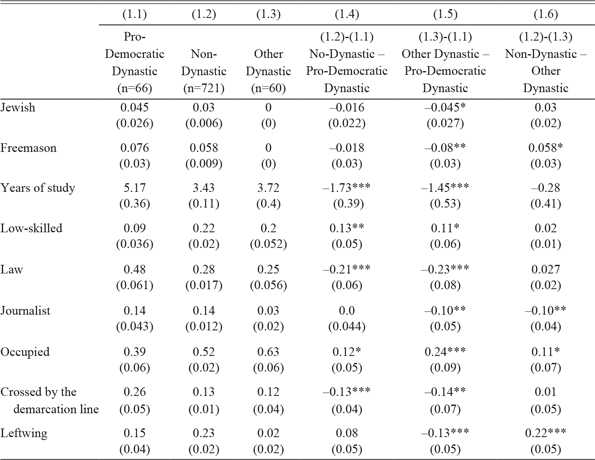
Table 1 separately reports descriptive statistics on observable variables for members of pro-democratic dynasties, members of other dynasties, and non-dynastic parliamentarians.Footnote 19 The left-hand panel reports averages and standard deviations. The right-hand panel shows differences in averages.
PRO-DEMOCRATIC DYNASTIC PARLIAMENTARIANS VERSUS OTHER DYNASTIC PARLIAMENTARIANS

Notes: Columns (1.1) to (1.3) are sample means. Columns (1.4) to (1.6) show differences between groups. Standard deviation in brackets. *** p<0.01, ** p<0.05, * p<0.1
Source: Lacroix, Méon, and Oosterlinck (2022).
The fourth column reports differences between non-dynastic and pro-democratic dynastic parliamentarians. For each variable, we subtract the values of pro-democratic dynasties from those of non-dynasties. A negative value thus represents a higher value for pro-democratic dynasts. Three characteristics appear to differ across the two groups: Pro-democratic dynastic parliamentarians were more educated, less likely to hold low-skilled jobs, and more likely to be involved in law-related positions than non-dynastic parliamentarians. Pro-democratic dynastic parliamentarians were also less likely to come from occupied départements but more likely to come from départements crossed by the demarcation line. These differences are significant at the 5-percent level of confidence or beyond.
In comparison to other dynastic parliamentarians, pro-democratic dynastic parliamentarians were on average more educated, more likely to be Freemasons, to belong to a leftwing party, and to work as journalists or in a law-related profession. Finally, in comparison to other dynastic parliamentarians, non-dynastic parliamentarians were more likely to belong to a leftwing party.
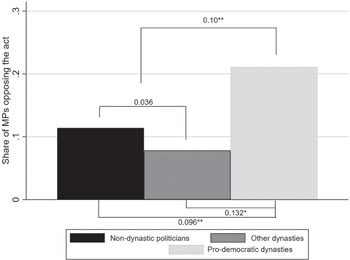
The upshot of Table 1 is that dynastic parliamentarians differed from non-dynastic parliamentarians. Most importantly, within the group of dynastic parliamentarians, there were substantial and statistically significant differences between pro-democratic and other dynastic parliamentarians. The table therefore provides evidence supporting the notion that the two groups should be distinguished and may have voted differently on the enabling act. To see if they did, Figure 1 displays the shares of votes opposing the votes cast by each group.
MEAN COMPARISON – SHARES OF PARLIAMENTARIANS OPPOSING THE ACT
Source: Authors’ calculations based on Joly (Reference Joly1960) and Journal Officiel de la République Française (10 July 1940).

Three findings emerge from Figure 1. First, pro-democratic dynastic parliamentarians opposed the act more than non-dynastic parliamentarians. Specifically, 21.1 percent of democratic dynastic parliamentarians voted against the act (12 out of 57 taking part in the vote), compared with 11.4 percent of non-dynastic parliamentarians (64 out of 561 taking part in the vote). This difference is statistically significant at the 5 percent level of confidence. Second, democratic dynastic parliamentarians also opposed the act more than other dynastic parliamentarians, only 7.8 percent of whom did so. This difference is marginally statistically significant at the 10 percent level. Finally, the difference between non-dynastic and other dynastic parliamentarians is not statistically significant at accepted levels.
Methodology
To go beyond bivariate correlations, we estimate the following baseline model:
 $$\begin{array}{l}Vot{e_i}(No) = {\beta _0} + {\beta _1}Pro - democratic\,Dynast{y_i} + {\beta _2}\,Other\,Dynast{y_i}\\\,\,\,\,\,\,\,\,\,\,\,\,\,\,\,\,\,\,\,\,\,\,\,\,\,\,\,\,\,\,\,\,\,\,\,\,\,\,\,\,\,\,\,\,\,\,\,\,\,\,\,\,\,\,\,\,\,\, + \,\Gamma {X_i} + {\varepsilon _i},\end{array}$$
where Vote i(No) is a dummy variable equal to one if a parliamentarian i opposed the enabling act; Pro − democratic Dynasty i is a dummy variable equal to one if he belongs to a pro-democratic dynasty; Other Dynasty i is a dummy variable equal to one if he belongs to a dynasty that is not defined as democratic; X i is a set of control variables including départements fixed effects accounting for spatial differences in the vote Footnote 20 ; β 0, β 1, and β 2 are coefficients; Γ is a vector of coefficients; and ε i the error term. The specification therefore distinguishes three types of parliamentarians: pro-democratic dynastic parliamentarians, other dynastic parliamentarians, and non-dynastic parliamentarians, which is the reference category.
In the baseline specification, opposing the reform is defined as having voted “No.” We do not take abstentions into account in our baseline model, because abstention cannot be interpreted as a tacit opposition to the reform. The baseline model therefore contrasts “No” votes on the one hand and “Yes” votes and abstentions on the other hand.Footnote 21
This model is estimated as a Linear Probability Model, using Ordinary Least Squares, to facilitate the interpretation and because the results are unlikely to diverge from the ones obtained using other procedures (Battey, Cox, and Jackson Reference Battey, Cox and Jackson2019; Gomila 2021). Online Appendix B3 shows that the baseline results are similar when estimating a logit model. This robustness test should alleviate concerns arising from the use of a Linear Probability Model for binary dependent variable.Footnote 22 All models are estimated using standard errors robust to heteroscedasticity and clustered at the party level because ideologies and the taste for democracy are more likely to be correlated across their members even without explicit coordination.Footnote 23
EMPIRICAL RESULTS
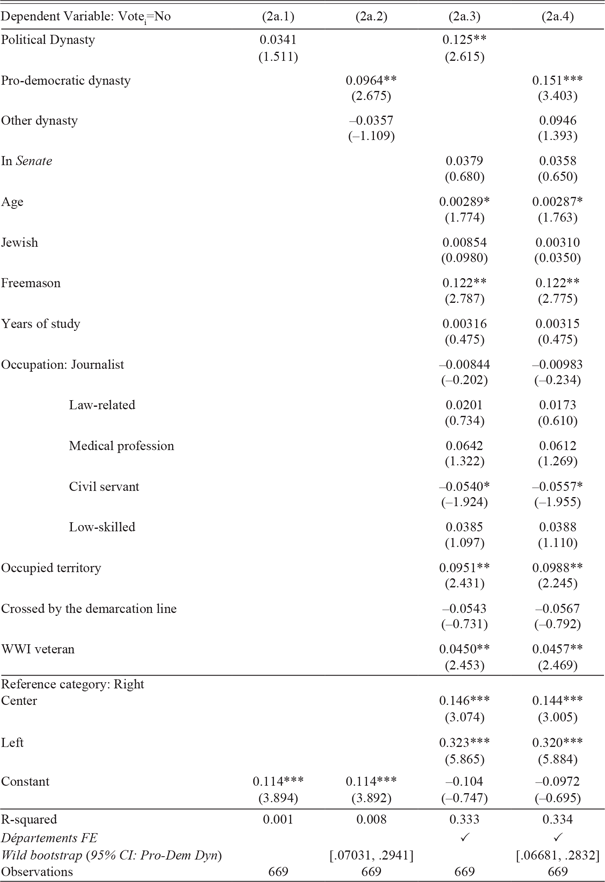
Table 2a reports baseline regressions. It contrasts models where all dynastic parliamentarians are pooled together, reported in odd-numbered columns, and models where we distinguish between pro-democratic and other dynastic parliamentarians, reported in even-numbered columns.
PRO-DEMOCRATIC DYNASTIC PARLIAMENTARIANS AND OPPOSITION TO THE ENABLING ACT: BASELINE RESULTS

Notes: OLS estimates. Robust z-statistics in parentheses. Standard errors clustered at the party-level. *** p<0.01, ** p<0.05, * p<0.1
Source: Lacroix, Méon, and Oosterlinck (2022).
Column (2a.1) reports a bivariate regression controlling for a single dummy variable that pools all dynastic parliamentarians, pro-democratic or not. The coefficient of that variable is non-significant at usual levels. At first sight, dynastic parliamentarians therefore did not oppose the act more than non-dynastic parliamentarians.
However, pooling dynasties hides differences. Column (2a.2) reports the result of a regression distinguishing pro-democratic and other dynastic parliamentarians. In that regression, the coefficient of the pro-democratic dynastic dummy is positive and statistically significant at the 5-percent level. The point estimate implies that pro-democratic dynastic parliamentarians were 9.64 percentage points more likely to oppose the act than their non-dynastic peers. Conversely, the coefficient of the other dynasty dummy variable is negative and insignificant at standard levels, implying that the behavior of other dynastic parliamentarians did not differ from the behavior of non-dynastic parliamentarians. This finding again supports our presumption that pro-democratic and other dynastic parliamentarians differed in their votes. This is confirmed by the finding that the coefficients of the Pro-democratic dynasty dummy variable and of the Other Dynasty are statistically different at the 5-percent level.
Columns (2a.3) and (2a.4) report similar regressions, controlling for the main observable characteristics of parliamentarians. The coefficient attached to some personal characteristics is in line with some of the explanations put forward by historians. Three are positive and statistically significant at the 5-percent level: being a Freemason, and having served during WWI, and representing an occupied territory. Political orientation also mattered in the vote. Leftwing and centrist parliamentarians were more likely than their rightwing counterparts to oppose the act, as their coefficient is positive and significant at the 1-percent level.
Two other characteristics bear coefficients that are significant at the 10-percent level: age, whose coefficient is positive, and civil servant, whose coefficient is negative. These results can be interpreted in light of the determinants of the voters surveyed by Ermakoff (Reference Ermakoff2008). The first is pressure. One may contend that older parliamentarians were less likely to give in to pressure because a smaller part of their career was at stake. Freemasons or members of veterans’ associations were likely more immune to pressure in the parliament because they could feel a sense of responsibility vis-à-vis their fellow members. The coefficients of the variables coding ideology may be driven by the fact that right-wing politicians were ideologically closer to the supporters of the Act.
More to the point, the dynastic dummy variable exhibits a positive and statistically significant coefficient in Column (2a.3), suggesting a general effect of being a dynastic parliamentarian. Again, when pro-democratic and other dynasties are distinguished in Column (2a.4), the effect appears to be driven mostly by pro-democratic dynastic parliamentarians. The coefficient of the pro-democratic dynastic dummy variable is positive and significant at the 1-percent level, and its point estimate implies that pro-democratic dynastic parliamentarians were 15.1 percentage points more likely to oppose the act than their non-dynastic peers. By contrast, the coefficient of the other dynasty dummy fails to be significant at accepted levels.
Regressions (2a.3) and (2a.4) confirm the two key findings of Regressions (2a.1) and (2a.2). Firstly, pro-democratic dynastic parliamentarians were more likely to oppose the enabling act than their non-dynastic peers. Secondly, the votes of other dynastic parliamentarians were statistically indistinguishable from those of their non-dynastic peers. Even after accounting for a set of individual characteristics, pro-democratic dynastic parliamentarians were more likely than their non-dynastic peers to oppose the vote. On the contrary, other dynastic parliamentarians did not differ from their non-dynastic peers. The coefficients of the pro-democratic dynasty and the other dynasty dummies are not statistically different. Control variables likely explained part of the differences between the two types of dynasties. The main lesson of Table 2a is that pro-democratic dynastic parliamentarians can be distinguished from non-dynastic parliamentarians, whereas this is not the case for other dynastic parliamentarians. Moreover, the effect of belonging to a pro-democratic dynasty rather than being a non-dynastic parliamentarian was substantial. Looking at the magnitude of the coefficient, pro-democratic dynastic parliamentarians did oppose the act 9.6 to 15.1 percentage points more than their non-dynastic peers.
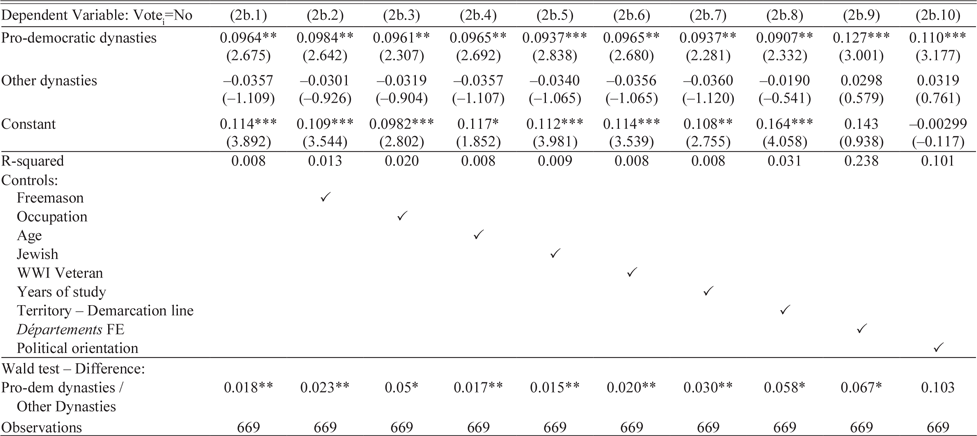
Table 2b further investigates the difference between the two types of dynastic parliamentarians. To do so, it sequentially adds control variables and reports Wald tests assessing whether the difference between the two dynastic dummy variables is statistically significant. Regardless of the control variable, the coefficient of the pro-democratic dynastic politicians is significant at the 10-percent level or beyond, and the magnitude of the coefficient of the pro-democratic dynasty dummy variable varies little across regressions. Accordingly, the point estimates of the effect of being a pro-democratic dynastic parliamentarian rather than a non-dynastic one ranges from 9.07 to 12.7 percentage points. Pro-democratic dynastic politicians differ from non-dynastic politicians in the same way regardless of the control variable that we include in the regression.
WHAT EXPLAINS THE DIFFERENCE BETWEEN PRO-DEMOCRATIC AND OTHER DYNASTIC PARLIAMENTARIANS

Notes: OLS estimates. Robust t-statistics in parentheses: *** p<0.01, ** p<0.05, * p<0.1. Each column adds a set of control variables. Column (2b.1) presents the same results as Column (2a.2) in Table 2a. Column (2b.2) adds a dummy variable for membership to freemasonry. Column (2b.3) adds dummy variables for different occupation (Journalist, Law-related, Medical profession, civil-servant, Low-skill). Column (2b.4) adds age as a control variable. Column (2b.5) adds a dummy variable equal to 1 if the Parliamentarian was Jewish. Column (2b.6) adds as control a dummy variable equal to one if the parliamentarian was a veteran from WWI. Column (2b.7) adds years of study as a control. Column (2b.8) adds two dummy variables: one if the département is in the territory occupied by Germany and one if the département he represents is crossed by the demarcation line. Column (2b.9) adds départements fixed effects. Column (2b.10) adds one dummy variable if the parliamentarian is left-wing, one dummy variable if he belongs in a party of the Center and one dummy variable equal to one if he was a Senator.
Source: Lacroix, Méon, and Oosterlinck (2022).
The Wald-tests show that the two dynastic dummy variables are statistically different from each other at the 10-percent level of significance or beyond, except when we control for parliamentarians’ political orientation. In that case, pro-democratic dynastic parliamentarians cannot be distinguished from other dynastic parliamentarians. This finding suggests that political orientation was an important driver of the difference in the propensity to oppose the act between pro-democratic and other dynastic parliamentarians. However, it does not explain why pro-democratic dynastic politicians opposed the act more than non-dynastic parliamentarians.
Our results are robust to five different considerations: selection into the vote, the role of abstention, confounding effects of covariates thanks to a propensity score matching procedure, alternative clustering of standard errors, and alternative coding of the dynasty variable (See Online Appendices B.1 to B.6).Footnote 24
The results from our propensity score matching exercise, reported in Online Appendix B5, may be illustrated by pairs of otherwise similar parliamentarians who belonged to a different form of political dynasty and voted differently.Footnote 25 The first pair consists of Paul Giacobbi and François Piétri, both from Corsica. They came from the same part of Corsica, being born at a distance of approximately 80 km from each other. Both had been trained as lawyers. They began their political careers at the same time, with Paul Giacobbi being elected mayor of Bastia in 1922 and François Piétri becoming a member of parliament in 1924. Paul Giacobbi belonged to Parti Radical, and François Piétri belonged to the Républicains de gauche, which were both left-of-center political parties, even though the second one gradually drifted to the center at the end of the interwar period.Footnote 26 Their political dynasties also differed strongly. Paul Giacobbi’s father, Marius Giacobbi, had been elected a member of parliament and senator during the Third Republic and belonged to the Gauche Démocratique. Accordingly, Paul Giacobbi is a pro-democratic dynastic parliamentarian. François Piétri’s political forebears include two senators active during the Second Empire as well as members of parliament during the Third Republic. He is therefore classified as belonging to another dynasty. In 1940, Paul Giacobbi voted against the proposal to grant full powers to Pétain, while François Piétri endorsed it. During the occupation, Piétri served as French ambassador in Madrid; Giacobbi joined the resistance, was captured, escaped, and was active in the liberation of Corsica in 1943.
The pair formed by Robert Mauger and Paul Bénazet provides another illustration of the role of political dynasties. Both came from a rural department in the center of the country, respectively Loir-et-Cher and Indre, fought during WWI, and belonged to parties on the left of the political spectrum, respectively SFIO and Gauche démocratique. Robert Mauger’s father, Pierre-Henri Mauger, had been elected on a leftwing-party list in 1924 as deputy of Loir-et-Cher. Paul Bénazet also came from a dynastic family; his grandfather, Théodore Bénazet, had been active in politics, and his father, Paul-Antoine Bénazet, was a Deputy of Indre. However, Paul-Antoine Bénazet was a Bonapartist. Accordingly, Robert Mauger’s dynasty is classified as pro-democratic, whereas Paul Bénazet’s is not.Footnote 27 Robert Mauger voted against the enabling act whereas Paul Bénazet voted in favor.
WHY DID DEMOCRATIC DYNASTIC PARLIAMENTARIANS BEHAVE DIFFERENTLY ON 10 JULY 1940?
We now investigate why pro-democratic dynasts were more likely to vote against the enabling act than their peers, distinguishing explanations based on self-interest from those based on socialization. First, we document the trajectories of those parliamentarians during WWII to gauge the role of self-interest and of a genuine commitment to democracy. Second, we leverage the heterogeneity of pro-democratic dynasties to further investigate both the importance of self-interest and the role of socialization in the family. The remaining sections are devoted to the role of later socialization: during WWI, in political parties, and inside and outside the parliament.
Self-Interest and Commitment to Democracy: The Trajectories of Parliamentarians during the War
The behavior of pro-democratic dynastic parliamentarians may be driven by lower career prospects under the new regime. Their opposition to the enabling act would then have been driven by self-interest. We investigate this hypothesis by studying the trajectory of parliamentarians under the Vichy regime and during the war. If the opposition of pro-democratic parliamentarians to the enabling act was driven by their lower career prospects in the new regime, we should observe that they fared less well than other parliamentarians during the war. This is not the case. Pro-democratic dynastic politicians were no more likely than other parliamentarians to hold a position in the Vichy regime, nor were they more likely to die during the war (Online Appendix C.1.).Footnote 28
Another way to gauge the role of self-interest is to assess the role of the individual political capital accumulated by parliamentarians. In Online Appendix C.2, we control for a series of measures of individual political experience and political capital. When doing so, the effect of being a pro-democratic parliamentarian is little affected.
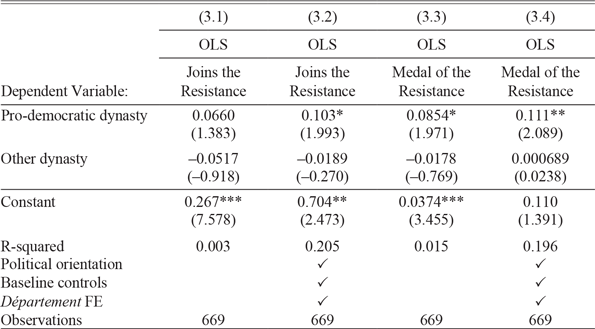
Participation in the resistance during the war can be interpreted as evidence of a deep-rooted motivation to stand for democracy. We therefore document the participation of parliamentarians in the resistance based on their biographies. We also determine whether a parliamentarian received the medal of the resistance after the war, thanks to data collected by Wieviorka (Reference Wieviorka2001). We code that information as two dummy variables that we use as dependent variables instead of the opposition to the enabling act.
Table 3 reports the outcome of those regressions. Even after controlling for baseline control variables, the coefficient attached to the pro-democratic dynastic variable is positive and significant at the 10-percent level (Column 3.2). Its magnitude implies that pro-democratic dynastic parliamentarians were 10 percentage points more likely than non-dynastic parliamentarians to join the resistance. Likewise, in Columns (3.3) and (3.4), where the dependent variable is the dummy variable set to one if a parliamentarian was awarded the medal of the resistance, the coefficients attached to the Pro-democratic dynasty variable are positive and significant at least at the 10-percent level. Their magnitudes imply that pro-democratic dynastic parliamentarians were 8.5 to 11.1 percentage points more likely to obtain the medal of the resistance. Moreover, dynastic parliamentarians did not behave differently in votes related to the balance of power between the government and the parliament in the legislature preceding WWII (Tables C5.a and C5.b in the Online Appendix), suggesting that their specific behavior appears when democracy is threatened.
PRO-DEMOCRATIC DYNASTIES AND RESISTANCE DURING WWII

Notes: OLS estimates. Robust z-statistics in parentheses. *** p<0.01, ** p<0.05, * p<0.1 Standard errors are clustered at the party level. Political orientation controls: Left (=1), Center (=1), Senate (=1). Demographic controls: Age, Jewish (=1), Freemason (=1), occupation, WWI veteran (=1), In occupied area (=1), département crossed by demarcation line (=1), study years and department fixed effects.
Source: Lacroix, Méon, and Oosterlinck (2022).
The results of this section indicate that the opposition to the enabling act of pro-democratic dynasts was unlikely driven by self-interest but rather reflected the effect of a genuine commitment to democratic ideals.
Heterogeneity within Pro-Democratic Dynasties
Pro-democratic dynasties are heterogeneous. They may, for example, be of different lengths or have emerged in different contexts. Some may have been interrupted, whereas others exhibit continuity. Those characteristics may result in either a stronger self-interest in maintaining democracy or a stronger socialization/monitoring by the dynasty. According to Piketty’s (1995) hypothesis of dynastic learning, different dynastic histories could result in different levels of support for democracy, hence potentially different behaviors in the vote of the enabling act.
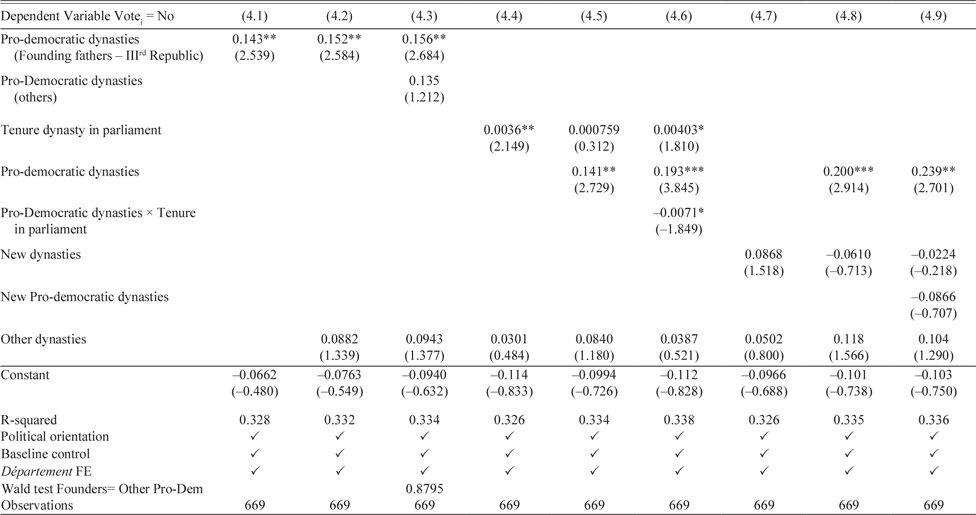
Table 4 investigates how those characteristics may either explain or mediate our effect. Columns (4.1) and (4.2) split the baseline pro-democratic dynastic dummy variable into a more restrictive dummy variable capturing whether the founder of the dynasty was also a founder of the republic and another capturing other pro-democratic dynasts. The coefficient of the dummy based on the more restrictive definition is positive and statistically significant at the 5 percent level. Its magnitude is similar to that of the broader pro-democratic dynasties dummy, as evidenced by the Wald test presented in Column (4.3). Accordingly, the origin of a pro-democratic dynasty was not essential to determining the behavior of a parliamentarian, as long as the dynasty was pro-democratic.
INVESTIGATING HETEROGENEITY WITHIN PRO-DEMOCRATIC DYNASTIES

Notes: OLS estimates. Robust z-statistics in parentheses. *** p<0.01, ** p<0.05, * p<0.1 Standard errors are clustered at the party level. Political orientation controls: Left (=1), Center (=1), Senate (=1). Demographic controls: Age, Jewish (=1), Freemason (=1), occupation, WWI veteran (=1), In occupied area (=1), département crossed by demarcation line (=1), study years and department fixed effects.
Source: Lacroix, Méon, and Oosterlinck (2022).
POLITICAL PARTIES, DYNASTIES, AND OPPOSITION TO THE ENABLING ACT

Notes: OLS estimates. Robust z-statistics in parentheses. *** p<0.01, ** p<0.05, * p<0.1 Standard errors are clustered at the party level. Pro-democratic parties is a dummy variable equal to one if a parliamentarian belongs to a party that would qualify as “democratic” according to our definition of pro-democratic dynasties. Political orientation controls: Left (=1), Center (=1), Senate (=1). Demographic controls: Age, Jewish (=1), Freemason (=1), occupation, WWI veteran (=1), In occupied area (=1), département crossed by demarcation line (=1), study years and department fixed effects.
Source: Lacroix, Méon, and Oosterlinck (2022).
Younger pro-democratic dynasties may provide a smaller electoral advantage, therefore reducing the vested interest of pro-democratic dynasts in maintaining democracy and/or transmitting weaker democratic ideals. To test the effect of dynasties’ age on the vote, we consider how long the dynasty had been active in parliament (Columns (4.4) to (4.6)). The variable “Tenure in Parliament” is equal to the sum of years spent, as a deputy or as a senator, by the family members of dynastic parliamentarians in our sample. With the same end in view, we define a dummy variable taking the value one if the dynasty was only one generation old in 1940 (Columns (4.7) to (4.9)). By construction, these dynasties were uninterrupted and can be used to assess the role of continuity. When controlling for those variables or interacting the pro-democratic dynasty variable with them, the main results remain unchanged. In this set of regressions, one result stands out: the probability of pro-democratic dynasts opposing the reform decreases when their dynasties have been active in Parliament for a longer time (see Column (4.6) and Figure C1 in the Online Appendix).
Dynasties also monitor their members (Geys and Smith Reference Geys and Smith2017). That monitoring is likely tighter when a forebear is still alive. We therefore control for two dummy variables coding that condition: one for all dynasties and one specifically for pro-democratic dynasties. Those estimations are reported in Online Appendix C.6.b. They show that the monitoring of parliamentarians with surviving forebears active in politics does not explain baseline results.
Socialization during WWI: Veterans’ Proximity to Pétain
In 1940, many parliamentarians were WWI veterans. What that particular form of socialization meant could depend on under whose command they fought. Cagé et al. (Reference Cagé, Dagorret, Grosjean and Jha2020) argue that soldiers who had fought under Pétain’s command in WWI were more likely to support his regime. We follow their approach and distinguish veterans who fought under the authority of Pétain, in particular during the battle of Verdun, from others. We checked the military records of the 397 veterans in our sample and looked for information about their activities during the war in their biographies to determine if they served under Pétain’s command. Online Appendix B.7 describes our method. We defined four dummy variables capturing different periods of Pétain’s command and controlled for them in the baseline regression.
The results are reported in Table B.7 in the Online Appendix. The table features three panels, each devoted to a specific way to consider veterans whose records could not be found. If anything, the table reports little evidence that parliamentarians who served under Pétain’s command were less likely to oppose the enabling act. In most regressions, the coefficients of the dummy variables are statistically insignificant or significant and positive, meaning that having served under Pétain’s command does not correlate or correlates positively with the probability of opposing the enabling act. The only exception appears in Panel B of Table B.7, where the dummy capturing service under Pétain’s command bears a negative coefficient significant at the 10-percent level. The evidence is, however, weak, as the same variable is statistically insignificant in all other regressions. These results could be reconciled with those of Cagé et al. (Reference Cagé, Dagorret, Grosjean and Jha2020) on the grounds that the populations and the incentives to support Pétain’s regime are certainly different between their sample and ours.
Regardless of the dummy variables for which we control in Online Appendix Table B.7, the finding that pro-democratic dynastic parliamentarians were more likely to oppose the enabling act is not driven by their service under Pétain during WWI.
The Role of Political Parties
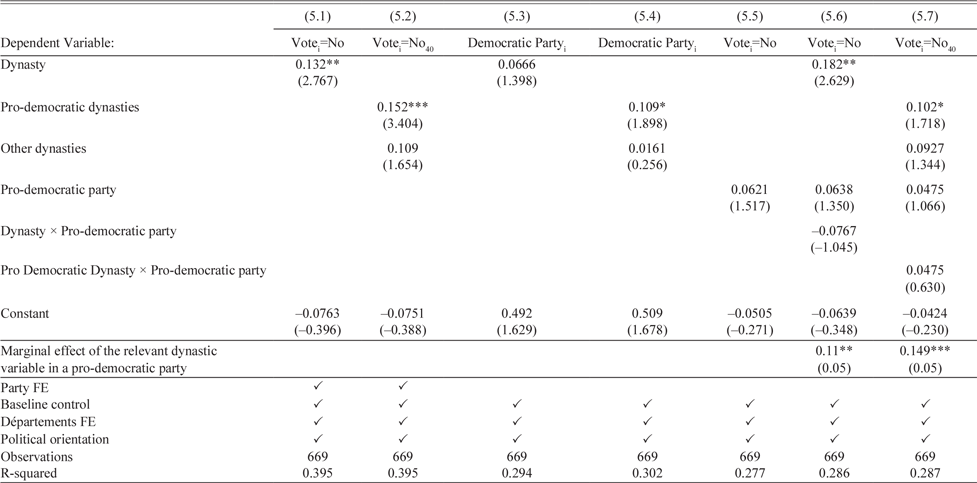
Despite being weak, parties may still have contributed to the socialization of parliamentarians. That could explain the behavior of pro-democratic dynastic parliamentarians if they were more likely to join parties with a specific pro-democratic stance. We therefore control for affiliation in several ways in Table 5.
First, we control for party fixed effects. In Column (5.1), we now observe that the coefficient of the dynasty dummy variable is positive and statistically significant at the 5-percent level. However, Column (5.2) confirms that that effect is mainly driven by pro-democratic dynasties, whose coefficient is statistically significant at the 1-percent level while the coefficient of other dynasties is statistically insignificant.
We then investigate the specific role of democratic parties. To do so, we define a dummy variable capturing whether a parliamentarian belonged to a party that would qualify as pro-democratic according to our definition of pro-democratic dynasties. In our sample, 535 parliamentarians belong to such a party.
We first used that dummy as a dependent variable to determine whether pro-democratic dynastic parliamentarians were more likely to join a pro-democratic party. Column (5.3) shows that dynastic parliamentarians were not more likely than their peers to join a democratic party. In Column (5.4), however, the coefficient of the pro-democratic dynastic dummy is positive and statistically significant at the 10-percent level. Pro-democratic dynastic parliamentarians were 10.9 percentage points more likely to belong to a democratic party.
Second, Column (5.5) reports estimates of the baseline specification, restricting the set of explanatory variables to the pro-democratic party dummy and baseline control variables.Footnote 29 In that regression, the coefficient of the pro-democratic party variable is statistically insignificant at standard levels. Therefore, members of pro-democratic parties were as likely to oppose the enabling act as members of other parties.
Third, to test whether belonging to a pro-democratic party amplifies the effect of being a pro-democratic dynast, we interact the dynastic dummies with the pro-democratic party dummy in Columns (5.5) and (5.6). Neither of these interaction terms is significant, but the pro-democratic dynastic dummy is positive and statistically significant at the 10-percent level, confirming that pro-democratic dynastic parliamentarians were more likely than non-dynastic parliamentarians to oppose the enabling act even when the former did not belong to a pro-democratic party. Membership in pro-democratic parties hence neither mediate nor moderate our baseline results.
For comparability, Table 5 controls for political orientation, which correlates with party types. Controlling for both political orientation and party memberships allows us to separately consider socialization within parties and political preferences. Table C.7 in the Online Appendix, however, shows that not controlling for political orientation does not affect our results on the behavior of dynasts. The coefficients attached to the pro-democratic party dummy variable then become positive and statistically significant. Accordingly, the political orientation of those parties correlates with opposition to the enabling act but does not explain the specific behavior of dynasts.
The Importance of Socialization inside and outside Parliament
Despite being born and initially socialized in pro-democratic dynasties pro-democratic dynastic parliamentarians interacted with their peers in the parliament. More experienced parliamentarians would have built more and stronger relationships with their peers, internalized their norms more, and thus been more likely to conform. The effect of being a pro-democratic dynastic parliamentarian would therefore fade with prominence in the parliament and time spent as a parliamentarian. By contrast, stronger connections outside parliament in the local environment shaped by their forebears could counterbalance connections within parliament. The effect of being a pro-democratic dynast could thus be larger for parliamentarians with stronger connections outside parliament.
We proxy prominence in the parliament by the number of interventions of each parliamentarian from 1936 to 1940, according to the parliamentary minutes published in the Journal officiel de la République Francaise.Footnote 30 We also define a dummy variable capturing whether the parliamentarian had held a special position before the war, namely if he had been chairman, vice-chairman, or secretary of one of the two chambers. We consider two measures of the strength of connections outside parliament: years of experience in the departmental assembly, “Conseil general,” and a dummy variable coding dynasties whose founder was a member of local labor or agricultural associations. The longer the parliamentarian’s experience in the departmental assembly the stronger the connections he will have kept with his constituency. Likewise, the founder of the dynasty’s membership in an agricultural or labor union could measure the strength of the dynasty’s commitment to democracy because membership in those organizations in the nineteenth and twentieth centuries was a statement in favor of democracy. Parliamentarians raised in such a dynasty should therefore have internalized stronger democratic norms.
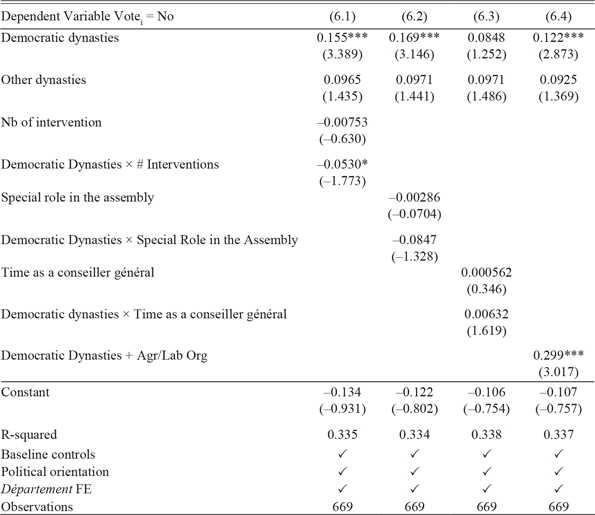
Simply controlling for the accumulation of more individual experience, prominence in parliament, or connections outside parliament, which we do in Online Appendix C, leaves our results unchanged. However, interacting them with the pro-democratic dynastic dummy variable shows that they moderate its effect, in line with the socialization hypothesis. The outcomes of those regressions are reported in Table 6. In Regressions (6.1) and (6.2), the interaction terms between the pro-democratic dummy variable and the two measures of prominence bear a negative sign, suggesting that the effect of being a pro-democratic dynastic parliamentarian was lower for more prominent parliamentarians.
PRO-DEMOCRATIC DYNASTIC PARLIAMENTARIANS AND OPPOSITION TO THE 1940 ENABLING ACT: EFFECTS CONDITIONAL ON SOCIALIZATION INSIDE AND OUTSIDE PARLIAMENT

Notes: OLS estimates. Robust z-statistics in parentheses. *** p<0.01, ** p<0.05, * p<0.1 Standard errors are clustered at the party level. Political orientation controls: Left (=1), Center (=1), Senate (=1). Demographic controls: Age, Jewish (=1), Freemason (=1), occupation, WWI veteran (=1), In occupied area (=1), département crossed by demarcation line (=1), study years and department fixed effects.
Source: Lacroix, Méon, and Oosterlinck (2022).
We obtain similar results when we interact the pro-democratic dynastic parliamentarian dummy variable with years of experience in their “Conseil général” and connections of the dynasty with local labor or agricultural associations. Here, the interaction terms bear a positive coefficient (Columns (6.3) and (6.4) of Table 6), suggesting that the effect of being a pro-democratic dynastic parliamentarian was larger for parliamentarians with stronger connections outside parliament.
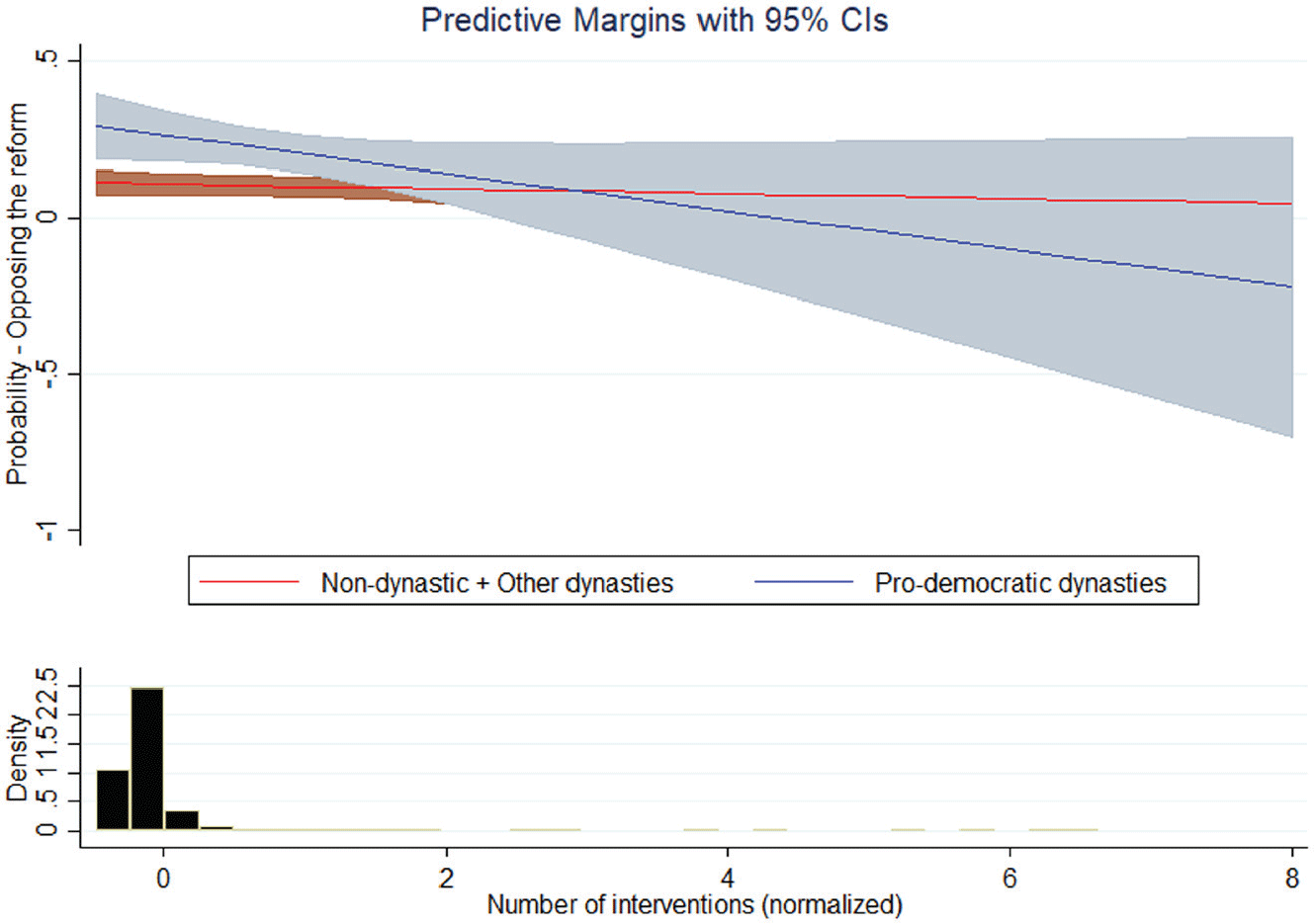
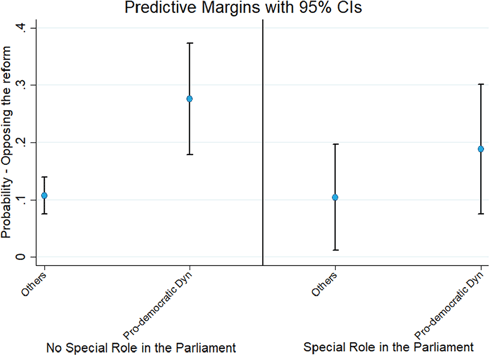
To gauge the quantitative significance of the regressions, Figures 2 to 5 plot the point estimates and the confidence intervals of the marginal effect of being a democratic dynastic parliamentarian on the probability of opposing the enabling act implied by the regressions in Table 6, as suggested by Brambor, Clark, and Golder (2006). The marginal effect of being a pro-democratic dynastic parliamentarian was statistically insignificant for parliamentarians with a large enough number of interventions in the parliament (Figure 2).Footnote 31 Only pro-democratic dynastic parliamentarians who held no special position opposed the act more than their non-dynastic peers (Figure 3).
MARGINAL EFFECT OF BEING A PRO-DEMOCRATIC DYNASTIC PARLIAMENTARIAN ON THE PROBABILITY OF OPPOSING THE ENABLING ACT CONDITIONAL ON THE NUMBER OF INTERVENTIONS IN PARLIAMENT
Source: Estimates inferred from Regression (6.1) reported in Table 6.

PROBABILITY OF OPPOSING THE ENABLING ACT CONDITIONAL ON ROLE IN PARLIAMENT
Source: Estimates inferred from Regression (6.2) reported in Table 6.

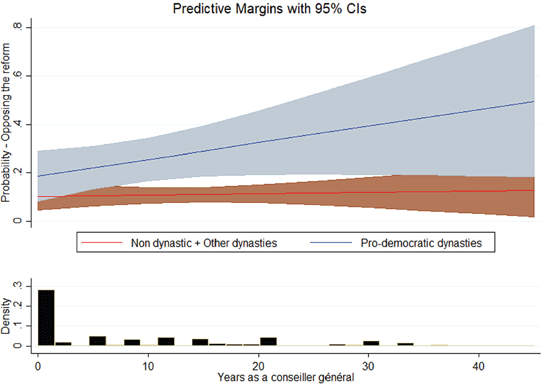
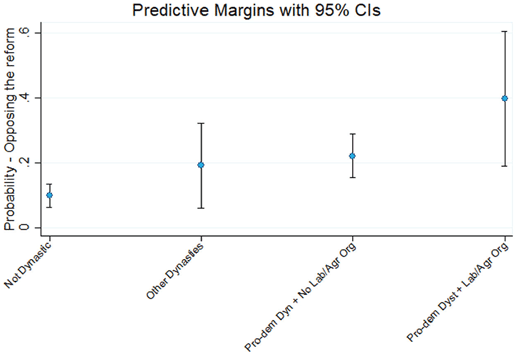
The marginal effect of being a pro-democratic dynastic parliamentarian increased with experience at the local level (Figure 4). Figure 5 moreover shows that the point estimate of the probability to oppose the act is larger if the founder of the dynasty belonged to a local agricultural/labor organization. It is twice as high as the probability of other dynastic parliamentarians opposing the act. Conversely, the opposition rate of members of pro-democratic dynasties not linked to those organizations is similar to that of other dynasties.
MARGINAL EFFECT OF BEING A PRO-DEMOCRATIC DYNASTIC PARLIAMENTARIAN ON THE PROBABILITY TO OPPOSE THE ENABLING ACT CONDITIONAL ON YEARS AS CONSEILLER GÉNÉRAL
Source: Estimates inferred from Regression (6.3) reported in Table 6.

PROBABILITY TO OPPOSE THE ENABLING ACT CONDITIONAL ON CONNECTION TO LABOR AND AGRICULTURAL ORGANIZATIONS
Source: Estimates inferred from Regression (6.4) reported in Table 6.

Those results sketch a consistent picture of the role of socialization inside and outside the parliament. The stronger their socialization inside the parliament, the lower the propensity of pro-democratic dynastic parliamentarians to oppose the act. Conversely, the stronger their socialization outside of parliament, the higher their propensity to oppose the act. As connections to labor and agriculture amplified the effect of being a pro-democratic dynastic parliamentarian, the nature of those connections also mattered.
CONCLUSION
Pro-democratic dynastic parliamentarians were more likely than the vast majority of their peers to oppose an act leading to the advent of a dictatorship. The finding is specific to pro-democratic dynastic parliamentarians, defined as members of a dynasty whose founder was a defender of pro-democratic ideals. It does not extend to other dynastic parliamentarians and survives a series of robustness checks and propensity score estimates, lending some credence to a causal interpretation of the results.
We provide suggestive evidence that the behavior of pro-democratic dynastic parliamentarians was in general not driven by self-interest, socialization within parties, the accumulation of more experience or prominence in parliament, or the monitoring of their dynasty. However, pro-democratic dynastic parliamentarians with less experience in parliament, more experience in local politics, and a connection to labor and agricultural organizations were more likely to oppose the act. Those findings suggest an important role for socialization inside and outside the parliament. Pro-democratic dynastic parliamentarians who had less time to socialize within parliament and who had more relationships outside it could better resist conformity to the parliamentary majority.
Those results contrast with the literature that usually points out the negative consequences of dynasties. Since pro-democratic dynastic parliamentarians were more likely to oppose an autocratic reversal, the emergence of pro-democratic dynasties may contribute to the stabilization of democracy after a democratic transition.
The effect was driven by pro-democratic dynastic parliamentarians as opposed to their other dynastic peers. This finding uncovers an unexplored source of heterogeneity: dynasties may differ in terms of their democratic culture.
History offers numerous examples of successful or failed autocratic reversals, including Spain in the 1930s and 1980s, or authoritarian backsliding, like in contemporary Eastern Europe. Gauging the role that pro-democratic dynasties may have played or still play in those episodes offers perspectives for future research.