Introduction
Spinocerebellar ataxia type 2 (SCA2) is a neurodegenerative disorder arising from a CAG expansion in the ATXN2 gene that causes a cerebellar deterioration associated with extra-cerebellar signs as it main phenotypic manifestation (Pulst et al., Reference Pulst, Nechiporuk, Nechiporuk, Gispert, Chen, Lopes-Cendes and Sahba1996; Schöls, Bauer, Schmidt, Schulte, & Riess, Reference Schöls, Bauer, Schmidt, Schulte and Riess2004). A variety of cognitive tests have shown that patients with SCA2 have deficits in different cognitive domains (Bürk, Reference Bürk2007; Garrard, Martin, Giunti, & Cipolotti, Reference Garrard, Martin, Giunti and Cipolotti2008; Kawai, Suenaga, Watanabe, & Sobue, Reference Kawai, Suenaga, Watanabe and Sobue2009; Manto, Reference Manto2005). These include immediate and delayed word recall, visuospatial memory and attention (Bürk et al., Reference Bürk, Globas, Bösch, Gräber, Abele, Brice and Klockgether1999; Cancel et al., Reference Cancel, Dürr, Didierjean, Imbert, Bürk, Lezin and Brice1997; Fancellu et al., Reference Fancellu, Paridi, Tomasello, Panzeri, Castaldo, Genitrini and Girotti2013); verbal fluency, including generation and switching of semantic and phonetic categories (Bürk et al., Reference Bürk, Globas, Bösch, Gräber, Abele, Brice and Klockgether1999, Reference Bürk, Globas, Bösch, Klockgether, Zühlke, Daum and Dichgans2003; Fancellu et al., Reference Fancellu, Paridi, Tomasello, Panzeri, Castaldo, Genitrini and Girotti2013; Le Pira et al., Reference Le Pira, Zappalà, Saponara, Domina, Restivo, Reggio and Giuffrida2002); executive functioning (Klinke et al., Reference Klinke, Minnerop, Schmitz-Hübsch, Hendriks, Klockgether, Wüllner and Helmstaedter2010; Storey, Forrest, Shaw, Mitchell, & Gardner, Reference Storey, Forrest, Shaw, Mitchell and Gardner1999) as measured in the delayed reproduction of a Wechsler Memory Scale prose fragment (Bürk et al., Reference Bürk, Globas, Bösch, Gräber, Abele, Brice and Klockgether1999, Reference Bürk, Globas, Bösch, Klockgether, Zühlke, Daum and Dichgans2003; Le Pira et al., Reference Le Pira, Zappalà, Saponara, Domina, Restivo, Reggio and Giuffrida2002), and nonverbal abstract reasoning (Le Pira et al., Reference Le Pira, Zappalà, Saponara, Domina, Restivo, Reggio and Giuffrida2002).
While these studies provide valuable information about cognitive functioning in SCA2, some limitations include: the focus on language capabilities, small sample size, and some studies pooled patients with different types of SCA. More importantly, despite of the extensive research described above, little is known about specific executive functions including strategy use, planning, and rule acquisition, which are crucial for daily living. Based on the knowledge about the impact SCA2 has on cognition and fronto-cerebellar deterioration (Hernandez-Castillo et al., Reference Hernandez-Castillo, Alcauter, Galvez, Barrios, Yescas, Ochoa and Fernandez-Ruiz2013; Koziol et al., Reference Koziol, Budding, Andreasen, D’Arrigo, Bulgheroni, Imamizu and Yamazaki2014) we hypothesize that patients with SCA2 will show deficits in strategy use, planning and rule acquisition compared to healthy controls.
To test this hypothesis and to improve the characterization of cognitive functions in patients with SCA2, here we present a large sample study using an automated neuropsychological method (Downes et al., Reference Downes, Roberts, Sahakian, Evenden, Morris and Robbins1989; Lawrence et al., Reference Lawrence, Sahakian, Hodges, Rosser, Lange and Robbins1996; Pantelis et al., Reference Pantelis, Barnes, Nelson, Tanner, Weatherley, Owen and Robbins1997; Robbins et al., Reference Robbins, James, Owen, Sahakian, Lawrence, McInnes and Rabbitt1998). This method allows for a more detailed examination of executive deficits by controlling errors in the registration of the correct and incorrect answers, faults in time measurement, and reducing implementation time (Robbins, Reference Robbins1996). Our findings replicated attentional and memory impairments previously characterized in patients with SCA2 and, more importantly, we identified specific deficits in strategy use, rule acquisition and planning.
Method
Participants
Only patients with molecular determination of the repeat expansion (CAG) whose neurological/motor impairment (assessed by an expert neurologist) did not prevent the performing of the tests were included. Patients without CAG determination whose neurological/motor impairment prevented the performing of the tests, and with a neurological assessment older than six months at the time of the interview were excluded from the study. Forty-one right-handed patients with SCA2 (16 female, 25 male) met the inclusion criteria. Their age ranged from 22 to 62 years, mean 40.3 [standard deviation (SD)=9.9]. The age of SCA2 onset ranged from 15 to 55 years, mean 29.9, (SD=9.2), and disease duration from 2 to 26 years, mean 10.7, (SD=5.4). Polyglutamine repeat size (CAG) ranged from 32 to 48 repetitions, mean 40.0, (SD=3.2). Years of education ranged from 3 to 16, mean 11.1 (SD=3.1). The control participants were selected to try to match the patients with SCA2 on all demographic variables. They were included if they were healthy and reported in a clinical interview no neurological or psychiatric disease. Thirty four healthy right handed volunteers (13 female, 21 male) met the inclusion criteria for the control group (CON). Their age ranged from 22 to 63, mean age of 40.0, (SD=10.9). Their years of education ranged from 9 to 20, mean 13.6 (SD=3.1).
Procedure and Materials
Both groups (CON and SCA2) were evaluated at the Centre for the Rehabilitation of the Hereditary Ataxias in Holguín, Cuba. All procedures were approved and performed under the standards of the research Ethics Committees in Human Research of the CIRAH Cuba and the Faculty of Medicine of the National Autonomous University of Mexico (No. 127-2011). All participants provided informed consent in accordance with the Declaration of Helsinki (Council for International Organizations of Medical Sciences, 2002). The assessment for SCA2 included a complete neurological examination (Velázquez-Pérez et al., Reference Velázquez-Pérez, Rodríguez-Labrada, García-Rodríguez, Almaguer-Mederos, Cruz-Mariño and Laffita-Mesa2011), as well as the Scale for the Assessment and Rating of Ataxia (SARA) as an indicator of Motor Deterioration (Schmitz-Hübsch et al., Reference Schmitz-Hübsch, du Montcel, Baliko, Berciano, Boesch, Depondt and Fancellu2006). The Mini-Mental State Examination (MMSE) was conducted to assess the general cognitive functioning (Folstein, Folstein, & McHugh, Reference Folstein, Folstein and McHugh1975). To understand the effect of SCA2 on cognitive functions, the SCA2 group was later divided in two subgroups depending on the SARA score. The selection criteria were the average SARA score for the whole group of patients (15 points). Patients with scores of 15 or less were assigned to the low-SARA group, while those with higher scores were assigned to the high-SARA group (Vaca-Palomares et al., Reference Vaca-Palomares, Díaz, Rodríguez-Labrada, Medrano-Montero, Vázquez-Mojena, Velázquez-Pérez and Fernandez-Ruiz2013).
Cognitive Assessment
Cognitive function was evaluated using subtests of the Cambridge Neuropsychological Test Automated Battery (CANTABeclipse®). The subtests were selected to evaluate functions such as visual and perceptual memory, executive functions, working memory, strategy formation, planning, attentional control, and rules acquisition. Some of the tests also allowed for inferring deterioration in temporal and frontal areas of the cerebral cortex (Pantelis et al., Reference Pantelis, Barnes, Nelson, Tanner, Weatherley, Owen and Robbins1997; Robbins et al., Reference Robbins, James, Owen, Sahakian, Lawrence, McInnes and Rabbitt1998). In all cases, we began with a training session to familiarize participants with CANTAB. Participants were seated at a table in front of a screen at a distance of 30–50 cm. Participants were instructed to keep their elbows on the table and to touch the screen with their right hand’s index finger for all of the tests (Pantelis et al., Reference Pantelis, Barnes, Nelson, Tanner, Weatherley, Owen and Robbins1997; Robbins et al., Reference Robbins, James, Owen, Sahakian, Lawrence, McInnes and Rabbitt1998). The tests applied were: Big/Little Circle (BLC) training test, which is a simple test of attention, comprehension, and learning, Intra-Extradimentional Set Shift (IED) to assess rule acquisition and inversion and attentional set-shifting, Stockings of Cambridge (SOC) to assess spatial planning and motor control, Paired Associates Learning (PAL) to assess visual memory and new learning, Delayed Matching to Sample (DMS) to test of immediate and delayed perceptual matching and Spatial Working Memory (SWM) to assess spatial task memory and strategy use (Owen, Downes, Sahakian, Polkey, & Robbins, Reference Owen, Downes, Sahakian, Polkey and Robbins1990; Owen, Morris, Sahakian, Polkey, & Robbins, Reference Owen, Morris, Sahakian, Polkey and Robbins1996). The complete evaluation was divided into two sessions. In the first session, participants completed the MMSE, SARA, BLC, and IED, always beginning with BLC to ensure that the participants understand the instructions. The second session included the random application of PAL, SOC, DMS, and SWM for each participant (patients and healthy volunteers).
Tests Analyses
The following variables were analyzed from different tests: BLC: (a) Total errors; and (b) Mean correct latency, speed in touching the correct stimulus after being presented. IED: (a) Stages completed; (b) IED EDS errors, errors in the extra-dimensional phase, which is a good indicator in attentional flexibility; (c) IED Pre-ED errors, errors previous to extra-dimensional change, which is a good indicator of inversion learning and sensible to damage in frontal zones (Pantelis et al., Reference Pantelis, Barnes, Nelson, Tanner, Weatherley, Owen and Robbins1997; Robbins et al., Reference Robbins, James, Owen, Sahakian, Lawrence, McInnes and Rabbitt1998); (d) IED Total errors (adjusted), general efficiency in the test. SOC: (a) SOC Problems solved in minimum moves, instances in which a problem is successfully completed with the minimum number of possible movements; (b) Mean initial thinking time time, used planning movements before solving a problem; (c) Mean subsequent thinking time, speed in performing movements after making the initial movement. PAL: (a) Stages completed, phases successfully completed, indicates overall success; (b) Total errors (adjusted), adjusts to each stage not performed due to previous failures; (c) Total trials (adjusted), total presentations required to correctly place all patterns. DMS: (a) Total correct, attempts in which the correct stimulus was selected at the first response; (b) Total correct (all delays), simultaneous, and with delays of 0 ms, 4000 ms, and 12,000 ms. SWM: (a) Between errors, occasions in which a box is used again where a token (blue box) has already been found; (b) Within errors, search errors, occasions where an empty box is tried again during the same search. In most of these variables the effect of the motor impairment does not affect the outcome of the cognitive evaluation. This allowed reducing the confounding effect of the motor deterioration on the cognitive performance evaluation.
Statistical Analysis
Independent samples Student t tests were conducted to assess group differences on the cognitive measurements. Pearson’s correlations (r) were conducted to determine the relationship between clinical and demographic variables in SCA2, as well as the relationship between the CANTABeclipse® subtests and the motor deterioration measured with SARA. To correct for multiple comparisons, each statistically significant result was corrected using the False Discovery Rate method. This allowed us to control the expected proportion of incorrectly rejected null hypotheses. In all cases, only the analyses where statistically significant differences were obtained are reported.
Results
On the MMSE 8 of the 41 patients with SCA2 had an abnormal score below the standard cutoff value of 26 of 30 (Folstein et al., Reference Folstein, Folstein and McHugh1975). Of these 8 patients, one had a score of 22, another of 23, and six more had a score of 25. Since these patients were not severely impaired and could understand the tasks instructions and procedures, they were included in the analysis. As a result, the CON group mean score 29.2 points (SD=0.890) had significantly higher MMSE scores compared to the SCA2 group mean score 27.2 (SD=2.9) (t(73)=−3.678; p=.000). It should be noted, however, that SCA2’s MMSE average score was above the abnormal score level of 26 of 30 (Folstein et al., Reference Folstein, Folstein and McHugh1975).
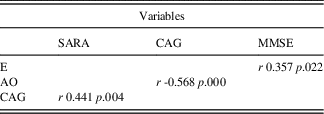
To find out if there was a relationship between clinical and demographic SCA2 variables in SCA2, Pearson’s correlation analyses were performed (Table 1). The analyses showed that the number of years of education has a weak correlation with MMSE (r=0.357; p=.022). Age at onset has a moderate negative correlation with CAG (r=−0.568; p=.000); and finally CAG has a weak correlation with SARA (r=0.441; p=.004).
r Test for clinical and demographic variables in SCA2

Note. Correlation analysis between SCA2 demographic and clinical variables. Results show statistically significant differences at p≤0.05.
SARA=Scale for the Assessment and Rating of Ataxia; CAG=expansion size; MMSE=Mini-Mental State Examination; E=years of education; AO=age at onset; r=value of r; p=probability.
Analysis of Cognitive Functioning
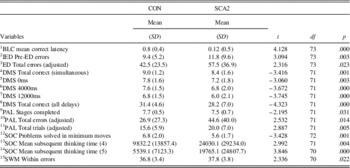
Statistical analysis of the cognitive measures between CON and SCA2 showed significant differences. Following is a list of the results for the Attentional task IED (Pre-ED errors SD=5.2/9.6; (t(73)=3.094; p=.003), (IED total errors SD=23.5/36.9; (t(73)=2.316; p=.023); Perceptual Learning task: DMS correct responses (DMS Total correct SD=1.2/1.6, (t(71)=−3.416; p=.001), (DMS at 0 ms delay SD=1.6/1.8; (t(71)=−3.060; p=.003), (DMS at 4000 ms delay SD=1.5/2.0, (t(71)=−3.672; p=.000), (DMS at 12,000 ms delay SD=1.5/2.1; (t(71)=−3.745; p=.000), (DMS Total correct including all delays SD=4.6/7.0; (t(71)=−4.323; p=.000); Associative Learning task: PAL (stages completed SD=0.5/0.7; (t(71)=−2.195; p=.031), (Total errors SD=27.3/40.0; (t(71)=2.532; p=.014), (Total trials SD=5.9/7.0; (t(71)=2.887; p=.005); Planning task: SOC (Problems solved in minimum moves SD=2.0/1.7; (t(72)=−3.428; p=.001); and Strategy task: SWM (within errors SD=3.4/3.8; (t(70)=2.336; p=.022) (Table 2).
t Test for CON and SCA2 of CANTAB variables

Note. t test between CON and SCA2 for different variables of the CANTAB subtests. Only results with statistically significant differences with p≤0.05 are shown. 1: speed in touching the correct stimulus after appearing on the screen. 2: errors before the extra-dimensional change, failure to select the stimulus compatible with the current rule. 3: participant's efficiency in the test. 4: selection of the correct stimulus in simultaneous trials. 5: selection of correct stimulus with 0 ms delay. 6: selection of correct stimulus with 4000 ms delay. 5: selection of correct stimulus with 12,000 ms delay. 8: selection of correct stimulus for all delays. 9: successful complete phases. 10: total errors with adjustment for each stage not carried out. 11: total trials necessary to properly place all patterns. 12: problems solved in minimum movements. 13: speed in performing movements after the initial movement, 4-movement problems. 14: speed in performing movements after the initial movement, 5-movement problems. 15: errors made in the same search for empty boxes. SD (standard deviation); t (value of t); df (degrees of freedom); and p (probability).
Analysis of Motor Deterioration and Cognitive Functioning
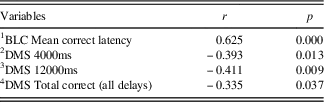
Correlation analyses were made between SARA score, and the CANTAB test scores (Table 3). Four significant correlations were found. As expected, BLC response speed showed a moderate correlation with SARA score (mean correct latency r=0.626; p=.000). However, three cognitive measures showed significant inverse correlation with SARA. These included the number of correct responses in the DMS test at the 4000 ms delay (r=−0.393; p=.013), at the 12,000 ms delay (r=−0.411; p=.009), and the DMS Total correct of number responses (r=−0.335; p=.037).
r Test for CANTAB subtests and SARA in SCA2

Note. Correlation analysis between CANTAB variables and SARA scores for SCA2. Only results with significant differences are shown. 1: speed in touching the correct stimulus after being presented on the screen. 2: selection of correct stimulus with 4000 ms delay. 3: selection of the correct stimulus with 12,000 ms delay. 4: selection of correct stimulus for all delays. r (value of r) and p (probability).
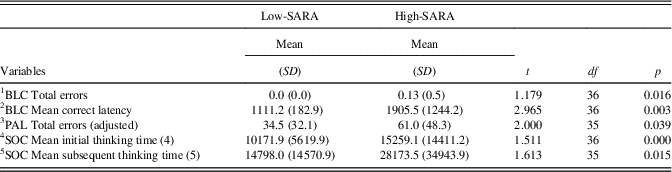
To further understand the effect of disease on cognitive functions, patients with SCA2 were divided in two subgroups depending on the SARA score. Twenty-two subjects obtained 15 points or less and were classified as low-SARA (average SARA 9.9; SD=2.5), and nineteen obtained 16 points or more and were classified as high-SARA (average SARA 20.3; SD=2.4). Table 4 show the results for t tests between low-SARA and high-SARA groups for each of the CANTAB subtests.
t Test for low-SARA and high-SARA of CANTAB variables

Note. t test between low-SARA and high-SARA for the different variables of the CANTAB subtests. Only the results with statistically significant differences with p≤0.05 are shown. 1: incorrect responses of a maximum of 40. 2: speed in touching the correct stimulus after being presented on the screen.3: total errors with adjustment for every non-realized stage. 4: speed in performing movements after the initial movement, 4-movements problems. 5: speed in performing movements after the initial movement, 5-movement problems. SD (standard deviation); t (value of t); df (degrees of freedom) and p (probability).
There were significant differences in BLC total errors (SD=0.0/0.5; (t(36)=1.179; p=.016), as well as in mean correct latency (SD=182.9/1244.2; (t(36)=2.956; p=.003). There were also significant differences in the total number of PAL errors (SD=32.1/48.3; (t(35)=2.000; p=.039), SOC mean initial thinking (SD=5619.9/14411.2; (t(36)=1.511; p=.000), and mean subsequent thinking (SD=14570.9/34943.9; (t(35)=1.613; p=.015).
Discussion
Our results provide novel evidence that patients with SCA2 have deficits in strategy, planning, and rule acquisition. Our findings also corroborate other SCA2 cognitive impairment, including memory deficits. Finally, the results suggest that patients with more motor impairment show greater deficits in specific cognitive domains. Following is a detailed discussion of these findings.
Demographical and Clinical Variables
Similar to previous reports we found that mutation size had a negative correlation with age at disease onset (Storey et al., Reference Storey, Forrest, Shaw, Mitchell and Gardner1999) and a positive correlation with motor deterioration. However, we did not find correlations between variables such as years of education, age, and cognitive tests (Le Pira et al., Reference Le Pira, Zappalà, Saponara, Domina, Restivo, Reggio and Giuffrida2002; Orsi et al., Reference Orsi, D’Agata, Caroppo, Franco, Caglio, Avidano and Mortara2011; Storey et al., Reference Storey, Forrest, Shaw, Mitchell and Gardner1999). This may be due to using CANTAB to test the patients, which may reduce cultural influences during the assessment (Pantelis et al., Reference Pantelis, Barnes, Nelson, Tanner, Weatherley, Owen and Robbins1997; Robbins et al., Reference Robbins, James, Owen, Sahakian, Lawrence, McInnes and Rabbitt1998).
Cognitive Impairment
Our results support the main hypothesis that patients with SCA2 have deficits in strategy, planning and rule acquisition. These results are backed by previous evidence showing fronto-cerebellar functional connectivity impairments in patients with SCAs (Hernandez-Castillo et al., Reference Hernandez-Castillo, Alcauter, Galvez, Barrios, Yescas, Ochoa and Fernandez-Ruiz2013; Schmahmann & Sherman, Reference Schmahmann and Sherman1998). Both the frontal cortex and cerebellum have been show to be involved in these cognitive processes (Miotto, Bullock, Polkey, & Morris, Reference Miotto, Bullock, Polkey and Morris1996; Owen et al., Reference Owen, Downes, Sahakian, Polkey and Robbins1990; Schmahmann & Sherman, Reference Schmahmann and Sherman1998). Deficits in the implementation of strategies in patients with SCA2 were evident by the impairment to generate efficient search strategies to remember spatial location in the SWM test. Similarly, poor results from the IED test suggested difficulties in the correct selection of the stimulus compatible with a current rule, and in attentional set-shifting, demonstrating deficits in rule acquisition. Lastly, SOC impairments in the generation and execution of strategies to solve spatial planning tasks, suggests deficits in planning. Thus we show executive dysfunctions in three fronto-executive domains in the SCA2 population. Previous reports using traditional tests in SCA2 patients have already demonstrated cognitive deficits that were mostly related to language, including immediate and delayed word recall, visuospatial memory and attention (Bürk et al., Reference Bürk, Globas, Bösch, Gräber, Abele, Brice and Klockgether1999; Cancel et al., Reference Cancel, Dürr, Didierjean, Imbert, Bürk, Lezin and Brice1997; Fancellu et al., Reference Fancellu, Paridi, Tomasello, Panzeri, Castaldo, Genitrini and Girotti2013), verbal fluency (Bürk et al., Reference Bürk, Globas, Bösch, Gräber, Abele, Brice and Klockgether1999, Reference Bürk, Globas, Bösch, Klockgether, Zühlke, Daum and Dichgans2003; Fancellu et al., Reference Fancellu, Paridi, Tomasello, Panzeri, Castaldo, Genitrini and Girotti2013; Le Pira et al., Reference Le Pira, Zappalà, Saponara, Domina, Restivo, Reggio and Giuffrida2002), deficits in delayed reproduction of a prose fragment (Bürk et al., Reference Bürk, Globas, Bösch, Gräber, Abele, Brice and Klockgether1999, Reference Bürk, Globas, Bösch, Klockgether, Zühlke, Daum and Dichgans2003; Le Pira et al., Reference Le Pira, Zappalà, Saponara, Domina, Restivo, Reggio and Giuffrida2002), and phonemic verbal fluency (Klinke et al., Reference Klinke, Minnerop, Schmitz-Hübsch, Hendriks, Klockgether, Wüllner and Helmstaedter2010).
Cognitive Functioning and Motor Deterioration
The correlation analysis between SARA scores and CANTAB subtests performance tested the relationship between motor deterioration and cognitive functioning. It should be noted that CANTAB has effectively been used to assess patients with different pathologies involving motor functions, such as Huntington’s disease (Lawrence et al., Reference Lawrence, Sahakian, Hodges, Rosser, Lange and Robbins1996) and Parkinson’s disease (Downes et al., Reference Downes, Roberts, Sahakian, Evenden, Morris and Robbins1989; Mehta, Sahakian, McKenna, & Robbins, Reference Mehta, Sahakian, McKenna and Robbins1999; Owen et al., Reference Owen, James, Leigh, Summers, Marsden, Quinn and Robbins1992, Reference Owen, Beksinska, James, Leigh, Summers, Marsden and Robbins1993; Riekkinen, Kejonen, Jäkälä, Soininen, & Riekkinen, Reference Riekkinen, Kejonen, Jäkälä, Soininen and Riekkinen1998). In addition, the general pattern of deficits that we found, resembles many of the cognitive deficits exhibited by SCA2 patients (Bürk, Reference Bürk2007; Garrard et al., Reference Garrard, Martin, Giunti and Cipolotti2008; Kawai et al., Reference Kawai, Suenaga, Watanabe and Sobue2009; Klinke et al., Reference Klinke, Minnerop, Schmitz-Hübsch, Hendriks, Klockgether, Wüllner and Helmstaedter2010; Manto, Reference Manto2005; Storey et al., Reference Storey, Forrest, Shaw, Mitchell and Gardner1999). Our findings that motor deterioration correlates with the selection of correct stimuli in an immediate and delayed matching to sample task are consistent with previous studies showing correlations between memory and clinical impairments (Bürk et al., Reference Bürk, Globas, Bösch, Klockgether, Zühlke, Daum and Dichgans2003). Our results cannot be explained as motor impairments alone, since most of the analyses were focused on error measurements, and not in variables involving reaction times that could be a confounding factor with motor performance.
To further explore if patients with more advanced ataxia show more cognitive deterioration we divided the SCA2 group into low-SARA and high-SARA subgroups. The results showed that high-SARA patients made more mistakes in learning pairs of associated figures, and required more time to pan solutions and implementing strategies for spatial tasks with a high degree of difficulty. These findings show that patients with more severe ataxia have greater deficits in specific cognitive domains.
Previous reports, however have found a lack of association between motor deterioration and cognitive functions (Fancellu et al., Reference Fancellu, Paridi, Tomasello, Panzeri, Castaldo, Genitrini and Girotti2013; Klinke et al., Reference Klinke, Minnerop, Schmitz-Hübsch, Hendriks, Klockgether, Wüllner and Helmstaedter2010; Le Pira et al., Reference Le Pira, Giuffrida, Maci, Marturano, Tarantello, Zappalà and Zappia2007; Orsi et al., Reference Orsi, D’Agata, Caroppo, Franco, Caglio, Avidano and Mortara2011). For example in one report, a group of 10 patients was tested 8.5 years after a first evaluation. The authors report that general motor deterioration worsened (especially regarding to posture, two patients even having to use a wheelchair), but most of the neuropsychological functions such as verbal memory, working memory, constructive abilities, and executive functions assessed by California Verbal Learning Test, Corsi Block-tapping Test, Rey Complex Figure, Controlled Oral Association Test, and Raven’s Progressive Matrices`47, respectively, did not show significant deterioration at the second evaluation. Consequently, the authors propose that cognitive decline does not progress in the same way as motor deterioration (Le Pira et al., Reference Le Pira, Giuffrida, Maci, Marturano, Tarantello, Zappalà and Zappia2007). Likewise, our study identified several cognitive functions whose deterioration was independent of the motor impairment. These include perceptual matching, learning and implementing rules to solve classification tasks, attentional set-shifting, spatial working memory, and generation of strategies for remembering spatial locations, which is consistent with the deterioration in strategy learning independent of the motor deterioration in SCA2 previously reported by our group (Vaca-Palomares et al., Reference Vaca-Palomares, Díaz, Rodríguez-Labrada, Medrano-Montero, Vázquez-Mojena, Velázquez-Pérez and Fernandez-Ruiz2013).
The aforementioned evidence suggests that further studies should be designed to understand the nature of these cognitive and motor variations. These studies should include the degeneration rate among different brain areas that could potentially substantiate motor, cognitive, or both processes. For example, cerebellar and/or extra-cerebellar damage could impact motor and cognitive processes depending on the specific areas affected by the disease (Della-Nave, Ginestroni, Tessa, Cosottini, et al., Reference Della Nave, Ginestroni, Tessa, Cosottini, Giannelli, Salvatore and Mascalchi2008; Della Nave, Ginestroni, Tessa, Salvatore, et al., Reference Della Nave, Ginestroni, Tessa, Salvatore, De Grandis, Plasmati and Mascalchi2008; Goel et al., Reference Goel, Pal, Ravishankar, Venkatasubramanian, Jayakumar, Krishna and Jain2011; Hernandez-Castillo et al., Reference Hernandez-Castillo, Alcauter, Galvez, Barrios, Yescas, Ochoa and Fernandez-Ruiz2013; Koziol et al., Reference Koziol, Budding, Andreasen, D’Arrigo, Bulgheroni, Imamizu and Yamazaki2014).
Cognitive Deterioration Consequences
It is important to mention the impact that the deterioration of strategy, planning and rule acquisition capacities can have in the patient’s activities of daily living. These impairments for example could impact not only their abilities to manage their doctor’s and physiotherapy appointments, but also their capacity to conclude their education, getting and keeping a job, and perform in self-sufficient way in their social life. Thus the cognitive implications resulting from SCA highlight the importance of creating cognitive and behavioral therapy programs to integrate the patient into society.
In conclusion, evaluation of patients with SCA2 with the CANTAB showed specific cognitive deficits, including strategy use, planning, and rule acquisition. The results also confirm deficits in attention and memory that have been previously described. Our analyses also suggest that patients with larger motor deterioration also show increased cognitive impairments in specific domains. However, this relationship could also reflect a progressive deterioration affecting various systems. Finally, these results support the fronto-cerebellar circuits’ role in cognitive functions suggesting deterioration in the cerebellar modulation of different cerebral cortex circuits in patients with SCA2.
Acknowledgments
We thank patients, patients’ families, and control participants. Competing Interests Statements: The authors on this manuscript do not have any conflicts of interest. Funding: Israel Vaca-Palomares was supported by Consejo Nacional de Ciencia y Tecnología (CONACYT) grant 229175. Juan Fernandez-Ruiz was supported by Universidad Nacional Autónoma de México, PAPIIT IN221413, and Consejo Nacional de Ciencia y Tecnología (CONACYT) 102314. This work was supported by the Cuban Ministry of Public Health. Contributorship Statements: Israel Vaca-Palomares: Conceived, designed, collected and analyzed the data of the study. Wrote the manuscript, revising the manuscript for content and final approval of the version to be published. Rosalinda Diaz: Logistic support and coordination of the study. Revising the manuscript for content and final approval of the version to be published. Roberto Rodríguez-Labrada: Collected data, logistic support and coordination of the study. Revising the manuscript for content and final approval of the version to be published. Jacqueline Medrano-Montero: Collected data, logistic support and coordination of the study. Revising the manuscript for content and final approval of the version to be published. Yaimeé Vázquez-Mojena: Logistic support and coordination of the study. Revising the manuscript for content and final approval of the version to be published. Juan Fernandez-Ruiz: Conceived, design and analyzed the data of the study. Wrote the manuscript, revising the manuscript for content and final approval of the version to be published. Luis Velázquez-Pérez: Design, logistic support and coordination of the study. Revising the manuscript for content and final approval of the version to be published.