Introduction
Children who learn two or more languages provide a rich source of information regarding language acquisition, in part because of the variability of their language-learning experiences. Bilingual learners may be classified according to the timing and social contexts of their experiences with each language. Children who begin acquiring one language at home and a second language in childhood through school and community exposure can be referred to as early sequential bilinguals. Often, the first language (L1) is a minority language and the second (L2) the majority language of the broader community, as is the case for Cantonese, Spanish, Urdu or Vietnamese L1 speakers in the United States, Canada, or the United Kingdom. In the United States, approximately 21% of school-age children fit this profile (US Department of Education, 2012).
Early sequential bilingual children with Primary (or Specific) Language Impairment (PLI)Footnote 1 can contribute a unique perspective to our knowledge of bilingual language acquisition. Children with PLI demonstrate significant delays in language acquisition in comparison to typically developing peers, despite normal hearing, performance within the average range on standardized measures of nonverbal intelligence, and comparable learning experiences (e.g., Leonard, Reference Leonard2000). For bilingual children with PLI, both languages are affected. Bilingual children with PLI have historically been an under-studied population, although the past decade has seen a surge of research interest and publications on this group. Nonetheless, there remain a number of questions about language profiles and development within this population that have not yet been answered. Specifically, the extent to which first and second language skills are associated or dissociated, the growth of each language over time, and the relative strength of each language are largely unexplored issues for children with PLI (Kohnert, Reference Kohnert2010). Building language profiles that include the two languages of bilingual children with PLI is crucial for understanding the intersection of bilingualism and PLI.
The overall purpose of the present study is to systematically profile the lexical skills of school-aged sequential bilingual children with PLI. Though the literature on bilingual children with PLI is growing, only a few studies have focused on the lexical domain. Although difficulties with morphosyntax may be a hallmark of PLI, children with PLI demonstrate deficits across a range of lexical-level tasks as well (Mainela-Arnold, Evans & Coady, Reference Mainela-Arnold, Evans and Coady2010; Sahlén, Radeborg, Wagner, Friberg & Rydahl, Reference Sahlén, Radeborg, Wagner, Friberg and Rydahl2000). Focus on a specific linguistic domain, namely the lexical domain, provides an opportunity to consider profiles across linguistic modalities (receptive versus expressive), task types (knowledge- versus processing-based), and languages. The primary research questions for this study are derived from the literature on typical bilingual children, providing an opportunity to validate this work in the language-impaired population.
Theoretical framework
The study is framed within Dynamic Systems Theory (DST) in which language is viewed as a complex system that emerges from multiple interactions within language (e.g., words and grammar) and between social and cognitive systems (e.g., de Bot, Lowie & Verspoor, Reference De Bot, Lowie and Verspoor2007; van Geert, Reference van Geert1998). Growth in complex systems is fueled by energy from internal and external resources. The language system interacts with external or environmental resources such as enrichment opportunities and frequency of use, as well as with child-internal resources such as processing capacity and motivation (Kohnert, Reference Kohnert2013; van Geert, Reference van Geert1998). Resources for growth are limited, and the amount of energy needed to cause a change in the system varies in part by whether growth in one component is dependent on growth in another component (de Bot et al., Reference De Bot, Lowie and Verspoor2007).
For bilingual speakers, growth in the L1 and L2 may be interconnected. Cross-linguistic relationships may be cooperative in which growth in one language may support growth in the other language, thus requiring less energy for both languages to develop. In contrast, relationships may be competitive in which growth in one language may interfere with growth in the other, thus requiring more energy for continued development in the decreasing language (de Bot et al., Reference De Bot, Lowie and Verspoor2007; Kohnert, Reference Kohnert2013). Both cooperative and competitive relationships may reflect common underlying mechanisms for language learning; in the case of competitive relationships, resources available in the language-learning system may have been exceeded by language-learning demands, leading to trade-offs between the two languages to be learned.
For early sequential bilinguals, the cognitive mechanisms underlying dual language learning interact with social context to shape language development. Children from minority language households face educational and societal pressures to use the majority language; these pressures may lead to the loss of skill in L1 (Wong Fillmore, Reference Wong Fillmore1991). However, supportive social and educational environments can foster growth in L1 for this population (Wright, Taylor & Macarthur, Reference Wright, Taylor and Macarthur2000). In the long term, continued growth in both the L1 and L2 is valuable. Early sequential bilinguals appear to reap benefits across multiple domains from the development of two languages (though it should be noted that there are also specific areas of disadvantage in comparison to monolingual peers, such as verbal fluency). Cognitively, a growing body of literature indicates that bilinguals demonstrate enhanced skills in comparison to monolinguals (see Bialystok, Craik & Luk, Reference Bialystok, Craik and Luk2012, for review). These advantages – in areas such as controlling attention and ignoring distracting information – may begin to appear after only a few years of exposure to a second language (Bialystok & Barac, Reference Bialystok and Barac2012). Benefits of bilingualism are seen in other areas as well; children who maintain L1 proficiency have improved outcomes across a range of psychological, educational, and social variables (Phinney, Romero, Nava & Huang, Reference Phinney, Romero, Nava and Huang2001; Tseng & Fuligni, Reference Tseng and Fuligni2000; Zhou & Bankston, Reference Zhou and Bankston1994).
The current study is an initial step in the investigation of L1–L2 relations among sequential bilingual children with PLI at the lexical level. Consistent with DST, the study examines interactions within each language between different aspects of lexical development as well as between the L1 and L2, and findings are interpreted within the broader context of interactions between cognitive, social, and environmental systems (de Bot et al., Reference De Bot, Lowie and Verspoor2007; Kohnert, Reference Kohnert2013).
Measuring lexical skills in bilinguals
Though lexical skill can be conceptualized as a single level of language complexity, it is a multidimensional entity. Correspondingly, a variety of tasks can be used to assess various dimensions of lexical skills in bilingual children. Lexical information can be obtained from the time it takes a child to name a picture (e.g., Kohnert, Reference Kohnert2002), from the number of word associations a child can generate in response to a stimulus (e.g., Sheng, Peña, Bedore & Fiestas, Reference Sheng, Peña, Bedore and Fiestas2012), or from the time it takes a child to determine whether a picture and its label match (Pham & Kohnert, published online July 13, Reference Pham and Kohnert2013). These varying tasks can be classified according to the type of lexical skill assessed. For the present study, two such classifications are important. First, as with other types of linguistic assessment, a basic distinction can be created between receptive and expressive lexical tasks. An additional distinction is the continuum between knowledge-based and processing-dependent tasks. While all linguistic assessments tap into a combination of language-learning ability and linguistic exposure, knowledge-based tasks are more reliant on exposure. At the lexical level, receptive and expressive vocabulary measures are classic examples of knowledge-based tasks; there is evidence that experience plays a strong role in vocabulary scores (e.g., Peña, Bedore & Zlatic-Giunta, Reference Peña, Bedore and Zlatic-Giunta2002). In the current study, receptive and expressive single-word vocabulary measures serve as knowledge-based assessments at the lexical level.
In contrast, tasks closer to the processing-dependent end of the continuum attempt to reduce the contribution of past experience to task performance, instead emphasizing underlying language-learning skills such as memory and processing speed (Laing & Kamhi, Reference Laing and Kamhi2003). It should be noted, however, that no linguistic task can completely eliminate the role of past experience; even processing-dependent tasks such as nonword repetition are influenced by linguistic exposure (Summers, Bohman, Gillam, Peña & Bedore, Reference Summers, Bohman, Gillam, Peña and Bedore2010; Windsor, Kohnert, Lobitz & Pham, Reference Windsor, Kohnert, Lobitz and Pham2010).
The two processing-dependent tasks utilized in the current study are nonword repetition (NWR) and rapid automatic naming (RAN). Both of these processing tasks have both lexical and sublexical components; here, we emphasize the lexical components and group them with other word-level tasks, though we do not deny the sublexical contributors to performance on RAN and NWR.
On the surface, NWR is a simple task in which a child repeats nonsense words that follow the phonotactic properties of a language. However, NWR is actually a complex task that taps multiple linguistic abilities, including lexical knowledge, speech perception, and motor planning (see Coady & Evans, Reference Coady and Evans2008, for a comprehensive review). The task has a close relationship with vocabulary learning, perhaps through a shared mechanism of sublexical phonological representations (Gathercole, Reference Gathercole2006). However, there are numerous lexical influences on NWR performance (Coady & Evans, Reference Coady and Evans2008) and NWR may be most accurately characterized as having both lexical and sublexical components. NWR is of particular interest in the study of PLI; in monolingual children with the disorder, NWR performance is markedly impaired, leading to consideration of this task as a clinical marker for PLI (Gathercole, Reference Gathercole2006). Furthermore, NWR deficits may be one contributor to the impaired word-learning skills observed in PLI (Gray & Brinkley, Reference Gray and Brinkley2011).
The second processing-dependent lexical measure, RAN, requires children to name an array of familiar items as quickly as possible. The task assesses the speed with which children can access and produce known words. The skill is hypothesized to be a core impairment in dyslexia (Wolf & Bowers, Reference Wolf and Bowers1999) and is also implicated in PLI (Coady, Reference Coady2013; Wiig, Zuerich & Chan, Reference Wiig, Zureich and Chan2000), although it has received less attention in the literature than NWR. Poor RAN performance in children with PLI may reflect a combination of slower overall processing speed (Sahlén et al., Reference Sahlén, Radeborg, Wagner, Friberg and Rydahl2000) and less robust lexical representations (Coady, Reference Coady2013).
Considering both knowledge-based and processing-dependent tasks at the lexical level provides an in-depth view of word-level language development in bilingual children with PLI. Vocabulary, NWR, and RAN are all known to be impaired in children with PLI. Furthermore, the tasks are interrelated in multiple ways, as NWR may reflect phonological storage that supports vocabulary learning (Gathercole, Reference Gathercole2006); larger vocabulary may support phonological pattern recognition that supports NWR performance (Munson, Kurtz & Windsor, Reference Munson, Kurtz and Windsor2005); NWR and RAN are both hypothesized components of phonological processing (see Wolf & Bowers, Reference Wolf and Bowers1999); and RAN and expressive vocabulary measures both share a clear lexical retrieval component (Coady, Reference Coady2013). In addition, recent evidence suggests there may be different patterns in cross-linguistic associations on these tasks (Verhoeven, Steenge & van Balkom, Reference Verhoeven, Steenge and van Balkom2012).
In the current study, we investigate associations between languages, lexical tasks, and age among Spanish–English early sequential bilingual children in the US with identified PLI. Because PLI is identified with reference to typically developing children of the same age, who share similar language-learning circumstances, we next review studies investigating lexical skills in both languages of typically developing sequential bilingual school-age children. We then review the empirical literature on school-age bilingual children with PLI, with a focus on lexical tasks.
Growth patterns and language interactions among typical bilingual children
There is now a robust literature considering performance on lexical-level tasks among early sequential bilingual children. On measures of vocabulary, this literature suggests that a gradual shift in language “dominance” or better skill from L1 to L2 occurs in mid-childhood for this group of children (e.g., Jia, Kohnert, Collado & Aquino-Garcia, Reference Jia, Kohnert, Collado and Aquino-Garcia2006; Kohnert, Bates & Hernandez, Reference Kohnert, Bates and Hernandez1999; Pham & Kohnert, published online July 13, Reference Pham and Kohnert2013; compare Oller, Jarmulowicz, Pearson & Cobo-Lewis, Reference Oller, Jarmulowicz, Pearson, Cobo-Lewis, Durgunoglu and Goldenberg2011). In other words, early sequential bilingual children may begin their school years performing faster and more accurately in the L1 on lexical tasks such as recognizing words and naming pictures. By the end of the primary school years, performance in the L2 often exceeds that in the L1 on the same tasks. This shift is supported by rapid growth in the L2; for example, Golberg, Paradis and Crago (Reference Golberg, Paradis and Crago2008) found that five-year-old typically-developing children from minority-language homes in Canada required just 34 months to acquire L2 receptive vocabulary skills comparable to monolingual peers. Consistent with DST, rapid growth in the L2 emerges from a substantial influx of energy from external resources such as schooling that interacts with internal resources such as motivation.
Rapid growth in the L2 can shift the overall language system, which in turn can affect the L1. For typical learners, lexical skills in the L1 generally appear to grow at a slower rate following the introduction of L2 (e.g., Rojas & Iglesias, Reference Rojas and Iglesias2013; Uccelli & Paez, Reference Uccelli and Páez2007). Variation across individuals, time periods, and linguistic tasks is substantial, however (Kohnert, Reference Kohnert2002), meaning that instances of L1 plateaus or even loss can be found. For example, narrative language samples collected longitudinally from a large group of early sequential Spanish–English bilingual children in the US (Rojas & Iglesias, Reference Rojas and Iglesias2013) showed a positive overall trajectory for L1 lexical diversity from the first sample (collected around age five) to the last (collected around age eight). However, lexical diversity in L1 decreases during some of the intervening samples.
The timing of shifts towards L2 dominance may be another indicator of L1 stagnation. In cross-sectional work, Kohnert and colleagues (Jia et al., Reference Jia, Kohnert, Collado and Aquino-Garcia2006; Kohnert et al., Reference Kohnert, Bates and Hernandez1999) conducted expressive lexical processing tasks in the L1 and L2 for Spanish–English bilinguals in the US and found shifts towards L2 dominance in accuracy and speed of processing at approximately 14 years of age or following nine years of schooling in the L2. However, Pham and Kohnert (published online July 13, Reference Pham and Kohnert2013) used similar expressive lexical processing tasks in a longitudinal design with Vietnamese–English bilinguals in the US and found shifts towards L2 dominance as early as 6–8 years of age or following 2–4 years of schooling in the L2. Consistent with DST, L1 attrition can include three patterns: (a) negative growth (i.e., decreases), (b) zero growth (i.e., plateau), and (c) early shifts toward L2 dominance; a steady amount of energy would be needed for L1 maintenance and an influx of energy would be needed for positive growth.
A third major question in the literature on sequential bilingual language development is how the L1 and L2 relate to each other. Here we focus specifically on L1–L2 relationships on lexical tasks, among school-aged early sequential bilingual children. Results from these investigations are somewhat mixed, with a number of methodological variables influencing results. When vocabulary size is examined in cross-sectional samples, cross-linguistic correlations have often not reached statistical significance; for example, Gottardo (Reference Gottardo2002) found a non-significant cross-linguistic relationship for receptive vocabulary measures in early school-aged Spanish–English bilingual children (r = .18). Branum-Martin, Mehta, Francis, Foorman, Cirino and Miller (Reference Branum-Martin, Mehta, Francis, Foorman, Cirino and Miller2009) provide a meta-analysis of this work for Spanish–English sequential bilinguals. Meta-analytic results indicated a statistically significant negative relationship between English and Spanish receptive vocabulary measures (Z = −.394) and a larger, statistically significant negative relationship between English and Spanish expressive vocabulary (Z = −.831). In contrast, cross-linguistic correlations on vocabulary measures extracted from narrative language samples were largely positive (Branum-Martin et al., Reference Branum-Martin, Mehta, Francis, Foorman, Cirino and Miller2009). Branum-Martin et al. (Reference Branum-Martin, Mehta, Francis, Foorman, Cirino and Miller2009) emphasize the importance of the type of vocabulary measure, as well as sociolinguistic variables such as the language of academic instruction, in interpreting cross-linguistic vocabulary associations.
On processing-dependent lexical tasks, cross-linguistic relationships may be both stronger and more positive. On Rapid Automatic Naming (RAN) tasks, two recent studies have found significant positive relationships across languages. Swanson and colleagues (Swanson, Orosco, Lussier, Gerber & Guzman-Orth, Reference Swanson, Orosco, Lussier, Gerber and Guzman-Orth2011) found a strong, positive cross-linguistic correlation (r = .50) on rapid automatic letter and digit naming in a large group of Spanish–English sequential bilinguals in the early school grades. Furthermore, positive cross-linguistic correlations were found between RAN and other lexical level tasks; for example, Spanish RAN was significantly correlated with English receptive vocabulary, r = .32. Li, Kirby and Georgiou (Reference Li, Kirby and Georgiou2011) also found positive L1–L2 relationships on RAN in a sample of school-aged Chinese–English sequential bilinguals. The total time to name an array of digits was significantly correlated in the L1 and L2 (r = .34). Investigations of nonword repetition have also yielded significant positive cross-linguistic correlations in sequential bilingual children (e.g., Masoura & Gathercole, Reference Masoura and Gathercole2005). In an investigation of 65 typically developing sequential bilingual children, Windsor et al. (Reference Windsor, Kohnert, Lobitz and Pham2010) found a very large, positive correlation (r = .71) between NWR performance in L1and L2. The stronger cross-linguistic correlations found on NWR and RAN in samples of early-sequential bilinguals suggest that these tasks may tap into underlying abilities that support learning across languages; however, additional studies, especially those with stronger experimental designs, are needed to verify such claims.
Longitudinal samples do offer a stronger design, with the potential to determine whether L1 skills can predict L2 growth over time, and vice versa. Verhoeven (Reference Verhoeven1994) conducted a longitudinal study with 74 Turkish–Dutch bilinguals that measured oral language skills in the L1 and L2 at three time points, namely at the beginning and end of first grade and the end of second grade (age range 6–8 years). Using structural equation modeling of L1 and L2 receptive and expressive vocabulary scores, Verhoeven (Reference Verhoeven1994) found no cross-language associations in vocabulary knowledge. However there were strong, positive cross-language associations for lexical use between the L1 and L2 at Time 1 and between the L1 at Time 1 and the L2 at Time 2 as measured by the number of different content words used during a conversational language sample. Pham (Reference Pham2011) conducted a longitudinal study with 33 Vietnamese–English bilinguals that measured the L1 and L2 at four yearly time points (age range 6–11 years). Using hierarchical linear modeling in which the L1 and age were dynamic predictors of the L2, Pham (Reference Pham2011) found strong positive cross-language associations on measures of speed and accuracy in picture naming in which performance in the L1 accounted for up to 12% unique variance in the L2 after controlling for age.
In sum, the literature on lexical development among typically-developing school-aged early sequential bilinguals supports the broad conclusion that the L1 and L2 may be positively or negatively associated, depending upon the sample of children and the dependent variable. Both cooperative and competitive relationships are allowed within DST, and may support the presence of common underlying mechanisms for learning the L1 and L2. There is converging evidence on group-level patterns of rapid L2 growth, shifts toward L2 dominance, and either slower increases in the L1 or L1 attrition. These trends provide a baseline against which to compare the development of bilingual children with PLI.
PLI in bilingual children
In the past five years, there has been tremendous growth in the number of studies examining bilingual children with PLI. Bilingual PLI has now been identified and studied in a variety of language pairs, including Spanish–Catalan (Sanz-Torrent, Serrat, Andreu & Serra, Reference Sanz-Torrent, Serrat, Andreu and Serra2008), Finnish–Swedish (Westman, Korkman, Mickos & Byring, Reference Westman, Korkman, Mickos and Byring2008), English–Hebrew (Iluz-Cohen & Walters, Reference Iluz-Cohen and Walters2012), and Turkish–German (Rothweiler, Chilla & Clahsen, Reference Rothweiler, Chilla and Clahsen2012). The L2 outcomes of bilingual children with PLI have been a topic of particular interest (Paradis, Reference Paradis2007; Rothweiler et al., Reference Rothweiler, Chilla and Clahsen2012; Verhoeven, Steenge, van Weerdenburg & van Balkom, Reference Verhoeven, Steenge, van Weerdenburg and van Balkom2011).
Relatively few studies have reported performance on the same tasks in both the L1 and L2, however. Such dual-language profiles are crucial to understanding the manifestation of PLI in sequential bilinguals. For example, Håkansson, Salameh, and Nettelbladt (Reference Håkansson, Salameh and Nettelbladt2003) documented depressed skills in both L1 and L2 for a small sample of Swedish–Arabic children with PLI, with a “balanced low level” of development in both languages; the result establishes an overall profile for the impact of PLI on the morphosyntactic system of Swedish–Arabic bilingual children.
The current study focuses on lexical tasks. Recent work by Sheng and colleagues (Sheng, Bedore, Peña & Taliancich-Klinger, Reference Sheng, Bedore, Peña and Taliancich-Klinger2013; Sheng et al., Reference Sheng, Peña, Bedore and Fiestas2012) has shown that bilingual children with PLI demonstrate reduced depth of semantic knowledge in both languages, as indexed by the number of word associations they can generate. Their word associations are also less likely to be among the most frequent responses, suggesting poor semantic convergence among bilingual children with PLI. This pattern was more pronounced in English (L2) than Spanish (L1).
Two additional investigations have focused on NWR performance in L1 and L2 for bilingual children with PLI (Gutiérrez-Clellen & Simon-Cereijido, Reference Gutiérrez-Clellen and Simon-Cereijido2010; Windsor et al., Reference Windsor, Kohnert, Lobitz and Pham2010). Both studies found poorer performance in both L1 and L2 for bilingual children with PLI in comparison to typically developing peers; furthermore, the most accurate picture of performance on this task is obtained when both languages are considered. Thus, across language levels, a growing body of literature is establishing deficits in both L1 and L2 in bilingual children with PLI.
A limited number of studies have considered how L1 and L2 relate to one another in early sequential bilingual children with PLI at the lexical level. Windsor et al. (Reference Windsor, Kohnert, Lobitz and Pham2010) examined NWR performance in Spanish and English by typical and atypical learners, aged 6–11, and found robust cross-linguistic correlations that persisted even after controlling for age and nonverbal intelligence among typical learners who were bilingual (n = 65) and monolingual (n = 69) as well as monolingual children with PLI (n = 34). However, no cross-linguistic correlation was found between Spanish and English NWR for the relatively smaller group of bilingual children with PLI (n = 19). Verhoeven et al. (Reference Verhoeven, Steenge and van Balkom2012) recently examined cross-linguistic associations in a larger group of Turkish–Dutch bilingual children with PLI, aged between 6 and 11 (n = 75). Participants completed a battery of language measures in Turkish and Dutch. Lexical tasks within this battery include word definitions, receptive and expressive vocabulary, and NWR. Cross-linguistic correlations, controlling for age, were calculated within-task only. Significant positive cross-linguistic associations were found across a range of tasks, including sentence repetition, story comprehension, and grammatical comprehension at the sentence level. At the lexical level, results were mixed: NWR was significantly correlated across languages, but receptive vocabulary, expressive vocabulary, and word definitions were not. Finally, cross-linguistic comparisons suggested performance was better in L1 than L2 on almost all tasks. These two studies (Verhoeven et al., Reference Verhoeven, Steenge and van Balkom2012; Windsor et al., Reference Windsor, Kohnert, Lobitz and Pham2010) provide an initial picture of how L1 and L2 may relate in bilingual children with PLI at the lexical level.
Similarly, there has been little empirical investigation of L1 and L2 growth trajectories in school-aged bilingual children with PLI (see Gutiérrez-Clellen, Simon-Cerejido & Sweet, Reference Gutiérrez-Clellen, Simon-Cereijido and Sweet2012, for an investigation with preschool children). One possibility consistent with DST is that sequential bilingual school-age children with PLI are more vulnerable to L1 plateaus or regression than their typically developing peers. Although this possibility has been largely unexplored, a case study supports it: Restrepo and Kruth (Reference Restrepo and Kruth2000) documented a decreasing mean length of utterance and a reduction in the variety of morphological forms used in L1 for a bilingual school-aged child with PLI (compare Bruck, Reference Bruck1982). Sheng et al. (Reference Sheng, Bedore, Peña and Taliancich-Klinger2013) also suggest that a plateau in L1 development may explain differences between Spanish and English semantic convergence patterns that emerged in their study of sequential bilingual children with PLI.
Fostering continued L1 growth may be particularly important for bilingual children with PLI. In addition to the cognitive and social benefits apparent for typically developing bilinguals, bilingualism may actually be instructive, or beneficial, to language learning in bilingual children with PLI (Armon-Lotem, Reference Armon-Lotem2010; Roeper, Reference Roeper2012). More specifically, children with PLI may be able to use knowledge of their first language to “bootstrap” into their second. However, this hypothesis hinges in part on the ability to maintain L1 knowledge.
In sum, the study of L1 and L2 relationships and change over time is in its infancy for children with PLI. Phenomena such as the shift in “dominance” to the L2, the nature of cross-linguistic relationships, and L1 maintenance are just beginning to be extended from typically developing to language-impaired children. The DST framework has been used to explain these patterns among typically developing sequential bilinguals and is flexible enough to be applied to children with impaired language learning as well.
The present study
This study profiles lexical skills in school-aged sequential bilingual children with PLI on receptive and expressive tasks in the L1 and L2. Our purpose is to examine relationships across languages, tasks, and age within this group. We address three specific questions:
-
1. What is the relationship between age, L1 and L2?
-
2. What are the patterns of relative L1–L2 dominance for bilingual children with PLI?
-
3. How is lexical task performance related across languages and across tasks for bilingual children with PLI?
We anticipate results that are largely consistent with DST and existing work on typically developing children. Because sequential bilingual children with and without PLI experience similar social and educational influences on language use in the early school years, we expect our sample to show a shift from L1 to L2 dominance and to show strong positive relationships between age and L2 skills, as has been shown in the typically developing sequential bilingual population (e.g., Cobo-Lewis, Pearson, Eilers & Umbel, Reference Cobo-Lewis, Pearson, Eilers and Umbel2002a, Reference Cobo-Lewis, Pearson, Eilers and Umbelb; Jia et al., Reference Jia, Kohnert, Collado and Aquino-Garcia2006; Pham & Kohnert, published online July 13, Reference Pham and Kohnert2013; Rojas & Iglesias, Reference Rojas and Iglesias2013). In addition, we predict positive correlations among tasks within each language, with stronger relationships between the knowledge-based tasks (receptive and expressive vocabulary tests, which measure a common core of vocabulary knowledge) than between processing-based tasks (NWR and RAN, which measure different aspects of lexical processing). Cross-linguistically, we anticipate some positive L1–L2 relationships, consistent with the existence of a common pool of resources to support language learning. Measures with a heavier processing component (e.g., RAN, NWR) may be more strongly related across languages than measures that rely more heavily on linguistic knowledge, as processing-based measures are presumed to emphasize underlying language-learning abilities over language-specific knowledge (Windsor et al., Reference Windsor, Kohnert, Lobitz and Pham2010).
Because the population of interest here has impaired language learning, we also anticipate a few possible differences with the literature on typically developing bilingual children. The relationship between age and L1 may be weak or even nonexistent for children with PLI, given the potential for L1 loss in this population (Restrepo & Kruth, Reference Restrepo and Kruth2000). There also may be more negative cross-linguistic relationships, as children with PLI have a smaller pool of resources from which to support dual language learning. Finally, although we expect wide individual variation for bilingual children with PLI as has been found with typical bilinguals (Kohnert, Reference Kohnert2002), the underlying language impairment will inherently restrict the upper limits in language scores for the group.
Method
Participants
The participants in this study were part of a larger study investigating different treatment conditions for bilingual school-aged children with PLI (Ebert, Kohnert, Pham, Rentmeester Disher & Payesteh, published online July 30, Reference Pham and Kohnert2013). The profiles used in this study represent each participant's performance on the language assessments at study entry. A total of 52 children participated in the treatment study. However, preliminary analyses indicated that one child was an extreme outlier in terms of nonverbal intelligence and this child was eliminated from the database. Ten additional children were eliminated due to incomplete data. Thus, data from 41 children are presented here.
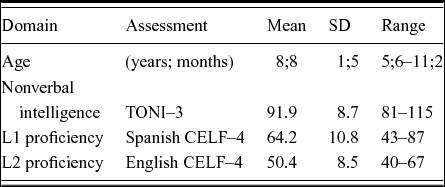
These 41 participants ranged in age (years;months) from 5;6 to 11;2, with a mean age of 8;8. Six participants were female and the remaining 35 were male. The parents of all participants reported using Spanish “all of the time” or “most of the time” at home. Mean age of first exposure to English, per parent report, was 4;0 years (range = 2– 7 years). Regional dialects of Spanish used in participants’ homes included Mexican and Central American. All participants attended elementary school in a large urban school district in the upper midwestern region of the United States. Most participants attended schools that use only English for instruction and provide speech-language therapy services only in English, although some of the schools provided limited support for Spanish.
All participants met conventional criteria for PLI (or specific language impairment) and qualified for school-based speech-language therapy services for language disorder. A number of steps were taken to verify this PLI status. First, parent interview was used to confirm parental concern with communication development (Restrepo, Reference Restrepo1998) and the absence of hearing loss, autism, head injury, cerebral palsy, seizures, general cognitive delay, and physical problems. Next, all participants passed a hearing screening at 20 dbHL at 1000 Hz, 2000 Hz and 4000 Hz, verifying the absence of hearing loss. Lower frequencies were not screened due to the ambient noise in the school setting at which screenings were conducted; however, no child had a history of hearing loss per parent report or school records. In addition, nonverbal intelligence testing using the Test of Nonverbal Intelligence – 3rd edition (TONI–3; Brown, Sherbenou & Johnsen, Reference Brown, Sherbenou and Johnsen1997) was used to confirm that each participant demonstrated cognitive skills within the average range (defined as no more than 1.25 standard deviations below the mean). Finally, all participants completed an omnibus language assessment, the Clinical Evaluation of Language Fundamentals – 4th edition, in Spanish (CELF–4S; Wiig, Secord & Semel, Reference Wiig, Secord and Semel2006) and English (CELF–4E; Semel, Wiig & Secord, Reference Semel, Wiig and Secord2003) to confirm the presence of delayed language skills in both languages. The four subtests that make up the Core Language composite were administered from the CELF–4S and the CELF–4E. Three subtests contribute to the Core Language score for all ages: Concepts and following directions, in which children follow directions of increasing length and complexity; Recalling sentences, in which children imitate sentences; and Formulated sentences, in which children are asked to compose a sentence using a target word. The fourth subtest of the CELF–4 Core composite varies by age group. Children aged 5–8 years complete the Word structure subtest, which assesses productive morphosyntax using a cloze procedure. Children aged nine years and older complete the Word classes–total subtest, which assesses receptive and expressive semantic knowledge.
Participant scores for the TONI–3 and CELF–4 tests are reported in Table 1. Consistent with the conventional definition of PLI for bilingual children, participants demonstrated nonverbal intelligence within the average range and low proficiency in both languages. Consistent with the manifestation of PLI in bilingual children (Kohnert, Reference Kohnert2010), substantial individual variation was present within all measures of the sample, including nonverbal intelligence, the L1 and the L2. Overall, participants displayed significantly depressed scores in both languages with average Core Language scores at between 2.5 and 3 standard deviations below the published mean of 100. Participants on average received a standard score of 64 for Spanish and 50 for English. In considering these scores, it is important to note differences in the normative samples for the Spanish and English tests that invalidates direct comparison of standard scores between languages. The CELF–4S is normed with bilingual Spanish–English speakers, whereas the CELF–4E is normed on monolingual speakers. Because the CELF–4E is standardized with monolingual English-speaking children, standard scores from bilingual participants in the present study may appear lower than scores from the monolingual norming population (Pearson, Fernandez & Oller, Reference Pearson, Fernandez and Oller1993). The present group of children demonstrated floor effects on the CELF–4E, with five children receiving the minimum possible Core language score of 40. In Spanish, no children scored below test norms (the lowest Core language score was 43). Overall, the scores in Table 1 indicate that this group of children exhibited moderate to severe impairment in language development, in comparison to bilingual peers.
Participant characteristics.

Note: Sample consisted of 41 participants (35 boys, six girls). Standard scores are displayed for the Test of Nonverbal Intelligence, 3rd edition (TONI–3) and the composite (Core) scores for the Clinical Evaluation of Language Fundamentals, 4th edition (CELF–4) for Spanish and English. CELF–4 standard scores cannot be directly compared between languages. Spanish CELF–4 scores are standardized on bilingual children, while English CELF–4 scores are standardized on monolingual English-speaking children. See Figure 5 for within-group comparisons using raw scores.
Measures
Lexical measures used in the current study include measures of receptive and expressive lexical knowledge and processing. The knowledge-based measures were published tests of expressive vocabulary in Spanish (Expressive One-Word Picture Vocabulary Test – Spanich-Bilingual Edition, (EOW–S), Brownell, Reference Brownell2001a), and in English (Expressive One-Word Picture Vocabulary Test, (EOW-E), Brownell, Reference Brownell2000a) and of receptive vocabulary in Spanish (Receptive One-Word Picture Vocabulary Test – Spanish-Bilingual Edition, (ROW–S), Brownell, Reference Brownell2001b) and in English (Receptive One-Word Picture Vocabulary Test, (ROW–E), Brownell, Reference Brownell2000b). The EOW–S and ROW–S were administered entirely in Spanish rather than bilingually as specified in the administration manuals. Raw scores were used as the dependent variable for the vocabulary measures in order to facilitate cross-linguistic comparison, as the Spanish and English versions of these tests are normed on different populations.
Two processing-dependent lexical tasks were also administered. The first was an NWR task in Spanish (NWR–S) and in English (NWR–E). Spanish nonword stimuli (Ebert, Kalanek, Cordero & Kohnert, Reference Ebert, Kalanek, Cordero and Kohnert2008) consisted of 20 nonwords ranging from one to five syllables. NWR–E stimuli in this study consisted of 16 nonwords ranging from one to four syllables (Dollaghan & Cambell, Reference Dollaghan and Campbell1998). Responses on the NWR tasks were digitally recorded, transcribed, and scored according to Dollaghan and Campbell (Reference Dollaghan and Campbell1998). The result was a Percent Phonemes Correct (PPC) score at each syllable level plus an overall PPC score for each language. Transcription reliability was completed for both Spanish and English (see Ebert et al., published online July 30, Reference Ebert, Kohnert, Pham, Rentmeester Disher and Payesteh2013, for details). In the present study, PPC scores were averaged for the two longest syllable lengths (four- and five-syllable words in Spanish, and three- and four-syllable words in English) to create the primary dependent variables for the NWR tasks. We eliminated the shorter nonwords from the PPC scores because of the robust evidence that longer nonwords are more sensitive to PLI (Dollaghan & Campbell, Reference Dollaghan and Campbell1998; Windsor et al., Reference Windsor, Kohnert, Lobitz and Pham2010).
The second nonstandardized language measure was a rapid automatic naming task in Spanish (RAN–S) and English (RAN–E). Picture stimuli for the RAN tasks were the Object and Digit arrays from the Comprehensive Test of Phonological Processing (Wagner, Torgesen & Rashotte, Reference Wagner, Torgesen and Rashotte1999). Objects and digits were translated into Spanish for the Spanish version of this task. Children were asked to name a total of 72 items in each array as quickly as possible. The dependent variable for the task was correct responses per second, created by dividing the total number of correct responses (summed across the object and digit arrays) by the total time in seconds (again summed across the object and digit arrays). The RAN task was added to the protocol after the beginning of the study. RAN scores were available for 30 participants.
Procedures
Following referral and consent, parents were contacted via phone to provide background information on language use and to confirm PLI status. The complete pre-treatment testing battery for the treatment study – of which the tasks described here are a subset – was then conducted across two to four sessions. Whenever possible, Spanish and English tasks were conducted during separate sessions. When it was necessary to use both languages within a single assessment session, Spanish and English tasks were conducted by separate examiners with a break in between the two languages. The order in which the languages were tested was counterbalanced across participants.
Testing was conducted in a quiet location in participants’ schools. During the academic school year, testing was conducted as part of an afterschool program. During the summer, testing was conducted as part of a summer school program. All individuals who assisted with testing were either certified speech-language pathologists or students in speech-language-hearing sciences who were trained to carry out the experimental tasks. Individuals administering Spanish language tasks were fluent Spanish speakers.
Analyses
Study questions were explored using a set of planned analyses. First, relations between age, languages, and tasks were examined using bivariate correlations between tasks and age and partial correlations between the L1 and L2 that controlled for the effect of age, which was expected to be a significant predictor of performance across tasks (Kail, Reference Kail1991). In all correlations, cases in which data were missing were excluded pairwise. Partial and bivariate correlations resulted in a total of 64 comparisons. In order to control for Type I error, a false discovery rate procedure (Benjamini & Hochberg, Reference Benjamini and Hochberg1995) was used to define statistical significance; the procedure is an alternate approach to multiple-comparison control that guarantees an error rate equal to or below that provided by traditional Bonferroni-type procedures. Because of this strong control of error rate and because of subsequent suggestions that the FDR is remains conservative (Benjamini & Hochberg, Reference Benjamini and Hochberg2000), we set the false discovery rate at .10. This resulted in p-values below .023 reaching statistical significance. Scatterplots were constructed in order to visually examine individual performance on each task in relation to age.
Second, language dominance at the group level was evaluated using a paired sample t-test comparing L1 performance to L2 performance for each task. In addition to the group-level analysis, individual participant profiles were evaluated for relative language dominance. L2 (English) dominance was operationally defined as obtaining an English score at least 10% greater than the Spanish score for the same task, while L1 dominance was defined as a Spanish score 10% greater than the English score (see Kohnert, Reference Kohnert2013). Participants who did not fall into either category (i.e., scores in both languages were within 10% of each other) were considered balanced in their L1–L2 performance on the given measure.
Results
We consider results separately for each of the three major study questions.
Relations with age
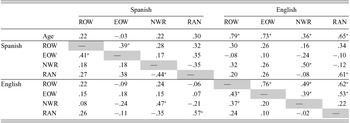
The top row of Table 2 depicts bivariate correlations between participant age and language measures. The correlation between age and task performance was significant and positive for all four English tasks: ROW (r = .73, p < .001), EOW (r = .79, p < .001), NWR (r = .36, p = .02), and RAN (r = .65 p < .001) indicating that older children had greater English performance on all lexical tasks. Using r2 as the effect size, age accounted for 54% of variance in English ROW, 62% in English EOW, 13% in English NWR and 42% of variance in English RAN. In contrast, none of the correlations between age and Spanish task performance reached statistical significance, indicating no increases in Spanish performance with age. Correlation coefficients ranged from r = −.03 for age and Spanish EOW to r = .30 for age and Spanish RAN.
Bivariate and partial correlations (age removed) among lexical tasks in Spanish and English.

ROW = Receptive One-Word Picture Vocabulary Test; EOW = Expressive One-Word Picture Vocabulary Test; NWR = Nonword repetition; RAN = Rapid automatic naming.
* significant after controlling for multiple comparisons (Benjamini & Hochberg, Reference Benjamini and Hochberg1995)
Note: Bivariate correlations are displayed above the shaded diagonal, and partial correlations controlling for age are below the diagonal. Correlations are based on raw scores.
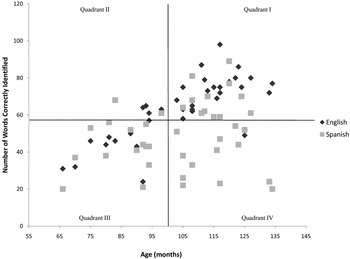
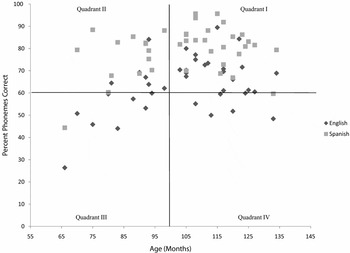
The scatterplots were used to visually explore relations between age and language scores at an individual level. Each scatterplot depicts L1 and L2 task scores against age and is divided into four quadrants according to the midpoint of each range of scores (i.e., at the midpoint of the age range, and at the midpoint of the range of task scores defined as the highest score in either language minus the lowest score in either language). Quadrants are labeled I–IV, counterclockwise beginning in the upper right-hand quadrant. Figure 1 displays the scatterplot for Spanish and English ROW against age. Individual scores for Spanish ROW were scattered across Quadrants I, III and IV, indicating low receptive vocabulary in the L1 for all ages and wider variation or spread for older children. In contrast, individual scores for English fall largely into Quadrants III and I, showing the relation between age and English receptive vocabulary.
Scatterplot for raw scores on the Receptive One-Word Picture Vocabulary Tests in Spanish and English for the total sample (n = 41). For Spanish, M = 50.0 and SD = 18.7; for English, M = 64.4 and SD = 16.3.

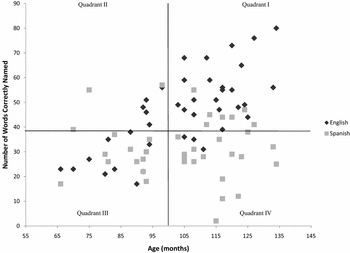
Figure 2 displays the scatterplot for Spanish and English EOW against age. Most individual Spanish scores fell within Quadrants III and IV indicating low expressive vocabulary in the L1 across ages; the presence of some dispersion shows that a few children were able to develop better expressive vocabulary in Spanish. Figure 2 again illustrates that the vast majority of individual scores in English fell in Quadrants I and III, indicating positive relationships between age and performance on expressive vocabulary tasks in the L2.
Scatterplot for raw scores on the Expressive One-Word Picture Vocabulary Tests in Spanish and English for the total sample (n = 41). For Spanish, M = 31.5 and SD = 11.7; for English, M = 46.4 and SD = 15.8.

Figure 3 displays a scatterplot for Spanish and English NWR against age. Nearly all individual scores for Spanish fell within Quadrants I and II indicating consistently high performance in repeating nonsense words in the L1. English NWR scores were scattered across all four quadrants, suggesting a modest positive relationship between age and phonological memory skills in the L2 with substantial individual variability.
Scatterplot of percent phonemes correct scores for nonword repetition tasks in Spanish and English (n = 40). For Spanish, M = 79.1 and SD = 10.5; for English, M = 63.6 and SD = 12.3.

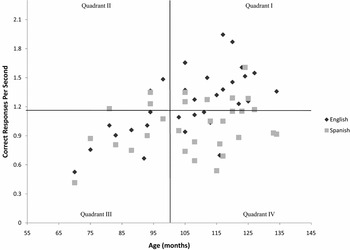
Figure 4 displays a scatterplot for Spanish and English RAN against age. In Spanish, scores fell mostly in the lower quadrants (III and IV) with some scatter into the remaining two quadrants. The result reflects limited efficiency in accessing familiar lexical items in the L1 across ages, with substantial individual variation. Nearly all individual scores for English fell within Quadrants I and III, indicating the robust positive relationship between age and rapid naming in the L2.
Scatterplot of ratio scores (total number correct/time in seconds) for rapid automatic naming tasks in Spanish and English (n = 30). For Spanish, M = 1.01 and SD = .27; for English, M = 1.25 and SD = .35.

Language dominance
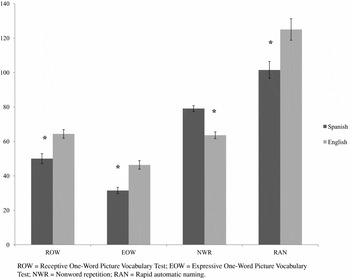
Figure 5 displays group performance in the L1 and L2 for each lexical task, along with results of the t-test analyses to determine relative language dominance at the group level. On average, participants had better performance in English (L2) on three of the four tasks: ROW (t = 4.45, df = 40, p < .001), EOW (t = 5.10, df = 40, p < .001), and RAN (t = −.50, df = 29, p < .001). Average performance was better in Spanish (L1) on NWR (t = 8.55, df = 39, p < .001).
Group-level performance in Spanish (L1) and English (L2). Performance on ROW and EOW are displayed as the number of items correct; NWR is displayed as percent phonemes correct; RAN is displayed as the number of correct items divided by the time in seconds (i.e., ratio × 100). Asterisks (*) correspond to differences between L1 and L2 performance using paired sample t-tests for each task with corresponding ps <.001, two tailed.

Individual participants were then classified for relative language dominance on each task using the 10% difference criterion defined above. Using this criterion, 13 of 41 participants (32% of sample) followed the group pattern of L2 dominance, with greater English performance on at least three tasks. An additional 14 of 41 participants (34%) demonstrated L2 dominance on two tasks. However, the remaining one-third of participants did not show this pattern of L2 dominance: seven of 41 participants (17%) showed relatively balanced performance across multiple tasks and seven of 41 participants (17%) showed L1 dominance on at least one task with balanced performance on others. Consistent with the group performance, children were most likely to show L1 dominance on the NWR task, even when they showed L2 dominance on other tasks. Of the 27 children who showed L2 dominance on at least two tasks, 20 remained L1-dominant on the NWR task.
Relations across languages and tasks
Associations between the L1 and L2 were first considered using the same task in each language (e.g., NWR–S and NWR–E). As shown in Table 2, two cross-linguistic correlations reached statistical significance. NWR scores in English and Spanish were positively correlated (r = .50, p = .001); this relation persisted after controlling for age (partial r = .47, p = .003). Similarly, RAN scores were strongly correlated across languages (r = .61, p < .001) and the relation persisted after controlling for age (partial r = .58, p = .001). In contrast to the presence of positive cross-language associations found among processing-based tasks, cross-language associations among the two vocabulary knowledge measures did not reach statistical significance. In addition, there were no cross-language associations on different tasks that reached significance.
Next, relations across tasks within each language were considered. Correlation analyses revealed a single within-language bivariate correlation for Spanish (out of six possible) between ROW and EOW (r = .39, p = .01), which persisted after controlling for age (partial r = .41, p = .01). Partial correlations also revealed one negative association between NWR and RAN (partial r = −.44, p = .02).
For English, five of six within-language associations reached significance: ROW positively correlated with EOW (r = .76, p < .001), NWR (r = .49, p = .001) and RAN (r = .62, p < .001); EOW positively correlated with NWR (r = .39, p = .01) and RAN (r = .53, p = .002). For English, three within-language associations were no longer significant once we controlled for age. Partial correlations revealed two remaining within-language associations between ROW and EOW (partial r = .43, p = .01) and between ROW and NWR (partial r = .37, p = .02). In sum, within-language associations were stronger and more prevalent in English (L2) than in Spanish (L1). For each language, knowledge-based tasks (ROW and EOW) were positively related.
Discussion
This study examined lexical skills in a sample of Spanish–English early sequential bilinguals, aged 5–11, with PLI. Four lexical tasks in each language measured receptive and expressive vocabulary knowledge (ROW and EOW) and two processing-based skills of phonological memory (NWR) and efficiency in lexical access (RAN). An overall goal of the study was to examine language profiles of bilingual children with language impairment in comparison to previous literature on typically developing bilingual children. Of key interest was to examine the nature and presence of cross-language relationships that are robust in face of weak or compromised language systems. Three specific questions regarding relationships among L1, L2, and age were considered.
The first research question addressed the role of maturation (i.e., age). The cross-sectional nature of the study limits the extent of the inferences that can be drawn in this area (in comparison to longitudinal studies that can examine within-child growth over time). However, results here are consistent with previous literature on sequential bilingual children. Older children in the sample showed stronger skills in English, consistent with more years of exposure to the language. Furthermore, the relationship between English skill and age was stronger for the knowledge-based measures, which may capture the effect of exposure more effectively (Peña et al., Reference Peña, Bedore and Zlatic-Giunta2002). In Spanish, the relationship with age is notably different. Results from the correlational analysis indicated no significant relationships between age and the L1; older children showed similar performance on L1 tasks as younger children. As shown in Figures 1 and 2, most children had low performance on Spanish receptive and expressive vocabulary skills no matter their age.
What is notable is that while L1 vocabulary levels remained low, children were increasing in their L2. Although the definition of PLI is based on low language abilities, the positive relationship between age and the L2 suggests that bilingual children with PLI do increase in language skills with age (as do their monolingual peers). The low performance across ages on L1 tasks should not then be viewed as simply an artifact of having PLI, as the L2 scores demonstrate the capacity for language growth in this population. Rather, this finding suggests that the combination of socio-cultural influences and impaired language learning ability increases susceptibility to plateaus in L1 growth. Previous literature with typical bilinguals showed slow but positive growth in the L1 within the same age range (e.g., Pham & Kohnert, published online July 13, Reference Pham and Kohnert2013; Rojas & Iglesias, Reference Rojas and Iglesias2013). Current findings clearly indicate, in the absence of enriched L1 language opportunities, sequential bilingual children with PLI are more vulnerable to L1 loss or plateau than their typically developing peers (Restrepo & Kruth, Reference Restrepo and Kruth2000).
Consistent with DST, child-internal and external resources for the L1 may not be meeting environmental demands. The combined effects of reduced environmental support for a minority L1 and a less efficient language learning system (i.e., PLI) may result in backsliding or a loss of L1 skills during the school-age years when academic demands increase substantially in the L2. The impaired language system may require significant energy – that is, robust support for the L1 – to meet environmental demands for continued L1 development. It is also possible that, for children who are by definition slower to acquire their L1, the introduction of L2 may occur when L1 is relatively less settled. That is, if sequential bilingual children with PLI are exposed to L2 at the same chronological age as their typically developing peers, they will inherently have lower levels of L1 development at the time of L2 exposure. The less stable state of the L1 when L2 exposure begins may further contribute to L1 vulnerability in this population.
The second research question addressed relative language dominance patterns. Bilingual children with PLI in this study, aged 5–11 years, demonstrated group-level shifts towards L2 dominance. As shown in Figure 5, children as a group were stronger in English (L2) for most tasks. Children on average showed better performance on three of the four tasks measuring expressive and receptive vocabulary knowledge and speed of processing. General patterns were consistent with previous findings among typical bilinguals in the United States (Cobo-Lewis et al., Reference Cobo-Lewis, Pearson, Eilers and Umbel2002a, Reference Cobo-Lewis, Pearson, Eilers and Umbelb; Jia et al., Reference Jia, Kohnert, Collado and Aquino-Garcia2006; Pham & Kohnert, published online July 13, Reference Pham and Kohnert2013). However, as in Pham and Kohnert (published online July 13, Reference Pham and Kohnert2013), the shift in dominance appears to have occurred at a relatively young age, as this cross-sectional sample captures the early school years only (see Jia et al., Reference Jia, Kohnert, Collado and Aquino-Garcia2006; Kohnert et al., Reference Kohnert, Bates and Hernandez1999). This early shift in dominance may be another reflection of L1 attrition in this sample. In contrast, sequential bilingual children with PLI in the Netherlands (Verhoeven et al., Reference Verhoeven, Steenge and van Balkom2012) showed relative dominance in L1.
These results support an interaction between the socio-linguistic environment and the integrity of the language-learning system in shaping language development in sequential bilingual children. In the United States, bilingual children with and without language impairment share similar psycho-social factors that contribute to shifts in language dominance towards English, the language of the majority community (Pearson, Reference Pearson2007). In other environments, such as Turkish-speaking families within the Netherlands, key social factors may vary. Thus, our results pattern largely with other studies conducted within the United States, with key differences (early shift in language dominance, and little to no relationship between L1 and age) attributable to the impaired language-learning system in our sample of children with PLI.
However, the general dominance pattern was not completely consistent across individuals and tasks in this study. Individual-level analyses revealed wide variation between this relatively homogenous sample of sequential bilingual children with PLI. While the majority of participants showed L2 dominance, over one-third of participants showed relatively balanced language skills or L1 dominance. This variation highlights the distributive nature of bilingualism, in which relative language strength or “dominance” varies as a function of age, task, and individual differences (Kohnert, Reference Kohnert2010). In addition, DST suggests that shifts towards L2 dominance may not be linear and may include fluctuations in L1 and L2 proficiency (de Bot et al., Reference De Bot, Lowie and Verspoor2007). Our results fit neatly into this framework.
In addition, one task (NWR) did not follow the general trend, as children performed better in Spanish than in English on this task. One potential explanation, consistent with the distributive nature of bilingualism, is that most children retained stronger Spanish skills in this area despite a general shift to English dominance. However, it is also possible the result is related to cross-linguistic phonological differences. Both sets of nonwords were constructed to follow language-specific phonotactic patterns (see Dollaghan & Campbell, Reference Dollaghan and Campbell1998; Ebert et al., Reference Ebert, Kalanek, Cordero and Kohnert2008), resulting in Spanish nonwords that are longer but have simpler syllable structure than English nonwords. Given the cross-linguistic phonotactic differences, the NWR stimuli could not be completely equated across languages. Differences across the two sets of stimuli in terms of factors known to influence the difficulty of nonsense words, such wordlikeness (Gathercole, Reference Gathercole2006), could also have played a role. Though no stimuli are perfectly equated across languages, the English and Spanish NWR stimuli in the present study were previously used with an independent sample of Spanish–English bilingual children in Windsor et al. (Reference Windsor, Kohnert, Lobitz and Pham2010). Consistent with the findings here, Windsor et al.'s sample of bilingual children obtained higher scores on Spanish NWR than on English NWR at the group level. In addition, the Spanish–English bilingual children in the study outperformed a sample of monolingual English speaking children on Spanish stimuli; the opposite pattern was true for English stimuli. These results suggest that language experience does play a role in performance on these particular NWR stimuli. Overall, Windsor et al.'s (Reference Windsor, Kohnert, Lobitz and Pham2010) results support the validity of these NWR stimuli and lend credibility to the interpretation that participants in this study retained relative Spanish dominance on NWR. However, it is clear that the question of language dominance is complex and warrants careful investigation and replication.
The third research question addressed associations across languages and tasks. Results revealed different patterns, depending on task type. Our tasks varied along two dimensions. The first dimension, receptive versus expressive tasks, did not appear to play a strong role in our results. That is, there did not appear to be a systematic difference in cross-linguistic correlations between the two receptive tasks (NWR and ROW) and the two expressive tasks (RAN and EOW). In addition, the two receptive tasks were significantly associated in English but not in Spanish, and the two expressive tasks were not significantly associated in either language. One potential contributor to the lack of associations within modality (receptive versus expressive) may be differences between the tasks categorized as receptive; NWR requires not only storing but also repeating a nonsense word, whereas ROW requires only a pointing response. However, this explanation does not apply to the expressive tasks, both of which require picture naming as a response. Furthermore, the only within-modality association was found on the two receptive tasks (in English).
In contrast, the second task dimension did appear to influence outcomes. The knowledge-based tasks, EOW and ROW, were related to each other within languages but did not show cross-linguistic associations. This pattern suggests that these single-word vocabulary tasks largely tap unique knowledge specific to each language. Of note, there is no evidence of competitive cross-linguistic relationships; cross-linguistic correlations on vocabulary tasks were small but positive.
On the processing-dependent tasks, results largely followed the opposite pattern. Within languages, RAN and NWR were either not related (English) or negatively related (Spanish). Cross-linguistically, strong positive correlations emerged. These correlations suggest that cooperative cross-linguistic relationships may be highlighted by lexical tasks that emphasize underlying language-learning abilities rather than lexical knowledge. Furthermore, the negative correlation between RAN and NWR in Spanish suggests there is a distinction or even a trade-off in the type of language-learning skills tapped by these two tasks. Though both tasks are considered components of phonological processing, RAN emphasizes processing speed (Sahlén et al., Reference Sahlén, Radeborg, Wagner, Friberg and Rydahl2000) whereas NWR emphasizes working memory (Gathercole, Reference Gathercole2006). A within-language negative association between the two tasks could indicate a competitive relationship or trade-off between these aspects of language-learning skills in this group for the L1. However, the negative relationship could also be transitory and should be replicated prior to drawing definitive conclusions.
Our results related to the third research question are largely consistent with the literature on language acquisition in typical bilingual children, in which large, positive cross-linguistic relations have been found using RAN and NWR tasks (Swanson et al., Reference Swanson, Orosco, Lussier, Gerber and Guzman-Orth2011; Windsor et al., Reference Windsor, Kohnert, Lobitz and Pham2010) and much more variable relations have been found on vocabulary measures (Branum-Martin et al., 2007). They are also consistent with the limited literature on sequential bilingual children with PLI; Verhoeven et al. (Reference Verhoeven, Steenge and van Balkom2012) also found significant positive cross-linguistic relations on NWR but not vocabulary measures.
Within DST (e.g., van Geert, 1994), these results can be interpreted as a cooperative relationship in which the L1 facilitates L2 learning or vice versa. Children with PLI may be able to tap into underlying cognitive skills such as phonological memory and processing speed to learn both of their languages despite an overall compromised language system. If the L1 and L2 are positively connected in this dynamic period of development, then subtle increases in the L1 can promote dramatic changes in both the L1 and L2 (de Bot et al., Reference De Bot, Lowie and Verspoor2007).
Summary and future directions
The present study was limited to correlational analysis of a single, diverse group of sequential bilingual children with moderate to severe language impairment. As such, it may be simply a starting point for creating dual-language profiles of bilingual children with PLI. In particular, comparisons between bilingual children with and without PLI will be a crucial next step to verify and extend our current results. Nonetheless, the performance patterns on lexical tasks among this sample of sequential bilingual children with PLI are similar to previously published studies of typically developing sequential bilinguals within the United States. These similarities highlight the role of external factors in shaping child language development, and also point to differences between tasks in the ability to capture underlying language-learning abilities.
The key difference between our results and previous work on typically developing bilinguals is increased risk of L1 attrition. We suggest that this reflects insufficient external energy (or environmental support) for an impaired internal language-learning system, with perhaps decreased stability in L1 at the time of L2 exposure making an additional contribution. Our results also point to cooperative cross-linguistic relationships within this population, suggesting a possible means of addressing this potential language loss. Providing increased external energy to L1 for sequential bilingual children with PLI could lead to substantial growth in both languages, given the cooperative relationships and the predictions of DST (de Bot et al., Reference De Bot, Lowie and Verspoor2007). To date, results of treatment studies with preschool-aged bilingual children with PLI (Gutiérrez-Clellen et al., Reference Gutiérrez-Clellen, Simon-Cereijido and Sweet2012) suggest this could be the case, as support for the L1 may result in greater growth in both the L1 and L2. Further controlled study of cross-linguistic transfer in language treatment (e.g., Ebert et al., published online July 30, Reference Ebert, Kohnert, Pham, Rentmeester Disher and Payesteh2013) may provide a unique perspective on the language learning system in bilingual children with PLI and also illustrate the potential for linguistic bootstrapping. Ultimately, the linguistic, cognitive, and psychosocial outcomes for bilingual children with PLI are influenced by L1 maintenance, and further investigation of this area is critical.