INTRODUCTION
Legal impact organizations are at the forefront of litigating rights disputes in the United States. The decisions they make may decide what issues are heard before the judicial branch with the backing of experienced litigators. The literature on movement organizations (Bell Reference Bell1976; Strolovitch Reference Strolovitch2007) and critiques of US LGBTQ legal impact organizations (Vaid Reference Vaid1995; Arkles, Gehi, and Redfield Reference Arkles, Gehi and Redfield2010) argue that rights-based groups like legal impact organizations (hereafter legal organizations) often prioritize issues for advantaged over disadvantaged subgroups. This has led to critiques of whom organizations are listening to and how they make decisions (Rubenstein Reference Rubenstein1997; Carpenter Reference Carpenter2014).
This raises the question: how do these legal organizations prioritize issues for case selection? Is there any single factor driving choices? To address these questions, I trace and evaluate several potential influences suggested in the literature, which I refer to as elements: funding (specifically major individual donors and foundations), the desire for community input, the perception of strategic opportunities, collaborations with other organizations, mission statements, boards of directors, and the degree of individual staff autonomy. Based on the literature, I develop a list of expectations for the effects of these elements. After my analysis, I compare those expectations to my observations.
Ultimately, because there is a dynamic relationship between elements, it is difficult to adjudicate their importance relative to each other. From one angle, this web of a decision-making process resembles certain theories of organizational behavior (Cohen, March, and Olsen Reference Cohen, March and Olsen1972) and policy agenda setting (Kingdon Reference Kingdon1984). These theories reject rigid or formulaic processes, and instead embrace the idea that a variety of factors, environments, and actors may be present at any given point and that action happens when certain factors align. Embracing these theories and the underlying recognition of “organized chaos” within agenda setting, I develop broad categories of “significant influence,” “moderate influence,” and “less influence” to organize the elements.
What emerges from interviews and analysis is a portrait of organizations where a multitude of converging influences shape the case selection agenda. However, unlike the models of “organized chaos” from the policy literature, there was one standout element driving the choice to litigate on an issue. That element was the autonomy and agency of individual lawyers. Lawyers often had the space to steer case selection within the confines of mission statements, with an eye on community need, around resource obstacles, and without much influence from boards of directors or major donors. This finding is supported by a large-N study that reported widespread use of “consensus” decision-making within lawyering groups (Rhode Reference Rhode2008, 2053). But the observations here go beyond “consensus.” They show the autonomy of individuals and that while a lack of resources can be constraining, rank-and-file staff are isolated from funding concerns. The perception of opportunities for success is influential, but fear of loss does not always hold lawyers back. Finally, community input on needs has a strong influence on, though is not entirely controlling of, case selection. Collectively, these findings contribute to our understanding of the critical scholarship of cause lawyering (Bell Reference Bell1976; Levitsky Reference Levitsky, Sarat and Stuart2006; Strolovitch Reference Strolovitch2007) by locating a greater degree of autonomy and agency within cause lawyering groups.
I begin below by expanding on the literature and the logic behind the categorizing scheme in this study. This is followed with a brief description of the approach and methods to identify and evaluate the influence of each element. Then, beginning with a historical overview of staff autonomy, all other elements are evaluated for their effect on case selection.
EXPECTATIONS OF BEHAVIOR
The scholarship on cause and public interest lawyering points to several potential influences on case selection. These influences include community input, funding and resources, perceived opportunities, staff autonomy, and boards of directors. However, their relative importance to one another is difficult to discern. Relying on the literature, I organized potential influences (henceforth “elements”) based on their likelihood of affecting case selection: significant likelihood, moderate likelihood, or limited likelihood. This approach avoids ranking elements individually and respects the dynamic relationship between them.
Elements expected to be “significant” are categorized as such because the literature consistently demonstrates or suggests their strong influence, or, in the absence of relevant studies, conventional wisdom strongly suggests such a connection. Likewise, elements expected to have a “moderate” influence might have just one or two studies suggesting a connection, or there may be competing narratives in the scholarship. Those elements expected to have “limited” influence either are suggested as such in the literature or are lacking relevant studies but conventional wisdom would suggest at least some connection.
Community Input, Collaboration, and Case Diversity
By their very nature, cause lawyers make commitments to advancing political-, cultural-, religious-, and social-based goals—causes—through the legal system (Scheingold and Sarat Reference Scheingold and Sarat2004). This often creates “a tension between service to particular individuals and efforts to achieve structural change” (Menkel-Meadow Reference Menkel-Meadow, Sarat and Stuart1998, 32). Cause lawyers serve their clients passionately but may also see them “as a means to their moral and political ends” (Scheingold and Sarat Reference Scheingold and Sarat2004, 6–7), or “a vehicle for the advancement of general principles” (Hilbink Reference Hilbink2004, 680). These observations suggest that, at the very least, “the cause” is a vital factor in driving what legal organizations do. Moreover, conventional wisdom would suggest that nonprofit organizations are attracting specific kinds of lawyers. That includes those who are willing to sacrifice higher-career earnings in the private industry and are dedicated to serving a community or cause. One might expect these kinds of lawyers to frequently utilize community input on need when making decisions.
However, there is scholarship that sows doubt about how well legal organizations and cause lawyers allow their constituencies to directly influence their caseloads. Deborah Rhode’s survey of public interest legal organizations found that most organizations do not make significant efforts to consider stakeholders, such as members, clients, or community groups (Rhode Reference Rhode2008, 2051). We also know that over time, many identity-based organizations will prioritize issues important to the middle class or “elites” over issues important to more marginalized or struggling subgroups (Berry Reference Berry1999; Skocpol Reference Skocpol2004; Strolovitch Reference Strolovitch2007). In Strolovitch’s (2007, 165–71) study of advocacy groups, she found that interest groups engage in litigation more frequently for advantaged subgroups than disadvantaged subgroups. Others have found that cause lawyers may influence the deradicalization of movement goals (Bell Reference Bell1976; Tushnet Reference Tushnet1987; Staggenborg Reference Staggenborg1988; Albiston Reference Albiston2011). Elsewhere, cause lawyers in LGBTQ legal organizations have been critiqued for this very concern (Rubenstein Reference Rubenstein1997; Levitsky Reference Levitsky, Sarat and Stuart2006; Arkles, Gehi, and Redfield Reference Arkles, Gehi and Redfield2010).
Another aspect of community input is collaboration with local, regional, or national groups. Based on any review of a legal impact organization’s website, we know that cause lawyers regularly collaborate and communicate with other groups. The question remains, though—to what extent do those collaborations affect case selection? The critical scholarship of movement lawyering suggests that while cause lawyers may listen, they do not always heed or prioritize collaborator advice, especially from smaller, grassroots organizations (Bell Reference Bell1976; Levitsky Reference Levitsky, Sarat and Stuart2006; Strolovitch Reference Strolovitch2007; Leachman Reference Leachman2014). Still, collaborations and creating community among groups may have an influence on strategy. Hollis-Brusky (Reference Hollis-Brusky2015) observed that among conservative legal groups like the Federalist Society, lawyers with shared values create “political epistemic networks” where members advance ideas and beliefs important for their cause. Pierceson (Reference Pierceson2022, 10) likened this observation to the LGBTQ movement, where lawyers and legal scholars worked together over time to change the way Title VII was interpreted.
Taken together, this literature presents somewhat competing narratives. However, because even the more critical scholarship does not discount community input altogether as a potential influence on case selection, we might fairly expect that the desire to represent a variety of community needs will have at least a moderate influence.
Funding and Resources
Though there is some conflict in the literature, funding concerns, especially from foundations, are expected to be strongly influential on case selection. According to Chen and Cummings (Reference Chen and Cummings2012, 145), foundations and major donors “can significantly shape institutional priorities.” Other scholarship on legal organizations (Komesar and Weisbrod Reference Komesar, Weisbrod, Weisbrod, Handler and Komesar1978) and social movement organizations (Wilson Reference Wilson1974; McCarthy and Zald Reference McCarthy and Zald1977) also suggests that bringing in resources (money, staff, expertise) could be a motivating factor in what organizations do. Komesar and Weisbrod (Reference Komesar, Weisbrod, Weisbrod, Handler and Komesar1978, 89) believed that highly visible cases that “might prove dramatic or startling” would attract donors and would thus be prioritized. There has long been a concern that funding pressures may move nonprofit organizations away from their original goals (Alexander Reference Alexander, Walter and Elisabeth1998; Spade and Dector Reference Spade and Dector2013; INCITE! 2017). Recipients of awards may have to consider the ideology and strategic visions of the donors and may be affected by the funder’s concern over controversial issues that would harm the funder’s public image (Chen and Cummings Reference Chen and Cummings2012, 137–39).
However, a survey of public interest legal organizations reports that funders had a limited influence on case selection (Rhode Reference Rhode2008, 2052–53). Most organizations (55 percent) reported that funders only have a “limited effect” on organizational priorities while well over a quarter (39 percent) reported a moderate impact. Rhode’s study quotes Lambda Legal Defense and Education Fund’s (Lambda’s) then legal director Jon Davidson as saying that leaders resist allowing “money to drive the agenda” (Rhode Reference Rhode2008, 252). On the donor side, Kosbie (Reference Kosbie2017) found in a survey of donors that many people who give to the National Center for Lesbian Rights (NCLR) had a low expectation that all of their preferred issues were being addressed but gave anyway. Albiston and Nielsen (Reference Albiston and Beth Nielsen2014) observed that while legal organizations (which included both impact and direct service groups) once heavily relied on foundations, today many are receiving funding from state and local governments, which comes with its own set of constraints. According to a survey by Albiston and Nielsen (Reference Albiston and Beth Nielsen2014, 83), 72 percent of responding legal organizations receive funding with some restrictions. Of those, the most common were lobbying restrictions and stipulation that the funding go to a particular issue/client (83).
Case studies of cause lawyering behavior have also revealed the influence of funders and resources. Tushnet (Reference Tushnet1987) found that the NAACP had conflict over strategy with their first major donor, the Garland Fund, which affected decision-making. He also found that resource constraints limited litigation, forcing hard choices. In essence, the NAACP’s early legal strategy shifted based on organizational capacity and needs. Bell (Reference Bell1976) observed in that same era conflicting reports of funding influence. Some interviewees stated that funding concerns were minor, while others felt funders/donors had a strong influence (Bell Reference Bell1976, 490). Bell’s concern was that the NAACP was prioritizing the concerns of those who make more financial contributions (often white liberals) over immediate clients (often black). Focusing on advocacy organizations broadly, not just legal groups, Hindman (Reference Hindman2018) observed a long-standing divide in the LGBTQ movement between more mainstream (referred to as neoliberal) groups like the Human Rights Campaign and grassroots or activist groups like ACT UP. Hindman (Reference Hindman2018, 166–73) argues that mainstream groups fund through major donors and foundations and in order to keep those funders, they become largely single-issue groups. Not everyone in the movement agrees with that approach, especially those that see causes through shared and intersectional lenses. Over time, Hindman argues, the strategy of these mainstream groups has created “interested citizens” whose participation is limited to things like donating and who do not have actual roles in shaping organizational strategy. Instead, these groups adopt a sort of “trust us” approach, where decisions are made from the top down (Hindman Reference Hindman2018, 183–89) (see also Levitsky Reference Levitsky, Sarat and Stuart2006).
Perception of Opportunities
The literature on opportunities largely suggests that perceptions of opportunity are going to play a significant role in case selection. Winning means advancing both organizational goals and drawing attention to movement issues (Komesar and Weisbrod Reference Komesar, Weisbrod, Weisbrod, Handler and Komesar1978, 87). Indeed, theories in legal and political opportunity structures suggest that lawyers may act when they perceive the presence of an opportunity window, generally defined as a change in elite support and allyship, support of the public at large, favorable change in the discourse/framing, and weakening of opposition forces (McAdam Reference McAdam1982; Andersen Reference Andersen2006; Vanhala Reference Vanhala2012; Barclay and Chomsky Reference Barclay and Chomsky2014). As an example, on the struggle for marriage equality, Mello (Reference Mello2016, 69) observed that the choice to litigate in the early 2000s was based on perception that the institutional environment was favorable to success in court, partly due to the success of other LGBTQ-rights issues in the late 1990s. When it came to litigating Title VII, Pierceson (Reference Pierceson2022, 130) found that lawyers saw opportunity where other LGBTQ groups feared “tremendous uncertainty” (151). However, lawyers do not always wait for opportunities (Tarn Reference Tarn2010; Vanhala Reference Vanhala2018) and sometimes are forced to react in defense of movement goals against opposition (Stone Reference Stone2012; Andrews and Jowers Reference Andrews and Jowers2018).
Staff Autonomy and Boards of Directors
In his analysis and critique of the NAACP’s legal strategy, Bell (Reference Bell1976) observed that there was a tension between two factors: the ideals of the lawyers (who wanted integration in school) and client interests (groups that wanted to target school quality). Ultimately, it was the preference of the lawyers that won out. These lawyers considered both their own idealized goals for their community and what would work in court. Decades later, survey data demonstrated that most organizations (95 percent) rely on staff in making case selections (Rhode Reference Rhode2008, 2051). According to Rhode’s 2008 survey, “informed judgements by experienced staff generally drove the priority-setting process and attracted reasonable consensus in strategic decision making” (2053). Rhode also found that a majority of respondents believe that boards of directors are not overly involved (2051). Most organizations rely on boards for fundraising, selecting new directors, and creating strategic vision. Of those organizations that Rhode surveyed, “only 13% of organizations reported high levels of participation; almost two thirds (63%) reported limited involvement” (Rhode Reference Rhode2008, 2051). Instead, most relied on their boards for fundraising and general governance, such as hiring of personnel. Given the influence of other elements as well as a constraining feature, we might expect a moderate to significant influence from individual staff members and lesser influence from boards.
Organizing the Elements
How should we conceptualize how all these elements relate, given their indeterminacy? Two theories of decision-making may prove useful. First is the classic “garbage can model” of bureaucratic decision-making by Cohen, March, and Olsen (Reference Cohen, March and Olsen1972). In their paper, Cohen, March, and Olsen examine the behavior of higher education institutions to extrapolate to other “organized anarchies.” While the cause lawyering organizations in this study do not likely meet Cohen, March, and Olsen’s (Reference Cohen, March and Olsen1972) definition of organized anarchies, the framework around an “organized chaos” or indeterminate fluctuation of variables fits. Under Cohen, March, and Olsen’s (Reference Cohen, March and Olsen1972) argument, we often want to see bureaucratic decisions as purely logical, linear patterns where when opportunities arise: actors take time considering the consequences, evaluate alternatives, and then decide. But this is not what they observed in higher education. Rather, problems and solutions arrive at times exogenously determined and are linked partly by their simultaneous arrivals (Cohen, March, and Olsen Reference Cohen, March, Olsen, Lomi and Richard Harrison2012, 22). That is, timing is key. Three “decision streams” (problems, solutions, participants), each of which operates independently of one another, must be simultaneously present to produce “choice opportunities.” What these opportunities consist of depends on the three streams, but more specifically, the timing of them and the presence of relevant actors (and which actors).
Kingdon (Reference Kingdon1984) adapted Cohen, March, and Olsen’s (Reference Cohen, March and Olsen1972) model in his analysis of public policy agenda setting in the United States. According to Kingdon, some of Cohen, March, and Olsen’s (Reference Cohen, March and Olsen1972) ideas were “bent,” while others were discarded, but the “general logic is similar” (Kingdon Reference Kingdon1984, 86). Instead of looking at bureaucratic decision-making in general, Kingdon wanted to know what gave rise to the problems to which people inside and outside of government gave serious attention. Kingdon’s “streams approach” focused on three different processes: problems (problem recognition and capturing interest), policies (prepared solution alternatives), and politics (national mood, election results, interest group pressure, etc.). Like Cohen, March, and Olsen, Kingdon argues that these streams that largely develop and operate independently of each other must meet (a coupling) to create a “policy window” in which the conditions are present to “push a given subject higher on the policy agenda” before it closes (Reference Kingdon1984, 88).
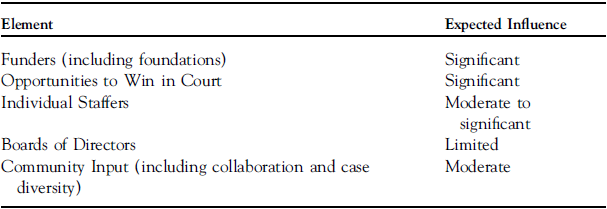
Embracing this idea of “organized chaos” and unstructured decision-making, I adopt a simple approach that categorizes the expectations and observations of the different elements. Based on the literature, I suggest that we might expect a combination of several elements, with varying degrees of influence, to be present when cases are selected. These are indicated in Table 1 above.
Expected Influence of Case Selection Elements

This basic categorization does not definitively rank individual elements, nor does it recognize a linear system of decision-making. Instead, it supports the idea that different considerations and actors may be relevant at any given period, all subject to change.
APPROACH AND METHOD
Those hoping to understand the case selection processes of legal impact organizations have both a data and transparency problem. As Carpenter (Reference Carpenter2014) points out, the public does not know much about these processes because they take place in closed conference rooms. There are no consistent official guides of what criteria are to be used, and organizations do not keep or publicly provide master lists of cases they have selected. To track cases, researchers either need access to an organization’s own archives (see Andersen Reference Andersen2006), or to estimate cases based on figures presented in annual reports. Annual reports, however, are not always consistent in the way they report issues and data. This makes comparison across time and between organizations challenging.
To get a clearer picture of why cases are selected, this project relies on interviews with people involved in case selection and an analysis of organizational documents related to case selection. Document analysis began with collecting over a hundred documents spanning from the early 1980s to 2017 (when analysis was conducted). Documents were obtained from the Internet, interviewees, and archives at the GLBT Historical Society (San Francisco, CA), Yale Manuscripts & Archives (New Haven, CT), and LGBT Community Center (New York, NY). That collection includes annual reports, newsletters, financial documentation, and memoranda. While roughly a dozen documents are utilized below, many more were instructive in building a narrative.
A selective snowball approach was used to choose interviews from staff members at several legal organizations that represent most of the identifiable LGBTQ-focused legal groups in the United States. However, this project focuses on just three: GLBTQ Advocates and Defenders (GLAD); Lambda Legal Defense and Education Fund (Lambda); and the National Center for Lesbian Rights (NCLR). There are three reasons for this focus. First, the larger sample included direct legal service providers, which have a different set of criteria and constraints for selection cases. Emphasizing this point, this study only examines the larger legal impact groups, not direct legal service providers. Second, I had greater access to documents and interviews with these three organizations. Finally, these organizations are the largest and are often part of the critique around priority setting in the LGBTQ legal industry.
Interviews were conducted between 2016 and 2017, were semistructured, lasted between forty-five minutes to over an hour, and were mostly conducted over the phone. To formulate questions, I relied on the cause lawyering and public interest law literature. The twelve interviews quoted here were recorded, transcribed, and then analyzed through Atlas.ti to pick out discussions on case selection.
FROM BOARDS TO STAFF AUTONOMY
The literature and interviewees are both clear that boards have limited influence on the day-to-day operations of legal organizations, which includes case selection (Rhode Reference Rhode2008). Today, lawyers report using a “consensus” model among staff for case selection. This means that each lawyer advocates for a certain case and together they (staff attorneys) provide feedback on whether it should be taken, though passionate individuals can decide to go their own way.
However, this was not always the case. First, from the 1970s to the early 1990s, boards of directors played a significant role in case selection. For example, a 1991 GLAD document explained that their board had a litigation committee that had “decision-making authority on the acceptance of potential cases for representation” (GLAD Staff 1991). The committee reviewed “prospective cases to determine whether each case raises issues that are in furtherance of GLAD’s goals” and “whether GLAD has the resources to pursue a case in light of the expected commitment of time and money” (GLAD Staff 1991).
Arthur Leonard, a former board member of Lambda Legal, explained that in these early decades Lambda “was a working board …. It was a bunch of attorneys, [and] they took on cases as part of their practice and they considered it pro bono activity.”Footnote 1 Relying heavily on volunteers, a legal committee would “start by weeding through calls and then compar[e] them to Lambda’s priorities,” asking “what are the issues that face our community, where do we need to make precedents?”Footnote 2
But as these organizations grew, decision-making authority shifted. Consider this snapshot from a November 1995 GLAD memorandum summarizing an institutional review of GLAD’s case selection process. Then executive director, Amelia Craig, reached out to other legal organizations to ask about how they select cases, including Lambda, NCLR, the ACLU, and the ACLU chapter of Massachusetts (Craig Reference Craig1995). Kate Kendell, then executive director at NCLR, was quoted in the document: “staff attorneys generally decide what cases to take by evaluating whether cases are clearly within their mission. If they have a question, they raise it at their Legal Committee, a committee chosen by the staff attorneys that also has a board liaison who participates” (Craig Reference Craig1995). In earlier years, the legal director had more input in the decision-making. In the event of a dispute after review by the committee, which Kendell noted rarely happened, the legal director would make the decision with the executive director having final approval (Craig Reference Craig1995). The board was then informed of the final decision. While this process clearly involves the board, it also demonstrates a degree of autonomy among staff. The Gay Rights Project and AIDS Rights Project at the ACLU (now the LGBT & HIV Project) followed what their legal director referred to as a “consensus model” with the legal director having the “ultimate say” (Craig Reference Craig1995).
Another GLAD document from that same period outlined their own litigation criteria. The weight given to any criterion was “determined in the direction of the GLAD attorney or attorneys involved in the decision-making process” (GLAD 1995). These criteria included: (1) engage laws restricting the civil rights of LGB people or people living with HIV/AIDS, as well as enforce laws that protect those populations; (2) maintain a diverse docket including variations in geography, topics, and client profiles; (3) coordinate with other organizations (including the Roundtable); (4) the facts of the case and how they accomplish GLAD’s mission; (5) GLAD’s financial capability and staff availability; and (6) whether there was an alternative to litigation (GLAD 1995).
Likewise, a Lambda pamphlet from the mid-1990s described case selection as having four elements: precedent, effect, success, and resources. Regarding precedent, the pamphlet reads: “Lambda considers cases that will either create new rights or enforce existing rights … preferring to focus on unestablished principles or cases in other jurisdictions” (Lambda Legal Reference Legal1993). Regarding “effect,” the pamphlet states that Lambda will consider whether the issue is of overall importance to the lesbian and gay community (Lambda Legal Reference Legal1993). Lambda also considered the likelihood of success, arguing that cases with greater legal “foundations” were more capable of enduring the legal process. Finally, Lambda considered the “availability of organizational resources such as finances, staff and cooperating attorneys” and how it could disperse those resources across a “wide variety of issues” (Lambda Legal Reference Legal1993).
In meetings on case selection and strategizing today, interviewees across organizations report a consensus model, which comports with the literature (Rhode Reference Rhode2008, 2053). However, individual lawyers also appear to have great autonomy. In these meetings, individual lawyers start by advocating for cases they want to take. Then other staff will offer suggestions, but if an individual wants to pursue a case, they will often be allowed to do so. While discussion may lead a lawyer to not take a case or to delegate it to cooperating attorneys, it is at the individual lawyer’s discretion. Executive directors can intercede, though they rarely do, and are present at meetings to offer advice and guidance. A negative word from a director could dissuade a lawyer (thus perhaps having equal weight to a veto) but in principle, it is up to the individual lawyer. Suzanne Goldberg, a former lawyer at Lambda, confirmed this individualistic model: “we had organization priorities and there was room for each staff lawyer to press for cases or projects that seemed of importance.”Footnote 3 The consensus model seems less about choosing cases as a group and more about individual lawyers defending their case to the group, giving individual lawyers a good deal of autonomy.
This also means that debate between staff can arise on contentious issues. This was the case with Lambda Legal when they debated pursuing marriage equality in the early 1990s. Evan Wolfson had been at Lambda for two years and had written his Harvard Law thesis on marriage equality (Wolfson Reference Wolfson1983). So, when two Hawaii citizens sought to challenge the denial of a marriage license, Wolfson jumped at the chance to join them. Paula Ettelbrick, then legal director of Lambda, recalled this as “probably the tensest moment within Lambda. Evan was chomping at the bit to do it and almost threatened mutiny” (Frank Reference Frank2017, 94). At first, Wolfson’s request to join the case was denied by both Ettelbrick, who believed it was “premature as a strategic matter,” and Executive Director Thomas Stoddard (Cole Reference Cole2016, 25–26). Ettelbrick also reportedly felt that Wolfson needed to prioritize other issues (Faderman Reference Faderman2015, 585). The influence of the LGBT Roundtable, a collection of LGBT lawyers across the country that met regularly to strategize about cases, was another factor. The consensus at the Roundtable was that it was the wrong time to pursue marriage (Frank Reference Frank2017, 94).
But eventually Stoddard and Lambda leadership relented under Wolfson’s persistence. First, they allowed him to act nonofficially in an advisory capacity, then permitted him to write an amicus brief, and finally gave him approval to serve in a private capacity as cocounsel (Zeitz Reference Zeitz2015). This unusual experience highlights the strength of the individual lawyer in selecting cases. Even when facing resistance from leadership, one lawyer may be able to pursue a particular cause.
Given the degree of staff autonomy, what do boards do and how might that relate to agenda setting? Following standards such as the Carver model, boards are responsible for holding staff and executives accountable, making sure that they adhere to the vision the staff shapes, and resolving disputes, and they are chiefly responsible for fundraising (Carver Reference Carver2016). When pressed, interviewees insisted that boards today do not pressure staff. Goldberg’s experience of Lambda “was that the board always respected the domain of the staff to make decisions.”Footnote 4 Boards were rarely involved in the day-to-day activities, and when they were, it was either to support staff or solve disputes. Former GLAD Executive Director Lee Swislow gave the following example: “We had been talking for a couple of years about increasing our work with LGBT youth … At some point, the board [said], ‘You guys are taking too long to do it, we want to see a budget that supports an increase in youth work.’”Footnote 5 Wolfson added a caveat, that, like with the mission statement, the board of directors at Lambda would sometimes vote on general policy directions. This was particularly salient in the early 1990s, during the debate over same-sex marriage. However, “by and large when it came to case selection, it was decided by the lawyers not by any level of hierarchy.”Footnote 6
Together, much of this narrative comports with scholarship indicating a stronger likelihood of staff influence in agenda setting (Rhode Reference Rhode2008). As organizations began to hire staff, authority shifted from volunteer boards to full-time legal staff that looked to boards for suggestions. Then, as boards were phased out of decision-making, legal staff used a consensus model to come to decisions, with approval from the legal director. They considered the constraints of the budget, the chance of success in creating precedent, community needs, and case diversity. While refusals and disagreements were allegedly rare, leadership often had final approval over cases. Today, and breaking from the consensus model suggested by the literature, case selection is largely driven by individual lawyers. While ideas are shared and feedback is given in groups, individuals still have autonomy to make decisions about case selection.
MISSION STATEMENTS
Interviews and organizational material indicate that mission statements are another element of case selection, albeit an infrequently relied upon one. When they were mentioned, they were described as a guidepost amid uncertainty. Janson Wu, executive director at GLAD, recalled when he was part of the staff and they would turn to their executive director for advice:
at the end of the day, we are guided by our mission, and as long as we’re using the resources to further our mission, that is what our compass point is. That is our North Star…. Whenever there was a hard decision to make, when there were competing interests, including interests from externally and from funding sources, and then all eyes in the room would turn to Lee [Swislow]. Lee would always say, “Well, the question I always ask myself in these moments is, ‘What would further our mission?’”Footnote 7
However, there are limits to their influence. An illuminating example of this, and an example of staff autonomy, is the transformation of mission statements between 1998 and 2002. During this period, one by one, GLAD, Lambda, and NCLR incorporated gender identity and/or transgender people into their core target constituency. As Chris Daley of the Transgender Law Center and Jennifer Levi of GLAD pointed out to me, the major three organizations were already doing work with transgender clients and had transgender staff members. But it was only after internal advocacy that these LGB organizations really became LGBT organizations. Today, all three organizations have created unique transgender rights projects. In fact, NCLR’s project spun off to become its own organization, the Transgender Law Center, founded by NCLR lawyer Chris Daley.
Observations suggest a constitutive nature of organizational missions, which are originally set by boards. That is, missions focus the organization’s work on given areas but because lawyers have a great deal of autonomy and are part of shaping the organization’s identity, they can push at those boundaries. Thus, lawyers are at once both constrained and free to set agendas within the organizations. The following story about GLAD provides an example.
In 1998, GLAD’s Board of Directors considered changing their mission statement to include issues of gender identity and defending transgender people. A Strategic Planning Committee was assembled to address the issue, ultimately deciding against recommending inclusion. While GLAD was already taking transgender clients and doing work in this area, the mission of the organization was focused on sexual orientation and AIDS/HIV. Some on the board felt GLAD should only take cases where a transgender person’s injury could be related to their sexuality (GLAD 1998a). Meeting minutes of the Strategic Planning Committee in September 1998 show a recommendation to not include transgender, gender expression, or gender identity. Instead, they adopted a new policy statement, which read in part:
We acknowledge that there are shared issues with the transgender community and that GLAD may choose to provide assistance in such cases, provided that the issues arising from such cases further GLAD’s mission and have sufficient nexus with GLAD’s mission to achieve full equality and justice for all [GLB individuals] and people living with HIV; … and does not consume a material portion of GLAD’s resources …. (GLAD 1998b)
Not long after, board member Donna Turley sent an email about the policy statement to the entire board. It was “full of too many ifs and buts, and very tepid,” according to Turley, and constrained work on transgender issues with the caveat about consuming too many resources. Turley wrote: “there may be a transgender issue that is exactly in line with our goals and mission statement (which isn’t really revised by this policy statement), and it may take many resources. I don’t want to limit us” (Turley Reference Turley1998). A week later, the policy recommendation was updated:
we acknowledge that there are shared issues with the transgender community and that GLAD may choose to provide assistance in cases raising issues of gender expression or identity, provided that the issues … further GLAD’s mission and have sufficient nexus with GLAD’s mission to achieve full equality and justice for all gay men, lesbians, bisexuals and people living with HIV; and … is consistent with the priorities and resources of the organization. (GLAD 1998b)
Note the changes. The resource caveat was altered to be less constraining. The portion about limiting GLAD’s effectiveness was also eliminated. Gender expression and identity were added. What remained was the concern that any case should have “sufficient nexus” to sexual orientation and people with HIV, and that GLAD “may” decide to take cases on behalf of transgender clients, not that it was their imperative.
Two years later Gary Buseck (lawyer and later legal director) brought the issue of including transgender people in the mission statement back to the board. Once again, the issue was elevated to Strategic Planning. On March 3, Buseck sent a message to the board advocating for the inclusion of gender identity and transgender people in the mission statement. “Things are moving very fast in our relevant world concerning the significance of transgender issues to the movement,” Buseck wrote. “People are seeing ever more clearly the intersection between trans and g&l activism” (Buseck Reference Buseck2000). He stated that since GLAD adopted the formal policy stance, it had “stepped out and really been doing pioneering work in the area” (Buseck Reference Buseck2000). He further argued that other legal groups had been looking to GLAD and that they had been getting enormous credit for their work. However, he also claimed that GLAD was “not getting credit in any wider circles because our policy remains essentially undisclosed except by our actions” (Buseck Reference Buseck2000). A day after this email, Turley sent Buseck a message recalling the last mission statement change attempt as “a tough fight and a lot of education … I think that your e-mail continues that education, but I am not sure the change will be easy” (Turley Reference Turley2000).
In the end, Buseck’s suggested mission statement change was adopted and GLAD went on to create a Transgender Rights Project within the organization, headed by Jennifer Levi.Footnote 8 Levi, who was hired amid this debate, suggested to me that “the internal conversations about the importance of doing the trans-work drove the reshaping of the mission statement.”Footnote 9 Even though transgender people and gender identity were not part of the formal mission, staff continued to work with transgender clients and related discrimination claims.
Observations reveal that mission statements are not afterthoughts; they are important both to boards and to staff. Bringing mission statements up to date with staff and broader movement priorities may bring greater publicity and visibility to a cause. However, regarding case selection, while staff are guided by the statement, missions do not constrain individuals from pushing at the margins. As Buseck and others pointed out, lawyers were working on issues that they believed in.
FUNDERS AND RESOURCES
Findings confirm the literature suggesting that lawyers try to avoid the influence of funders (Rhode Reference Rhode2008, 252) and counter works that suggests funders, foundations in particular, significantly influence case selection (Komesar and Weisbrod Reference Komesar, Weisbrod, Weisbrod, Handler and Komesar1978). As this section demonstrates, funding sources are diverse, and individual donors, not foundations, make up the majority of funding sources (see Figures 1–3).Footnote 10 Executive directors also see it as their duty to educate major donors on the organization’s work, not to offer things they would not normally pursue. Organizations are sometimes even in a position to reject donations from foundations and major donors if leadership feels that the requirements of the gift do not fit with the organization’s goals.
Percent of Total Revenue by Source for Lambda Legal, 2006–2015.

Percent of Total Revenue by Source for NCLR, 2005–2015.

Percent of Total Revenue by Source for GLAD, 1979–2001.

However, a lack of resources generally may be considered in case selection. When lawyers discuss taking on a case, they may ask: will there likely be an appeal? If so, will it lead to the US Supreme Court? Are you going to need to pay for witnesses and experts? How much travel will be involved? Will a large public education campaign be required? When the answers are costly, according to Jennifer Levi, it may lead to a “more searching review of whether it’s the right case to take.”Footnote 11 Yet, answers that prove costly do not mean the end to a case. Instead, a lack of resources could mean, for instance, bringing in cooperating attorneys who are willing to work pro bono to lead the case.
Foundation funding is also diverse. For example, there were eighteen different foundations and grantees that gave to NCLR between 2003 and 2005. Goldberg (Lambda) explained the significance: “one reason that funding did not drive case selection is that we were not heavily funded by any single source.”Footnote 12 Thus, there may be limited influence from foundations because organizations have many sources of funding (individual, donated services, foundations, etc.). If organizations do not agree with the demands or requests from one potential donor, they do not risk shuttering their operations.
Where does this foundation money go? Again, one popular narrative suggests that foundations may have a tight control over organizational agendas and thus we might see foundations giving to certain issues and activities, thus influencing the organization’s work. Admittedly, it is difficult to trace exactly where money is going, but there are hints within publicly available financial documents.
First, based on IRS 990 forms, annual reports, and audited financial statements, the majority of year-to-year net assets for the three major impact organizations were unrestricted. That is, the organizations were not bound to use those financial assets in any given way, contrary to what we might expect. In most years, these unrestricted assets exceeded and sometimes doubled temporarily restricted donations.
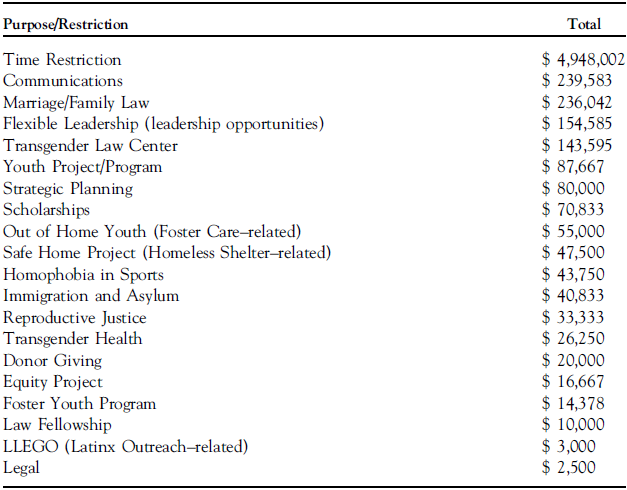
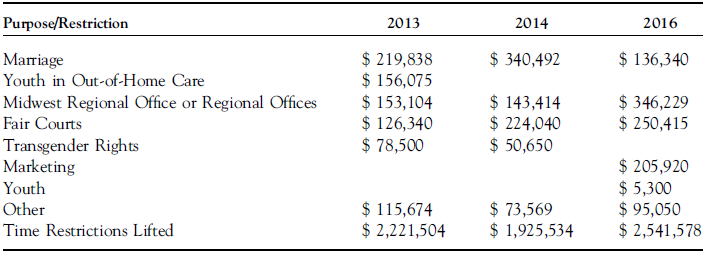
Temporarily restricted net assets are contributions that are limited by donor-imposed stipulations such as money spent in a specific time frame or based on specific activities/causes (e.g., Lambda’s Fair Courts Project). When those stipulations are fulfilled, the restricted assets are then reported as net assets in that year. Thus, the financial figures in Tables 2 and 3 represent the total assets over eight years that were released due to their fulfillment.Footnote 13 Table 2 shows the total of NCLR’s temporarily restricted net assets from 2005 until 2012.Footnote 14 Table 3 shows Lambda’s temporary net assets by issue and release date.Footnote 15
Total NCLR Temporarily Restricted Net Assets, 2005–2012

Lambda Temporarily Restricted Net Assets, 2013–2016

As the tables demonstrate, marriage received the most funding of any restricted issue, though time restrictions, not bound to any issue, far outpaced marriage-specific grants over these years. Additionally, foundations were giving to a multitude of issues, such as foster care, homophobia in sports, and immigration. While these tables do indicate that marriage was a favored issue among foundations, they also show that legal organizations were hardly restricted to marriage. Given that most assets are unrestricted and most restricted assets are only limited by time, organizations are much less constrained by foundations than one might expect.
What then about individual giving, the largest source of funding overall (Figures 1–3)? A larger proportion of funding from individual donors could encourage publicity-seeking behavior (e.g., choosing controversial issues) if leaders believe that high visibility tactics and issues will bring more attention and name recognition to the organization. However, if many donors are giving with different purposes, the preferences of any single donor may be diluted. In other words, a diverse group of donor preferences may make it difficult for any single donor to exert influence.
The interviews suggest a narrative closer to the latter alternative. Organizational leaders believe that their donors may originally give for one reason, but they stay because they believe in the mission of the organization. And there is indeed some early evidence suggesting that donors are continuing to donate at high levels after Obergefell v. Hodges. Interviewees repeated that donors were “loyal”Footnote 16 and likely to stay given the identity of organizations that presumably attracted donors to them.Footnote 17 “We attract a certain type of donor and foundation,” Kendell explained. “We are relentlessly progressive [and] unapologetically intersectional.”Footnote 18
These suggestions are supported by findings about donor opinions of NCLR (Kosbie Reference Kosbie2017). This survey found that donors gave regardless of whether they perceived NCLR as advancing their own personal priorities and that they identify NCLR not just as an LGBT organization, but a broader social justice one (Kosbie Reference Kosbie2017). A plurality of donors ranked a “willingness to pursue broad, transformative goals” as the most important reason to give to NCLR, while “responsiveness to preferences and wishes of donors” was ranked the least important (Kosbie Reference Kosbie2017, 88). Supporting these findings, interviewees here were adamant in rejecting the notion that funders influence their priorities. Kendell (NCLR) explained: “I have never in my twenty years as executive director, done something that I felt like the organization shouldn’t do in order to get donor money nor have I chosen not to do something because a donor made their gift contingent on us not doing something.”Footnote 19
Donation restrictions can influence when work gets done. Most individual donations are made through fundraising campaigns (mailings and emails), donor drives and dinners, and memberships. These kinds of donations are unrestricted, meaning there is no limitation to what the organization can spend them on. As Wu (GLAD) explained it, “those are actually the most powerful ways to give to organizations because that really allows us the flexibility to be responsive, to be flexible, to be nimble, and to respond to the needs of the community at the moment.”Footnote 20 In other words, restrictions can become problematic when organizations need greater general operating funds. These funds help to pay for salaries and rent, things that are “unsexy” to donors but necessary to keep the doors open. One lawyer explained that foundations are more likely to prefer restricted gifts and are less likely to give to general operating funds. They continued:
Our goal is always to try to find a project that we’re already working on that they are interested in funding, or something that we want to work on but we haven’t been able to get off the ground yet, and to try to avoid as much as possible trying to fit our work into the strategic goals of a foundation when that stuff doesn’t exist … sometimes that means saying no to money. (Anonymous)
Therefore, organization leaders see it as their job to educate donors. Often the executive director will sit down with individual donors and foundation staff and explain what the organization does and what it wants to work on.Footnote 21 Kendell (NCLR) expands on this:
If a donor wants to make a really significant gift and talks to me about restricting it to just one particular project or issue, I will usually to try to talk them out of that and explain that look, if we win protections for transgender women in detention facilities or conditions of confinement or we win employment protection for transgender individuals, that’s going to help a transgender kid who wants to play the girl soccer team as a girl because she identifies as a girl.Footnote 22
Leadership tries to connect the organization’s needs to what funders want. If organizational need does not match donor preferences, leadership may be willing to walk away from the donation and even recommend other organizations that are better suited.
This does not mean that individual donors or foundations will not try to exert influence. In fact, interviewees reported that they try. But when that happens, the executive director bears the burden and isolates those concerns from staff. Beatrice Dohrn, formerly of Lambda Legal, stated: “there was no pressure brought to bear on us … the legal department was really kept pristine from those [funding] concerns.”Footnote 23 Dohrn explained that their executive director made clear that the legal department should make its decisions “cleanly.” Dohrn: “He [Cathcart] wanted us to make clean decisions about what the legal department thought was the thing to pursue ….”Footnote 24 If an individual donor wanted to give money to alter their agenda, according to Dohrn, “forget about it.”Footnote 25
To summarize, interviews and materials demonstrate that the preferences of foundations and major individual donors do not appear to significantly or even moderately influence case selection by legal organizations in this study. This both confirms more recent scholarship (Rhode Reference Rhode2008, 2052–53) and counters older theories (Komesar and Weisbrod Reference Komesar, Weisbrod, Weisbrod, Handler and Komesar1978). Leadership within impact organizations allege that they explicitly keep funding concerns separate from case selection. They view it as their duty to educate donors—individuals and foundations—on the organization’s work. Instead, the influence of funding is that a lack of resources will constrain the amount of work an organization can conduct.
PERCEPTION OF OPPORTUNITIES
Another element organizational leaders consider is the perception of whether the legal and political environments have the conditions for success. The literature on legal and political opportunity structures (McAdam Reference McAdam1982; Epp Reference Epp1998; Andersen Reference Andersen2006) suggests that lawyers may try to take advantage of these moments, such as when there are new allies in important institutions, a sympathetic public, new legal frames, and a weakened opposition. However, there were few references during interviews that reflect such behavior in case selection. Some suggested that the ability to win a case was a factor, while others explained that an assured or likely courtroom victory was not a necessary condition. Instead, interviewees and archival material suggest that while lawyers will take advantage of any opportunity, legal or political, they also try to build favorable conditions long-term through tactics including education campaigns.
Two examples are the decades plus–long efforts to reform sodomy laws and to achieve marriage equality. In each of these instances, organizations used state-by-state legal strategies to create a favorable federal court environment. This meant using state constitutions to challenge laws criminalizing same-sex sexual relations and bans on same-sex marriage in state courts and in state legislatures. Once legal precedent had been created across the country, legal organizations (through careful strategizing via the LGBT Roundtable) moved into federal courts, ultimately arriving at the Supreme Court. Once there, they had advantages in both politics (more favorable public opinion, new political allies) and the law (more favorable state laws, new legal precedent, federal judges ruling in their favor). This kind of “opportunity construction” has been observed elsewhere (Vanhala Reference Vanhala2012).
Additionally, interviews suggest that obstacles to victory do not necessarily end pursuit of a legal challenge. Goldberg (Lambda) said that organizations would take on cases that did not have a “snowball’s chance in hell” of success.Footnote 26 Leonard (Lambda) recalls National Gay Rights Advocates (NGRA) being “willing to go into court on absolutely hopeless cases” to raise money and to educate the public. Wolfson (Lambda) describes the desire to find cases that would help them develop the law in a new direction: “If we want to showcase sex discrimination in the law, what kinds of cases do we want to go out and look for. So, it wasn’t only just what was coming into us, it was also, how can we make this point? What kinds of things do we want to try to develop?”Footnote 27
Losses too can have positive effects. As Boutcher (Reference Boutcher2005) demonstrated after Bowers v. Hardwick (1986), losses might mobilize a constituency to a movement and to organizations (also see NeJaime Reference NeJaime2011). Janson Wu (GLAD) explained how this worked in case selection:
whether or not we can win the case is an important consideration, although, certainly there are times when we’ll take a case even though we think we may not win, or perhaps feel like we absolutely will lose but there’s benefit in losing, such as to spur the legislature to do something and pass a law or clarify law. There’s the public education value in litigation and so we’ll certainly talk about [whether] that will be a good educational vehicle.Footnote 28
On this last point, while scholars have observed lawyers seeing educational value in cases generally (McCann and Silverstein Reference McCann, Silverstein, Sarat and Stuart1998, 269), selecting cases (in part) because of that value is surprising. Leonard explained to me that: “it’s Lambda Legal Defense and Education Fund, and the education is a big part of it. It’s using the cases to educate the public, using the litigation to educate the judges and educate the defendants that you’re suing.”Footnote 29 Wolfson described “public education value” as “what kind of story will it tell, how will it help move public support and the general law and culture in addition to the specific law in support of LGBT people.”Footnote 30 Litigation can create visibility and establish the humanity of individuals in the LGBTQ community.Footnote 31 This kind of nonlitigious goal was especially prevalent in the early 1990s when lawyers did not expect to win as much as they do today. Goldberg (Lambda) recalled that: “[W]e were thinking there were factors beyond [legal]. The question was always if we lose, how much harm would that loss do, and how much could we leverage the loss to strengthen public support?”Footnote 32
What this tells us is that while perceptions of legal opportunities are considered by lawyers, they are not singularly driving case selection. However, given that lawyers are obviously looking for chances to win, this element has at least a moderate influence on case selection. There are two important caveats. First, lawyers and staff work to create favorable conditions, essentially trying to build their own opportunities in the face of inhospitable environments. Second, lawyers may plunge ahead even with a lack of perceived legal opportunity with the hope of affecting public attitudes. Relevant scholarship does not say much about a case’s “educational value” being an important part of the process, though the literature does observe cause lawyers using public education tools generally (McCann Reference McCann1994; Lobel Reference Lobel2007; Trowbridge Reference Trowbridge2019). Thus, the frequency with which this came up in interviews and documentation was surprising. What it means is that while winning is important, a court victory is not the only goal lawyers consider, and that advancing educational goals may have an influence, albeit limited, on case selection.
COMMUNITY INPUT, CASE DIVERSITY, AND COLLABORATIONS
Determining community needs by itself is a challenging undertaking and thus determining the degree to which community input is informing case selection is also difficult (how well they meet those needs is outside the scope of this study). There are some observable signposts of need: call center data, collaborations with organizations, and the diversity of cases organizations take on. Based on these observations, it appears that perceptions of need have at least a moderate, if not significant, influence on case selection.
As the literature would suggest (Carpenter Reference Carpenter2014; Trowbridge Reference Trowbridge2022), one of the most cited sources in interviews for determining case selection priorities and community need was information coming from intake centers.Footnote 33 Intake centers (e.g., “Help Desk”) are resources within legal organizations where anyone with a legal concern or complaint can call and either request legal advice, ask a legal question, or seek legal representation. Organizations receive hundreds of calls and messages every year and they are managed by trained volunteers, law clerks, or attorneys. Staffers will screen calls to determine whether the caller’s concern/injury fits within the organization’s scope and expertise and whether the concern should be forwarded to a staff attorney. Then, callers may be given legal advice or resources, referred to a network of cooperating attorneys, or may receive help directly from the organization. Given the sheer volume of calls, most do not turn into cases. However, many of the cases that organizations do take start as calls through their intakes.Footnote 34
Intake data has long been used to illustrate the range of harms within the constituency to staff, the board, and donors (Lambda Legal Reference Legal1990). This information is compiled and analyzed to locate trends in issues, discover newly reported harms, and assess what is happening in different regions.Footnote 35 But there are limitations to using intakes.Footnote 36 Cathcart (Lambda) pointed out that priorities are often based on “what people are calling us about” but that Lambda does not prioritize “strictly on calls” because “it’s going to skew access or skew entitlement [which] would lead to skewed priorities and outcome.”Footnote 37 The concern is that the collection of people calling may not represent the scope of experiences in the community. Instead, organizations also rely on collaborations with other groups, outreach work, and surveys (Trowbridge Reference Trowbridge2022) to determine needs and priorities.
Yet, the literature suggests that social movement organizations do not always represent subgroups within their constituency equally well (Strolovitch Reference Strolovitch2007; Carpenter Reference Carpenter2014). Still, given the missions of these organizations, and the motivations of cause lawyers that separate them from their colleagues (Menkel-Meadow Reference Menkel-Meadow, Sarat and Stuart1998; Scheingold and Sarat Reference Scheingold and Sarat2004), we might expect organizations to listen to their constituency. Measuring an organization’s attention to or reception of community need is challenging, but organizations may exhibit some signs that the needs of their constituency are important to their case selection process.
One such sign is the diversity of cases that organizations take on, though I should be careful to note that these are not exact proxies for need. The assumption is that a caseload focused on a small number of issues important to only part of the constituency might (though will not necessarily) suggest limited consideration of the multitude of problems facing a constituency. A caseload that is diverse and reaches different parts of the constituency might suggest the opposite.
To evaluate case diversity, I analyzed newsletters and annual reports. This means an analysis of how organizations are choosing to represent their work, not complete lists.Footnote 38 Interviews and organizational documents are also considered alongside this data. Case analysis was limited to Lambda and NCLR (not GLAD) because they were the only organizations with comparable and publicly available yearly data. They also represent the kind of large national-scope lawyering organizations that are often critiqued.
A significant hurdle in tracing these documents is that organizations do not keep compendiums of cases by year, or at least, not in a format they were willing to share. This problem can be overcome if a researcher is given access to the organization’s private files (see Andersen Reference Andersen2006).Footnote 39 However, this was not a feasible undertaking across multiple organizations. As described in footnote 7, proxies were developed using newsletters and annual reports. I refer to these as “report lists” because what the data shows is an aggregate of cases presented in annual reports and newsletters designed to give readers (including donors) a clear sense of what the organization is doing. While these lists are not fully representative of actual caseloads, I expect organizations to portray their work to members as accurately as possible.Footnote 40
Using theories and critiques about the influence of foundations (Komesar and Weisbrod Reference Komesar, Weisbrod, Weisbrod, Handler and Komesar1978; Mananzala and Spade Reference Mananzala and Spade2008), we might expect issues like marriage equality and sodomy laws (issues said to be championed by wealthy white gay interests) to dominate report lists because annual reports and newsletters target funders. Likewise, under the same critique, we would be less likely to see many cases for disadvantaged subgroups (e.g., immigration and asylum; transgender rights).
Lambda Legal
Analysis of Lambda’s documents reveals early prioritization of family issues (i.e., custody, adoption, and reproductive rights) and HIV/AIDS discrimination (see Figure 4).Footnote 41 HIV/AIDS was counted as one just issue, yet it includes issues that could be subcategories on their own, such as employment, health care, and immigration. “Family issues” was defined as involving custody, adoption, and certain reproductive rights (i.e., artificial insemination). By the late 1990s and 2000s, employment and marriage rose in prevalence. This was followed by employment, military, and “civil rights” cases.Footnote 42 This is also the period when organizations were working strategically to end sodomy laws nationwide. Yet, they do not rise above 9 percent of cases from report lists in any given year. In this period, marriage accounted for only 6 percent of reported cases in 1992 and 1993, and no marriage cases were reported in 1989 and 1990 newsletters.
Most Frequent Cases in Lambda Legal Annual Reports, 1989–1993.

In Figure 5, which looks at documents at the turn of the twentieth century, the more frequent issues remained the same.Footnote 43 These include HIV/AIDS discrimination, employment, and family cases. However, there was much more parity among the top issues. The gap between HIV/AIDS and family issues closed and employment cases rose up to match them. Youth/school cases also make an appearance among the top issues. Marriage again would not have made this list of top issues (it averaged 3 percent of reported cases in these years) but was included for comparison. Sodomy cases were not highlighted in these newsletters.Footnote 44
Most Frequent Cases in Lambda Legal Newsletters, 1998–2001.

By the mid-2000s (Figure 6), marriage rose above HIV/AIDS and matched family cases.Footnote 45 “Community” cases were briefly among the most highlighted cases and included work in ballot initiatives, a sodomy statute in Virginia, a nondiscrimination law, and a case involving the judicial code of ethics. Transgender rights also appear among the top reported cases for the first time.
Most Frequent Cases in Lambda Legal Annual Reports, 2004–2006.

Collectively, these figures of cases tell us that Lambda is far from a one-issue organization (or at least far from presenting itself to donors and members as such). These are only among the top categories reported, and reports may contain as many as ten categories. Since the use of some category labels fluctuates between publications, there are twenty-five different categories total among all the publications reviewed in these years.
National Center for Lesbian Rights
As Figure 7 shows, NCLR has long been dedicated to family law issues. Prior to 2010, only one issue from the previous two decades surpassed family law cases in report lists: marriage in 2004.Footnote 46 This was the year that San Francisco Mayor Gavin Newsom began issuing marriage licenses, triggering litigation that Lambda and NCLR participated in. Then, from 2010 on, immigration and asylum cases are the most reported, though these might include family cases.Footnote 47 The next highest single-issue category is marriage, which is another issue likely to involve family.
NCLR Newsletter and Annual Report Cases, 1990–2014.

However, Figure 7 also displays case diversity.Footnote 48 From year to year, NCLR reports significant numbers of cases involving transgender rights, youth and sports, immigration, and criminal justice. Additionally, the reports of marriage and family cases both dropped sharply, resulting in greater parity with these other issues. Thus, while NCLR is generally focused on a broad area (family law), they are also involved in a litany of other issues.
Interviewees also made plain their commitment to diversity in other ways. Kevin Cathcart (Lambda) was explicit that diversity of their docket was important. Lambda moved early to diversify where cases were coming from. Leadership did not want to be a New York–only firm. Over two decades, they set up three more offices covering the Midwest, the West Coast, and the South (Cathcart Reference Cathcart, Cathcart and Gabel-Brett2016). Multiple NCLR staffers also discussed the Rural Pride Project, which reaches out to areas without legal aid or resources for LGBTQ clients.
We also see the influence of community need when organizations forgo concerns about victory or popularity. This was the case when GLAD took on Kosilek v. Spencer (2014) (later Kosilek v. O’Brien), where a transgender person in federal prison challenged the state’s refusal to provide gender-affirming surgery as medical treatment. GLAD took on the case without assurances of a victory and even though “the ethics [and] educational value of that case wasn’t conducive to touching people’s hearts and minds when it comes to trans people.”Footnote 49 The motivation for selection was described simply as “a case that we could not refuse to do.Footnote 50 ” Therefore, without financial motivation, without a perception they would win, without an opportunity for educational advancement, and without political mobilizing implications, GLAD took the case. Such a situation fits with a case selection process that considers marginalized subgroups, contrary to what one might expect given the literature.
Collaborations
Another way to observe the influence of community input is through collaborations with other organizations. Indeed, organizations in the LGBTQ legal industry have a long history of coordination, as far back as the early 1980s. A document outlining GLAD’s early case selection criteria reads: “There is also consultation and coordination undertaken in part in an effort to maintain a cohesive national strategy and to maintain consistency on a national basis….” (GLAD 1995). Much of this coordination involves submitting joint amicus curiae briefs.
But how might collaboration influence case selection? Could one or more groups push others to select a case? What literature that exists on group influence on case selection suggests that larger, “elite” organizations may be unlikely to heed recommendations from smaller organizations (Levitsky Reference Levitsky, Sarat and Stuart2006). Accounts in this study suggest that while collaboration happens frequently on certain matters, it has a limited influence in case selection.
The most likely source of collaborative influence is the LGBT Roundtable. Attendees include staff and leaders from legal organizations as well as legal academics who have “drafted legislation or published significant works” addressing movement issues (GLAD 1995). In 1990, Lambda legal director Ettelbrick wrote that it was a “very important vehicle” to make strategy and legal decisions (Ettelbrick Reference Ettelbrick1990). However, it is difficult to obtain detailed accounts of these meetings because they are held in strict confidence. Even speaking anonymously, interviewees would not disclose details about proceedings. We can however surmise from the works of participants and researchers (Klarman Reference Klarman1994; Andersen Reference Andersen2006; Eskridge Reference Eskridge2008; Cathcart and Gabel-Brett Reference Cathcart and Gabel-Brett2016) that either specific legal strategies (e.g., is it better to take an equal protection stance or a due process stance?) or political and legal timing (e.g., will we lose? Is the public ready?) are discussed.
It does seem that discussions do not relate to everyday case selection. Leonard (Lambda) noted: “[N]one of the organizations has ceded to the Roundtable the right to make decisions. The Roundtable doesn’t pass resolutions, it doesn’t dictate policies that are binding, but it creates a place for conversation.”Footnote 51 Sometimes organizations could be talked out of doing things and the Roundtable was critical in developing marriage equality strategies: first discouraging cases in late 1980s to early 1990s, and then later, in coordinating case across states.Footnote 52 While archival documents mention the influence of the Roundtable, interviewee references were less frequent. This may point to the waning influence of the Roundtable and a shift to more informal weekly discussions among lawyers mentioned in interviews.Footnote 53
Like in earlier years, the Roundtable still meets twice annually, but it has grown immensely. Where it used to be a handful of lawyers and academics, today hundreds attend the LGBT Roundtable. However, a well-circulated critique of the Roundtable (repeated in interviews) is that it is a place where strategy is dictated to attendees, rather than made by them (Arkles, Gehi, and Redfield Reference Arkles, Gehi and Redfield2010). One interviewee emphasized a well-known critique in the movement that the meeting was “a really big deal” but also highly exclusionary. That is, there are few “elites” who run the meetings and ultimately decide what gets discussed and considered. Similarly, there is a feeling that the Roundtable represents control of the LGBTQ movement by wealthy white male interests that discourage having nonlawyer community members become part of strategizing. While agreeing with the problem of white male dominance within the movement, another interviewee argued, “it would be completely bizarre if the LGBT legal groups did not meet with one another and compare notes on legal strategies and so forth. Of course, we are going to do that … that’s not the place to invite in the community. It would just be chaos.” However, this person also agreed that “we need our work to be informed by a really serious, deep understanding of community needs. And I think most of it is.”
These observations amount to three points. First, the LGBT Roundtable is a historically important meeting between lawyers and organizations that helps set general strategies (sometimes case selection) for the legal industry within the movement. Second, the debate about the Roundtable also reflects concerns about the lack of diversity in movement leadership (Vaid Reference Vaid1995, 275–76; Arkles, Gehi, and Redfield Reference Arkles, Gehi and Redfield2010; Carpenter Reference Carpenter2014). Third, while the Roundtable could (and likely does) have some influence on case selection on particular issues, none of the interviews suggested that it has a significant or even moderate influence. As Leonard argued,Footnote 54 organizations have not ceded that decision-making to the Roundtable or any other body.
Putting all these observations together with the evidence from interviews, especially regarding intakes, it is reasonable to suggest that perception of community needs (however accurate) has at least a moderate influence on case selection, if not significant. To be clear, this does not negate criticisms of how well organizations are serving those needs and comes with the caveats of limited data. There are also other ways of assessing the influence of community input. To what degree is the organization embedded in the community? Are they conducting workshops or listening tours; are they involved with allied and intersectional causes; do lawyers participate in community events? Based on reviews of annual reports and newsletters, the answer to some of these questions seems to be yes. But answering all of them and determining the degree to which they influence case selection is much more difficult and is worthy of future research.
DISCUSSION
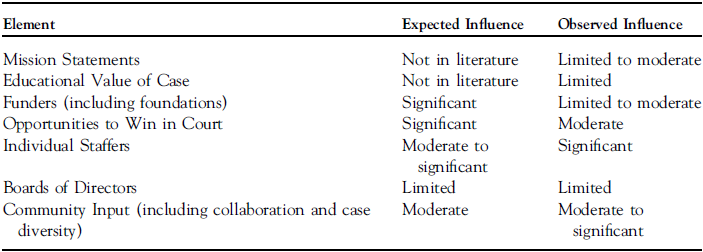
A basic model for case selection might begin with a sincere problem recognized by the organization that is then evaluated by attorneys for whether it fits their mission. Then, lawyers would determine the feasibility of winning in court, and finally leadership would determine if enough resources were available. But how does this model compare to what was observed here and how do expectations from the literature compare to observations? Table 4 below reveals the results.
Expected versus Observed Influence of Case Selection Elements

Instead of this linear model, this study supports the theory that case selection within legal impact organizations is akin to (but not the same as) organized anarchy models of agenda setting (Cohen, March, and Olsen Reference Cohen, March and Olsen1972; Kingdon Reference Kingdon1984). Several elements may be present at once, not all actors/stakeholders are always present to make decisions, and the weight of any given element may change. Decisions are not necessarily made in a particular order. There is also no singular veto. Mission statements can be overcome. Concerns over opportunity and conditions might be rejected by lawyers who believe a loss could be beneficial. Organizations might look for outside resources. At any given point, any element may gain importance, even if indirectly or infrequently.
The only quality that is continuously present is persistent individuals determined to pursue a particular issue. With that element, much can be overcome. This finding is also at odds with the theory of organized chaos and thus, modification is necessary—case selection by legal impact organizations involves an array of disparate influences bounding around a singular element: the individual lawyer and their preferences.
As a hypothetical, imagine a lawyer with two prospective cases, but, given time and resource constraints, they can only choose to take one. The lawyer’s expertise includes the issue presented in case A and this is an issue the organization receives many calls about. Case B involves an issue the organization has not dealt with, but leadership is interested in diversifying cases. There is also a collective perception that case B has a better chance of legal victory. In this scenario, it is not clear which case would get selected. But, what if the sincere belief of an individual lawyer is that case A must be taken, and they want that case? According to observations here, that’s the case that would likely be chosen. The point is that in the uncertain balancing act between elements, staff preferences wield the greatest influence over case selection.
This finding adds nuance to our understanding of cause lawyers as social engineers and of movement cooption (Pound Reference Pound1954; Bell Reference Bell1976; Tushnet Reference Tushnet1987; Vaid Reference Vaid1995; Menkel-Meadow Reference Menkel-Meadow, Sarat and Stuart1998), reminding us that sometimes “personnel is policy.” Because individual lawyers have space to make decisions, their personal beliefs and enthusiasm can drive case selection. Take for instance Evan Wolfson’s campaign to take on marriage equality at Lambda, or lawyers at GLAD taking on issues of gender identity. Even though there was institutional resistance, and at the time these were not well-resourced organizations either, individuals pushed ahead with their own priorities. This also might be significant if we believe that individual lawyers are pushing certain agendas (consciously or not) that advantage specific subgroups (see Strolovitch Reference Strolovitch2007). In the case of Wolfson, it might be a lawyer pushing an issue that favored an advantaged subgroup (though, Wolfson would say it is an issue that affects everyone). At GLAD, it was lawyers advancing an issue for a disadvantaged subgroup. Consequently, we might ask if lawyers play the role of entrepreneurs, pushing groups in new directions that may benefit certain subgroups.
Another important finding is that major individual donors and foundations lacked significant influence. In particular, the findings that most resources are unrestricted and that most restrictions are time based, together with the observation that organizations try to shape donor preferences, provides a new angle to view the organization-and-donor relationship. This counters the expectations that foundations or donors may “capture” these organizations, funding certain issues and strategies, that ultimately drive case selection (Bell Reference Bell1976; Tushnet Reference Tushnet1987; Hindman Reference Hindman2018). However, we cannot say that funding generally is not a concern, and we cannot say that funding is an equal concern for all organizations at different times. The organizations in this study have much greater resources and public support than they did twenty years ago. With more funding comes more staff and capacity for different projects. Funding may also affect autonomy, as greater staff numbers might give individuals freedom to work on different issues.
There are also two important limitations to this study. First, this study relies on the memories and opinions of lawyers whose behavior is under examination. These participants may be motivated to express the most altruistic motivations and less willing to reveal influences that the public or community may perceive negatively. Further, while document analysis and archival work were used to corroborate interviewee statements, not everything can be confirmed. Second, there are reasons to question the applicability of the findings here to other kinds of legal organizations because this project is a case study of a single type of legal organization (impact groups as opposed to direct services) in a single legal industry. For example, how might the lessons here provide insight into case selection within conservative legal organizations? Studies of the conservative cause lawyering (Decker Reference Decker2016; Southworth Reference Southworth2018, 1709) suggest that donors may have slightly more influence on case selection than donors do with LGBTQ groups. Other studies indicate differences in collaborative influences and that conservative organizations may deal with subgroups with more distinct priorities (e.g., probusiness agendas, libertarians, religious conservatives) (Heinz, Southworth, and Paik Reference Heinz, Southworth and Paik2003; Southworth Reference Southworth2008, 41–65, 101–10; Hollis-Brusky and Wilson Reference Hollis-Brusky and Wilson2020). However, these organizations were built to mirror others like the NAACP LDF, the ACLU, and LGBTQ organizations, so we might expect some similarities.
Finally, there are three areas that deserve greater attention in future research. First, given the lack of transparency around the LGBT Roundtable and the stark differences in how it is viewed in the LGBTQ community, it would help us understand the influence of community input to know more about how this event works. Relatedly, more could be done to measure just how well case selection matches community needs. While this study and others assess the degree to which lawyers listen and believe they are incorporating need, we do not know how well they are doing it. Another interesting finding that deserves more attention is that the educational value of cases matters to lawyers. While public education work is very much part of what legal organizations do (McCann Reference McCann1994; Lobel Reference Lobel2007; Trowbridge Reference Trowbridge2019), this is slightly different and learning more might add to our understanding of multidimensional strategies to achieve social change (Cummings and NeJaime Reference Cummings and NeJaime2010).
CONCLUSION
The cause lawyering and public interest law literature recognizes an array of elements that may influence which issues cause lawyers pursue. The goal of this project was to organize these elements and evaluate their significance. Through interviews with lawyers and analysis of documents, observations suggest that separate elements run through decision-making, “each with a life of its own,” and as these elements coincide, they may produce the opportunity for an issue to rise on an organization’s litigation agenda (Kingdon Reference Kingdon1984, 86–87). However, in this study, of these elements (donors, community input, opportunities, and others), it is staff autonomy and preferences that drive litigation priorities. These findings suggest greater agency for individual lawyers and contribute to the scholarship on movement lawyering.