

Huntington’s disease (HD) is an autosomal dominant disorder caused by CAG repeat expansion in the HTT gene and is characterized by movement disorders, psychiatric symptoms, and cognitive impairment. In adults, chorea is the most prominent motor symptom, and other features include dystonia, parkinsonism, myoclonus, and ataxia. Juvenile HD (JHD), defined by symptom onset at 20 years of age or younger, has a different phenotype and typically presents with parkinsonism (Westphal variant), dystonia, and seizures, in the absence of chorea. Reference Fusilli, Migliore and Mazza1 Cases of JHD are rarely reported and, accordingly, atypical motor features are unclear.
A previously healthy, developmentally normal 18-year-old left-hand dominant female presented with a 4-year history of slowly progressive cognitive impairment, affecting her ability to work as a part-time cashier, and depression, anxiety, and irritability. Her initial examination showed mildly slowed saccade initiation and velocity, moderate dysarthria, mild generalized chorea without motor impersistence, mild bradykinesia without rigidity, and a wide-based gait. Her father had HD, developed symptoms in his twenties, and passed away at 35 years of age. Genetic testing confirmed a diagnosis of JHD, with 63 repeats. Her psychiatric symptoms were treated with escitalopram, and trazodone was added for insomnia.
At 19 years of age, her generalized chorea worsened, and she developed motor impersistence, difficulties with the Luria sequence, and mild difficulties with tandem gait. Tetrabenazine was started, with some improvement of chorea. At 19 years of age, she also developed intrusive, sudden, brief, repetitive, stereotyped movements, including blinking and nasal movements consistent with simple motor tics, readjustment of her eyeglasses using her left hand consistent with a complex motor tic, and sniffing, clicking, and throat clearing consistent with simple phonic tics. These movements were associated with a premonitory urge, and suppressible, suggestible, and distractible, which distinguished them from other movement disorders. Waxing and waning were not evident on history. Other secondary causes of tics were not identified. The frequency of her tics increased over time. In particular, near-constant sniffing interfered with swallowing and eating. A modified barium swallow study at 23 years of age showed oropharyngeal dysphagia secondary to JHD that was concurrently contributing.
Her parkinsonism progressed and by 24 years of age, she was falling approximately once per month. Discontinuation of tetrabenazine did not improve her parkinsonism and did not worsen tic frequency or severity. Pharmacological treatment of tics with neuroleptics was avoided due to parkinsonism. Treatment with guanfacine, an α-adrenergic agonist, did not provide any benefit in tic suppression.
Her most recent neurological examination at 24 years of age showed significant dysarthria with incomprehensible speech, axial rigidity, severe appendicular rigidity and bradykinesia that was slightly greater on the left than right, a wide-based gait, reduced stride length, and en bloc turns. She was unable to maintain tongue protrusion for more than 1–2 seconds and had a milkmaid’s grip on the right, along with mild right-hand chorea. Dystonia was observed in the left hand and proximal right upper extremity. She had frequent motor and phonic tics.
Anecdotally, tics are an accepted phenotype of JHD. A recent survey of caregivers of JHD patients suggested that tics are a common phenomenon. Reference Moser, Epping and Espe-Pfeifer2 However, caregivers may have had difficulty distinguishing tics from other motor phenomena. Other movement disorders such as chorea or dystonia may be mistaken as tic-like behaviors and may not be indicative of true tics. In patients with coexisting JHD and phenomenologically defined tics, it is difficult to determine whether tics are secondary to JHD or due to a concurrent primary tic disorder, given that tic disorders are common before 18 years of age, with the prevalence approaching 3% in childhood and adolescence. Reference Knight, Steeves, Day, Lowerison, Jette and Pringsheim3 The prevalence of tics in JHD and how it differs from the prevalence in the general population is unclear.
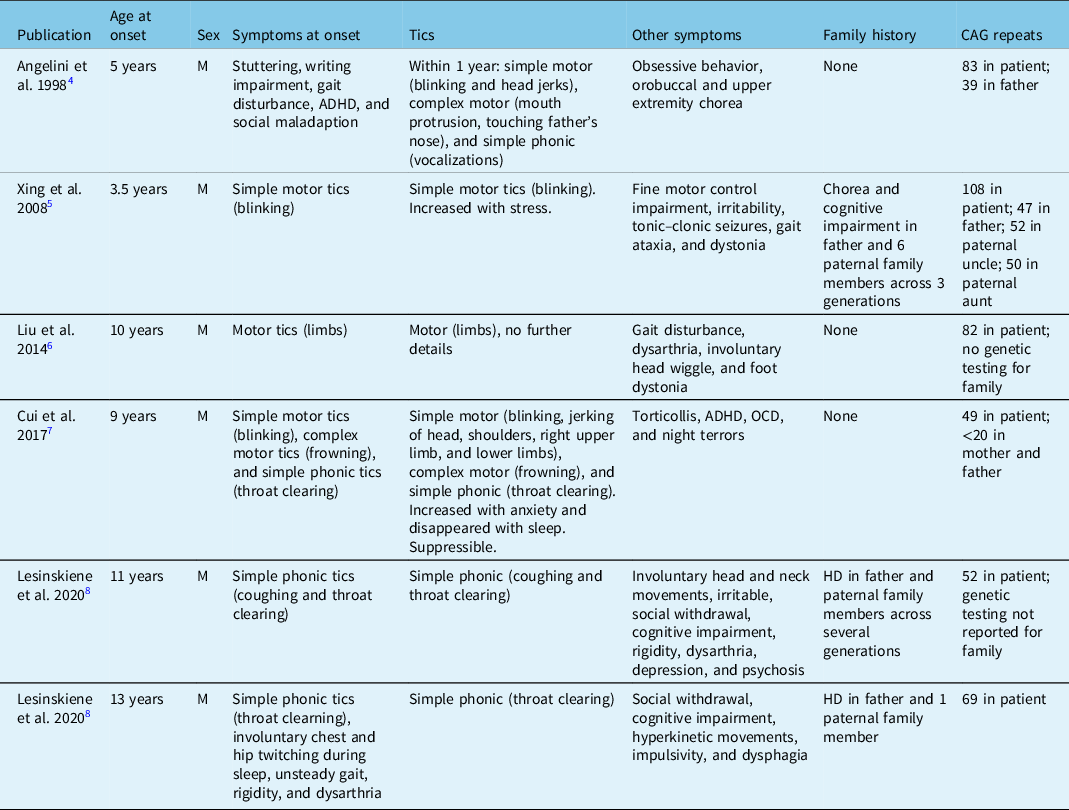
Cases of coexisting JHD and tics in the literature are limited, and six cases are summarized in Table 1. Reference Angelini, Sgrò, Erba, Merello, Lanzi and Nardocci4–Reference Lesinskiene, Rojaka, Praninskiene, Morkuniene, Matuleviciene and Utkus8 In these cases, supporting characteristics of tics, including premonitory urge and suppressibility, were not described, and it is difficult to clearly differentiate the reported tics from other movement disorders. All cases developed tics between 3.5 and 13 years of age and were male, which is consistent with the age of onset and male predominance of primary tic disorders. Reference Knight, Steeves, Day, Lowerison, Jette and Pringsheim3 Furthermore, most cases (5 out of 6) developed tics as their initial symptom. Consequently, tics in these cases could be due to a concurrent primary tic disorder instead of secondary to JHD. For example, one case reported motor and phonic tics as an initial motor manifestation of JHD with 49 CAG repeats and a negative family history. Reference Cui, Ren, Wang, Wang and Chen7 Although the case had torticollis, there were no other clear features of manifest JHD, and they had a history of tics, attention-deficit hyperactivity disorder (ADHD), and obsessive-compulsive disorder (OCD) that is typical of Tourette’s syndrome.
Cases in the literature with coexisting tics and genetically identified juvenile Huntington’s disease. Other secondary etiologies of tics were not reported in these cases. ADHD, attention-deficit hyperactivity disorder; HD, Huntington’s disease; OCD, obsessive compulsive disorder

In contrast, our case had characteristics that support tics occurring secondary to JHD rather than a concurrent primary tic disorder. Her tics developed after 18 years of age, which is inconsistent with primary tic disorders, and after the onset of motor, psychiatric, and cognitive features that are consistent with her genetically confirmed diagnosis of JHD. Furthermore, she did not have a history of tics in childhood, neurodevelopmental comorbidities, medication exposures, or a family history of tic disorders. Overall, this case provides evidence for motor and phonic tics as potential motor features of JHD. Distinguishing tics from other motor phenomena such as chorea or dystonia is important, as management approaches differ for different movement disorders. Onset after 18 years of age, onset after symptoms of JHD, absence of comorbidities such as ADHD, OCD, or learning disabilities, and absence of a family history of tic disorders may help distinguish tics secondary to JHD from a primary tic disorder.
Whereas tics due to a primary tic disorder have a neurodevelopmental etiology, tics secondary to JHD may be caused by neurodegeneration affecting striatal circuits. The phenomenology, natural history, and response to treatment of tics may differ based on etiology. This case suggests that neurodegenerative tics may be more progressive, medication refractory, and disabling compared to tics associated with a primary tic disorder. Accurate diagnosis of tics based on etiology may be important for determining prognosis, expectations for currently available management strategies, and the development of new treatments for tics. Further investigation will be required to characterize tics due to neurodevelopmental and neurodegenerative processes, and the use of structural and functional neuroimaging may provide insight into differences in pathophysiology.
Acknowledgments
The authors thank the patient for her verbal and written consent to publish this case report and for her contribution to the medical literature.
Statement of Authorship
JLC and JRS were involved in reviewing the literature and drafting the manuscript. All authors revised and approved the manuscript for submission.
Competing Interests
No conflicts of interest, financial or otherwise, are declared by the authors.

 Open access

