Introduction
Over the last five years, the number of children in out of home care in Australia has been rising annually (Australian Institute of Health & Welfare, 2012). Generally, Australian children are entering out of home care at an older age (Hillan, Reference Hillan, Burt and Halfpenny2008) and are staying in care longer (Tilbury & Thoburn, Reference Tilbury and Thoburn2008). These trends have been paralleled by a rise in the number of children being placed into permanent care (Victorian Auditor-General, 2005). Permanent care is home-based care that is provided on an ongoing basis by a carer who has been granted a Permanent Care Order, transferring guardianship and custody to the carer (AIHW, 2012; Brydon, Reference Brydon2004; Victorian Auditor-General, 2005). The aim of permanent care is to provide children with nurturing relationships in a stable home environment. Permanent Care Orders are specific to the state of Victoria, although other states have similar legislation and procedures in place to secure permanency for children in out of home care (AIHW, 2012; Victorian Auditor-General, 2005).
Children in permanent care can have complex case histories that often include previous placements, welfare drift and earlier unsuccessful attempts at reunification with their birth family (Aarons, James Monn, Raghavan, Wells & Leslie, Reference Aarons, James, Monn, Raghavan, Wells and Leslie2010; Akin, Reference Akin2011; Barber & Delfabbro, Reference Barber and Delfabbro2005; Cushing & Greenblatt, Reference Cushing and Greenblatt2009; Pine, Spath, Wettbsch, Jenson & Kerman, Reference Pine, Spath, Werrbach, Jensen and Kerman2009; Tregeagle & Hamilla, Reference Tregeagle and Hamilla2012).These prior experiences, and children's individual risk factors, influence the children's emotional and behavioural adjustment (Osborn, Delfabbro & Barber, Reference Osborn, Delfabbro and Barber2008; Oswald, Heil & Goldbeck, Reference Oswald, Heil and Goldbeck2009; Ward, Reference Ward2009) and can also affect the quality of their relationships with their carers. Existing literature suggests that positive relationships can develop between children and their out of home carers (Christiansen, Havnen, Havik & Anderssen, Reference Christiansen, Havnen, Havik and Anderssen2012; Rushton, Mayes, Dance & Quinton, Reference Rushton, Mayes, Dance and Quinton2003). With time, maladaptive trajectories may be modified to contain more positive perceptions of others and ones’ self (Payne, Reference Payne2000).
One challenge to positive relationships is in the area of emotional and behavioural difficulties. Children in the out of home care system have been found to have a greater prevalence of behaviour problems than the general population (Laybourne, Anderson & Sands, Reference Laybourne, Andersen and Sands2008; Sawyer, Carbone, Searle & Robinson, Reference Sawyer, Carbone, Searle and Robinson2007; Taylor, Swann & Warren, Reference Taylor, Swann and Warren2008). Children's problem behaviours in out of home care can be either internalising (e.g., anxiety or depression) or externalising (e.g., hyperactivity, non-compliance and aggression), or a combination of the two (Bellamy, Gopalan & Traube, Reference Bellamy, Gopalan and Traube2010; Janssens & Deboutte, Reference Janssens and Deboutte2009; Newton, Litrownik & Landsverk, Reference Newton, Litrownik and Landsverk2000; Oswald et al., Reference Oswald, Heil and Goldbeck2009; Robinson, Sheffield, Morris, Scott-Heller, Scheeringa, Boris & Smyke, Reference Robinson, Sheffield-Morris, Scott-Heller, Scheeringa, Boris and Smyke2009; Sempik, Ward & Darker, Reference Sempik, Ward and Darker2010). Children with more severe behaviour problems often meet DSM-IV classifications for disorders such as conduct disorder, oppositional defiant disorder, and attention deficit-hyperactivity disorder (Liu, Reference Liu2004; Oswald et al., Reference Oswald, Heil and Goldbeck2009). Emotional and behavioural difficulties are highly prevalent in out of home care, with prevalence rates between 29–96% being reported (Simms, Dubowitz & Szilagyi, Reference Simms, Dubowitz and Szilagyi2000). Emotional and behavioural problems can make it difficult to parent children, and may strain and challenge carer-child relationships (Holmes & Silver, Reference Holmes and Silver2010; Sargent & O'Brien, Reference Sargent and O'Brien2004; Sinclair & Wilson, Reference Sinclair and Wilson2003; Ward, Reference Ward2009).
During the permanent care accreditation process, permanent carers undergo some training; however, they may be unprepared for dealing with the range and severity of challenging behaviours that the children in their care present. Where carers face overly difficult, confronting behaviour, relationships with children in their care may suffer (Aarons et al., Reference Aarons, James, Monn, Raghavan, Wells and Leslie2010; Gilbertson & Barber, Reference Gilbertson and Barber2003; Ward, Reference Ward2009). It is important therefore, to investigate the relationship between children's emotional and behavioural difficulties and the quality of carer-child relationships.
This study examined the role of child emotional and behavioural difficulties in predicting the quality of carer-child relationships. It was hypothesised that carers who report greater child emotional and behavioural difficulties would also report less positive carer-child relationships.
Method
Participants
The carers of 46 children in permanent care formed the study sample. Permanent carers were recruited from six Victorian permanent care agencies. Ethical approval was granted by the Australian Catholic University Human Ethics Committee and participating permanent care placement agencies. Of the 204 permanent carers invited to participate, 46 took part in the study, yielding a participation rate of 23%, consistent with other studies utilising out of home care populations (e.g., Whenan, Oxlad & Lushington, Reference Whenana, Oxlad and Lushington2009). Informed consent was obtained from carers prior to their participation in the study. Carers were between 34–66 years of age (M = 48.39, SD = 6.82). Forty-one carers were female and five were male. The children in their permanent care were aged between three to 12 years (M = 8.10, SD = 2.67). Forty-six per cent of the children were female and 54% were male. Children had been living with their permanent carers for a period of at least six months. Children had experienced between one and 39 previous placements before entering their current permanent care placement and ranged from several days to five years of age at the time of separation from their birth parents.
Measures
Questionnaire measures included the Strengths and Difficulties Questionnaire (SDQ; Goodman, Reference Goodman1997) and the Child-Parent Relationship Scale (CPRS; Pianta, Reference Pianta1992). The SDQ is a 25-item screening tool of five areas of child behaviour – emotions, conduct, inattention/hyperactivity, peer-problems and pro-social behaviour. Items are rated on a 3-point scale, with higher scores indicating more behavioural difficulty (excluding the pro-social scale). There is also a total score for all problem behaviour areas. There has been increasing use of the scale, with research indicating good reliability and validity, both with international and Australian samples (Goodman, Reference Goodman1997; Reference Goodman2001; Fanaj, Poniku, Sadiku, Vehbiu & Fanaj, Reference Fanaj, Poniku, Sadiku, Vehbiu and Fanaj2011; Hawes & Dadds, Reference Hawes and Dadds2004; Janssens & Deboutte, Reference Janssens and Deboutte2009; Mellor, Reference Mellor2005).
The CPRS is a 30-item scale that measures caregiver-child relationships across three areas – positive aspects, conflict and dependence. Items are rated on a 5-point scale, with higher scores denoting better relationships. The Conflict scale is reverse scored; higher scores therefore imply less conflict. A total relationship score can be calculated. Although the CPRS has not received extensive use in research literature, normative data suggests good reliability and validity for at least two of the scales and the total score, and the scale appears to be a viable tool in measuring relationships (Pianta, Reference Pianta1992).
Procedure
After relevant research ethics approvals had been obtained, permanent care agencies distributed questionnaire packages to potential carer participants by mail. Carers mailed completed questionnaires to the researchers. A reminder letter was posted out to potential participants approximately two weeks after the initial mail-out.
Results
Emotional and Behavioural Difficulties
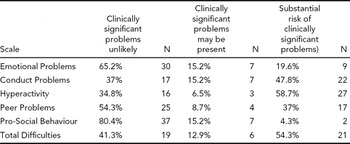
Children in out of home care are often reported as displaying more emotional and behavioural difficulties than the general population. To gain an understanding of the degree of emotional and behavioural difficulty of the sample, means obtained for the SDQ scales were compared to Australian normative data. As can be seen from Table 1, the percentage of children with scores indicating presence of problems or presence of significant problems was considerably higher than expected from normative data.
Percentage of children with and without difficulties on SDQ scales

N = 46.
Elevated levels of problematic behaviour were evident across all difficulty scales of the SDQ. Specifically, 34.8% of children demonstrated moderate to severe difficulty (15.2% and 19.6% respectively) with depression and anxiety, 63% of children displayed conduct problems, 47.8% of the children had severe conduct problems, and hyperactivity, with 58.7% of children having severe hyperactivity problems. Severe peer problems were evident in 37% of the sample while 20% had moderate to severe pro-social behaviour problems (specifically, 15.2% and 4.3% respectively). Overall, 67% of children in permanent care showed problem behaviour, with 54.3% showing severe behaviour problems. Children did, however, rate comparably on the Pro-Social scale indicating that they did not differ significantly in their propensity to engage in socially desirable behaviour.
Previous research with out-of-home populations also suggests that such children experience difficulties across multiple areas of behaviour (Egelund & Lausten, Reference Egelund and Lausten2009; Newton et al., Reference Newton, Litrownik and Landsverk2000). A correlation analysis was performed to examine the inter-relationships between various problem behaviours in this sample. The correlations in Table 2 show the relationships between the SDQ scales. Results showed that children with difficulty in one area are also likely to show difficulty in other areas of their behaviour.
Correlations among SDQ scales

N = 46. * p < .05. ** p < .01
Carer-Child Relationships
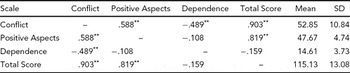
The correlations in Table 3 show the relationships among the CPRS scales. The Conflict scale was positively correlated with the Positive Aspects scale and negatively correlated with the Dependence scale. Specifically, carers who expressed less conflict with the children in their care regarded the relationship as more positive, and their children as less dependent on them.
Correlations among CPRS scales

N = 46. * p < .05. ** p < .01
Note: Conflict is reverse scored, higher scores denoting less conflict.
Emotional and Behavioural Difficulties and Carer-Child Relationships
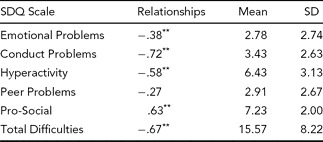
The results in Table 4 show that all areas of child emotional and behavioural difficulties, except Peer Problems, are correlated with carer-child relationships. Strong negative correlations between Conduct Problems, Hyperactivity and Carer-Child Relationships indicate that the more children show hyperactive behaviour or serious conduct problems the less positive their relationships with their carers. Conversely, pro-social behaviour by the child was associated with positive carer-child relationships. The total score appears to represent Conflict and Positive Aspects more than Dependence.
Correlations between child emotional and behavioural difficulties and carer-child relationships

N = 46. * p < .05. ** p < .01
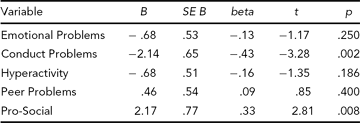
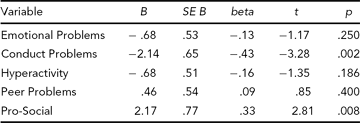
A standard multiple regression analysis using the SDQ scales as predictor variables and the CPRS total score as the criterion (Table 5) showed that two of the predictors contributed significantly to the model F(5,46) = 14.07,p<.01. Conduct Difficulties was the best predictor, followed by Pro-Social. Together, these predictors accounted for 59% of the variance in carer-child relationships. Positive relationships were represented by fewer conduct difficulties and more pro-social behaviour.
Standard multiple regression of SDQ scales predicting carer-child relationships
N = 46. Δ R2 − .59 (p < .01)
Discussion
Results indicate that a high proportion of the children in permanent care had moderate to severe levels of emotional and behavioural problems. Well over 50% of children had conduct problems and hyperactivity and approximately 35% had difficulties with depression/anxiety and peer relationships. Overall, 67% of children in permanent care showed problem behaviour with 54.3% showing severe behaviour problems. Correlations between SDQ scales also showed significant inter-correlations between scales indicating difficulty in multiple areas of behaviour. These results are consistent with existing out of home care literature describing greater problem behaviours amongst children in care (Egelund & Lausten, Reference Egelund and Lausten2009; Gilbertson & Barber, 2005; Janssens & Deboutte, Reference Janssens and Deboutte2009; Kelly, Allan, Roscoe & Herrick, Reference Kelly, Allan, Roscoe and Herrick2003; Laybourne et al., Reference Laybourne, Andersen and Sands2008; Oswald et al., Reference Oswald, Heil and Goldbeck2009; Sargent & O'Brien, Reference Sargent and O'Brien2004; Taylor et al., Reference Taylor, Swann and Warren2008). Correlations between CPRS scales showed that relationships higher in positive aspects had less conflict, and children were less dependent on their carers.
Carers reported fewer positive relationships with children exhibiting more challenging behaviours. Specifically, Conduct Problems predicted less positive relationships whereas Pro-Social Behaviour predicted positive relationships. This is consistent with existing research findings (Fraser, Day, Galinsky, Hodges & Smokowski, Reference Fraser, Day, Galinsky, Hodges and Smokowski2004; Gilbertson & Barber, Reference Gilbertson and Barber2003; Pakaslahti, Karjalainen & Järvinen, Reference Pakaslahti, Karjalainen and Järvinen2002). Parenting a child who exhibits challenging behaviour appears to interfere with the quality of carer-child relationships. Of the problem behaviours investigated here, conduct difficulties and poor pro-social skills emerged as the most significant predictors of carer-child relationships. Hence, it is the child's challenging conduct and antisocial behaviour that appears to hinder carer-child relationships. There is no doubt that carer-child relationships are the result of numerous interacting factors (e.g., Pine et al., Reference Pine, Spath, Werrbach, Jensen and Kerman2009; Robinson et al., Reference Robinson, Sheffield-Morris, Scott-Heller, Scheeringa, Boris and Smyke2009; Ward, Reference Ward2009). Both child and carer variables are likely to contribute to the overall success of carer-child relationships. On the basis of the results of the current study, however, it is plausible to suggest that by working with children to improve behaviours, and by helping carers to identify ways of managing difficult behaviour, carer-child relationships can be improved. Permanent carers may profit from advanced parenting training designed to increase skills in dealing effectively with challenging behaviour. Support for permanent carers with difficult children should be available, and readily accessible so as to support and reinforce positive relationships.
There are several limitations to the current study. First, the study relied solely on carer-report. Responses are therefore subjective, and are susceptible to bias. As carers are the most significant individuals in the day-to-day rearing of their children however, their perceptions are clearly critical in determining carer-child relationships. A second limitation was the size of the sample. This raises concerns regarding how representative the sample is of permanent carer-child relationships and how confidently the results can be generalised to other permanent care families. For this reason, further research with larger samples is necessary.
Children's problem behaviours appear to affect carer-child relationships. In the current study, conduct problems and poor pro-social skills predicted carer-child relationships. The results of this study highlight the need for specialised training and support programs for permanent carers and their children. Parent training programs which aim to enhance parenting skills to manage difficult child behaviour, and child development programs concentrated on improving conduct and pro-social skills may help improve carer-child relationships in permanent care.