


“Many finance students and members of the Occupy Wall Street movement have a great deal in common: a deep interest in democratizing Wall Street.”
— Robert Shiller, New York Times, April 2012.
“What good is the legal right to sit in a restaurant if one cannot afford the price of its food?”
— Coretta Scott King, Congressional Hearing, Joint Economic Committee, December Reference Scott King1975.
INTRODUCTION
Calls for the “democratization of finance” are seemingly everywhere today. While such demands have deep historical roots, the slogan first gained widespread prominence in the wake of the Financial Crisis of 2008 when it seemingly united left critiques of bank bailouts (Appel Reference Appel2014; Block and Hockett Reference Block and Hockett2022; McCarthy Reference McCarthy2025) with libertarian counter-visions of cryptocurrencies as decentralized financial technologies (Laboure and Deffrennes Reference Laboure and Deffrennes2022; Zumbansen Reference Zumbansen2023). Today, the phrase has become the hallmark promise of FinTech start-ups and investment platforms. Prominent economists have similarly adopted the language of democratization to frame the quest for financial inclusion through new technologies (Prasad Reference Prasad2021; Shiller Reference Shiller2012b). From the critical finance literature to crypto ads: all converge in the same shared slogan. As a result, to democratize finance can now mean both socializing finance and financializing society. The ubiquity of this language no doubt attests to the social reach of financialization and it frequently reflects deep discontent with the existing financial system. But what, if anything, does the phrase mean? Does it contain a conceptual promise that is worth articulating and clarifying?
In this article, we argue that behind demands for the democratization of finance lurk both distinct visions of the social purpose of finance as well as sharply divergent—and often conflicting—conceptions of democracy that are worth fleshing out. Some of these uses, we conclude, are more coherent and plausible than others. Our argument operates on two levels. On a first level, we pursue an initial minimalist goal of providing a wide-ranging conceptual and institutional mapping of divergent proposals for the democratization of finance. This involves making explicit the often radically divergent invocations of both finance and democracy that largely remain implicit in the various iterations of the phrase. To do so, we build on the distinction between access-based conceptions of democracy and power-based ones, while offering a differentiation between three dimensions of finance as payment, capital markets, and banking (Mehrling Reference Mehrling2017).
This mapping opens up a second level of analysis in the form of a normative and conceptual assessment. In doing so, we set out three substantive arguments. First, we develop a critique of conceptions of democracy as mere access to markets.Footnote 1 Because such thin accounts rely on market-mediated access to financial services, the inclusion they offer ends up reproducing and often deepening underlying inequalities (Getachew Reference Getachew2016). Indeed, when applied to high-risk speculation in capital markets, such financial inclusion frequently amounts to a form of predatory inclusion (Seamster and Charron-Chénier Reference Seamster and Charron-Chénier2017). Existing accounts of democratizing finance thus not only reflect fundamental disagreements about the meaning of democracy, but their respective prescriptions stand in direct tension with one another.
Second, employing a form of immanent critique, we argue that introducing thicker notions of access in response to this critique is a move in the right direction that, however, turns out to be an unstable halfway house. Thicker notions of equal access contain within themselves a tension that pushes them toward acknowledging the need to grapple with questions of power and how to share it democratically. To illustrate this argument, we engage with the economic dimension of the U.S. Civil Rights movement and its insistence on the intimate link between economic and democratic empowerment.
Third, we develop a normative argument that democratizing must engage with questions of power and collective authority, not merely demands for inclusion. The most promising conceptualizations of democratizing finance require in this sense strengthening public power over finance; especially, as we will argue, over questions of credit creation and allocation. In developing this conceptual and normative claim, our purpose is not to foreclose institutional debate or merely to propose our favorite institutional reform. Instead, we offer an institutional framework for assessing varieties of public control in order to clarify the underlying tradeoffs and facilitate a broader debate about competing proposals. This also allows us to point to the need for more comprehensive perspectives, including the importance of extending such debates to the international level based on the insufficiency of domestic public control over finance. Laying out such a wide range of possible solutions serves to highlight underlying disagreements about the meaning of democracy. In concluding, we point to the particular importance of some form of public control over decisions of credit creation and allocation.
While our conceptual stocktaking primarily seeks to evaluate foundational disagreements surrounding the meaning of democratization, in so doing, we also chart a path for opening up democratic theory to pressing questions of finance while offering a critical democratic lens for contemporary debates in political economy. To see what is at stake in our assessment, however, we must first examine how “democratization” itself has conventionally been defined and what that definition leaves out. Political scientists consider democratization primarily in the context of regime transformation: in this case, a country’s transition from authoritarian rule to democratic institutions. To democratize, on this view, requires the adoption of certain institutional attributes that govern how a society structures political rule (Ziblatt Reference Ziblatt2006). Democratization here usually involves some form of universal suffrage, an autonomous legislature, and a set of basic civil liberties (Acemoglu and Robinson Reference Acemoglu and Robinson2006; Boix Reference Boix2003). Yet this institutionalist understanding is largely silent about the varying degrees of democratic control over specific institutions or domains of social and economic life. So long as representative institutions are elected on the basis of universal suffrage and basic rights are secured, the question of whether, for example, investment decisions, credit allocation, or monetary governance are subject to democratic self-rule remains conceptually moot.
The conventional meaning of democratization thus sidesteps the reach of democratic institutions into the economic realm. This agnosticism has deep roots. Not coincidentally, one of the persistent critiques of modern liberal democracy since the nineteenth century has been its tendency to exclude the economic and financial realm from democratic self-rule (Gourevitch Reference Gourevitch2014; Leipold Reference Leipold2024).Footnote 2 This observation continues to ground the conceptual tension between democracy and capitalism, which defines our current moment with renewed vigor through the financialization of the economy and the globalization of finance after the end of the Bretton Woods system (Krippner Reference Krippner2017; Streeck Reference Streeck2011).
A recent literature in democratic theory has meanwhile started to attend to the centrality of economic power within democratic regimes. This has been accompanied by a latent recognition of the extent to which foundational ideal theories of the liberal state were themselves products of the mid-century stabilization of democracy and capitalism which has since disappeared (Forrester Reference Forrester2019). And yet even where democratic theorists have turned to capitalism and the economy, they have tended to focus on the power relations of the workplace and the internal organization of firms while largely sidestepping questions of finance, credit creation, or central banking (Landemore Reference Landemore2020; Anderson Reference Anderson2017; for two exceptions, see Cordelli Reference Cordelli2025 and Downey Reference Downey2024). Inversely, the by now vast critical literatures on finance, credit, and banking have tended not to draw a connection to fundamental questions of democratic politics or the underlying conceptual stakes of democratic theory (Braun Reference Braun2020; Gabor Reference Gabor2021; Mehrling Reference Mehrling2011).
In this article, we seek to overcome this impasse by critically assessing proposals for the democratization of finance. We do so by building on the nascent literature on the political theory of money and finance, including some of its democratic ramifications (Downey Reference Downey2024; Eich Reference Eich2022; Kapadia Reference Kapadia2024). Attending to the divergent meanings of calls for the democratization of finance, we argue, is a productive path for clarifying a number of overlapping disagreements and forging a clearer account of the democratic stakes of finance and the financial dimension of democracy.
The lack of conceptual clarity surrounding calls to “democratize finance” is not innocent but carries distinct political stakes. When radically divergent projects are articulated in a shared democratic idiom, the language of democratization can function ideologically: channeling democratic dissatisfaction into forms of market participation that leave underlying power relations intact. In this sense, invocations of financial democratization as mere access to markets can operate as a form of “democracy washing,” offering the appearance of democratic progress while displacing demands for democratic control (Downey and Eich Reference Downey and Eich2023; Perelman Reference Perelman2024). As we will argue, such notions of democracy invoke democratic language to disguise forms of disempowerment. Clarifying the meaning of democratization in the realm of finance is therefore not only a matter of conceptual precision, but a prerequisite for assessing which claims genuinely advance democratic self-rule and which contribute to foreclosing it.
MAPPING FINANCE AND DEMOCRACY
What Is Finance?
When the founders of the retail investing platform Robinhood peddle the “democratization of finance” as their mission, they clearly do not mean the same thing as critical legal scholars calling for postal banking. But is this disagreement only the result of divergent conceptions of democracy? Or does at least part of the divergence also revolve around the meaning and nature of finance? The first and most basic distinction we can make is to differentiate finance proper from the two related realms of money and banking. Mehrling (Reference Mehrling2017), on whom we build here, refers in this sense to a threefold infrastructure of “modern financial society,” consisting of (a) payment infrastructure, (b) investment and capital markets, and (c) banking and credit.Footnote 3
(a) Most fundamentally, there is the realm of payment systems (or what Mehrling simply dubs “money”). This refers to the infrastructures that make it possible for people to pay and get paid, to buy and sell goods and services. Institutionally, this includes the private and public systems, from cash to bank accounts, that “revolve around the settlement of promises to pay” (Mehrling Reference Mehrling2017, 3–4). This is the basic plumbing of any economy. (b) By contrast, the realm of investment—or what is often considered the realm of “finance” proper—revolves around the “valuation of existing promises stretching out into the future” (Mehrling Reference Mehrling2017, 4). Under capitalism, this includes most prominently capital markets and corporate financing through such markets. It is this aspect of finance that enables both investment and speculation about a future that has to be priced (Levy Reference Levy2025). Here we encounter some of the most recognizable faces of finance in the form of markets for stocks (equity in firms) and debt, as well as the world of hedge funds, pension funds, asset managers, and other investment schemes. (c) Finally, there is the realm of banking, which, while overlapping with money and finance, revolves at its heart around the creation and allocation of credit. This includes most fundamentally the banking system, as well as its supervisory institutions and, crucially, the steering capacities of the central bank (Hockett and Omarova Reference Hockett and Omarova2017; Menand Reference Menand2021; Monnet Reference Monnet2018).
While it is helpful to differentiate between these three realms in order to get a clearer sense of what exactly is meant by various invocations of finance, it is important to stress that these are not strictly separate domains but rather three dimensions of an integrated financial system. Indeed, as we will argue below, all three are held together by the promissory forces of credit. A credit card provider, for example, will usually combine the use of private payments infrastructures with the bank-like provision of credit, while managing its balance sheet through investments in various traded assets. Inversely, the activities of money funds and so-called primary dealers easily blend into forms of shadow-banking outside of the formal banking system (Menand Reference Menand2022). And yet this initial differentiation already highlights a first difference in emphasis. While cryptocurrencies, such as Bitcoin, started with promises about improving payment systems, (a) in the above terminology, the overwhelming bulk of recent crypto invocations of democratizing finance have focused on retail access to capital markets (b). The critical finance literature, by contrast, has mainly been interested in democratizing the infrastructural components of the payment system (a) and, more fundamentally, the creation, allocation, and governance of credit by banks and central banks (c). We will return to how distinguishing between these dimensions of finance allows for greater clarity on how different uses of democratization are applied to them. Let us now turn to these divergent conceptions of democracy.
Two Views of Democracy: Access versus Power
To democratize is to make something more democratic. The democratization literature in political science, mentioned above, tends to focus on the democratization of states—seeking to understand how non-democracies become democracies (Acemoglu and Robinson Reference Acemoglu and Robinson2006; Boix Reference Boix2003). While this literature examines economic factors, such as inequality and industrial development, when considering what renders states ripe for democratization, it does not consider what it might mean to democratize a particular sector of the state or society, nor if the democratization of such a sector, like finance, might be required for democratization more broadly.Footnote 4 To begin to ask such questions, we must first understand the underlying meaning of democracy deployed in calls to democratize. We start here by suggesting that there are broadly two ways in which scholars have conceptualized the possibility of democratizing specific institutions: (a) expanding access to certain goods, versus (b) sharing power through participation in institutions of self-rule.
(a) The idea that democratization consists in expanding access is grounded in a conception of democracy that emphasizes inclusion. Originally this referred to inclusion within the body of citizens enjoying certain civil and political rights. But depending on how citizenship is theorized, inclusion can also stretch further, for example, to entail access to certain goods or services. Such access-based conceptions of democracy can have radically different implications depending on whether access is understood as mere legal access to the market provision of goods and services (“thin access”), or instead more robustly as equal access to the goods themselves, including through public provision (“thick access”). The former conception is most frequently associated with the neoliberal turn since the 1970s (McCarthy Reference McCarthy2025), but its roots go back to earlier neo- and ordoliberal positions of the mid-twentieth century which analogized market choices to voting (Olsen Reference Olsen2018; Slobodian Reference Slobodian2020). As von Mises (Reference von Mises1951, 443) put it, “capitalist society is a democracy in which every penny represents a ballot paper.” Rather than the egalitarian democratic principle of “one person, one vote,” the underlying logic is instead that of “one dollar, one vote.” What is being equalized here is a negative economic freedom to buy certain financial services. Within this neoliberal and ordoliberal tradition, markets are considered paradigmatically democratic institutions because anyone can legally participate in them. To be excluded from a market is inversely tantamount to an act of disenfranchisement on this account. Once financial markets are seen as paradigmatic arenas of empowerment, access to them becomes not only permissible but a necessary requirement. However, as we argue below, while the terms of such access might be formally equal, mere market access tends to reproduce underlying economic inequalities and as such amounts to a form of unequal inclusion.
There are, at the same time, thicker conceptions of access that insist on equal inclusion and thus on something more than mere access to markets. Democracy, on this view, requires that citizens have access to a set of goods that are understood as fundamental, foundational, or necessary for citizenship or for sustaining democracy over time. Consider the following example from US Reconstruction, which serves to illustrate the difference between thinner and thicker versions of access. Thin accounts of access would have been content with removing discriminatory legal barriers, for example concerning the ownership of land by formerly enslaved persons. Thicker accounts of access, by contrast, would have insisted on the need to provide land ownership for all, which has echoes in the disappointed promise of “forty acres and a mule” (Foner Reference Foner2015).
We can relate this differentiation between thinner and thicker conceptions of access back to questions of finance. On the thin end lies a conception of democracy as access to markets for speculative investments. In the next section, we offer a normative critique of such thin accounts of access. On the thick end, by contrast, we can locate demands for equal inclusion related to basic financial services—such as a bank account—that we might think of as necessary for full citizenship. However, while thicker notions of access are democratically more robust, we argue below that securing equal inclusion forces us to grapple with questions of public control in ways that go beyond access. In other words, an insistence on access as equal inclusion ultimately spills over into the second camp of conceptions of democracy based on power sharing. Let us now turn to this alternative perspective.
(b) The second overarching idea of democratizing is less about individual access and more about collective power. Democracy, on this view, insists on rendering relations of power legitimate by subjecting them to shared control and self-rule (Allen Reference Allen2023). The focus of this understanding of democracy rests firmly on questions of power, and in particular, the power of citizens qua citizens over private entities.Footnote 5 Equality and inclusivity are still essential on this account (not least in the constitution of the citizenry), but they are not sufficient for democratization.Footnote 6 This concern with checking and sharing power can be institutionally articulated in a number of different ways. It can and has most obviously taken the form of the democratic state and its representative institutions, but there are also other competing proposals for institutionalizing self-rule (Guerrero Reference Guerrero2024; Landemore Reference Landemore2020). Shaping the exercise of financial power can, for example, mean submitting those who wield such power to regulatory regimes that seek to align their actions with the public good. But it can also mean more direct interventions of public provision, either in the form of a public option alongside private alternatives or even wholesale public provision in the form of nationalization. We will return to these alternative options in a moment. However, our goal in this article is not so much to advocate for one specific institutional solution over others but to narrow the range of conceptually and normatively defensible conceptions.
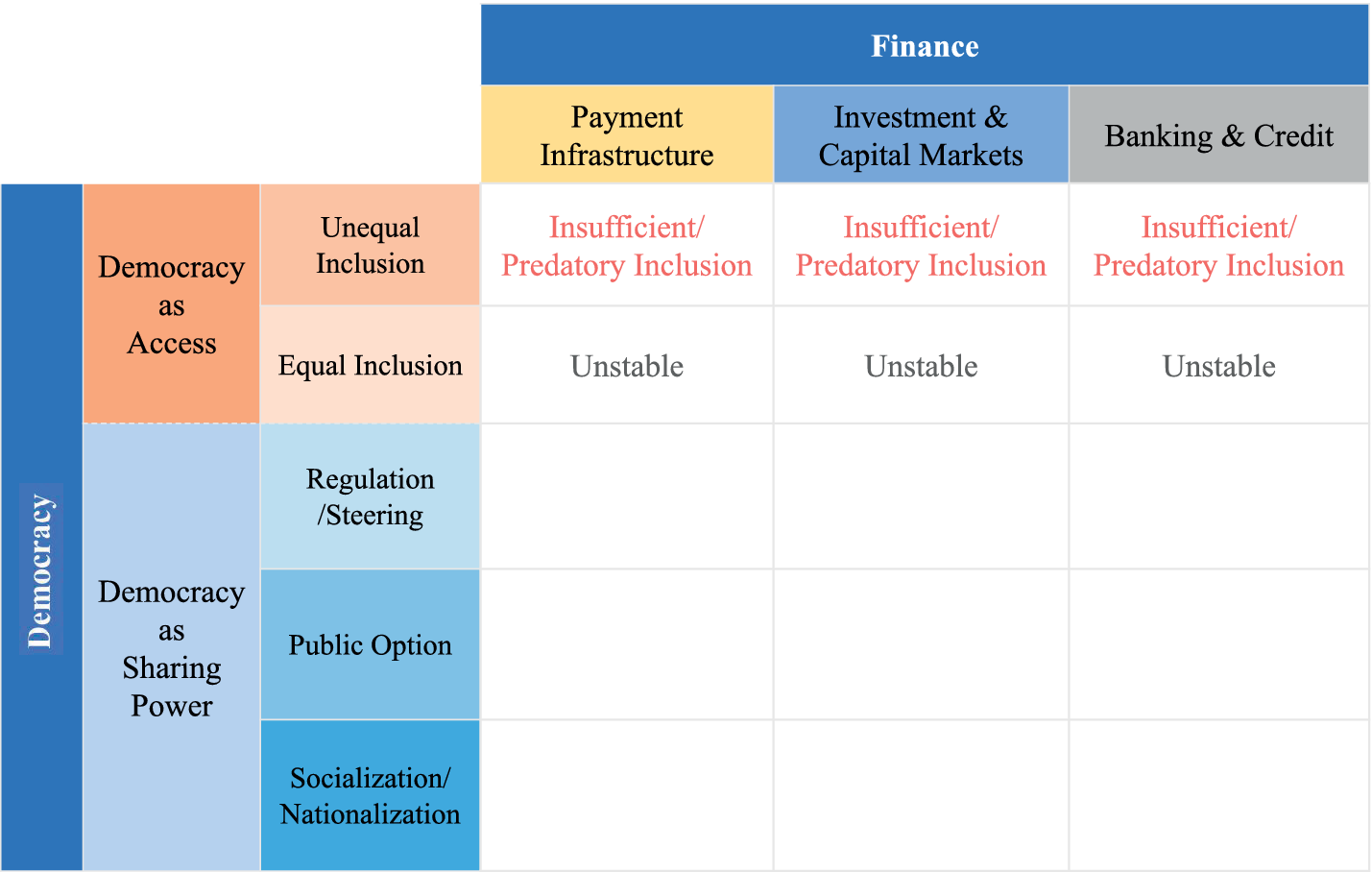
Putting together these two descriptions of finance and democratization, we arrive at the following taxonomic map (Figure 1). This should not be read as a static classificatory grid in which all cells represent equally stable or normatively defensible positions. Rather, it summarizes our argument about the limits and internal tensions of different conceptions of democratization as they interact with distinct dimensions of finance. More specifically, we argue that the first row—democracy as mere market access—is insufficient to constitute meaningful democratization and can even amount to a form of predatory inclusion. The second row—democracy as equal inclusion—constitutes an unstable position that either collapses into unequal inclusion or grapples with power-sharing conceptions of democracy. The most defensible understandings of democratizing finance, we will argue, are instead located among the bottom rows, which foreground questions of public power and control.Footnote 7 We will return to this map below to illustrate our argument and to situate divergent usages of “democratizing finance” within it.
Democracy and Finance Mapped

Figure 1. Long description
A matrix with Finance as the horizontal header and Democracy as the vertical header.
Horizontal Header (Finance) contains three columns:
* Payment Infrastructure (yellow)
* Investment and Capital Markets (blue)
* Banking and Credit (gray)
Vertical Header (Democracy) is divided into two main sections:
1. Democracy as Access (orange): Subdivided into Unequal Inclusion and Equal Inclusion.
2. Democracy as Sharing Power (light blue): Subdivided into Regulation or Steering, Public Option, and Socialization or Nationalization.
Data Intersections:
* For Democracy as Access - Unequal Inclusion: All three finance columns result in Insufficient or Predatory Inclusion (text in red).
* For Democracy as Access - Equal Inclusion: All three finance columns result in Unstable.
* For Democracy as Sharing Power: The cells for Regulation or Steering, Public Option, and Socialization or Nationalization are currently blank across all three finance columns.
THE INSUFFICIENCY OF ACCESS
With this taxonomic map in mind, we can begin to distinguish between various uses of the phrase “democratizing finance” in order to assess which of these should be considered most coherent, defensible, and attractive. The idea that markets function as democratic institutions—most prominently articulated within neoliberal and ordoliberal traditions—finds contemporary expression in proposals that frame expanded access to financial markets as a form of democratization. This framing was, for example, widely deployed during the 1990s in order to argue that expanding access to financial markets constituted an act of democratization. As Quinn (Reference Quinn2019, 3) writes, “It was to be a new era of credit access for poorer borrowers, constituting nothing less than the democratization of credit.”Footnote 8 Indeed, in the US context, often a perverse link was drawn between struggles to overcome forms of financial discrimination based on race and the imperative to deregulate financial services. The invocation of the phrase “democratize finance” went from negative to positive, from arguments for the removal of mistreatment or discriminatory obstacles to a rallying cry for financialization. Financial deregulation was thought to hold the key for the broadening of access to finance in the name of democratization. Even economists who question such claims empirically have tended to accept the underlying conceptual framing, simply stating upfront that the democratization of finance is “a term we use to signify the broadening and deepening of access to the capital market for ordinary, moderate-income individuals and households” (Erturk et al. Reference Erturk, Froud, Johal, Leaver and Williams2007, 554).
This idea of democracy as market access continues to define common conceptions of “financial inclusion.” It is, after all, such a narrow conception of democracy as access that allows Shiller (Reference Shiller2012b, 5) to define democratizing finance simply as “the opening of financial opportunities to everyone.”Footnote 9 As he had put it elsewhere, “we need to democratize finance and bring the advantages enjoyed by the clients of Wall Street to the customers of Wal-Mart” (Shiller Reference Shiller2009, 1). Democratization as market access was in this sense the organizing thesis of Shiller’s influential intervention, which presented the extension of sophisticated financial tools to ordinary households as a route to what he called the “good society” (Shiller Reference Shiller2009; Reference Shiller2012b). For Shiller, any other meaning of “democratization” was seemingly so unthinkable that he sought to present himself as an ally of Occupy Wall Street, which after all also called for the democratization of finance (Shiller Reference Shiller2012a; Reference Shiller2012b). More recently, Larry Fink, co-founder, chairman, and CEO of the world’s largest asset manager BlackRock, similarly hailed the “democratization of investing” in the firm’s annual investor letter as “more investors, broader participation, and expanded prosperity” (Fink Reference Fink2025). Democratizing finance takes on a simple form here: it is the removal or lowering of barriers to access, primarily understood as access to capital markets or other investment opportunities. It is worth registering the genuine democratic intuition at work. In a context in which financial markets shape life chances, the removal of arbitrary barriers to participation can plausibly be experienced as a form of empowerment, and proponents draw on a recognizable tradition linking the expansion of consumer choice to individual freedom.Footnote 10 But the result is a vision of citizenship as access to financial investments that also places the onus of failure on the individual (Krippner Reference Krippner2017).Footnote 11
A radicalized version of this conception of financial democracy as market-based access has since emerged with renewed ferocity in the realm of crypto and FinTech. Kalshi, the prediction market operator that allows users to gamble on elections, claims to be “democratizing finance through innovation.”Footnote 12 Robinhood, whose gamified stock trading app boomed during the pandemic, describes its mission as the “democratization of finance.” As Robinhood’s co-founder and CEO put it: democratization means “that everyone should have access to the financial markets” (Tenev Reference Tenev2023).Footnote 13 It is tempting to dismiss such talk as vacuous marketing speak that hardly deserves scholarly attention. However, this framing has not remained confined to start-ups but is now also widely deployed among academic economists. Even otherwise cautious observers of the promises of FinTech use as their yardstick whether any particular innovation expands access to financial markets or other market-mediated financial services. As Eswar Prasad (Reference Prasad2021, 359) puts it in his influential account of the future of money: “New technologies hold out the promise of democratizing finance and broadening access to financial products and services.” On this account, decentralized finance’s promise to allow even low-income households to gain access to speculative financial products is seen as a feat of democratic empowerment.Footnote 14 Indeed, the term is by now widely deployed across the social sciences, where a substantial empirical literature treats “democratization” straightforwardly as a measurable expansion of market access (Cumming, Meoli, and Vismara Reference Cumming, Meoli and Vismara2021). This usage is concentrated among scholars outside of democratic theory, for whom democratization functions as a metric of market inclusion rather than a claim about self-rule. The term does serious rhetorical work in these hands, while borrowing a normative authority from “democracy” that its access-based content cannot support.
As we will argue in the remainder of this article, these widespread uses of the slogan “democratize finance,” which combine an understanding of democracy as access with a focus on speculative investing, are deeply flawed.Footnote 15 If full citizenship requires access to certain financial services, say a bank account, the mere legal possibility of a bank account is not enough. Being “unbanked” severely limits one’s ability to fully participate in society (Baradaran Reference Baradaran2015). But so do instances of what we call unequal inclusion whereby formally expanded access operates on terms that reproduce and deepen underlying inequalities, for example by being forced to pay for financial services that wealthier fellow citizens receive for free or by having to resort to exploitative forms of credit. Indeed, this reveals a deeper problem with well-intended calls for “financial inclusion.”
The problem with market-mediated access is not merely that the inclusion it offers is frequently insufficient but that it can be actively harmful.Footnote 16 For example, where access to speculative capital markets is extended on exploitative terms—as with gamified trading platforms—inclusion does not empower but deepens the very inequalities it purports to address. These trading platforms use behavioral design features that specifically target inexperienced retail investors, encouraging more frequent and riskier trading that tends to produce worse outcomes for investors (Tan Reference Tan2021). At the same time, they generate revenue through payment for order flow arrangements in which market makers compensate the platform for routing trades, often at the cost of inferior execution prices for investors.Footnote 17 Our threefold distinction between payment, investment, and banking is instructive here: while access to basic payment infrastructure is a plausible precondition for citizenship, extending access to speculative investment under conditions of structural inequality turns democratization into a mechanism of predatory inclusion (Seamster and Charron-Chénier Reference Seamster and Charron-Chénier2017).
Let us at this point turn to democratic theory to help explain what has gone awry here. There is a wide variety of ways to describe democracy and a wide array of reasons for why democracy is valuable. None of these, however, can reasonably be deployed to claim that expanding market access meaningfully “democratizes” finance. Accounts that justify democracy primarily by its outcomes still presuppose that citizens have the power to hold decision-makers accountable and to contest outcomes (Arneson Reference Arneson, Christiano and Christman2009). Even where democracy’s value is located in what it delivers, it is not mere access to goods or services that renders a system democratic. Other accounts locate the democratic ideal even more explicitly in power and standing: for Kolodny (Reference Kolodny2014a; Reference Kolodny2014b), equal power and authority constitute relations of non-inferiority; for Waldron (Reference Waldron and Estlund2001), democratic legislation derives its authority from the equal participation of citizens in the decision-making process; while for Lovett and Zuehl (Reference Lovett and Zuehl2022), collective autonomy requires that citizens jointly exercise control over the rules that govern them.Footnote 18 Even on “thin” accounts of democracy, it is access to the power to rule that is foundational.Footnote 19
Across otherwise divergent democratic theories—whether focused on non-domination, political equality, accountability, or collective self-rule—democracy requires that those subject to social and economic rules stand in a position to shape and contest them. Access to financial goods without any corresponding power over the institutions that govern credit creation, allocation, and risk therefore fails as a democratic ideal in principle because it solely revolves around individual empowerment rather than collective decision-making. Even where access is formally equal, citizens remain exposed to decisions taken by private actors over whom they exercise no meaningful control. From a democratic perspective, this is not just an incomplete form of democratization; it is a category mistake. To count as democratization, individual empowerment would have to be linked to collective decision-making. Put differently, the idea of democracy is less about expanding participation in the game of finance, and more about how to share the power over setting the rules of the game, which might then be used to expand access. What is democratically deficient about access-only accounts is therefore not merely that they deliver poor outcomes or expose individuals to risk, but that they leave intact inequalities of power that democracy, in its most basic sense, exists to contest.
At this point, it is important to emphasize a distinct normative danger associated with democratization as mere access to markets. Thin accounts can be sincere, and they are often motivated by genuine concerns about exclusion or discrimination, yet precisely because they leave unequal relations of power untouched and indeed frequently deepen them, they risk hollowing out the very meaning of democracy. The language of democratization is, in such cases, deployed to legitimate market outcomes by presenting increased access to financial markets as democratic empowerment while actively displacing questions of public authority and control.Footnote 20 The fact that these claims proliferate most extensively not around basic financial services but rather around access to speculative finance, such as derivatives or other risky investment products, might seem to render market-provision less offensive—as it seems intuitive that access to such financial products is not required for citizenship. But, for the same reason, it makes the invocation of democracy all the more jarring. Ironically, it is precisely within this context—the most unsatisfactory of all possible uses—that we have recently witnessed the habit of referring to such predatory practices as the democratization of finance. The problem in these cases is not mere insufficiency but a more pernicious case of political misrepresentation and “democracy washing”: democratic language is used to mimic the appearance of democratization while neutralizing its substance. In rejecting this increasingly common invocation of financial democracy, we thus also want to encourage social scientists to interrogate their uses of democratization more critically. At stake is not only conceptual clarity but the coherence of democratic discourse.
FROM EQUAL INCLUSION TO POWER SHARING
If our critique of democratization as mere access to markets highlights the ways in which such access tends to result in unequal inclusion, our critique of thicker notions of access is somewhat different. Our main point here is that a more robust notion of inclusion reveals the need to grapple with how to share power over the rules of the game. Inclusion turns out to be an unstable halfway house that either collapses into market-based unequal inclusion or slides toward more robust demands based on an engagement with questions of power.
Before we turn at greater length to varieties of public control in the realm of finance, in this section we first want to illustrate why aiming for equal inclusion forces precisely such a reckoning with power sharing and public control. Consider, for example, the central case of access to credit. On the thin, market-based conception of access, little more than anti-discrimination legislation is required (Krippner Reference Krippner2017). If we reject this vision as insufficient to secure inclusion in practice, we find ourselves insisting on a fundamental right to credit (Meyer Reference Meyer2018). But how can we ensure and enforce equal inclusion? Having started with an insistence on mere access, we now find ourselves contemplating regulation requiring banks to serve all communities on fair terms. Soon we would discover that effective regulation and compliance require the reassertion of public power over the financial sector.Footnote 21 Without having intended to do so, we thus find ourselves firmly surrounded by questions of power and the exercise of public control. In other words, to democratize in the access-sense first requires democratizing in the power-sense. In terms of Figure 1, the second row (based on equal access) is inherently unstable and gives rise to questions of power sharing and public control.
One powerful historical illustration of this dynamic is provided by the Civil Rights movement and its insistence on the economic dimension of full democratic citizenship (Baradaran Reference Baradaran2017; Hill Edwards Reference Hill Edwards2024; Rothstein Reference Rothstein2017). This matters all the more because the early Civil Rights movement, with its emphasis on tackling the discriminatory financial exclusion of Black households (including mortgage redlining but also other forms of financial discrimination), is sometimes cited in support of accounts of financial democracy as access to financial markets. Shiller (Reference Shiller2012b), for example, highlights the removal of discriminatory exclusions within the banking system as an instructive analogy for the democratization of finance. At first sight, the Civil Rights movement does seem to provide an alternative and much more distinguished genealogy of conceptions of democratic citizenship as access than those we have offered above. A large part of the legal struggle of the early Civil Rights movement did indeed revolve around overcoming explicit forms of discrimination. This included most prominently a struggle against long-standing exclusions of Black households from private credit creation as well as the financial welfare programs of the New Deal state, especially the racialized exclusion of Black households and Black neighborhoods from federal mortgage programs through so-called redlining (Rothstein Reference Rothstein2017). Much of this can and has been read as the demand for access through the removal of arbitrary restrictions.
Crucially, however, as Civil Rights activists grappled with what it might mean to struggle for financial access, their conceptions of inclusion gradually became thicker and more demanding over time (Goluboff Reference Goluboff2007; Taylor Reference Taylor2019). Meaningful inclusion based on equality, they realized, requires a reckoning with underlying questions of power. We can thus see through the history of the economic and financial dimension of the Civil Rights movement how an apparently narrow concern with ending discrimination developed into an ever-richer engagement with the policies that would be necessary for achieving meaningful power sharing.
As a recent literature on race and money has shown, not only were economic considerations central to the Civil Rights movement—the March on Washington was after all a march “for Jobs and Freedom”—but access to credit and banking free of racial discrimination was a central motivating factor (Baradaran Reference Baradaran2017). Many Civil Rights activists operated, moreover, with a much more demanding positive vision of the civic empowerment of credit. They shared a deep historical awareness of the legacy of the Freedman’s Bank (Hill Edwards Reference Hill Edwards2024) and the need for strategies of public control over banking (Baradaran Reference Baradaran2017, 119). Civil rights protests concerned not just discrimination by banks, but also revolved around a positive vision of the power of Black community banks, as well as an awareness of their precarious historical position.Footnote 22
Not coincidentally, Martin Luther King’s speeches frequently contained powerful allusions to the promissory powers of both equal credit and democratic citizenship. Most famously, he opened his “I have a dream…” speech in this spirit with an elaborate banking allegory that drew an analogy between the US Constitution and a “bad check” (King Reference King1963). Far from resorting to a thin conception of democracy as mere access, many Civil Rights leaders pointed to the insufficiency of leaving equal integration to market forces. Rather, they began to push toward public options, comprehensive forms of regulation, and the explicit macroeconomic steering of investment. Indeed, Coretta Scott King continued this campaign even after King’s death and throughout the 1970s, pushing for a Jobs Guarantee and eventually helping to pass the 1978 Humphrey-Hawkins Act, which requires the Federal Reserve to pursue not just price stability but also full employment (Stein Reference Stein2016).Footnote 23
The Civil Rights movement had a vision of democracy as more than access—let alone mere market participation—and instead one that revolved around different strategies of power sharing through more comprehensive proposals for legislation and regulation. In terms of Figure 1, a study of the Civil Rights movement reveals a certain internal logic that pushes a concern with equal access to foundational goods toward a richer engagement with questions of equal inclusion and ultimately power sharing. Appropriations of the Civil Rights movement in defense of financial democracy as access are thus at best incomplete and at worst distortive because they ignore that the Civil Rights movement itself developed a critique of merely formal inclusion as a perpetuation of past injustices. To summarize, situated between thin accounts of market inclusion and more robust notions of power sharing, we encounter an insistence on equal inclusion. However, this is revealed to be an unstable halfway house that prompts the need to push toward more robust power-sharing conceptions of democracy.
It might be objected that in principle a proverbial benevolent dictator could extend equal access without altering the distribution of authority over finance. But access guaranteed by a benevolent dictator is necessarily dependent. Even with identical outcomes, the recipient stands in a relation of subordination and such access held at another’s discretion is for that reason neither securely equal nor stable. By contrast, democratization, on the power-based conception we defend, concerns how a domain is ruled. If one of the wrongs we objected to in thin market access was subjection to arbitrary power over one’s inclusion, the benevolent dictator reproduces that wrong as the sovereign’s will. This affirms our argument that stable, non-dependent equal access requires power sharing, in this case over the terms of financial inclusion. The collapse of the Freedman’s Savings Bank, chartered for freedpeople but governed without them, is a haunting reminder of how inclusion can become not only precarious but predatory when it is not backed by control (Hill Edwards Reference Hill Edwards2024). The instability of equal inclusion is thus a pressure toward the only thing that would secure it, namely sharing in the power to rule. To democratize in the sense of altering the balance of power over finance is in this sense about the collective power of the citizenry. There are, of course, different ways to enhance or exercise citizens’ collective power. It is to these that we turn now to add some further institutional specificity.
VARIETIES OF PUBLIC CONTROL
Having argued that access-based accounts of democratizing finance are either normatively insufficient or internally unstable, we now turn to the institutional forms such power-sharing might take and, in doing so, to the range of democratic possibilities that the access framing forecloses. There are a number of different mechanisms through which public power over the financial system could be rebalanced: (i) regulation, or some other form of collectively steering credit creation to align private provision with the public interest, (ii) public provision alongside private provision (that is a “public option”), or (iii) public provision through nationalization. Rather than arguing for one strategy over others, in this section we primarily want to emphasize the sheer variety of possible agents and tools of such strategies of power sharing and public control while providing a clear differentiation between different agents and tools of public control.
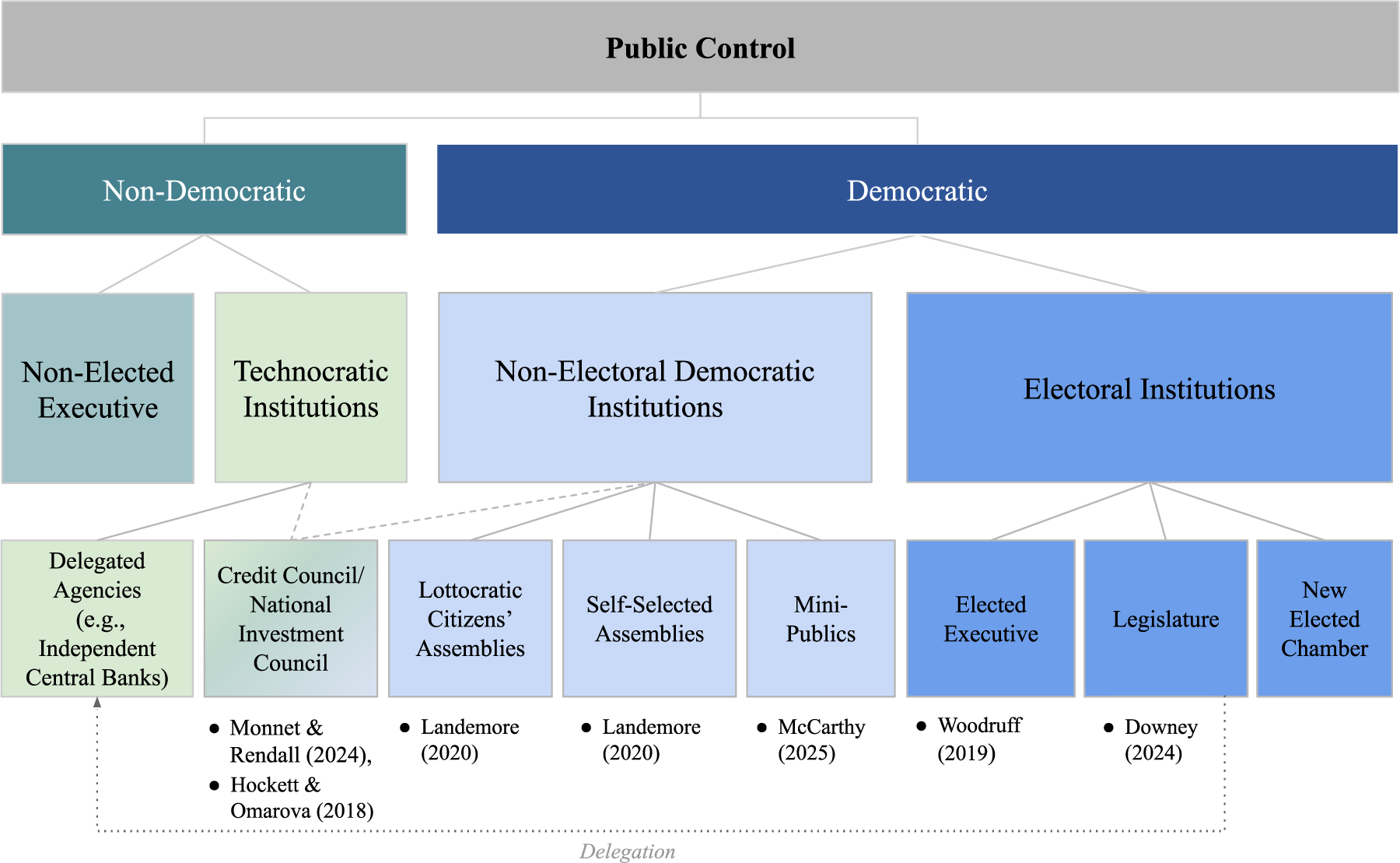
Before we elaborate the varieties of tools of public control, it is helpful to differentiate this dimension of the debate from that of its possible agents (see Figure 2). For example, even the seemingly straightforward demand for the nationalization of central banks, which gained widespread traction in the wake of World War II, is institutionally underspecified without a consideration of who will be the agent of public control after nationalization. Would central banks be considered a subdivision of national finance ministries and thus ultimately under the executive (as was initially the case)? Would they be directly accountable to the legislative branch? Or should they be independent public agencies insulated from democratic electoral politics (as is the case today)?
Agents of Public Control over Financial Institutions

Figure 2. Long description
A flowchart organized into four vertical levels.
Level 1: At the top is a single grey box labeled Public Control.
Level 2: Two branches emerge from Public Control. To the left is a teal box labeled Non-Democratic. To the right is a dark blue box labeled Democratic.
Level 3:
- Under Non-Democratic are two boxes: Non-Elected Executive and Technocratic Institutions.
- Under Democratic are two boxes: Non-Electoral Democratic Institutions and Electoral Institutions.
Level 4:
- Under Technocratic Institutions are Delegated Agencies (e.g. Independent Central Banks) and Credit Council/ National Investment Council. These are cited by Monnet 2024 and Hockett & Omarova 2018.
- Under Non-Electoral Democratic Institutions are Lottocratic Citizens’ Assemblies (Landemore 2020), Self-Selected Assemblies (Landemore 2020), and Mini-Publics (McCarthy 2025).
- Under Electoral Institutions are Elected Executive (Woodruff 2019), Legislature (Downey 2024), and New Elected Chamber.
Structural Relationships: A dashed line connects Technocratic Institutions to Credit Council. A dotted line labeled Delegation at the bottom connects the Legislature back to Delegated Agencies.
In inquiring about the possible agents of public power, it is helpful to differentiate between proposals for public control that seek to ground such control in the executive or indeed some unelected technocratic body from a wide range of proposals that seek to anchor public control in a more plural representation of the citizenry, whether that be the legislature or some alternative body (or devolved bodies). Here we can distinguish between proposals that focus on democratizing finance by reforming existing institutions and those that call for the creation of new mechanisms for democratic control. Among the former, when it comes to democratizing finance by shifting the balance of power, there is only one place to start: the central bank.Footnote 24 The most developed and informed calls to democratize finance all involve calls to democratize the central bank, although unsurprisingly, they diverge on what this requires. Two prominent arguments have called for reducing central bank independence by either embedding central banks more firmly in the executive branch (Woodruff Reference Woodruff2019), or by bolstering legislative power over central banks (Downey Reference Downey2024; Mason Reference Mason2016). This would likely still involve some degree of delegation of technical policy execution but now based on reinvigorated legislative authority and democratic agency.
Others have offered a creative range of proposals for new institutions that would aim to make central banks more responsive to the democratic will or take over some of the responsibilities of central banks. These could, for example, be new electoral institutions, such as an additional legislative chamber primarily concerned with questions of credit and investment policy (Eich Reference Eich2022, 217). More prominent, however, have been calls for other non-elected technocratic bodies in the form of Credit Councils (Monnet Reference Monnet2024) or National Investment Authorities (Hockett and Omarova Reference Hockett and Omarova2018) that would complement existing legislatures and monetary authorities. As highlighted in Figure 2, these tend to occupy the ambiguous space between technocratic institutions and non-electoral democratic ones, for example based on an emphasis on the deliberative democratic character of such bodies (Monnet Reference Monnet2024).
Yet others have recently called for bypassing the traditional democratic structures of the state by instead directly empowering citizens through novel non-electoral democratic institutions, such as for example lottocratic citizens’ assemblies or self-selected assemblies (Guerrero Reference Guerrero2024; Landemore Reference Landemore2020).Footnote 25 While such proposals come directly out of the democratic theory literature, they have only recently been explicitly extended to credit and monetary policy, in particular to the investment function of finance. One version of this perspective has been articulated by McCarthy (Reference McCarthy2019; Reference McCarthy2022; Reference McCarthy2025), who argues for the democratization of finance through “minipublics”—small randomly selected, statistically representative bodies of citizens—which would control public banks or steer investment. For McCarthy (Reference McCarthy2025), the aim is to “shift decision-making about investments into the hands of the people, not just rely on private corporations or the state to make those calls.” McCarthy (Reference McCarthy2022) thus calls for assembling “a group of citizens to deliberate on where public investment should go.” In contrast to the views of democratization outlined above, McCarthy does not think that elected officials are best qualified or disposed to represent the interests of citizens. Instead, he wants to give power over investment to small statistically representative bodies of citizens. Democratic theorists continue to disagree on these fundamental questions, and it is beyond the scope of this article to intervene in this debate. Rather, we want to point to the underlying normative stakes and demonstrate how public control plays out across the three dimensions of finance. Irrespective of where we locate democratic agency, this still leaves open a wide variety of possible strategies for power sharing and public control (see Figure 3).
Democracy and Finance Mapped Again

Figure 3. Long description
The matrix is organized with Finance categories as columns and Democracy categories as rows.
Column Headers (Finance):
1. Payment Infrastructure (yellow)
2. Investment and Capital Markets (blue)
3. Banking and Credit (gray)
Row Headers (Democracy):
1. Democracy as Access, subdivided into Unequal Inclusion and Equal Inclusion.
2. Democracy as Sharing Power, subdivided into Regulation or Steering, Public Option, and Socialization or Nationalization.
Data Cells by Row and Column:
- Unequal Inclusion: Payment services or Cryptocurrency (Payment); Gamified Trading Platforms (Investment); FinTech (Banking). All are labeled in red text.
- Equal Inclusion: All three columns are labeled Unstable.
- Regulation or Steering: Proposed Fair Access to Financial Services Act (Payment); Community Reinvestment Act, Investment policy, Credit guidance, Capital controls (Investment); Equal Credit Opportunity Act (E C O A), Reserve Requirements, Liquidity Coverage Ratios, Conditional central bank lending (Banking).
- Public Option: Retail FedAccounts, Brazilian P I X, Expanded FedNow (Payment); National Investment Authority (N I A), Reconstruction Finance Corporation (R F C), Federal Credit programs, Sovereign wealth funds (Investment); Postal Banking, Community Banks (Banking).
- Socialization or Nationalization: FedWire, State Currency, Central Bank Digital Currency (C B D C) (Payment); Gosplan, Nationalization of retirement accounts, Abolition of capital markets (Investment); Nationalization of bank depository functions, Sectoral investment boards (Banking).
Regulation/Steering
The most traditional form of public control over finance comes in the form of regulation and supervision (Menand Reference Menand2021). States can regulate the basis on which banks can offer or deny access to bank accounts and loans. In the U.S., for instance, the Equal Credit Opportunity Act (ECOA) of 1974 prohibits discrimination in the practice of originating or allocating credit. There is no similar law on the books when it comes to access to bank accounts or financial services, although one has recently been proposed.Footnote 26 Beyond the basis of credit allocation, states also regulate the quantity of credit that financial institutions originate using reserve requirements, liquidity coverage ratios, and interest rate policy, for instance. The hope of all such regulation is for the state to steer and shape private finance such that it better aligns with the public interest. In terms of democratic theory, regulation represents an exercise of public power over the conditions under which financial activities (across payments, investment, or banking) take place, thereby subjecting these foundational economic decisions to a form of democratic steering.
In recent history, state steering or regulating investment has been less common, or at least less obvious (Block Reference Block2008; Block, Keller, and Negoita Reference Block, Keller and Negoita2024). Nevertheless, there are longstanding and distinguished proposals for the state to steer credit creation and investment decisions more actively. For example, a recent wave of readers has creatively returned to and built on Keynes’s famous call for the “somewhat comprehensive socialisation of investment” (Keynes Reference Keynes1936, 378) by stressing the centrality of greater democratic control over investment decisions. Cordelli (Reference Cordelli2025, 14) has in this light argued for “the democratization and the collective planning of investment decisions.” This would likely entail some form of changed ownership structures, and Cordelli points to experiments in “participatory planning” in this regard.Footnote 27 Benanav (Reference Benanav2025) has similarly proposed a set of democratically constituted sectoral investment boards that would function as political assemblies tasked with weighing “competing futures.”
Expanding public power over investment is unlikely to be straightforward, but it is far from unprecedented. The Community Reinvestment Act of 1977 required banks to reinvest in the communities from which they were taking deposits (Krippner Reference Krippner2017). Even broader and more sweeping examples of credit guidance can be found around the world and throughout history in capitalist and non-capitalist countries alike (Downey Reference Downey2023; Monnet Reference Monnet2018). Examples include credit ceilings, qualitative incentives, or quotas (Kedward, Gabor, and Ryan-Collins Reference Kedward, Gabor and Ryan-Collins2024). Today these can be found in proposals for asset-based reserve requirements (Downey Reference Downey2024) and conditional central bank lending (van’t Klooster and van Tilburg Reference van’t Klooster and van Tilburg2020), alongside more comprehensive plans for democratic economic planning (Ban and Hasselbalch Reference Ban and Hasselbalch2025; Sorg Reference Sorg2025).
Public Option
Partially in response to a widespread sense of regulatory failure and a recognition of the ability of banks essentially to blackmail the agencies meant to supervise them, there is today a wide range of proposals suggesting the need to establish a public option. These are different from proposals for the wholesale nationalization of private banking (to which we turn next). Instead, with the emergence of the possibility of central bank digital currencies, legal scholars of money and finance such as Ricks, Crawford, and Menand (Reference Ricks, Crawford and Menand2019) have suggested opening up the Federal Reserve to all citizens—to make it a public retail bank rather than a private banker’s bank. This would offer citizens access to public depository accounts. Others have suggested public banking options in the form of postal banking or community banks (Baradaran Reference Baradaran2014; Epstein Reference Epstein2024; Marois Reference Marois2022). Such proposals for a public option also extend into the realm of investment, either through existing state-run credit programs (Downey Reference Downey2023; Quinn Reference Quinn2019), sovereign wealth funds (Mazzucato and Penna Reference Mazzucato and Penna2016), or more creative proposals for a National Investment Authority (Hockett and Omarova Reference Hockett and Omarova2018).Footnote 28 The democratic significance of a public option lies not so much in expanding access but in providing citizens with an alternative to private financial services, thereby establishing a mechanism of exit (Hirschman Reference Hirschman1970) through the exercise of public power. Crucially, this would not only have the advantage of introducing a public floor to catch anyone unable to find the financial services they need in the market, but it would also likely change the regulatory playing field by shifting the underlying balance of power between citizens and private financial entities. A public option might, from this perspective, help to deprive banks of a key source of leverage in avoiding unwelcome regulations (Baradaran Reference Baradaran2019; Braun Reference Braun2020).
Socialization/Nationalization
While a public option holds the promise of resetting the public-private settlement of the existing banking system, other proposals have insisted that only full nationalization of the different dimensions of finance can deliver on the promise of public steering and ultimately public control. Indeed, some of the above proposals for the “socialization of investment” steer in this direction. But perhaps the paradigmatic example of expanding state power over finance remains in this sense the nationalization of financial institutions. Here it is worth stressing that most states already possess some direct power over the payment system, not least in their singular control over cash, as well as indirect power over the banking system. In the U.S., this power extends to the payment system that banks use to execute payments amongst themselves. However, access to that system is restricted to banks. Some have suggested this should change through expanded access to FedNow or through the development of a digital equivalent of cash in the form of a central bank digital currency (Mason Reference Mason2016).Footnote 29 Elsewhere, public payment systems are designed to be accessed directly by citizens. One example of a public payment infrastructure is the Brazilian Pix system, an instant-payment service offered essentially free of charge by the Brazilian Central Bank which is used regularly by more than 66% of the Brazilian population, thereby surpassing credit and debit cards and other private electronic transfer methods (Mazzucato and Eaves Reference Mazzucato and Eaves2024; Pistor Reference Pistor2025).
Others have suggested paths toward the (effective) nationalization of the banking system itself. Omarova (Reference Omarova2021), for example, proposes to separate investment and banking before eliminating private deposit banking. Doing so, she argues, “would democratize not only access to financial services but also the very process of generation and allocation of financial resources” (1237). Such proposals point to an important strand of the demand for nationalization: democratizing finance can mean the abolition of certain functions of finance (Amato and Fantacci Reference Amato and Fantacci2011). This represents the most complete form of public control: rather than merely steering private activity through regulation or offering a public alternative alongside it, it removes private provision altogether and places financial decisions directly under public authority. On this view, there is no democratizing finance; there is only democracy and finance. More concretely, to nationalize investment in this sense might mean shutting down certain aspects of private capital markets (Cordelli Reference Cordelli2025). In the extreme, this could resemble the Gosplan approach adopted in the USSR, or the JUCEPLAN planning board established in Cuba in 1960. This is a position with an interesting history, but few contemporary proponents. More readily available are proposals to nationalize aspects of the investment system, for example by nationalizing retirement accounts or through the credit councils and investment boards discussed above.Footnote 30
Although our aim in this article has not been to defend a single institutional model of financial governance, the preceding analysis does yield a clear normative implication at the conceptual level. Accounts of democratizing finance that restrict democratization to access fail insofar as they refuse to confront questions of power: the collective capacity to shape and contest the institutions that structure social and economic life across all three elements of modern financial society (payment, capital markets, and banking). As is clear from the above account, this still leaves open a wide range of institutional embodiments of democratic control over finance, but any account of “democratizing finance” that ultimately brackets or displaces power sharing fails to meet the threshold of a democratic justification.
A SKEPTICAL REJOINDER
Our above taxonomy of the different dimensions of finance builds on Mehrling (Reference Mehrling2017). But Mehrling’s influential perspective also helps to introduce a critical rejoinder to our discussion so far. While he does not directly discuss democracy—or the democratization of finance—for Mehrling credit is inherently hierarchical and this seems to provoke an inevitable conflict with democracy. As Mehrling (Reference Mehrling2017, 2) puts it, “By rights men are equal, and sovereigns are equal, but in practice the liabilities of men and the liabilities of sovereigns are deeply unequal.” Mehrling is undoubtedly right to observe that democratic theorists have found it hard to integrate credit creation into their accounts. He is also justified to caution against Polanyian readings that draw an artificial distinction between the fictitious realm of finance and the real realm of society. Instead, Mehrling (Reference Mehrling2017, 1) rightly retorts, finance is “the very substance of modern social relations, a web of time-dated promises to pay that stretches from now into the future, and from here around the globe.”
This picture of financial society can easily appear overly rigid. But Mehrling’s perspective is more versatile than might appear, and there are numerous ways to add an enlarged scope of public control. To begin with, the private provision of credit based on profitability is not without alternatives. In the postwar period, many OECD countries had extensive credit councils, systems of public credit, and other mechanisms of investment steering (Monnet Reference Monnet2018). In some societies, including highly commercialized, capitalist ones such as contemporary China, the provision of credit is more or less directly steered by the state. More fundamentally, as Mehrling himself acknowledges, it is clearly possible for states to shape the provision of private credit by setting the terms of financial regulation or by making available certain public options or public guarantees. Such public issuance and allocation of credit will still occur within a monetary hierarchy, but it is perfectly conceivable that a public body would hold the balance of power over private origination and allocation decisions at the apex of the monetary pyramid (Pistor Reference Pistor and Herzog2017). Here it is worth distinguishing between two senses of hierarchy. That some liabilities are more money-like than others describes a hierarchy of instruments intrinsic to any monetary system. This gradient is not, by itself, a democratic problem. What matters democratically is the hierarchy of power that this gradient can entrench. Democratizing finance does then not require flattening the hierarchy of moneyness but bringing the power at its apex under public and accountable control. As moments of crisis reveal, who occupies that apex, and on what terms, is a political question.
Recent work on the infrastructural power of finance has illuminated why this hierarchy of power can appear unassailable, and yet is open to democratic contestations. Building on earlier accounts of infrastructural state power (Mann Reference Mann1984), scholars have recently shown how financial institutions today wield similar forms of private infrastructural power (Braun Reference Braun2020; Braun and Gabor Reference Braun and Gabor2020; Krippner Reference Krippner2024). Because many states currently delegate credit creation and allocation to private financial institutions, these institutions acquire structural leverage over public authorities, including in the form of bailouts that override ordinary mandates in the name of systemic stability (Konings Reference Konings2024). Yet precisely because bailouts and other interventions reveal the extent to which financial infrastructures rely on public backstops, they also expose the fundamentally political character of financial hierarchy. In being embedded in social relations and infrastructural dependencies, finance remains susceptible to democratic contestations. The democratic challenge of finance consists, in this sense, in a double problem since the concentration of infrastructural power currently allows private financial actors to shape the boundaries of democratic choice itself.
In responding to this fundamental challenge, it is nonetheless important to concede the insufficiency of the above proposals for democratizing finance on their own. A central bank or credit council will always be constrained by the structure of the underlying banking system and in a regime of global capital mobility, banking systems will be deeply integrated across borders.Footnote 31 But rather than declaring the futility of attempts to extend democratic institutions of shared self-governance into the financial realm, this points to the way in which such debates can never be purely domestic but ultimately have to be embedded in broader discussions of international monetary hierarchy and global monetary reform (Amato and Fantacci Reference Amato and Fantacci2011; Reddy Reference Reddy2003). And yet the insufficiency of domestic public control does not mean that such exercises in democratic self-rule are meaningless. Instead, the stakes of democratizing finance concern the very conditions under which democratic societies govern themselves.
CONCLUSION
To call for the democratization of finance means different things to different audiences. In this article, we have sought to bring conceptual order to this proliferating vocabulary by distinguishing between access- and power-based conceptions of democracy, and by differentiating between the core dimensions of finance as payment, capital markets, and banking. This mapping enabled us to stage a broader normative argument about the meaning of the democratization of finance. More specifically, we argued that one increasingly dominant usage of the phrase—reducing democratization to expanded access to markets under conditions of unequal power—is deeply flawed. Such accounts invoke a democratic language of inclusion while reproducing domination. When applied to speculation in capital markets, this amounts to a form of predatory inclusion. The problem, in other words, is not the existence of markets as such, but the tendency to treat access to financial markets as a substitute for democratic power over the institutions that structure economic life.
Invocations of such thin accounts should not be dismissed as empty rhetoric. Instead, they act as a form of “democracy washing” that should be rejected. The very popularity of such slogans functions at the same time as a negative diagnostic: a symptom of widespread dissatisfaction with the concentration of financial power and the insulation of key financial decisions from democratic control. When conceptualized in thicker terms as demands for equal inclusion, such claims reveal an internal instability. Equal inclusion generates pressure to confront questions of public control and power sharing. Inclusion, in short, spills over into power. This immanent dynamic underwrites our central claim: any plausible conception of democratizing finance must ultimately be power-centered. To democratize finance is not merely to widen participation in existing financial arrangements, but to rebalance public power over private financial institutions. Importantly, we have not defended a single institutional blueprint but have instead considered a wide range of strategies while narrowing the field of normatively defensible positions and clarifying the trade-offs they entail.
At this point, it is useful to return to the grammar of the slogan itself. Democratizing finance is a gerund. It names not a settled institutional endpoint but an ongoing, contestable process. This grammatical feature is not accidental. It mirrors a conception of democracy as an open-ended practice of collective self-rule rather than a fixed set of institutional attributes. To democratize finance, on this view, is to subject the evolving infrastructures of money, credit, and investment to continuing democratic contestation. This fault line becomes most visible, and most consequential, around questions of credit and investment. Policymakers have historically relied on the expansion of private credit to manage distributional conflict within capitalist democracies (Adkins, Cooper, and Konings Reference Adkins, Cooper and Konings2020; Krippner Reference Krippner2017; Quinn Reference Quinn2019). But such strategies at best instantiate an access-based conception of democratization. A more demanding vision would require forms of public control over credit creation and allocation themselves. Control over credit lies at the heart of any attempt to democratize finance—not only because credit links payment, banking, and investment, but because it embodies a temporal structure that parallels democracy itself.
Both democracy and credit are promissory institutions. Each rests on collective commitments that stretch from the present into an uncertain future. As King (Reference King1963) suggested, democratic citizenship is underwritten by a “promissory note” whose fulfillment requires ongoing struggle. To democratize finance, understood as an ongoing process rather than a final state, is to insist that the power to issue, allocate, and honor such promises must itself be subject to democratic control. The stakes of democratizing finance are therefore not merely distributive or technocratic. They concern the conditions under which democratic societies can credibly author shared futures.
ACKNOWLEDGMENTS
We benefited from comments, questions, and suggestions by Carlo Invernizzi Accetti, Bear Brown, William Callison, Carlos Corrochano Pérez, Jonathan Derbyshire, Soumil Dhayagude, Mark Fisher, Manjari Mahajan, Matthew Mautarelli, and Steven Klein, as well as the participants of the financial history workshop at the University of Cambridge, the CUNY Political Theory workshop, and the Moynihan Center Seminar. Soumil Dhayagude provided outstanding research assistance. Finally, we are grateful to the editors for their invaluable editorial guidance, as well as the anonymous reviewers for their constructive and thoughtful engagement with the article.
CONFLICT OF INTEREST
The authors declare no ethical issues or conflicts of interest in this research.
ETHICAL STANDARDS
The authors affirm this research did not involve human participants.


 Open access


Comments
No Comments have been published for this article.