





1 Introduction
An important step in Elliott’s classification programme for C*-algebras has been the insight that besides long anticipated assumptions such as simplicity and nuclearity, it is necessary to assume some additional regularity of the C*-algebras under consideration. One such notion of regularity is that of finite nuclear dimension, which was introduced by Winter and Zacharias in [Reference Winter and ZachariasWZ10] as a noncommutative generalisation of finite Lebesgue covering dimension. A C*-algebra is called classifiable if it is simple, separable, non-elementary, unital, satisfies the UCT and has finite nuclear dimension. Work of many hands has shown that such C*-algebras are classified up to isomorphism by
$\mathrm {K}$
 -theory and tracial data; see [Reference WinterWin18] and the references therein.
After Elliott’s classification programme saw its breakthrough, the investigation of natural examples arising for instance from topological dynamics moved into the focus of substantial parts of the community. One bridge between these topics is created by the crossed product C*-algebra
${\text {C}}_0(X) \rtimes G$
 which can be associated with any action
$G \stackrel {}{\curvearrowright } X$
 of a locally compact group on a locally compact Hausdorff space. This line of research can be roughly divided into two directions: One investigating actions of discrete groups and the other one actions of connected groups. We are not concerned with discrete group actions in this article, but point the reader to the work in [Reference Hirshberg, Winter and ZachariasHWZ15; Reference Szabó, Wu and ZachariasSWZ19; Reference NaryshkinNar22; Reference GardellaGar+23], where classifiability of crossed products with various discrete groups has been established. In particular, [Reference Szabó, Wu and ZachariasSWZ19] shows finite nuclear dimension of crossed product C*-algebras associated with free actions of finitely generated groups of polynomial growth acting on compact spaces of finite covering dimension.
For actions of connected locally compact groups, classifiability results and nuclear dimension estimates so far have been restricted to
$\mathbb {R}$
 -actions. In [Reference GardellaHir+17], Hirshberg, Szabo, Winter and Wu developed a notion of Rokhlin dimension for
$\mathbb {R}$
 -actions which was used to show that the crossed product of a free action of
$\mathbb {R}$
 on a finite-dimensional space has finite nuclear dimension. We note that Hirshberg and Wu were later able to remove the assumption that the action is free in [Reference Hirshberg and WuHW21].
The main theorem of the present paper extends the main result of [Reference GardellaHir+17] to free actions of connected Lie groups of polynomial growth. By Breuillard’s work [Reference BreuillardBre14] the growth rate of any compactly generated group of polynomial growth G behaves asymptotically like
$n^{\text {d}(G)}$
 for some uniquely determined integer
$\text {d}(G)$
 . We prove the following explicit nuclear dimension bound in terms of the dimension
$\dim X$
 and
$\text {d}(G)$
 .
Theorem 1.1. Let
$G \stackrel {}{\curvearrowright } X$
 be a free action of a connected Lie group of polynomial growth on a locally compact space X. Then

An important motivation for the present work is the application to groupoid C*-algebras associated with point sets in groups of polynomial growth. In Euclidean spaces, dynamical properties of point sets and tilings are studied in the field of aperiodic order [Reference Baake and GrimmBG13] which has been motivated by the discovery of quasicrystals in the 1980s. Bellissard and Kellendonk [Reference BellissardBel86; Reference BellissardBel92; Reference KellendonkKel95] constructed groupoids from such point sets and tilings, which have been studied from the point of view of operator algebras, noncommutative geometry and mathematical physics. Of particular interest to us are model sets (or cut-and-project sets) which were introduced by Meyer [Reference MeyerMey72]. More recently model sets and other point sets have been introduced and studied in the setting of non-abelian locally compact groups in [Reference Björklund, Hartnick and PogorzelskiBHP18; Reference Björklund, Hartnick and PogorzelskiBHP21; Reference Björklund, Hartnick and PogorzelskiBHP22; Reference HrushovskiHru12; Reference Björklund and HartnickBH18; Reference MachadoMac23]. In light of this development, the first and third named authors recently extended the definition of the previously studied transversal groupoid of a point set in a Euclidean space to the locally compact group setting in [Reference Enstad and RaumER22]. In particular, to a Delone set
$\Lambda $
 in a locally compact group G one can associate an étale groupoid
$\mathcal {G}(\Lambda )$
 which arises as the restriction of the transformation groupoid of the so-called hull dynamical system
$G \curvearrowright \Omega (\Lambda )$
 to a canonical transversal
$\Omega _0(\Lambda )$
 . When
$\Lambda $
 is a discrete subgroup
$\Omega _0(\Lambda )$
 is a one-point space and the groupoid
$\mathcal {G}(\Lambda )$
 agrees with
$\Lambda $
 as an abstract group. Hence the groupoid
${\mathrm {C}}^*$
 -algebra
${\mathrm {C}}^*(\Lambda ) := {\mathrm {C}}^*(\mathcal {G}(\Lambda ))$
 generalises the group
${\mathrm {C}}^*$
 -algebra of a discrete group.
As
${\mathrm {C}}^*(\Lambda )$
 is Morita equivalent to a crossed product C*-algebra, the nuclear dimension estimates obtained in Theorem 1.1 can be used to prove that it is classifiable. For an explanation of the terminology we refer the reader to Section 7.
Theorem 1.2. Let
$\Lambda $
 be a repetitive, aperiodic, FLC Delone set in a connected Lie group of polynomial growth. Then its C*-algebra
${\mathrm {C}}^*(\Lambda )$
 is classifiable by the Elliott invariant.
This theorem generalises the work of Ito-Whittaker-Zacharias on tiling C*-algebras associated with repetitive, aperiodic, FLC tilings [Reference LukeIWZ19], whose approach established almost finiteness of the associated étale groupoids and thus Jiang-Su stability of the tiling C*-algebra. In contrast, our approach establishes a nuclear dimension bound for the C*-algebra
${\mathrm {C}}^*(\Lambda )$
 , only depending on the Lie group under consideration.
The hypotheses of Theorem 1.2 can be verified in particular for model sets arising from irreducible lattices in products of connected nilpotent Lie groups. We refer the reader to Section 7 for natural examples arising from nilpotent Lie algebras over algebraic number fields.
Corollary 1.3. Let G be a connected, simply connected nilpotent Lie group and let
$\Lambda \subseteq G$
 be a regular model set arising from a cut-and-project scheme
$(G, H, \Gamma )$
 where H is another nilpotent Lie group and
$\Gamma $
 is an irreducible lattice. Then
${\mathrm {C}}^*(\Lambda )$
 is classifiable.
Let us now describe the techniques we use to prove Theorem 1.1. The results of [Reference GardellaHir+17; Reference Hirshberg and WuHW21] are based on the use of slices. For the purposes of the present paper, a slice for a group action
$G \stackrel {}{\curvearrowright } X$
 is a compact subset S of X which has the property that for some compact identity neighbourhood
$K \subseteq G$
 , the group action
$(g,x) \mapsto gx$
 is a homeomorphism onto its image when restricted to
$K \times S$
 . The image of this map is called a tube (or a box). This is a local version of slices introduced by Bartels, Lück and Reich in [Reference Bartels, Lück and ReichBLR08] as a modification of the global slices introduced in the context of principal bundles, for example by Palais [Reference PalaisPal61]. For
$\mathbb {R}$
 -actions on metric spaces, the existence of so-called long, thin covers of tubes was established by Kasprowski and Rüping in [Reference Kasprowski and RüpingKR17]. In [Reference Hirshberg and WuHW21; Reference GardellaHir+17], these covers are used to construct partitions of unity consisting of Lipschitz functions which are instrumental for the nuclear dimension estimates of the corresponding crossed products.
Our proof follows the strategy to locally trivialise actions by means of tubes as already done in [Reference GardellaHir+17; Reference Hirshberg and WuHW21]. It is however not possible anymore to directly refer to [Reference Kasprowski and RüpingKR17; Reference Bartels, Lück and ReichBLR08], where only
$\mathbb {R}$
 -actions are considered. Instead we have to develop suitable extensions to connected groups of polynomial growth. Further, the notion of Lipschitz functions is not adapted to non-abelian groups, so that a suitable replacement has to be developed. In particular we establish the following technical innovations.
-
• We prove in Theorem 3.14 that every free action of a matrix Lie group $G \stackrel {}{\curvearrowright } X$
 admits slices, that is, every point
$x \in X$
belongs to the interior of some tube. This result is extended to connected Lie groups of polynomial growth – which are not necessarily matrix Lie groups – in Corollary 3.15. This step extends the case of
$\mathbb {R}$
-actions considered in [Reference Bartels, Lück and ReichBLR08, Lemma 2.11].
-
• We show in Theorem 4.2 that if a free action $G \stackrel {}{\curvearrowright } X$
admits slices and G has polynomial growth, then X admits so-called long covers. That is, for every compact set
$K \subseteq G$
there is a cover
$\mathcal {U}$
of X of finite multiplicity (bounded in terms of
${\text {d}}(G)$
and
$\dim X$
) by interiors of open tubes such that for every
$x \in X$
,
$Kx \subseteq U$
for some
$U \in \mathcal {U}$
. This implies in particular a bound on the tube dimension of
$G \stackrel {}{\curvearrowright } X$
, a notion we extend from the case of
$\mathbb {R}$
-actions in [Reference GardellaHir+17]. -
• For G amenable, we prove that a bound on the tube dimension of $G \stackrel {}{\curvearrowright } X$
is equivalent to a number of other statements, cf. Proposition 5.4, in particular the existence of partitions of unity consisting of so-called Følner functions. This is a modification of the techniques used in [Reference GardellaHir+17; Reference Hirshberg and WuHW21] where Lipschitz partitions of unity are used.


Finally, we establish an explicit bound of the nuclear dimension of
${\text {C}}_0(X) \rtimes G$
 in terms of the tube dimension of
$G \stackrel {}{\curvearrowright } X$
 and the dimension of X, simplifying some arguments of [Reference Hirshberg and WuHW21] along the way.
2 Preliminaries
In this section we recall some of the objects used throughout the article. This is also an opportunity to fix notations and conventions. As a general convention, all groups G and spaces X are locally compact Hausdorff unless otherwise specified.
2.1 Dimension theory
We will need some basic dimension theory for topological spaces. Topological dimension will only be applied to normal, metrisable spaces, and for such spaces the most commonly used notions of dimension coincide. In particular, the frequently encountered Lebesgue covering dimension equals the small inductive dimension, which is well suited to the arguments in the present work. We denote the dimension of such a topological space X unambiguously by
$\dim X$
 .
Definition 2.1. The small inductive dimension of a topological space X is defined recursively by the conditions that
-
(i) $\dim (\emptyset ) = -1$
, -
(ii) $\dim X \leq k$
if for every
$x \in X$
and every open neighbourhood U of x there exists an open neighbourhood
$U' \subseteq U$
of x such that
$\dim (\partial U') \leq k-1$
, and -
(iii) $\dim X = k$
if
$\dim X \leq k$
but it is not the case that
$\dim X \leq k-1$
.






Remark 2.2. Note that the open neighbourhood
$U'$
 in ii of Definition 2.1 can be chosen to be regular open, that is,
$\overline {U'}^{\circ } = U'$
 , whenever U is regular open. Indeed, if U is regular open then
$x \in U" := \overline {U'}^{\circ } \subseteq \overline {U}^{\circ } = U$
 , and since
$\partial U" \subseteq \partial U'$
 we obtain
$\dim (\partial U") \leq \dim (\partial U') \leq k-1$
 . Hence
$U'$
 may be replaced with the regular open set
$U"$
 .
We will frequently apply the following properties of dimension.
Proposition 2.3. Let M and N be second countable, normal spaces.
-
(i) Every subspace $M'$
of M satisfies
$\dim (M') \leq \dim (M)$
. -
(ii) If M is the countable union of a sequence of closed sets $(F_n)_{n \in \mathbb {N}}$
, each with
$\dim (F_n) \leq k$
, then
$\dim (M) \leq k$
. -
(iii) $\dim (M \times N) \leq \dim M + \dim N$
. -
(iv) If $\mathcal {U}$
is an open cover of M, then
$\dim M = \sup _{U \in \mathcal {U}} \dim U$
.








Proof. Parts (i), (ii) and (iii) of the proposition are respectively 1.1.2, 1.5.4 and 1.5.16 of [Reference EngelkingEng78]. To see (iv), note first that M is metrisable and hence paracompact, so we may choose a locally finite refinement
$\mathcal {V}$
 of
$\mathcal {U}$
 . Since open sets are
$F_\sigma $
 in a metrisable space, Theorem 4.1.10 of [Reference EngelkingEng78] gives that
$\dim M = \sup _{V \in \mathcal {V}} \dim V$
 . Since each
$V \in \mathcal {V}$
 is a subset of some
$U \in \mathcal {U}$
 , i gives
$\dim V \leq \dim U$
 , so
$\dim M = \sup _{U \in \mathcal {U}} \dim U$
 .
2.2 Nuclear dimension
Definition 2.4. The nuclear dimension of a
${\mathrm {C}}^*$
 -algebra A, denoted by
${\dim}_{\mathrm {nuc}}{A}$
 , is the least number n such that the following hold: There exists a net
$(F_\lambda , \Psi _\lambda , \Phi _\lambda )_{\lambda \in \Lambda }$
 where
$F_\lambda $
 are finite-dimensional
${\mathrm {C}}^*$
 -algebras and
$\Psi _\lambda \colon A \to F_\lambda $
 ,
$\Phi _\lambda \colon F_\lambda \to A$
 with the following properties:
-
(i) $(\Phi _\lambda \circ \Psi _\lambda )(a) \to a$
uniformly on finite subsets of A, -
(ii) $\| \Psi _\lambda \| \leq 1$
for all
$\lambda $
, and -
(iii) for each $\lambda \in \Lambda $
,
$F_\lambda $
decomposes into
$n+1$
ideals
$F_\lambda = F_\lambda ^{(0)} \oplus \cdots \oplus F_\lambda ^{(n)}$
such that
$\Phi _\lambda |_{F_\lambda ^{(i)}}$
is a completely positive order zero map for each
$0 \leq i \leq n$
.






The nuclear dimension generalises the dimension of a topological space in as far as when X is a metrisable locally compact space,
${\dim}_{\mathrm {nuc}} ({\text {C}}_0(X))$
 agrees with the unambiguous topological dimension of X from Section 2.1.
In the proof of our main result we will employ the following lemma which has already been used in [Reference Hirshberg and WuHW17; Reference Hirshberg and WuHW21] to facilitate estimates of nuclear dimension.
Lemma 2.5 (See [Reference Hirshberg and WuHW17, Lemma 1.2]).
Let B be a separable, nuclear
${\mathrm {C}}^*$
 -algebra and let
$B_0$
 be a dense subset of the unit ball of B. Then
${\dim}_{\mathrm {nuc}}(B) \leq n$
 if and only if for every finite subset
$F \subseteq B_0$
 and every
$\varepsilon> 0$
 there exist a
${\mathrm {C}}^*$
 -algebra
$A = \bigoplus _{l=0}^d A^{(l)}$
 and completely positive maps
$\Phi = \bigoplus _{l=0}^d \Phi ^{(l)} \colon B \to A$
 ,
$\Psi = \sum _{l=0}^d \Psi ^{(l)} \colon A \to B$
 such that
-
(i) $\Phi $
is contractive, -
(ii) $\Psi ^{(l)} = \sum _{k=0}^{d^{(l)}} \Psi ^{(l,k)}$
where each
$\Psi ^{(l,k)} \colon A \to B$
is an order zero contraction, -
(iii) $\| \Psi (\Phi (x)) - x \| < \varepsilon $
for all
$x \in F$
, and -
(iv) $\sum _{l=0}^d ({\dim}_{\mathrm {nuc}}(A^{(l)})+1)(d^{(l)} + 1) - 1 \leq n$
.




2.3 Locally compact groupoids and their C*-algebras
We recall the definition of a topological groupoid and its C*-algebras here and refer to [Reference RenaultRen80] for a comprehensive introduction to the subject. A groupoid is a set
$\mathcal {G}$
 together with a distinguished subset
$\mathcal {G}^{(2)} \subseteq \mathcal {G} \times \mathcal {G}$
 , a multiplication map
$\mathcal {G}^{(2)} \to \mathcal {G}$
 ,
$(\alpha ,\beta ) \mapsto \alpha \beta $
 , and an inversion map
$\mathcal {G} \to \mathcal {G}$
 ,
$\alpha \mapsto \alpha ^{-1}$
 , such that the following properties are satisfied.
-
(i) If $(\alpha ,\beta ),(\beta ,\gamma ) \in \mathcal {G}^{(2)}$
, then
$(\alpha \beta ,\gamma ),(\alpha ,\beta \gamma ) \in \mathcal {G}^{(2)}$
, and
$(\alpha \beta )\gamma = \alpha (\beta \gamma )$
. -
(ii) $(\alpha ,\alpha ^{-1}) \in \mathcal {G}^{(2)}$
for all
$\alpha \in \mathcal {G}$
, and for all
$(\alpha ,\beta ) \in \mathcal {G}^{(2)}$
we have that
$\alpha ^{-1}(\alpha \beta ) = \beta $
and
$(\alpha \beta )\beta ^{-1} = \alpha $
. -
(iii) For all $\alpha \in \mathcal {G}$
we have that
$(\alpha ^{-1})^{-1} = \alpha $
.


The unit space of the groupoid is the set
$\mathcal {G}^{(0)} = \{ \alpha ^{-1}\alpha \mid \alpha \in \mathcal {G} \} = \{ \alpha \alpha ^{-1} \mid \alpha \in \mathcal {G} \}$
 . The source and range maps
$\text {s},\text {r} \colon \mathcal {G} \to \mathcal {G}^{(0)}$
 are given by
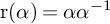
$\text {s}(\alpha ) = \alpha ^{-1}\alpha $
 and
$\text {r}(\alpha ) = \alpha \alpha ^{-1}$
 for
$\alpha \in \mathcal {G}$
 . We have that

For each
$x \in \mathcal {G}^{(0)}$
 we set

A locally compact groupoid is a groupoid
$\mathcal {G}$
 equipped with a locally compact Hausdorff topology under which the multiplication, inversion, source and range maps are continuous with respect to the relative topologies on
$\mathcal {G}^{(2)}$
 and
$\mathcal {G}^{(0)}$
 . We will assume that all locally compact groupoids are Hausdorff and that range and source maps are open. We say that
$\mathcal {G}$
 is étale if the source map (equivalently range map) is a local homeomorphism when viewed as a map
$\mathcal {G} \to \mathcal {G}$
 .
Given a subset X of the unit space
$\mathcal {G}^{(0)}$
 , the restriction of
$\mathcal {G}$
 to X, denoted by
$\mathcal {G}|_X$
 , is the subset
$\{ \alpha \in \mathcal {G} \mid \text {s}(\alpha ),\text {r}(\alpha ) \in X \}$
 of
$\mathcal {G}$
 . This is a groupoid with unit space X where the operations are restricted from
$\mathcal {G}$
 .
A Haar system for a locally compact groupoid
$\mathcal {G}$
 is a collection
$(m^x)_{x \in \mathcal {G}^{(0)}}$
 where
$m^x$
 is a positive regular Borel measure on
$\mathcal {G}^x$
 for each
$x \in \mathcal {G}^{(0)}$
 , such that the following requirements are satisfied:
-
(i) The support of $m^x$
is equal to
$\mathcal {G}^x$
for each
$x \in \mathcal {G}^{(0)}$
. -
(ii) For every $g \in {\text {C}}_{\text {c}}(\mathcal {G})$
the function
$x \mapsto \int _{\mathcal {G}^{x}} g(\alpha ) \, \text {d}{m^x(\alpha )}$
belongs to
${\text {C}}_{\text {c}}(\mathcal {G}^{(0)})$
. -
(iii) For every $\alpha \in \mathcal {G}$
and
$g \in {\text {C}}_{\text {c}}(\mathcal {G})$
we have that $$ \begin{align*} \int_{\mathcal{G}^{\text{s}(\alpha)}} f(\alpha\beta) \, \text{d}{m^{\text{s}(\alpha)}}(\beta) = \int_{\mathcal{G}^{\text{r}(\alpha)}} f(\beta) \, \text{d}{m^{\text{r}(\alpha)}(\beta)} . \end{align*} $$


Given a Haar system
$(m^x)_{x \in \mathcal {G}^{(0)}}$
 on
$\mathcal {G}$
 , one defines the convolution of two functions
$f,g \in {\text {C}}_{\text {c}}(\mathcal {G})$
 by the formula

One frequently writes the convolution product implicitly.
With respect to the convolution product and the involution given by
$f^*(\alpha ) = f(\alpha ^{-1})$
 , the space
${\text {C}}_{\text {c}}(G)$
 becomes a
$*$
 -algebra. The I-norm on
${\text {C}}_{\text {c}}(\mathcal {G})$
 is given by

Any
$x \in \mathcal {G}^{(0)}$
 determines a corresponding left regular representation
$\lambda _x$
 of
${\text {C}}_{\text {c}}(\mathcal {G})$
 on
${ \mathrm {L} \hskip -0.3ex ^2}(\mathcal {G}^x,m^x)$
 given by

The full C*-algebra of
$\mathcal {G}$
 , denoted by
${\mathrm {C}}^*(\mathcal {G})$
 (with respect to the given Haar system) is the C*-envelope of
${\text {C}}_{\text {c}}(G)$
 , while the reduced C*-algebra, denoted by
${\mathrm {C}}^*_{\mathrm {red}}(\mathcal {G})$
 , is the completion of
${\text {C}}_{\text {c}}(G)$
 with respect to the norm

All groupoids considered in this work are amenable, so that their full and reduced groupoid C*-algebras are naturally isomorphic. See for example [Reference Anantharaman-Delaroche and RenaultAR00, Theorem 6.1.4].
We have the norm inequality

There is an embedding of
${\text {C}}_0(\mathcal {G}^{(0)})$
 into the multiplier algebra
$\mathrm {M}({\mathrm {C}}^*_{\mathrm {red}}(\mathcal {G}))$
 of
${\mathrm {C}}^*_{\mathrm {red}}(\mathcal {G})$
 such that if
$f \in {\text {C}}_0(\mathcal {G}^{(0)})$
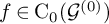 and
$a \in {\text {C}}_{\text {c}}(\mathcal {G})$
 then
$fa, af \in {\text {C}}_{\text {c}}(\mathcal {G})$
 , with


For
$a \in {\mathrm {C}}^*_{\mathrm {red}}(\mathcal {G})$
 , the element
$faf$
 is called the compression of a by f. It follows in particular from the above equations that if
$f \in {\text {C}}_{\text {c}}(\mathcal {G}^{(0)})$
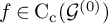 is supported in an open subspace
$X \subseteq \mathcal {G}^{(0)}$
 and
$a \in {\mathrm {C}}^*_{\mathrm {red}}(\mathcal {G})$
 , then
$faf \in {\mathrm {C}}^*_{\mathrm {red}}(\mathcal {G}|_X)$
 .
The following examples will be important later.
Example 2.6 (Transformation groupoids).
Let G be a locally compact (Hausdorff) group acting (on the left) on a locally compact Hausdorff space X. We can then associate to this data a corresponding groupoid
$\mathcal {G} = G \ltimes X$
 , called a transformation groupoid. As a topological space we have
$\mathcal {G} = G \times X$
 , and the unit space is given by
$\{ (e,x) \mid x \in X \} \cong X$
 . The source and range maps are given by
$\text {s}(g,x) = x$
 and
$\text {r}(g,x) = gx$
 , the multiplication is given by
$(h,gx)(g,x) = (hg,x)$
 and the inversion is given by
$(g,x)^{-1} = (g^{-1},gx)$
 . A natural Haar system on this groupoid comes from the Haar measure m on G. Since
$\mathcal {G}^x = \{ (g,g^{-1}x) \mid g \in G \} \cong G$
 , we can define
$m^x$
 via

The full and reduced groupoid C*-algebras of
$G \ltimes X$
 are isomorphic to the full and reduced crossed products
${\text {C}}_0(X) \rtimes G$
 and
${\text {C}}_0(X) \rtimes _{\mathrm {red}} G$
 associated to
$G \stackrel {}{\curvearrowright } X$
 , respectively. For amenable groups G, which will be exclusively considered in this work, the transformation groupoid
$G \ltimes X$
 is amenable by [Reference Anantharaman-Delaroche and RenaultAR00, Example 2.2.14 (1) in connection with Corollary 2.2.10]. Hence also the reduced and the full crossed products are isomorphic.
Example 2.7 (Pair groupoids).
Let X be a locally compact Hausdorff space. The pair groupoid
$\operatorname {\mathrm {Pair}}(X)$
 of X is defined as a set
$\operatorname {\mathrm {Pair}}(X) = X \times X$
 with unit space
$X \cong \{ (x,x) \mid x \in X \} \subseteq X \times X$
 and with source and range maps given by
$\text {s}(x,y) = y$
 and
$\text {r}(x,y) = x$
 , respectively. Its multiplication is given by

Haar systems on
$\mathcal {G}$
 are in one-to-one correspondence with regular Borel measures
$\mu $
 on X with full support, and the reduced groupoid C*-algebra of
$\operatorname {\mathrm {Pair}}(X)$
 is isomorphic to
$\mathcal {K}({ \mathrm {L} \hskip -0.3ex ^2}(X,\mu ))$
 , the compact operators on
${ \mathrm {L} \hskip -0.3ex ^2}(X,\mu )$
 , see e.g. [Reference PatersonPat99, Theorem 3.1.2]. When
${ \mathrm {L} \hskip -0.3ex ^2}(X,\mu )$
 is separable (e.g. when
$\mu $
 is
$\sigma $
 -finite) then
$\mathcal {K}({ \mathrm {L} \hskip -0.3ex ^2}(X,\mu ))$
 has nuclear dimension equal to zero.
Example 2.8 (Topological spaces).
A degenerate example of a locally groupoid occurs when
$\mathcal {G} = \mathcal {G}^{(0)}$
 . In this case
$\mathcal {G}^{(2)} = \mathcal {G}^{(0)} \times \mathcal {G}^{(0)}$
 , with multiplication and inversion trivially given by
$x \cdot x = x$
 and
$x^{-1} = x$
 for
$x \in \mathcal {G}$
 . Conversely, any locally compact space X can be equipped with this groupoid structure. For each
$x \in \mathcal {G}^{(0)}$
 we have that
$\mathcal {G}^x = \{ x \}$
 , so a natural Haar system is given by assigning unit mass to x. The corresponding convolution and involution collapse to pointwise operations, and the associated C*-algebras are isomorphic to
${\text {C}}_0(X)$
 , the continuous functions vanishing at infinity on X.
Example 2.9 (Product groupoids).
If
$\mathcal {G}$
 and
$\mathcal {H}$
 are locally compact groupoids, the Cartesian product
$\mathcal {G} \times \mathcal {H}$
 may be given a locally compact groupoid structure in the evident way. A pair of Haar systems for
$\mathcal {G}$
 and
$\mathcal {H}$
 gives rise to a Haar system for
$\mathcal {G} \times \mathcal {H}$
 via the corresponding product measures. The full (reduced) groupoid
${\mathrm {C}}^*$
 -algebra of
$\mathcal {G} \times \mathcal {H}$
 is isomorphic to the maximal (spatial) tensor product of the full (reduced)
${\mathrm {C}}^*$
 -algebras of
$\mathcal {G}$
 and
$\mathcal {H}$
 .
2.4 Polynomial growth
A locally compact group G is said to be compactly generated if it admits a compact generating set, that is, a compact subset
$\Omega \subseteq G$
 such that
$G = \bigcup _{n=0}^\infty (\Omega \cup \Omega ^{-1})^n$
 . We will usually assume
$\Omega $
 to be symmetric, that is,
$\Omega ^{-1} = \Omega $
 . Furthermore, G is said to be of polynomial growth if there exist
$d \in \mathbb {N}$
 and
$C> 0$
 such that
$m(\Omega ^n) \leq C n^d$
 for all
$n \in \mathbb {N}$
 . The definition can be shown to be independent of the chosen generating set. By a fundamental result of Breuillard [Reference BreuillardBre14] there exist an integer
$\text {d}(G) \geq 0$
 depending only on G and a constant
$c(\Omega )> 0$
 (depending on the normalisation of a Haar measure m) such that

We will need the following covering property for generating sets in polynomial growth groups. The proof is a standard maximal packing argument that we include here for completeness.
Proposition 2.10. Suppose G is compactly generated of polynomial growth, say with compact symmetric generating set
$\Omega \subseteq G$
 , and let
$a \in \mathbb {N}$
 . Then there exists an
$N \in \mathbb {N}$
 such that for all
$n \geq N$
 , any translate of
$\Omega ^{an}$
 can be covered by
$(a+1)^{\text {d}(G)}$
 translates of
$\Omega ^{2n}$
 .
Proof. Let
$\varepsilon> 1$
 be such that
$\varepsilon (a + 1)^{\text {d}(G)} < (a + 1)^{\text {d}(G)} + 1$
 , fix a Haar measure m on G with the associated constant
$c(\Omega )$
 and set
$\delta = c(\Omega )\frac {\varepsilon -1}{\varepsilon +1}> 0$
 . By formula (2.4) there exists
$N \in \mathbb {N}$
 such that

Let
$n \geq N$
 and let
$\mathcal {S}$
 be the set of subsets
$S \subseteq \Omega ^{an}$
 such that
$g^{-1}g' \notin \Omega ^{2n}$
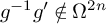 for all
$g,g' \in S$
 with
$g \neq g'$
 . Note that for every
$S \in \mathcal {S}$
 the sets
$\{ g \Omega ^{n} \mid g \in S \}$
 are pairwise disjoint. Indeed, if
$h \in g \Omega ^{n} \cap g' \Omega ^{n}$
 for distinct
$g,g' \in S$
 then
$g^{-1}g' = (h^{-1}g)^{-1}(h^{-1}g') \in \Omega ^{n}\Omega ^{n} = \Omega ^{2n}$
 , which is a contradiction.
We order
$\mathcal {S}$
 with respect to inclusion. Then every totally ordered subset of
$\mathcal {S}$
 has an upper bound (namely the union), hence
$\mathcal {S}$
 admits a maximal element S by Zorn’s lemma. We claim that
$\Omega ^{an} \subseteq \bigcup _{g \in S} g \Omega ^{2n}$
 holds. Otherwise we can find
$h \in \Omega ^{an}$
 with
$h \notin g\Omega ^{2n}$
 for any
$g \in S$
 , which implies that
$S \cup \{ h \} \in \mathcal {S}$
 . This contradicts the maximality of S, so we conclude that
$\Omega ^{an}$
 can be covered by translates of
$\Omega ^{2n}$
 by elements from S.
It remains to bound the size of S. Using the pairwise disjointness of
$\{ g\Omega ^n \mid g \in S \}$
 and the inclusion
$\bigcup _{g \in S} g \Omega ^{n} \subseteq \Omega ^{an}\Omega ^n = \Omega ^{(a+1)n}$
 we have that

Applying both bounds in (2.5) gives

by the choice of
$\varepsilon $
 . This implies that
$|S| \leq (a+1)^{\text {d}(G)}$
 .
3 Slices
Slices are used to understand to what extent actions of locally compact groups are locally trivial. In the relevant context of non-compact groups, the concept was introduced by Palais for proper actions [Reference PalaisPal61]. In this article we are concerned with free actions, for which we can show the existence of slices for suitable classes of groups in Section 3.2. The following definition of a slice is suitable for this setup, while for non-free actions a definition closer to Palais’ work is needed.
Definition 3.1. Let
$G \stackrel {}{\curvearrowright } X$
 be an action. Let
$K \subseteq G$
 be some compact identity neighbourhood. A K-slice is a compact subset
$S \subseteq X$
 such that the map
$K \times S \to X$
 given by
$(g,x) \mapsto gx$
 is injective. The resulting image
$KS$
 in X is called a tube, and its interior
$(KS)^{\circ }$
 is called an open tube.
Remark 3.2. Note that we take slices to be compact. Thus, the injectivity of the map
$K \times S \to X$
 in Definition 3.1 implies that it is a homeomorphism onto its image since
$K \times S$
 is compact and X is Hausdorff. Therefore the tube
$KS$
 is a compact set in X homeomorphic to
$K \times S$
 . There are definitions of slices in the literature that do not require compactness, see e.g. [Reference PalaisPal61].
Remark 3.3. We will frequently use the following facts. Any closed subset of a K-slice is also a K-slice, and if
$L \subseteq K$
 is a compact identity neighbourhood, then every K-slice is also an L-slice. Furthermore, S is a K-slice if and only if
$gS \cap S = \emptyset $
 for all
$g \in K^{-1}K \setminus \{ e \}$
 .
3.1 Properties of slices
In this section we collect some basic properties of slices that will be used in the remainder of the article. We start by considering a suitable notion of the interior of a slice.
Lemma 3.4. Let K and
$K'$
 be compact identity neighbourhoods in G such that the set
$S \subseteq X$
 is both a K-slice and a
$K'$
 -slice. Then

Proof. Passing to the intersection
$K \cap K'$
 , we may assume that
$K \subseteq K'$
 and prove that
$S \cap (K'S)^{\circ } \subseteq S \cap (KS)^{\circ }$
 . Let
$x \in S \cap (K'S)^{\circ }$
 . Since
$(K'S)^{\circ } \subset K'S$
 is open and products of open subsets form a basis of the topology of
$K' \times S$
 , there are open subsets
$U \subseteq K'$
 and
$V \subseteq S$
 such that
$x \in UV \subseteq (K'S)^\circ $
 . Since
$x \in S$
 , we find that
$e \in U$
 and may hence assume without loss of generality that
$U \subseteq K$
 . Then
$x \in UV \subseteq KS$
 on the one hand and on the other hand we obtain inclusions where each term is open in the next one
$UV \subseteq (K'S)^\circ \subseteq X$
 . So
$UV \subseteq X$
 is open, which shows that
$x \in (KS)^\circ $
 .
Definition 3.5. Given a K-slice S, we define its tube interior and its tube boundary to be the sets

respectively.
By Lemma 3.4 we infer that
$\operatorname {\mathrm {int}}_{\operatorname {\mathrm {tube}}}(S)$
 and
$\partial _{\operatorname {\mathrm {tube}}}(S)$
 are independent of the compact identity neighbourhood K.
We will next obtain some basic properties of the tube interior. For this, the following result is instrumental, which allows us to enlarge a tube in the direction of the group.
Lemma 3.6. Assume that G is second-countable. Let S be a K-slice for a compact identity neighbourhood K in G. Then there exists a compact identity neighbourhood L with
$K \subseteq \mathring {L}$
 such that S is an L-slice.
Proof. Since G is second-countable we can multiply K by elements from a descending sequence of compact neighbourhoods of the identity to find a descending sequence
$(L_n)_{n \in \mathbb {N}}$
 of compact sets such that
$\mathring {L_n} \supseteq K$
 for all
$n \in \mathbb {N}$
 and
$\bigcap _{n \in \mathbb {N}} L_n = K$
 . Suppose for a contradiction that S is not an
$L_n$
 -slice for any
$n \in \mathbb {N}$
 . By Remark 3.3 we then find
$g_n \in L_n^{-1}L_n \setminus K^{-1}K$
 and
$x_n,x_n' \in S$
 such that
$g_nx_n = x_n'$
 for all
$n \in \mathbb {N}$
 . Passing to convergent subsequences, we may assume that
$x_n \to x$
 ,
$x_n' \to x'$
 with
$x,x' \in S$
 and

In particular,
$g \neq e$
 . Continuity of the action then implies
$gx' = x$
 , so
$g S \cap S \neq \emptyset $
 . By Remark 3.3 this is a contradiction to the fact that S is a K-slice.
Lemma 3.7. Let K be a compact identity neighbourhood and let S be a K-slice. Then the following identities hold.


Furthermore, if B is regular open in S and contained in
$\operatorname {\mathrm {int}}_{\operatorname {\mathrm {tube}}}(S)$
 , then


Proof. We start by proving (3.1) and first show that
$\mathring {K}\operatorname {\mathrm {int}}_{\operatorname {\mathrm {tube}}}(S) \subseteq (KS)^{\circ }$
 . Let
${x \in \mathring {K}\operatorname {\mathrm {int}}_{\operatorname {\mathrm {tube}}}(S)}$
 , say
$x=gy$
 where
$g \in \mathring {K}$
 and
$y \in \operatorname {\mathrm {int}}_{\operatorname {\mathrm {tube}}}(S)$
 . Set
$L = K \cap g^{-1}K$
 and consider the open set
$U = g(LS)^{\circ }$
 in X. Then
$U \subseteq gLS \subseteq gg^{-1}KS = KS$
 , so that
$U \subseteq (KS)^{\circ }$
 follows. Furthermore, since
$L \subseteq K$
 , we know that S is also an L-slice and Lemma 3.7 shows that
$y \in \operatorname {\mathrm {int}}_{\operatorname {\mathrm {tube}}}(S) = S \cap (LS)^{\circ }$
 . Thus
$x = gy \in g(LS)^{\circ } = U \subseteq (KS)^{\circ }$
 .
Now we show that
$(KS)^{\circ } \subseteq \mathring {K}\operatorname {\mathrm {int}}_{\operatorname {\mathrm {tube}}}(S)$
 . Let
$x \in (KS)^{\circ }$
 , say
$x = gy$
 with
$g \in K$
 and
$y \in S$
 . Then
$g^{-1}K$
 is a compact identity neighbourhood and S is a
$g^{-1}K$
 -slice, so by Lemma 3.7 we obtain

It remains to argue that
$g \in \mathring {K}$
 . For this, we apply Lemma 3.6 to find a compact identity neighbourhood L in G with
$K \subseteq \mathring {L}$
 such that S is an L-slice. By continuity of the group action, the set

is open in G and it is clear that
$g \in W$
 . We show that
$W \subseteq K$
 . Indeed, if
$h \in W$
 then
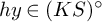
$hy \in (KS)^{\circ }$
 so we can write
$hy = h'y'$
 with
$h' \in K$
 and
$y' \in S$
 . Since
$h \in L$
 and S is an L-slice, this forces
$h = h'$
 and
$y = y'$
 . In particular, we infer that
$h \in K$
 .
We next prove (3.2). First observe that

Indeed, the inclusion from left to right is obvious. Conversely, if
$x = gy \in \mathring {K}S \cap K\operatorname {\mathrm {int}}_{\operatorname {\mathrm {tube}}}(S)$
 for uniquely determined elements
$g \in K$
 and
$y \in S$
 , it follows from
$x \in \mathring {K}S$
 that
$g \in \mathring {K}$
 and from
$x \in K\operatorname {\mathrm {int}}_{\operatorname {\mathrm {tube}}}(S)$
 that
$y \in \operatorname {\mathrm {int}}_{\operatorname {\mathrm {tube}}}(S)$
 . Hence
$x \in \mathring {K}\operatorname {\mathrm {int}}_{\operatorname {\mathrm {tube}}}(S)$
 .
Applying the equality above and using (3.1), we get

Let us next show (3.3). First we show that
$B \subseteq \operatorname {\mathrm {int}}_{\operatorname {\mathrm {tube}}}(\overline {B})$
 . Using that
$B \subseteq \operatorname {\mathrm {int}}_{\operatorname {\mathrm {tube}}}(S)$
 and (3.1) we obtain
$\mathring {K}B \subseteq \mathring {K}\operatorname {\mathrm {int}}_{\operatorname {\mathrm {tube}}}(S) = (KS)^{\circ }$
 . Since
$\mathring {K}B$
 is open in
$KS$
 and hence in
$(KS)^{\circ }$
 , it is also open in X. But then
$B \subseteq \overline {B} \cap (K\overline {B})^{\circ } = \operatorname {\mathrm {int}}_{\operatorname {\mathrm {tube}}}(\overline {B})$
 .
Now we show that
$\operatorname {\mathrm {int}}_{\operatorname {\mathrm {tube}}}(\overline {B})\subseteq B$
 . Let
$x \in \operatorname {\mathrm {int}}_{\operatorname {\mathrm {tube}}}(\overline {B})$
 . Since
$(K\overline {B})^{\circ }$
 is open in
$KS$
 and
$x \in (K\overline {B})^{\circ }$
 , we can by definition of tubes find open sets
$W \subseteq K$
 and
$V \subseteq S$
 such that
$x \in WV \subseteq (K\overline {B})^{\circ }$
 . The inclusion
$WV \subseteq K\overline {B}$
 then forces
$V \subseteq \overline {B}$
 , and since
$x \in \overline {B} \subseteq S$
 we get
$x \in V$
 . Since
$x \in V \subseteq \overline {B}$
 and V is open in S, this means that x lies in the interior of
$\overline {B}$
 inside S. By assumption the latter equals B, so
$x \in B$
 .
To show (3.4), we use (3.3) and obtain

Let us now show (3.5). Since
$\overline {B}$
 is a compact subset of S, it is a K-slice. Hence (3.2) together with (3.4) gives that

Moreover, the definition of boundary together with (3.1) and (3.4) gives that

This finishes the proof.
The next lemma will be frequently used to extract information about the intersection of tubes and slices.
Lemma 3.8. If S and
$S'$
 are K-slices, then the restriction of the second factor projection
$KS \cong K \times S \to S$
 to the set
$KS \cap S'$
 is a homeomorphism onto its image.
Proof. Since
$KS \cap S'$
 is compact and S is Hausdorff, it suffices to show that the map is injective. Let
$g_1,g_2 \in K$
 and
$x_1,x_2 \in S$
 such that
$g_1x_1 , g_2x_2 \in S'$
 . Suppose that the images of
$g_1x_1$
 and
$g_2x_2$
 under the projection
$KS \to S$
 are equal, that is,
$x_1 = x_2$
 . We then have that
$g_1^{-1}(g_1x_1) = g_2^{-1}(g_2x_2) \in KS'$
 and since
$S'$
 is a K-slice, it follows that
$g_1^{-1} = g_2^{-1}$
 . This implies injectivity.
3.2 Existence of slices
The existence of G-slices for actions of G is a classical topic closely related to the early development of the theory of principal bundles and the question about their local triviality. The ultimate existence result in this direction was obtained by Palais in [Reference PalaisPal61]. The notion of K-slices and thus tubes as used in the present work goes back to the work of Bartels–Lück–Reich in which an equivariant version for
$\mathbb {R}$
 -actions equipped with an additional commuting action of a discrete group was obtained [Reference Bartels, Lück and ReichBLR08, Lemma 2.11] based on ideas from Palais’ work. For our needs, this approach needs further refinement in order to treat actions of Lie groups and simplifies at the same time since we target free actions and there is no additional action of a discrete group present. The goal of this subsection will be to show that actions of matrix Lie groups and of connected Lie groups of polynomial growth admit slices in the following sense.
Definition 3.9. We say that an action
$G \curvearrowright X$
 admits slices if for every compact identity neighbourhood
$K \subseteq G$
 and every
$x \in X$
 there exists a K-slice
$S \subseteq X$
 such that
$x \in \operatorname {\mathrm {int}}_{\operatorname {\mathrm {tube}}}(S)$
 .
Remark 3.10. Notice that if an action
$G \curvearrowright X$
 admits slices then it must be free. Indeed, if
$gx =x$
 for
$g \in G$
 and
$x \in X$
 , pick some compact identity neighbourhood
$K \subseteq G$
 that contains g. If S is a K-slice that contains x, then the equation
$gx = x = ex$
 forces
$g=e$
 by the definition of a K-slice.
The next lemmas provide us with a sufficiently equivariant map from a free G-space into a finite dimensional representation, in analogy with Palais’ result [Reference PalaisPal61, Theorem 1.2.7] in the context of proper G-spaces.
Lemma 3.11. Let
$K \subseteq G$
 be a compact subset. Then there is a symmetric relatively compact identity neighbourhood
$U \subseteq G$
 such that
$\bigcap _{k \in K} k U$
 is an identity neighbourhood.
Proof. Replacing K by
$K \cup K^{-1}$
 , we may assume that K is symmetric. Take any symmetric, relatively compact identity neighbourhood
$V \subseteq G$
 and define
$U = VK \cup KV$
 . Then U is symmetric and since K is symmetric it follows that

Since V is relatively compact, also U is relatively compact.
Lemma 3.12. Let
$G \stackrel {}{\curvearrowright } X$
 be a free action, V a finite dimensional G-representation and
$v \in V$
 a vector with trivial stabiliser in G. For every
$x \in X$
 , every neighbourhood A of x and every relatively compact identity neighbourhood
$U \subseteq G$
 there is a function
$f \in {\text {C}}_{\text {c}}(A, \mathbb {R})$
 such that
$\int _U f(g^{-1}x) gv \, \text {d} g= v$
 .
Proof. Consider the linear map
$T \colon {\text {C}}_{\text {c}}(A, \mathbb {R}) \to V$
 given by
$Tf = \int _U f(g^{-1}x) g v \, \text {d} g$
 . Since V is finite dimensional and
$\mathop {\mathrm {im}} T$
 is a vector subspace of V, it suffices to show that for all convex neighbourhoods C of v we have
$C \cap \mathop {\mathrm {im}} T \neq \emptyset $
 .
Fix a convex neighbourhood C of v as above and let
$U_0 \subseteq G$
 be an identity neighbourhood satisfying
$U_0 v \subseteq C$
 . Since
$\overline {U}x \subseteq X$
 is closed, there is a neighbourhood
$B \subseteq A$
 of x satisfying
$B \cap \overline {U}x \subseteq U_0x$
 . By freeness of
$G \stackrel {}{\curvearrowright } X$
 , this implies that for every
$g \in U$
 , the statement
$g x \in B$
 implies
$g \in U_0$
 . Let
$f \in {\text {C}}_{\text {c}}(A, \mathbb {R})$
 satisfy
$0 \leq f \leq 1$
 ,
$f(x) \neq 0$
 ,
$\int _U f(g^{-1}x) \, \text {d} g = 1$
 and
$\mathop {\mathrm {supp}} f \subseteq B$
 . Then by choice of B, the map
$g \mapsto \mathbb{1}_U(g) f( g^{-1} x)$
 is a probability density on G supported in
$U_0$
 . Since
$U_0v \subseteq C$
 , this implies that
$\int _U f(g^{-1}x) gv \, \text {d} g \in C$
 .
We are now prepared to construct sufficiently equivariant maps into finite dimensional representations.
Lemma 3.13. Let
$G \stackrel {}{\curvearrowright } X$
 be a free action and assume that X is second-countable. Let V be a finite dimensional G-representation and
$v \in V$
 a vector with trivial stabiliser in G. For every relatively compact identity neighbourhood
$K \subseteq G$
 and for every
$x_0 \in X$
 there is a neighbourhood A of
$x_0$
 and a continuous map
$F\colon X \to V$
 such that
$F(x_0) = v$
 and
$F(k x) = k F(x)$
 for all
$k \in K$
 and all
$x \in A$
 .
Proof. By Lemma 3.11 there is a symmetric, relatively compact identity neighbourhood U in G such that
$U_0 = \bigcap _{k \in K} Uk$
 is an identity neighbourhood. Since G acts freely, we have
$x_0 \notin (K \overline {U} \setminus U_0)x_0$
 . Hence,

By compactness, there is a neighbourhood A of
$x_0$
 such that for any
$g \in K \overline {U} \setminus U_0$
 and every
$x \in A$
 we have
$gx \notin A$
 . Fix such an A.
By Lemma 3.12, there is
$f \in {\text {C}}_{\text {c}}(A, \mathbb {R})$
 supported in A such that
$\int _U f(g^{-1}x_0) gv \, \text {d} g = v$
 . Put

For
$k \in G$
 ,
$x \in X$
 , left-invariance of the Haar measure shows that

Let us simplify the last expression, assuming that
$x \in A$
 holds. If
$g^{-1}x \in \mathop {\mathrm {supp}} f \subseteq A$
 and
$g \in kU \setminus U$
 , then
$x \in (kU \setminus U)A \subseteq (K\overline {U} \setminus U_0)A = \emptyset $
 , which is absurd. Similarly,
$g^{-1}x \in \mathop {\mathrm {supp}} f$
 together with
$g \in U \setminus kU$
 implies
$x \in (U \setminus kU)A \subseteq (K\overline {U} \setminus U_0)A = \emptyset $
 . We infer that
$F(kx) = kF(x)$
 for all
$k \in K$
 and all
$x \in A$
 .
We are now able to prove the existence of slices in the sense of Definition 3.9 for free actions of matrix Lie groups, that is, subgroups of
$\mathrm {GL}(n,\mathbb {R})$
 for some
$n \in \mathbb {N}$
 .
Theorem 3.14. Let G be a matrix Lie group and
$G \stackrel {}{\curvearrowright } X$
 be a free action and assume that X is second-countable. Then
$G \curvearrowright X$
 admits slices.
Proof. Fix an embedding with closed image
$G \subseteq \text {GL}(n, \mathbb {R})$
 and consider the vector
${v = 1 \in {\text {M}}_n(\mathbb {R}) = V}$
 . Let
$K \subseteq G$
 be a compact identity neighbourhood. By Lemma 3.13, there is a neighbourhood
$A \subseteq X$
 of x and a continuous map
$F\colon X \to V$
 such that
$F(x) = v$
 and
$F(ky) = kF(y)$
 for all
$k \in K$
 and
$y \in A$
 . After shrinking it, we may assume that A is compact. Since
$G \subseteq \text {GL}(n, \mathbb {R})$
 is closed, its action on V is proper, so that [Reference PalaisPal61, Theorem 2.3.2] shows the existence of a G-slice
$S_0$
 at v, that is a subset
$S_0 \subseteq V$
 with
$v \in S_0$
 and such that
$G \times S_0 \longrightarrow V$
 ,
$(g, w) \mapsto gw$
 , is a homeomorphism onto its open image. Let C be a compact neighbourhood of v contained in the locally compact space
$GS_0$
 . Let D be the slice projection of C onto
$S_0$
 , which is a compact set. Put
$S = F^{-1}(D) \cap A$
 . Then S is compact, since D is closed in X. Further,
$x \in S$
 , since
$F(x) = v$
 . We show that S is a K-slice and then that
$x \in \operatorname {\mathrm {int}}_{\operatorname {\mathrm {tube}}}(S)$
 .
Let
$(k_1,x_1), (k_2,x_2) \in K \times S$
 . If
$k_1x_1 = k_2x_2$
 , then

implying that
$k_1 = k_2$
 , since
$S_0$
 is a G-slice. So
$x_1 = x_2$
 follows, proving injectivity of the map
$K \times S \to KS$
 .
Now fix a neighbourhood
$B \subseteq A$
 of x and a symmetric identity neighbourhood L such that
$L^2 \subseteq K$
 and
$L B \subseteq A$
 . We claim that the neighbourhood
$F^{-1}(L^\circ D) \cap B$
 of x is contained in
$KS$
 , which will prove that
$x \in \operatorname {\mathrm {int}}_{\operatorname {\mathrm {tube}}}(S)$
 . Take
$y \in F^{-1}(L^\circ D) \cap B$
 . There is
$k \in L$
 satisfying
$kF(y) \in C$
 . Since
$k \in K$
 and
$y \in A$
 , we find that
$F(ky) = k F(y) \in D$
 , that is
$ky \in F^{-1}(D)$
 . As we also have
$ky \in LB \subseteq A$
 , we infer that
$ky \in S$
 . Using the fact that L is symmetric, we now conclude that
$y \in L^{-1}S \subseteq KS$
 , which finishes the proof.
Corollary 3.15. Let
$G \curvearrowright X$
 be a free action of a Lie group of polynomial growth and assume that X is second-countable. Then
$G \curvearrowright X$
 admits slices.
Proof. By [Reference LosertLos01, Theorem 2] G contains a maximal compact normal subgroup H. The quotient group
$G/H$
 is then a Lie group of polynomial growth containing no nontrivial compact normal subgroups, hence by [Reference LosertLos20, Corollary 3.6]
$G/H$
 is a matrix Lie group. Denote by
$\pi \colon G \to G/H$
 and
$p \colon X \to X/H$
 the quotient maps.
Let K be an identity neighbourhood in G and let
$x \in X$
 . We may assume that
${K = HK = KH}$
 . Since
$G/H$
 acts freely on
$X/H$
 , we can apply Theorem 3.14 to get a
$\pi (K)$
 -slice
$S' \subseteq X/H$
 such that
$p(x) \in \operatorname {\mathrm {int}}_{\operatorname {\mathrm {tube}}}(S')$
 . Set
$T = p^{-1}(S') \subseteq X$
 . Then T is H-invariant, so we can consider the action
$H \curvearrowright T$
 . Since H is compact there exists by [Reference MostowMos57, Theorem 2.1] an H-slice
$S \subseteq T$
 such that
$x \in \operatorname {\mathrm {int}}_{\operatorname {\mathrm {tube}}}(S)$
 , where the interior is taken in the H-space T.
We claim that S is a K-slice. To see this, let
$g,g' \in K$
 and
$x,x' \in S$
 satisfy
$gx=g'x'$
 . Then
$(gH)[x] = (g'H)[x']$
 , so since
$gH,g'H \in \pi (K)$
 and
$[x],[x'] \in p(S) \subseteq p(p^{-1}(S')) = S'$
 , we get that
$gH = g'H$
 and
$[x]=[x']$
 . Let
$h_1,h_2 \in H$
 be such that
$g' = gh_1$
 and
$x' = h_2x$
 . Then
$gx = gh_1h_2x$
 , so by freeness of the action
$h_1h_2 = e$
 . But
$x' = h_2x$
 also implies that
$h_2=e$
 since
$h_2 \in H$
 and
$x,x' \in S$
 , so we arrive also at
$h_1 = e$
 . We conclude that
$g=g'$
 . It remains to argue that
$x \in \operatorname {\mathrm {int}}_{\operatorname {\mathrm {tube}}}(S)$
 inside X, that is
$x \in (KS)^\circ $
 . Since
$K = HK$
 , we have
$p^{-1}(p(KS)) = KS$
 . So it suffices to show that
$p(x) \in p(KS)^\circ $
 holds. Since S is an H slice at x in the H-space T, there is a subset
$x \in U \subseteq HS$
 which is open in T. As p is a quotient map, it follows that
$p(U)$
 is open in
$p(T) = S'$
 . Set
$\tilde {U} = p(U) \cap (\pi (K)S')^{\circ }$
 . Then
$\tilde {U}$
 is open in
$X/H$
 and
$p(x) \in \tilde {U}$
 . Furthermore
$\tilde {U} \subseteq \pi (K)^\circ p(U) \subseteq \pi (K) p(HS) = p(KS)$
 which finishes the proof.
4 Long covers and tube dimension
The notion of tube dimension was introduced for
$\mathbb {R}$
 -actions in [Reference GardellaHir+17, Definition 8.6]. Here we extend the notion to actions of arbitrary locally compact groups. Recall that the multiplicity of a cover
$\mathcal {U}$
 of X is the least number d such that the intersection of any
$d+1$
 elements of
$\mathcal {U}$
 is empty.
Definition 4.1. The tube dimension of an action
$G \stackrel {}{\curvearrowright } X$
 , denoted by
${\dim}_{\mathrm{tube}}(G \stackrel {}{\curvearrowright } X)$
 , is the least natural number d such that for all compact subsets
$K \subseteq G$
 and
$Y \subseteq X$
 there is a family
$\mathcal {U}$
 of open sets of X satisfying the following properties:
-
(i) for all $x \in Y$
there is
$U \in \mathcal {U}$
such that
$K x \subseteq U$
, -
(ii) every $U \in \mathcal {U}$
is contained in a tube, and -
(iii) the multiplicity of $\mathcal {U}$
is at most
$d + 1$
.


If no such natural number d exists, then we define
${\dim}_{\mathrm{tube}}(G \stackrel {}{\curvearrowright } X) = \infty $
 .
In the present section we will show that for certain group actions there are covers with controlled multiplicity and arbitrary length, as specified by the group action. This is the content of Theorem 4.2, which generalises [Reference Kasprowski and RüpingKR17, Theorem 5.2] and follows the same proof outline. As a consequence, we will obtain explicit bounds on the tube dimension of these actions. Recall the number
$\text {d}(G)$
 associated with a group of polynomial growth G from Section 2.4.
Theorem 4.2. Let
$G \stackrel {}{\curvearrowright } X$
 be an action of a locally compact group of polynomial growth on a locally compact, second-countable Hausdorff space. Suppose that
$G \curvearrowright X$
 admits slices as in Definition 3.9. Then for every compact identity neighbourhood
$K \subseteq G$
 there exists an open cover
$\mathcal {U}$
 of X with the following properties.
-
(i) The cover consists of open tubes.
-
(ii) The multiplicity of the cover is at most $11^{\text {d}(G)} \cdot (\dim X + 1)$
. -
(iii) For every $x \in X$
there exists
$U \in \mathcal {U}$
such that
$K \cdot x \subseteq U$
.



In particular

Proof. First, note that once we have proved the theorem for K, it automatically holds for any compact identity neighbourhood
$K' \subseteq K$
 , hence we may enlarge K to a compact symmetric generating set for G. Using Proposition 2.10 with
$a=10$
 , we can find
$N \in \mathbb {N}$
 such that
$K^{10N}$
 can be covered by
$11^{\text {d}(G)}$
 translates of
$K^{2N}$
 . Replacing K with the larger set
$K^{2N}$
 , we now have that
$K^5$
 can be covered by
$11^{\text {d}(G)}$
 translates of K. The first step will be to show the following claim, which is an adaption of [Reference Kasprowski and RüpingKR17, Lemma 4.6].
Claim 1. There is a countable collection
$\mathcal {S}$
 of
$K^5$
 -slices such that
-
(i) $\{ (KS)^{\circ } \mid S \in \mathcal {S} \}$
is a locally finite cover of X, and -
(ii) for every pair $S,S' \in \mathcal {S}$
there exists
$h \in G$
such that
$\{ g \in K^3 \mid gS \cap S' \neq \emptyset \} \subseteq h \mathring {K}$
.


Proof of Claim 1.
For every
$x \in X$
 we can by Corollary 3.15 find a
$K^5$
 -slice
$S_x'$
 such that
$x \in S_x' \cap (K^5 S_x')^{\circ }$
 . Since
$K \subseteq K^5$
 , each
$S_x'$
 is also a K-slice, hence
$x \in (K S_x')^{\circ }$
 by Lemma 3.4. Now consider the cover
$\{ (K S_x')^{\circ } \mid x \in X \}$
 of X. Since G is a locally compact, second countable Hausdorff space, it is paracompact and Lindelöf. We can therefore find a countable, locally finite, open refinement for the above cover, i.e. an open cover
$\mathcal {V} = \{ V_i \mid i \in \mathbb {N} \}$
 of X such that every
$x \in X$
 belongs to only finitely many sets from
$\mathcal {V}$
 and such that for every
$i \in \mathbb {N}$
 there exists
$x(i) \in X$
 with
$V_i \subseteq (K S_{x(i)}')^{\circ }$
 . Since X is locally compact and second countable, every compact subset of X intersects only finitely many elements of
$\mathcal {V}$
 . We may hence replace each
$V_i$
 by
$\overline {V_i}^{\circ }$
 and assume that it is regular open. By definition of slices,
$K S_{x(i)}'$
 is homeomorphic to
$K \times S_{x(i)}'$
 , so we can project the compact set
$\overline {V_i} \subseteq K S_{x(i)}'$
 to the second coordinate. The resulting compact set
$D_i \subseteq S_{x(i)}'$
 is then also a K-slice satisfying
$V_i \subseteq K D_i$
 .
We claim that the cover
$\{ (K D_i)^{\circ } \mid n \in \mathbb {N} \}$
 of X is also locally finite. Indeed, let
$i \in \mathbb {N}$
 and suppose
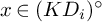
$x \in (K D_i)^{\circ }$
 . Then there exists an open, precompact neighbourhood U of x such that
$U \subseteq KD_i$
 . Since
$x \in KD_i$
 we can write
$x = ky$
 for some
$k \in K$
 and
$y \in D_i$
 . By definition of
$D_i$
 it follows that there exists
$x' \in \overline {V_i}$
 such that
$x' = k'y$
 for some
$k' \in K$
 . Hence
$x' = k'k^{-1}x \in K^2U \cap \overline {V_i}$
 , in particular
$K^2U$
 intersects
$\overline {V_i}$
 . Since
$K^2U$
 is open, it must intersect the regular open set
$V_i$
 . Since
$K^2\overline {U}$
 is compact and
$\mathcal {V}$
 is a locally finite cover of X, this can happen for only finitely many
$i \in \mathbb {N}$
 . Hence there are only finitely many
$i \in \mathbb {N}$
 such that
$x \in (KD_i)^{\circ }$
 .
For every pair
$i,j \in \mathbb {N}$
 such that
$D_i \cap K^3 D_j \neq \emptyset $
 , define the function

to be the restriction of the projection
$K^3 D_j \to K^3$
 to the set
$D_i \cap K^3 D_j$
 . Then
$f_{i,j}$
 is continuous by definition of slices, hence we can for every
$x \in D_i \cap K^3D_j$
 pick an open neighbourhood
$U_{i,j,x} \subseteq D_i \cap K^3D_j$
 of x such that
$f_{i,j}(U_{i,j,x}) \subseteq f_{i,j}(x)K^{\circ }$
 . Since X and hence
$D_i$
 is second countable, we can find an open set
$U_{i,j,x}'$
 in
$D_i$
 containing x such that
$U_{i,j,x}' \cap K^3D_j = U_{i,j,x}$
 . For every
$i \in \mathbb {N}$
 the set
$J_i = \{ j \in J \mid D_i \cap K^3D_j \neq \emptyset \}$
 is finite, so
$U_{i,x} = \bigcap _{j \in J_i} U_{i,j,x}'$
 is a finite intersection of open sets, hence open. Since
$D_i$
 is compact and
$D_i = \bigcup _{x \in D_i} U_{i,x}$
 , we can find
$x_1, \ldots , x_{m_i} \in D_i$
 such that
$D_i = \bigcup _{k=1}^{m_i} U_{i,x_k}$
 . Pick open sets
$V_{i,k}$
 in
$D_i$
 with
$D_i = \bigcup _{k=1}^{m_i} V_{i,k}$
 and
$\overline {V_{i,k}} \subseteq U_{i,x_k}$
 . Let
$S_{i,k}$
 denote the closure of
$V_{i,k}$
 and consider the set

Then every element of
$\mathcal {S}$
 is a closed subset of
$D_i$
 for some
$i \in \mathbb {N}$
 , hence a K-slice.
We now argue that
$\{ (KS)^{\circ } \mid S \in \mathcal {S} \}$
 is a cover of X. To this end it suffices to show that
$(KD_i)^{\circ } = \bigcup _{k = 1}^{m_i} (K V_{i,k})^\circ $
 for all i. The inclusion from the right to the left is clear. To see the other inclusion, let
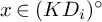
$x \in (K D_i)^{\circ }$
 and write
$x = ky$
 for
$k \in K$
 and
$y \in D_i$
 . Since
$D_i = \bigcup _{k=1}^{m_i} V_{i,k}$
 there is
$1 \leq k \leq m_i$
 such that
$y \in V_{i,k}$
 . Further, Lemma 3.7 says that
$(KD_i)^{\circ } = \mathring {K} \operatorname {\mathrm {int}}_{\operatorname {\mathrm {tube}}}(D_i)$
 , so that
$k \in \mathring {K}$
 follows. So we find that
$x \in \mathring {K}V_{i,k}$
 , which by the definition of a K-slice is open in
$KD_i$
 . We conclude by summarising that
${x \in \mathring {K}V_{i,k} \cap (KD_i)^{\circ } \subseteq (KV_{i,k})^{\circ }}$
 .
We also see that
$\{ (KS)^{\circ } \mid S \in \mathcal {S} \}$
 is locally finite since each
$(K D_i)^{\circ }$
 intersects finitely many sets
$KS$
 for
$S \in \mathcal {S}$
 and the cover
$\{ (KD_i)^{\circ } \mid i \in \mathbb {N} \}$
 is locally finite.
For some
$i,j \in \mathbb {N}$
 and
$1 \leq r \leq m_i$
 ,
$1 \leq s \leq m_j$
 put
$h = f_{i,j}(x_r)$
 . We show that

If g is a member of the left-hand side, we can find some
$x \in S_{i,r} \cap g S_{j,s} \subseteq U_{i,x_k} \cap gU_{j,x_s} \subseteq D_i \cap K^3 D_{j}$
 , so
$j \in J_i$
 . Hence
$x \in U_{i,j,x_r}'$
 . Since
$x \in K^3D_j$
 as well, we have that
$x \in U_{i,j,x_r}$
 . This implies that
$g = f_{i,j}(x) \in f_{i,j}(x_r)\mathring {K}$
 .
Let now
$\mathcal {S} = (S_i)_{i \in \mathbb {N}}$
 be as in Claim 1. By the shrinking lemma [Reference MunkresMun00, Lemma 41.6] we can find a cover
$\{ V_i \mid i \in \mathbb {N} \}$
 of X where each
$V_i$
 is open and
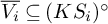
$\overline {V_i} \subseteq (KS_i)^{\circ }$
 . Then each
$\overline {V_i}$
 is a closed subset of
$KS_i$
 , so we can project
$\overline {V_i}$
 onto
$S_i$
 to get a new K-slice
$A_i^0 \subseteq S_i$
 satisfying
$V_i \subseteq K A_i^0$
 . So
$\{ (K A_i^0)^{\circ } \mid i \in \mathbb {N} \}$
 is a cover of X. Also, since
$\overline {V_i} \subseteq (KS_i)^{\circ } = K^{\circ } \operatorname {\mathrm {int}}_{\operatorname {\mathrm {tube}}}(S_i)$
 by (3.1), it follows that
$A_i^0 \subseteq \operatorname {\mathrm {int}}_{\operatorname {\mathrm {tube}}}(S_i)$
 . Consider the following claim, which is an adaption of [Reference Kasprowski and RüpingKR17, Lemma 5.1].
Claim 2. Let
$k \in \mathbb {N}$
 . If
$(A_i)_{i \in \mathbb {N}}$
 is a sequence of compact sets where
$A_i \subseteq \operatorname {\mathrm {int}}_{\operatorname {\mathrm {tube}}}(S_i)$
 and
$\dim A_i \leq k$
 for all
$i \in \mathbb {N}$
 , then there exist regular open sets
$B_i \subseteq \operatorname {\mathrm {int}}_{\operatorname {\mathrm {tube}}}(S_i)$
 in
$S_i$
 for each
$i \in \mathbb {N}$
 such that
-
(a) the set $\{ \mathring {K}^5 B_i \mid i \in \mathbb {N} \}$
has multiplicity at most
$11^{\text {d}(G)}$
, and -
(b) for every $i \in \mathbb {N}$
the compact set $$ \begin{align*} A_i \setminus \bigcup_{j \in \mathbb{N}} \mathring{K}^3B_j \end{align*} $$
has dimension at most $k-1$
.


Before proving the claim we show how it can be used to finish the proof of Theorem 4.2. By Proposition 2.3 we have that
$\dim (A_i^0) \leq \dim (X)$
 for each
$i \in \mathbb {N}$
 . Applying the claim to
$(A_i^0)_{i \in \mathbb {N}}$
 , we obtain sets
$(B_i^0)_{i \in \mathbb {N}}$
 satisfying the conclusion of Claim 2 with the choice
$k = \dim X$
 . Set

Then apply Claim 2 again to the sequence
$(A_i^1)_{i \in \mathbb {N}}$
 , obtaining a new sequence of sets
$(B_i^1)_{i \in \mathbb {N}}$
 . Continuing like this, we obtain sets
$(A_i^k)_{i \in \mathbb {N}}$
 and
$(B_i^k)_{i \in \mathbb {N}}$
 for every
$k \in \mathbb {N}$
 . We will now show that

satisfies the properties of Theorem 4.2. First, note that since
$B_i^k$
 is a regular open subset of the
$K^5$
 -slice
$S_i$
 with
$B_i^k \subseteq \operatorname {\mathrm {int}}_{\operatorname {\mathrm {tube}}}(S_i)$
 , it follows from equations (3.1) and (3.3) of Lemma 3.7 that
$\mathring {K}^5 B_i^k = (K^5\overline {B_i^k})^{\circ }$
 is an open tube. Hence the first assertion of Theorem 4.2 is established.
We now claim that

is a cover of X. Indeed, let
$x \in X$
 , so that
$x \in K A_i^0$
 for some
$i \in \mathbb {N}$
 , say
$x = x' y$
 with
$x' \in K$
 and
$y \in A_i^0$
 . If
$y \in \mathring {K}^3 B_j^0$
 for some
$j \in \mathbb {N}$
 then
$x \in K \mathring {K}^3 B_j^0 = \mathring {K}^4 B_j^0$
 , so x belongs to an element of
$\mathcal {U}'$
 . If no such j exists, then by definition we have
$y \in A_i^1$
 . Continuing like this, if
$y \notin \mathring {K}^3 B_j^k$
 for any
$j \in \mathbb {N}$
 and
$0 \leq k \leq \dim X$
 , we reach the conclusion that
$y \in A_i^{\dim X + 1}$
 . However
$\dim A_i^{\dim X + 1} \leq -1$
 so
$A_i^{\dim X + 1} = \emptyset $
 which is a contradiction. This shows that
$\mathcal {U}'$
 is a cover of X.
Now if
$x \in X$
 , say
$x \in \mathring {K}^4 B_i^k$
 for some
$i \in \mathbb {N}$
 and
$0 \leq k \leq \dim X$
 , then
$K x \subseteq K (\mathring {K}^4 B_i^k) = \mathring {K}^5 B_i^k$
 , which shows that
$\mathcal {U}$
 satisfies the second assertion of Theorem 4.2. Also, by Claim 2 the multiplicity of
$\mathcal {U}$
 , being a union of
$\dim X + 1$
 sets all of multiplicity at most
$11^{\text {d}(G)}$
 , cannot exceed
$11^{\text {d}(G)} \cdot (\dim X + 1)$
 . Hence the last assertion of Theorem 4.2 is also established.
As we have just shown, it remains to prove Claim 2.
Proof of Claim 2.
Let
$(A_i)_{i \in \mathbb {N}}$
 be as in the statement of the claim. We will divide the proof into five steps.
Step 1. In the first step we will construct the sets
$(B_i)_{i \in \mathbb {N}}$
 . For this, fix
$i \in \mathbb {N}$
 . We apply Definition 2.1 of small inductive dimension to the set
$A_i$
 viewed as a subset of the ambient space
$S_i$
 to obtain for every
$x \in A_i$
 an open neighbourhood
$U_x$
 of x in
$S_i$
 which satisfies
$\dim (\partial _{S_i}U_x) \leq k-1$
 . As explained in Remark 2.2, we may assume that the sets
$U_x$
 are regular open.
Since
$A_i$
 is compact we can find a finite subset
$F_i\subseteq A_i$
 such that
$U_i = \bigcup _{x\in F_i}U_x$
 contains
$A_i$
 . Note that
$U_i$
 is regular open in
$S_i$
 . Since X is separable and metrizable, every subset is also separable and metrizable, in particular
$\partial _{S_i}U_x$
 is so for each
$x \in F_i$
 . Hence we can apply Proposition 2.3 to obtain

We define subsets
$(I_i)_{i \in \mathbb {N}}$
 of
$\mathbb {N}$
 and sets
$(B_i)_{i \in \mathbb {N}}$
 in X recursively. Set
$I_1 = \emptyset $
 and
$B_1 = U_1$
 . Further, for
$i \geq 2$
 , set
$I_{i} = \{ j \in \mathbb {N} \mid j < i, K^2 \overline {B_j} \cap U_i \neq \emptyset \}$
 and

It is then clear from the construction that
$B_i$
 is an open subset of
$S_i$
 for each
$i \in \mathbb {N}$
 . We will prove that each
$B_i$
 is regular open by induction. For
$i = 1$
 we have that
$B_1 = U_1$
 which is regular open by construction. Next, assume that
$B_j$
 is regular open for all
$j < i$
 . Note first that

Now by the induction assumption combined with equations (3.1) and (3.3) of Lemma 3.7 we have that
$(K^3\overline {B_j})^{\circ } = \mathring {K}^3\operatorname {\mathrm {int}}_{\operatorname {\mathrm {tube}}}(\overline {B_j}) = \mathring {K}^3 B_j$
 for all
$j < i$
 . Since
$S_i$
 is a
$K^3$
 -slice, we have
$\overline {WB} = \overline {W}\, \overline {B}$
 for all subsets
$W \subseteq K^3$
 and
$B \subseteq S_i$
 . So we get that
$\overline {(K^3\overline {B_j})^{\circ }} = K^3\overline {B_j}$
 . Using this and the fact that
$U_i$
 is regular open, we find

Since
$B_i \subseteq \mathring {\overline {B_i}}$
 is obvious, this proves that
$B_i$
 is regular open, finishing the induction argument.
Step 2. In this step we show assertion a of Claim 2. Note that by construction of
$B_i$
 , the elements of the set
$\{KB_i\}_{i\in \mathbb {N}}$
 are pairwise disjoint. Indeed, suppose for a contradiction that
$x \in KB_i \cap KB_j$
 with
$j < i$
 , say
$x = g_iy_i = g_jy_j$
 with
$g_i,g_j \in K$
 ,
$y_i \in B_i$
 and
$y_j \in B_j$
 . Then
$y_i = g_i^{-1}x \in U_i \cap K(KB_j)$
 , hence
$j \in I_i$
 . It then follows from the definition of
$B_i$
 that
$y_i \notin K^3 \overline {B_j}$
 which contradicts
$y_j = g_j^{-1}g_iy_i \in K^2B_j$
 .
Consider now the set
$\{K^5 B_j\}_{j\in \mathbb {N}}$
 from assertion a of the claim. By choice of K, its power
$K^5$
 can be covered by
$\ell = 11^{\text {d}(G)}$
 translates of K, say
$K^5 \subseteq \bigcup _{n=1}^\ell g_n K$
 for some
$g_1, \dotsc , g_\ell \in G$
 . Suppose for a contradiction that there exist indices
$i_1 < \cdots < i_{\ell +1}$
 such that there is
$x \in K^5B_{i_1} \cap \cdots \cap K^5B_{i_{\ell +1}}$
 . Then for each
$1 \leq r \leq \ell + 1$
 there exists
$1 \leq n_r \leq \ell $
 such that
$g_{n_r}^{-1}x \in KB_{i_r}$
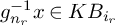 . Since
$\{ n_1, \dotsc , n_{\ell +1} \} \subseteq \{ 1 , \dotsc , \ell \}$
 , there exist
$1 \leq r,r' \leq \ell + 1$
 such that
$n_r = n_{r'}$
 . This gives
$g_{n_r}^{-1}x = g_{n_{r'}}^{-1}x \in KB_{i_r} \cap KB_{i_{r'}}$
 , which is a contradiction. Hence the set
$\{ K^5 B_j \}_{j \in \mathbb {N}}$
 has multiplicity at most
$\ell $
 .
Step 3. In this step we will show that the sets
$S_j\cap (\partial K^3) \overline {B}_k$
 are empty when
$j \in \mathbb {N}$
 and
$k \in I_j$
 .
Suppose for a contradiction that there is some
$x \in S_j \cap (\partial K^3) \overline {B}_k$
 , say
$x = gy$
 for
$g \in \partial K^3$
 and
$y \in \overline {B_k}$
 . Since
$k \in I_j$
 , there exists some
$x' \in K^2\overline {B_k} \cap U_j \subseteq K^2\overline {B_k}\cap S_j$
 , say
$x' = g'y'$
 with
$g' \in K^2$
 and
$y' \in \overline {B_k}$
 . We now have that
$g,g' \in K^3$
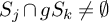
 ,
$S_j \cap g S_k \neq \emptyset $
 and
$S_j \cap g' S_k \neq \emptyset $
 , so by Claim 1 we obtain that
$g^{\prime -1}g \in \mathring {K}$
 . Hence

which contradicts
$g \in \partial K^3$
 .
Step 4. In this step we prove that showing b of the present claim can be reduced to showing that
$\partial _{S_j} B_j$
 has dimension at most
$k-1$
 for all
$j \in \mathbb {N}$
 . Fix
$i \in \mathbb {N}$
 and note that

Hence, taking complements in
$A_i$
 and using the fact that
$A_i \subseteq U_i$
 , we obtain

Thus, in order to show that
$A_i \setminus \bigcup _{j \in \mathbb {N}} \mathring {K}^3 B_j$
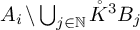 has dimension at most
$k-1$
 , it suffices by Proposition 2.3 to show that the sets

have dimension at most
$k-1$
 . By Step 3, the set
$A_i \cap (\partial K^3)\overline {B_j}$
 is empty. Therefore, using (3.5) of Lemma 3.7, we have that

For each
$i,j \in \mathbb {N}$
 , we consider the projection
$K^3S_j \to S_j$
 , which maps
$K^3(\partial _{S_j}B_j)$
 to
$\partial _{S_j}B_j$
 . The restriction of this projection to
$A_i \cap K^3(\partial _{S_j}B_j)$
 is a homeomorphism onto its image by Lemma 3.8, so it suffices to show that the dimension of
$\partial _{S_j}B_j$
 is at most
$k-1$
 .
Step 5. In this step we finish the proof of Claim 2 by showing that
$\partial _{S_i}B_i$
 has dimension at most
$k-1$
 for all
$i \in \mathbb {N}$
 . We establish this by induction. Consider first the base case
$i=1$
 . Then
$\partial _{S_1}B_1 = \partial _{S_1}U_1$
 which has dimension at most
$k-1$
 by inequality (4.1).
For the induction step, let
$i \in \mathbb {N}$
 and assume that
$\dim (\partial _{S_j}B_j) \leq k-1$
 for all
$j < i$
 . First we estimate
$\partial _{S_i}B_i$
 using Lemma 3.7 to obtain

From (4.1) we know that
$\partial _{S_i}U_i$
 has dimension at most
$k-1$
 . Further, by Step 3, the sets
$S_i \cap (\partial K^3)\overline {B_j}$
 for
$j \in I_i$
 are empty. Applying Proposition 2.3, we need only show that
$\mathrm{dim}( S_i \cap K^3 ( \partial_{S_j} B_j)) \leq k-1$
 . But for this we can again consider the projection of the tube
$K^3(\partial _{S_j}B_j) \to \partial _{S_j}B_j$
 which, once restricted to
$S_i \cap K^3(\partial _{S_j}B_j)$
 , becomes a homeomorphism onto its image by Lemma 3.8. Since the image is a subset of
$\partial _{S_j}B_j$
 which has dimension at most
$k-1$
 by the induction hypothesis, we can appeal to Proposition 2.3 to finish the proof.
5 Partitions of unity
Our next aim is to provide a suitable adaption and generalisation of [Reference GardellaHir+17, Proposition 8.23]. The notion of Lipschitz functions, which was used in the context of
$\mathbb {R}$
 -actions, is not suitable for general amenable locally compact groups and we resort to the following notion of Følner functions instead. As it turns out, this concept is still suitable to characterise finite tube dimension and can be used for nuclear dimension estimates.
Definition 5.1. Let
$G \curvearrowright X$
 be an action and
$(Y, \text {d})$
 a metric space. Let
$K \subseteq G$
 be a compact identity neighbourhood and let
$\epsilon> 0$
 . Then a function
$\Phi : X \to Y$
 is called
$(K, \varepsilon )$
 -Følner if for every
$g \in K$
 and every
$x \in X$
 we have

A function
$\varphi : X \to \mathbb {C}$
 is called
$(K, \varepsilon )$
 -Følner if it is
$(K, \varepsilon )$
 -Følner for the Euclidean metric on
$\mathbb {C}$
 .
Remark 5.2. This notion is not to be confused with the Følner function of a group.
Lemma 5.3. Let G be an amenable locally compact group and let
$G \stackrel {}{\curvearrowright } X$
 be a continuous action by homeomorphisms. Let
$\varphi \colon X \to \mathbb {C}$
 be a continuous bounded function, let
$K \subseteq G$
 be compact and
$\varepsilon> 0$
 . If
$B \subseteq G$
 is a
$(K, \varepsilon /\|\varphi \|_\infty )$
 -Følner set, then

is
$(K, \varepsilon )$
 -Følner and continuous.
Proof. It is clear that
$\psi $
 is continuous, since
$\varphi $
 is continuous. We have to show that it is
$(K, \varepsilon )$
 -Følner. For
$g \in K$
 we find that

The next proposition is an adaption of [Reference GardellaHir+17], which was formulated for
$\mathbb {R}$
 -actions. In the general setup of amenable groups, it is not possible any longer to show the existence of Lipschitz partitions of unity, however a slight adaption of the proof makes it possible to replace these by suitable Følner partitions of unity, which suffice for the purpose of proving nuclear dimension estimates. There is only a conceptual innovation, but no substantial technical change over the proof of [Reference GardellaHir+17, Proposition 8.23].
In order to formulate our proposition, we briefly recall combinatorial simplicial complexes and their
$\ell ^1$
 -metric realisation.
-
• A (combinatorial) simplicial complex is a set Z of finite sets closed under taking subsets. An l-simplex in Z is an element $\sigma \in Z$
with cardinality
$|\sigma | = l + 1$
and we denote by
$Z^{(l)}$
the set of all l-simplices of Z. The elements of
$Z^{(0)}$
are called the vertices of Z. The dimension of Z is the highest number d such that
$Z^{(d-1)} \neq \emptyset $
(if no such number exists, the dimension of Z is infinite). -
• Given a simplicial complex Z, we denote by $\text {C} Z = \{\sigma \in Z \sqcup \{\infty \} \mid \sigma \cap Z^{(0)} \in Z\}$
the cone over Z. -
• The $\ell ^1$
-metric realisation of a simplicial complex Z is $$ \begin{align*} |Z| = \bigcup_{\sigma \in Z} \{(z_v)_v \in [0,1]^{Z^{(0)}} \mid \sum_{v \in \sigma} z_v = 1 \text{ and } z_v = 0 \text{ for any } v \in Z^{(0)} \setminus \sigma \} \end{align*} $$endowed with the restriction of the $\ell ^1$
-metric on finitely supported functions on
$Z^{(0)}$
.
-
• For any vertex $v_0\in Z^{(0)}$
, the simplicial star around v is the set of simplices that contain
$v_0$
, and the open star around
$v_0$
is the subset
$\{ (z_v)_v \in |Z| : z_{v_0}> 0 \}$
of the geometric realisation of Z. -
• If $\mathcal {U}$
is a finite open cover of X, its nerve complex is the simplicial complex $$\begin{align*}\mathcal{N}(\mathcal{U}) = \{ \mathcal{U}' \subseteq \mathcal{U} : \bigcap_{U \in \mathcal{U}'} U \neq \emptyset \}. \end{align*}$$
The dimension of $\mathcal {N}(\mathcal {U})$
is equal to
$\mathrm {mult}(\mathcal {U}) - 1$
. -
• If $\mathcal {U}$
is a finite open cover of a closed subset C of X, we denote by
$\mathcal {U}^+$
the open cover of X given by
$\mathcal {U}^+ = \mathcal {U} \cup \{ X \setminus C \}$
. One can then identify
$\mathcal {N}(\mathcal {U}^+)$
as a subset of
$\text {C}\mathcal {N}(\mathcal {U})$
via sending
$X \setminus C$
to
$\infty $
.


We are now ready to formulate our adaption and generalisation of [Reference GardellaHir+17, Proposition 8.23].
Proposition 5.4. Let G be an amenable locally compact second countable group and let
$G \curvearrowright X$
 be a continuous action by homeomorphisms. Then the following statements are equivalent.
-
(i) The tube dimension of $G \curvearrowright X$
is at most d. -
(ii) For every compact subset $K \subseteq G$
, every compact subset
$A \subseteq X$
and every
$\varepsilon> 0$
there is a finite simplicial complex Z of dimension at most d and a continuous map
$\Phi : X \to |\text {C} Z|$
such that-
(a) $\Phi $
is
$(K, \varepsilon )$
-Følner, -
(b) for every vertex $v \in Z^{(0)}$
the preimage of the open star around v under
$\Phi $
is contained in a tube, and -
(c) $\Phi (A) \subseteq |Z|$
.
-
-
(iii) For every compact subset $K \subseteq G$
, every
$\varepsilon> 0$
and every compact subset
$A \subseteq X$
there is a finite partition of unity
$(\varphi _i)_{i \in I}$
for
$A \subseteq X$
such that-
(a) $\varphi _i$
is
$(K,\varepsilon )$
-Følner for all i, -
(b) $\varphi _i$
is supported in the interior of a tube, and -
(c) there is a partition $I = I^{(0)} \sqcup \ldots \sqcup I^{(d)}$
such that for all
$l \in \{0, \dotsc , d\}$
and all
$i,j \in I^{(l)}$
we have $$ \begin{align*} \mathop{\mathrm{supp}} \varphi_i \cap \mathop{\mathrm{supp}} \varphi_j = \emptyset . \end{align*} $$
-
-
(iv) For every pair of compact subsets $K, L \subseteq G$
, every
$\varepsilon> 0$
and every compact subset
$A \subseteq X$
there is a finite partition of unity
$(\varphi _i)_{i \in I}$
for
$A \subseteq X$
such that-
(a) $\varphi _i$
is
$(K,\varepsilon )$
-Følner for all i, -
(b) $L\mathop {\mathrm {supp}} \varphi _i$
is contained in the interior of a tube, and -
(c) there is a partition $I = I^{(0)} \sqcup \ldots \sqcup I^{(d)}$
such that for all
$l \in \{0, \dotsc , d\}$
and all
$i,j \in I^{(l)}$
we have $$ \begin{align*} L\mathop{\mathrm{supp}} \varphi_i \cap L \mathop{\mathrm{supp}} \varphi_j = \emptyset . \end{align*} $$
-
-
(v) For every compact subset $L \subseteq G$
and every compact subset
$A \subseteq X$
there is a finite collection
$\mathcal {U}$
of open subsets of X that cover A such that-
(a) each $U \in \mathcal {U}$
is contained in a tube of shape larger than L, and -
(b) there is a partition $\mathcal {U} = \mathcal {U}^{(0)} \sqcup \dotsm \sqcup \mathcal {U}^{(d)}$
such that for any
$l \in \{0, \dotsc , d\}$
and any distinct elements
$U_1, U_2 \in \mathcal {U}^{(l)}$
we have $$ \begin{align*} L\overline{U_1} \cap L\overline{U_2} = \emptyset . \end{align*} $$
-


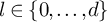



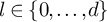


Proof. We start by proving (i)
$\Rightarrow $
 (ii). Fix the notation of (ii), let
$0 < C$
 be such that
$3(d+1)C < \varepsilon $
 and let
$L \subseteq G$
 be a
$(K,C)$
 -Følner set. Consider
$B = LA$
 . Then by the definition of tube dimension there is a family of open subsets
$\mathcal {U}$
 of X, each contained in a tube, having multiplicity at most
$d+1$
 such that for every
$x \in LB$
 there is
$U \in \mathcal {U}$
 such that
$Lx \subseteq U$
 . Consider the sets

and the collection
$\mathcal {V} = \{V_U \mid U \in \mathcal {U}\}$
 . Then
$\mathcal {V}$
 covers B and we can find a finite subset
$\mathcal {U}_0 \subseteq \mathcal {U}$
 such that
$\mathcal {V}_0 = \{V_U \mid U \in \mathcal {U}_0\}$
 remains a cover of B. Let
$(\varphi _U)_{U \in \, \mathcal {U}_0}$
 be a partition of unity for
$B \subseteq X$
 subordinate to
$\mathcal {V}_0$
 . By Lemma 5.3, the functions
$\psi _U = \frac {1}{m(L)} \mathbb{1}_L * \varphi _U$
 for
$U \in \mathcal {U}_0$
 are
$(K, C)$
 -Følner. Note also that
$\mathop {\mathrm {supp}}(\psi _U) \subseteq \mathop {\mathrm {supp}}(\mathbb{1}_L)\mathop {\mathrm {supp}}(\varphi _U) \subseteq LV_U \subseteq U$
 for each
$U \in \mathcal {U}_0$
 . Since
$\mathcal {U}_0$
 has multiplicity at most
$(d + 1)$
 , at most
$2(d+1)$
 functions from the set
$\{g\psi _U \mid U \in \mathcal {U}_0\} \cup \{\psi _U \mid U \in \mathcal {U}_0\}$
 can be non-zero at a time. So for
$g \in K$
 , we find that

which shows that
$\mathbb{1}_X - \sum _{U \in \mathcal {U}_0} \psi _U$
 is
$(K, 2(d+1)C)$
 -Følner.
Let
$Z = \mathcal {N}(\mathcal {U}_0)$
 be the nerve of
$\mathcal {U}_0$
 , which is a simplicial complex of dimension at most
$\mathrm {mult}(\mathcal {U}_0) = (d+1)-1 = d$
 . Consider the continuous map

given by
$\Phi = (\mathbb{1}_X - \sum _{U \in \, \mathcal {U}_0} \psi _U) \oplus \bigoplus _{U \in \, \mathcal {U}_0} \psi _U$
 and observe that
$\Phi $
 is
$(K, 3(d+1)C)$
 -Følner. By the choice of C, this shows that
$\Phi $
 is
$(K, \varepsilon )$
 -Følner. It maps A into
$|\mathcal {N}(\mathcal {U}_0)|$
 , since
$\mathbb{1}_X - \sum _{U \in \mathcal {U}_0} \psi _U$
 vanishes on A. Also the preimage of every open star is contained in some
$U \in \mathcal {U}_0$
 , which in turn is contained in a tube.
Next we prove (ii)
$\Rightarrow $
 (iii). Let
$K \subseteq G$
 be a compact subset, let
$A \subseteq X$
 be compact and let
$\varepsilon> 0$
 . Let
$\Phi : X \to |CZ|$
 be chosen as in (ii) for
$K \subseteq G$
 and the constant
$\frac {\varepsilon }{2 (d+1)(d+2)(2d+3)}$
 . Let
$I^{(l)}$
 be the collection of l-simplices of Z for
$l \in \{0,\dotsc , d\}$
 , and let
$I = I^{(0)} \cup \cdots \cup I^{(d)}$
 , which is a disjoint union. Consider the functions
$\nu _\sigma : |\text {C} Z| \to [0,1]$
 for
$\sigma \in Z$
 as in [Reference GardellaHir+17, Lemma 8.18]: They are
$2(d+1)(d+2)(2d+3)$
 -Lipschitz and form a partition of unity for
$|Z| \subseteq |\text {C} Z|$
 which is subordinate to the cover
$\{ V_\sigma : \sigma \in Z \}$
 where

Put

We get that
$\sum _{\sigma \in I} \varphi _\sigma (x) = 1$
 for
$x \in A$
 since
$\Phi (A) \subseteq |Z|$
 and
$\sum _{\sigma } \nu _\sigma (z) = 1$
 for
$z \in |Z|$
 . Since
$\Phi $
 is
$(K, \frac {\varepsilon }{2 (d+1)(d+2)(2d+3)})$
 -Følner and
$\nu _\sigma $
 is
$2(d+1)(d+2)(2d+3)$
 -Lipschitz, we find that for
$g \in K$
 we have

so that
$\varphi _\sigma $
 is a
$(K, \varepsilon )$
 -Følner function. The remaining properties of
$(\varphi _\sigma )_\sigma $
 follow as in [Reference GardellaHir+17]: since the support of
$\nu _\sigma $
 is contained in an open star, the support of
$\varphi _\sigma $
 is contained in the interior of a tube, and the orthogonality condition on
$\nu _\sigma $
 implies the one on
$\varphi _\sigma $
 .
We proceed to prove (iii)
$\Rightarrow $
 (iv). Let
$K, L \subseteq G$
 be compact, let
$\varepsilon> 0$
 and
$A \subseteq X$
 be compact. Without loss of generality, we may enlarge K and assume that
$L \subseteq K$
 .
Choose constants
$\delta _1, \delta _2> 0$
 such that

By (iii) there is a partition of unity
$(\psi _i)_{i \in I}$
 for
$A \subseteq X$
 that consists of
$(K, \delta _2)$
 -Følner functions, which are supported in the interior of a tube and satisfy the disjointness condition on their supports as in (iii). Put
$\psi ^{\prime }_i = (\psi _i - \delta _1)_+: X \to [0, 1 - \delta _1]$
 . Then
$\psi ^{\prime }_i$
 is
$(K, \delta _1 + \delta _2)$
 -Følner. Further, the Følner condition for
$\psi _i$
 and the fact that
$L \subseteq K$
 imply that

So
$L \mathop {\mathrm {supp}} \psi ^{\prime }_i$
 is contained in the interior of a tube.
Put

Then
$\mathbb{1}_X - \psi ' = \sum _{i \in I} \psi _i - \psi ^{\prime }_i$
 and the image of the latter is contained in the interval
$[0, (d+1)\delta _1]$
 , owing to the fact that
$(\psi _i)_{i \in I}$
 is the union of
$d+1$
 orthogonal families of functions. We note for later use that
$\psi '$
 is bounded from below by
$1 - (d+1)\delta _1$
 . Put

Then
$(\varphi _i)_{i \in I}$
 is a partition of unity for
$A \subseteq X$
 , since
$(\sum _i \psi _i)(x) = 1$
 for all
$x\in A$
 . Further,
$L\mathop {\mathrm {supp}} \varphi _i = L\mathop {\mathrm {supp}} \psi ^{\prime }_i$
 is contained in the interior of a tube. In order to see that each
$\varphi _i$
 is a
$(K, \varepsilon )$
 -Følner function, we calculate for
$g \in K$
 and
$x \in A$
 that

Let us next prove (iv)
$\Rightarrow $
 (v). Let
$L \subseteq G$
 be compact and
$A \subseteq X$
 be compact as given by (v), let
$K \subseteq G$
 be some compact subset and let
$(\varphi _i)_{i \in I}$
 be a partition of unity for
$A \subseteq X$
 as provided by (iv). Then
$U_i = (\mathop {\mathrm {supp}} \varphi _i)^\circ $
 ,
$i \in I$
 defines the desired open cover of A.
The implication (v)
$\Rightarrow $
 i is immediate from the definition of the tube dimension.
6 Nuclear dimension estimates from tube dimension
In this section we obtain upper bounds for the nuclear dimension of crossed products by connected groups in terms of the tube dimension of a dynamical system. We proceed by first establishing results on transformation groupoids, generalising results from [Reference Hirshberg and WuHW21, Section 7] and then employing these in a technically refined approach compared to the similar proof strategy of [Reference Hirshberg and WuHW21, Theorem 8.1].
6.1 Restriction to open tubes
We start by describing how restrictions to open tubes affect transformation groupoids and crossed product
${\text {C}}^*$
 -algebras. For the present subsection, we fix the following notation. Let
$G \stackrel {}{\curvearrowright } X$
 be an action and set
$\mathcal {G} = G \ltimes X$
 . Let K be a compact identity neighbourhood of G and let S be a K-slice in X. We are interested in the relationship between the restriction
$\mathcal {G}|_{KS}$
 to the corresponding tube
$KS$
 and the product groupoid
$\mathcal {H} = \operatorname {\mathrm {Pair}}(K) \times S$
 , where
$\operatorname {\mathrm {Pair}}(K)$
 is the pair groupoid associated with K and S is considered as a topological space. Note that by definition of a K-slice these groupoids have homeomorphic unit spaces since
$(\mathcal {G}|_{KS})^{(0)} = KS$
 while
$(\mathcal {H})^{(0)} = K \times S$
 . We also set
$\mathcal {H}^{\mathrm {open}} = \operatorname {\mathrm {Pair}}(K^{\circ }) \times \operatorname {\mathrm {int}}_{\operatorname {\mathrm {tube}}}(S)$
 , which is an open subgroupoid of
$\mathcal {H}$
 .
Proposition 6.1. Consider the map

Then the following statements hold true.
-
(i) $\tau $
is a continuous, injective groupoid homomorphism. -
(ii) The image of $\tau $
is equal to $$ \begin{align*} \{ (g,x) \in \mathcal{G}|_{KS} : \mathrm{proj}(x) = \mathrm{proj}(gx) \} , \end{align*} $$where $\mathrm {proj} \colon KS \to S$
denotes the tube projection. Similarly, we have $$ \begin{align*} \tau(\mathcal{H}^{\mathrm{open}}) = \{ (g,x) \in \mathcal{G}|_{(KS)^\circ} : \mathrm{proj}(x) = \mathrm{proj}(gx) \} \end{align*} $$
-
(iii) The set $\tau (\mathcal {H}^{\mathrm {open}})$
is clopen in
$\mathcal {G}|_{(KS)^\circ }$
.


Proof. First observe that
$\tau $
 is well-defined, as for
$g,h \in K$
 and
$x \in S$
 the computation

shows that
$(gh^{-1},hx) \in \mathcal {G}|_{KS}$
 .
We start by showing i. In order to show that
$\tau $
 is a groupoid homomorphism, we compute for
$(g,h,x),(h,k,x) \in \mathcal {H}$
 that

Its defining formula shows that
$\tau $
 is continuous. To show injectivity, suppose that for a pair of elements
$(g,h,x),(g',h',x') \in \mathcal {H}$
 we have
$\tau (g,h,x) = \tau (g',h',x')$
 . In different terms, we suppose
$(gh^{-1}, hx) = g'(h')^{-1}, h'x')$
 . Then
$hx=h'x'$
 implies
$h=h'$
 and
$x=x'$
 by the definition of a slice, so that subsequently
$gh^{-1} = g'h^{\prime -1} = g'h^{-1}$
 forces
$g=g'$
 . This shows that
$\tau $
 is injective.
We next prove (ii). If
$(g,h,x) \in \operatorname {\mathrm {Pair}}(K) \times S$
 , its image under
$\tau $
 belongs to the claimed set, since
$\mathrm {proj}(hx) = x = \mathrm {proj}(gx) = \mathrm {proj}(gh^{-1}hx)$
 . Conversely, given an element
$(g',x') \in \mathcal {G}|_{KS}$
 that satisfies
$\mathrm {proj}(x') = \mathrm {proj}(g'x')$
 , we write
$x' = hx$
 and
$g'x' = gx$
 for certain
$h,g \in K$
 and
$x \in S$
 . Then it follows that
$g'hx = gx$
 so that freeness of the action
$G \stackrel {}{\curvearrowright } X$
 implies that
$g' = gh^{-1}$
 . Hence we obtain that
$(g',x') = (gh^{-1},hx) = \tau (g,h,x)$
 lies in the image of
$\tau $
 . Using equation (3.1) of Lemma 3.7, saying that
$(KS)^\circ = K^{\circ }\operatorname {\mathrm {int}}_{\operatorname {\mathrm {tube}}}(S)$
 , we infer that also
$\tau (\mathcal {H}^{\mathrm {open}}) = \{ (g,x) \in \mathcal {G}|_{(KS)^\circ } : \mathrm {proj}(x) = \mathrm {proj}(gx) \}$
 holds.
Let us finish by proving iii. Since
$\mathrm {proj}$
 is continuous, the description of
$\tau (\mathcal {H}^{\mathrm {open}})$
 obtained in (ii) shows that
$\tau (\mathcal {H}^{\mathrm {open}})$
 is closed in
$\mathcal {G}|_{(KS)^{\circ }}$
 . Further, since
$\tau $
 is a continuous injection from a compact space to a Hausdorff space, it is a homeomorphism onto its image. In particular
$\tau (\mathcal {H}^{\mathrm {open}})$
 is open in
$\mathcal {G}|_{KS}$
 since
$\mathcal {H}^{\mathrm {open}}$
 is open in
$\mathcal {H}$
 . To conclude, we use the fact that
$\mathcal {G}|_{(KS)^{\circ }}$
 is an open subset of
$\mathcal {G}|_{KS}$
 , so that it follows that
$\tau (\mathcal {H}^{\mathrm {open}})$
 is open in
$\mathcal {G}|_{(KS)^{\circ }}$
 .
Combining the previous result with [Reference Hirshberg and WuHW21, Lemma 6.1 and Theorem 6.2], we obtain the following maps.
Corollary 6.2. Consider the inclusion
$\mathcal {H}^{\mathrm {open}} \subseteq \mathcal {G}|_{(KS)^{\circ }}$
 given by the map
$\tau $
 of Proposition 6.1. The following statements hold true.
-
(i) The inclusion ${\text {C}}_{\text {c}}(\mathcal {H}^{\mathrm {open}}) \to {\text {C}}_{\text {c}}(\mathcal {G}|_{(KS)^{\circ }})$
extends to an injective *-homomorphism
${\text {C}}^*_{\mathrm {red}}(\mathcal {H}) \to {\text {C}}^*_{\mathrm {red}}(\mathcal {G}|_{(KS)^{\circ }})$
. -
(ii) The restriction ${\text {C}}_{\text {c}}(\mathcal {G}|_{(KS)^{\circ }}) \to {\text {C}}_{\text {c}}(\mathcal {H}^{\mathrm {open}})$
extends to a conditional expectation
$\text {E} \colon {\text {C}}^*_{\mathrm {red}}(\mathcal {G}|_{(KS)^{\circ }}) \to {\text {C}}^*_{\mathrm {red}}(\mathcal {H}^{\mathrm {open}})$
.


The next lemma strongly localises subsets of tubes in the presence of connectedness. Its special case for
$\mathbb {R}$
 was used without explicit reference in [Reference Hirshberg and WuHW21, p.36, line after (8.1.4)].
Lemma 6.3. Let
$G \stackrel {}{\curvearrowright } X$
 be an action. Let
$L \subseteq G$
 be a connected open subset and let S be a K-slice. If
$Lx \subseteq (KS)^\circ $
 for some
$x \in X$
 , then there is
$s \in S$
 such that
$Lx \subset Ks$
 .
Proof. Write
$B = KS$
 , denote by
$\pi \colon B \to S$
 the projection on the slice S and consider the map
$\psi \colon L \to S$
 given by
$l \mapsto \pi (lx)$
 . We have to show that the image of
$\psi $
 is a singleton. Since
$\psi $
 is continuous and L is connected its image
$\psi (L)$
 is connected too. Assume that
$s \in \psi (L)$
 . Since
$Lx \subseteq B^\circ $
 , (3.1) implies that there is
$g \in L$
 and
$k \in K^\circ $
 such that
${gx = ks}$
 . Let U be a symmetric identity neighbourhood in G such that
$Uk \subseteq K$
 and
${Ug \subseteq L}$
 . Then
$ugx = uks \in Ks$
 for all
$u \in U$
 , so that
$\psi ^{-1}(\{s\})$
 has non-empty interior. So
$L = \bigsqcup _{s \in S} \psi ^{-1}(\{s\})$
 is a partition of L into sets with non-empty interior. Since G is second-countable, this implies that the image of
$\psi $
 is countable. So
$\psi (L)$
 is a countable, connected Hausdorff space, and hence a singleton.
6.2 The estimate
The aim of this section is to establish bounds on the nuclear dimension of crossed products associated with actions of connected amenable groups in terms of the tube dimension of the action. We will apply this to Lie groups of polynomial growth, for which estimates on the tube dimension can be established.
The next result shows that Følner functions, as introduced in Section 5, give rise to quasi-central elements in the
${ \text {L} \hskip -0.3ex ^1}$
 -crossed products. This replaces arguments based on Lipschitz functions used in [Reference GardellaHir+17; Reference Hirshberg and WuHW21] that are only adapted to
$\mathbb {R}$
 -flows.
Lemma 6.4. Let
$G \curvearrowright X$
 be an action and consider the groupoid
$G \ltimes X$
 . Let
$K \subseteq G$
 be a symmetric compact subset and let
$A \subseteq X$
 be a compact subset. Assume that
$(\varphi _i)_{i \in I}$
 are
$(K, \varepsilon )$
 -Følner functions in
${\text {C}}_{\text {b}}(X)$
 such that
$(\varphi _i^2)_i$
 is a partition of unity for A. Further assume that
$I = I^{(0)} \sqcup \dotsm \sqcup I^{(d)}$
 such that
$\mathop {\mathrm {supp}} \varphi _i \cap \mathop {\mathrm {supp}} \varphi _j = \emptyset $
 for all
$0 \leq l \leq d$
 and
$i,j \in I^{(l)}$
 . Then for all
$a \in {\text {C}}_{\text {c}}(K \times A) \subseteq {\text {C}}_{\text {c}}(G \ltimes X)$
 , we have

Proof. Let
$a \in {\text {C}}_{\text {c}}(G \times X)$
 and
$f \in {\text {C}}_{\text {b}}(X)$
 . Then we have

So we calculate for
$a \in {\text {C}}_{\text {c}}(K \times A)$
 , for
$g \in G$
 and
$x \in A$
 that

For the last inequality we used the fact that
$\varphi _i$
 is a
$(K, \varepsilon )$
 -Følner function for each i as well as the fact that there are at most
$d + 1$
 indices i satisfying
$\varphi _i(x) \neq 0$
 and likewise there are at most
$d + 1$
 indices i satisfying
$\varphi _i(gx) \neq 0$
 . We can now estimate the following integrals for fixed x:

and similarly

Taking the supremum of both terms over
$x \in X$
 , we conclude the proof.
We are now ready to state and prove our main result, establishing nuclear dimension bounds for free actions in terms of the tube dimension and the dimension of the base space.
Theorem 6.5. Let
$G \stackrel {}{\curvearrowright } X$
 be a free action of a connected amenable group on a second-countable, locally compact Hausdorff space. Then

Proof. Set
$\mathcal {G} = G \ltimes X$
 . Let
$B_r \subseteq {\text {C}}_{\text {c}}(G,{\text {C}}_{\text {c}}(X))$
 be the r-Ball with respect to the I-norm. Then
$\bigcup _{r \in \mathbb {N}} \overline {B_r}^{\| \cdot \|} = {\text {C}}_0(X) \rtimes G$
 , so that a Baire category argument shows that there is some
$R> 0$
 such that the closure of
$B_R$
 contains the unit ball of
${\text {C}}_0(X) \rtimes G$
 . Let F be a finite subset of
$B_R$
 and let
$\varepsilon> 0$
 . Let
$L \subseteq G$
 and
$A \subseteq X$
 be compact subsets such that
${F \subseteq {\text {C}}_{\text {c}}(L, {\text {C}}_{\text {c}}(A))}$
 . Write
$d = {\dim}_{\mathrm{tube}}(G \stackrel {}{\curvearrowright } X)$
 and pick
$\delta < ( \frac {\varepsilon }{2(d+1)R} )^{1/2}$
 . Then Proposition 5.4 provides a finite family of functions
$(\varphi _i)_{i \in I}$
 such that
-
• $(\varphi _i^2)_{i \in I}$
is a partition of unity for
$A \subseteq X$
-
• each function $\varphi _i$
is
$(L, \delta )$
-Følner -
• $L \mathop {\mathrm {supp}} \varphi _i$
is contained in the interior of a tube
$K_i S_i$
, and -
• there is a partition $I = I^{(0)} \sqcup \ldots \sqcup I^{(d)}$
such that for all
$l \in \{0, \dotsc , d\}$
and all
$i,j \in I^{(l)}$
we have $$ \begin{align*} L\mathop{\mathrm{supp}} \varphi_i \cap L\mathop{\mathrm{supp}} \varphi_j = \emptyset \text{.} \end{align*} $$


For each
$i \in I$
 denote by
$\tilde {\mathcal {H}}_i$
 the product groupoid
$\operatorname {\mathrm {Pair}}(K_i^{\circ }) \times \operatorname {\mathrm {int}}_{\operatorname {\mathrm {tube}}}(S_i)$
 as in Section 6.1. Let
$\Psi _i \colon {\text {C}}^*(\tilde {\mathcal {H}}_i) \to {\text {C}}^*(\mathcal {G})$
 be the inclusion as in Corollary 6.2 and let
${\text {E}}_i \colon {\text {C}}^*(\mathcal {G}|_{(K_iS_i)^{\circ }}) \to {\text {C}}^*(\tilde {\mathcal {H}}_i)$
 be the conditional expectation from Corollary 6.2. We observe that compression with
$\varphi _i$
 is a completely positive map on
${\text {C}}^*(\mathcal {G})$
 , which is contractive since
$\| \varphi _i \|_\infty \leq 1$
 and has its image in
${\text {C}}^*(\mathcal {G}|_{(K_i S_i)^{\circ }})$
 since
$\mathop {\mathrm {supp}}(\varphi _i) \subseteq (K_iS_i)^{\circ }$
 . Thus, we obtain a completely positive contractive map
$\Phi _i \colon {\text {C}}^*(\mathcal {G}) \to {\text {C}}^*(\tilde {\mathcal {H}}_i)$
 by putting

For
$l \in \{0, \dotsc , d\}$
 put
$A^{(l)} = \bigoplus _{i \in I^{(l)}} {\text {C}}^*(\tilde {\mathcal {H}}_i)$
 and
$A = \bigoplus _{l=0}^d A^{(l)}$
 . Let
$\Phi ^{(l)} = \bigoplus _{i \in I^{(l)}} \Phi _i\colon {\text {C}}^*(\mathcal {G}) \to A^{(l)}$
 and let
$\Psi ^{(l)} = \bigoplus _{i \in I^{(l)}} \Psi _i\colon A^{(l)} \to {\text {C}}^*(\mathcal {G})$
 . Then each
$\Phi ^{(l)}$
 is completely positive and contractive, so
$\Phi = \bigoplus _{l \in \{0, \dotsc , d\}} \Phi ^{(l)} \colon {\text {C}}^*(\mathcal {G}) \to A$
 is also completely positive and contractive. Moreover, each
$\Psi ^{(l)}$
 is a *-homomorphism, in particular an order zero contraction, so the number
$d^{(l)}$
 from Lemma 2.5 is zero. It follows that
$\Psi = \sum _{l \in \{0, \dotsc , d\}} \Psi ^{(l)} \colon A \to {\text {C}}^*(\mathcal {G})$
 is completely positive.
Since
$L \mathop {\mathrm {supp}} \varphi _i$
 is contained in the interior of
$K_i S_i$
 and
$F \subseteq {\text {C}}_{\text {c}}(L, {\text {C}}_{\text {c}}(A))$
 we find that
$\varphi _i a \varphi _i \in {\text {C}}^*(\operatorname {\mathrm {Pair}}(K_i^\circ ) \times S_i^\circ )$
 when
$a \in F$
 . Indeed,

implies that
$g \in L$
 and
$gx, x \in \mathop {\mathrm {supp}} \varphi _i$
 , which in combination with Lemma 6.3 shows that there is
$s \in S_i$
 and
$k_1, k_2 \in K_i$
 such that
$x = k_1 s$
 and
$gx = k_2s$
 . By freeness of the G-action, this implies
$g = k_2k_1^{-1}$
 . It follows by Proposition 6.1 that
$(g, x) = (k_2k_1^{-1}, k_1 s)$
 lies in
$\tilde {\mathcal {H}}_i = \operatorname {\mathrm {Pair}}(K_i^\circ ) \times \operatorname {\mathrm {int}}_{\operatorname {\mathrm {tube}}}(S_i)$
 when identified with its image in
$\mathcal {G}$
 under
$\tau $
 . Combined with Lemma 6.4 this shows that for all
$a \in F$
 we have

To finish the proof, we observe that by Example 2.7 and Example 2.8 the
${\text {C}}^*$
 -algebra
${\text {C}}^*(\tilde {\mathcal {H}}_i)$
 is isomorphic to
${\text {C}}^*(\operatorname {\mathrm {Pair}}(K_i^{\circ }) \times \operatorname {\mathrm {int}}_{\operatorname {\mathrm {tube}}}(S_i)) \cong {\mathcal {K} \otimes {\text {C}}_0(\operatorname {\mathrm {int}}_{\operatorname {\mathrm {tube}}}(S_i))}$
 where
$\mathcal {K}$
 denotes the compact operators on a separable, infinite-dimensional Hilbert space. This has nuclear dimension at most
$\dim (\operatorname {\mathrm {int}}_{\operatorname {\mathrm {tube}}}(S_i)) \leq \dim X$
 , so that Lemma 2.5 gives

The previous theorem was formulated in a general form, and we next specialise to concrete nuclear dimension estimates in the context of actions of connected Lie groups of polynomial growth, thanks to our results on the tube dimension established in Section 4. Recall from Section 2.4 Breuillard’s numbers
$\text {d}(G)$
 describing the growth asymptotics of balls in a group of polynomial growth such as a nilpotent Lie group.
Corollary 6.6. Let
$G \stackrel {}{\curvearrowright } X$
 be a free action of a connected Lie group of polynomial growth on a second-countable, locally compact Hausdorff space. Then

Proof. By Theorem 4.2 combined with Corollary 3.15 the tube dimension of
$G \stackrel {}{\curvearrowright } X$
 is bounded by
$11^{\text {d}(G)} \cdot (\dim X + 1) - 1$
 . We hence obtain the estimate from Theorem 6.5.
Remark 6.7. We remark on the difference between the nuclear dimension bound obtained in Corollary 6.6 and [Reference GardellaHir+17, Corollary 10.2] or [Reference Hirshberg and WuHW21, Theorem 8.1]. These differences are a result of the following two observations about [Reference Kasprowski and RüpingKR17]:
Firstly, on p. 1214 in [Reference Kasprowski and RüpingKR17] in the final line of the proof of Lemma 5.1, it is written that if
$x \in \Phi _{[-4\alpha ,4\alpha ]}(gB_i)$
 then there is
$\beta \in \{ -4\alpha , -2\alpha , 0, 2\alpha , 4\alpha \}$
 such that
$\Phi _\beta (x) \in \Phi _{[-\alpha ,\alpha ]}(gB_i)$
 . While this is true, there is a more optimal choice here:
$\beta $
 can be chosen from the set
$\{ -3\alpha ,-\alpha ,\alpha ,3\alpha \}$
 which has one less element. This affects the multiplicity in the statement of Kasprowski-Rüping’s Lemma 5.1 (2) and consequently also Theorem 5.2, which is cited in [Reference GardellaHir+17, Theorem 8.8] and [Reference Hirshberg and WuHW21, Theorem 3.11].
Secondly, in the proof of [Reference Kasprowski and RüpingKR17, Theorem 5.2] it is written that by Lemma 5.1 (1) every element in
$X_{>\gamma }$
 is contained in an open set of the form
$\Phi _{(-3\alpha ,3\alpha )}(gB_i^k)$
 for some
$g \in G$
 ,
$i \in \mathbb {N}$
 ,
$k=0,\ldots , \mathrm {ind} X$
 . Upon inspection of this claim it seems however that Lemma 5.1 (1) only guarantees that the sets
$\Phi _{(-4,\alpha ,4\alpha )}(gB_i^k)$
 cover
$X_{>\gamma }$
 . Thus, one will in the end need to control the multiplicity of the collection
$\mathcal {B} = \{ \Phi _{(-5\alpha ,5\alpha )}(B_i^k) \mid i \in \mathbb {N}, k=0, 1 \ldots , \mathrm {ind} X \}$
 rather than
$\mathcal {B} = \{ \Phi _{(-4\alpha ,4\alpha )}(B_i^k) \mid i \in \mathbb {N}, k=0,1\ldots ,\mathrm {ind}X \}$
 . This is exactly the situation we end up with in the present paper in the proof of Theorem 4.2 after Claim 2, and we account for this with the choice of
$a=10$
 in the very beginning of the proof of Theorem 4.2.
7 Classifiable C*-algebras associated with FLC point sets
In this section we describe examples of classifiable
${\text {C}}^*$
 -algebras arising from Theorem 6.5. In greatest generality, abstract conditions on a point set in a connected Lie group of polynomial growth ensure that its
${\text {C}}^*$
 -algebra introduced in [Reference Enstad and RaumER22] is classifiable. Every nilpotent Lie group is of polynomial growth. Subsequently specialising these results, our main source of concrete examples arises as approximate lattices constructed from arithmetic lattices in products of nilpotent Lie groups.
Let us start by introducing some notation. We recall that G denotes a locally compact second countable group and we denote by
$\mathcal {C}(G)$
 the Chabauty space of all closed subsets of G, whose topology has a subbasis

where
$K \subseteq X$
 is compact and
$U \subseteq X$
 is open. For a closed subset
$\Lambda \subseteq G$
 , we denote its hull and its discrete hull, respectively, by

Using the discrete hull, a Delone set of finite local complexity (FLC) in G can be defined as a closed subset
$\Lambda \subseteq G$
 such that
-
• for every compact subset K there is a finite set $\mathcal {F} \subseteq \mathcal {C}(G)$
such that for every
$P \in \Omega _0(\Lambda )$
there is
$F \in \mathcal {F}$
such that
$P \cap K = F$
, and -
• $\emptyset \notin \Omega (\Lambda )$
.


In order to apply Corollary 6.6 to dynamical systems arising from point sets, we need the following result, which is well-known for point sets in
$\mathbb {R}^d$
 , see e.g. [Reference Bellissard, Herrmann and ZarrouatiBHZ00, Corollary 2.1].
Proposition 7.1. Let
$\Lambda \subseteq G$
 be an FLC Delone set. Then
$\Omega _0(\Lambda )$
 is totally disconnected.
Proof. Let U be a non-empty open subset of
$\Omega _0(\Lambda )$
 . We have to find a non-empty compact open subset of U. There are relatively compact open subsets
$V_1, \dotsc , V_n \subseteq G$
 and a compact subset
$K \subseteq G$
 such that
$\emptyset \neq \mathcal {O}_K\cap \mathcal {O}^{V_1}\cap \dotsc \cap \mathcal {O}^{V_n} \subseteq U$
 . Let
$C = K \cup \overline {V_1} \cup \dotsm \cup \overline {V_n}$
 . Since
$\Lambda $
 is FLC, the set
$\mathcal {F}=\{Q \cap C \mid Q \in \Omega _0(\Lambda )\}$
 is finite. Since
$\mathcal {F}$
 consists of finitely many finite subsets of G, there is an open identity neighbourhood
$V \subseteq G$
 satisfying the following condition: for all
$F \in \mathcal {F}$
 , we have
$Q \cap C = F$
 if and only if
$Q \cap gV \neq \emptyset $
 for all
$g \in F$
 and
$Q \cap (C \setminus \bigcup _{g \in F} gV) = \emptyset $
 . Writing

this can be restated as
$Q \cap C = F$
 if and only if
$Q \in U_F$
 . So the open sets
$U_F$
 for
$F \in \mathcal {F}$
 are pairwise disjoint and cover
$\Omega _0(\Lambda )$
 . They are hence clopen. Since
$U_F \subseteq \mathcal {O}_K\cap \mathcal {O}^{V_1} \cap \dotsc \cap \mathcal {O}^{V_n} \subseteq U$
 for some
$F \in \mathcal {F}$
 , and since
$U_F \neq \emptyset $
 for all
$F \in \mathcal {F}$
 this finishes the proof.
Since total disconnectedness is equivalent to zero-dimensionality, we can now derive dimension bounds for the hull of an FLC point set.
Corollary 7.2. Let
$\Lambda \subseteq G$
 be an FLC Delone set in a Lie group. Then
$\dim (\Omega (\Lambda )) \leq \dim G$
 .
Proof. Since
$\Lambda $
 is FLC, it is also uniformly discrete, that is there exists an open identity neighbourhood
$U \subseteq G$
 such that
$|U \cap P| \leq 1$
 for all
$P \in \Omega (\Lambda )$
 .
Put
$V = \{P \in \Omega (\Lambda ) \mid P \cap U \neq \emptyset \}$
 , which is an open subset of
$\Omega (\Lambda )$
 containing
$\Omega _0(\Lambda )$
 . The map
$\varphi _0 \colon V \to U$
 satisfying
$\{\varphi _0(P)\} = P \cap U$
 for all
$P \in V$
 is continuous by definition of the Fell topology. So the map
$\varphi \colon V \to U \times \Omega _0(\Lambda )$
 defined by
$\varphi (P) = (\varphi _0(P), \varphi _0(P)^{-1}P)$
 is also continuous. A continuous inverse for
$\varphi $
 is obtained by restricting the action map for
$G \stackrel {}{\curvearrowright } \Omega (\Lambda )$
 to obtain a map
$\psi \colon U \times \Omega _0(\Lambda ) \to V$
 satisfying
$\psi (g, P) = gP$
 . So we infer that
$V \cong U \times \Omega _0(\Lambda )$
 .
In order to conclude the proof, we calculate

where we used the equalities
$\dim (\Omega (\Lambda )) = \sup _{g \in G} \dim (gV) = \dim V$
 as well as
$\dim U = \sup _{g \in G} \dim gU = \dim G$
 which are justified by Proposition 2.3 together with the fact that
$\dim (\Omega _0(\Lambda )) = 0$
 , which follows from Proposition 7.1.
In order to formulate the first main result of this section, we recall some terminology. A point set
$\Lambda $
 is repetitive if for every compact set
$K \subseteq G$
 there exists a compact set
$L \subseteq G$
 such that the following statement holds: for all
$h \in G$
 and all
$P \in \Omega (\Lambda )$
 there is
$g \in G$
 such that
$g(K \cap P) \subseteq hL \cap \Lambda $
 . It follows from [Reference Beckus, Hartnick and PogorzelskiBHP20, Propositions 2.2 and 2.4] that an FLC Delone set
$\Lambda $
 is repetitive if and only if the action
$G \stackrel {}{\curvearrowright } \Omega (\Lambda )$
 is minimal. We further recall that,
$\Lambda $
 is called aperiodic if the action
$G \stackrel {}{\curvearrowright } \Omega (\Lambda )$
 is free. In [Reference Enstad and RaumER22] groupoids associated to point sets were introduced. In particular, if
$\Lambda \subseteq G$
 is an FLC Delone set, then

is an étale groupoid. The reduced and universal
${\text {C}}^*$
 -algebras of the point set
$\Lambda $
 are then by definition

If G is amenable, e.g. a nilpotent Lie group, these
${\text {C}}^*$
 -algebras are isomorphic. We will need the following result to analyse
${\text {C}}^*(\Lambda )$
 .
Lemma 7.3. The
${\text {C}}^*$
 -algebras
$C_0(\Omega (\Lambda )) \rtimes _{\mathrm {red}} G$
 and
${\text {C}}^*_{\mathrm {red}}(\Lambda )$
 are stably isomorphic.
Proof. It follows from [Reference Enstad and RaumER22, Proposition 3.8] and [Reference WilliamsWil19, Example 2.40] that the groupoids
$G \ltimes \Omega (\Lambda )$
 and
$\mathcal {G}(\Lambda )$
 are equivalent. So [Reference WilliamsWil19, Theorem 4.9] says that their
${\text {C}}^*$
 -algebras are Morita equivalent. Since both are separable, as
$\mathcal {G}(\Lambda )$
 is second countable, it follows that
${\text {C}}^*(\Lambda ) = {\text {C}}^*_{\mathrm {red}}(\mathcal {G}(\Lambda ))$
 is stably isomorphic with
$\text {C}(\Omega (\Lambda )) \rtimes _{\mathrm {red}} G$
 .
Theorem 7.4. Let
$\Lambda $
 be an aperiodic, FLC Delone set in a connected Lie group of polynomial growth. Then
${\text {C}}^*(\Lambda )$
 has finite nuclear dimension. If additionally,
$\Lambda $
 is repetitive then the
${\text {C}}^*$
 -algebra
${\text {C}}^*(\Lambda )$
 is classifiable.
Proof. First assume that
$\Lambda $
 is an aperiodic, FLC Delone set in a connected, simply connected, nilpotent Lie group G. By Lemma 7.3, the
${\text {C}}^*$
 -algebras
${\text {C}}^*(\Lambda )$
 and
${\text {C}}^*_{\mathrm {red}}(\mathcal {G}(\Lambda ))$
 are stably isomorphic. It hence suffices to show that
$\text {C}(\Omega (\Lambda )) \rtimes G$
 has finite nuclear dimension. This follows from Theorem 6.5, making use of the assumption of aperiodicity, which ensures that
$G \stackrel {}{\curvearrowright } \Omega (\Lambda )$
 is free.
Let us now additionally assume that
$\Lambda $
 is repetitive. We already know that
${\text {C}}^*(\Lambda )$
 is separable and has finite nuclear dimension and we will show that
${\text {C}}^*(\Lambda )$
 is simple, unital, non-elementary and in the UCT class. It is unital, since
$\mathcal {G}(\Lambda )$
 is étale and
$\mathcal {G}(\Lambda )^{(0)} = \Omega _0(\Lambda )$
 is compact. Further, since
$\mathcal {G}(\Lambda )$
 is infinite, it follows that
${\text {C}}^*(\Lambda )$
 is not isomorphic to a matrix algebra, and hence not a (unital) elementary
${\text {C}}^*$
 -algebra. As G is an amenable group, also
$G \ltimes \Omega (\Lambda )$
 and hence
$\mathcal {G}(\Lambda )$
 are amenable groupoids. By the work of Tu [Reference TuTu99, Proposition 10.7] it follows that
${\text {C}}^*(\Lambda )$
 is in the UCT class.
It remains to argue that
${\text {C}}^*(\Lambda )$
 is simple. Since
$\Lambda $
 is repetitive the groupoid
$G \ltimes \Omega (\Lambda )$
 is minimal. By [Reference WilliamsWil19, Lemma 2.41] the orbit spaces of
$G \ltimes \Omega (\Lambda )$
 and
$\mathcal {G}(\Lambda )$
 are homeomorphic so that also the latter groupoid is minimal. Since
$\Lambda $
 is aperiodic,
$G \ltimes \Omega (\Lambda )$
 is principal and so is its subgroupoid
$\mathcal {G}(\Lambda )$
 . Finally, observe that
${\text {C}}^*(\mathcal {G}(\Lambda )) = {\text {C}}^*_{\mathrm {red}}(\mathcal {G}(\Lambda ))$
 by amenability of
$\mathcal {G}(\Lambda )$
 , so that [Reference BrownBro+14, Theorem 5.1] applies and proves simplicity of
${\text {C}}^*(\Lambda )$
 .
We are next going to provide examples to which the previous theorem applies. It is necessary to verify among others the condition of aperiodicity. While for repetitive point sets in abelian groups, [Reference Baake and GrimmBG13, Proposition 5.5] shows that aperiodicity is equivalent to the formally weaker requirement that the point stabiliser
$G_\Lambda = \{g \in G \mid g\Lambda = \Lambda \}$
 is trivial, this is not known in general. The known proof in the abelian case does not generalise to nilpotent groups. However, in the specific context of model sets introduced below, aperiodicity can be easily verified as we will show.
A cut-and-project scheme is a triple
$(G,H,\Gamma )$
 , where G and H are locally compact groups, and
$\Gamma $
 is a lattice in
$G\times H$
 such that the projection
$\pi _{G}:G\times H\to G$
 is injective when restricted to
$\Gamma $
 and the image of
$\Gamma $
 under the projection
$\pi _H:G\times H\to H$
 is dense in H. In view of results obtained in [Reference Björklund, Hartnick and PogorzelskiBHP18], we are interested in regular model sets, which are obtained as

for windows
$W \subseteq H$
 satisfying the following conditions: W is a regular compact subset, its boundary is Haar negligible, it satisfies
$\partial W \cap \pi _H(\Gamma ) = \emptyset $
 and
$\mathrm {stab}_H(W)=\{e\}$
 . If
$\Lambda $
 is a (regular) model set, then it has finite local complexity by [Reference Björklund and HartnickBH18, Proposition 2.13 (i)]. As lattices in nilpotent Lie groups are automatically uniform, it follows that (regular) model sets constructed from cut-and-project schemes of nilpotent Lie groups are Delone sets. Not every lattice in a product of nilpotent Lie groups however gives rise to a cut-and-project scheme and we need to require slightly more: a lattice in a product of groups
$\Gamma \leq G \times H$
 is irreducible if the projections onto G and H, respectively, are injective and have dense image when restricted to
$\Gamma $
 .
Corollary 7.5. Let G be a connected, simply connected nilpotent Lie group and let
$\Lambda \subseteq G$
 be a regular model set arising from a cut-and-project scheme
$(G, H, \Gamma )$
 where H is another nilpotent Lie group and
$\Gamma $
 is an irreducible lattice. Then
${\text {C}}^*(\Lambda )$
 is classifiable.
Proof. By the previous discussion
$\Lambda \subseteq G$
 is an FLC Delone set. So Theorem 7.4 applies if we can show that
$\Lambda $
 is repetitive and aperiodic. The former follows from [Reference Björklund, Hartnick and PogorzelskiBHP18, Proposition 3.3] combined with [Reference Beckus, Hartnick and PogorzelskiBHP20]. We have to show that
$\Lambda $
 is aperiodic.
Consider the G-space
$Y = (G \times H) / \Gamma $
 where G acts by multiplication on the left in the first component. By [Reference Björklund, Hartnick and PogorzelskiBHP18, Theorem 3.1] there exists a G-equivariant map
${\beta \colon \Omega (\Lambda ) \to Y}$
 . Since
$G_P \subseteq G_{\beta (P)}$
 for every
$P \in \Omega (\Lambda )$
 , it suffices to show that the action of Y is a free G-space. If
$g' (g,h)\Gamma = (g,h)\Gamma $
 for some
$g,g' \in G$
 and
$h \in H$
 , then
$(g^{-1}g'g, e)\Gamma = \Gamma $
 . Since
$\Gamma \subseteq G \times H$
 is irreducible, the projection
$G \times H \to H$
 is injective when restricted to
$\Gamma $
 , so that we can conclude that
$g^{-1}g' g$
 and hence also
$g'$
 is trivial.
Concrete examples of irreducible lattices in products of connected, simply connected, nilpotent Lie groups can be obtained from arithmetic constructions. We provide a class of examples based on the Heisenberg group and mention the work of Machado [Reference MachadoMac20], which shows that all approximate lattices in connected, simply connected, nilpotent Lie groups are of arithmetic origin.
Example 7.6. Denote by
${\text {H}}_n$
 the Heisenberg group of dimension
$2n + 1$
 . Let
$d \in \mathbb {Z}$
 be a square-free integer and consider the embedding

It induces an embedding of the Heisenberg groups

whose image is an irreducible lattice. We identify
${\text {H}}_n(\mathbb {Z}(\sqrt {d}))$
 with this lattice. Taking for W any metric ball in
${\text {H}}_n(\mathbb {R})$
 , we obtain the regular model set
$\Lambda = \pi _1({\text {H}}_n(\mathbb {Z}(\sqrt {d})) \cap ({\text {H}}_n(\mathbb {R}) \times W))$
 , where
$\pi _1$
 is the first factor projection. Corollary 7.5 applies and gives rise to a countable family of classifiable
${\text {C}}^*$
 -algebras parametrised by the pairs
$(n,d)$
 for
$n \geq 1$
 and d a square-free integer. We note also that instead of
$\mathbb {Z}[\sqrt {d}]$
 one could consider the ring of algebraic integers in
$\mathbb {Q}(\sqrt {d})$
 , which is a finite index extension if
$d \equiv 1 (\mathrm {mod} 4)$
 .
More examples can be obtained by following the construction of [Reference MachadoMac20, Proof of Theorem 1.5, necessity] and considering Lie algebras over number fields. Their classification up to dimension 6 is given in [Reference de GraafGra07].
As we obtain classifiable
${\text {C}}^*$
 -algebras, it is intriguing to calculate their Elliott invariant and thus determine their isomorphism class. We are able to achieve the following partial results in this direction. We remark that, descriptions of
$\text {K}$
 -theory for groupoids associated with cut-and-project schemes in Euclidean groups have been obtained in [Reference Forrest, Hunton and KellendonkFHK02, Theorem 4.2]. See also [Reference Forrest, Hunton and KellendonkFHK02, Chapters III, IV and V] for concrete calculations.
Proposition 7.7. Let
$\Lambda $
 be a regular model set in a connected, simply connected nilpotent Lie group arising from an irreducible lattice as in Corollary 7.5. Then
-
• ${\text {K}}_*({\text {C}}^*(\Lambda )) \cong \text {K}^*(\Omega (\Lambda ))$
as abelian groups, and -
• ${\text {C}}^*(\Lambda )$
has a unique trace.


Proof. Denote by
$\Lambda \subseteq G$
 the inclusion in the assumptions. By Lemma 7.3, the
${\text {C}}^*$
 -algebras
${\text {C}}^*(\Lambda )$
 and
${\text {C}}^*_{\mathrm {red}}(\mathcal {G}(\Lambda ))$
 are stably isomorphic and hence have isomorphic
$\text {K}$
 -theory. As connected simply connected nilpotent Lie groups are amenable and as such satisfy the Baum-Connes conjecture [Reference Higson and KasparovHK01] and G is a model for its classifying space for proper actions, it follows that there is a
$\text {KK}^G$
 -equivalence
$\text {C}(\Omega (\Lambda )) \sim _{\text {KK}^G} {\text {C}}_0(G \times \Omega (\Lambda ))$
 , where G acts diagonally on
$G \times \Omega (\Lambda )$
 . Considering the self-homeomorphism of
$G \times \Omega (\Lambda )$
 defined by
$(g,P) \mapsto (g, gP)$
 , we find that
$G \stackrel {}{\curvearrowright } G \times \Omega (\Lambda )$
 is conjugate to the action on its first factor. By descent in
$\text {KK}$
 -theory, we infer that

This shows that

Let us now show that
${\text {C}}^*(\Lambda )$
 has a unique trace. Since
$\mathcal {G}(\Lambda )$
 is principal, by [Reference NeshveyevNes, Theorem 1.1] (see also [Reference RenaultRen87]), traces on
${\text {C}}^*(\Lambda )$
 are precisely of the form
$\int \text {d} \mu \circ \text {E}$
 for
$\mathcal {G}(\Lambda )$
 invariant probability measures
$\mu \in \mathcal {P}(\Omega _0(\Lambda ))$
 , where
$\text {E}: {\text {C}}^*(\Lambda ) \to \text {C}(\Omega _0(\Lambda ))$
 is the natural conditional expectation. So it suffices to prove that
$\Omega _0(\Lambda )$
 carries a unique
$\mathcal {G}(\Lambda )$
 -invariant probability measure. Let
$\mu $
 be such a measure and consider the finite measure
$\mu _G$
 on
$\Omega (\Lambda )$
 associated with it by transverse measure theory through the correspondence
$\mathcal {G}(\Lambda ) \sim G \ltimes \Omega (\Lambda )$
 . If
$\nu $
 denotes an admissible probability measure on G, and
$\tilde \mu _G$
 is a probability measure equivalent to
$\mu _G$
 , then
$\frac {1}{n} \sum _{i = 1}^n \nu ^{*n} * \tilde \mu _G$
 is a
$\nu $
 -stationary probability measure that is equivalent to
$\mu _G$
 . Consider the continuous map
$\beta \colon \Omega (\Lambda ) \to G \times H / \Gamma $
 and the subset
$\Omega (\Lambda )^{\text {ns}}$
 of non-singular points introduced in [Reference Björklund, Hartnick and PogorzelskiBHP18]. Then [Reference Björklund, Hartnick and PogorzelskiBHP18, Theorem 3.4] applied to
$\frac {1}{n} \sum _{i = 1}^n \nu ^{*n} * \tilde \mu _G$
 shows that
$\Omega (\Lambda )^{\text {ns}}$
 is
$\mu _G$
 -negligible. Hence
$\beta _* \mu _G$
 is a well-defined G-invariant
$\sigma $
 -finite measure on
$G \times H / \Gamma $
 . So the argument of [Reference Björklund, Hartnick and PogorzelskiBHP18, Lemma 3.7] shows that
$\mu _G$
 is a scalar multiple of the unique
$G \times H$
 -invariant probability measure on
$G \times H/\Gamma $
 . This proves uniqueness of
$\mu $
 .
Remark 7.8. In [Reference Enstad and RaumER22, Proposition 4.1] we described how transverse measure theory associates finite measures on
$\Omega _0(\Lambda )$
 to G-invariant probability measures on
$\Omega (\Lambda )$
 . The proof of uniqueness of the trace on
${\text {C}}^*(\Lambda )$
 in Proposition 7.7 needs the reverse construction though, which is why we presented a proof that the measure
$\mu _G$
 in there is finite.
Remark 7.9. In view of Proposition 7.7 and the continuous map
$\beta \colon \Omega (\Lambda ) \to G \times H / \Gamma $
 from [Reference Björklund, Hartnick and PogorzelskiBHP18], which is bijective on the set of non-singular points, it would seem natural to expect that
${\text {K}}_\bullet ({\text {C}}^*(\Lambda )) \cong \text {K}^\bullet (G \times H / \Gamma )$
 . While this might hold as abstract groups, such an isomorphism cannot respect the order of
$\text {K}$
 -theory. Indeed,
$\Omega _0(\Lambda ) = \mathcal {G}(\Lambda )^{(0)}$
 is totally disconnected by Proposition 7.1 and carries an invariant probability measure so that there are infinite strictly descending chains in the positive cone of
${\text {K}}_\bullet ({\text {C}}^*(\Lambda ))$
 . As
$G \times H / \Gamma $
 is a closed manifold, its
$\text {K}$
 -theory is finitely generated.
Problem 7.10. Calculate the Elliott invariant of
${\text {C}}^*(\Lambda )$
 for a regular model set
$\Lambda $
 in a connected, simply connected nilpotent Lie group arising from an irreducible lattice as in Corollary 7.5.
Acknowledgements
The first author is indebted to Stockholm University and the University of Potsdam for their hospitality during extended research stays in 2021–2023.
The third author would like to thank Nigel Higson and Bram Mesland for useful discussions on the K-theory of C*-algebras considered in this work.
Competing interests
The authors declare no competing interests.
Funding statement
The first author was supported by The Research Council of Norway through project 314048. The second and third authors were supported by the Swedish Research Council through grant number 2018-04243.
Data availability statement
None.


 Open access

