Introduction
In order to achieve the host, parasitoids need to identify the right cues, which are embedded in an environmental background of high chemical complexity (Schröder and Hilker, Reference Schröder and Hilker2008). Therefore, insects have developed complex searching strategies, especially egg parasitoids. Due to their small sizes and inconspicuous host appearance, cues for egg parasitoids may have high chemical reliability (Vet and Dicke, Reference Vet and Dicke1992; Vinson, Reference Vinson, Wajnberg and Hassan1994, Reference Vinson1998; Vet et al., Reference Vet, Lewis, Cardé, Cardé and Bell1995). Egg volatiles have been demonstrated as an essential kairomone to guide many Scelionidae (Bin et al., Reference Bin, Vinson, Strand, Colazza and Jones1993; Borges et al., Reference Borges, Costa, Sujii, Cavalcanti, Redigolo, Resck and Vilela1999; Conti and Colazza, Reference Conti and Colazza2012; Tognon et al., Reference Tognon, Sant'Ana and Jahnke2014, Reference Tognon, Sant'Ana, Zhang, Millar, Zalom and Aldrich2016; Michereff et al., Reference Michereff, Borges, Aquino, Laumann, Mendes and Blassioli-Moraes2016), Trichogrammatidae (Renou et al., Reference Renou, Nagnan, Berthier and Durier1992; Bai et al., Reference Bai, Wang, He, Wen and Zhou2004; Yong et al., Reference Yong, Ptcher, Gardner and Hoffmann2007; Vargas et al., Reference Vargas, Redaelli, Sant'Ana, Morais and Padilha2017) and Mymaridae (Conti et al., Reference Conti, Jones, Bin and Vinson1996).
Some studies showed Scelionidae being attracted by their Pentatomidae host egg masses, as observed to E. heros/T. podisi (Borges et al., Reference Borges, Costa, Sujii, Cavalcanti, Redigolo, Resck and Vilela1999; Tognon et al., Reference Tognon, Sant'Ana and Jahnke2014); crude egg extracts registered to Nezara viridula (L.)/Trissolcus basalis (Wollaston) (Bin et al., Reference Bin, Vinson, Strand, Colazza and Jones1993), E. heros, N. viridula, Piezodorus guildinii (Westwood)/T. podisi, T. basalis (Tognon et al., Reference Tognon, Sant'Ana, Redaelli and Meyer2018) and/or to synthetic compounds from egg volatiles showed in E. heros/T. podisi (Michereff et al., Reference Michereff, Borges, Aquino, Laumann, Mendes and Blassioli-Moraes2016); Euschistus conspersus Uhler, Halyomorpha halys Stål/T. podisi, Trissolcus erugatus Johnson (Tognon et al., Reference Tognon, Sant'Ana, Zhang, Millar, Zalom and Aldrich2016). Bin et al. (Reference Bin, Vinson, Strand, Colazza and Jones1993) was the starting point to Heteroptera/Scelionidae egg volatiles interaction. They reported T. basalis (Hymenoptera: Scelionidae) behaviour to N. viridula (Hemiptera: Pentatomidae) egg extract and secretions from host female ovarioles.
For some Telenomus and/or Trissolcus species, kairomones are present in the adhesive secretion from the colleterial glands of Lepidoptera (Nordlund et al., Reference Nordlund, Strand, Lewis and Vinson1987; De Santis et al., Reference De Santis, Conti, Romani, Salerno, Parillo and Bin2008) and follicular cells of Heteroptera (Bin et al., Reference Bin, Vinson, Strand, Colazza and Jones1993; Borges et al., Reference Borges, Costa, Sujii, Cavalcanti, Redigolo, Resck and Vilela1999; Conti et al., Reference Conti, Salerno, Bin, Williams and Vinson2003). To some pentatomids, the chemical nature on eggs, previously defined as glycoconjugate complexes in N. viridula (Bin et al., Reference Bin, Vinson, Strand, Colazza and Jones1993), methyl (2E,4Z)-2,4-decadienoate as the main component in E. conspersus and a complex of aldehydes (hexadecanal, octadecanal and eicosanal) in H. halys was identified (Tognon et al., Reference Tognon, Sant'Ana, Zhang, Millar, Zalom and Aldrich2016). To E. heros, egg chemical substances were primarily detected comprising mainly of C16 and C18 saturated and unsaturated fatty acids, but also small molecules such as limonene, (E)-ocimene and linalool (Aquino, Reference Aquino2011; Michereff et al., Reference Michereff, Borges, Aquino, Laumann, Mendes and Blassioli-Moraes2016).
Telenomus podisi Ashmead (Hymenoptera: Scelionidae) is one of the major egg parasitoids of Pentatomidae with close association to Euschistus species (Sujii et al., Reference Sujii, Costa, Pires, Colazza and Borges2002; Tillman, Reference Tillman2011). In Brazil, E. heros, a soybean pest, is the preferred host (Corrêa-Ferreira and Moscardi, Reference Corrêa-Ferreira and Moscardi1995; Tognon et al., Reference Tognon, Sant'Ana and Jahnke2014). Thus, we hypothesize that volatiles from the external surface of E. heros egg masses have high potential for guiding T. podisi to hosts, which might improve parasitism rates. Thus, we aim to identify and evaluate the influence of volatile substances from E. heros eggs surface as kairomones to T. podisi under laboratory and semi-field conditions.
Materials and methods
We reared insects and carried out bioassays under controlled condition chamber (26 ± 1°C, 65 ± 10% r.h., L14: D10).
Origin and maintenance of insect colonies
The adults of E. heros were reared in 19 × 25 × 19 cm plastic cages, supplied with water in a glass shell vial with a cotton wick and fed with fresh green beans, Phaseolus vulgaris (L.); soybean, Glycine max (L.) Merrill; sunflower, Helianthus annuus (L.) and raw peanuts, Arachis hypogaea (L.) seeds, as recommended by Borges et al. (Reference Borges, Laumann, Silva, Moraes, Santos and Ribeiro2006).
Paper towels hung horizontally on the cage walls served as an oviposition substrate. Eggs were collected daily and kept under the same conditions in separate nymphal rearing cages or removed for use in bioassays. Newly eclosed adults were removed daily from the immature cages and transferred to separate ones containing recently emerged insects. Each cage contained no more than 50 adults. Water was replenished as needed and the food was replaced twice weekly.
Telenomus podisi was reared on E. heros eggs. Wasps were kept in glass tubes (7.5 × 1.3 cm) sealed with Parafilm® (Bemis Flexible Packaging, Neenah, WI, USA) and fed with a drop of honey. In our experiments, only females, previously paired with males for 24 h, were used (approximately 48 h old). Each wasp was tested only once.
Preparation of egg external surface extract
Mated E. heros females were separated from males and kept in different cages with food, water and organza screen for oviposition. Eggs (12–24 h old) were removed from the substrate (with forceps), weighed and placed in glass vials (4 ml clear vial, W/PTFE cap; Sigma-Aldrich St. Louis, Missouri, USA). We used hexane to extract the compounds on the surface of the eggs, because as reported by Conti et al. (Reference Conti, Salerno, Bin, Williams and Vinson2003), stink bugs eggs soaked in acetone for 1 h were killed, but not when the eggs were soaked for the same period in hexane, indicating that hexane cannot transpose easily the eggshell. Enough n-hexane to cover ~1 g of eggs was added; after 5 min, the solvent was transferred by syringe to another clean glass vial and kept at −4°C until use on bioassays and chemical analysis. Six samples of egg extracts were chemically analysed and the other four samples were used for laboratory experiments.
Chemical identification
Egg extracts (N = 6), previously concentrated to 50 μl under N2 flow, were analysed by GC equipped with flame ionization detector (GC-FID) (Agilent 7890A, DB-5MS) with a 30 m × 0.25 mm ID column and 0.25 μm film thickness (J&W Scientific, Folsom, CA, USA), using a temperature programme of 50°C (2 min), 5°C min−1 to 180°C (0.1 min) and 10°C min−1 to 250°C (20 min). To the analyses, 1 μl of 2-ethyl hexanoate was added as an internal standard (IS) with a final concentration of 0.25 μg ml−1. One microliter of each sample was injected using the splitless mode with helium as the carrier gas. Quantification of compounds was conducted by comparing the areas of each compound to the area of the IS used. Data were collected through Class-CG software.
In the qualitative analysis of extracts, a gas chromatograph (Agilent 5975 MSD) coupled to a mass-selective detector (GC-MS) with ionization by electron impact (ionization energy 70 eV) and quadrupole analyser was used. The temperature programme, injection mode, the column and the carrier gas were identical to those used in GC-FID. The fragmentation pattern of the compounds was compared to the data of mass spectrum library (NIST/wiley, 2008). Identifications were confirmed by comparison of retention times and mass spectra with authentic standards obtained commercially when available (Sigma-Aldrich®), as well as the calculation of retention indices.
Chemicals
n-Hexane (98% for GC), linear alkanes from C8 to C40, camphene (95%), α-pinene (99%), β-pinene (99%), benzaldehyde (99%), myrcene (>90%) were purchased from Sigma-Aldrich (Steinheim, Germany). Limonene (95%) was purchased from TCI America (Portland, USA).
Olfactometry
All olfactometer bioassays were conducted in an acclimatized room (26 ± 1°C, 65 ± 10% r.h.) during the photophase period and under fluorescent bulb (9 W, luminance = 290 lux).
The behaviour of T. podisi females was observed to synthetic compounds from eggs, in a two-choice test using a horizontally positioned Y-tube olfactometer (1.4 cm diameter), with a 16 cm basal arm, bifurcated at 60° into two 19 cm arms. Airflow was 0.8 litres min−1 provided by a vacuum pump connected to a flow meter and a humidifier. Before the experiment, each female was placed individually into a glass tube (5 ml) and provided a drop of honey (3 μl) as food.
A single wasp was introduced into the Y-tube and permitted to choose between the odour test. A piece of filter paper (1 × 2 cm/80 gm−2 – P5 Fisherbrand®, Fisher Scientific, Marshalltown, IA, USA) with 5 μl aliquot of the synthetic solution was placed in one arm of the olfactometer; the other arm contained the filter paper with 5 μl of hexane, as a control. Each insect was given 10 min to make a choice of arms in the olfactometer. Parasitoids that moved at least 3 cm into one branch arm and remained there for at least 60 s were recorded as responsive. If no choice was made in 10 min, the assay was concluded and the insect considered non-responsive, being excluded from statistical analysis. The olfactometer was rotated 180° every trial, washed after two trials with water and acetone and dried at 100°C. After this procedure, the filter papers with test substances were renewed.
There are several studies reporting the importance of monoterpenes and some aldehydes, like benzaldehyde, in insect chemical communication through the air (Arn et al., Reference Arn, Toth and Priesner1992; Colazza et al., Reference Colazza, Mcelfresh and Millar2004), and other studies that showed that egg parasitoids use also cuticular hydrocarbons as a cue to locate the host (Colazza et al., Reference Colazza, Aquila, De Pasquale, Peri and Millar2007, Reference Colazza, Lo Bue, Lo Giudice and Peri2009). Therefore, we decided to prepare two groups of synthetic solutions to evaluate the influence of the chemicals identified from the egg extracts on the egg parasitoid behaviour. The synthetic compounds were separated into two groups containing monoterpenes plus aldehyde and other with linear hydrocarbons. For monoterpenes and aldehyde, the mixtures evaluated were : (1) mixture A = MA containing the compounds: α-pinene (1 ng 5 μl−1), camphene (4 ng 5 μl−1), β-pinene (2 ng 5 μl−1), β-myrcene (2 ng 5 μl−1), limonene (1.2 ng 5 μl−1) and benzaldehyde (3 ng 5 μl−1); (2) mixture B = MB (MA without α-pinene); (3) mixture C = MC (MA without α-pinene and limonene); (4) mixture D = MD (MA without α-pinene and camphene); (5) mixture E = ME (MA without α-pinene and benzaldehyde); (6) mixture F = MF (MA without α-pinene and β-pinene); (7) mixture G = MG (MA without α-pinene and β-myrcene); mixture H = MH (MA without α-pinene, β-myrcene and limonene); (8) mixture I = MI (MA without α-pinene, β-myrcene and camphene); (9) mixture J = MJ (MA without α-pinene, β-myrcene and benzaldehyde); (10) mixture K = MK (MA removed α-pinene, β-myrcene and β-pinene). All of these solutions were contrasted against hexane as control. Synthetic solutions (MB and MG) were also contrasted between them and with egg extracts. Alkanes were evaluated in two mixtures, considering their volatility: (1) mixture of alkanes A (MAA) composed by C12, C13, C14, C15, C16, C17, C18 and C19 (2 ng 5 μl−1); and (2) mixture of alkanes B (MAB) C20, C21 (2 ng 5 μl−1), C23, C24 (3 ng 5 μl−1), C25 and C26 (9 ng 5 μl−1). The solvent hexane (H) was the control treatment. We carried out between 40 and 42 replicates to each treatment. To prepare the synthetic solutions, the ratio obtained of each compound was considered, but also the volatilities of the components. Therefore, for the compounds with higher molecular weight, a higher amount in the synthetic solution was used.
Parasitism tests
No-choice laboratory parasitism tests were performed with T. podisi females (48 h old). They were individually kept into a glass tube (7.5 × 1.3 cm), with a drop of honey, sealed with Parafilm® (Bemis Flexible Packaging, Neenah, WI, USA) and offered an E. heros egg mass with ten eggs glued over a filter paper piece (1 × 2 cm) with a double side tape (Scotch®), either coated with 5 μl of hexane (control) or 5 μl of synthetic mixture G ( = MG) (limonene, camphene, benzaldehyde and β-pinene), chosen for showing significant response when contrasted with hexane, and because it is the less complex synthetic solution, i.e., with less number of components. After 3 h, the females were removed from the glass tubes and the egg masses observed daily to report parasitism or nymphal emergence. We carried out, at least, 30 replicates/treatment.
The mixture G was also evaluated under semi-field conditions. These experiments were executed using a cage (2 × 2 × 2 m) made by cuboid wooden frame covered with voile screen in an open area (27 ± 2°C, 72 ± 20% r.h.) at Agronomy College (30°05′27″S, 51°40′18″W) in Porto Alegre, Rio Grande do Sul. The cage contained 12 soybean plants (grown crop TEC 5936 IPRO) on the reproductive phase R4-R5 (60–70 cm height), into plastic black containers (8 l). Euschistus heros eggs (N = 20, 24 h old) were glued on a filter paper (1 × 2 cm) with the double-sided tape fixed on a wooden support (10 × 10 cm) supported by a wooden stick (30 cm high) and placed at four vases, close (5 cm) to the plant. On the top of two egg masses, we added 5 μl of synthetic MG or the same volume of hexane (control) on the other two. After that, we released 30 mated T. podisi females (48 h old), at the centre of the cage, which were exposed to eggs for 6 h. The eggs were removed and placed in glass tubes, as previously described. Parasitoid emergence or nymph hatch were checked daily. All unhatched eggs were dissected and the presence of parasitoid embryos, if any, was recorded. Egg mortality (i.e., mortality from other causes including infertility) was defined as being when eggs did not hatch after 2 weeks, and neither parasitoid nor stink bug embryos were found after dissection. We performed 34 replicates.
Parasitoids were sent to Dr Valmir Antônio Costa from Biological Institute of São Paulo, Brazil for species confirmation; voucher specimens are deposited in the same institution.
Statistical analyses
The data of individual compounds from chemical analyses of egg extracts did not follow a normal distribution, thus the differences in the amounts of each individual compound in each functional group were compared by non-parametric statistics using Kruskal–Wallis test and Dunn test with 95% confidence. Data from parasitism's bioassays were, as well, compared with the same test. First choice in olfactometer and differences in the proportion of T. podisi females choosing a particular odour source were analysed by χ2 test. All analyses were performed in Bioestat® 5.0 software (P < 0.05) (Ayres et al., Reference Ayres, Ayres, Ayres and Santos2007).
Results
Chemical identification
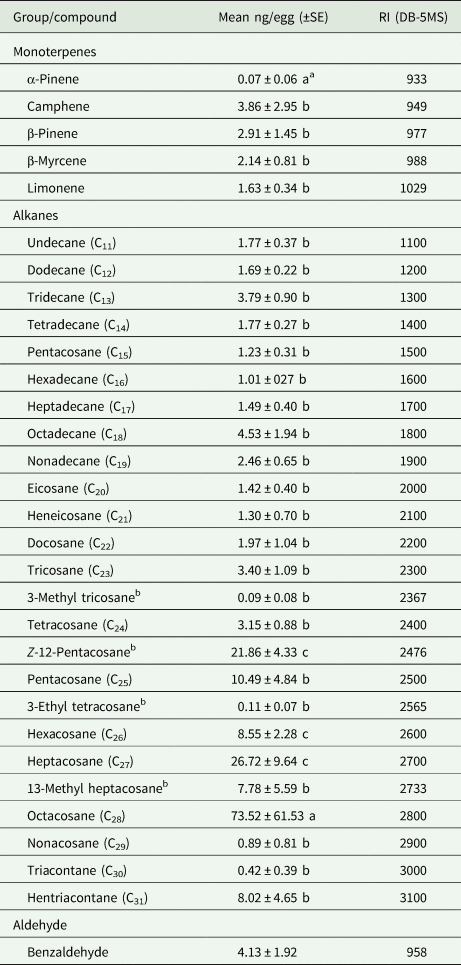
Thirty-one compounds were identified from E. heros egg extracts (four of them were tentatively identified) which are included in the following chemical groups: monoterpenes (α-pinene, camphene, β-pinene, β-myrcene and limonene), alkanes (C11 to C31) and aldehyde (benzaldehyde). Among monoterpenes, α-pinene was the minor component (P < 0.05), the others were not significantly different on quantity (P > 0.05). To alkanes, C28 was the major component (P < 0.05) (table 1).
Mean (ng/egg mass) ± (SE) of compounds extracted from 1 g of Euschistus heros and retention index (RI) of compounds/chemical group identified on E. heros eggs

a Means followed by the same letter in the same functional group do not differ by Kruskal-Wallis (P > 0.05).
b Compounds tentatively identified, the chemical standards were not available in the laboratory.
Olfactometry
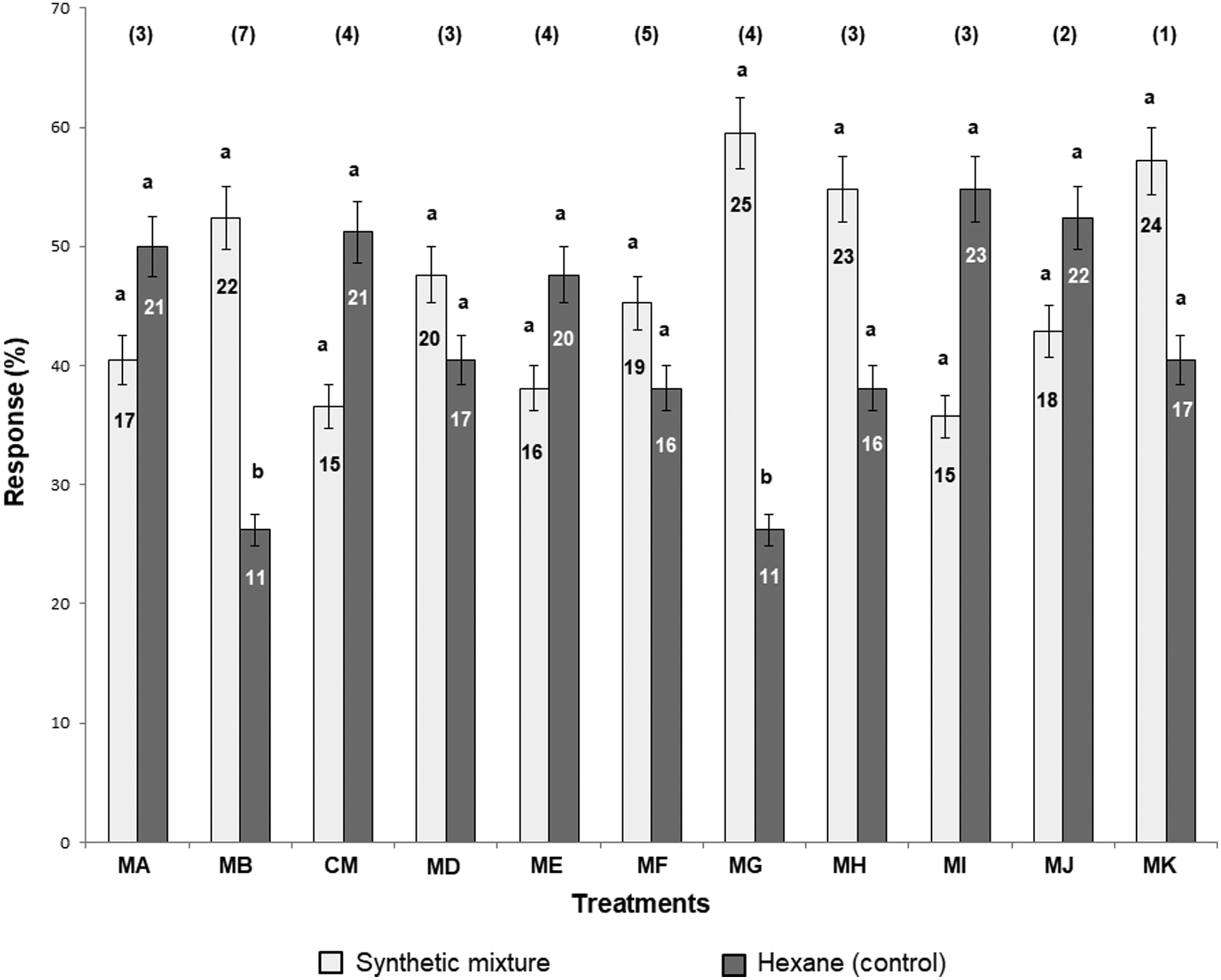
Telenomus podisi females did not show a significant choice between the synthetic MA (α-pinene + camphene + β-pinene + β-myrcene + limonene + benzaldehyde) (40.47% of choices made by the parasitoid) and hexane (50%) (χ2 = 0.842; d.f. = 1; P = 0.491). On the other hand, when α-pinene was removed from the mixture (MB), the wasps showed a positive response (52.38%) when compared to hexane (26.19%) (χ2 = 7.333; d.f. = 1; P = 0.014). A similar result was observed in MG, i.e., MA without α-pinene and β-myrcene (χ2 = 10.889; d.f. = 1; P = 0.002) (fig. 1).
Response of Telenomus podisi (±SE) tested in olfactometer dual choice to the following mixtures vs. hexane: MA: limonene, camphene, benzaldehyde, β-myrcene, β-pinene and α-pinene; MB: limonene, camphene, benzaldehyde, β-myrcene and β-pinene; MC: camphene, benzaldehyde, β-myrcene and β-pinene; MD: limonene, benzaldehyde, β-myrcene and β-pinene; ME: limonene, camphene, β-myrcene and β-pinene; MF: limonene, camphene, benzaldehyde and β-myrcene; MG: limonene, camphene, benzaldehyde and β-pinene; MH: camphene, benzaldehyde and β-pinene; MI: limonene, benzaldehyde and β-pinene; MJ: limonene, camphene and β-pinene; MK: limonene, camphene and benzaldehyde. Numbers represent the number of responsive insects. Bars followed by different letters within each treatment indicate difference (χ2, P < 0.05).

The choice between MC, MD, ME, MF, MH, MI, MJ and MK was not different when compared to the control (hexane) (P > 0.05) (fig. 1). Similarly, alkane solutions (MAA and MAB) were not attractive to the parasitoid females (P > 0.05).
When MB vs. E. heros egg extract was tested, 28.57% of the wasps choose MB rather than the extract (66.66%) (χ2 = 6.4; d.f. = 1; P = 0.011). A similar response was observed in MG (30.23%) vs. E. heros egg extract (62.79%) (χ2 = 4.9; d.f. = 1; P = 0.027). There was no difference between MB (38.29%) and MG (46.80%) (χ2 = 0.4; d.f. = 1; P = 0.527).
Parasitism tests
We observed greater parasitism on E. heros egg masses treated with MG (52.4%) than with hexane (33.9%) in laboratory test (H = 4.9547; d.f. = 1; P < 0.026). A similar result was reported under semi-field conditions (MG – 56.3% and control – 38.8%) (H = 7.2467; d.f. = 1; P < 0.0071). In both conditions, emergence was greater on MG than control (P < 0.05), and consequently, the nymph emergence was greater in the control than MG (P < 0.05) (table 2). Nymphal emergence from egg masses not exposed to T. podisi was 98.2%.
Parasitism of Euschistus heros eggs with synthetic mixture G (MG) or hexane (H) under laboratory or semi-field condition by Telenomus podisi

a Numbers followed by different letters are significantly different within each treatment/condition/column at Kruskal–Wallis, P < 0.05.
b These include the percentage of eggs from which neither parasitoids nor E. heros nymphs emerged.
Discussion
We presented a variety of compounds found on the surface of E. heros eggs, including different chemical groups, i.e., monoterpenes, alkanes and aldehyde. Substances from E. heros eggs were first observed by Aquino (Reference Aquino2011); however, only compounds derived from long-chain fatty acids were reported, probably internal egg components. Lately, Michereff et al. (Reference Michereff, Borges, Aquino, Laumann, Mendes and Blassioli-Moraes2016) also identified egg substances in the same species, and three compounds were also found in this work, the monoterpene limonene, two hydrocarbons tetradecane and hexadecane. The difference between these results might be associated with the difference in the methodology to extract egg compounds. In this work, as we were interested in the compounds present in the egg chorion, an apolar (hexane) solvent was used and for a very short extraction time (5 min). From the compounds evaluated, only the mixture of monoterpenes and aldehyde triggered the chemotactic response in T. podisi females. Volatiles such as limonene and α-pinene are known as substances from plant secondary metabolism and as insect repellents (Nerio et al., Reference Nerio, Oliveiro-Verbel and Stashenko2010). Therefore, we observed that synthetic blends with α-pinene (MA) were not attractive to wasps, and when this compound was removed from synthetic blends, females become responsive (MB). When α-pinene and any other compounds were removed from the mixture, the parasitoids were not attracted, with the only exception of β-myrcene (MG). On the other hand, the presence of α-pinene in the natural extracts does not interfere in the attraction of the parasitoid, because these egg extracts were more attractive to the parasitoids than the MB and MG extracts. These contrasting results show the relevance of specific volatile composition to the parasitoid attraction. The loss of activity of the solutions MB and MG can be also related to different rate emissions of the volatiles from the filter paper compared to the emission from the stink bug egg, and a mix of volatiles missing information can avoid the recognition of the blend. Studies have discussed the importance of the ratio of the volatile semiochemicals to natural enemies to locate hosts; the ratio between the components in a blend can provide information about the quality and host reliability (Bruce and Pickett, Reference Bruce and Pickett2011). We may suggest that the absence of response to alkanes by T. podisi should be associated with its low volatility. The identified C28 was the most abundant hydrocarbon found in egg extracts. Due to their long chains that influence their low volatility usually, they work on host recognition and not location (Rutledge, Reference Rutledge1996). Cuticle hydrocarbons are found in high quantities on the insect exoskeleton (Gibbs, Reference Gibbs1998; Howard and Blomquist, Reference Howard and Blomquist2005). Colazza et al. (Reference Colazza, Aquila, De Pasquale, Peri and Millar2007) identified hydrocarbons from C19 to C34 on the body of N. viridula adults. These compounds provide intraspecific signals and/or interspecific cues that modify the behaviour of natural enemies. The same compounds were described on the scales (Boo and Yang, Reference Boo and Yang2000) and eggs of Ostrinia nubilalis (Hübner) (Lepidoptera: Crambidae) and Mamestra brassicae L. (Lepidoptera: Noctuidae) (Renou et al., Reference Renou, Nagnan, Berthier and Durier1992); in both studies, they were reported as contact kairomone.
In this way, alkanes from E. heros eggs would act in a very short-range distance or only by contact. Furthermore, MG (camphene, β-pinene, limonene and benzaldehyde) was efficient to increase the parasitism on E. heros eggs by T. podisi either on laboratory or semi-field condition.
The results present here are in accordance with those reported by Tognon et al. (Reference Tognon, Sant'Ana and Jahnke2014), who are studying volatiles from egg masses, reporting a high attraction by T. podisi to E. heros eggs. Thus, we can claim that this parasitoid species uses volatile cues from E. heros eggs, as a short-range kairomone for location.
Semiochemicals related to location, recognition and acceptance could be a practical solution to attract and retain natural enemies in field areas where there are pest spots (Borges and Aldrich, Reference Borges and Aldrich1994). For example, the main compound present on the pentatomid Nearctic species E. conspersus egg masses, methyl (2E,4Z)-2,4-decadienoate, the principal component of male-produced aggregation pheromone was attractive to egg parasitoids in the field and act only as kairomone when available in low quantity (close to 1 and 0.1 mg total) reported by Tognon et al. (Reference Tognon, Sant'Ana, Zhang, Millar, Zalom and Aldrich2016). In the present study, we did not identify any E. heros pheromonal substance on egg masses, as compared to E. conspersus by Tognon et al. (Reference Tognon, Sant'Ana, Zhang, Millar, Zalom and Aldrich2016). We may conclude that pheromonal compounds on eggs are species-specific as also observed for H. halys eggs which contain no pheromones, but have substances that inhibit parasitism by native scelionids in North America, T. podisi and T. erugatus (Tognon et al., Reference Tognon, Sant'Ana, Zhang, Millar, Zalom and Aldrich2016). Michereff et al. (Reference Michereff, Borges, Aquino, Laumann, Mendes and Blassioli-Moraes2016) also did not identify any of the three male-specific components of E. heros sex pheromone in egg extracts from conspecific females, but these extracts were equally attractive to T. podisi.
Our research reports relevant results to understand the interactions between Scelionidae/Pentatomidae, through the substances on egg masses and kairomonal activity on T. podisi. Since we obtained positive responses regarding the parasitism in a semi-field experiment with the mixture G (MG), we believe that our results have the potential use to manipulate natural enemies' behaviour in the field. It could help to improve the use of semiochemicals mainly on biological conservative programmes to attract and retain natural enemies in infested spot areas.
Acknowledgements
We thank Dr Valmir Antônio Costa from Biological Institute of São Paulo, Brazil, for the parasitoid identification. The Coordination for the Improvement of Higher Education Personnel Program (CAPES) from Brazil for providing a scholarship to Roberta Tognon to conduct this portion of her thesis research. The National Council for Scientific and Technological Development (CNPq 449738/2014-0) for the financial support and for fellowships awarded to second (CNPq 303758/2018-0), fouth (CNPq 308658/2018-3), fifth (CNPq 307104/2018-4), sixth (CNPq 304329/2017-7) and seventh authors (CNPq 308113/2016-0).