For decades, social historians have devoted considerable attention to nineteenth-century towns and cities, including the formation of new patterns of social relations.Footnote 1 While much of this work is skewed towards the ‘shock’ towns of the Industrial Revolution, research on the seaside resort has broadened our understanding of nineteenth-century urbanization. The work of John Walton in particular demonstrates that social relations took shape in a variety of urban contexts, and that the seaside town ‘provides an excellent laboratory for the examination of a spectrum of social tensions on a very public stage, where interests, hopes and fears are articulated with unusual openness’.Footnote 2 Much research in this field, though, eschews this broad perspective. Although welcome, most studies address a rather narrow range of resort-specific questions – including environmental management and the tourist market – rather than using the seaside town as a distinctive basis on which to analyse the condition of urban society.Footnote 3
The resort did not merely contain social tensions, but was itself a ‘factor’ in shaping debates about day-tourism. Cultural historians of space have emphasized the geographical basis of identity formation, the social connotations of particular districts and the subjective significance of the town.Footnote 4 Such issues were especially prominent in small seaside towns undergoing rapid expansion. By the 1870s, thousands of day-trippers dispersed each year to ‘resorts’, yet they arrived in places which others called ‘home’. This spatial contradiction provides rich opportunities for the study of social interaction, urban affiliation and the regulation of public space.
This article returns to the study of seaside social relations in its urban context, through a case-study of late Victorian Southend.Footnote 5 The town was a leading popular resort by 1914, as well as a major centre for commuters retreating from London, in sharp contrast to the mid-century fishing township which played host to the occasional visitor.Footnote 6 What follows explores the social consequences of this immense transformation. Through the town's newspaper, the Southend Standard, it analyses the key issues which preoccupied residents: the character of working-class tourists, the propriety of those who catered for them and the measures taken to regulate the impact of tourism on the town. Taken together, these debates offer a vivid insight into social perceptions and urban anxieties in this period.
Residents and the tripper
The final quarter of the nineteenth century witnessed a remarkable expansion in popular tourism. Rising incomes and time for leisure in the working class unleashed a new wave of demand upon English seaside towns, fuelling substantial population growth at the coast; while the great industrial cities continued to expand, resorts provide the most dramatic examples of urbanization at this time.Footnote 7 More profoundly, the arriving hordes of working-class tourists threw established social relations into flux, prompting the construction of the working-class day-tripper as a social ‘problem’.Footnote 8
According to Walton, Southend's residents greeted the tripper with impressive restraint. Excursionists were apparently welcomed with an open mind, in contrast to crude stereotyping at most resorts.Footnote 9 In fact, representations of the tripper were far more complex: in very general terms, the tolerant stance of the 1870s deteriorated in the following decade. Originally welcoming, residents over time developed distinctly mixed feelings about their working-class guests. Relations remained fluid, though, with the tripper evoking diverse reactions throughout this period.
Amidst rapid urban development in the 1870s, representations of the tripper were nonetheless broadly favourable. Responding in 1874 to a tourist riot – the single worst disturbance to hit the town in this period – the Standard remained cautious.Footnote 10 Critically, it took care not to implicate the peaceable majority of excursionists in its verdict on the riotous few: ‘Hundreds of working men have visited Southend during the season, who were a credit to themselves and connections, and whose conduct have been of the utmost propriety and respect, and who we shall always be pleased to see.’Footnote 11 Furthermore, locals were encouraged to take pride in their tolerance of the tripper: one reporter commended residents the following year for their ‘moderation and civility, which the inhabitants of other places of holiday resort would do well to imitate’.Footnote 12
While a few dissented, negative sentiments remained marginal at this time. The only direct attack upon the prevailing mood came in 1877, when an anonymous resident condemned excursions as a nuisance to both locals and genteel, ‘regular visitors’: bank holidays, they claimed, invariably entailed ‘thousands of roughs’ descending on the town.Footnote 13 Yet, this was a lone voice against the tide, which provoked a hostile reaction from more approving commentators.Footnote 14 As one journalist replied: ‘There are still a few isolated individuals who hate progress, and would gladly see Southend the dull old place of 60 years ago, instead of the improved and improving, flourishing town of 1877.’Footnote 15
Within a few years, however, things were beginning to change. The Standard complained in 1881 of the menacing ‘rough element’ of excursionists,Footnote 16 while fights between trippers soon made the main news column.Footnote 17 The journal also granted increasing space to critical residents, who issued several damning assessments. Having suffered property damage at the hands of Bank Holiday excursionists, Thomas Arnold mounted a fierce attack on ‘the plague of locusts’ that regularly descended upon the town. ‘Wherever they go they carry destruction with them’, he claimed, noting ‘the chance of getting your head punched into the bargain if you remonstrate.’Footnote 18 The following year, another resident condemned ‘the deplorable, drunken, and disgusting rabble that daily pours into Southend’, and complained that day-trippers challenged the right of respectable townsfolk to enjoy public space: ‘It is positively dangerous for decent people to walk the High-street.’Footnote 19 Even more approving commentators were compelled to moderate their endorsements, with one journalist in 1882 admitting that a significant minority of residents resented the regular tourist influx.Footnote 20
The excursionist was frequently portrayed as a debauched, rough and dangerous character, in contrast to ‘decent’ inhabitants and better-off visitors. One columnist complained in 1884: ‘From London the railway has brought shoals of visitors of a very low class, who give evidence of an almost total lack of morality, and whose behaviour is both careless and disgusting.’Footnote 21 Others, including a regular visitor writing four years later, condemned the excursionist's ‘ruffianism’.Footnote 22 Such damning descriptions did not go uncontested: reflecting on the recent Bank Holiday weekend, one correspondent concluded that, ‘on the whole, as far as my observation went, the people were orderly and well behaved’.Footnote 23 Nevertheless, the tone of commentary had clearly shifted dramatically since the 1870s.
The shifting image of the day-tripper was probably the product of a conscious shift in editorial policy at the Standard. Whether the actual editorship changed is unclear, yet considering similar criticisms were hardly ever accommodated previously, the cascade of ill-feeling from 1880 demonstrates a new willingness to canvass diverse opinions and publish letters from discontented residents. Furthermore, tales of tripper misconduct were more regularly reported in the later period: only six cases of drunkenness made the summer news columns (June–September inclusive) between 1873 and 1879, compared to 36 incidents between 1880 and 1889. There may, of course, have actually been more drunkenness in the 1880s, yet such a dramatic leap in reports at least betrays a change in journalistic priorities.
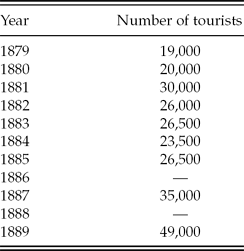
The growth of day-tourism – and so of the tripper ‘problem’ – might explain why the Standard could no longer ignore critical voices by the 1880s. While newspaper estimates of visitors do not provide ‘hard’ data,Footnote 24 the Standard's figures for August Bank Holiday weekends at least offer a rough guide (see Table 1). The arrival of about 19,000 in 1879 marked a new record,Footnote 25 while figures in excess of 26,000 were common by the early 1880s. This expansion did not go unnoticed: commenting upon the record crowds of 1881, the Standard proclaimed Bank Holiday Monday the greatest day of the year, ‘if it can be considered an honour to have thirty thousand people parading the town’.Footnote 26 Really decisive growth came only from the late eighties – and crowds of 80,000 were common by the turn of the centuryFootnote 27 – yet, the escalation of demand around 1880 certainly seemed dramatic at the time, pressing residents to re-evaluate their first impressions of the day-tripper.
Estimates of tourist numbers over the August Bank Holiday weekend

Source: Southend Standard.
If Southend residents were not a peculiarly tolerant folk after all, what then sustained sympathetic perceptions of the excursionist? Some certainly had an economic interest in tolerance, especially the many shopkeepers in the town's tourist districts.Footnote 28 The Standard itself was consistently gloomy on wet, quiet holidays,Footnote 29 while, in a local government debate on the pier toll, Mr Brasier argued, ‘If you shut out the excursionists, you shut up Southend.’Footnote 30 However, the remunerative significance of working-class tourists should not be overstated. Most came only for the day, many brought their own food, and any spare cash probably went to publicans, entertainers and street traders – or perhaps the pier toll – rather than local retailers. Well into the twentieth century, the middle-class visitor remained crucial to the commercial viability of even ‘popular’ seaside resorts.Footnote 31
Recognition of the tripper's poor living conditions back home was a further source of local sympathy. The Standard was keen to stress the invigorating effects of the seaside environment on the lower orders: ‘After months of toil in the close confined neighbourhoods of London, the fresh air and sea breeze of this place, must add new life to such [people], who must fully appreciate those days of healthful recreation.’Footnote 32 Indeed, through its sustained interest in matters of health,Footnote 33 the newspaper tried to fashion a kind of civic pride, conducive to tolerant relations between residents and trippers. In response to the attack on Arnold's farm, one journalist defended excursions, which allowed Londoners to escape ‘the smoke and dirt and dissipation of their every day [sic] life, to breathe the pure air of such resorts as Southend’; hence, ‘allowance should accordingly be made’ for their boisterous conduct.Footnote 34 In the context of close and contingent associations between urban environment, health and morality in Victorian England, residents thus were invited to imagine their accommodation of the tripper as contributing to the elevation of the metropolitan masses.Footnote 35
Those on the other side of the argument, however, were equally considered in reply. Their most common claim was that rough trippers were driving lucrative, well-off visitors away. Residential complaints of indecent bathing in the early 1880s asserted that such ‘disgusting’ scenes were alienating the respectable.Footnote 36 There may well have been some truth in this, as some middle-class visitors themselves complained of indecency;Footnote 37 yet, such arguments also allowed disgruntled inhabitants to guard against being marginalized as ‘a few isolated individuals who hate progress’.Footnote 38 By asserting that the middle-class visitor was deserting Southend, disaffected residents added a potent economic gloss to their moral indignation.
Such argumentative devices extended to the selective appropriation of various languages of social description. Those who deplored the tripper crowd tended to depict it as a homogeneous cultural unit, embracing an ‘us against them’ tone. Reporting disturbances involving excursionists and the local military in 1884, one journalist conceded: ‘In making mention of the military it is but our duty to bear emphatic testimony to the excellent behaviour of the great majority, who are highly respectable and always welcome.’ He added no such caveat regarding ‘the shoals of visitors of a very low class’.Footnote 39 Conversely, sympathetic commentators preferred to draw distinctions between trippers. As a report on the ‘orderly and well behaved’ Bank Holiday crowd of 1887 noted, excursionists ‘were chiefly of the ‘Arry and ‘Arriett class, many, however, being a grade or two below, and some a grade or two above’.Footnote 40 This tactic allowed more optimistic contributors to write off disruptive behaviour – including the 1874 tripper riotFootnote 41 – as the province of a few ‘roughs’.
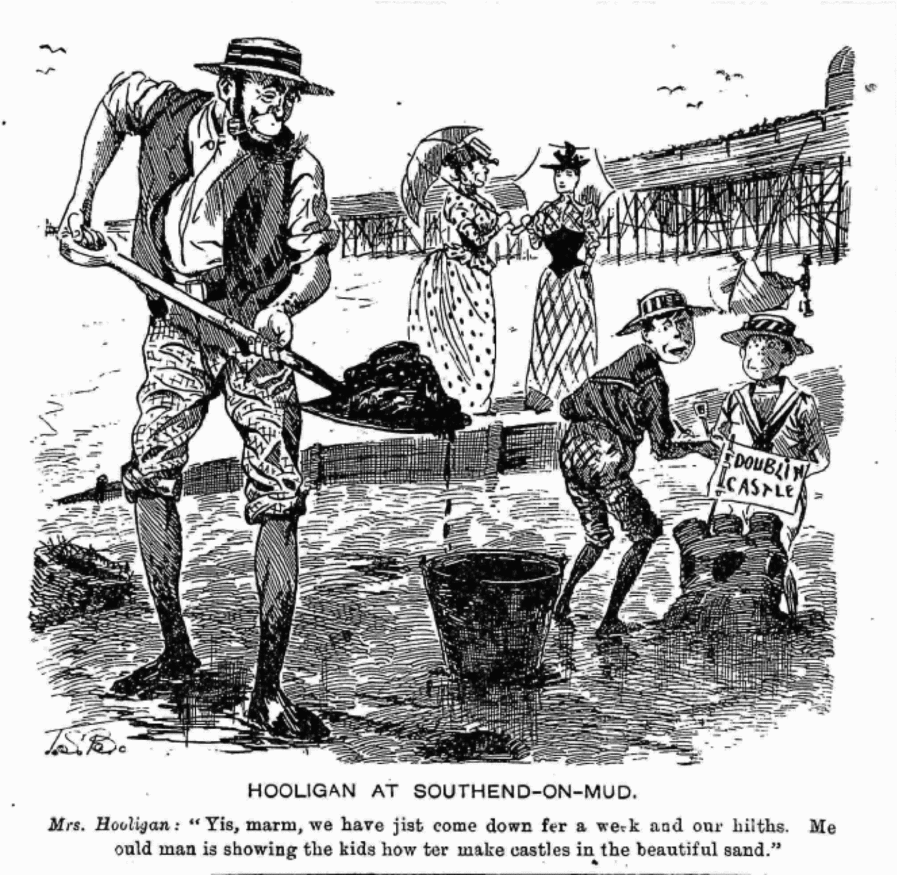
Yet, if the propriety of the day-tripper was a matter for debate, Standard readers were left in no doubt of their social superiority over the East End excursionist. Confectioner John Sykes, for instance, defended tourists from the anonymous polemic of 1877, yet he urged his neighbours, ‘Let us be satisfied with the class that has come of late years.’Footnote 42 Languages of class condescension, rather than fear, maintained this central social distinction between reader and tripper.Footnote 43 The ‘sham gentility’ of the Cockney excursionist was a favourite target.Footnote 44 One visitor, however sympathetically, publicized their amusement at working-class pretensions to refinement: ‘A man who makes a fool of himself is an object of pity rather than an object of derision.’Footnote 45 An 1889 article on tourist recreations similarly mused, ‘what a hearty sight it is to see people enjoying themselves even in this simple way’.Footnote 46 Some historians argue that holiday-makers were able, by emulating their betters, to ‘move up a class’ on holiday;Footnote 47 most observers, however, readily saw through the façade (see Figure 1).
One family's attempt to ‘move up a class’ on holiday fails to convince Source: Funny Folks, 27 Aug. 1892, 280 – Gale Cengage Learning, 19th Century UK Periodicals online collection. Reproduced by courtesy of the British Library (© British Library Board, NT152).
Social perceptions and relations in seaside towns were thus a good deal more varied than many scholars have recognized. Mark Billinge, for example, argues that permissive excursions relieved social tensions, thereby promoting harmonious class relations.Footnote 48 Yet, this argument manifestly fails to consider social relations at the seaside itself, marginalizing those who made their homes at resorts. Whatever the broader social impact of tourism in industrial England, it clearly prompted considerable conflict at Southend. A further point of contention between residents in this period, though, was the growth of those industries which served the expanding tourist market.
Tourist trades and the town
Besides day-trippers, the ranks of donkey drivers, hawkers and entertainers who catered for them were the subject of residential scrutiny. As working-class demand for holidays increased, so certain services and entertainments proliferated; while some were structured, commercial amusements, itinerant entertainers remained prominent too.Footnote 49 These trades not only threatened the right of respectable inhabitants to enjoy the use of public space, but forced many to re-evaluate the town itself, as it rapidly evolved into a distinctly popular resort.
Beach entertainers and traders – operating in a space central to the resort's commercial prospects – encountered sustained criticism. By the mid-1870s, Southend's sands were already crowded with fruit and refreshment stalls, oyster vendors, bathing machines and photographic studios.Footnote 50 The Local Board of Health received a letter of complaint in 1874 from future member Mr Verrall, concerning beach traders and coconut shies, and the Board remained preoccupied with such nuisances in the eighties.Footnote 51 While such annoyances were common to seaside towns, conflict was accentuated in Southend by its distinctive geography. The beach was narrow and notoriously muddy, making it extremely crowded at peak times. Walton argues that long, straight beaches often allowed different sorts of tourists to spread themselves out, diffusing tension; this was hardly possible at Southend.Footnote 52
Those entrepreneurs who plied their trade from the streets attracted similar hostility. Drivers of cabs and donkeys were a particular nuisance, prompting frequent complaints of furious driving and obstruction, including three separate representations to the Local Board in 1873.Footnote 53 The Victorians were especially sensitive to such street disruptions, which refracted visions of broader social relations,Footnote 54 while drivers offended a further respectable sensibility of the age by their cruel treatment of animals.Footnote 55 In Southend, the problem of animal cruelty was all the more distressing for its public display, for the impossibility of ignoring the upsetting spectacle; as one visitor complained in 1879, ‘It is positively cruel, I may say brutal, to see the number of people carried in such vehicles.’Footnote 56
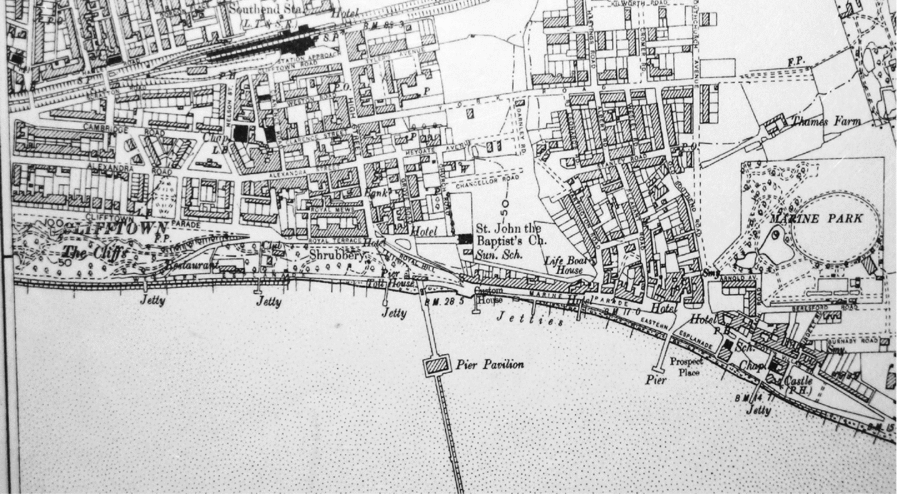
In order fully to understand attitudes towards tourist trades, one must first appreciate the social geography of the town. Seaside resorts were commonly partitioned into specialized ‘social zones’ which accommodated different kinds of tourists, and Southend was no exception.Footnote 57 The town was divided into two distinct districts: Old Town, to the east of the pier, was the natural home of the day-tripper, in contrast to the exclusive Cliff Town estate to the west (see Figure 2).Footnote 58 The latter housed various refined pleasures by the 1870s, including the ‘shrubbery’ pleasure garden and a yacht club, while contemporary guides made much of its peaceful decorum.Footnote 59 Despite their contrasting ‘tones’, however, these two zones were situated close together, with a mere five minute walk separating refinement from excess. Furthermore, certain areas remained contested territories; as the natural through route from station to seafront, the High Street hosted all sorts of tourists, and the pier was probably a socially inclusive attraction.
Southend seafront in the late 1890s Source: Essex Record Office: Ordnance Survey Map, sheet 78, 2nd edn, 1898. Reproduced by courtesy of the Essex Record Office.
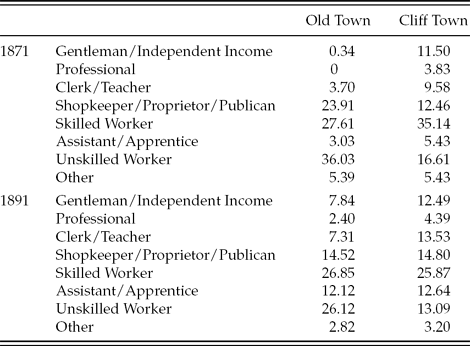
How far, though, did the division between Old Town and Cliff Town segregate residents as well as tourists? The study of nineteenth-century censuses can provide only an approximation of urban social structure, and concerns about differences in interpretation between historians are certainly well justified. Nevertheless, the returns offer a rough impression of the social composition of these two neighbourhoods (see Table 2). There was already a measure of social differentiation between the two districts by 1871, with a much higher proportion of unskilled labour in Old Town, and the concentration of wealthy merchants, annuitants and professionals in Cliff Town. By 1891, the picture had changed somewhat: the elite had spread itself further into Old Town, perhaps as the growing ranks of commuters settled more widely, while the proportion of shop assistants in each district expanded significantly. Yet, the broad social division between these two districts remained, with the elite housed chiefly in the west and the unskilled largely in the east.
Occupational profile of residents in Old Town and Cliff Town, 1871–91 (given as percentages of total labour force, excluding domestic servants, to two decimal places)
Sources: 1871 Census, RG10/1688, districts 1–2; 1891 Census, RG12/1391, districts 1–6 (www.ancestry.com).
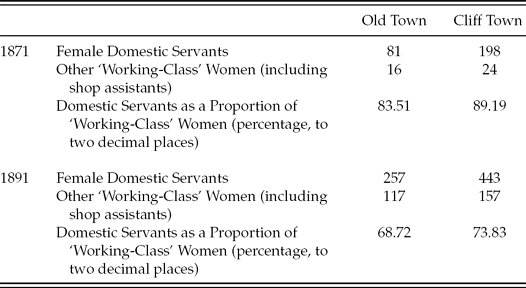
This tentative impression of the town's social structure is corroborated by the concentration of domestic service in Cliff Town. The data presented below shows the number of female domestic servants as a proportion of all women engaged as workers and shop assistants (see Table 3).Footnote 60 If the preceding analysis is accurate, one would expect a higher proportion in Cliff Town (with extensive servant-keeping and few females engaged in other labouring employment) than in Old Town (vice versa). Again, there is a modest distinction between the two areas in 1871 and 1891. Of course, servant-holding is an imperfect proxy for affluence, while more extensive employment of women as shop assistants pulled both figures down in 1891. Nonetheless, there was some social differentiation between these two zones – albeit patchy and incomplete – in the 1870s and 1880s. The geography of east and west separated different classes of tourist, and probably different classes of resident too.
It is hardly surprising, therefore, that tourist services were condemned more fiercely in some streets than others. Cliff Town – home to better-off residents and middle-class visitors – was least tolerant. In 1880, inhabitants formed the Cliff Town Residents’ Committee, to organize opposition to a new concert tent. At its meeting in July, Mr Draper asserted that donkey driving was ‘out of place’ in the neighbourhood.Footnote 61 Residents across town complained about this nuisance, yet the idea that it was not in keeping with the tone of the place was unique to Cliff Town.
The discussion of tourist trades presents many parallels with the debate over the day-tripper. Opponents in Cliff Town often added an economic rationale to their complaints: one claimed in 1880 that catering for ‘the “East End” penny gaff element’ was deterring respectable visitors,Footnote 62 while J.B. Baylis asserted the following year that cabs and donkeys had ‘driven visitors and even residents away’.Footnote 63 Opponents of tourist services were thus able to ally commercial interest to residential amenity. Entertainers, hawkers and drivers were also depicted as rough, drunken and abusive, just like the excursionist. In 1877, one visitor complained that beach photographers used language which was ‘anything but pleasant to the ears of ladies and others’,Footnote 64 while another protested that donkey drivers ‘make use of disgusting language, and run against any person’.Footnote 65
There was often, though, no respectable consensus over which enterprises were acceptable; amusements were often contentious, provoking conflict between residents. Some condemned the Old Town swings, for example, and the Local Board repeatedly refused to license swing proprietors.Footnote 66 Yet others formed quite the contrary opinion; one ratepayer complained in 1877 about the Board's decision to refuse a licence to Mr English, who had apparently ‘for three years . . . conducted them with propriety; a benefit to himself and a great boon to excursionists’.Footnote 67 The same was true of Punch and Judy shows, strictly regulated by the Board but celebrated by others as wonderful entertainment for children.Footnote 68 Such debates demonstrate that there was no single ‘middle-class culture’ in this period; abstractly consensual notions of respectability were often contested in practice.Footnote 69
Such divisions were accompanied in the 1880s by diverse reactions to the town's remarkable growth. Following Harold Perkin, historians normally analyse debates about the condition of seaside towns in terms of ‘social tone’,Footnote 70 yet this concept – based narrowly on a resort's commercial viability and the social basis of demand – fails to capture the essence of contemporary arguments. Rather, their impassioned temper is best understood by considering the importance of the town itself in residential self-definition. Considerable emotional investment in urban space was evident from one Cliff Town resident who, alarmed by the apparent exodus of respectable visitors, bemoaned the ‘miserable state of my own native town’.Footnote 71
A case-study further illustrates what was at stake. In 1880, Mr Jarvis established a concert tent in Cliff Town, provoking outrage from the locals. One dubbed it ‘an insufferable nuisance’, with the noise so unbearable, ‘as more than to suggest a lunatic asylum on the Cliff!’Footnote 72 A letter the following week suggested that the neighbourhood had been ‘degraded by an entertainment that draws the worst characters of the town’.Footnote 73 Yet, outside Cliff Town, many failed to see the problem, and according to one correspondent, ‘a more respectable body of people I never before saw assembled’.Footnote 74 While the tent's opponents claimed it damaged the local economy by deterring well-off visitors, others disagreed: the concerts boosted business by adding to the town's appeal, with one visitor celebrating ‘Southend en fête at last.’Footnote 75 Both sides claimed to be struggling, in the words of one critic, ‘for the sake of the reputation of Southend’,Footnote 76 though imagined in quite contrary ways. While the Cliff Town interest was determined to preserve its protected zone of tranquillity, others sought to add new life to the resort.
Exactly the same issues were at stake in broader debates concerning tourist amusements and urban development. One group was, broadly speaking, pro-development, encouraging greater provision for tourists. One journalist thus urged the Local Board in 1886 to press on with improvements to the cliffs, fearing otherwise that Southend would fall behind its competitors in attracting middle-class visitors.Footnote 77 A resident the following year similarly urged the Board to purchase Pawley's Green and transform it into a public park, with a view long term to making Southend ‘the second Brighton’.Footnote 78 Yet others resented the impact of tourist development on the town. In 1880, one inhabitant attacked those who ‘would sooner see Southend go to the dogs’ than cease to provide entertainments of the lowest sort.Footnote 79 While they were rarely so clearly distinguishable, these two competing perspectives dominated public discussion of the town's transformation as a resort, and its prospects for future development.
Despite sometimes bitter divisions, however, there remained a certain base-line of moral probity upon which all could agree. Commercial interest and residential amenity demanded that Southend maintained a respectable reputation, as one particular episode revealed. In 1890, Bishop Gregg and Reverend Waller conducted a joint public sermon, in which they revealed that prostitutes regularly congregated under the cliff. As Waller later asserted that many of their clients were working-class tourists,Footnote 80 the whole affair was intimately bound up with the tripper ‘problem’. Yet, far from reproducing the familiar argumentative fault-lines, the exposé provoked a united response through the Standard. One columnist asserted that the churchmen's claims were ‘unproved and unprovable’, while others sought to play down the sensation: Mr White of the Local Board admitted that the town was not free of vice, yet he defended the essential morality of the town, insisting that it was cleaner than most coastal resorts.Footnote 81
The public outrage was not confined to the newspaper. The Board's meeting with Waller drew a crowd of 600 people (about 5 per cent of the population) intent on confronting the clergyman;Footnote 82 the following week, he was forced to abandon a beach service when challenged by a group of tradesmen and boatmen, blowing foghorns and beating trays in a bout of ‘rough music’.Footnote 83 The presence of retailers is instructive: benefiting financially from better-off tourists, they had much to lose from a blot on the town's name. The Board's rejection of Waller's claims was thus welcomed by a deputation of ‘ratepayers, lodging-house keepers, and the whole trade of the town’.Footnote 84 W.J. Heath went even further than most, claiming that the whole affair was ‘calculated to do the town serious injury’.Footnote 85 This was not an issue of money versus morals – a theme familiar to seaside historiansFootnote 86 – but of the two joining hand-in-hand.
Regulation
The controversy surrounding tourist trades and entertainments prompted frequent calls for better regulation. Policing public space at the seaside was, of course, crucial to maintaining an attractive and profitable resort. It is surprising, therefore, that seaside police forces have attracted little attention from historians of policing or tourism.Footnote 87 As the instability of working-class demand forced nineteenth-century resorts to attract a socially broad clientele, there was always an imperative to regulate both disorderly traders and working-class tourists. Local government, police and civilian agencies all contributed to this task.
As Southend grew, so did its police. The town had just one permanent officer as late as 1867,Footnote 88 and in 1872, residents successfully memorialized for an increase, the present force apparently ‘insufficient to the protection of property and maintenance of order in the town’.Footnote 89 While it remained just a division of the Essex Constabulary, manpower grew throughout the 1870s and 1880s,Footnote 90 while additional men were also drawn in from elsewhere on major holidays, as at other resorts.Footnote 91 The force was increased to 25 for the 1880 August Bank Holiday weekend,Footnote 92 and by 1887 a force of 37 kept the holiday peace.Footnote 93
Alongside the police, the Local Board of Health was the primary agency responsible for maintaining order. In 1867, it set out bye-laws relating to Hackney Carriages, donkeys and ponies, reserving the right to issue fines for various traffic offences. Regulation was most wide-ranging for donkey drivers: licences could be revoked if, ‘in the opinion of the Board or their officer duly authorized in that behalf’, drivers were ‘a source of danger or annoyance to the inhabitants or the public’.Footnote 94 Moreover, the Board refused to license those who transgressed the bye-laws, prompting Mr Heygate to remark on one occasion, ‘if you don't make an example of some, you will have no control over others’.Footnote 95 After refusing several licences on similar grounds in 1883, Mr Gregson insisted, ‘We can't have bad character lads here.’Footnote 96
Like other institutions of seaside local government, however, the Board's authority was strictly limited in practice.Footnote 97 In 1882, the majority ruled it could not even revoke Arthur Sharp's cab licence for misconduct.Footnote 98 More generally, it was reluctant to intervene in matters entirely unrelated to its central duties of sanitation and public health. Residential complaints about fairs were met by the Board's insistence that, beyond sanitary concerns, they could not interfere in private matters.Footnote 99 Throughout, its stock response to complaints was simply to remind the police of their duties.Footnote 100
The apparent inability of the police to keep order proved a constant headache. Complaints about cabs, donkeys and hawkers poured in throughout this period, and officers were repeatedly reminded to enforce the bye-laws.Footnote 101 Tensions developed between the Board and Superintendent Hawtree, the chief police officer. In 1881, the Board bypassed Hawtree by writing directly to Chief Constable McHardy, highlighting ‘the serious increase in obstructions to and nuisances in the principal streets of the town and requesting more efficient control by the police’.Footnote 102 A month later, one member complained of police inadequacy, referring to ‘Mr Hawtree's way of not doing things.’Footnote 103 Much of this, undoubtedly, was due to the shortage of police manpower, and inadequate local control over policing.Footnote 104 A further difficulty was the bewildering variety of police duties: in his own defence, Hawtree reminded members that his men had much to do beyond ‘normal duties’, and urged them to issue fewer cab and donkey licences.Footnote 105
That said, as the testimonies of street traders reveal, the police were far from impotent. One apparently described how they, ‘druv [sic] us out of High street and now they wont [sic] let us stand in the lower town, nor nowhere’,Footnote 106 while another protested that ‘several respectable licensed vendors of curiosities, &c., were summarily ordered from the Esplanade by the Police, and ordered not to sell there again’.Footnote 107 Periodic crackdowns intensified bye-law enforcement: co-ordinated action in July 1879 resulted in fines for 11 donkey drivers.Footnote 108 Even Hawtree characterized the Board's policy towards the tourist industries as ‘persecution’.Footnote 109 The highly discretionary enforcement of street order was as central to policing at the seaside as elsewhere.Footnote 110 Meanwhile, the RSPCA brought numerous cases before magistrates around 1880. The charity enjoyed good relations with the town's authorities, with policemen often assisting its prosecutions.Footnote 111 Moreover, Reverend Thackeray was the Society's treasurer while sitting on the Local Board, and members explicitly drew his attention to instances of cruelty, perhaps to relieve the burden on the police.Footnote 112
This regulatory regime is perhaps best analysed through a case-study of one of its objects. Thomas Sharp, donkey driver, enters the historical record in 1867, when the Board threatened to revoke his licence if he remained ‘a source of annoyance and danger to the public’.Footnote 113 The police reported him to the Board 10 years later,Footnote 114 and he was caught in police action against donkey drivers in 1879.Footnote 115 He was subsequently twice refused a licence,Footnote 116 before being prosecuted for animal cruelty by the RSPCA, allegedly prompting him to declare that ‘he did not care for all the Humane Society men in London, or all the police in Southend’.Footnote 117 He was similarly indignant the following year when cleared from Cliff Town by the police and Board officials.Footnote 118 In total, between the months of June and September, 1873–89, Sharp appeared at petty sessions at least 23 times for obstruction, loitering, cruelty to animals, drunkenness and more besides. His story stands as a necessary corrective to complaints of police ‘inefficiency’.
In dealing with the trippers themselves, the police adopted a more relaxed approach. This prompted few complaints from the Board, possibly (as in Blackpool) for fear of turning tourists away, however modest their spending money.Footnote 119 In short, the police prioritized donkey drivers over drunkards. Yet, as well as reluctant, constables were incapable of enforcing order amongst day-trippers. Despite substantial reinforcements on Bank Holiday weekends, the 40 officers who met some 15,000 tourists in the mid-eighties were forced to embrace operational restraint. In James Ritchie's admittedly sensationalist account of Southend excursions, policemen tended to ‘get out of the way’ at the sight of trouble, knowing ‘their utter inability to deal with a drunken mob, and the ridiculousness of their attempting to do so’.Footnote 120 His account was corroborated by George Totterdell, who was posted to Southend in 1912 after just one month's police service:
Even in those days the town in the summer months, on holidays and week-ends, would be filled with day trippers. It was no easy task to handle these crowds, who respected nobody . . . We had to learn to take the middle course, to keep our tempers, and to keep order, sometimes by rule-of-thumb which didn't always follow the letter of the law.Footnote 121
The anonymity of tourists posed further problems. Nineteenth-century police intelligence relied substantially on personal recognition and identification, presenting inevitable difficulties at the resorts.Footnote 122 The man responsible for killing a railway worker in 1890, for example, was a day-tripper, apparently ‘well-known to the police at Ilford’, but obviously not at Southend.Footnote 123 The contrast with drivers and hawkers is instructive: the likes of Thomas Sharp, who were well known locally, were subject to effective surveillance.
Finally, while the Metropolitan Police had its own problems in enforcing street order,Footnote 124 a trip to Southend still presented the day-tripper with something of an escape from more rigorous discipline at home. It was, perhaps, a ‘liminal’ environment, in which the normal constraints of social life were relaxed.Footnote 125 Walton argues that working-class tourists were sensitive to the ‘censorious gaze’ of their peers,Footnote 126 yet, at Southend, the presence of workmates often precipitated drinking and acts of violence: all three tripper riots in this period issued from groups of workers on excursions.Footnote 127 The boisterous crowd, lack of structured entertainments and insufficiency of police all conspired to prevent the satisfactory regulation of tourist excesses.
Conclusion
This article has exposed the growth of popular tourism and its social consequences in late nineteenth-century Southend. Representations of day-trippers were much more diverse and interesting than historians have realized, yet, throughout, clear distinctions were drawn between working-class tourists and middle-class readers, facilitating the re-creation of residential identity. Debates about the character of the tripper and the propriety of tourist trades, however, exposed divisions between residents. These communicated divergent conceptions of the town and its future as a resort, loaded both with moral-economic considerations and the subjective significance of the urban environment. While hawkers, drivers and entertainers were subject to a significant degree of regulation, there were simply too many excursionists for the police to cope with. As a result, dreams of pristine urban decorum remained unfulfilled.
In many respects, the town struggled throughout this period to come to terms with modernity. On the one hand, the seaside holiday symbolizes the new world of modern leisure of the late nineteenth century.Footnote 128 Yet, modernity came late to Southend. Before the trains arrived in 1856, it supported fewer than 2,500 residents; by 1911, it housed a staggering 62,713 people.Footnote 129 In the 1870s and 1880s, thousands of Londoners descended upon what had, until very recently, been merely the south end of Prittlewell parish. Arriving late, modernity also failed to sweep all before it; older customs, conventions and mentalities lived on not as anachronistic ‘survivals’, but as viable constituents of the culture in a period of accelerated change.Footnote 130 Hence, it is most fitting to find, at the end of our period, the local parson being driven off the beach by the townsfolk's rough music.
This is not to devalue the profound shock visited upon residents in the late nineteenth century. Even by 1870, Southend remained in state of innocence. Many doubtless looked back fondly on the place their parents inhabited, scarcely a town at all, which played host to the Constables and Disraelis of their world.Footnote 131 Yet, by the 1880s, faced with record numbers of trippers, such residents saw the town they knew vanishing around them, and fought back. The vitriol of residential condemnation – ‘the plague of locusts’, ‘the deplorable, drunken, and disgusting rabble’ – can only be understood in this context.
And yet, this is still not quite the full story. Southend was not a pure relic of times lost, suddenly flooded by the metropolitan masses. Rather, residents were primed for the influx, not least as some were themselves commuters, who settled there in small but significant numbers from the 1860s.Footnote 132 The national press, which reached such out-of-the-way places as Southend, further prepared locals for what was to come. This perhaps explains why the language of social description in the Standard is reminiscent of metropolitan discourse on the social problem.Footnote 133 One way or another, Southend folk understood what the London working man looked like even before he set foot in their town.
Given the town's eventual transformation into an overwhelmingly popular resort, it is difficult to take the opponents of development seriously. It would be easy to dismiss their concerns as those of a time already passed, as a hopelessly lost cause. Yet this was not how it seemed at the time. Contemporary guides continued to reassure readers, with some justification, that Southend was ‘a most lovely retreat’.Footnote 134 Working-class demand remained profoundly uncertain, and a resort's ‘social tone’ was not pre-destined, but hinged (amongst other things) on local regulation and policing.Footnote 135 Nobody in this period wished to see the town play host to the kind of mass tourism for which it eventually became known. Southend's prospective development remained indeterminate; all futures seemed possible, and all were worth fighting for.