Introduction
Circadian rhythms are common phenomena, widely observed in organisms from unicellular cyanobacteria to multicellular plants and animals (Edgar et al., Reference Edgar, Green, Zhao, van Ooijen, Olmedo, Qin and Reddy2012; Harmer, Reference Harmer2009). Such biological cycles, taking place over approximately 24 h, are adjusted by both endogenous and external cues (Pittendrigh, Reference Pittendrigh1993). It is generally assumed that daily rhythms enable organisms to adapt to the daily fluctuations in environmental factors, for example, light intensity and temperature, driven by the rotation of the earth around its axis (Woelfle, Yan, Phanvijhitsiri & Johnson, Reference Woelfle, Yan, Phanvijhitsiri and Johnson2004; Yerushalmi & Green, Reference Yerushalmi and Green2009). However, there are several habitats that are not subject to such obvious daily cycling of environmental factors. For example, in polar regions, the strength of the cycling of environmental factors is greatly reduced during the summer and winter when the sun never sets (polar day) or never rises (polar night) (Williams, Barnes & Buck, Reference Williams, Barnes and Buck2015). Do organisms living under such conditions still exhibit a 24-h rhythm?
In a study based on 32 shorebird species, Bulla et al. (Reference Bulla, Valcu, Dokter, Dondua, Kosztolanyi, Rutten and Kempenaers2016) found the 24-h cycle in incubation rhythms to be less prevalent at high latitudes and absent in 18 species (Bulla et al., Reference Bulla, Valcu, Dokter, Dondua, Kosztolanyi, Rutten and Kempenaers2016). However, Lakshman, Shindey & Sharma (Reference Lakshman, Shindey and Sharma2017) provided mixed support for daily rhythms in a review. During the polar day, there is no daily rhythm of plasma melatonin in the Svalbard ptarmigan (Lagopus mutus), but significant daily rhythms of plasma melatonin were observed in both willow warblers (Phylloscopus trochilus) and Lapland longspurs (Calcarius lapponicus) (Lakshman et al., Reference Lakshman, Shindey and Sharma2017). Furthermore, the daily rhythm can change in different breeding stages within species. Both pectoral sandpipers (Calidris melanotos) and red phalaropes (Phalaropus fulicarius) lack daily rhythms of activity patterns during the early breeding season, but show a daily periodicity during incubation (Steiger et al., Reference Steiger, Valcu, Spoelstra, Helm, Wikelski and Kempenaers2013). Clearly, whether daily rhythms persist during the polar day depends on the species, and additional field studies are still needed. Moreover, most circadian rhythm research in polar regions was conducted in the Arctic Circle (Lakshman et al., Reference Lakshman, Shindey and Sharma2017; Williams et al., Reference Williams, Barnes and Buck2015). The number of studies done in order to explore rhythms in Antarctic organisms is relatively scarce, understandably due to inherent difficulties in sampling.
In this study, we tested the daily rhythm in Adélie penguins (Pygoscelis adeliae), a common species along the entire coast of the Antarctic continent. There are several approaches to assessing rhythmicity, such as measuring activity, heart rate and plasma melatonin (Dominoni, Akesson, Klaassen, Spoelstra & Bulla, Reference Dominoni, Akesson, Klaassen, Spoelstra and Bulla2017). Measuring activity is labor-intensive (through continuous observation) or costly (through GPS tracking devices), while measuring plasma melatonin is invasive, and may not be feasible due to ethical considerations. Therefore, we focused on the heart rate in Adélie penguins. Heart rate is a classic marker for measuring daily rhythm in humans (Vandewalle et al., Reference Vandewalle, Middleton, Rajaratnam, Stone, Thorleifsdottir, Arendt and Dijk2007), and also in birds, for example, bar-headed goose (Anser indicus) (Bishop et al., Reference Bishop, Spivey, Hawkes, Batbayar, Chua, Frappell and Butler2015). In penguins, heart rate provides a reliable estimation of metabolic rate (Green, White & Butler, Reference Green, White and Butler2005; Groscolas, Viera, Guerin, Handrich & Cote, Reference Groscolas, Viera, Guerin, Handrich and Cote2010) and can reflect the general activity pattern. Heart rate of Adélie penguins was reported in previous research (e.g. Giese, Handsworth & Stephenson, Reference Giese, Handsworth and Stephenson1999; Culik, Reference Culik1992; Culik et al., Reference Culik, Adelung, Heise, Wilson, Coria and Spairani1989). However, no assessments of daily rhythmicity were undertaken. In our study, both fast Fourier transformation and autocorrelation were employed to assess the daily rhythm of Adélie penguins. Considering the environment in polar regions, we predicted that there would be no daily rhythm of heart rate in Adélie penguins.
Methods
Study area and species
Field work was conducted on Inexpressible Island (74°54 ′N, 163°39′E). Inexpressible Island is a small, rocky island on the shore of the Ross Ice Shelf in Antarctica, with an area of about 70 km2. The occupation of Adélie penguins in this area can be dated to 7 000 years ago (Emslie, Coats & Licht, Reference Emslie, Coats and Licht2007). It has been estimated that there have been approximately 20 000 breeding pairs of Adélie penguins on Inexpressible Island each year for the past 3 decades (He et al., Reference He, Cheng, Li, Zhu, Hui, Wu and Tang2017).
From 15 January 2019 to 21 January 2019, heart rate data from Adélie penguin chicks were collected. Adélie penguin chicks, rather than adults, were used in the study for two reasons. Firstly, previous research on daily rhythm overwhelmingly focused on adults (Bulla et al., Reference Bulla, Valcu, Dokter, Dondua, Kosztolanyi, Rutten and Kempenaers2016; Steiger et al., Reference Steiger, Valcu, Spoelstra, Helm, Wikelski and Kempenaers2013), so we paid attention to chicks which constitute a relatively neglected subject. The second reason is pragmatic. As we needed to capture and recapture the penguins to fit the heart rate monitors and download recorded data, it was simpler to use chicks, compared to adults.
Measuring heart rate
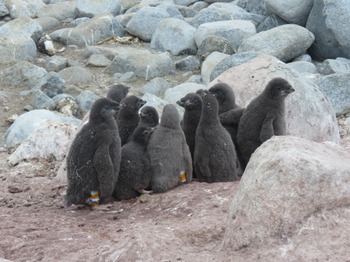
On 15 January 2019, 10 Adélie penguin chicks were captured with a butterfly net. All chicks were fitted with a heart rate monitor (type: FCHL101; ChangSha Can Fly Electronic Technology Co., China) weighing 25 g. The heart rate monitor was bound to the tarsometatarsus, with the probe close to the skin (Fig. 1). There is one LED light and one photo detector within the probe. The light emitted from the LED travels through tissue and blood and is collected in the photo detector. The flow of blood is heartbeat induced, so the transmitted light changes with time. In this way, the monitor records heart rate continuously and reports the number of beats per minute. This monitor was calibrated for Humboldt penguins (Spheniscus humboldti), as the measurement difference between this monitor and a stethoscope was less than 5% of the actual heart rate (measuring with a stethoscope), according to the manufacture’s data sheets.
The picture shows two Adélie penguin chicks fitted with the heart rate monitor (type: FCHL101; ChangSha Can Fly Electronic Technology Co., China). The heart rate monitor was bound to the tarsometatarsus, with the probe close to the skin.

On 21 January 2019, six Adélie penguin chicks fitted with heart rate monitors were recaptured. These chicks were molting when they were recaptured, with visible new plumage. As Adélie penguin chicks begin to develop a new plumage at an age of about 25 days (Penney, Reference Penney1967), we inferred that these chicks were fitted with heart rate monitors at about age 20 days. The fate of the four other Adélie penguin chicks fitted with heart rate monitor is unknown, as these four chicks, or their corpses, were not seen within or near the crèches.
The research protocol was approved by the Animal Management Committee at the College of Life Sciences, Beijing Normal University, under license number CLS‐EAW‐2018‐012. Bird capture was permitted by the Chinese Arctic and Antarctic Administration and the 35th Antarctic scientific expedition of China.
Data selection
After obtaining the data, the heart rate during the first 1.5 h after fitting the monitor and the heart rate during the last 0.5 h before recapturing were deleted. As penguins are sensitive to human disturbance (Le Maho et al., Reference Le Maho, Whittington, Hanuise, Pereira, Boureau, Brucker and Le Bohec2014), heart rate during these time spans may be unnatural.
In total, 7 269 ± 1 905 min of heart rate data per individual (mean ± standard deviation) was used in the following analysis (8 280, 8 264, 8 348, 6 771, 8 359 and 3 590 min, respectively, for each individual; Appendix 1). Four heart rate monitors recorded periods of zero beats/min, totally 133 min (periods of 1, 4, 10 and 118 min were recorded per respective individual). It is difficult to explain zero beats/min for heart rate, as all individuals were still alive. The manufacturer (ChangSha Can Fly Electronic Technology Co., China) suggested that the zero beats/min may be due to the drop of the probe when penguins do strenuous exercise. However, the reasons remain uncertain. To be conservative, we deleted these zero beats/min data. Then, the average heart rate for each half hour per individual was calculated, for smoothing the data and also for eliminating the gaps (with zero beats/min).
Data analysis
In previous studies of daily rhythms in Adélie penguins, it was always assumed that the large variation in activity, heart rate or plasma melatonin over the 24-h day is evidence of daily rhythms, while uniform or no obvious change of these components signals the lack of daily rhythms (Cockrem, Reference Cockrem1991a; Yeates, Reference Yeates1971). However, the significance of daily rhythms lies in the predictability of daily cycles, with different species, or even different rhythms within the same species (e.g. melatonin and core body temperature in humans) showing various patterns within the cycle (Benloucif et al., Reference Benloucif, Guico, Reid, Wolfe, L’Hermite-Baleriaux and Zee2005; Edgar et al., Reference Edgar, Green, Zhao, van Ooijen, Olmedo, Qin and Reddy2012). In that way, for estimating daily rhythmicity we focused on whether there is a (roughly) 24-h cycle, rather than a specific pattern within 24 h.
Both fast Fourier transformation and autocorrelation were employed to assess the daily rhythm in this study. Through fast Fourier transformation, the time series can be decomposed into several sine waves with different cycles (Heideman, Johnson & Burrus, Reference Heideman, Johnson and Burrus1985). The cycle closest to 24 h was reported for each individual, and the significance of the cycle was assessed by the harmonic analysis test (Fisher, Reference Fisher1929), based on the null hypothesis of white noise against the alternative hypothesis of a periodic wave.
Autocorrelation, another popular approach for the identification of cycles, shows the degree of similarity between the elements of a time series and others from the same time series separated from them by a given time lag (Yue, Pilon, Phinney & Cavadias, Reference Yue, Pilon, Phinney and Cavadias2002). An autocorrelation coefficient, with a 24-h time lag, was calculated for each individual. If there is a daily rhythm, the real autocorrelation coefficient calculated from heart rate data should be larger than the autocorrelation coefficient calculated from white noise time series. White noise time series were constructed 1000 times, by randomly sorting the original number in heart rate data. The corresponding 1000 autocorrelation coefficients were calculated from these 1000 white noise time series. The ratio between the number of autocorrelation coefficients calculated from white noise time series larger than real autocorrelation coefficient and 1000 was calculated as the significance level of the real autocorrelation coefficient, based on the null hypothesis that the real autocorrelation coefficient is no larger than 0.
All analyses were performed using R software (R Core Development Team, 2019), with fast Fourier transformation and harmonic analysis test in the package PML (Li & Kane, Reference Li and Kane2019). Data were presented as mean ± standard deviation, and p values < 0.05 were considered statistically significant.
Results
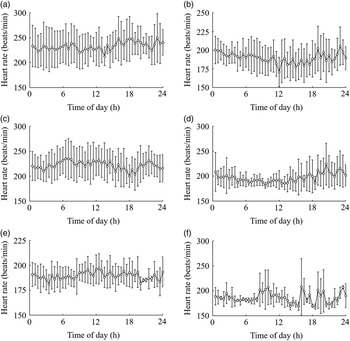
For these six Adélie penguin chicks on Inexpressible Island during the polar day, mean (± SD) heart rates were 233 ± 43, 189 ± 27, 222 ± 34, 196 ± 28, 190 ± 20 and 186 ± 24 beats/min, respectively (Fig. 2).
Heart rate for each half hour (mean ± standard deviation) plotted against time of day. A~F represent six Adélie penguin chicks, with 8 280, 8 264, 8 348, 6 771, 8 359 and 3 590 min heart rate data collected, respectively.

Through fast Fourier transformation, the heart rate data were decomposed into sine waves with different cycles. The cycle closest to 24 h varied among individuals from 23 to 30 h (Table 1). However, only the cycle of one individual (ID_4) was significant (p = 0.017), based on harmonic analysis test, while the cycles in the other individuals did not contribute substantially to variation in heart rate.
The cycle closest to 24 h in fast Fourier transformation and autocorrelation coefficient with a 24-h time lag for each individual.

1 The significance of the cycle was assessed by harmonic analysis test (Fisher, Reference Fisher1929).
2 The significance of autocorrelation coefficient was assessed by comparison with white noise time series.
The autocorrelation coefficient with a 24-h time lag for each individual was calculated (Table 1). Among them, only the autocorrelation coefficients in two individuals were significantly larger than 0 (p < 0.001). The value of these two autocorrelation coefficients were 0.24 (ID_3) and 0.23 (ID_5), which means the 24-h rhythm can only explain a small proportion of the variance in the heart rate.
Discussion
In this study, 5.05 ± 1.32 days heart rate data per individual were collected from six Adélie penguin chicks on Inexpressible Island from 15 January 2019 to 21 January 2019. These heart rate data were used to assess the daily rhythm during the polar day. However, neither Fourier transformation nor autocorrelation found prevailing daily rhythms of heart rate in these Adélie penguin chicks. Through fast Fourier transformation, daily rhythm that significantly contributed to the variation in heart rate was found only in one individual. Similarly, small effect sizes of significant autocorrelation coefficients were found in two individuals. Thus, a large proportion of heart rate variation could not be explained by daily rhythms in Adélie penguin chicks.
Comparison with previous studies of penguins
Cockrem (Reference Cockrem, Davis and Darby1990) concluded that “Antarctic penguins maintain daily activity rhythms during the summer”. This is true for penguins breeding north of the Antarctic Circle. For example, both gentoo penguins (Pygoscelis papua) and chinstrap penguins (Pygoscelis antarctica), breeding around the Antarctic Peninsula with light–dark cycle during summer, show a two-peak (dawn and afternoon) rhythm of activities during summer (Golombek, Calcagno, & Luquet, Reference Golombek, Calcagno and Luquet1991; Quintana, Pratolongo, Agraz, Benitez, & Mengual, Reference Quintana, Pratolongo, Agraz, Benitez and Mengual2005). The situation is complex for penguins that live south of the Antarctic Circle and experience no obvious photic zeitgeber cues during the polar summer. Although Adélie penguins can be active 24 h per day during the polar day, the activity levels on land are reduced during mid-day (Wilson, Culik, Coria, Adelung, & Spairani, Reference Wilson, Culik, Coria, Adelung and Spairani1989; Yeates, Reference Yeates1971), which seems connected with the high summer noon temperatures that approach the birds’ upper limit of tolerance (Müller-Schwarze, Reference Müller-Schwarze1968). However, this daily rhythm (mid-day minimum) was not supported in another study: both bird activity and heart rate showed no diurnal periodicity after correcting for wind speed influences (Culik et al., Reference Culik, Adelung, Heise, Wilson, Coria and Spairani1989). Plasma prolactin, corticosterone and melatonin levels also did not reveal daily rhythms in Adélie penguins during the polar day (Cockrem, Reference Cockrem1991a; Vleck & Van Hook, Reference Vleck and Van Hook2002). However, the daily rhythm of plasma melatonin in Adélie penguins quickly emerge under an artificial light–dark cycle in the laboratory during the polar summer (Cockrem, Reference Cockrem1991b). Emperor penguins (Aptenodytes forsteri), which lives south of the Antarctic Circle, had daily rhythmicity of melatonin secretion when there was a light–dark cycle in the environment, while this rhythmicity was largely absent during both polar day and polar night (Miche et al., Reference Miche, Vivienroels, Pevet, Spehner, Robin and Lemaho1991).
Why is there no daily rhythm in Adélie penguin chicks?
Could the lack of a daily rhythm be due to the weak strength of the cycle in environmental factors? This is perhaps the most common explanation for the lack of daily rhythm in polar regions (Lakshman et al., Reference Lakshman, Shindey and Sharma2017; Williams et al., Reference Williams, Barnes and Buck2015). The sun never sets during the polar day, resulting in continuous daylight. However, the temperature and light intensity show diurnal periodicity (Cockrem, Reference Cockrem1991a; Culik et al., Reference Culik, Adelung, Heise, Wilson, Coria and Spairani1989; also see in Appendix 2). There is also daily cycling of other environmental factors in the habitat, such as the rhythmicity of the tide (Bornemann, Mohr, Plötz & Krause, Reference Bornemann, Mohr, Plötz and Krause1998). These cycles in environmental factors may stimulate the sensory systems and activate the complex endogenous biological clock in birds (Gwinner & Brandstatter, Reference Gwinner and Brandstatter2001; Kumar, Singh & Rani, Reference Kumar, Singh and Rani2004).
The lack of daily rhythm in newborns can be due to the immature circadian rhythm in some species. For example, there is no rhythmicity of body temperature, breathing or heart rates in newborn goats and sheep (Giannetto et al., Reference Giannetto, Arfuso, Fazio, Giudice, Panzera and Piccione2017); in newborn dogs, the onset of daily rhythms of body temperature is at about one month of age, while daily rhythms in breathing and heart rates could not be recognised at the age of two months (Piccione, Giudice, Fazio, & Mortola, Reference Piccione, Giudice, Fazio and Mortola2010); for humans, the first daily patterns of heart rates in infants become apparent at the age of one month (Ardura, Andres, Aldana, Revilla, & Aragon, Reference Ardura, Andres, Aldana, Revilla and Aragon1997; Glotzbach, Edgar, Boeddiker, & Ariagno, Reference Glotzbach, Edgar, Boeddiker and Ariagno1994). Birds generally have a faster growth rate than mammals (Case, Reference Case1978), with a quick development of circadian rhythm (Tazawa, Akiyama & Moriya, Reference Tazawa, Akiyama and Moriya2002). For example, dickcissel (Spiza americana) fledglings show a daily rhythm of activity seven days after hatching (Jones, Brawn & Ward, Reference Jones, Brawn and Ward2018); shortly after hatching, the heart rate of domestic chickens (Gallus gallus domesticus) forms a clear daily rhythm, with marked increase during daytime and a drop during night (Moriya, Hochel, Pearson & Tazawa, Reference Moriya, Hochel, Pearson and Tazawa1999). Considering the quick development of circadian rhythm in previously studied birds, the lack of circadian rhythm in heart rate in Adélie penguin chicks is probably not due to slow development of this rhythm.
It is generally assumed that daily rhythms are an adaptation of organisms to daily fluctuations in environmental factors (Woelfle et al., Reference Woelfle, Yan, Phanvijhitsiri and Johnson2004; Yerushalmi & Green, Reference Yerushalmi and Green2009). Could the lack of daily rhythm in Adélie penguin chicks be an adaptation to the local environment? This is probably true. Adélie penguins breed in open areas, with no shelter for chicks to avoid the attack from predators. There are thousands of south polar skuas (Catharacta maccormicki) in the Ross Sea (Wilson et al., Reference Wilson, Lyver, Greene, Whitehead, Dugger, Karl and Ainley2017), with the eggs and chicks of penguins as its main source of food on land (Grilli, Libertelli & Montalti, Reference Grilli, Libertelli and Montalti2011). Without various strategies such as habitat choice and camouflage, the only way for Adélie penguin chicks to avoid attack from south polar skuas is escape. Perhaps, it is advantageous for the chicks to keep a high activity all day to increase their chances of survival in such dangerous surroundings. We therefore speculate that, since the heart rate is closely linked to activity in penguins (Green et al., Reference Green, White and Butler2005; Groscolas et al., Reference Groscolas, Viera, Guerin, Handrich and Cote2010), the lack of daily rhythm of heart rate in Adélie penguin chicks might be an adaptation to reduce predation in polar regions.
In conclusion, our recordings of Adélie penguin chicks’ heart rates during the polar summer provided no indication of prevailing daily rhythms in heart rate. We propose that the lack of daily rhythms in this instance is likely an adaptation to the local environment, although the exact adaptive value remains to be investigated.
Acknowledgements
Our thanks to Zhu Lizhong, Zhang Bo, Xu Qibin and Wang Ninglian for their assistance in the field work, and Anders Pape Møller and Per Alström for their contribution in the correction of English language. This study was supported by the Chinese Arctic and Antarctic Administration (No. JDXT2019-02), Polar Research Institude of China and the 35th Antarctic Scientific Expedition of China.
Conflict of interest
None
Ethical standards
The authors assert that all procedures contributing to this work comply with the ethical standards of the relevant national and institutional guides on the care and use of laboratory animals. The research protocol was approved by the Animal Management Committee at the College of Life Sciences, Beijing Normal University, under license number CLS‐EAW‐2018‐012. Bird capture was permitted by Chinese Arctic and Antarctic Administration and the 35th Antarctic Scientific Expedition of China.
Author Contributions
Canwei Xia and Yanyun Zhang designed the experiments. Canwei Xia collected and analysed the data. Canwei Xia and Yanyun Zhang wrote the manuscript.
Supplementary material
To view supplementary material for this article, please visit https://doi.org/10.1017/S0032247420000017