Outbreaks of infectious diseases, such as the 2002 to 2003 severe acute respiratory syndrome (SARS) outbreak or the more recent influenza pandemic (influenza A[H1N1]pdm09) not only have a significant impact on individual and public health, but can also lead to other adverse consequences such as short-term reductions in global economic output.Reference Gupta, Moyer and Stern1, Reference Mackey and Liang2 Therefore, it is important that those responsible for safeguarding public health have efficient, effective, and coordinated management in place to prepare for and respond to outbreaks of infectious diseases. However, research into infectious, particularly emerging, diseases, which many regard as critical to the design of effective control measures, is still viewed with suspicion by many members of the public.Reference Dickmann, Keith, Comer, Abraham, Gopal and Marui3, Reference Inglesby, Cicero and Henderson4 Dual-use aspects of biomedical research, meaning that findings can potentially be applied for both civilian and military means, are currently being widely discussed.Reference Cohen5–Reference Herfst, Osterhaus and Fouchier8
These considerations, along with further research into public attitudes, point to an increasing public demand for comprehensive, coherent, and concise information on infectious disease outbreaks, especially the scientific evidence used to inform different approaches to their management.Reference Dickmann, Rubin and Gaber9–Reference Rubin, Page and Morgan11 These developments underline the importance of risk communication strategies, in terms of both preparedness and crisis response, to the public sphere.
In 2005, the World Health Organization (WHO) published the International Health Regulations (IHR), which advise all member states to ensure that sufficient capacity is devoted to the prevention of, and preparation and response to, major disease outbreaks and other public health emergencies; this has been a legally binding requirement since 2007. Risk communication is placed as 1 of the 8 core capacities required for states to be in line with the regulation. However, while the IHR and associated risk communication quality indicators and capability assessments show that this issue is beginning to be accorded greater importance, little empirical data are publicly available on the capacities and practice by member states on the ground. This lack of data makes comparisons among countries impossible, which in turn limits their scope for learning from best practices, which occurs in many other areas of public policy.
The aim of this study was to provide an outline of the current approaches to risk communication and crisis management in Germany, against which other countries can potentially benchmark their own performance. We also sought to identify areas for development within the German system itself.
Methods
The study involved a cross-sectional, 2-stage, mixed methods approach. First, an electronic questionnaire containing both closed and open-ended items was distributed via e-mail to the directors of the 12 research laboratories under the umbrella of the German Centre for Infection Research (Deutsches Zentrum für Infektionsforschung, DZIF). This questionnaire included information about the anonymity of the responses, which noted that participation is voluntary, and that respondents could opt out at any time without giving reasons. The same instrument, which was slightly adapted to reflect differences between the laboratory and clinical context, was also sent to the 8 hospitals constituting the State Network of Competence and Treatment Centres of Highly Infectious Patients (Ständige Arbeitsgemeinschaft der Kompetenz- und Behandlungszentren, StAKoB). In spite of the ostensibly small sample size, these hospitals collectively comprise every high containment ward in Germany.
For the purposes of the questionnaire, risk communication was defined as any communication in isolation or as part of coordinated efforts with other persons and agencies or general planning activities related to the period before an outbreak or crisis. For example, these might include any proactive communication designed to improve understanding of risks and benefits associated with laboratory research into infectious diseases. Similarly, crisis communication was posited to be anything that falls into the cited categories but which took place during an outbreak or crisis, including the implementation of certain emergency protocols. Survey responses were used to generate a series of descriptive statistics.
In the second stage, semistructured interviews were conducted with representatives from the laboratories (n = 2), hospitals (n = 1), state public health authorities (n = 3), and federal agencies (n = 2). A focus group was also conducted with a group of 7 journalists to garner a media perspective. The interviews were informal and were designed to collect information on attitudes, experiences, and expectations. The contents of the interviews were grouped according to profession, and key themes were extracted. These groups were then analyzed with respect to the questionnaire items.
Results
Data collection and interviews took place between April and August 2012. The response rate among laboratories was 83.3% (10/12), and the rate among hospitals was slightly higher at 87.5% (7/8). Laboratory size ranged from 14 to 120 research staff, encompassing the only 2 BSL4 laboratories (focused on highly pathogenic viruses and tropical medicine) in Germany along with 8 other BSL3 laboratories, whose research centers on infection biology and immunology. The hospitals in the sample also varied in size. The ratios of doctor/nurse to isolation beds are shown in Figure 1. Isolation ward usage rates also varied greatly; 1 ward had yet to treat a patient, while another had only received 1 patient in 1999. Another hospital frequently used its isolation ward to treat patients with multidrug-resistant infections.
Overview of Isolation Beds in Proportion to Physicians and Nursing Staff in Hospitals.

Risk Communication
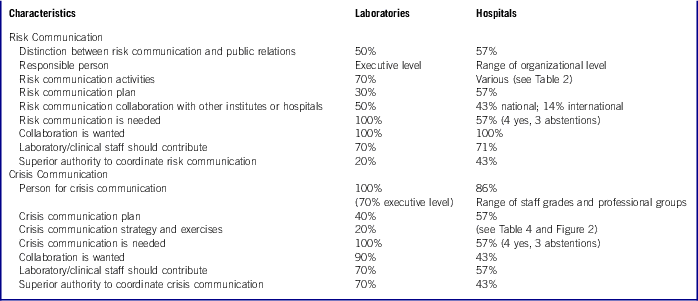
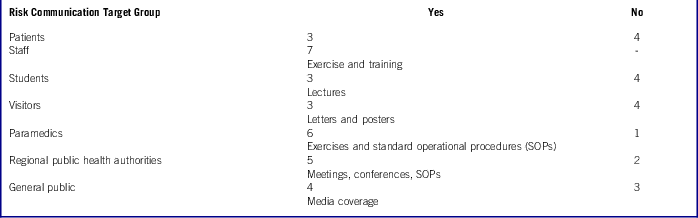
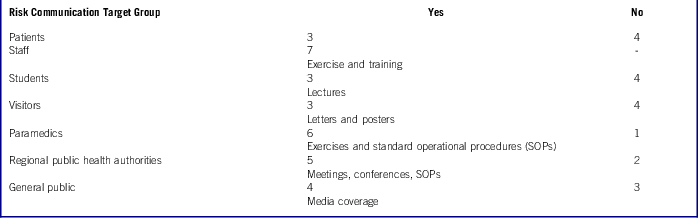
One half of the laboratories distinguished between risk communication and day-to-day public relations activities; a comparable situation was observed for hospitals. Responsible persons for risk communication in laboratories were found to be in management positions, whereas hospitals relied on staff at the consultant level to guide their activities. The majority of laboratories reported at least 1 example of activities related to risk communication (open days, materials providing information, eg, on good hygiene practices). Among the hospitals, the majority were found to engage in communication aimed at highlighting risk with staff (100%), paramedics (86%), and public health officials (71%) (Tables 1 and 2). However, patients, students, visitors, and the public were only sporadically addressed by hospitals. Both laboratory and hospital respondents reported that risk communication is necessary and they believed that they have a role to play in it. They also expressed a preference for more collaborative working arrangements. However, both sets of respondents cautioned against a top-down approach to implementation; instead, they advocated the development of relationships with similar institutions, for example, through networks, as the best way of introducing a coordinated strategy.
Risk Communication and Crisis Communication of Laboratories and Hospitals
Risk Communication Activities of Hospitals With Target Groups
Crisis Communication
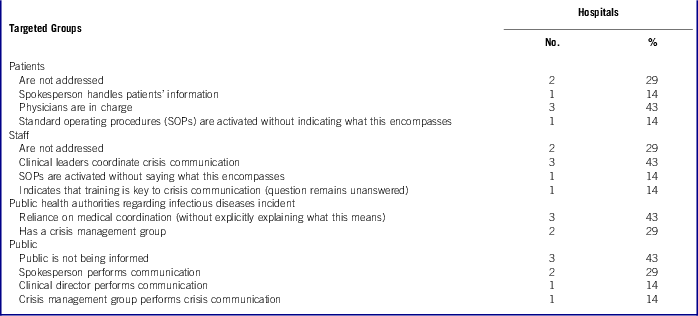
In terms of crisis communication, all of the laboratories and almost all of the hospitals had a specifically designated person responsible for this role. This person tended to be an executive for the laboratories, while the hospitals designated persons from a variety of departments, eg, medical physicians, physician consultants, and clinical directors. However, only a minority of the laboratories (40%) and just over half (57%) of the hospitals had a formal crisis communication plan. Only 20% of the laboratories conducted drills to test the robustness of their protocols. In contrast to risk communication, respondents in 70% of the laboratories and in 43% of the hospitals expressed a view that crisis communication should be managed by central authorities, albeit with input from local institutions and agencies (Table 3; Figure 2).
Hospital Crisis Communication Strategy
Crisis Communication Exercises Conducted in Hospitals.
Laboratory Staff Perspective
Findings from the interviews with laboratory staff broadly supported those of the questionnaire study. Both groups of interviewees expressed the need for greater coordination between interested parties with regard to risk communication. Also, they noted that a joint strategy would address the deficiencies of the current system, in which both staff and the public tend to gain the majority of their information secondhand through the media. In addition, the respondents expressed a willingness to be involved in efforts to achieve the increased communication. One suggestion to achieve better risk and crisis communication was through the use of an expert directory, although a barrier to using pooled resources and plans was current constraints on capacity, with materials and outputs requiring large investment of resources.
Hospital Staff Perspective
We also interviewed a staff member from the infectious disease department in one of the hospitals. The findings were similar to those of the laboratory interviews: risk communication activities are insufficient, and crisis communications lack the necessary coordination. The respondent detailed emotionally fraught experiences when faced with public concerns and media interest regarding certain patients treated at the hospital. The hospital had instances of in which journalists disguised as hospital supply workers attempted to gain access to information directly. Because of these previous negative experiences with journalists, the hospital is now careful to maintain good relations with the media and the public to ensure that accurate information is available.
Policy Perspective
During the interviews with the 2 representatives of federal institutes, it was revealed that 1 institute did not have a dedicated risk communication unit. However, it did undertake a range of risk communication activities via its website, publications, research projects, regular open days, and connections with media representatives and experts from other institutions. It also noted that another agency was responsible for health communication and for publically tailored communication campaigns.
The other institute was found to have a large risk communication department consisting of 40 staff members, representing 5% of the entire institute. The risk communication department was subdivided into risk research (30%), scientific event management (25%), internal and external coordination (national and international, 20%), and public relations (25%).
Public Health Perspective
Public health functions organized as part of the StAKoB network were found to have well-established protocols governing the management of highly infectious patients. However, the interviews with staff suggested that risk communication was still lacking in the context of clinical management of and public health threat posed by infectious diseases. Because those involved in the management of highly infectious patients were small in number, an informal network had evolved that helped facilitate more effective risk communication practices. As respondents from the other professions noted, the interviewees also expressed a desire for more coordination between the various sectors. In addition, they suggested the creation of a task force to help and contribute to both the risk communication and the crisis management, which was similar to what the laboratory workers recommended. Finally, they stressed the need for multidisciplinary exercises to be conducted in different settings.
Media Perspective
The media focus group comprised 7 journalists, drawn from a range of mediums (radio, daily and weekly print, freelance). The respondents expressed the view that risk communication is generally lacking in the management of threats posed by infectious diseases. They thought that the system would benefit from more openness and transparency in communications from laboratories, especially given the large amount of public interest. Emphasis was placed on the provision of hard facts and the need for stakeholders to actively engage with media representatives. They also believed that public perception is an important determinant of media amplification. However, they acknowledged that the process by which public interest develops is complex and may be difficult to change. The group of journalists were in favor of developing their relationship with stakeholders within the health service.
Discussion
The findings from this study pointed to a German risk and crisis communication framework that is improving but is far from complete. The large variation in risk communication activities carried out by laboratories and hospitals indicated the lack of a coordinated strategy for dealing with issues related to infectious disease outbreaks. Only a small number of the institutions in the study were found to have a formal crisis communication plan, and even fewer actively tested the appropriateness of these plans through simulated exercises. These exercises also tended to be associated with general crisis management and were not specific to communication, with hospitals excluding key groups such as patients, students, visitors, and member of the public.
This lack of communication increases the possibility of public anxiety, leading to spikes in demand for information during times when threats are perceived to be elevated. Subsequently, failures in high-level crisis management result, especially where capacity at the top levels is limited. It is therefore not surprising that crisis communication is frequently a major focus for public criticism and complaints.
It was clear that representatives from laboratories and hospitals perceive an urgent need for improvement in risk and crisis communication measures. Although the current trend has been for crisis management to be driven in a top-down directive from the government, they believed that risk communication should be built on strong networks among relevant institutions and key players working together with a coordinated strategy.
Although the exact changes that would be needed to implement that goal were unclear, some lessons could be taken from areas in which the infrastructure and protocols were already in place. For example, while we found that some federal institutes have dedicated risk communication departments, with research, coordination, and public relations subdivisions, most only have general purpose public relations departments managing all types of communication. By having a model whereby various subdivisions, each with a clear function and mandate, work together to achieve shared goals, it would be possible to develop a national framework.
Practical issues in the way that patients suffering from highly infectious diseases are managed were also thought to have a negative impact on risk communication measures. One example is when management protocols differ between the various parts of the health service with which a patient interfaces. This disconnection can lead to confusion and potential misinformation when practices contradict each another. Closely related to this example are issues arising from gaps within the protocols themselves and whether they are implemented in an optimal manner. Moreover, because expertise also varies significantly, opportunities to relay critical information may be missed.
Working with the media is a topic frequently on the agenda of StAKoB meetings regarding strategy, but a consistent approach has yet to emerge. The findings from our study suggest that members of the media are willing to work with stakeholders to develop better relationships; however, it is questionable how much the role of the media can change given their lack of training on the issues at hand and the commercial pressures in some areas. The journalists interviewed in our study expressed a desire for “a face to relate to.” They believed that they had a role to play in improving the understanding of infectious diseases and outbreak patterns. It was also clear that the human element must be adequately considered in any crisis; otherwise, an informational vacuum may arise. In the worst case scenario, the vacuum would be filled with rumor, opinions from self-appointed experts, and sensational press coverage.
Limitations
The survey used for this study was subject to a number of limitations. First, the questionnaire sent to laboratories was not necessarily completed by the person with overall responsibility for risk and crisis communication. The answers expressed in the questionnaire could therefore be biased by gaps in knowledge and experience of the respondents (junior bias) and fail to reflect the official position of the laboratory. Questionnaire and interview respondents were also selected based on their knowledge and expertise in the area of infectious disease management and risk communication, which may have introduced bias in the importance accorded to the issues under investigation. The small sample size was also accepted as an overall limitation; however, the impact of this was attenuated by the inclusion of all operational BSL4 laboratories, 8 of the leading BSL3 laboratories of the DZIF, and all hospitals in Germany containing a high-risk isolation ward. Finally, some bias may have resulted from the sampling method used to recruit interviewees. We attempted to minimise the impact of this by only using the qualitative data as contextual information for the questionnaire responses.
Conclusion
This survey indicated that the strategies toward risk and crisis communication currently adopted by German agencies and institutions responsible for managing infectious disease outbreaks and other public health emergencies would benefit from better coordination between interested parties. It also provided information against which academics and decision makers in other countries may benchmark the performance of their own systems.
Those involved with these concerns, however, are aware of the deficiencies in the current system and appear to be working toward remedying the most pressing gaps, such as the development of a joint communication strategy and a knowledge-sharing policy. Examples of best practice are also available, and may serve as a template for service delivery in other areas. In addition, better network operations may produce economies of scale and therefore reduce the overall workload for the various institutions involved.
However, a key barrier to the improvement of the current situation in Germany, and indeed in other countries as well, is the lack of a normative framework to guide best practices in terms of risk and crisis communication. The global community with a vested interest in this important area needs to develop more research into effective means of risk communication, which can then be used to inform the activities of practitioners in the field.
Funding and Support
This work was supported by the Federal Ministry of Education and Research (BMBF) through the German Center of Infection Research (TTU Emerging Infections).
Disclaimer
The publication of data respects the anonymity of the participating facilities and interviewees. Participation in the survey and focus group was voluntary and could be terminated at any time without giving reasons.