



No CrossRef data available.
CAUSALITY: MODELS, REASONING, AND INFERENCE, by Judea Pearl, Cambridge University Press, 2000
Published online by Cambridge University Press: 06 June 2003
Extract
This book seeks to integrate research on cause and effect inference from cognitive science, econometrics, epidemiology, philosophy, and statistics. It puts forward the work of its author, his collaborators, and others over the past two decades as a new account of cause and effect inference that can aid practical researchers in many fields, including econometrics. Pearl adheres to several propositions on cause and effect inference. Though cause and effect relations are fundamentally deterministic (he explicitly excludes quantum mechanical phenomena from his concept of cause and effect), cause and effect analysis involves probability language. Probability language helps to convey uncertainty about cause and effect relations but is insufficient to fully express those relations. In addition to conditional probabilities of events, cause and effect analysis requires graphs or diagrams and a language that distinguishes intervention or manipulation from observation. Cause and effect analysis also requires counterfactual reasoning and causal assumptions in addition to observations and statistical assumptions.
Information
- Type
- BOOK REVIEWS
- Information
- Copyright
- © 2003 Cambridge University Press
This book seeks to integrate research on cause and effect inference from cognitive science, econometrics, epidemiology, philosophy, and statistics. It puts forward the work of its author, his collaborators, and others over the past two decades as a new account of cause and effect inference that can aid practical researchers in many fields, including econometrics. Pearl adheres to several propositions on cause and effect inference. Though cause and effect relations are fundamentally deterministic (he explicitly excludes quantum mechanical phenomena from his concept of cause and effect), cause and effect analysis involves probability language. Probability language helps to convey uncertainty about cause and effect relations but is insufficient to fully express those relations. In addition to conditional probabilities of events, cause and effect analysis requires graphs or diagrams and a language that distinguishes intervention or manipulation from observation. Cause and effect analysis also requires counterfactual reasoning and causal assumptions in addition to observations and statistical assumptions.
Chapter 1 sketches some of the ingredients of the new approach to cause and effect inference: probability theory, graphs, Bayesian causal networks, causal models, and causal and statistical terminology. Chapter 2 builds the elements of Chapter 1 into a theory of inferred causation. Chapter 3 focuses on causal diagrams and identifying causal effects. Chapter 4 studies intervention or manipulation and direct causal effects. Chapter 5 considers causality and structural equation models. Chapter 6 examines Simpson's paradox and confounding. Chapter 7 blends structural modeling with counterfactual reasoning. Chapter 8 is an approach to imperfect random assignment experiments through bounding effects and counterfactuals. Chapter 9 analyzes notions of necessary cause and sufficient cause. Chapter 10 explicates a concept of single event causality. The epilogue is a public lecture that Pearl gave at UCLA that, in mostly not too technical language, places the new approach to causality within the long history of thought on the subject.
The interdisciplinary nature of the book, a great strength, at times makes it difficult to read because its theory of inferred causation blends the languages of econometrics and statistics, mathematical graph theory, and Bayesian networks with philosophical notions of cause and effect. However, Pearl facilitates reader understanding by using reasonably straightforward mathematics and examples to help to connect the separate disciplinary discourses. Nevertheless, an only semiformal approach does not ease sorting the theory into assumptions and deduced conclusions. The chapters less build one upon the next than take cuts at the subject of causality from slightly different angles. Hence the reader must struggle to sort assumptions from conclusions and to assemble the theory from the slices. The book rewards perseverance in such an effort. Pearl deepens one's sense of the nuances involved in cause and effect inference and offers intriguing proposals to deal with some unresolved conceptual issues in such inference.
1. THE BASIC IDEAS OF THE THEORY OF INFERRED CAUSATION
By probability Pearl means degree of belief. Let V be a set of variables, preordered by hypothesized cause-effect relations, whose joint probability distribution is P(v). He calls a minimal set of predecessors of any Xi in V that make it independent of all of its other predecessors the Markov parents or immediate causes (PAj) of Xi. That is, if Qi (⊇ PAj) is the set of predecessors of Xi then P(xj|pai) = P(xj|qi) and the equality fails to hold if any proper subset of PAj replaces PAj. The functional causal model associated with V is a set of equations of the form xi = fi(paj, uj), i = 1,…,n “where the Uj represent errors (or ‘disturbances’) due to omitted factors” (p. 27) and the fi are functions.
From mathematical graph theory, Pearl takes a graph as a set of nodes with some edges between them. Edges are either directed or not. Points, lines, and arrows represent nodes, edges, and directed edges, respectively. A path is a sequence of edges, and a cycle is a path with at least two edges that ends at the node where it began. A directed acyclic graph (DAG) is one with no cycles whose edges are all directed. Pearl depicts the preordering of V by hypothesized cause-effect relations with a graph whose nodes are the variables of V where the arrows entering any node are from its hypothesized immediate causes. So a causal structure consists of the set of variables V, its joint probability distribution P(v), its preordering by hypothesized cause-effect relations, its functional causal model, and its associated graph.
Pearl holds that his functional causal model concept “is a nonlinear, nonparametric generalization of the linear structural equation models (SEMs)” (p. 27) of econometrics. The graphs associated with causal structures, developed by him and others in Bayesian networks, resemble the path analytic diagrams that the Wrights sought, only partially successfully, to introduce into econometrics in the 1920s (see Morgan, 1992, pp. 178–179). Pearl stresses that in “linear models, paj corresponds to those variables on the r.h.s…. that have nonzero coefficients” (p. 27).
Pearl maintains that the absence in probability language of a way to distinguish setting a variable from observing it impedes the modeling of cause and effect relations. He introduces “do(x)” for setting X = x, and “x” for observing X = x. The expression “do(xj)” means to delete the arrows from PAj to Xj from the graph and the equation xi = fi(paj,uj) from the functional causal model and to set Xj = xj in the right-hand sides of the other equations of a causal structure. Pearl calls the mapping from x to P(y|do(x)) for all x the causal effect of X on Y. He calls the mapping from (x, paY[setmn ]X) to P(y|do(x), do(paY[setmn ]X)) for all (x, paY[setmn ]X), where paY[setmn ]X is a realization of the Markov parents of Y (excluding X), the direct effect of X on Y.
Setting variables is not always ethical or possible. If P(y|x) ≠ P(y|do(x)), Pearl says that there is confounding bias. He argues that even without setting X = x one can sometimes estimate P(y|do(x)) from observations and assumptions embedded in the graph of the functional causal model. Whereas path analysis uses arrows primarily to depict coefficients that are not a priori zero, Pearl develops work on causality by analytic philosophers beginning in the 1950s (see Eells, 1991, pp. 59–80) into a fuller graphical formalism. In particular, he shows that two graphical criteria are sufficient conditions for causal effects to be expressible in terms of probabilities without the “do” operator.
A set of nodes, Z, blocks (or d-separates) a path p if and only if p contains a chain i → z → j with z ∈ Z, a fork i ← z → j with z ∈ Z, or a collider i → m ← j with neither m nor any descendant of m ∈ Z. Here Z satisfies the back-door criterion relative to an ordered pair of nodes (X,Y) in DAG G if no node in Z is a descendant of X and Z blocks every path between X and Y that contains an arrow into X. Pearl proves that if Z satisfies the back-door criterion relative to (X,Y) then P(y|do(x)) = Σz P(y|x, z)P(z).
The variable Z satisfies the front-door criterion relative to an ordered pair of nodes (X,Y) in DAG G if Z intercepts all paths from X to Y, there is no back-door path from X to Z, and X blocks all back-door paths from Z to Y. Pearl proves that if Z satisfies the front-door criterion relative to (X,Y) and P(x, z) > 0 then P(y|do(x)) = Σz P(z|x)Σx′ P(y|x′,z)P(x′).
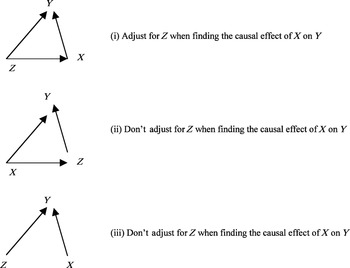
Figure 1 contains graphs of hypotheses of the causal relations among three variables. In (i) Z is a common cause of X and Y, Z satisfies the back-door criterion relative to (X,Y), and the Pearl adjustment formula makes intuitive sense. In (ii) Z is not a common cause of X and Y, Z fails to satisfy the back-door criterion relative to (X,Y), and to combine the direct and indirect causal effects of X on Y no adjustment for Z makes intuitive sense. In (iii) Z is not a common cause of X and Y, Z fails to satisfy the back-door criterion relative to (X,Y), but adjustment for Z seems to make intuitive sense if X and Y are associated. That is, from an econometric perspective if Z and X are collinear then shouldn't one adjust for Z when assessing the effect of X on Y?

The back-door criterion.
For Pearl a “node in a directed graph is called a root if it has no parents” (p. 13) “and root variables (as the d-separation criterion dictates) are independent of all other variables except their descendants” (p. 25). So his graphical formalism appears to assume that the root nodes X and Z in Figure 1 (iii) are independent and hence not associated. The philosophical literature that Pearl formalizes in his back-door criterion takes third variable common causes as the only source of confounding bias. Yet Mill draws a distinction between “laws of causation and collocations of the original causes” (1973, p. 348). Two associated causes of an effect can confound attempts to separate their impacts. In a single equation linear model, this is the problem of multicollinearity, and the Pearl approach appears to rule it out a priori.
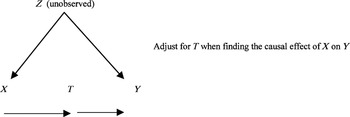
Figure 2 contains a graph of a hypothesis of the causal relations among X, Y, and Z. That graph differs from Figure 1(i) in two respects. It contains a new variable T that is an intermediate effect between cause X and effect Y, and Z is now unobservable. That Z is unobservable makes application of the back-door criterion to the fork X ← Z → Y impossible. However, T in Figure 2 satisfies the front-door criterion relative to (X,Y) so that P(y|do(x)) is expressible in terms of probabilities and observable variables without the “do” operator using the adjustment formula of that criterion. Pearl notes that this conclusion is controversial, at least among statisticians, by quoting Cox: “the concomitant observations [or those that one adjusts for] should be quite unaffected by the treatment” (p. 81) and T is not unaffected by X. Hence Pearl's graphical formalism suggests that in situations like Figure 2, one should adjust for an intermediate effect when assessing the effect of X on Y, though conventional statistical practice is not to do so.

The front-door criterion.
The theory of inferred causation also leaves a puzzle about the independence of causally unrelated variables. In the theory framework, doesn't the independence of causally unrelated variables Z and X, e.g., root nodes, mean that P(z|do(x)) = P(z) and P(x|do(z)) = P(x)? But does P(z|do(x)) = P(z) imply that P(z,x) = P(z)P(x)? If Z and X are causally unrelated but P(z,x) ≠ P(z)P(x) and one thinks that Z is a cause of Y, then isn't adjustment for Z in the back-door or front-door adjustment formula appropriate when finding P(y|do(x))?
2. SEMs AND THE THEORY OF INFERRED CAUSATION
Pearl regards SEMs as a specialization—to linear functional causal models—of his theory of inferred causation but claims that the algebraic language of SEMs makes it hard to express causal assumptions. He argues that the left- and right-hand sides of an SEM equation do not relate strictly algebraically: implicit is the idea that the variables on the right cause the variable on the left. He wonders if “SEM practitioners have sought to gain respectability for SEM by keeping causal assumptions implicit, since statisticians, the arbiters of respectability, abhor assumptions that are not directly testable” (p. 138).
The probability formalism behind the Markov parent notion implies that one can intervene in SEM equation i, i.e., change fi, without changing the other functions. To illustrate the difference between observing and intervening in inferred causation, Pearl borrows a simple SEM from Arthur Goldberger:

He notes that the Goldberger model graph is cyclic and refers to it as a “canonical economic problem of demand and price equilibrium” (p. 215). He adds that “q is the quantity of household demand for a product A, p is the unit price of product A, i is household income, w is the wage rate for producing product A, and u1 and u2 represent error terms—unmodeled factors that affect quantity and price, respectively” (p. 215).
Pearl asks two questions of the Goldberger model. First: “What is the expected value of the demand Q if the price is controlled at P = p0?” (p. 216). He answers that to set P = p0 is to replace the second model equation with p = p0. He uses the independence of U1 and I to find that E [Q|do(P = p0), i] = E(Q) + b1(p0 − E(P)) + d1(i − E(I)). Second, “What is the expected value of the demand Q if the price is reported to be P = p0?” (p. 216). He answers that both equations operate in this case and finds that E(Q|p0,i,w) = b1 p0 + d1 i + E(U1|p0,i,w). He adds that the “computation of E [U1|p0,i,w] is a standard procedure once [the covariance matrix] Σij is given … Note that, although U1 was assumed to be independent of I and W, this independence no longer holds once P = p0 is observed” (p. 216).
Pearl also notes that the nodes “associated with the variables U1, U2, I, and W are root nodes, conveying the assumption of mutual independence” (p. 28). In addition he observes that it “is well known in economics (dating back to Wright 1928) that the assumptions of linearity, normality, and the independence of {I,W} and {U1,U2} permit consistent estimation of all model parameters including the covariance matrix Σij” (p. 215). Hence precisely what assumptions full answers to the two Pearl questions of the SEM require remains slightly unclear.
As important as what assumptions Pearl uses to answer questions with the Goldberger model is the question: How do SEMs and graphs relate? Wermuth sought to clarify the relation “between graphical chain models for continuous variables on the one hand and linear structural equations discussed in the econometric … literature on the other hand” (1992, p. 1). Wermuth argued that a SEM follows from its reduced form “by premultiplying the residual matrix … with an arbitrary nonsingular matrix” (1992, p. 19). That suggested to Goldberger that Wermuth thought the reduced form more fundamental than the SEM itself. He responded that Wermuth was guilty of a “failure to pay attention to the substance of the phenomenon being modelled by the economist” (1992, p. 47). He introduced the SEM that Pearl borrows because its reduced form is the equation Wermuth seemed to suggest was more fundamental, and then he argued that the essence of the economics was in the SEM itself rather than its reduced form.
However, one can go a step further than Goldberger did. He justified the second equation of his SEM: “On the other side of the market, the price that producers will charge is an increasing function of the quantity” (1992, p. 46). Consider another simple SEM with variables defined as for his:

Better than the Goldberger SEM, the new SEM captures the substantive economic idea that in competitive markets all agents take prices as given. Most remarkably, apparently no associated graph for the new SEM exists. Although any graph has a corresponding class of SEMs, evidently not all SEMs are members of a class with an associated graph.
The new and Goldberger–Pearl SEMs both embody an economic problem of demand, supply, and price equilibrium, not just an “economic problem of demand and price equilibrium,” as Pearl maintains, because in both SEMs the second equations are supply equations. A refinement clarifies the economic substance of the new SEM:

with qD the quantity of product A consumers want to consume and qS the quantity of product A producers want to produce. A DAG of the first two equations of the SEM exists, but no graph of the three equations together does. The third equation represents the price-quantity equilibrium condition, not a cause-effect relation. SEMs might require a stretch of mathematical graph theory to encompass equations of noncausal economic substance simultaneously with equations that may convey cause-effect relations.
However, do the first two equations of a demand-supply SEM such as the new three-equation one actually reflect cause and effect relations as Pearl suggests, i.e., with effects on the left and causes on the right? Intervention and expectations under intervention with the new three-equation SEM should also reflect economic substance. For example, economic intuition of the effect of government price controls suggests that setting P = p0 ought to result in E [QD|do(p),i,w] = E [QS|do(p),i,w] when p0 is an equilibrium price and to result in deletion of the third equation and E [QD|do(p),i,w] ≠ E [QS|do(p),i,w] otherwise. Government directly setting QD or QS—how much consumers want to consume or producers want to produce—is hard to envision. However, government can manipulate QD indirectly by altering consumer utility functions, e.g., by taxing consumption or declaring some illegal. Government can also manipulate QS indirectly by altering firm production functions, e.g., subsidizing production or patenting a new technology. Such government manipulation of consumption and/or production would replace SEM demand and/or supply equations with new ones but not with the constant functions qD = qDo or qS = qSo that the Pearl approach suggests properly represents intervention.
So econometricians may not mention causal assumptions in demand-supply SEMs—not to gain statistician approval (as Pearl suggests)—but because interventions in such SEMs may occur at the implicit utility-production function level. Pearl sometimes uses physics analogies, and one seems apt here. The expression X ≈ 0.5gt2 describes the distance X from the drop point of a falling body near the earth's surface in terms of time t elapsed. Yet a physicist probably would not say that t causes X but rather that X ≈ 0.5gt2 is the equation of motion of the falling body. The equation follows deductively from Newton's universal gravity force and second laws. Change the force acting on the body, e.g., superimpose a rocket force on gravity, and a new equation of motion follows deductively from the new force equations. Forces cause the motion.
A demand-supply SEM may be more akin to a Newtonian mechanical equation of motion than to something that directly embodies cause-effect relations. The demand-supply SEM follows deductively from the utility-production function equations and profit and utility maximization, where the basic causes of the market demand and supply relations may lie. How would graph theory represent the equations that imply the demand-supply SEM, the cause and effect relations possibly embodied in them, and their mathematical relation to the SEM equations? Is graph theory formalism adequate to represent the possibly complicated cause and effect relations behind demand-supply SEMs?
3. RANDOM ASSIGNMENT EXPERIMENTS, SEMs, AND THE THEORY OF INFERRED CAUSATION
Let x′ and x′′ be values of X denoting treatment and control groups and let u index units or subjects. Make the stable unit treatment value assumption (SUTVA), i.e., each subject in a group receives identical treatment, the response of a subject does not depend on the responses of other subjects, and identical repetitions of an experiment result in identical responses. Then one can represent the response of subject u as (Yu(x′),Yu(x′′)) (where one and only one of the components of the response is observable), define the causal effect of X on Y for u as Yu(x′) − Yu(x′′), and define the average causal effect of X on subjects as Σu(Yu(x′) − Yu(x′′))/N where N is the number of units. On this view (for a more detailed account, see Rubin, 1980) the purpose of cause and effect inference is to say something about the (Yu(x′) − Yu(x′′))'s. Pearl calls this outlook on cause and effect inference the potential-outcome approach.
Pearl maintains that his theory of inferred causation incorporates, along with SEMs, the potential-outcome approach and that the potential-outcome definition of causal effect is a special case of his own:
The difference E(Y |do(x′)) − E(Y |do(x′′)) is sometimes taken as the definition of “causal effect” … where x′ and x′′ are two distinct realizations of X. This difference can always be computed from the general function P(y|do(x)), which is defined for every level x of X and provides a more refined characterization of the effect of interventions. (p. 70)
Certainly he is right that P(y|do(x)) for x′ and x′′ implies E(Y |do(x′)) − E(Y |do(x′′)). However, he mistakes the potential-outcome definition of average causal effect for its unit-level definition of causal effect. Pearl's approach infers what for the potential-outcome approach is an average causal effect, but does his approach make room for inference of unit-level causal effects per se? For example, how would Pearl's theory encompass the Fisher randomization test of the hypothesis that Yu(x′) = Yu(x′′) for all u?
Pearl does argue that “the probability P(y|do(x)) … may be interpreted as the conditional probability … corresponding to a controlled experiment in which X is randomized” (p. 184). So evidently P(y|do(x)) and P(y|x) are the same if X is randomized. However, this appears to take “do x” beyond the mere setting, rather than observing, of X. One can conduct an experiment in which one sets X at various levels without randomizing X. Pearl suggests that in an experiment the setting of X is not sufficient for inferring causal effects—randomization is necessary.
Consider a random assignment experiment, with causal inference within the subject population only, that assigns n (N − n) subjects at random to a treatment (control) group t′ (t′′). There are then C(N,n) possible sets of observations, and the randomization makes each of them equally likely, i.e., gives them each probability 1/C(N,n). That is, randomization is equivalent to random selection of subjects for whom the treatment group response will be observed and for a simultaneous nonindependent random selection of subjects for whom the control group response will be observed.
Let d be the difference between the mean of the observed Yu(t′)'s and the mean of the observed Yu(t′′)'s—i.e., the difference between the mean observed treatment response and the mean observed control response. On the potential-outcome approach, given SUTVA, E(d) = Σu(Yu(t′) − Yu(t′′))/N, the average causal effect, where the expectation is over the C(N,n) possible sets of observations, each with probability 1/C(N,n). Thus the randomization assures that d is an unbiased estimate of the average causal effect, Σu(Yu(t′) − Yu(t′′))/N—i.e., that the estimate d entails no selection bias.
Let Y, T, and X be response, treatment, and blocking (in the statistical sense) variables, respectively. For example, X may be an attribute on which subjects are paired prior to the experiment and then assignment occurs randomly within each pair. Rubin explains: “The physical act of randomization in the experiment … is designed to ensure that all scientists will accept the specification Pr(T |Y,X) = Pr(T |X)” (1980, p. 591). He adds: “If treatments are assigned using characteristics Z of the units that are correlated with Y …, then Pr(T |Y,X) = Pr(T |X) would generally not be acceptable” (1980, p. 591).
Rubin's outlook blends into Pearl's. On the graph theory approach, if treatments are assigned using Z correlated with Y then Z becomes a third variable common cause of Y and T, confounding the cause and effect relation between Y and T. Random assignment makes no Z a cause of T, and hence the assumption that there are no third variable common causes of Y and T becomes plausible. Then the average causal effect of T on Y is E(Y |do(t′)) − E(Y |do(t′′)), which is evidently Σu(Yu(t′) − Yu(t′′))/N of the potential-outcome approach.
The Fisher randomization test answers the question: Is Yu(t′) = Yu(t′′) for all u? Rubin argues (1980, p. 592): “More complicated questions, such as those arising from the need to adjust for covariates brought to attention after the conduct of the experiment, simultaneously estimate other effects, or generalize results to other units, require statistical tools more flexible than” the Fisher randomization test. He adds: “Such tools are essentially based on a specification for Pr(Y |X,Z), where now Y refers to outcome variables in general, X refers to blocking and design variables, and Z refers to covariates” (p. 592).
However, the difficult question remains: What justifies a particular specification of Pr(Y |X,Z)? For example, how does one know if one leaves out important variables or chooses inappropriate functional forms? Pearl's emphasis on the distinction between causal and direct effects may help to answer this question, at least in the context of a random assignment experiment. If T is the treatment variable with two settings in such an experiment, then the randomization certainly helps to answer the question of the Fisher randomization test: Is Yu(t′) = Yu(t′′) for all u? Yet it does more than that: it underpins an unbiased estimate of the average causal effect, E(Y |do(t′)) − E(Y |do(t′′)).
An SEM is a way to specify Pr(Y |X,Z) where, in SEM language, X are endogenous and Z are exogenous variables. One can certainly specify an SEM and use it with data from the experiment, as Rubin suggests, to “simultaneously estimate other effects.” However, the effects that come directly from the SEM, including the effect of T on Y if there are exogenous variables in the equation with Y and T, are what Pearl calls direct effects. The various direct effect estimates of the SEM combine into an estimate of the average causal effect of T on Y. Cannot one compare that estimate of the causal effect of T on Y with the randomization-based estimate of the same thing to judge the quality of the SEM specification?
4. CONCLUSION
Pearl came to the issue of causality as an artificial intelligence researcher who asked: “How do humans infer cause and effect relations?” He and others first answered with the notion that humans implicitly employ Bayesian networks to infer cause and effect relations. In Causality Pearl seeks, among other things, to extend his Bayesian network theory of causality to encompass what statisticians and econometricians do to infer cause and effect relations. The book won the 2001 Lakatos Award in Philosophy of Science and certainly poses an important challenge to econometricians trying to estimate economic cause and effect relations.
Among the questions that the book poses for econometricians are the following. In judging if X causes Y, are there any possible sources of confounding other than possible variables Z of which X and Y may both be effects? When an econometrician tries to deal with multicollinearity is that econometrician doing something connected to estimating cause and effect relations? If so, does Pearl's graph theory approach to causality provide anything that could help? If there are situations where the graph theory approach says to adjust for intermediate effects but statisticians say not to do so, how can we decide who is right? If all SEMs do not have associated causal graphs, then is there something wrong with the graph theory approach to causality or something wrong with the SEMs that do not have causal graphs?
Econometricians should read Causality and start contributing to the cross-disciplinary discussion of the subject that Pearl has begun. Hopefully mutual enlightenment will be the effect of our reading and talking about the book among ourselves and with the Bayesian causal network thinkers.
References
REFERENCES
Eells, E.
(1991)
Probabilistic Causality.
New York:
Cambridge University Press.
Goldberger, A.S.
(1992)
Models of substance.
Brazilian Journal of Probability and Statistics
6,
46–48.Google Scholar
Mill, J.S.
(1973)
A System of Logic: Ratiocinative and Inductive, Collected Works
of John Stuart Mill,
vol. VII.
Toronto:
University of Toronto Press.
Morgan, M.
(1992)
The History of Econometric Ideas.
New York:
Cambridge University Press.
Rubin, D.B.
(1980)
Randomization analysis of experimental data: The Fisher
randomization test comment.
Journal of the American Statistical Association
75,
591–593.Google Scholar
Wermuth, N.
(1992)
On block-recursive regression equations.
Brazilian Journal of Probability and Statistics
6,
1–56.Google Scholar
The back-door criterion.
The front-door criterion.
 You have
Access
- 199
- Cited by