

Introduction
Birds are highly mobile organisms when compared with other groups of terrestrial vertebrates and even sedentary species exhibit several types of movements during their lives (Rappole Reference Rappole2013). Understanding the types of movements exhibited by a species, especially a threatened one, is important for creating conservation and management strategies, as well as for the development of life history theory. Unfortunately, the movement ecology of tropical birds is understudied, especially for those rare and threatened grassland species (Jahn et al. Reference Jahn, Bejarano, Cueto, Di Giacomo and Fontana2017), several of which exhibit marked but poorly understood seasonal variation in their abundance (Vickery et al. Reference Vickery, Tubaro, Silva, Peterjohn, Herkert and Cavalcanti1999, Azpiroz et al. Reference Azpiroz, Isacch, Dias, Di Giacomo, Fontana and Palarea2012, Somenzari et al. Reference Somenzari, Amaral, Cueto, Guaraldo, Jahn, Lima, Lima, Lugarini, Machado, Martinez, Nascimento, Pacheco, Paludo, Prestes, Serafini, Silveira, Sousa, Sousa, Souza, Telino-Júnior and Whitney2018). This is because unravelling the movement ecology of obligate grassland birds (sensu Vickery et al. Reference Vickery, Tubaro, Silva, Peterjohn, Herkert and Cavalcanti1999) is a complex task full of subtleties, as these species live in habitats that are extremely dynamic in space and time (Winter et al. Reference Winter, Johnson and Shaffer2005, Luza et al. Reference Luza, Carlucci, Hartz and Duarte2014), with their habitat use and behaviour responding accordingly.
Miners (Geositta, Scleruridae) include 11 species of terrestrial and insectivorous Neotropical passerines associated with open dry habitats, including grasslands, arid scrub, and deserts (Remsen Reference Remsen, Del Hoyo, Elliott and Sargatal2003, Ridgely and Tudor Reference Ridgely and Tudor2009). Six species of miners are year-round residents throughout their ranges, but populations of at least four other species exhibit seasonal altitudinal and/or latitudinal movements (Fjeldså and Krabbe Reference Fjeldså and Krabbe1990, Remsen Reference Remsen, Del Hoyo, Elliott and Sargatal2003). The movement ecology of the Campo Miner Geositta poeciloptera, the most distinctive species in the genus (Remsen Reference Remsen, Del Hoyo, Elliott and Sargatal2003, Ribeiro et al. Reference Ribeiro, Peterson, Werneck and Machado2017), is still poorly understood. The species is rare and locally distributed in the grasslands of the South American Cerrado, a threatened biodiversity hotspot, where it is endemic (Silva and Bates Reference Silva and Bates2002). Campo Miners inhabit open grasslands, building nests within galleries excavated in steep soil banks and its breeding season extends from late July to early December (Silva e Silva Reference Silva e Silva and Aleixo2005, Machado et al. Reference Machado, Lombardi, Meireles, Teixeira, Solar and Lopes2017, Meireles et al. Reference Meireles, Teixeira, Solar, Vasconcelos and Fernandes2018). It is the only threatened species in the genus, considered “Vulnerable” in Brazil (MMA 2022) and worldwide (Birdlife International 2021), presenting high conservation and research priorities (Parker et al. Reference Parker, Stotz, Fitzpatrick, Stotz, Fitzpatrick, Parker and Moskovits1996).
No study to date has been dedicated to the movement ecology of Campo Miners. Anecdotal data from the literature suggest different movement strategies for the species, some of them contradictory, as summarised here: (1) Remsen (Reference Remsen, Del Hoyo, Elliott and Sargatal2003) suggested that the Campo Miner is probably resident, but highlighted its high vagility and capacity for long-distance movements; (2) Bates et al. (Reference Bates, Parker, Caparella and Davis1992) and Parker and Willis (Reference Parker and Willis1997) observed that the species is closely associated with fires, dispersing at intervals of more than one year, tracking recently burned grassland patches to breed; accordingly, the species is not expected to perform regular movements, but to facultatively disperse short distances, tracking patches of suitable habitat; (3) Silva e Silva (Reference Silva e Silva and Aleixo2005), during a long-term study of a colour-ringed population, obtained no record of the species in January and April/May, suggesting the occurrence of regular post-breeding movements in the species; (4) Remsen and Sharpe (Reference Remsen, Sharpe, del Hoyo, Elliott, Sargatal, Christie and Juana2020) reported the disappearance of the species from favoured areas after breeding, as well as its sudden appearance in recently burned areas, sometimes when the ground is still smoking; this behaviour is often interpreted as evidence of nomadism (Pacheco et al. Reference Pacheco, Parrini, Lopes and Vasconcelos2008, Lombardi et al. Reference Lombardi, Santos, D’Angelo, Mazzoni, Rennó, Faetti, Epifânio and Miguel2012, Fieker et al. Reference Fieker, Reis and Bruno2014); (5) Three other studies found that the Campo Miner did not perform regular seasonal movements, but highlighted that its detectability varied dramatically throughout the year (Peixoto Reference Peixoto2014, Machado et al. Reference Machado, Lombardi, Meireles, Teixeira, Solar and Lopes2017, Lopes and Peixoto Reference Lopes and Peixoto2018), which could bias our perception of its seasonal abundance and distribution; accordingly, this nondescript species would be easily detected during the breeding season when males sing during a conspicuous hovering flight display, however, after breeding, birds become silent and elusive, and therefore are easily overlooked (Machado et al. Reference Machado, Lombardi, Meireles, Teixeira, Solar and Lopes2017, Lopes and Peixoto Reference Lopes and Peixoto2018).
Despite the different hypotheses regarding the movement ecology of Campo Miners, data are lacking for testing them, and many unanswered questions regarding its life history remain (Remsen and Sharpe Reference Remsen, Sharpe, del Hoyo, Elliott, Sargatal, Christie and Juana2020). In this paper, we investigated which of the major movement strategies of bird populations (sensu Rappole Reference Rappole2013) are exhibited by Campo Miners, and also investigated the territorial behaviour and home range size of the species. For that we used data from a wide variety of sources, including field data from a colour-ringed population of the species that we monitored for seven years, as well as data from the literature, ornithological collections, and citizen science projects. We also comment on the implications of our findings for the conservation of other tropical bird species restricted to open grasslands.
Methods
Movement strategies investigated
We investigated which of the major movement strategies of land bird populations are exhibited by Campo Miners. These strategies (sensu Rappole Reference Rappole2013) are summarised below.
Local movements
Sedentary species exhibit several types of local movements, such as juvenile dispersal, post-breeding dispersal, resident dispersal, and single-species flocking, among others. Territorial behaviour is a key component underlying such local movements.
Short-distance and long-distance migration
All individuals of the population migrate to a specific non-breeding range, which can be lesser (short-distance) or greater (long-distance) than 2,000 km, often following a latitudinal gradient.
Altitudinal migration
After breeding, some birds migrate to a specific range at a different elevation.
Partial migration
Some individuals of a population undertake regular migration (usually females and young birds in the first cycle), while others (usually adult territorial males) remain in the breeding ground during the non-breeding period.
Facultative migration
Movements during the non-breeding season are facultative and depend largely on environmental conditions. This strategy is commonly found among species that inhabit areas where rainfall is sporadic and unpredictable, and in extreme cases, all individuals migrate if environmental conditions become extremely harsh (irruptive migration).
Nomadism
The population has no fixed breeding and non-breeding areas, and all individuals move throughout their range tracking suitable environmental conditions, usually dictated by rainfall.
Stepwise migration
Birds migrate consecutively from the breeding range to two or more specific non-breeding ranges, such as during moult migration.
Study area
To investigate local movements, we monitored a colour-ringed population of the species in a hilly area in the municipalities of São João del-Rei and Tiradentes, Minas Gerais, south-eastern Brazil (centred at 21.1611ºS, 44.1966ºW). The study area was in the Upper Rio Grande Grasslands (URGGs), an area (~1.2 million km2) originally covered by open grasslands (Azevedo Reference Azevedo1962) and that still harbours large populations of several threatened grassland birds (Pacheco et al. Reference Pacheco, Parrini, Lopes and Vasconcelos2008, Lopes et al. Reference Lopes, Malacco, Alteff, Vasconcelos, Hoffmann and Silveira2010, Lombardi et al. Reference Lombardi, Santos, D’Angelo, Mazzoni, Rennó, Faetti, Epifânio and Miguel2012, Lopes and Peixoto Reference Lopes and Peixoto2018). The area has a humid subtropical climate with dry winters and wet temperate summers, according to the Köppen climate classification system (Alvares et al. Reference Alvares, Stape, Sentelhas, Gonçalves and Sparovek2013). The average temperature is 14°C during winter and 17°C during summer, with a dry season from May to August and a wet season from September to April, with an average annual rainfall of ~1,500 mm (Sá Júnior et al. Reference Sá Júnior, Carvalho, Silva and Alves2012).
Fieldwork
We conducted intermittent fieldwork in the URGGs for seven years, from August to November 2013, July 2014 to February 2016, August to December 2016, and August to December 2019. In this same area (Figure 1) we have conducted several other studies on the natural history of Campo Miners, including its habitat use, breeding biology, nest site selection, association with a given fire regime, and the influence of testosterone on parental behaviour and territorial aggressiveness (Peixoto Reference Peixoto2014, Teixeira Reference Teixeira2016, Machado et al. Reference Machado, Lombardi, Meireles, Teixeira, Solar and Lopes2017, Lopes and Peixoto Reference Lopes and Peixoto2018, Meireles et al. Reference Meireles, Teixeira, Solar, Vasconcelos and Fernandes2018, 2021, Lopes et al. Reference Lopes, Teixeira, Meireles, Bastos, Oliveira and Solar2021).
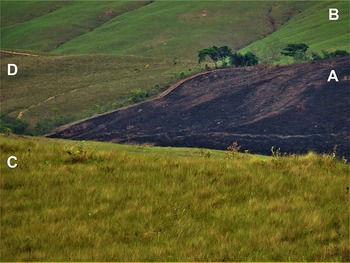
A typical landscape in the study area in the Upper Rio Grande Grasslands, south-eastern Brazil, showing a mosaic of pure grassland patches of distinct ages since the last fire. (A) A recently burned area; (B) a grassland patch recovering from a fire that completely burned it some few weeks previously; (C) a grassland patch 1–2 years without fire; (D) a grassland patch probably more than 2 years without fire. Campo Miners favour grasslands under earlier successional stages (e.g. A and B). Municipality of São João del-Rei, northern part of the Upper Rio Grande Grasslands, Minas Gerais, south-eastern Brazil, October 2016 (early rainy season). Photograph by Vitor T. Lombardi.

To investigate the home range size of the species, we monitored six colour-ringed males, recording their locations with a handheld GPS device from August 2014 to January 2015. We searched for ringed birds in the field by tracking their songs, looking for them around the nesting site, or walking through the vegetation to flush them. We then followed birds for as long as possible, usually in the first hours of the morning, marking a new location for each displacement equal or larger than 10 m, irrespective of whether or not this location was being defended.
To evaluate territorial behaviour, we kept notes during the whole study period on whether the monitored birds were singing or silent, with song, especially if accompanied by hovering flight display, interpreted as evidence of territoriality. We also evaluated the seasonal variation in territorial aggressiveness of Campo Miners by conducting playbacks of their songs from August 2015 to January 2016. Birds that aggressively responded to the playback were considered territorial, while birds that did not respond were considered non-territorial (for details, see Lopes et al. Reference Lopes, Teixeira, Meireles, Bastos, Oliveira and Solar2021).
In addition to the six closely monitored males, for which we were able to estimate home ranges, we monitored 22 other ringed birds (including males, females, and unsexed birds) from August 2014 to January 2015, tracking their permanence in their home ranges during this period. This was carried out during a study on the breeding biology of the species, which involved visits to their home ranges at weekly intervals or less (for details, see Machado et al. Reference Machado, Lombardi, Meireles, Teixeira, Solar and Lopes2017, Meireles et al. Reference Meireles, Lopes, Pichorim, Machado, Duca and Solar2021). Other aspects of the local movements of the species (e.g. nest site fidelity, juvenile dispersal) were investigated using the full dataset gathered during seven years of fieldwork.
Database construction
To investigate large-scale seasonal movements, we collated a database with all second-hand records of the species that we could find. This database included information on locality, date, geographical coordinates, elevation, and source of records. We performed a thorough review of the literature using two search engines (https://scholar.google.com and www.biodiversitylibrary.org) and looked for records in sound archives (http://macaulaylibrary.org and www2.ib.unicamp.br/fnjv), citizen science projects (www.xeno-canto.org, www.wikiaves.com.br, and http://ebird.org), museum databases (www.vertnet.org and http://splink.cria.org.br), and biodiversity databases (www.gbif.org). All online sources were consulted during March–April 2020. We also examined museum specimens in 15 Brazilian and overseas ornithological collections, but only seven of them harboured specimens of the Campo Miner: Coleção Ornitológica Marcelo Bagno, Universidade de Brasília, Brasília (COMB), Fundação Museu de Ornitologia, Goiânia (FMO), Louisiana State University Museum of Natural Sciences, Baton Rouge (LSUMZ), Museu Nacional, Rio de Janeiro (UFRJ), Museu Paraense Emílio Goeldi, Belém (MPEG), Museu de Zoologia da Universidade de São Paulo, São Paulo (MZUSP), and Reserva Ecológica do IBGE, Brasília (IBGE).
Given that citizen science projects frequently include erroneous records in their databases (Gorleri and Areta Reference Gorleri and Areta2021), the senior author checked all photographs and sound recordings available in the citizen science projects consulted. We excluded from the analysis unsubstantiated records obtained in areas where the species is not known to occur and that lack suitable habitat. Geographical coordinates were obtained from the original sources, the Paynter and Taylor (Reference Paynter and Traylor1991) gazetteer, or Google Earth (http://earth.google.com). WikiAves does not give the exact localities for its records so we assigned them to the municipal seat where they were obtained.
Data analysis
For data analysis we used the program R (R Core Team 2021). To estimate the home range size of the species, we used an Autocorrelated Kernel Density Estimator (Fleming and Calabrese Reference Fleming and Calabrese2017), adopting a contour value of 95% (Laver and Kelly Reference Laver and Kelly2008). This estimator is more accurate than conventional home range estimators, especially for small effective sample sizes (Noonan et al. Reference Noonan, Tucker, Fleming, Akre, Alberts, Ali, Altmann and Antunes2019). We conducted all home range analyses using the ctmmweb (Calabrese et al. Reference Calabrese, Fleming, Noonan and Dong2021), which is an R Shiny-based graphical user interface to the R package ctmm (Calabrese et al. Reference Calabrese, Fleming and Gurarie2016). Data used in the home range analysis are available through MoveBank (www.movebank.org/cms/movebank-main, ID 1884059896).
When analysing the entire database collated from second-hand sources, the heterogeneity of the data sources consulted prevented the standardisation of sampling effort throughout the year or range of the species. To reduce bias, we first pooled records obtained on the same day and locality as representing a single occurrence (a same bird is often recorded by multiple birdwatchers travelling together). Second, in some analyses we also controlled for potential bias caused by differences in sampling effort, as explained below.
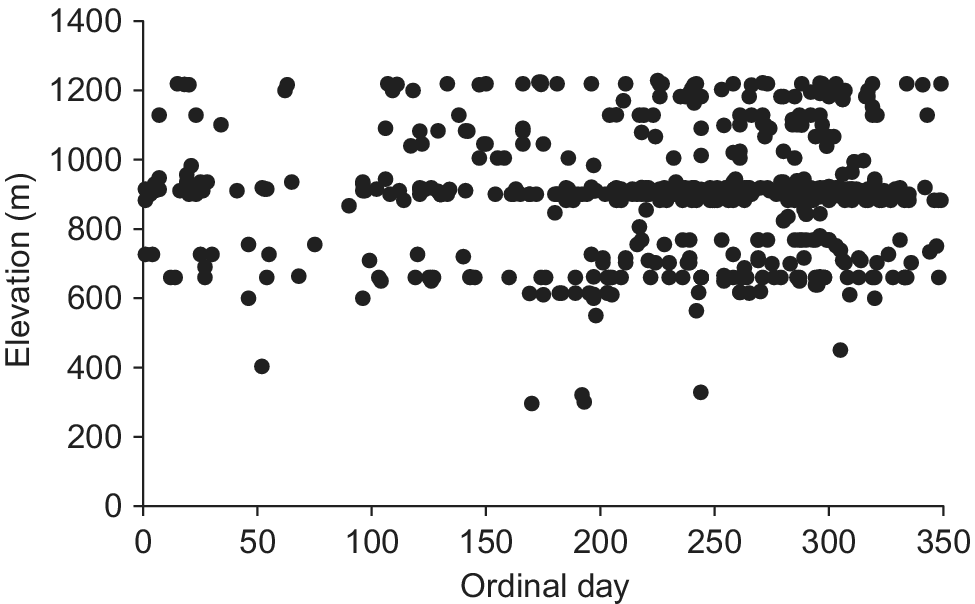
To investigate if the latitudinal distribution of the species varies through time (i.e. the existence of short-distance or long-distance migration), we constructed a scatterplot of the latitude of each occurrence against ordinal dates, i.e. day of year ranging from 1 (1 January) to 365 (31 December; 366 on leap years). To investigate altitudinal migration, we first used the tool “sample raster values” in QGIS 3.1 to extract elevation values for the records gathered in the database built here (we excluded WikiAves data from the altitudinal analysis due to the impossibility of recovering accurate elevation estimates). We used the Global Multi-resolution Terrain Elevation Data 2010 at 30 arc-seconds resolution (GMTED2010) (Danielson and Gesch Reference Danielson and Gesch2011) as a source of elevation data. We then constructed a scatterplot of elevation of each occurrence against ordinal dates.
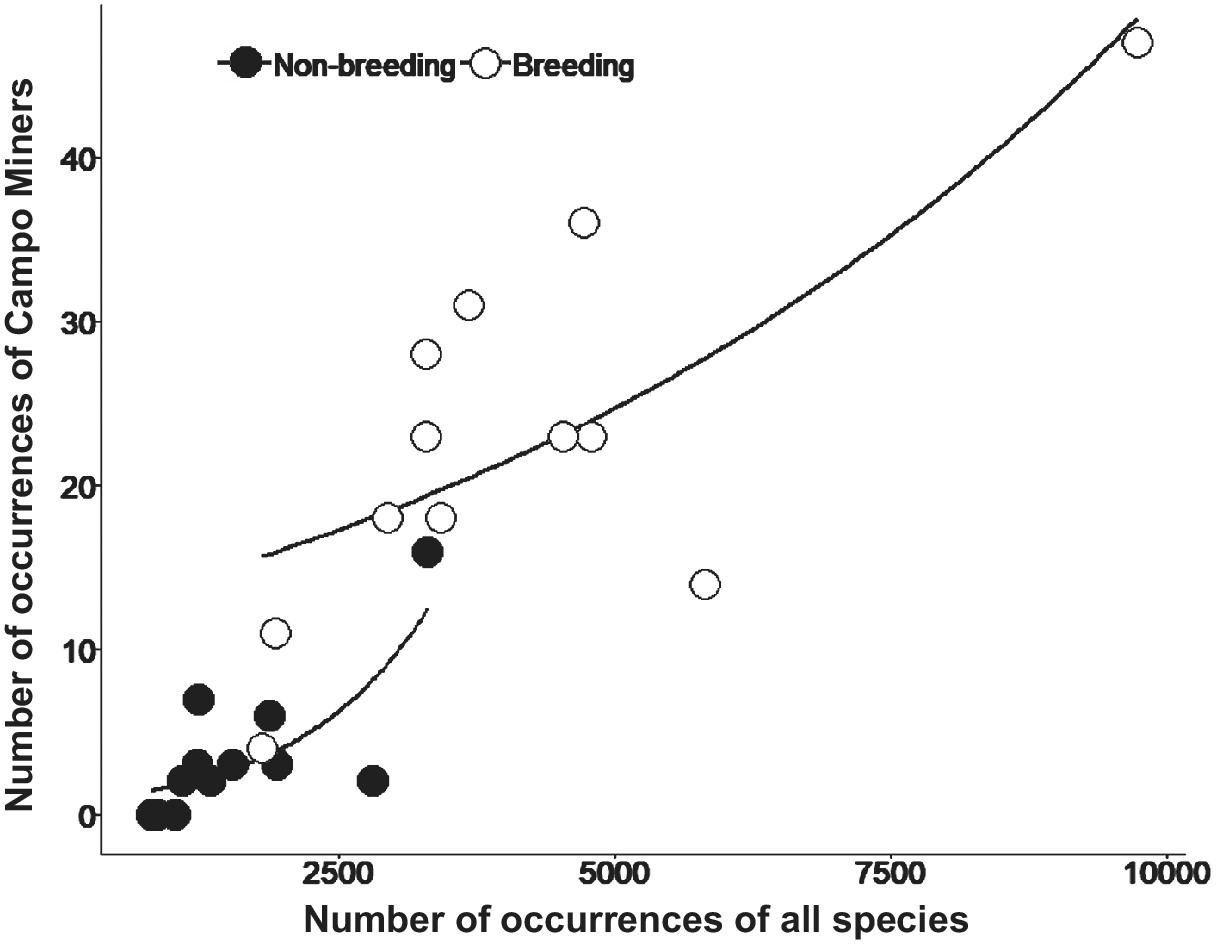
To investigate whether our perception of the seasonal abundance of Campo Miners can be influenced by seasonal changes in detectability and sampling effort, we conducted a separate analysis using a subset of the citizen science dataset cropped for the Serra da Canastra region (here defined as the municipalities of Delfinópolis, Sacramento, São João Batista do Glória, and São Roque de Minas). We chose this region because it is a well-known birdwatching destination, being by far the best sampled region for grassland birds within the range of the species (Couzens Reference Couzens2008). For that we constructed a Generalised Linear Model with a “quasi-Poisson” distribution (to account for over dispersion) to test whether sampling effort and breeding activity could predict the seasonal variation in the number of occurrences of Campo Miners in the Serra da Canastra. The number of occurrences of Campo Miners (our response variable) was calculated for each half month using citizen science data from the eBird and WikiAves databases. As explanatory variables we used the number of occurrences of all bird species available in eBird and WikiAves for the Serra da Canastra region as a proxy for sampling effort, and breeding activity (0 = non-breeding, January–June; 1 = breeding, July–December) as a proxy for song/display output and, consequently detectability (Silva e Silva Reference Silva e Silva and Aleixo2005, Machado et al. Reference Machado, Lombardi, Meireles, Teixeira, Solar and Lopes2017, Lopes et al. Reference Lopes, Teixeira, Meireles, Bastos, Oliveira and Solar2021).
We verified model assumptions by plotting residuals versus fitted values, versus each covariate in the model (Zuur and Ieno Reference Zuur and Ieno2016), and used the percentage of explained deviance as a goodness-of-fit measure (Zuur et al. Reference Zuur, Ieno, Walker, Saveliev and Smith2009), adopting an alpha of 5%.
Results
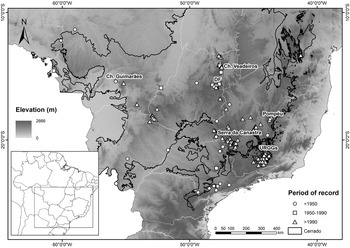
During seven years of intermittent fieldwork in the URGGs, we colour-ringed 82 individuals and found 98 active nests. We also identified ~1,000 records of Campo Miners (54 records from museum specimens, 82 from the literature, and 901 records from citizen science sources). Our data confirmed that the species is widespread in the central–south portion of the Cerrado, where it is endemic (Figure 2). Our findings are summarised below.
Geographical distribution of records of Campo Miners Geositta poeciloptera (symbols) through three distinct periods. Grey tones indicate elevation (the darker the higher). The black line indicates the limits of the Cerrado biogeographical province (Olson et al. Reference Olson, Dinerstein, Wikramanayake, Burgess, Powell, Underwood, D’Amico, Itoua, Strand, Morrison, Loucks, Allnutt, Ricketts, Kura, Lamoreux, Wettengel, Hedao and Kassem2001, Silveira et al. Reference Silveira, Negreiros, Barbosa, Buisson, Carmo, Carstensen, Conceição, Cornelissen, Echternacht, Fernandes, Garcia, Guerra, Jacobi, Lemos-Filho, Le Stradic, Morellato, Neves, Oliveira, Schaefer, Viana and Lambers2016), “Campos Rupestres” included. The white lines indicate the borders of Brazilian states. The names of some important localities cited in the text are also shown. Note how the species range is closely tied to the Cerrado, where it is endemic.

Local movements
The territorial behaviour of Campo Miners varied dramatically throughout the year. Birds defended their territory throughout the breeding season (i.e. from July to December), but the intensity of territorial aggressiveness varied through the nesting cycle. Both sexes defended the territory during its establishment by aggressively singing in duets when a threat was detected, almost always on the ground. Vocal disputes along territorial borders were common, including hovering flight displays by males, though aggressive encounters between males were rare. As soon as the eggs were laid, females stopped defending the territory, likewise the males as soon as the eggs hatched. Consequently, territorial aggressiveness mostly ceased during the nestling period, when other adults and juveniles were allowed to enter the home range of the breeding pair. Given that this is a multiple brood species, breeding synchrony decreased alongside the breeding season as nests were predated and replacement clutches or second clutches were laid. Consequently, birds exhibiting different levels of territorial aggressiveness were often observed side by side.
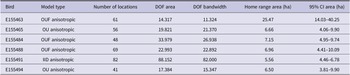
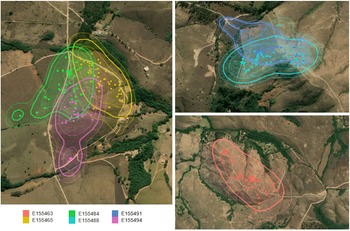
The median size of the home range used by each pair during the breeding season was 6.81 ± 7.74 ha (ranging from 5.56 ha to 25.47 ha, n = 6), with all studied males exhibiting site fidelity. Variation in home range size between males was small (Figure 3, Table 1), with the remarkable exception of the male E155463, whose home range was about 3.5 times larger than the second largest home range studied. This is because this male greatly expanded its home range in October, incorporating the home range of two neighbouring pairs that had abandoned their home ranges for unknown reasons. Although we have not evaluated variation in home range size and overlap during the breeding season, these two parameters seemed to vary considerably depending on the nesting stage of the pair under study and its neighbouring pairs.
Parameters estimated for the home ranges of six Campo Miners Geositta poeciloptera males using autocorrelated kernel density estimates. Data obtained during the 2014 breeding season in the municipality of São João del-Rei, Upper Rio Grande Grasslands, Minas Gerais, south-eastern Brazil. Models are: IID = Independently and Identically Distributed data, OU = Ornstein–Uhlenbeck Process, and OUF = Ornstein–Uhlenbeck Foraging Process. CI = confidence interval; DOF = degrees of freedom.

Home ranges of six Campo Miners Geositta poeciloptera males estimated by an autocorrelated kernel density estimator. Thicker lines represent the 95% home-range area point estimate, while the lighter contours represent their 95% confidence intervals. Data obtained during the 2014 breeding season in the municipality of São João del-Rei, Upper Rio Grande Grasslands, Minas Gerais, south-eastern Brazil.

Breeders seemed to occasionally engage in short-duration forays into neighbouring home ranges. For example, a male that was defending its home range and building its nest in August and September 2014, was observed on 30 September foraying almost 3 km away from its home range. On the following day, this bird was back in its home range, and on 2 October the first egg was observed in its nest. The content of this nest was predated, but the pair renested in the same cavity.
With the end of the breeding season, territorial behaviour ceased, and birds became mostly irresponsive to the playback from January to June. A total of 19 out of the 28 (68%) colour-ringed individuals monitored during the home range and breeding studies from August 2014 to January 2015 have not been observed in their home ranges since the end of the breeding season, including eight pairs that left their home ranges soon after the termination of the first breeding attempt, without renesting. These 19 individuals have probably dispersed regionally, as suggested by the observation of five of them in areas ranging from 1 km to 5 km apart from the places where they were ringed. All nine birds that remained in their home ranges after breeding stayed there for at least five more months (i.e. during the entire non-breeding season), and at least six of them (five males and one female) bred again in the same home range in the following breeding season. Eight other birds ringed in the 2015 breeding season (including two females) bred in the same or in a nearby home range in the 2016 breeding season, with one of them breeding in four consecutive years in the same place. Therefore, even though Campo Miners do not hold year-round territories, nest-site fidelity seems to be common in the species.
Our data on juvenile dispersal are scarce, but one nestling ringed on 13 December 2014 stayed in its natal home range, sometimes accompanied by an unringed bird, until at least May 2015. During the 2015 breeding season, this individual bred in a nearby home range (~500 m from the nest in which it fledged), but we found it dead on 28 October 2015, probably killed by a predator. After the end of the breeding season, small flocks ranging from three to, exceptionally, seven birds, including adults and juveniles, were commonly observed. These single-species flocks freely crossed other home ranges while foraging, without signs of aggression.
Short-distance and long-distance migration
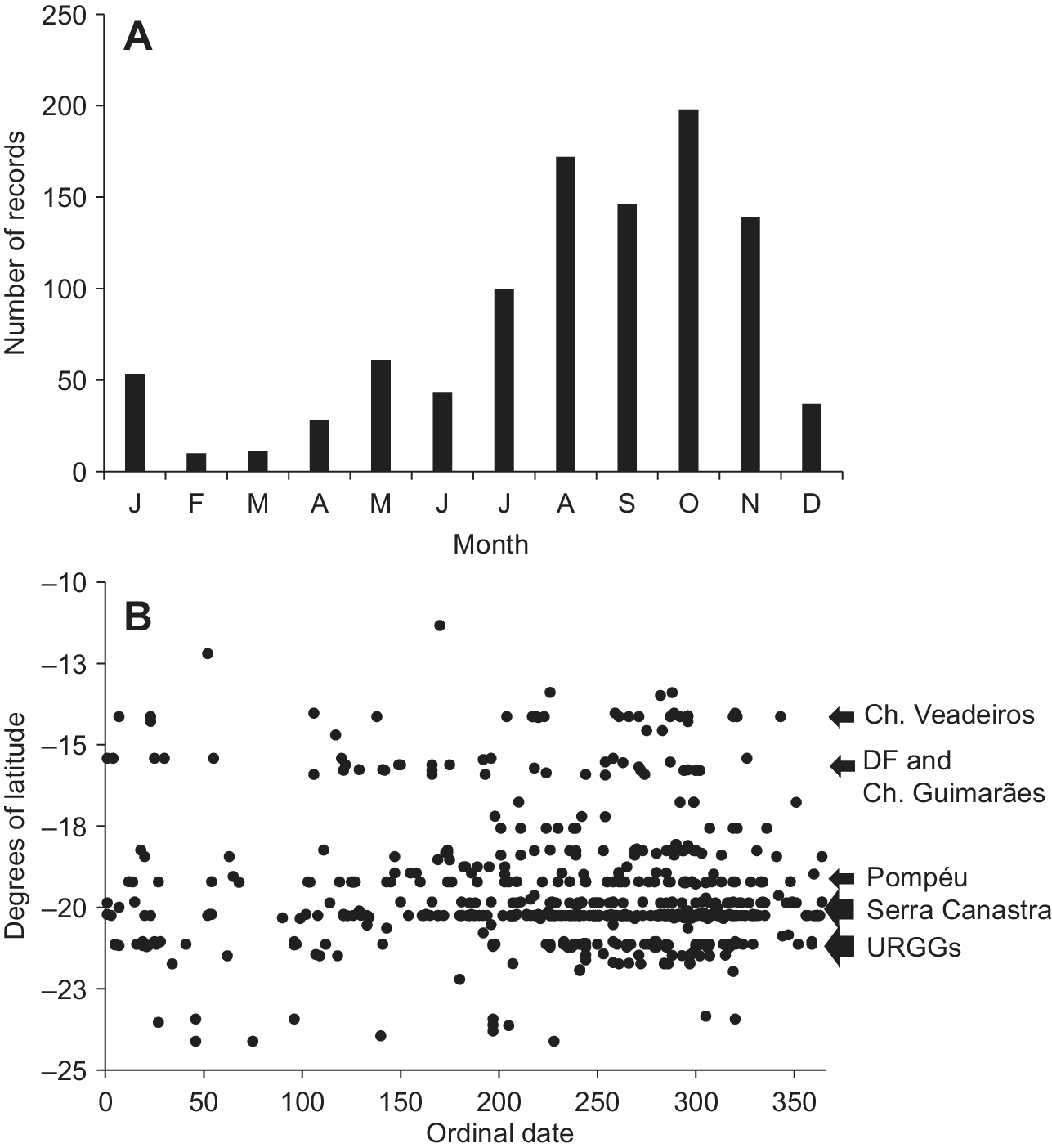
When considering the whole range of Campo Miners (not controlling for sampling), a dramatic variation in the number of records of the species throughout the year was evident (Figure 4A), with the second semester exhibiting almost four times more records than the first semester (records are particularly scarce during February and March).
(A) Monthly variation in the number of records of the Campo Miner Geositta poeciloptera throughout the entire range of the species. (B) Annual variation in the latitudinal distribution of the species in South America. The approximate latitudes of the six better sampled regions are indicated by arrows. Ordinal date = number of days since 1 January.

There are records of Campo Miners during all months of the year throughout its latitudinal range (not controlling for sampling), with no evidence of seasonal latitudinal migration (Figure 4B). The lack of large-scale latitudinal movement was verified in those few well-sampled regions, such as the Chapada dos Veadeiros (~14°S), Distrito Federal and Chapada dos Guimarães (both at ~15°S), Pompéu (~19°S), Serra da Canastra (~20°S), and the URGGs (~21°S). In our study area, we also recorded colour-ringed individuals throughout the year, including males, females, and young in the first cycle, revealing that our studied population did not perform complete short- or long-distance migration.
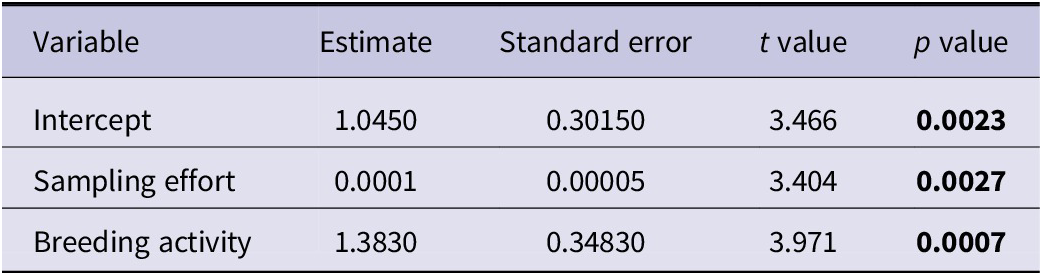
Data from the well-sampled Serra da Canastra region (controlled for sampling) (Figure 5), revealed that the dramatic seasonal variation in the number of records of the species can in large part be explained by differences in sampling effort and changes in bird behaviour when breeding (explained deviance of 73.7%) (Table 2). Model validation indicated no problems.
The number of occurrences of the Campo Miner in relation to occurrences (data from WikiAves and eBird) and breeding status of all species of birds for the Serra da Canastra region, south-eastern Brazil.

Estimated regression parameters, standard errors, t values, and p values for a Generalised Linear Model with “quasi-Poisson” distribution testing whether sampling effort (i.e. number of occurrences of all species) and breeding activity (0 = non-breeding, 1 = breeding) can predict the seasonal variation in the number of occurrences of Campo Miners in the Serra da Canastra region, south-eastern Brazil. Significant values are in bold.

Altitudinal migration
We found no evidence of altitudinal migration in Campo Miners neither when considering its whole range (Figure 6), nor in our studied population, which is found at the uppermost elevational range for the species (where, theoretically, the species would be more prone to migrate altitudinally). Campo Miners inhabited an altitudinal range of about 1,000 m (between 300 m and 1,300 m asl), with breeding records available from its lowermost (e.g. Pompéu, Minas Gerais; Fazenda Formiga, Goiás) to its uppermost range (e.g. URGGs; Chapada dos Veadeiros, Goiás) (Pinto Reference Pinto1936, WikiAves data).
Seasonal records of the Campo Miner Geositta poeciloptera plotted by elevation. Ordinal date = number of days since 1 January.

Partial and stepwise migration
The lack of evidence of latitudinal and altitudinal migration, associated with the observation of colour-ringed individuals, including males, females, and young, in the first cycle of our population studied throughout the year, revealed that Campo Miners do not perform partial or stepwise migration.
Facultative migration and nomadism
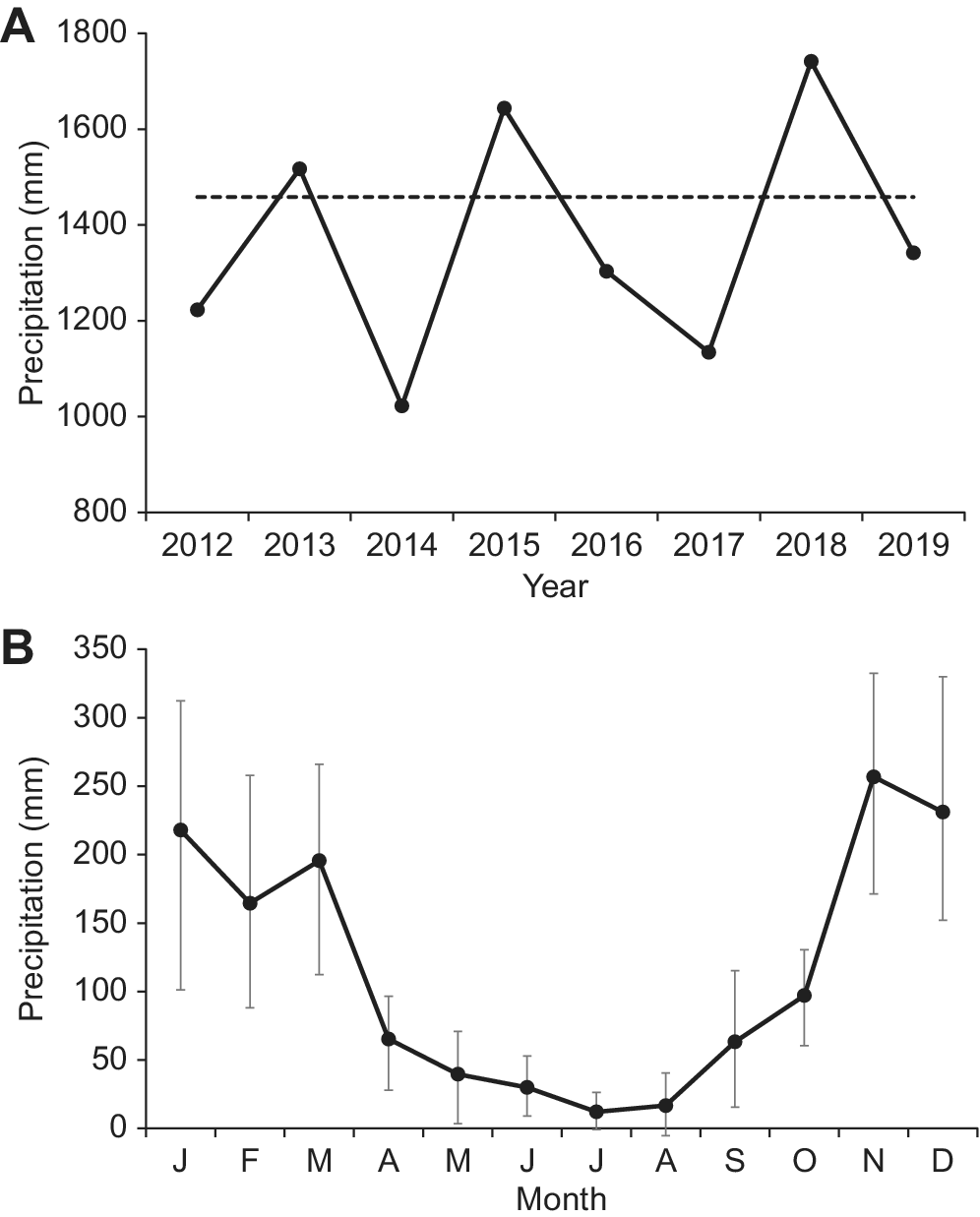
Campo Miners bred in our study area (data from WikiAves and our fieldwork) during at least eight consecutive years, from 2012 to 2019 (there are no data available for before that). During this period, rainfall, the main driver of nomadism in birds, varied considerably, with 2014 registering a 30% decrease in rainfall when compared with historical average annual precipitation (Figure 7). Despite the much lower rainfall recorded in 2014, nest survival of Campo Miners was much the same during the four breeding seasons monitored, ranging from 44.9% (2019) to 45.1% (2016).
(A) Variation in annual precipitation during the study period (2012–2019) when compared with the historical average annual precipitation (dashed line). During 2014, south-eastern Brazil suffered one of the most severe droughts ever recorded (Coelho et al. Reference Coelho, Oliveira, Ambrizzi, Reboita, Carpenedo, Campos, Tomaziello, Pampuch, Custódio, Dutra, Rocha and Rehbein2016). (B) Average monthly precipitation during the study period showing monthly standard deviations. Data from the São João del-Rei Meteorological Station. Source: Brazilian Agrometeorological Monitoring System (https://www.agritempo.gov.br/agritempo/index.jsp).

Discussion
In this paper, using data from the literature, museum specimens, citizen science projects, and long-term fieldwork, we found that Campo Miners, differing from some of their congeners (Fjeldså and Krabbe Reference Fjeldså and Krabbe1990, Remsen Reference Remsen, Del Hoyo, Elliott and Sargatal2003), do not perform long-distance or altitudinal migration. The exhibition of either of these migration strategies within the Cerrado boundaries, where the species is endemic, would be surprising because: (1) the precipitation regime is approximately the same throughout the Cerrado (Silva et al. Reference Silva, Assad, Evangelista, Sano, Almeida and Ribeiro2008); (2) no bird species seems to perform large-scale migratory movements within the Cerrado boundaries (Somenzari et al. Reference Somenzari, Amaral, Cueto, Guaraldo, Jahn, Lima, Lima, Lugarini, Machado, Martinez, Nascimento, Pacheco, Paludo, Prestes, Serafini, Silveira, Sousa, Sousa, Souza, Telino-Júnior and Whitney2018); (3) the elevational range of the species (~1,000 m) is quite narrow when compared with that of over 3,000 m exhibited by other miners that perform altitudinal migration (Fjeldså and Krabbe Reference Fjeldså and Krabbe1990, Parker et al. Reference Parker, Stotz, Fitzpatrick, Stotz, Fitzpatrick, Parker and Moskovits1996). We also found no evidence of partial or stepwise migration, which was expected, because this movement strategy seems to be non-existent or at most very rare among members of Scleruridae and the closely related families Dendrocolaptidae and Furnariidae (Marantz et al. Reference Marantz, Aleixo, Brevier, Patten, Del Hoyo, Elliott and Sargatal2003, Remsen Reference Remsen, Del Hoyo, Elliott and Sargatal2003).
In a similar way, we found no evidence of facultative migration or nomadism by Campo Miners. The adoption of either of these two movement strategies, as suggested by previous authors, was also unexpected, because these strategies are more common in unpredictable deserts, such as those in Africa and Australia (Davies Reference Davies1984, Dean Reference Dean2003), usually not occurring in comparatively mesic habitats, such as the Cerrado grasslands. It is also important to remember that the Campo Miner has the most divergent niche among its congeners, living in a more mesic habitat than other miner species (Ribeiro et al. Reference Ribeiro, Peterson, Werneck and Machado2017). The Cerrado, despite its marked dry season of five or six months, has predictable annual rains over 1,100 mm (Silva et al. Reference Silva, Assad, Evangelista, Sano, Almeida and Ribeiro2008). Therefore, the Cerrado grasslands depart from the typical habitat used by other members of Geositta, a genus well adapted to arid and barren regions with only sparse herbaceous vegetation or even no vegetation at all (Fjeldså and Krabbe Reference Fjeldså and Krabbe1990, Remsen Reference Remsen, Del Hoyo, Elliott and Sargatal2003).
As summarised above, of all the movement strategies we investigated, Campo Miners only performed local movements. The dataset gathered here provides new insights on the movement ecology of the species, generating new hypotheses that still need to be tested in future studies.
In the URGGs, soils in the higher areas are shallow, nutrient-poor, and prone to erosion processes (Oliveira et al. Reference Oliveira, Lopes, Cunha Neto, Carvalho and Gavilanes1999, EMBRAPA 2013). Consequently, these soils can only support open grasslands that, when subject to heavy grazing and/or frequent fires, produce a short and/or sparse grass cover. Without an effective plant cover, these soils become more vulnerable to erosion processes, especially in furrows, resulting in frequent ravine slopes (see https://youtu.be/EM6SRIyiHVA) where Campo Miners excavate their nests (Machado et al. Reference Machado, Lombardi, Meireles, Teixeira, Solar and Lopes2017, Meireles et al. Reference Meireles, Teixeira, Solar, Vasconcelos and Fernandes2018). Contrastingly, along the valleys, soils are deeper, more fertile, and humid, supporting semideciduous forests (Azevedo Reference Azevedo1962, Oliveira et al. 1999, EMBRAPA 2013). The contrasting flammability of these two vegetation types (i.e. semideciduous forests along the valleys seldom burn), associated with a vast network of dirt roads, work as firebreaks, in such a way that the frequent fires usually burn only small patches (some few hectares) at a time. Additionally, local farms are usually small and some of them are abandoned, with the result that fire management practices and grazing pressure differ between neighbouring properties. Consequently, the URGGs exhibit a rich mosaic of grassland patches of different heights and densities (Figure 1), producing high heterogeneity in vegetation structure and species composition, providing an ideal place to investigate the pyrodiversity–biodiversity relationships (Fuhlendorf et al. Reference Fuhlendorf, Harrell, Engle, Hamilton, Davis and Leslie2006, Jones and Tingley Reference Jones and Tingley2022).
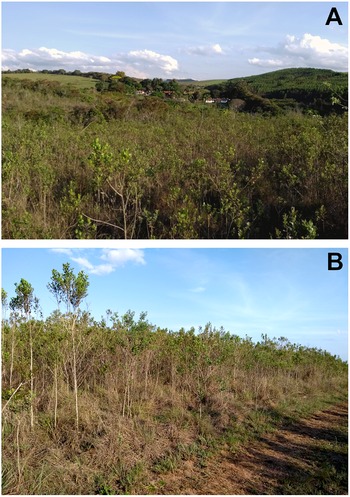
In our study area, Campo Miners favour patches of open grasslands with short and sparse grass cover (Peixoto Reference Peixoto2014), so open that the bare ground can be seen at a distance, recalling the habitats of its congeners that live in arid, barren regions. Complete suppression of fire and grazing in the region is rarely attained, but we had the exceptional opportunity to visit a farm that had excluded cattle for 40 years and banned fire for 10 years. Consequently, a remarkable woody plant encroachment (mostly Baccharis sp. shrubs) had completely modified the vegetation structure and species composition, with dramatic impacts on the composition of the local bird community (Figure 8). In a similar way, natural grasslands in the South Brazilian Highland Grasslands where traditional cattle ranchers management practices (i.e. fire) were suppressed also experienced remarkable encroachment by Baccharis shrubs, resulting in the loss of those grasslands in about three decades (Sühs et al. Reference Sühs, Giehl and Peroni2020).
A former open grassland now dominated by Baccharis sp. shrubs, after 40 years of cattle exclusion, 10 years of which were without fire. (A) A general view of the area, showing a dramatic woody plant encroachment; compared with a patch of grazed natural grassland in the upper left and a eucalyptus plantation in the upper right of the picture. (B) Detail of the area showing ~2 m tall Baccharis shrubs. Municipality of Andrelândia, southern part of the Upper Rio Grande Grasslands, south-eastern Brazil, September 2018 (early rainy season). Photographs by Helberth Peixoto.

The URGGs also harbour several other threatened bird species restricted to native grasslands, such as the Sickle-winged Nightjar Eleothreptus anomalus, the Sharp-tailed grass Tyrant Culicivora caudacuta, the Cock-tailed Tyrant Alectrurus tricolor, the Ochre-breasted Pipit Anthus nattereri, and the Black-masked Finch Coryphaspiza melanotis (Pacheco et al. Reference Pacheco, Parrini, Lopes and Vasconcelos2008, Lopes et al. Reference Lopes, Malacco, Alteff, Vasconcelos, Hoffmann and Silveira2010, Lombardi et al. Reference Lombardi, Santos, D’Angelo, Mazzoni, Rennó, Faetti, Epifânio and Miguel2012, Lopes and Peixoto Reference Lopes and Peixoto2018). These grasslands have been used for low-density extensive cattle ranching for at least three centuries (IBGE 1959). For example, the municipality of São João del-Rei alone, which originally included the current municipalities of Nazareno, Ritapólis, and Conceição da Barra de Minas, harboured more than 52,000 heads of cattle in the 1950s (IBGE 1959). Currently, these four municipalities together have about 78,200 heads of cattle (IBGE 2020). This suggests that extensive cattle ranching in native grasslands can coexist with the conservation of grassland birds in the URGGs, a fact already demonstrated for grassland birds in the South Brazilian Highland Grasslands (Jacoboskia et al. Reference Jacoboskia, Paulsen and Hartz2017). Therefore, maybe a mosaic of strictly protected and sustainable use reserves is the best option for the conservation of this region, which seems to be one of the main strongholds of Campo Miners. Contrastingly, in areas of the URGGs where native grasses were replaced by introduced African grasses, most, if not all, threatened grassland birds have disappeared (pers. obs.). A more dramatic biodiversity erosion was observed in those areas where native grasslands were replaced by grain crops, such as wheat and beans, or eucalyptus plantations (the “tyranny of trees in grassy biomes”, Veldman et al. Reference Veldman, Overbeck, Negreiros, Mahy, Le Stradic, Fernandes, Durigan, Buisson, Putz and Bond2015). In these areas, most or even all grassland birds, including “Least Concern” farmland species, have vanished.
With all that considered, we propose a theoretical framework for understanding local movements of Campo Miners and their association with fires and vegetation structure. For that, we assumed that members of Geositta are highly vagile (Remsen Reference Remsen, Del Hoyo, Elliott and Sargatal2003), and that Campo Miners favour patches of grasslands with short and sparse grass cover to forage and breed (Peixoto Reference Peixoto2014, Machado et al. Reference Machado, Lombardi, Meireles, Teixeira, Solar and Lopes2017). We also assumed that patches with short and sparse grass cover are very dynamic in space and time, because, with the onset of rains, the grass cover quickly became high and dense in the absence of heavy grazing or additional fire (see Figure 8). With that in mind, we propose that Campo Miners: (1) establish their territories at the beginning of the breeding season (i.e. July–August) in patches of suitable habitat; (2) stop defending their home ranges after the breeding season, therefore not holding year-round territories; (3) stay during the non-breeding season in their home ranges if habitat features are still suitable, also wandering across neighbouring home ranges; (4) abandon their home ranges at any time of the year if the grass cover becomes high and dense or when a better quality habitat patch becomes available, using fires (which are common at the end of the dry season when territories are being established) as a cue for locating recently burned patches that will soon offer suitable habitat. The theoretical framework proposed here still needs to be tested, representing a first step to addressing the four major questions about animal movement ecology (Nathan et al. Reference Nathan, Getz, Revilla, Holyoak, Kadmon, Saltz and Smouse2008): (1) why move?; (2) how to move?; (3) when and where to move?; (4) what are the ecological and evolutionary consequences of movement?
Conservation implications
In this study, we showed that the threatened Campo Miner is a year-round resident species whose local movements seems to be highly dependent on the fire regime for foraging and breeding (note also that nests are often lined with charcoal fragments) (Machado et al. Reference Machado, Lombardi, Meireles, Teixeira, Solar and Lopes2017). Therefore, it is necessary to seek a better understanding of how different grazing and fire regimes influence the vegetation structure and the availability of food resources exploited by Campo Miners and other threatened grassland birds found in the URGGs. These two variables have already been shown to have a marked influence on the composition of bird communities in the South Brazilian Highland Grasslands (Beal‑Neves et al. Reference Beal‑Neves, Chiarani, Ferreira and Fontana2020, Chiarani et al. Reference Chiarani, Bettio and Fontana2020). Therefore, the impacts of fire and grazing intensity upon habitat suitability for Campo Miners, as well as a driver of local movements of the species, deserve additional studies.
Acknowledgements
We thank the following museum personnel that kindly allowed us to study material under their care: M. Â. Marini (COMB), J. Hidasi (FMO), J. V. Remsen Jr. (LSUMZ), M. Raposo (MNRJ), A. Aleixo (MPEG), L. F. Silveira (MZUSP), and M. Resende (IBGE). Ricardo Solar helped with the statistical analysis. We are grateful to the managers and users of the online databases consulted for providing occurrence data. We thank the several farmers who allowed our studies on their properties and to the people who helped us during fieldwork. This study was financed in part by the Coordenação de Aperfeiçoamento de Pessoal de Nível Superior – Brasil (CAPES, study fellowships to R.C.M., H.J.C.P., J.P.G.T., T.L.S.S.M., and V.T.L.) – Finance Code 001, as well as by grants from CNPq to L.E.L. (476031/2013-3, 309660/2017-3, and 305401/2014-9). All procedures performed in the field study were in accordance with the ethical standards of the relevant national and institutional committees, with permits from CEMAVE/ICMBio and CEUA-UFV. We followed all protocols established by the online databases consulted.