INTRODUCTION
The oral explanations of young elementary students incorporate a wide range of language and discourse skills. These skills comprise features of language at the word, sentence, and discourse levels. This study focuses on characterizing how these features progress and how they may progress differently for students who are acquiring English as a new language, compared with students who are monolingual or proficient English speakers. These findings provide the empirical basis of language-learning progressions used to guide formative assessment. The benefit of learning progressions to formative assessment is the framework they provide to more readily place students along a continuum of development and then more effectively identify next language skills on the progression for ensuing instruction and learning (Bailey & Heritage, Reference Bailey and Heritage2008). The information this study yields is important for teachers and students alike—under a formative assessment model, both are tasked with making decisions about what aspects of oral language to focus on. This study can also inform teachers and students about what progress is reasonable to assume.
The need for improved understanding of the trajectories of young school-age children's language development cannot be understated. Close to 5 million U.S. public school students (the majority of whom are enrolled in the earliest grades) are identified by their school districts as English learners. This number constitutes approximately 10% of school enrollment (National Center for Education Statistics, 2016) and is the fastest growing segment of the U.S. school-age population (Flores, Batalova, & Fix, Reference Flores, Batalova and Fix2012). The following exchange between an interviewer and Alfredo, a third-grade Spanish-speaking student who is receiving English learner support services from his U.S. school district, is an example of the explanatory language elicited from students in the current study, which was designed to trace the emergence of key language and discourse features in explanations.
Interviewer: Pretend you are talking to a classmate who has never done this activity. When you're ready, tell him how to use the cubes to find out how many there are, and why using the cubes this way helps him.
Alfredo: Um, because, um, using the cubes, using the cubes help you, helps you, and it can help you keep track of where you go. And you can count by tens or ones or twos. Whatever.
Interviewer: Can you tell him how to do it?
Alfredo: Again?
Interviewer: Yes.
Alfredo: You can use the cubes and you can. Okay, using the cubes can help you, and they can help you keep track of where you're going, of what you're counting. And they can. And then you can get your answer.
Alfredo had previously completed a short mathematics task—finding the total number of cubes in a loose pile. He was asked by the interviewer to first explain how he had arrived at his answer and then why he had chosen to solve the task in that manner. The exchange above is the result of a follow-up prompt asking Alfredo to explain how and why he solved the task in his chosen manner to a hypothetical classmate. Alfredo's explanation is part of the Dynamic Language Learning Progressions (DLLP) corpus of school-age, oral and written explanations (Bailey & Heritage, Reference Bailey and Heritage2014, Reference Bailey, Heritage, Peters, Cowie and Menter2017). These prompts have been expressly designed to elicit language samples from school-age English learners and their English monolingual or proficient peers. The prompts generated two key types of explanatory discourse frequently encountered in classrooms: procedural explanations (i.e., the how of completing a task) and justifications (i.e., the why for having chosen a specific manner or strategy to complete the task).
Alfredo's explanation includes predictable mathematical vocabulary, such as “count,” “counting,” use of number words, and “answer” with its discipline-specific meaning of a solution to an arithmetic problem in this instance. Explanatory language, however, allows us to go far beyond the lexical-level features of Alfredo's language sample to learn more about his syntactic and discourse competencies. We see that while he has borrowed much of the interviewer's wording to start his explanation (e.g., “using the cubes”), he also produces a complex embedded sentence to complete his justification, “it can help you keep track of where you go.” He also has command of the modal auxiliary verb “can,” using it productively in conjunction with several different verbs (“help,” “count,” “use,” and “get”). Alfredo is able to self-correct grammatical errors such as the number agreement on the verb “help” following “using the cubes” (i.e., agreement with the singular “using”). He even retraces his possibly ambiguous use of the verb “going” by replacing it with the more specific verb “counting” the second time he says “keep track of where you are going.”
Alfredo's explanation is most challenging for the naïve listener in terms of the details needed to replicate his actions. Coherently structuring an explanation by chronological or logical order (e.g., temporal discourse markers such as then, next, finally) can signal unambiguously in what order actions must have occurred. Also contributing to the listener's comprehension is the use of cohesive devices such as anaphoric references to connect referents (i.e., accurately tie pronouns to previous nouns), something Alfredo is able to do with “it” referring to “using the cubes.”
Explanations used in academic contexts may also require students to verbalize relationships between ideas or concepts such as causes and effects, contrasts and comparisons, counterfactuals and hypotheticals. The mental model students possess for their own or others’ experiences and for events or processes they are learning about must also be put into words. Without the stamina to render a mental model into a complete and detailed explanation, students may fall short of an adequate explanation.
The language and discourse skills outlined for Alfredo's explanation are found in the communicative competencies that many countries around the world have placed at the center of their latest educational reform efforts. Yet, how is a teacher to discern whether Alfredo is making progress in language? Is Alfredo on par with English learner peers who have comparable years of education in the United States, are literate Spanish speakers, and are male, given the documented poorer language and literacy outcomes for boys compared with girls who are English learners (Taylor, Bailey, Cooper, Dwyer, & Lieb, Reference Taylor, Bailey, Cooper, Dwyer, Lieb and Klein2007)? Even further, how is Alfredo's English progressing relative to his English monolingual or proficient peers at the same grade level?
Without a clear description of the language and discourse competencies of English monolingual or proficient students, we run the risk of not sufficiently preparing Alfredo and similar students for the expected demands of the classroom. Alternatively, we may erroneously hold him accountable for attaining a level of English proficiency that outstrips that of his English monolingual or proficient peers. The latter is a genuine concern given the dearth of information about growth in oral language and discourse characteristics of school-age students at different grades and across time. In part, this is due to often mistaken beliefs that a first language is largely already acquired by the time a child enters school (Hoff, Reference Hoff2013) and because few large-scale assessments of language arts include oral language, with oral language assessment largely confined to English as a new or second language and language impairment contexts (Bailey, Reference Bailey and James2010).
Next, I place the study of young school-age language and discourse in the broader context of increased language demands found in recent educational reform efforts. While these heightened demands affect the scholastic experiences of all students, they are particularly impactful for the education of English learners.
New Demands on Language Practices in the Classroom
While new college and career standards that have been at the heart of the most recent educational reform in the United States call for many new core competencies such as critical thinking and creativity (National Education Association, 2011), chief among these competencies is the need to become more skilled at communicating and collaborating with others—both language-based skills. Elsewhere in the world, for example, China, we see similar reform efforts that have called for use of such pedagogical practices as classroom participation, which also inherently require language and discourse competencies so that students can successfully communicate and collaborate during participation (e.g., Zhao, Mok, & Cao, Reference Zhao, Mok and Cao2016).
To succeed in this era of new academic standards and the assessments that have been designed to measure them, students must be encouraged to participate in the disciplinary discourse practices of their classrooms (Lee, Quinn, & Valdés, Reference Lee, Quinn and Valdés2013). Such practices include the use of explanations to reason through academic content learning (Covitt & Anderson, Reference Covitt, Anderson, Bailey, Maher and Wilkinson2018), and to convey that learning to others (Bailey, Blackstock-Bernstein, & Heritage, Reference Bailey, Blackstock-Bernstein and Heritage2015). This shift in educational practices gives teachers a unique opportunity to gauge what their students can do with language and, not inconsequently, evaluate through the medium of language the new discipline content they are learning (e.g., National Governors Association [NGA] & Council of Chief State School Officers [CCSSO], 2010).
Development of Explanation Abilities
Explanation, as illustrated above, involves a host of underlying language skills in order for a student to participate in deeper learning activities. Students, however, do not arrive at school fully conversant in explanation as a classroom language practice. The skills that go into explanatory talk likely develop over the elementary grades and function in social context to explain psychological states, phenomena, and actions (Beals, Reference Beals1993). The acquisition of these skills is sensitive to incidental exposure and deliberate instruction and involves the development of vocabulary, sentence structure, and discourse skills.
The majority of developmental studies of children's explanatory language and its key prerequisites have been conducted with young, often preschool-aged, children. This research strand in particular has shown young children's increasingly sophisticated use of causal language, from use of and to link causal events, to conventional uses of causal connectives (e.g., because, so) and if-then sentence constructions. This is followed in development by the logical ordering of events using sequencing language, as well as increasingly contingent responses to prompts for explanatory talk (e.g., Donaldson, Reference Donaldson1986; McCabe & Peterson, Reference McCabe and Peterson1985; Peterson & French, Reference Peterson and French2008).
An additional limiting factor to the existing literature is that most studies are conducted with young, native English-speaking children (see Aukrust, Reference Aukrust2004 for a notable exception with Norwegian-as-a-second language for Turkish-speaking children). While we know very little about the course of development of explanation skills from a linguistic and discourse perspective in school-age children and those students who are acquiring English as a new language in school, we do know that explanation is a form of school-relevant language critical for academic success (Christie, Reference Christie2012; Nippold & Scott, Reference Nippold and Scott2010; Snow, Reference Snow1991). Explanation as a productive language practice is found in the discourse, texts, and tests used across academic content areas (Bailey, Butler, Stevens, & Lord, Reference Bailey, Butler, Stevens, Lord and Bailey2007). Much of the research on academic uses of explanation has been directed toward documenting the role of explanations in children's acquisition of new content knowledge. In the area of English language arts (ELA), for example, Goldman and Wiley (Reference Goldman, Wiley, Duke and Mallettee2011) used discourse analysis to understand sixth-grade students’ understanding of texts and found that “causal self-explanation during reading was related to better reasoning scores” (p. 127). During mathematics instruction, explanation has been defined as “giving mathematical meaning to ideas, procedures, steps, or solution methods” (Hill, Charalambous, & Kraft, Reference Hill, Charalambous and Kraft2012, p. 63), and during science, students are frequently expected to explain their project-based work (Moje et al., Reference Moje, Peek-Brown, Sutherland, Marx, Blumenfeld, Krajcik, Strickland and Alvermann2004).
Not surprisingly then, explanation has been emphasized as a key language function cutting across the academic domains of college and career-ready standards and is a target for the language development of English learners (e.g., Framework for English Language Proficiency Development Standards Corresponding to the Common Core State Standards and the Next Generation Science Standards; CCSSO, 2012). The next section makes a case for teachers’ and students’ organized and sustained attention to language and discourse practices for formative assessment purposes during content instruction. To support such an assessment approach, teachers need to know how their students are progressing in language in ways that go beyond the aspirational statements found on English language proficiency standards (Bailey & Heritage, Reference Bailey and Heritage2014).
Assessment of Explanatory Language in Schools
Unfortunately, communication and collaboration competencies do not readily lend themselves to large-scale, primarily written, standardized assessment approaches, even while explanation abilities are now being required of students in order to show their content understanding on the new state content assessments aligned to college and career-ready standards. These assessments are now multipart, not multichoice, and frequently require students to display content understanding through written explanations of their reading comprehension and mathematical reasoning or justifications (e.g., see the ELA and mathematics practice items of the Smarter Balanced Assessment Consortium, at SmarterBalanced.org, to which 15 U.S. states currently belong). Moreover, large-scale, summative assessment of English language proficiency may be suitable for tracking how well a student is progressing annually, but this approach to assessment does not lend itself to monitoring incremental language growth over shorter intervals.
Alternatively, formative assessment gives educators an opportunity to evaluate what their students know about language through language itself (Bailey, Reference Bailey2016). Formative assessment can be an especially effective gauge of learning with young language learners. Because formative assessment takes place through observation of student behaviors and work, or during conversations with teachers and other students, it can reveal to a teacher key aspects of language-learning needs as well as (mis)conceptions of new academic content learning. As a result of the unscripted, informal nature of formative assessment, a teacher can stay in conversation long enough with a young language learner to identify new targets of language and content instruction. Formative assessment allows teachers to work with students in the moment so the teachers can rephrase their questioning to the point that they connect with the “right” level of language for learners to make meaning. Thus, unlike summative assessment of students’ academic content learning, formative assessment enables teachers to disentangle a language gap from an academic content knowledge gap (Bailey & Heritage, Reference Bailey and Heritage2008). Finally, during formative assessment, teachers can model and actively scaffold a young learner's communication of new content knowledge and build collaboration skills between students (Bailey, Reference Bailey2016).
The DLLP corpus of K–6 grade students’ language informed the creation of learning progressions that illustrate how students’ language use increases in complexity over time. More broadly, learning progressions have been defined as “successively more sophisticated ways of thinking about a topic that can be used as templates for the development of curricular and assessment products” (Songer, Kelcey, & Gotwals, Reference Songer, Kelcey and Gotwals2009, pp. 2–3) and can provide greater specificity about student pathways to learning than performance standards (Heritage, Reference Heritage2008). The DLLP project offers an interpretive framework in which to elicit language practices in social routines and academic tasks and inform formative assessment by describing language development over time. The language progressions created by the DLLP project can serve as valuable resources to teachers by informing ongoing formative assessment and contingent language instruction in their classrooms (Bailey & Heritage, Reference Bailey and Heritage2014, Reference Bailey, Heritage, Peters, Cowie and Menter2017).
The Present Study
The research reported here focuses on progressions of language and discourse features in the oral explanations of a subset of the corpus, longitudinally at two time points and cross-sectionally at two grades (kindergarten and third), chosen to represent the span of early elementary grades. This study addresses gaps in the extant literature by describing development during the early school years, by directly comparing how abilities progress for English learners and their English monolingual or proficient peers, and by determining whether teachers’ holistic judgments of student oral language bear resemblance to the more specific progressions of oral explanations. The main questions addressed by these analyses include the following:
1. What orders of emergence are observed for features of explanations of young English learners compared with English monolingual or proficient peers? In addition, how do these progressions differ at two elementary grades and across two time points?
2. What relationship, if any, do progressions have with teachers’ concurrent ratings of student oral language abilities more generally?
METHOD
Participants
The mathematics explanations of 78 kindergarten and 71 third-grade students (46% girls) are part of the larger corpus consisting of 324 students recruited from five schools located in Southern California: two public elementary schools, one public charter elementary, and one public charter primary center (kindergarten–first grade) within a large urban school district; and a laboratory school at a public university. Schools were selected to obtain a range of academic performances, as well as linguistic, racial/ethnic, and socioeconomic diversity within the corpus. School assessment records indicated 74 students (37 kindergarteners and 37 third graders), for whom we have mathematics explanations were designated as English learners.Footnote 1 Kindergarten English learners were primarily at the beginning (30%) and early intermediate (35%) overall levels of the California English Language Development Test; 52% of third-grade English learners were at the intermediate overall level. The corpus was ethnically diverse, and the public schools’ 2012–2013 Academic Performance Index (API) ranged from 772 (lower than the California state average of 791) to 884. At the public schools, the number of students eligible for free or reduced-price ($0.40) lunch ranged from 35% to 99%.Footnote 2 English learners were enrolled in all five schools but predominately in the two lowest socioeconomic status (SES) schools, limiting statistical control of school-level SES. The number of girls and boys did not differ significantly by language group at either grade level. Prior preschool attendance was also high for both language groups (approximately 90%).
For meaningful comparison between future student performances and those in the corpus, we collected additional information on the students. Standardized measures of speaking (and often listening) are not available for students who are English monolinguals. Teachers therefore holistically rated oral language abilities of all students at Time Point 1 by comparing students with classmates (1 = below average, 2 = average, 3 = above average). Table 1 shows that approximately half of kindergarten and third-grade students were rated average on English listening and speaking abilities.
Teacher-Rated English Language Abilities of All Corpus Kindergarten and Third-Grade Students at Time Point 1Footnote a

Note. Percentages may not sum to 100 due to rounding.
a Sample size by grade varied in the current study from the sizes reported here due to some students not contributing to mathematics explanations and some teachers unable to provide information for both variables.
Teachers also considered the level of student–teacher engagement during classroom interactions, specifically when explanations were requested by the teacher and/or provided by the student. Teachers rated students at one of the following three levels and were given examples for guidance: low (e.g., little spontaneous participation in explanatory discourse, unresponsive to teacher attempts to elicit explanatory discourse), medium (e.g., some spontaneous participation in and some responsiveness to explanatory discourse), or high (e.g., very interactive, initiates participation frequently, and is usually responsive to explanatory discourse). Teachers also rated students in terms of level of extroversion in the classroom based on definitions provided: shy (appears shy when talking with teachers or peers), average (neither especially shy nor extroverted), and extroverted (appears outgoing, willing, and excited when talking with teachers or peers). These data helped determine whether students differed in comfort level with researchers. Teachers reported half of the students as having medium levels of engagement and average extroversion (see Table 2), although both sets of ratings were skewed to higher values overall.
Teacher-Reported Student Engagement During Explanation Opportunities and Student Extroversion of Kindergarten and Third-Grade Students at Time Point 1Footnote a

Note. Percentages may not sum to 100 due to rounding.
a Sample size by grade varied in the current study from the sizes reported here due to some students not contributing to mathematics explanations and some teachers unable to provide information for both variables.
Pearson's chi-square statistic (test of homogeneity of groups) indicated that the kindergarten English learners were significantly less extroverted than their English monolingual or proficient peers, χ2(2, N = 77) = 6.46, p < .04, but their lower engagement with explanations in the classroom only approached significant difference, χ2(2, N = 77) = 5.82, p < .054. Neither rating scale differed by language group at third grade.
Language Sampling Task and Procedures
The corpus includes tasks eliciting explanations of personal routines (e.g., teeth cleaning) as well as written explanation tasks. This study focuses on the oral mathematics task in which students were first presented with the colored interlocking cubes. As the example of Alfredo illustrated, students first found the total number of cubes, which minimally requires concepts of counting and cardinality included in current mathematics standards (NGA & CCSSO, 2010), then expressed their understanding of mathematical procedures through their oral explanations. Six cubes were given to kindergarteners and 50 cubes to third graders to maintain cognitive demand across grades, but the task was designed to be essentially equivalent, so explanations would be suitable for comparative linguistic analyses. After students found the number of cubes by counting, doing repeated addition, or multiplying groups of cubes (left to student choice), the researcher asked the following series of prompts:
Prompt 1: What did you do to find out how many cubes there are?
Prompt 2: Why did using the cubes this way help you find out how many there are?
Prompt 3: Pretend you are talking to a classmate who has never done this activity. When you're ready, tell him or her how to use the cubes to find out how many there are, and why using the cubes this way helps him or her.Footnote 3
The focus of subsequent analyses is on the third prompt. The first two prompts provided an opportunity for students to organize their responses, but the language and cognitive demands associated with the third prompt were deliberately chosen so they would overtly elicit fully explanatory, monologic discourse from students. Researchers elicited the explanations in English, working individually with students in a quiet location in their schools. The mathematics task and oral explanation took approximately 5–15 minutes, and all responses were audiorecorded. There was an interval of 4–6 months (fall–spring of the school year) between sampling time points.Footnote 4
Corpus Creation and Analyses
A web-based corpus management system was created for the project (see Bailey, Blackstock-Bernstein, Ryan, & Pitsoulakis, Reference Bailey, Blackstock-Bernstein, Ryan, Pitsoulakis, El Atia, Zaiane and Ipperciel2016). Verbatim transcriptions of the audiorecorded explanations were made by trained research assistants, and parsing of the speech stream into utterances was verified by a second trained transcriber. Iterative analyses of the first 200 explanations in the larger project had revealed many language features, which were eventually narrowed down to eight language features or clusters of features that capture characteristics of explanations at the word, sentence, and discourse levels (see Bailey & Heritage, Reference Bailey and Heritage2014), namely the following:
• Vocabulary sophistication (core topic vocabulary progressing to more extensive topic lexicon and use of precise or low-frequency topic vocabulary; Verhoeven & Perfetti, Reference Verhoeven and Perfetti2011)
• Verb sophistication (simple tensed verb forms progressing to gerunds, participles, and modal auxiliary verbs conveying probability, obligation, etc.; Halliday & Martin, Reference Halliday and Martin1993)
• Sentence sophistication (simple sentences progressing to complex sentences; Christie, Reference Christie2012; Schleppegrell, Reference Schleppegrell2004)
• Advanced relationships between ideas (increasing repertoire of causal, adversative, conditional, comparative, contrastive, etc., discourse connectors; Christie, Reference Christie2012)
• Control of perspective-taking (increasing maintenance of appropriate personal pronouns)
• Coherence/cohesion (increasing repertoire of logical and temporal connectors and cohesive devices; Halliday & Hasan, Reference Halliday and Hasan1976)
• Expansion of word groups (increasing repertoire of derived words, nominalizations, adverbs, adjectives, prepositional phrases, and general academic vocabulary; Schleppegrell, Reference Schleppegrell2004)
• Stamina (increasing detail and elaboration to convey speaker's mental model of events, processes, etc.)
We determined the “best fit” of the sampled kindergarten and third-grade explanations as being at one of four points on a continuum for each feature: not evident (i.e., not yet detectable, may only use language from the prompt, or non-English response), emergent (i.e., occurs infrequently or intermittently, incomplete, and no repertoire of types), developing (i.e., occurs more frequently, more complete, and a small repertoire of types), and controlled (i.e., occurs where expected or in obligatory contexts, complete, broad repertoire of types, and most frequently accurate). Productions may be “flawed” (i.e., inaccurate, nonconventional) at both emergent and developing phases, an expected characteristic of the acquisition process (Valdés, Reference Valdés2005). Coders were blind to the linguistic backgrounds of all students.
Reliability
A total of 24 (10%) explanations (12 at each time point) were randomly selected within language group and grade to ensure representation, and they were rated by a second trained coder. Interrater reliability expressed as the number of agreements divided by the number of agreements and disagreements for each feature ranged from .79 for stamina to .96 for control of perspective-taking, with a mean of .88. Cohen's kappa, which takes account of chance agreement, ranged from .67 for stamina to .92 for control of perspective-taking and is considered “substantial” (Landis & Koch, Reference Landis and Koch1977).
RESULTS
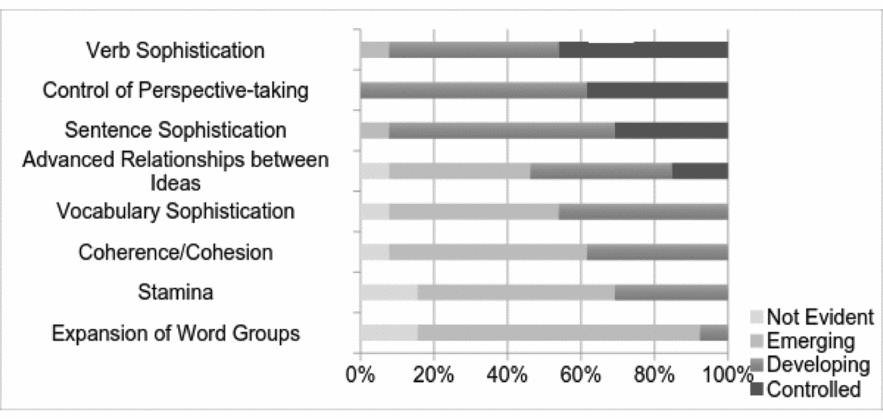
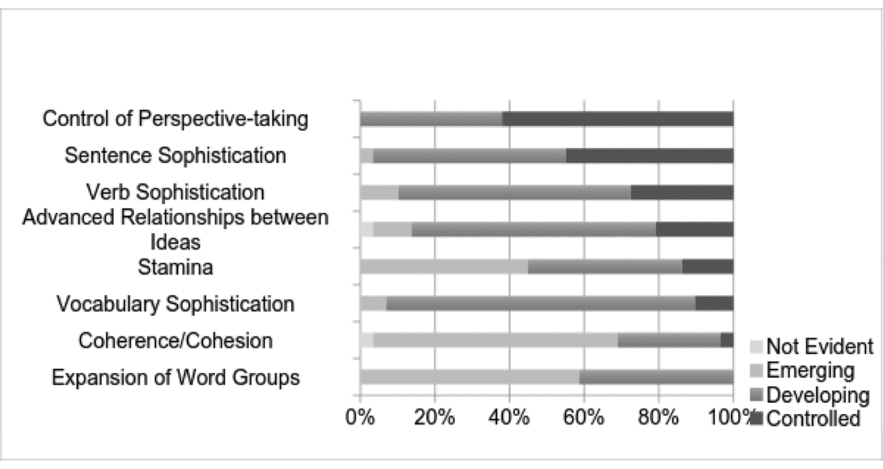
The order of emergence of each language feature was examined by comparing Time Points 1 and 2 for the percentage of students at the not evident, emergent, developing, and controlled phases of the progressions by each language group. This was initially conducted separately by grade, then by comparing the two grades to determine any similarities or differences for the emergence of features. These results are presented graphically in Figures 1–8 to convey the progression of features with this sample of students and later summarized in Table 3.
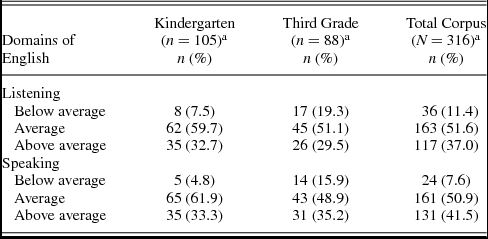
Kindergarten English learners’ Order of Emergence at Time Point 1 (n = 35)

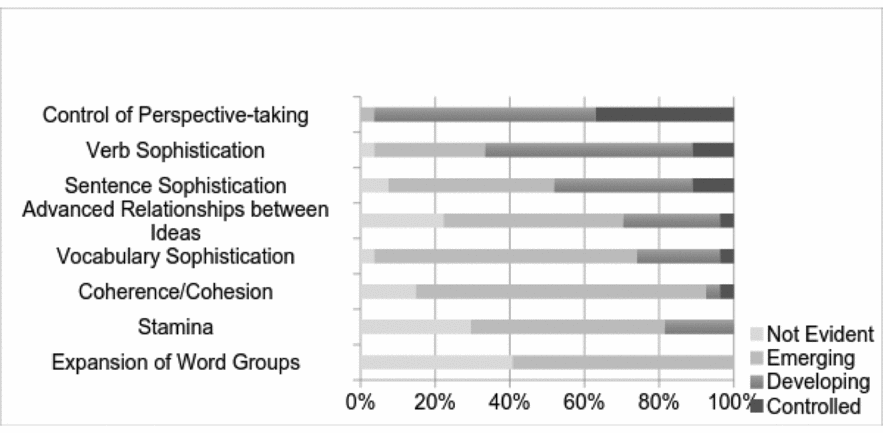
Kindergarten English Learners’ Order of Emergence at Time Point 2 (n = 27)

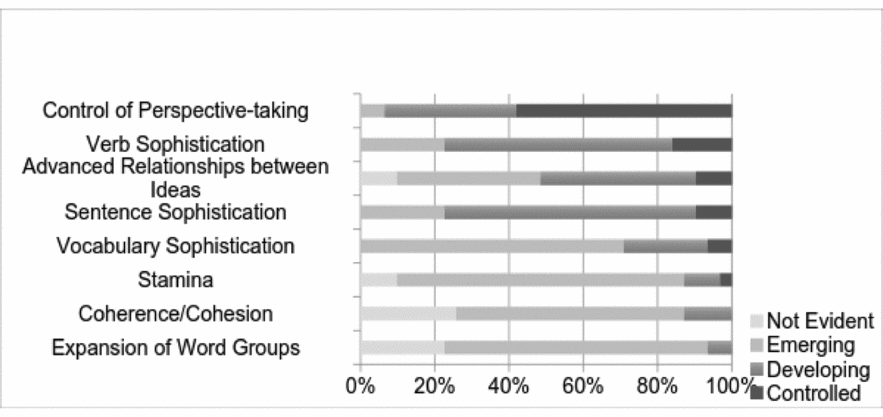
Kindergarten English Monolingual and Proficient Students’ Order of Emergence at Time Point 1 (n = 40)

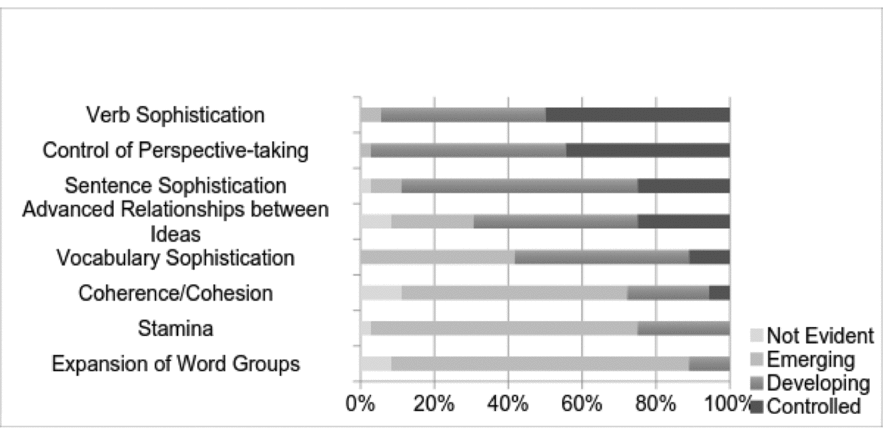
Kindergarten English Monolingual and Proficient Students’ Order of Emergence at Time Point 2 (n = 31)

Third-Grade English Learners’ Order of Emergence at Time Point 1 (n = 36)

Third-grade English Learners’ Order of Emergence at Time Point 2 (n = 13)

Third-grade English Monolingual and Proficient Students’ Order of Emergence at Time Point 1 (n = 29)

Third-Grade English Monolingual and Proficient Students’ Order of Emergence at Time Point 2 (n = 23)

Summary of Percentage of Students at the Controlled Phase of the Progressions for Eight Language Features by Grade and English Learner Status (n = 129)a

Note. aNot every student contributed an explanation (see individual figures for group/time sample sizes).
Kindergarten Language Progressions
Figures 1 and 2 show language features ordered by highest to lowest percentage of explanations at the controlled phase for kindergarteners who were English learners. The majority of students were at the developing phase on control of perspective-taking, and a large percentage were already at the controlled phase at Time Point 1. Very few student explanations were at the not evident or emergent phases. Verb sophistication, sentence sophistication, and advanced relationships between ideas had a small percentage of explanations placed at the controlled phase. The remaining language features had no student explanations at the controlled phase and thus were ordered by percentage of student explanations at the developing phase: namely, vocabulary sophistication, coherence/cohesion, expansion of word groups, and stamina.
Figures 1 and 2 can be contrasted to show modest increases in the proportion of explanations at the higher phases of the progressions. Control of perspective-taking, verb sophistication, and sentence sophistication all increased in the proportion of student explanations placed at the developing or controlled phases. However, advanced relationships between ideas appears static between the two time points. Vocabulary sophistication and coherence/cohesion each had explanations placed at the controlled phase at Time Point 2 in contrast with Time Point 1. Stamina moved up in the ordering, with a larger proportion of explanations now placed at the developing phase. Expansion of word groups fell in the ordering, with no student explanations at the developing phase in contrast with a few at Time Point 1.
Figure 3 shows order of emergence for the explanations of English monolingual and proficient students at Time Point 1 in kindergarten. As with English learners, the majority of kindergarteners had explanations placed at the developing phase on control of perspective-taking, and a large proportion were also already at the controlled phase. Furthermore, as with English learners, few explanations were at the not evident or emergent phases. Sentence sophistication, verb sophistication, and advanced relationships between ideas also had some explanations placed at the controlled phase at Time Point 1. In the case of sentence sophistication, the proportion of student explanations at higher phases is significantly different from the English learner group, χ2(2, N = 75) = 7.96, p < .05. As with English learners, however, the remaining language features had no student explanations at the controlled phase. However, with the exception of vocabulary sophistication that was comparable, the features appeared in a different order of emergence from those of the English learners, namely, stamina, expansion of word groups, and finally coherence/cohesion.
Contrasting Figures 3 and 4 revealed modest increases in the proportion of student explanations at the controlled phase of the progressions for some language features. As with English learners, these included control of perspective-taking and verb sophistication, and additionally advanced relationships between ideas, vocabulary sophistication, and stamina for the explanations of English monolingual or proficient students. However, sentence sophistication appeared to be an anomaly with fewer explanations placed at the controlled phase and more at the developing phase at Time Point 2 compared with Time Point 1. This anomaly was not evident with the explanations of English learners and, unlike at Time Point 1, the higher placement on the sentence sophistication progression for explanations of English monolingual or proficient students now only approached significance (p = .07). Also in contrast with English learners’ explanations, coherence/cohesion remained relatively static between time points for the English monolingual or proficient kindergarteners. As with English learners, expansion of word groups fell in the ordering, the vast majority of explanations still at the emergent phase.
Third-Grade Language Progressions
Figure 5 shows the order of emergence of language features of the explanations for English learners at Time Point 1 in third grade. Verb sophistication had most third-grade explanations placed at the controlled phase. All language features except coherence/cohesion, stamina, and expansion of word groups have the majority of explanations placed at the developing and controlled phases. This overall pattern shows higher placement along the progressions than for the kindergarten explanations of English learners on all language features.
Figure 6 can be contrasted with Figure 5 to reveal growth for the third-grade explanations of English learners. While the order of emergence remained the same across the two time points, there were some anomalies, with vocabulary sophistication and coherence/cohesion no longer having explanations placed at the controlled phase although larger proportions were placed at the developing phase at Time Point 2 than at Time Point 1. The remaining features remained static. This contrasts with the growth described between time points for kindergarten English learners who did progress modestly as a group even if they did not yet reach the higher phases of the progressions in the same proportions as the third-grade students.
Figure 7 shows the order of features for the third-grade explanations of English monolingual and proficient students at Time Point 1. This order is control of perspective-taking, sentence sophistication, verb sophistication, advanced relationships between ideas, stamina, vocabulary sophistication and coherence/cohesion, with no student explanations placed at the controlled phase for expansion of word groups. There were differences compared with third-grade English learners: Verb sophistication was ordered ahead of control of perspective-taking, and stamina was ordered lower for English monolingual or proficient students. The placement of more explanations of the English monolingual or proficient students at higher phases of the progression for stamina, vocabulary sophistication, and expansion of word groups at Time Point 1 was significantly different from the English learners, χ2(2, N = 65) = 9.11, p < .03, χ2(2, N = 65) = 10.65, p < .01, and χ2(2, N = 65) = 9.49, p < .01, respectively.
The order of features remained the same for explanations of English monolingual and proficient students when contrasting Figures 7 and 8, with the exception of vocabulary sophistication and coherence/cohesion now positioned before stamina with proportionately fewer student explanations placed at controlled on stamina at Time Point 2 than at Time Point 1. The previously reported difference between the two language groups for vocabulary sophistication only approached significance at Time Point 2 (p =.06). There appeared to be modest gains on most features as there were between time points in kindergarten for English monolingual or proficient students.
Stamina and expansion of word groups were exceptions by not showing gains on the progressions at third grade. Indeed, the placement of explanations of English monolingual or proficient students for stamina was no longer significantly different from that of English learners (p = .10). Between-group differences for expansion of word groups remained significant, χ2(2, N = 36) = 6.14, p < .05. Gains on other features by English monolingual or proficient students were made mainly at the controlled phase unlike the gains of English learners that were due mainly to increases in the proportion of explanations at the developing phase.
Table 3 provides a summary of the percentage of students at the controlled phase by language group, across time interval and grade. No students had explanations placed at controlled for expansion for word groups, and very few students had explanations placed at controlled for coherence/cohesion and stamina, with few gains across the time interval. Explanations were also rarely placed at controlled for vocabulary sophistication, although the third-grade English monolingual or proficient group had the largest proportion of students and progressed between time points. Control of perspective-taking was the most controlled feature for both language groups but differences suggesting gains between grades and across time interval were less pronounced for English learners than for the English monolingual or proficient students. Verb sophistication and advanced relationships between ideas both had anomalous patterns for explanations produced by third-grade English learners. For other students, percentages for advanced relationships between ideas were largely static across time, whereas verb sophistication showed progression across time for English monolingual or proficient students at both grades. Finally, the percentage of controlled explanations for sentence sophistication for third-grade English learners was initially lower than that for kindergarten English monolingual or proficient students, although the latter actually decreased in percentage controlled across time. Percentages of kindergarten English learners and third-grade English monolingual or proficient students were largely static across time.
Progression Placement and Teacher Ratings of Oral Language Proficiency
Relationships between placement of student explanations on the oral language progressions at Time Point 1 and teachers’ concurrent ratings of the students’ listening and speaking can be examined separately by language group and grade using Spearman's rho correlations (suited to nonparametric data). There were no significant correlations for the explanations of English learners at either grade level and just two for English monolingual or proficient students. Placement on the progression for control of perspective-taking (i.e., being able to maintain pronominal references in the explanation, contributing to listener comprehension) at the third grade was positively correlated with teacher listening ratings (r (28) = .381, p < .05). Placement on the progression for expanding word groups (i.e., using a repertoire of adverbs, adjectives, nominalizations, etc.) at kindergarten was positively correlated with teacher speaking ratings (r (40) = .362, p < .05).
DISCUSSION AND CONCLUSION
The placement of language and discourse skills in explanations of a mathematics task showed both differences and similarities between English learners and English monolingual or proficient students. By collecting explanation samples at two time points and two grade levels, we can begin to address the question of how stable the order of emergence is and how quickly features are developing during the early elementary years. There were fewer significant differences between the English learner and the English monolingual or proficient groups at kindergarten than at third grade. This is not surprising, given that both language groups, with the exceptions of controlling perspective-taking and verbs forms, have yet to see many of the language and discourse features of their explanations progress much beyond the emergent phase at kindergarten. A notable difference between the language groups was in students’ use of complex sentences, a hallmark of the developing phase of the sentence sophistication progression. At the first time point, this distinguished the English learner kindergartners from their English monolingual or proficient peers. However, we did see some growth in both language groups during kindergarten, with slightly larger numbers of student explanations placed at higher phases of the progressions 4–6 months later for relationships between complex ideas and vocabulary. These involved kindergartners adding different markers of causal connectives to their explanations (e.g., expanding beyond because and so to include other connectives, such as since) and increasing the range of their vocabularies (e.g., adding words beyond core topic vocabulary for the task, such as equals and plus).
Grade also matters in that kindergarteners and third graders appeared to differ in the distribution of explanations on the phases of the progressions. At the first time point, there were more significantly different placements on the progressions for the two language groups in third grade than in kindergarten, with explanations of English monolingual or proficient students’ placed higher than those of English learners’ for vocabulary sophistication, stamina, and expansion of word groups. It is noticeable that these differences, with the exception of expansion of word groups, did not last into the second time point. Rather, both language groups showed areas of very little progression at third grade, especially in the cases of coherence/cohesion and stamina. Both are discourse-level features or clusters of features that may still be challenging to students at this age due to underlying cognitive as well as linguistic aspects. Coherence/cohesion involves ordering the explanation logically or temporally and using linguistic devices to tie together different referents, and stamina refers to how completely a student can explain his or her mental model of the mathematics task.
These data may assist teachers in how best to respond to students’ language-learning needs. The relative lack of correlation between the placement of student explanations on the progressions of language and discourse features and teacher ratings of their students’ listening and speaking abilities suggests that teachers may have a more generalized impression of student language abilities: one that is more favorable toward students’ abilities and one that is not necessarily commensurate with the level of specificity provided in the progressions of language and discourse features. The progressions force attention to language at different levels of organization, namely, word, sentence, and discourse. Within these levels, teachers will be able to use the DLLP approach to formative assessment to focus on one or more aspects of language. The details in the language features are rarely included on standards for language development (Bailey & Heritage, Reference Bailey and Heritage2014, Reference Bailey, Heritage, Peters, Cowie and Menter2017) and therefore the language-learning progressions can give teachers and their students a more precise picture of where students currently are in development and what aspects of the language features both can work on in the future.
To illustrate briefly the kinds of information that the progressions can offer to teachers and their students, the following explanations are placed at the successive phases of the progression for sentence sophistication. Each example is from a different kindergartener. English learner and English monolingual students are included to highlight that students at any grade level and with any language background produce explanations that can be placed across all phases of the progressions.
Not Evident Phase: “Six.” (kindergarten, English learner)
• Use of one word
Emergent Phase: “Basically you just use. . . . Put two in one group and turn them over and turn them over. And then basically, you just do the math. I mostly do it this way because the math. . . . And basically, two plus two is four. And I got two more basics.” (Kindergarten, English monolingual student)
• Use of simple sentences
Developing Phase: “Because if you want to make them in two lines, you could count them like this: one, two, three, four, five, six. And then you can write the numbers on your paper or your mom's paper.” (Kindergarten, English learner)
• Use of one adverbial clause and simple sentences
Controlled Phase: “You need to use the cubes to put them in line and then count them before you put them in line. And then you put them in line and then you start piling them more and more and more until you find out.”
[Tell him why using the cubes this way helps him?]
“Because you will learn and know already what is like three plus three or if you put them in line, you already know that there are six in all.”
• Use of a variety of complex clause structures (adverbial and complementizer) (Kindergarten, English learner)
If we examine the sentence sophistication of the explanations above, we can identify and monitor the successive emergence, development, and control of language. Teachers can use the audio and transcribed explanations in the corpus to build their own familiarity with the progression of student explanation abilities at different grade levels (available at DLLP.org). They can compare their students’ productions to those of the corpus to help place their students’ explanations on the progressions. Use of this information need not be limited to students’ acquisition of English as a new language, and could be drawn upon more widely to assess all students regardless of language background if teachers found the need outweighed the extra commitment.
In addition, because teachers can and should be constantly revising where they place their students’ language performances on the progressions to guide their instruction, the DLLP approach to formative assessment of language is not high stakes; rather it is “day-to-day” stakes. This is no less important than the stakes associated with assessing students for placement, program exit, or program accountability because knowing the appropriate pedagogical response to choose is also critical. For example, an explanation placed at emergent for sentence sophistication may signal the need for more input of complex syntax such as embedded clauses, or more opportunities for interaction that solicits complex syntax in students’ own language productions.
However, day-to-day stakes also means that teachers need not fear being inaccurate in their placement of a student's explanation on the progressions. Additional samples elicited in different contexts on a different day may confirm or refute any given placement so teachers can modify their instruction accordingly. Such contextual information may also reveal a student's facility with language in different situations (formal, informal, highly scaffolded, familiar topic, etc.) and can further inform and refine instructional responses.
The results of the current study are exploratory due to the modest sample size employed to try out these analyses. Moreover, a major limitation includes the confounding of SES at the school level with English learner status. Unfortunately, school SES and English learner status are frequently overlapping in this population of students (Cosentino de Cohen & Chu Clewell, Reference Cosentino de Cohen and Chu Clewell2007) and remain a major challenge for future study recruitment strategies and analyses. The findings, however, may still prove valuable to educators and others to help identify and sequence characteristics of language for targeted instruction and to stimulate further research. Other important questions remain, including whether teachers receive support (preparation and time) to develop formative assessment literacy for language learning, and whether teachers stay in conversation with students long enough to effectively elicit evidence of student language learning on a regular basis. These issues notwithstanding, the current study's approach can function as a model for further development of language-learning progressions and could be extended to other key language practices that students need for engaging both with academic content and other students, such as arguing from evidence, also prevalent across the school curriculum (Lee et al., Reference Lee, Quinn and Valdés2013).
Acknowledgments
I thank the many students, teachers, and administrators who participated in the DLLP project, as well as colleagues and graduate students who assisted, particularly Anne Blackstock-Bernstein, Sandy Chang, and Margaret Heritage. This work was funded by the WIDA Consortium at the Wisconsin Center for Educational Research and an ASSETS Enhanced Assessment Grant from the U.S. Department of Education. However, the content does not necessarily represent the policy of the U.S. Department of Education, and you should not assume endorsement by the federal government. I also acknowledge serving as a consultant and advisory board member for WIDA projects.