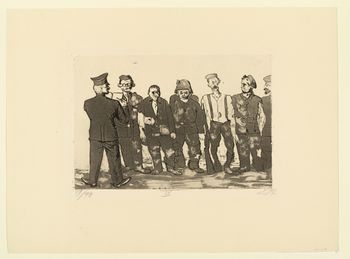
Figure 1 shows Otto Dix's Roll Call of Returning Troops from his 1924 collection The War. The soldiers, except for the one second from the left, who seems to have lost an eye, appear physically intact. However, these presumably working-class men, standing in front of their well-dressed, upper-class officer, do not display the sort of masculinity that Austrian and German armies expected their frontline servicemen to have. As we shall see, this masculinity was defined above all by strength of nerve. Indeed, as the historian Hans-Georg Hofer writes, since the First World War's trench warfare demanded that soldiers be stationed on the front for extended periods of time, strong nerves and tenacity became the most valued male qualities during the late 1910s and the 1920s.Footnote 1 The ideal warrior in First World War-era Austria and Germany was thus distinguished by his stoicism: he did not lose his cool despite overwhelming artillery violence. Dix's portrayal of soldiers in the aftermath of the war, then, should be perceived as a deliberate representation of the kind of shaken, ‘damaged’ men who inundated Austria and Germany during that time. With unsparing honesty about veterans' conditions, Dix's political-artistic endeavour was echoed in the visual arts by Max Beckmann, George Grosz and Oskar Kokoschka, to name but a few.Footnote 2 Together, their depictions of physically decrepit and emotionally wounded men became a means through which they rejected the German-speaking Central Powers' singular vision of heroic manhood. Their images represent a resistance to a certain kind of institutional violence against men whom the military had treated as ‘idle’ and therefore ‘immoral’.Footnote 3
Dix, Otto (1891–1969) © ARS, NY. Roll Call of Returning Troops (Appell der Zurückgekehrten), from The War (Der Krieg). 1924. Etching, aquatint and drypoint, from a portfolio of 50 etchings, aquatints and drypoints. Plate: 7 11/16 × 11 5/16″ (19.6 × 28.8 cm); sheet: 13 3/4 × 18 9/16″ (35 × 47.2 cm). Publisher: Karl Nierendorf, Berlin. Printer: Otto Felsing, Berlin. Edition: 70. Gift of Abby Aldrich Rockefeller. The Museum of Modern Art, New York, USA. © ESTATE OF OTTO DIX / SOCAN (2019). Digital image © The Museum of Modern Art / Licensed by SCALA / Art Resource, NY.

From this cultural milieu also emerged Alban Berg's Wozzeck, now one of the most canonical operas of the twentieth century. An ordinary soldier who suffers medical and psychological abuse at the hands of the high-ranking characters of the Captain, the Doctor and the Drum Major, Berg's titular protagonist survived the war physically unblemished but psychologically destroyed. His despondent demeanour marked him as a man who could not measure up to expectations of masculine perseverance. At the time of a Georg Büchner renaissance, Berg's critics recognized the theme of structural violence in Büchner's original play, Woyzeck.Footnote 4 Many of them could not, however, empathize with Berg's protagonist, citing the opera's lack of vocal expressivity as the reason for their trouble (a point to which I shall return).Footnote 5 Despite the absolute calamity that had just passed, as Patricia Hall observes, not one of Berg's early critics made an explicit connection between the opera and the kinds of medical exploitation and military violence opened up by the war.Footnote 6 The historical specifics of the First World War nevertheless form the basis of my reading, not least because Berg served in the war and began working on the opera during it. He was, moreover, personally and emotionally invested in his protagonist's plight, writing to his wife: ‘There is a bit of me in this character [… having] been in chains, sick, captive, resigned, and in fact humiliated.’Footnote 7 Büchner's peas and mutton in the play became Berg's beans and meat scraps in the opera, which, Berg complained, had been cooked ‘in the most disgusting manner’ when he served in the Austrian army.Footnote 8 While critics had refrained from mentioning the war in what was already the roaring twenties, these were details that at least some of Berg's audience would have recognized and understood.
In this article, in addition to analysing the ways in which Berg portrays vulnerability and the abuse of power by means of operatic voices, I examine critical commentaries from Wozzeck's première in Berlin in 1925 and Berg's subsequent responses to these early critiques in the context of post-First World War Austria and Germany. This was an environment in which doctors and military officials were held in uncritically high esteem.Footnote 9 This was also where state apparatuses shaped public opinion about failed soldiers who became veterans, apparently able-bodied yet living on state pension. From there, I interrogate how society's tendency to trust blindly figures of authority, even in the post-war years, might have affected their hearing of Wozzeck as an operatic character. That is to say, critics' general lack of empathy with the opera's downtrodden protagonist had as much to do – or so they claimed – with Berg's inexpressive atonal language as it had to do with people's ill perception of seemingly indolent veterans at this time. So I shall first paint a fuller picture of what it meant to be a man who could not match up to expectations of Austria and Germany's cool, indefatigable masculine ideal during and after the war that was supposed to end all wars.
War hysterics
The point that Berg's protagonist Wozzeck emerged in 1925 without an external injury – as had almost all of Dix's row of soldiers the year before – was crucial within the frame of (post-)First World War politics. Simply put, doctors and state officials deliberately underscored the difference between soldiers who were wounded in action and those who merely suffered from psychological afflictions. Those who had escaped the war superficially unscathed but did not work – even when it was simply because they could not work – thus became war ‘hysterics' (Hysteriker).Footnote 10 Portraying ‘hysterics' as work-shy and exclusively working class, the Viennese psychiatrist Julius Wagner von Jauregg, for instance, suggested in a 1917 issue of the Wiener medizinische Wochenschrift that symptoms occurring in ‘hysterics' were in reality feigned to ‘gain advantages or avoid evil’.Footnote 11 Indeed, as late as 1917, when initial idealism for the war's invigorating potential had abated, the consensus among those in power was still that ‘hysterics' either pretended to be ill or were already susceptible to nervous breakdowns regardless of the war (there was a strong class component to this critique – officers, under a different label of ‘neurasthenic’, were shielded from such criticisms).Footnote 12 Moreover, as state officials sought to control the declining military force, the Austrian and German armies were unique in their active cultivation of civilians' negative attitude to unproductive soldiers and veterans. The British government, to give a counterexample, carefully avoided the term ‘shell shock’ once they concluded in 1916 that the condition was not the result of brain concussion but a weakness of the nerves.Footnote 13
The characters of the Doctor, the Captain and the Drum Major from Büchner's early nineteenth-century drama Woyzeck (premièred as late as 1913) hence gained further resonance against the backdrop of the First World War. As Austria and Germany engineered and politicized the now archaic diagnosis of ‘hysteria’, the power that doctors had over common soldiers grew immense, especially, as already noted, for those who remained ‘outwardly intact’.Footnote 14 Furthermore, given that the threat of ‘male hysteria’ was a means in the pre-war years of instilling factory workers with a Protestant work ethic, there was, as Ursula Link-Heer has traced, a smooth transfer of the condition from the factory floor to the battlefield.Footnote 15 Correspondingly, there were attempts to bring industrial efficiency to the army, something that could be observed in, for instance, the physiologist Arnold Durig taking as a model the American industrialist Frederick W. Taylor's The Principles of Scientific Management (1911).Footnote 16 The vast number of temporary hospitals (Barackenspitäler) that Durig set up in the Viennese district of Grinzing were anonymous – and dehumanized – spaces where the aim was to treat, or rather to process, the largest number of men in the shortest length of time.Footnote 17 There, the timings for offloading, tending to or operating on soldiers were carefully studied for maximum efficiency.
A more appalling example of medical-military abuse can be located in Austria's use of electricity on both their enemies and their own men, even when Germany had already adopted hypnosis as their primary remedy for ‘hysteria’.Footnote 18 The Austrian doctor Stefan Jellinek's 1916 breakthrough in incapacitating enemy soldiers by means of high-voltage electrified barbed wire was soon turned against the country's own failing soldiers, as electric compulsion therapy was prescribed to their own ‘nervous men’ in need of a ‘hard fist’.Footnote 19 As the First World War was seen to be a singular opportunity to carry out medical research on a mass scale, doctors' wartime work was considered ‘war gains' (Kriegsgewinnern).Footnote 20 Even after 1918, the idea that the First World War brought with it considerable advancement in knowledge meant that doctors, who were already held in high esteem for their ‘strike power’, went on to be regarded as ‘silent, selfless heroes’.Footnote 21
There was, thus, in the post-war years when Berg's Wozzeck was being staged, a stark contrast between people's reverence for doctors (and officers) and their scorn for the many veterans seen loitering on the streets. As Carol Poore writes, unlike soldiers who returned triumphantly from the Franco-Prussian War, the 2.7 million German servicemen who survived the First World War became a liability for a state that, defeated and impoverished, could not provide adequate social support to veterans, whose presence interrupted the forward movement of a nation frantically trying to hide behind the glamorous façade of a new decade.Footnote 22 Thus, political manoeuvring backed up by ostensibly scientific research, as the historian Paul Lerner has argued, allowed the depiction of ‘male hysterics' as ‘pension squeezers' or ‘chasers’.Footnote 23 Although viewed in equal parts with fear and wonder, as Lerner explains more extensively, men with visible injuries could reintegrate into civilian life once they had been fitted with prosthetics and were back at work.Footnote 24 But for a nation embittered by the severe terms of the Treaty of Versailles and yet able to replace its male workforce, it was simply too much, as Jauregg and Jellinek (cited above) made clear, to have men who appeared capable of working, but did not do so, lingering on their streets. Wartime controversies about ‘hysterics' claiming pensions only intensified after the war. Throughout the 1920s and 1930s, Austria and Germany's war ‘hysterics’, then, faced the daily threat or, at times, reality of losing financial support and the public's respect.
Berg's aristocratic status ensured a smooth re-entry into Viennese society following his military service. Yet his exposure to the military informed his view of ‘hysteric’ figures such as his own Wozzeck, whose demonization during and after the war hinged on their (lack of) officer titles. In his 1930 interview with the essayist Oskar Jancke for the Aachener Anzeiger, for instance, Berg said:
There was probably some natural relationship between me and this poem. But let me emphasize that Wozzeck is no simple ‘we-poor-people’ [Wir-arme-Leut] play. What happened to Wozzeck can happen to any poor person, regardless of what type of clothing he wears. It can happen to anyone who is subjugated by others and cannot defend himself.Footnote 25
Commenting on the hierarchical and often dehumanizing experience of the army, Berg communicated understanding of and therefore solidarity with individuals who were without power. At the Berlin première of the opera, his social critique should have been clear. After all, Berg carefully curated a portion of his audience in order to ensure a successful first performance. Also, the cast, from the State Opera's company, was familiar to Berlin's regular opera-goers. Indeed, a glance at the singers who played the central roles suggests how the characters were perceived; it reveals an intertextual web of suffering shared between Berg's traumatized soldiers and the perverse exercise of authority. His opera therefore opens up questions about the expression of ideals: the ideal of a stoic man demanded by the army; and the ideal of (first) a Verdian bel canto voice and (later, approaching the 1930s) a ‘German’ voice, whatever the nature of the individual voices and generic allegiances of particular performers.
Lyrical tension
On 14 December 1925, then, the tenor Waldemar Henke entered the Berlin State Opera stage in the role of Wozzeck's Captain. A regular member of the opera house's company since 1911, Henke was routinely heard by the Berlin audience singing buffo and ‘character’ tenor (Charaktertenor) parts, such as Mime from the Ring, Monostatos from Die Zauberflöte and the many Spieltenor parts in Albert Lortzing's comic operas.Footnote 26 When the curtain opened on Wozzeck, Henke as the superior officer was seen taking advantage of – being shaved by – Wozzeck, who thus performed a servile task that the Captain could have done himself, but chose not to. Drawing on the commedia dell'arte tradition after Büchner's Woyzeck (and no doubt also Schoenberg's Pierrot lunaire), Berg depicts the Captain as a musical caricature who, though he swaggers around the military compound, would in reality do anything to avoid a fight.Footnote 27 Even with Wozzeck, the Captain avoids a full-blown conflict as he hastily puts an end to the dialogue of Act 1, scene i, by saying (‘anxiously’, as Berg instructs): ‘This discussion has quite unnerved me’ (bars 162–4).Footnote 28 The Captain's nervous temperament is put before the public with musical tropes such as punctuated short notes that suggest agitation and frequent shifts between modes of articulation that signify a mercurial disposition. The voice of this impotent male figure is comparable to the characters of Herodes and Aegisth from the similarly provocative early twentieth-century operas Salome and Elektra, and the Captain's tenor register in Berg's opera is intended to sound feminine, if not outright ‘effeminate’. The same musical tropes were also used by Strauss to represent, for instance, his Herodes, who despite being a king has vocal lines that often resemble the explicitly anti-Semitic characterization of Salome's four tenor Jews.Footnote 29
As early as the middle of Wozzeck's Act 1, scene i, before the Captain becomes anxious to make his exit and while he is taunting Wozzeck about lacking morals, the neurosis of Berg's buffo tenor becomes apparent (see Example 1). In the space of 18 bars (bars 110–27), Berg's character alters his methods of utterance at a remarkably fast pace. In the initial six bars alone the expression markings go from ‘sympathetically’ (bar 110), to ‘striking up an attitude’ (bar 112) and ‘like a fanfare’ (bar 114), to ‘very dignified’ (bar 115), while the volume of the Captain's voice swells from piano to forte. Listeners were reminded of symptoms of ‘combat neurosis' that Freud, for instance, observed in his patients, including abrupt change in mood and confusion, signifying the rupture of one's self and affecting speech.Footnote 30 After the Captain reaches an octave leap on ‘Moral sense’ at bars 1152–1161, the tension in his voice increases as Berg underscores the sadistic nature of this character's unnecessary chiding of the opera's protagonist. The next leap, a minor seventh up to c″ at the top of the tenor's usual range on ‘quite mor(ally)’ in bars 1162–1171, then, is to be sung in a piercing falsetto, resulting in a shrill tone that renders the Captain effete in his momentary loss of control. From there, the Captain shifts between parlando and cantabile, as he fails again and again to represent himself in a coherent fashion (bars 118–27). Berg even places some of the Captain's flustered parlando asides in actual parentheses in the score (punctuation not present in editions of Büchner's play), foregrounding the Captain's inability to stay focused: ‘(Is that clear? It is a splendid word)’ (bars 118–19) and ‘(the words are not my own)’ (bars 126–7). Versed in the mannerisms of Mime, another semi-comical and quasi-hysterical figure, who accentuates the masculinity of Siegfried, Henke thus brought to the Berlin audience a buffo tenor as Berg's ineffective authority figure abusing his power.
Berg's Wozzeck, Act 1, scene i, bars 110–27 (vocal part only), from orchestral score (Vienna: Universal Edition, 2011). Reproduced by permission of Universal Edition. Alban Berg, ‘Wozzeck, op. 7’. © Copyright by UNIVERSAL EDITION A.G., Wien. www.universaledition.com.

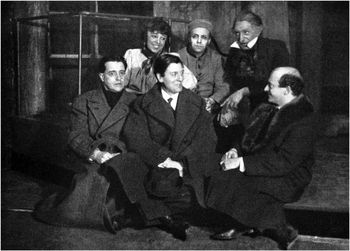
The role of the Doctor, by contrast, was created by the bass Martin Abendroth. Having joined the State Opera only in the autumn and hence being relatively unknown to the Berlin audience, he had débuted in the part of King Henry from Wagner's Lohengrin.Footnote 31 In Wozzeck, however, he lent his authoritative bass voice to very different ends. The Doctor, a buffo bass, never establishes through his voice a secure sense of composure. The music critic Walter Schrenk, for instance, observed that Abendroth, while having what Schrenk considered to be the ‘hardest of all vocals' in this opera, defied via Berg's music the image of a skilled and cool-headed scientist.Footnote 32 Rather, he portrayed with ‘admirable musicality’ a power-hungry man's ‘splitting obsession’ with cold-blooded experiments.Footnote 33 He thus rendered preposterous an authority figure that would, in real life, as my introduction explains, be unreservedly venerated during and after the First World War. Instead, he accentuated through Berg's music the Doctor's tendency – already apparent in Büchner's play – to drivel. There he was, a man large in stature, though not heavy (Figure 2), as one might expect a doctor from a commedia dell'arte to be, presented as a learned character who knows a great deal but understands very little, and who gabbles. While the Captain's timidity is reflected in the way in which he temporarily oscillates between parlando and cantabile, Berg heightens the use of this compositional device, effectively representing a state of neurosis, as the unstable Doctor fixates and repeats himself. Therefore, in prolonged passages in Act 1, scene iv, the Doctor, too, shifts between parlando and cantabile (as well as a range of other meticulously placed expressive markings), unable to command self-possession. The brief moments of cantabile function to support this character's articulation of grand ambitions. Conversely, Berg lets the Doctor vocalize in parlando style when calling attention to his struggle to suppress his temper. Table 1 makes this distinction clear.
From left to right: Franz Hörth (producer), Sigrid Johanson (Marie), Berg, Leo Schützendorf (Wozzeck), Martin Abendroth (the Doctor) and Erich Kleiber (conductor). Abendroth was clearly much larger than Schützendorf in stature. Berg himself was, of course, famously very tall. Rehearsal for Wozzeck at the Berlin State Opera, presumably 1925. Lebrecht Music & Arts / Alamy Stock Photo.

| Bars | Parlando | Cantabile |
|---|---|---|
| 488–4911–2 | What is this now, Wozzeck? Where is your word? Eh! Eh! Eh! I saw you now, Wozzeck, I saw you just now coughing, in the street you were coughing, you howled like a dog. | |
| 4913–494 | You do not get paid every day for such antics, Wozzeck! This is bad! This world is bad, so bad! | |
| 4954–504 | By your nature, by your nature! Superstition, ridiculous superstition! Have I not proved quite clearly that the muscles are subject to the human will? [flaring up again] Nature's force, Wozzeck! Man's will is free. In man, individuality is sublimated to freedom. [shaking his head, in a whisper] (You were coughing!) [again to Wozzeck] Have you already eaten your beans up, Wozzeck? | |
| 505–12 | Beans in plenty, nought but beans for dinner. Mark my words. And then, next week, we'll start with a little leg of mutton. I'm starting a whole revolution in medicine. | |
| 5124–16 | Albumen, fats too, carbohydrates, [broad gesture] and next oxyaldehydanhydridum [as before … with sudden anger] And yet, you have once again failed me … | |
| 517–23 | No! This anger will not do. Anger is bad for health and bad for one's science. I am quite steady, my pulse is beating its usual sixty. Take care, and do not let a mere man upset you. If it were some lizard now, which had become indisposed … | |
| 523 | But now, really, Wozzeck, you should not misbehave so. |
Note: Italics for emphasis have been added.
The first two of the three sections shown in Table 1 where the Doctor sings in cantabile style are moments at which he respectively claims (as the Captain did over Wozzeck) the moral high ground (bars 491–4) or declares how his experiments should ideally unfold (bars 505–12). After the eventual arrival at ‘This anger will not do … ’ (bars 517–18), Berg inflates the Doctor's voice by having him communicate his scientific pretension in sempre dolce cantabile style (bar 521) and ‘warmly’ (bar 522). Yet as the Doctor finds out, reality – and, for that matter, the respiratory muscles that make Wozzeck cough – is not always subject to human will. In between futile attempts at scientific transcendence voiced in cantabile style, his parlando thus betrays his ridiculous reality. When the Doctor jabbers on about how Wozzeck makes his experiments fail, Berg portrays the Doctor's frustration in rapid parlando style, underscoring the character's inflated yet fragile ego.
Alongside the two buffo singers representing authority figures, the tenor Fritz Soot, another performer who regularly played Wagner's heroic tenor roles such as Lohengrin, Parsifal and Siegfried, stepped into the character of the Drum Major on the night of the première.Footnote 34 The casting of Soot as Wozzeck's high-ranking officer flaunting a heteronormative outlook is also intriguing from a biographical perspective.Footnote 35 Soot was the only actor in the major roles to have served in the First World War and, as though the war had hardened both his personality and his voice, he resumed his singing career in 1918 not in his previous Fach as a soft lyric tenor, but rather as a darker and more powerful heroic tenor.Footnote 36 With a voice that Schoenberg said had ‘extraordinary volume’, able to withstand a 150-person orchestra,Footnote 37 Soot thus delivered a performance that was, as Schrenk reported, ‘steeped in masculinity’ and ‘magnificent in attitude, song, and acting’.Footnote 38 Indeed, here is a tenor who sang Tristan in a 1924 recording both ‘valiant[ly]’ and enchantingly, ‘as if in a trance’.Footnote 39 However, as the musicologist Julian Johnson writes apropos of ironic gestures in Mahler's music that Mahler often ‘intends something other [than], perhaps quite opposite to, what is said’, Berg – an admirer of Mahler – similarly let his Drum Major overstate his masculinity to the point that the character's insecurity is exposed.Footnote 40 Already apparent in Büchner's text, the Drum Major's wickedness, then, is amplified through Berg's use of a pompous voice and vulgar stage directions.
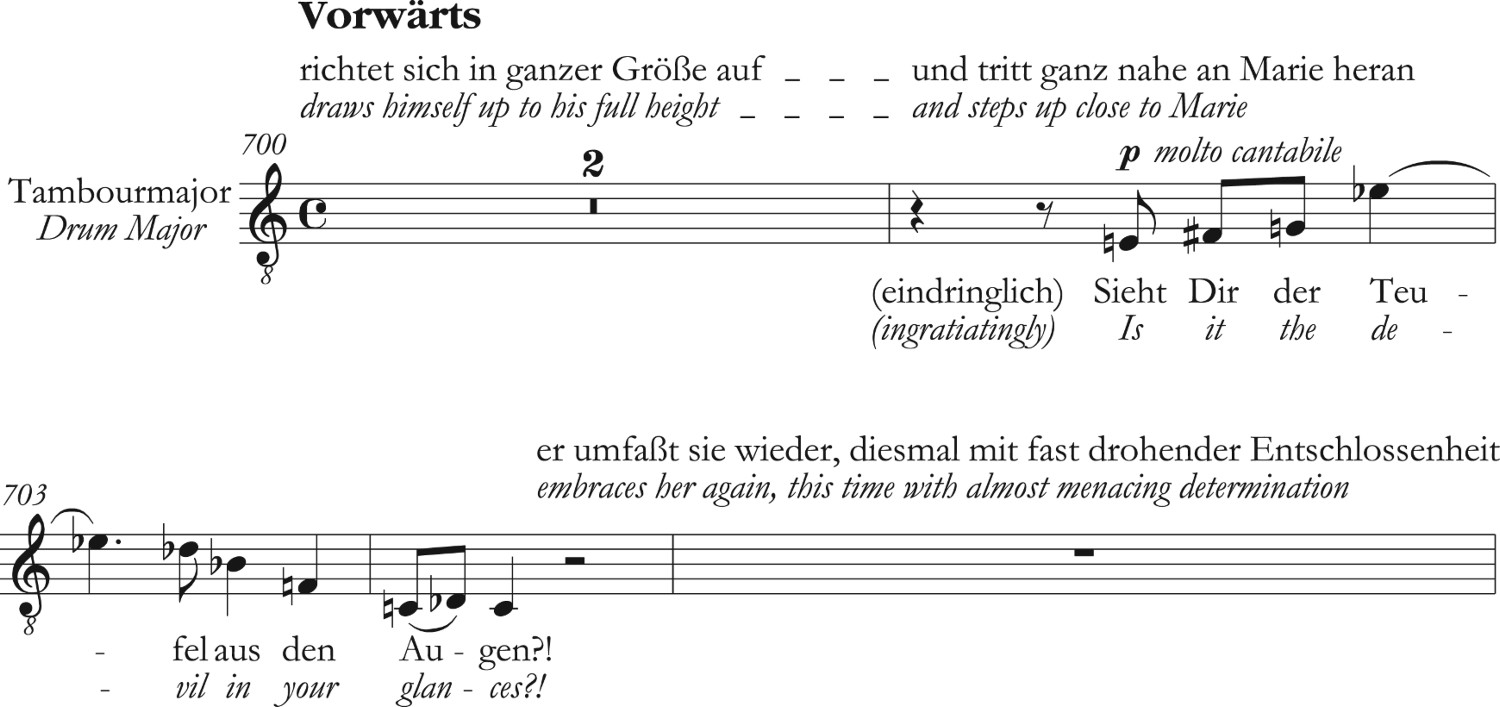
In the brief scene v of Act 1, this heroic tenor voice is written almost entirely in cantabile and even molto cantabile style in the score. As in the Captain's part, however, Berg regularly strains the Drum Major's voice and has him take his melodic arches to the top of the heroic tenor's range (a♭′ at bar 681 and a′ at bar 682) at a forte dynamic.Footnote 41 Unable to take Marie's initial mocking (Berg's direction, bar 684), the Drum Major's posturing is further turned into verbal and then physical abuse, as this character once more breaks into a′ before he ‘embraces [Marie]’ (bar 692), who ‘tries to break loose’ (bar 693). He ignores Marie's emphatic plea to let her go (bar 698), and the two characters ‘wrestle with each other’ (bars 693–4) until the Drum Major cries out, fortissimo: ‘Wildcat, hey!’, reaching an unprecedented b♭′. Yet the brutish Drum Major will not listen; instead, he ‘draws himself up to his full height’ (bars 700–1), further inflating his sense of self. In molto cantabile style, he threateningly drops his voice to a sinister piano as he creeps close to Marie before he ‘embraces her again, this time with almost menacing determination’, against the cymbals' ominous resonance (bars 704–5), and coerces her into sex (see Example 2). This ‘heroic’ tenor's words are so violent that they clash with the expectations of the cantabile style as the signifier for a virtuous character. While performers of the Captain and the Doctor underlined the protagonist's good nature via their weak, dissembling voices, Soot as the Drum Major did so through his over-masculinist posturing.
Berg's Wozzeck, Act 1, scene v, bars 700–5 (vocal part only), from orchestral score (Vienna: Universal Edition, 2011). Reproduced by permission of Universal Edition. Alban Berg, ‘Wozzeck, op. 7’. © Copyright by UNIVERSAL EDITION A.G., Wien. www.universaledition.com.

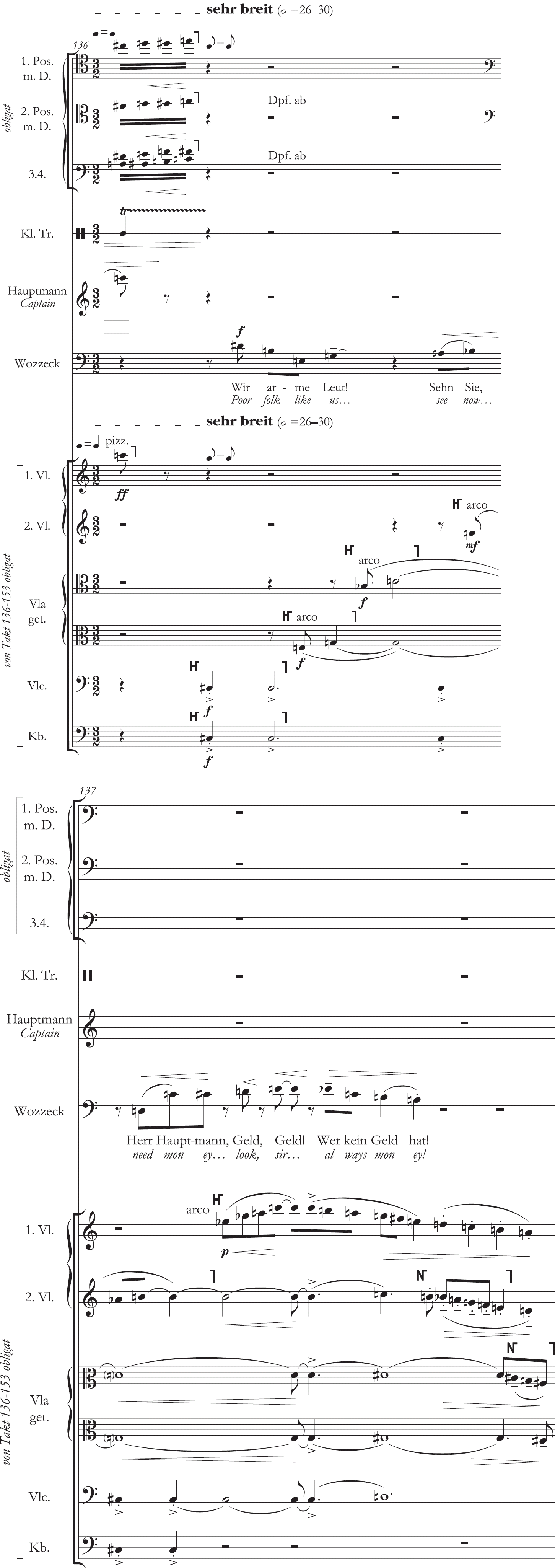
Conversely, with reference to the ‘lyrical tension’ of my title, even in times of indignation Wozzeck's vocal lines are never as tense or rhythmically animated as those of his superiors. Rather, the protagonist takes many of these scenes' melodic moments – a task that Berg's first Wozzeck, the bass-baritone Leo Schützendorf, would have executed compellingly as a ‘splendid’ actor with a ‘dark and unusually versatile voice’, adept at articulating the ‘subtlety of its characterization’.Footnote 42 As early as Act 1, scene i, for instance, Wozzeck is unaffected by the Captain erratically shifting between cantabile and parlando styles and can only be, as Andrew Clements comments, ‘provoked into a lyrical response’.Footnote 43 Berg's protagonist thus grieves, quietly, in a steady movement by step: ‘And yet sir, the good Lord God will not spurn the poor little fellow … ’ (bars 127–32). I suggested above that Herodes from Strauss's seminal Salome serves as a suitable point of reference from the early twentieth century for Berg's Captain. Strauss's contrasting depictions of Herodes and Jochanaan in that opera also provides a helpful intertext for interpreting Berg's treatment of the Captain and Wozzeck.Footnote 44 The warm brass music that provides solace to Jochanaan's stable baritone, which is at odds with the nervously descending violins accompanying Herodes's feverish voice, is echoed in Wozzeck's relation to the Captain. The orchestra in Berg's opera thus slows down with Wozzeck and adopts his 4/4 time (bars 130ff.) as opposed to the Captain's much more quickly paced and hence agitated 8/8 (bars 133ff.). Forming an intimate ensemble at a ‘very broad’ tempo, the strings are unhurried for Wozzeck (bar 136). Berg quite literally provides Wozzeck with breathing room as the orchestra paces gently and resonates spaciously. As Wozzeck musters more courage, he sings more loudly than before and introduces the opera's most significant theme, ‘Wir arme Leut!’ (bars 136–8), to the tenderness of arco strings (see Example 3).
Berg's Wozzeck, Act 1, scene i, bars 136–8, orchestral score (Vienna: Universal Edition, 2011). Reproduced by permission of Universal Edition. Alban Berg, ‘Wozzeck, op. 7’. © Copyright by UNIVERSAL EDITION A.G., Wien. www.universaledition.com.

There are other instances in which Wozzeck's singing creates emotional release. For instance, in Act 1, scene iv, while Wozzeck is calm, the Doctor needs to tell himself to be so. In case listeners might miss in Wozzeck this quality of self-control, which was, as we have seen, the most desirable quality during wartime, Berg specifies piano, molto cantabile and sehr ruhig (‘very calm’) (bar 524). Confronted by the Doctor, who is restless with ‘movement of rage’ (bar 524), Wozzeck offers instead one of the most poignant and songful moments of the entire opera, ending with him softly crying ‘Ach Marie!’ over an E minor chord (bars 524–40, Variations 5–7). In the midst of a mostly atonal opera, Berg thus presents his protagonist with a moment of tonal release, allowing the audience to identify with Wozzeck through the familiar sound of a conventional key. Similarly, Wozzeck's soft legato prayer in Act 2, scene v (bars 7534–7581), is juxtaposed with the Drum Major's ‘nois[y], very drunk[en]’ Rondo marziale (bars 761ff.). As Wozzeck ends this scene in defeat and quietly sings ‘One after the other!’ (bar 813), a phrase heard earlier from Marie (Act 2, scene iii, at bar 392), Berg is also mapping the Drum Major's act of rape onto this brutish authority's fight with Wozzeck. In relation to the Drum Major, there is also something to be said about Berg choosing a baritone – instead of a tenor – voice for his protagonist. After not only Verdi's famous baritones such as Falstaff, Macbeth and Rigoletto, but also Debussy's Goland and, once more, Strauss's Jochanaan, Berg likewise questions the parameter of a Wagnerian tenor lead and explores differing visions of masculinity by placing centre stage a traditionally secondary voice in opera.Footnote 45
Given that Wozzeck had Soot's enormous ‘heroic tenor’ voice propping up a drunken predator beside Henke and Abendroth, who also failed to establish their role as authority figures but remain buffo characters, Berg's first opera challenged on a night in post-First World War Germany the wartime association of the stoic man with military rank and institutional power. Moreover, as we have seen, the versatile performer Schützendorf concurrently realized what Berg had given Wozzeck – sympathetic arched melodic passages – as he pleads with his superiors for kinder treatment. If seeing on stage a ‘hysterical’ soldier – with notable expressive power – was likely to be unpalatable for many in the audience in the post-war political climate, Berg's empathetic treatment of his anti-hero, like Dix's art, could be considered an audacious act.
Collective voices
Now that we know that Berg's protagonist can sing with more emotional strength than his superiors, my aim in this section of the article is to show the wide range of emotions – including camaraderie, hopelessness and remorse – which Wozzeck is capable of expressing. These are responses to events that, contrary to the Captain's derision of Wozzeck's lack of morals, a person with a secure moral framework might have. Set against the opera's two-dimensional villains, Wozzeck and, to a degree, his peers become real characters troubled by complex feelings heard through their equally complex reservoir of voices. As Berg wrote, this opera was ‘the first and for a long time the only one to use the so-called rhythmic declamation that Schoenberg some twenty years ago introduced into the speaking choruses of Die glückliche Hand and his Pierrot melodramas’, and so I now turn to an examination of the Sprechgesang voice in Wozzeck.Footnote 46 My argument is that the utility of this technique lies not so much in its novelty as in the way that Berg has reserved it for a limited number of characters to use in spaces that are outside the military compound.Footnote 47 As the ‘collective voices' of my title suggests, Sprechgesang is remarkable because it signals the vulnerability of, and solidarity between, the opera's downtrodden characters in a cruel environment.
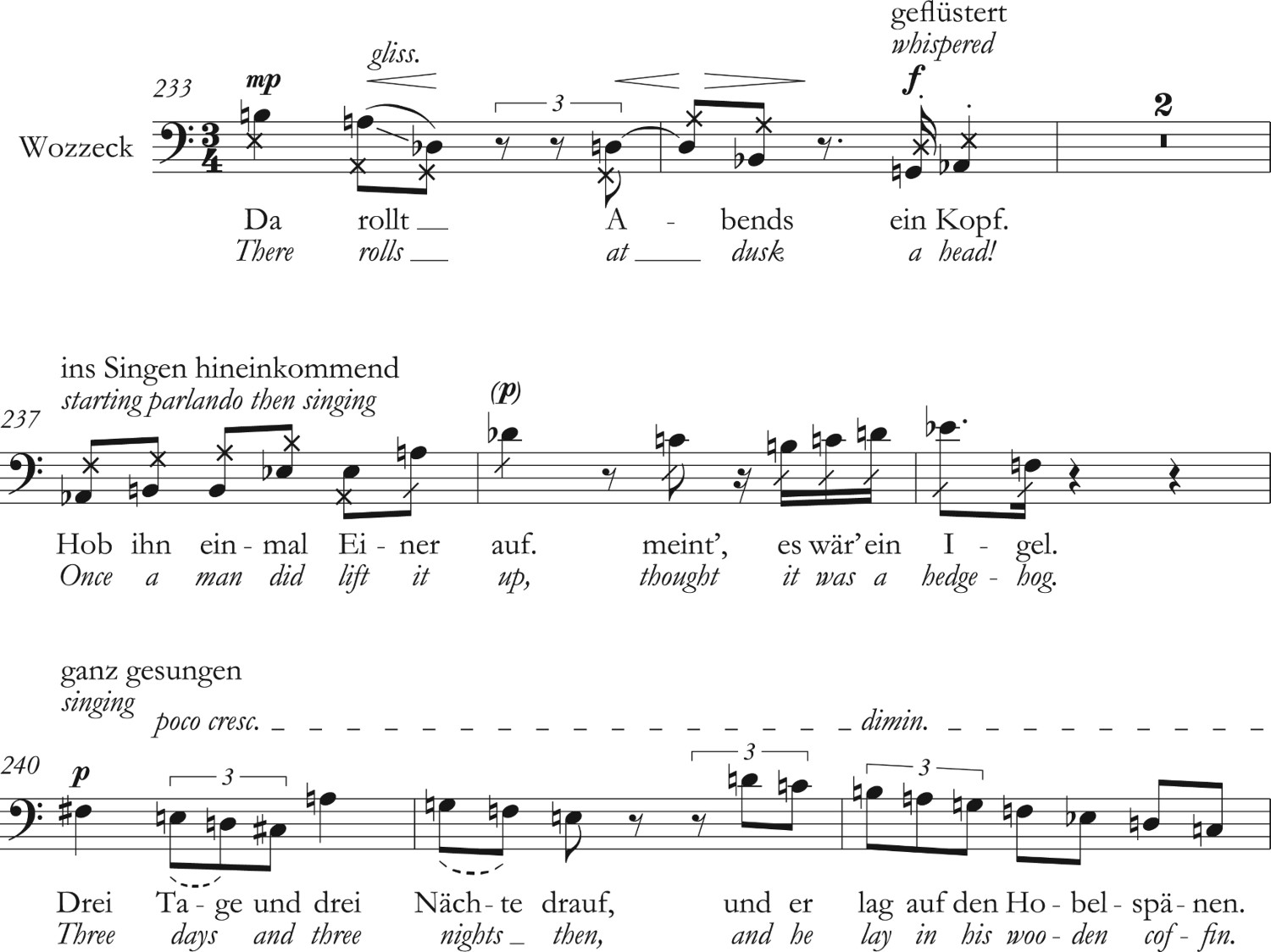
Momentarily driven mad in Act 1, scene ii, Wozzeck is to sing almost entirely in Sprechgesang, and in that sense the audience is allowed to hear this particular mode of vocalization as one that signals psychological instability. (The connection between Sprechgesang and mental illness is further reinforced in Act 2, scene iii, when a delirious Wozzeck confronts Marie with rumours of her infidelity; and in Act 3, scene iv, when a remorseful Wozzeck frantically tries to recover the knife that he has used to kill Marie.) In Act 1, scene ii, set in an open field outside town, Berg's musical setting makes Büchner's already frightening image (as part of Wozzeck's hallucination) of a rolling head at dusk even scarier. Wozzeck is to perform in an almost whispered Sprechgesang, enunciating slowly the harsh German consonants. Wozzeck's performer is to build up tension further by going against a singer's natural tendency to become louder when singing an ascending line. Instead, he diminuendos as he climbs up an already piano phrase enunciating ‘See how the mist is floating … ’ (bars 227ff.) before tapering off to pianissimo (bar 230), giving way to the strings playing pianississimo harmonic overtones in an airy, ghostly timbre (bars 231–2). Despite Andres taking it upon himself to cheer up his friend, Wozzeck never manages to display in this scene the kind of calmness that he has shown in his interactions with his superiors. Wozzeck shifts – as the Captain and the Doctor have done – between differing modes of utterance in a short span of time, going from, for instance, ‘whispered’ (bar 234), ‘starting parlando then singing’ (bar 237), to ‘singing’ (bar 240) (see Example 4). Yet what Wozzeck's vocal instability also signifies is a brief respite from the officers. Moments such as this allow him to reveal an aspect of himself that he is not free to show in front of his superiors.
Berg's Wozzeck, Act 1, scene ii, bars 233–42 (vocal part only), from orchestral score (Vienna: Universal Edition, 2011). Reproduced by permission of Universal Edition. Alban Berg, ‘Wozzeck, op. 7’. © Copyright by UNIVERSAL EDITION A.G., Wien. www.universaledition.com.

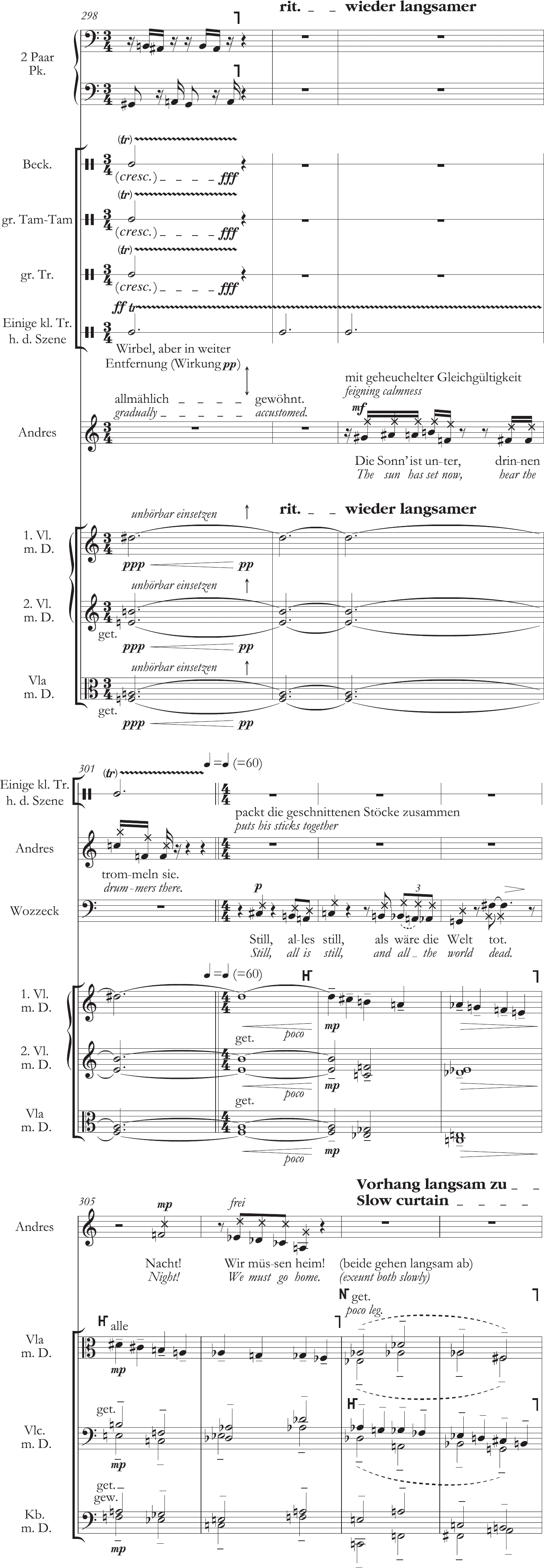
That Wozzeck communicates in Sprechgesang only when he is out of earshot of his superiors is significant. He does not use Sprechgesang in the barracks scene of Act 2, scene v, for instance, when as an insomniac he tells Andres that he is haunted by the image of Marie and the Drum Major dancing. The absence of Sprechgesang in the barracks does not mean that his peers do not support him; they do. Even when the soldiers protest in their sleep against Wozzeck speaking aloud, their quiet hum is soothing in its near motionlessness, and recalls – ‘famously’, as Stephen Decatur Smith writes – the ‘nature chords' heard earlier in Act 1, scene ii, when Wozzeck saw visions.Footnote 48 By contrast, out in the field, Wozzeck and Andres take on the Sprechgesang voice in a way that shapes it into a secret language, their private mode of communication. Thus, although Andres comforts Wozzeck by singing folk tunes, first at ease (bars 212ff.), then more anxiously about Wozzeck's visions (bars 249ff.), to the point that he sings over Wozzeck (bars 259ff.) and invites his friend to sing along (bar 263), Andres realizes that singing will not be enough. Instead, he gives up, and gets onto the same level as Wozzeck by breaking into Sprechgesang, initially trying to jolt his friend out of his hallucination: ‘Hey! Are you mad?’ (bar 279). When that proves to be in vain, Andres softens his stance, ‘feigning calmness' (bar 300), and descends as low as possible from his tenor voice to meet Wozzeck's baritone register, eventually reaching down to A in Sprechgesang (bar 306; see Example 5). As Andres assumes the Sprechgesang voice, he also assures Wozzeck of his caring.
Berg's Wozzeck, Act 1, scene ii, bars 298–308, orchestral score (Vienna: Universal Edition, 2011). Reproduced by permission of Universal Edition. Alban Berg, ‘Wozzeck, op. 7’. © Copyright by UNIVERSAL EDITION A.G., Wien. www.universaledition.com.

Indeed, Berg did not reserve Sprechgesang exclusively for the protagonist, but made it available to be shared between Wozzeck and his low-ranking peers: Andres and, later, the First Apprentice. It is therefore overly reductive to say that this voice only gestures towards a ‘broken’ psychology. Their mutual experience in being abused in the military reinforces their camaraderie, and in Act 2, scene iv, in a tavern garden, Andres and the First Apprentice, along with the other soldiers, raise their voices in support of Wozzeck. Although the First Apprentice does not use Sprechgesang until later in the scene, he establishes an affinity with the protagonist early on by mocking the Doctor and by comforting Wozzeck as he witnesses Marie dancing with the Drum Major.Footnote 49 When the First Apprentice re-enters the stage at a section marked ‘Melodrama’ (bars 605ff.), he will perform entirely in Sprechgesang as he ‘climbs on the table and begins to preach’ (bars 603–4). Echoing Wozzeck's ‘Wir arme Leut’, the First Apprentice laments a hopeless world of power, greed and suffering, where farmers, coopers, tailors and soldiers are confined to doing the tasks to which they have been assigned just in order to survive. The First Apprentice takes on the task, in a sense, of bringing attention from a third-person point of view to ethical issues that have arisen from the military's treatment of Wozzeck.
Berg is careful to delineate this moment of third-person omniscient critique by offering his audience a distinct aural experience. The First Apprentice's ‘Melodrama’ is the scene's most substantial segment in the middle of a fully orchestrated opera to rely solely on diegetic music heard both by the audience and by the characters. The other two diegetic moments occur when Andres begins to play the guitar prior to the ‘Melodrama’ (bars 576–80; the choir enters at bar 581 and the orchestra at bar 584) and when the Fool briefly interacts with Wozzeck later (bars 658–69). With this special aural effect, Berg's First Apprentice leads listeners into a cabaret (Kabarett)-like aural space ripe for social commentary. Indeed, Berg's instrumentation of fiddles, clarinet, accordion, guitar and bombardon evokes the Kleinkunst (cabaret, literally ‘small-art’) arrangement of an art form that was often used in Weimar Germany as a vehicle for political satire and social critique.Footnote 50 While cabaret in Berlin varied wildly in its aesthetic and cultural objectives and did not have a uniform identity as it did in Paris, Berg's segmented musical setting for this tavern scene clearly calls forth the environs of what was known as ‘pub cabaret’.Footnote 51 Thus we have here the intimate performance format that ‘consisted of short (five- or ten-minute) numbers from several different genres, usually songs, comic monologues, dialogues and skits, less frequently dances, pantomimes, puppet shows, or even short films’.Footnote 52 The cabaret was, moreover, an entertainment form with which Berg's first Wozzeck, Schützendorf, was familiar. Just from available records, we know that he performed in cabaret and operetta venues such as the Berliner Volksoper (today's Theater des Westens) in 1924–5, the Metropol-Theater (today's Komische Oper) in 1929 and (days before his death) Max Reinhardt's Großes Schauspielhaus in 1931.Footnote 53 Eventually, Schützendorf's engagement in cabaret performances would cost him his job at the State Opera – a point to which I shall return.
In marking out the space for Sprechgesang as one of lower-class camaraderie and explicit social critique, Berg allows this voice to become an unusual kind of vernacular used between the ‘wir arme Leut’ of this opera. It becomes a parlance shared between the protagonist and his low-ranking comrades in moments when they do not need to adopt more conventional operatic voices in order to navigate the merciless environments of institutional power. They can communicate more candidly with one another in this voice; indeed, with it, Berg gives his characters tools actively to reframe ideas about adequate modes of utterance and even what it meant to be a man. Indeed, to reference once more the tavern scene examined above, the men answer specifically to a broken-hearted Wozzeck witnessing Marie dancing with the Drum Major. Yet, more generally, that to which they really respond is their shared position with the protagonist in being poor and emasculated by their superiors. Collectively, the opera's downtrodden characters show that – unlike the Captain, the Doctor or the Drum Major – they are not absolute or static characters, as Berg has not simply compromised the opera's officer figures in his music, but has made more understated means of power effective in their expression. Rather than continuing the wartime ideal of masculine stoicism, then, Berg's Wozzeck offered its first audience a space where they might temporarily find sanctuary in witnessing an anti-hero – ‘hysterical’, but with a sizeable expressive capacity – in the middle of the prestigious Berlin State Opera.
Berg's critics listen
Music critics, however, did not always hear Berg's differentiated portrayal of characters and thus did not appreciate this space of sanctuary in the opera house. As the quotations from critics' reviews below will show, central to their complaints was an opposition between notions of technicality and expressiveness which they regarded as incompatible. First of all, as Hall points out, the opera's early reception was shaped to a large extent by the general music community's unfamiliarity with Berg as a composer.Footnote 54 Despite the success of the opera's Bruchstücke at the 1924 Music Festival of the General German Music Society (Musikfest des Allgemeinen Deutschen Musikvereins) more than a year prior to the Berlin première, then, Schoenberg's notoriety as a ‘technical’ – hence mechanical and expressionless – composer still cast a shadow over his now 38-year-old former student's first opera.Footnote 55 Already before Wozzeck's première, critics had in mind the scandalous sound of Schoenberg's Pierrot lunaire (Berlin, 1912), Erwartung (Prague, 1924) and Die glückliche Hand (Vienna, 1924), and no doubt also the equally sensational criticisms that had emerged after performances of these pieces. It was therefore to critics' displeasure that Berg – the ‘Schoenberg pupil’ who prioritized compositional technique over the human voice's expressive power – was to have his first opera legitimized through a staging at the Berlin State Opera.Footnote 56
In the same way that critics objected to Schoenberg's compositions, they found techniques of atonality and Sprechgesang most problematic in Berg's Wozzeck. It is now well known that because of the absence of traditional tonal patterns, critics struggled to hear the opera's musical form.Footnote 57 Since questions concerning the opera's formal organization have been addressed extensively by Berg in his Oldenburg lecture, and more recently by music scholars such as George Perle, Janet Schmalfeldt and Hall, my interest here lies in the perceived lack of expressive potential in Berg's writing for voices.Footnote 58 Problematically, critics heard Sprechgesang – to them, a voice unsatisfactory for opera – in all the characters of Wozzeck, although Berg had published a vocal score in January 1923, two entire years before the première, which clearly indicated that only Wozzeck, Andres and the First Apprentice were to perform in this manner. That is to say, critics did not hear the difference between Berg's disparate modes of vocal delivery for his protagonist and the Captain, the Doctor and the Drum Major. Some of them went so far as to reject features such as rhythm and melody in this half-singing, half-speaking voice, and suggested that there was no singing in the opera at all, but only Sprechgesang. Indeed, it seems that critics' encounter with history's first mostly atonal opera with Sprechgesang proved so overwhelming that they felt disorientated enough to reject every aspect of the work. While they recognized that Büchner depicted the misuse of power by authority figures, there remained a disconnect between their reading of his play and their hearing of Berg's setting of the drama. The critics' verdict on Berg's opera was, as Hall observes, that it constituted an assault on a nineteenth-century classic.Footnote 59
Criticism of Wozzeck's première was remarkably consistent on these fronts, as studies by Douglas Jarman and Hall have shown.Footnote 60 This consistency bears witness to the influence that the earliest commentaries, especially those published before the première, had on people's later hearing. The excerpts that I quote below are representative of the broader discussion about voice and vocal expression as they were perceived in the opera.
Almost two years before Wozzeck was staged in Berlin and shortly after Berg had released the opera's vocal score, the Viennese music critic Emil Petschnig wrote damningly in Die Musik about Berg's vocal writing for opera. On the subject of Wozzeck's unsuitability for the voice, Petschnig remarked specifically: ‘What our present composer expects of a voice defies description and indicates total unfamiliarity with the subject.’Footnote 61 Petschnig referred to the potential damage to (‘ruin of’) singers' vocal health, owing to the wide range and the nature of the Sprechgesang demanded of them: ‘The vocal parts in Wozzeck spell certain ruin for the singer, who, at some points, has to sing in horrendously high registers and who does not even have a melody but must sing in Sprechgesang.’Footnote 62 Petschnig therefore also raised the issue of a ‘natural’ voice in opera, stating that Sprechgesang ‘is a completely unnatural method and – with the voice being required to cover over two octaves – borders on caricature’.Footnote 63 Problematically, while Petschnig heard Berg's wide range of vocal methods, he did not recognize them as means of characterization. Rather, he concluded that the singers' having to ‘constantly readjust [their] method of delivery’ was
something behind which I could see absolutely no inner necessity or even any consistent principle such as, for example, the desire for intensification – the wish to progress from the spoken through recitative and melodrama to song, or the distinguishing of what is real from what is ideal.Footnote 64
Following such matters of the ‘real’ and the ‘ideal’, then, Petschnig announced that Berg failed to achieve what should be the ‘primal’ paradigm of melody in opera, writing:
The vocal range of everyday speech is often accurately recorded in the notes of the opera (Act I scenes 1, 4 and 5, Act II scenes 2 and 3), but the purpose of music, surely, is to lift the word out of these troughs, to take it above the sphere of rhythmic poetic language and back to its starting point in the primal world of melody.Footnote 65
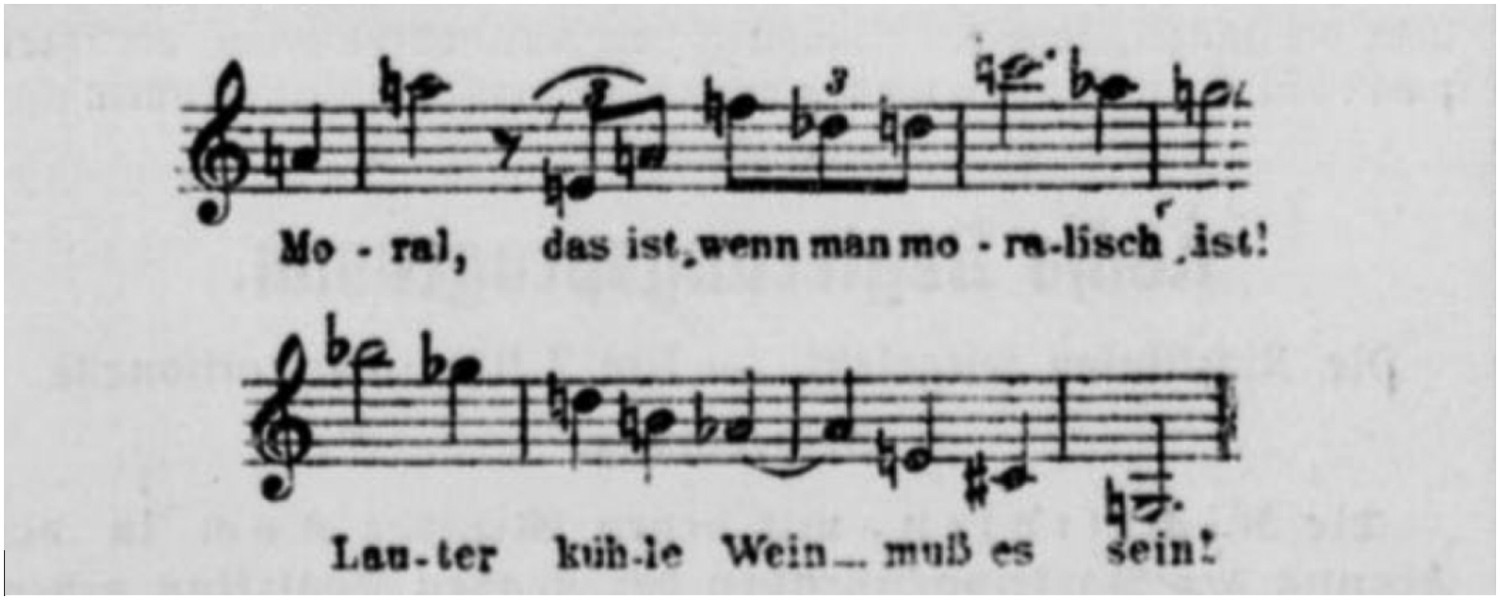
Readers might attribute Petschnig's negative report on Wozzeck to his having only read the score rather than having heard the opera performed on stage. Yet even critics who had heard the characters brought to life at the première held similar opinions about Berg's vocal writing. Echoing Petschnig and his complaint about Wozzeck's less-than-‘ideal’ voices without ‘inner necessity’, then, the German music historian Leopold Schmidt, writing for the Berliner Tageblatt und Handels-Zeitung, emphasized the voices' ‘lack of expression’ (Ausdruckslosigkeit).Footnote 66 Linking expression with beauty, and rejecting what he heard as ‘the ugly (dissonant, poor, overloaded, distorted)’ in modernist music, Schmidt asserted: ‘One cannot take the beauty of it [the essence of the arts] without at the same time robbing it of its expression.’Footnote 67 Schmidt consequentially characterized an ‘ideal’ and ‘natural’ operatic voice, as Petschnig had, by indicating how it should not sound. That is, it should not sound like the voices in Wozzeck, which ‘depicts something grotesque, false or morbid, or cringe-worthy […] debases itself to a state of unnatural service and often indulges only in the needs of the rawest instincts and elementary sensations’.Footnote 68 To drive home the point that Berg's style ‘convulsively avoids any natural means of expression’ for ‘a natural-minded people’, Schmidt even offered two musical excerpts in his newspaper review (see Figure 3).Footnote 69 And he wrote directly after his illustration of Berg's ‘unnatural’ music:
That sort of thing, of course, only comes out roughly so in the performance, as it generally may not and cannot be taken so precisely in all melodic aspects, which at first approximates speaking-tone and is soon replaced by it. Yet, the deep regret is that the singer is hardly needed. Naturalists [actors] would also suffice. Whether a person sings or plays the wrong way is simply irrelevant in such a musically sloppy style of representation.Footnote 70
As Schmidt spoke about his ‘deep regret’ that Berg's opera really required no singers but simply ‘naturalist’ actors, he hinted at spaces outside the opera for Sprechgesang that were – from his viewpoint – more relevant for this technique. More significantly, however, Schmidt's words thus delineated the kind of voice that he believed to be desirable, or even necessary, in opera.
Actually spelling out what he wanted to hear from opera singers, Lothar Band at the Berliner Volks-Zeitung demanded a ‘lyrical’, ‘song[ful]’ and ‘melodic’ voice.Footnote 71 In the same way that Petschnig and Schmidt opposed an ‘unnatural’ and ‘realist’ voice lacking in expression, Band foregrounded an expressiveness that was intimately connected with singing as he critiqued Berg's Sprechgesang:
Such ‘atavisms’, especially in the lyrical realm, show the composer's weak inventiveness […] This music barely knows even song. The text becomes – like Schoenberg's Pierrot lunaire – rhythmically spoken, fixed to certain pitches, and is indeed in affective moments turned into melodic lines. The natural intonation of speech and its accents are strictly preserved. But all these considerations and forms of expression do not solve the problem of opera.Footnote 72
Top: The Captain's line from Berg's Wozzeck, Act 1, scene i, bars 115–18. Bottom: Marie's line from Act 1, scene iii, bars 400–3. Reproduced from Leopold Schmidt, ‘Wozzeck: Uraufführung in der Staatsoper’, Berliner Tageblatt und Handels-Zeitung, 15 December 1925, p. 2.

Wozzeck's reputation as an opera without vocal expression, then, had already been sealed by earlier criticisms by the time it finally reached the State Opera in Vienna on 30 March 1930. While Vienna's audience barely had a chance to make up their own minds about the effectiveness of Berg's operatic writing, the infamously conservative critic Julius Korngold unimaginatively raised in Die neue freie Presse the same criticism that we have already seen against Berg's writing for the singing voice. As was the case with Petschnig's review, the possible purpose of differing vocal methods did not form part of Korngold's evaluation. Rather, Korngold remarked on Berg's unsophisticated grasp of the voice in a composition that was – in Korngold's view – evidently more suited to instruments, stating: ‘The singing voice also comes off in intonations and accents that, in a distorted jargon, imitates everyday speech, mostly with less vocal than instrumental chromatic, creepy, jagged and wide-reaching intervals (and [is] therefore also notated instrumentally).’Footnote 73 Here, then, we have a discussion from another critic who, though the score indicates both Sprechgesang and conventional singing, nonetheless interpreted everything as ‘spoken song’. On this voice that was antithetical to a ‘natural’ means of operatic expression, Korngold wrote:
The composer differentiates in a preface to his work between the sung and the spoken […] But the sung voice is actually also only a spoken song or in the heat of the moment an excited shrieking singing, often brilliant in enunciation though seldom natural and mostly against all the vocal necessities of human voices. [… The] atonal composer arrives by himself at the singing voice in the speaking voice, not because he wants to but because he must. So that the ‘opera’ turns into melodrama.Footnote 74
In pointing to Berg's opera as ‘instrumental’ rather than ‘vocal’ and consequently unoperatic, Korngold joined the Berlin critics in their complaints about Wozzeck's excessive technicality. The reviews demonstrate not only critics' preoccupation with the singing voice but also their belief in its particular, idealized expressive power, and it seems that anything short of such a – as we will see, bel canto – voice was to them expressionless.
With critics failing to hear the range of vocal expressions, or even expressions at all, there was little likelihood of their properly discerning Berg's sympathetic portrayal of his anti-hero or, for that matter, his musical undermining of the opera's officer characters. For example, Petschnig's references to Act 1, scenes i, iv and v, and Act 2, scenes ii and (albeit less so) iii, are intriguing as examples of where he believed Berg ‘accurately recorded’ vocal registers of regular speech ‘in the notes’. These scenes are, as I showed in my analyses of the opera's characters above, those that establish the buffo personas of the Captain and the Doctor and the vile ‘heroic tenor’ character of the Drum Major. Their voices strain and extend over the outer edges of their vocal categories' normal reach. Alternatively, while Schmidt commented on the Captain's line ‘Moral sense’ as an instance of not sounding ‘good’, he also reproduced an excerpt from Marie's lullaby to demonstrate what he called ‘harmonically false’ (harmonisch querständig) and ‘rhythmically complicated’ (rhythmisch kompliziert) writing for the voice. Just as Marie's song is already one of the most accessible segments of the opera, so too Schmidt's example shows a smooth descending line consisting of crotchets and minims on two chords approximating G♭ and A. Schmidt's comments are hence revealing in the way that he heard all the opera's voices as Sprechgesang and could not engage with them because they were in ‘a musically sloppy style’, more suited for the realistic approach of naturalist actors.
I would like to put some pressure on critics' idealization of ‘natural’ singing and on Berg's response to the suggestion that the opera lacked it. Their parallel effort to delineate the boundaries of acceptable vocal performance showed an early twentieth-century anxiety about the state of opera. Amid the so-called ‘crisis of opera’ (Opernkrise), the opera community concerned itself with the legacy of Wagner along with changing audience demographics and the challenge posed by radio's partiality towards self-contained Italian arias.Footnote 75 In circumstances of post-war reorganization, it is not surprising that critics should have emphasized ideals that in essence aligned with the prevailing aesthetic taste – and social politics – of the general public. For an opera whose all-too-real images of the protagonist's war ‘hysteria’ were blatantly exhibited at a time when memories of similar military scenes were still familiar, it seems that critics – although they had had little trouble separating Büchner's drama from Berg's opera – found it difficult to disconnect the politics taking place outside the confines of the State Opera from what they heard on stage. As, for instance, Petschnig (quoted above) implied with regard to singers' ruined voices, their preoccupation with acceptable vocal performance also exposes a degree of unease about (vocal) injury.
Berg responds
Berg, in turn, was uneasy about these critiques, returning again and again to the matter of vocal expression in his opera. He maintained that an expressive voice – especially one of a ‘lyrical’, ‘melodic’ and ‘songful’ type – was an indispensable component of his opera. Equally importantly, he employed, as he explained his melodic composition, technical terminology to a greater extent than his critics had done. His repeated use of the term bel canto is particularly surprising, not least because it was not one that the critics had actually employed. For instance, in a 1927 interview after Wozzeck's Leningrad performance, Berg explained that modern melodies must differ from those more often heard in opera houses of his day, and must ‘say with tones in the most concise way and in the least time what a more prolix melodiousness might need minutes, even hours to say’. He nevertheless carried on commending the soprano Tatiana Pavlovskaia, who sang Marie in Leningrad, for realizing the opera's bel canto, writing:
The singers were all equally good, and especially Frau Pavlovskaia, Russia's leading Salome. They sang Wozzeck with the right bel canto. Yes, a modern opera needs to be as beautifully sung as [Verdi's] Il trovatore. With the same plasticity of phrasing.Footnote 76
In writing about bel canto and ‘beautiful singing’, Berg stated that it would be misguided to think that performers did not need to approach his ‘modern’ (atonal) opera as they would more traditional works. Crucially, the work of Verdi was offered as an example of how opera should be ‘beautifully sung’.
In a longer essay entitled ‘The Voice in Opera’, written two years later, Berg went on to address critics' concerns about the absence of a natural, human (as opposed to instrumental, mechanical) singing voice within Wozzeck.Footnote 77 While he carefully incorporated other modes of vocal expression such as cantabile singing or even declamatory parlando, he nevertheless organized his discussion around bel canto song. Berg hence stayed, for now, within the realm of traditional styles of operatic performance. Cautiously expanding the boundaries of operatic voice, but referring again to one of Verdi's best-known operas, he wrote:
It is self-evident that an art form that avails itself of the human voice cannot bypass any of the voice's many resources. So in opera the spoken word – whether unaccompanied musically or melodrama – is just as suitable as singing itself, from recitative to parlando, from cantilena to coloratura. One such resource is the expansion of bel canto, which is justifiably demanded even in operas of the present day. There is no reason that modern melodies having such cantabile phrases as the following (I select only one here from among hundreds in Schoenberg's Erwartung [see Example 6]), could be any less ‘beautifully sung’ – indeed, must be as beautifully sung if they are done to the best advantage – than the famous ‘La donna è mobile’ [from Verdi's Rigoletto].Footnote 78
This time, though, the Italian composer's ‘beautifully sung’ (and, by inference, singable) melodies became not only a guide for performance, as had been the case for Pavlovskaia, but also a model for Berg's own writing. Via Verdi, Berg held up traditional, nineteenth-century Italian opera as symbolic of an expressive ideal in opera. As he tactfully framed Schoenberg's compositional style, which was intimately bound up with his own reception, Berg thus also identified himself with a Verdian model. Tradition (tonality) in a sense did not matter. Rather, ‘modern’ composers had in common with their Romantic Italian predecessor(s) a commitment, beyond compositional techniques, to the human voice's expressive power.
Schoenberg's Erwartung, bars 398–400 (vocal part only), from orchestral score (Vienna: Universal Edition, 1916). Reproduced by permission of Universal Edition. Arnold Schönberg, ‘Erwartung’. © Copyright 1916, 1950 by Universal Edition A.G., Wien/UE 13612.

On the question of Sprechgesang, then, Berg continued to argue that his writing differed from established means of operatic expression only in so far as it also included the Sprechgesang technique. More importantly, at the heart of the argument was an assertion that Sprechgesang and bel canto could coexist within the bounds of a single work. That is to say, rather than producing a non-operatic (‘naturalist’/actorly or instrumental) effect, Sprechgesang, Berg contended, enhanced rather than diminished expressive apparatuses already available in conventional opera:
[In Wozzeck] I lost no opportunity to use bel canto. I believe that I have richly compensated for the former shortcoming [that is, his sparing use of recitative] by being the first and for a long time the only one to use the so-called rhythmic declamation that Schoenberg some twenty years ago introduced […] this manner of declamation not only constitutes one of the best means of communication (which even in opera is occasionally fulfilled by speaking) but also, ranging from toneless whispered word to the true bel parlare of broadly sweeping speech melody, enriches operatic music by a fully equal and artistic means that comes from the most sparkling of musical sources. Together with the sung word, to which it gives a welcome rounding out and an appealing complement, this way of speaking that is fixed in melody, rhythm, and dynamics can also partake in all other resources of dramatic music.Footnote 79
It was a vision of ‘modern’ opera that, as Berg said earlier, though more economical (‘concise’) in its melodic unfolding, was intensified by a more expansive reservoir of vocal methods and textures. The German music community would, moreover, not be unacquainted with this line of thought. Berg's idol, Mahler, for example, had similarly identified modernity with an increased expressive capacity, addressed to an increasingly delicate sensorium. Or, as Mahler phrased it in an 1893 letter to the then nine-year-old Gisella Tolney-Witt (Selden-Goth), ‘our eye is learning to distinguish more and more colours in the rainbow’ – and our ears subtler tones.Footnote 80
Through his broadened range of vocal expression, then, Berg responded to the public's overexcited senses and made demands on their changing (read: malleable) sensibility after twentieth-century Europe's first total war. We are thus back to the topic of the national ‘crisis of opera’ (or what Band referred to above as ‘the problem of opera’), characterized by a preference for Italian arias as well as a turning away – paradoxically, perhaps, after a military defeat – from Wagner.
What is crucial here is that despite his continually pushing the boundaries of acceptable vocal performance, Berg adheres in general to the aesthetic consensus that emerges from such a ‘crisis’. For instance, when Berg underlined his singers' ‘rounding out’ of words, he doubtless alluded to Wagner's critique that bel canto singers laboured unnecessarily with ‘whether that G or A-flat will come out roundly’.Footnote 81 The spiritedness of Germany's declamatory style that is paramount in Wagner's music dramas hence was ‘complement[ary]’. Berg's comment about composers whose operas required hours probably also refers to Wagner and his works. Moreover, as Berg cited Schoenberg's complaint that opera had become ‘a symphony for large orchestra with the accompaniment of a voice’, one wonders if Berg was hinting at the symphonic quality so often discussed with regard to Wagner's Ring cycle.Footnote 82 Of course, the remark that opera should not simply be a symphony with a voice – reminiscent of a large-scale lied – might once more be Berg resisting letting opera become a medium for beautiful singing. Ever so carefully, as we have seen from passages of his writings above, Berg has his cake and eats it, so to speak. At the very time that he was keen to extend the reach of vocal possibility so that his characters may become more than beautiful voices – rather, three-dimensional people – he maintained the prominence of bel canto in Wozzeck.
After twentieth-century Europe's first total war, facilitated by history's most complex machinery thus far, the simplicity of melody in civilian life was important, and Berg was perceptive enough to hold bel canto in high esteem. Berg's references to Verdi in this context, then, were not accidental. As Gundula Kreuzer writes, in spite of First World War enthusiasm for German works, Verdi's operas continued to be staged by German theatres.Footnote 83 Moreover, as people sought after the war to escape from the oppressiveness of German Kultur (including, most pertinently for this article, its militarism and even authoritarianism), the Germany that saw Wozzeck's early performances also witnessed a ‘Verdi renaissance’.Footnote 84 Schmidt, whom I quoted above, for instance, contributed to Verdi's prestige by commenting as early as 1901 that Germany was not yet ready to appreciate him.Footnote 85 Korngold's 1913 remark that Verdi was the most exceptional composer of ‘now-lost dramatic melody’, whose simplicity yielded mesmerizing effect, also provides insight into his frustration with what he considered Wozzeck's lack of singing.Footnote 86 In later interwar years, the novelist Franz Werfel elevated Verdi's music above Wagner and above ‘the abstract, anti-melodious, atonal and “completely new” compositional principles' of modernist writers.Footnote 87 His words summarize the kinds of antagonism critics directed towards Wozzeck, which Berg evidently undertook to temper. In Kreuzer's discussion about Weimar Germany's (feverish) idealization of Verdi, Berg appears alongside composers such as Schreker and even Krenek and Weil.Footnote 88 Even though Berg's ‘The Voice in Opera’ is ambivalent about putting bel canto forward as the sole – or even the most important – method of operatic expression, Kreuzer cites the essay precisely as an example of Verdi's influence on German composers of the 1920s.
Following Berg's operatic début in Berlin, then, it was especially astute of him to align himself with Verdi and to distance himself from Wagner. As the cultural historian Misha Aster explains, the State Opera had engaged a number of directors who favoured traditionalist (konservative) operas.Footnote 89 The works performed under Botho von Hülsen (1851–86) and Bolko von Hochberg (1886–1903) were first and foremost Italian or French ‘classics' (Klassiker).Footnote 90 Moreover, they deliberately stayed away from – as Aster lists – Romantic, Symbolist, Decadent, Determinist and Wagnerian works.Footnote 91 When Bismarckian liberalization allowed Hochberg to recruit conductors such as Karl Muck, Richard Strauss and Felix Weingartner, the company still remained guarded towards these relatively young reformers.Footnote 92 Despite the well-rehearsed stories of Berg and Schoenberg leaving conservative Vienna to find acceptance in Berlin, the latter city presented its own challenges, and the two were not alone in encountering them. Resistance to Strauss's Feuersnot (Dresden 1901, then Berlin 1902) was so strong, for instance, that, even as general music director, Strauss refused to grant the State Opera the right to première his later works.Footnote 93 In any case, Strauss's apparently ‘immoral’ (unmoralisch) Feuersnot enraged the kaiser's clique to such an extent that Wilhelm II curbed the State Opera's artistic freedom.Footnote 94 Whilst Georg von Hülsen-Haeseler (1903–18) sought to accommodate Strauss's artistic vision, he nevertheless avoided infighting, ensuring that the State Opera remained an establishment for ‘Königliche Schauspiele’.Footnote 95 Even in what has been called the State Opera's ‘modern golden age’ under Max von Schillings (1918–25) and the conductor Erich Kleiber (1923–34), traditionalists both inside and outside the institution barely concealed their hostility towards the younger cohort of artists.Footnote 96
Enabled by a cultural climate that felt nostalgic towards ‘authentic’ (Italian) opera, critics were ready to condemn history's first atonal opera in advance of its arrival at the State Opera. Kleiber's widely reported announcement that he was ‘going to do the opera in Berlin, even if it costs [him his] job!’ did not lead to his dismissal.Footnote 97 However, the so-called ‘scandal’ involving Schillings's resignation three weeks before Wozzeck's first night demonstrates just how bitterly political the mounting of Berg's opera had become.Footnote 98 Surprisingly (given that the work had already required 34 full rehearsals at the State Opera), critics were not afraid to speculate about the dismissal of Kleiber or, for that matter, the cancellation of Wozzeck.Footnote 99 Along with a general lack of sympathy with the aesthetics of the opera, suspicion of it seems also to have arisen from a perception that – in spite of the reckless extravagance of the roaring twenties – Berg unjustifiably and undeservingly laid claim to state resources. Later, the Depression would push Weimar society further to the right, and consequently made room for chauvinist attitudes towards operatic repertoire. Worrying developments were nonetheless already taking place alongside the earliest performances of Wozzeck, among them the Saxon parliament's demand for a ‘German repertory’ at the Dresden State Opera.Footnote 100 In other words, a mere 100 miles away from Berlin, state legislation sought to maintain the ‘classical-romantic German status quo’ in the midst of a ‘Verdi renaissance’.Footnote 101 With special emphasis on ‘the classicists' and amid a renascent and increasingly belligerent nationalism, the Saxon parliamentarians turned, as Kreuzer writes, ‘irritably against Verdi and Puccini’.Footnote 102
It is significant, then, that in this context Berg's defence of Wozzeck changed too. From 1929 onwards, he no longer relied on references to Italian composers and singing styles, and chose to emphasize instead the Germanness of his music. Suddenly, his acknowledged models were not Verdi and Puccini but rather Bach, Mozart and Schubert. In his 1929 Oldenburg lecture on Wozzeck, for instance, Berg elucidated how important it was for him to follow a German ‘classical’ tradition.Footnote 103 While he maintained the presence of melody in his opera, Berg relinquished his earlier claim on bel canto and recognized the versatility of the German voice, ‘capable of declamation’, as an alternative.Footnote 104 The Sprechgesang technique did not simply have a complementary role supporting the bel canto voice; rather, it took on a primary significance. Berg wrote:
Critics have repeated that this is no bel canto opera. And it really isn't! The treatment of the voice here is much more in line with many works of the German classicists, in which the voice is thoroughly emotional, expressive in all registers, and a spirited instrument that is also capable of declamation, indeed, an ideal instrument. […] You will look in vain for this style of singing [that is, ‘the broad phrases of Italian cantilena’] in Bach as well, and hopefully no one will question his melodic power, much as we German composers cannot be taken to task if we also in this regard learned from Bach rather than from Puccini.Footnote 105
Berg's preference for study ‘from Bach rather than from Puccini’ indicates a hardened – and troubling – attitude to national styles. Recall here also Berg's earlier comments in ‘The Voice in Opera’ that he was ‘the first and for a long time the only one’ after Schoenberg to employ Sprechgesang: in this 1929 lecture, he quoted that passage word for word before he carried on placing both himself and his teacher within an extended tradition of German composition.Footnote 106 From that point on, Berg persistently professed his allegiance to his German heritage, as he did for example in his scripted 1930 radio interview ‘What is Atonal?’: ‘Isn't this [Schubert's “Der stürmische Morgen”] a typical example of a richly “jagged” song melody?’ he wrote. ‘And here's one with especially “wide leaps”.’Footnote 107 Careful to address critics' long-held dissatisfaction with what they heard as the opera's unnatural (instrumental, ‘jagged’ and ‘realistic’) melodies, Berg selected examples by ‘classicists' regarded as German music's best lyricists.
The politics surrounding Wozzeck during the ‘crisis of opera’ lead me back to people's hearing of Berg's first Wozzeck. Indeed, Schützendorf's reception as Berg's downtrodden protagonist, and the ways in which his career later unfolded, betray the kinds of changing politics that took place in the late 1920s and early 1930s. In the opening section of this article I made a connection between the figure of Wozzeck and the vast number of war ‘hysterics' on the streets. At the height of the roaring twenties' escapism, it arguably was distasteful for the State Opera to present a ‘damaged’ man to its bourgeois audience, who had to confront veterans on the boulevard Unter den Linden as they made their way to the opera house. Audiences' perception of a work about the military, then, was always going to be filtered through their understanding of contemporary post-war politics before the curtain opened.
Needless to say, as the opera's leading character, Schützendorf's role – even at a time of a ‘Verdi renaissance’ – was not supposed to have left critics unaffected. I have argued above that Berg's music and comments repeatedly point to his intention to challenge the German public's prejudice against ostensibly idle veterans with an anti-hero able to summon up the greatest expressive power. Equally importantly, the State Opera had cast a performer who was already familiar to Berlin's audience (over his ten-year tenure there, from 1920 to 1930, he made 445 appearances in 47 roles).Footnote 108 The public had, in other words, recognized this bass-baritone from a family of singers as an eloquent performer and had enjoyed his artistry in both buffo and serious roles, including as the late nineteenth century's most famous ‘mad’ man, Boris Godunov.Footnote 109 Indeed, as I suggested in my examination of the tavern scene, Schützendorf's experience at both serious opera houses and cabaret theatres gave him an advantage when he came to perform Wozzeck, whose voice extends from some of the opera's most bel canto moments to Sprechgesang.Footnote 110 The Berlin critics nevertheless struggled to hear expression in Schützendorf's performance and, by extension, in Berg's protagonist. Franz Köppen, for instance, wrote that Schützendorf, while normally ‘an excellent, lucid singer-declamator’, fell ‘monotone and cold’ in Wozzeck and was a second-rate actor in comparison with singers in the roles of the Captain, the Doctor and the Drum Major.Footnote 111
In addition to critics' evaluation of the opera's ‘expressionlessness’, since Schützendorf is remembered in part for his acting ability, Köppen's negative opinion of his acting implies that something else was at play. The timing of Schützendorf's dismissal from the State Opera in 1930 is difficult to separate from Germany's establishment in the same year of a national committee for supervising the ‘artistic and personal politics' of state theatres.Footnote 112 While Schützendorf had violated his contract with the State Opera, it was not unusual to perform across venues. Henke, the Captain at the première, for instance, not only was not dismissed for having outside engagements, but later became stage manager of the State Opera and organized performances for frontline soldiers during the Second World War. Rather ironically, the performers' lives unfolded in ways that mirrored the power dynamics on the stage of Wozzeck. Abendroth, the first Doctor, was honoured by the State Opera in 1964, at the age of 84, as doctors had been for their service in the First World War. And Soot, the Drum Major, became the head of the State Opera's artistic management in 1935.Footnote 113 Judging by the political crackdown, we might tentatively suspect that Schützendorf's association with the Independent Social Democratic Party (Unabhängige Sozialdemokratische Partei Deutschlands) played a part in his unfair dismissal (though there is no mention of political involvement in his brother's memoir of him).Footnote 114 Schützendorf's unfair expulsion gives an indication that something was amiss, perhaps with his personal politics. Likely to have borne the brunt of being the title character of a provocative opera, Schützendorf never managed to recover, and died two years after his swift removal.
Conclusion
Categories of the ‘ideal’ and the ‘natural’ – though not ‘naturalist’, which, as Schmidt's review makes clear, is a ‘realist’ style – obviously weighed on the minds of Berg's critics amid the devastation of the First World War. Indeed, Schmidt's words describing his experience at the première, hearing that Wozzeck ‘debases itself to a state of unnatural service’ and wallows in ‘the rawest instincts and elementary sensations’, for instance, resonate with contemporary criticisms of ‘male hysterics' who were ‘idle’ on the streets.Footnote 115 His complaint about Berg's opera being ‘in such a musically sloppy style’ further betrays his (rather Romantic) attitude that what is ‘natural’ is already idealized, and vice versa. We must therefore return to my opening discussion about Austria and Germany's idealization of the stoic man as one who simply persevered. I began this article with the history of ‘male hysteria’ during and shortly after the war, so I will now tell how the rest of the story unfolded for the physically intact ‘hysterics' in the interwar years that followed. Just as Britain, for example, had officially refrained from using ‘shell shock’ as a label of discrimination and ridicule, Germany adopted diverging strategies that, as the historian Deborah Cohen writes, resulted in a profound division between veterans and civilians.Footnote 116
The post-war Germany that witnessed Wozzeck's première purposefully eliminated charities for veterans and monopolized care for them, consequently distancing ex-servicemen from the public.Footnote 117 In addition to laws that guaranteed work for veterans, Germany also allocated a considerable proportion of its state budget to veterans' pensions. In terms of numbers, 90% of ‘severely disabled veterans' not only worked but were ‘twice as likely’ as their civilian parallels to keep their jobs; German veterans moreover enjoyed 20% of the state budget (as opposed to 7% in Britain).Footnote 118 During the Depression, when German employers could not have their preferred candidates because of legislated hiring quotas for ex-servicemen, the public understandably grew resentful of employed (and often disabled) veterans.Footnote 119 As pensions for unproductive ‘hysterics' were already a topic of contention during the war, one need only imagine the antagonism faced in financially challenging interwar times by seemingly able-bodied veterans out of work but still receiving governmental support. Germany's First World War veterans were therefore never heralded as ‘heroes' as Britain's soldiers were; rather, they were looked on suspiciously as beneficiaries of public funds.Footnote 120 If the earlier, wartime history outlines the state's displeasure at figures like Wozzeck, this post-war history supplies reasons for the public's distaste for Berg's protagonist.
In the Weimar welfare state, there were hence shared sentiments of distrust and alienation. Berg's Wozzeck represents in this environment an isolated and unnatural person who explicitly resisted the narrative of perseverance and idealization. One should therefore note here the unique place that Wozzeck occupies in early twentieth-century Austro-German opera, and not just because of its atonality. The invisible injury of Berg's protagonist stands apart from manifestations of the so-called ‘Expressionist impulses’, with what Sherry Lee calls ‘a damaged inner life’ frequently externalized in the ‘token’ of a spinal deformation.Footnote 121 Moreover, Wozzeck also differs from operas that Lee describes – in words reminiscent of Berg's own – as ‘lovely voices accompanied by the orchestral language of passion’; Schreker's Die Gezeichneten (1913–15), Strauss's Die Frau ohne Schatten (1911–17) and Zemlinsky's Der Zwerg (1922) are among the examples.Footnote 122 Quite the opposite, in terms of musical dissonance, Wozzeck's depiction of psychological as well as social deviation confronts the topic of marginalization. It is precisely the uninhibitedness of Berg's presentation of a ‘male hysteric’ during wartime that makes Wozzeck an explicitly political opera, cutting across Berg's ‘Schoenbergian’ experimentation without aesthetic sanitization.
Indeed, Wozzeck tackles the military head on, not from the perspective of a secondary character, and without geographical displacement or temporal distancing (especially since Büchner was rediscovered a century later).Footnote 123 Making plain that Wozzeck's abnormality was one not of medical science but of socialized marginalization, Berg maintains a narrative of the ‘hysteric’ as a person temporarily debilitated by the system in which he lives. Wozzeck tells not of a ‘subjective crisis' (retrospectively so pertinent in the age of Freud), but rather of a collective crisis. What we have here is the age-old story of the demonization of the poor and the powerless. From Büchner's fragments, it is therefore also interesting to note that Berg did not choose the alternative ending in which Wozzeck is put on trial for murder and consequently gets a chance to speak for himself, as Georg Klaren depicts in his 1947 GDR film version of the play.Footnote 124 Rather, Berg's Wozzeck drowns and can thus be dismissed, as James Crighton explains, as an individual consumed by his private, schizophrenic suffering.Footnote 125 In the concluding statement of Berg's opera, he thus unequivocally homes in on state violence by implying that it was not enough for the abnormal – or perhaps even the ‘useless’, as ‘hysterics' were perceived – to be normalized. Rather, foreshadowing the horror of the 1930s, they had to be eliminated.
I wish now to come full circle and return to Berg's personal politics as they emerged from the war. As was common among the intelligentsia, Berg at the beginning of the war was not the same person as he became later, after the war had dragged on. His initial disappointment at not being drafted because he was ‘too tall and too thin’ quickly turned into what was for the then private Berg a month of horror in a training camp that led to a complete breakdown.Footnote 126 His heart was, apparently (or so Berg believed), too small.Footnote 127 Adding to any anxiety he may have felt about being perceived as a ‘weakling’ prior to joining the army, and having failed to persevere at the training camp, Berg had to endure humiliation as an officer cadet on guard duty, serving below his rank, before he was able to return to Vienna and to settle in the office of the war ministry.Footnote 128 But it was also while he was serving as a guard that he wrote a revealing letter to his pupil Gottfried Kassowitz about being overlooked and discriminated against because he was without external injury. Berg wrote: ‘It has been impossible for me to get proper medical treatment, since more attention is paid to flat feet and broken limbs, etc., than to internal ailments.’Footnote 129 We thus read, perhaps, Berg articulating – and not just musically through his opera Wozzeck – words that neither his protagonist nor many ‘hysterics' from the war got to say.
Special thanks to Mirjam Frank, Jonathan Hicks, Sherry Lee, Ken McLeod, Mitchell Morris, Emily Payne, Arne Stollberg, the editors of JRMA, the anonymous reviewers of this article and the interlibrary loan staff at the University of Michigan. Bear-sized gratitude to Ellen Lockhart, who has taught me to be a better storyteller. This research has been funded by the Deutscher Akademischer Austauschdient.