The conductor must be able both to see and hear; he must be agile and energetic; he must know the construction, principles and range of the instruments; he must be able to read a score and must have … other almost indefinable gifts without which an invisible bond cannot be struck between him and those whom he directs … The musicians must share his feelings, his perceptions and his emotions. His feelings and emotions will then pass to them, his inner flame will warm them, his electricity will charge them, his drive will propel them. He will radiate the vital spark of music. But if he is lifeless and cold he paralyses everything around him, like icebergs floating in polar waters which you can tell, from the sudden chill in the air, are not far away.Footnote 1
The above is a passage from Berlioz's essay ‘Le chef d'orchestre, théorie de son art’, written in 1855 as the final chapter in an English version of the orchestration treatise. It was the first widely read account of modern conducting, serialized in both the Revue et gazette musicale and the Musical Times in 1856 and available in Italy and Germany soon thereafter. Written at the height of Berlioz's career, the essay was born of both knowledge and imagination, a record of the composer's struggle to master the art of orchestral leadership (often at odds with prevailing French tradition) and to elevate it to new heights. Among other things, it marked the moment when conducting emerged as an autonomous pursuit, a practice with its own technical and creative aims. No longer simply a time-beater or administrator, the chef d'orchestre celebrated by Berlioz was an interpreter, a locus of power, energy, and charisma.Footnote 2
The change articulated in the essay as well as the rhetoric underpinning it had begun to take shape several decades earlier. Through the early part of the nineteenth century, the old conductor-violinist and conductor-keyboardist – leaders operating from within the ranks of the orchestra – gradually gave way to the idea of an independent baton-wielding director. This shift emanated from German-speaking centres: Carl Maria von Weber is reported to have led with a stick (or scroll of paper) in 1812 in Berlin, and more consistently as director of the Dresden orchestra from 1817; Ludwig Spohr began conducting in a similar manner in Frankfurt between 1815 and 1817; and Spontini used a baton in Berlin from about 1820. Mendelssohn followed suit, as did conductors centred in London, including the showman Louis-Antoine Jullien and the more sober leaders George Smart and Michael Costa.Footnote 3 The ascendance of these baton-wielding figures was the result of a series of musico-aesthetic shifts, among them increased complexity of symphonic and operatic works, rising standards of orchestral performance, deepening attention to instrumental genres, and public appetite for virtuosic display. Raised on podiums, sometimes wearing white gloves, and calling on a range of mysterious, even melodramatic gestures, baton leaders were compelling figures. How did they exercise control? Communicate with the players under their command? Shape orchestral sound? As Alison Winter and others have pointed out, critics often turned to magnetic and, more broadly, electric metaphor to answer these questions. Jullien was credited with a quasi-mesmeric power, a ‘mysterious virtue’.Footnote 4 And accounts of Mendelssohn's conducting referred to an ‘electric fire’ which seemed to stream from his baton and be ‘felt at once by singers, orchestra, and audience’.Footnote 5 The podium conductor led by energizing and animating his forces, wielding a new kind of power.Footnote 6
This strand of rhetoric came to a head – indeed, was rendered authoritative – in Berlioz's treatise, which made electricity central to the baton conductor. Spark, flame, radiation, vital energy: these were the qualities of the modern leader; without them, he failed utterly, paralyzing all around him. He emerged in Berlioz's writing as a figure of rigorous technical accomplishment as well as invisible influence: part musician, part magician. That he should have conjured such a conductor was not surprising, for his own works demanded it. Enormous, replete with new orchestral effects, unusual agglomerations of choral and orchestral forces, texted and untexted material, and (in the dramatic works) on- and offstage, visible and invisible forces, they presented an insurmountable challenge to the old French violinist-conductor. The proof of this – at least, to Berlioz – was the utter failure of Narcisse Girard, who led the premier and several subsequent performances of Harold en Italie with a violin bow in the mid 1830s. Disaster ensued, including muddled time keeping (followed by total breakdown) in the latter half of the Pilgrim's March and a mishandling of the metric modulations in the Serenade.Footnote 7 These mistakes spurred the composer to action and, in the years following, he began directing his own works. Though the tradition of violin-leadership remained the norm in France well into the 1870s, Berlioz became a figure of resistance – a champion of the baton – fashioning himself by trial and error into a successful podium leader.Footnote 8 If he borrowed from earlier (largely German) directors, he also differed from them in crucial ways. He was, among other things, the first influential conductor to approach the activity as an art in its own right rather than as an extension of either orchestral or solo performance. He played not with but on the orchestra, ushering in a new kind of leader-virtuoso.Footnote 9
It was this figure that he described in 1855: a conductor even more ‘electric’ than his predecessors (in part because he was more distant from the instrumentalists he led), armed with technology, infused with current. No longer simply metaphorical, electricity also became a practical component of modern conducting, key to emerging notions of musical control and communication. Berlioz waxed rhapsodic over a new ‘electric baton’, a quasi-telegraphic device allowing him to coordinate the vast musical forces of modern spectacle, while also identifying human nervous charge – the energy of life itself – as a conveyor of musical sentiment and meaning. He embraced the term ‘conducteur’ in both senses, rendering the musical director in some sense synonymous with the electrical transmitter. Here, I focus on this connection: first, on the new physical electrical technologies embraced by Berlioz, then on the medical discourses –particularly notions of bioelectricity – underpinning his conception of orchestral leadership, and finally, on magico-vitalist cultures of showmanship yoking baton to wand. The new podium conductor, as I conclude, was a profoundly wired figure, poised at the intersection of medicine, technology and electric mythology.
The Electric Baton
That electrical technology was at the forefront of Berlioz's mind when writing the conducting essay was hardly surprising. The document was penned during the busy time of Paris's Universal Exhibition of 1855, at the closing concerts of which he employed a recent invention – an electric metronome or baton – to control the complex musical forces under his command. The occasion marked his most literal and public interface with electricity, and it did much to shape his image as a modern leader.
The Exhibition was a massive international affair – France's answer to Britain's Great Exhibition of 1851 – which drew together representatives from all parts of the globe, including Britain, Continental Europe, Africa, Asia, and the Americas. Its displays (featuring machines, industrial processes, aesthetic objects and recently patented inventions) were overseen by Prince Napoléon himself, who figured their varied contents as a celebration of the dual forces of ‘art and industry’, brought together in the modern Palace of Industry. Berlioz's role was, in the first instance, as a member of an international jury set up to assess new musical instruments, a job that occupied an exhausting two months during the late summer of 1855.Footnote 10 But he was also placed in charge of a series of concerts given in the Exhibition's final days, including at the awards ceremony presided over by the Prince and attended by delegations from all participating countries. The audience for these events was enormous, and Berlioz's musical forces were equally so, composed of some 1200 musicians drawn from not just Parisian institutions but also those of neighbouring cities (London, Brussels, Cologne and Vienna). He did not come to such an undertaking a novice; indeed, by the 1850s, he was already inextricably connected to the ‘concert monstre’, having led large-scale performances at the 1844 Festival of Industry, in the vast space of the Cirque Olympique, and elsewhere. But the Exhibition forces were even more sprawling, featuring three choirs, an orchestra, a wind band, a chorus of 30 harps, and a contingent of saxhorns.Footnote 11 In order to lead such an ensemble, Berlioz employed a system of subconductors connected via electrical wires to his own podium, an arrangement rigged up by the inventor Johannes Verbrugghe, who had travelled from Belgium to oversee the arrangements. Here is Berlioz's description of the ‘electric metronome’ in the conducting treatise:
It consists of a set of copper wires connecting a battery underneath the stage to the conductor's stand and then on to a moving baton pivoted at one end on a board at any distance from the conductor. On the conductor's stand is fixed a copper key rather like a piano key, springy to the touch, with a pin about seven or eight millimeters long underneath. Immediately beneath the pin is a little cup, also copper, filled with mercury. As the conductor presses the copper key with his left index finger (his right hand is holding the baton), the key goes down, the pin goes into the cup of mercury, a weak electric spark is given off, and the baton at the other end of the copper wire oscillates on its board. Communication through the fluid to the moving baton is completely instantaneous, however far it has to travel. Performers in a group backstage with their eyes on the electric metronome's baton are thus directly in touch with the conductor's indications; if he needed to he could conduct a piece played at Versailles from the middle of the orchestra of the Paris Opéra.Footnote 12
Verbrugghe's metronome was not entirely new to Berlioz in 1855; he had encountered it the year before in Brussels and used it in a performance of his oratorio L'Enfance du Christ. And at least ten years before that, he had envisioned such a device, never suspecting that it would actually come into being. He gives an account of it in an uncannily prescient moment of his tale ‘Euphonia’, written in 1844 but set in the year 2344, which describes the doings of a town composed entirely of musicians and led by the ideal conductor. At mass rehearsals and even larger ‘festival’ performances given by this community, the musical director uses a special instrument:
an ingenious mechanism which would have been discovered five or six centuries earlier if anyone had troubled to think about it. It picks up the conductor's movements without being seen by the audience and conveys them directly before the very eyes of each player. It gives the beats of the bar and the various degrees of loud and soft with great precision. The players are thus in instant and immediate communication with the feelings of their conductor and can respond as rapidly as piano keys do to the pressure of the fingers, and the conductor can then truly claim to be playing the orchestra.Footnote 13
What the device allowed for, in Berlioz's story, was total control of the amassed musical forces – a reflection of the organization of Euphonia itself, whose musicians lived in tightly organized groups determined by instrument or voice type, worked, ate, rehearsed and rested according to musical signals disseminated by a central clock, and were trained according to a set of inflexible pedagogical regulations. They were governed, as Berlioz put it, ‘in military fashion and subjected to a despotic regime’, together forming a perfectly regulated orchestra – ‘a huge intelligent instrument’ – over which the conductor was ‘the absolute master’.Footnote 14
When the device Berlioz had imagined came into being (when electrical technology made it a reality) it was perceived, just as he had foretold, as an instrument of quasi-military power; indeed, it was in language eerily close to that of his Euphonian fantasy that critics described its musical effects. A review in the Gazette musicale referred to Berlioz as the wielder of a ‘bâton magistral’, an instrument allowing him to lead ‘his numerous ministers or lieutenants and his army of 1250 artists’ in such marvellous accord that it would be ‘impossible to better discipline, to more fully dominate a population of sounds than did Berlioz’.Footnote 15 In Le Constitutionnel, the electric metronome placed Berlioz's mammoth orchestra ‘under the command of a supreme leader, transmitting his orders, his movements, his measure’ to produce a performance of absolute unanimity and ‘perfection of ensemble’.Footnote 16 And, even more tellingly, in the Revue franco-italienne (echoing Le Moniteur), Berlioz was the director of an immense ‘musical army’ controlled by electrical technology:
A touch on a copper [wire] similar to a piano key, fitted to the desk of the leader and barely brushed by the index finger of his left hand, allows him to mark from a distance the main beats of the measure, while conducting the closest players with his right arm. Thanks to this device … a single person could conduct at the same time four orchestras placed to the south, north, east, and west, at the four extremities of the earth … [with] faultless ensemble, and perfectly in time, as if all were under the eyes of the conductor.Footnote 17
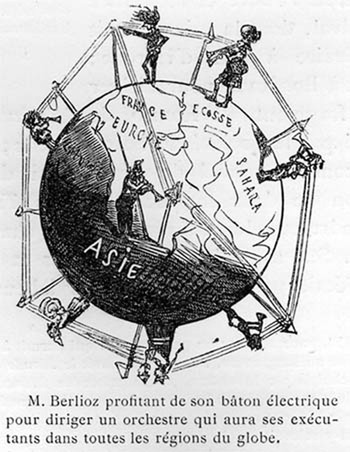
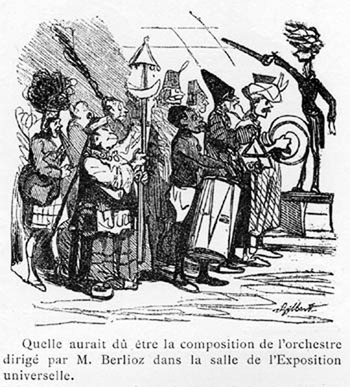
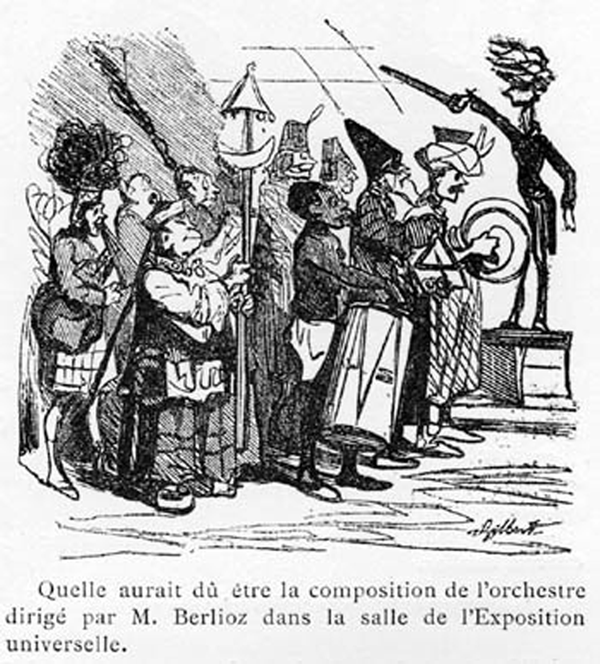
Here, electricity renders Berlioz not just the head of a single musico-military force but of multiple battalions across the globe; he emerges as a figure of modern imperial power, and his orchestra a symbol of colonial vastness and obedience.Footnote 18 Caricatures of the period, including a popular image by Cham (Amédée-Charles-Henri, Comte de Noé) made precisely this connection. Here (Fig. 1), we see Berlioz linked to players across the world, from Europe to Asia, the Sahara and Scotland, all held in thrall by his electric baton – or as it's depicted here, an electric telegraph. An earlier cartoon, also by Cham, places him at the head of an orchestra including caricatures of a Scottish bagpiper, a Chinese figure with a pavillon chinois, an African drummer, a man with a pointed hat carrying a triangle, and another in a turban with cymbals. Its caption notes that this ‘should have been’ (in a metaphorical sense, was) the composition of his Exhibition orchestra. Berlioz's hair stands on end, presumably electrified by the same telegraphic current that now flows through a sabre-like baton (Fig. 2).
Unsigned woodcut, after Cham (Amédée-Charles-Henri, Comte de Noé), Le Charivari (2 December 1855): ‘M. Berlioz profitant de son baton électrique pour diriger un orchestra qui aura ses exécutants dans toutes les régions du globe’ [M. Berlioz uses his electric baton to conduct an orchestra with performers in all parts of the globe]

Woodcut by Gilbert, after Cham (Amédée-Charles-Henri, Comte de Noé), Le Charivari (25 November 1855): ‘Quelle aurait dû être la composition de l'orchestre dirigé par M. Berlioz dans la salle de l'Exposition universelle’ [How the orchestra conducted by M. Berlioz in the hall of the Universal Exhibition should have been made up]
Links between Berlioz's new device and telegraphic technology have been richly explored by Inge van Rij, who notes that the telegraph was central to both French and British imperial expansion through the early to mid-nineteenth century.Footnote 19 Claude Chappe's optical telegraph – a signalling apparatus consisting of an upright post with movable arms arranged to communicate messages from one hilltop to the next – facilitated Napoleon's continental incursions in the early 1800s and, through the 1840s (first in Britain, then on the Continent), the electric telegraph became even more critical. Patented in 1837, it ushered in modern telecommunications, using electric signals sent through iron or copper wires to communicate over long distances within relatively short spaces of time (and without the climatic and range limits affecting optical systems). From the outset, inventors made efforts to run their lines underwater. They began with an insulated copper wire from Dover to Calais, which failed within a few hours. Better protected lines – those insulated with gutta percha – proved more successful. In 1853, a submarine cable was successfully laid to Ireland and, by 1858, across the Atlantic. Soon thereafter, cables were installed linking the two major colonial empires of the time: Britain to India and France to Algeria. Overland telegraphic cables also proliferated, crisscrossing Europe, the Mediterranean, and portions of Asia. They connected major Indian centres (first, a line from Bombay to Calcutta) and, more slowly, colonial outposts in Africa. By the 1880s, wires really did encircle the globe as agents of electrical communication, discipline and latex-insulated control.Footnote 20 Lord Salisbury (the Tory Prime Minister), drove home their importance in an 1889 address given to the Institution of Electrical Engineers:
And what gives [our] armies their power? What enables them to exist? By what power is it that one single will can control these vast millions of men, and direct their destructive energies at one moment upon one point? What is the condition of simultaneous direction and simultaneous action which alone gives to these vast armies their vast power? It is nothing else than the electric telegraph.Footnote 21
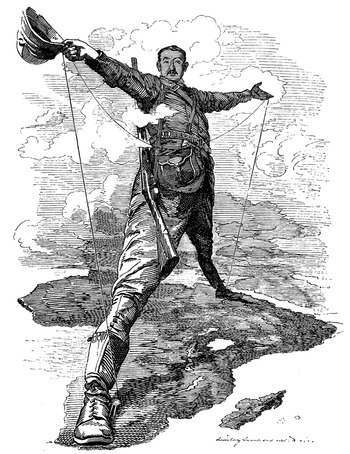
Cartoons of the moment, including an iconic image satirizing Cecil Rhodes's plan to connect Cape Town to Cairo via telegraph (Fig. 3), make the same point, resonating easily with the earlier caricatures of Berlioz (Rhodes's gun now standing in for Berlioz's baton).
Edward Linley Sambourne, ‘The Rhodes Colossus’, Punch (10 December 1892)

The power of the telegraph lay not just in its collapse of space but, equally importantly, its annihilation of time (a fact much remarked upon by nineteenth-century commentators). From the late 1830s onwards, electrical signals sent via telegraph were key to coordinating British trains, replacing local time with so-called railway time. By the 1850s, a telegraphic link had been constructed between the new electro-magnetic clock at Greenwich and railway stations across the length of Britain, which ran according to London time. The clock's signals were also transmitted between London and Paris and, eventually, throughout the British Empire. Temporal coordination, imposed by the clock at Greenwich and its ‘slave clocks’ elsewhere, became key to notions of imperial efficiency and discipline, ensuring the smooth operation of transportation networks, industrial production and financial systems.Footnote 22 The link to Berlioz's electric baton, with its five ‘slave’ batons is clear, and the rhetoric of efficiency and unanimity weaving through reception of the Exhibition concerts easily contextualized. Wielding such a system, Berlioz – like a telegrapher – became a disseminator of central time, electrical technology rendering his orchestra as modern and efficient as the British trains. One critic for the Revue musicale complained, revealingly, that his Exhibition concerts were not a staging of music at all but of ‘locomotives’ and ‘telegraphs’, figuring Berlioz himself as a wielder of imperial orchestral power. His baton allowed him to hold together an orchestra of ever-increasing size; indeed, once it had absorbed all the players and singers in Paris it would expand to include European musicians at large, then those of the colonies (‘Corsica and Algeria’) and finally, even the New World.Footnote 23 The result would be a composite ensemble of unprecedented size and volume. Its sound was already deafening, as this critic and many others complained, operating almost like a weapon (a form of ‘sound imperialism’, in R. Murray Schafer's formulation, or even ‘sonic warfare’, to borrow Steve Goodman's termFootnote 24). But if it was an echo of Metropolitan power, Berlioz's orchestra was also – as the empire expanded – a conduit for exotic noise, a force potentially devastating to its own producers.Footnote 25
Here, and in Berlioz's own writing, electrical technology emerged as key to the idea of conductorly control and modern orchestral power. But equally central was the notion of human energy. Electricity, as Berlioz imagined it, communicated not just accurate rhythmic information – pulse and measure – but also sentiment, thought and meaning. It did more than marshal orchestral forces, it also animated them: the conductor ‘charged’ his players with energy, warmed them with his ‘inner flame’. External and internal, technological and biological currents interface in his descriptions of conducting, one kind of spark shading fluidly into the other. The conflation was far from unprecedented. Britain's pioneering telegraphic web had, from the outset, been compared to the human electrical network; it was ‘the nervous system of Britain’, and the ‘spinal chord’ of the empire.Footnote 26 The metaphor was also mobilized in reverse, organic nervous operation described in terms of networked telegraphic transmission, technological models pressed into service to explain physiological functions.Footnote 27 Understandable then that Berlioz, who maintained a keen interest in both medicine and industry, might have imagined the electric baton as an extension of his own vital current and the conductor himself as a live wire.
The Orchestral Nervous System
Conceptions of the body as a machine powered by electrical impulses have roots reaching back to the early eighteenth century, but emerged as an experimental reality in the 1790s, most famously via the work of the Italian physician Luigi Galvani. Galvani's much-touted animation of frogs’ legs via electric current suggested that electricity was intrinsic to biological systems and further, that ‘animal electricity’ worked much as did the artificially generated power stored in Leyden jars. The brain, according to Galvani, was the source of electric current, which was conducted through the nerves to the muscles of the body. His ideas, published in De Viribus Electricitatis (1791) sparked a lively debate (including contradictory claims by Alessandro Volta), and were popularized by his nephew Giovanni Aldini, who travelled throughout Europe staging sensational public animations of animal and human corpses. Later research, particularly that of Alexander von Humboldt and Carlo Matteucci, provided further evidence of a kinship between the electrical forces studied in laboratories and those at work in living bodies. Their findings were clinched by the work of German physiologist Emil DuBois-Reymond, whose treatise Untersuchungen über thierische Elektricität (Researches on Animal Electricity, 1848–1884) provided experimental models of nerve-impulse conduction, concretizing Galvani's claims and thus generating a framework for modern neuroscience.Footnote 28 Emerging theories of nervous energy promulgated by these researchers impacted not just nineteenth-century medical culture but philosophical and occult discourses, producing conjecture that electricity could exert influence over distances, bind individuals into invisible energy networks, even generate an all-embracing world soul.Footnote 29 Both scientific and sensational strands of the new biological ‘science’ impacted Berlioz, who studied electricity (and its implications for human physiology) during his brief stint at medical school in the early 1820s and, around the same time, became aware of more speculative tracts on magnetism and Mesmerism.Footnote 30 In tandem, they shaped his notions of musical, especially conductorly, power, producing the idea that leaders operated as ‘chargers’ channelling their physical and creative energy to an orchestral body (‘his electricity will charge them, his drive will propel them’). The orchestra, according to this model, became an extension of the leader's nervous system – or perhaps a collection of bodies temporarily under the sway of his electrical energy. The latter idea is underscored by Berlioz's repeated claims to be ‘playing upon the orchestra’ as upon a singular instrument responsive to his every impulse. He invokes the image not just in the conducting essay but in his fictional writing, correspondence, and Memoirs. The last of these sources contains an especially revealing description – an account of conducting during the German tour of 1842–43:
[T]he public arrives, the clock strikes, the composer appears at his desk, pale and exhausted with fatigue of body and mind, scarcely able to stand, uncertain, faint, and discouraged, until the applause of his audience, the spirit of the performers, and love for his own work transforms him in an instant into an electrical machine giving forth marvellous radiations, invisible indeed, but none the less real. And then begins his compensation. Ah! it is then, I grant you, the conductor has a life unknown to the virtuoso! With what frantic delight he abandons himself to the pleasure of playing on the orchestra! How he hugs and clasps and sways this immense and fiery instrument!Footnote 31
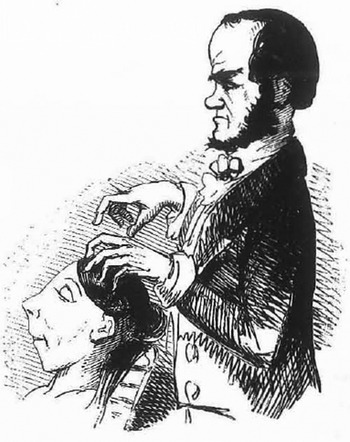
The link to Mesmerism, as Alison Winter has pointed out, is strong. Berlioz imagined himself doing what many mesmeric showmen and healers also claimed to do: temporarily overwhelming the minds of their subjects or patients with their own more powerful bio-electricity, engendering new kinds of perception, cognition and action. She notes that the act of Mesmerism was itself often described via musical metaphor; its practitioners ‘played upon’ the body as musicians did on their instruments (an 1843 cartoon given in Winter shows the mesmeric doctor John Elliotson, dressed as a concert pianist, stroking the cranial ‘keys’ of a subject; it is reproduced here as Fig. 4). The act had both utopian and sinister overtones. Mesmerism, like telegraphy, seemed on one hand to hold out the promise of universal communication, a means to reintegrate disparate minds into a lost organic whole; on the other hand it smacked of co-option, a potentially violent stripping away of autonomy. In describing Berliozian conducting, Winter argues for the former – for consensus – situating the electric orchestra as an instance in which discrete players were united through shared nervous experience in a ‘healthy’ form of incorporation. And yet shades of something darker seem also to have been in play, namely the spectre of imperial domination, which overlapped uneasily with the notion of musico-mesmeric accord.Footnote 32 Under the irresistible thrall of the conductor, the orchestra as well as the audience had access to a larger self (they became more than the sum of their parts) while also becoming vulnerable to physiological and psychological dissolution. Players, listeners, and especially leaders, for Berlioz, were locked into a bio-electrical loop both wondrous and perilous.
John Elliotson ‘playing upon’ a mesmeric patient. Punch (1843)

In orchestral performance, according to his accounts, a spark passed first from the chef to his players, then to listeners, and finally back through the conductor. It was transmitted by (and as) music itself; indeed, Berlioz describes the movement of sound in terms borrowed from the discourses of electricity, mapping ‘electrical fluid’ onto ‘musical fluid’ and figuring both as conveyors of current. The idea has a complex history dating back at least as far as Newton, who suggested that sound (like light) was transmitted via ‘a subtle fluid’, or ‘electric and elastic spirit’ sending vibrations along the body's solid nerve fibres (1717). His ideas were taken up by a range of eighteenth-century physicians and physiologists: George Cheyne, for instance, theorized sound traveling through a ‘nervous juice’ flowing like wind and ‘drunk in at the ears’ (1733), and David Hartley described vibrations descending along the motor nerves ‘in some such manner as sound runs along the surfaces of rivers’ (1749).Footnote 33 Notions of music's electric and fluidic properties carried on into nineteenth-century sources, both British and French, including those Berlioz is likely to have known. He was surely aware of Jean Baptiste Lamarck's description of sound as a ‘subtle fluid’ (1802) and may even have read earlier French accounts, especially those associated with Mesmerism, which figured music as both liquid and charged. Jean-Louis Carra's Examen physique du magnetisme animal (1785), for instance, situated electric, luminous, animal, and sonorous fluids as intertwined and in some sense interchangeable, all derived from the same ‘universal fluid’ (a version of Newton's subtle ether).Footnote 34 It was this idea, of course, that rendered sound central to Anton Mesmer's cures, which purported to rectify nervous disorders by regulating both animal and musical current. It also wove through German idealist writings on music, which figured sound as a medium with special access to the universal ether, able to encode and transmit the vital energy of the universe itself.Footnote 35 French music critics through the early decades of the nineteenth century inherited and popularized this collection of ideas. It became common to describe sound as magnetic or electric, capable of generating mysterious sympathies between listeners; indeed, many critics embraced the notion that music was the medium most able to disseminate electric charge – to transmit ‘the unknown electricity that places bodies in rapport one with one other’. Repeated references to ‘fluide’ and ‘fluide musicale’ appear in the Gazette musicale, Le Ménestrel, and La France musicale through the 1830s and 1840s, sometimes in discussions of musical communication and affect, sometimes in occult or pseudo-scientific tales.Footnote 36 And from the 1860s on, French treatises on music and medicine, including those of Adolphe de Pontécoulant and, more famously, Hector Chomet, stated as a matter of fact that sound was a fluid which, like the animal electricity manipulated by doctors, altered the emotional state and physical behaviours of listeners, causing them to rouse from apathy, sink into despondency, even dance the polka.Footnote 37
It was in the midst of this emerging musico-electric discourse that Berlioz meditated on the relationship among musical liquidity, human nervousness, and concert performance in an essay published in the collection A Travers chant (1862). Here, among other things, he addressed the problem of fluidic ‘range’, underscoring the need for music's vital spark to reach all listeners in a given concert space:
Some scientists believe that electrical fluid (fluide électrique) cannot travel through space more than a certain number of thousands of miles. I do not know whether this is true, but I am sure that musical fluid (fluide musicale) (if I may so describe the mysterious source of musical emotion) is without force or warmth of life when it has to travel too great a distance. We may hear, but we do not vibrate. And one must vibrate with the instruments and voices and because of them in order to have genuine musical sensations.Footnote 38
In ever-enlarging modern halls, Berlioz warned, many listeners remained untouched by the musical current and therefore immune to its emotional impact. Composers and performers, in an attempt to compensate, resorted to noisy orchestration (Rossini was especially culpable, according to Berlioz) and vocal straining. The alternatives included carefully calibrated acoustic effects (the ‘surround sound’ brass in Berlioz's Messe des morts, for instance) or – in truly cavernous venues like the Palace of Industry and the Cirque Olympique – much-expanded ensembles meant to ensure that musical current travelled even to the furthest corners. The latter solution was far from perfect, as Berlioz knew, since it compromised timbral nuance and balance in favour of a flood of sound (a ‘musical locomotive’, as he once put it). And there were other problems, too: such large musical forces had themselves to be ‘charged’, demanding enormous energy from the conductor. The generation of so much fluid came at a cost, depleting the leader's electrical resources, leaving him physically and emotionally drained.
Berlioz's accounts of conducting large-scale performances through the 1840s and 1850s are replete with the rhetoric of nervous exhaustion and breakdown. During the ‘colossal’ performances at the Festival of Industry, for instance, at which he conducted an ensemble of over a thousand, he describes first the ‘musical fever’ running through his own veins, then the ‘electrification’ of players and audience and, when the concert reached its height, his own sudden and total electrical breakdown:
I was seized with such a fit of nervous trembling that my teeth chattered as though I were in a violent fever. … I was in such a state … that the concert had to be interrupted for a fairly lengthy interval. They brought me some punch and a change of clothes. Then they formed a kind of little room on the platform itself, by putting together a dozen harps in their linen cases, and, by slightly stooping, I was able to undress and even change my shirt, in the very face of the public, without being seen.Footnote 39
Later, at a performance of his dramatic symphony Roméo et Juliette in St Petersburg something similar happened: Berlioz described ‘a colossal chorus’ and other forces at the Grand Theater, all ‘imperially organized’. The performance, he noted, was marvellous and his conducting unusually animated – indeed, so much so, that he experienced a nervous overload:
[S]uch was the impression made on me by that divine Shakespearean poem as I played and sang it to myself that after the finale I fled for refuge into one of the side rooms, where Ernst found me a few moments later in floods of tears. ‘Ah, your nerves!’ he said; ‘I know well what that is’. And he supported my head and let me cry like a hysterical girl for a good quarter of an hour.Footnote 40
The problem that Berlioz describes (and self-consciously constructs) was not just one of depletion but also saturation. If his body was drained of electricity during the act of conducting, it was also, he suggested, bombarded by the fluidic charge generated by the performance itself, at the moment when his own current, amplified through the orchestra, came back around the electric loop. He described the situation well in an 1847 letter to Liszt which referenced both the benefits of a sensitive nervous system as well as the misfortunes of being such an ‘electrifiable electric machine’ (‘Quel malheur d’être machine électrique électrisable!’) – a producer of musical current who was also himself highly chargeable.Footnote 41 Such a condition was painful and dangerous, but it was also allegedly what set Berlioz apart from other musicians. Nervous excitability allowed him both to hear the impossible (he had ‘the most nervously sensitive ear that I believe any human being can have’, according to Louis EngelFootnote 42) and also to give voice to it. On his best days, Berlioz claimed, electric communion with his players allowed him to conjure the sounds of the otherworldly, opening the ‘heaven of art’ (le ciel de l'art). Wielding magical influence he could bring forth ‘terrible chords’ (terribles accords) and even a musical ‘whirlwind’ (un tourbillon).Footnote 43 The idea is telling (and, to historians of electricity, familiar) tapping into an array of supernatural rhetorics associated, in the late eighteenth and early nineteenth centuries, with electric bodies and instruments – ideas that begin to draw together the technological and biological strands of electric discourse I have been following thus far.
Supernatural Currents
In his book Modern Enchantments, Simon During notes the ways in which electricity became central, in early romanticism, to conceptions of magic and illusion. As a partially mastered though still mysterious force, it hovered between science and supernaturalism, between cultures of rational demonstration and those of mere entertainment. Through the latter half of the eighteenth century and into the nineteenth, as During demonstrates, electric rhetoric became increasingly central to the promotion of showmen and magicians, who embraced it as ‘a renovated version of old “natural magic”’, a modern form of Neoplatonic ether.Footnote 44 A case in point was the well-known performer Nicholas Ledru (stage name, Comus), a successful conjurer in Paris from the 1760s onward, as well as an electric ‘healer’. Rumours circulated that he had gained mastery over both cosmic and nervous energy, and therefore over minds and bodies alike. These were confirmed in a 1783 book by Comus himself, who claimed power over ‘a universal fluid … used to situate and move all beings’ and, in so doing, produce ‘infinitely varied effects’.Footnote 45 The same kind of power was ascribed to (and embraced by) a series of later magicians, including Giovanni Pinnetti, Jacques Talon (stage name, Philippe), and the famous Jean-Eugène Robert-Houdin, the last of whom rose to prominence at roughly the same time as Berlioz. These performers, while embracing the mythos of electricity, also used it in a more practical sense to achieve stage effects. Robert-Houdin, for instance, relied on magnets to render heavy or light a strong-box which he invited audience-members to lift. He also rigged up wires such that, when brought in contact with electric current, they ignited streams of gas, illuminating a hundred candles at once. And, especially significant for our purposes, he made harps and violins ‘play themselves’ via a complicated arrangement of rods and signals: each onstage instrument was linked via an insulated tube to the soundboard of an identical instrument concealed below the stage. Alerted by an electric buzzer, real musicians played the concealed instruments, whose vibrations travelled up the rods to the visible ones, which, receiving the vibrations, seemed magically to produce sound.Footnote 46
Electrical technology was responsible for generating these effects, and yet it was ostensibly the magician's electro-cosmic energy – channelled through his wand – that produced them. Robert-Houdin, like other conjurers before him, emphasized the importance of the wand as a symbol of power, an apparent focuser and magnifier of the magician's inner spark. He described making a ‘mesmeric pass’ with it over the strong box to alter its weight, using it to ‘levitate’ objects, and to command the start of his occult, seemingly automatic, musical performances. In his Les secrets de la prestidigitation et de la magie and other reveal-all works, he gave careful descriptions of the ideal wand: ‘a small ebony rod with a rounded ivory tip at each end; its total length is about thirteen to fourteen inches’. It was the most essential accoutrement of the magician; indeed, as he put it, ‘a conjuror rarely comes forward on the stage otherwise than wand in hand … A touch of the wand on any object, or even a wave in that direction, forms the apparent cause of its transformation or disappearance’.Footnote 47
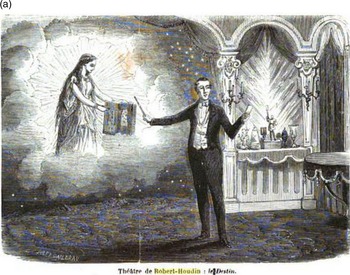
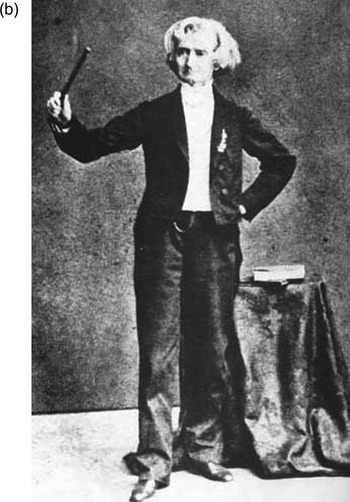
The leap from wand to baton – and from conjurer to conductor – is not hard to make, especially as the dress and staging of magicians and professional musicians began to overlap. The visual link between the two was cemented by Robert-Houdin, who abandoned the quasi-medieval and outlandish costumes of earlier conjurers in favour of formal evening dress and a theatrical set akin to an elegant drawing room. He looked very much like a concert performer, and one easily compared to the contemporary conductor, wand in hand, half turned toward the audience, cuing each element of his unfolding performance (compare Figs 5a and 5b). Berlioz's baton, as he described it, was remarkably similar to Robert-Houdin's stick, although lighter in colour. He referred in the conducting essay to ‘a small, light baton half a metre long and preferably white rather than dark (in order to be seen more easily), which he [the leader] holds in the right hand’.Footnote 48 Although he eschewed decoration, many of his contemporaries used batons tipped in ivory (like Robert-Houdin's wand) or embellished in other ways. Small wonder, then, that critics as well as musicians associated the implement with musical enchantment; indeed, by the time it came into regular concert use, the baton was overdetermined as a magical object. The idea that it could conjure a whirlwind, open the heavens, or generate a storm was far from strange. Musicians fetishized the baton in much the way that magicians did the wand (Berlioz sent his to Mendelssohn in 1843 as a gesture of respect and power-sharing that marked the first of many similar exchanges). Not just a practical tool, it was an object of power, a repository of magical potential and musical spark.
Robert-Houdin performing the trick ‘Le Destin’, L'Illustration (6 April 1861)

Berlioz conducting in Russia, 1867

The idea remains metaphorical when applied to a piece of polished wood, but it becomes literal if we return to Verbrugghe's electric baton (the machine hovering behind Berlioz's magical wand). This device did more than connect the far-flung forces of the Exhibition concerts; it also served as a link between on- and off-stage musicians, allowing its wielder to coordinate mysterious effects: sudden aural reveals, appearances, and disembodiments. It was in this capacity that Berlioz first used it, in a production of L'Enfance du Christ (Brussels, March 1855 – the year before the Exhibition concerts), where it allowed him to connect the visible, human characters of his oratorio with an angelic chorus hidden behind the scenes, the natural with the supernatural sound-world. The device came into play in the final scene of Part 1, during which Mary and Joseph are addressed by invisible angels: ‘Joseph! Marie! / Listen to us’ (Joseph! Marie! Ecoutez-nous). The couple respond ‘Holy spirit / Is that you?’ (Esprit de vie / Est-ce bien vous?) and at this moment Berlioz, activating his electric baton, invoked a spirit answer (in the form of a warning) from the backstage choir: ‘Marie, you must save your son / Who is threatened by great danger’ (Il faut sauver ton fils / Qu'un grand péril menace, Marie). Verbruggen's mechanism was, as we know, invisible to the audience, who simply saw the conductor wave his baton as if conjuring the otherworldly sound out of thin air – but of course Berlioz, like Robert-Houdin, relied on invisible electrical technology and concealed performers to produce the effect. By the same method he coordinated the invisible demons in La Damnation de Faust and the unseen chorus of Numi infernali in Gluck's Alceste.
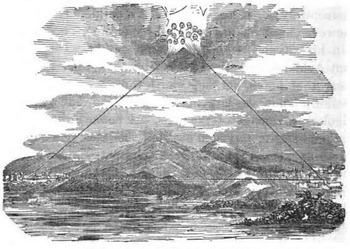
If magicians are likely to have appreciated these effects, a related group – the Christian occultists called spiritualists – might also have found them compelling. This sect, active in both Europe and the United States through the middle decades of the century, believed that electrical technology could, like a giant wand, facilitate otherworldly communication, linking not just the living with the living, but the living with the dead. Their ideas were promulgated in publications including The Celestial Telegraph and The Spiritual Messenger, which argued for a new kind of ‘wired’ spirituality, a conflation of the technological and religious sublime (Fig. 6). Adherents held magnetic séances, employed mediums with (allegedly) Mesmeric powers, and hosted electric rituals in which participants were connected by live cables meant to extend the limits of human audition into the domain of the supernatural.Footnote 49 These were earnest versions of the musico-electric tricks plied by magicians, experiments which yielded supposedly real results. Famously, some heard ‘spirit rapping’, others received messages from the departed, still others reported ghostly whispering. For them, Berlioz's ‘telegraphic’ conjuring of spirits in L'Enfance du Christ and elsewhere could hardly have seemed surprising. Such moments ratified (at least in the dramatic realm) the idea of electrical spirituality, underscoring the complex romantic relationships among technology, enchantment, and science – and between otherworldly and earthly power.
The ‘Spiritual Telegraph’, in Andrew Jackson Davis, The Present Age and Inner Life; Ancient and Modern Spirit Mysteries Classified and Explained (London, 1869), 280

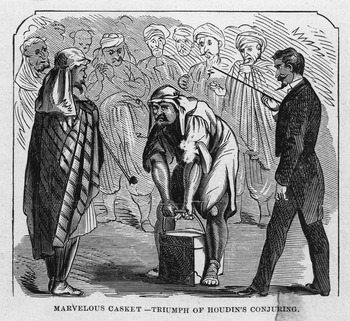
Spiritualist ‘revelations’, moments of occult hearing, were of course in large part contrived – mere deceptions used to shore up the authority of occult practitioners (and to wrest it from conventional religious authorities). And electric magic in general, as practiced by conjurers and showmen, was also a medium of control, often with disturbing, overtly political implications. Robert-Houdin's most famous performances were those given in Algeria, where he was sent by the French government in 1856 to undermine the influence of the region's own magicians, the Marabouts. He relied on electrical wires and magnets to trick and publicly terrorize his rivals, thus ‘proving’ that Western magic was stronger than its heathen counterpart (Fig. 7). Some portions of his demonstrations even involved administering electric shocks to members of the audience in entertainments clearly hovering on the edge of the punitive, their violence meant to hold France's burgeoning colonies under the yoke of Metropolitan control.Footnote 50 These uses of electricity bring us full circle, of course, to Berlioz's imperial baton and the despotic resonances of conductorly current, which emerge as inseparable from its magical and medical implications. The ‘charge’ at the heart of the modern chef d'orchestre cut across physical and metaphysical, magical and technological lines, rendering nineteenth-century leaders at once despots, magicians, Mesmerists, and technicians.
Robert-Houdin performing the strong-box trick in Algeria, Confidences et revelations; comment on devient sorcier (Paris: A. Delahays, 1868)

Coda
By amplifying and literalizing the electric ethos associated with early baton leaders, Berlioz invested romantic conductors with a quintessentially modern form of power. He provided a framework in which to understand musical leadership – to theorize the invisible ties binding autonomous leaders to their players, individual interpretive minds to orchestral bodies. The conductor emerged in his writing not just as a music director but a political and scientific figurehead, a repository of contemporary ideas surrounding communication, consensus and control. If Berlioz's conflation of electrical modes and discourses (physical with human wires, nervous power with magnetic influence and magical sway) was partly the result of rhetorical slippage, it was equally clearly a reflection of the complex set of romantic interactions among these devices and systems: the sense that human, machine and spirit worlds were electrically connected and could therefore be electrically influenced.Footnote 51 Music, seemingly endowed with a cosmic spark, was a medium connecting these distinct arenas, and the conductor was the figure directing its flow.
The idea of the ‘electric’ leader did not end with Berlioz, of course, but hovered around virtually all those who came after. Wagner was famously charged, his ‘animal magnetism’ the subject of persistent speculation. Richard Strauss was described as a magician, a Mesmerist, and another purveyor of ‘musical fluid’. Later, Toscanini was credited by his own players with ‘a dynamic, electric quality’ and Stokowski was figured as a ‘wizard’ and a wielder of ‘electrical influence’.Footnote 52 Even once the art of conducting had developed a concrete pedagogical and technical rhetoric – and once electricity had lost some of its mystery – the connection between the two persisted. Well into our own time, Leonard Bernstein figured the baton as ‘a living thing, charged with a kind of electricity’.Footnote 53 Much has changed since Berlioz but much has also remained static; we are, it seems, reluctant to let go of the quasi-mesmeric leader he described. And, of course, the electric metronome is alive and well (now in the form of closed-circuit television), a standard feature of virtually all concert halls and opera houses. In this sense, and in many others, both the figure of the Berliozian conductor and the legacy of the composer's 1855 treatise have remained vital.