Introduction
A recently published text from the time of Assurbanipal (Waerzeggers Reference Waerzeggers2010 no. 220) records an exceptional trial over the inheritance of a prebend in the Ezida temple of Borsippa. The uniqueness of the trial is determined by two elements: firstly, the litigation took place in Nineveh (rather than in Borsippa) and, more strikingly, the case was decided by the king himself. The king is said to have delivered the verdict and spoken directly to the litigants;Footnote 1 the wording seems to reflect the actual narrative of the trial. Such personal involvement of the king in the execution of justice is poorly attested in Babylonia under Assyrian rule.Footnote 2
Evidence of the monarch's role in the court system under Chaldean rule is just as limited.Footnote 3 Notable exceptions include Weidner Reference Weidner1954–1956, a land sale deed with an elaborate introduction describing king Nebuchadnezzar II rendering a verdict in a case of high treason, and King of Justice, a literary text attributed to Nebuchadnezzar II or Nabonidus, showing a monarch intervening in the case of a delinquent who fraudulently sought to re-open a case he had previously lost.Footnote 4 The king appears in similar contexts in a few other documents, although these cannot confidently be linked with legal proceedings.Footnote 5 This meagre body of evidence has brought many scholars to the opinion that royal involvement in the administration of justice was significantly smaller than in earlier periods of Babylonian history.Footnote 6
Such a picture of the king's role in the execution of justice may, however, result from the vagaries of textual discovery. The corpus of Neo-Babylonian court documents comprises abundant temple files on the one hand and private records, some of them kept in the private archives of judges, on the other. But since no state or proper court archives are available, an important piece of the puzzle may be missing. This paper will present evidence that the involvement of the king in the local administration of justice could have been more extensive than previously assumed. Moreover, it was not restricted to crimes of special nature. The evidence is based on a dossier, the crucial element of which is BM 114574.
Day one: royal message is delivered to Eanna (BM 114574)
BM 114574 is a formal record confirming receipt of a message in the Eanna temple on the ninth of abu of Nabonidus’ fourteenth year:
BM 114574 (1920–6–15, 170)
6.3 × 4.6
-
1. mìr-damar.utu a-šú šá mnumun-ia a m e-gi-bi
-
2. mddi.ku5-šeš.meš-mu a-šú šá m gi-mil-lu a m ši-gu-ú-a
-
3. mden-dù a-šú šá m bul-luṤ a lúšu.ku6
-
4. m ki-rib-ti a-šú šá m na-din a m ba-bu-tu
-
5. m pir-’u a-šú šá m tab-né-e-a a lú.šu.ku6
-
6. mdnà-gin-a a-šú šá m na-din a m da-bi-bi
-
7. mdutu-eri 4-ba a-šú šá mdu.gur-mu a md30-tab-ni
-
8. mdnà-numun-giš a-šú šá men-šú-nu a m kur-i
-
9. lú.dumu ba-ni-i.meš šá i-na pa-ni-šú-nu
-
10. m re-mut ⸢a-šú⸣ šá mdu.gur⸣-a-šá-red a m ri-ma-nu
-
11. a-na mdingir.meš-re-man-ni lú.sag lugal
l.e.
-
12. lú.en pi-qit-ti é.an.na
rev.
-
13. iq-bu-ú um-ma a-mat lugal ina muḫ-ḫi-ka
-
14. um-ma m i-sin-na-a-a lú.qal-la šá m re-mut
-
15. md a-nu-um-zi-tì-ùru a-šú šá m šá-pi-i- den
-
16. mdnà-lu-ú-sa-lim ⸢lú⸣.qal-la šá mdamar.utu-sur
-
17. m kal-bi a-šú šá mzálag-e-⸢a⸣ mšeš-⸢mu⸣ a-šú šá mìr-den
-
18. pab 5 lú.érin.meš šá ú-kal-lim-ú-k[a] la tu-maš-šar
-
19. lú.sa-ar-ri-ú-tu ⸢šú-nu⸣ (erasure)
-
20. lú.umbisag m gi-mil-lu a-šú šá md in-nin-numun-mu
-
21. unug.ki iti.ne u4.9.kám mu.14.kám
-
22. mdnà-i lugal tin.tir.ki
-
1 Arad-Marduk/Zēria//Egibi,
-
2 Madānu-aḫḫē-iddin/Gimillu//Šigūa,
-
3 Bēl-ibni/Bulluṭ//Bā’iru,
-
4 Kiribti/Nādin//Babūtu,
-
5 Pir'u/Tabnēa//Bā’iru,
-
6 Nabû-mukīn-apli/Nādin//Dābibī,
-
7 Šamaš-erība/Nergal-iddin//Sîn-tabni,
-
8 Nabû-zēru-līšir/Bēlšunu//Kurī –
-
9 these are the mār banê in whose presence 10–13aRēmūt/⸢Nergal⸣-ašāred//Rīmanu said to Ilū-rēmanni, the royal supervisor of Eanna, as follows:
-
13b“Royal order is upon you as follows:
-
14 Isinnāya, the slave of Rēmūt,
-
15 Anu-napištī-uṣur/Ša-pī-Bēl,
-
16 Nabû-lū-sālim, the slave of Marduk-ēṭir,
-
17 Kalbu/Nūrēa,
Aḫu-⸢iddin⸣/Arad-Bēl
-
-
– 18the total of five men that I have pointed out to you, you shall not release. 19They are criminals.”
-
-
20 Scribe: Gimillu/Innin-zēru-iddin.
-
21 Uruk, the ninth of abu, fourteenth year of 22Nabonidus, king of Babylon.
BM114574

The text follows a formula referred to in assyriological literature as a deposition; in this paper, it will be called a “writ”. At first glance, the document looks like an arrest warrant, but as will be demonstrated below, it had the effect of a writ of mandamus. Such a document is defined by Black's Law Dictionary as “a writ issued by a superior court to compel a lower court or a government officer to perform mandatory or purely ministerial duties correctly.” More generally, mandamus may refer to any writ issued by a superior institution with such authority that calls upon another institution to perform its duties.
The message was delivered to Eanna by Rēmūt, son of Nergal-ašarēd from the Rīmanu (Rīm-Anu) family.Footnote 7 The Rīmanus were not one of Eanna's leading families, but they did own the prebend of šangû of Nergal and Ereškigal.Footnote 8 They appear among the mār banê Footnote 9 and witnesses of legal deeds;Footnote 10 only two of the family members are known to have been scribes.Footnote 11 The Rīmanus also owned and rented land in and around the city.Footnote 12 They were rich enough to have donated oblates to Eanna.Footnote 13 A policeman (paqūdu) Šamaš-aḫu-iddin/Šamaš-šumu-iddin//Rīmanu is attested in a document from Cambyses’ acccession year.Footnote 14 However, since neither the messenger Rēmūt nor his father are known from published Uruk material, Rēmūt could have been an official from Babylon and not a member of the local branch of the family.
The body of mār banê present at the delivery of the message to the royal supervisor comprised Eanna's most important functionaries: Arad-Marduk/Zēria//Egibi, temple enterer who heads numerous lists of witnesses,Footnote 15 Madānu-aḫḫē-iddin/Gimillu//Šigūa, the supervisor of temple brewersFootnote 16 and Nabû-mukīn-apli/Nādin//Dābibī, who was to become Eanna's šatammu (chief administrator) in less than a decade.Footnote 17 Pir'u/Tabnēa//Bā’iru and Bēl-ibni are known as scribes.Footnote 18 Kiribti/Nādin//Babūtu was a temple enterer and an entrepreneur, a member of the temple assembly.Footnote 19 The functions of Nabû-zēru-līšir/Bēlšunu//Kurī and Šamaš-erība/Nergal-iddin//Sîn-tabni cannot be established; they are known as witnesses of legal documents only.Footnote 20
But the most striking particular of the text is, obviously, its sender. Amat šarri,Footnote 21 literally “royal word,” may refer to a direct appeal to royal justice,Footnote 22 it further appears in the headings of royal letters and it introduces royal instructions.Footnote 23 In the lattermost case, it may be rendered simply as a “royal order.”Footnote 24 Amat šarri in the above writ belongs clearly to this last category.
The royal writ calls for the arrest of five people who have committed an unspecified crime (sarru). The semantic range of the word sarru is broad: it may denote various wrongs, from “lie,” through “theft” and “fraud” to “murder” and “treason.” The act committed by the five criminals must have been horrific to have caused a royal intervention.
Two of the criminals were slaves of individuals whose full filiation was not given. This terseness of description may be due to one of two reasons: either the owners’ identity was obscure or, much more plausibly, the owners were public figures whose filiations or functions did not have to be specified, because they were generally known. The remaining three individuals are not denoted as slaves, but their short filiation (the lack of family names) may point to their low status.
Luckily, the identity of these wrong-doers can be reconstructed based on a group of documents from the Eanna files. The principal part of the dossier was identified over a decade ago by Francis Joannès (Reference Joannès and Joannès2000: 215–17), who offered a translation of three documents belonging to it, preceded by a brief overview. The present royal writ may now be added to it, as well as plausibly YOS 6 213. Based on this material, the nature of the sarru committed by the criminals can be established.
Day two: release is granted to criminal number four (YOS 6 213)
Action in response to the royal order was undertaken already on the following day. On the tenth of abu, officials of Eanna allowed the temporary release of Kalbu, son of Nūrēa, the fourth criminal listed in the royal writ.
YOS 6 213 Footnote 25
-
1. pu-ut m kal-bi a-šú šá mzálag-e-a
-
2. mzálag-e-a a-šú šá m a-ḫu-lap-dxv ad-šú
-
3. m ba-la-ṭu a-šú šá mdnà-gi a md30-ti-èr
-
4. a-di u4.10.kám šá iti.kin i-na šuii
-
5. mdingir.meš-re-man-ni lú.sag lugal lú.en pi-qit-ti
-
6. é.an.na na-šú-ú u 4 -mu
-
7. šá re-e-su in-na-šú-ú
-
8. i-ba-kám-nim-ma i-nam-din-nu
-
9. ki-i la i-tab-kám-nim-ma
l.e.
-
10. la it-tan-ni
rev.
-
11. ḫi-ṭu šá lugal i-šad-da-du
-
12. ina gub-zu šá mšeš-šú-nu lú.gal bán šá kur.[tam]-tì
-
13. lú.mu-kin-nu md30-kám a-šú šá mdnà-mu-giš
-
14. a m ib-ni-dingir mdnà-du-numun a-šú
-
15. šá m na-din a m da-bi-bi mden-dù
-
16. a-šú šá m bul-luṭ a lú.šu.ku6 mdinnin-na-mu-šeš
-
17. a-šú šá mmu-dnà a m ki-din- damar.utu
-
18. lú.umbisag m gi-mil-lu a-šú šá
-
19. mdinnin-na-numun-mu unug.ki
u.e.
-
20. iti.ne u4.10.kám mu.14.kám
-
21. mdnà-i lugal e.ki
1−6aFor Kalbu/Nūrēa, his father Nūrēa/Aḫulap-Ištar (and) Balāṭu/Nabû-ušallim//Sîn-lēqe-unninī assume guarantee to Ilu-rēmanni, the royal administrator of Eanna, till the tenth of ulūlu.
6b−8On the day he (the administrator) summons him (Kalbu), they! will bring (him) and hand (him) in.
9–11If they! do not bring and do not hand (him) in, they will bear the penalty of the king.
12In the presence of Aḫušunu, chief bowman of the [Sea]land.
13−17Witnesses: Sîn-ēreš/Nabû-šumu-līšir//Ibni-ili,
-
Nabû-mukīn-zēri/Nādin//Dābibī,
-
Bēl-ibni/Bulluṭ//Bā’iru,
-
Innin-nādin-aḫi/Iddin-Nabû/Kidin-Marduk.
18−19aScribe: Gimillu/Innin-zēru-iddin.
19b−21Uruk, tenth of abu, fourteenth year of Nabonidus, king of Babylon.
Ll. 8–10. One expects ibbakūnimma, ittabkūnimma, ittannū (3rd plural).
Thus, custody over Kalbu was entrusted to his father and yet another individual. The father of Kalbu is referred to with his father's name only, which might be indicative of his low social standing, unless he is identical with a certain Nūrēa/Aḫulap-Ištar//Aṣûšu-namir, the first witness at a slave sale YOS 6 197 concluded four years earlier in Uruk. This identification would speak in favour of the higher status of Nūrēa and at the same time the higher status of his delinquent son. The other surety, Balāṭu/Nabû-ušallim//Sîn-lēqe-unninī was a member of the local elite; he belonged to an influential Uruk family of kalû-singers and was possibly a scribe.Footnote 26
Both guarantors undertook an obligation to bring Kalbu back to the royal supervisor in a month's time (or earlier, upon summons). Failure to do so was to result in the “penalty of the king” (ḫīṭu ša šarri). Temporary custody release secured by suretyship was common in Neo-Babylonian investigation procedures.Footnote 27 It allowed criminals and defaulting debtors to remain at home rather than being kept in a temple or private prison. Home detention is attested even in the case of very serious charges, including murder. Suretyship was often assumed by family members and respected members of the local community. Failure to deliver such releasees was liable to high financial fines, from one mina up to half a talent of silver, or, less frequently, to the “penalty of the king” or a governor (ḫīṭu ša šarri or ḫīṭu ša Gubāru).Footnote 28 The release to custody must have been considered as a secure measure, otherwise Kalbu would not have been set free the day after the writ instructing against doing so had reached the Eanna officials.
Day eight: confession of Isinnāya (AnOr 8, 21)
The next step of the temple authorities is restored from a document written seven days later. According to the autographed copy, the text comes from Nabonidus’ fourth (rather than fourteenth) year, but on account of the incumbency of the royal supervisor the date no doubt has to be emended: Ilu-rēmanni was the bēl piqitti of Eanna between Nabounidus’ fourteenth and sixteenth year.Footnote 29 This tablet is of crucial importance for the reconstruction of the case. It records a confession of Isinnāya, criminal number one in the royal writ. Before a group of mār banê and the royal supervisor of the temple, Isinnāya denounced as many as thirty nine people as his accomplices.
AnOr 8 21 Footnote 30
-
1. m re-mut- den a-šú šá mden-tin-iṭ a mšu-d na-na-a
-
2. m kal-ba-a a-šú šá mba-šá a m ba-si-a
-
3. mddi.ku5-šeš.meš-mu a-šú šá m gi-mil-lu a m ši-gu-ú-a
-
4. m ki-rib-ti a-šú šá m na-di-nu a m ba-bu-tu
-
5. mden-šeš.meš-mu a-šú šá mden-da a lú.ma-la-ḫu
-
6. mzálag-d30 a-šú šá mdnà-dù-šeš a mzálag-d30
-
7. mden-šeš-gál-ši a-šú šá m šá-pi-i- den a lú-didim
-
8. m e-li- damar.utu a-šú šá mdnà-mu-du a lú.gír.lá
-
9. md na-na-a-kám a-šú šá mden-gi a m ki-din- damar.utu
-
10. [m]dnà-na-din-ibila a-šú šá m ba-ni-ia a lú.šu.ku6
-
11. lú.dumu ba-ni-i.meš šá ina pa-ni-šú-nu m i-sin-na-a
-
12. lú.qal-la šá m re-mut a-na mdingir.meš-re-man-ni
-
13. ⸢lú⸣.sag lugal lú.en pi-qit-ti é.an.na
-
14. ⸢iq⸣-bu-ú um-[ma] m ḫaš-da-a a-šú šá
rev.
-
15. [m]gi-mil-lu [m re-e’]-a-nu a-šú šá mdinnin-na-numun-dù
-
16. [o m]ìr-ia a-šú šá md na-na-a-sízkur m ni-din-ti
-
17. [a-šú šá] mdù-dxv m u-qu-pu a-šú šá mdutu-šeš.meš-mu
-
18. [mše]š.meš-ba-šá a-šú šá mden-tin-iṭ mdnà-re-ḫi-it-ùru
-
19. [lú.qal]-la šá <m> kal-ba-a mdnà-lu-ú-sa-lim lú.qal-la šá mdamar.⸢utu-sur⸣
-
20. m⸢hu? x⸣ [x x]-a mìr-ía u mden-dù a.meš šá ! mdnà-na-din-mu a m⸢x x⸣-a-a
-
21. m⸢pa⸣-[šá]-nu [a-šú šá] mdnà-mu-še- < <še > >-tíq-ud.da md na-na-a-mu lú.šu.i
-
22. md na-[na-a-síz]kur a-šú šá m da-a-né-eš-šú m e-rib-šú šá é qé-me-ti
-
23. m lu-ú-ma-gi-il šá é qé-me-ti md30-šeš-mu a-šú šá migi-ni-ía
-
24. mddi.ku5-lugal-ùru šá é qí-me-ti m ki-di-nu šá é qé-me-ti
-
25. m ni-din-ti a-šú šá m id-di-ía m ki-di-nu šá é re-du-ú-tu
-
26. m ni-din-ti a-šú šá mtin mdutu-numun-dù a-šú šá mdnà-en-mu-m[eš] ⸢m gi-mil⸣-lu a-šú šá mdutu-tin
-
27. m ú-bar a-šú šá mšu m ṣil-la-a u šeš-šú lú.ma-ḫi-ṣe.[meš md amar.]utu-šeš-mu
-
28. lú.ḫa-at-ta-šú šá mdutu-mu-mu m gu-za-nu a-šú šá md na-na-a-mu
-
29. m pir-’u a-šú šá m še-el-le-bi m ni-iḫ-ḫu-ru u m ṣa-ṣi-ru a.meš!(t:lú) šá mdnà-ú-ṣur-šú lú.uš.bar
-
30. m eš-šú-ú-a lú.kur [x x]-ú-tu lú.ḫa-at-ta-šú šá mdù-ía lú.si-pi-ri
-
31. m id-di-ía šá é mdamar.utu-numun-dù m bu-ú-ṣu a-šú šá mkar-den
-
32. m la-ba-a-ši lú.šir-ki lú.mu m ni-din-ti a-šú šá mden-su
u.e.
-
33. m ni-din-ti a-šú šá mdnà-mu-giš m ni-din-ti a-šú šá m tab-né-e-a a lú.gal [x]
-
34. lú.sa-ar-ri-ú-tu it-ti-ia šú-nu
-
35. lú.umbisag m gi-mil-lu ⸢a-šú šá m⸣d in-nin-numun-mu
l.h.e.
-
36. unug.ki iti.ne u4.17.kám
-
37. mu. <1> 4.kám mdnà-i lugal tin.tir.ki
L. 30. lú.qúr-[bu]-ú-tu seems unlikely for reasons of orthography: the first sign is always spelled qur.
-
1 Rēmūt-Bēl/Bēl-uballiṭ//Gimil-Nanāya,
-
2 Kalbā/Iqīša//Basia,
-
3 Madānu-aḫḫē-iddin/Gimillu//Šigūa,
-
4 Kiribtu/Nādin//Bābūtu,
-
5 Bēl-aḫḫē-iddin/Bēl-lē’’i//Malāḫu,
-
6 Nūr-Sîn/Nabû-bāni-aḫi//Nūr-Sîn,
-
7 Bēl-aḫu-ušabši/Ša-pī-Bēl//Amēl-Ea,
-
8 Eli-Marduk/Nabû-šumu-ukīn//Ṭābiḫu,
-
9 Nanāya-ēreš/Bēl-ušallim//Kidin-Marduk,
-
10 Nabû-nādin-apli/Bānia//Bā’iru
– 11–14athese are the mār banê in whose presence Isinnāya, the slave of Rēmūt, said as follows to Ilu-rēmanni, the royal supervisor of Eanna: 14b–15“Ḫašdā/Gimillu, Rē[‘ā]nu/Innin-zēru-ibni, 16–17Ardia/Nanāya-karābī, Nidintu[/]Ibni-Ištar, Uqūpu/Šamaš-aḫḫē-iddin, 18–19[Aḫḫ]ē-iqīša/Bēl-uballiṤ, Nabû-rēḫit-uṣur, the [sla]ve of Kalbā, Nabû-lū-sālim, the slave of Marduk-ēṤir, 20Ḫ[u?...]a, Ardia and Bēl-ibni, sons of Nabû-nādin-šumi//[...]-āya, 21P[ašā]nu/Nabû-mušētiq-uddē, Nanāya-iddin, the barber, 22Na[nāya-ka]rābī/Dāneššu, Erēbšu from the flour mill, 23Lū-māgil from the flour mill, Sîn-aḫu-iddin/Inīya, 24Madānu-šarru-uṣur of flour mill, Kidin from the flour mill, 25Nidintu/Iddia, Kidin from the crown prince's estate, 26Nidintu/BalāṤu, Šamaš-zēru-ibni/Nabû-bēl-šumāte,
Gimillu/Šamaš-uballiṤ, 27Ubār/Gimillu, Ṣillā and his brother, scout[s], [Mar]duk-aḫu-iddin, 28the ḫattaššu of Šamaš-šumu-iddin, Guzānu/Nanāya-iddin, 29Pir'u/Šellēbu, Niḫḫuru and Ṣāṣiru, sons! of the weaver Nabû-uṣuršu, 30Eššūa [...], the ḫattaššu of the Aramaic scribe Bānia, 31Iddia of the house of Marduk-zēru-ibni, Būṣu/Mušēzib-Bēl, 32Lâbāši, the oblate, the cook, Nidintu/Bēl-erība, 33Nidintu/Nabû-šumu-līšir, Nidintu/Tabnēa//Rab [...]
– 34they are criminals together with me.”
35Scribe: Gimillu/Innin-zēru-iddin
36Uruk, seventeenth of abu, 37four<teen>th year of Nabonidus, king of Babylon.
Day(s) X: further hearings (Stigers, JCS 28 39, GCCI 2 350)
The texts discussed so far disclosed the identity of the criminals, but they have not been very revealing when it comes to the nature of the crime or crimes committed. This may be culled from two memoranda, short notes written in the course of evidentiary procedures. They are not dated, but the identity of people listed in them as members of Isinnaya's gang is easily established.
Stigers, JCS 28 39 Footnote 31
-
1. m i-sin-na-a-a
-
2. m pa-šá-nu
-
3. mden-dù a mdnà-na-din-mu
-
4. m re-a-nu
-
5. m ḫaš-da-a
-
6. md na-na-a-mu <<a>> lú.šu.i
-
7. m pir-’u
-
8. f nu-up-ta-a šá ta-aq-bu-ú
-
9. um-ma m i-sin-na-a-a ina pa-ni-ía
-
10. iq-ta-bi um-ma a-na é
-
11. mtin a mdinnin-mu-kám ki-i ni !(t:er)-ru-bu
-
12. 1-en kuš.ḫi-in-du-šá tap-tin ?! -nu
-
13. f re-e’-in-du dumu.sal-su šá mìr-dinnin-na
L. 11. After the list of seven names a plural form is expected, hence the emendation er > ni. The resulting Preterite form stands further in agreement with the following Perfect tapti (unlike the 1 Sg Present errubu). The emendation is very speculative, however; the text needs to be collated.
L. 12. I take taptinnu for Perfect with Ventive and 1sg Dative (for -nu rather than the more common –ni, see GAG §42 k3).
Isinnāya, Pašānu, Bēl-ibni/Nabû-nādin-šumi, Rē’anu, Ḫašdā, Nanāya-iddin the barber, Pir'u –
it is fNuptā who said (about them) as follows: “In my presence Isinnāya said: When we entered the house of Balāṭu/Ištar-šumu-ereš, she opened to me one bag of hers.”
fRē’indu, the daughter of Arad-Innin.
The text starts with a list of the names of seven men known to us from Isinnāya's testimony,Footnote 32 followed by a deposition of a certain fNuptā. It is uncertain whether fNuptā was a member of the gang. She is not listed in any other document of the dossier, so she could have been connected with the criminals in another way. The reading of a crucial place of the text is obscure, but it is certain that it deals with “entering” (i.e., “breaking into”) the house of a certain Balāṭu and with a ḫindu, a leather pouch used for keeping silver and valuables.
Criminals of Uruk

This memorandum is not a formal document, but rather a note drawn up ad hoc, meant to be rewritten later. It could have been drafted at an informal questioning. The text is thus not very well phrased; particularly striking is the female name in the bottom line, clearly having no syntactic link with the text above. If we accept that a genitive suffix and a female verbal form are to be read in the difficult part of l. 12, the name in the bottom line could specify who “she” and “her” are referring to.
A characteristic of the scribe's manner of writing is the usage of A (“descendant”) for A-šú šá (“son of”) in lines 3 and 11. The sign certainly introduces the name of the father rather than that of an ancestor, as follows from AnOr 8 21, where Bēl-ibni is called “the son of Nabû-nādin-šumi.”
The last document of the dossier is even more provisional in character:
GCCI 2 350 Footnote 33
-
1. 2 udu.⸢níta⸣ šá m i-sin-na-a-a ul-tu <X >
-
2. a mìr-d in-nin i-bu-ku ina igi m re-m[ut a]
-
3. m id-di-ia šá é mdamar.utu-numun-dù
-
4. mden-dù a mdnà-na-din-mu
-
5. md60-ik-ṣur
-
6. mšeš-mu ina é mba-šá- damar.utu
-
7. m ú-bar a m gi-mil-lu
-
8. md na-na-a-mu a mden-lu-mur lú.šu.i
-
9. mtin a mdnà-en-mu.me
rev.
-
10. 2 TÚG.KUR.RA 1 túg.ga-am-mi-da-tu 4
-
11. mba-šá- damar.utu a midim-ía
1−3Two sheep that Isinnāya took from <x>/Arad-Innin: with Rēm[ūt/]Iddia of the house of Marduk-zēru-ibni;
4Bēl-ibni/Nabû-nādin-šumi, 5Anu-ikṣur, 6Aḫu-iddin: in the house of Iqīša-Marduk;
7Ubār/Gimillu, 8Nanāya-iddin/Bēl-lūmur, the barber, 9Balāṭu/Nabû-bēl-šumāte: 10two TÚG.KUR.RA-garments, one gammidātu-cloth.
11Iqīša-Marduk/Kabtia
L. 2 [u] instead of [a] at the end of the line is also possible (“Rēm[ūt and] Iddia”).
As in Stigers, JCS 28 39, a name syntactically unrelated to the previous part of the text is found in the bottom line. In similarity to the previous memorandum, the function of this note may have been to specify the identity of Iqīša-Marduk from l. 6. The person who was drafting the document did not have time to put down all the details as dictated, so he added an important detail later on; this detail could have been included in the main body of the formal document that was later rewritten. The fact that the same characteristic is found in both texts suggests the common authorship of both memoranda. This assumption is further strengthened by the same use of A (“descendant”) for A-šú šá (“son of”) common to both documents. The scribe probably chose the former form for reasons of economy of time. His haste is noticeable also in l. 1 where he skipped the name of the robbed man, a son of Arad-Innin.
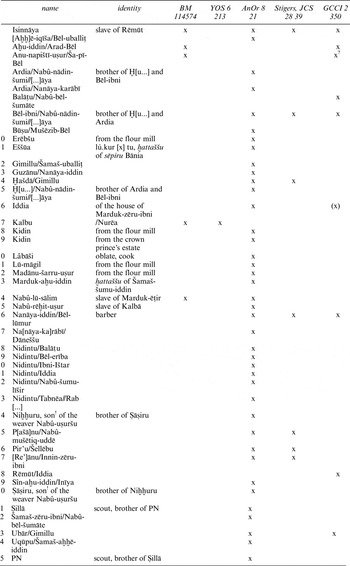
This memorandum, like the previous one, deals with theft, this time of sheep and garments. Several of the men who are mentioned may be identified as members of the gang: Isinnāya himself, Bēl-ibni/Nabû-nādin-šumi, Ubār/Gimillu and the barber Nanāya-lūmur.Footnote 34 The fifth man, Balāṭu/Nabû-bēl-šumāte, was possibly the brother of Šamaš-zēru-ibni/Nabû-bēl-šumāte listed in AnOr 8 21: 26, while Rēmūt, in whose house the two sheep stolen by Isinnāya were hidden, could have been the son of Iddia turned in by Isinnāya in his testimony (AnOr 8 21: 31). Two names, however – those of Anu-ikṣur, Aḫu-iddin – are new.
Since they are intermingled with those of members of the gang, there is little doubt that these three men were likewise Isinnāya's accomplices. It is unclear why they are missing from Isinnāya's testimony; a number of possible reasons can be given. More importantly, both men may perhaps be identified with individuals listed in the royal writ. If we look back at the five men referred to as “criminals” by the king, we can now establish that two of them – the slaves Isinnāya and Nabû-lū-sālim – were certainly involved in the same case, the case of Isinnāya's gang. This is less certain in the case of Kalbu, who was released to house arrest by the board of Eanna. That leaves two men, Anu-napištī-uṣur and Aḫu-iddin. The latter could be identical with the thief Aḫu-iddin listed in the second memorandum. The last identification is more problematic. The two names – Anu-napišti-uṣur, Anu-ikṣur – sound similar, so the scribe who drew up the memorandum (or the writ) may have misheard the name and made a mistake.Footnote 35 If this identification is correct, it is possible that the entire royal writ dealt with one case, the case of Isinnāya's gang, and not with a number of individual criminals that the royal administration was seeking to track down. This assumption may be corroborated, however, only with new textual evidence.
Going back to GCCI 2 350, it is clear despite the terseness of its formulary that the text deals with the location of stolen goods and the identification of their owners. Two individuals mentioned in it were apparently victims of the thieves. The first one is “son of Arad-Innin” (l. 2), possibly a brother of fRē’indu, daughter of Arad-Innin from Stigers, JCS 28 39. If that is the case, Isinnāya and his men stole in one break-in not only valuables, but also sheep. Provided our interpretation of lines 4–6 is correct, the second victim was Iqīša-Marduk, son of Kabtia (as specified in the bottom line), whose house was burglarised by three members of the gang. He could be identical with a man of the same name from the Šigūa family, brother of Mušēzib-Marduk, an influential scribe and a prebendary baker of Nanāya.Footnote 36 Finally, lines 7–10 name three criminals next to several garments that were assumingly found in their hands and not yet traced back to their owners.
Both memoranda are extremely concise and laconic. They must have been produced in the course of criminal investigation procedures: collection of evidence, questioning of witnesses and suspects. It is regrettable that we do not know the people behind these procedures, Eanna's detectives and policemen.
The composition of the gang
Throughout the dossier, criminals are identified by their father's names, their occupation or status. These data give an insight into the social structure of Isinnāya's gang. In this respect, the dossier is extremely valuable, as it provides insight into the lower strata of Neo-Babylonian urban society.
The head of the gang, Isinnāya, was a slave. Unfortunately, it is impossible to establish conclusively who his master Rēmūt was. As noticed earlier on, the fact that Rēmūt's name was not given suggests that he was well known and easily recognizable. The zazakku Rēmūt, a close associate of Nabonidus, could be a candidate, but no strong arguments in favour of this identification may be offered.Footnote 37 It seems less plausible that the owner of Isinnāya was Rēmūt//Rīmanu, the messenger who brought the royal writ to Uruk. Isinnāya is called “the slave of Rēmūt” (with no filiation given) also in BM 114574; had the messenger been the owner, his filiation or function should have been specified there.
Two more individuals are labelled as qallus,Footnote 38 and one as an oblate (a cook by profession).Footnote 39 Four flour-mill workers belonged to the gang,Footnote 40 one barber,Footnote 41 two individuals labelled ḫattaššu (the meaning of this term is uncertain),Footnote 42 two scouts,Footnote 43 two sons of a weaver,Footnote 44 and one man from the crown prince's estate.Footnote 45 Several members of the gang were related: three groups of brothers may be detected,Footnote 46 and possibly a few father-and-son pairs.Footnote 47
Most of the gang members do not seem to be linked formally to the temple: apart from one oblate, none of the criminals were identified as members of the Eanna household; Kalbu/Nūrēa, the man released to his father's custody may be the sole exception. The victims, on the other hand, were possibly prebendaries of Eanna. It is unclear whether it was for this reason that the case came under temple jurisdiction.Footnote 48 Perhaps, alternatively, Eanna was the sole judiciary institution in Uruk at the time, representing the royal administration of justice also among people who were not members of the temple household.
All the criminals bear purely Babylonian names. One or at most two people have three-tier filiation indicative of a more noble pedigree,Footnote 49 but the overwhelming majority seem to be simple lower-class Urukeans. Since their filiation is short, associating them with any individuals known from the Uruk material is hazardous. One identification, however, seems very plausible. In Nabonidus’ seventh year a certain Ardia/Nanāya-karābī and his accomplice broke into a storehouse and stole offering dates, garments and wooden tablets.Footnote 50 Not only the name, the (quite rare) father's name and the chronological proximity, but also a criminal past allow the man's identification with one of Isinnāya's colleagues.
Composition of temple bodies

Investigation proceedings
The dossier comprises five documents produced in the course of subsequent stages of the investigation proceedings undertaken by Eanna; seldom is the accumulation of available evidence so thick. The effectiveness of temple officials is impressive. The investigation began when the order of the king reached Uruk on the ninth of abu. The first steps in response to the writ were taken on the following day, when Kalbu was granted house arrest (tenth of abu). Seven days later Isinnāya disclosed his accomplices (seventeenth of abu). It is uncertain where in time to locate the undated memoranda: the questioning recorded in them could have taken place between the receipt of the royal writ and Isinnāya's testimony (ninth–seventeenth of abu) or after the latter event. Still, within roughly eight days, temple officials had managed to track down the criminals listed in the royal writ, receive their testimonies, question witnesses and locate at least part of the stolen goods.
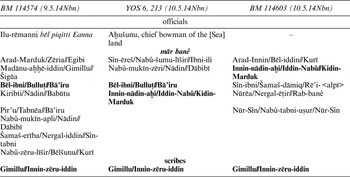
Several officials were involved in the investigation. The royal order was addressed to the royal administrator of the temple, ša rēš šarri bēl piqitti of Eanna, but the receipt of the writ was officially acknowledged in the assembly of mār banê. No specific mār banê seem to have been assigned to the case; with two exceptions (Bēl-ibni/Bulluṭ//Bā’iru and Innin-nādin-aḫi/Iddin-Nabû/Kidin-Marduk), they changed from record to record. Characteristically, the second top-ranking official of Eanna, the chief administrator (šatammu), who usually appears in similar contexts next to the bēl piqitti, is missing from all documents. It is uncertain whether any significance is to be ascribed to this fact.
Interestingly, on the day Kalbu's release was granted yet another record of legal deposition was drafted in Eanna (BM 114603). The collegia of the mār banê who appeared as witnesses of these two transactions differ substantially from one another.Footnote 51 This provides insight into the temple board's sitting practice: either the body of the mār banê changed over the day or two parallel sittings were held. On the other hand, the two documents, as well as the formal acknowledgment of the royal writ BM 114574 drafted a day earlier, were written by the same scribe, perhaps on account of his being assigned to the case.
Unfortunately, it is not known how this trial proceeded. Kalbu's release to house arrest was granted for a period of one month. By this time, presumably, the investigation was expected to have ended and the criminals put to trial. This last, crucial piece of the documentation is missing: there is no trial record, so it is not clear whether the court case took place in Uruk, at the local court, or in Babylon.Footnote 52 Finally, the sentence passed is unknown.
Nabonidus’ return from Teima
One more aspect of BM 114574 is of interest as it contributes to our knowledge of the chronology of Nabonidus’ reign. The king is known to have moved to the oasis of Teima in Arabia in his third year, but the precise date of his return to Babylon and his assuming of royal functions is disputed; opinions vary between his thirteenth and fifteenth year.
Paul-Alain Beaulieu quoted several arguments in favour of the former option.Footnote 53 Firstly, Inscription no. 13 states clearly that Nabonidus returned from Arabia ten years after his departure (which took place in his third year, according to the Verse Account). Secondly, late in the thirteenth year several high officials were replaced in Uruk, a fact which may be linked to the king's reorganisation of the local administration upon his return.Footnote 54 Thirdly, up till the thirteenth year royal letters opened with the heading amat mār šarri “the word of the crown prince”, afterwards the formula went back to the standard amat šarri “the word of the king.”
The validity of Beaulieu's arguments was questioned by A.C.V.M. Bongenaar (Reference Bongenaar1993) who noted that Belshazzar was still enjoying royal prerogatives in Sippar in the fourth month of the fifteenth year: a royal share of the sacrifices was sent to him.
Similarly to all the royal messages dispatched beginning with the thirteenth year, BM 114574 opens with amat šarri rather than amat mār šarri. This confirms the consistency of the formulary used by royal scribes and thus adds weight to Beaulieu's third argument. With this consistency in mind, it seems unlikely that the message came from the crown prince Belshazzar. The writ could have obviously been dispatched from Arabia, but Nabonidus’ involvement in a local criminal investigation would be very unusual had the king still been away. It seems much more probable that in his fourteenth year Nabonidus was already back in Babylon. Bongenaar's argument is strong, but a solution can be offered. Sacrificial remains were divided between the king and the crown prince during the Teima period,Footnote 55 but perhaps they also continued to be divided also later on, for example whenever the king and the crown prince were in different locations. Belshazzar could have also retained part of his earlier duties and privileges. Alternatively, the dispatch of sacrificial baskets from Sippar to Belshazzar could simply have continued as it had been for the ten preceding years.
Conclusions
The royal writ puts the dossier of Isinnāya's gang in an entirely new perspective. If not for it, the remaining documents could have been treated as a product of an internal temple investigation, following which a local trial would be expected.
The dossier demonstrates that the king interfered in the execution of justice on a local level in cases of not only state importance, but also petty crime like theft and burglary, committed by simple, low class city dwellers. Obviously, not all the details of the case are known and the size of the gang and the possible scope of its activities may not be irrelevant.
The royal writ is a unique document and as long as it remains isolated, it does not provide sufficient grounds to reformulate opinions about the shape of the Neo-Babylonian court system. It does, however, increase awareness of the lamentable one-sidedness of our material.
APPENDIX
BM 114603 (1920-06-15, 199)
5.3 × 4.2
-
1. mìr-d in-nin a-šú šá mden-mu a m kur-i
-
2. md in-nin-mu-ùru a-šú šá mmu-dnà a m ki-din- d šú
-
3. md30-ib-ni a-šú šá mdutu-sig15 a lú.sipa-i- <gu4>
-
4. mzálag-e-a a-šú šá mdu.gur-sur a lú.gal.dùover erasure
-
5. mzálag-d30 a-šú šá mdnà-dù-šeš a mzálag-d30
-
6. lú.dumu ba-ni-i.meš šá ina pa-ni-šú-nu
-
7. fé.sag.gil-be-let dumu.sal-su
l.e.
-
8. šá mdu.gur-mu a m ár-rab-tu 4
-
9. taq over erasure -bu-ú um-ma túg.šir-a-am
rev.
-
10. šá ina ⸢šuii⸣ f nu-up-ta-a dumu.sal-su
-
11. šá mdnà-sur áš-šu-ú at-tu-ú-a
-
12. ši-i
-
13. lú.umbisag m⸢gi⸣-mil-lu a-šú šá mdinnin-na-numun-mu
-
14. unug(over erasure).ki iti.ne u4.10.kám
-
15. mu.14.kám mnà-i lugal e.ki
Arad-Innin/Bēl-iddin//Kurī,
Innin-šumu-uṣur/Iddin-Nabû//Kidin-Marduk,
Sîn-ibni/Šamaš-udammiq//Rē’i- <alpi> ,
Nūrēa/Nergal-ēṭir//Rab-banê,
Nūr-Sîn/Nabû-bāni-aḫi//Nūr-Sîn.
– these are the mār banê in whose presence fEsangil-bēlet/Nergal-iddin//Arrabtu said as follows: “The šir’ām-cloth that I took from fNuptā/Nabû-ēṭir is mine.”
Scribe: Gimillu/Innin-zēru-iddin.
Uruk, tenth of abu, fourteenth year of Nabonidus, king of Babylon.
See Table 2 for the juxtaposition of the mār banê present at this and yet another hearing held on the same day.
The identity of neither of the protagonists can be established. Among the mār banê there is Sîn-ibni/Šamaš-udammiq//Rē’i-alpī, Eanna's “Generalpächter” (ša muḫḫi sūti) and crop estimator.Footnote 56 His three sons were scribes and his family held the milk supply prebend in Eanna.Footnote 57 Nūr-Sîn/Nabû-bāni-aḫi//Nūr-Sîn was a jeweller.Footnote 58 The remaining mār banê are, to my knowledge, hitherto unattested.
BM114603