INTRODUCTION
Despite large strides made in improving productivity and environmental conditions in many developing countries, a great number of poor families in Africa and Asia still face poverty, hunger, food insecurity and malnutrition. These problems are exacerbated by adverse biophysical growing conditions and the poor socio-economic infrastructure in many areas in the semi-arid tropics (SAT). The SAT are home to 38% of the developing countries' poor, 75% of who live in rural areas. Over 45% of the world's hungry and more than 70% of its malnourished children live in the SAT. Apart from the problems of equity, poverty and sustainability – and hence the need for greater investment in SAT areas – studies have shown that research and development (R&D) investments in less-favoured semi-arid environments could provide high marginal payoffs in terms of generating new sources of economic growth (Fan and Hazell, Reference Fan and Hazell2000).
Even with growing urbanization, globalization and better governance in Africa and Asia, hunger, poverty, and vulnerability of livelihoods to natural and other disasters will continue to be greatest in the rural SAT. These challenges are complicated by climatic variability, the risk of climate change, population growth, health pandemics (AIDS, malaria), a degrading natural resource base, poor infrastructure, and changing patterns of demand and production (Freeman et al., Reference Freeman, Rohrbach and Ackello-Ogutu2002; Ryan and Spencer, Reference Ryan and Spencer2001; Shiferaw and Bantilan, Reference Shiferaw and Bantilan2004). The majority of developing country poor live in rural areas; their livelihoods depend on agriculture and exploitation of the natural resource base. Agriculture will continue to be the backbone of economies in Africa and South Asia in the foreseeable future. As most of the SAT poor are farmers and landless labourers, strategies for reducing poverty, hunger and malnutrition should be driven primarily by the needs of the rural poor and should aim to build and diversify their livelihood sources. Substantial gains in land, water and labour productivity as well as better management of natural resources are essential to reversing the downward spiral of poverty and environmental degradation (Scherr Reference Scherr2000; Templeton and Scherr, Reference Templeton and Scherr1999). Renewed effort and innovative R&D strategies are needed to address these challenges, such as Integrated Natural Resource Management (INRM) that has been evolving within the 15 International Agricultural Research Centers (IARCS) of the Consultative Group for International Agricultural Research (CGIAR) (Harwood and Kassam, Reference Harwood and Kassam2003; Harwood et al., Reference Harwood, Kassam, Gregersen and Ferres2005; Kassam et al., Reference Kassam, Gregersen, Ferres, Javier, Harwood, de Jancry and Cernea2004; Task Force on INRM, 2000). The basic role of the 15 IARCs is to develop innovations for improving agricultural productivity and natural resource management for addressing the problems of poverty, food insecurity and environmental degradation in developing countries. This effort has generated multiple and sizeable benefits (welfare, equity, environmental) (Kassam et al., Reference Kassam, Gregersen, Ferres, Javier, Harwood, de Jancry and Cernea2004). But much remains to be done in sub-Saharan Africa (SSA) and less-favoured areas of South Asia.
This paper seeks to outline the challenges faced by the IARCS in developing an INRM approach to maximize research for development impacts, whilst safe guarding science quality and the generation of International Public Goods (IPGs) with which they are charged. Against this background, a framework for the implementation of a modified version of the INRM paradigm within the International Crops Research Institute for the Semi-Arid Tropics (ICRISAT) to clearly articulate the role of genetics is presented.
THE NEED FOR NEW CONCEPTS AND OPERATIONAL PRINCIPLES
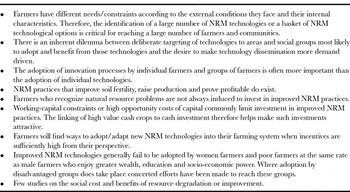
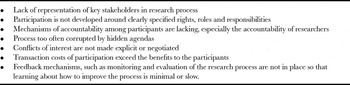
Good management of natural resources is the key to good agriculture. This is true everywhere – and particularly in the SAT, where over-exploitation of fragile or inherently vulnerable agro-ecosystems is leading to land and soil degradation, productivity decline, and increasing hunger and poverty. Modern crop varieties offer high yields, but the larger share of this potential yield can only be realized with good crop management. A plethora of NRM technologies have been developed over the years, but adoption has been poor for various reasons: technical, environmental, socio-economic and institutional. Table 1 summarizes what is currently known about the adoption of NRM technologies, whilst Table 2 summarizes some of the institutional and organizational constraints. Low adoption leads to low impact and failure to reach the goals of agricultural research investments (Freeman et al., Reference Freeman, Rohrbach and Ackello-Ogutu2002; Ryan and Spencer, Reference Ryan and Spencer2001).
What we know about the adoption of Natural Resource Management (NRM) practices (adapted from Barrett et al., Reference Barrett, Place and Aboud2002).

Common organizational problems in Natural Resource Management research (adapted from Ashby, Reference Ashby, Pound, Snapp, McDougall and Braun2003).

There are several reasons for low impact of R&D investments and why smallholder farmers often do not invest in new technologies. First is the relative profitability and associated risk of the new technology under moisture-limited and variable climatic conditions. Second, the need for site-specific innovations that address farmer and market preferences and the diversity in the policy and institutional constraints, all which affect adoption. For IARCs these problems are further exacerbated by the expectation that their research endeavours will result in IPGs, set against the increasing uncertainty of climatic environments.
Profitability of innovations under moisture limited and variable climatic conditions
Production systems in the SAT are very complex and have evolved over generations in order to adapt to high variability and diverse biotic and abiotic stresses. In a risk-prone environment, the nexus between rural poverty, population pressure and agro-ecosystem degradation (Scherr, Reference Scherr2000; Templeton and Scherr, Reference Templeton and Scherr1999) further complicates research. The relative importance of land and labour as factors of production will also vary according to the population densities in a given production system. Also, the R&D strategy will have to vary according to the relative importance and scarcity of land, labour and capital. Where land is scarce (e.g. South Asia) and labour is relatively abundant, research should focus on technologies that improve land productivity and use labour to generate employment. Labour-saving options that also improve land productivity may be needed in areas of low population density where labour markets are poor and HIV/AIDS is a major issue, impacting on labour availability (e.g. sub-Saharan Africa).
Site-specific innovations targeted to farmer and market preference and institutional diversity
Social and economic diversity and failure to capture farmer/consumer preferences and market requirements are key factors constraining the adoption of innovations. Individual farmers and governments may have non-complementary (and sometimes conflicting) economic, social and environmental objectives. Farmers' economic and environmental objectives might depend on their comparative advantages and vulnerabilities to shocks, in turn determined by natural resource endowments, market access, government polices and social entitlements. For example, with unreliable or imperfect markets, farmers may not be in a position to adopt profitable and marketable varieties. The opportunities for intensification, diversification and commercialization of production will vary accordingly. In remote SAT areas that are poorly integrated to markets, perishables and high-value input-intensive crops may not be appropriate, whereas farmers closer to urban centres, processing plants and marketing points may benefit from such technologies. Also, comparative advantages are relatively dynamic, varying over time depending on changing infrastructure and market conditions. This will necessitate different R&D strategies for the short, medium and long-term, and periodic evaluation and refinement of growth opportunities and research priorities.
In addition to markets, property rights, pricing policies and institutional arrangements can also influence the profitability and uptake of new innovations. Vulnerability to drought and other risks will differ across farm households depending on wealth, access to resources and ability to smooth consumption over time. Accordingly different groups of rural households may have differing capacities for buffering and managing risk and may require different types of technological and policy interventions. When the benefits from resource investments are unequally distributed or externalities affect the flow of benefits captured by farmers, it can hamper adoption and investment in such technologies. For example, households in the upper and downstream reaches of a watershed may have different incentives for land and water management investments. Yet it is essential each understands the needs of the other, and the off-site implications of future management decisions, particularly those taken in the upper catchments that influence flows to the lower reaches (CAWMA, 2007). Likewise, developing integrated pest management (IPM) options requires collective, coordinated action amongst a group of farmers to combine occasional use of pesticides with crop rotation or intercropping of different crops or varieties in order to reduce pest resistance (Singh and Trivedi, Reference Singh and Trivedi2005). Similarly, men and women farmers may have different constraints and priorities and preferences. Labour-deficient households or those affected by AIDS may require special attention and targeting (Yamano and Jayne, Reference Yamano and Jayne2004). Technology development needs to be fully cognizant of client needs and growing conditions in a given target region.
Even when technologies are profitable under a given biophysical environment, uptake may be limited by policies and institutional factors including production and market risk (especially among risk-averse farmers). While developing new technologies, it is important to diagnose needs and limiting factors – biophysical and socio-economic constraints, biotic and abiotic stress factors, resource conditions, and market, policy and institutional factors. Experience has shown that a narrow disciplinary or commodity approach that fails to integrate all these dimensions will not succeed.
Matching the need for site-specific research with the generation of IPGs
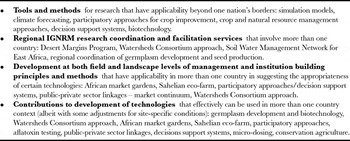
As indicated above, the biophysical and social diversity in SAT areas enforces the need for site-specific technologies if the desired adoption and impact is to be achieved. However, on the face of it, this may appear to conflict with the mandate of IARCs, which is to generate widely applicable IPGs (Kassam et al., 2006). Whereas IPGs should be interpreted in a broad context to include lessons, tools and methods, as well as new technologies that are relevant across multiple countries, the role of IARCs in generating local innovations needs to be interpreted in relation to the capacity and comparative advantages of other partners (see Table 3).
Examples of International Public Goods Generated through ICRISATs Integrated Genetic and Natural Resource Management (IGNRM) research (adapted from Thomas (Reference Thomas2005) to reflect ICRISATs current research agenda).

Although the IARCs may not be involved in developing finished products and technologies for specific agro-ecosystems per se, they can play a crucial role in generating prototypes and models that can be scaled up in certain development domains. Simultaneously IARCS can complement the functions of national programmes by undertaking upstream and cutting edge strategic research to address identified priority constraints to agricultural development (Harwood et al., Reference Harwood, Kassam, Gregersen and Ferres2005; Kassam et al., Reference Kassam, Gregersen, Ferres, Javier, Harwood, de Jancry and Cernea2004; Reference Kassam2006).
In the light of this challenge to match the need of site-specific research with the generation of IPGs, the IARCs have played a leading role over the past two decades in developing and testing new conceptual frameworks and approaches for research that responds to the diversity of farmers' needs. Much of this developing and testing work has been done in close collaboration with national programmes which have subsequently integrated such approaches into their own research agenda.
CONCEPTUAL FRAMEWORKS AND MODELS OF INTEGRATION
Both biophysical and socio-economic factors are crucial in shaping research strategies and priorities (Harwood et al., Reference Harwood, Place, Kassam and Gregersen2006; Kassam, Reference Kassam2006). Research in developing countries has evolved in different phases. Agronomists and breeders have long been aware of genotype–environment interactions and the need to tailor technologies for specific eco-regions. There is now a growing realization that R&D efforts should be demand-driven and respond to the needs and priorities of smallholder farmers and their support agents as well as consumers and markets. Developing widely adaptable, acceptable products requires participatory approaches that involve end-users, stakeholders and target groups at all stages of technology development. It also requires proper monitoring and evaluation (M&E) that will help draw lessons from experience. A coalition of strategic partners, with complementary skills, is also needed for scaling out desirable innovations. A brief review of the different integrating models and their evolution within the CGIAR is provided below.
The INRM paradigm within the CGIAR
INRM is an attempt to build a new agricultural research and development paradigm to meet the challenges and opportunities outlined above. Campbell et al. (Reference Campbell, Sayer, Frost, Vermeulen, Ruiz Pérez, Cunningham and Prabhu2001) define INRM as ‘a conscious process of incorporating the multiple aspects of natural resource use (be they biophysical, sociopolitical or economic) into a system of sustainable management to meet the production goals of farmers and other direct users (e.g. food security, profitability, risk aversion) as well as the goals of the wider community (e.g. poverty alleviation, welfare of future generations, environmental conservation).’ This new paradigm attempts to integrate various, but not necessarily multi-disciplinary, participatory R&D paradigms that include:

There is a vast literature on NRM and on technology evaluation and adoption. Some recent publications include Barrett et al. (Reference Barrett, Place and Aboud2002), Campbell et al. (Reference Campbell, Hagmann, Stroud, Thomas and Wollenberg2006) Campbell and Sayer, (Reference Campbell and Sayer2003), CIMMYT (2003), Douthwaite et al. (Reference Douthwaite, Delve, Ekboir and Twomlow2003), Harwood and Kassam (Reference Harwood and Kassam2003), Perez and Tschinkel (Reference Perez and Tschinkel2003), Pound et al. (Reference Pound, Snapp, McDougall and Braun2003) and Shiferaw and Freeman (Reference Shiferaw and Freeman2003, Reference Shiferaw, Freeman and Swinton2005). A recent issue of the journal Agricultural Systems (vol. 78) was devoted to this subject. However, the focus of much of this literature was on the integration of socio-economic and biophysical issues, with little focus on the integration of the genetic dimension. Omission of the genetic component (both crop and livestock) in improved management of agro-ecosystems is contrary to the wider consensus of linking NRM with livelihood strategies of smallholder farmers and other resource users.
Evolution and operationalization of the INRM paradigm
INRM has grown out of farming systems research (FSR), which had its heyday in the mid 1980s, and then all but disappeared by the early 1990s. This was because FSR attempted, just as INRM is attempting today, to carry out research with complicated technologies in complex settings (Douthwaite et al., Reference Douthwaite, Ekboir, Twomlow, Keatinge, Shiferaw, Freeman and Swinton2004). Research on complex agricultural systems is difficult because of the multiple scales of interaction and response within and between physical and social subsystems, uncertainty, long time lags, and multiple stakeholders with often contrasting objectives and activities (Campbell et al., Reference Campbell, Sayer, Frost, Vermeulen, Ruiz Pérez, Cunningham and Prabhu2001).
In a synthesis paper, Sayer and Campbell (Reference Sayer, Campbell, Campbell and Sayer2003) flesh out the definition of INRM given above, which serves as a road map of how institutions might modify their way of doing business rather than employing tried and trusted approaches already in use.
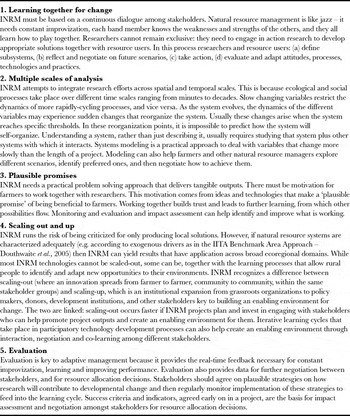
The guiding perspective of ‘best practice’ INRM is that standardized, generally applicable, technologies or truths are unlikely because smallholder farmers generally have multiple objectives and achieving change involves the interplay of multiple stakeholders. Rather, research should be directed at improving the adaptive capacity of agro-ecological systems, i.e. improving the system's capacity to adapt to changes and to continue to supply products and services that poor people depend upon. In practice this means helping farmers and other managers of natural resources to acquire skills and technologies to better control their resources, i.e. improving their ‘adaptive management’ abilities. INRM is a way to develop practical, local solutions by working with farmers and a range of other partners, blending the best science with local and specialized technological knowledge. The lessons learned can then be used to develop solutions for similar conditions in different environments. However, one must not get lost in the complexity of the system, and attempt to target the uniqueness of individual households. The five key elements of the INRM paradigm are summarized in Table 4.
Five key elements of Integrated Natural Resource Management (adapted from Douthwaite et al., Reference Douthwaite, Ekboir, Twomlow, Keatinge, Shiferaw, Freeman and Swinton2004).

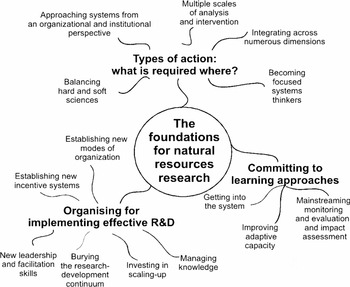
In essence INRM tries to harmonize the complementary but often conflicting goals of production and environmental protection. The current thinking within the CGIAR on INRM can be described through a conceptual and an operational framework (Figure 1). The conceptual framework rests on three pillars:
• Types of action: deciding what type of science to do where
• Committing to learning approaches: establishing a system for adapting and learning
• Organizing for implementing effective R&D: changing the social organization of science.
The principles for more effective Integrated Natural Resource Management (Campbell et al., Reference Campbell, Hagmann, Stroud, Thomas and Wollenberg2006).

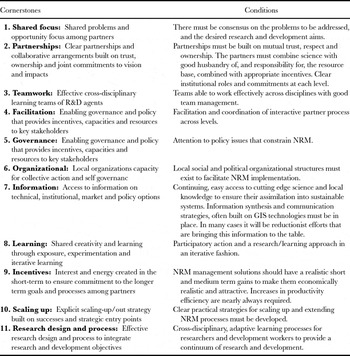
It is argued that, to bring science to bear on poverty and sustainability simultaneously, society needs a new social contract for science. For putting INRM into action, an operational framework consisting of 11 ‘cornerstones’ has been developed (Table 5) and can be used as a guideline for implementing INRM projects, thus complementing the three pillars of the conceptual framework. The cornerstones can be used as a checklist for self-reflection and evaluation; each must be considered; otherwise the weakest becomes a threat to the whole. Evaluation provides learning opportunities for all stakeholders: country leaders and decision-makers, public sector managers, project managers, team leaders and individual scientists. Both successes and failures can provide insights. These learning opportunities and insights can be derived throughout the project cycle, what in INRM parlance is termed the learning cycle (Campbell et al., Reference Campbell, Hagmann, Stroud, Thomas and Wollenberg2006).
The eleven ‘cornerstones’ to achieve effective Integrated Natural Resource Management research and development (adapted from Campbell et al., Reference Campbell, Hagmann, Stroud, Thomas and Wollenberg2006).

Asking the right questions
Asking the right questions in NRM research is paramount. Gladwin et al. (Reference Gladwin, Peterson and Mwale2002), for example, suggest that the seemingly crucial question of ‘how much nutrient a farmer should put on his/her soil given the desired output’ is not the ‘right’ question for most poor African farmers. Although these farmers desire higher outputs to meet their growing desires and expectations, they are severely resource constrained. They need answers to other types of questions: ‘How much nutrient can we afford to put on and where, and how much yield will that give and how will we make up the gaps?’ (Dimes et al., Reference Dimes, Twomlow, Rusike, Gerard, Tabo, Freeman and Keatinge2005; Gladwin et al., Reference Gladwin, Peterson and Mwale2002). In effect scientists and change agents need a reality check (the reflective phase of the project cycle) to ensure integration of local and scientific knowledge (Table 6).
A reality check for the ivory tower integrating local and scientific knowledge

Research to promote innovation through action-based learning is the key to successful, sustainable resource management. Pretty and Hine (Reference Pretty and Hine2001) analysed over 200 cases of sustainable agriculture from 52 countries, involving more than 9 million farmers and over 30 million ha. They concluded that success occurred when participatory approaches were used that involved farmer experimentation and built capacity to learn about biological and ecological complexity. A major research challenge faced in INRM is to combine the various ‘information bits’ derived from different stakeholders, and distil these into decision rules that they can use (Snapp and Heong, Reference Snapp, Heong, Pound, Snapp, McDougall and Braun2003).
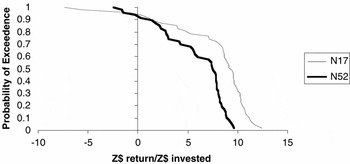
ICRISAT staffs in southern Africa have achieved this through linking the logics of participatory action research and simulation modelling to better understand the limited gains achieved in crop yields and productivity, despite some 20 years of donor-supported breeding programmes in the region. The results indicated farmers were better off applying lower rates of inorganic nitrogen fertilizer, ammonium nitrate (34% N), on more fields, than concentrating a limited supply of fertilizer on one field alone (Figure 2). Subsequent participatory on-farm experimentation on micro-dosing alone or in combination with available animal manures confirmed that farmers could increase their yields by 30–100% by applying as little as 10 kg N ha−1 (Dimes et al., Reference Dimes, Twomlow, Rusike, Gerard, Tabo, Freeman and Keatinge2005; Ncube et al., Reference Ncube, Dimes, Twomlow, Mupangwa and Giller2007; Rusike et al., Reference Rusike, Twomlow, Freeman and Heinrich2006).
The percentage chance of exceeding given rates of return on N-fertilizer investment on maize production at 17 and 52 kg ha−1, Masvingo, Zimbabwe (Dimes, Reference Dimes2005).

The question remained whether this result could be replicated across much larger numbers of farmers. Donor-funded relief programmes in Zimbabwe from 2003/2004 provided the vehicle for the successful scaling out of this intervention to more than 170 000 farmers, and convinced relief organizations that investing in inorganic nitrogen fertilizer was a viable step towards the promotion of sustainable smallholder cropping systems (Twomlow et al., Reference Twomlow, Rohrbach, Rusikes, Mupnagwa, Dimes, Ncube, Hove, Moyo, Mashingaidze and Maphosa2007).
Adoption of INRM technologies – measuring impacts
Unlike traditional crop improvement research, where there is large documented evidence of impacts, there is a dearth of evidence of both overall and specific outcomes, intermediate and long-term impacts of natural resource management for INRM-based research. However, a lack of documented evidence does not necessarily imply lack of impact: it is often difficult in the short term to attribute the direct impacts/benefits of INRM research (DFID, 2003). As a consequence, M&E is now high on the agenda of many organizations, but few know how to generate relevant information for INRM-type initiatives (Thomas, Reference Thomas2005). While there are often cited valid reasons for not undertaking M&E within INRM research, such as complexity, it is essential to understand its contribution to enhancing agricultural productivity and sustainability, reducing vulnerability and ultimately alleviating poverty (Shiferaw and Freeman, 2005). In fact, Sayer and Campbell (Reference Sayer, Campbell, Campbell and Sayer2003) assert that M&E is the key to the adaptive project management, and reflective learning is required for successful INRM. Identification and development of an evaluation framework and appropriate impact indicators early in the research process is critical to ex-ante and ex-post assessment of progress and potential for impact (Douthwaite et al., Reference Douthwaite, Delve, Ekboir and Twomlow2003).
Impact assessment is seen as a key feature of the CGIAR's INRM paradigm (Harwood et al., Reference Harwood, Kassam, Gregersen and Ferres2005, Reference Harwood, Place, Kassam and Gregersen2006; Kassam et al., Reference Kassam, Gregersen, Ferres, Javier, Harwood, de Jancry and Cernea2004). It is a tool for adaptation, learning and performance enhancement, providing data for further negotiation among stakeholders and for resource allocation decisions. Three types of assessment are required: ex-ante analysis to help set research priorities, continuous monitoring in order to make corrections during implementation and ex-post impact assessment to evaluate and attribute impacts. In the case of NRM, the latter involves substantial difficulties, as discussed in the literature (Shiferaw and Freeman, 2005).
A recent review of INRM research within the CGIAR, notes that it is increasingly clear to NRM programme evaluators that they must add appropriate indicators of both social and natural resource endowments and well-being to the limited, traditional economic indicators if they are to truly assess impacts (Harwood and Kassam Reference Harwood and Kassam2003; Harwood et al., Reference Harwood, Place, Kassam and Gregersen2006). Unfortunately, the focus of much of the current CGIAR current core investment in social science research is towards ex-ante and ex-post impact activities and the production of IPGs (Kassam et al., Reference Kassam, Gregersen, Ferres, Javier, Harwood, de Jancry and Cernea2004; Harwood, et al., Reference Harwood, Place, Kassam and Gregersen2006). This indicates to the need to strengthen socio-economic analyses to support crop improvement and technology generation through ex-ante and ex-post assessments that help inform future priorities, and facilitate proper targeting and uptake of suitable germplasm and natural resource management technologies.
Kelley and Gregersen (Reference Kelley and Gregersen2003) paint an even bleaker (but accurate) picture in terms of some of the methods needed: ‘When addressing NRM research impacts, a whole range of other issues needs to be considered. Markets are largely missing for the environmental services provided. Different valuation methods exist, all of which are highly imperfect and tricky to use, and hence need bracketing, attributing prices from different angles. Externalities are spread over different scales and hence difficult to capture as each level needs to be done with different tools. The time dimension is crucial and hence the choice of discounting is key. There are also important problems of resilience and irreversibilities that need to be taken into account in constructing counterfactual scenarios. For these reasons, designing control groups for NRM treatments is particularly difficult because of the spatial and temporal dimensions involved.’ (See Table 1 for more details.)
The need for early and on-going evaluation
Adesina and Chianu (Reference Adesina, Chianu, Barrett, Place and Aboud2002) in an evaluation of alley farming in Nigeria, note that all too often, researchers focus on the biophysical characteristics of the system and neglect the socio-economic factors, which leads to inappropriate targeting and lower adoption. Early evaluation of alley farming technologies would have enabled researchers to work more closely with communities to adapt the technologies to their specific needs. For example, in many parts of West Africa, women do not have secure land and tree tenure, due to a patrilineal inheritance system. Therefore the technologies required modification for female-headed households. In addition it is important to use spatial analyses to understand better where to target the technologies relative to incentive structures across villages and communities as determined by market factors. In fact, the most important part of the whole adoption process is the ability of farmers to use their knowledge to modify and adapt technologies. When trying to understand adoption decisions, researchers should make sure they spend enough time evaluating the entire sequence of the adoption process from initial farmer experimentation with new ideas, to technology modification, adaptation and finally uptake. An overly protective researcher/institutional environment can stifle both farmer and researcher creativity and innovation.
Problems with institutions and organizations
A good example of how a protective institutional research framework can delay the spread of innovation is the case of Mr Z. M. Phiri in Zishavane district, Zimbabwe (Murwira et al., Reference Murwira, Hagmann, Chuma, Reij and Waters-Bayer2001). Phiri developed a number of innovations in soil and water conservation, but it took more than 15 years to spread beyond his farm, as government services providers viewed them as a threat to the country's NRM policy. The technologies disseminated to farmers had to be tested and proven under researcher management, a protective condition that still dominates the NRM research and extension agenda in many countries. It was only with the advent of farmer-participatory research techniques and a demand for alternative soil water conservation methods, that researchers began to document Phiri's experiences and provide a platform for him to share them with other farmers, scientists and extensionists. Lessons from this work led to the rapid farmer-to-farmer extension of rainwater harvesting (run-on) orchards in a small dam and community resource management project in semi-arid Zimbabwe (Ellis-Jones et al., Reference Ellis-Jones, Zvarevashe, Twomlow and Stevenson2001). In fact the demand for fruit trees, above and beyond the initial 7000 trees supplied by the project to six pilot communities, required the development and promotion of community-based nurseries to meet the demands from more than 100 communities in less than 18 months.
Reddy and Soussan (Reference Reddy and Soussan2003) attempted to assess the impact of watershed development programmes in the context of the Sustainable Livelihoods Framework (SLF). They concluded that assessing the impacts of participatory watershed management using the SLF is a methodological challenge, as it requires monitoring changes in the five capital assets, some of which are difficult to quantify. Hence, the evaluation process needs to be balanced between its qualitative and quantitative aspects, as well as long and short-run aspects. A further complication is one of scale; some indicators are measured at household level and some at village, community and even national levels. Moreover, attributing change to a particular intervention or programme is difficult, as there could be variables external to the project influencing these changes. For instance, changes in educational and health status could be due to other programmes, but they may influence the impacts of the INRM intervention, or vice versa.
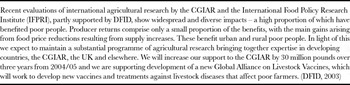
Methodological difficulties for NRM impact assessment are rooted in several unique features of such technology interventions. Unlike germplasm technologies, the impact of NRM technology occurs only indirectly through the economic and environmental goods and services that generate direct and indirect benefits to society. These benefits, as donors are beginning to recognize (see Table 7), are often multi-faceted, including economic, environmental and social gains across different scales. Hence, these benefits are often externalized, and not entirely captured by the investor.
Extract from United Kingdoms Department for International Developent (DFID) Policy Paper December 2003.

INTEGRATED MANAGEMENT APPROACHES IN ICRISAT'S RESEARCH
Despite some seven years, five global meetings and numerous publications, the label ‘INRM framework’ still creates confusion. Many CGIAR scientists, particularly plant breeders, think that such research focuses only on natural resource management, identifying complex NRM problems or improving environmental resilience. In fact the objective is broader – how to increase productivity of the agro-ecosystem in a sustainable manner.
Technologies must match not only the crop or livestock enterprise and the biophysical environment, but also the market and investment environment, including seed availability. Plant breeders and NRM scientists must integrate their work with change agents (both public and private sector), and work with target groups to develop flexible cropping systems that can respond to changes in market opportunities. Rather than pursuing a single correct answer, we need to look for multiple solutions tailored to the requirements of contrasting environments and diverse sets of households. These include female-headed households, HIV/AIDS-affected households, those lacking draft power, farmers with poor market access as well as households with good market access and better commercial production opportunities. In the SAT, ICRISAT must ensure that farmers have access to crop varieties that will improve household subsistence and increase marketable surplus; and processors and other end-users have access to quality produce that meets market needs. In the longer term carefully prioritized biotechnology work, that acknowledges consumer concerns, will underpin these activities.
ICRISAT's studies in Africa and Asia have identified several key constraints to more widespread technology adoption (Freeman et al., Reference Freeman, Rohrbach and Ackello-Ogutu2002; Shiferaw et al., Reference Shiferaw, Freeman and Swinton2005; Ryan and Spencer, Reference Ryan and Spencer2001). Other institutes have independently reached similar conclusions for other agro-ecosystems, so there is general agreement on the key challenges before us. These are:
• Lack of a market-oriented smallholder production system where research is market-led, demand-driven, and follows the commodity chain approach to address limiting constraints along the value chain. For example, ICRISAT's work on developing groundnut markets in Malawi aims to address this issue.
• Poor research–extension–farmer linkages, which limit transfer and adoption of technology. For example, ICRISAT's work on Farmer Field Schools in Africa and the Consortium approach to integrated management of watersheds in Asia aims to strengthen these linkages.
• Need for policies and strategies on soil, water and biodiversity, to offset the high rate of natural resource degradation. These issues are central to ICRISAT's Desert Margins Program and the Consortium approach to integrated watershed management.
• Need to focus research on soil fertility improvement, soil and water management, development of irrigation, promotion of integrated livestock–wildlife-crop systems, and development of drought mitigation strategies. These issues are addressed by several ICRISAT programmes, e.g. low-input soil fertility approaches in Africa, micro-nutrient research in Asia and the Sahelian Eco-Farm.
• Need to strengthen capacities of institutions and farmers' organizations to support input and output marketing and agricultural production systems. Such capacity building is a primary goal of the Soil Water Management Network (SWMnet) of the Association for Strengthening Agricultural Research in Eastern and Central Africa (ASARECA) and the Eastern and Central Africa Regional Sorghum and Millet Network (ECARSAM) in Eastern and Central Africa, and of seed systems/germplasm improvement networks globally.
• Poor information flow, lack of communication on rural development issues. This is being addressed by ICRISAT's VASAT Consortium (Virtual Academy for the Semi-arid Tropics) globally and specifically ICRISAT's Bio-economic Decision Support work with partners in West Africa.
• Need to integrate a gender perspective in agricultural research and training as seen in ICRISAT's work on HIV/AIDS amelioration in India and Southern Africa.
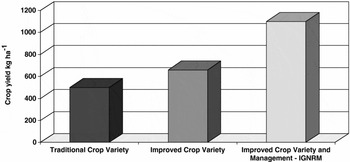
Crop improvement plays an important role in addressing each of these issues, and thus ICRISAT has expanded the INRM paradigm to emphasize specifically the role crops and genetic improvement can play in enabling SAT agriculture to achieve its potential. Thus, the institute is seeking to embrace an overall philosophy of ‘Integrated Genetic and Natural Resource Management’ – IGNRM. There is clear evidence from Africa that the largest productivity gains in the SAT can come from combining new varieties with improved crop and natural resource management (Figure 3), or a better understanding of the genotype–climate interaction.
Contribution of different technology components on sorghum yield, as observed in on-farm trials in Zimbabwe (source: Heinrich, Reference Heinrich2004).

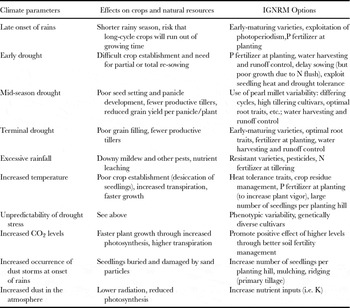
In much of agricultural research, the multidisciplinary team approach has often run into difficulties in achieving impact, because of the different disciplinary ‘takes’ on a given problem. For example, when it comes to managing the vagaries of climate in the semi-arid tropics, the agro-meteorologists tend to advise delayed sowing in order to minimize the risk of early-season drought, the crop improvement specialists prefer to promote more drought-resilient crop varieties and the agriculturalists see agronomic interventions as the solution. The aim of ICRISAT's IGNRM approach in West Africa has been to integrate the knowledge and products of the various research disciplines into useful extension messages that can sustainably increase yields for a range of climatic and edaphic conditions. Table 8 summarizes such an attempt at integration for pearl millet production in Mali for a range of possible climatic scenarios.
Effect of climate variability on pearl millet crop performances and Integrated Genetic Natural Resource Management (IGNRM) options in Mali (adapted from ICRISAT, 2006).

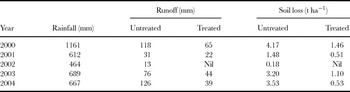
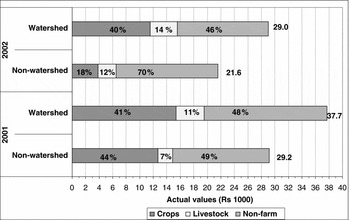
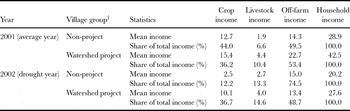
Similarly in Asia, the integrated watershed management approach that aims to promote income-generating and sustainable crop and livestock production options as an important component of improved management of watershed landscapes is an example of how IGNRM can lead to significant benefits in a poor area (Table 9 and Figure 4).
Effect Integrated Water Management interventions on runoff and soil erosion from Adarsha watershed.

The effects of integrated watershed management interventions (crop and livestock) on the flow of household net incomes over two contrasting rainfall seasons compared to unimproved watersheds (ICRISAT: data from Adarsha watershed, AP, India). Numbers at right of horizontal bars represent mean total income per household (Rs 1000).

ICRISAT in partnership with National Agricultural Research Systems in Asia, have developed an innovative and upscalable consortium model for managing watersheds holistically. In this approach, rainwater management is used as an entry point activity starting with in-situ conservation of rainwater and converging the benefits of stored rainwater into increased productivity by using improved crops, cultivars, suitable nutrient and pest management, and land and water management practices (Table 9). The IGNRM approach has enabled communities to harness not only the benefits of watershed management, but also achieve much of the potential from improved varieties from a wider range of crops. The households' incomes and overall productivity have more than doubled throughout selected benchmark sites in Asia (Figure 4 and Table 10). The benefits not only accrue to landholding households, but also to the landless marginalized groups through the creation of greater employment opportunities. The greater resilience of crop income in the watershed villages during the drought year in 2002 is particularly noteworthy (Figure 4). While the share of crops in household income declined from 44% to 18% in the non-project villages, crop income remained largely unchanged from 41% to 40% in the watershed village. The loss in household income in the non-project villages was largely compensated by migration and non-farm income, which increased from 49% in an average year to 70% during the drought year. Such rewards also benefit the research and development organizations. Much of this gain originates from improved soil fertility management and increased availability of irrigation water and integration of improved cultivars and cropping patterns into the watershed systems.
The effect of integrated watershed interventions on alternative sources of household income (Rs 1000).

† The sample size (n = 60 smallholder farmers) in each group (ICRISAT data).
Integrating IGNRM into ICRISAT
When IGNRM approaches are considered, various questions arise. Are such complementary technologies available? If so, why are they not being adopted? Is it because the technologies themselves are at fault? Perhaps they are effective only under carefully managed conditions at research stations, not in a highly variable farming environment. Perhaps integrated approaches are too expensive, or not cost-effective. But if effective, appropriate technologies are available, is adoption being limited by lack of enabling institutions, or by other cultural or economic factors? Are farmers simply not aware of, or not convinced by, the new technologies? Yet, if technologies are to be developed, how should we adjust our research agenda? How do we make it easier for researchers to develop the right genetic and NRM technologies, and seed entrepreneurs and extension agents to promote their adoption? These are difficult questions, but finding the answers should be the goal of every IGNRM scientist at ICRISAT.
The IGNRM agenda is ambitious but achievable, given the successes in the recent past, and the progress of ongoing programmes. Much of the Institute's work already has an IGNRM focus. For example, current work is contributing to at least four types of IPGs within the INRM paradigm (summarized in Table 3), which were identified at a major CGIAR workshop in 2005Footnote 1 and discussed in detail by Harwood et al. (Reference Harwood, Place, Kassam and Gregersen2006).
However, ICRISAT cannot and must not attempt to address all these issues on its own. ICRISAT scientists must continue to foster and broker partnerships that provide synergies to our core mandate, thus leading to greater global impacts as outlined by the CGIAR Systems Priorities (CGIAR, 2005).
CONCLUSIONS
The main objective of agricultural research is to make a meaningful contribution to agricultural development to improve human well-being and foster sustainable management of the resource base. Whereas international agricultural research has generated and promoted a number of successful agricultural technologies that enhanced productivity and improved global food security, there are continuing challenges for improving targeting of such technologies to achieve greater impacts on poverty, depletion of the resource base and environmental degradation. These challenges are particularly difficult in the dry tropics where soil fertility is poor and production systems suffer from climatic variability, erratic rainfall and recurrent droughts that perpetuate livelihood risks faced by farmers and other resource users. Unlike the irrigated systems in the high potential green revolution areas, the increasingly complex and diversified production systems in these areas have evolved over a long period of time to exploit the biophysical diversity and to cope with harsh climatic conditions and pervasive risks to livelihood. The combined effect of these factors makes component technologies less suitable in addressing multiple constraints in the system and necessitates complementary options to fit specific niches and meet socio-economic and environmental conditions of the target groups.
Increasing recognition of these problems and the need to generate innovations with greater and widespread impacts has propelled alternative approaches to agricultural research. This study reviews the historical experiences and response of the International Crops Research Institute for the Semi-Arid Tropics in its effort to make research more relevant to its target ecosystems and the problems faced by its clientele. While the INRM approach has made significant contributions in re-orienting research for sustainable management of natural resources, there is now a need to create clear synergies with germplasm improvement and the income and livelihood strategies of resource users. It is in this regard that the IGNRM approach espoused by ICRISAT now encompasses seed technologies and germplasm improvement as one of the important pillars for sustainable intensification and productivity improvement of agriculture in the semi-arid tropics. Recent experiences at ICRISAT with projects that pursue the IGNRM approach (e.g. integrated management of watershed landscapes) provide optimism about the effectiveness and suitability of this approach.