Introduction
Pronunciation is a significant component of successful oral communication in an L2. That is, high pronunciation proficiency aids in understanding and being understood, for both native speakers of the target language and L2 learners (Tsai, Reference Tsai2019). That being said, the role of L2 pronunciation instruction and its practices have been influenced by “the whims of the time and the fashions of the day” (Isaacs, Reference Isaacs2018, p. 273). In the early methods era, for instance, L2 pronunciation instruction was considered irrelevant by the grammar-translation method (GTM) and similar reading-based and naturalistic approaches. Although the direct method emphasized the importance of effective L2 pronunciation skills, it was not until the introduction of the audio-lingual method (ALM) and oral approach that it was viewed as an essential aspect of L2 teaching. The role of teaching pronunciation was again redefined with the rise of the communicative language teaching (CLT) (Richards & Rodgers, Reference Richards and Rodgers2014). That is, the “disjuncture between pronunciation and [CLT]” (Isaacs, Reference Isaacs2009, p.1) became evident. Similarly, teacher cognition studies showed that language teachers lack confidence in teaching L2 pronunciation (Baker, Reference Baker2011), feel uncertain about how to teach it (Couper, Reference Couper2017), and as a result, utilize mainly controlled techniques (Baker, Reference Baker2014). However, it is now evident that L2 pronunciation teaching, which had been identified with the Cinderella imagery in language teaching even before the CLT era (Kelly, Reference Kelly1969), has eventually been invited to the language teaching ball, or at least it does not suffer from “specialists’ underappreciations for the possibility of making better connections between CLT and pronunciation teaching” (Levis & Sonsaat, Reference Levis, Sonsaat, Kang, Thomson and Murphy2017, p. 13–14).
Similar to the trajectory of L2 pronunciation teaching, L2 pronunciation research was once considered as the neglected orphan of SLA studies (Deng et al., Reference Deng, Holtby, Howden-Weaver, Nessim, Nicholas, Nickle, Pannekoek, Stephan and Sun2009), a field that suffered from paradigm shifts, growing pains (Munro & Derwing, Reference Munro and Derwing2015), and rampant labeling inconsistencies (Munro & Derwing, Reference Munro and Derwing2020). However, following the transparent conjuncture out of the nebulous teaching and research context caused by CLT (Levis & Sonsaat, Reference Levis, Sonsaat, Kang, Thomson and Murphy2017), L2 pronunciation research has enjoyed a resurgence of interest, making it a rapidly growing field (Isaacs & Trofimovich, Reference Isaacs, Trofimovich, Isaacs and Trofimovich2016; Nagle et al., Reference Nagle, Levis, Todey, Levis, Nagle and Todey2019; Pennington, Reference Pennington2021). The growing interest in L2 pronunciation research and teaching, as expected, has lent impetus to review studies and meta-analyses, a sign of the growth of the field. These review studies have focused on a limited aspect of L2 pronunciation research, such as the effectiveness of L2 pronunciation instruction (Saito; 2012; Saito & Plonsky, Reference Saito and Plonsky2019; Thomson & Derwing, Reference Thomson and Derwing2015), the use and role of high variability pronunciation training (Thomson, Reference Thomson2018), and feedback type (Bliss et al., Reference Bliss, Abel and Gick2018) in L2 pronunciation teaching and learning, the effects of perception training on L2 perception and production gains (Sakai & Moorman, Reference Sakai and Moorman2018), and the assessment and teaching of comprehensible and nativelike pronunciation in ESL contexts (Saito, Reference Saito2021).
What is missing in the studies mentioned in the preceding text is an overarching bibliometric analysis lens serving to portray the state of L2 pronunciation research through a holistic and historical framework. Although coverage of relevant studies and synthesis of their findings can be made possible through meta-studies, bibliometric analyses are highly needed to compile and compare vast amounts of quantitative data to unravel the intellectual structure, research patterns, dynamics, and evolution of L2 pronunciation research, coupled with the detection of highly influential authors, references, and publication sources in the field. This kind of analysis is likely to enable academic professionals to stay current concerning research themes and trends and make insightful decisions on research issues that are worthy of investigation. A bibliometric analysis of L2 pronunciation research has the potential to contribute to the field by filling these niches, providing a systematic overview, and visualizing “big data” (Beelen et al., Reference Beelen, Thijm, Cochrane, Halvemaan, Hirst, Kimmins and Polyanovsky2017), thus serving as the main springboard for our study. Researchers in an array of education fields have recently shown great interest in bibliometric research (e.g., Gülmez et al., Reference Gülmez, Özteke and Gümüş2021; Heradio et al., Reference Heradio, De La Torre, Galan, Cabrerizo, Herrera-Viedma and Dormido2016). Moreover, several bibliometric studies have already been conducted on the general research field of SLA (Zhang, Reference Zhang2020), applied linguistics (Lei & Liu, Reference Lei and Liu2019), and e-books in EFL teaching (Chen et al., Reference Chen, Hwang, Majumdar, Toyokawa and Ogata2021). However, to date, no bibliometric analysis has appeared in the literature for L2 pronunciation research. This gap limits our understanding of the intellectual structure and research patterns of L2 pronunciation research.
With these gaps in mind, the present study applies bibliometric methods to map the L2 pronunciation research field by analyzing L2 pronunciation articles extending over four decades (1977–2020) that were published in distinguished applied linguistics journals covered by the SSCI index in the Web of Science (WoS) database. While doing so, we mainly drew on citation analysis of impact and cocitation analysis. The former allowed to reveal the impact of authors, publications, and sources in the dataset, whereas the latter, a broader kind of analysis reaching the reference lists of the documents in the dataset, enabled us to create network maps to illuminate the knowledge base of L2 pronunciation research. With such a perspective, we sought answers to the following research questions:
-
1. What are the featured themes, trends, and documents in L2 pronunciation research?
-
2. Which are the most influential authors and sources?
Method
This study employed the bibliometric method, which entails “the application of mathematical and statistical methods to books and other means of communication” (Pritchard, Reference Pritchard1969, p. 349). Having its roots in the field of library and information science, bibliometrics maps the literature in relation to a research field by collecting and quantitatively analyzing the bibliographic data embedded in scientific outputs. Bibliometric analyses can identify research themes and trends as well as scholarly networks based on published documents, major journals, productive authors, countries, research institutions, and keywords (Xiang et al., Reference Xiang, Wang and Liu2017). In this way, research patterns, dynamics, and characteristics of a particular field or discipline can be explored. As a method for analyzing, monitoring, and measuring scientific production (Gumpenberger et al., Reference Gumpenberger, Wieland and Gorraiz2012), bibliometrics furthers knowledge expansion on a particular research field and establishes connections between pioneering publications, authors, journals, and other features of the field under scrutiny (Vogel, Reference Vogel2014).
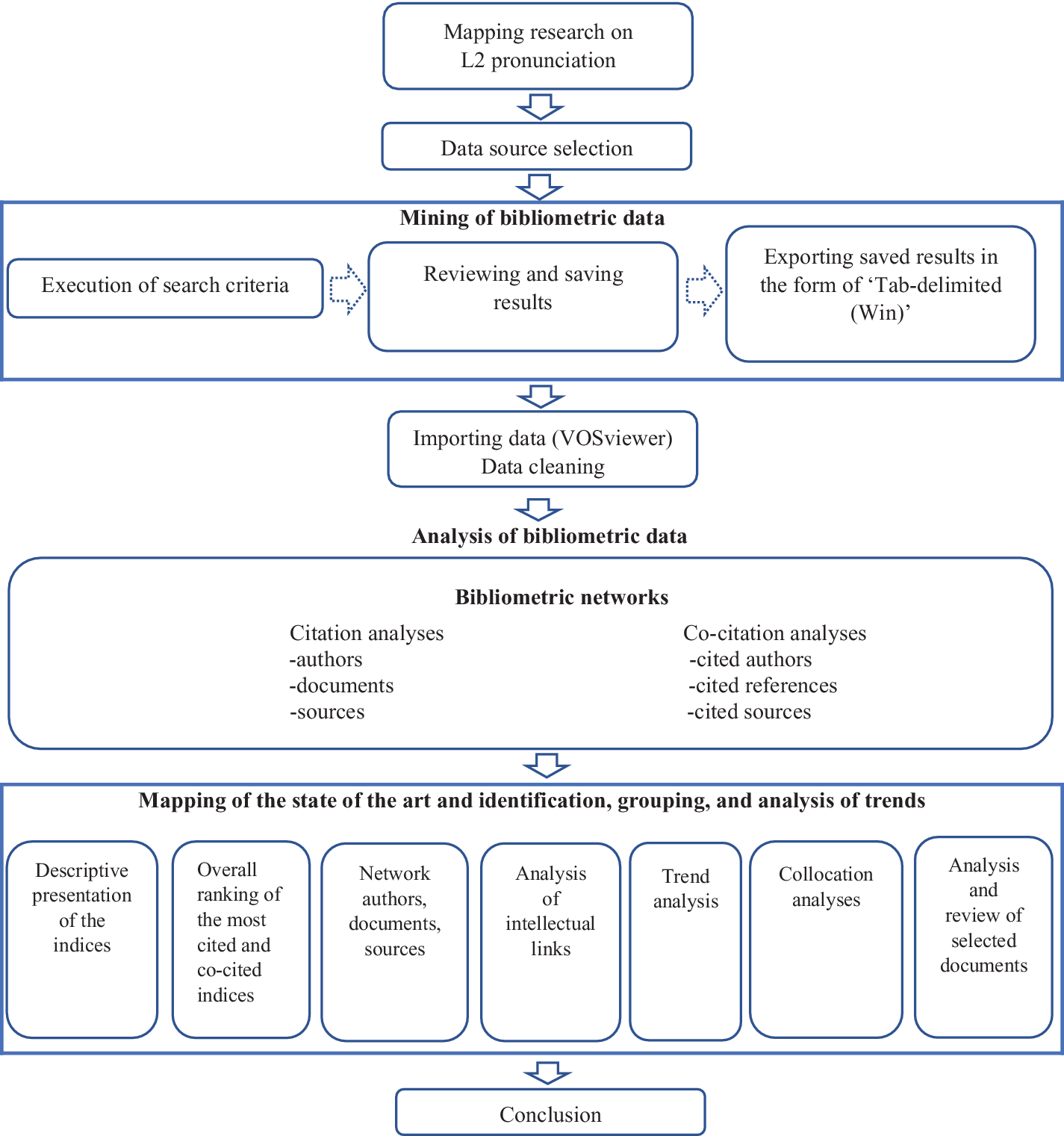
In this article, we provide a general and systematic overview of research on L2 pronunciation extending upward of four decades using bibliometric methods. To this end, we grounded our study on two main functions of bibliometric research, that is, performance assessment and science mapping (Van Raan, Reference Van Raan2014). The former encapsulates, for example, citation analysis of impact on journals, authors, and countries, whereas the latter involves creating network maps to illuminate conceptual, intellectual, social, historical, and relational features of a knowledge base (Cobo et al., Reference Cobo, López-Herrera, Herrera-Viedma and Herrera2011; Small, Reference Small1999). In the present study, with a view to identifying the research themes, trends as well as the influential authors, documents, and publication venues that altogether form the schools of thought in L2 pronunciation research, two types of bibliometric analysis were performed: citation analysis of impact and cocitation analysis. Moreover, we visualized the scientific networks to clarify the links between the bibliometric indices, and to depict the evolution and intellectual structure of the field of L2 pronunciation. We also employed the Mann–Kendall trend test, a tool that analyzes time-series data for a monotonic upward or downward trend, to find the potential trends of the key terms in the paper titles, alongside collocation analyses on the paper abstracts to reveal the common cooccurrences of the terms in the paper titles. Adapted from de Oliveira et al.’s (Reference de Oliveira, da Silva, Juliani, Barbosa and Nunhes2019) model, the workflow diagram in Figure 1 presents the research macro-steps for mapping the state of the art in L2 pronunciation research explained in the following sections.
Workflow diagram.

Journal Selection
The dataset for the study was comprised of L2 pronunciation-oriented articles published in 15 featured SSCI-indexed SLA journals. We resorted to journals as sources of publication on the grounds that they are the primary means of L2 research dissemination as opposed to books or other forms of publication (Plonsky & Derrick, Reference Plonsky and Derrick2016). We predicated our journal selection policy on several motives to compose a representative sample of L2 pronunciation research as a measure of validity (Granda-Orive et al., Reference Granda-Orive, Alonso-Arroyo, García-Río, Solano-Reina, Jiménez-Ruiz and Aleixandre-Benavent2013). The journals in our research focus have come of age over several decades through their statistical rigor and perceived quality. WoS Journal Citation Reports (2019), for example, showed that 12 out of the 15 journals were ranked in the Q1 quartile in the subject area of linguistics, and three in the Q2 quartile. All the 15 journals had a 5-year impact factor (IF) above 1.5, while 13 journals had an IF of more than 1.5 for the 2019 evaluation year (see Table A1 in the Appendix for the journals’ IF and 5-year IF scores in the past 5 years).
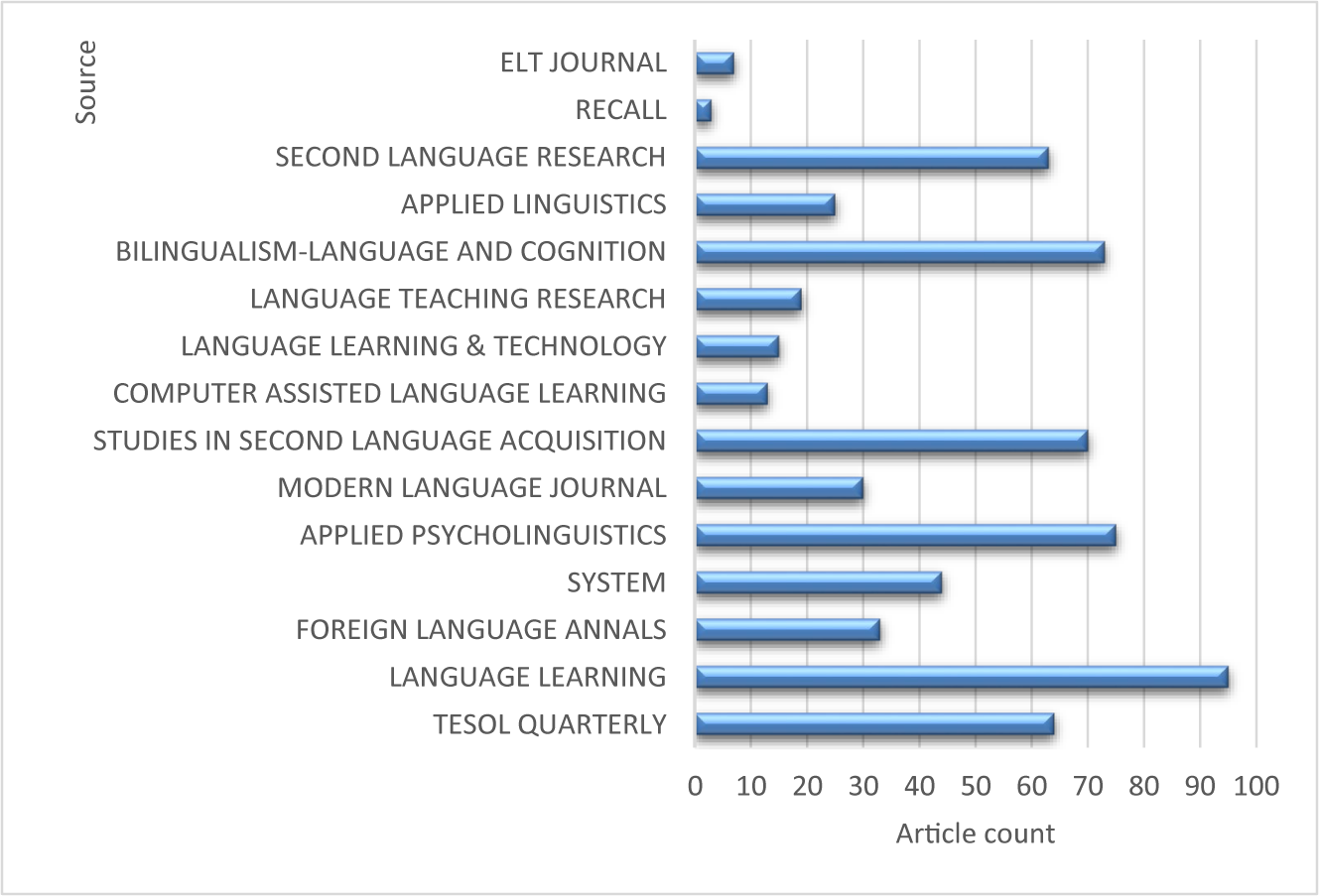
Eleven of the journals that formed our dataset were among those that were classified as top-tier through SLA professionals’ opinions, as reported by VanPatten and Williams (Reference VanPatten and Williams2002). Their list of top 15 journals was also embraced by a number of researchers to reveal different SLA research dimensions (e.g., Gass et al., Reference Gass, Lee and Roots2007; Plonsky & Ghanbar, Reference Plonsky and Ghanbar2018; Zhang, Reference Zhang2020). The journals surveyed in the present study also cover the top seven L2 journals (with the exception of Journal of Second Language Writing for topical irrelevance) specified by Egbert (Reference Egbert2007) according to quality indicators such as selectivity, mentions, and citation counts. Thirteen out of the 15 journals in our list were also included in both Al-Hoorie and Vitta’s (Reference Al-Hoorie and Vitta2019) list of 30 representative SLA journals assessed for statistical quality, and the white paper by the University of California Consortium for Language Learning & Teaching (UCCLLT, 2009) published for the departments seeking guidance in the field of applied linguistics, including top journals. Moreover, all the 15 journals were included in Levis and Sonsaat’s (Reference Levis and Sonsaat2020) list of 27 general SLA journals that regularly publish L2 pronunciation research, in their editorial Publication Venues for L2 Pronunciation Research. Accordingly, our major consideration in journal selection was oriented to investigating L2 pronunciation research from the perspectives of mainstream SLA journals. This led us to leave out some specialist journals such as the Journal of the Acoustical Society of America, Journal of Phonetics, and Language and Speech because of their lack of typical focus on second language acquisition, learning, and teaching (ibid.) while also acknowledging their recognized significance in the field. We need to digress here into the Journal of Second Language Pronunciation (JSLP), a burgeoning prestigious journal (founded in 2015) that is steered toward understanding L2 phonological learning and building links between L2 pronunciation and other areas of applied linguistics but failed to enter our dataset because of its content not being available in the WoS database. As a result, the insights we derived from (a) the journals’ statistical positioning, (b) the publications that discussed and listed influential journals representative of SLA, and (c) the papers that made use of those listed journals to investigate several SLA issues led us to draw from the 15 journals (Figure 2) to obtain the bibliometric data of the field of L2 pronunciation.
Distribution of the L2 pronunciation articles across the journals in the dataset.
Note: Although SSCI started journal indexing as of 1980, there is one article in our dataset covered by SSCI earlier (Parish, C. [Reference Parish1977]. A practical philosophy of pronunciation. TESOL Quarterly, 11, 311–317).

Data Retrieval
The bibliometric data for this study were retrieved from WoS, one of the most widely used library resources (Roemer & Borchardt, Reference Roemer and Borchardt2015). We adopted a top-down approach to data retrieval. In the first place, we searched the publications regarding L2 pronunciation from the WoS Core Collection on the SSCI database by using the following search terms: "pronunciation" OR "comprehensib*" OR "segmental" OR "fluency" OR "accent*" OR "intelligib*" OR "vowel" OR "speech recognition" OR "dialect" OR "speech rate" OR "phonetic*" OR "phonolog*" OR "acoustic" OR "speech production" OR "consonant" OR "voiced" OR "voiceless" OR "auditory" OR "voicing" OR "stress" OR "intonation" OR "suprasegmental" OR "prosod*" OR "rhythm*" OR "articulat*" OR "speech sound" OR "phoneme.” The search was conducted on the “Topic” section, which searches title, abstract, author keywords, and Keywords Plus. The search was filtered through the document type of “articles” written in the English language only, for all years, yielding 308,645 papers. Next, we excluded the 1,065 papers published in 2021, resulting in 307,580. In what follows, we chose the related WoS categories: Education Educational Research, Education Scientific Disciplines, Education Special, Language Linguistics, Linguistics, and Psychology Educational, which elicited 40,973 articles. Then, from the “Source Titles” menu, we selected the 15 listed journals that left us with 2,095 articles published from 1977 through 2020.
To test the validity of the search strategy, we collaboratively reviewed these articles through a one-by-one manual sifting process (Hernández-Vásquez & Rosselli, Reference Hernández-Vásquez and Rosselli2017). While doing so, we initially reviewed the articles’ titles, then their abstracts and research questions/hypotheses in terms of topical appropriateness for the study. The following questions guided us through the process: Do the articles have an initial focus on L2 pronunciation and its related concepts provided in the previously mentioned search terms? Are these concepts essentially covered in the articles? Do any of the research questions of the articles address these concepts, and were therefore analyzed somehow? Do the articles have an L2 focus rather than L1? If we still had some concerns and hesitations in terms of the relevance of an article, we cyclically read the whole text. There were eight papers that posed a dilemma for us. For these papers, we informed an SLA researcher-colleague on the purposes and methodology of our study, and asked her for a third opinion. She also reviewed a random 10% of the articles (N = 63) in terms of topical relevance. As a result of the sifting process, we finally came up with a list of 629 articles (Table A2 in the Appendix) within the body of the 15 journals and gathered the following types of information to conduct bibliometric analyses: paper titles, authors, abstracts, sources, and references. Figure 2 shows the distribution of the 629 L2 pronunciation articles across the journals.
Data Analysis
Bibliometric analysis in this study incorporated quantification and knowledge mapping technology. Following data retrieval from the WoS database, we performed network analysis for knowledge mapping through VOSviewer software (Van Eck & Waltman, Reference Van Eck and Waltman2009). Network analysis constructs bibliometric networks and visualizations to reveal the scope and structure of the field in addition to key research clusters (Fahimnia et al., Reference Fahimnia, Sarkis and Davarzani2015). VOSviewer also serves to identify the link strengths and relationships between authors, documents, and sources (Van Eck et al., Reference Van Eck, Waltman, Dekker and den Berg2010). In this study, the network analyses through VOSviewer generated cocitation maps of the references, authors, and sources. Before performing all the analyses, we conducted data cleaning by creating thesaurus files and then embedding them into the VOSviewer interface. By doing so, we were able to avoid coding errors and merge variants of an author name, a source title, or a reference with different spellings into a single unit. To exemplify, we merged “thomson, rı” and “thomson, ron, I” into “thomson, ron” in the VOSviewer output to refer to the same author. Likewise, “stud second lang acq” and “studıes 2 language a” were recoded into “ssla” to represent the same journal.
Citation analysis of impact draws on citation counts to determine the impact of authors, documents, and journals on a given field. Cocitation analysis, a more insightful method for being not restricted to documents residing in a particular dataset (Hallinger & Kovačević, Reference Hallinger and Kovačević2019), was also performed in this study to create bibliometric maps of key cited references, authors, and sources. Two items are considered to have a cocitation relationship when they are cited together in a citing item’s reference list (Osareh, Reference Osareh1996). Cocitation analysis of cited references identifies the most influential publications in a given research field, the core literature and their links to other documents (Dong & Chen, Reference Dong and Chen2015), and the domain’s evolutionary path (Liao et al., Reference Liao, Tang, Luo, Li, Chiclana and Zeng2018), while also serving as a measure of the similarity of these two documents’ research or theoretical perspectives (Özçınar, Reference Özçınar2015). Author cocitation analysis labels pivotal authors in the field and indicates an intellectual affinity between two authors when they are often cited together in other documents (Small, Reference Small1999). This also applies to cocited sources. Source cocitation analysis distinguishes the most important publication sources and ascertains their interconnectedness. Using cocitation analysis information, sources, authors, or documents that are frequently cited together can be grouped in clusters to reveal the intellectual structure of a particular field (Small, Reference Small1973). In this study, we opted for cocitation analysis over its alternative bibliographic coupling. This practice has been found in many other bibliometric studies (e.g., Andrews, Reference Andrews2003; Chen, Reference Chen2018; Shiau et al., Reference Shiau, Chen and Tsai2015). Bibliographic coupling creates maps on the basis of publications in their citing modality and cocitation analysis cited modality, which makes the former static and the latter a dynamic one (Van Raan, Reference Van Raan2014). More specifically, two papers are bibliographically coupled if they have shared references whereas a cocitation link is created between two publications when they are jointly cited by other papers. We did not perform keyword cooccurrence analysis either, as the articles published in the early periods did not include keywords (author keywords started to be included in the WoS database from 1991). Interpretation of VOSviewer outputs, that is, network visualizations in which each source, author, document, or a term is represented by a node, rests on the following parameters: The stronger the link between two nodes, the thicker the line that displays the link in the visualization of the map (Van Eck & Waltman, Reference Van Eck and Waltman2020). In addition, the size of a node represents its weight. The larger a node is, the higher its weight is. Finally, the nodes with the same color belong to the same cluster.
Results and Discussion
We organized this section around findings with regard to the research questions: (a) featured themes, trends, and documents, and (b) the most influential authors and sources.
Featured Themes, Trends, and Documents
Citation Analysis of Impact: Most Cited Articles
Table A3 in the Appendix provides the citation information of the top 20 most-cited L2 pronunciation articles in the 15 journals across the three periods (1977–1991, 1992–2006, 2007–2020; with 58, 106, and 465 articles, respectively). These articles were adjusted for the time effect and ranked by their normalized citations for the analysis (see also Table A4 in the Appendix for the top 20 most-cited lists ranked by the raw citations received by the articles). A number of most-cited articles in the first period underlay the introduction of some key concepts such as accentedness (e.g., Anderson-Hsieh & Koehler, Reference Anderson‐Hsieh and Koehler1988; Flege, Reference Flege1981; Patkowski, Reference Patkowski1990; Thompson, Reference Thompson1991; Van Els & De Bot, Reference Van Els and De Bot1987), comprehensibility (e.g., Gass & Varonis, Reference Gass and Varonis1984; Smith & Bisazza, Reference Smith and Bisazza1982), intelligibility (e.g., Eisenstein & Verdi, Reference Eisenstein and Verdi1985; Fayer & Krasinski, Reference Fayer and Krasinski1987), and the perception and production of some L2 sounds (e.g., Bohn & Flege, Reference Bohn and Flege1990; Borden et al., Reference Borden, Gerber and Milsark1983; Werker, Reference Werker1986). Naturally, some of these highly cited articles paved the way for the foundation of some related concepts of L2 pronunciation. For instance, intelligibility was conceptualized afterward by Munro and Derwing (Reference Munro and Derwing1995a), at the same time delineating comprehensibility and accentedness. Later on, intelligibility was introduced as a principle in its own right by Levis (Reference Levis2005) that has since then significantly guided L2 pronunciation teaching and research. Some of the most-cited studies in this period also made significant contributions to the field of L2 pronunciation by presenting alternative hypotheses or building on former theoretical arguments to shed light on, for example, interlanguage phonology (e.g., Eckman, Reference Eckman1981; Hodne, Reference Hodne1985), interlanguage phonetics (Flege, Reference Flege1980), and the critical period hypothesis (e.g., Flege’s Phonological Translation Hypothesis, Reference Flege1981). The high citation numbers of these theory-oriented studies imply that the first period served as a rotator to adapt some general SLA theories to phonetics and phonology.
In the second period, the focus on foreign accents and intelligibility became more transparent (e.g., Derwing & Munro, Reference Derwing and Munro2001; Field, Reference Field2005; Hahn, Reference Hahn2004; Koster & Koet, Reference Koster and Koet1993; Munro et al., Reference Munro, Derwing and Morton2006). Especially Munro and Derwing’s (Reference Munro and Derwing1995a) highly influential paper, with the most citations, alongside its reprint (Munro & Derwing, Reference Munro and Derwing1999), guided future studies with these foci. This makes sense as their seminal work led to a movement toward a standard terminology. As Munro and Derwing (Reference Munro and Derwing2020) has recently noted, the field of L2 pronunciation had witnessed inconsistencies among the concepts of accentedness, intelligibility, and comprehensibility before their 1995 study that showed these constructs to be related but partially independent. The following research on L2 pronunciation has consistently considered their work. A special issue of JSLP in 2020, “25 years of Intelligibility, Comprehensibility and Accentedness,” also refocused on its essential role in L2 pronunciation research. The second period was also the period when there was an increasing interest in the pedagogy of L2 pronunciation led by a number of most-cited articles (e.g., Derwing & Munro, Reference Derwing and Munro2005; Jenkins, Reference Jenkins2002; Levis, Reference Levis2005). These articles suggested informed insights and methodologies for L2 pronunciation instruction in consideration of the intelligibility principle, accentedness, and the concept of English as an International Language (EIL). This period also covered the most-cited studies in the nexus of L2 speech perception and production. These included vowel perception (Flege & MacKay, Reference Flege and MacKay2004) and production (Munro et al., Reference Munro, Flege and MacKay1996), the perception and acquisition of contrasting segments (Escudero & Boersma, Reference Escudero and Boersma2004), and some speech sounds (Hardison, Reference Hardison2003). The eminence of perception and production seems to have contributed a theoretical viewpoint to L2 pronunciation instruction, categorized as either being perception- or production-based (Lee et al., Reference Lee, Plonsky and Saito2020).
In the third period, the study of the effectiveness of instruction in L2 pronunciation development served as the main concern of several most-cited articles with the tools of form-focused instruction and corrective feedback (Saito & Lyster, Reference Saito and Lyster2012), ad hoc training (Wong & Perrachione, Reference Wong and Perrachione2007), podcasting (Ducate & Lomicka, Reference Ducate and Lomicka2009), and gestures (Smotrova, Reference Smotrova2017). A highly cited meta-analysis (Lee et al., Reference Lee, Jang and Plonsky2015) and a narrative review (Thomson & Derwing, Reference Thomson and Derwing2015) were also conducted to investigate the effectiveness of L2 pronunciation instruction. The eminence of these studies in this period is not surprising. With the start year of the third period being 2007, we concur with several authors in coming up with a date close to 2005 as a milestone when L2 pronunciation instruction began to generate more research as an important area of investigation (Isaacs, Reference Isaacs2018; Isaacs & Trofimovich, Reference Isaacs, Trofimovich, Isaacs and Trofimovich2016; Munro & Derwing, Reference Munro and Derwing2015; Thomson & Derwing, Reference Thomson and Derwing2015). Besides, accentedness and comprehensibility received wide attention among the highly cited articles in this period. The linguistic (e.g., Isaacs & Trofimovich, Reference Isaacs and Trofimovich2012; Saito et al., Reference Saito, Trofimovich and Isaacs2017) and nonlinguistic (Saito et al., Reference Saito, Dewaele, Abe and In’nami2018) influences on these concepts, their development (e.g., Derwing et al., Reference Derwing, Munro and Thomson2008; Derwing & Munro, Reference Derwing and Munro2013), and the judgments of them (e.g., Kang, Reference Kang2010; Kang et al., Reference Kang, Rubin and Pickering2010) were addressed in these papers. Finally, several highly cited articles with a focus on L2 speech perception and production also appeared in this period (e.g., Carlson et al., Reference Carlson, Goldrick, Blasingame and Fink2016; Pelzl et al., Reference Pelzl, Lau, Guo and DeKeyser2019; Saito et al., Reference Saito, Trofimovich and Isaacs2016; Shen & Froud, Reference Shen and Froud2019).
Cocitation Analysis: The Highly Influential References
Different from the citation analysis of impact that evaluated the effectiveness of the articles limited to the bibliometric dataset (i.e., the 629 articles) by the number of citations, cocitation analysis is based on the documents cited in the reference lists of the 629 articles. Therefore, cocitation analysis covers cocited documents located outside the available dataset and captures a much broader literature (Hallinger & Kovačević, Reference Hallinger and Kovačević2019). When put together, an amalgamation of these emic and etic perspectives to bibliometric analysis led us to more effectively reveal the intellectual structure and evolution path of the field of L2 pronunciation.
In the cocitation analysis, of the 1,327 unique references cited by the articles published between 1977 and 1991, the top 42 most-cited references (Table A5 in the Appendix) had citation counts of a minimum of three. The network map created by the VOSviewer produced six clusters (Figure 3). With regard to the second period (1992–2006), when the minimum number of citations of a cited reference was set to seven, of the 3,284 references, the top 55 most-cited references (Table A6 in the Appendix) created three clusters as shown in Figure 4. Among the 14,738 references in the 2007–2020 period, the top 50 most-cited references (Table A7 in the Appendix) had at least 25 citations and produced three clusters (Figure 5).
The network map of the most-cited references (1977–1991).

The network map of the most-cited references (1992–2006).

The network map of the most-cited references (2007–2020).

Despite being quite an infertile period in terms of the number of cocitations, the first period provides some useful insights to shed light on the infancy of L2 pronunciation research. Some of the influential documents and clusters that emerged in the cocitation network map of this period set the scene and charted out directions for future L2 pronunciation research. This was the natural corollary of the emergence of a number of foundational theories and hypotheses. As a case in point, the cluster which we termed “interlanguage/interphonology” (Cluster 2 in green), highlighted as one of the biggest clusters with nine references, a total of 46 cocitations and total link strength (TLS), an attribute that indicates the total strength of the cocitation links. The top four most-cited references in this period were also in this cluster. This cluster was mainly represented by Selinker’s (Reference Selinker1972) highly influential paper Interlanguage, and the concomitant work on interlanguage phonology. Tarone (Reference Tarone and Richards1978) in this cluster, for example, the most-cited document in this period, elaborated on the phonology of interlanguage by making a case for L2 pronunciation errors, stating that variable rules of the interlanguage are among the possible causes of such errors. A relevant effort was also made by the two highly cited papers in the same cluster (Eckman, Reference Eckman1977, Reference Eckman1981). While in the former he considered applying the Contrastive Analysis Hypothesis (CAH) to English and German phonologies and proposed typological markedness as the alternative to CAH to explain the relative degree of difficulty, in the latter he provided data for the postulation of interlanguage phonological rules. The other documents in the interlanguage/interphonology cluster dealt with considerations along similar lines such as syllable structure of interlanguage phonology (e.g., Sato, Reference Sato1984; Tarone, Reference Tarone1980), built-in syllabus (e.g., Corder, Reference Corder1967), CAH (Lado, Reference Lado1957), language transfer and language universals (e.g., Gass, Reference Gass1979). Alongside these central theoretical concerns, the first period also established key research themes in the field of L2 pronunciation. These themes gained ground in several documents, such as age factors, the critical and sensitive periods for the acquisition of phonological systems (e.g., Flege, Reference Flege1987a; Krashen, Reference Krashen1973; Neufeld, Reference Neufeld1978, Reference Neufeld1980; Olson & Samuels, Reference Olson and Jay Samuels1973; Oyama, Reference Oyama1976; Snow & Hoefnagel-Höhle, Reference Snow and Hoefnagel-Höhle1977), foreign accents (e.g., Elsendoorn, Reference Elsendoorn1980; Flege, Reference Flege1981, Reference Flege1984; Hill, Reference Hill1970; Scovel, Reference Scovel1969), speech perception and production (e.g., Flege, Reference Flege1987b; Flege & Eefting, Reference Flege and Eefting1987; Flege & Hillenbrand, Reference Flege and Hillenbrand1984; MacKain et al., Reference MacKain, Best and Strange1981), and comprehensibility (e.g., Gass & Varonis, Reference Gass and Varonis1984; Varonis & Gass, Reference Varonis and Gass1982).
In the second period, the interlanguage/interphonology cluster grew bigger (Cluster 1 in red), and created the biggest cluster of this period with 22 documents and 188 cocitations to these documents that formed a TLS of 185. In addition to the theoretical insights presented in the first period’s interlanguage/interphonology cluster, the new members of this cluster in the second period proposed, or built on, a number of hypotheses. These include Eckman’s (Reference Eckman1991) Interlanguage Structural Conformity Hypothesis (which assumes that implicational universals operate in the structuring of interlanguage phonology), Major’s (Reference Major, Loup and Weinberger1987) Ontogeny Model (which claims that interference decreases over time whereas developmental processes increase, and then decrease), parameter setting in L2 phonology (Broselow & Finer, Reference Broselow and Finer1991), and autosegmental and metrical phonology (Goldsmith, Reference Goldsmith1990). Apart from this cluster, this period also generated two more meaningful clusters. The one that we called the “age/accent/speech perception-production” cluster (Cluster 2 in green) was a systematic coming together of these constructs as opposed to their positioning in the first period, and took the form of a cluster in real terms, with 21 documents, 178 citations, and a total of 175 TLS. The other meaningful cluster in the second period witnessed the debut of a new concept, that is, L2 pronunciation teaching. It emerged for the first time to form a cluster in company with comprehensibility and intelligibility. Therefore, we termed this cluster (Cluster 3 in blue) “pronunciation teaching/comprehensibility-intelligibility.” In terms of L2 pronunciation teaching, through a number of highly cited documents, this cluster suggested reference guides (Celce-Murcia et al., Reference Celce-Murcia, Brinton and Goodwin1996; Morley, Reference Morley1991; Pennington & Richards, Reference Pennington and Richards1986), the lingua franca core (LFC) for intelligibility-based pronunciation teaching (Jenkins, Reference Jenkins2000), as well as the results of comparative modes of L2 pronunciation instruction (Derwing et al., Reference Derwing, Munro and Wiebe1998). With respect to comprehensibility and intelligibility, the documents in this cluster established strong connections with accentedness (e.g., Derwing & Munro, Reference Derwing and Munro1997; Munro & Derwing, Reference Munro and Derwing1995a, Reference Munro and Derwing1995b, Reference Munro and Derwing2001). The reason for these terms to be salient together might be that speakers who are perceived as accented can also be highly intelligible (Derwing & Munro, Reference Derwing and Munro2015; Munro & Derwing, Reference Munro and Derwing1995a). That is to say, this cluster situated research on the concept of accentedness in the context of comprehensibility, intelligibility, and speaking rate whereas its word stem accent was mainly approached in terms of the perceived degree and strength in the related documents in Cluster 2 (e.g., Flege, Reference Flege1988; Flege & Fletcher, Reference Flege and Fletcher1992; Flege et al., Reference Flege, Munro and MacKay1995; Piske et al., Reference Piske, MacKay and Flege2001).
The third period was an established period with considerably higher numbers of cocitations to the references in comparison to the earlier periods. The interlanguage/interphonology cluster that swelled in the second period disappeared in this period. However, the pronunciation teaching/comprehensibility-intelligibility cluster expanded into the biggest cluster in this period (Cluster 1 in red), with 27 documents, 943 cocitations, and a TLS of 928. While two of the pedagogy-oriented documents in this cluster also existed in the related cluster of the second period (Derwing et al., Reference Derwing, Munro and Wiebe1998; Jenkins, Reference Jenkins2000), its expansion in the third period, no doubt, led to the inclusion of a great deal of new works. Levis (Reference Levis2005) for example, the most-cited document of this cluster with regard to the pedagogy of L2 pronunciation, shed light on the influences of competing ideologies (teasing apart the nativeness and intelligibility principles), identities, and contextual dynamics. Levis questioned the supremacy of native speaker models, challenging the earlier nativist paradigm that viewed nativelike L2 pronunciation to be possible and desirable to achieve, and instead placing the emphasis on helping learners become simply intelligible. Levis (Reference Levis2005) was followed by Derwing and Munro’s article (2005) that proposed a research-based approach to the teaching of L2 pronunciation. There were also two comprehensive reference books in this respect: Teaching Pronunciation (Celce-Murcia et al., Reference Celce-Murcia, Brinton and Goodwin2010) and Pronunciation Fundamentals (Derwing & Munro, Reference Derwing and Munro2015). The intellectual focus of the pronunciation teaching component of this cluster was furthered by the research syntheses on the effectiveness of L2 pronunciation instruction (e.g., Lee et al., Reference Lee, Jang and Plonsky2015; Saito, Reference Saito2012; Thomson & Derwing, Reference Thomson and Derwing2015). The expansion of the pronunciation teaching/comprehensibility-intelligibility cluster in the third period also extended to the work on the concepts of comprehensibility and intelligibility through newly added documents (e.g., Derwing et al., Reference Derwing, Munro and Thomson2008; Derwing & Munro, Reference Derwing and Munro2009; Field, Reference Field2005; Hahn, Reference Hahn2004; Isaacs & Trofimovich, Reference Isaacs and Trofimovich2012; Munro et al., Reference Munro, Derwing and Morton2006; Trofimovich & Isaacs, Reference Trofimovich and Isaacs2012).
Two other meaningful clusters in the third period were a result of the fission of the age/accent/speech perception-production cluster that emerged in the second period. Accordingly, “speech perception-production” and “age/accent” took the form of two separate clusters. While the age/accent cluster (Cluster 3 in blue) was a small formation devoted to the same concerns as in the second period with five documents, 192 citations, and 183 TLS, the speech perception-production cluster (Cluster 2 in green) was quite extensive, having 18 documents and 736 citations that received a TLS of 699. By far the most-cited document in the speech perception-production cluster was an instrumental book chapter by Flege (Reference Flege and Strange1995). Its guiding role in L2 speech perception-production research seems to result from the content laying out a model of L2 speech learning (SLM), hypotheses regarding the cause of accentedness in L2 speech production, and empirical findings on the perception and production of L2 vowels and consonants. The other highly cited documents in this cluster, among many others, were Best (Reference Best and Strange1995), Best and Tyler (Reference Best, Tyler, Bohn and Munro2007), Bradlow et al. (Reference Bradlow, Pisoni, Akahane-Yamada and Tohkura1997), Flege (Reference Flege1987b), and Flege et al. (Reference Flege, Bohn and Jang1997). In the speech perception-production cluster, we also encountered two seemingly irrelevant documents that found a seat with high citations. The first one was a paper from a scholar in the cognitive SLA family (Schmidt, Reference Schmidt1990). Having theorized the concepts of noticing and consciousness, this paper was cited in L2 pronunciation research when the researchers elaborated on the link between oral input, learners’ noticing, and speech perception (e.g., Trofimovich et al., Reference Trofimovich, Lightbown, Halter and Song2009). This interest in Schmidt echoes in Zhang’s (Reference Zhang2020) bibliometric analysis of the field of SLA between 1997 and 2018, which found his noticing hypothesis continued to influence the field even after three decades. The other one was Bates et al. (Reference Bates, Machler, Bolker and Walker2015) cited by L2 pronunciation researchers when they conducted mixed-effects logistic regression analyses by using the glmer() function in the lme4 package for R (e.g., García-Amaya & Lang, Reference García-Amaya and Lang2020), a package that provides functions to fit and analyze linear, nonlinear, and generalized linear mixed models (Bates et al., Reference Bates, Machler, Bolker and Walker2015).
Trend Analysis
Paper Titles
In another effort to trace the intellectual trajectories of the key terms and themes of L2 pronunciation research in the 629 articles, we first revealed the top ten most frequently occurring terms in the articles’ titles across the three periods in a heuristic manner rather than through a predetermined set of terms or themes. Naturally, a paper title could yield more than one key term with an intellectual magnitude, and this was the case in most of the paper titles in our dataset. For instance, we extracted “perception,” “production,” and “instruction” from the paper titled “The Effects of Perception- vs. Production-Based Pronunciation Instruction,” but disregarded “effects” having no significance for our research concern. Moreover, we left out generic terms such as English, language, pronunciation, phonology, EFL, ESL, and L2 while condensing derivatives into one term (e.g., accent|ed|ness). A cautious approach needs to be followed here while interpreting these results as paper titles may not always effectively cover or reflect research orientations.
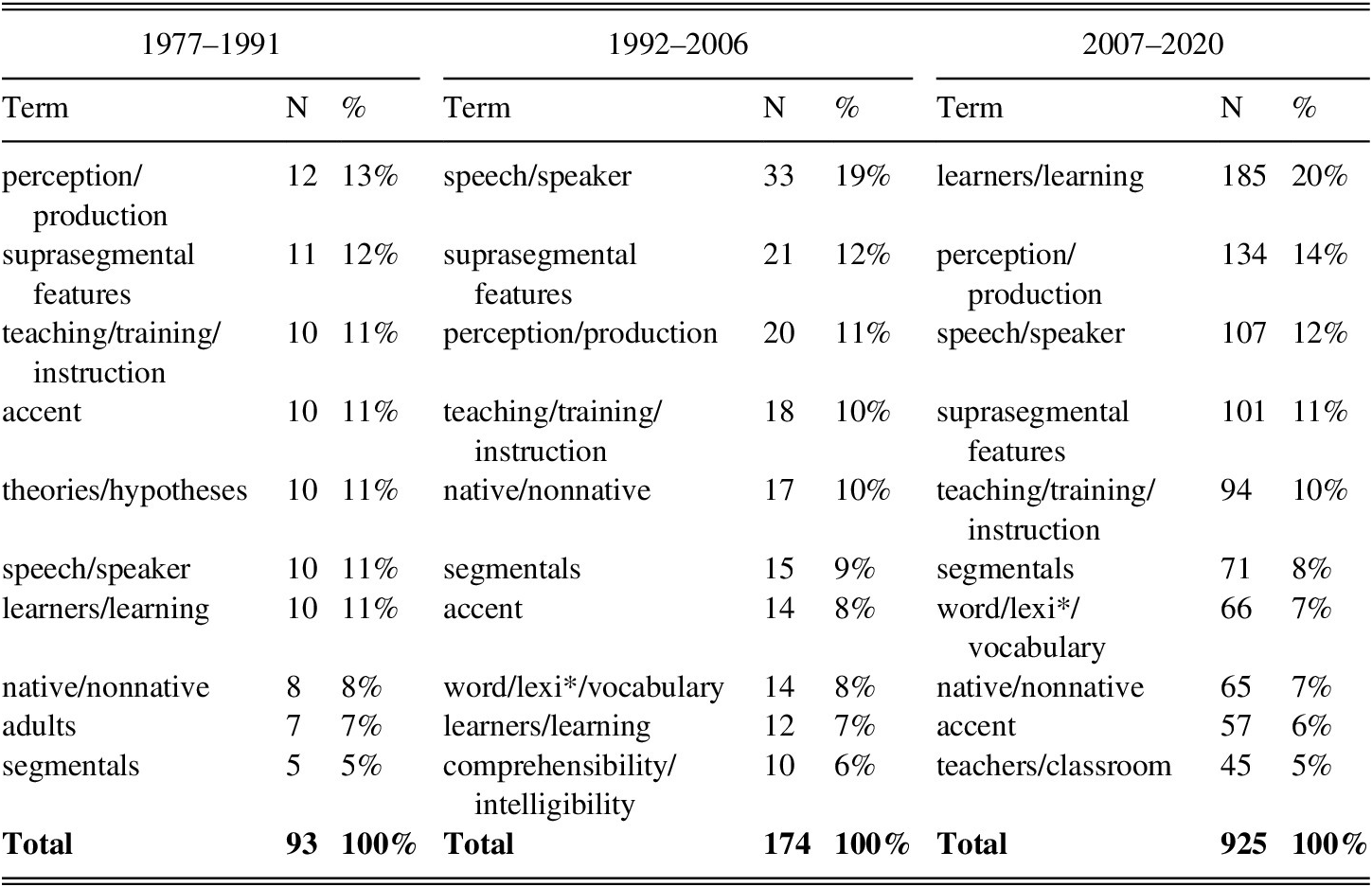
As shown in Table 1, there are a number of evergreen terms and research themes that were principally addressed in all the periods. These include perception/production, segmentals and suprasegmental features, teaching/training/instruction, accent, speech/speaker, native/nonnative, and learners/learning. The terms perception/production, suprasegmental features, teaching/training/instruction, and native/nonnative made up more or less the same proportion of the top frequent terms across the three periods. Native was also the most typical collocate of speaker in all the three periods. Although nativeness is usually unattainable and unnecessary (Levis, Reference Levis2020), a possible reason why the nativeness principle remains alive is that L2 pronunciation has evolved separately from other language skill areas in the CLT era, and therefore it continues to stand as an engaging goal for many practitioners and learners (Levis, Reference Levis2020). Thomson and Derwing’s (Reference Thomson and Derwing2015) narrative review also reported most of the studies under scrutiny to have adopted the nativeness principle (63%), followed by the intelligibility principle (24%), while 13% had elements of both. Raising an objection to favoring the nativeness principle, Levis (Reference Levis2020) offers “to embrace the intelligibility principle and consign the nativeness principle to the past” (p. 323). With regard to segmental and suprasegmental(prosod|y|-ic), there was a diversity in cooccurrences in the third period, represented by their frequent collocates with features, cues, attainment/acquisition, perception/production, training/instruction, information, and accuracy. Collocates of perception/production in the second period were characterized by frequent cooccurrences such as vowel perception/production, accent perception, speech perception/production, speaker(s’) production, and accurate/accuracy of perception/production while in the third period, in addition, learner(s’) perception/production, tone and sound perception/production, perception/production task, perception/production training, production improvement, and segmental and suprasegmental(prosodic) perception/production became highly visible. Naturally, teaching/training/instruction collocated most often with pronunciation in all the periods. The coming together of explicit and instruction was also quite common in the third period. This could be accounted for by the promising findings on the effectiveness of explicit pronunciation instruction (Derwing et al., Reference Derwing, Munro, Foote, Waugh and Fleming2014; Kissling, Reference Kissling2013; Saito, Reference Saito2013) that seem to have contributed to the growth of research with such focus.
Top ten most common terms in the paper titles across the three periods

Note: Percentages were rounded and calculated within the top terms. In this way, each term could be assessed in terms of its specific period, without being affected by the widely differing number of articles in different periods.
While speech/speaker showed an undulating pattern in the paper titles across the periods, the ratio of learners/learning almost doubled and trebled, respectively, from the first and second periods to the third period, making it by far the most common title word in the last period. Cooccurrences such as speech learning and speech sounds were widespread in the third period. Despite its persistent presence in the paper titles, accent was proportionally in a constant state of decrease, and collocated most often with foreign in all the periods. Teachers/classroom appeared in the top ten list for the first time in the third period. Its emergence in the last period may provide evidence for the migration of L2 pronunciation research, more specifically, pronunciation instruction research, from laboratory settings to classrooms, which is also echoed by Lee et al. (Reference Lee, Jang and Plonsky2015). The collocates of teachers/classroom were not rich in diversity in the first two periods. In the third period, alongside teacher training/education, psychological constructs such as teacher cognition/beliefs/knowledge/identity exhibited eminence. This finding shows parallelism with the growing body of research on the learning of pronunciation pedagogy (Kochem, Reference Kochem2021) and the influence of psychological and social factors (Pennington & Rogerson-Revell, Reference Pennington and Rogerson-Revell2019a), which is also evident in general applied linguistics research (Lei & Liu, Reference Lei and Liu2019).
In this period, moreover, the typical collocates of classroom were L2, observations, learning, setting/environment, and instruction/training. When coupled with the notable increase in the ratio of learners/learning in the last period, this tends to indicate that the field of L2 pronunciation seems to evolve into a more learner- and learning-centered and instructional dimension. This trend may be due in part to the effects of student-centered learning in education and calls from influential scholars such as Oxford (Reference Oxford1996) to put the learners in the center of instruction. Previous research also acknowledged this change (Derwing & Munro, Reference Derwing and Munro2015; Murphy & Baker, Reference Murphy, Baker, Reed and Levis2015). Taken together, the collocates, along with the results of the citation, cocitation, title word, and Mann–Kendall analyses, tend to show that the field is now somehow structured by the research on L2 pronunciation instruction.
Comprehensibility/intelligibility became visible in the top ten list in the second period whereas it failed to show up in the third period despite its high frequency (n = 42). The other highly frequent key terms in the paper titles of the third period were the technologies (CAPT, ASR, computer, web, podcast, video, Twitter, distance, mobile, apps, mp3, video; n = 44), bilinguals/bilingualism (n = 36), listeners/listening (n = 32), experience (n = 23), and orthography (n = 21). One reason for the recently emergent technologies in the paper titles might be that technology seems to be a relatively recent tool of inquiry gaining rapid ground in L2 pronunciation research. Also, there is little reason to deny the role of the concomitant effects of using technological affordances in applied linguistics research, and by extension, in L2 pronunciation research. This technological uptrend in L2 pronunciation research also seems to be facilitated by the rise of several technology-oriented SLA journals such as CALL, ReCALL, and Language Learning & Technology. The years that CALL and ReCALL started to be included in the SSCI database are 2010 and 2011, respectively. The coverage of these two journals also plays a role in increasing the number of technology-oriented L2 pronunciation articles.
Mann–Kendall Trend Test
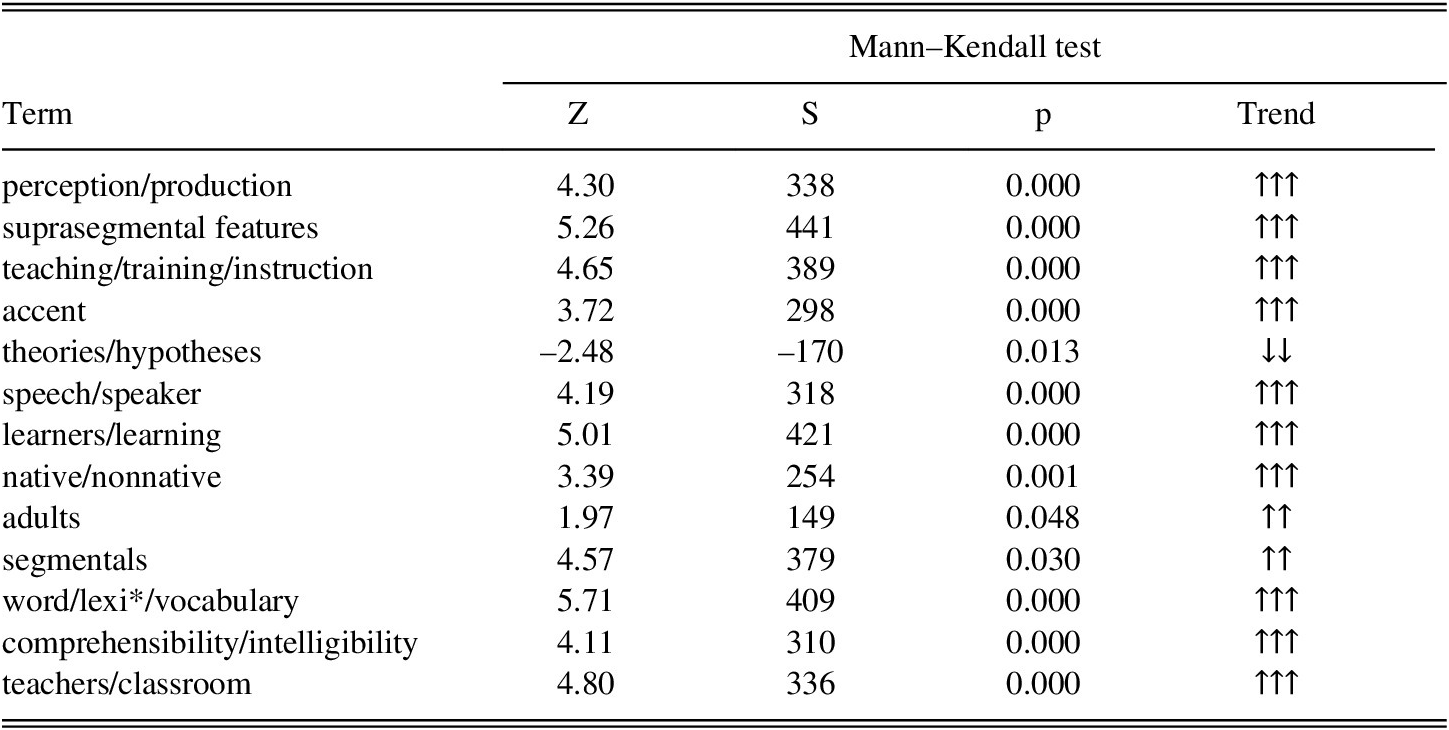
We also conducted a nonparametric Mann–Kendall test (Mann, Reference Mann1945) to find out whether the top ten key terms that occurred in the paper titles of the three periods, totaling 13 different terms, revealed significant trends in the historical framework. More specifically, on a yearly basis, this analysis included the time slot starting from the first year of appearance (1980–1983, for all the top terms) through 2020. By doing so, this time, we adopted a temporally holistic approach to the trend analysis of the top key terms as opposed to the period-based frequency analyses reported earlier. The trend analysis is illustrated in Table 2, showing the top key terms, levels of significance, and trend directions. The Mann–Kendall test results indicated significant trends for all the top key terms. There was a considerably increasing resort in the paper titles to most of the top terms at p < 0.01 level (i.e., perception/production, suprasegmental features, teaching/training/instruction, accent, speech/speaker, learners/learning, native/nonnative, word/lexi*/vocabulary, comprehensibility/intelligibility, teachers/classroom), and to some of them at p < 0.05 level (i.e., segmentals, adults).
Trend analysis of the top key terms in the paper titles

*↑ ↑, ↑ ↑ ↑; significantly increasing trends with p < 0.05, p < 0.01 respectively. ↓ ↓; significantly decreasing trend with p < 0.05.
Starting from Flege’s SLM (Reference Flege, Munro and MacKay1995), the terms perception and production are evergreen because production-based instruction methodologies go as far back as the ALM, which remains in practice today (Heinz, Reference Heinz2013). Despite its proportional decrease in the face of the other key terms in the paper titles in their specific periods, the term accent is also in a general increasing trend.
Influential Authors and Sources
Citation Analysis of Impact and Cocitation Analysis: Influential Authors
A total of 908 unique authors contributed to the articles published in the 15 journals in the dataset. K. Saito contributed 39 articles. He is followed by P. Trofimovich, having 28 articles. T. M. Derwing, M. J. Munro, J. E. Flege, and T. Isaacs are among the top six, with the article counts of 14, 14, 13, and 12, respectively. R. I. Thomson (n = 8), J. M. Levis (n = 8), O. Kang (n = 7), D. M. Hardison (n = 7), I. R. A. Mackay (n = 5), R. C. Major (n = 5), E. Gatbonton (n = 5), C. T. Best (n = 5), and M. Wang (n = 5) also highlighted with document counts ≥ 5. When interpreting the productivity, it must be kept in mind that the authors’ article counts were only generated from the 629 articles in the dataset. Otherwise, they are no doubt in a more productive position. With respect to the authors’ citation performance revealed in citation analysis of impact, Table A10 in the Appendix displays the top 20 most-cited authors in L2 pronunciation research for the whole period in ranked order of normalized citations adjusted for the time effect and raw citations. The dominance of a number of authors (K. Saito, T. M. Derwing, P. Trofimovich, M. J. Munro) stands out in terms of the normalized citations they received. The other authors that make up the top ten are T. Isaacs, R. I. Thomson, O. Kang, J. E. Flege, R. Lyster, and C. T. Best. Although citation analysis led us to identify the prominent authors, this information needs to be approached with caution because citation analysis, as mentioned before, is limited to the documents in our dataset. Therefore, it is apt to resort to cocitation analysis that is based on authors cited in the reference lists of the reviewed documents, thereby covering a much broader literature. In this way, we can obtain a wider perspective on scholarly impact than basic citation analysis (White & McCain, Reference White and McCain1998).
Alongside citation analysis which portrayed the 44-year period holistically, we also conducted cocitation analysis with a view to identifying the influential authors in the field of L2 pronunciation across the three periods, and the potential intellectual affinities between the authors. In the author cocitation analysis, of the 898 unique authors cited between 1977 and 1991, the top 32 most-cited authors had citation counts of a minimum of six. The network map created by the VOSviewer produced four clusters (Figure 6a). Regarding the second period (1992–2006), the minimum number of citations of a cited author was set to 14, creating three clusters for the top 32 most-cited authors out of 2,042 (Figure 6b). Among the 8,011 cited authors in the 2007–2020 period, the top 33 most-cited authors had at least 60 citations and produced three clusters (Figure 6c). The list of the most-cited authors in the three periods is provided in Table A11 in the Appendix.
The network maps of the most-cited authors in (a) 1977–1991, (b) 1992–2006, and (c) 2007–2020.

The top-cited author lists firstly show that J. E. Flege dominated the field with the highest citation scores throughout the three periods. This may be because the most well-known perception-based model, perhaps, is Flege’s SLM (Flege, Reference Flege and Strange1995). The model “was designed specifically with the L2 learner in mind, attempting to describe the process by which a learner perceives then comes to produce L2 speech sounds” (Lee et al., Reference Lee, Plonsky and Saito2020, p. 2). This model is directly germane to a large number of L2 pronunciation studies. There were two other scholars who kept their seats in the top lists in all the periods (S. Gass, R. C. Major). A number of theory builders such as L. Selinker, N. Chomsky, R. Lado, and S. Krashen, appeared in the top list of the first period only. Theory-building is a central plank of research in any field. This finding can be attributed to the fact that these theory builders are foundational in mainstream SLA research. A number of scholars (e.g., M. C. Pennington, M. Celce-Murcia, C. J. Sato) appeared in the second period for the first time, and then disappeared in the third period. Some of the scholars (e.g., E. Tarone, F. R. Eckman, T. Scovel, J. Morley, W. Labov) stayed in the top list in the first two periods but disappeared in the third period. A possible reason for this could be the natural theoretical evolution such as the increased use of new theories and paradigms (e.g., usage-based theories, EIL pedagogy) alongside the ones coming from the general field of education (e.g., individual differences, learning strategies, self-paced learning) and distant disciplines (e.g., music, computer science), which is also the case in general applied linguistics research (Lei & Liu, Reference Lei and Liu2019). A number of scholars entered the list in the second period, and remained increasingly influential in the third period, best exemplified by T. M. Derwing, M. J. Munro, C. T. Best, and A. Cutler. Of these, especially Derwing and Munro dominated the field by resolving the inconsistencies among accentedness, intelligibility, and comprehensibility. These authors inspired researchers publishing on these constructs and gave impetus to many of the studies conducted recently. The top list of the third period also welcomed newly added scholars, such as, in order of citation count, K. Saito, P. Boersma, P. Escudero, P. Trofimovich, J. M. Levis, T. Isaacs, P. K. Kuhl, Y. Wang, and R. I. Thomson. Several scholars from the cognitive-interactionist family, such as R. Ellis, R. DeKeyser, and M. Long also appeared together in the top list of the third period.
The network maps (Figure 6) visualize the intellectual structure of the field of L2 pronunciation by clarifying some meaningful clusters and intellectual links between some of the highly influential authors. For example, the 1977–1991 map identifies the “theorists” cluster (Cluster 1 in red), comprising the pioneers of the approximative system (W. Nemser), CAH (R. Lado), Markedness Differential Hypothesis (F. R. Eckman), Universal Grammar (N. Chomsky), and interlanguage phonology (E. Tarone). The 1992–2006 map shows some of the scholars taking center stage in the first cluster (M. J. Munro, T. M. Derwing), second cluster (R. C. Major, F. R Eckman, E. Tarone), and third cluster (J. E. Flege). The 2007–2020 map reveals the strongest intellectual affinities built by some of the highly influential authors in this period (e.g., in order of LS [link strength], J. E. Flege–C. T. Best with 64.96, M. J. Munro–T. M. Derwing with 62.04, T. M. Derwing–K. Saito with 51.30, J. E. Flege–T. M. Derwing with 41.40, and J. E. Flege–M. J. Munro with 40.83). The intellectual affinity of Derwing and Munro is long-standing, and they have been instrumental in the remarkable strength of Canadian researchers in L2 pronunciation (e.g., K. Saito, P. Trofimovich, R. Thomson). Saito worked with Munro as a postdoctoral researcher, and studied under Trofimovich. Many of these researchers also have long-standing connections through the annual “Pronunciation in Second Language Learning and Teaching (PSLLT)” conferences and serving on the editorial board of the JSLP.
In these lists of the most highly cited authors in L2 pronunciation research, we can see the effects of both the eclectic nature of the SLA field and its evolving development. The inclusion of applied linguists, theoretical linguists, educators, teacher education specialists, methodologists, cognitive psychologists, and those from relevant disciplines altogether present a field that values applied and theoretical perspectives toward phonetics, phonology, and the learning and teaching of L2 pronunciation.
Citation Analysis of Impact and Cocitation Analysis: Influential Sources
Table A12 in the Appendix displays the citation analysis performance of the 15 journals in the dataset in ranked order of normalized citations adjusted for the time effect. Language Learning is by far the most-cited journal (n = 121.85). It is followed by other influential journals, such as Studies in Second Language Acquisition (SSLA) (n = 77.53), TESOL Quarterly (n = 70.32), Applied Psycholinguistics (n = 70.07), Bilingualism-Language and Cognition (n = 63.16), and Applied Linguistics (n = 40.68). However, Language Teaching Research (n = 14.82), Computer Assisted Language Learning (n = 13.64), ELT Journal (n = 2.47), and ReCALL (n = 2.45), with normalized citation counts as few as below 15, seem to have limited intellectual impact on the work in L2 pronunciation research in the dataset (cf. the number of raw citations and document counts per journal in Table A12 of the Appendix for a fuller picture).
In the source cocitation analysis, to establish tangible outcomes, the 1977–1991 and 1992–2006 periods were integrated into a single period, and formed the earlier period. When the default setting of the VOSviewer algorithm was preserved (i.e., the minimum number of citations of a source being 20), out of 2,090 sources, 32 met the threshold in the earlier period whereas the latter period (2007–2020) generated 143 publication venues out of 5,129. Table A13 in the Appendix shows the list of the 32 most-cited sources in the earlier period and the top ten most-cited sources in each cluster in the latter period.
The intellectual structures of the top publication sources are visualized in Figure 7. The network map identified three clusters in the earlier period (Figure 7a). The largest cluster in this period (Cluster 1 in red) firstly included influential phonetics and speech-oriented journals such as Journal of Acoustical Society of America (JASA), Journal of Phonetics, and Language and Speech. There were also relatively less influential journals and books in this cluster with similar foci such as Phonetica, Journal of Speech, Language and Hearing Research, and Speech Perception and Linguistic Experience: Issues in Cross-Language Research. Moreover, this cluster included journals with a focus on psychology and psycholinguistics such as Applied Psycholinguistics, Journal of Memory and Language, Cognition, Brain and Language, and Attention, Perception, & Psychophysics. The other two clusters in this period (Cluster 2 in green and Cluster 3 in blue), as in Cluster 1, illustrate intertwinements, but this time in the sense that both of these clusters are an interweave of the sources centered on SLA/T (Second Language Acquisition and Teaching), on the one hand, and linguistics/phonological focus, on the other. Cluster 2, for example, includes SLA/T sources such as Language Learning, SSLA, and Applied Linguistics as well as those with linguistics/phonological focus such as the books Interlanguage Phonology: The Acquisition of a Second Language Sound System and First and Second Language Phonology. Likewise, in Cluster 3, TESOL Quarterly, IRAL–International Review of Applied Linguistics, and ELT Journal sit together with the book Current Perspectives on Pronunciation: Practices Anchored in Theory and the journal Language, which “publishes peer-reviewed articles dealing with issues in linguistic theory” as mentioned in the website. In the earlier period, overall, the most influential publication venues were Language Learning, JASA, TESOL Quarterly, SSLA, and Journal of Phonetics (with citation counts of 414, 259, 203, 183, 154 and TLS of 308.92, 207.57, 143.76, 157.08, 138.98, respectively). The most established links in this period, displaying intellectual affinities, were built between Language Learning–TESOL Quarterly (LS = 42.65), Language Learning–SSLA (LS = 35.10), and JASA–Journal of Phonetics (LS = 26.29).
The network maps of the most-cited sources in (a) 1977–2006 and (b) 2007–2020.

The latter period (2007–2020) presents a well-defined three-clustered structure (Figure 7b). The first cluster (Cluster 1 in red, with 53 sources) was named the “Psycholinguistics” cluster and most effectively represented by the journals such as Journal of Memory and Language, Applied Psycholinguistics, Cognition, Bilingualism-Language and Cognition, and Attention, Perception, & Psychophysics. The second cluster (Cluster 2 in green, with 46 sources) was entitled the “Phonetics/Speech” cluster, strongly represented by the sources such as JASA, Journal of Phonetics, Language and Speech, focused theses, and Speech Perception and Linguistic Experience: Issues in Cross-Language Research. The third cluster (Cluster 3 in blue, with 44 sources) was labeled as the “SLA-T” cluster. The strongholds of this cluster were the journals such as SSLA, Language Learning, TESOL Quarterly, Applied Linguistics, and Modern Language Journal. Overall, the most influential sources in this period were JASA, SSLA, Language Learning, Journal of Phonetics, TESOL Quarterly, Journal of Memory and Language, Applied Psycholinguistics, Language and Speech, and Applied Linguistics (with citation counts of 1,323, 1,106, 1,096, 1,031, 630, 489, 487, 447, 442 and TLS of 1124.86, 990.74, 974.96, 913.87, 559.42, 448.62, 465.11, 430.76, 415.44, respectively). Starting from the earlier period, especially in the latter period, these journals hold the flagship position, that is, the most consistently visible sources in cocitation analysis resorted by researchers in their efforts to access and cite research on L2 pronunciation. While the sources show a tendency to receive more citations in the latter period considering the higher number of articles in comparison to the earlier period, some noticeable changes are evident in some of the journals’ ranking in the top-cited lists of the two periods (e.g., rises: Journal of Memory and Language from #14 to #6, SSLA from #4 to #2, Cognition from #16 to #11; falls: Language Learning from #1 to #3, TESOL Quarterly from #3 to #5, IRAL from #7 to #21). Also, some of the sources entered the top-cited list in the latter period (e.g., Bilingualism-Language and Cognition, Praat: Doing Phonetics by Computer, System, Foreign Language Annals), whereas some of the sources disappeared in the top-cited list in the latter period (e.g., Language, Journal of Child Language, Journal of Psycholinguistic Research, and Interlanguage Phonology: The Acquisition of a Second Language Sound System). As a result, it is possible to recommend the sources in the three clusters, in order of intellectual impact, to the researchers and readers of L2 pronunciation who would like to keep abreast of inspiring documents and experts in the heartland of L2 pronunciation research. The sources that became visible in the latter period such as Praat: Doing Phonetics by Computer and System point to the increasing role of technology in L2 pronunciation research. Praat’s manual is a highly cited source used by researchers in their efforts to record student responses and conduct phonetic analysis. This tool contributed to the implementation of CAPT practices, providing endless opportunities for repetition and exposure to a wide range of target language speech (Pennington & Rogerson-Revell, Reference Pennington and Rogerson-Revell2019b) and for the improvement of segmental and suprasegmental features (Fouz-González, Reference Fouz-González2020). Similarly, System is an international journal that mainly publishes articles on educational technology and applied linguistics. In the latter period, the strongest associations were observed between JASA–Journal of Phonetics (LS = 130.57), SSLA–Language Learning (LS = 113.55), JASA–SSLA (LS = 72.31), Language Learning–TESOL Quarterly (LS = 65.81), JASA–Language Learning (LS = 62.17), SSLA–Journal of Phonetics (LS = 59.75), Language Learning–Applied Linguistics (LS = 53.13), and SSLA–TESOL Quarterly (LS = 51.81).
Conclusion
In this study, we have conducted a bibliometric survey of the articles published in the internationally renowned applied linguistics journals to map L2 pronunciation research over the past 44 years. The citation analyses of impact and cocitation analyses revealed the featured documents, influential sources, and authors that altogether form the schools of thought and intellectual background of the field. The network maps of the cited references, authors, and publication sources allowed us to visualize the intellectual structure of the field of L2 pronunciation by clarifying some meaningful clusters and intellectual links between some of the highly influential documents, authors, and sources. As the first of its kind in L2 pronunciation research, the results of this study also bear significant implications for researchers and future research directions. The results have the potential to enable L2 pronunciation researchers to stay up-to-date regarding the emergent and evolving research trends, make informed decisions regarding their research agenda, and choose from among contemporary L2 pronunciation research themes, subthemes, perspectives, and methodologies.
The present study mainly suffers coverage limitations. Our inclusion of the 15 prestigious journals and 629 articles for bibliometric analyses necessarily excluded other influential publications. Due to practical constraints, our dataretrieval practice put non-SSCI and some of the SSCI-indexed journals, non-English articles, and other types of publications aside. Greater numbers of sources and documents could have resulted in a fuller picture of the development of the field. Moreover, the validity of bibliometric studies could be leveraged through interviewing field professionals. Despite these limitations, the present study is an insightful endeavor to map and illustrate the intellectual dynamics of L2 pronunciation research.
SUPPLEMENTARY MATERIAL
To view supplementary material for this article, please visit http://doi.org/10.1017/S0272263121000966.